

The Sign Above My Door
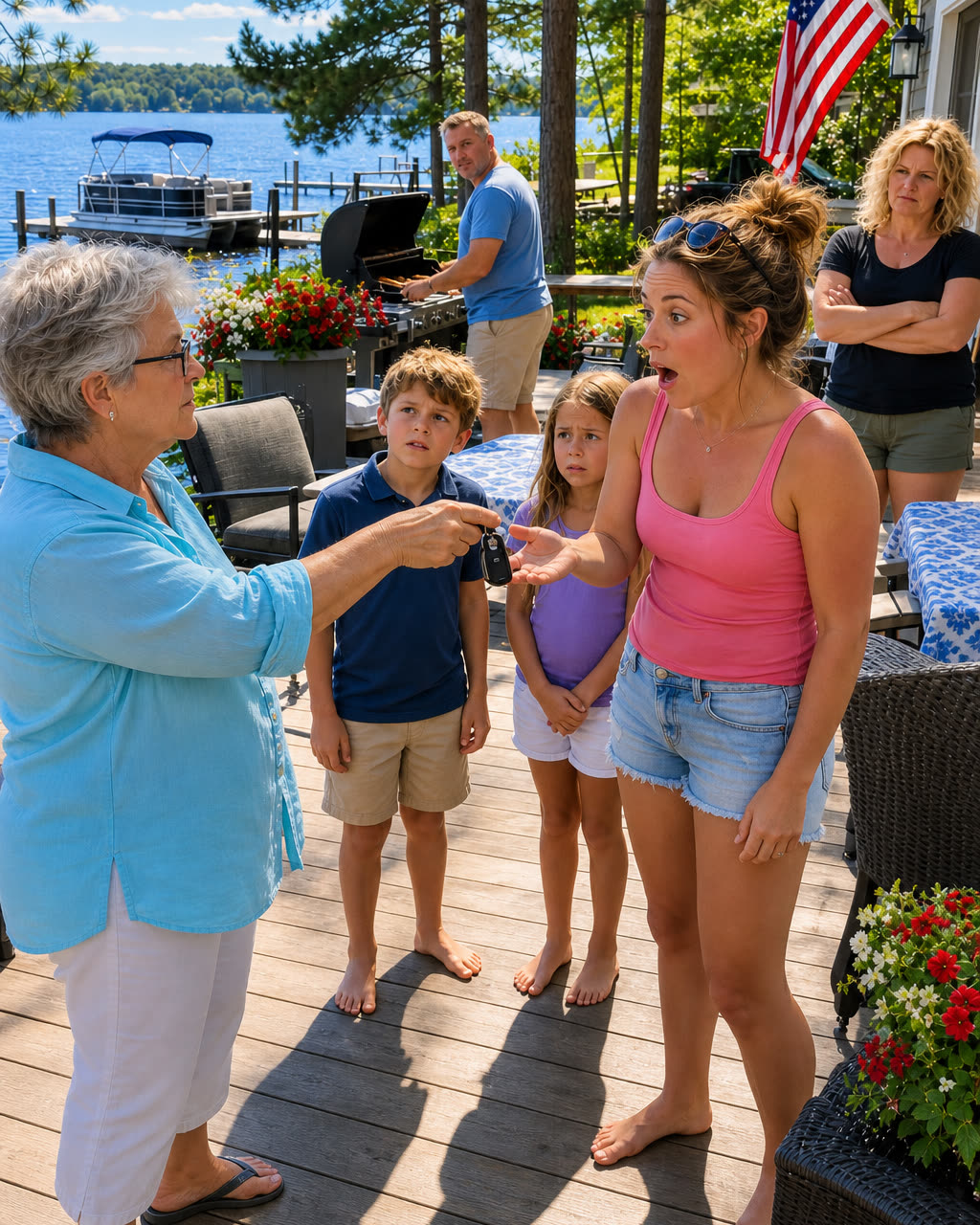
When I turned onto the gravel road that led to my lake cabin, there were four cars parked in my driveway. I eased off the gas. Then I stopped altogether at the bottom of the hill, my foot pressed on the brake and my fingers clenched around the wheel.
“Mom?” Owen leaned forward from the back seat. “Whose cars are those?”
I didn’t answer. I was too busy taking it all in. Damp beach towels were draped over my porch railing like flags. Inflatable lake toys lay strewn across the lawn: a pink flamingo, a green alligator, an enormous slice of watermelon. Someone had hauled folding chairs into a ring around my firepit. And over my front door, right where my grandfather’s old carved sign had always hung, a new one had been put up.
It was a hand-painted board, white letters on blue. THE HOGANS. EST. 2024.
The trouble was simple. The cabin belonged to me.
I was thirty-eight years old and worked as a residential appraiser in Chicago, which means I spend my days walking through other people’s homes with a tape measure and a clipboard, deciding what they’re worth. I’m good at it. I notice things. That little place in northern Wisconsin had been in my name since 2019. My grandfather, Earl Lindqvist, had handed it over himself, with a lawyer, a notary and a recorded warranty deed. My mother knew that. My younger brother, Kyle, knew that. My father knew it too, because he had been sitting in the room when Grandpa signed.
I lifted my foot off the brake and rolled up the drive, parking behind a silver minivan with a Minnesota Twins sticker on the bumper and a red pickup I didn’t recognize. In the back, Poppy, my six-year-old, had her nose flattened against the window. “Is it a party?”
“I don’t know, sweetheart. Stay in the car one minute, okay?”
I climbed out. The air smelled of pine needles, sunscreen and lighter fluid, and somewhere down by the water a radio was playing country music. On my porch, in my favorite chair, the old green rocker my grandfather built with his own hands, sat my mother. Glenda Hogan held a glass of iced tea and had a magazine open in her lap. She looked up and saw me, and for one second her face went perfectly blank. Then she said, “What are you doing here?”
The screen door banged open and my brother wandered out barefoot, eating a red popsicle. I knew it came from my freezer, because I’d bought that box myself in May, on my last visit, and left it for the kids. Kyle was thirty-four and still had the soft, boyish face he’d had at twelve. He froze on the top step when he spotted me, the popsicle halfway to his mouth. His wife, Brandy, followed with a bag of chips, then their two kids, Mason and Kaylee, both damp from the lake, then Brandy’s parents, Ron and Cheryl, whom I’d met exactly twice, at Kyle’s wedding and at a christening. Last came my father. Dale Hogan, sixty-six, in his fishing hat with a can of beer in his hand. He glanced at me and then stared straight down at the porch boards. My whole family, settled in as if they’d been there all summer.
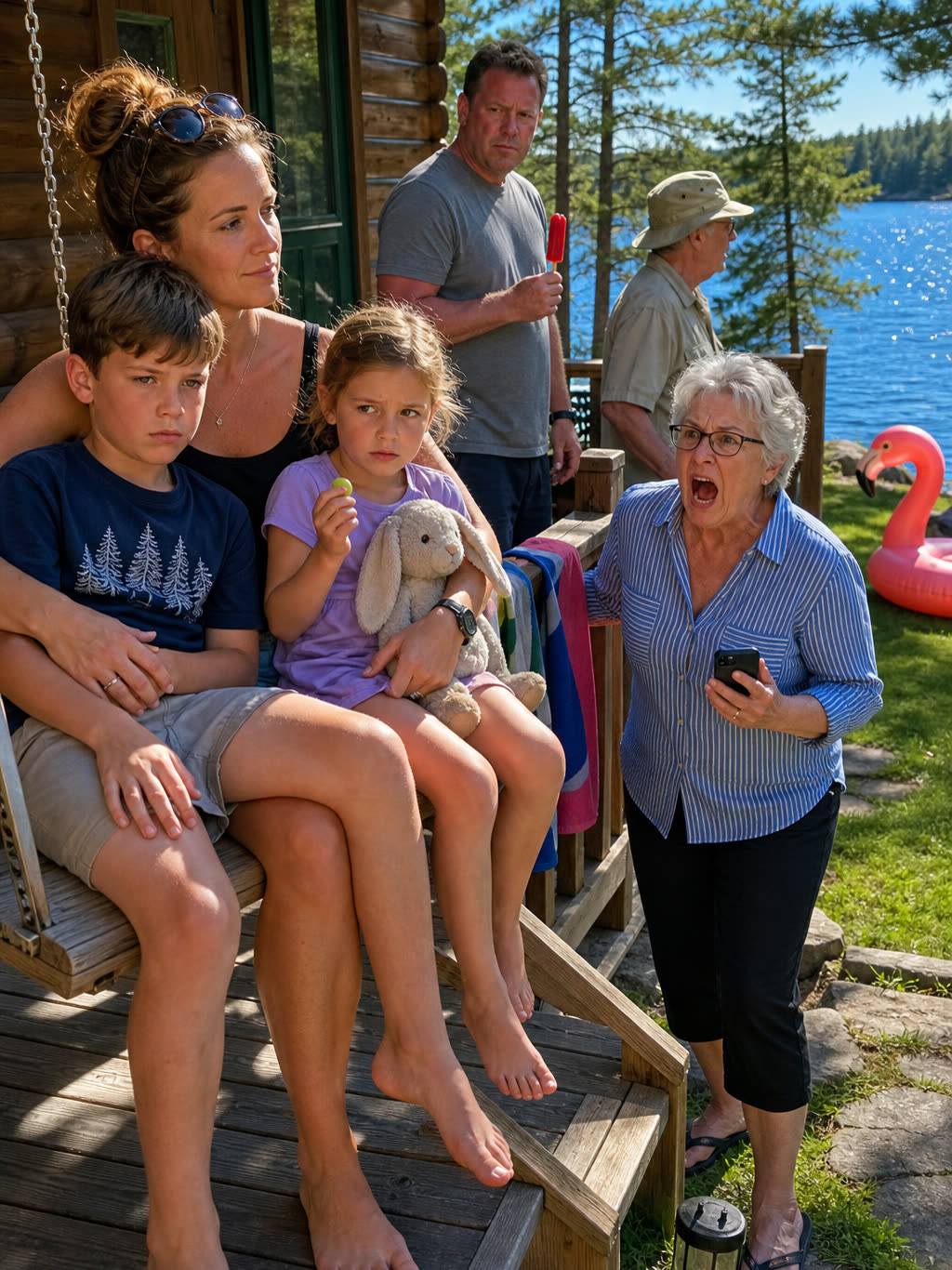
“Mom,” I said, “this is my cabin.” She put down her iced tea and rose slowly, then came down the steps toward me the way she used to walk up to me when I was a teenager who’d come home late. “We have guests,” she said. “Your brother’s family has been staying here since June.” “Since June?” “Don’t use that tone with me, Heidi. Kyle needed a place. And you weren’t using it.” I looked past her at my brother, who was studying his popsicle as if the answers were printed on the stick.
I had driven four hours to get there. We’d left Chicago at eight that morning, me, nine-year-old Owen and Poppy, with a trunk full of groceries, life jackets, a cooler and a brown paper bag of sparklers. For weeks the kids had talked about nothing else. The dock. The loons. The sparklers. Owen had written a list on the back of his spelling homework of every fish he meant to catch. Poppy wanted the top bunk in the little back room that Grandpa Earl built when I was nine. It was supposed to be a quiet Fourth of July, our first real vacation since the divorce. Instead strangers’ cars crowded my driveway and my family stood on my porch as if I were the one who’d turned up uninvited.
“Everybody needs to pack up and leave,” I said.
My mother’s face tightened and her lips went thin. “You’d throw your own family out? On the Fourth of July?” “I didn’t invite anyone here.” Then she said the sentence that ended the conversation for me. “This is your brother’s home now. You’re the one who’s trespassing.”
“Trespassing,” I repeated. “You heard me.” “Mom. This is my property. My name is on the deed.” “It’s family property,” she snapped. “Your grandfather always meant for it to go to Kyle. Everybody knows that. You just happened to be the one he signed it to because Kyle was going through a hard time back then.” “That isn’t what the deed says.” Something flickered across her face for an instant, like a shadow crossing water. Then she dug her phone out of the back pocket of her capris. “Fine. I’m calling the police. I’ll have you and your kids removed.” Behind me a car door opened. Owen had climbed out, walked around to Poppy’s side, and helped her down, holding her hand so she wouldn’t slip on the gravel, just as I’d taught him. They came and stood beside me. Poppy dangled her stuffed rabbit by one ear. Owen was holding Poppy. “Mom,” he whispered, tugging my sleeve. “Is Grandma going to have us arrested?” That was when something in me went completely still. I could have yelled. I wanted to. I could have listed every last thing: the property taxes I paid each December, $3,840 last year; the new well pump in 2021; the roof patch; the summer I spent with Grandpa Earl scraping and staining every board of the porch she was standing on. I could have told her exactly what I knew. All of it. Instead I looked my mother in the eye. “Please do,” I said.
Her mouth fell open. On the porch, Kyle stopped chewing. Brandy looked from me to my mother and back again, and Ron and Cheryl traded a glance. My father took a long sip of beer and gazed at the lake. I took Owen’s hand, and Owen still had Poppy’s, and the three of us walked past my mother, past the folding chairs and the plastic flamingo, and up my own porch steps. Kyle stepped aside to let us pass. He actually stepped aside.
I sat down on the porch swing, and the chains creaked the same creak they’d made my whole childhood. Owen settled on one side of me and Poppy climbed up on the other. I pulled a bag of green grapes from my purse, opened it in my lap and said, “Here, have a snack.” Poppy took a grape. Owen didn’t; he kept watching his grandmother. Down in the driveway my mother stood with the phone at her ear, staring at me as though I’d lost my mind. She thought I was reckless. She thought I was bluffing. She had no idea that I’d spent the past three weeks preparing for exactly this moment.
Three weeks earlier I had been at my desk in Chicago, finishing an appraisal on a bungalow in Berwyn, when my phone lit up with a Wisconsin number I didn’t know. “Heidi? It’s Norm. Norm Brekke. From up at the lake.” Norm had been my grandfather’s neighbor for forty years. He was eighty-one and still split his own firewood, and Grandpa used to say he was the only man in Oneida County who could talk for an hour without using more than ten words. “Norm! Is everything okay?” There was a long pause, long even for Norm. “Well,” he said. “Don’t know. That’s why I’m calling.”
He told me a family had knocked on his door the Saturday before. Nice people from Minneapolis, he said, who wanted to know where to buy firewood. They were staying next door, at my cabin. “Said they paid nineteen hundred dollars for the week,” Norm told me. “Said the owner’s name was Kyle Hogan.” I couldn’t say anything. “Now I know Earl gave that place to you,” he went on. “I was at the house the day he signed it. So I figured either something changed that I don’t know about, or somebody ought to tell you.” “Nothing changed, Norm,” I said. My voice sounded strange in my own ears. “Thank you for calling me.” “Earl would want you to know,” he said, and hung up, because that was all he had to say.
I found the listing in under four minutes. I typed the name of the lake into a vacation rental site and there it was, third result down. The photos loaded one at a time, and with each one my stomach dropped a little further. My kitchen, with the yellow curtains my grandmother sewed. My dock at sunset. The back room with the bunk beds. Grandpa Earl’s stone fireplace, built from rocks he hauled up from the shore in a wheelbarrow one summer. The cabin had a new name: Pine Hollow Retreat. The listing said it slept fourteen, fourteen people, in a two-bedroom cabin with a bunk room and a pullout couch.
There were eleven completed stays and eleven five-star reviews. Absolutely magical. Our kids loved the dock! Host was so responsive, will be back next summer! So peaceful. You can feel the history in this place. At the bottom of the page sat a small round photo of my brother, smiling in sunglasses. I recognized it, because I’d taken that picture at Poppy’s fifth birthday party. Beneath it were the words: Hosted by Kyle, owner. I stared at that single word for a long time. Owner.
My first impulse was to call Kyle and scream. I actually picked up the phone, his name on the screen and my thumb hovering over the button. Then I thought about every argument I’d ever had with my family and how each one had ended the same way. Kyle would cry, or go quiet. My mother would call and say I was being cruel, that I’d always been jealous, that I had everything and he had nothing, and couldn’t I let it go for once in my life. And somehow, by the end, I’d be the one apologizing. So I set the phone down and called a real-estate attorney instead.
Marcela Tuttle had an office above a bakery in Rhinelander. I found her because she’d handled the closing on Norm’s daughter’s house years earlier, and Norm said she was “sharp,” which from Norm was practically a poem. She called me back within the hour and listened without interrupting while I laid everything out. “Okay,” she said afterward. “First question. Is there anything, anything at all, in writing that gives your brother permission to use the property? A lease? An email? A text that says sure, go ahead?” “No. Nothing. I didn’t even know they were there.” “Second question. Has he ever paid you for using it?” “Not a dollar.” “Third question.” She paused. “Do you want your family back after this? Or do you just want your cabin back?” Nobody had ever asked me that. “I don’t know,” I admitted. “That’s honest,” she said.
“Here’s my advice. Don’t confront anybody yet. Don’t call him. Don’t call your mother. Preserve everything. Screenshots of the listing, every review, every photo, the booking calendar. If you can find out where the money’s going, even better.” “And then what?” “And then we wait,” Marcela said. “Give people enough time and enough rope, and they almost always explain themselves.” So that’s what I did. Every night after the kids were asleep, I sat at my kitchen table with my laptop and a cup of tea and documented my own family like a case file. I captured the listing daily. I watched the calendar fill, two more bookings in the first week, one for late July and one for mid-August. I saved every review and the house rules Kyle had written: No smoking. No pets. Please respect our family home. Our family home.
I sent an inquiry from an old email address I never used, asking about Labor Day, and Kyle answered within twenty minutes. Hi there! Sorry, we’re booked for Labor Day, but we have availability the week after at a discounted rate of $1,600. Our family has owned this cabin for three generations and we love sharing it! Payment is through the site, or I can do Venmo directly for a 5% discount. Let me know! Kyle. I read the line about three generations five times and then forwarded it to Marcela. She wrote back a single word: Perfect.
The next step was harder. Marcela asked whether I knew anyone who’d stayed there, so I combed the reviews and found a woman named Lisa from Eau Claire who had written a long, warm one in May. Her profile linked to a small business page. I sent a careful, polite message explaining that I was the legal owner and asking if she’d be willing to share how she paid. I didn’t expect a reply, but the next morning one came. Oh my goodness. I’m so sorry. We paid through the site for the first part, but Kyle asked if we could pay the cleaning fee and the “boat rental” directly. I sent it to a Venmo account. Here’s the screenshot. The screenshot showed $340 sent to an account named @Glenda-Hogan-WI.
My mother’s account. I sat at my kitchen table holding my phone for a very long time. The tea went cold. The refrigerator hummed, and down the hall Poppy talked in her sleep. For the first few days I’d told myself that maybe my mother didn’t know, that Kyle had done this alone and she was just a mother protecting a son in over his head. But the money was going to her. Not all of it, but some. She knew. She had known the whole time.
By the end of three weeks, Marcela had a folder. It held the recorded warranty deed from 2019, five straight years of Oneida County property tax receipts in my name, screenshots of the listing, the calendar and all eleven reviews, Kyle’s email offering me my own cabin for $1,600, and Lisa’s Venmo screenshot. It also held a spreadsheet I’d built myself, the way I would for any appraisal, estimating what the eleven completed bookings had brought in from the nightly rates and cleaning fees on the site. The total came to $23,400. Twenty-three thousand, four hundred dollars, from my cabin, in a single summer.
“What do you want to do?” Marcela asked on the phone. “I’m going up for the Fourth,” I said. “Like I always do. With my kids.” “And if they’re there?” “Then I want you and a deputy there too.” “I can’t promise a deputy,” she said. “But if somebody calls the sheriff, they’ll come. And if they come, I’ll be right behind them.” “Somebody’s going to call,” I said. “I know my mother.”
Back on the porch swing, I watched her make that call. She walked down toward the water so we couldn’t hear, but she talked with her hands the way she always did when she was angry, and every so often she turned and pointed up at the porch. At me. Owen ate one grape, then another. Poppy was already on her sixth. “Mom,” Owen said quietly. “Are you scared?” “No, buddy.” “Why not?” I thought of the folder riding in Marcela’s car somewhere on Highway 17, heading this way. “Because I didn’t do anything wrong,” I said. “And when you haven’t done anything wrong, you can sit and wait.” He considered that, nodded slowly, and leaned his head against my arm.
My mother finished and marched back up the lawn. “They’re on their way,” she announced. “So you can stop this whole act right now. Pack up your kids and go, and I won’t press anything.” “We’ll wait,” I said. She stared at me, then turned on her heel and went inside, and the screen door slapped shut behind her.
The first hour crawled. Ron and Cheryl took Mason and Kaylee down to the dock, and I heard Cheryl say, too loudly, “Let’s just give the grown-ups some space.” Ron kept glancing back at the porch as if trying to work out which side of a fight he’d landed on. Brandy stood at the grill flipping hot dogs that were already burned. She was tall, with a sunburned nose and a ponytail, and I’d always liked her the few times we’d met. She laughed easily, and she had mailed me a real card when my divorce was final, which no one else in my family did. Every so often she looked at me, then at Kyle, then back at the grill. My father sat in a camp chair at the edge of the lawn with a fishing rod across his knees that he wasn’t using, looking at no one. Kyle vanished into the cabin, and through the window I could hear his voice low and fast, and my mother’s lower and faster.
At one point Poppy said, “I have to go potty.” I took her inside, and I walked through my own front door for the first time that summer. It smelled different. It used to smell of cedar and woodsmoke and the lemon oil Grandpa rubbed into the table. Now it smelled of plug-in air freshener, something called Ocean Breeze according to the little white box by the door. The yellow curtains were gone, replaced by cheap gray ones from a big box store. Grandma’s quilt was missing from the couch. The framed photo of Grandpa Earl holding a giant muskie, the one that always hung over the fireplace, had been swapped for a canvas print that said GATHER in curly letters. On the kitchen counter lay a laminated sheet: WELCOME TO PINE HOLLOW RETREAT! WIFI PASSWORD: LAKELIFE2024.
While Poppy was in the bathroom I opened the hall closet. Grandpa’s things were shoved in the back, behind a vacuum cleaner and a box of toilet paper. His muskie photo, face to the wall. Grandma’s quilt, folded inside a garbage bag. And the old carved wooden sign that had hung over the front door, the one that said LINDQVIST in letters Grandpa cut himself with a jigsaw in 1974. I stood and touched the letters with my fingertips. The wood was smooth and warm. “Mama?” Poppy had come out. “What’s that?” “That’s your great-grandpa’s name,” I said. “He made it.” “Why’s it in the closet?” I didn’t answer. I shut the door gently, the way you close a door on someone sleeping.
When I turned around, Kyle was standing at the end of the hallway. We looked at each other. “Heidi,” he said, his voice quiet. “Can we just talk? Like, just us?” “We could have talked anytime in the last three months,” I said. “I know. I know. It’s not what you think.” “What do I think, Kyle?” He opened his mouth and closed it. He rubbed the back of his neck, the way he used to when he was a little boy who’d broken something. “Just… don’t do this in front of Brandy,” he said at last. “Please. I’m begging you.”
That was the first moment I understood there was something here I didn’t know yet. Something that wasn’t in Marcela’s folder. “Come on, Poppy,” I said, taking her hand, and I walked past my brother, out the front door and back to the swing, with the sound of tires still somewhere in my future and a question I couldn’t shake: what exactly was my brother so afraid his wife would hear?
The Deputy, the Deed and Brandy’s Question
The second hour was worse than the first. My mother’s anger began to change shape. At first she’d been loud, stomping around and slamming the screen door. Now she went quiet. She and Kyle stood together at the far end of the porch with their heads close, whispering. Now and then Kyle said something and she shook her head hard. Once she grabbed his arm, and he pulled it away.
Brandy abandoned the grill and walked down to the dock where her kids were. She sat on the end with her feet in the water and her back to the cabin. Cheryl went and sat beside her and said something, but Brandy didn’t answer. Owen fell asleep against my arm. Poppy colored in a little notebook from my purse, drawing the lake, a loon, a sun wearing sunglasses.
My father rose from his camp chair, walked slowly up the lawn and stopped at the bottom of the porch steps. “Heidi,” he said. “Hi, Dad.” He took off his fishing hat and held it in both hands. “I told her,” he said. “Back in June. I told her this was a bad idea.” “But you came anyway.” He looked at the ground. “She’s my wife.” “And I’m your daughter.”
He had nothing to say to that. He just stood with his hat in his hands, sixty-six years old, looking like a man who’d forgotten how to be anything except quiet. “You were there,” I said. “When Grandpa signed the deed. You sat at his kitchen table. You were a witness. Your name is on the notary log.” “I know.” “So you knew. This whole time. Every week they rented it out, you knew whose it was.” He nodded once. Then he put his hat back on, walked down to the water, stood beside Ron, and didn’t say another word.
At ten to five my mother came back to the swing and stood in front of me with her arms crossed. “This is ridiculous,” she said. “They’re obviously not coming. It’s a holiday. You’re just sitting here to humiliate me.” “Then call them back,” I said. “I don’t have to. You can leave. Right now. And we’ll pretend this never happened.” “I’m not leaving my own cabin, Mom.”
“It is not your cabin!” Her voice cracked like a whip, and down on the dock everyone turned around. “Earl was my father! Mine! Not yours! He built this place for his family, and Kyle is his family, and Kyle has nothing. Do you understand me? Nothing. And you have everything. You have your big job and your condo in Chicago and you come up here, what, three weekends a year? And you won’t share?”
Owen woke and sat very still, watching his grandmother. “Mom,” I said quietly. “You’re scaring the kids.” She looked down at Owen, then at Poppy, who held her crayon frozen in midair, and for a second something in her face softened. Then she turned away and went back inside.
At 5:12 p.m. I heard tires on the gravel. My mother burst onto the porch so fast the screen door hit the wall. She smoothed her blouse and put on the face she wore to church. “There,” she said, without looking at me. “Now you’ll see.”
A white sedan rounded the last curve of the drive first, clean and plain, the kind of car that doesn’t want to be noticed. Behind it came a brown and tan cruiser with a light bar on the roof and gold letters on the door: ONEIDA COUNTY SHERIFF’S OFFICE.
The sedan stopped and the door opened, and Marcela Tuttle stepped out. She was a small woman in her fifties with short gray hair and reading glasses pushed up on her head, wearing a navy blazer though it was eighty-two degrees, a thick leather folder tucked under one arm. She looked up at the porch, found me, and gave one small nod. That was all, but it was enough. The deputy climbed out of the cruiser behind her, young, maybe thirty, with a sunburned neck and a calm, careful way of moving. His name tag said HALVERSON.
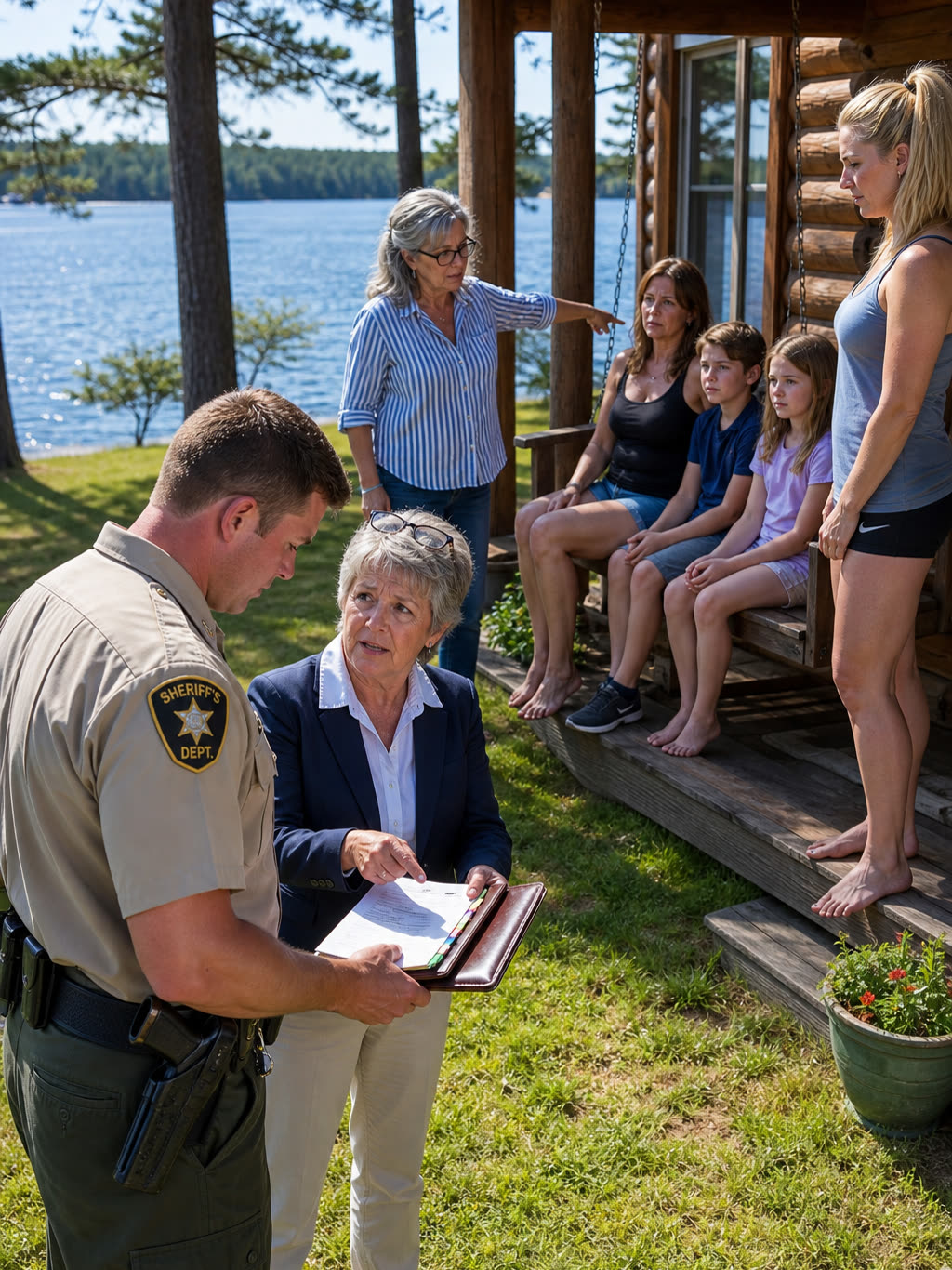
My mother hurried down the steps before he’d crossed half the lawn. “Officer! Thank you for coming. That woman,” she pointed straight at me, “is trespassing on my son’s property. She showed up today without any warning and she refuses to leave. She’s frightening everyone.” Deputy Halverson stopped and didn’t answer right away. He looked at the cabin. He looked at the four cars in the drive, the wet towels on the railing, the plastic flamingo on the grass. He looked up at the hand-painted sign over the door. THE HOGANS. EST. 2024. Then he looked at me, sitting on the swing with a sleepy nine-year-old and a six-year-old holding a crayon.
“Ma’am,” he said politely to my mother. “Before I take any kind of action here, I need to establish who owns this property.” “My son does,” she said at once. “Kyle Hogan.” The deputy turned toward the porch. Kyle stood by the door in sandals he must have put on at some point, his face the color of skim milk. “Sir,” Halverson said. “Is that correct? Are you the owner of this property?” Kyle opened his mouth. Nothing came out.
Marcela stepped forward. “Deputy, I’m Marcela Tuttle. I’m an attorney in Rhinelander, and I represent Heidi Strand.” She nodded up at me. “I have the recorded ownership documents right here.” She opened her leather folder, thick with papers divided by colored plastic tabs, red, blue, green, yellow, and pulled a document from the very front. “This is a certified copy of the warranty deed, recorded with the Oneida County Register of Deeds on August 14, 2019. Grantor, Earl Lindqvist. Grantee, Heidi Hogan Strand. It’s the current deed of record. There have been no transfers since.”
The deputy took the paper and read it carefully, line by line, the way a careful person reads something that matters. Nobody on that lawn made a sound. Even the radio by the dock had been switched off at some point. He looked up from the deed, at me, then at my mother. “Ma’am,” he said gently. “According to this recorded deed, this property belongs solely to your daughter.”
For the first time all afternoon, my mother had no answer. She just stood on the grass in her nice blouse with her mouth slightly open and a hand rising to her throat. “That’s just a piece of paper,” she said finally, but her voice was thin. “My father meant for Kyle to have it. Everybody knows that.” “Ma’am, I can only go by what’s on record,” the deputy said. “If there’s a dispute about what your father intended, that’s for a civil court. But as far as I’m concerned, right now, Ms. Strand is the property owner. She has every right to be here.”
The real shift didn’t come from my mother, though. It came from the porch. Marcela flipped to the red tab and drew out a stack of printed pages, the listing, the reviews, the photo of Kyle in his sunglasses. She said nothing, just handed them over. The deputy paged through them slowly. Pine Hollow Retreat. Sleeps 14. Hosted by Kyle, owner. He looked up at the cabin, then down at the photos, as if checking that they matched. They did. Then he turned to my brother. “Mr. Hogan. Have you been accepting payments from guests to stay at this address?”
Kyle’s face changed. It didn’t go red, the way it used to when we were kids and he got caught. It went gray. He looked like someone who’d been holding his breath for three months and had just run out of air. Before he could answer, Brandy stepped onto the bottom porch step. I hadn’t even seen her come up from the dock. She was barefoot, her wet feet leaving dark prints on the wood. “Kyle,” she said quietly. “You told me Grandpa Earl left this place to you.” And suddenly my brother wasn’t looking at me anymore. He was looking at his wife.
“Brandy,” Kyle said. “Babe. Can we talk about this inside?” “No,” she said. “We can talk about it right here.” Her voice wasn’t loud, and that was what made it frightening. It was low and flat, the way a person talks when they’ve stopped expecting good news. “You told me in May,” she said. “You sat me down at the kitchen table. You said your grandpa left you the lake cabin in his will, and that your mom had been holding onto the paperwork until the estate settled. You said it was ours. You said we could sell the house and move up here for the summer and figure things out.” “I know what I said.” “You said we could rent it out to cover the bills.” She pointed at the papers in the deputy’s hand. “You said it was legal. You said it was our property.” “Brandy…” “Was it ever ours, Kyle?” He didn’t answer.
She looked up at me then, right at me. Her eyes were wet, but she wasn’t crying. “Heidi. Did your grandfather leave this cabin to Kyle?” “No,” I said. “He gave it to me. Five years ago. Kyle was at the house the week after. He knew.” Brandy closed her eyes. Deputy Halverson cleared his throat like a man who’d walked into the wrong room at a party and was trying hard to be polite about it. “Mr. Hogan, I’ll ask one more time. Have you been accepting payment from people to stay at this property?” Kyle glanced at my mother, a small, quick look, but everyone saw it. I think that was the moment my mother realized she couldn’t fix this. “Yes,” Kyle said, his voice hoarse. “Since April.” “And did the property owner give you permission to do that?” Kyle’s eyes slid to me, then down to his sandals. “No, sir.”
The deputy nodded slowly and wrote in a small notebook. “All right. Here’s where we are. Nobody’s getting arrested today.” He looked at my mother as he said it. “Ms. Strand is the owner. She’s not trespassing. Anybody who’s here is here because she lets them be here. And if she asks you to leave, you need to leave.” “And the money?” Marcela asked. “The money’s a different question,” he said. “That might be a civil matter or it might be something for the district attorney to look at. That’s not my call tonight. But I’m going to write a report, and I’ll note everything I saw and everything Mr. Hogan just told me.” He looked at Kyle. “I’d strongly suggest you talk to a lawyer, sir.”
That was when my mother found her voice again. “This is unbelievable,” she said, rounding on me. “You set this up. You planned this whole thing. You let us stay here for weeks so you could ambush your own brother in front of his wife and kids. What kind of person does that?” “Mom,” I said. “I didn’t let you stay here. I didn’t know you were here until three weeks ago.” “Then you should have called! You should have called your own mother!” “And what would you have said?” She stopped. “What would you have said, Mom? If I called you three weeks ago and said, Kyle’s renting out my cabin. What would you have told me?” She didn’t answer, but we both knew. She would have said I was imagining things. That I was jealous. That I was overreacting. That family shares. And then she would have called Kyle and told him to take the listing down for a week, just long enough for me to stop looking.
Marcela turned to the yellow tab and drew out a single sheet, a screenshot. “Mrs. Hogan,” she said, very politely. “Is this your Venmo account?” She held up the page: three hundred and forty dollars, from Lisa in Eau Claire, to @Glenda-Hogan-WI. Memo line: Boat rental + cleaning. My mother looked at the paper. Then she looked at my father, who stood at the bottom of the lawn with his fishing hat in his hands. Then she sat down hard on the porch steps, as if her legs had simply stopped holding her up.
The deputy left around six. He gave me his card and told me to call if anything changed. He also told Kyle, very clearly, to take the listing off the website that night. “Today,” he said. “Not tomorrow.” Kyle nodded without looking up. Marcela stayed, sitting with me on the porch while the kids played in the grass with Mason and Kaylee. Children are strange that way. Thirty minutes earlier everyone had stood in a circle while a deputy read a deed, and now four cousins were trying to catch a frog together as if nothing had happened.
“What do you want to do tonight?” Marcela asked. I looked at Brandy’s minivan, the folding chairs, Ron and Cheryl quietly loading suitcases into the red pickup. They’d said almost nothing all afternoon. I think they were embarrassed. I think they’d come for a nice holiday weekend at their son-in-law’s family cabin and learned it wasn’t his. “I want them gone,” I said. “But not tonight.” Marcela raised her eyebrows. “Their kids are seven and ten. It’s almost dark. It’s a holiday. It’s three and a half hours back to Wausau.” I watched Kaylee hold up the frog for Poppy. “I’m not going to put two kids in a car at night because their dad’s a liar.” “That’s generous.” “It’s not for him.” Marcela nodded and closed her folder. “I’ll draft something tonight. A written notice revoking permission to be on the property, effective tomorrow at noon. So it’s on paper.” “Thank you.” “And Heidi? The bookings for the rest of the summer. There are people who’ve paid for weeks that aren’t going to happen. We need to deal with that fast. Those families are going to drive up here.” I hadn’t thought of that: strangers with kids and coolers pulling into my driveway expecting Pine Hollow Retreat. “We’ll deal with it,” I said.
My mother left at seven, my father driving. She didn’t say goodbye. She walked past me on the porch without looking, then turned at the bottom of the steps. “Your grandfather would be ashamed of you,” she said. I didn’t answer. I just looked at her. She got in the car. My father stood beside the driver’s door a moment, gazing up at me, his mouth opening as though he wanted to speak. Then he got in and drove away. I stood on the porch and watched the dust settle on the gravel road. I’d expected victory, maybe, or relief. Mostly I felt tired, the kind of tired that sits in your bones. Owen came up and took my hand. “Is Grandma coming back?” “Not tonight, buddy.” He nodded. “Good,” he said quietly, then looked scared that he’d said it. I squeezed his hand. “It’s okay to feel how you feel.”
At nine o’clock, with the kids asleep, I sat at the kitchen table with a cup of coffee. Grandpa Earl’s table, made from a single slab of white pine, with burn marks from his pipe and a dent in one corner where I’d dropped a cast iron pan at eleven. Somebody had laid a plastic tablecloth over it. I took it off, folded it and dropped it in the trash. The screen door creaked. Brandy stood there in a sweatshirt holding two bottles of beer, and she offered me one. “Can I sit?” “It’s your last night,” I said. “Sit.” She sat across from me and turned her bottle slowly on the table. For a long while neither of us spoke. A loon called out on the lake, that long, lonely sound. Grandpa used to say a loon sounded like somebody missing somebody.
“We lost the house,” Brandy said at last. I looked up. “In Wausau. In March. Kyle told me in February that we were behind on the mortgage. Just a couple of months, he said. He said he’d handle it.” She sipped her beer. “He didn’t handle it. It turned out to be nine months. The bank started foreclosure. I found the letters in his truck.” “Brandy. I’m sorry.” “He’d been gambling. Online. Sports betting, mostly. He promised me he stopped. He said he was going to fix everything.” She laughed, short and sad. “And then in May he comes home and tells me his grandpa left him a lake cabin. Like a miracle. Like God himself dropped it in his lap.” “And you believed him.” “I wanted to believe him. I’m not stupid, Heidi. I wanted to so bad that I didn’t ask any questions.” She wiped her eyes on her sleeve. “Your mom backed him up. She said she had the paperwork and was handling the estate. She said you’d been given money when your grandpa died, and that the cabin was Kyle’s share. So it’d be fair.”
I set my coffee down. “I wasn’t given any money,” I said. “Grandpa didn’t have any money. He had a pension and this cabin. He gave me the cabin five years ago, while he was alive, because he wanted to.” “Why you?” Brandy asked. She didn’t say it meanly. She truly wanted to know. I thought about that. “Wait here,” I said. I went out to my car and opened the glove box and took out a manila envelope I’d carried with me every time I came to the lake for five years. I never knew why. It just felt right to keep it close. I came back in and set it on the table between us. “Grandpa gave me this the day he signed the deed,” I said. “He told me to read it if anybody ever asked why.”
I slid out a single sheet, a letter written by hand in blue ink in Grandpa Earl’s square, careful printing, the paper soft from being folded and unfolded. I hadn’t read it in three years, and my hands shook a little as I flattened it. “Can I?” Brandy asked. I turned it around and pushed it across. She read it aloud, her voice quiet and a little shaky at the start, then steady. Heidi, If you’re reading this, somebody probably asked why I gave you the cabin. I figured they would. So here it is, plain. I didn’t give it to you because I love you more than your brother. I love you both the same. I always will. I gave it to you because you’re the one who showed up. Every summer since you were nine, you came up here and you worked. You scraped that porch. You helped me haul those rocks for the fireplace. You learned how to fix the pump. When your grandma was dying, you came up every weekend for four months and sat with her so I could sleep. Kyle is a good boy with a good heart. But that boy has never held onto anything in his life. Not money, not a job, not a car. Your mother has spent thirty years catching him every time he falls, and she’ll keep doing it until she can’t. If I give him this cabin, it’ll be sold inside of five years. I know it, and I think deep down he knows it too. So I’m giving it to you. Not to keep from him. To keep for him. And for your kids, and his kids. Somebody’s got to hold onto it, so it’s still here when they need it. Be fair. Be kind. But don’t be a fool. Love doesn’t mean letting people take what isn’t theirs. The loons will still be here. So will I, in a way. Grandpa
When Brandy finished, neither of us spoke for a long time. A moth bumped against the kitchen window. The refrigerator hummed. Out on the lake the loon called again. Brandy set the letter down carefully, like something fragile. “Your mom’s seen this?” “She’s seen it. Grandpa showed her. The same day.” “And she still told everyone he meant it for Kyle.” “She’s been saying it so long,” I said, “I think she believes it now.” Brandy pushed her beer aside and laid both hands flat on the table. “He took twenty-three thousand dollars,” she said. “From strangers. For your cabin. And I don’t have a dime of it. Do you know that? We’re living off my paycheck from the dental office. I asked him last week why we were so short when the cabin was booked every weekend. He said the cleaning fees and the taxes ate it all.” “Where did it go?” I asked. She shook her head. “I don’t know.” Then she looked up and her face hardened. “But I’m going to find out.”
She didn’t sleep in the cabin that night. She took her pillow out to the minivan and slept in the back seat with the windows cracked. I watched her through the kitchen window. Kyle came onto the porch twice and stood looking at the van, but he never went to it. Around eleven he came back inside and found me still at the table. He looked at Grandpa’s letter lying between the beer bottles. He knew what it was. I could see it on his face. “I read it,” he said. “Back then. Mom showed me.” “I know.” “I hated you for it.” He lowered himself into the chair Brandy had left. “For years. I told myself you tricked him. That you got him when he was old and sick and made him sign it.” “He wasn’t sick, Kyle. He was eighty-one and sharper than both of us.” “I know.” He rubbed his eyes with the heels of his hands. “I know that.” “Where’s the money?” I asked. He was quiet for a long time. “Most of it’s gone,” he said.
Sparklers, Sawdust and a Mother on the Porch
He told me everything that night, or at least more than he’d ever told anyone. He’d started betting on sports three years earlier, small at first, twenty dollars on a Packers game, fifty on the playoffs. Then he won $2,800 on a parlay one Sunday, and he said it felt like the world had finally decided to be fair to him. After that he spent two years chasing that Sunday. “I lost the house money,” he said. “The mortgage money. I’d pay one month and bet the next one, thinking I’d win it back double. I never won it back.”
The cabin had been my mother’s idea. She learned about the foreclosure in April when Kyle came to her crying, and she was the one who said Heidi barely uses it. She was the one who said we’ll rent it out, just for one summer, just until you get on your feet, and she’ll never even know. “She set up the listing,” Kyle said. “She wrote the descriptions. She picked the name. Pine Hollow. She said it sounded classy.” “And the Venmo?” “Cleaning fees and extras went to her account. She said it would look less suspicious than everything going to mine.” He laughed, a terrible, hollow sound. “She was keeping some to pay the property taxes. Your property taxes. She said if we paid them, it would be like we had a claim.”
Of course. That was my mother. From the start she’d planned to build a case, a story in which Kyle had paid taxes and fixed things and lived there, and after a few years maybe a judge would see it her way. Except I’d paid the taxes every December on the dot. The county never needed her money. “And the rest?” I asked. Kyle looked at the table. “I bet it,” he said. “Some of it. I tried to win back the house.” His voice broke. “I thought if I could just win back the house, I could tell Brandy the truth, and we’d move home, and you’d never know, and Mom would stop looking at me like I was a broken thing she has to keep gluing back together.”
He put his face in his hands. My little brother, thirty-four years old, crying at Grandpa’s kitchen table. I wanted to be angry, and I was. But I also remembered him at six, trailing me down to the dock with his fishing pole, wanting so badly to catch something bigger than mine. “Kyle,” I said. “How much is left?” “About four thousand. In the account Mom set up.” “And there are two more bookings. July and August.” He nodded without lifting his head. “Those families paid deposits,” I said. “Through the site and through Venmo. They’re going to show up here, Kyle. With their kids. Thinking they have a vacation.” “I know.”
“So here’s what’s going to happen,” I said. “Tomorrow, before you leave, you’re going to sit here with me and Marcela. You’re going to cancel every future booking and refund every single dollar to those families. Today. Not next week. Whatever the site doesn’t cover, you’ll pay back out of that four thousand.” He nodded. “And then you’re going to sign a paper. Marcela’s going to write it up. You’ll agree to pay back the rest. To me. Every month, until it’s done.” “Twenty-three thousand,” he whispered. “Heidi, I can’t.” “You can’t all at once,” I said. “But you can a little at a time. That’s how most people do hard things.” He looked up, eyes red. “And if I don’t sign?” “Then Marcela gives the deputy’s report to the district attorney,” I said, “and I’ll let them decide.” I didn’t say it to scare him. I said it because it was true, and for once in his life somebody was telling him the truth before it was too late.
Marcela came back the next morning at nine. She sat at the kitchen table with her laptop and a small portable printer and drafted a promissory note while Kyle watched. He would repay $23,400 at $300 a month, interest free, starting August first. If he missed three payments in a row, the whole balance became due and I could take it to court. She also wrote a separate page in which Kyle acknowledged that he had no ownership interest in the cabin, never had, and would not claim one in the future. “Sign here,” she said. “And here. And initial each page.” Kyle signed, his hand shaking so badly that his K looked like a broken fence.
Then he logged into the rental site with Marcela watching over his shoulder and canceled the July and August bookings. He wrote to both families himself and told them the truth: that the listing had been posted without the owner’s permission, that he was deeply sorry, and that they would receive a full refund. One family answered within the hour, a mother from Duluth. She said it was a shame, that her kids had been so excited, and that she hoped he’d learn something. Kyle read the message out loud, then closed the laptop and sat there a long time.
Afterward Marcela told me the rental site would likely ban the account and might report it. She also raised something I hadn’t considered. “Your homeowner’s policy. I’d call your agent Monday. Most standard policies exclude short-term rental activity. If one of those guests had gotten hurt on that dock, the insurance company might have denied the claim. You could have been personally liable. Eleven bookings, up to fourteen people each, three months.” I felt cold. I pictured all those children racing down my dock and leaping off the end into the lake, fourteen people in a cabin built for six. “Nothing happened,” I said. “Nothing happened,” she agreed. “This time. And Oneida County has a room tax on short-term rentals. If the town comes looking for unpaid room tax on those stays, it’ll come to the owner first.” “So I might owe taxes on money I never saw.” “Possibly. I’ll handle it. We’ll show them the deputy’s report and Kyle’s signed statement. They’ll know who ran the business.” She gave me a small smile. “This is what the colored tabs are for.”
They left at noon. Ron and Cheryl had gone early that morning, quietly, but Cheryl came to the porch first and shook my hand, holding it a long time. “I’m sorry,” she said. “We didn’t know. We thought we were his guests.” “I know,” I said. “It’s okay.” Brandy packed the minivan by herself. When Kyle tried to help, carrying a cooler down the steps, she took it from his hands without a word and put it in the back. Mason and Kaylee hugged Owen and Poppy goodbye, and Kaylee handed Poppy the green inflatable alligator. “You can keep him. His name is Gary.” Poppy hugged Gary so hard he squeaked.
Just before she climbed into the van, Brandy came up the porch steps one more time. “I’m going to my sister’s in Stevens Point,” she said quietly. “With the kids. For a while.” “And Kyle?” “Kyle’s going to find out what it’s like to live with your mom again. Full time.” The smallest smile touched her mouth, then faded. “I’m not leaving him forever, Heidi. I don’t think. But he needs to get help. Real help. A meeting, a counselor, something. Not another miracle cabin.” “For what it’s worth,” I said, “I hope he does.” She nodded and looked at the lake a long moment. “Your grandpa sounds like he was a good man.” “He was the best man I ever knew.” “He was right,” she said. “About you holding onto it.” She went down the steps, got in the van and drove off, her kids waving from the back window until they were out of sight.
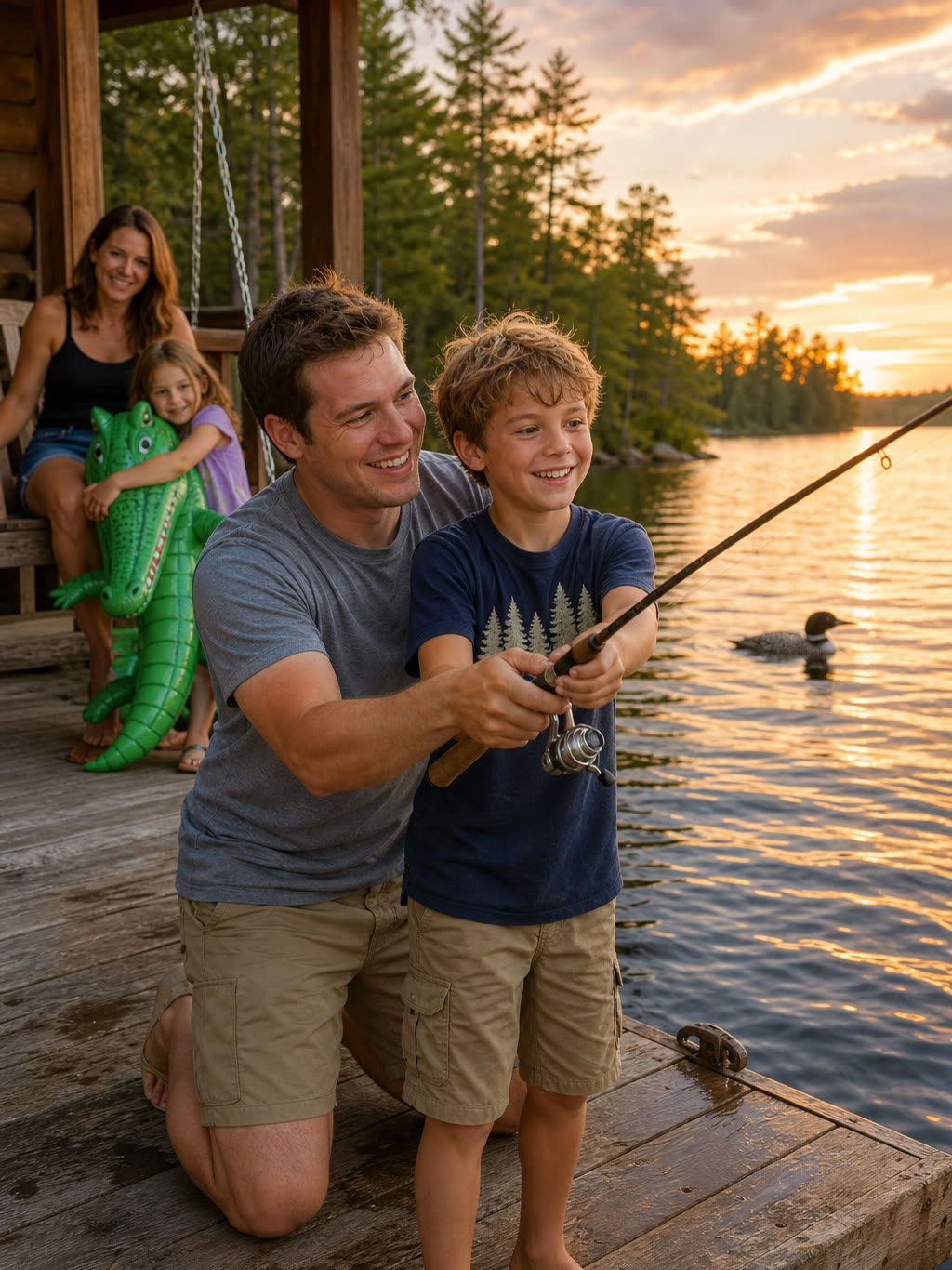
Kyle left last. He stood at the bottom of the steps with his duffel bag over his shoulder, waiting for my father to come get him, since Dad had said he’d be there by one. “Can I wait on the porch?” “It’s your grandfather’s porch,” I said. “Sit.” He sat on the top step and I sat on the swing. We didn’t speak for a while. Then Owen came out with his fishing rod and studied his uncle carefully. “Uncle Kyle,” he said. “Do you want to fish?” Kyle looked up, and something broke open in his face. “Yeah, buddy,” he said. “Yeah. I’d like that.” They went down to the dock together while I watched from the swing. Owen baited his own hook, the way Grandpa taught me and I taught him, and Kyle showed him how to cast sidearm so the line went out flat across the water.
I didn’t know whether Kyle would keep his promise. I didn’t know if he’d make a single payment, if Brandy would ever come back to him, or if my mother would ever speak to me again. But I knew my son was learning to cast sidearm from his uncle on Grandpa Earl’s dock, and for that one hour it felt like enough. When my father’s car came up the gravel road, Kyle walked up from the dock and picked up his duffel. He paused beside the swing. “I’ll pay it back,” he said. “All of it.” “I know you will,” I said, though I didn’t know.
He looked up at the hand-painted sign over the door. THE HOGANS. EST. 2024. “I made that,” he said. “In May. I thought…” He shook his head. “I don’t know what I thought.” He reached up and took it down himself. It came off easily, held by only two nails. Underneath, on the cedar siding, were four old screw holes and a pale rectangle where the wood hadn’t weathered, the shape of something that had hung there for fifty years. Kyle stared at it. “Grandpa’s sign,” he said quietly. “Where’s Grandpa’s sign?” “In the hall closet,” I said. “Behind the vacuum.” He closed his eyes, tucked the Hogan sign under his arm and walked to my father’s car without another word.
My father didn’t get out. He rolled down the window and looked up at me. “Heidi.” “Dad.” “Your mother’s very upset.” “I know.” He looked at the steering wheel. “I should have stopped it. Back in June. I should have said something.” “Yes,” I said. “You should have.” He nodded, and that was all. He rolled the window up and drove away with my brother beside him.
That evening I took Grandpa’s toolbox out of the shed. Owen held the stepladder steady and Poppy cradled the screws in her cupped hands like jewels. I climbed up and held the old carved sign against the pale rectangle, and the four holes lined up perfectly. LINDQVIST. I screwed it back in one screw at a time, and it took me twenty minutes because my hands were shaking. When I climbed down, the three of us stood on the lawn and looked up at it. “What does it say?” Poppy asked. “It says this is Great-Grandpa’s place,” I said. “And now it’s ours. And someday it’ll be yours.” “And Mason’s and Kaylee’s?” Owen asked. I thought of Grandpa’s letter. Not to keep from him. To keep for him. “Yes,” I said. “Theirs too. If they need it.” That night we lit the sparklers on the dock, and the kids wrote their names in the dark in big glowing loops that faded the moment you looked at them. A loon called from the middle of the lake. Poppy asked if it was sad. Owen said no, it was just calling its family.
My mother didn’t speak to me for five months. She didn’t call on my birthday in August. She didn’t call on Owen’s birthday in September, though she did mail him a card with a twenty-dollar bill inside and no message. She didn’t call at Thanksgiving. I heard about her from my father, who started phoning me on Sunday afternoons, never when she was home, always from the bait shop parking lot or the hardware store. “She’s having a hard time,” he said once. “So am I, Dad.” “I know.” A long pause. “I know you are.” He told me Kyle had moved into their basement, found a job at a lumberyard in Wausau, and was going to a Tuesday-night meeting at a church for people with gambling problems. “He doesn’t talk about it,” Dad said. “But he goes. Every Tuesday. I drive him.”
The first check arrived August first, for $300, exactly as the note said, in a plain envelope with Kyle’s Wausau address in the corner and no letter, only the memo line: 1 of 78. The second came September first, the third October first. In November the check was for $350, with a note folded around it on a page torn from a spiral notebook. Extra $50. Worked Saturday. Brandy says hi. She let me take the kids to the movies. First time since July. K. I kept every note in the same manila envelope as Grandpa’s letter. Marcela settled the room tax issue with the town in October, sending the deputy’s report, Kyle’s signed statement and the promissory note. The clerk agreed I had never operated a rental business and that any unpaid tax belonged to the person who had. Kyle paid it, $1,170, which took him three extra months. My insurance agent added a written note to my policy confirming the property was for personal use only, and told me I’d been lucky. “Most people find out about this stuff after something goes wrong,” he said. “Something did go wrong,” I said. “Just not the kind of wrong that sends somebody to the hospital.”
In December I drove up to the cabin alone for a day to check the pipes before the deep freeze. A car sat in the driveway when I arrived, and my stomach dropped for a second, the old fear. Then I recognized it. My father’s old Buick. He was on the porch in Grandpa’s green rocker, wrapped in a heavy coat. Beside him on the bench sat my mother. I stayed in my car with the engine off for a long time, watching the two of them, the breath of the cold lake drifting past the glass and my hands tight on the wheel, wondering what she could possibly have driven four hours to say. Then I got out.
Disclaimer: This story is a work of fiction inspired by real-life themes. Names, characters, places and events are fictionalized, and any resemblance to real persons is purely coincidental. Images are for illustration purposes only.
