

Part 1: The Perfect Illusion
“The actors in the haunted maze just scared her, Sarah. You’re being completely hysterical. Stop smothering the kid.”
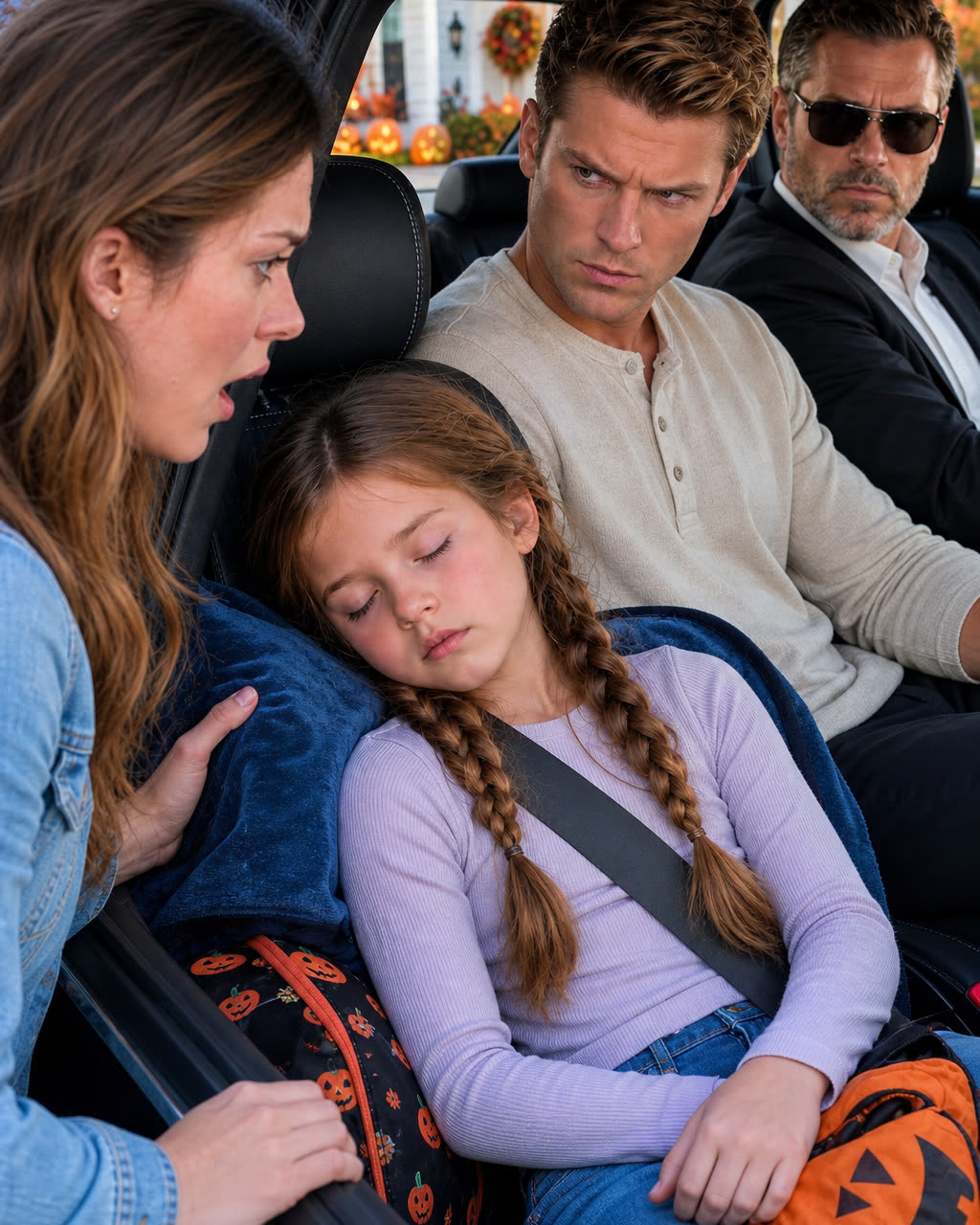
My husband, Greg, laughed as he said it. It was a rich, booming, well-rehearsed sound, a baritone chuckle built to roll up into the high vaulted ceiling of our spotless suburban foyer and leave me feeling impossibly small. He flicked my hand away with a careless, dismissive snap of his wrist while I reached out, trembling and gentle, to touch the round, deep purple bruises spreading along the fragile ridge of my seven-year-old daughter’s spine.
Greg stood in the entryway of our five-bedroom colonial home, carrying the scent of expensive sandalwood cologne, crisp autumn air, and a faint trace of bourbon. He looked like the very picture of a devoted, fun-loving, upper-middle-class father who had simply taken his little girl out for a night of harmless Halloween thrills. He was a partner at a prestigious downtown law firm, a man who coached little league, showed up at neighborhood barbecues, and charmed every woman at the country club. He was also a sociopath. And he had no idea that the seasoned emergency room trauma nurse he was trying to gaslight had already caught the faint, sickly sweet chemical smell of sedatives on her child’s breath, or that I was standing at the edge of a depravity so deep and so carefully constructed that stopping it would mean burning his reputation, his freedom, and his entire world to the ground.
This was not the first time. The nightmare I was living was a sequel. For two Halloweens in a row, the pattern had been the same: cyclical, identical, and horrifying. It had begun when Lily was five.
Greg and his older brother, Marcus, a man whose eyes always held the cold, calculating blankness of a dead television screen, had eagerly proposed taking Lily to the Blackwood Corn Maze. It was a neighborhood institution, a sprawling, intense haunted attraction set up on the lonely edge of the county, and in our affluent enclave they called it a “rite of passage” for the kids.
I had hesitated. A deep, primal, maternal unease had settled in my stomach. Lily was a sensitive girl, vibrant and talkative, but quickly overwhelmed by loud noises and sudden scares, and I suggested we stay with the local pumpkin patch. But Greg spun his web with great skill. He never raised his voice; he manipulated. He accused me of coddling her. He said I was projecting my own clinical anxieties from the trauma ward onto our daughter. He cast me as the “boring, restrictive mother” who wanted to keep her child in a sterile bubble while he was the fun, adventurous dad helping her conquer her fears. I gave in. I was worn out from twelve-hour hospital shifts, and I wanted badly to protect the illusion of our happy, balanced family.
Three hours later they carried her through the front door like a discarded, broken ragdoll. Greg was laughing loudly, holding a half-empty thermos of spiked hot cider and slapping his brother on the back. He claimed Lily had just gotten “a little too spooked by the chainsaw actors in the final cornfield.” But a few minutes later I was kneeling on the cold porcelain tiles of our master bathroom, holding a cool washcloth to my daughter’s forehead and wiping a thin, acidic trail of vomit from her pale chin, and I knew it was a lie. Her eyes had rolled back, her pupils were wide and sluggish, and she wore a frozen stare of pure, unfiltered terror. She wasn’t just frightened. As a trauma nurse I had seen fear and I had seen panic. This was something else. This was profound neurological shock.
And the vomit did not smell like Halloween candy, caramel apples, or chocolate. It smelled of chloral hydrate. It is an old-fashioned, potent sedative, once used in pediatric clinical settings before safer drugs replaced it, with a sharp, distinct, melon-like chemical odor. Once you have smelled it in a medical setting, you never forget it. My hands began to shake. I peeled her ruined, vomit-stained princess costume away so I could bathe her and wash the night off her skin, and that was when my heart stopped in my chest. There they were: five perfectly round, deep purple bruises, each exactly two inches across, stamped hard into the delicate, pale skin of her spine, her ribcage, and the center of her sternum. I traced them with trembling fingers. They were not grab marks from a startled actor. They were not the result of a clumsy fall in a muddy cornfield. They were too uniform, too geometrically perfect. As a medical professional, I knew exactly what they were: the unmistakable result of severe, localized suction trauma. Something heavy, industrial, and mechanical had been clamped against my five-year-old daughter’s torso with tremendous force.
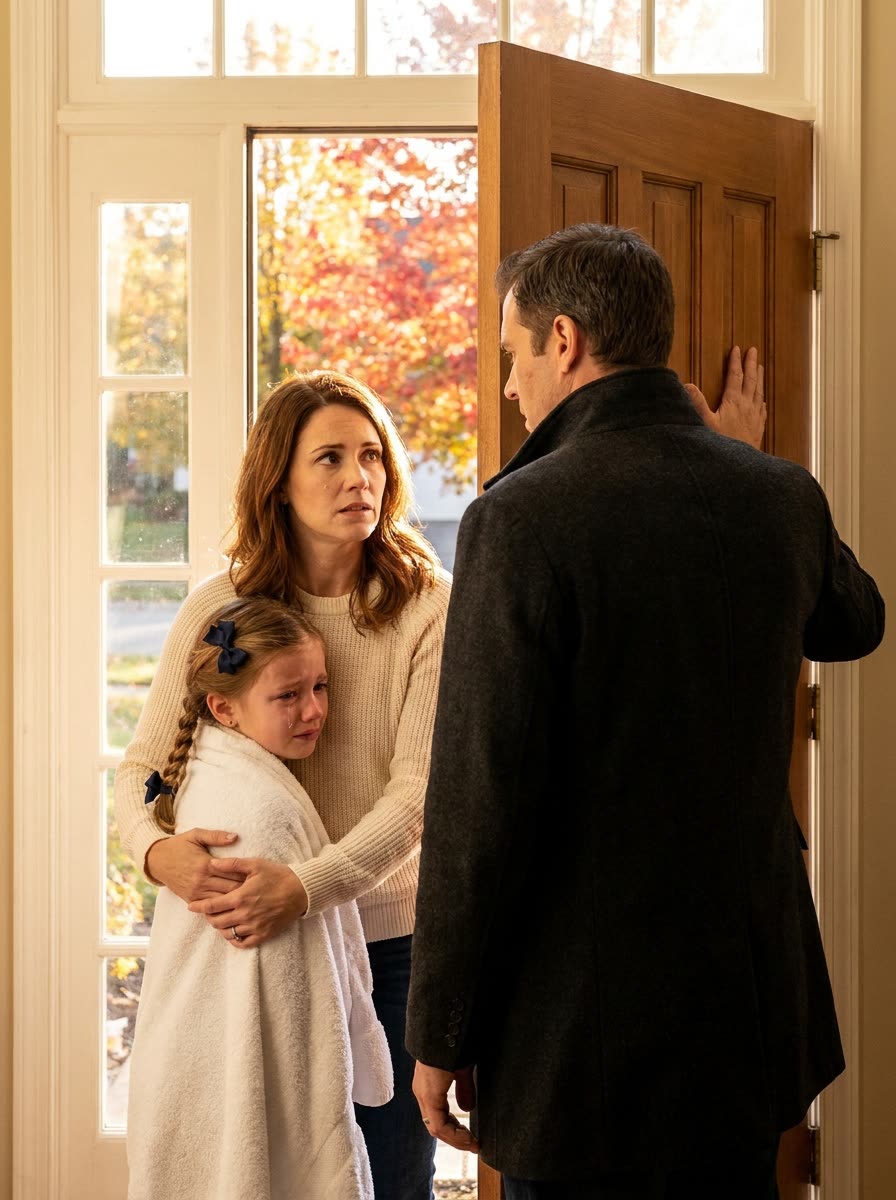
“I’m taking her to the ER, Greg,” I had demanded that first year. I scooped Lily up in a towel, my voice climbing in panic as I reached for my car keys on the granite kitchen counter. Greg moved with terrifying, predatory speed. He crossed the kitchen in two strides and slammed his heavy hand against the front door, physically blocking my way out. The jovial father-of-the-year mask slipped at once and shattered on the hardwood floor, exposing a cold, aggressive dominance that froze me where I stood.
“You are not taking her anywhere, Sarah,” he hissed, his face inches from mine, his breath smelling of apples and alcohol. “Do you know what the doctors will think if you walk in there with a bruised, sedated kid? Do you? They will think we abuse her. Because you left your medication out. Because you’re careless.”
“I didn’t give her anything!” I cried, clutching Lily tighter.
“Prove it,” Greg countered, his voice dropping to a lethal whisper. “You have access to hospital pharmacies. I’m a lawyer. I know how the system works. Do you want Child Protective Services taking our child away tonight? Do you want to be placed on a psychiatric hold because you’re a hysterical, overprotective mother who can’t handle a few bruises from a bumpy, automated hayride? You will ruin this family, Sarah. I will make sure they look at you. She just got scared. Put her to bed.”
I froze. I looked at the man I had married and understood, for the first time, that I was sleeping beside a stranger. And he had turned my greatest fear into a weapon: losing my daughter to the system. I backed down. That is the insidious, venomous power of domestic gaslighting. When the person you trust most in the world, a man with legal power and social standing, looks you in the eye and tells you your reality is a symptom of madness, you start to doubt the very ground beneath your feet. I bathed my daughter, put her to bed, and spent the whole night in a chair beside her door, watching her breathe.
I spent the following year in a fog of suffocating anxiety. Over many months of gentle coaxing, I watched Lily slowly recover her bright personality. I desperately convinced myself that Greg was right, that it had only been a rough ride, that I was dragging my work trauma into my own home. I had to believe it, because the alternative was too horrifying to face.
Then came the second Halloween. The same insistence on the “tradition.” The same trip with Marcus. The same catatonia when they returned. And the same circular bruises.
I did not argue the second time. I didn’t reach for my keys, and I didn’t scream. I simply nodded, bathed my daughter, and held her while she slept, staring at the dark ceiling of her bedroom until the sun came up. The terrified, compliant, gaslit wife died in that room on the second Halloween, and I mourned her in silence. In her place, a cold-blooded, deeply analytical, utterly ruthless investigator drew her first freezing breath.
If Greg believed my silence was submission, it was the most catastrophic miscalculation of his life.
I knew I couldn’t go to the police. Greg was a senior partner at a firm that regularly played golf with the district attorney. If I walked into a precinct with a wild story about corn mazes and circular bruises and no hard, irrefutable evidence, Greg would legally destroy me. He would paint me as a manic, unstable nurse suffering from Münchausen syndrome by proxy. He would win full custody, and I would be locked in a psych ward while he went on tormenting our daughter. I needed a bulletproof vest of evidence. I needed to build, piece by agonizing piece, a federal guillotine in the shadows.
I spent three hundred and sixty-four days preparing. I became a ghost inside my own home. I learned to smile perfectly, to cook his favorite meals, to ask about his day in court with convincing interest. I became the ultimate, subservient suburban wife. And while Greg slept, I worked.
I bought a cheap, untraceable laptop with cash at a pawn shop two towns over. I learned how to get around the basic security on Greg’s home office computer, and I began auditing his finances. Greg was clever, but he was also arrogant, and he assumed I was mathematically illiterate outside of calculating medication dosages. It took four months of sleepless nights, cross-referencing bank statements against his tax returns, before I found the anomaly.
There were large, unexplained transfers occurring twice a month. But they weren’t flowing into offshore bank accounts or shell corporations. They were passing through an intricate chain of digital tumblers and vanishing into the blockchain. Cryptocurrency. Specifically Monero, a coin built for total, untraceable privacy. He was receiving tens of thousands of dollars from unknown sources.
Then I turned my attention to Marcus. Greg’s brother had no real job. He claimed to be a “freelance tech consultant,” yet he lived in a lavish downtown loft. I began tracking his visits to our house. He never came for dinner. He only arrived when Greg needed him, and the two of them would go straight to the garage, lock the door, and run the heavy power tools to drown out their conversation.
One afternoon, while Greg was at trial and Marcus was “consulting” out of state, I picked the lock on Greg’s heavy tool chest in the garage. Beneath a tray of wrenches sat a small, locked Pelican case. I didn’t try to open it, because tampering would alert them. But the mere presence of a secure case hidden inside a tool chest confirmed my darkest fears. There was a physical mechanism to their crime. And I needed to know where they were taking her.
As October rolled around for the third year, the dread in my stomach turned into a heavy physical weight, like swallowing lead. I knew the cycle was about to repeat. I knew they would take her. Two weeks before Halloween, I drove to a specialized electronics store three counties away and paid cash for a microscopic, military-grade GPS tracking node. It was the size of a shirt button, fully waterproof, with a battery life of seventy-two hours once activated.
On the afternoon of Halloween, while Greg sat in the living room drinking a beer and yelling at a college football game on television, I sat in my sewing room. My hands were remarkably steady. I took Lily’s favorite autumn jacket, a bright pink, insulated coat she wore everywhere, and carefully opened the inner lining near the left shoulder seam. I buried the tiny tracker deep in the down insulation, activated it with a burner phone, and stitched the seam shut with an invisible hem stitch. Even if Greg searched her pockets, he would find nothing.
Now, as the sun set and cast long, bleeding shadows across our manicured lawn, the trap was truly set.
“Come on, Lil bug, Uncle Marcus is waiting in the truck! The chainsaw guys are waiting for you!” Greg cheered, zipping up Lily’s pink jacket.
Lily didn’t speak. She gave a quiet, frightened whimper, her small hands twisting the hem of her shirt, her eyes darting to me in silent pleading. It took every ounce of my willpower, every shred of my humanity, not to tear my daughter out of his hands and beat him to death with the hallway lamp.
“Have fun, you two,” I smiled, my voice light, breezy, and completely fake. It was the hardest, most excruciating performance of my life. “Don’t eat too much candy, Lily.”
“We’ll have her back by ten, babe. Enjoy the quiet house,” Greg grinned, kissing my cheek. His lips felt like a snake’s scales against my skin.
Greg’s heavy black SUV rolled out of our driveway and disappeared into the festive, glowing twilight of our neighborhood, where children were already beginning to trick-or-treat. I didn’t go to the kitchen to hand out candy. I walked into the garage, climbed into my own unremarkable sedan, locked the doors, and opened the encrypted tracking app on my burner phone.
I stared at the glowing blue dot on the screen. It was moving steadily east. I put the car in drive, and the engine hummed softly beneath me. I had no idea that the digital signal I was chasing was about to carry me far from the safety of my comfortable life, and straight to the gates of a technological, unfathomable hell.
Part 2: The Descent into the Rust
The blue dot on my phone did not stop at the county fairgrounds where the Blackwood Corn Maze stood.
I sat in my idling car, parked two streets from my own house, and watched the digital marker sail past the bright, festive suburbs altogether. My breath caught. It kept going down the interstate, pulling farther and farther from the safety of crowds, away from the actors and the hayrides.
It traveled six unbroken miles before taking an exit that dropped into the rotting, abandoned industrial sector near the city’s riverfront. It was a desolate expanse of decommissioned auto parts factories, crumbling brick, rusted chain-link fences, and overgrown lots littered with broken glass and forgotten dreams.
My heart hammered against my ribs with the frantic, desperate rhythm of a trapped bird. The air in my car suddenly felt too thin to breathe. Whatever they were doing to my daughter, it had absolutely nothing to do with a haunted house. I put the car in drive and followed the ghost on my screen.
A freezing, miserable autumn rain began to fall as I entered the industrial district. It slicked the cracked asphalt and reflected the sparse, flickering yellow glow of the few working streetlamps. Two blocks from the GPS marker I killed my headlights and relied on ambient light to pick my way through the treacherous, pothole-riddled streets.
I parked in the pitch-black shadow of a collapsed, graffiti-covered highway overpass. I stepped out into the freezing rain, pulled the hood of my dark raincoat over my head, and shivered as the cold bit straight through my clothes. I carried no flashlight; I couldn’t risk a beam giving away my position.
I moved on foot, my boots splashing softly through puddles, every sense raised to a state of primal hyper-vigilance. The smell of the river was overpowering: mud, wet rust, and damp industrial decay.
I followed the GPS signal until I found Greg’s heavy black SUV. It was parked in an alley behind a massive, dilapidated, windowless meatpacking warehouse that looked as though it hadn’t operated since the late nineteen-eighties. Rusted barbed wire wrapped the perimeter of the building, but a section of chain-link fence near the rear loading dock had been peeled back to form a crude entrance.
I stood in the rain and stared at the building. There were no children here. There were no actors in rubber masks leaping from behind hay bales. There were no pumpkins, no cider stands, no laughter. There was only the low, vibrating, rhythmic hum of a heavy industrial generator sitting in the alley beside the SUV. A thick black power cable snaked out of it, crossed the wet concrete, and slid beneath a rusted metal side door of the warehouse.
I crept toward the door, keeping flat against the rough brick wall. The metal handle was freezing against my bare hand. I pulled gently. It wasn’t locked; the thick power cable wedged under the frame kept the heavy door from clicking shut.
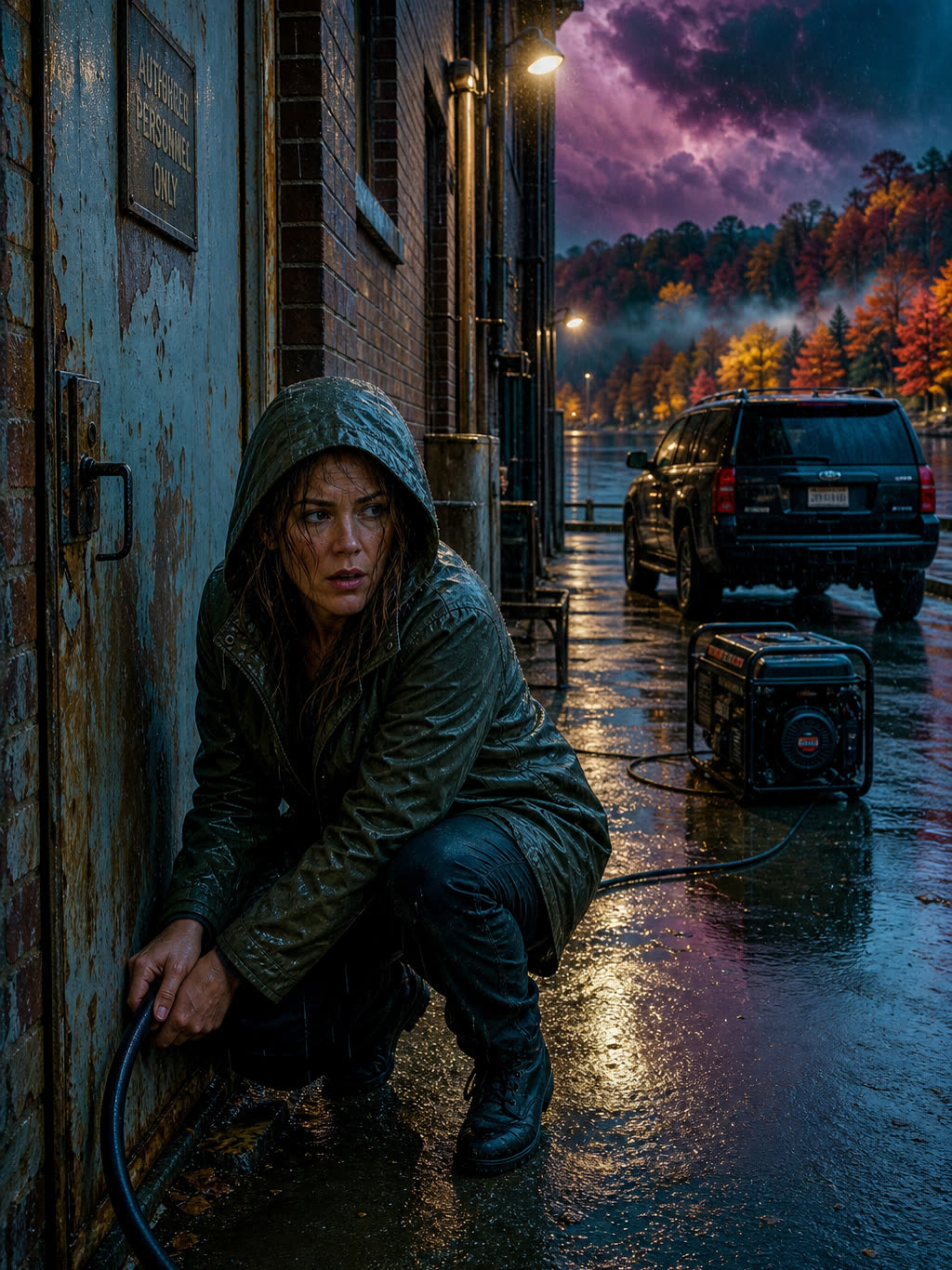
I slipped through the narrow gap, holding my breath, and the absolute darkness of the warehouse swallowed me whole. The interior was a labyrinthine nightmare of crumbling concrete pillars, hanging industrial chains, and rusted meat hooks swaying gently in the draft from the open door. It smelled sickeningly of ozone, stale air, and something deeply metallic, like old blood and copper.
I took my medical penlight from my pocket and covered the tip with my thumb, letting only a microscopic, red-tinted sliver of light escape, just enough to show the ground in front of my boots so I wouldn’t trip over debris. I crept forward, guided by a muffled, high-pitched sound echoing from deep inside the building.
As I drew closer, the sound sharpened into something that made the blood freeze in my veins and sent a shockwave of nausea through my body. It was the quiet, rhythmic, exhausted, hyperventilating whimper of my seven-year-old daughter.
I followed it toward a rusted iron staircase that led up to a suspended metal catwalk running the length of the vast warehouse floor. I climbed in agonizing slow motion, setting the balls of my feet on the very edges of the metal steps so they wouldn’t ring, gripping the railing so hard my knuckles went white.
At the top I dropped to my hands and knees. The metal grating dug painfully into my skin as I crawled toward a large, rusted ventilation grate set into the floor of the walkway. It overlooked a subterranean basement room that had once been used for cold storage. I settled myself over the heavy iron slats and looked down.
The room below was drenched in harsh, blood-red LED light that threw long, demonic shadows across the concrete walls.
I clamped both hands over my mouth and bit down hard into the flesh of my own palm to smother the raw, agonizing scream tearing at my vocal cords. My reality, my marriage, and my whole understanding of human nature shattered into a million irreparable pieces in a single catastrophic second.
Lily was strapped into a heavy, antique metal dental chair that had been bolted straight into the center of the concrete floor. Her pink fairy-tale jacket was gone, and her small shirt had been shoved roughly up to her neck.
Marcus, my brother-in-law, stood over her. He wore no Halloween costume. He wore black surgical gloves. He was methodically, violently pressing thick, black biometric suction sensors, exactly two inches across and attached to a thick tangle of wires, against the bare, fragile skin of her spine and chest.
They had never been taking her to a haunted house. They were the haunted house.
Greg stepped into the red light out of the shadows. He was holding a massive, terrifyingly realistic silicone mask of a deformed, rotting demon. But it wasn’t the mask that horrified me to my core. It was the sight of Marcus, typing furiously on a high-end, multi-monitor laptop setup on a folding table just a few feet from the dental chair. The screens showed a live, complex digital interface: a dark-web streaming platform with a rapidly scrolling chat box down the right side.
They weren’t scaring my child for fun. They were broadcasting her pure, unfiltered terror to a hidden audience of nameless, faceless, sadistic monsters, for profit.
And as Greg slowly lifted a medical syringe filled with a clear liquid, the chloral hydrate, flicking the needle with his finger and preparing to inject it into Lily’s arm to keep her medically compliant for the stream, I understood that I had less than sixty seconds to stop my daughter from being sedated into oblivion.
Part 3: The Anatomy of the Eclipse
“Heart rate is holding steady at 180, Greg. Blood pressure is spiking beautifully. The whales in the chat are absolutely loving it,” Marcus laughed. It was a hollow, soulless sound that bounced off the cold concrete walls, empty of any human empathy. His face glowed in the sickening, pale blue light of the laptop screens. “We just broke a new concurrent viewer record for the site. Push the crypto transfer from escrow to the offshore cold wallet before you dose her. We need her conscious and twitching for the jump-scare finale.”
Greg tapped the side of the syringe with a manicured fingernail, a sociopathic, triumphant grin spread across his handsome face. It was the face I had kissed at the altar, the face I had trusted with my life, the face of the man who had held my hand while I gave birth to the child he was now torturing. “This single haul is going to pay off the new mortgage on the lake house in one night, Marc,” Greg said, his voice dripping with arrogant, intoxicating greed. He glanced down at Lily, who was sobbing silently, paralyzed by fear. “The wife still thinks we’re wandering around a pumpkin patch looking for kettle corn and taking pictures with scarecrows. She’s so beautifully, predictably oblivious. It’s almost pathetic how easy it is to manage her.”
I lay flat against the freezing metal grating of the catwalk and listened to the men I called family casually discuss the monetization of my daughter’s psychological torture. The mechanism of their crime was a masterpiece of modern, digital depravity. They belonged to an elite, heavily encrypted, illegal dark-web syndicate, a variation on the red room. But instead of physical gore, this network served a narrow, sadistic clientele who placed enormous cryptocurrency bets on children’s biometric fear responses.
The suction sensors Marcus was attaching to Lily’s chest and spine were medical-grade telemetry units. They transmitted her live heart rate, adrenaline spikes, galvanic skin response, and respiratory distress straight to the viewers in real time, displaying her vital signs on screen like some twisted video-game HUD. The viewers paid to watch the numbers climb while Greg subjected her to assorted psychological horrors in his demon masks.
The sedation was the final, crucial piece of their flawless plan. Greg gave her just enough chloral hydrate to cause anterograde amnesia and physical paralysis. It meant she couldn’t fight back, couldn’t remember the details of the warehouse or the torture well enough to tell me the next day, and, crucially, it acted as a chemical brake, keeping her small, fragile heart from giving out in cardiac arrest under the sheer scale of the physiological stress. They were managing her trauma medically to keep their cash cow alive.
My hands were no longer shaking. The tears that had stung my eyes had completely evaporated, replaced by a cold, absolute, calculating clarity like ice water in my veins. The terrified, gaslit mother had vanished. I was no longer Sarah Collins, the exhausted suburban nurse. I was an apex predator, and my only biological imperative was the immediate, violent eradication of the threat to my offspring.
But before I struck, my clinical training took over. I needed the cancer cut out, but I also needed the pathology report to make sure the infection never returned to threaten my child again. I needed undeniable proof. I slowly drew my burner smartphone from my pocket, set the camera lens over the gaps in the rusted iron grate, and angled it to capture the whole room. I hit record.
I zoomed in on the laptop screens and captured crystal-clear 4K footage of the dark-web interface, the scrolling chat box of the abusers placing their bets, and the alphanumeric strings of the offshore crypto-wallets displayed on Marcus’s monitor. I panned to catch Marcus adjusting the biometric sensors on Lily’s chest, careful to keep his face clearly visible. Finally I centered the frame on Greg’s face as he held the syringe of sedatives beside my weeping daughter, adjusting his demon mask with his free hand. I recorded a flawless, undeniable, two-minute forensic death warrant.
I stopped the recording, tapped the screen, and instantly uploaded the file to a secure, encrypted cloud server I had set up months earlier. Even if they caught me and destroyed the phone, the evidence was preserved forever in the digital ether. Now it was time for the execution. I slid backward off the catwalk, my raincoat gliding silently over the metal, and descended the rusted iron staircase with the fluid, silent grace of a ghost. On the main floor of the warehouse, my eyes, fully adjusted to the darkness, swept the sprawling, debris-filled space.
I weighed the tactical reality. I couldn’t just rush the basement door. Greg and Marcus were both over six feet tall, heavy, and running on adrenaline and greed. I was a hundred-and-thirty-pound nurse. If I burst in blindly, they would overpower me in seconds. They would sedate me, and Lily and I would simply vanish into the river, another tragic suburban mystery. I needed an equalizer. I needed to change the environment to my absolute advantage. I needed to blind them.
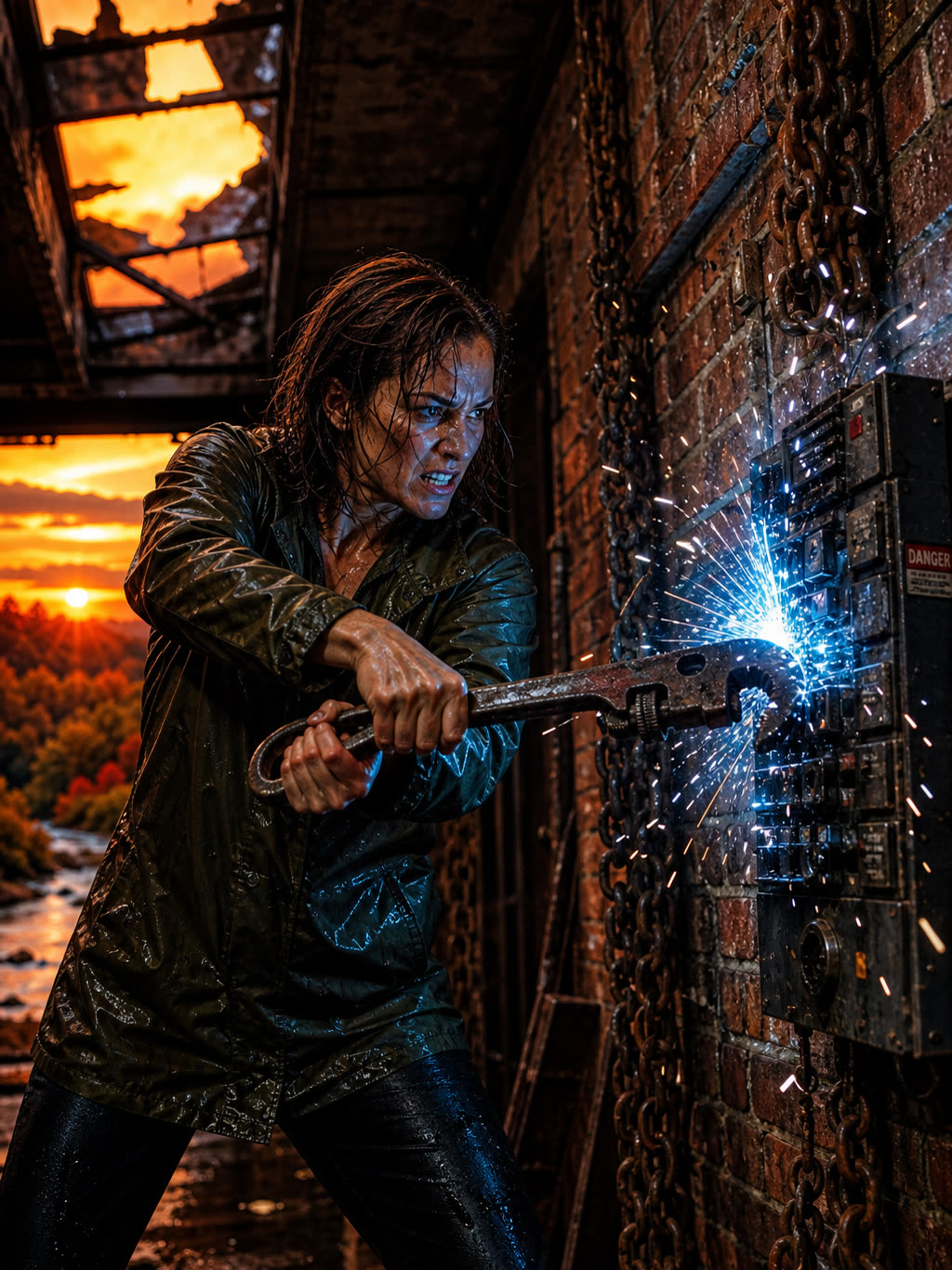
I followed the thick black power cable running from the outside generator. It crossed the damp concrete and plugged directly into a massive, antiquated main electrical breaker box on the brick wall just outside the heavy steel door of the basement room. Lying on the floor beside the box, abandoned by whatever construction crew had gutted the place decades ago, was a two-foot solid iron industrial pipe wrench, thick with rust and heavy as a sledgehammer. I picked it up. The cold, heavy iron felt perfect in my hands. It wasn’t a tool; it was the physical weight of justice.
I pressed myself into the pitch-black shadows beside the steel door, my back against the damp brick. I took one last deep breath, letting the freezing, stale air fill my lungs and slow my heartbeat to a steady, rhythmic, terrifyingly calm cadence. Then I raised the wrench high over my head, gripping the rusted handle with both hands, and didn’t hesitate. I smashed it down on the main breaker with all my strength.
Sparks showered the darkness in a blinding, chaotic cascade of blue and white light. Outside, the generator whined, coughed a plume of diesel smoke, and died. The basement room was plunged at once into absolute, suffocating, pitch-black darkness.
“What the hell?!” Marcus shouted from inside, his voice spiking with confusion and panic. The only light left in the subterranean room was the faint, ghostly, pale blue glow of the laptop screens running on battery power.
“The breaker must have tripped from the generator surge,” Greg groaned, his heavy footsteps echoing as he fumbled blindly toward the steel door. “Watch your step. Keep an eye on her, I’ll reset it. Don’t lose the stream connection.”
I stood perfectly still in the shadows outside the door, the iron wrench gripped in my fists. I was a shadow within a shadow. Greg had no idea that he wasn’t walking into an empty, abandoned hallway to flip a switch. He was walking straight into the swing of a mother’s vengeance.
The heavy steel door groaned on its rusted hinges as Greg pushed it open. He stepped into the pitch-black hallway, muttering curses under his breath, hands outstretched as he groped through the dark, stripped of his sight. I didn’t scream. I didn’t announce myself. I didn’t give him a single millisecond to process what was happening or brace for the impact.
I stepped forward, planted my feet, and swung the heavy iron wrench with the full, devastating rotational force of my entire body, aiming low. I didn’t want to kill him instantly; I wanted to break his foundation. The metal struck the side of Greg’s right knee dead on.
A sickening, wet, catastrophic snap rang through the cavernous warehouse, like a thick oak branch giving way under heavy snow. Greg didn’t even have time to understand what had hit him. The arrogant, wealthy lawyer let loose an agonizing, high-pitched, guttural roar that tore out of his throat and echoed off the concrete walls. His shattered leg folded completely, sending his two-hundred-pound frame crashing onto the hard, damp floor. He writhed in the darkness, clutching his ruined knee, gasping for air, unable to form words.
I didn’t stop to watch him suffer. Momentum carried me forward. I stepped over his thrashing, whimpering body and burst through the open doorway into the basement room. Marcus spun around from the laptop, his face lit by the pale blue screens, his eyes wide with animal panic as he tried to make out the shape rushing at him in the dark.
“Greg?! Who the hell is—!” Marcus started to shout, realizing the threat was no tripped breaker. He grabbed frantically toward the folding table, reaching for the syringe of chloral hydrate and meaning to use it as a weapon. He was too slow. I closed the distance in two quick, aggressive strides. I didn’t aim for his legs this time. I drove the heavy, rusted head of the wrench straight into the center of his ribcage like a medieval battering ram.
The impact was brutal. The air left Marcus’s lungs in a wet gasp. The force lifted him clean off his feet and sent him crashing backward over the folding table, whose flimsy frame collapsed under his weight. The laptop, the expensive monitors, and the whole dark-web streaming apparatus smashed onto the concrete in a chaotic tangle of sparking wires and broken glass, cutting the broadcast instantly. Marcus lay groaning in the dark ruins of his digital empire, struggling weakly to pull air into his bruised lungs, incapacitated by the blow.
I dropped the wrench. The weapons of violence had served their purpose. I rushed to the center of the room, guided by the faint light of a single shattered monitor that still flickered. “Mommy’s here, baby. Mommy’s got you,” I whispered fiercely, my voice finally breaking with emotion as I reached the heavy dental chair.
Lily was trembling so hard the metal chair vibrated against the concrete. She was hyperventilating, trapped inside the nightmare. I didn’t bother with the buckles on the thick, complicated leather straps binding her small wrists and ankles; I ripped them loose with a frantic, maternal strength I never knew I had, ignoring the friction burns on my own hands. I tore the biometric suction sensors from her bruised skin and flung the wires to the floor in disgust. I pulled my daughter against my chest and wrapped my raincoat tightly around her freezing, shivering body. She buried her face in my neck, sobbing hysterically, her small fingers clutching my coat like a lifeline in a storm.
Suddenly the rusty industrial emergency backup lights on the ceiling sensed the power failure and flickered on, throwing a sickly, dim, yellow-orange glow over the basement. The shadows pulled back and revealed the undeniable carnage I had caused. Greg was dragging himself through the doorway on his elbows, leaving a smear of dirt on the floor, his face pale, slick with cold sweat, and twisted in excruciating agony. He looked at the wrecked streaming setup. He looked at his brother Marcus, bleeding and gasping among the broken laptops. And finally his eyes dragged upward to meet mine.
He stared at the “hysterical, weak, overprotective” suburban wife he had gaslit, controlled, and manipulated for years. He saw me standing tall in the middle of the torture chamber, shielding our weeping daughter behind my body, the heavy iron wrench lying on the concrete at my feet. The arrogant, untouchable, sociopathic facade of the successful lawyer didn’t just crack; it pulverized to microscopic dust. His mind violently, pathetically refused the reality in front of him.
“Sarah?” Greg choked out, his voice a pathetic, high-pitched wheeze, stripped of its usual booming authority. He looked at the bloody wrench, then back at my face, sheer terror blooming in his eyes. “You… how did you… what did you do?”
I stood tall, feeling my daughter’s warm, steady heartbeat against my chest, a stark contrast to the cold monster bleeding on the floor. I looked down at the man who had laughed in my face, the man who had sold my child’s terror for cryptocurrency, the man who thought he could use the darkness to hide his sins and my supposed weakness as his shield.
“I stopped being hysterical, Greg,” I said, my voice ringing off the concrete walls with a lethal, absolute, freezing authority that made him physically recoil as if I had struck him again.
I offered him not another word. I didn’t demand an explanation. I didn’t scream or cry. I pulled my burner smartphone from my pocket, dialed 911, set it on speakerphone, and held it up.
“911, what is your emergency?” the dispatcher’s voice rang out clearly in the silent, yellow-lit room.
“My name is Sarah Collins,” I said calmly, holding unbreakable, predatory eye contact with my shattered husband. “I am at the abandoned meatpacking plant on River Road in the industrial district. I need a pediatric trauma ambulance, and I need every available armed police unit in the county. I have just uncovered a live, dark-web child exploitation ring, and I have the perpetrators subdued.”
I left the line open and set the phone on a relatively intact corner of the broken table. I looked back at the ruined men on the floor and listened to the faint wail of sirens already rising in the distance. I knew, with absolute, ironclad certainty, that the physical pain I had just inflicted with an iron wrench was nothing compared to the federal, apocalyptic, inescapable nightmare that was about to descend on them.
In the space of ten excruciating minutes, the deserted industrial complex was suddenly flooded with the frantic, pulsating glow of countless red and blue emergency lights. The approaching sirens sounded like a terrifying announcement of inevitable destruction to Greg and Marcus, who had remained trembling on the freezing concrete, hearing Lily’s faint cries and slowly comprehending the irreversible consequences of what they had done.
Armed tactical officers, dispatched following reports of an active dark-web operation, stormed into the basement with their guns ready, their powerful tactical flashlights cutting sharply through the darkness as they searched the room.
“He’s bleeding! My wife went crazy! She tracked us here and attacked us for no reason!” Greg screamed from the ground, directing a shaking, frantic finger toward me. Even with his leg destroyed, his brother helpless, and his online criminal operation collapsing around him, his deeply narcissistic instincts continued reaching for the same manipulative lies, desperately believing his money, charm, and social standing might somehow deceive the police one final time.
The commanding officer, an experienced veteran with silver-streaked hair and penetrating eyes, turned his attention toward me, absorbing the disturbing surroundings: a composed mother embracing a crying, visibly bruised little girl, while two adult men insisted they were innocent victims inside a basement containing shattered recording devices, a dental chair, and discarded syringes.
I made no attempt to debate Greg. I refused to shout or defend myself against his fabricated allegations. Instead, I quietly slipped my hand into my pocket, unlocked my cellphone, and passed it directly to the officer.
The screen was already prepared to display the 4K recording I had captured from the elevated catwalk.
The officer started the video. Crystal-clear audio echoed through the basement, immediately exposing the dishonesty of Greg’s claims. Greg could be heard arrogantly explaining the offshore cryptocurrency transactions, Marcus boasting about the number of viewers and the heart-rate monitoring equipment, and the unmistakable, incriminating images of Greg filling a syringe with chloral hydrate beside his frightened daughter.
For two uninterrupted minutes, the officer examined the footage without speaking. Once the recording finished, his expression shifted from measured professionalism to unmistakable, overwhelming revulsion. His eyes dropped toward Greg, who had abruptly stopped talking, his complexion turning deathly pale as he understood that no amount of lying could rescue him now.
“Call the FBI Field Office immediately,” the senior officer ordered his partner, throwing a set of solid steel handcuffs toward a younger officer while indicating Greg. “Tell them to send the Cyber Crimes unit and the Crimes Against Children task force. We have a live, confirmed dark-web exploitation ring, and secure this entire building. Nobody touches those broken laptops.”
When the emergency medical team hurried into the basement carrying a stretcher, I refused to retreat into the background as a helpless observer. Drawing upon every skill acquired during my ten years as a trauma nurse, I became an unwavering advocate for my daughter’s medical needs.
“She needs an immediate, comprehensive toxicology screen for chloral hydrate and benzodiazepines,” I instructed the paramedics, carefully assisting them as they positioned Lily on the stretcher and covered her with a heavy insulating blanket. “She has been subjected to extreme psychological stress. She is tachycardic right now. Monitor her closely for rebound bradycardia on the transport to the pediatric unit.”
The emergency responders acknowledged my instructions with quick nods, immediately recognizing my medical expertise, and continued their work with swift, respectful precision.
Just before leaving the basement to accompany Lily, I glanced backward one final time. Officers were roughly pulling Greg and Marcus upright. As pressure fell upon Greg’s ruined knee, he howled in unbearable pain, pleading desperately for medical assistance of his own. Thick steel handcuffs had already been fastened securely around his wrists behind his back.
He stared at me through uncontrollable tears, the once-powerful, affluent suburban father now nothing more than a miserable, defeated criminal smeared with the grime of an abandoned warehouse. At that instant, he understood that the recording I had obtained and the backup preserved in the cloud would prevent him from ever experiencing freedom outside a federal prison again. His fortune, his calculated deception, his privileged reputation in society—everything had been destroyed by a mother who finally refused to question what she knew was true.
I offered no satisfied grin. I took no pleasure in humiliating him. Without uttering a single word, I turned away and stepped into the icy rainfall, staying close behind Lily’s stretcher as it approached the waiting ambulance, abandoning Greg to the darkness he had embraced for so long.
Inside the ambulance, I remained beside Lily, gently clasping her little, warm hand while the medical monitors showed her heartbeat gradually returning to a steadier rhythm. A man wearing a dark windbreaker—the senior FBI investigator who had reached the location only minutes earlier—accompanied us, recording his initial observations in a compact notebook.
Eventually, he shut the notebook and regarded me with unmistakable, deeply sincere admiration.
“We’ve been hunting this specific dark-web syndicate for three years, ma’am,” the investigator murmured above the constant rumbling of the ambulance motor, briefly looking toward my sleeping daughter. “They were ghosts. Untraceable. They used routing protocols we couldn’t crack. The video you took, the crypto-wallet addresses you captured on those screens… you didn’t just save your daughter today. You just handed us the keys to burn their entire global network to the ground.”
I bent closer to Lily and softly pressed my lips against her forehead.
The relentless, suffocating anxiety that had consumed the previous two years—the constant dread, the uncertainty about my own judgment, the exhausting need to tread carefully inside my own house, and the nightmare surrounding Halloween—had vanished entirely, never to return. In its place stood an unbreakable, absolute conviction that my little girl was finally beyond danger, and that the poisonous presence infecting our existence had been removed with the cold, merciless precision of a surgeon’s blade.
Two years have passed.
The fresh, invigorating autumn breeze of late October drifts through our new, sunlit neighborhood in a peaceful seaside town, hundreds of miles removed from the city, the abandoned warehouse, and the darkness we escaped. Tonight is Halloween.
I stand on the spacious wooden porch of our new house, holding a steaming cup of apple cider while distributing sweets to the neighborhood children. My eyes follow a lively, courageous nine-year-old girl racing up the driveway, dressed not as some defenseless princess, but as a powerful superhero with a flowing cape and a plastic shield raised proudly in her hand.
Her joyful laughter carries through the cool evening air like a beautiful melody. She is strong. She is glowing. With the help of intensive, specialized pediatric trauma counseling, EMDR treatment, and a home filled with unwavering protection and unconditional affection, Lily has blossomed. The nightmares of her former life no longer weigh upon her. Her back is spotless, untouched by injury, and forever beyond the reach of monsters.
Yesterday afternoon, I received an encrypted email from the chief federal prosecutor, informing me that the prolonged court proceedings had finally reached their conclusion.
The criminal network had been dismantled with devastating, irreversible force. Using the evidence I had collected inside the warehouse, FBI agents coordinated simultaneous operations spanning three continents, apprehending dozens of network administrators and wealthy “whales.” The final, frantic attempts by Greg and Marcus to overturn their convictions were swiftly rejected by a federal appeals judge, who specifically referenced the “depraved and exceptionally cruel nature” of their offenses.
Both men are now imprisoned under consecutive life sentences, with absolutely no opportunity for parole, inside a maximum-security federal institution. Their existence has effectively been wiped from the outside world. Every day, they live in fear of fellow prisoners who are fully aware of the precise atrocities they committed against a defenseless child. The enormous cryptocurrency fortunes they accumulated through offshore accounts were confiscated by federal authorities, converted into funds, and transferred into a victims’ compensation program dedicated to helping other children heal.
They have become forgotten shadows, condemned permanently to a concrete prison born from their own carefully constructed cruelty, trapped behind bars that no clever deception or manipulation can ever unlock.
When Lily comes bounding back toward our porch, proudly displaying an enormous chocolate bar she received from a neighbor, she notices a neighborhood police vehicle moving slowly beside the park opposite our house, its emergency lights blinking softly to protect the children celebrating Halloween.
In another lifetime, the presence of uniformed officers or the unexpected flicker of flashing lights might have sent her running for cover, her instincts shaped by the terror Greg had taught her to associate with authority.
But tonight, Lily beams happily and waves with infectious excitement toward the policeman. He responds with a gentle chirp of his siren and a friendly wave. The world no longer frightens her. Deep inside, she possesses the reassuring, unquestionable confidence of a child who has been saved: monsters can be captured, and the heroes will always emerge victorious.
I wrap my arms tightly around my daughter, drawing her into a loving, protective embrace while inhaling the fragrance of fallen autumn leaves and the extraordinary comfort of knowing we are safe.
Greg had convinced himself that a mother’s devotion made her vulnerable. He regarded my instinctive concern for my child as irrational hysteria, something he could ridicule, control, and exploit whenever it suited him. He imagined himself an unstoppable predator, capable of concealing his wickedness beneath darkness and the ordinary appearance of suburban family life while endlessly enriching himself through our suffering.
What he failed to comprehend was the most essential principle of nature.
When you force a child down into the darkness, you are not demonstrating superiority. You are not achieving victory. You are merely awakening the one person capable of patiently, precisely, and mercilessly constructing the perfect plan for your complete and unavoidable downfall.
A peaceful smile spreads across my face as I take Lily’s little hand and lead her through the doorway of our cozy, brightly illuminated, secure home. My heart is finally free of fear, filled instead with an absolute, immovable certainty that the monsters will remain imprisoned in darkness forever, while the light belongs to us for all the years ahead.
Disclaimer: This story is a work of fiction inspired by real-life themes. Names, characters, places and events are fictionalized, and any resemblance to real persons is purely coincidental. Images are for illustration purposes only.
