

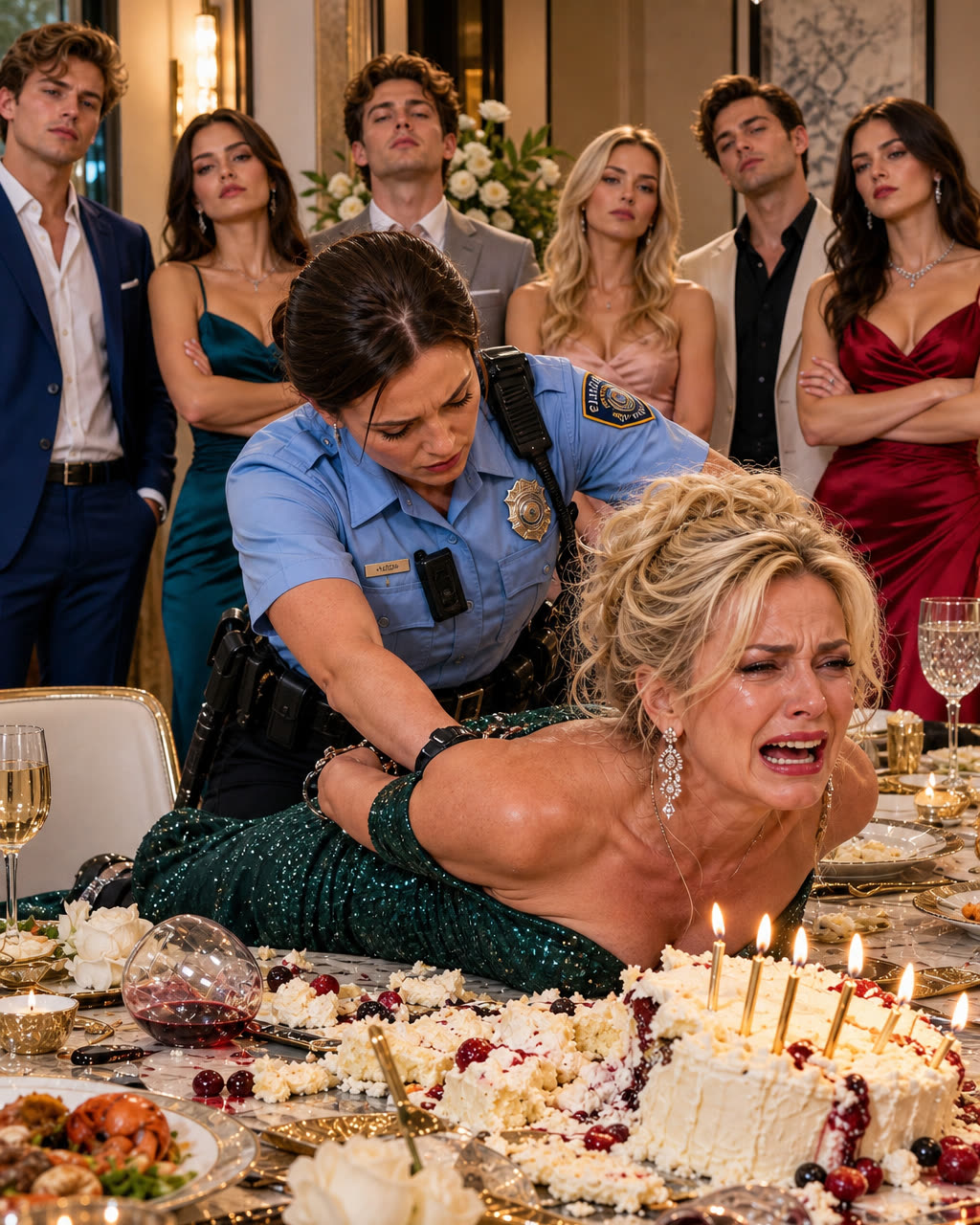
Part 1: Six Empty Chairs on Wells Street
It took me two full days to get my sixtieth birthday dinner ready for my six children. Two whole days of chopping and seasoning, of baking, and of standing at the kitchen counter lost in memory, my hands moving while my mind drifted back through the years.
My name is Linda Henderson. For the better part of my adult life, I haven’t kept track of time with calendars or clocks. I’ve kept it with my children’s milestones. School plays. Trips to the emergency room. Graduations. And all the countless small crises that come with raising a noisy, chaotic, beautiful family in Fort Wayne, Indiana. Never once did I imagine that my own sixtieth birthday would become a night seared into my memory for reasons so entirely different—and so utterly terrifying.
I wanted everything about this dinner to be perfect. Our three-bedroom house on Wells Street had been far too quiet for far too long. I polished my mother’s ivory china, the set with the delicate gold trim that only came out of the cabinet on Thanksgiving and Christmas. I pressed the heavy linen napkins until they were crisp. Then I set seven places around the dining room table: one for me, and one for each of my six children.
I made every person’s favorite dish, leaning on muscle memory and love in equal measure. For Mark, my eldest, a heavy pot roast nestled among long-cut carrots and pearl onions, left to simmer until the meat collapsed at the touch of a fork. For Jason, scalloped potatoes baked in heavy cream beneath a crust of sharp cheddar. Caleb’s green bean casserole, crowned with the crispy fried onions he used to pick off the top when he was small. Sarah’s soft, buttery dinner rolls. Eliza’s sweet macaroni salad. And for Grant—my fourth child, my wild boy—a dense, dark chocolate sheet cake, made precisely the way he had asked for it every single year since he turned five.
Six o’clock came, and not one of them had arrived. By seven, the pot roast was drying out in the warming oven, the potatoes had gone thick and congealed, and the ice in the water glasses had dissolved into tepid little puddles. By seven-thirty, the tall taper candles I had lit at the center of the table were weeping wax onto my good lace tablecloth. And I sat alone at the head of the table, gripping a linen napkin, trying to force down the hard, bitter lump lodged in my throat.
At five o’clock I had sent a message to the family group chat. Drive safely, everyone! Love you! The roast is almost done. I watched Sarah start to type. Three small gray dots danced across my phone screen. Then they disappeared. No reply ever came. I tried calling Mark and got his voicemail. Jason didn’t pick up. Neither did Caleb, or Sarah, or Eliza, my youngest. And Grant’s phone, as it so often did, went directly to an automated message.
My thoughts began to spiral, sinking down into the dark corners that only a mother’s mind knows how to find. I understood that they were busy adults. Mark was an accountant with two children of his own. Jason was an electrician who worked punishing shifts. Caleb was a physical therapist, Sarah an ER nurse, and Eliza taught second grade. They had their own lives, their own mortgages, their own bone-deep exhaustion. But six people? Every one of them forgetting? Every one of them ignoring my calls? No. That wasn’t ordinary forgetfulness. That was simply impossible.
I found myself thinking about their father, Ray. I was twenty-three when I married Ray Henderson, and he had promised me a house overflowing with children and a dinner table that would never sit empty. For ten years he honored that promise, giving me four boys and two girls. But when Eliza was six, Ray packed one suitcase and walked out the front door, leaving behind a mortgage I couldn’t afford, an emptied bank account, and six broken hearts. For the next two decades I worked as a high school cafeteria manager during the day and did medical billing at night, all just to keep the lights on. I had worn myself to the bone making sure my children would never feel abandoned again. And now, staring across at six empty chairs, I felt that old, familiar, icy fist of abandonment tightening around my chest.
Then, at precisely 7:45 PM, my phone buzzed against the mahogany tabletop. The caller ID lit up: GRANT. I lunged for it so fast I nearly knocked over a crystal goblet. “Grant? Honey, where are you? Where is everybody?” No answer came right away. There was only a crackle of static. “Grant? Are you there?”
And then the sound poured through the speaker. It was loud, chaotic, and impossible to mistake: the piercing, shrieking wail of police sirens, layered over the garbled squawk of a dispatch radio. It sounded as though he were standing in the middle of a war zone. “Mom…” Grant’s voice cut through the din. It was hardly more than a whisper, strangled and ragged, like a man fighting to drag air into his lungs. My blood turned to ice. “Grant! What’s happening? Are you hurt?” “Mom… I’m…” A loud burst of static swallowed his words, followed by a heavy metallic slam. “…I’m so sorry, Mom.” Click. The line went dead.
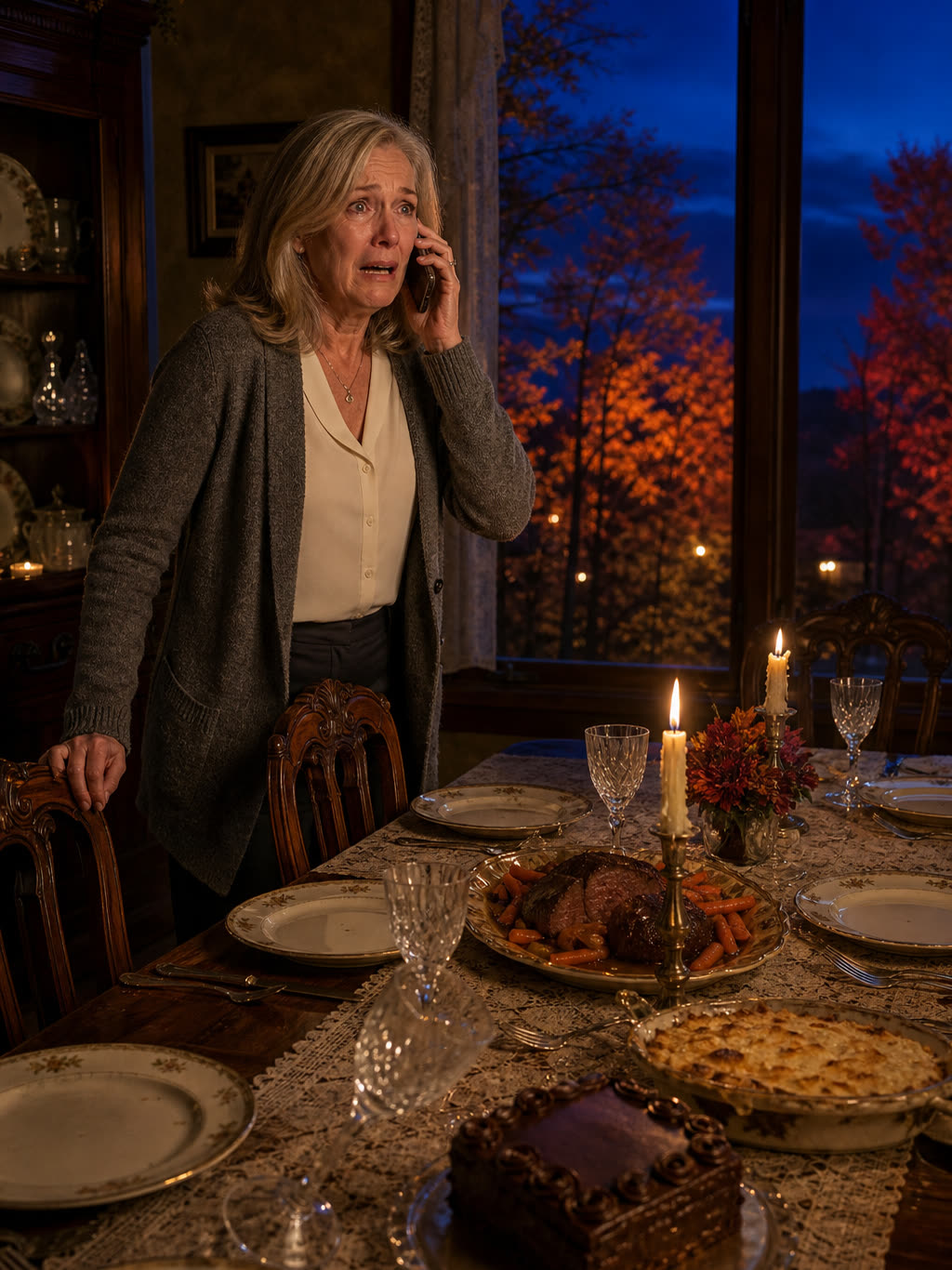
I stared at the dark screen of my phone, my breath snagging in my throat. I hit redial. Voicemail. I hit it again. Voicemail. I’m so sorry, Mom. Of all my children, Grant was the one I had always worried about most. When Ray left, something inside Grant snapped. He grew into an angry, reckless teenager. He spray-painted buildings, stole my car, dropped out of community college twice, and ran with a crowd that kept me pacing the floorboards until three in the morning. For years I had lived in dread of the late-night phone call—the one telling me my son was in a cell, or in a hospital bed, or lying on a slab. And now, on my sixtieth birthday, that call had finally arrived.
I rose from my chair, my knees shaking so violently that I had to grab the edge of the table to keep from going down. I had no idea what to do. Should I call the hospitals? Should I dial 911? Just as I reached for my purse to dig out my car keys, three heavy, commanding knocks pounded against my front door. I went rigid. Those knocks didn’t sound like a child coming home. They sounded like the end of the world.
I stumbled out of the dining room and down the hallway, my heart beating a frantic rhythm against my ribs. I reached out with a trembling hand, turned the deadbolt, and pulled the door open. There on my porch, washed in the harsh yellow glow of the porch light, stood a police officer.
He was young, maybe in his late twenties, dressed in the dark navy uniform of the Fort Wayne Police Department. His duty belt hung heavy with equipment, and a silver badge glinted on his chest. The nameplate read: ALVAREZ. “Ma’am, are you Linda Henderson?” he asked. His voice was low, strained, and painfully formal. “Yes,” I breathed. The word barely made it past my lips.
Officer Alvarez swallowed hard. Even in the cool evening air, a film of sweat shone on his forehead. He looked deeply uncomfortable, his eyes sliding away from mine to stare past my shoulder into the hallway. It was the expression of a man who had drawn the short straw. The expression of a man who had been sent to destroy a mother’s life. He reached into his breast pocket and drew out two things, holding them toward me in a gloved hand. The first was a folded sheet of lined notebook paper. The second was a heavy ring of keys.
I knew that keychain the moment I saw it. It was a tarnished little metal baseball bat I had bought Grant at a minor league game when he was eight years old. He had never once taken it off his ring. Seeing it dangling from a stranger’s hand felt like looking at a severed limb. Why would the police have his keys? You only take a man’s keys if he’s about to be locked away… or if he won’t be needing them anymore. “What… what is this?” I stammered, refusing to reach for them. “I need you to read the note, ma’am,” Officer Alvarez said quietly.
My fingers shook as I took the paper. Across the outside, scrawled in rushed, messy ink, was a single word: Mom. It was Grant’s handwriting. There was no mistaking it. I unfolded the page. The words swam as tears flooded my eyes, but I made myself focus. “Mom, I’m sorry for what I’ve done today. Please, don’t call Mark or Sarah. Don’t ask questions. Just go with the officer. I’m waiting for you at the ‘scene’. – Grant”
The paper slid from my fingers and drifted down to the porch floor. I’m sorry for what I’ve done today. I’m waiting for you at the ‘scene’. “Oh, God,” I gasped, slapping a hand over my mouth. “What did he do? Who did he hurt?” Officer Alvarez bent down, retrieved the note, and pressed it back into my hand along with the keys. He still wouldn’t meet my eyes. “Ma’am, I need you to come with me right now. Please.”
“Is my son alive?” I screamed, and the polite mask of the suburban mother shattered completely. “Just tell me if he’s alive!” The young officer flinched. He actually took half a step backward, his jaw tightening. He looked panicked, torn in two, and overwhelmingly sad. “Ma’am… he’ll explain everything. Please, just get in the car.”
He’ll explain everything. It wasn’t an answer at all. It was the sort of thing they say on television just before they ask you to lift a sheet off a face. The sirens on the phone. The apologies. The car keys. My other children refusing to answer their phones—had the police already reached Mark and Sarah? Were the rest of my children already waiting at the hospital? Was that why Grant had told me not to call them?
“I have to get my purse,” I whispered, moving on nothing but shock. I turned like a ghost and drifted into the kitchen, where I picked up my handbag and a grey cardigan. I glanced back at the dining room one final time. The candles had at last burned themselves out, sinking the beautiful, untouched dinner into shadow. It looked like a mausoleum.
I stepped back out onto the porch. Officer Alvarez gently steered me down the front steps toward the patrol car waiting at the curb. Its headlights were dark, but the engine idled with a low, menacing rumble. He opened the rear door. I had never in my life sat in the back of a police car. The seat was hard molded plastic, built to be hosed down easily. There were no handles on the inside of the doors. A thick, scratched plexiglass partition, reinforced with heavy wire mesh, walled off the back from the front.
I slid onto the plastic seat, and the cold crept straight through my slacks. Officer Alvarez shut the door. The heavy thud of the lock catching sounded like a vault slamming closed. I was trapped. Locked in a cage, about to be driven into the darkest night of my life, with my ruined son’s car keys resting in my lap.
Part 2: Flashing Lights at Kingsland
Officer Alvarez got into the driver’s seat and shifted the cruiser into gear. We eased away from the curb, leaving my dark, empty house behind us on Wells Street.
The drive was a nightmare for every one of my senses. The air in the back of the cruiser carried a faint smell of stale coffee and industrial disinfectant, mixed with the lingering sweat of desperate people who had sat where I was sitting. As streetlights swept past the windows, the wire mesh threw grid-shaped shadows across my hands, and I felt like a prisoner of my own grief.
Up front, the police radio abruptly crackled to life, shattering the suffocating silence. “Dispatch, Unit 4. Target is secured. We are approaching the lockdown area.” Alvarez grabbed the mic on his shoulder. “Unit 4, copy. ETA is three minutes.”
Target secured. Lockdown area. The cold, detached language of law enforcement sent a new wave of nausea churning through my stomach. Was Grant the target? Had he been arrested? Or was he the victim, secured inside a body bag?
“Officer,” I pleaded, leaning forward until my forehead rested against the chilly plexiglass divider. “Please. I am begging you as a mother. I can’t breathe. Just tell me what happened.” Alvarez kept his eyes fixed on the road. The dashboard glow picked out the hard lines of his jaw. “I can’t say anything, Mrs. Henderson. I’m under strict orders.”
“Strict orders from who?” I sobbed. “A detective? The coroner?” Silence. “Please,” I whispered, tears now streaming freely down my cheeks and dripping from my chin onto my cardigan. “Just… just look in the rearview mirror. Just give me a nod or a shake of the head. That’s all I ask. Is my son’s body intact? Will I be able to recognize him?”
I saw Alvarez’s eyes flick up to the mirror. When they found mine, I saw pure, undiluted horror in them. It was as if my words had struck him a physical blow. He looked sick to his stomach. But he didn’t nod. And he didn’t shake his head. Instead he looked away, clenched the steering wheel harder, and stamped his boot down on the gas. The patrol car lunged forward, its engine roaring as we tore through a yellow light.
He couldn’t tell me. It was that bad. My boy. My angry, lost, beautiful boy, who used to help his father fix bicycles out in the driveway. He was gone, and whatever had happened to him was too gruesome for a rookie cop to put into words. I sank back against the hard plastic, shut my eyes, and began to pray. Not for a miracle—the keys in my hand told me it was far too late for that. I prayed for strength. I prayed I wouldn’t faint when they showed me the wreckage.
The cruiser swung through a sharp right turn, its tires squealing faintly on the asphalt. I opened my eyes. We were turning onto a street I knew well. A moment later, we rolled into the sprawling parking lot of the Kingsland Community Center. I knew that building by heart. For twenty years it had been where Mark played rec-league basketball, where Sarah competed in her gymnastics meets, where Eliza spent her summer camps. It was a place of childhood joy, of sweat and spilled juice boxes. Why on earth would a police officer bring me here?
Then I looked across the lot, and the breath died in my throat. Parked near the front entrance were two more police cruisers, their lightbars spinning without a sound, throwing alternating bursts of harsh red and blue across the building’s brick front. And parked right beside them were five civilian cars. Mark’s gray SUV. Jason’s white work truck. Sarah’s blue sedan. Caleb’s Subaru. Eliza’s Jeep. Every single one of my children’s cars was sitting in that lot.
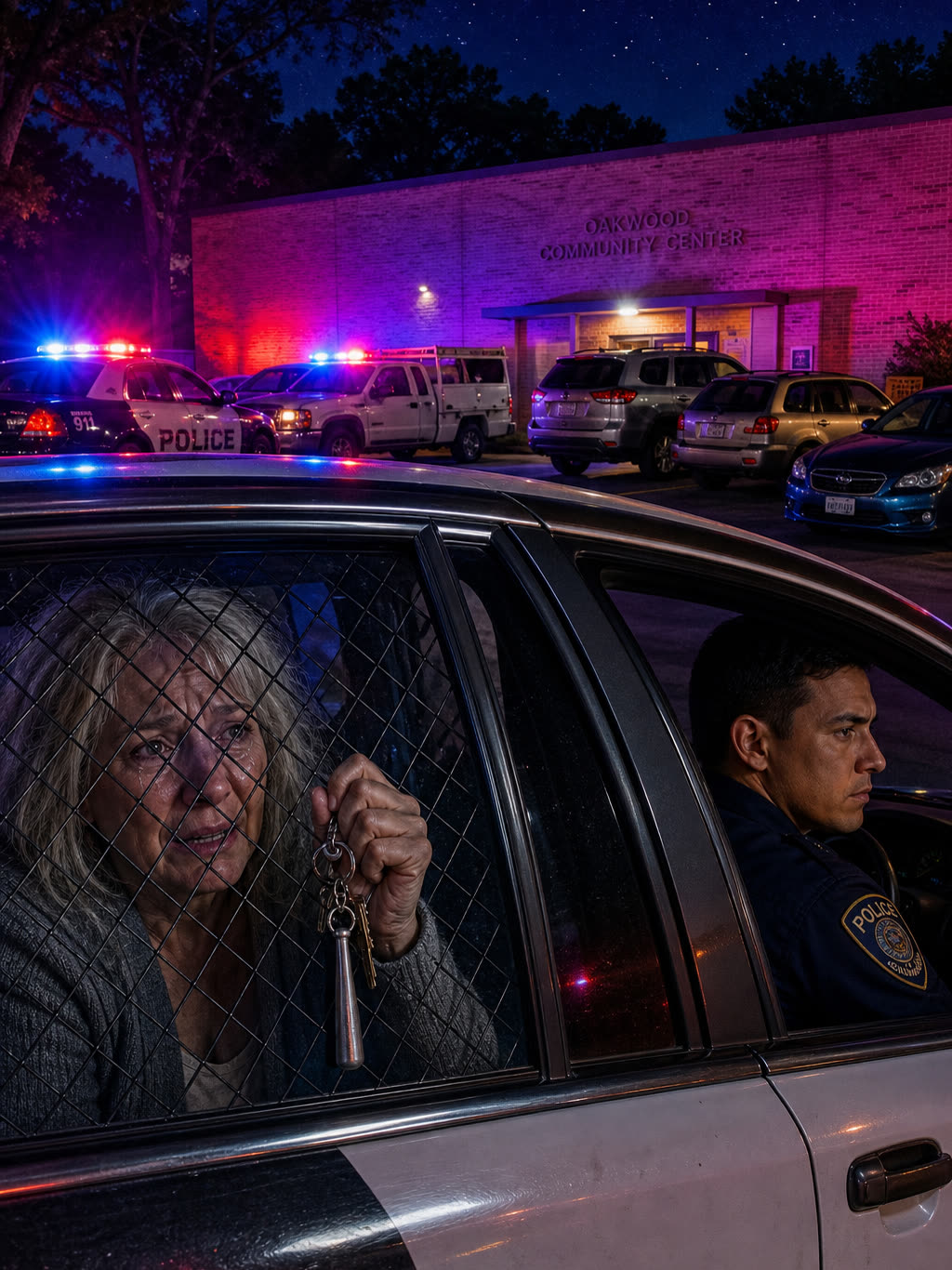
The conclusion slammed into me like a physical blow. The police hadn’t taken me to a hospital. They had set up a staging area. A triage center. Grant must have done something here. A standoff? An accident? The police had summoned the whole family to the scene so they could break the news all at once—or maybe to ask us to talk him down—but they had arrived too late.
Officer Alvarez put the car in park and cut the engine. He climbed out, came around to the back, and opened my door. “We’re here,” he said softly, holding out his hand. I didn’t take it. I couldn’t feel my legs. “They’re all here,” I whispered, staring at Jason’s truck. “You called my whole family.” “Yes, ma’am.”
I stumbled out of the car, my knees giving way beneath me. Alvarez reached out and caught my elbow, holding me steady. I sagged against him as my vision narrowed into a tunnel. The flashing red and blue lights bounced off the dark glass doors of the community center, making the whole building seem to pulse with blood. Every step toward those doors felt like a walk to my own execution. I squeezed Grant’s keys so hard that the little metal bat bit into my palm. I was bracing myself to see the chaplain. To see the grief counselors. To see my other five children weeping in the lobby. Alvarez reached out and pulled the heavy glass door open. “After you, Mrs. Henderson,” he said, his voice shaking slightly. I drew a deep breath, squeezed my eyes shut for a split second, and stepped into the darkness.
The lobby was pitch black. I took two steps forward. The silence was thick and heavy around me. I could make out the faint hum of the vending machines in the corner, but nothing else. No crying. No police radios.
Without warning, a blinding, brilliant light flooded the enormous gymnasium beyond the lobby doors. “HAPPY 60TH BIRTHDAY, MOM!” A dozen voices shouted it at once. Confetti cannons went off with a loud POP that echoed against the high wooden ceilings, showering colorful foil down onto the polished hardwood floor. I stood frozen in the doorway, blinking hard against the sudden onslaught of light.
The gym had been completely transformed. Hundreds of purple, gold, and white balloons floated against the ceiling. A huge, professionally printed banner stretched between the basketball hoops: WE LOVE YOU MOM! HAPPY 60TH! In the middle of the room, gathered around folding tables piled with catered food and a towering three-tier cake, stood my family. Mark, Jason, Caleb, Sarah, and Eliza. Their spouses. My grandchildren. A few close family friends. All of them wore party hats, held plastic cups, and grinned from ear to ear.
For three seconds, the room was a perfect picture of pure, unadulterated joy. Then they truly saw my face. I did not smile. I did not gasp with delighted surprise. I did not drop my purse and laugh.
The deep, traumatic terror that had been building inside me for four long hours—the empty table, the wailing sirens on the phone, the cryptic note, the car keys, the frightening ride in the cage of a police car—collided with this brightly lit room and shattered my mind completely. My brain simply could not make the flashing police lights outside fit with the party balloons inside. My legs finally gave out. I dropped to my knees on the hardwood floor, losing my grip on my purse. Grant’s heavy ring of keys struck the wood with a sharp, ugly clatter. “Mom!” Mark yelled, dropping his cup.
“Where is he?” I screamed. It wasn’t really a question; it was a primal, agonized wail ripping out of my throat and echoing horribly through the vast gymnasium. “Where is Grant?!” The smiles disappeared in an instant. The happy atmosphere drained away, replaced by a sudden, smothering panic. Someone abruptly shut off the music playing from a small speaker.
Sarah, my nurse, raced across the floor and fell to her knees beside me, reaching for my shoulders. “Mom! Mom, what’s wrong? Are you having chest pains?” I batted her hands away with a wild, frantic strength I never knew I had. “Don’t touch me! What is wrong with you people?!” I sobbed, tears blinding me. “Your brother is in an accident! He’s hurt, or he’s… he’s…” I couldn’t bring myself to say the word dead. I only pointed a shaking finger at the glass doors. “The police brought me! They gave me his keys! I heard the sirens on the phone!”
Jason hurried over, his face gone pale. He glanced at Mark, then at Sarah. “What is she talking about? Keys?” “The note!” I cried, yanking the crumpled paper from my pocket and hurling it at Mark’s chest. “He said he was sorry for what he did! He said he was at the scene! Why are you throwing a party while your brother is dead?!”
Mark picked up the note. As he read it, every bit of color drained from his face. He looked up, his eyes wide with a horrifying understanding. His gaze went past me, toward the lobby doors, where Officer Nate Alvarez stood awkwardly in the shadows, looking like he wished the floor would open up and swallow him. “Oh, my God,” Caleb whispered from a few feet away, covering his mouth. Eliza started to cry as she grasped what they had done to me.
They hadn’t ignored me. They hadn’t forgotten my birthday. They had organized an elaborate, enormous surprise party. And to get me out of the house, they had counted on Grant, the wildcard, to invent a cover story. Grant, who always pushed things too far. Grant, who thought a dramatic, movie-style police “arrest” would be a hilarious way to deliver his mother to a surprise party. Grant, who had no clue that a mother who spends her whole life waiting for the other shoe to drop will always assume the very worst when a cop knocks on her door.
Without meaning to, they had put me through the most profound psychological torture imaginable. I knelt on the floor amid the scattered confetti, hyperventilating, my hands clutching my chest, waiting for someone to finally confirm the nightmare. “Mom,” Mark said, his voice shaking, tears pooling in his own eyes as the guilt crashed over him. “Mom, listen to me. Breathe. Grant isn’t dead.” “I heard the sirens!” I shrieked. “He couldn’t breathe!”
“Mom, please,” Sarah begged, seizing my hands and holding them tight. “Look at me. Look at me. Grant is alive. He’s okay.” “Then where is he?” I demanded, my chest heaving. “If he’s alive, where is my son?!”
From the dim hallway that led to the locker rooms on the far side of the gym, a sound sliced through the tense silence. Clack. Clack. Clack. It was the heavy, steady rhythm of leather duty boots striking the hardwood. Every head in the room turned. A tall silhouette emerged from the shadows and walked slowly into the bright lights of the gymnasium.
Part 3: The Badge Over His Heart
He came to a stop about ten feet away from me.
I stared up at him through blurred, tear-soaked eyes, my mind straining to make sense of what I was seeing.
It was Grant. He was not bleeding. He was not in handcuffs. He was not zipped inside a body bag. He stood tall with his shoulders squared, dressed in a crisply pressed, spotless navy blue Fort Wayne Police Department uniform. His black boots gleamed beneath the gym lights. A heavy duty belt circled his waist. A silver badge shone on his chest, catching the light perfectly. And pinned just above his left breast pocket was a silver nameplate. HENDERSON.
For ten agonizing seconds, no one moved. The whole room held its breath. Grant’s hair, which was usually shaggy and unkempt, had been buzzed into a neat, military-style fade. He looked older. He looked solid. He looked like a man.
He gazed down at me kneeling on the floor, and his proud posture fell apart. He saw my red, swollen eyes. He saw the raw terror still trembling through my body. He saw the crumpled note lying on the floor. “Mom…” Grant whispered, his voice breaking. “Oh, God. Mom, I’m so sorry.”
Something inside me snapped as the adrenaline broke. The paralyzing terror transformed in an instant into a white-hot, explosive fury, fed entirely by the overwhelming relief that he was alive and breathing. I scrambled to my feet. Sarah tried to hold me back, but I pushed right past her. I marched straight up to my son—a man who towered over me, a sworn officer of the law.
I lifted my right hand and slapped him hard across his left shoulder. Smack. “Ow!” Grant flinched and stepped back.
“You stupid, reckless boy!” I screamed, striking his shoulder again, my fists pounding against his Kevlar vest. “You scared me to death! I thought you were dead! I thought you killed someone! How could you do that to me?!” “I know, I know!” Grant pleaded, lifting his hands in surrender as tears spilled from his eyes. “I didn’t think, Mom! I’m sorry, I’m so stupid, I just… I wanted to surprise you…”
I hit him one final time, every ounce of my energy spent. Then, with a loud, shuddering sob, I flung my arms around his neck and pressed my face into his chest. Grant caught me. His strong, muscular arms closed around me, lifting me a little off my feet. He buried his face in my hair, holding me tighter than he ever had in his whole life. He was trembling, crying every bit as hard as I was.
“I’m here, Mom,” he sobbed into my shoulder. “I’m right here. I’m safe. I’m so sorry.” I clung to his uniform, feeling the cold metal of his badge press into my cheek. It was real. He was real.
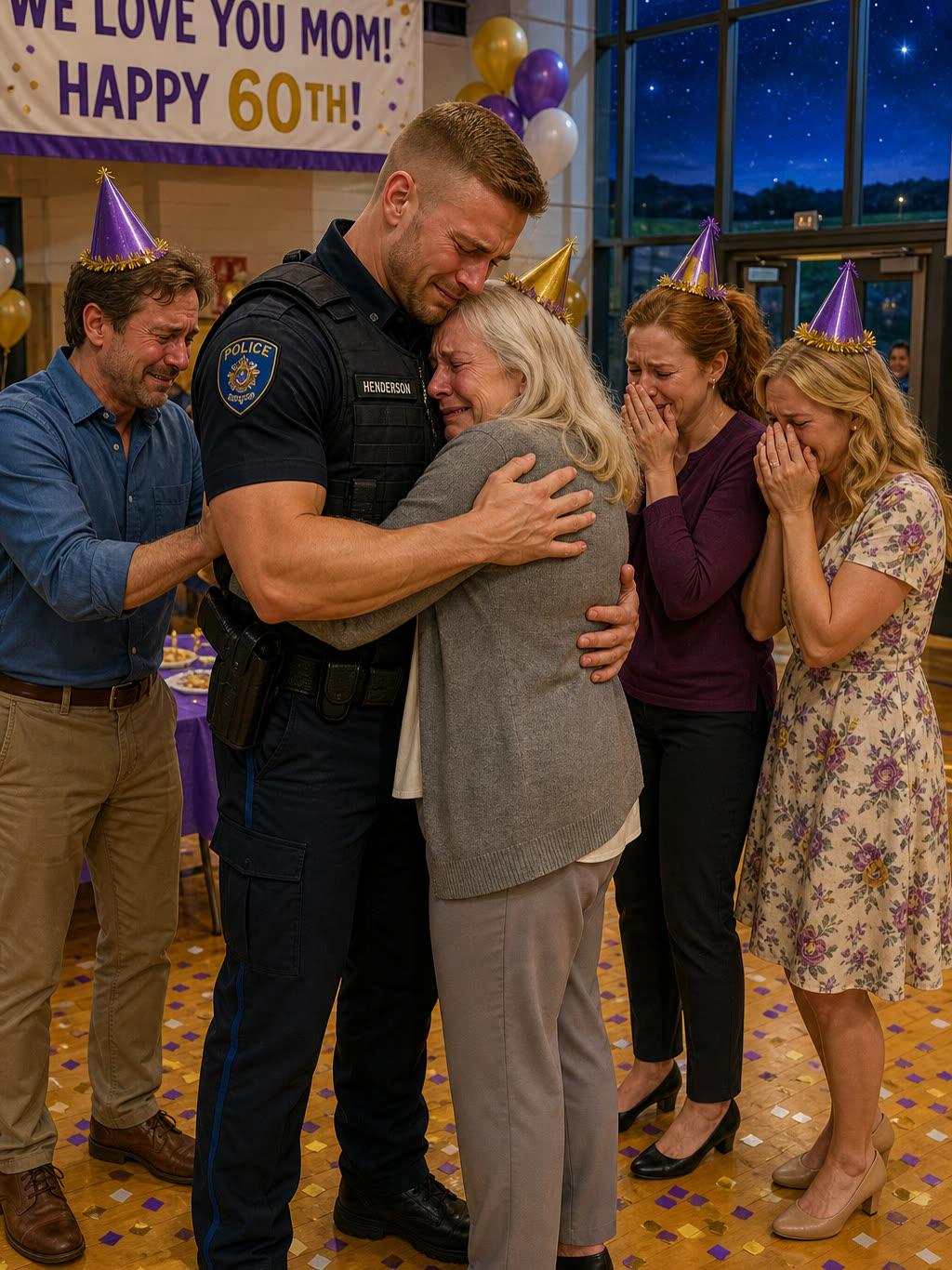
Little by little, the rest of the family closed in around us. Mark laid a hand on my back. Jason threw an arm around Grant. Sarah and Eliza wept openly. We stood there in the middle of the gym, a tight, tangled knot of a family, crying and laughing and trying to settle ourselves down.
Once my heartbeat had finally slowed back to its normal rhythm, I leaned back and looked at my son. I ran a shaking hand over the fabric of his uniform and touched the silver nameplate. “Grant,” I whispered, my voice hoarse. “What is this? What are you wearing?”
He wiped his eyes with the back of his hand and sniffed loudly. “It’s my uniform, Mom. I graduated the academy this morning. I was sworn in at three o’clock this afternoon.”
Mark stepped forward, looking completely bewildered. “You’re a cop? You? For how long?” “Seven months,” Grant said, glancing around at his brothers and sisters. “I’ve been in the academy for seven months. That’s why I’ve been missing Sunday dinners. That’s why I told you all I was working night shifts at the warehouse.”
“But… how?” Jason asked, putting into words what everyone else was thinking. The spray-painting. The stolen car. The fights.
Grant drew a deep breath. “It wasn’t easy. The background investigators dug into everything. I had to sit in front of a review board and explain every stupid, arrogant, angry thing I did when I was a teenager. I had to explain why Dad left, and how angry I was at the world.” He looked straight at me. “I didn’t make excuses, Mom. I told them I was a screw-up. But I told them I didn’t want to be angry anymore.”
“Why didn’t you tell me?” I asked as fresh tears gathered in my eyes. “Why keep it a secret?” Grant dropped his gaze to his boots. “Because I was terrified I’d wash out. I was terrified I’d fail the physicals, or the exams, and prove everyone right. Everyone always expected me to fail, Mom. Teachers. Neighbors. Even Dad.”
He raised his head, and his eyes locked onto mine with a fierce, burning intensity. “Everyone except you. You never gave up on me. Even when I screamed at you, even when I stole from you. You sat on the edge of my bed and told me I was better than my worst mistakes. I wanted to prove you right. I wanted to walk in here tonight, wearing this badge, and show you that your sacrifices weren’t for nothing.” My heart swelled until I was sure it would burst.
“But the plan got messed up,” Grant confessed, looking miserable all over again. “The swearing-in paperwork took forever. I couldn’t leave headquarters. I knew I was going to be late to pick you up. So, I called Nate.” He nodded toward Officer Alvarez, who was still standing near the door and looking enormously relieved that I hadn’t suffered a heart attack. “I told Nate to go get you. I thought it would be funny. I thought a fake arrest, a mysterious note… I thought it would be like a movie.”
“It was an awful movie,” I sniffled, dabbing my nose with a napkin Sarah passed me. “I know,” Grant said. “When I called you from the station… there was an ambulance pulling out of the bay with its sirens on. And the static… my radio was acting up. I just wanted to say I was sorry I was late. But the call dropped. I had no idea what you thought was happening.”
I reached up and cradled his face in my hands. His cheek was a little rough with stubble. He was a man. A good man. “You scared half my life away tonight, Grant Henderson,” I told him fiercely. “If you ever pull a stunt like this again, I will have your badge, do you hear me?” He let out a watery laugh. “Yes, ma’am. Understood.”
“But,” I went on, my thumbs brushing away his tears, “I have never, ever been more proud of you than I am right now.” Grant closed his eyes and leaned into my palms, and the very last traces of that angry little boy slipped away forever.
At last, the tension in the room gave way. Jason clapped his hands together loudly. “Alright! Mom is alive, Grant is a cop, and I am starving. Can we please eat this food before I pass out?” We laughed. It was shaky, worn-out laughter, but it was genuine.
We drifted over to the tables. Somehow, over the past two weeks, the kids had managed to slip into my house, copy my recipes, and recreate the very meal I had been cooking at home. There was pot roast, scalloped potatoes, and green bean casserole. It was cold, just like the food waiting on my dining room table, yet it was the finest meal I had ever eaten.
We sat together in a circle of folding chairs. Mark made a disaster of cutting the cake. Jason told a joke that was not appropriate. Caleb and Eliza squabbled over the last roll. And Grant sat beside me in his full uniform, telling us about the punishing morning runs at the academy, the drill instructors who shouted in his face, and the excruciating exams.
Sitting there, watching all six of my children talk and laugh, I came to understand something profound. For twenty years I had carried the heavy, smothering fear that Ray’s abandonment had broken our family beyond repair. I had believed my children would forever bear the scars, forever searching for some missing piece of themselves.
But as I looked at them now, what I saw was resilience. Yes, they had made mistakes. Tonight had been a catastrophic, terribly executed mistake. But everything they had intended grew out of a deep, desperate love for me. They had pulled together. They had kept coming back. They had chosen one another.
I didn’t get the quiet, elegant birthday dinner I had so carefully planned. What I got instead was a terrifying, chaotic, emotional explosion of a night. But I also got my son back. The boy I had spent years believing in had finally started to believe in himself.
And when we loaded up the cars at midnight and Grant walked me to my front door, he didn’t simply drop me off and race away into the night. He paused on the porch, wrapped his arms around me, and kissed the top of my head. “I’m here, Mom,” he whispered into the cool night air.
And this time, gazing at the silver badge resting over his heart, I knew he meant it for good.
If you’d like more stories like this one, or if you want to tell me what you would have done in my place, I would love to hear from you. Your perspective helps these stories reach more people, so please don’t hesitate to comment or share.
Disclaimer: This story is a work of fiction inspired by real-life themes. Names, characters, places and events are fictionalized, and any resemblance to real persons is purely coincidental. Images are for illustration purposes only.
