

PART 1 — THE TAPE ON THE HALLWAY WALL
That fall, the first time I really looked at my daughter’s face, it was blown up to poster size on a wall in her school hallway.
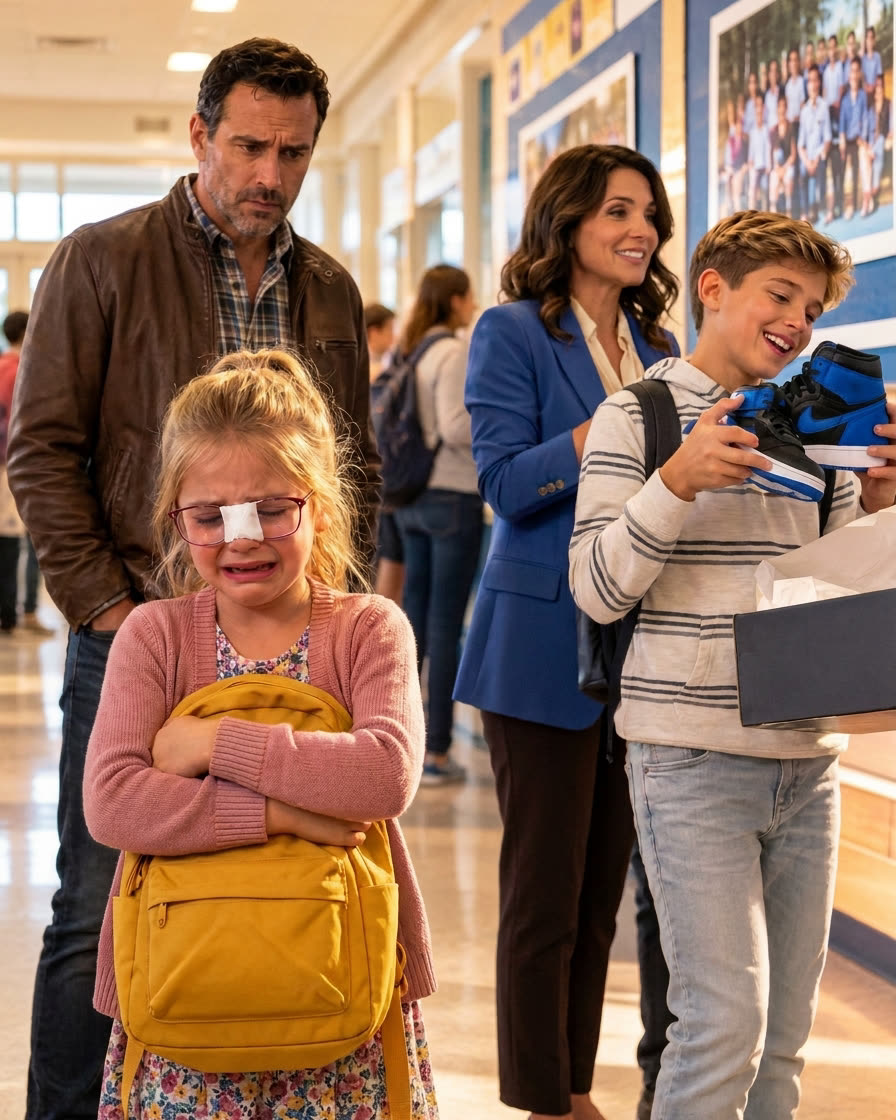
Her broken glasses were held together with a strip of white tape.
A few feet away, my wife was cheerfully telling another parent about the expensive sneakers she’d bought for her son.
When I asked her about my daughter’s replacement glasses, she gave me an answer I still can’t shake.
"She broke them. She can keep wearing them."
I’m Frank Delgado. I’m forty-seven, I run construction crews as a foreman in Fresno, California, and until Friday, October 16, 2026, I honestly believed I was doing right by my family.
I was wrong.
My daughter, Rosie, was ten. She’d needed glasses since first grade, and without them, anything more than a few feet away turned into a blur.
My wife, Brenda, was forty-one. We’d been married four years, and her son, Dominic, was twelve.
Dominic was a good kid. He loved basketball and collected sneakers that cost more than my work boots. He called me Dad Frank, and I’d always thought of him as family.
Brenda took care of the school emails, the clothes, and the appointments. I paid for most of the household and spent long days overseeing job sites.
We figured that system worked.
I never understood how much could slip past me once I trusted someone else to handle everything.
That Friday, I left the site early for the annual photography exhibition at Maple Grove Elementary.
Rosie had talked about it all week.
"Dad, our class picture’s going on the big wall. You’re coming, right?"
"Wouldn’t miss it."
At 3:08 p.m., I walked into the hallway. It smelled of fresh paint and construction paper.
Parents strolled past rows of student photos while kids eagerly pulled them toward pictures of field trips, science projects, and friends.
Brenda was near the entrance with Dominic, chatting with another mom.
"The black pair cost two hundred and forty dollars," she laughed. "But Dominic looks after his shoes. They’re worth every penny."
Dominic looked a little embarrassed.
I gave them a wave and went to find Rosie’s display.
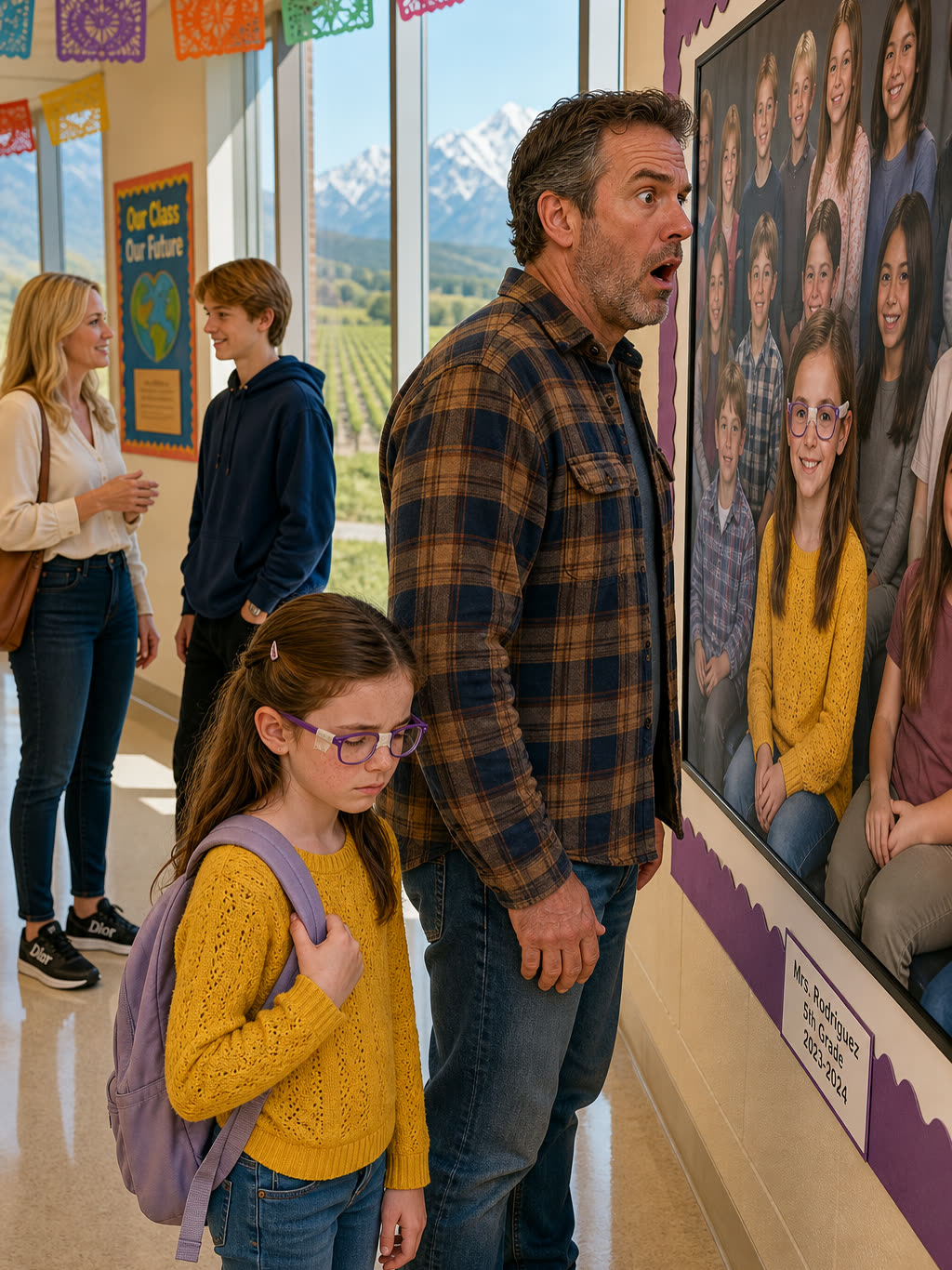
Her class photo hung beneath a bright paper banner. It had been taken on September 11.
Rosie sat in the front row in her favorite yellow sweater, her hair clipped back, her hands folded neatly together.
She was smiling. But her head was tipped slightly to one side.
A thick band of white tape stretched across her purple glasses.
I stopped cold.
At that size, the tape was impossible to miss. One lens sat lower than the other. Even her smile looked forced.
I knew those glasses had broken in July. That was what bothered me most.
I’d seen the tape at dinner back in August. When Rosie asked about new glasses, Brenda said she’d already ordered them, and I told Rosie to be patient.
In September, Rosie brought it up again while I was going through work emails.
"Brenda’s handling it, sweetheart," I’d told her. Then I went straight back to my phone.
Standing in that hallway, it hit me. September 11 was long past. It was October 16. And Rosie was still wearing those broken glasses.
"Beautiful class, aren’t they?"
I turned. Ms. Nguyen, Rosie’s teacher, stood beside me.
"That’s my daughter," I said.
"I know. Rosie’s a wonderful, thoughtful student."
She hesitated.
"Has she gotten her new glasses?"
"Not yet."
"Oh. I’d hoped they’d arrive before the exhibition."
"What do you mean?"
Worry crossed her face.
"She’s struggling to see the board. We’ve moved her closer, and I emailed twice."
"Who received those emails?"
"Mrs. Delgado. She’s the primary contact for school communications."
I looked back at the photograph.
"You contacted Brenda?"
"Yes. She told me the glasses were ordered."
My stomach knotted. Rosie’s teacher knew she was struggling, and I’d had no idea.
Then Brenda walked over.
"Frank? There you are."
I turned to her.
"Where are Rosie’s replacement glasses?"
Her smile disappeared.
"What?"
"The ones you supposedly ordered in August."
She glanced at Ms. Nguyen.
"Can we talk later?"
"Did you order them?"
"Frank, please don’t start."
"Answer me."
She dropped her voice.
"I told you shipping was delayed."
"Then show me the confirmation."
Her face went rigid.
"You’re making a ridiculous scene."
Rosie appeared next to us, quietly gripping the strap of her backpack.
Brenda glanced at the photo.
"Frank, she needs to learn responsibility. She broke those glasses herself."
"She fell while wearing them at summer camp."
"Then she should’ve been more careful."
"Brenda, she needs them to see."
"Dominic looks after his belongings. That’s why he gets nice things."
I looked at Rosie. She was staring at the floor.
Part of me wanted to keep arguing. Instead, I took out my phone.
"What are you doing?" Brenda asked.
"Calling her eye doctor."
"Now?"
"Yes."
Dr. Tran’s office answered at 3:24. They had a 4:30 opening, and I took it on the spot.
"Her glasses broke in July," I explained. "She needs an examination and replacement frames."
When I hung up, Brenda folded her arms.
"You’re embarrassing me."
I looked her straight in the eye.
"Rosie’s been wearing broken glasses at school for three months."
Then I turned to my daughter.
"Get your things, sweetheart. We’re having your eyes checked."
She followed me without a word.
Outside, the bright afternoon sun made her squint. When we reached my truck, she tugged gently at my sleeve.
"Dad?"
"Yes, sweetheart?"
"Please don’t be angry with Brenda."
I crouched down next to her.
"Why would you think that?"
She looked down at her shoes.
"I asked three times. She doesn’t like it when I keep asking."
"Three times?"
She nodded.
"After they broke, before school started, and before picture day."
My chest went tight.
"Why didn’t you tell me?"
She looked honestly puzzled. Then she said five words I will never forget.
"I did tell you, Dad."
I couldn’t say anything.
"You said Brenda was handling it," she explained. "So I thought I shouldn’t ask anymore."
She touched the tape on her glasses.
"And I didn’t want you disappointed in me."
Standing beside my truck, I finally understood. For three months, my daughter had kept asking for something she truly needed. And every time I waved her off, I’d taught her, without meaning to, that asking got her nowhere.
At 4:30, Dr. Tran set Rosie’s glasses on a metal exam tray. The tape was peeling, one hinge was cracked, and dried glue held the bridge together at a crooked angle.
She turned them over under a bright lamp.
"How long has she worn these?"
"Since July," I replied.
"About three months," Rosie added quietly from the exam chair.
Dr. Tran frowned.
"The damaged frame isn’t positioning the lenses properly. They’re sitting at different angles."
"Could that permanently affect her eyesight?"
"An outdated prescription doesn’t necessarily cause permanent damage," she explained. "But inadequate correction can contribute to blurry vision, headaches, and eye strain. Her nearsightedness may also have progressed naturally."
She checked Rosie’s chart.
"Her last complete examination was fourteen months ago. She was due for another assessment."
I remembered that visit. August 2025. I’d taken the day off to bring her. Afterward, Brenda offered to handle the follow-ups, and I agreed without a second thought.
With her old prescription, Rosie stumbled over several rows of letters. Then Dr. Tran switched the lenses, and Rosie sat bolt upright.
"Oh!"
Dr. Tran smiled.
"Is that clearer?"
Rosie nodded eagerly.
"The letters aren’t blurry!"
She read the next line correctly. Then the one after that.
Watching her, I remembered things I’d noticed and never looked into. She’d started sitting closer to the TV. She’d stopped reading before bed. Sometimes she rubbed her forehead after homework.
"Her prescription has changed considerably. We’ll update both lenses."
Then Dr. Tran asked, "Rosie, do you experience headaches?"
"Sometimes."
"How frequently?"
Rosie hesitated.
"Most days after school."
I leaned forward.
"Most days?"
She nodded.
"Especially after reading."
"Why didn’t you tell me?"
She dropped her eyes.
"I thought everyone who wore glasses got headaches."
My heart sank. She hadn’t realized her pain was worth mentioning.
Dr. Tran moved closer.
"Rosie, glasses shouldn’t regularly cause headaches. Whenever something feels wrong, tell an adult who can help."
Rosie glanced at me. I knew exactly what that look meant. She had already spoken up. We just hadn’t listened.
At the optical counter, the technician pulled up our insurance. Our family plan included a yearly eyewear allowance, and Rosie’s 2026 benefit hadn’t been touched. No replacement order had ever been submitted.
Brenda had blamed the insurance company. But there wasn’t even a claim waiting for approval.
"How much would two pairs cost?" I asked.
The technician explained that our coverage would help with one pair, and we’d pay for the second ourselves.
"Let’s get two."
Rosie looked startled.
"Two pairs?"
"One for everyday wear and another as backup."
"Isn’t that expensive?"
It hurt to hear her worry about money.
"We can afford your glasses, sweetheart."
She scanned the shelves: black frames, blue frames, purple frames, and one bright red pair. Her eyes went straight to the red ones. Then she looked away.
"Those might be too much."
"Too expensive?"
"Too bright."
"Do you like them?"
She nodded.
"Then let’s see how they look."
Rosie slipped them on and turned to the mirror. For the first time all afternoon, her smile looked completely natural.
The technician found a smaller size that fit comfortably, and Rosie also picked a sturdy pair of dark-purple frames. Both would arrive with her new prescription in about five days. In the meantime, the technician fitted her old lenses into a temporary frame so she could finally stop wearing the taped ones.
I asked to keep the broken frame. The technician slipped it into a small paper bag, and Rosie held it on her lap the whole drive home.
On the way, I asked about the three times she’d asked for new glasses. She counted them on her fingers.
"First, after I fell at summer camp."
"What happened?"
"I slipped near the slide. Mr. Harris helped me and called Brenda because my glasses broke."
"And the second time?"
"Before school started."
"The third?"
"Before picture day."
She hesitated.
"I didn’t want the tape showing in our class picture."
My chest tightened.
"What did Brenda say?"
"She said I broke them, so I had to keep wearing them."
I kept my eyes on the road.
"Anything else?"
"She said Dominic knows how to look after his belongings."
"Rosie, accidents happen. You did nothing wrong."
She turned toward the window.
"Then why did she keep saying it?"
I couldn’t come up with an answer a ten-year-old would understand.
That evening, I asked Brenda for the order confirmation. She said she’d find it. When I told her the insurer had no claim on file, she got defensive right away.
"Maybe the optical store forgot to submit it."
"Then there should still be an order."
She went quiet. I refused to fight in front of the kids.
At 9:42, after they’d gone upstairs, I logged into our joint household account. Four years earlier, Brenda and I had set up a separate fund for the children. We both paid into it. It covered clothes, school supplies, activities, routine medical costs, and the occasional extra. Brenda kept the debit card. I had online access but rarely looked at individual purchases.
I downloaded July through October. Fourteen pages. Then I pulled out the shoebox labeled KIDS, where Brenda kept the receipts, and started checking them against the statements.
Four pairs of designer sneakers for Dominic. $245. $219. $256. $240. Total: $960.
A smartwatch: $329. Two branded hoodies: $310. Bicycle and sports accessories: $341.
I checked my math twice. $1,940.
Then I searched for anything connected to Rosie’s glasses. Replacement frames. Prescription lenses. Optometry copays. Insurance reimbursements.
Nothing.
The only related purchase was $6.40 for tape and glue.
I sat at the kitchen table until after midnight. Dominic having nice things wasn’t the problem. The problem was that Rosie had been taught her most basic needs were too much to ask for.
We’d spent $1,940 on extras for one child, and nothing at all to replace the other child’s broken glasses.
One question remained.
Had Brenda simply put it off, or had she never placed the order at all?
PART 2 — THE CONFESSION AT THE KITCHEN TABLE
By Monday morning, I had a spreadsheet, fourteen pages of transactions, and a growing fear that money wasn’t the biggest problem.
Over the weekend, our vision insurer confirmed there was no pending eyewear claim for Rosie. The clinic also confirmed that Friday’s purchase was her first new eyewear order in more than a year.
On Monday, October 19, I called Maple Grove Elementary and asked for any records about Rosie’s broken glasses. Once they’d verified I was her parent, the office sent three documents.
The first was an incident report dated Friday, July 17, 2026. Rosie had slipped near a slide during the school’s supervised summer program. She wasn’t hurt, but her glasses had snapped at the hinge. Staff called Brenda, and her response was in the report: Parent stated replacement glasses would be arranged within the week.
Within one week. Ninety-four days had gone by.
The second was Ms. Nguyen’s email from September 15. Rosie was squinting in class, had mentioned headaches, and had asked to sit closer to the board. Brenda had replied: They’ve already been ordered. Shipping is taking longer than expected.
The third, dated October 6, said Rosie still couldn’t see the board and asked about extra temporary accommodations. Brenda never answered.
Every message had gone to the only address on file for school updates. Brenda’s. I’d never checked whether I was getting copies. I’d worked overtime to pay for Rosie’s education and healthcare while staying completely shut out of the conversations about what she needed.
I printed everything. At 7:43 that evening, once the kids were upstairs, I asked Brenda to join me at the kitchen table.
She saw the papers. "What’s all this?"
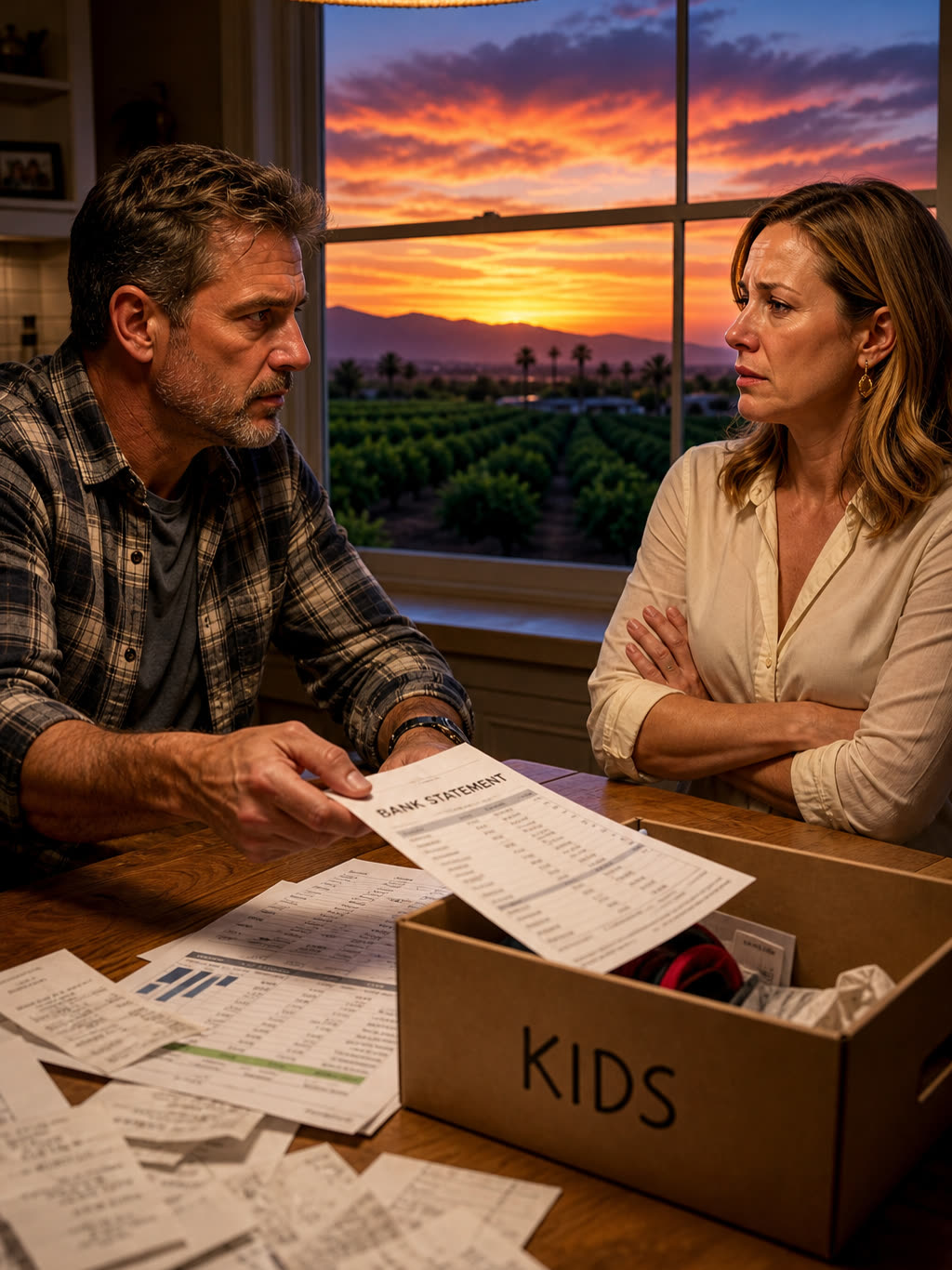
"Receipts, bank statements, and school emails."
Her expression changed.
"Frank, are you investigating me?"
"I’m trying to understand what happened with Rosie’s glasses."
She crossed her arms.
"You’re treating me like I’ve committed a crime."
"I’m asking for an explanation."
I slid the spreadsheet in front of her.
"Between July and October, we spent $1,940 on extras for Dominic."
She frowned.
"Why are you tracking everything I bought my son?"
"Because we spent nothing replacing Rosie’s glasses."
"Dominic needed school supplies."
"Four pairs of designer sneakers?"
"They weren’t purchased together."
"I know. I’ve checked every date."
She stared at the papers.
"I’m not against Dominic having gifts or shoes. But we paid for things he wanted while Rosie went without something essential."
"She has you," Brenda replied.
I stared at her.
"What does that mean?"
"You’re her father. You always provide for her."
"Then why didn’t you tell me she was still waiting?"
Brenda looked away. I handed her the July incident report.
"You knew her glasses broke accidentally."
She said nothing.
"You promised the summer program you’d replace them within a week."
"I planned to."
"Then why keep telling Rosie she was careless?"
"Children need to learn responsibility."
"Brenda, she slipped near a playground slide."
"She should’ve been more careful."
"She’s ten. Acc!dents happen."
I put Ms. Nguyen’s emails on the table.
"September fifteenth. You claimed the glasses were ordered."
Brenda sighed.
"Frank—"
"October sixth. Her teacher contacted you again because Rosie couldn’t see properly."
"I was busy."
"So was I. That’s why I’m admitting I should’ve followed up instead of assuming everything was handled."
She looked up at me.
"I let Rosie down," I continued. "But that doesn’t excuse your decisions."
Brenda started to cry. I asked the question that had been eating at me all weekend.
"Did you ever order those glasses?"
Silence.
"Brenda?"
She shook her head.
"No."
I stared.
"No?"
"I meant to."
"When?"
"After the acc!dent. Before school started. I kept intending to call."
"Why didn’t you?"
She wiped her cheeks.
"Other things kept coming up."
"Like sneakers?"
Her face reddened.
"That’s unfair."
"So was making Rosie believe an accident meant she didn’t deserve proper glasses."
Brenda covered her face.
"I didn’t want to admit I’d forgotten."
"So you blamed her instead."
"I never meant to upset her."
"But you knew she was waiting."
"Yes."
"And that her teacher was concerned."
"Yes."
"And that no order existed."
She nodded.
I leaned back. There it was. Three months of false explanations. No lost shipment. No insurance holdup. No simple mix-up. Brenda had kept blaming Rosie rather than own her mistake.
"Why were Dominic’s shoes always the priority?" I asked.
Brenda looked down at the receipts.
"His father hasn’t supported him in years."
I waited.
"Dominic has heard so many promises that never happened. Birthdays, Christmas, school trips. His father always said he’d help, then didn’t."
"So you buy everything Dominic requests?"
"I don’t want him feeling forgotten."
"And Rosie?"
Brenda met my eyes.
"Rosie has a father who stays."
Her words stunned me.
"Does that mean her needs can wait?"
"No."
"We both contributed money for both children."
She began crying again. I kept my voice low.
"I love Dominic. He’s done nothing wrong. But you treated his wishes as urgent while Rosie’s eyesight became an afterthought."
Brenda whispered, "I assumed you’d eventually handle it."
"Only if someone told me what was happening."
We sat without speaking. Then footsteps sounded near the doorway.
Dominic stood there in pajama pants and his newest black sneakers. He’d apparently come down for a glass of water. I had no idea how much he’d heard.
"Mom?"
Brenda straightened up.
"Sweetheart, go back upstairs."
He didn’t move.
"You told us Rosie’s glasses were coming."
"Dominic, please."
"You said they’d already been ordered."
Brenda had no answer. I stood up.
"Buddy, the adults will work this out."
He looked at the receipts. Then down at his shoes. He swallowed hard.
"How much do glasses cost?"
"Dominic—"
"Would selling these be enough?"
I froze. He turned to me, clearly upset.
"Dad Frank, I could sell my new sneakers. I didn’t know Rosie was still waiting."
Then he said something that brought fresh tears to Brenda’s eyes.
"She’s my sister. I would’ve helped her."
I knelt down beside him.
"Look at me, buddy."
He wiped his cheeks.
"Dominic, listen carefully. Rosie’s replacement glasses are already ordered. Two pairs."
"Two?"
"One purple and one red. She chose them Friday."
"So she doesn’t need my shoes?"
"No. And even if she did, selling your belongings wouldn’t be your responsibility."
He looked confused.
"But Mom bought me all those things."
"Those were her decisions. You didn’t know what was happening."
He glanced at Brenda.
"I thought Rosie’s glasses were being shipped."
"So did I, for a while."
I put my hand on his shoulder.
"None of this is your fault. Those shoes are yours, and paying for your sister’s medical care isn’t your responsibility."
His lips trembled.
"I don’t want Rosie thinking I got everything instead of her."
"Then remind her you love her. That’s what matters."
He nodded, and I pulled him into a hug. Then he went back upstairs.
Once the hallway was quiet, Brenda whispered, "I never wanted him feeling guilty."
"Then neither child should have to carry our mistakes."
We talked until nearly eleven. From then on, any nonessential purchase over $50 from the children’s fund needed both of us to agree. Not just Brenda. Both of us. We’d share account access, get transaction alerts, and go over spending every month. Necessary healthcare would never be held up waiting for approval, and both parents would receive every school and medical update.
"Fairness doesn’t mean identical purchases," I explained. "Dominic might need quality running shoes, while Rosie needs prescription lenses. We should meet their individual needs, not make them compete."
Brenda agreed. She also agreed to put back the $1,940 she’d spent on Dominic’s extras, and offered to sell several of her designer handbags to do it. I made it clear Dominic wouldn’t give up anything.
I owned my part too. Brenda held the card, but I’d stopped watching what we spent. I’d cover whatever insurance didn’t, go to Rosie’s appointments, and get more involved in both kids’ schooling. The next morning, I updated our contact information with the school and her doctors. Nobody congratulated me. I was just finally doing what I should have been doing all along.
On Wednesday, October 21, the optical shop called. Rosie’s glasses were ready. I picked her up after school, and she practically ran to the counter.
She put on the purple pair and looked across the store. She blinked. Then she broke into a huge smile.
"Dad, I can read that sign!"
It listed the shop’s hours in tiny print. She read every word out loud, and I laughed right along with her.
Then she tried the red frames and studied herself in the mirror.
"They’re really red."
"They certainly are."
"Are they too bright?"
"Do you like them?"
She grinned.
"Yes."
"Then they’re perfect."
At dinner, she read the menu without leaning in. She asked to keep the receipt because it was the first thing she’d read clearly through her new lenses, and she folded it carefully into her backpack.
At home, Brenda noticed the glasses right away.
"They look beautiful, sweetheart."
"Thank you."
Rosie didn’t offer a hug. Brenda looked briefly hurt, and I gave a small shake of my head. Rosie didn’t owe anyone comfort.
Later, Brenda knocked on Rosie’s door while I sat beside her reading.
"May I come in?"
Rosie nodded. Brenda stayed by the doorway.
"I owe you an apology."
Rosie lowered her book.
"I’m sorry I didn’t replace your glasses when I promised. And I’m sorry I blamed you for breaking them."
Rosie studied her hands.
"I knew it was an accident," Brenda continued. "I should never have made you feel responsible."
Silence.
"It’s okay if you’re upset with me."
Rosie looked up.
"I’m not really angry."
Brenda’s face softened. Then Rosie added something none of us expected.
"I’m scared you’ll promise something’s coming again when it isn’t."
Brenda swallowed.
"I understand."
Rosie adjusted her purple frames.
"Can I ask you something?"
"Anything."
"If someone says they’re sorry, do I have to say it’s okay?"
Brenda looked at me. I answered gently.
"No, sweetheart. You don’t."
"Even when they mean it?"
"Even then."
Rosie nodded slowly and turned back to Brenda.
"I want to believe you."
Brenda’s eyes filled.
"But I’m not sure I can yet."
For once, Brenda didn’t make excuses.
"Then I’ll have to prove it."
Our first family counseling session was November 5. I moved two construction inspections to be there. A year earlier, I’d have sent Brenda alone and asked for a summary.
Our counselor, Marissa Walsh, worked with blended families. She listened to all of it: the broken glasses, the order that never existed, the account, Dominic’s offer. Then she turned to Brenda.
"When you bought things for Dominic, what worried you about saying no?"
"Nothing worried me."
Marissa waited. Eventually, Brenda looked down.
"I was afraid he’d feel abandoned again."
Dominic’s father, Miguel Alvarez, had walked out when Dominic was six. He’d promised to come to his seventh birthday and never showed. Camping trips, Christmas gifts, help with school costs: most of those promises turned into excuses, and then even the excuses stopped. There was a child-support order, but he hadn’t paid reliably in years. Brenda had worked two jobs to get by.
"I promised myself my son would never wait for another man to decide whether he deserved something," she said, her eyes wet.
"And when Rosie needed something?" Marissa asked.
Brenda was silent for a long moment. Finally, she whispered, "That Frank would handle it."
Marissa leaned in.
"Your experiences may explain this pattern. They don’t excuse delaying Rosie’s glasses or making false claims about the order."
Brenda nodded.
"I understand."
Then Marissa asked why I hadn’t followed up. I thought about mentioning my schedule, the long days, Brenda handling the appointments. All true. None of it an excuse.
"Because Brenda said she’d handled it," I admitted. "And trusting that answer was easier than checking."
My voice wavered.
"I thought being a good father meant earning enough to provide everything my daughter needed. But when she actually needed help, I didn’t spend five minutes confirming she received it."
Brenda reached across the table, and I took her hand. Not because everything was forgiven, but because fixing our family meant we both had to face what we’d done.
On November 12, Brenda took three designer handbags to a consignment shop. They sold for $1,650, and she added $290 from her savings, putting the full $1,940 back before the month was out. Neither of us mistook repaying money for repairing trust.
On Sunday, November 22, Rosie agreed to a family conversation, on one condition: Dominic had to be there. Brenda had written out an apology but set the paper aside and spoke plainly about the accident, the broken promise, the blame, the lies to me and to Ms. Nguyen.
Rosie gripped a couch cushion.
"Did you know I didn’t want the tape showing in my class picture?"
"Yes."
Rosie’s voice shook.
"Then why didn’t you help me?"
Brenda started crying.
"Because I kept delaying it. Eventually, admitting my mistake felt harder than telling another lie."
"But I was the one wearing them."
"You’re right."
Then Rosie turned to me.
"Dad, did you really believe the glasses were coming?"
"I did."
"Even after I asked you?"
"Yes. But I should’ve checked."
She lowered her eyes.
"I thought maybe you didn’t want to buy them either."
That nearly broke me. I told her I was sorry, that I’d seen the tape and let her wait anyway, and that from now on I would listen. She took my hand.
Dominic cleared his throat.
"I honestly didn’t know."
"I know."
"I would’ve shared my things."
She smiled faintly.
"Dominic, I didn’t want your things. I just needed glasses."
He leaned over and rested his head against hers for a moment. Nobody pushed Rosie to forgive anyone. Afterward, she went upstairs to read, and that was okay.
A week later, Dominic needed running shoes for his school team. His coach recommended a $120 pair. Brenda and I went over the budget and approved it together while Rosie quietly watched from her homework.
"So Dominic can still have new shoes?"
"Of course," I answered. "He needs suitable shoes for running."
"And if I need glasses again?"
"We’ll get them," Brenda promised.
Rosie thought about that. Then she asked the question that showed how much trust we still had to rebuild.
"What if I accidentally break these?"
Brenda and I traded a look.
"Then we’ll repair or replace them," I said.
Rosie nodded, but she didn’t smile. She’d heard promises before.
We were about to learn that trust only comes back when you keep those promises, especially when keeping them is inconvenient.
PART 3 — FOUR WORDS BENEATH TWO PHOTOGRAPHS
By December, Rosie’s schoolwork was improving.
Her teacher sent a progress note I read over and over.
Rosie has returned to her regular seat. She can see the board comfortably again and participates more confidently during reading activities.
Her grades climbed slowly, not overnight. Some days were still hard, and we knew new glasses couldn’t fix everything.
At her December follow-up, Dr. Tran confirmed the new prescription was working. Rosie said the daily headaches were gone.
"How are your glasses?" Dr. Tran asked.
Rosie smiled. "Great. I have two pairs."
"Which are your favorites?"
"The red ones when I want attention. The purple ones when I don’t."
Dr. Tran laughed. "Sounds like you’ve figured it out." That Christmas, Brenda gave Rosie a small wooden glasses box with her name carved into the lid by a local craftsman. Inside the lid, Brenda had written: Your glasses are something you need, not something you must earn.
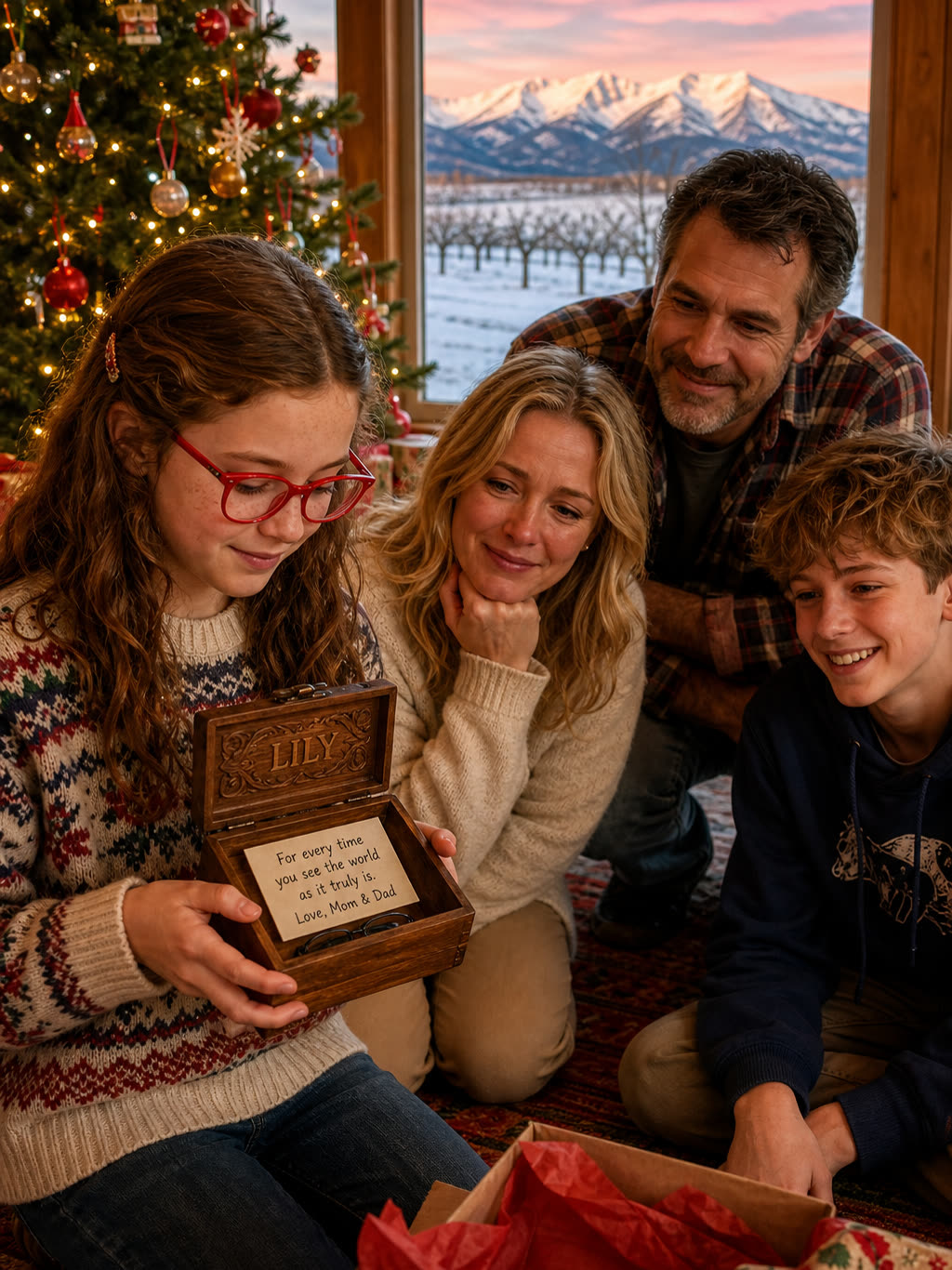
Rosie read it, then looked at Brenda. There was no hug and no speech. Just a little more trust than the month before, and Brenda accepted it without asking for more.
Our new money system became routine. Each month we went over the children’s account together: school activities, clothes, healthcare, what was coming up. We sometimes disagreed, but we learned to work it out without comparing the kids. Brenda also contacted the county child-support office about Miguel’s unpaid support. No big win, just paperwork and patience.
By January, I’d rearranged my schedule to make it to more school events. When Dominic ran track, Brenda and I cheered side by side. Work still got in the way, but I learned to find coverage instead of assuming family could wait.
Then came Wednesday, March 17, 2027. I was on a job site when Brenda called at 3:47 p.m.
"Frank, Rosie’s okay."
My stomach dropped.
"What happened?"
"Her purple glasses broke during the library club."
"Is she hurt?"
"No. She’s fine. They fell while she was cleaning them, and another student accidentally stepped on one arm."
"Does she have the red pair?"
"She’s wearing them."
"How did she react?"
Brenda paused.
"She apologized."
"Frank, she looked frightened for a moment."
That stayed with me. The accident was small. Her reaction showed the old hurt hadn’t gone away.
"I’m coming home," I said.
Months earlier, I’d have told myself I couldn’t leave. Now I handed the afternoon checklist to my assistant foreman. Someone else could supervise the concrete prep. My daughter needed to see me show up.
When I got home, Rosie was on the couch in her red frames. The broken purple pair sat on a clean towel next to Brenda.
"I’m sorry, Dad."
"Are you hurt?"
"No."
"Then everything’s okay."
She looked confused.
"But my glasses broke."
"Sounds like an accident."
"Are you disappointed?"
"Not at all."
"What if they can’t repair the purple ones?"
"Then we’ll replace them."
"Even though I dropped them?"
"Even then."
Brenda sat down beside her.
"Rosie, I know I told you something different before. But I was wrong. You need glasses, and an acc!dent doesn’t change that."
"You’re really not angry?"
"No."
Brenda explained she’d already called the optical shop and that the warranty might cover the repair.
Rosie turned to me.
"You already figured everything out?"
"That’s our responsibility," I replied.
The room went quiet. Then Rosie leaned against Brenda’s shoulder. It lasted only a few seconds. Brenda held completely still and let Rosie decide. She didn’t pull her closer or make it a moment. She simply stayed.
The technician confirmed the hinge could be replaced under warranty. We got ice cream afterward. At home, Rosie showed Dominic the repair receipt.
"Equipment failure," he declared.
"Dominic, they’re glasses, not military equipment."
"They should be. They’ve survived two serious incidents."
"Someone accidentally stepped on them!"
"Exactly. D@ngerous working conditions."
Rosie laughed so hard she almost dropped her spoon. For the first time since July, my daughter could talk about broken glasses without shame. The whole thing was fixed in forty-eight hours, and I couldn’t stop thinking about the three months she’d waited the summer before, and how simple the fix had been all along.
By September, life had settled. Rosie read constantly. Dominic started another track season. Then Maple Grove announced its October exhibition. This year’s special display, One Year of Growth, would pair September 2026 class photos with portraits taken in May 2027. Rosie’s class had been chosen. The picture with the white tape would hang beside the one with red glasses.
When I told Rosie, she went quiet.
"Dad, if they want my old picture again, can I say no?"
"Of course, sweetheart."
"And if I agree, can I write the caption myself?"
The May portrait showed her in a blue dress with white buttons and her red glasses, head straight, shoulders relaxed, smiling right at the camera. But the old photo belonged to Rosie, and my embarrassment didn’t give me the right to decide who saw it. I asked Ms. Nguyen to make sure Rosie knew she could say no, and to take the picture down whenever she wanted.
Rosie took nearly a week to think it over. Then one evening she walked into my office and laid both photos side by side.
"I think I want both pictures."
"Can I ask why?"
"Because they’re both me."
She pointed at the older one.
"I didn’t like it before. But it really happened."
Then at the newer one.
"That’s who I am now."
"I want to write the caption."
"Then it’s yours to write."
"And don’t correct my words."
"Wouldn’t dream of it."
She drafted on index cards for days. When Dominic suggested she write "I told you so," she told him it was her caption, and he backed off with his hands up. She submitted it on October 10 and wouldn’t let me read it early. On Friday evening, when the school emailed the program, I finally saw it. Brenda read it over my shoulder and whispered, "Oh, Frank."
On Saturday, October 16, 2027, exactly one year later, I parked in the same school lot under the same bright California sun. Rosie wore a blue cardigan, white sneakers, and her red glasses. Dominic wore running shoes scuffed from hundreds of miles, and somehow I liked them better that way.
"Dad? Please don’t cry in the hallway."
"I’ll try."
"You cried when I won my science-fair ribbon."
"Something got in my eye."
The hallway smelled of fresh paint, paper, and coffee, just like a year before. Under a banner reading ONE YEAR OF GROWTH, two portraits shared one frame. On the left, a girl in a yellow sweater with taped glasses and an uncertain smile. On the right, the same girl, now eleven, confident in red frames.
Beneath them, on a plain white card in large black letters, were four words.
I CAN SEE NOW.
I couldn’t speak. She could see the board, read comfortably, and pick whichever glasses she liked. More than that, she no longer believed that needing help meant she had to apologize.
Brenda’s breath caught.
"She could’ve written anything."
"She didn’t mention how unfairly I treated her."
"Because it’s her story."
Dominic studied the older photo.
"I thought you were avoiding homework when you said your head hurt. I’m sorry. I didn’t understand."
Rosie looked at him.
"Now you do."
Then she nudged his shoulder. "And your shoes still smell awful."
"They’re running shoes!"
Ms. Nguyen came over and asked why she’d picked those words. Rosie pointed at the old photo, then the new one, then looked at me, Brenda, and Dominic.
"And now, when I need something, I can tell people."
My throat closed up.
"Because they listen."
Then she grabbed Dominic and ran off to see the science pictures, arguing about whether Pluto counts as a planet.
That night, I found her reading in bed, the wooden box on her desk next to a printed photo from the exhibition. No leaning in. No squinting. No rubbing her forehead.
"I love you, Rosie."
She smiled without looking up. "Love you too, Dad."
Downstairs, Dominic set four plates on the table. Nothing remarkable, and yet I finally understood. A family can look happy while one child quietly learns to expect less. Money was never our problem. We lacked attention and honesty, and a fairness that isn’t measured in gifts. Rosie wore taped glasses for three months and asked three times. I was one of the adults who failed her. I’d seen the tape, heard her ask, and trusted someone else to deal with it.
Being a good father isn’t only about providing. It’s noticing when your child stops asking, when she says she’s fine too fast, when she apologizes for needing something essential. And when you’ve let her down, you don’t ask why she stayed quiet. You remember when she tried to tell you, and you make sure things change.
Rosie never needed designer sneakers or a smartwatch. She needed glasses that worked, and a father who could tell the difference.
Disclaimer: This story is a work of fiction inspired by real-life themes. Names, characters, places and events are fictionalized, and any resemblance to real persons is purely coincidental. Images are for illustration purposes only.
