

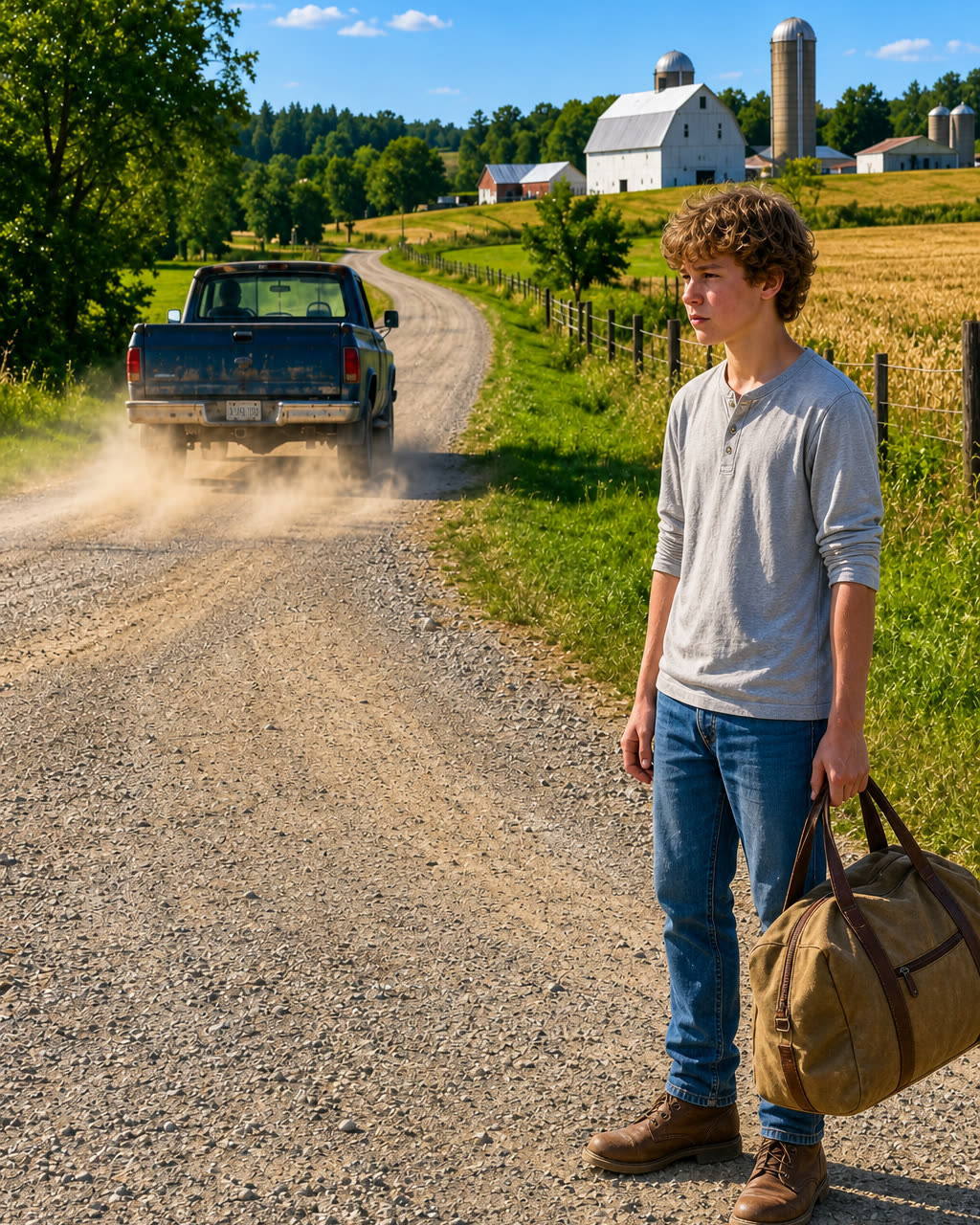
Part 1: The Dirt Road
I was thirteen years old the day my father tossed my duffel bag into the dirt and told me to walk home.
It was August, and the heat was bad enough that the vinyl seat of his truck burned right through my shorts. We’d been driving for about forty minutes without a single word passing between us. That was normal. My dad wasn’t a talker. He used silence the way other men used words, and he expected you to figure out what the silence meant. If you figured wrong, that was your problem.
He swung off the highway onto a dirt road I had never seen before. Gravel cracked and popped under the tires. Fields stretched out on both sides, with a long row of fence posts and not one house anywhere.
He brought the truck to a stop but never shifted into park. He just kept his boot pressed down on the brake.
"Get out," he said.
I stared at him. I honestly believed he was kidding. He used to pull that kind of thing. He’d pretend he was going to leave me at a gas station if I took too long picking out a candy bar, then laugh while I sprinted across the lot after him. That was my father’s idea of a joke.
"I’m serious, Thomas. Get out of the truck."
Something in his voice told me to grab my bag, so I did. I climbed down onto the gravel. Heat rose off the road in shimmering waves. The quiet out there was so total it made my ears ring.
He leaned across the seat and looked at me through the open passenger door.
"Walk home," he said. "Maybe it’ll toughen you up."
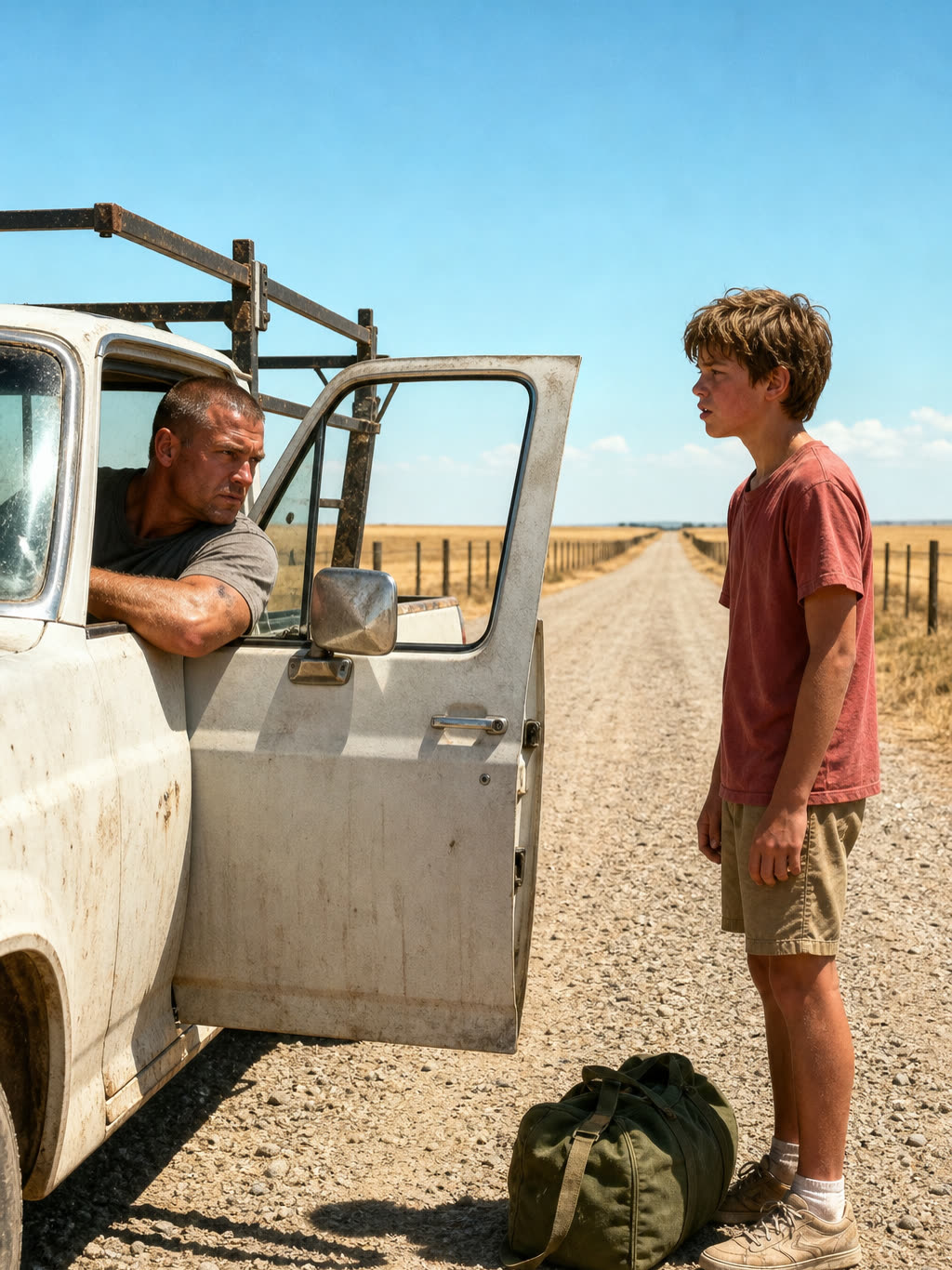
Then he pulled the door shut and drove away.
I stood there with my bag at my feet and watched the dust settle behind his tailgate. I kept waiting for the truck to swing back around the bend. Five minutes passed, or maybe thirty. I really don’t know. When you’re thirteen and alone on a road you don’t recognize, time stops working the way it’s supposed to.
The truck never came back.
So eventually I picked up my bag and started walking.
If I’m going to explain how a man ends up doing something like that to his own son, I need to back up a little.
My mom died when I was eight. Ovarian cancer. She was thirty-one, which is the age I am now, and that still gets into my head some nights. Her name was Elaine. Her handwriting was round and careful, she laughed with her whole face, and she read to me every night until she got too weak to hold the book. After that, she had me read to her.
Once she was gone, it was just me and my dad, Ray Whitfield. He was a roofer with strong hands and a short fuse. He believed you raised a boy the way you trained a dog: steady discipline, no coddling, and never let him see you go soft.
I wasn’t the son he wanted. I liked books. I was quiet. I cried at my mother’s funeral, and on the drive home he told me it had been embarrassing.
I was eight.
When I was ten, he married Cheryl. She was never cruel to me, and in some ways that made it harder to explain to anyone. She was just indifferent. To her I was leftover furniture from a life she had no interest in. She smiled at me the way you smile at a coworker’s kid at the company picnic, quick and polite, and then she turned back to whatever actually mattered to her.
By the time I was twelve, I was spending most of my weekends with my Aunt Diane.
Diane was my mom’s older sister. She lived about an hour away in a small house, and she looked after the old lake property that had been in my mother’s family for decades. She’d never married and never had kids, and she treated me like I was both her son and her best friend. She taught me to fry eggs without breaking the yolks. She sat with me over pre-algebra until it finally clicked. She asked about my day and then actually listened to the answer, which was something I wasn’t used to.
My father hated her. He called her a meddler and said she was making me soft. Every time I came home from her place, he found something wrong with me. My posture. My attitude. The way I said please too often, as if good manners were a disease I’d picked up at her house.
The day he left me on that road, I had just come back from two weeks with Diane. I knew something was wrong the second I climbed into the truck. His jaw was locked tight and his knuckles were white on the steering wheel. I figured he and Cheryl had been fighting, so I kept quiet and stared out the window.
Then came the dirt road, the bag, and the silence after his truck was gone.
I walked for almost two hours before I reached a gas station at a crossroads. It was a tiny place with a single pump and a hand-painted sign advertising night crawlers. The woman behind the counter took one look at me, sunburned and sweaty and dragging that duffel bag, and slid the phone across the counter without saying a word.
I didn’t call my father. I called Diane.
It was an hour’s drive for her. While I waited, it got dark, and I didn’t want to sit outside by myself, so the clerk let me sit on the floor behind the counter. I sat back there watching the door, and every time headlights swept across the lot, I straightened up, sure it was his truck coming back for me.
It never was.
When Diane walked in, she didn’t ask me a single question. She knelt down, set her hand on my shoulder, and said, "You’re staying with me now."
The following week, she went to a family law attorney in town and filed for emergency custody. I remember sitting in a waiting room that smelled like burnt coffee while she signed paper after paper.
My father didn’t fight it, not even a little. He signed the custody transfer the way you’d return something to a store. There was no phone call, no letter, not even a box with the rest of my clothes. Diane had to drive over herself and haul my things off the front porch, where Cheryl had already stacked them in trash bags.
I never spoke to him again.
That was eighteen years ago.
I’m thirty-one now. I teach tenth-grade English at a public high school two towns over from Diane’s place, which would probably make my father laugh if he knew. A grown man getting paid to talk about books all day. I live in the old caretaker’s cottage on the lake property, a one-bedroom place with a woodstove and a screened porch that leans a little to the left. Diane still lives in her small house up the hill. Most Sundays I walk up the gravel path for dinner, and most Sundays she sends me back down with enough leftovers to last until Wednesday.
She’s sixty now. Her hair has gone completely silver, and she wears it in a short bob she cuts herself in the bathroom mirror. She keeps her reading glasses on a beaded chain around her neck and still corrects my grammar when I get lazy, even though I correct grammar for a living. She came to every one of my school plays, every debate tournament, and my college graduation, where she cried so hard she had to borrow a stranger’s handkerchief. When people ask about my parents, I usually say I was raised by my aunt. It’s the simplest true sentence I have.
Over the years I heard about my father only in pieces. A cousin at a funeral mentioned he’d hurt his back and quit roofing. Someone from my old school saw him at a hardware store and said he’d gone gray. I knew he and Cheryl had stayed together. I knew they had a daughter, my half-sister Lily, born the spring after they married. She was barely walking when I left that house for good.
I have exactly one clear memory of her. She was sitting in her high chair with oatmeal smeared across her face, and when I walked past on my way out to Diane’s car that last weekend, she opened and closed her little fist at me. Bye-bye. That was the whole thing. I didn’t even wave back. I didn’t know it was going to be the last time.
I’d built a real life out of what was left. I went to therapy in my twenties and learned to say things like "I was abandoned" without my voice cracking. I dated, broke up, dated again. I taught kids who reminded me of myself, the quiet ones in the back with a paperback hidden under the desk, and I tried to be the kind of adult who noticed them. Most of the year, I didn’t think about the dirt road at all. Only in August, when the heat came up off the asphalt in waves and the cicadas got loud, did I sometimes feel thirteen again, standing in the gravel and waiting for a truck that wasn’t coming.
The envelope arrived on a Tuesday in late September.
I almost didn’t notice it. It was tucked between a power bill and a hardware store flyer, a thick cream-colored envelope, the expensive kind with a lining you can feel through the paper. My name was written across the front in neat, looping blue ink. The return address made my stomach drop. It was the old house on Larkspur Road, the house I’d lived in until I was thirteen, the one with the porch where my life had been stacked in trash bags.
I sat in my truck at the end of the drive with the engine running and held it in my lap for a long time. Part of me wanted to drop it into the burn barrel behind the cottage without opening it. Nothing good had ever come from that address. But my name was on it, written by someone who had taken care to get the spelling right, and I’ve never been able to leave a letter unopened.
I carried it inside and slit it open at the kitchen table. The invitation slid out first, heavy card stock with a sprig of pressed lavender on the front. Together with their families, Lily Anne Whitfield and Marcus James Bell request the honor of your presence at their marriage. Saturday, the eighth of November. Four o’clock in the afternoon.
Lily. The baby with oatmeal on her face was getting married.
Behind the invitation was a folded note card, and behind that was something else, something that didn’t belong with all that cream and lavender. It was a small envelope, yellowed with age, its corners worn soft, its flap held down by a strip of old tape gone brittle and amber.
I turned it over, and my hands stopped working.
On the front, in round, careful handwriting I would have recognized anywhere, in a hand I had seen on every birthday card and lunchbox note until I was eight years old, were five words: For Thomas, on his thirteenth birthday.
My mother had been dead for twenty-three years. And the letter she had written for my thirteenth birthday had just shown up on my kitchen table, eighteen years late.
Part 2: The Letter in My Mother’s Hand
I didn’t open it right away. I read Lily’s note first, because I was a coward, and because some part of me needed to know how this envelope had found its way to me before I could stand to find out what was inside it.
"Thomas," she had written. "You probably don’t remember me much. I’m not sure I’d remember me either. I found this in a metal lockbox on the top shelf of Dad’s closet while Mom and I were packing up the house. Dad’s sick. It’s his heart. After the wedding we’re moving him into a place with nurses. I didn’t read it. The tape was already broken when I found it, so somebody did, and I think we both know who. I don’t know what happened between you two. Nobody in this house would ever tell me. But it has your name on it, and it was never his to keep. I would really, really like you to be at my wedding. You don’t have to answer. Lily."
I read it three times. I kept stopping on the same line. It was never his to keep. Twenty-one years old, and she had put into nine words what I’d been circling for eighteen years.
The sun was going down by then. I couldn’t read my mother’s letter in that cramped kitchen with the fridge humming and the clock ticking. So I took it down to the dock, the old wooden one my great-grandfather had built, its boards silver with age and warm from the day. I sat at the very end with my feet hanging over the water, the way my mother used to sit with me when I was little.
Up close I could see exactly what Lily had seen. The flap had been opened once and pressed back down, and the tape had long since given up. Somebody had pried it open, read it, and sealed it again as well as he could, as if that could undo the reading. My father had read my mother’s last words to me and then locked them in a box on a closet shelf.
Inside were two sheets of lined paper torn from a spiral notebook, the ragged fringe still along one edge. The writing started out round and careful and got shakier toward the end, the letters leaning as if they were tired. At the top she had written the name of the hospital and a date. It was eleven days before she died.
"My Tommy," it began. "If you’re reading this, you’re thirteen. I can’t picture it. Right now you’re eight and you’re asleep in the chair next to my bed with a library book open on your chest, and your mouth is open and you’re snoring a little, and I want to remember this forever. I’m so sorry I’m not there. I’m sorry for every birthday I’m missing. I need you to know none of this was your fault, not my getting sick and not anything that comes after."
"I want to tell you something about your daddy, because I don’t think he will. When he was twelve, his father put him out of the truck on a county road and told him to walk home. He did it to make him tough. Your daddy told me that one time, the night before we got married, and never mentioned it again. He’s a hard man, baby, because he was made hard by a harder one. I love him. But I know him. And I’m scared that without me here he’ll try to make you into what was made out of him. Don’t let him. Soft is not the same thing as weak. You remember that."
"So I made him promise me something. On your thirteenth birthday, he’s supposed to give you this letter himself, and then he’s supposed to ask you, straight out, where you want to live. If you want to stay with him, good, and I hope it’s good. If you want to go to Aunt Diane, he lets you go. No fighting, no punishing you for it, no making you feel like you chose wrong. He promised me, Tommy. He held my hand and he promised."
"The lake house is yours. Diane is only keeping it for you until you’re grown. Swim off the end of the dock for me. Read to somebody, the way you read to me these last weeks. Laugh with your whole face. I love you more than every word in every book we ever read. I’ll be close by. Mama."
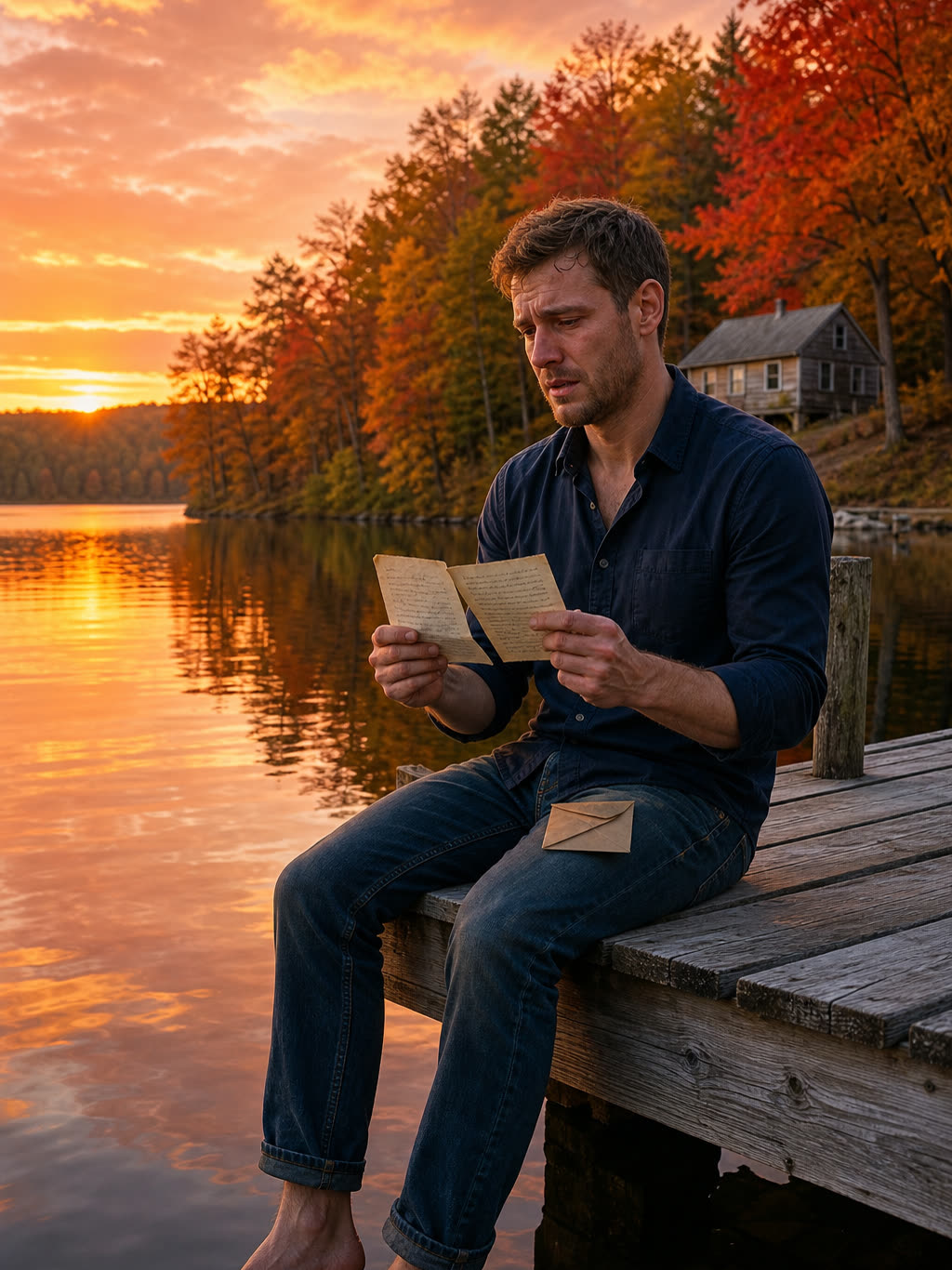
I sat at the end of that dock until the sky went from orange to pink to deep blue and the first stars came out over the far shore. I didn’t cry at first. It was like the night at the gas station, when the feeling was too big to get through my body all at once and it just sat in my chest like a stone.
Then the pieces started fitting together, and they fit so neatly it made me sick. My birthday was the last week of July. I had spent it at Diane’s, with a lopsided chocolate cake and a used copy of The Hobbit she’d found at a library sale. I came home two weeks later and found my father with his jaw locked and his knuckles white on the wheel. He’d had the letter. He’d read it. He’d known what my mother asked of him and what he had promised her. And instead of asking me where I wanted to live, he drove me out to a dirt road and left me there.
I walked up the hill to Diane’s in the dark. Her kitchen light was on. She was at the table doing the crossword in pen, the way she always did, and she looked up and smiled when I came in. Then she saw my face, and the smile disappeared.
I didn’t say anything. I just set the yellowed envelope on the table in front of her.
She knew the handwriting before she touched it. I watched her know it. She put the pen down very slowly and pressed her fingertips to her mouth, and for a second she looked older than I had ever seen her look.
"Where did you get this?" she whispered.
I told her about the invitation, about Lily, about the lockbox. Then I handed her the two pages and watched her read them. When she finished, she folded them along the creases, laid them down, and set her hand flat on top of them like she was taking an oath.
"I knew about it," she said.
The kitchen went very quiet.
"Not what was in it," she said quickly. "I swear to you, Thomas, I never saw the words. But Elaine told me, at the end, that she had written you a letter for when you turned thirteen. She said she’d given it to Ray and made him promise to give it to you himself. She wanted it to come from him. She thought it might do him good, having to be the one."
"And when I turned thirteen," I said.
She closed her eyes. "The week of your birthday, while you were here, I called him. I asked him whether he’d given you your mother’s letter. He didn’t say anything for so long I thought the line had gone dead. Then he said, ‘Don’t you ever tell me how to raise my son,’ and he hung up on me." She opened her eyes, and they were full. "Two weeks later you called me from that gas station."
"Diane."
"I have spent eighteen years wondering if I put you on that road," she said. "If I’d kept my mouth shut, if I’d just let him do it his own way, in his own time —"
"He wasn’t going to do it," I said. "Not in his own time, not ever. The letter was in a lockbox, Diane. On a closet shelf. For eighteen years."
She nodded, but I could see it hadn’t reached her yet. I came around the table and knelt down next to her chair, the way she had knelt down next to me on that gas station floor, and put my hand on her shoulder. She covered it with her own.
After a while she laughed, wet and shaky. "Since we’re confessing," she said, "there’s something else. Every year, the week school pictures came back, I mailed one to him. No note. Just the picture. Every single year until you finished college. I wanted him to have to look at you."
I didn’t know what to say to that. I’d had no idea. I pictured eighteen photographs going into that house, eighteen versions of me with bad haircuts and braces and then without braces, landing in the same mailbox as the invitation. I wondered whether he’d thrown them away. Part of me hoped he had, because it would be easier to understand.
I called Lily two days later. It took me most of an evening to work up to it, and when she answered, her voice was higher than I expected and very careful, like she was afraid I might hang up. We agreed to meet that Saturday at a diner halfway between us, a place off the interstate with red vinyl booths and pie in a rotating glass case.
She was already there when I arrived. I knew her right away, which surprised me. She had long, wavy auburn hair, a scatter of freckles across her nose, and a jean jacket over a green dress. But it was the eyes that stopped me. They were gray, the same gray I see in the mirror every morning, the same gray as our father’s.
"Hi," she said, half standing up and then sitting back down. "I wasn’t sure you’d actually come."
"Neither was I," I admitted, and she laughed, and something in my chest loosened a little.
We talked for nearly three hours. She was studying to be a nurse, which made sense the more I listened to her. Marcus was a lineman for the electric company, steady and kind, and he’d proposed on a fishing pier with the ring tied to a bobber. She told me she’d grown up knowing she had a brother only because of a single photograph on the fridge, a school picture of a boy with sandy hair and a crooked smile, which our father had never once explained.
"I asked about you when I was little," she said. "Mom would just say you lived with your aunt. Dad would leave the room. When I got older I quit asking, because it made the whole house go cold."
Then she told me about the lockbox. It hadn’t held only the letter. It held a stack of school photographs, every one Diane had ever mailed, with the year written on the back of each in my father’s blocky print. It held a clipping from the county paper about a teaching award I’d won three years ago, folded into a tight square. It held the custody papers. It held a dried-out boutonniere I didn’t recognize and a hospital bracelet with my mother’s name on it.
"He kept you," Lily said quietly. "He didn’t keep you, I mean, I know he didn’t. But he kept you in that box."
I looked down at my coffee. I didn’t trust my voice.
"There’s something else," she said. "I told him I’d sent you the letter. I didn’t want to do it behind his back. I figured he’d blow up. He didn’t. He just sat there with his oxygen hissing and asked me if you’d read it. I said I didn’t know. And then he said something I didn’t understand, and he made me promise to tell you exactly the way he said it."
"What did he say?"
Lily took a breath. "He said, ‘Tell him I didn’t drive home that day. Tell him I was at the top of the hill the whole time.’"
Part 3: The Road Back
I drove to Larkspur Road the next Saturday. I didn’t tell anyone except Diane, who stood in her driveway in her cardigan with her arms crossed against the cold and said only, "Call me after. Whatever happens, call me after."
The house hadn’t changed, but it had gotten smaller, the way childhood houses always do. The white paint had gone chalky. The porch where my things had once waited in trash bags had a wheelchair ramp built over the front steps now, plywood still raw at the edges. The maple in the side yard had grown huge and was dropping red leaves all over the gravel.
Cheryl answered the door. Her bleached hair had thinned, and she was wearing a pale pink sweatshirt with a cardinal stitched on the front. She looked at me for a long second, as if she were checking my face against the boy she remembered.
"Thomas," she said.
"Hi, Cheryl."
She stood back to let me in, then seemed to change her mind and stepped out onto the porch instead, pulling the door shut behind her. "I want to say something before you go back there," she said, not quite meeting my eyes. "I put your things in trash bags. I think about that more than you’d guess. I was young, and I was jealous of a dead woman, and I took it out on a kid. I’m sorry." She said it fast, like she’d practiced it. Then she pointed around the side of the house. "He’s out back. He likes to look at the fields."
I walked around the house over the crunching gravel. The back porch looked out over the same fields I remembered, cut to stubble now and gone amber in the October light, with a line of fence posts running toward a distant tree line burning orange and red. My father sat at the top of the porch steps in a wheelchair, facing all of it.
I wouldn’t have known him on the street. The broad-shouldered man who used to carry two bundles of shingles up a ladder at once had shrunk down to almost nothing. His red-and-black flannel shirt hung off him like it belonged to someone bigger. His hair was thin and gray, and a clear oxygen tube looped over his ears and under his nose. Only his hands were the same. They rested on his knees, enormous and scarred, the knuckles thick from thirty years of hammers.
He heard me on the gravel and turned his head. We looked at each other for a long time. A crow called out somewhere over the field.
"You got tall," he said finally. His voice was rougher than I remembered, thinner around the edges.
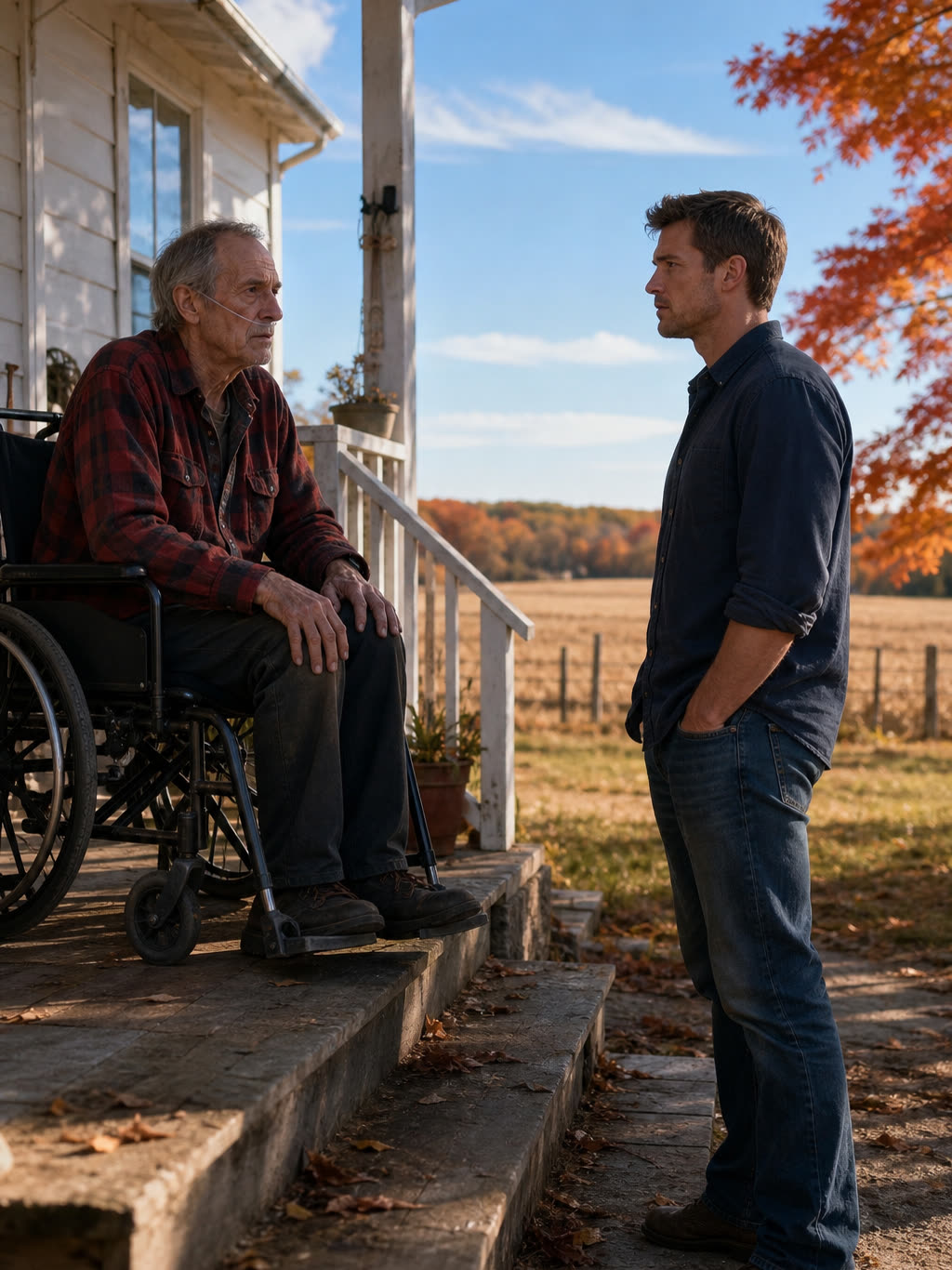
"You read it," I said. It came out flat. I hadn’t planned to start there, but there it was.
He didn’t look away. "I read it." He was quiet for a moment. Then he nodded at the wooden chair beside him. "Sit down if you’re staying."
I stayed at the bottom of the steps. I wasn’t ready to be that close to him. He seemed to understand, because he didn’t ask a second time.
"Diane called me," he said. "That week. Asked if I’d given it to you. I hadn’t even opened it. Five years it sat in my sock drawer and I couldn’t look at it. After she called, I sat at the kitchen table that night and read it. Twice." He breathed in, and the oxygen hissed. "Your mother made me promise to let you choose. And I knew what you’d choose. Anybody would’ve known. You came home from that woman’s house every time looking like you’d been somewhere warm."
"So you left me on a road."
"So I left you on a road." He said it like a man reading a verdict against himself. "I figured if you were going to leave me, I’d do the leaving. I took you out on County Road Fourteen. Same road my old man put me out on when I was twelve. Same spot, near enough. I told myself it was to make you tough. That’s what he told me. Maybe I believed it for a minute."
My hands had started shaking, so I shoved them into my jacket pockets. "Lily said you didn’t drive home."
He looked out at the fields. "There’s a rise about a half mile past that bend. You can see the whole road from up there. I pulled off behind the trees and I watched you. You stood there a long while. Then you picked up that bag and started walking, and you didn’t once sit down, not once. I followed way back with the lights off once it got dusky. I watched you go into that gas station. I sat across the road for an hour, and I watched her car pull in, and I watched her bring you out with her arm around you."
"And then you went home," I said.
"And then I went home."
"Why?" My voice cracked on the word, and I hated that it did. "You were right there. You could’ve come back. I was sitting on that floor, Dad. I sat up every time a car turned in. Every single time."
It was the first time I’d called him Dad in eighteen years. I saw it hit him. His mouth worked, and nothing came out for a while.
"Because you’d have gotten back in the truck," he said at last. "You’d have gotten back in, and you’d have stayed, and I’d have spent the next five years doing to you exactly what my old man did to me. I knew it, sitting there. I could feel it in my hands. I wasn’t ever going to be what your mother needed me to be for you. She was right about me. She always was."
"Don’t make it a gift," I said. "Don’t you dare sit there and make that into something you did for me."
"It wasn’t a gift." He shook his head slowly. "It was cowardice with a reason attached. I know that. The right thing was to hand you that letter on your birthday and ask you the question, like I promised her. Then let you go with my blessing. Instead I made you walk. I’ve known that every day since." He looked down at his hands. "I never told you I was sorry. Not once."
"Not once," I agreed.
"I’m sorry, Thomas."
I didn’t tell him it was all right. It wasn’t, and we both knew it, and I think he would have thought less of me if I’d lied. But I climbed the steps and sat down in the wooden chair beside him, and we looked out at the fields together while the sun dropped toward the trees. Neither of us said anything for a long time. It was a different silence than the one in the truck. This one didn’t come with anything I was supposed to work out. It was just two people who didn’t know what to say.
Before I left, he told me about the photographs. He kept every one in that lockbox, he said, and on the bad nights he’d lay them out on the kitchen table in order, from second grade through college, and watch me grow up like a flip book. "Your aunt meant it as a punishment," he said, with something close to a smile. "Worked, too."
"Lily wants you at the wedding," he said as I stood to go. "I want you there. I don’t get a say, I know. But I want it."
I called Diane from the truck at the end of the driveway. I told her everything. When I finished, she was quiet for a while, and then she said, "Well. I suppose I’ll need a dress."
The wedding was at a little white Methodist church two miles from Larkspur Road, with a reception afterward in the fellowship hall under strings of paper lanterns. I sat on the bride’s side with Diane, who wore navy blue and her good pearls and held my hand so hard during the processional that I lost feeling in two fingers. My father sat at the end of the front pew in his wheelchair in a suit that had been taken in twice, the oxygen tube tucked behind his ears.
Lily walked down the aisle by herself. She’d told me she wanted it that way. But when she reached the front pew, she stopped beside our father’s chair, bent down, and kissed his forehead. He reached up with one huge, scarred hand and held her wrist for a second before he let her go. Then she turned, found me in the third row, and smiled with her whole face. I thought of my mother so hard that I had to look up at the ceiling.
At the reception, Marcus shook my hand like we’d known each other for years, and Lily dragged me onto the dance floor for a song I didn’t know, laughing at how badly I danced. Cheryl brought Diane a plate of cake and the two of them ended up sitting together at a back table, two women who had never once been in the same room, talking quietly with their heads bent close. I don’t know what they said. I’ve never asked.
A week later, I drove back to Larkspur Road and asked my father if he wanted to see the lake.
He hadn’t been there since before my mother got sick. It took Cheryl and me both to get him into my truck, and I folded the wheelchair into the bed and laid his oxygen tank on the seat between us. He watched the fields go by without saying anything. When we turned off the highway, he gripped the door handle. When the lake came into view between the trees, glassy and gold under the late afternoon sun with the maples on the far shore burning red, he made a sound I had never heard him make.
I pushed his chair down the gravel path and out onto the old dock, its silver boards thumping under the wheels, and parked him at the very end where my mother used to sit with me. Then I sat down beside him with my legs hanging over the water and took the yellowed envelope out of my jacket.
"She used to make me read to her," I said. "At the end. When she couldn’t hold the book anymore."
He nodded. He remembered.
So I read it to him. All of it. My Tommy. The boy asleep in the chair with a library book on his chest. The county road. Soft is not the same thing as weak. He promised me, Tommy. He held my hand and he promised. My voice gave out twice, and both times I waited, and both times he waited with me, his big hands shaking on the arms of the chair. When I reached Mama at the bottom of the second page, my father was crying the way I had cried at her funeral, openly and without any shame, the way he had once told an eight-year-old boy was embarrassing.
I didn’t tell him it was embarrassing. I just put my hand on his shoulder and left it there.
He died eleven weeks later, a few days after Christmas, with Lily on one side of the bed and me on the other. He never did toughen me up. But I’ve come to believe that on that dock, with the lake going gold and my mother’s words between us, I finally managed to soften him. And I think, wherever she is, she was close by, exactly like she promised, laughing with her whole face.
Disclaimer: This story is a work of fiction inspired by real-life themes. Names, characters, places and events are fictionalized, and any resemblance to real persons is purely coincidental. Images are for illustration purposes only.
