

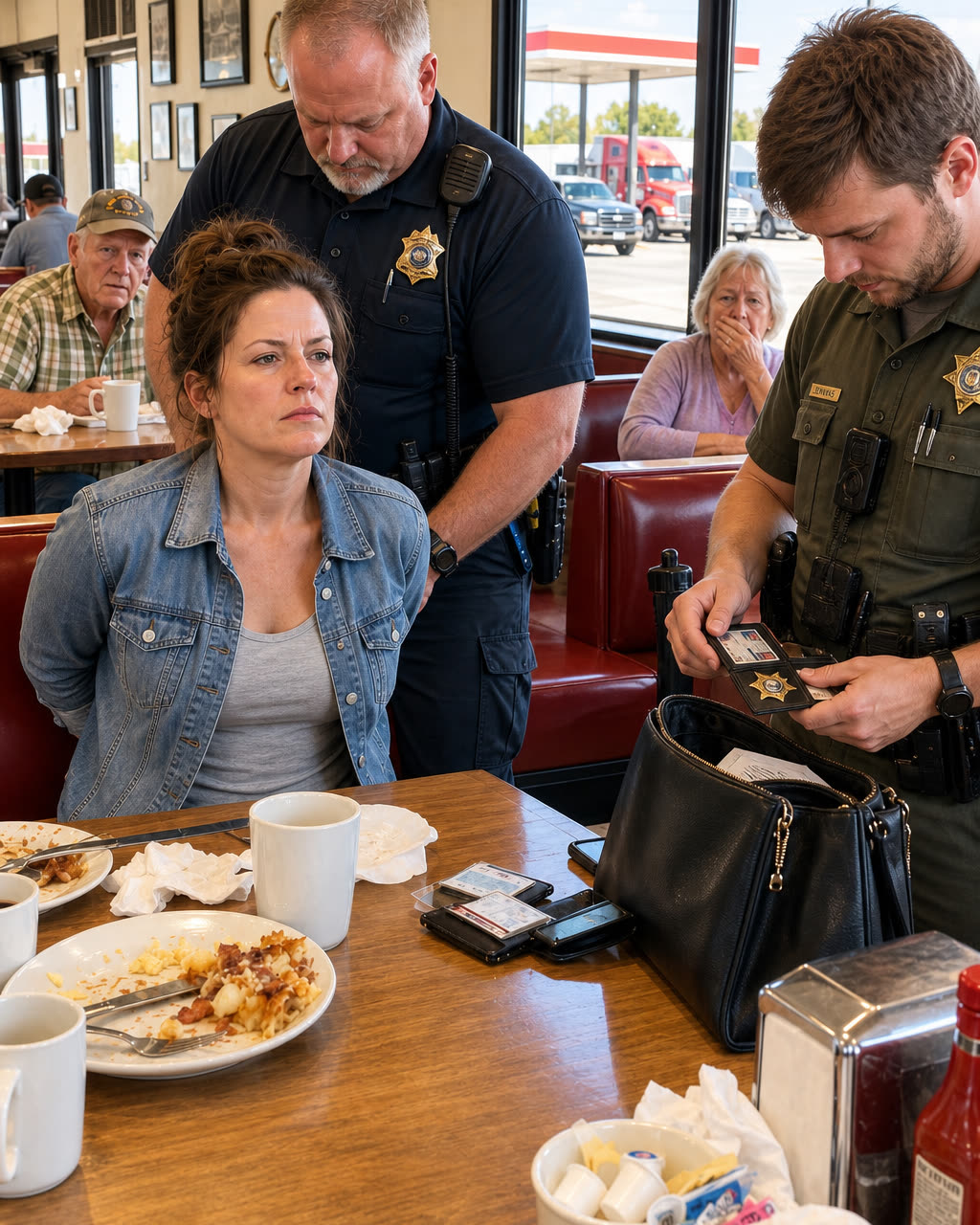
Part 1: Handcuffs at the Magnolia Diner
The handcuffs clicked shut before I understood what was happening. It was such a small sound — a quick, mechanical snap, hardly louder than a stapler — and yet it seemed to travel through the entire room. My thoughts were still somewhere else, still drifting in the slow, ordinary rhythm of a quiet afternoon, and it took a full second for my body to catch up with what my ears had already heard.
“Turn around,” Sheriff Voss said.
I looked down at the metal biting into my wrists, then up at him. He was a broad man in his late fifties, with a thick neck, a silver belt buckle, and the kind of confidence that comes from spending too many years being the most powerful person in a small county. It was the confidence of a man who had stopped expecting to be questioned long ago — a man who no longer remembered what it felt like to hear the word no. He stood with his feet planted wide, as though the diner, the street outside, and everyone within shouting distance belonged to him.
I kept my voice even. Years on the bench had taught me that the calmest person in a room is usually the one who sees it most clearly. “Sheriff, I think there’s been a misunderstanding.”
He smiled. It was not a kind expression. It was the smile of someone who had heard that sentence so many times it had turned into a private joke. “That’s what they all say.”
The diner had gone quiet. A waitress stood near the counter holding a coffee pot. Two men in work shirts had stopped eating. An elderly couple sat frozen in their booth. Nobody said a word. Nobody needed to. I could feel their eyes on me, and beneath that, I could feel something else — a practiced stillness, the stillness of people who had learned that the safest thing to do when the sheriff was angry was to become part of the furniture.
“What am I being arrested for?” I asked.
He answered without a pause, listing the charges as if reading from something he had rehearsed. “Interfering with an investigation. Obstruction of justice. Resisting a lawful order.”
I blinked. Each phrase dropped into the silence like a stone into still water. I had spent my entire career weighing words like those — examining them, testing them against facts and statutes and precedent. I knew precisely what each one required. And I knew I had done nothing that came anywhere close. “I haven’t interfered with anything.”
Voss leaned closer, bending until his face hovered just above mine, his shadow sliding across the table. “You’ve been asking questions around town.”
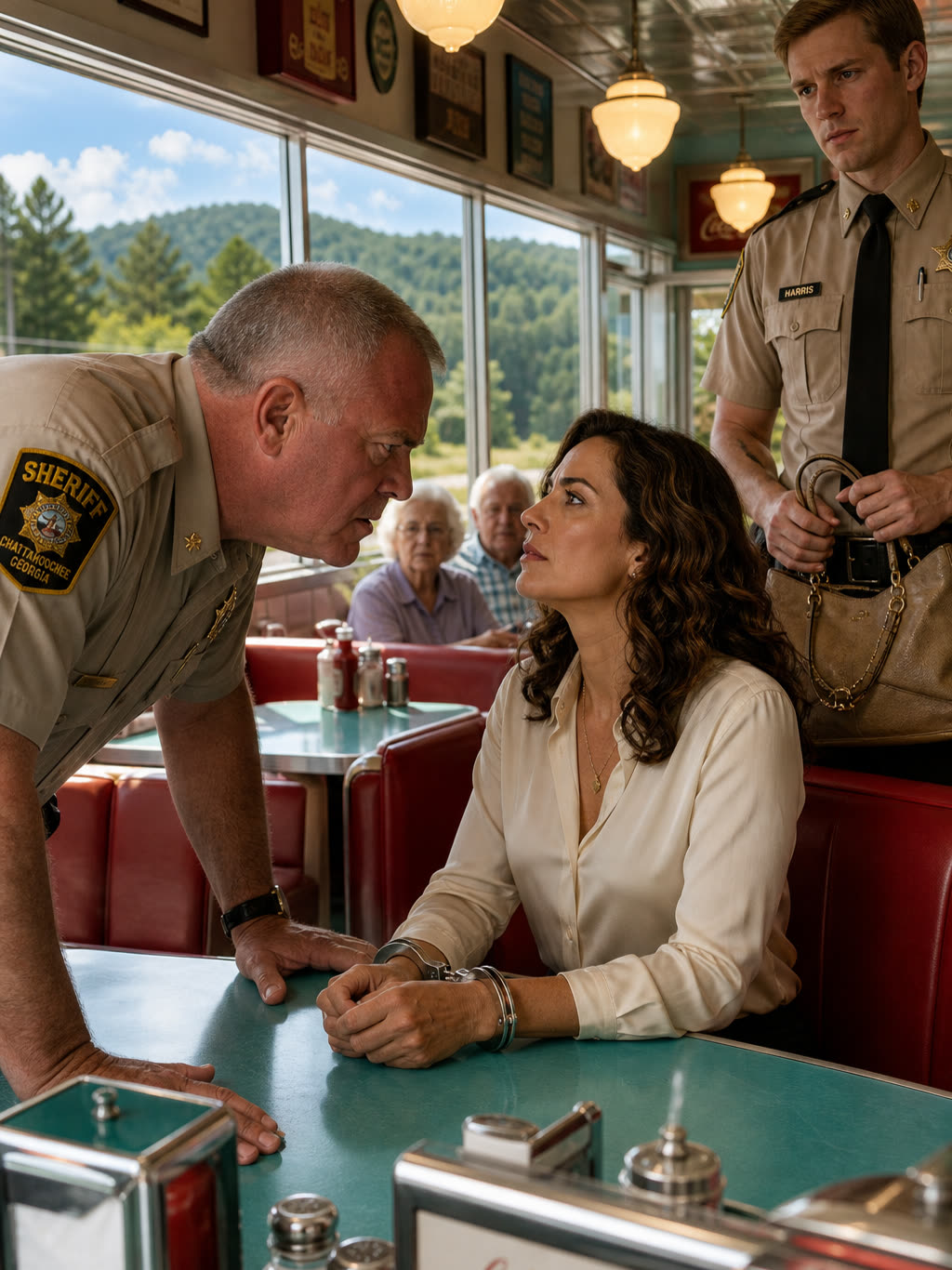
“I ordered catfish.”
A couple of people looked down at their plates. Somewhere near the kitchen, someone drew a breath that might have been the beginning of a laugh, swallowed before it could escape.
The sheriff didn’t laugh. His eyes narrowed into thin slits. “Don’t get smart with me.”
“I’d like to know what investigation you’re referring to.” I said it plainly, with no sarcasm and no heat. It was the same question I would have put to any attorney standing before me, and it deserved the same kind of answer.
He reached into his pocket and pulled out a folded sheet of paper. He didn’t open it. He simply held it up between two fingers, the way a magician shows a card he has no intention of letting anyone examine. “Anonymous complaint. Someone says you’ve been contacting witnesses in an ongoing criminal matter.”
“That is false.”
“Then you won’t have any trouble explaining it downtown.”
He nodded to his deputies. There were two of them standing just behind him, and until that moment I had barely noticed they were there.
One of them, a young man with a name tag reading HARRIS, took my purse. He handled it awkwardly, almost apologetically, as though he weren’t entirely sure what he was supposed to do with it once it was in his hands. The other lifted my phone from the table.
“Careful with that,” I said. “It’s personal property.”
Voss turned toward me slowly, as if I had finally said something that genuinely interested him. “Everything you own becomes evidence when we have reason to believe it’s connected to a crime.”
I looked directly at him. I made myself hold his gaze, because I understood that in a moment like this, looking away is its own kind of answer. “Sheriff, I want you to understand something. I am not resisting you. I am asking you to identify the legal basis for this arrest.”
He stepped close enough that I could smell the mint on his breath. His voice dropped low, meant for me and no one else. “You’re in my county now.”
That was when I understood.
This wasn’t a misunderstanding.
He knew exactly who I was.
Or at least he knew enough.
Enough to decide that I was a problem. Enough to decide that the fastest way to handle a problem in Pell County was to put it in handcuffs in front of a room full of people who had long since learned to keep their mouths shut. The arrest wasn’t really about me at all. It was a performance, and the diner was his audience.
The ride to the sheriff’s office took eleven minutes.
Nobody spoke. The only sounds were the hum of the tires against the asphalt and the faint creak of the seat whenever the car turned. The deputies kept their eyes forward. Voss didn’t look back once.
I sat in the back of the patrol car with my hands cuffed behind me, watching the familiar streets of Halvorsen Springs pass through the window. Every bump in the road pressed the steel deeper into my wrists, and every time I shifted to ease the pressure, it found a new place to bite. There is no dignified way to sit with your hands locked behind your back. I suspect that is part of the point.
The hardware store. The Baptist church. The old courthouse with its white columns and peeling paint.
I had walked those streets as a child. I knew them the way you know the words of a song you learned before you could read — not by thinking about them, but by feeling them. Every corner held some small memory, some sun-faded image I hadn’t realized I was still carrying.
My grandmother used to buy peaches from a woman who sold them beside the gas station. My mother had graduated from the high school at the edge of town. This place was stitched into my family’s history, thread by thread, generation after generation. It was supposed to be the one place on earth where I would never feel like a stranger.
Now I was being driven through it like a criminal.
I watched the town slide by and thought about how strange it was that the same streets could feel so different depending on which side of a patrol car window you were looking through. From the back seat, everything familiar looked slightly distorted — the church a little farther away, the courthouse columns a little more cracked, the people on the sidewalk a little quicker to turn their heads.
At the station, Voss ordered the deputies to take me into an interview room. It was a small, windowless box with a metal table, three chairs, and walls painted the tired color of old paper. The air smelled faintly of burnt coffee and floor cleaner.
“Get her identification.”
Harris placed my wallet on the table and opened it.
His expression changed.
He pulled out my federal judicial identification card.
Then he looked at me. It was a long look — not hostile, not even suspicious, but searching, the way someone looks at a photograph they’ve just realized they misread.
“Sheriff?”
Voss was signing paperwork at the doorway. He didn’t bother raising his head.
“What?”
Harris held up the card. When he spoke, his voice came out thinner than before, as though the words had cost him something.
“Sir, she’s a federal judge.”
Part 2: Forty-Three Minutes in the Interview Room
For the first time that afternoon, Dalton Voss stopped moving. The pen hung motionless above the paperwork. For a long moment, he simply stood in the doorway, and I watched something flicker behind his eyes — calculation, perhaps, or the first faint tremor of doubt. Then he crossed the room and took the card. He read it. Turned it over. Read it again, more slowly this time, as if the words might rearrange themselves into something more convenient if he stared at them long enough.
Then he looked at me. “Amara Whitfield?” “Yes.” “United States District Court?” “Yes.”
His face changed, but only for a second. It was there and gone so quickly that someone who hadn’t spent years watching witnesses on the stand might have missed it entirely. Then he smiled again, and the smile was back in place as though it had never slipped. “Well, Judge, that’s an interesting little surprise.”
I looked at the handcuffs, then back at him. “Would you like to explain why I’m sitting in them?” He tossed my identification onto the table. It skidded across the metal and came to rest near my elbow. “Being a federal judge doesn’t make you immune from arrest.”
“No,” I said. “It doesn’t.” “Good. Then we understand each other.” “But it does mean you should be particularly careful about the constitutional rights of the person you’ve arrested.”
His jaw tightened. A muscle twitched along the side of his face. “Take her prints.” Harris hesitated. “Sheriff—” “Did you hear me?” The deputy looked at me, then at Voss. “Yes, sir.”
I could see the conflict on his face. He knew this was wrong. He just wasn’t sure whether he could afford to say so. I recognized that expression. I had seen it on young clerks and nervous witnesses and frightened jurors — the look of a decent person standing at the edge of a choice, measuring what it would cost to step forward and what it would cost to stay where they were.
They left me alone for forty-three minutes. I counted.
A federal judge learns to count time in a courtroom. You learn to listen to what isn’t being said, to notice when someone avoids a question, and to distinguish authority from intimidation. So I sat in that windowless room with my wrists aching and my fingertips still faintly stained with ink, and I counted. Not out of panic. Out of habit. Counting gave the silence a shape, and a shape is something you can hold on to.
At 3:17, the door opened. Voss entered carrying a paper cup of coffee. He sat opposite me, settling into the chair with the unhurried ease of a man in his own living room, and set the cup down between us. “You know, Judge, this could all be cleared up pretty easily.”
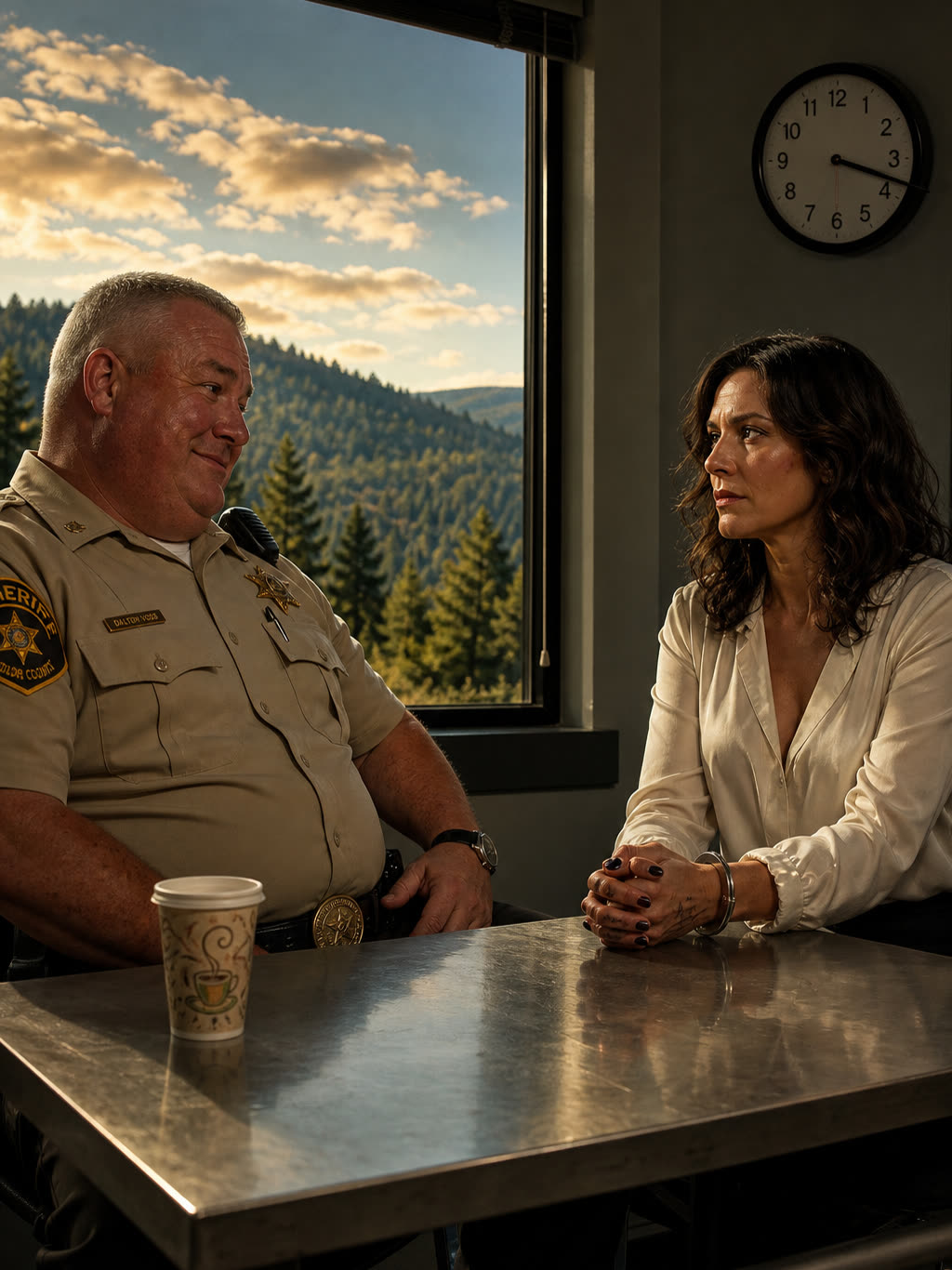
“How?”
“You tell me who sent you down here.”
“Nobody sent me.”
“Come on. You’ve been talking to people.”
“I came to visit my aunt.”
“Lorraine Bishop.”
I felt my stomach tighten. He said her name casually, almost lazily, but there was nothing casual about it. It was a message. He wanted me to know that he knew.
He knew about Aunt Lorraine.
“She’s an elderly woman recovering from a broken hip,” I said. “I’d appreciate it if you left her out of this.”
Voss leaned back, the chair creaking under his weight. “Your aunt has been making trouble for a long time.”
“She has written letters.”
“Thirty-one of them, I believe.”
I said nothing. Silence, I had learned, is sometimes the most useful thing a person can offer. People rush to fill it, and when they do, they often say far more than they intended.
He smiled. “That’s a lot of paper for an old woman.”
“Why did you arrest me, Sheriff?”
He took a sip of coffee, taking his time, letting the question hang in the air. “Because people need to understand that this county has laws.”
“And you believe I broke them?”
“I believe you came here with an agenda.”
“I came here for lunch.”
He leaned forward, resting his forearms on the table, closing the distance between us until the room felt even smaller than it was. “Here’s what I want you to do. Tell your friends in Atlanta that Pell County is handling its own business. Tell them to stop sending people down here. And tell your aunt to stop collecting stories.”
I stared at him.
There it was.
Not a misunderstanding.
Not an unfortunate arrest.
A confession disguised as a conversation.
I let the words settle, turning them over the way I would turn over testimony I had just heard from the bench. He had arrested me to send a message. He wanted the complaints to stop. He wanted whatever was happening in Atlanta to stop. And he had just said all of it, out loud, in a room built for recording exactly that kind of statement.
“Are you asking me to interfere with a federal investigation?”
His smile disappeared. “I’m telling you that you should be careful.”
I looked at the clock.
3:24.
Then I said something that made him stand up.
“Sheriff, I think you should stop talking.”
He stared at me. “Excuse me?”
“You’ve just told me that you arrested me to discourage complaints about your conduct and to influence a federal investigation. I would strongly advise you not to say another word until you have spoken with counsel.”
For a moment, neither of us moved. The air between us felt tight and brittle, like a wire stretched to its limit.
Then he laughed. “That’s a pretty serious accusation.”
“Yes,” I said. “It is.”
He walked out and slammed the door. The sound rang off the bare walls, and then the room was silent again, and I was alone with the clock and the ache in my wrists.
At 4:06, my phone rang.
I didn’t hear it, of course. It was somewhere in that building, sealed in an evidence bag or lying in a drawer, buzzing against nothing.
But somewhere across town, Aunt Lorraine was trying to reach me.
When I hadn’t returned by four, she’d called the pharmacy. The pharmacist told her I’d collected the prescription.
She called the diner. The waitress remembered the sheriff putting me in handcuffs.
Aunt Lorraine called Chief Judge Brennan.
And Chief Judge Brennan called the United States Attorney.
By 4:30, things were moving.
I knew none of this at the time. All I knew was the slow crawl of the minute hand and the hum of the fluorescent light above me. But I would later think about that chain of phone calls often — about how one stubborn old woman with a broken hip refused to accept a silence that didn’t make sense, and how that single refusal traveled outward, from a pharmacy counter to a diner to a federal courthouse, faster than Dalton Voss could have imagined.
At 4:47, a woman entered the interview room.
She was wearing a dark blue suit and carrying a leather briefcase.
“Judge Whitfield?”
“Yes.”
“My name is Rachel Monroe. I’m with the FBI’s Atlanta field office.”
I almost laughed with relief. It rose up in my chest so suddenly that I had to press my lips together to hold it in. “I’m glad to see you.”
She looked at the handcuffs. Her expression didn’t change, but something in her eyes went very still. “Who authorized these?”
“Sheriff Voss.”
“Have you been questioned?”
“Yes.”
“Did you make any statements?”
“I answered basic questions. I did not discuss anything substantive. He made several statements concerning my aunt and the complaints she submitted.”
Monroe pulled out a notebook. “What statements?”
I told her. Every word I could remember.
She wrote without interrupting. Her pen moved steadily across the page, never pausing, never asking me to repeat myself. When I finished, she closed the notebook.
“Judge, I’m going to ask you something, and I need you to answer honestly. Did Sheriff Voss know your identity before he arrested you?”
“I don’t know.”
“He knew about the thirty-one letters.”
“Yes.”
“And he specifically mentioned the federal investigation?”
“Yes.”
She exchanged a glance with someone standing behind her. Then she said, “All right. We’re going to get you out of here.”
Voss came into the room five minutes later. He looked angry — the flushed, tight-lipped anger of a man who has just discovered that something in his own house has slipped out of his control.
“What is this?”
Monroe presented her identification. “Special Agent Rachel Monroe, Federal Bureau of Investigation.”
“I know who you are.”
She didn’t blink. Her voice was quiet, almost pleasant, and it landed harder than any shout.
“Then you know this conversation is not going to improve your afternoon.”
Part 3: The Letter on the Porch
“This is a county arrest. She was interfering with an investigation.” “Which investigation?” “That’s not your concern.” “Actually, Sheriff, given the circumstances, it may be very much our concern.”
Voss looked at me, his eyes hard and accusing. “You called them?” “No,” I said. “I didn’t have my phone.”
Monroe stepped between us. “Remove the handcuffs.” Voss didn’t move. He stood with his arms at his sides, his chest pushed out, as though by refusing to budge he could hold back everything that was now coming toward him. “I’m not taking orders from the FBI.”
Monroe opened her briefcase and produced a document. “Your department has received a preservation notice concerning records relevant to a federal public corruption inquiry. Your arrest report, dispatch records, booking video, interview-room recordings, and communications concerning Judge Whitfield are now subject to preservation.”
His face went pale. The color drained out of it all at once, leaving his skin the gray of old newsprint. “You can’t just come in here and—” “We can, Sheriff. And we’re going to.”
He looked around the room. For the first time, he seemed to notice that Harris was standing near the door, watching him. Something passed between them — not words, just an awareness, the sudden understanding that the people in this building no longer all stood on the same side. “Get these cuffs off her,” he snapped.
Harris stepped forward. His hands trembled slightly as he unlocked them. The metal fell away. I rubbed my wrists, feeling the blood rush back into my fingers in hot, prickling waves. “Thank you, Deputy.” He nodded. He wouldn’t meet my eyes.
I left the sheriff’s office at 5:31. The afternoon had softened into early evening, and the light lay low and golden across the parking lot. Aunt Lorraine was waiting outside in her old Buick, wearing her house slippers and the same blue cardigan she’d worn that morning. She had driven herself despite her broken hip.
“Baby!” She tried to get out of the car. “Lorraine, don’t move!” I called. She ignored me, the way she had ignored every instruction anyone had ever given her for as long as I could remember. I hurried over and helped her settle back into the seat.
Then she grabbed my hand, her grip surprisingly fierce for someone so small. “Did he hurt you?” “I’m all right.” “Did he?” “No.”
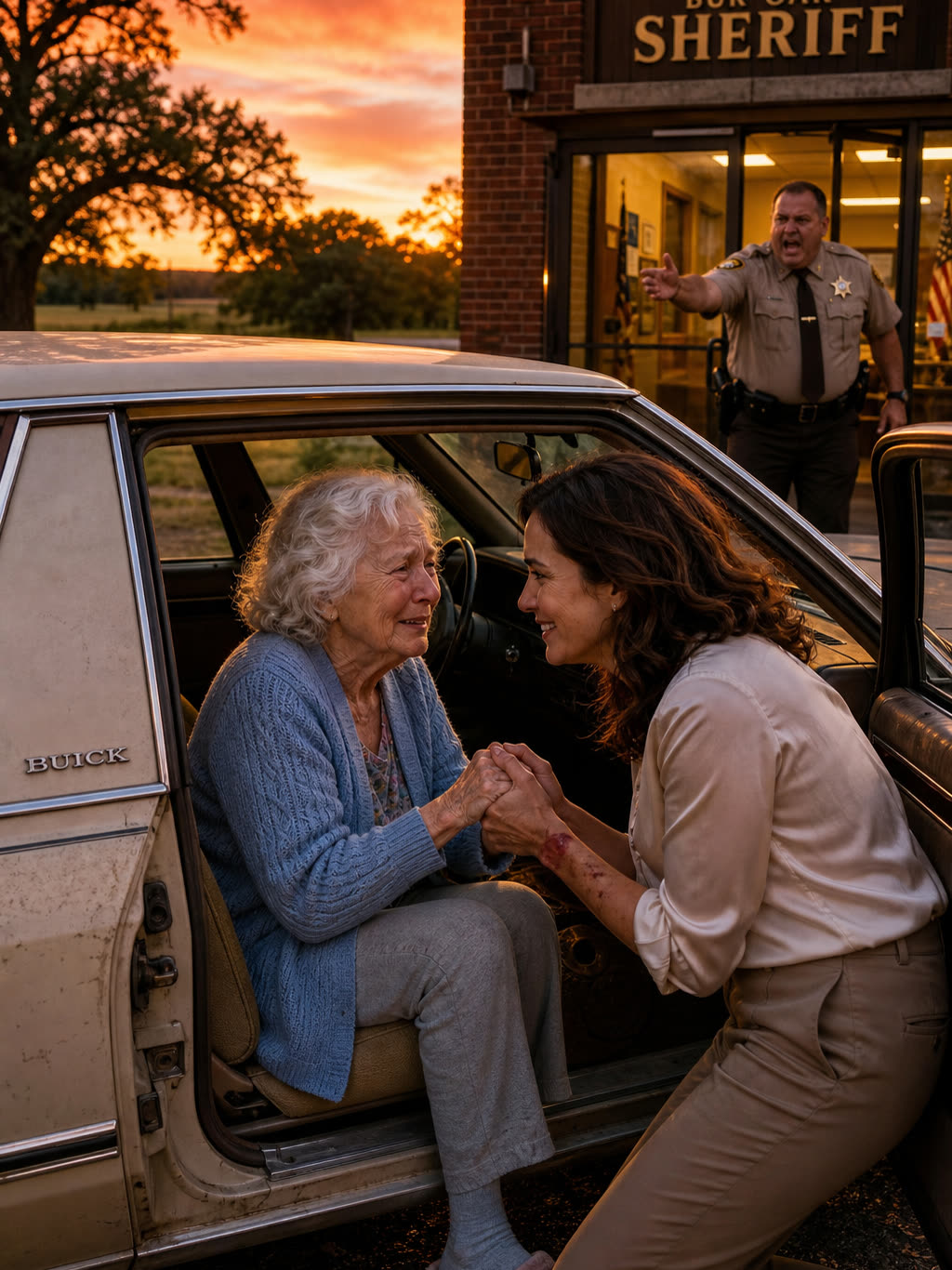
She looked at my wrists. Red marks circled them where the steel had pressed into my skin.
Her eyes filled with tears.
“I told them,” she whispered. “I told them what he was doing.”
“I know.”
“I didn’t think they’d arrest you.”
I squeezed her hand. “Neither did I.”
For a moment, we sat quietly. The engine ticked as it cooled. Somewhere down the street, a screen door banged shut. The ordinary sounds of an ordinary evening drifted around us, and they felt almost unreal after the hours I had spent inside that windowless room.
Then she asked, “What happens now?”
I looked back at the sheriff’s office. Through the glass doors, I could see Voss standing in the lobby, speaking angrily to one of his deputies. His arms were moving, his face was red, and from where I sat, without any sound, he looked smaller than he had in the diner. Not harmless. Just smaller.
“Now,” I said, “we let the people whose job this is do their work.”
The investigation lasted seven months.
The FBI interviewed the thirty-one people who had written to Aunt Lorraine. Then they interviewed another forty-six residents who had never submitted complaints because they were afraid.
Forty-six. I thought about that number often in the months that followed. Forty-six people who had carried their stories alone, who had decided it was safer to swallow what had happened to them than to risk saying it out loud. Forty-six people who had looked at Aunt Lorraine’s stack of letters and thought, quietly, that she was either very brave or very foolish.
They obtained financial records, search warrants, dispatch logs, and years of internal communications.
The evidence revealed that Voss and two deputies had been using minor criminal charges to intimidate residents who questioned their authority. Several arrests had been fabricated. Others had been deliberately prolonged to pressure people into abandoning complaints.
The widow’s property sale was examined. So was the mechanic’s arrest. So was the church deacon’s case.
Each of those stories had been, at one time, just a few pages in one of Aunt Lorraine’s envelopes — words written in shaky handwriting by people who were not sure anyone would ever read them. Now they were case files. Now they had weight.
And the Magnolia Diner arrest?
That turned out to be particularly useful.
The interview-room recording captured Voss telling me to stop the complaints and discourage federal investigators.
His own words.
His own voice.
No ambiguity.
No missing context.
He had built that room to hold other people’s words against them. In the end, it held his.
In February, a federal grand jury returned an indictment charging Voss and two deputies with civil rights violations, obstruction, and conspiracy.
I recused myself from every proceeding connected to the investigation.
I watched none of the hearings.
I made no calls.
I offered no opinions.
That was not my job.
The case belonged to the prosecutors and the jury.
It would have been easy, perhaps, to want more than that — to want to sit in the gallery and watch him squirm, to want my own small piece of the reckoning. But I had spent too many years defending the idea that justice must be impartial to abandon it the moment it became personal. The system I believed in only works if the people inside it are willing to step back when they should. So I stepped back.
Voss was eventually convicted. The two deputies pleaded guilty and agreed to cooperate.
At sentencing, the judge described the damage caused by years of intimidation.
He spoke about people who had stopped calling the police because they no longer trusted them.
About families who had lost homes.
About citizens who had learned to lower their voices when a patrol car passed.
Voss received a substantial federal prison sentence.
But the moment I remember most didn’t happen in a courtroom.
It happened three weeks after his arrest.
I was sitting with Aunt Lorraine on her porch, watching the sun go down over her eleven acres. The sky had turned the color of ripe peaches, and the long shadows of the trees stretched across the grass toward the house.
She had a fresh envelope in her lap.
“What is it?” I asked.
“Another letter.”
“From whom?”
“Mrs. Evelyn Carter. She lives over on Mill Creek Road.”
“What does she want?”
Aunt Lorraine smiled sadly. “She wants to know if it’s safe to speak now.”
I looked across the yard, where the evening light was settling over the old oak trees.
Then I reached for the envelope.
“Tell her yes,” I said.
Aunt Lorraine shook her head. “No, baby. You tell her.”
And she handed me the letter.
It was written in careful handwriting on a sheet of yellow legal paper.
At the bottom were six words.
I thought nobody would ever listen.
I read them twice.
Then I folded the paper and placed it back in the envelope.
Because that, I realized, had always been the real crime in Pell County.
Not simply that one sheriff had abused his power.
It was that thirty-one people had asked for help, and had been made to believe that asking was dangerous.
And somewhere along the way, they had begun to believe that silence was the same thing as safety.
I had gone to the Magnolia Diner for catfish.
I had left in handcuffs.
But Dalton Voss had made one mistake.
He had mistaken a small town for a place without witnesses.
And he had mistaken frightened people for powerless ones.
He was wrong about both.
Disclaimer: This story is a work of fiction inspired by real-life themes. Names, characters, places and events are fictionalized, and any resemblance to real persons is purely coincidental. Images are for illustration purposes only.
