

Part 1: Three Empty Hooks
The brass tag drawer at Gate Six was already three short before I’d put my name on the morning clipboard.
Private Dewitt counted them twice and came up with the same number both times.
Nine tags on the board. Twelve hooks.
The three empty hooks hung in a row right above the drawer.
“Maybe maintenance borrowed them,” Dewitt said.
His boots ground on the gravel as he shifted his weight.
“Maintenance signs for brass.” I checked the chain on the clipboard, then looked at the board again. “Who had the drawer open before shift?”
“Sergeant Salas had it at six. Then headquarters called about the vehicle count.” Dewitt stared at the empty hooks. “I never saw anyone take tags.”
I lifted the top sheet on the clipboard.
Two carbon copies were still clipped underneath.
The same vehicle number appeared on both, at 0610 and 0614, and neither line had a stamp beside it.
“Did you run this vehicle twice?”
“No, Sergeant. The first line was already there when I came on.”
The brass clip pressed into my thumb.
I let it. The sting kept my head clear, and the morning already felt wrong in a way I couldn’t name yet.
Gate Six sat at the far eastern edge of Fort Calder. It was the rear gate of the supply depot, where the fenced compound met the desert highway. Behind our barrier an access road ran two miles across red sand and sage to the depot’s loading docks. In front of it the highway ran west across open country toward mesas that turned the color of rust every evening. Nobody came through Six by accident. If you were on our road, you were going to or from the depot, and either way you went through me.
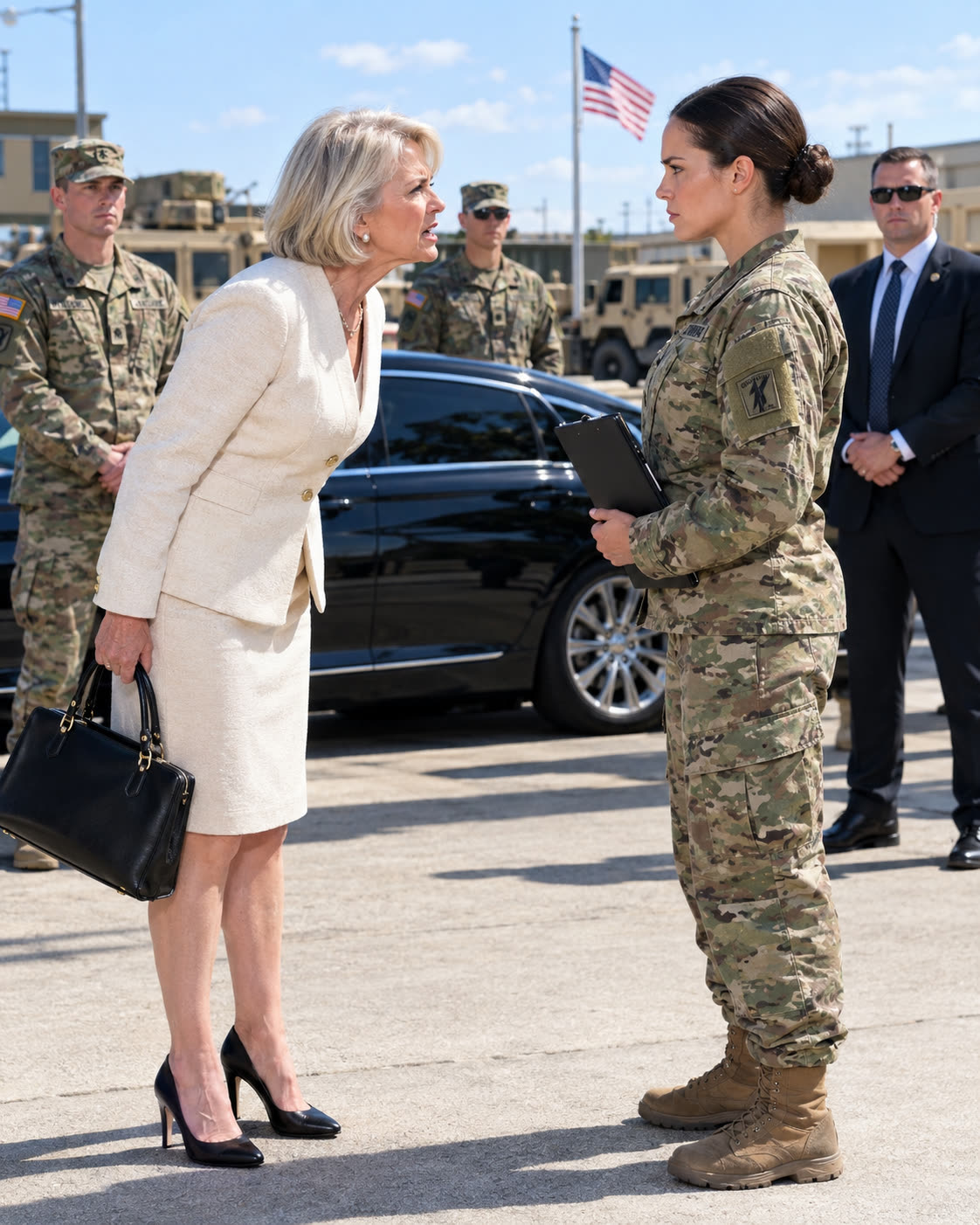
The brass tags were the oldest system on post, and the one I trusted most. There were twelve of them, numbered and stamped with the garrison crest, each about the size of a playing card. A vehicle cleared inspection, got a stamp on the clipboard and a tag on the dash. On the way out the driver handed the tag back, we matched the number, and it went back on its hook. Twelve hooks, twelve tags, every one accounted for at shift change. I had enforced that rule at this gate for four years.
Nine meant three vehicles were out there somewhere with a free pass and no record.
“Pull the drawer log,” I said.
Dewitt slid it out from under the counter. It was a green ledger with a pen tied on by a length of string. Every tag that left the drawer was supposed to get a line: time, number, plate, initials. The last line was from yesterday at 1720. Tag eleven out, tag eleven back, with my own initials beside both.
Nothing from this morning.
“So Salas opened the drawer and didn’t write in it,” I said.
“I don’t know that he took anything, Sergeant.” Dewitt’s ears had gone pink. He was twenty, freckled, and new enough to think every question was an accusation. “He was just standing there when the phone rang. Then he went inside to take it.”
“And you came on at what time?”
“Six-fifteen. A little before.”
So he’d come on after the 0610 line. I looked at the second carbon again. The handwriting was neat, round and careful, and it was Dewitt’s. The line above it was blockier and slanted hard to the right.
“You wrote the 0614.”
He swallowed. “I wrote what the phone told me to write.”
I waited.
“Somebody from headquarters,” he said. “He said the vehicle count was off. He said a car had come through on a tag at six-ten and there was another pass at six-fourteen, and I should log the second one so the numbers would match. He said the stamps would come down with the paperwork later today.”
“Did you see a car at six-fourteen?”
“No, Sergeant. I was in the booth. The barrier was down the whole time.”
“Then you logged a car that never passed you.”
He said nothing. The wind threw grit against the booth glass with a dry hiss.
“Every entry on this clipboard needs a matching stamp or the barrier stays down. You understand that?”
“Yes, Sergeant.”
“Then who at headquarters benefits from a quiet gate?”
Dewitt didn’t answer.
He looked back toward the road, where a dust cloud was settling behind a supply truck.
I put the carbons in the red hardbound binder and wrote the tag count on the inside cover.
At eleven I walked over to the guardhouse office with the clipboard under my arm.
Sergeant Salas had the week’s duty rosters spread out across the metal desk. He’d pulled the night shift and should have been asleep two hours ago.
He stood up when I came in.
“Sergeant, they moved three names off Gate Six for the week. No annex, no signature.” Salas tapped a pencil line. “The duty clerk wrote it in pencil at 0645. Garrison headquarters called it in.”
I leaned over the roster. Kowalski, Brandt, Pruitt. Three of my six. Across from each name someone had penciled TDY – MOTOR POOL. Temporary duty, effective today, no end date. That left me, Dewitt, and one night relief for the busiest stretch of the month.
“Three tags and three soldiers,” I said.
Salas looked up. He was forty-six and thick through the shoulders, with a gray-shot mustache he’d worn since before Dewitt was born. We had stood this gate together through two summers and one very bad winter, and I had never caught him cutting a corner.
“Tags,” he said.
“Three missing from the board. Nothing in the log. Dewitt says you had the drawer open at six.”
Something shifted behind his eyes. It wasn’t quite guilt. It looked more tired than that.
“I’ll talk to you about it,” he said. “Not here.”
“Here’s where I am.”
“Ellen.” He had never used my first name on duty. “Not here.”
He picked his cover up off the desk and walked out past me. A minute later I heard his truck start in the lot.
I called the duty clerk. Specialist Varga answered on the fourth ring, and she sounded like she’d been waiting for someone to call about it.
“It came from operations,” she said. “Major Halvorsen’s line. He said to put it in pencil and the signed annex would follow by close of business.”
“Does that happen often? Pencil first?”
She paused. “It’s happened before, Sergeant.”
“To Gate Six?”
This pause was longer. “Twice this spring. Both on Tuesdays.”
I thanked her and hung up. Then I sat for a while looking at the red binder. Major Carl Halvorsen ran garrison operations. He signed the depot schedules, the convoy releases and the contractor access lists. He was also the man who had shaken my hand at the spring award ceremony and told me Gate Six was the tightest gate on post. He’d meant it as a compliment. I wondered how it would sound now.
I called his office and got voicemail. I left my name, my gate and the words “brass tag discrepancy.” I didn’t expect a call back.
The afternoon turned hot and bright. Beyond the barrier the desert shimmered, the sage gone silver in the heat, and the mesas stood red against a sky so blue it almost hurt to look at. Two supply trucks came through before one o’clock. I inspected both myself, stamped both lines and issued tags nine and ten. Then I wrote them in the ledger with the pen on its string while Dewitt watched.
“You don’t have to check everything twice,” he said after the second truck rolled through.
“Today I do.”
At 1:52 I heard it before I saw it. It wasn’t a truck. It was something low and smooth, an engine that had never hauled anything heavier than a briefcase.
A white Mercedes sedan came up the highway from the west, clean as a dinner plate, sun flashing off the glass. It slowed at the barrier and stopped exactly where it was supposed to, just short of the red-and-white arm.
There was no permit sticker on the windshield and no contractor placard on the dash. There was nothing.
I stepped out of the booth. The driver’s window slid down, and a man looked up at me over a pair of gold-framed sunglasses. He was in his fifties, with silver hair combed straight back, a navy suit too heavy for the desert and the kind of tan that comes from golf courses.
“Afternoon, Sergeant.” He said it as if we’d met before. “I should be on your list.”
“What list would that be, sir?”
He smiled and didn’t answer. Instead he reached toward the dash and held something up between two fingers, the way you’d show a bartender a twenty.
It was a brass tag, the garrison crest catching the light.
Number four.
I didn’t need to check the board. I knew which hooks were empty: four, seven and twelve.
When I glanced down at the plate on his front bumper, I saw the same vehicle number that was printed on both unstamped carbons in my binder.
“Major Halvorsen said you’d be expecting me,” he said.
Part 2: The Barrier Stays Down
I hadn’t been expecting him. That was exactly the problem.
“Can I see a permit, sir?”
“You’re looking at it.” He waggled the tag. “That’s what these are for, isn’t it?”
“A tag gets issued at this gate after an inspection. It comes with a stamp and a line in my log.” I kept my voice level. “That tag was never issued at this gate, so it isn’t yours.”
The smile stayed, but it thinned. “Graham Lisle. Lisle Logistics. I hold the transport contract for the depot. Major Halvorsen and I have a standing arrangement.”
“Then he can send me the arrangement in writing.”
“He did. It’s on your clipboard. Six-ten this morning.”
“There’s a line at six-ten, sir. There’s no stamp beside it.” I held up the red binder without opening it. “Every entry on this clipboard needs a matching stamp or the barrier stays down.”
Behind me I could hear Dewitt breathing in the booth. The barrier control sat by his right hand, a big green button under a flip cover.
Lisle took off his sunglasses and folded them. His eyes were pale blue and very calm. “Sergeant—” he leaned out to read my name tape— “Marsh. I’ve come through this gate a dozen times. Nobody has ever made it a thing.”
“A dozen times,” I said. “Through Gate Six.”
He heard what he’d said about half a second after I did. His face didn’t change, but his hand went back to the steering wheel.
The guardhouse phone rang.
Dewitt picked it up and listened, and he went white under his freckles. He held the receiver out the booth window toward me as if it were hot.
“It’s the major.”
I took it. “Gate Six, Sergeant Marsh.”
“Sergeant.” Halvorsen’s voice was warm and easy, the same voice he’d used at the award ceremony. “You’ve got Mr. Lisle at your barrier. He’s cleared. Lift it, please.”
“Sir, he’s carrying a brass tag that was taken from my drawer without a log entry. His plate is on two carbons from this morning, and neither one has a stamp. I can’t lift on that.”
“I’m telling you he’s cleared.”
“Then I’ll need it signed, sir. An access memo with your signature and a stamp. I’ll lift the minute I have it.”
The line went quiet. Wind pressed against the glass.
“You understand I could have you relieved in about ten minutes,” he said. The warmth never left his voice, and somehow that was worse.
“Yes, sir. And whoever relieves me will need a stamp too.”
“I’m coming down,” he said, and the line went dead.
I handed the phone back. Dewitt’s hand was resting on the flip cover over the green button. He wasn’t pressing it. It was just resting there.
“Step away from the panel, Private.”
He looked at his hand as if it belonged to someone else, then pulled it back.
Lisle opened his door and got out. He was taller than I’d thought. He stood in the hot glare in that navy suit with the brass tag still between his fingers and the mesas burning red behind him.
“You’re making a career decision,” he said. “I want you to understand that’s what this is.”
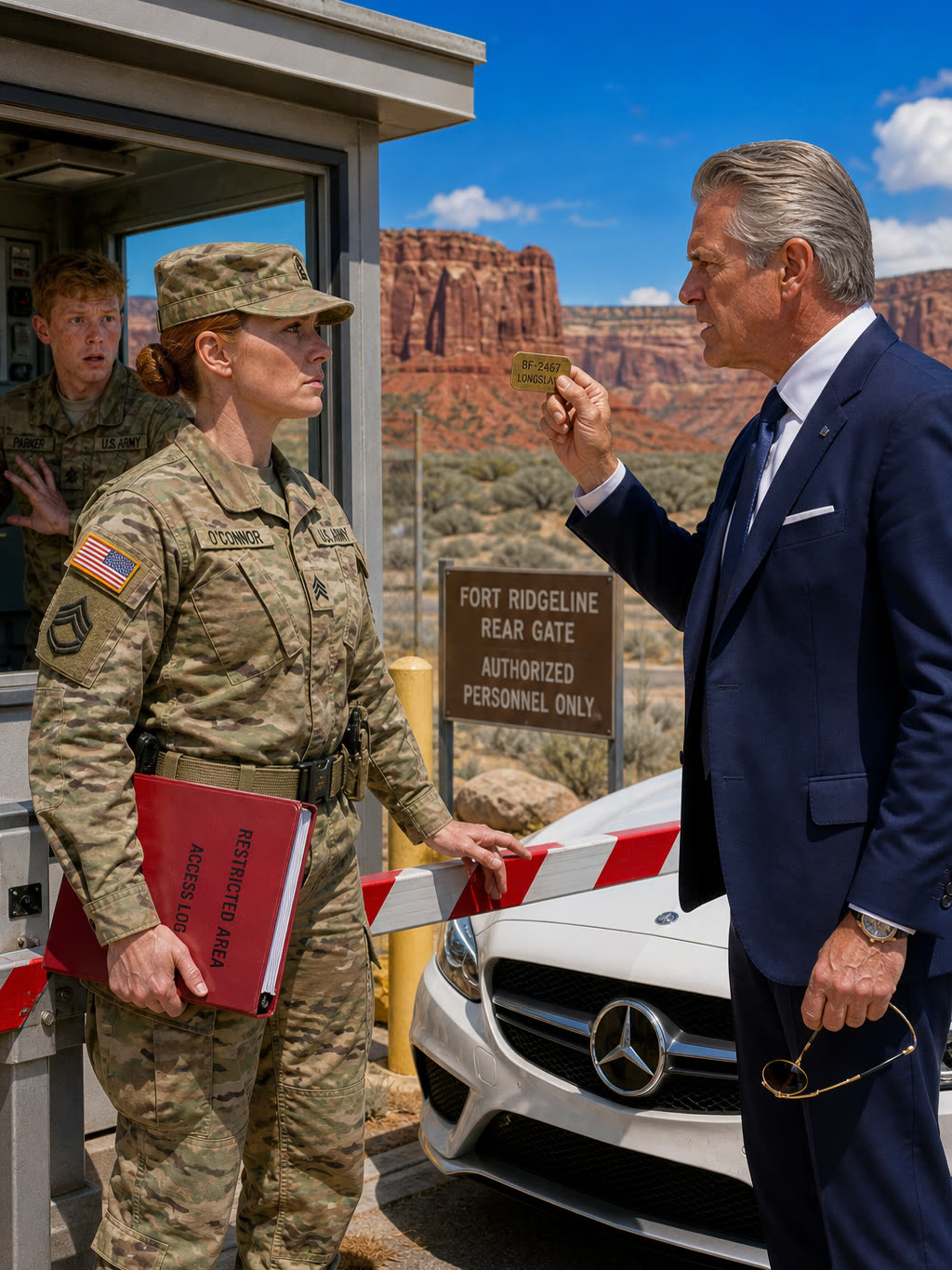
“I made it four years ago, sir.” I stepped between him and the barrier and laid my hand on the striped metal arm. “It stays down.”
He looked at me for a long moment. Then he got back into the Mercedes, closed the door and took out his phone. Through the tinted glass I could see him talking, unhurried, one finger tapping the wheel.
I keyed my radio. “Six to Salas.”
Static. Then: “Salas.”
“I need you at the gate. Now.”
He didn’t ask why. “Ten minutes.”
While we waited I turned to Dewitt. “Tell me about the phone call this morning again. All of it.”
He wiped his palms on his trousers. “It wasn’t the major. I know his voice from formations. This was somebody younger, flat, like he was reading. He said the count was off and told me to log the plate at six-fourteen. Then he said a white sedan would come through in the afternoon and I should let it out on its tag.” Dewitt’s voice cracked. “He said, ‘Don’t make it a thing.’”
Lisle had used the same words, almost exactly.
“Did he give a name?”
“No, Sergeant. I thought it was paperwork. I thought somebody up there just needed the numbers to line up.” He looked at the floor of the booth. “I’m sorry.”
“You told me the truth when I asked,” I said. “That counts. Write it down while you remember it. Times, words, all of it.”
He pulled a blank statement form from the shelf and started writing, his round, careful letters filling the lines.
Salas’s truck came down the access road from the depot side in a long plume of red dust. He parked behind the booth, got out and stopped dead when he saw the Mercedes. For a second he closed his eyes, the way you do when something you’ve been dreading finally shows up.
He tipped his head toward the back of the booth, and I followed him around into the narrow strip of shade.
“That’s the car,” he said quietly.
“Which car?”
“Six-ten this morning. Same make, same color, same plate.” He rubbed his mustache. “Ops called on the landline right before six. They said the major needed three tags sent with a contractor courier, a pre-cleared convoy, and the stamps would come down with the paperwork. They said not to touch the ledger because the ledger would be squared at headquarters. At six-ten a white Mercedes pulled up from the highway. Younger guy driving, dark beard. I handed him three tags through the window and wrote his plate on the clipboard. That’s the first line.”
“You gave three tags to a man you’d never seen.”
“I gave three tags to the major’s office.” He said it without heat. He’d already had this argument with himself, probably all night. “Twenty-two years, Ellen. When ops calls at six in the morning, you don’t ask for a memo. I wrote the plate down because something in my gut didn’t like it. That’s as far as my gut got me.”
“And the courier went in?”
“Straight down to the depot. I lifted for him myself.” He looked out at the white sedan. “I didn’t see him come back out. My shift ended.”
I opened the red binder and laid the two carbons side by side on the booth’s ledge.
“Then here’s what I think,” I said. “Two cars, one plate. The first comes in at six-ten on a real lift and a fake clearance. The six-fourteen line is a ghost. Nothing passed, but on paper that plate entered twice. So whenever two white Mercedes with that plate drive out of here, the count balances. Two in, two out, all of it recorded first thing in the morning. Nobody looks twice at an afternoon exit for a car that’s already on the board.”
Salas said nothing.
“Except the second car never came in this morning,” I went on. “It’s coming in now, at two in the afternoon, on a stolen tag. If I lift, it goes to the depot, loads up and leaves with its twin. Both on tags, both on the clipboard. Twelve hooks are full by tonight, and nobody can ever say the gate was open.”
“And the three names off the roster,” Salas said slowly.
“Three fewer people standing here to notice.”
He let out a long breath. “Twice this spring,” he said. “Tuesdays.”
“Varga told me.”
“I was on nights both times.” His jaw tightened. “I signed the shift log both times. Twelve hooks.”
“Then they brought the tags back before you counted,” I said. “This time they got greedy and needed three.”
I went back around the booth. Lisle was still in the Mercedes with the engine running and the air conditioning on, watching me in his side mirror. I picked up the landline and dialed a number I hadn’t used in two years: the Provost Marshal’s office, direct, not through operations.
“Captain Ortega,” a woman’s voice said.
“Ma’am, this is Sergeant Marsh at Gate Six. I’ve got a tag discrepancy, two unstamped carbons with the same plate, and a contractor at my barrier on a stolen tag who says Major Halvorsen cleared him. The major’s on his way down to make me lift. I’m not going to lift.”
There was a short silence. “Don’t,” Ortega said. “I’m sending a patrol. Twenty minutes. Don’t let anybody touch your clipboard.”
“Yes, ma’am.”
I had barely set the phone down when the radio on my vest crackled.
“Depot dock to Gate Six.” It was Corporal Haines at the loading dock, two miles down the access road. He sounded uncertain, the way people do when they think they might be bothering you for nothing. “Heads up. White Mercedes just pulled away from bay three, heading your way. Trunk’s riding pretty low. Driver had a brass tag on the dash, so I didn’t stop him.”
I turned around.
Far down the access road, small and white against the red sand, a car was coming toward the inside of my gate, raising a long ribbon of dust behind it. It was the same shape as the sedan idling at my barrier. Behind it, closing fast and black as a beetle, came a staff car with a garrison flag snapping on its fender.
Two white cars with one plate, one on each side of my barrier.
Lisle’s engine revved once, softly, as if he’d been waiting for exactly this.
And I still had only one tag of the three back in my hand. Somewhere out there was number twelve.
Part 3: Twelve Hooks
“Dewitt,” I said. “Both barriers down. Inbound and outbound. Flip covers closed, hands in your pockets.”
“Yes, Sergeant.” He did it, and for the first time all day his voice didn’t shake.
Salas stepped out of the shade and planted himself in the outbound lane, arms folded, in front of the striped arm. He didn’t look at me. He didn’t need to.
The second Mercedes slowed as it came up the access road. Through the dusty windshield I could see the driver: young, dark beard, aviator glasses. The man Salas had described. He saw Salas standing in the lane, saw both barriers down, and for a moment I thought he might try to turn around. But the access road dead-ended at the depot behind him, and the staff car was already pulling in on his bumper.
He stopped. On his dash, propped against the windshield, sat a brass tag. Number seven.
The staff car door opened, and Major Carl Halvorsen got out.
He was tall, with a blond-gray crew cut and a square jaw, his uniform pressed so sharp it looked painted on. He settled his cover on his head and walked toward the booth without hurrying, the way a man walks when he’s sure the ground belongs to him.
“Sergeant Marsh.” Warm again, almost fond. “Let’s not make this complicated.”
“No, sir.”
“Mr. Lisle has a contract with this garrison. So does his associate.” He nodded toward the bearded driver. “They’re moving inventory to a refurbishment facility. It’s on the depot schedule. I signed it myself.”
“Then there should be stamps, sir.”
“The stamps are a formality.”
“The stamps are the gate, sir.” I held up the red binder. “Every entry on this clipboard needs a matching stamp or the barrier stays down.”
Something flickered across his face, quick as a lizard over a rock. Then the warmth came back.
“Sergeant Salas.” He turned. “You were on this gate at six this morning. You released three tags to my courier on my office’s instruction. Correct?”
Salas met his eyes. “I released three tags to a voice on the phone, sir. I didn’t log them in the ledger because the voice told me not to. I wrote the plate on the clipboard because I didn’t like it.” He paused. “I’ve given Sergeant Marsh my statement.”
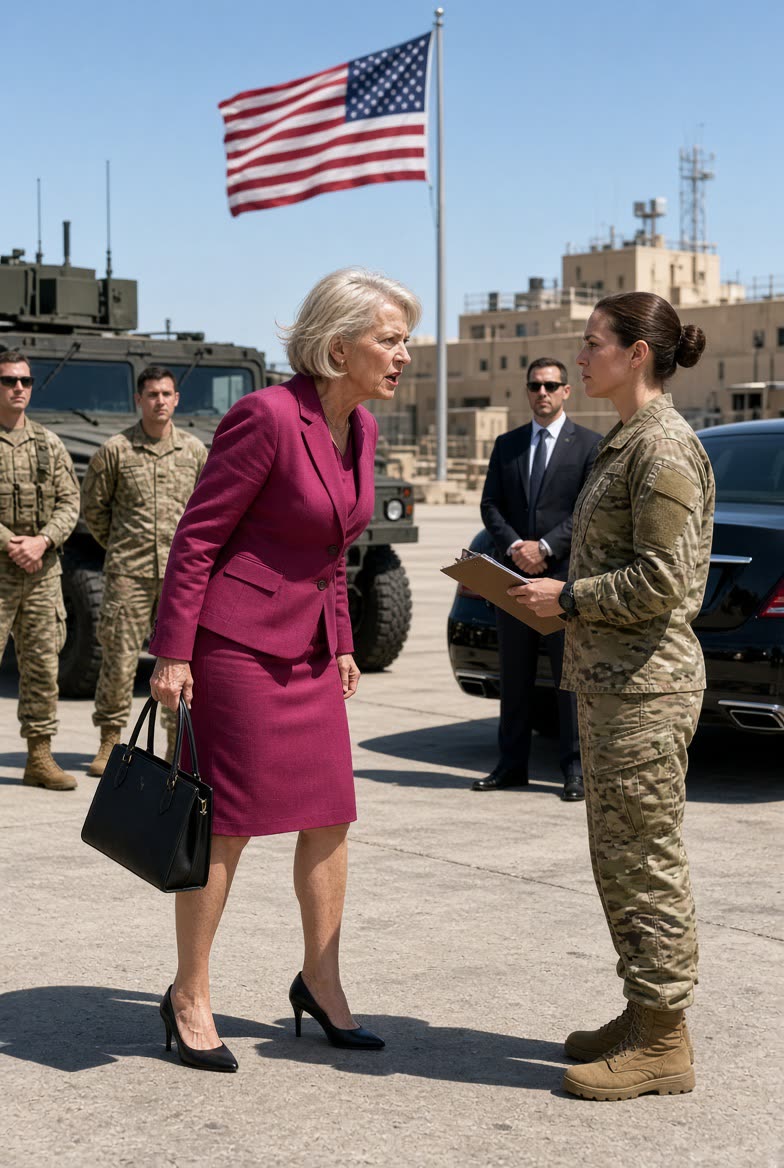
He hadn’t yet, not in writing. But he would. I could hear it in his voice.
Halvorsen looked at him for a long moment. Then he turned back to me, and the warmth was gone.
“Lift the barrier, Sergeant. That’s a direct order.”
The wind moved across the sage. Out on the highway a hawk circled over the red mesas, patient, in no hurry at all. I remember thinking how still everything was, how bright, as if the whole desert had stopped to listen.
“Sir,” I said, “I’ll lift the minute you hand me a signed and stamped access memo for both vehicles. Until then, the barrier stays down. The Provost Marshal’s patrol is on its way. If you want to give me that order again in front of Captain Ortega, I’ll log it.”
He said nothing.
Lisle got out of his car. He came around the front bumper and stood next to Halvorsen, and for the first time I saw the two of them side by side: the suit and the uniform, the golf tan and the crew cut, both wearing the face of men who had been sure of something all morning and were now running the numbers again.
“Carl,” Lisle said under his breath.
“Not now.”
The patrol came down the highway from the west at seventeen minutes, two vehicles with light bars dark. Captain Dana Ortega stepped out of the first one. She was short and compact, with reading glasses pushed up into close-cropped hair, and she looked at the scene the way I imagine a surgeon looks at an X-ray.
“Major,” she said.
“Captain. There’s been a misunderstanding about paperwork.”
“Then we’ll understand it,” Ortega said, and turned to me. “Sergeant?”
I told her. The three empty hooks. The silent ledger. The two carbons, 0610 and 0614, the same plate and no stamps. The pencil roster line from 0645 that took three soldiers off my gate. The phone call to Dewitt. The phone call to Salas. Tag four in Lisle’s hand. Tag seven on the second dash. I told it in order, the way I’d write it on a report, and I handed her the red binder open to the inside cover, where I’d written the tag count that morning in ink with the time beside it.
Ortega read it all without speaking. Then she walked over to the second Mercedes and tapped on the glass.
“Pop the trunk, please.”
The bearded driver looked at Halvorsen. Halvorsen was looking at the mesas.
The trunk opened with a soft hydraulic sigh.
Inside, packed tight in gray foam, were hard plastic cases, eight of them, each the size of a shoebox. Each one had an olive drab label with a depot stock number and a serial plate riveted to the lid. Ortega opened one. Nested in the foam was a night-vision monocular, the kind we issued to perimeter patrols, the kind that cost more than my truck.
“Refurbishment facility,” Ortega said, to no one in particular.
One of her MPs leaned into the cab, then straightened up holding something in a gloved hand. He’d found it in the glovebox, under the registration. It was a brass tag. Number twelve. Folded around it was a single typed sheet: a list of dates, every one a Tuesday, running through the end of the year. Beside each date was a gate number.
Every one of them said Six.
Halvorsen finally looked at me. I’ll remember that look for the rest of my career. It wasn’t anger, exactly. It was the look of a man realizing that the tightest gate on post had been the tightest gate on post the whole time, and that he had been the one to say so.
“You could have just lifted it,” he said quietly.
“No, sir,” I said. “I couldn’t.”
Ortega’s people separated the three of them: Lisle into one vehicle, the bearded driver into another, the major into the back of his own staff car with an MP at the wheel. Nobody put on handcuffs. Nobody had to. Halvorsen walked to his car with his back straight and his cover square on his head. He didn’t look back at the gate.
Ortega stayed. She took statements from Salas and from Dewitt, standing at the booth ledge in the hot wind. Dewitt’s hand shook a little at the start and then steadied. When he finished, he handed her the form he’d begun earlier, the one with the 0614 call written out word for word, and she read it twice.
“Who told you to write this down, Private?”
“Sergeant Marsh, ma’am.”
Ortega glanced at me over her reading glasses. “Good,” she said.
Salas signed his statement with the blocky, right-slanted hand that matched the 0610 line. When he finished, he set the pen down, looked at it for a moment and said, “I should’ve asked for the memo.”
“You wrote the plate down,” I said. “That’s why we have one.”
He nodded slowly. Then he said, “Thanks, Ellen,” and walked back to his truck. This time it didn’t start right away. He sat in the cab with the door open for a long while, looking out at the desert.
Before she left, Ortega took the three brass tags into evidence: four, seven and twelve. She photographed them on the booth ledge beside the red binder, then sealed them in a clear bag and wrote her initials across the tape.
“You’ll get them back when this is done,” she said. “Could be a while.”
“We’ll manage with nine, ma’am.”
“I’m sure you will.” She paused at the door of her vehicle. “The roster change. Kowalski, Brandt, Pruitt. Consider it rescinded. I’ll have the annex down by close of business.”
“In ink, ma’am?”
She almost smiled. “In ink.”
By the time the dust from the patrol settled on the highway, the sun had dropped toward the mesas, and the whole desert had gone gold and red. The light lay long and slanted across the sage, and the sky above the cliffs turned orange, then pink, then a deep violet I’ve never seen anywhere else. Two late supply trucks came through. I inspected both, stamped both lines and issued tags nine and ten again, and Dewitt wrote them in the ledger with the pen on its string.
At shift change he stood in front of the board with the green ledger open in his hands.
Nine tags, twelve hooks. Three empty hooks in a row above the drawer.
But this time each one had a slip of paper taped beneath it, in my handwriting: EVIDENCE – PROVOST MARSHAL – CPT ORTEGA, with the date and the time.
Dewitt counted twice. He came up with the same number both times.
“Nine,” he said. “And three accounted for.”
“Then sign it.”
He signed it. His round, careful letters went across the bottom of the shift log under my initials.
He lingered at the booth door, looking out at the barrier arm, red and white against the darkening sky.
“Sergeant,” he said. “This morning, when you asked who at headquarters benefits from a quiet gate. Did you already know?”
“No,” I said. “I just knew it wasn’t us.”
He thought about that. Then he nodded, picked up his cover and walked out to the lot.
I stayed a while longer with the red binder open on the ledge. I read the tag count on the inside cover, the two carbons, the times, the ink. Outside, the last light was going off the mesas, and the first stars were coming up over the highway.
Somewhere in the depot two miles behind me, eight cases of night-vision monoculars sat back on their shelves.
Somewhere on post, a major was learning how long a Tuesday can be.
And at Gate Six, the barrier stayed down until the paperwork said otherwise. It always had.
