

PART 1
My mother never brought her work home.
That is the first thing you need to understand about her, because without it, the rest of this story might not make much sense.
It explains why I wore secondhand sneakers to school, why I rarely spoke about my family, and why I had become so good at sitting quietly in a crowded room that people sometimes forgot I was there.
My mother was away a lot.
When she came home, she didn’t talk about missions, aircraft, or the people she worked with. Whatever happened at the base stayed there. She seemed to leave that entire part of herself somewhere along the drive home.
The woman who walked through our front door was simply Mom.
She asked whether I’d finished my homework. She cooked rice exactly the way I liked it. She reminded me to put my laundry away. And most evenings, she fell asleep on the couch with the nature channel playing because she was exhausted.
I knew she was a pilot.
I’d known that for as long as I could remember.
There was a photograph on her dresser showing her standing on a runway in a flight suit, one hand resting near the ladder of an aircraft. She wore dark sunglasses, and her expression was calm and unreadable.
I knew she flew something fast.
Something important.
I knew her job demanded years of training, repeated qualifications, and an extraordinary amount of concentration.
Sometimes I woke during the night and found her sitting alone at the kitchen table, holding a glass of water and staring into the darkness.
I learned not to interrupt those moments.
What I didn’t know was how unusual her career really was.
She had never encouraged me to boast about her.
She never said, “Tell your classmates what I do.”
But she had never instructed me to hide it, either.
So when Northwood High School announced Heroes’ Week, I knew exactly whom I wanted to write about.
My mother.
I was fifteen years old, a freshman, and my third-period English teacher, Mr. Reynolds, had assigned everyone a short presentation about someone they considered a hero.
Some students chose firefighters.
Others wrote about police officers, doctors, or grandparents.
I chose Captain Rachel Miller.
My mom.
The night before my presentation, I sat at our kitchen table with my notebook open while she washed the dinner dishes.
Every so often, she’d glance over my shoulder and correct something.
“That sentence needs a comma, Lucas.”
Or she’d hear my pen stop moving and ask whether I was stuck.
She didn’t ask to read the whole presentation.
I didn’t offer.
It was something I wanted to do myself.
The next morning, I folded the photograph carefully and slipped it between the pages of my notebook.
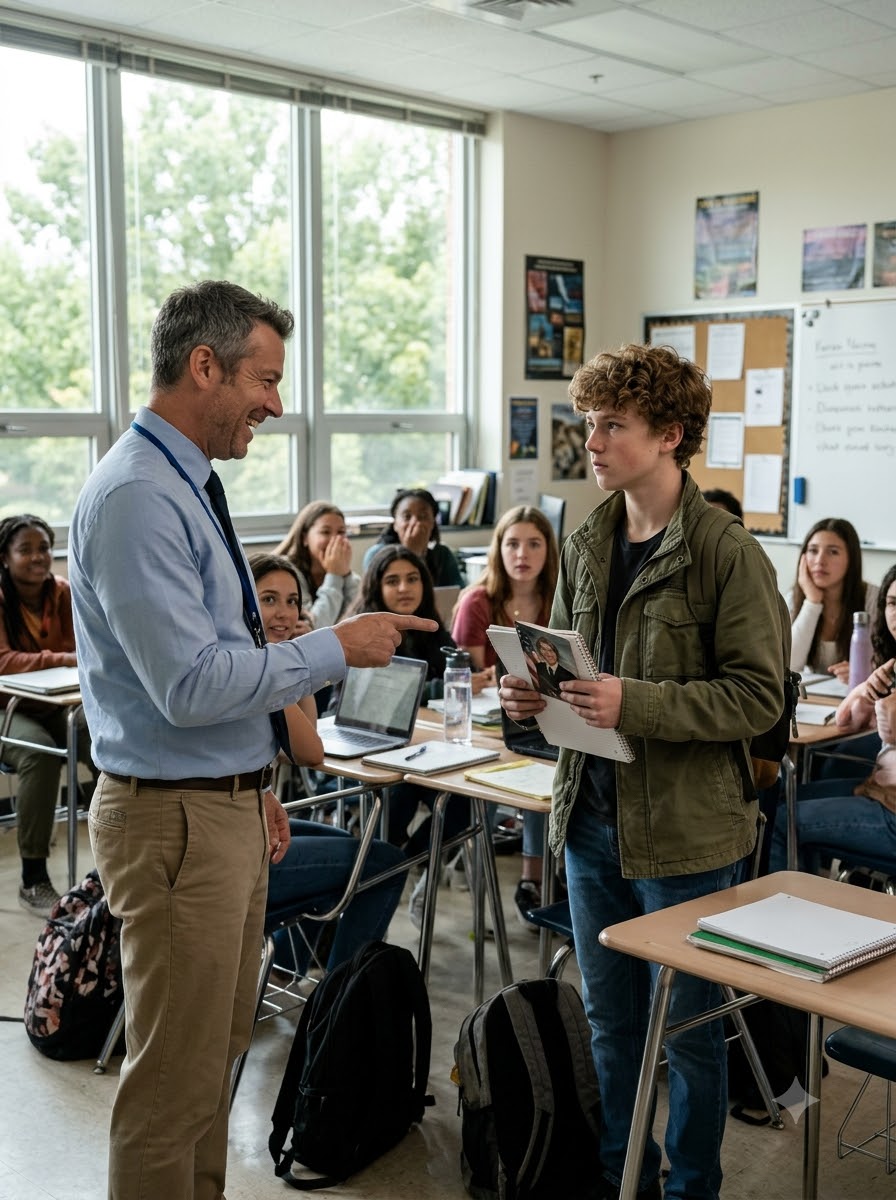
When Mr. Reynolds called my name, I walked to the front of the classroom.
My palms were sweating.
Public speaking had never been something I enjoyed.
I opened my notebook, unfolded the picture, and began explaining why my mother was my hero.
Then I said she flew an F-22 Raptor.
The laughter started before I’d even finished the sentence.
At first, it came from the back of the room.
A couple of boys snickered.
Someone whispered something.
Then Mr. Reynolds smiled.
And that was when the rest of the classroom understood they had permission to laugh.
I want to be fair about Mr. Reynolds.
He wasn’t a cartoon villain.
He didn’t spend every day looking for students to humiliate.
He was a real teacher who believed he understood people well. He trusted his first impressions and thought he could usually tell when a teenager was exaggerating.
Unfortunately, he had already decided what kind of boy I was.
Quiet.
Ordinary.
Secondhand shoes.
A mother who was rarely seen at school events.
In his mind, that apparently didn’t fit the image of someone whose parent flew one of the world’s most advanced fighter aircraft.
“Lucas,” he said, using the gentle voice adults sometimes use when they believe a child needs correcting, “let’s try to stay with believable stories today.”
More laughter.
My face burned.
I could feel the heat spreading all the way to my ears.
I held the photograph tighter.
Mr. Reynolds continued.
“There’s nothing wrong with ordinary jobs. Not everyone has to make up dramatic stories just to sound impressive.”
Make up.
Those two words hurt more than the laughter.
He wasn’t simply suggesting I’d misunderstood something.
He was calling me a liar.
In front of everyone.
I looked down at the presentation I’d written the night before.
I remembered my mother standing at the sink, correcting my grammar while the water ran.
Every word on those pages was true.
I could have argued.
I could have raised my voice and insisted that he was wrong.
Instead, I stood there.
Years earlier, after another embarrassing experience, my mother had told me something I never forgot.
People who feel the need to humiliate others often feel small themselves.
And I should never make myself smaller just to match them.
So I didn’t.
I kept my shoulders straight.
I held my notebook.
I let the laughter pass over me without giving it anything more to feed on.
That didn’t mean it didn’t hurt.
It did.
By lunchtime, the story had traveled through the school.
Someone stopped me near the lockers.
“Hey, Lucas! Does your mom park her fighter jet at Walmart?”
A group of boys burst out laughing.
Another made airplane noises as I passed.
I kept walking.
That was the part nobody seemed to understand.
Remaining calm didn’t mean I couldn’t feel humiliation.
It meant I was choosing what to do with it.
I sat in the cafeteria with my lunch tray and notebook, trying to concentrate on eating.
I thought about calling Mom.
But her phone was often switched off while she worked, and I knew better than to expect an immediate answer.
I took out the photograph again.
There she was on the runway, wearing her flight suit and sunglasses.
She looked exactly as she did whenever she was completely focused.
I knew that face better than anyone.
And I knew I hadn’t invented a single thing.
Heroes’ Week was supposed to end that afternoon with a schoolwide assembly.
There would be community guests, speeches, and presentations about service and courage.
I’d glanced at the printed program earlier but hadn’t studied it.
I had no reason to believe the assembly would have anything to do with what had happened in English class.
So I finished my lunch.
Put away the photograph.
And went on with my day.
I didn’t know that somewhere else in the building, a note about my presentation had already reached someone who knew exactly who my mother was.
And when that man read it, everything was about to change.
PART 2
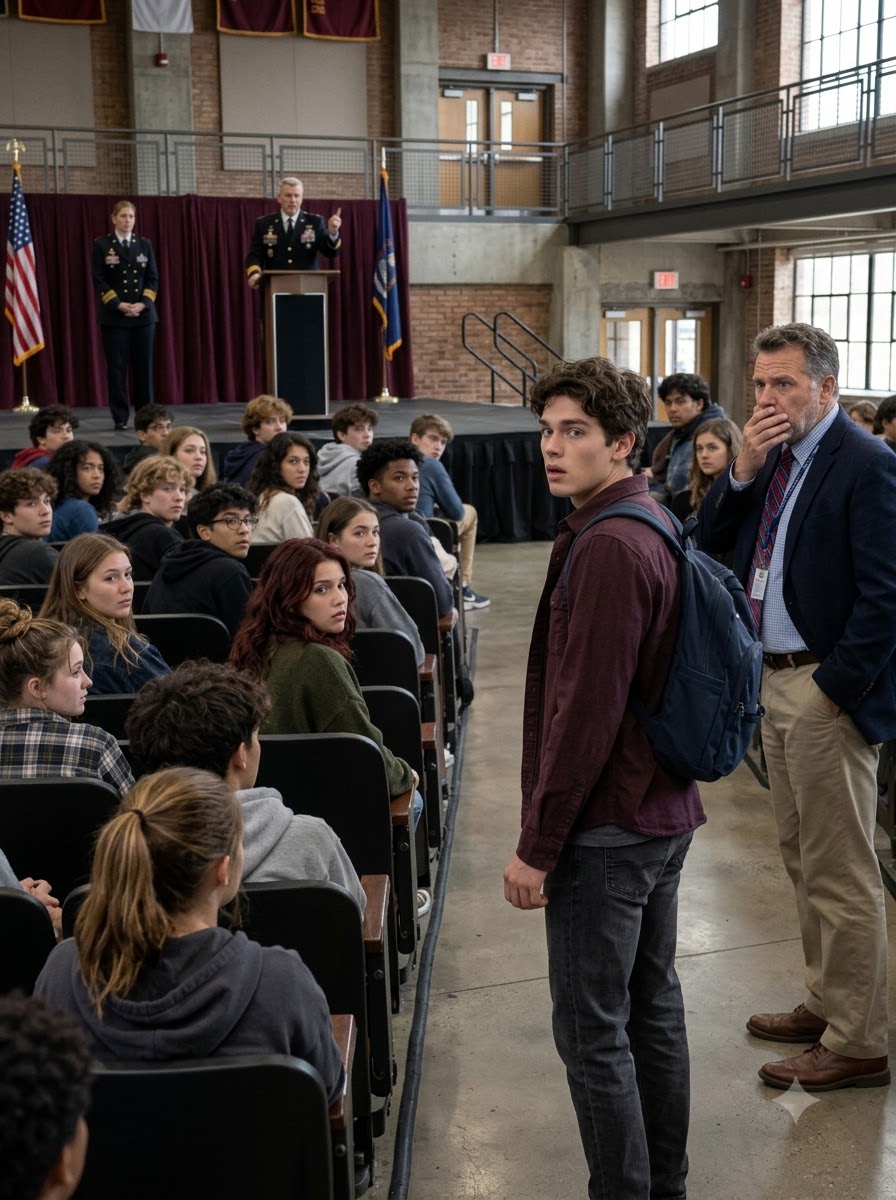
Admiral William Carter was not the sort of person students at Northwood High School expected to meet.
Most of us knew his name only from news reports.
He was a senior military officer whose career had involved decisions far beyond anything we could imagine from our classrooms.
Even people who knew little about the military understood that he was important.
He had silver hair, a commanding presence, and the kind of posture that comes from spending decades in uniform.
He didn’t need to speak loudly to make people listen.
He was one of the honored guests at our Heroes’ Week assembly.
Nine hundred students filled the auditorium.
Teachers lined the walls.
Principal Harris stood at the microphone, delivering her welcome speech about courage, community, and the importance of recognizing those who serve others.
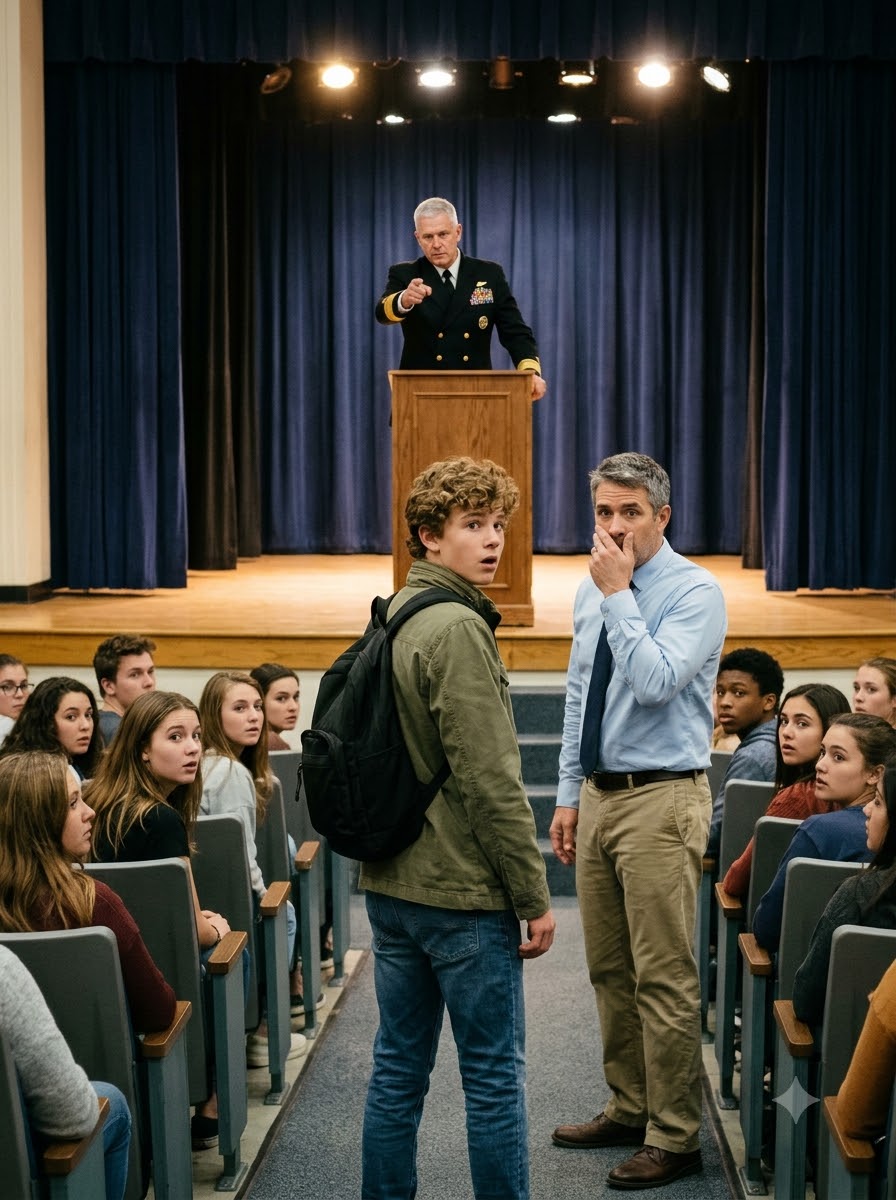
I sat halfway down the freshman section.
In the middle of a row.
I’d chosen that seat deliberately.
Not too close to the front.
Not too close to the back.
Somewhere I could disappear into the crowd.
My notebook rested on my knees.
I wasn’t paying much attention to the stage.
But then something changed.
It wasn’t a sound.
It was the strange sensation of a room shifting its attention all at once.
I looked up.
Admiral Carter was studying the printed program in his hands.
He had stopped turning the pages.
His eyes remained fixed on one particular section.
For several seconds, he didn’t move.
Then he raised his head and slowly looked across the audience.
It wasn’t a casual glance.
He seemed to be searching for someone.
His gaze traveled over the rows of students.
And stopped on me.
My stomach tightened.
There was something unmistakable in his expression.
Recognition.
Not confusion.
Not surprise at seeing a stranger.
Recognition.
For a brief moment, he looked as though he’d found exactly the person he’d been expecting.
Then his expression settled into professional calm.
He stood.
The auditorium grew quiet.
Students stopped whispering.
Teachers straightened.
Even Principal Harris seemed uncertain about what was happening.
Admiral Carter walked toward the microphone.
“Lucas Miller,” he said.
My heart began pounding.
“Would you and your mother please join me on stage?”
I froze.
My mother?
She wasn’t supposed to be there.
She was working.
At least, that was what I’d believed when I left the house that morning.
Before I could make sense of his request, the auditorium doors opened.
And my mother walked inside.
She was wearing her service dress uniform.
Dark blue.
Perfectly pressed.
Her decorations and ribbons were arranged across her chest with a precision I’d seen many times but had never fully understood.
At home, those ribbons were simply part of the uniform hanging in her closet.
Under the auditorium lights, surrounded by people who understood what they represented, they seemed different.
She moved with the same quiet confidence I’d watched all my life.
No dramatic entrance.
No attempt to attract attention.
She simply walked into the room, alert and composed, looking for me.
Then she found me.
Her expression softened slightly.
It was such a small change that most people probably missed it.
But I knew my mother’s face.
I understood the message immediately.
I’m here.
You’re all right.
I wasn’t entirely all right.
Not yet.
But I stood.
The students around me moved their feet so I could reach the aisle.
Nobody laughed.
Nobody made airplane noises.
Nobody asked whether my mother had parked her jet at Walmart.
I walked toward the stage, feeling hundreds of eyes following me.
Admiral Carter met us near the steps.
He offered my mother his hand.
“Rachel,” he said.
“Admiral,” she replied.
They shook hands like people who had known each other for years.
That alone surprised me.
Then he turned toward me.
“You must be Lucas,” he said. “Your mother talks about you.”
I had no idea how to respond.
“Yes, sir.”
He smiled.
“Good things,” he said. “Only good things.”
My mother gave me a quick glance.
I followed them onto the stage.
Principal Harris stood nearby, looking as though the afternoon’s carefully prepared schedule had just become irrelevant.
Admiral Carter took the microphone again.
“I was given a program this afternoon,” he began, “with a note attached to the student presentation segment.”
He paused.
“The note was from a teacher in third period who wanted to flag, in his words, ‘a student who may need gentle guidance about the difference between fact and fiction.'”
My hands went cold.
I knew exactly which teacher had written that note.
And exactly which student he meant.
“The student’s name was Lucas Miller,” Admiral Carter continued. “The fact in question was that his mother flies an F-22.”
The auditorium fell completely silent.
I looked toward the wall where several teachers stood.
Mr. Reynolds was among them.
He was no longer smiling.
Admiral Carter continued.
“Captain Rachel Miller has been flying F-22 Raptors for nine years. She holds the distinction of being one of the most decorated active female fighter pilots in the United States Air Force.”
A murmur moved through the auditorium.
“She has flown operational missions in three different theaters. She was awarded the Distinguished Flying Cross two years ago for actions I am not at liberty to describe in full, but that I can tell you required a kind of judgment and precision and courage that very few people in any profession ever achieve.”
I looked at Mom.
She stood perfectly still.
She wasn’t smiling triumphantly.
She wasn’t looking toward Mr. Reynolds.
She seemed almost uncomfortable with the attention.
But the admiral wasn’t finished.
“The F-22 Raptor is the most advanced air superiority fighter in the world,” he said. “There are fewer than two hundred pilots certified to fly it in combat conditions. Captain Miller is one of them.”
For a moment, I couldn’t hear anything except my own heartbeat.
My mother.
The woman who cooked rice for me after exhausting workdays.
The woman who fell asleep watching documentaries.
The woman who corrected my grammar without even looking at my notebook.
That woman was standing beside me while one of the most respected officers in the room described a career I had barely understood.
I looked toward the freshman section.
Somewhere in those rows sat the boys who had laughed at me.
I couldn’t distinguish their faces from the stage.
I didn’t need to.
Then I looked toward Mr. Reynolds.
His expression had changed completely.
He seemed to be realizing not only that he’d made a mistake, but that he’d publicly accused a student of lying without ever bothering to verify the truth.
I expected to feel satisfied.
I thought I might enjoy watching everyone who had laughed become uncomfortable.
But standing beside my mother, I felt something different.
I was beginning to understand why she’d never asked me to tell people about her accomplishments.
She had never needed an audience to know who she was.
Admiral Carter stepped away from the microphone.
And my mother walked toward it.
For the first time that day, the entire auditorium was ready to listen.
PART 3
My mother spoke for four minutes.
She didn’t begin by mentioning Mr. Reynolds.
She didn’t talk about the students who had laughed.
She didn’t ask anyone to apologize.
Instead, she talked about service.
She explained that serving other people wasn’t about appearing impressive.
It wasn’t about collecting praise or making sure everyone understood how important your work was.
It was about being useful.
Sometimes that usefulness demanded sacrifices other people would never see.
Sometimes it required difficult decisions, years of preparation, and responsibilities that couldn’t be fully explained.
And sometimes, she said, you had to accept that people wouldn’t understand what you did.
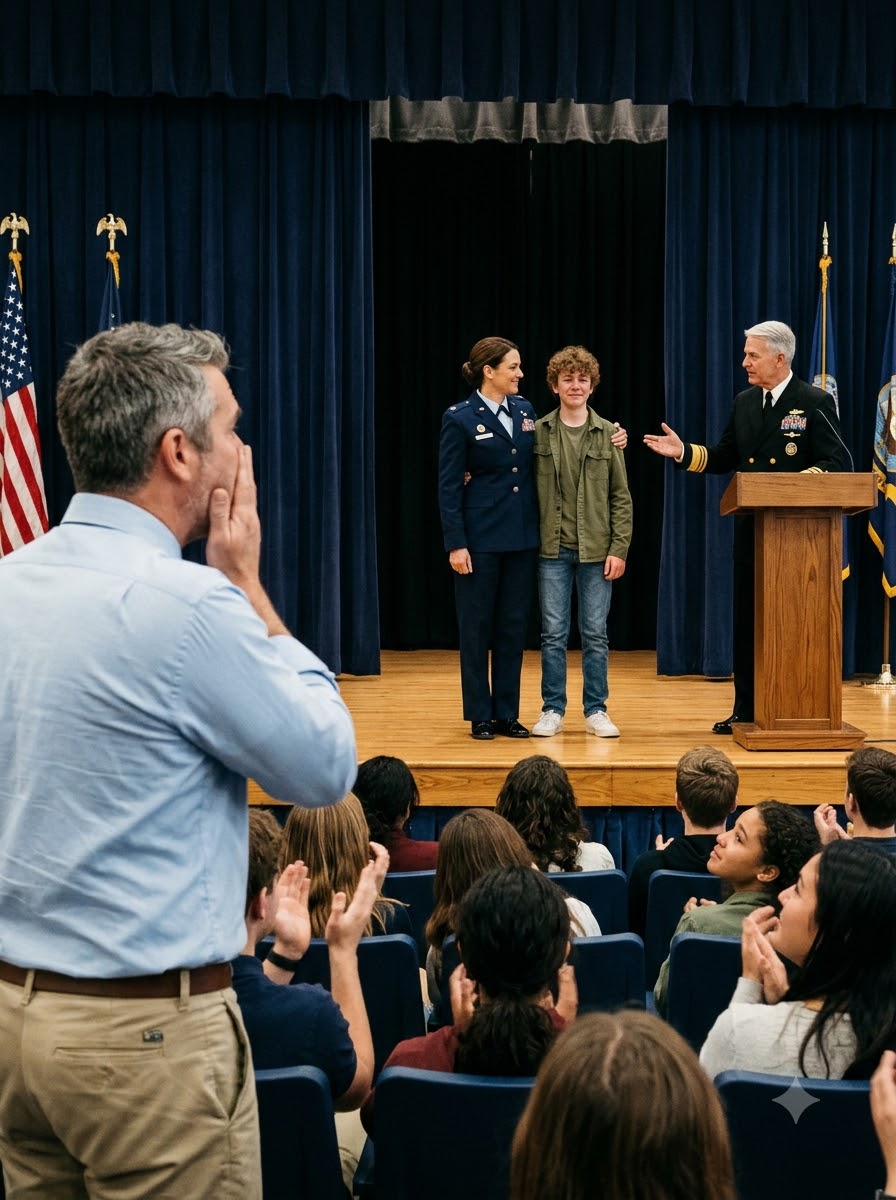
That was all right.
The value of the work didn’t depend on whether strangers recognized it.
I listened more carefully than I’d ever listened to a speech.
Then she said something that made my throat tighten.
She said she had a son who had already learned something about carrying that kind of responsibility quietly.
And she was proud of him.
She didn’t turn toward me.
She kept looking at the audience.
But I knew the words were meant for me.
The applause began when she finished.
It wasn’t the automatic applause students give because an assembly is nearly over.
It was louder.
Longer.
The kind that comes when people realize they’ve heard something worth remembering.
I stood beside my mother, trying to decide what to do with my hands.
She looked at me and gave the smallest smile.
That was enough.
After the assembly, we walked into the hallway outside the auditorium.
Students were still talking excitedly.
A few stared at Mom’s uniform.
Others glanced at me with expressions I couldn’t quite interpret.
Then Mr. Reynolds approached us.
I saw him coming before Mom did.
He looked nervous.
Not frightened exactly.
More like someone who had spent the last half hour thinking carefully about something he wished he could undo.
He stopped in front of my mother and introduced himself.
Then he said he owed both of us an apology.
He turned toward me.
“I’m sorry, Lucas. I should have listened.”
There was no excuse attached.
He didn’t say he’d only been joking.
He didn’t blame the other students.
He acknowledged that he’d made an assumption, treated that assumption as fact, and embarrassed me in front of my classmates.
My mother studied him for a moment.
She had an expression she used when she was evaluating a situation.
Not angry.
Not particularly warm.
Just attentive.
Then she said, “He handled it with more dignity than I would have at fifteen.”
Mr. Reynolds looked at me.
“I know,” he said. “I noticed that.”
I wasn’t sure what to say.
I’d spent the morning wishing he would believe me.
Now he did.
And the moment felt quieter than I’d expected.
“Thank you, sir,” I said.
That was all.
We went back inside.
The school year didn’t suddenly transform into something out of a movie.
There wasn’t a dramatic announcement that everyone had learned their lesson.
Nobody gathered around me every morning to apologize.
Life continued.
Classes started and ended.
Homework piled up.
Tests came and went.
The assembly gradually became one of those stories students remembered when something reminded them of it.
But certain things changed.
In English class, Mr. Reynolds stopped treating my contributions as though they needed special verification.
When I offered an answer, he listened.
Sometimes he asked genuine questions about aviation or military service.
I answered what I knew.
And when I didn’t know something, I said so.
He seemed comfortable with that.
Some of the boys who had laughed apologized too.
Not always directly.
Teenagers have strange ways of admitting they’re wrong.
One boy muttered something while we were leaving class.
Another stopped making jokes whenever I walked past.
A few simply began treating me normally again.
Then, about a week after the assembly, a girl approached me in the hallway.
She looked uncomfortable.
“I didn’t laugh,” she said quietly. “I just want you to know I didn’t laugh.”
I remembered her.
She’d been one of the students looking down at her desk while the others laughed.
“I know,” I told her.
She seemed relieved.
And that conversation stayed with me.
Because I’d noticed the students who hadn’t joined in, even when nobody else seemed to.
Silence could mean different things.
Sometimes it was fear.
Sometimes it was indifference.
But sometimes it was a small refusal to participate in somebody else’s humiliation.
I understood that better after Heroes’ Week.
December arrived.
My mother came home.
She walked through our front door exactly the way she always did.
No grand entrance.
No speech about the assembly.
No mention of the admiral.
She set down her things, asked about my homework, and looked exhausted.
The version of Captain Rachel Miller who flew fighter aircraft had once again remained somewhere outside our house.
The woman standing in our kitchen was Mom.
That evening, I decided to cook dinner for her.
I was fifteen and knew how to prepare approximately three meals.
I chose the easiest one.
It wasn’t especially impressive.
But I cooked it, set the table, and waited for her to sit down.
She looked surprised.
Then she smiled.
We ate together.
She asked about school.
I told her about the semester.
Not the assembly itself.
She already knew what had happened there.
I told her about everything afterward.
About the boys who had stopped teasing me.
About Mr. Reynolds treating me differently.
About the girl who wanted me to know she’d never laughed.
About how it felt to walk into a classroom without expecting everyone to remember the joke.
My mother listened without interrupting.
When I finished, she asked, “How are you?”
“Good,” I said. “Better.”
She nodded.
“You handled it right,” she said.
I shrugged.
“I didn’t do anything. The admiral—”
“Before that,” she interrupted gently. “In the classroom. You stood there and you didn’t make yourself smaller.”
She looked down at her plate.
“That’s the part I was proud of.”
I sat quietly for a moment.
Then something occurred to me.
“How did you know about the classroom?”
She looked up.
It was the expression she always gave me when she thought I was overlooking something obvious.
“I called your principal,” she said. “When I saw the email. I wanted to understand the full situation before I decided what to do about it.”
I stared at her.
“You planned the assembly?”
“Admiral Carter planned the assembly,” she replied. “I made a phone call.”
I thought about the admiral looking through the auditorium, finding me in the middle of the freshman section.
I thought about how naturally he’d greeted her.
“Mom,” I said, “you never told me you knew Admiral Carter.”
“You never asked,” she said.
“I didn’t know to ask.”
“Now you know,” she replied.
Then she went back to eating her rice.
That was my mother.
She could walk into an auditorium and leave nine hundred students speechless.
She could be introduced as one of the most decorated women flying fighter aircraft.
She could receive an award for courage that an admiral wasn’t even permitted to describe fully.
And afterward, she’d come home and eat dinner with her son as though nothing extraordinary had happened.
Outside, the December evening had settled over the neighborhood.
The house was warm.
My mother was home.
She was tired, as usual, and I knew she’d need time to recover from whatever demands her work had placed on her.
But she was sitting across from me.
Listening.
Asking about school.
Being my mother.
I thought about the photograph I’d carried into English class.
The runway.
The flight suit.
The sunglasses.
For years, I’d looked at that picture and known I was proud of her, even without understanding the details of her career.
After the assembly, I understood more.
I knew about the F-22.
The ribbons.
The Distinguished Flying Cross.
The missions in places she couldn’t discuss.
I knew that important people respected her.
But none of those discoveries changed the reason I’d chosen her for Heroes’ Week.
I’d chosen her because of what she’d taught me long before anyone at Northwood High School knew her name.
She’d taught me that truth didn’t become less true when someone laughed at it.
She’d taught me that remaining calm wasn’t the same as feeling nothing.
She’d taught me that I didn’t need to humiliate someone else to protect my dignity.
And she’d taught me never to make myself smaller simply because another person had decided I didn’t belong.
Mr. Reynolds hadn’t known any of that when he called my story unbelievable.
The boys at lunch hadn’t known it when they made airplane noises.
And even Admiral Carter, for all he knew about my mother’s military career, couldn’t have known every ordinary lesson she’d taught me at our kitchen table.
That was the part of her life no medal could describe.
The part I knew best.
I was fifteen when I learned that sometimes telling the truth costs you something before anyone believes you.
It can cost you comfort.
It can cost you confidence.
It can leave you standing alone at the front of a classroom while people laugh.
But I also learned that the truth doesn’t require you to become louder or crueler just to defend it.
Sometimes all you can do is stand there, hold your notebook, and refuse to shrink.
Then you let the truth catch up.
My mother had taught me that before Heroes’ Week.
Before Mr. Reynolds laughed.
Before the auditorium doors opened.
She’d taught it in a hundred ordinary moments.
At the kitchen table.
Over dinner.
While correcting my grammar without even looking over my shoulder.
And when I think back on that day now, the moment I remember most clearly isn’t the applause.
It isn’t the admiral announcing her accomplishments.
It isn’t even the silence that fell over the auditorium when everyone realized I’d been telling the truth.
It’s the look on my mother’s face when she found me in the crowd.
That small, familiar expression.
The one that told me she was there.
That I was going to be all right.
Because before the entire school discovered that my mother was a remarkable fighter pilot, I already knew something far more important.
She was the person who had taught me how to stand tall.
And that was why she had always been my hero.
THE END
