

PART 1
Tamra had taped the notice to the kitchen door before the final hymn had even faded from my ears.
It was a spotless white sheet printed from a computer, with carefully drawn lines for names and schedules. Across the top, in a cheerful, rounded typeface, were the words:
FUNERAL LUNCHEON SIGN-UP. NEW PROCESS EFFECTIVE IMMEDIATELY.
She stood beside it with her hands clasped neatly at her waist, looking like someone who expected gratitude for delivering good news.
“I know change is hard,” she said.
She was speaking to the five of us.
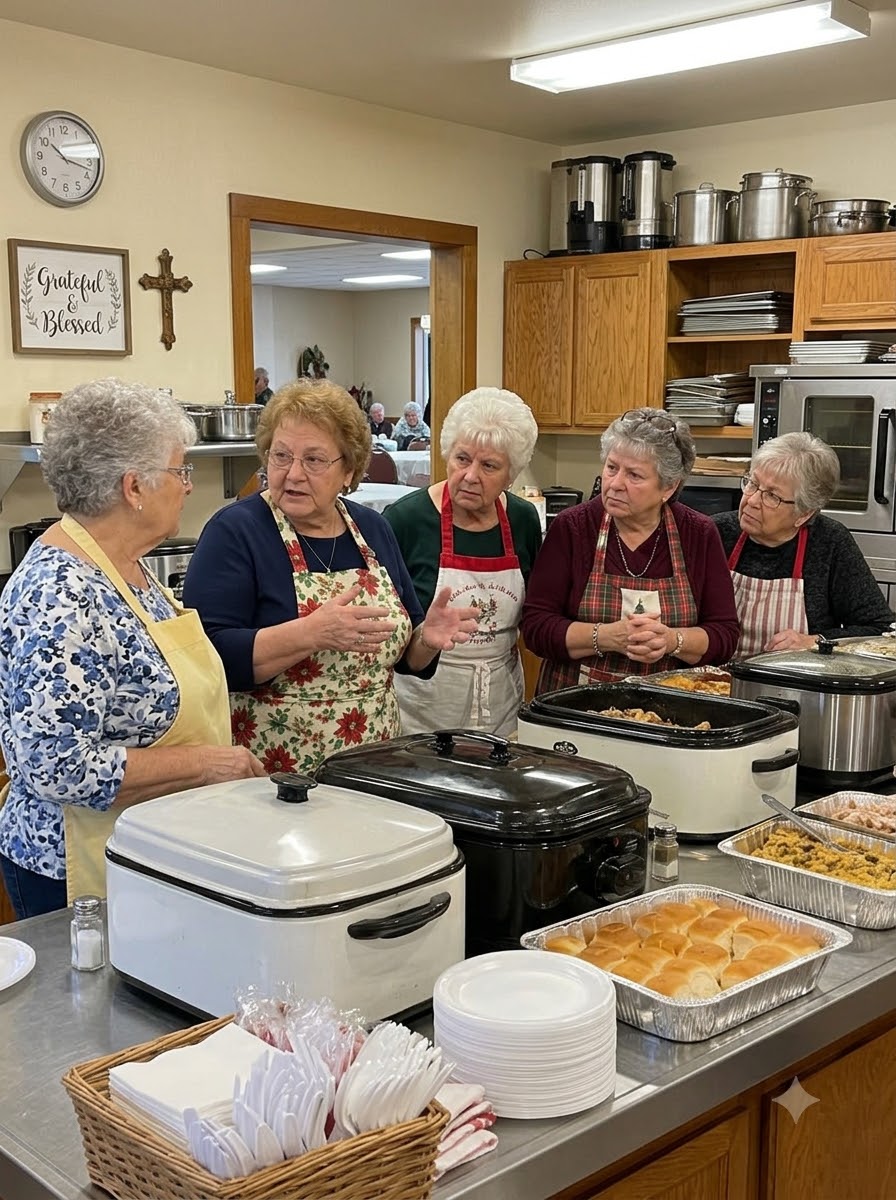
We stood in the basement kitchen of Zion Lutheran Church, still wearing our aprons, suddenly unsure what to do with our hands.
“But I talked to Pastor Shay, and we both think it’s time for some fresh ideas down here. We’ve found a wonderful catering service out of Grand Island. Prairie Table. They do a lovely spread for sixty people. Soup to dessert. And nobody has to stand over a hot stove at seven in the morning when they ought to be upstairs grieving with everybody else.”
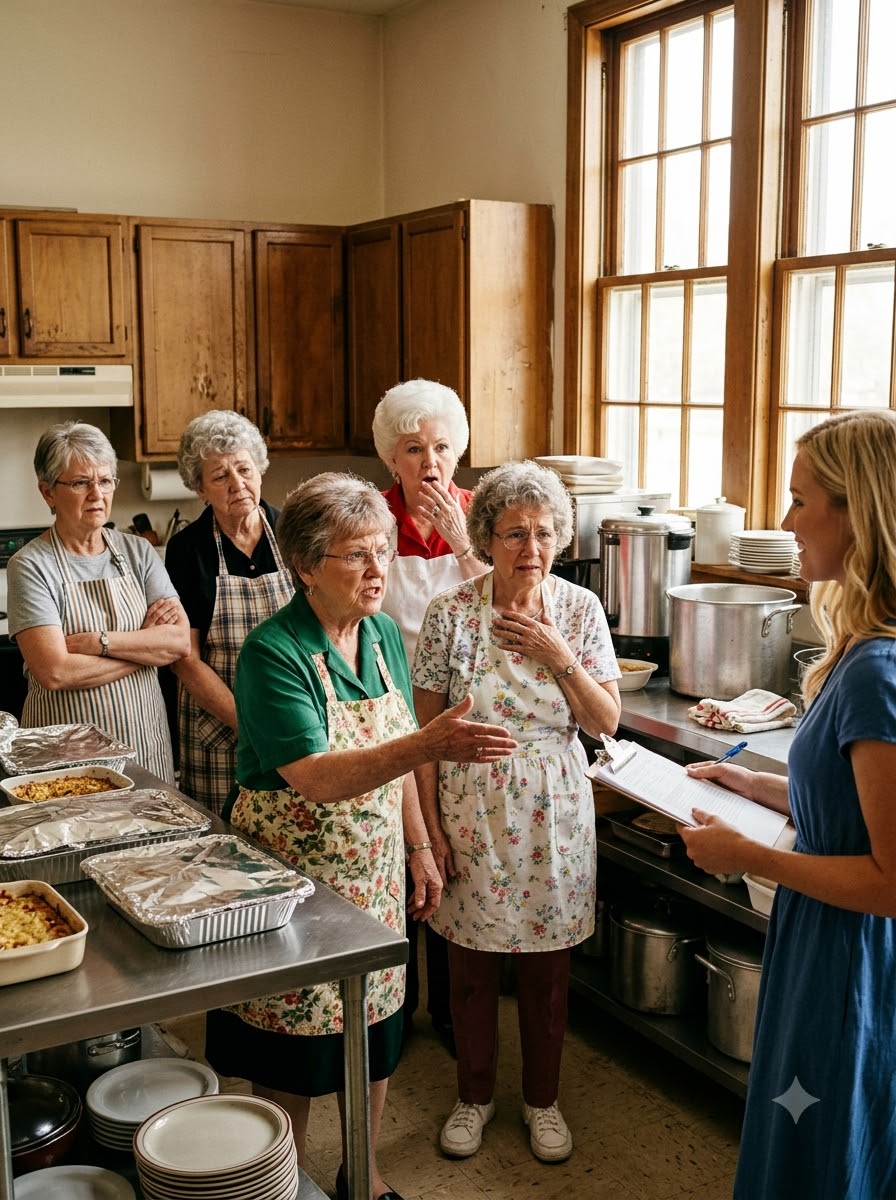
Louise slowly lowered the roasting pan she had been carrying.
It touched the countertop with a quiet metallic sound.
She didn’t slam it. Louise wasn’t that kind of woman.
“We’ve been doing the seven in the morning for thirty years, Tamra,” she said. “None of us minded.”
“I know,” Tamra replied.
And I believe she genuinely thought she was being considerate.
“That’s exactly why it’s time. You’ve all given so much. Now you can come sit with everybody else at the service. Doesn’t that sound nice?”
No one answered.
Wanda stared toward the coffee urns, the two enormous hundred-cup machines sitting on the shelf Eunice’s husband had built and bolted to the wall years earlier so they couldn’t tip.
Marge kept her eyes on the floor.
I looked at the notice.
I wish I could tell you that I found exactly the right words. Something dignified and memorable, something that might have made Tamra understand what she was taking away.
But I didn’t.
I loosened the strings of my apron, folded it into thirds and then in half, just as my mother had taught me to fold dish towels, and hung it on the hook beside the door.
It had hung there for thirty years.
“Well,” I said. “I suppose we’ll see you at church, Tamra.”
Then I climbed the basement stairs, entered the sanctuary, and sat in the pew where my husband would have been sitting if he’d lived long enough to see that day.
I held myself together until I got home.
Then I cried.
My name is Opal Deane, and I’m seventy-two years old.
I’ve spent my entire life in a little Nebraska town small enough that you could walk every street before a pot roast finished browning.
For thirty years, beginning when I was forty-two and had just buried my mother, I helped prepare the funeral luncheons at Zion Lutheran Church.
There were five of us.
Louise Pruitt.
Wanda Keel.
Eunice Brandt.
Marge Holt.
And me.
We never had an official title. Nobody appointed us or held an election.
We were simply the women who showed up when somebody died.
And once we’d started showing up, we never stopped.
We cooked through our own husbands’ funerals, through one another’s losses, through the deaths of farmers, teachers, neighbors, and even children.
Eventually, showing up became as natural as breathing.
To understand why that kitchen mattered so much, you need to know how it all began.
Thirty-one years earlier, my mother died in February.
The cold that winter was so severe that frost had penetrated four feet into the earth. They needed a backhoe to break the frozen ground for her grave.
After the burial, forty mourners returned to the church basement, shaking snow from their boots and rubbing their frozen hands together.
There was no food waiting.
Only a single coffee urn that somebody’s daughter-in-law had remembered to plug in.
Louise understood what that felt like.
Her husband had died the previous year, and she had stood in the same basement after his funeral, surrounded by people who wanted to comfort her but with nothing on the tables.
She remembered the emptiness.
So at six o’clock on the morning of my mother’s funeral, Louise appeared on my porch carrying two casserole dishes filled with scalloped ham and a quart jar of green beans she’d canned herself.
“Opal,” she said. “Get your coat. We’ve got a lunch to put on.”
That was how it started.
Wanda and Eunice joined us within the hour.
Marge came along two years afterward, following her mother-in-law’s death. She saw what we were doing, joined in, and never stopped.
We built our little system the way people build most things in a small town.
We used what we had.
There was a designated funeral shelf in the church pantry, kept stocked throughout the year.
Canned corn. Green beans. Dried noodles for hotdish. Two hundred paper napkins. A spare case of instant coffee in case the regular grounds ran out.
Inside the pantry door, we taped a list of dietary needs.
Who had diabetes.
Who couldn’t tolerate dairy after gallbladder surgery.
Who needed to avoid onions.
We wanted to make certain that someone already carrying the weight of a fresh loss wouldn’t have to worry about whether the food would make them sick.
And there was one thing we understood without ever needing to put it into words.
A funeral luncheon was never really about lunch.
It was about a widow sitting down at a folding table and finding a plate placed in front of her before she had to ask.
It was about giving a grieving person twenty minutes when they didn’t have to make a decision, organize anything, or take care of somebody else.
For a little while, someone would take care of them.
That was the purpose.
Nothing more complicated than that.
Pastor Shay arrived at Zion eighteen months before the kitchen notice appeared.
He was young, sincere, and newly graduated from seminary in St. Louis.
Our previous pastor, Pastor Ohlrich, had retired at seventy-nine after his hip became too painful for him to climb the chancel steps.
Zion had gone eleven years without a newly called pastor.
Meanwhile, our congregation had dwindled from forty families to twenty-two.
That happens to little rural churches.
The children grow up and move away. The older members die. The houses along the gravel roads grow quieter.
Our call committee spent months praying and discussing what to do.
Eventually, by a vote of six to one, they decided to bring in a young pastor.
Maybe a young family living in the parsonage would encourage other young families to come.
Pastor Shay arrived with his wife, Tamra.
She was twenty-nine, energetic, cheerful, and overflowing with ideas.
For the first year, she mostly left the basement kitchen alone.
Sometimes she helped on Sundays.
She learned our names, remembered that Eunice drank her coffee black, and discovered that Marge couldn’t eat onions.
Then September came.
Tamra attended a church conference in Lincoln focused on revitalizing small congregations.
When she returned, she carried a binder.
I don’t mention that binder to ridicule her.
Looking back, I believe it represented a sincere desire to help, mixed with a lack of understanding about the place she’d come to serve.
One conference session had addressed volunteer burnout.
The speaker had described churches that depended on the same few faithful members for decades, asking them to do unpaid work until they became exhausted, withdrew, or died.
Those churches, the speaker warned, often failed to build anything that could survive the people who kept everything running.
Tamra thought about five women in their sixties and seventies carrying hot roasting pans up and down basement stairs before sunrise.
And she saw women who needed rescuing.
What she didn’t see was what my friend Sharon Lindqvist would have recognized immediately.
Sharon had worked as a dispatcher for the county sheriff before retiring. She was practical, sharp, and rarely wasted a sentence.
When I eventually told her what happened, she said she’d have seen five women who had never complained, never requested relief, and never regarded their work as a burden.
Those women would have told anyone who asked that preparing funeral lunches was not a sacrifice they resented.
It was something they were grateful to be able to give.
But none of us told Tamra.
Sharon asked me about that later.
“Opal, why in the world didn’t you just say so? Why didn’t you tell that woman plain? We’re not tired. We like it. Leave us be.”
I wish the answer made me look wiser.
It doesn’t.
Pastor Shay was twenty-nine. The congregation had voted to call him after years of worrying whether Zion would survive another decade.
Tamra was his wife.
In a town our size, that position carries influence whether the woman wants it or not.
If five elderly women had stood before the council and refused to surrender their kitchen, people might not have understood that we were defending something built from love.
They might have seen us as stubborn old churchwomen determined to block the pastor’s young wife on her first important project.
And that was exactly the kind of story a struggling congregation feared.
We’d watched two other small churches in our county divide over disputes less serious than a kitchen sign-up sheet.
We couldn’t bear the thought of Zion becoming the third.
So we removed our aprons.
We stayed quiet.
We told ourselves we were being humble.
Part of that was true.
But our silence had a cost.
Wanda’s husband, LeRoy, had died nine years earlier.
The church kitchen was the only place in town where she still laughed with her whole heart.
Eunice’s eyesight had deteriorated so badly that she’d quietly stopped driving after dark.
Tuesday morning kitchen preparations were among the few remaining occasions when somebody needed her for something other than transportation.
Marge had buried her grandson three years before.
Tyler was nineteen when an infection took his life, an infection that should never have killed a healthy young man.
She once told me that cooking his funeral luncheon was the only reason she’d managed to get out of bed that week.
Grief feels different when your hands have work to do.
And my own Hollis had been gone six years.
That basement was where I still felt like someone’s wife, someone’s neighbor, someone who mattered to the town.
At home, I was a widow alone in a quiet house.
Downstairs at Zion, I was Opal, and there were people waiting for me.
Tamra couldn’t have known those things.
We never gave her the chance.
After the change, we continued attending Sunday services.
Louise sat two rows behind me. Wanda sat across the aisle. Eunice and Marge preferred the front, where Eunice could still make out the hymn board.
The new sign-up sheet gradually filled with names.
Three funerals came and went.
All were small services for longtime residents whose families already had plenty of relatives willing to prepare food.
Prairie Table delivered soup in disposable bowls, cold cuts and cheese cubes on plastic trays, and sheet cakes from the grocery store.
Everything went reasonably well.
Nobody complained.
Nobody remembered the food afterward, either.
We attended in our good dresses instead of our aprons, sitting with the rest of the congregation as Tamra had suggested.
She had promised it would be nice.
It wasn’t.
It felt like walking into a room after someone had rearranged the furniture.
You kept reaching for the place where the old chair used to stand.
Then, during the second week of October, Cole Haney’s wife died.
Cole and Dana Haney had moved to our county eighteen months earlier, around the same time as Pastor Shay.
They were still new enough that most neighbors referred to them as the young couple renting the old Petersen place out on the gravel road.
Cole worked on the loading dock at the grain cooperative.
Dana was pregnant with their first child, due the following spring.
On Tuesday, she went to the hospital in Grand Island with what doctors initially believed was an unusually severe headache.
By Thursday, she was dead.
An aneurysm.
Almost no warning.
Almost no time.
Their unborn baby died too.
Cole was twenty-six years old.
He had no family nearby.
His mother had died while he was in high school. His father lived three states away, and they hadn’t spoken for years because of an old dispute Cole rarely discussed.
Dana’s relatives lived in Ohio. Money was tight, and the distance was too great for them to come for anything beyond the funeral itself.
When Cole stood in the front pew at Zion, he had nobody beside him.
Not one person.
Only Pastor Shay’s hand resting gently on his shoulder.
In thirty years of funeral services, I’d never seen a man look so terribly alone while surrounded by so many people.
Prairie Table had been scheduled to provide lunch for sixty mourners at eleven-thirty that Saturday.
I knew because Eunice’s daughter-in-law helped prepare the church bulletin and had mentioned the arrangement to her.
The booking had originally been made for old Mr. Riggle’s funeral.
But his family requested a postponement so a son could travel in from out of state.
Instead of canceling the catering order, Tamra transferred it to Dana Haney’s service because the dates were close enough.
Six hundred and fifty dollars.
Soup, rolls, cold cuts, and sheet cake.
A reasonable price for feeding sixty people when the caterer was traveling forty miles from Grand Island.
Provided the food actually arrived.
That Saturday morning, the county was still recovering from a hard frost that had swept through two nights earlier.
Somewhere along the gravel road between Grand Island and our town, Prairie Table’s delivery van approached a stalled grain truck.
The driver tried to steer around it.
The tires struck an icy patch.
The van slid into a ditch.
Thankfully, nobody was injured.
But the meal was ruined.
Soup spilled across the van floor. A case of bottled water slid into the cold-cut trays and crushed them.
The driver called his employer.
The employer called Tamra at nine-forty.
The food couldn’t be delivered.
The caterer offered a full refund and a sincere apology, but there was nothing left to serve.
Meanwhile, mourners would soon be coming downstairs expecting lunch.
And Cole Haney, who had just buried his wife and unborn child, would be among them.
At nine-thirty that morning, council president Harold Bruning had already telephoned Louise, worried that something was going wrong.
By the time the full disaster became clear, he was beside himself.
Louise told me later that she’d never heard Harold sound so shaken in all his seventy-four years.
His wife had died eleven years earlier. He’d never organized a meal for more than himself and his dog.
“Louise,” he began. “I don’t suppose there’s any way—”
He couldn’t finish.
After what had happened to us two months before, he didn’t believe he had the right to ask.
But Louise understood.
She called me.
I called Wanda and Marge.
Louise called Eunice.
We divided the calls exactly as we’d always done.
Thirty years of habit worked faster than any plan.
By nine-fifty, I knew that seventy people, not sixty, would need to be fed by eleven-thirty.
And somewhere upstairs, a twenty-six-year-old widower was preparing to face the loneliest day of his life.
I looked at the clock.
Then I reached for my church keys.
PART 2
I didn’t telephone Tamra to request permission.
That is something I want to admit plainly.
I believe the way we do a good thing matters, not only the fact that we do it.
But in those first minutes, I wasn’t thinking about Tamra, her conference binder, or the sign she’d posted.
I wasn’t interested in embarrassing her.
I wasn’t trying to prove that the five of us knew better.
I kept seeing Cole Haney standing alone in the front pew.
I remembered the funeral shelf we’d stocked for thirty years, and I hoped nobody had emptied it.
Most of all, I knew that whatever had happened to our pride was far less important than putting a warm plate of food in front of that young man.
Eunice still had her key to the church.
Nobody had asked her to return it.
That, I suppose, shows how little thought had been given to what removing us from the kitchen actually meant.
At ten o’clock, all five of us were standing downstairs again.
We were still wearing our Sunday dresses, but we’d rolled up our sleeves.
And suddenly the kitchen felt familiar.
It was as though we’d never been gone.
At the same time, we knew those two months of feeling unnecessary could never be returned to us.
Both things were true.
“Ham and noodles,” Wanda announced, already reaching for the big roasters on the upper shelf. “We’ve still got canned ham in the chest freezer upstairs, don’t we? Or did Tamra clear that out too?”
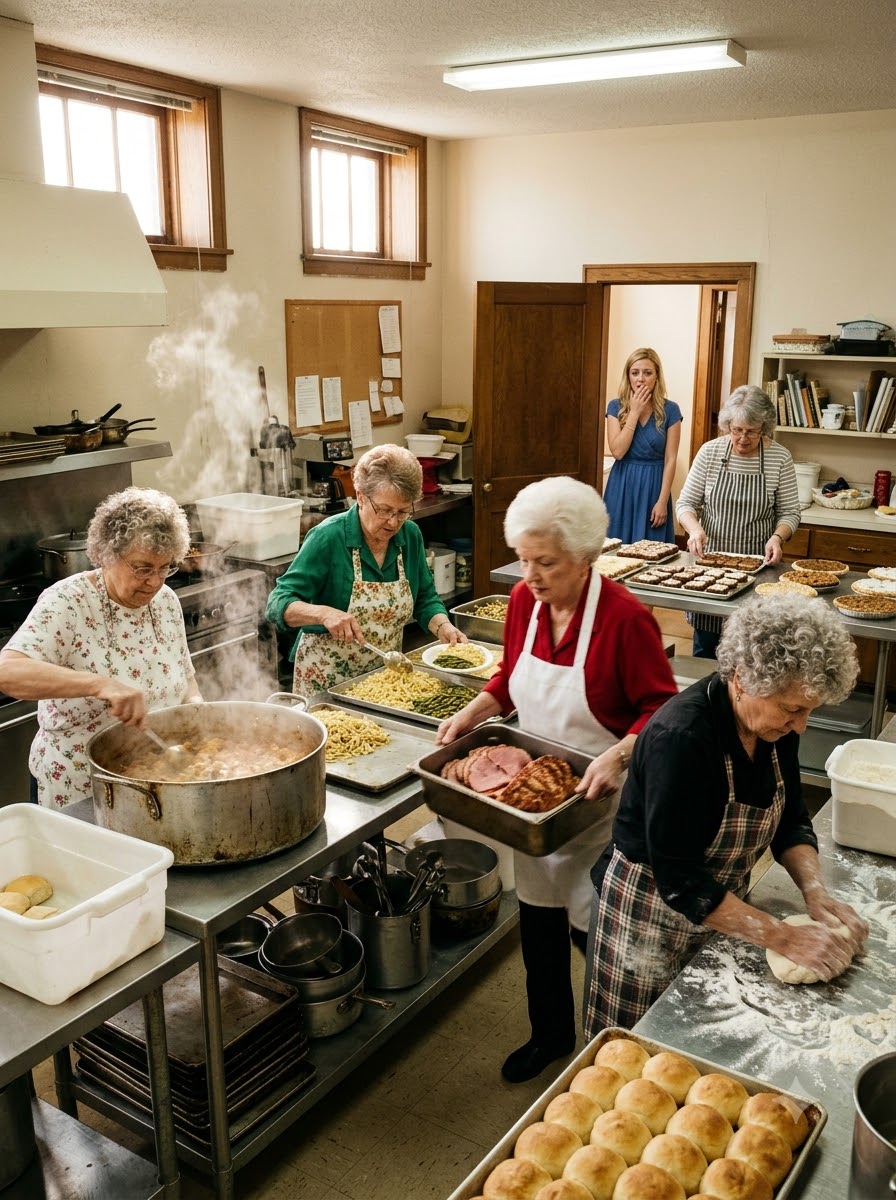
“She didn’t touch the freezer,” Eunice replied. “I don’t think she knew it was there.”
Marge was already calling her husband, Dale.
Dale was seventy and still farmed outside town.
Like many farm families in our county, he kept two quarters of beef in a locker freezer.
He understood what it meant to feed a crowd on almost no notice.
“Dale. Bring the folding tables from the shop. And call LeRoy’s boy, see if he can run the extra chairs over from the fire hall.”
LeRoy had been dead nine years, but his son still owned the old flatbed trailer.
Within twenty minutes, that trailer was backed up to the fellowship hall entrance.
Eight folding tables and forty metal chairs were stacked on it.
Dale, LeRoy’s son, and Harold Bruning hauled everything down the ramp.
None of those men had ever prepared a funeral luncheon.
But they knew how to lift heavy things and carry them where they were needed.
And not one had to be asked twice.
Louise opened three jars of home-canned green beans from her garden.
She’d canned green beans every August for fifty years, whether the church needed them or not.
It was simply what Louise did.
At home, I had four pounds of ground beef in my freezer.
I’d intended to stretch it into meals for myself throughout the coming week.
Instead, every pound went into a roasting pan of tater tot hotdish.
In our county, that was what people ate when they were grieving.
You couldn’t replace it with a plastic tray of catered cold cuts, however attractive the arrangement might be.
Eunice started making biscuits.
Her eyesight was poor in the basement light, but her hands knew the dough.
She’d made those biscuits so often that she could almost have done it in her sleep.
And perhaps, on some early mornings, she nearly had.
None of us had slept especially well since being told we were no longer needed.
Yet now, rushing around the kitchen, we felt something almost like relief.
It seemed strange to feel relief on the day a young woman and her unborn child were being buried.
But grief is strange.
And being able to help somebody can ease a hurt that sitting still only makes worse.
There wasn’t time to bake a sheet cake.
Fortunately, every woman who’d cooked funeral lunches for thirty years knew the importance of keeping dessert ready.
We had tins of lemon bars, rhubarb crisp, and other treats in our kitchens at home.
You keep them the way a farmer keeps diesel in the tank.
Ready before the need arises.
Marge’s granddaughter drove the two miles to her house and returned eleven minutes later carrying every tin she could find.
By eleven-fifteen, steam was rising from the roasters.
The coffee was brewing.
The basement smelled of fried onions, baked ham, and warm biscuits.
Pastor Shay came down the stairs looking for Tamra.
He explained that she was upstairs in the sanctuary, trying to figure out what to tell seventy mourners who would soon be descending into a basement with no food.
Then he reached the third step from the bottom.
And stopped.
He stared at the five of us.
Five elderly women in church dresses, wearing aprons that had been hanging on the same hooks where we’d left them.
Every burner was occupied.
Food was cooking.
People were setting tables.
For thirty years, that smell had filled Zion’s basement whenever somebody died.
And now it was there again.
“I don’t—” Pastor Shay began.
He stopped speaking.
For a moment, he looked almost unable to believe what he was seeing.
Then he said one thing.
“Thank you.”
Very softly.
He turned around and went upstairs to find his wife.
Tamra came down at eleven-twenty.
Her face was pale, and she looked like a woman who had spent the last hour rehearsing an apology she didn’t know how to deliver.
She stopped on the bottom stair.
It was the same place she’d stood two months earlier, announcing the new process.
But she wasn’t standing confidently with her hands folded at her waist this time.
She was twisting a church bulletin into a tight roll.
“I called everyone I could think of,” she said. “I didn’t know who else. I didn’t know you still had a key.”
“We never gave it back,” Eunice replied.
There was no cruelty in her voice.
Eunice was simply stating a fact.
Tamra’s gaze moved over the kitchen.
She saw the steaming roasters, the empty green bean jars on the counter, and Marge’s granddaughter arranging mismatched tins of dessert.
To us, those things were perfectly ordinary.
To Tamra, they seemed almost miraculous.
“I don’t know how to thank you,” she said. “After everything. I wouldn’t have blamed you if you’d let it fail.”
I wish I could tell you I answered with some beautiful speech.
I didn’t.
I had a hotdish that needed to come out of the oven in four minutes.
There were seventy people to feed.
And upstairs was a young man who might collapse if someone didn’t get something warm into him.
So I said the only thing that mattered.
“Tamra, grab that stack of plates and start carrying them out to the tables. We’re short on hands and long on minutes.”
She obeyed immediately.
She took an apron from the hook, rolled up her sleeves, and began carrying plates.
For the next forty minutes, the pastor’s wife who had replaced us worked beside us.
She ladled hotdish onto paper plates.
She carried dishes to the tables.
She helped feed a young man who had lost everything.
None of us said one unkind word to her.
There wasn’t room in that kitchen for resentment.
There was only room for work.
At eleven-thirty-five, Cole Haney came down the stairs.
Pastor Shay still had a hand at his elbow.
Cole stopped three steps from the bottom, exactly where Pastor Shay had stopped earlier.
He looked across the room.
There were folding tables, chairs, coffee, hot food, and people waiting to serve him.
Somehow, in less than ninety minutes, a meal had been assembled for a man most of us barely knew.
Cole stood silently.
Then he moved toward the ham and noodles.
Something about the dish seemed to draw him.
He stared down into the pan.
“My wife’s grandmother used to make this exact thing,” he said.
His voice was so quiet I nearly missed it.
“Same way. Noodles on the bottom.”
Wanda looked up.
She had made that dish.
Cole’s eyes filled with tears.
“Dana used to call it her grandma’s funeral dish,” he said. “She said it was the only time anybody in her whole family ever sat down together at once.”
Wanda set her serving spoon aside.
She walked around the table and placed both hands on his shoulders.
It was the way you steady a fence post that’s begun to lean.
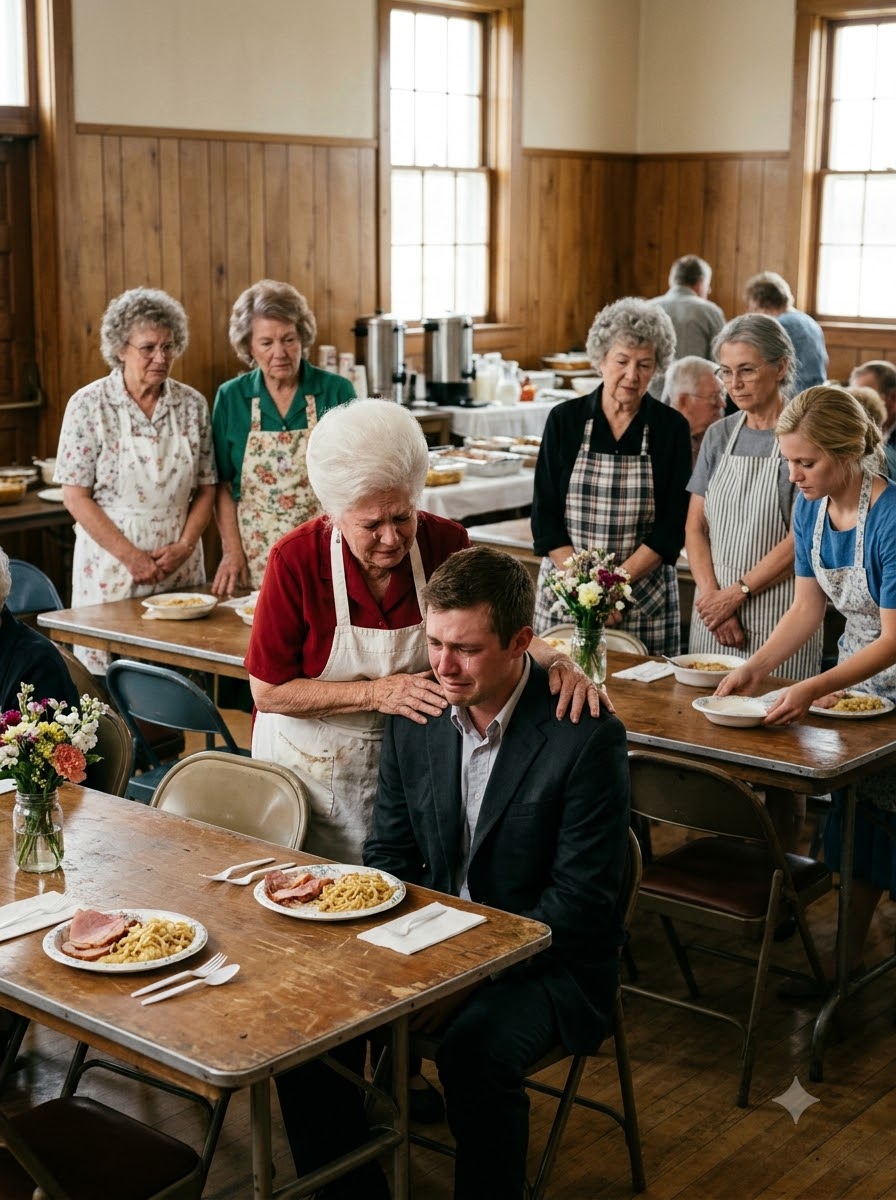
“Well then, son,” she said. “You sit right down here, and you eat all you want of it. And when you’re done, there’s seconds. And there’s a woman in this basement who will sit with you just as long as you need sitting with.”
She guided him to a chair.
Then she sat across from him.
I watched a twenty-six-year-old widower, with no family beside him, eat ham and noodles across a folding table from a seventy-one-year-old widow he’d known for barely eleven minutes.
Both of them cried a little.
Neither seemed ashamed that the other could see.
I cried too.
I was standing near the two coffee urns on the shelf Eunice’s husband had bolted to the wall so many years before.
Marge found me there.
She didn’t say anything.
She squeezed my arm once, then went back to cutting lemon bars into smaller pieces.
After all, we were feeding seventy people with food originally meant to serve sixty.
You learn to stretch what you have.
And when people matter enough, you always find a way.
The mourners stayed for lunch.
They talked quietly.
They passed the dishes.
Some went back for seconds.
For a little while, Cole wasn’t alone in the world.
There was a place set for him, food prepared for him, and a woman sitting across from him who wasn’t going anywhere until he was ready.
That was what our kitchen had always been for.
Eventually, the final mourner left.
The tables were wiped clean.
The roasters were washed, dried, and stacked.
The kitchen grew quiet.
But Tamra didn’t leave.
She sat on an overturned five-gallon bucket beside the pantry, looking at the funeral shelf.
Someone, probably Louise, had already started replacing the green beans we’d used.
“I thought I was doing you a kindness,” Tamra said.
She didn’t look at me.
Her eyes remained on the shelf.
“I went to that conference, and they talked about burnout. About churches that run the same five people into the ground for forty years, because nobody ever gives them permission to stop. And I looked at the five of you climbing those stairs with hot pans, and I thought, nobody has ever told these women it’s all right to rest. I thought I was the one finally saying it.”
I pulled a folding chair over and sat facing her.
At seventy-two, my knees weren’t particularly fond of sitting down or standing up.
“We know what you thought,” I said.
She looked at me.
“I don’t believe you meant us any harm, Tamra. I never believed that. Not even the day you taped that sign to the door.”
“Then why didn’t anybody tell me different? Why did you just let me do it?”
It was the same question Sharon would ask.
And I gave Tamra the answer I would eventually give my friend.
“Because you’re the pastor’s wife of a church that’s one bad year away from closing its doors,” I said. “And we weren’t going to be the reason folks in this town said five old biddies ran off the new pastor’s wife two years into his call.”
Tamra stared at me.
“Some things are worth losing quietly instead of winning loud,” I continued. “We decided the kitchen was one of them. I’m not sure now that we decided right. But it’s what we decided. And I don’t regret the kindness of it. Even if I regret some of the silence.”
She didn’t respond immediately.
The basement was quiet enough that I could hear the refrigerator humming.
Then Tamra looked around the room.
“I didn’t understand what this room was.”
She studied the shelves, the roasting pans, and the tables.
“I thought it was a chore somebody needed to be rescued from. I thought a sign-up sheet and a caterer were the modern, kind way to do it. And I never once asked any of you what this basement actually was. Before I decided to fix it.”
Her gaze settled on the inside of the pantry door.
The dietary list was still there.
Who couldn’t eat onions.
Who couldn’t have dairy.
Who had diabetes.
Thirty years of quietly remembering what other people needed.
Most of the congregation probably didn’t know the list existed.
“It was never about the food,” Tamra said softly. “Was it.”
“No,” I answered. “It was never about the food.”
For a while, neither of us spoke.
I wondered whether this was the moment when things would change.
Whether Tamra would take down her sign and hand the kitchen back to us.
Whether the five of us would return the following Tuesday as though the previous two months had never happened.
But that wasn’t what happened.
Not yet.
And looking back, I’m glad.
Because what Tamra did next mattered more than simply admitting she had been wrong.
PART 3
We didn’t reclaim the kitchen that Saturday.
There was no dramatic confrontation, no tearing down the notice, and no demand that everything be restored exactly as it had been.
The change came more slowly.
And in the end, it was better that way.
The following Tuesday morning, somebody knocked on the basement door.
Louise opened it.
Tamra stood on the other side wearing jeans and an old sweatshirt.
She held a notebook and a pen.
I remember being struck by the fact that she had knocked.
On a door in her own husband’s church.
“I’d like to learn the funeral shelf,” she said. “And the dietary list. And how Eunice takes her coffee. Not to run any of it. Just to help carry it. If you’ll still have me.”
The rest of us turned toward Louise.
She was the one who’d begun this work thirty-one years earlier, arriving at my house with two casseroles and a jar of green beans on a freezing February morning.
It seemed right that she should answer.
Louise studied Tamra for a long moment.
“There’s always room at this table for one more set of hands, Tamra,” she said. “So long as you remember whose table it is you’re setting.”
Tamra nodded.
Her eyes shone with tears.
“I’ll remember,” she said.
And she did.
She began coming every Tuesday.
She wrote things down.
She learned that when you double the recipe for scalloped potatoes, they need a full extra hour in the oven.
She learned that coffee should be started before anything else because grieving people almost always want a cup before they’re ready to eat.
She learned that Eunice drinks hers black.
That Marge can’t eat onions.
That old Mr. Pfeiffer, who sits in the fourth pew, isn’t supposed to have salt but always asks for ham anyway.
And that you give him a small piece without making a fuss.
Tamra learned those details one by one.
She didn’t try to reorganize our shelves or replace our recipes.
She didn’t arrive with another binder full of improvements.
She simply worked alongside us.
Sometimes she asked questions.
Sometimes she carried heavy pans.
Sometimes she listened while we explained why a particular family always needed an extra pot of coffee, or why one widow preferred to sit near the kitchen door.
Little by little, she began to understand what we’d spent thirty years learning.
You can’t serve people well if you don’t know them.
And knowing them takes time.
The sign-up sheet is still on the pantry door.
But it no longer looks the way it did that first morning.
It isn’t a computer-printed list of caterers and delivery times.
Marge wrote the new one by hand.
It contains the names of people willing to help.
People who can carry folding tables.
People who will haul the heavy coffee urns.
People who can fetch chairs from the fire hall.
People who will drive an elderly woman home after she’s spent the morning standing over a stove.
Because we learned something too.
Five women who have been doing the same work for thirty years are allowed to accept help.
We don’t have to carry every heavy thing ourselves simply because we always have.
There are twenty-three names on that sheet now.
Tamra’s is first.
Pastor Shay’s is second.
Prairie Table sent Zion a check for six hundred and fifty dollars, refunding the entire failed catering order.
They enclosed a thoughtful letter of apology.
The following Wednesday, the church council met to decide how to use the money.
Harold Bruning rose before anybody else could speak.
“I move that we put it toward a new chest freezer for the basement,” he said. “For the funeral shelf. A big one.”
Pastor Shay seconded the motion.
It passed unanimously.
Seven votes to none.
Tamra cast the seventh vote.
She’d been added to the council that fall.
The freezer arrived in November.
It was a large white chest freezer, the kind that could hold enough food to feed half the county if necessary.
Dale and LeRoy’s son carried it downstairs and positioned it beside the pantry.
At some point, somebody stuck a strip of masking tape across the lid.
Five names were written on it in black marker.
Louise.
Wanda.
Eunice.
Marge.
Opal.
I suspect Tamra put it there.
She’s never admitted it.
I’ve never asked.
Some things don’t need explaining.
Cole Haney still attends church most Sundays.
He usually sits near the back, alone in the last pew.
I don’t know whether he chooses that spot because he likes the quiet or because sitting in front still reminds him of Dana.
I don’t ask.
Grieving people deserve to keep some things private.
But twice now, Cole has come down to the basement on a Tuesday morning to help us.
The first time, I was standing at the stove when I looked up and saw him in the doorway.
His hands were tucked into his jacket pockets.
He looked uncertain whether he was welcome.
“I don’t really know how to cook,” he said.
“Nobody does, at first,” I told him. “Come on in.”
He came.
Now he helps Eunice stir the large pots.
Her eyes have grown too weak to tell exactly when the noodles are ready.
But she can still tell by their smell.
So Cole stirs, and Eunice tells him when to stop.
One Tuesday, while he was drying roasters at the sink, he explained why he kept coming back.
He said it quietly, almost as if he was embarrassed to admit it.
“It’s the only place in this whole town,” he said, “that still smells like somebody cares whether I eat.”
I didn’t know what to say.
Sometimes there isn’t anything useful to say.
So I let him finish drying the pan.
Wanda sends him home every Tuesday with a foil-covered plate.
She insists he’s too thin.
She says it every single week.
And every week, Cole answers, “Yes ma’am,” and takes the food.
I don’t know whether he’ll remain in our county.
He’s young.
He might return to Ohio someday, or move somewhere else entirely.
Perhaps he’ll find a place that doesn’t carry so many painful memories.
I hope he finds whatever he needs.
But I know one thing for certain.
On a Saturday morning in October, when Cole had lost his wife and the baby they were expecting, five elderly women chose to cook for him.
Those same five women had recently lost something they loved.
We’d been told our work was no longer necessary.
We’d been asked to step aside.
And we’d done it without making a fuss.
Yet when somebody needed us, we came back.
Not because we wanted to win an argument.
Not because we wanted Tamra to fail.
Not because we believed our feelings mattered more than anybody else’s.
We came because there was a young man upstairs who needed to be fed.
And because thirty years in a church basement had taught us what to do when somebody was hurting.
I’ve thought often about that morning.
About the notice on the door.
About how Louise set down her roasting pan.
About the way Wanda stared at the coffee urns and Eunice kept her eyes on the pantry.
I’ve thought about the two months we spent sitting in our good dresses, wondering whether the place we’d made for ourselves in the world had disappeared.
And I’ve thought about Tamra.
She was trying to do something kind.
She simply hadn’t asked enough questions before deciding what kindness should look like.
I think that’s an easy mistake to make.
You see somebody carrying a heavy load, and you assume they want it taken away.
Sometimes they do.
Sometimes they’re exhausted, and they desperately need someone to notice.
But sometimes what looks heavy to you is the very thing giving them strength.
Sometimes the work isn’t what wears them down.
Sometimes it’s what helps them get through the day.
Tamra learned to ask before changing things.
And we learned that silence, even when it comes from a wish to keep the peace, can prevent people from understanding one another.
We should have told her what the kitchen meant.
We should have explained about Wanda’s laughter, Eunice’s sense of purpose, and Marge’s need to keep her hands busy after losing Tyler.
I should have told her about Hollis.
About how the kitchen made the empty house waiting for me afterward a little easier to bear.
We didn’t tell her any of it.
And she didn’t know to ask.
Now we talk more.
We ask more.
And when somebody new offers to help, we don’t simply hand them a roasting pan and expect them to understand thirty years of history.
We tell them why we do things the way we do.
We explain that a widow shouldn’t have to ask for a plate.
That a grieving family shouldn’t have to worry about dietary restrictions.
That a young man sitting alone deserves somebody willing to sit across from him.
And that a funeral luncheon is not a performance.
Nobody needs to admire the food.
Nobody needs to remember who made the biscuits.
The important thing is that the people who came in hungry leave feeling that somebody noticed them.
I still wear my apron on Tuesday mornings.
It hangs on the same hook by the basement door.
The cloth is older now, and so am I.
My knees complain when I carry things downstairs.
Sometimes I have to sit for a few minutes before I can get back to work.
And now, when that happens, somebody else picks up the heavy end.
Sometimes it’s Tamra.
Sometimes it’s Pastor Shay.
Sometimes it’s Cole.
Sometimes it’s one of the other twenty people whose names are written on Marge’s sign-up sheet.
I never imagined, when Louise first knocked on my door all those years ago, that the five of us would build something that could outlast our own ability to carry it.
But perhaps that’s what we’ve done.
Not because we found a caterer.
Not because we created a better schedule.
Because we made room for more people to care.
And because we finally understood that letting someone help doesn’t mean surrendering the thing you love.
It means giving that love somewhere else to go.
I don’t know how many more funeral lunches I’ll cook.
At seventy-two, you become aware that there are fewer years ahead than behind.
I don’t say that sadly.
It’s simply true.
One day, another woman will hang her apron on my hook.
She may be younger than Tamra.
She may not know the difference between ham and noodles and tater tot hotdish.
She may have never canned a green bean in her life.
That’s all right.
Someone will teach her.
Someone will show her the funeral shelf and the dietary list.
Someone will explain why the coffee goes on first.
And if she asks why we do all this work for people who may never know our names, I hope somebody tells her the truth.
Because it was never really about the roasting pans.
Or the folding tables.
Or the biscuits Eunice can make by feel.
Or the hundred-cup coffee urns her husband secured to the wall.
It was about the people who came through those basement doors carrying a loss too heavy to manage alone.
For thirty years, we learned that love doesn’t always arrive with grand words or beautiful gestures.
Sometimes it gets up at six in the morning.
Sometimes it opens three jars of green beans.
Sometimes it drives a flatbed trailer to the fire hall.
Sometimes it cuts lemon bars into smaller pieces because seventy people showed up instead of sixty.
And sometimes it sits across from a grieving young man while he eats his grandmother-in-law’s favorite funeral dish, letting him cry without trying to stop him.
Real love doesn’t keep a ledger of what it has given.
It doesn’t calculate what it’s owed.
It doesn’t wait for an invitation when somebody is hungry.
It simply asks one question.
Who needs feeding?
And then it goes downstairs to find out.
