

PART 1
The Name on the Back
At exactly 2:47 on a Friday afternoon in September, my phone began ringing.
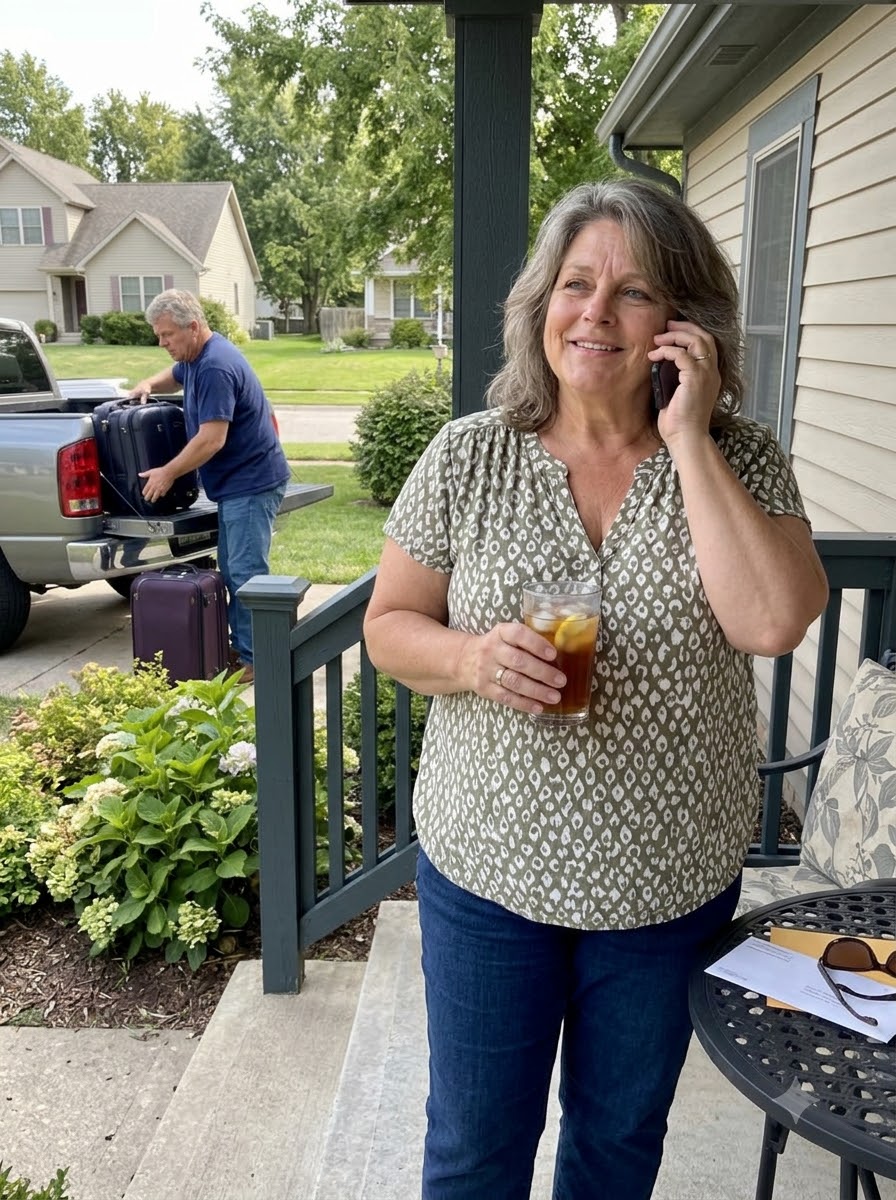
I was sitting on the front porch of my house in Dalton, Georgia, rocking gently in the white wicker chair my mother had left me. A glass of iced tea sat on the table beside me, condensation running down its sides. My bare feet rested against the porch railing.
I’d just finished watering my tomatoes.
The Cherokee Purples were late that season, growing heavy and dark, their skins splitting near the stems after too much water following weeks of dry weather.
My phone vibrated against the table.
The number had a 404 area code.
Atlanta.
I watched it ring twice before answering.
“Hello?”
“Am I speaking with Patricia Dunn?”
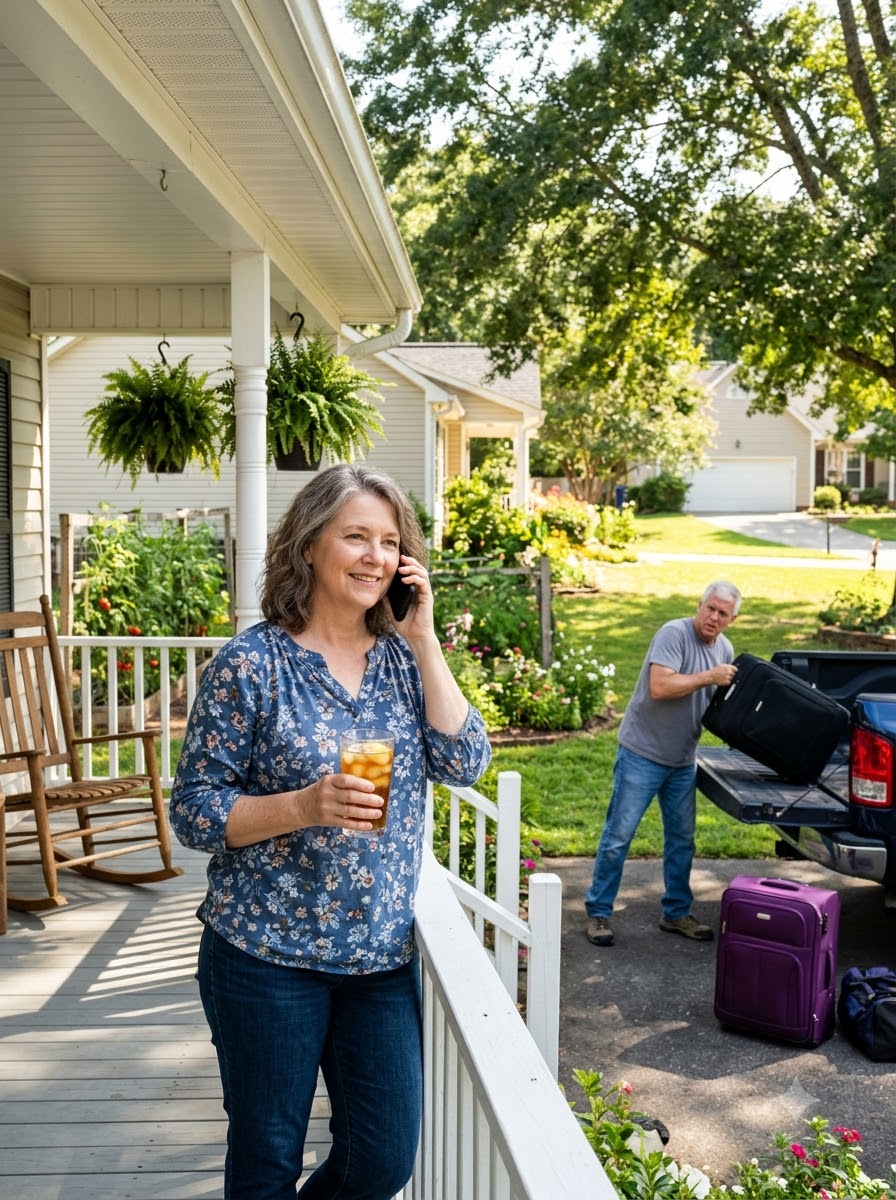
The woman sounded middle-aged, professional, and unusually cautious. She had the measured voice of someone accustomed to delivering unpleasant information.
“Yes, this is Patricia.”
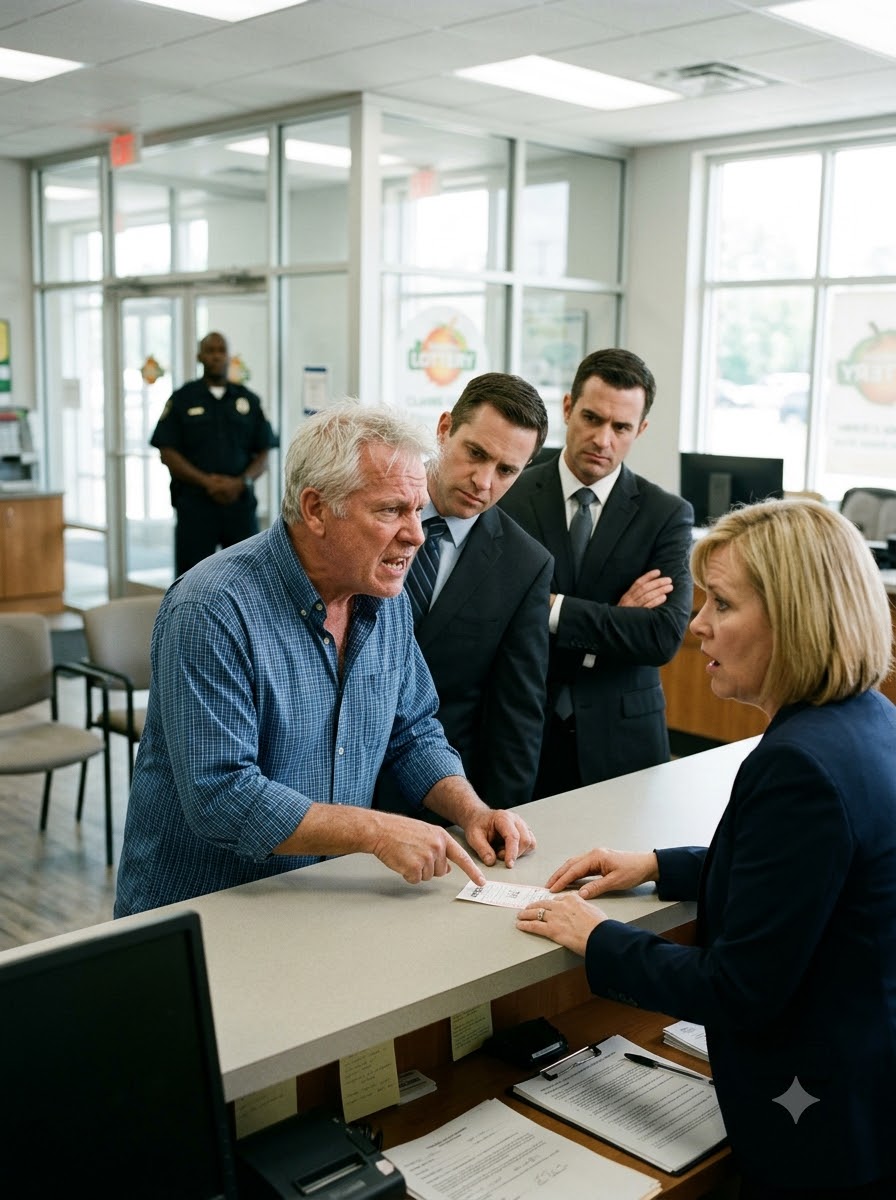
“Mrs. Dunn, my name is Linda Holloway. I’m calling from the Georgia Lottery Claims Center on Centennial Olympic Park Drive. Your husband is here attempting to claim a winning lottery ticket.”
I looked out at my garden.
“I thought he might be.”
Silence followed.
Then I heard a man’s voice somewhere behind her. It was muffled at first, but the volume was rising.
“Ma’am,” Linda continued, “we’ve encountered a problem with the back of the ticket.”
I lifted my iced tea.
“The ticket has already been signed,” she explained. “And the signature doesn’t match the identification your husband provided.”
In the background, I heard Gary shouting.
“That’s my wife’s handwriting! She signs everything! It’s a joint ticket! We’re married! Thirty-four years!”
I smiled.
Then I placed my glass on the table.
“No, Linda,” I said. “I don’t imagine it would.”
Because nineteen years earlier, when I bought my very first lottery ticket, I made a promise to myself.
And Gary was about to discover what I’d written on the back of every ticket since.
But to understand why that mattered, I need to tell you about my mother.
And a little plastic pineapple.
My name is Patricia Ann Dunn, although nearly everyone calls me Patty.
I’m fifty-eight years old, and I’ve lived my entire life in Dalton, Georgia.
People call Dalton the carpet capital of the world. My father spent thirty-one years working for Shaw Industries. My mother put in twenty-six years at Mohawk. Growing up, nearly every family I knew had somebody working in a carpet mill.
I married Gary Dunn when I was twenty-four.
He was twenty-seven, a forklift driver at the Shaw plant on Industrial Boulevard. He drove a red Chevrolet pickup, wore a thick mustache, and had a talent for making people laugh.
We met at a church fish fry in 1990.
He did an impression of our pastor so perfectly that even the pastor laughed.
Six months later, Gary proposed in the Dairy Queen parking lot on Walnut Avenue.
The ring came from Kmart.
I said yes.
We had three children.
Robby arrived in 1992. He’s thirty-three now, works as a lineman for Georgia Power, and has a wife and two daughters.
Tessa was born in 1995. She’s thirty, works as a nurse at Hamilton Medical Center, and shares her home with a cat named Biscuit.
Our youngest, Kyle, was born in 1999. He’s twenty-six and serves in the Army at Fort Stewart near Savannah.
I raised those children.
Gary was physically present. He lived under the same roof. He occasionally attended a ballgame.
But I was the one who raised them.
I prepared lunches, organized carpools, stayed awake through fevers, attended school conferences, signed permission slips, and made Halloween costumes.
I went to their graduations and cried every time.
Gary worked, came home, ate whatever I’d cooked, watched television, and went to bed.
Saturdays were for fishing at Carters Lake.
Thursday evenings belonged to the Moose Lodge.
That was our arrangement.
Except nobody ever asked me whether I agreed to it.
I worked too.
At first, part-time while the children were small. Once Kyle started kindergarten, I began working full-time at the Walker County Health Department.
For twenty-two years, I checked patients in, answered telephones, and scheduled immunizations.
By the time I retired, I earned twenty-eight thousand dollars annually.
Gary earned considerably more.
He’d worked his way from forklift driver to shift supervisor and eventually warehouse manager.
He also controlled our finances.
Both paychecks went into our joint checking account.
Gary handled the bills.
Every Sunday evening, he handed me two hundred dollars in cash.
That was supposed to cover groceries, gasoline, and whatever the children needed.
If I ran short, I had to ask him for more.
Most of the time, he refused.
“Patty, you spent two hundred dollars on groceries last week? What are you feeding these kids? Steak?”
Or:
“Patty, why do you need new shoes? What’s wrong with the old ones?”
And:
“Patty, the kids don’t need to go to that camp. I didn’t go to camp. I turned out fine.”
So I learned to make the money last.
I clipped coupons and bought store brands. I cooked casseroles that could stretch across three dinners. I shopped at the Goodwill on Thornton Avenue and convinced my children their secondhand clothes were fashionable vintage finds.
Two hundred dollars every week.
That was what I was allowed.
For thirty-four years.
My mother died on March 14, 2006.
Her name was Ruby Mae Whitmire.
She was seventy-one, and ovarian cancer had taken nearly everything from her.
She’d been sick for fourteen months.
During that time, I went to her little brick house on Murray Avenue every day after work and spent nearly every weekend there.
Gary never came.
Not once.
He said hospitals made him uncomfortable. Sick people made him nervous. Besides, according to him, I was better suited to that sort of thing.
My younger sister June helped whenever she could.
June lived in Chattanooga, about forty minutes away. She’d been born with a heart condition and had already undergone two surgeries. Heavy physical work wasn’t possible for her.
So most of the care fell to me.
I bathed Mama, changed her sheets, helped her eat, and administered morphine after the hospice nurse taught me how.
Three days before she died, Mama asked me to sit beside her.
She weighed only eighty-one pounds.
Her hair was gone, and she wore a pink scarf Tessa had knitted in home economics class.
She reached for my hand.
“Patty, can I tell you something?”
“Of course, Mama.”
She studied me for a long time.
“I’ve watched you,” she said. “Thirty-two years. Since you were born. And for the last fifteen, I’ve watched you with Gary.”
I stayed quiet.
“You put everybody’s name first,” she continued. “The kids. Gary. Me. June. Your boss at the health department. The church. Everybody.”
Her fingers tightened around mine.
“I’ve never once seen you put your own name on anything.”
I frowned.
“What do you mean?”
“The house is in Gary’s name. The truck is in Gary’s name. The bank account says Gary and Patricia Dunn. Gary first. Your Christmas cards say The Gary Dunn Family.”
She managed a tired smile.
“Even the mailbox says DUNN in Gary’s handwriting. He painted it himself.”
“It doesn’t matter, Mama.”
“It does,” she insisted. “It matters.”
For a while, she stared toward the window.
“I made the same mistake with your daddy. Forty-one years together. I let him handle everything and put his name on everything. When he died, I didn’t know how to write a check. I didn’t know which bank we used. I didn’t even know the mortgage balance.”
She turned back toward me.
“I was sixty-four years old, and I’d never signed my name on something that belonged only to me.”
Then she made me promise something.
“Find one thing,” she whispered. “Just one. Something small. Something that’s just yours. And put your name on it.”
I squeezed her hand.
“Every week,” she added. “So you don’t forget you have one.”
Mama died three days later.
At 4:15 in the morning.
I was holding her hand.
The first Friday after her funeral, I stopped at the Highway 41 Gas & Go.
It stood south of town, beyond Walmart, near the intersection where Highway 41 met the interstate.
I’d bought gasoline there for years.
The owners were the Mehta family, who’d purchased the business in 1996.
Mr. Arjun Mehta usually worked the register. He was a slender man with graying hair and gold wire-rimmed glasses. He knew all three of my children by name.
That Friday, I filled my tank and went inside.
While waiting at the counter, I noticed the lottery machine.
I’d never purchased a lottery ticket.
My father considered gambling foolish. Gary called it a waste of money. Our pastor said lotteries were a tax on people who couldn’t do mathematics.
But something made me stop.
Mr. Mehta looked up.
“Mrs. Dunn, I am so sorry about your mother. I read about her passing in the newspaper.”
“Thank you.”
“She used to come here on Tuesdays,” he said. “A newspaper and a Moon Pie. She always paid with quarters.”
I started crying.
Right there in the store.
Mr. Mehta came around the counter and handed me a tissue.
He didn’t ask questions.
He simply waited until I could speak.
Then I said, “Mr. Mehta, how do you play the lottery?”
He blinked.
“The lottery?”
“I’ve never bought a ticket before. I’d like to try.”
He explained Fantasy 5.
Five numbers between one and forty-two.
Two dollars per ticket.
A drawing every night, with the jackpot rolling over until somebody won.
He gave me a play slip and a tiny golf pencil.
“Choose five,” he said.
I thought carefully.
Then I marked my numbers.
3, for Robby, born March third.
11, for Tessa, born November eleventh.
22, for Kyle, born June twenty-second.
16, for my wedding anniversary, June sixteenth.
14, for Mama, who died March fourteenth.
Mr. Mehta fed the slip into the machine.
A pink-and-white ticket came out.
I stared at the numbers.
My children.
My marriage.
My mother.
Then I turned the ticket over.
There was a small space for a signature, printed name, address, and telephone number.
Mr. Mehta noticed.
“You should sign it immediately,” he advised. “That helps establish who owns the ticket if it gets lost. An unsigned ticket can cause problems.”
Who owns the ticket.
Mama’s words returned.
Find one thing. Something that’s just yours. And put your name on it.
I picked up a blue ballpoint pen printed with HIGHWAY 41 GAS & GO.
And I signed.
Not Patty Dunn.
Not Mrs. Gary Dunn.
I wrote the entire name Mama had given me.
Patricia Ann Whitmire Dunn.
Whitmire.
My maiden name.
The name I hadn’t written since my wedding day.
Beneath it, I added:
Week 1. For Mama.
Mr. Mehta watched without speaking.
Then I asked him a favor.
“Would you initial it next to my signature? And put today’s date? Just so somebody knows I signed it here when I bought it.”
He studied me for a moment.
Then he took the pen.
A.M. — 3/24/06.
I thanked him, slipped the ticket into my purse, and drove home.
That evening, I placed it on the refrigerator beneath an old pineapple magnet.
Yellow and green plastic.
Ugly, if I’m being truthful.
Mama had bought it during a 1987 vacation to Tybee Island, the only trip she and Daddy ever took together.
It had spent nineteen years on her refrigerator.
I’d taken it home the day after her funeral.
The lottery ticket didn’t win.
I hadn’t expected it to.
Winning wasn’t why I’d bought it.
From that Friday onward, I bought one ticket every week.
Same store.
Same counter.
Same five numbers.
3, 11, 22, 16, 14.
Mr. Mehta memorized them within two months.
Every Friday, he printed the ticket.
Every Friday, I signed:
Patricia Ann Whitmire Dunn.
Then I wrote the week number.
Week 2.
Week 3.
Week 52.
Week 104.
And Mr. Mehta added his initials and the date.
Sometimes I wrote a little more.
Week 87. Robby graduated.
Week 211. Tessa passed her nursing boards.
Week 340. Kyle enlisted. I’m scared.
Week 412. June’s second heart surgery. She made it.
Week 506. First grandbaby. Lily Rose. 7 lbs 4 oz.
Other entries contained things I couldn’t bring myself to tell anyone.
Week 133. Gary forgot our anniversary again.
Week 298. Gary said I was getting fat. In front of his brother.
Week 445. Gary went to Biloxi with the Moose Lodge for four days. Didn’t tell me until he was in the truck.
Week 617. Found a receipt in Gary’s jacket. Olive Garden. Chattanooga. Two entrees. I wasn’t there.
Every Friday, the ticket went beneath Mama’s pineapple magnet.
Every Saturday morning, I checked the winning numbers in the Daily Citizen-News.
Usually, nothing matched.
In 2014, I matched three numbers and won four dollars.
I spent it on two more tickets.
Neither won anything.
After checking each ticket, I took it down from the refrigerator and placed it inside a shoebox.
The box lived behind my winter boots at the back of my bedroom closet.
Gary never looked there.
He mocked my little ritual constantly.
“Throwing money in the toilet again, Patty?”
“It’s two dollars, Gary.”
“Two dollars every week for nineteen years. You know what that adds up to?”
“About two thousand dollars.”
“Two thousand dollars! Could’ve bought a new bass boat motor for that.”
He never asked which numbers I played.
He never asked what they represented.
And he never once looked at the back.
Nineteen years passed.
Nine hundred and eighty-eight Fridays.
Nine hundred and eighty-eight tickets.
All signed.
All numbered.
All witnessed.
And not one meaningful prize.
Until the Saturday I forgot to check.
My sister June was admitted to Erlanger Hospital in Chattanooga on the second Tuesday in September.
Her heart was failing again.
Congestive heart failure had caused her legs to swell so badly she could barely walk. Her lips had turned blue.
Doctors said she needed another valve replacement.
Her third heart operation.
She was only fifty-five.
Then came the financial problem.
Her insurance wouldn’t cover everything.
There could be a gap of forty or fifty thousand dollars.
June worked at the Dollar General on Cleveland Highway. She was divorced, lived in a rented trailer, and barely had enough to pay her regular bills.
She certainly didn’t have fifty thousand dollars.
She didn’t have five thousand.
When they told her, she cried.
I drove to Chattanooga every day.
Forty minutes there.
Six hours at the hospital.
Forty minutes home.
On Friday, September twelfth, I stopped at the Gas & Go on my way north.
Mr. Mehta already had my ticket prepared.
I was running late, so I signed it in the parking lot, balancing it on my knee.
Patricia Ann Whitmire Dunn.
Week 988. June’s in the hospital again. Third surgery. Please.
Mr. Mehta came outside to initial it.
A.M. — 9/12/25.
I tucked the ticket into my purse.
That night, I arrived home at eleven, exhausted, and slipped it beneath the pineapple magnet.
Saturday morning, I left for the hospital at six.
I didn’t check the lottery results.
For the first time in nineteen years, I forgot.
I forgot Sunday too.
And Monday.
And Tuesday.
June’s surgery took eight hours on Monday. I spent the entire time in the waiting room. Tessa came during her lunch break to sit with me.
June survived.
By Tuesday night, she was recovering in intensive care.
On Wednesday, I finally allowed myself to sleep late.
I went downstairs around nine, made coffee, and looked toward the refrigerator.
The pineapple magnet was there.
But the ticket wasn’t.
I checked the floor.
Behind the trash can.
Inside the junk drawer.
Under the refrigerator.
Nothing.
Gary was in his recliner watching The Price Is Right.
He’d taken the week off, claiming he had unused vacation days.
That alone was strange.
Gary almost never took time off unless he was going fishing.
“Gary, have you seen my lottery ticket? The one on the fridge?”
He kept watching television.
“Probably fell behind the fridge. It’s two bucks, Patty.”
I stared at the back of his head.
His gray hair was thinning.
He wore his bathrobe.
And his hand held the remote unusually still.
“Okay,” I said.
That evening, Gary brought me chamomile tea with honey.
He’d never made me tea before.
Not in thirty-four years.
He sat beside me on the couch.
“How’s June doing?”
I stared at him.
He hadn’t shown any interest in my sister for a decade.
Not during her second heart surgery.
Not when her marriage collapsed.
Not when she lost her Chattanooga apartment.
“She’s doing better,” I said cautiously. “They’re moving her out of intensive care tomorrow.”
“That’s good. Real good.”
Then he patted my knee.
“You’ve been working so hard, Patty. Driving up there every day. You ought to rest.”
He hadn’t touched my knee like that since 2015.
I drank the tea.
And said nothing.
Thursday morning, I found the newspaper Gary had left on the kitchen table.
It was folded to the sports section.
I opened it and turned to page six.
The lottery results were printed where they always appeared.
Fantasy 5 — Friday, September 12:
3 — 11 — 14 — 16 — 22.
I read the numbers once.
Then again.
Then a third time.
Robby.
Tessa.
Mama.
My wedding anniversary.
Kyle.
Beneath the results was a small announcement.
One winning ticket sold at Highway 41 Gas & Go, Dalton.
Jackpot: $2,412,000.
Currently unclaimed.
I sank onto the kitchen floor.
Still wearing my robe.
The newspaper lay across my knees, my back pressed against the dishwasher.
I stayed there a long time.
At 9:15, Gary walked into the kitchen for coffee.
He saw me.
Then he saw the newspaper.
He stopped.
“Patty? You all right? What are you doing down there?”
I looked at him.
At the careful way he held his coffee cup.
At the expression he was trying to keep off his face.
“My back,” I said. “Dropped a fork. Bent over to pick it up, and my back went out.”
He watched me.
“Want me to help you up?”
“No. I’ll sit here a minute.”
He poured his coffee.
His eyes drifted toward the newspaper.
Then he walked back into the living room.
I didn’t say another word.
I wanted to find out what kind of man I’d spent thirty-four years loving.
By the following morning, I had my answer.
PART 2
Half of Nothing
Friday morning began like any other.
I was sitting at the kitchen table eating scrambled eggs and toast when Gary walked in.
He wasn’t wearing his robe.
He had on jeans, a clean flannel shirt, and his good boots.
In one hand, he carried a manila envelope.
He set it beside my breakfast plate.
“What’s that?” I asked.
“Open it.”
Inside were court documents.
IN THE SUPERIOR COURT OF WHITFIELD COUNTY, STATE OF GEORGIA.
PETITION FOR DIVORCE.
GARY WAYNE DUNN, Petitioner, v. PATRICIA ANN DUNN, Respondent.
I looked at the filing date.
Tuesday.
The day after June’s operation.
The day after the lottery ticket had disappeared from my refrigerator.
Then I looked at my husband.
Gary pulled out the chair opposite me.
He reached across the table, took a piece of toast from my plate, and began spreading butter over it.
“I’ve been unhappy for a long time,” he announced. “I think you know that.”
“Is that right?”
“Thirty-four years, Patty. We’ve grown apart. It happens. The kids are adults now. No sense pretending anymore.”
He bit into my toast.
“I’m moving out today.”
I didn’t respond.
“Now, there’s something you need to understand,” he continued. “I don’t want you getting your hopes up.”
He leaned back.
“The house is mortgaged to the roof. I took out a second mortgage in 2019. For the boat and the truck. We owe more than the place is worth.”
That was the first I’d heard of another mortgage.
“The truck’s in my name. Boat’s in my name. My Shaw retirement account’s in my name.”
He smiled.
“So don’t expect much, Patty.”
He took another bite.
“Half of nothing is nothing.”
I looked at him.
At the man who’d proposed beside a Dairy Queen with a Kmart ring.
The man whose breakfast I’d made thousands of times.
Whose shirts I’d ironed.
Whose children I’d raised.
Whose mother I’d cared for in the hospital when she died in 2011, because he couldn’t stand being around sick people.
“Okay,” I said.
He blinked.
“Okay?”
“Okay, Gary.”
He’d been expecting tears.
Maybe screaming.
Maybe begging him to reconsider.
Instead, I sat there quietly.
He studied me, then shrugged.
He finished my toast.
Packing took two hours.
He filled two suitcases, then gathered his fishing equipment.
Rods, reels, tackle boxes, waders, a cooler, a cast net, and three fishing hats.
He carried everything to his silver Ford F-150.
The truck that was supposedly his alone.
At the front door, he turned toward me.
“Take care of yourself, Patty.”
Then, without appearing to realize what he was doing, he reached behind him and patted his back pocket.
Checking his wallet.
I noticed.
He walked outside, climbed into his truck, and backed down the driveway.
At the end of Murray Avenue, he turned left.
Toward Interstate 75.
Toward Atlanta.
Toward the Georgia Lottery Claims Center.
Ninety minutes away.
I watched until his truck disappeared.
Then I washed my breakfast plate.
The same plate he’d stolen my toast from.
I dried it carefully and returned it to the cabinet.
Afterward, I watered the garden.
Cherokee Purples.
Better Boys.
Little Sungold tomatoes growing along the fence.
Then I went into my bedroom.
I moved my winter boots.
Behind them was the shoebox.
It was surprisingly heavy.
Inside were nine hundred and eighty-seven old lottery tickets, secured in bundles of fifty.
The nine hundred and eighty-eighth was missing.
I carried the box to the porch, made iced tea, and settled into Mama’s white wicker rocker.
And waited.
At 2:47, my phone rang.
“Is this Patricia Dunn?”
“Yes.”
“Mrs. Dunn, this is Linda Holloway with the Georgia Lottery Claims Center. Your husband is here attempting to claim a winning ticket.”
“I thought he might be.”
“We have a problem. The ticket is already signed, and the signature doesn’t match his identification.”
I heard Gary shouting behind her.
I set down my tea.
“No, Linda. I don’t imagine it would.”
There was a pause.
“Mrs. Dunn, can you describe what’s written on the back of this ticket?”
“Certainly.”
I closed my eyes.
“In blue ink, from a Highway 41 Gas & Go pen, it says Patricia Ann Whitmire Dunn.”
Linda remained silent.
“Underneath, it says Week 988. June’s in the hospital again. Third surgery. Please.”
I heard her inhale.
“Beside my signature are the initials A.M. and the date 9/12/25.”
Another silence.
“Who is A.M.?” she asked.
“Arjun Mehta. He owns the Highway 41 Gas & Go. He sold me the ticket at 7:42 on Friday morning, September twelfth. He witnessed my signature and initialed it.”
“How do you know the exact time?”
“Because he keeps records. And he’s witnessed every ticket I’ve bought.”
“Every ticket?”
“Nine hundred and eighty-eight. One every Friday for nineteen years.”
Linda went quiet.
Then she asked me to hold.
Eleven minutes passed.
When she returned, her voice was even more careful.
“I’ve spoken with my supervisor, our security department, and the Georgia Bureau of Investigation liaison assigned to our building.”
I waited.
“I need to ask you several questions. Is that all right?”
“Of course.”
“When did you last see the winning ticket?”
“Friday night, September twelfth. Around eleven. I put it on my refrigerator beneath a pineapple magnet.”
“When did you discover it was missing?”
“Wednesday morning, September seventeenth.”
“Did you ask your husband about it?”
“Yes. He said it probably fell behind the refrigerator. Said it was only two dollars.”
“Did you give him permission to take the ticket?”
“No.”
“Did you authorize him to claim it?”
“No.”
“Did you know he intended to come here today?”
I looked toward my tomato plants.
“I knew when he checked his wallet at the front door.”
Linda paused.
“Your husband claims the ticket was bought with marital funds. He says you’re married and he has the right to claim it for both of you.”
“We are married,” I replied. “For the moment. He filed for divorce on Tuesday.”
“On Tuesday?”
“The day after the ticket disappeared. Four days after the drawing.”
Linda let that sink in.
“He also claims you sign documents for him routinely,” she said. “He says the name on the ticket doesn’t matter because you’re his wife.”
I laughed.
“Linda, may I tell you something?”
“Please.”
“For thirty-four years, my husband put his name on practically everything. Our house, our truck, our boat, our bank account, our mailbox, even the Christmas cards.”
I pulled the shoebox closer.
“Nineteen years ago, my mother was dying. She asked me to find one small thing that belonged to me and put my name on it every week.”
Linda listened.
“So I started buying a two-dollar lottery ticket every Friday. I signed my entire name, including my maiden name. The name my mother gave me.”
I opened the box.
“I have nine hundred and eighty-seven signed tickets sitting beside me right now. Every one numbered. Every one witnessed by Mr. Mehta.”
“Nine hundred and eighty-seven?”
“The nine hundred and eighty-eighth is in your office,” I said. “In my husband’s possession.”
That was when Gary’s attempt to claim the money began falling apart.
The GBI questioned him for three hours.
I learned the details afterward.
At first, he insisted the ticket belonged to him.
He claimed he’d bought it.
Investigators showed him my signature.
He said I’d signed it for him.
They showed him the handwritten note about June’s surgery.
He couldn’t explain it.
They asked about the initials A.M.
He said he didn’t know who that was.
So an investigator called the Highway 41 Gas & Go.
Mr. Mehta was working the register.
The agent asked whether he’d sold a Fantasy 5 ticket to Patricia Dunn on September twelfth.
“Yes,” Mr. Mehta answered.
“How can you be certain?”
“Because I’ve sold her the same ticket every Friday for nineteen years. Three, eleven, fourteen, sixteen, twenty-two. I could recite those numbers in my sleep.”
Had he initialed the back?
Yes.
Why?
Later, Mr. Mehta told me what he’d explained.
“Nineteen years ago, a woman came into my store the week her mother died. She was crying. She asked how to buy a lottery ticket because she’d never bought one before.”
He remembered watching me sign my full name.
A name he hadn’t heard me use.
My maiden name.
Then I’d asked him to witness it.
“I didn’t ask why,” he told the investigator. “I could see why. She wanted someone to know she’d put her own name on something that belonged to her.”
So he’d witnessed it.
Every week.
Even when he underwent gallbladder surgery, his son stepped in to help.
Then Mr. Mehta mentioned something nobody knew about.
A logbook.
He went into the back office, opened a filing cabinet, and took out a thick black three-ring binder.
On the cover, in his handwriting, were the words:
MRS. DUNN — FRIDAYS.
Inside were nine hundred and eighty-eight entries.
Each recorded the date, time, lottery numbers, ticket serial number, and his initials.
He’d also written brief notes.
Mrs. Dunn came in at 7:15. Bought gas, $38. One Fantasy 5. Signed back in my presence. Initialed.
Mrs. Dunn’s son Robby graduated. She was very proud.
Mrs. Dunn’s daughter is a nurse now. She showed me the picture.
Mrs. Dunn was crying today. She did not say why. I did not ask.
Mrs. Dunn’s sister is in the hospital again. She was in a hurry. I went to her car.
The investigator wanted to know why he’d kept such meticulous records.
Mr. Mehta told him about his parents.
His father had immigrated from Gujarat in 1979 and purchased a little grocery store in Atlanta.
He placed the business license in his wife’s name because he wanted her to own something nobody could take away.
When his father died, an uncle tried to claim the store as family property.
But the license carried his mother’s name.
She kept it.
“When Mrs. Dunn asked me to witness her signature,” Mr. Mehta explained, “I remembered my mother. I thought someone ought to keep a record in case another person ever tried to claim it wasn’t hers.”
That evening, investigators arranged for the binder to be delivered to Atlanta.
They also obtained lottery terminal records covering nineteen years of sales.
The serial number on the ticket Gary had brought matched the final entry.
September 12, 2025.
7:42 a.m.
Serial number 4471-0912-3388-2026.
Mrs. Dunn’s sister is in the hospital again. She was in a hurry. I went to her car.
Gary faced charges of theft by taking, attempted fraud, and forgery.
The forgery allegation came from something he’d done at the claims counter.
When Linda told him the signature didn’t match his identification, he’d requested a pen.
He tried adding his own name beside mine before the clerk took the ticket away.
He got as far as a single letter.
G.
A small blue smudge remained beside my signature.
My attorney was Delores Simmons.
She was sixty-three and had practiced family law in Dalton for thirty-five years.
We’d gone to Dalton High together.
She’d sat behind me in Mrs. Pruitt’s English class.
Delores came to my house the following Saturday.
We sat in the two wicker rockers on the porch.
I showed her the shoebox.
For two hours, she examined the tickets.
Stack after stack.
She read my little notes.
Week 133. Gary forgot our anniversary again.
Week 298. Gary said I was getting fat. In front of his brother.
Week 617. Found a receipt in Gary’s jacket. Olive Garden. Chattanooga. Two entrees. I wasn’t there.
When she finished, she removed her reading glasses.
“Patty, in thirty-five years of practicing law, I’ve never seen a marriage documented quite like this.”
Then she explained what we were facing.
“Georgia follows equitable distribution. Marital property is divided fairly, not automatically fifty-fifty.”
“Does that mean the lottery ticket is marital property?”
“Ordinarily, a ticket purchased during the marriage using household funds could be considered marital property,” she said. “A judge might divide the proceeds.”
I nodded.
“But there’s more to this than who bought a ticket.”
She placed a photocopy of the winning ticket on the table.
“Gary took it without permission. Concealed it. Filed for divorce while he had it. Told you there was nothing worth dividing. Then attempted to claim the prize and alter the signature.”
She tapped the photograph.
“His conduct matters. The court can consider fraud, bad faith, and attempts to conceal assets when making its decisions. We have a serious argument to make.”
I looked at the box.
For nineteen years, I’d been signing my name because Mama asked me to.
I never imagined those signatures might someday become evidence.
“And there’s something else,” Delores said.
She opened another folder.
“I obtained the property and financial records. Gary’s been hiding more than a lottery ticket.”
She showed me the second mortgage.
Taken out in 2019.
Seventy-eight thousand dollars.
The stated purpose was home improvements.
But no improvements had been made.
Forty-one thousand dollars had gone toward a Ranger Z520 bass boat.
The remainder had gone into a First Horizon bank account in Chattanooga.
An account held only in Gary’s name.
“There are sixty-two thousand dollars in it now,” Delores said.
She spread out more statements.
Gary had been transferring money out of our joint account since 2017.
Two hundred dollars here.
Five hundred there.
Often on Sundays.
The same Sundays he handed me two hundred dollars and expected me to feed our family.
Then Delores showed me a lease.
A one-bedroom apartment on Signal Mountain, overlooking Chattanooga.
Signed in August.
Two names appeared on it.
Gary W. Dunn.
Brenda K. Hollis.
I stared at the paper.
“Brenda Hollis?”
“Do you know her?”
“She’s the bartender at the Moose Lodge.”
Thursday nights.
Olive Garden.
Chattanooga.
Two entrees.
Week 617.
Delores watched me quietly.
“He was planning to leave before the lottery drawing, Patty. The apartment, the hidden account, the divorce preparations. The winning ticket only accelerated his plans.”
I looked at the evidence spread across my porch.
The bank statements.
The lease.
The photograph of my ticket.
And the shoebox that held nineteen years of my life.
Gary thought he’d taken the one thing that was mine.
But now the court was going to see everything he’d tried to keep for himself.
PART 3
What I Really Won
Our divorce was finalized the following March.
The judge was the Honorable Theresa Bledsoe, a sixty-year-old woman who’d spent three decades on the bench in Whitfield County.
She examined the GBI report.
The bank statements.
The Signal Mountain lease.
The second mortgage.
And the evidence surrounding the winning ticket.
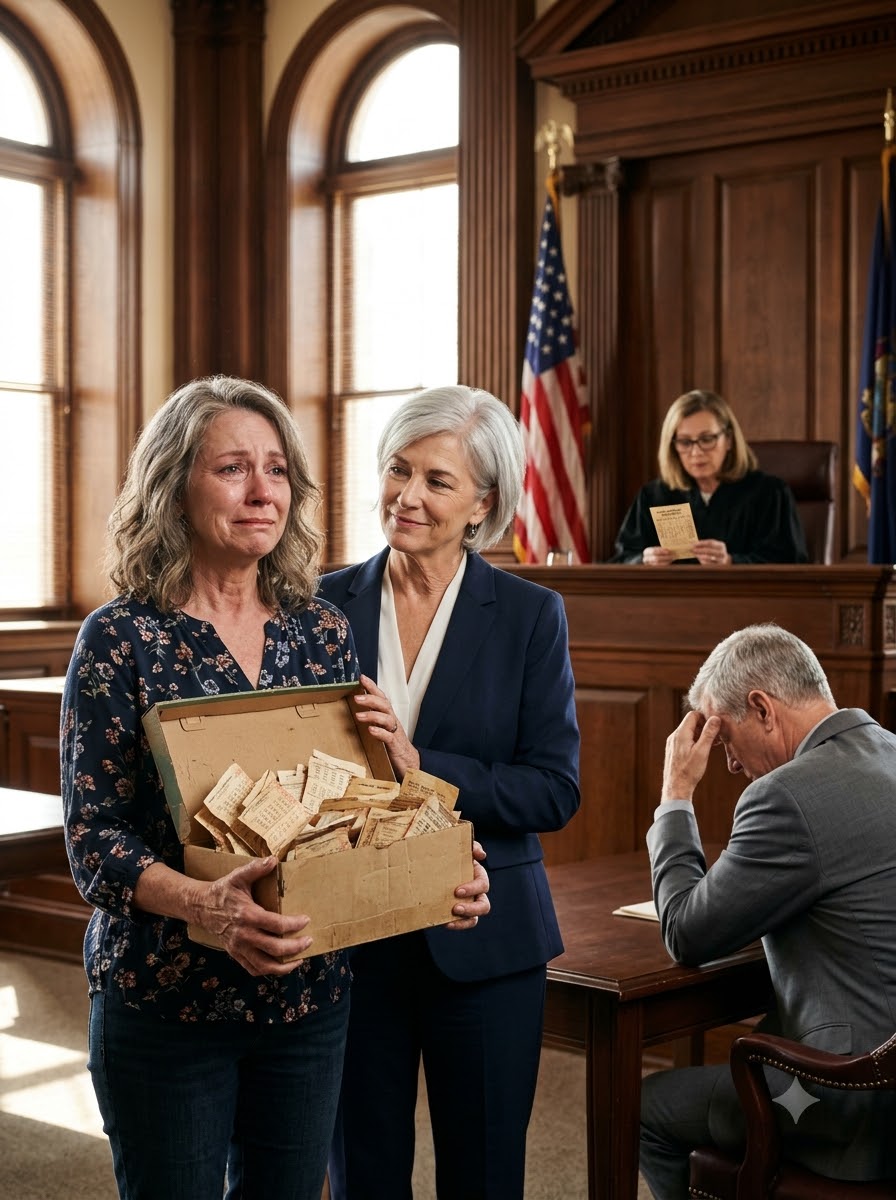
Then she asked to see my shoebox.
Delores carried it into court.
Judge Bledsoe took the box into her chambers and spent an hour examining the tickets.
When she returned, she held one in her hand.
The very first.
Week 1. For Mama.
A.M. — 3/24/06.
She looked at the faded handwriting for a long time.
Then she addressed Gary.
“Mr. Dunn, your wife signed her own name on the back of a two-dollar lottery ticket every Friday for nineteen years because her mother asked her to find one thing that belonged to her.”
Gary sat silently.
“You placed your name on the house, the truck, and the boat. You maintained an undisclosed bank account in Chattanooga containing sixty-two thousand dollars of marital funds. You signed an apartment lease with another woman.”
Gary stared at the table.
“And when that one little ticket finally won, you removed it from the refrigerator, concealed it in your wallet, and told your wife that half of nothing was nothing.”
She placed the old ticket on her desk.
“Mr. Dunn, today you’re going to find out what half of something is.”
The court awarded me the lottery proceeds.
All of them.
The prize was approximately $2.4 million, with roughly $1.6 million remaining after taxes.
The judgment treated the winnings as my separate property in light of Gary’s attempted theft and fraudulent claim.
The written ruling referred to his egregious conduct in trying to convert the asset to his sole use.
I also received the house.
Gary was ordered to pay off the second mortgage using funds from the Chattanooga account.
I received half of his Shaw retirement account.
He kept the boat.
In April, Gary pleaded guilty to theft by taking and attempted fraud.
He received five years of probation, a fine, and three hundred hours of community service.
He moved to Signal Mountain.
Brenda left him in June.
But Gary’s punishment isn’t the part of this story that matters most to me.
The money arrived in May.
It came by direct deposit into a new account at the Dalton credit union.
The account was in my name.
Patricia Ann Whitmire.
I’d legally changed my surname back in March, on the day the divorce became final.
I sat at my kitchen table, staring at the balance displayed on my phone.
$1,612,000.
I’d never seen that much money.
Not in a bank account.
Not on a paycheck.
Not anywhere.
For a long time, I didn’t know what to do.
So I went to talk to Mama.
I know how that sounds.
She’d been gone nineteen years.
But one Tuesday afternoon, I drove to Westview Cemetery and sat in the grass beside her headstone.
Ruby Mae Whitmire.
1935–2006.
She Kept Us Together.
The grass was warm.
A mockingbird sang from an oak tree overhead.
“Mama,” I said, “I did it. I put my name on something. Every week, just like you told me.”
I looked at her name carved into the stone.
“And it finally won. Two point four million dollars. Gary tried to take it, but he couldn’t. Because my name was on the back.”
I laughed softly.
“Your name too, Mama. Whitmire. I wrote it every Friday.”
Then I sat there listening to the bird.
“I don’t know what to do with all this money,” I admitted.
I’d spent my entire adult life asking whether I could afford groceries, shoes, school supplies, or a little something extra for the children.
Now I had more money than I’d ever imagined.
And I didn’t know how to spend any of it on myself.
I thought about Mama at sixty-four.
Newly widowed.
Unable to write a check because she’d never had to handle the money.
I thought about her lying in bed in that pink scarf, holding my hand.
Find one thing that’s yours.
She hadn’t told me to keep everything for myself.
She’d told me to put my name on something.
To remember I existed.
And suddenly, I knew where to begin.
The first thing I paid was June’s hospital bill.
Fifty-three thousand, four hundred dollars.
That was the remaining balance after insurance for her third heart surgery.
I drove to Erlanger Hospital and went to the financial counseling office on the second floor.
A young woman with braids looked up from her desk.
“Can I help you?”
“My sister is June Whitmire Patterson,” I said. “She had a valve replacement in September. She owes fifty-three thousand dollars. I’d like to pay the balance.”
The woman blinked.
“All of it?”
“All of it.”
She processed my payment.
Then she printed the receipt and handed it across the desk.
At the bottom was a line labeled Signature.
I took the pen.
And signed.
Patricia Ann Whitmire.
June cried for nearly an hour when I told her.
She was back home in her trailer, recovering in her recliner with her legs elevated.
Her color was better.
Her lips were pink again.
“Patty, you didn’t have to do that.”
“I know.”
“That’s your money. It belongs to you.”
I sat on the arm of her recliner and took her hand.
“June, do you remember what I wrote on the back of the winning ticket?”
She shook her head.
I opened the photograph on my phone.
The front.
Then the back.
Patricia Ann Whitmire Dunn.
Week 988. June’s in the hospital again. Third surgery. Please.
June stared at the screen.
“You wrote my name.”
“I did.”
“On the ticket that won?”
“On the very one.”
She covered her mouth.
“So it’s yours too,” I told her.
After that, I paid off Robby’s mortgage.
He and his wife owned a modest three-bedroom house in Rocky Face.
They’d been making payments for eight years while raising my granddaughters, Lily Rose and Hazel.
Robby worked twelve-hour shifts repairing power lines in all kinds of weather.
When the bank notified him that his mortgage had been satisfied, he called me.
For a long time, he couldn’t form a complete sentence.
He just kept saying, “Mama. Mama. Mama.”
I paid Tessa’s nursing school loans next.
Forty-one thousand dollars.
She’d been paying two hundred dollars a month since 2017.
Once, she’d joked that she’d still be paying them when she turned fifty.
That evening, she came to my house with Biscuit in a pet carrier.
She sat at my kitchen table and cried into a glass of sweet tea.
Then she asked me something.
“Mama, what are you going to keep for yourself?”
I didn’t have a good answer yet.
But I was beginning to understand that I could give money away without giving myself away.
There was a difference.
Kyle was saving for an engagement ring.
He was stationed at Fort Stewart, and he’d fallen in love with a nurse named Marisol who worked at Winn Army Community Hospital.
He’d told me in June that he hoped to marry her.
I sent him twenty thousand dollars.
On the check’s memo line, I wrote:
Not from Kmart.
When he called, he was laughing.
Then he started crying.
I made donations too.
Ten thousand dollars went to the Walker County Health Department’s immunization program, where I’d spent twenty-two years working.
I wanted families who struggled financially to have help obtaining the vaccinations their children needed.
Another ten thousand went to the cancer unit at Hamilton Medical Center, supporting hospice care and the nurses who had taught me how to look after Mama.
And I donated twenty-five thousand dollars to the Dalton Public Library.
That gift established a financial literacy program.
For women over fifty.
Women who had never learned to manage their own finances.
Women who’d spent decades depending on someone else to explain the bills.
They named it the Ruby Whitmire Class.
It meets every Tuesday morning in the library’s community room.
Twelve women attend at a time.
Retired mill workers.
Widows.
Divorced women.
Married women who want to understand their finances before something goes wrong.
A volunteer from the credit union teaches them how to open accounts in their own names, understand mortgage statements, examine credit reports, and identify financial records they might never have known existed.
Sometimes, when the lesson reaches hidden bank accounts, somebody jokes about Chattanooga.
I go every week.
I sit in the back.
And I watch women discover that they can ask questions without apologizing for them.
There was one other person I wanted to thank.
Mr. Mehta.
In July, I stopped at the Highway 41 Gas & Go for gasoline.
He mentioned that the building needed a new roof.
He wasn’t asking for anything.
He was simply explaining why there was a bucket beside the lottery machine.
“When it rains hard,” he said, “the water comes through right there.”
I paid for the roof.
At first, he refused.
He insisted it wasn’t appropriate.
He said he’d only done his job.
“Mr. Mehta,” I told him, “you witnessed my signature every Friday for nineteen years.”
He looked down.
“Even when you had your gallbladder removed, you arranged for your son to help.”
He tried to interrupt.
I kept going.
“You maintained a binder with nine hundred and eighty-eight entries. Nobody asked you to do that. Nobody paid you. You just decided somebody should remember.”
He looked at me.
“When Gary tried to take that ticket, you could tell investigators exactly when I bought it, what numbers I played, and whose name was on it.”
His eyes filled.
“For nineteen years, you stood behind that counter and said, Yes. She signed it. I saw her.”
Mr. Mehta took off his glasses.
“My mother,” he said quietly, “would have liked you.”
I smiled.
“I think my mother would have liked yours.”
He finally allowed me to pay for the roof.
I don’t buy lottery tickets anymore.
But I bought one last ticket in September, on the anniversary of the winning drawing.
I went back to the Gas & Go.
The new roof was finished.
Mr. Mehta was waiting at the counter.
He’d already printed my numbers.
I turned the ticket over.
And signed:
Patricia Ann Whitmire.
Underneath, I wrote:
Week 989. Last one. Thank you, Mr. Mehta.
He took the pen.
A.M. — 9/12/26.
Then he did something he’d never done before.
He wrote one additional sentence beneath his initials.
In small, careful handwriting.
It was always yours.
That final ticket didn’t win.
I never expected it to.
I took it home and placed it on my refrigerator.
Under Mama’s pineapple magnet.
It’s still there.
Sometimes people ask what advice I’d give to a woman in the position I was in.
A woman who’s been married thirty-four years.
A woman whose husband controls the house, the vehicles, the bank accounts, and the money.
A woman who receives two hundred dollars for groceries every week and has to ask permission for anything more.
They expect me to tell her to leave.
Or to buy a lottery ticket.
But I don’t say either.
I tell her about Mama.
About the last days of her life.
About a pink scarf knitted by her granddaughter.
About her thin hand wrapped around mine.
And the promise she asked me to make.
Find one thing.
Just one.
Something small.
Something that belongs to you.
Put your name on it.
Every week.
So you never forget that you have one.
My name appeared on the backs of nine hundred and eighty-nine lottery tickets.
Two dollars apiece.
Purchased from grocery money.
I never needed a single ticket to win.
What I needed was that moment each Friday when I turned the paper over and wrote my name.
A reminder that I was a person with an identity of my own.
Someone whose signature mattered.
Someone who was allowed to own something.
The money changed my circumstances.
It paid bills, protected my children, helped my sister, and created opportunities for women I’d never met.
But the money wasn’t the most important thing I gained.
For nineteen years, I’d practiced writing the name I thought I’d lost.
And when the time came, I finally knew how to claim it.
Patricia Ann Whitmire.
That’s what my mailbox says now.
I painted it myself.
