

PART 1
You know that strange feeling when your life has been going so well for so long that you almost become suspicious of your own happiness?
When your marriage is strong, your home feels peaceful, and everything seems to be falling into place, but some nervous little voice keeps whispering that something must eventually go wrong?
That was exactly where my husband and I were.
And when disaster finally arrived, it came in the form of his mother.
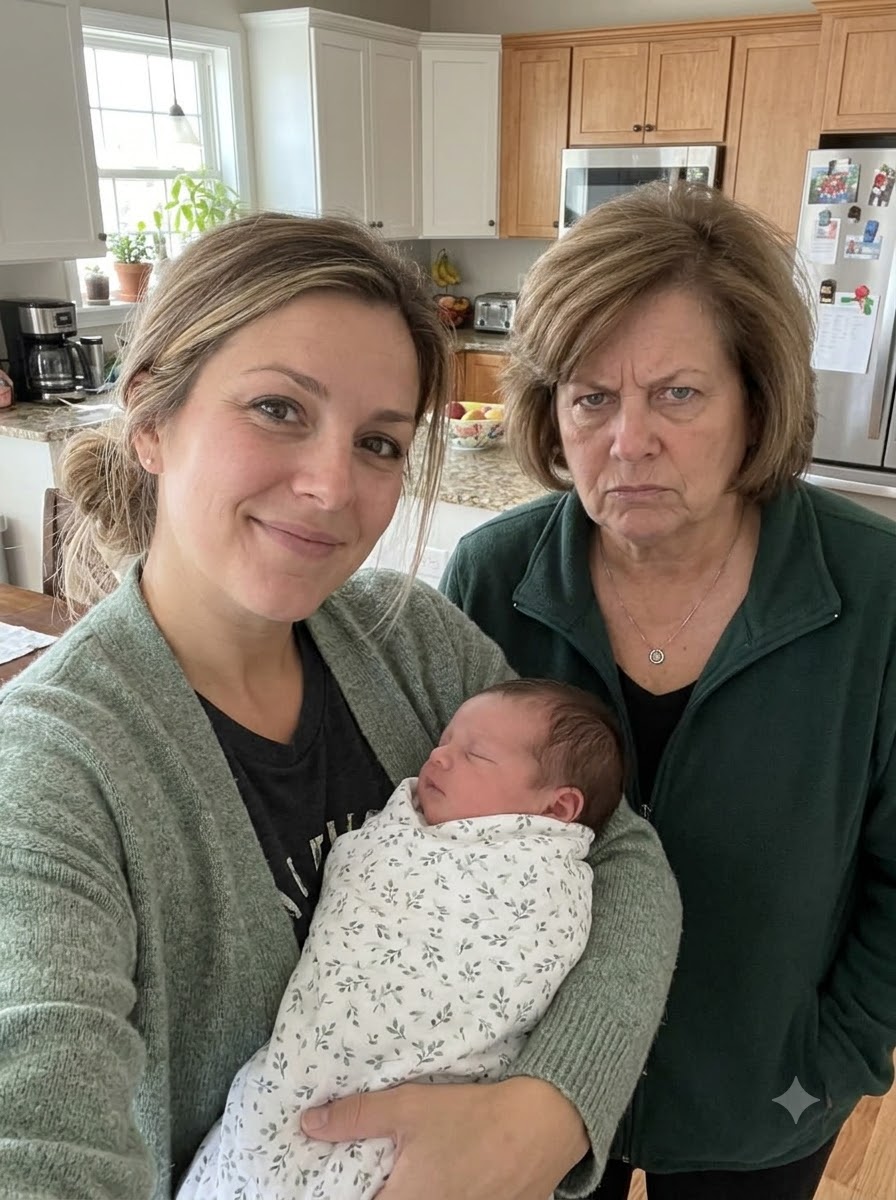
Judy.
There were years when I genuinely believed Judy was the devil’s most trusted assistant. On particularly difficult days, I wondered whether I was giving the devil too much credit and Judy was actually running the operation herself.
I wish that were an exaggeration.
The worst part was that I hadn’t started out disliking her. Quite the opposite. When Mark and I first got serious, I wanted desperately to have a good relationship with his mother.
I pictured family dinners where everyone laughed together, holidays without tension, shopping trips, birthday celebrations, and all those ordinary moments that make people feel like they belong to the same family.
I wanted to be the daughter-in-law she could genuinely love.
And I tried.
For years, I tried harder than anyone realized.
At the beginning, I invited Judy shopping because I thought perhaps we simply needed time together. Maybe she was uncomfortable with me because we were practically strangers. Maybe if we spent a few afternoons talking, browsing stores, and getting to know each other, she would stop seeing me as the woman taking her son away.
Instead, every outing became another opportunity for her to criticize me.
One afternoon, while we were walking through a department store, she examined me from head to toe and frowned.
“Oh, dear, are you eating enough? You’re looking a little frail. A little washed out. You should really take better care of yourself now that you’ve got a husband to think about.”
I went home feeling self-conscious and wondering whether I actually looked unhealthy.
The next time we went shopping, she had an entirely different complaint.
“You’ve put on some weight, haven’t you? Around the middle, I mean. Nothing drastic. But maybe a little diet would do you some good. You want to keep him interested.”
Apparently, there was no acceptable weight for me.
If I was thin, I looked sickly.
If I gained a few pounds, I was letting myself go.
If I cooked dinner, she found something wrong with the seasoning.
If Mark and I ordered takeout, I was lazy and neglecting my responsibilities as a wife.
If I dressed casually, I wasn’t making enough effort.
If I dressed nicely, I was trying too hard.
Whatever I did, Judy could find a reason to disapprove.
Eventually, I began to understand that the problem had never really been my appearance, my cooking, or my personality.
The problem was that I existed.
I had become the most important woman in her son’s life, and Judy could not tolerate that change.
Still, I kept trying.
I remembered her birthday every year and chose gifts carefully, hoping to find something she would genuinely appreciate.
She would unwrap them, give a small, unimpressed smile, and say, “How nice.”
Those two words somehow managed to communicate more disappointment than a ten-minute speech.
I asked her to teach me some of Mark’s favorite childhood recipes, believing she might enjoy passing them down.
She gave me the instructions, but every explanation came with the unmistakable implication that I would probably ruin the dish.
I complimented her house.
Her clothes.
Her garden.
Her taste in furniture.
She accepted every compliment as though I were simply acknowledging an obvious fact.
Not once did she offer anything similar in return.
For a long time, I convinced myself that if I remained patient enough, she would eventually soften.
But trying to earn Judy’s approval was like pouring water into a bucket with a hole in the bottom.
No matter how much I gave, nothing stayed.
Eventually, I stopped.
I remained polite, because I wasn’t interested in creating unnecessary family drama, but I stopped chasing a relationship she clearly didn’t want.
I kept my distance.
I smiled when necessary.
I avoided being alone with her whenever possible.
For a while, that arrangement worked.
Then Judy did something shortly before our wedding that destroyed whatever hope remained.
She hired a woman to seduce Mark.
Yes.
You read that correctly.
My future mother-in-law actually arranged for another woman to approach my fiancé during his bachelor weekend.
Judy knew which bar Mark and his friends planned to visit. She arranged for this woman to be there, strike up a conversation, flirt aggressively, and make herself available.
Her goal was obvious.
She wanted Mark to cheat on me.
Then she could use his betrayal to stop the wedding or, at the very least, create enough doubt and resentment to poison our marriage before it began.
Fortunately, the plan failed.
Mark noticed almost immediately that something about the woman’s behavior was strange.
She was unusually forward, seemed determined to keep his attention, and refused to take his polite lack of interest as an answer.
He eventually excused himself and left the conversation.
When he came home, he told me about the encounter because he thought it was bizarre.
At first, neither of us suspected Judy.
We discovered her involvement later, after she accidentally revealed details she had no legitimate reason to know.
When confronted, she didn’t even seem particularly ashamed.
“Just so he could remember,” Judy explained with horrifying calm, “that there are better women out there. Before he ties himself down. A mother has to look out for her son.”
I could hardly believe what I was hearing.
She had deliberately tried to destroy our relationship, and somehow she believed she had been acting like a responsible mother.
That incident changed everything.
Mark and I argued about it for hours.
Not because he defended her.
He didn’t.
He was every bit as disgusted as I was.
But we were both furious, hurt, and struggling to understand how his own mother could have done something so cruel.
Mark confronted Judy directly.
He made it clear that he was marrying me and that her interference was unacceptable.
For the first time, I truly understood that whatever Judy believed about her influence over him, Mark was not secretly on her side.
He chose our relationship.
And I loved him even more for it.
After that, Judy and I abandoned any pretense of affection.
At family gatherings, we treated each other like distant acquaintances who happened to share a last name through marriage.
She spoke around me.
I spoke around her.
We were civil, but only in the cold, formal sense.
There were no more shopping trips.
No more attempts to win approval.
No more pretending that we were eventually going to become close.
Strangely enough, the arrangement made my marriage happier.
Mark and I no longer wasted energy trying to manufacture harmony.
We understood where we stood.
We were partners.
We were a team.
And Judy’s opinion of me no longer determined how I felt about myself.
She continued telling relatives that Mark was a devoted mama’s boy who would always put her first.
But the truth was far more complicated.
Mark loved his mother because she was his mother.
He felt responsible for her.
He carried years of guilt and obligation that I could never fully understand.
But he didn’t trust her.
Not after what she had done before our wedding.
Fortunately, we lived five hours away.
Those five hours were one of the greatest blessings of our marriage.
Judy couldn’t casually appear on our doorstep.
Visits required planning.
Holidays had clear beginnings and endings.
We had room to breathe.
For several years, our life together was wonderful.
Then we welcomed our daughter.
Riley.
I still remember the first time I held her, how impossibly small she felt, how her tiny fingers curled around mine, and how the entire world seemed to rearrange itself around this little person.
Mark was completely in love with her from the beginning.
So was I.
Those first two months were exhausting beyond anything I had imagined.
We slept in fragments.
I forgot meals.
Mark sometimes came home from work and found me sitting in the nursery, unable to remember whether it was Tuesday or Thursday.
There were nights when I fell asleep halfway through a sentence.
But underneath the exhaustion, we were happy.
Happier than we had ever been in eight years together.
We had created a family.
Our home felt complete.
And then, one evening, Mark walked into the nursery looking as though he was about to confess to a crime.
I was sitting in the glider beside the window, gently rocking Riley as the last afternoon sunlight faded.
Mark entered quietly.
He went to the crib.
Straightened a stuffed rabbit that was already perfectly straight.
Touched the wooden railing.
Looked at the changing table.
Then the window.
Then the floor.
Anywhere except my face.
After eight years together, I knew every one of his nervous habits.
“What?” I asked.
He looked at me innocently.
“What do you mean, what?”
I narrowed my eyes.
“You have something to tell me. I can see it. So tell me.”
He scratched the back of his neck.
That was another giveaway.
“You always know everything,” he muttered.
I almost smiled.
“We’ve been together for eight years, Mark. What did you expect? Say it.”
He took a deep breath.
Then the words came out in one frantic burst.
“Momhadafiresheneedsaplacetostay.”
I stared at him.
“What? Say that in English.”
He swallowed.
“My mom. There was a fire. At her house.”
I stopped rocking.
“What?”
“She says there’s damage. She needs to have the house repaired before she can live there again.”
He hesitated.
“And until then, she needs somewhere to stay.”
A terrible feeling began spreading through my chest.
“Mark.”
He wouldn’t look at me.
“She’s going to stay with us. Just for a little while.”
The nursery went silent.
I stared at my husband, wondering whether exhaustion had finally caused me to hallucinate.
“You’re joking.”
He said nothing.
“Please tell me you’re joking.”
Still nothing.
Then something else occurred to me.
I looked down at Riley, sleeping peacefully in my arms.
Then back at Mark.
“Wait a minute.”
He winced.
“Did you deliberately wait until I was holding the baby to tell me this?”
He looked away.
“So I couldn’t scream at you? Because you knew I’d have to keep my voice down?”
A long pause followed.
“…Maybe.”
I closed my eyes.
For several seconds, I concentrated entirely on breathing.
“Mark,” I finally said, “do you understand what you’re asking me to do?”
He shifted uncomfortably.
“I’m home with Riley all day. Every single day. You’re at work for nine or ten hours. If Judy moves in, that means I will be here with her for nine or ten hours every day.”
He tried a hopeful smile.
“But hey. At least you’ll have help with the baby, right?”
I gave a short, disbelieving laugh.
“Help?”
His smile disappeared.
“You think Judy is going to help me?”
“Kate—”
“No. You think your mother is going to spend her days helping me? Or do you think she’s going to stand over my shoulder telling me everything I’m doing wrong?”
“Please. It’s only temporary.”
“How temporary?”
He hesitated.
And I knew immediately that he had no answer.
“I… don’t know.”
I stared at him.
“You don’t know?”
“She said the repairs might take a while.”
“How long?”
“She didn’t say.”
Before I could ask anything else, he turned and practically fled the nursery.
I remained in the glider, holding our sleeping daughter, staring at the doorway.
I should have realized then that the absence of a clear timeline was going to become a disaster.
But I was exhausted.
We had a newborn.
And despite everything Judy had done, the idea that someone’s home had been damaged by fire seemed too serious to question.
So I agreed.
Two days later, Judy arrived.
She brought three enormous suitcases, a garment bag, and a box filled with her own kitchen utensils.
Apparently, even after losing the use of her home, she had found time to worry that my cookware might not meet her standards.
Within four days, I was ready to lose my mind.
Judy hadn’t moved in to help.
She had moved in to supervise.
According to her, absolutely everything I did with Riley was wrong.
The bathwater was too warm.
Then it was too cold.
I wasn’t supporting Riley’s head properly.
I was using the wrong soap.
Then too much soap.
Then not enough.
The diapers were too loose.
Then too tight.
The brand was wrong.
My changing technique was wrong.
Judy informed me that cloth diapers had been superior when Mark was a baby and that modern parents had become far too dependent on convenience.
Feeding Riley became another battlefield.
I fed her too often.
Or not often enough.
I held her incorrectly.
I let her feed for too long.
I stopped too soon.
When Riley cried, Judy had an explanation.
When she slept, Judy had a criticism.
The nursery was too dark.
Then too bright.
I rocked her too much.
I should rock her more.
I was swaddling her incorrectly.
Then Judy announced that swaddling was unnecessary anyway.
It made no difference that Riley’s pediatrician was pleased with her growth.
It made no difference that I had taken parenting classes, read books, and kept detailed notes from medical appointments.
It made no difference that Riley was healthy, thriving, and meeting her developmental milestones.
Judy had raised one child more than thirty years earlier.
In her mind, that made her the final authority on every aspect of motherhood.
And I, apparently, was a hopeless amateur.
The days became unbearable.
Mark left for work each morning, and the house became a prison of constant commentary.
Nine hours.
Sometimes ten.
Just me, Judy, and Riley.
I began measuring my days by how long remained until Mark came home.
One afternoon, Riley had been particularly fussy.
I’d spent nearly an hour walking around the house, gently bouncing her, singing, and trying everything I knew to settle her.
Finally, she drifted to sleep against my chest.
I was surviving on perhaps three hours of broken sleep.
My back ached.
My arms were tired.
I lowered myself carefully into the chair and enjoyed a few precious seconds of silence.
Then Judy spoke.
“You’re holding her too much, you know.”
I stared at the wall.
“You’ll spoil her. In my day we let them cry it out. Put them down and let them learn.”
I said nothing.
“You carry that child around like she’s made of glass and you’ll have a clingy, needy little thing on your hands, mark my words.”
I tightened my arms gently around Riley.
“Mark never cried. I made sure of it.”
I kept staring at the wall.
There was no point responding.
Any disagreement would only give Judy another opportunity to lecture me.
I called Mark during his lunch breaks.
I tried to explain how miserable things had become.
He would sigh and say something like, “She means well.”
Or, “Just try to ignore it.”
Or, “Remember, it’s only temporary.”
Every time, I hung up feeling more alone.
He didn’t hear what I heard.
He didn’t spend the day being corrected.
He didn’t understand that it wasn’t one cruel remark breaking me.
It was the endless accumulation.
Hundreds of small criticisms, every day, until I started questioning things I had previously felt confident about.
Still, I tried to endure it.
A few weeks, I told myself.
Perhaps another month.
Eventually, Judy’s house would be repaired.
She would go home.
And we could return to our peaceful life.
Then one evening, Judy said something that made every previous insult seem almost harmless.
I’d just finished feeding Riley.
She was resting against my shoulder while I gently patted her back.
Judy sat in the armchair she had claimed as her own on the first day, drinking tea.
She watched me for several minutes.
Then, in the same casual tone she might have used to comment on the weather, she said:
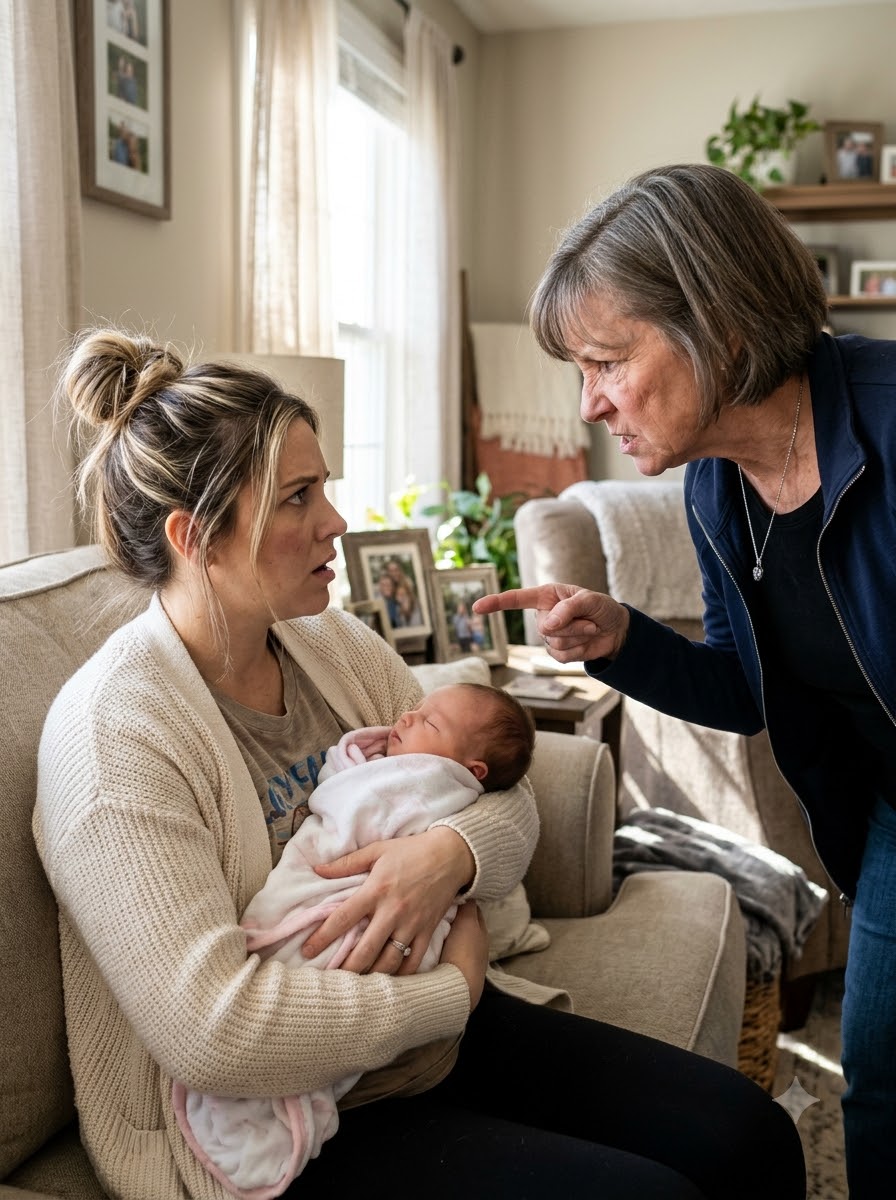
“You know, maybe you should just let me take Riley. Let me raise her. She’d be so much better off with me, dear. Truly.”
I stopped moving.
For a moment, I couldn’t process what I’d heard.
My arms tightened protectively around my daughter.
“…I’m sorry,” I said. “Are you joking?”
Judy looked completely serious.
“No. I’m not joking at all.”
She set down her cup.
“I raised Mark, and you married him, so you must think I did a decent job of it.”
I stared at her.
“And frankly, dear, I look at you, and I genuinely cannot imagine what kind of child you’re going to raise.”
My heart began pounding.
“It worries me. It keeps me up at night.”
She gave a small, almost sympathetic smile.
“So I’m offering. Let me take her. Let me do it right.”
For several seconds, all I could hear was the blood rushing in my ears.
Then I spoke very quietly.
“Let me make sure I understand you.”
Judy waited.
“You want to take my daughter away from me and raise her yourself because you don’t believe I’m good enough to be her mother?”
“Well,” she said, sighing as though I were making something obvious unnecessarily complicated, “yes, dear. But it would be for the best. For everyone. Especially for her.”
Then she reached out and placed her hand on my shoulder.
As though she were comforting me.
As though offering to take my child was an act of kindness.
I knocked her hand away.
My entire body was shaking.
I didn’t trust myself to speak another word.
I stood, carried Riley into the nursery, and laid her safely in the crib.
Then I began packing.
Diapers.
Wipes.
Bottles.
Formula.
Clothes.
Blankets.
Everything I could fit into the diaper bag and another large tote.
I picked Riley up again and marched into our bedroom.
Mark was sitting comfortably in bed, reading.
He looked up just as I opened my dresser and began throwing clothes into a suitcase.
“Whoa. Hey. Where are you going?”
I didn’t look at him.
“To my mother’s.”
He sat up immediately.
“What? Kate, what happened?”
I turned toward him.
“Your mother just told me we should give Riley to her.”
He stared.
“What?”
“She wants to raise our daughter because she thinks I’m an incompetent mother.”
Mark blinked.
“I’m… I’m sure she didn’t mean it like that. You know how she talks, she—”
“Oh, she meant it.”
My voice was trembling.
“She looked me straight in the eye and told me Riley would be better off with her.”
Mark opened his mouth.
Then closed it.
He knew his mother.
And deep down, he knew I was telling the truth.
I zipped the suitcase.
“I’m staying with my mom until Judy leaves this house.”
Mark sat silently for a moment.
Then he reached for his car keys.
He drove Riley and me to my mother’s house without saying a word.
Neither of us knew that what was supposed to be a few days apart would stretch into nearly three weeks.
And by the end of those three weeks, my husband would say something that made me wonder whether our marriage was already over.
PART 2
My mother opened her front door close to eleven that night.
I stood on her porch holding Riley, with a diaper bag over one shoulder, a suitcase beside my feet, and eyes so swollen from crying that I could barely see her expression.
She didn’t demand an explanation.
She didn’t ask what Mark had done.
She didn’t tell me I was overreacting.
She simply stepped aside.
“Come in, sweetheart, I’ll put the kettle on.”
Then she reached for Riley so I could put down the bags.
I nearly started crying all over again.
My mother had raised me and my two siblings mostly by herself after my father left. She had worked hard, sacrificed more than we understood as children, and somehow still managed to make our home feel safe.

She wasn’t perfect.
Nobody is.
But she had never made me feel that needing help was proof of failure.
That night, she prepared my old bedroom, found a bassinet we could borrow, and told me to get some rest.
For the first time in weeks, I felt as though I could breathe.
The next morning, she made breakfast while I fed Riley.
She didn’t stand over me correcting my technique.
She didn’t comment on the feeding schedule.
She didn’t tell me I was spoiling my daughter by holding her.
When Riley cried, my mother asked whether I wanted her to take the baby for a few minutes.
When I said yes, she did.
When I said no, she respected that too.
It was such a small difference.
And yet it changed everything.
Over the following days, my mother cooked, helped with laundry, and held Riley while I slept.
Sometimes we talked.
Sometimes she simply sat beside me while I cried.
She never treated my exhaustion as incompetence.
Gradually, I began to feel like myself again.
I stopped second-guessing every little thing.
Riley seemed calmer too.
She was eating well, sleeping more comfortably, and continuing to grow exactly as she should.
I started remembering that I was a good mother.
Not a perfect mother.
Not an expert.
But a loving, attentive woman doing her best for her daughter.
Judy had spent weeks making me doubt that.
My own mother helped me remember it without giving a single lecture.
Unfortunately, while my days became easier, my marriage became more strained.
Mark visited almost every evening after work.
He came straight from the office, sometimes still wearing his work clothes, and spent as much time with Riley as he could.
He held her.
Rocked her.
Changed her diaper.
Talked softly to her about the things he’d done that day.
Watching him with our daughter made my heart ache.
Because I still loved him.
I loved him desperately.
And I knew he loved us.
But every visit ended with the same conversation.
“Have you talked to Judy?”
“Yes.”
“Is she leaving?”
“Not yet.”
“Why?”
“Her house isn’t ready.”
At first, I tried to remain patient.
Perhaps the repairs were more complicated than we’d expected.
Perhaps contractors were delayed.
Perhaps the insurance company was taking too long.
But the days kept passing.
One week.
Then two.
Then almost three.
And Judy remained comfortably installed in our house while Riley and I slept in my childhood bedroom.
Mark seemed increasingly exhausted too.
He missed his wife.
He missed waking up beside his daughter.
He missed the life we’d had before his mother arrived.
But whenever I asked him to make a decision, he fell back on the same explanation.
Judy had nowhere else to go.
Her house was damaged.
He couldn’t put his mother out on the street.
I understood the argument.
At least, I understood it if the fire had really happened the way Judy claimed.
But I was beginning to realize how little either of us actually knew.
One evening, near the end of the third week, Mark came to my mother’s house after Riley had fallen asleep.
We sat together in the living room.
The television was off.
My mother had gone upstairs to give us privacy.
Mark looked tired.
There were shadows beneath his eyes, and his shoulders seemed permanently tense.
For a while, neither of us spoke.
Then he reached for my hand.
“Come home,” he said quietly.
I looked at him.
“Please, Kate. Just come home.”
I wanted to.
More than anything, I wanted to go back to our own bedroom, our own kitchen, our own familiar routines.
I wanted Riley to wake up with both her parents nearby.
But I couldn’t return to the same situation that had driven me away.
“Has Judy left?” I asked.
Mark looked down.
“No.”
I gently pulled my hand away.
“Then you know my answer.”
He rubbed his face.
“Kate, she says the renovations aren’t finished.”
I stared at him.
“The renovations.”
“Yes.”
“Mark, how badly damaged was her house?”
He frowned.
“What?”
“The fire. How bad was it?”
“I don’t know exactly.”
I leaned forward.
“Was it the kitchen? The living room? The roof? Did the fire spread upstairs? Was there structural damage?”
He looked increasingly uncomfortable.
“I haven’t seen it.”
“You haven’t seen it?”
“No.”
I could hardly believe what I was hearing.
“Your mother’s house supposedly caught fire badly enough that she couldn’t live there anymore, and you haven’t even seen a photograph?”
Mark rubbed his temples.
“Kate, I know how that sounds.”
“Do you?”
“She told me the house needed repairs.”
“Did she show you anything?”
“No.”
“An insurance report?”
“No.”
“A contractor’s estimate?”
He shook his head.
“A timeline?”
“Not really.”
I sat back slowly.
“Don’t you think that’s strange?”
He looked at me.
“It’s been over a month since she moved in. She’s still saying the house isn’t ready, but neither of us has seen a single picture of the damage.”
Mark sighed.
“I don’t know, okay? I don’t know how bad it was. I haven’t been down there.”
His voice softened.
“But Kate, I miss you. I miss Riley. I miss my family. I want you home.”
My throat tightened.
“I miss you too.”
“Then come back.”
“I can’t.”
He stared at me.
“I won’t come back while your mother is living there.”
He looked away.
“And I’m sorry, Mark, but it’s starting to feel as though keeping her comfortable matters more to you than having your wife and daughter at home.”
His expression changed.
“That isn’t fair.”
I folded my arms.
“Isn’t it?”
“No. It isn’t.”
“Then tell me what I’m missing.”
He said nothing.
“Your wife and baby have been gone for almost three weeks. Your mother is still in our house. She told me she wanted to take our daughter because she thinks I’m unfit to raise her.”
“Kate—”
“And somehow, I’m the one who has to keep making sacrifices.”
His jaw tightened.
“I am trying.”
“I know you’re trying to keep everyone happy.”
“What’s wrong with that?”
“Because keeping Judy happy has meant letting me be miserable.”
He looked hurt.
And for a moment, I almost apologized.
But I was too tired.
Too frightened.
Too angry about everything that had happened.
Mark stood up.
“You know what?”
I looked at him.
“Maybe you should just file for divorce, then.”
The words hit me like a physical blow.
For a second, I couldn’t breathe.
He continued, his voice sharp with frustration.
“If that’s really how you feel. If I’m such a terrible husband. Maybe we should just end it.”
I stared at the man I loved.
The man who had held my hand when Riley was born.
The man who had promised me we’d always face problems together.
And before I could stop myself, I shouted back.
“Maybe I will!”
Silence.
Absolute silence.
The anger vanished from Mark’s face almost immediately.
He looked stunned.
Then devastated.
I knew he regretted what he’d said.
I regretted my answer just as much.
But neither of us knew how to take the words back.
Mark stood motionless for another moment.
Then he turned, walked out of the living room, and slammed the front door so hard that I heard picture frames rattle.
I remained standing until the sound of his car faded.
Then my knees gave way.
I sank onto the floor and buried my face in my hands.
I cried harder than I had cried in years.
Not the quiet tears of exhaustion.
Not the frustrated crying I’d done while Judy criticized me.
This was something deeper.
I was terrified that my marriage was falling apart.
Eight years together.
A beautiful daughter.
A home we’d built.
All of it seemed to be unraveling because we couldn’t find a way to deal with one woman.
I kept replaying the argument.
Divorce.
The word felt enormous.
Unreal.
How had we reached that point?
Mark and I had always been a team.
We’d survived disagreements, financial worries, sleepless nights, and the ordinary pressures of marriage.
But now we were living apart.
Our daughter wasn’t sleeping in her own nursery.
And Judy was still sitting in our living room as though nothing had happened.
I cried until I was exhausted.
Then, somewhere in the middle of that misery, a thought surfaced.
A lie.
I had been thinking that our marriage was being destroyed by a lie I couldn’t prove.
And suddenly I realized something.
Why couldn’t I prove it?
Why had I accepted the fire story without ever checking?
I sat up.
Wiped my face.
And began thinking carefully.
Everything we knew about the fire came from Judy.
She said it happened.
She said the house was damaged.
She said repairs were necessary.
She said she couldn’t live there.
She said the work wasn’t finished.
But neither Mark nor I had seen anything.
No photographs.
No insurance paperwork.
No repair estimates.
No contractor’s schedule.
Not even a picture of a damaged wall.
Nothing.
I had believed her because the story sounded serious.
Because a house fire seemed like something no reasonable person would invent.
But Judy had already demonstrated that she was willing to do unreasonable things to interfere with our marriage.
She had once paid another woman to seduce her own son.
Why was I treating her word as unquestionable now?
I sat there for a long time.
The more I considered it, the more obvious the answer became.
I needed to see her house.
Not hear about it.
Not ask Judy another question.
Not argue with Mark about whether his mother was telling the truth.
I needed to go there myself.
The next morning, I woke early.
My mother was already in the kitchen.
She looked at my face and seemed to understand that something had changed.
“Are you all right?” she asked.
I nodded.
“I need to go somewhere today.”
She glanced toward Riley.
“Do you want me to keep her?”
“Please.”
My mother didn’t ask where I was going.
She simply held out her arms.
I kissed Riley’s forehead, gathered my keys, and left.
Judy lived five hours away.
Five long hours.
I knew the drive would be exhausting, especially after the emotional disaster of the previous night.
But I couldn’t wait another day.
I needed answers.
As I drove, my thoughts moved in furious circles.
I was angry with Mark for refusing to confront the situation.
Angry that he had allowed his mother to remain in our home while his wife and daughter lived elsewhere.
Angry that he’d mentioned divorce.
And angry with myself for saying it back.
But beneath everything else was my anger toward Judy.
She had entered our home claiming to be a victim of a terrible accident.
Then she had criticized my parenting until I barely recognized myself.
She had suggested taking my baby.
She had driven me out of my own house.
And now she was still there, while my husband and I stood on the edge of losing everything we’d built.
I kept imagining what I would find.
Perhaps the fire had been small.
Maybe the kitchen had been damaged, but the rest of the house was fine.
Maybe Judy had exaggerated the repairs.
Or perhaps there really was extensive damage, and I was about to feel terrible for suspecting her.
I considered that possibility too.
I wanted the truth, even if the truth proved me wrong.
As the hours passed, I rehearsed what I might say to Mark.
I imagined showing him photographs of the damage and asking him to establish a firm timeline.
I imagined discovering that the house was already habitable and finally convincing him his mother needed to leave.
And sometimes, when my anger took over, I imagined confronting Judy directly.
By the time I reached her neighborhood, my stomach was in knots.
I knew the street well.
I’d visited the house many times during the early years of my relationship with Mark.
It was a quiet residential area with tidy lawns, mature trees, and houses that looked much the same as they had for decades.
I turned onto Judy’s road.
My hands tightened around the steering wheel.
I expected to see signs of a fire.
Boarded windows.
Smoke stains.
A damaged roof.
A dumpster in the driveway.
Scaffolding.
Construction materials.
Something.
Anything.
I slowed as her house came into view.
Then I stopped.
For several seconds, I couldn’t understand what I was looking at.
The house was beautiful.
Perfectly normal.
The windows were intact.
The exterior walls were clean.
The front door still had its decorative wreath.
The lawn had been freshly mowed.
Flowers bloomed along the walkway.
There were no contractors.
No equipment.
No tarps.
No dumpsters.
No boarded windows.
Not one visible sign that a fire had ever occurred.
I pulled over and sat staring through the windshield.
Surely I was missing something.
Perhaps the damage had been inside.
Perhaps the exterior repairs were already finished.
But the entire property looked exactly as it had the last time I’d visited.
Even the flower beds were neatly maintained.
I got out of the car.
Walked slowly along the public sidewalk.
Looked at the house from one direction.
Then the other.
Nothing.
I took out my phone and began photographing everything I could see.
The front windows.
The clean siding.
The roof.
The driveway.
The lawn.
The flowers.
The intact front door.
I took dozens of photographs.
I knew exterior pictures alone couldn’t prove that no interior damage had ever existed.
But they certainly didn’t match the picture Judy had painted of a house undergoing extensive fire restoration.
And there was something else.
No sign that any renovation work was happening at all.
My hands trembled as I reviewed the photographs.
For weeks, Judy had told us that her home was too damaged for her to return.
Yet here it stood, peaceful and immaculate in the afternoon sunlight.
I felt sick.
I thought about Riley.
About the weeks we’d spent away from home.
About the way Judy had looked at me when she suggested taking my daughter.
About Mark saying divorce.
The possibility that all of this had been engineered deliberately was almost too much to bear.
I got back into my car.
I didn’t stop for lunch.
I didn’t book a hotel.
I didn’t call Mark.
I turned around and began the five-hour journey home.
During that drive, my anger became something colder.
More focused.
I wasn’t going to argue about Judy’s intentions anymore.
I was going to put the photographs in front of her and demand an explanation.
By the time I reached our neighborhood, it was well after dark.
I pulled into the driveway and saw the lights glowing through our living-room windows.
My heart was pounding.
I opened the front door and walked inside.
And there they were.
Mark and Judy.
Sitting together on the couch.
Watching television.
Comfortable.
Relaxed.
As though my daughter and I hadn’t spent nearly three weeks living somewhere else.
Mark stood when he saw me.
“Kate—”
I didn’t let him finish.
I looked straight at Judy.
“Tell me the truth.”
She blinked.
“Kate, dear—”
“There was no fire. Was there?”
Her expression changed into wounded confusion.
“What? Of course there was a—”
“Don’t.”
My voice was shaking.
“Don’t you dare lie to me again.”
Mark stared at us.
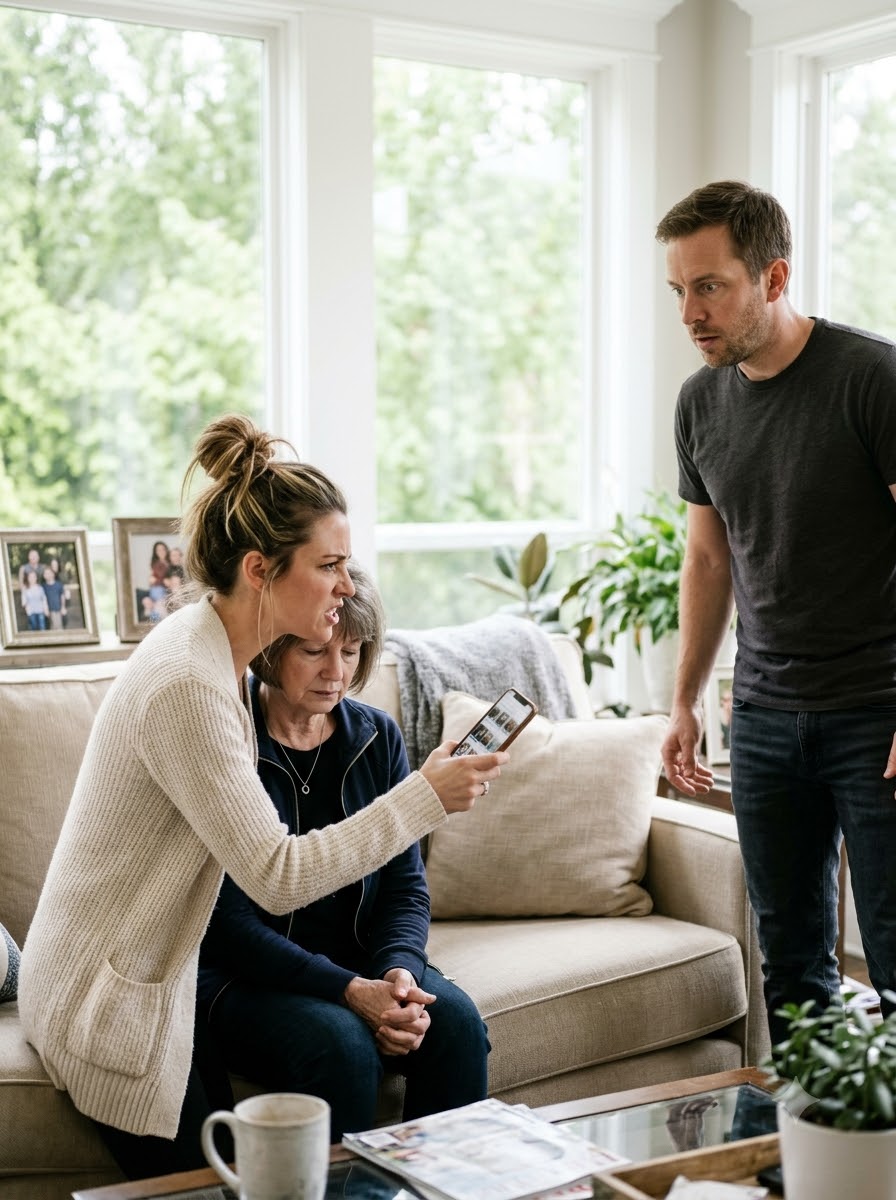
I held up my phone.
“I drove to your house today, Judy. Ten hours round trip.”
She went still.
“Your house looks exactly the same as it always has. The windows are perfect. The walls are clean. The lawn is freshly cut. There are flowers blooming beside the walkway.”
I stepped closer.
“No construction crew. No equipment. No visible damage. Nothing.”
Mark looked at his mother.
I opened the photographs.
“I have pictures. Every angle I could get.”
Judy stared at the screen.
Her face changed.
The wounded confusion disappeared.
Her shoulders slowly dropped.
And for the first time since I had known her, she seemed to have no criticism ready, no explanation prepared, and no way to turn the blame back on me.
I asked one final question.
“Why did you do it?”
For a long moment, she said nothing.
Then she looked down at her hands and whispered:
“I was lonely.”
PART 3
I stared at Judy.
Of all the explanations I had imagined during the ten hours I’d spent driving, that one had never occurred to me.
Lonely.
One small word.
I almost laughed.
Not because anything was funny, but because I couldn’t comprehend how such a simple feeling could have caused so much destruction.
“You were lonely?” I repeated.
Judy nodded without looking up.
“Yes.”
Mark stood beside the couch, staring at his mother as though he were seeing her for the first time.
Judy twisted her fingers together.
“Do you have any idea what it’s like to live alone in that house?”
Her voice was quieter than I’d ever heard it.
“Five hours away from my only son. Knowing he has a whole life that I’m not part of.”
I remained silent.
“A wife,” she continued. “And now a baby. My granddaughter. I’ve barely had the chance to hold her.”
Her voice trembled.
“Your mother lives twenty minutes away, Kate. You can see her whenever you want. She’s involved in everything.”
I felt my jaw tighten.
Judy continued before I could respond.
“I only see you at holidays. Sometimes not even then. And when I do, it’s for a few hours before you go home.”
She looked toward the dark window.
“I sit in that house by myself, imagining all of you together. Mark coming home from work. You cooking dinner. Riley growing up.”
She swallowed.
“And I’m not there.”
Mark finally spoke.
“Mom.”
His voice sounded wounded.
“If you were lonely, why didn’t you tell us?”
Judy looked at him.
“Why didn’t you just say you wanted to see us more?” he asked. “Why invent a fire? Why make us believe your home was damaged?”
She was quiet for several seconds.
Then she looked at me.
“Because Kate never would have let me stay.”
I opened my mouth.
Then closed it.
Judy continued.
“And I knew it. If I’d called and asked to visit for a month, she would have found a reason to say no.”
She gave a small, miserable shrug.
“And honestly, I couldn’t have blamed her.”
The admission surprised me.
“So I made up a reason she couldn’t argue with,” Judy finished.
I stood motionless.
Because she was right about one thing.
If Judy had called and asked to move in for a month, I would have refused.
Immediately.
After everything she’d done, I couldn’t imagine willingly sharing a house with her for that long.
But knowing that didn’t excuse the lie.
Not even slightly.
I folded my arms and took a long breath.
“You did this to yourself, Judy.”
She looked up.
“You understand that, don’t you?”
She didn’t answer.
“For years, I tried to have a relationship with you.”
My voice was no longer loud.
The anger was still there, but underneath it was something heavier.
Sadness.
“When Mark and I first got together, I wanted you to like me. I wanted us to be close. I wanted you to feel like family.”
Judy looked down again.
“I invited you shopping. I remembered your birthday. I asked for your recipes. I tried to include you in our lives.”
I shook my head.
“And every time, you found something wrong with me.”
Her eyes filled.
“You told me I was too thin. Then too fat. You criticized my cooking, my clothes, and practically everything else I did.”
I swallowed.
“You hired another woman to try to destroy our wedding.”
Mark looked away.
Even now, remembering that betrayal hurt.
“And then you moved into my home and spent weeks telling me I was a terrible mother.”
Judy pressed her lips together.
“You actually suggested taking my daughter away from me.”
My voice cracked.
“Do you understand what that did to me?”
She nodded faintly.
“I was already exhausted. I was trying to care for a newborn. I needed help and reassurance.”
I looked straight at her.
“And instead, you made me feel like I couldn’t do anything right.”
A tear slipped down Judy’s cheek.
I continued.
“So when you ask why I keep my distance, why I don’t invite you to stay, why I don’t want to spend time alone with you, the answer isn’t some mystery.”
I gestured between us.
“You created that distance.”
Judy sat quietly for a long time.
Then she nodded.
“I know.”
I stopped.
It was such an unfamiliar response that I almost didn’t believe I’d heard it.
She took a shaky breath.
“I know I did all that.”
Mark turned toward her.
Judy wiped her cheek.
“The truth is, Kate, I always think I know what’s best.”
She gave a small, unhappy laugh.
“For Mark. For Riley. For everyone I love.”
I waited.
“But I don’t know how to say it properly.”
She looked at her hands.
“Everything comes out as criticism. Even when I think I’m trying to help.”
Her voice weakened.
“My mother was exactly the same way with me.”
I sat down slowly.
Judy continued.
“Nothing I did was ever good enough for her. If I brought home a good grade, she asked why it wasn’t better. If I cleaned the house, she found something I’d missed.”
She paused.
“I hated it.”
For a moment, her face looked older.
“And somehow, I became just like her.”
The room was silent.
“I’ve pushed everyone away,” she whispered. “You. Mark. Friends. People who tried to care about me.”
She wiped her eyes again.
“And now I’m lonely because of the way I am.”
She looked directly at me.
“I know that. I just don’t know how to be different.”
Something shifted inside me.
For eight years, Judy had been a woman who seemed incapable of admitting fault.
She always had an explanation.
Always had a criticism.
Always found a way to make someone else responsible.
But now she was sitting in my living room, acknowledging that she’d created much of her own unhappiness.
I didn’t suddenly forgive everything.
I couldn’t.
But for the first time, I could see the frightened, lonely person underneath the cruelty.
I let out a long breath and sat across from her.
Mark looked between us.
Neither of us spoke for a moment.
Then I asked Judy a question.
“Why were you so determined to make Mark think I wasn’t good enough for him?”
She closed her eyes briefly.
“When Mark was little, it was mostly just the two of us.”
Her voice grew distant.
“His father wasn’t around much. Then eventually he wasn’t around at all.”
Mark sat quietly.
“I raised him. Worked for him. Worried about him. Everything in my life revolved around making sure he was all right.”
She glanced at her son.
“And somewhere along the way, I think I forgot he was supposed to grow up and build a life of his own.”
She looked back at me.
“When you came along, I was terrified.”
I frowned.
“Of me?”
“Of losing him.”
Her eyes filled again.
“He looked at you in a way I’d never seen him look at anyone. He was happy. Completely happy.”
She smiled sadly.
“And instead of being glad that my son had found someone who loved him, I felt as though I was being replaced.”
I looked down.
“I had made him my whole world,” she continued. “And suddenly his world wasn’t centered on me anymore.”
She shook her head.
“I didn’t know what to do with that.”
“So you tried to make him doubt me,” I said.
Judy nodded.
“Yes.”
I waited.
“I looked for faults because I wanted him to see faults. But there wasn’t anything serious enough, so I exaggerated little things.”
She swallowed.
“And sometimes I invented problems where none existed.”
The honesty hurt almost as much as the original behavior.
“Even the woman before our wedding?” I asked.
Judy covered her face briefly.
“Yes.”
Mark looked toward the floor.
“I knew it was wrong,” she whispered. “I knew it when I arranged it.”
I stared at her.
“Then why?”
“Because I was desperate.”
She shook her head.
“That’s not an excuse. I know it isn’t.”
She looked at Mark.
“I thought if I could make him question the marriage, maybe he wouldn’t leave me behind.”
Mark’s expression was filled with sadness.
“Mom, getting married didn’t mean I stopped being your son.”
“I know that now.”
“You could have been part of our lives without trying to control them.”
“I know.”
Judy began crying again.
“And I was too proud to apologize afterward. Because apologizing felt like admitting I’d lost.”
I thought about all the years we’d wasted.
All the holidays spent avoiding one another.
All the conversations that had never happened.
Then I realized I had things to admit too.
Not the same things.
Not anything that justified Judy’s cruelty.
But things that had contributed to the distance between us.
“I stopped trying,” I said quietly.
Judy looked at me.
“After the wedding incident, I decided there was no point. I didn’t just protect myself from your criticism. I stopped believing you could ever change.”
She listened.
“I kept you at a distance, and honestly, sometimes I enjoyed it.”
I gave a tired little smile.
“It felt good knowing you couldn’t interfere in our lives when you were five hours away.”
Judy nodded.
“I understand.”
“And I know there were times when I made Mark feel caught between us.”
Mark looked up.
I turned toward him.
“I’m sorry for that.”
He shook his head.
“Kate, you had reasons.”
“I did,” I agreed. “But I still wish we’d handled some things differently.”
I looked back at Judy.
“I was so busy protecting myself from you that I never really asked why you were so afraid of losing him.”
She wiped her cheeks.
“And I was so busy being afraid that I never noticed I was driving both of you farther away.”
For a while, nobody spoke.
Then Judy said something I hadn’t expected.
“I don’t want Riley to grow up afraid of disappointing me.”
My eyes filled.
“I don’t want her to feel the way you felt around me.”
I nodded slowly.
“Then you have to stop treating love like something that gives you permission to control people.”
Judy looked at me.
“Being worried about someone doesn’t mean you get to criticize everything they do.”
“I know.”
“And wanting to be involved doesn’t mean you get to take over.”
She nodded again.
“Especially with Riley,” I added.
My voice became firmer.
“She’s my daughter. Mark’s daughter. We make the parenting decisions.”
“Of course.”
“And if you disagree with something, you can ask whether we want advice. You cannot spend every day telling me I’m doing things wrong.”
Judy lowered her eyes.
“That’s fair.”
I hesitated.
“And you can never, ever suggest taking my child away from me again.”
She looked horrified now.
“I won’t.”
“I need you to understand that I meant it when I left.”
“I do.”
“I will not let anyone make me feel unsafe or incompetent in my own home.”
Judy nodded.
“I’m sorry, Kate.”
She paused.
“Truly.”
Those words were so unfamiliar coming from her that I didn’t know how to respond.
For years, I’d imagined Judy apologizing.
In those imaginary conversations, I always had the perfect speech prepared.
I would tell her exactly how much she’d hurt me.
I would make her understand.
I would finally win.
But sitting there, looking at a lonely woman who had just admitted how much damage she’d caused, I no longer felt interested in winning.
I wanted the fighting to stop.
We began talking.
Really talking.
At first, it was awkward.
We stumbled over sentences.
Stopped halfway through thoughts.
Corrected ourselves.
Sometimes one of us said something that made the other defensive, and we had to begin again.
But neither of us walked away.
We talked about the shopping trips.
The cruel comments.
The wedding.
The years of family gatherings when we’d barely acknowledged each other.
Judy admitted that she had sometimes known a remark would hurt me and said it anyway.
I told her how much that had affected my confidence.
She explained how frightened she’d been when Mark began building a life that didn’t revolve around her.
I told her that I had never wanted to take her son away.
I had only wanted to marry him.
At one point, Mark quietly stood and left the room.
I barely noticed.
Later, he told me he had realized that Judy and I were finally having a conversation neither of us could have while he was trying to referee.
He wanted to give us space.
The hours passed.
The television remained off.
The house became quiet.
And slowly, the tension that had lived between Judy and me for almost a decade began to loosen.
Not disappear.
Not magically heal.
But loosen.
Then something happened that I still remember clearly.
Judy leaned forward.
For a second, I thought she was reaching for her handbag.
Instead, she put her arms around me.
I froze.
My entire body stiffened.
For eight years, I’d avoided being close enough to this woman for a genuine embrace.
Now she was hugging me.
I could feel her shoulders shaking.
She was crying.
And suddenly, I was crying too.
I don’t know which of us held on first.
I only know that eventually I wrapped my arms around her.
We sat together on my living-room couch, two women who had spent years treating each other like enemies, both exhausted by the same conflict.
It wasn’t a perfect moment.
It didn’t erase the past.
But it was real.
And after eight years, real felt like a miracle.
When Mark came back into the room, he stopped in the doorway.
He looked at us.
Then he smiled.
Not a triumphant smile.
Not the expression of a man who thought every problem had been solved.
Just a tired, relieved smile.
I looked at him and realized how close we’d come to losing each other.
That night, after Judy went to bed, Mark and I sat together in the kitchen.
For a while, we held hands without speaking.
Then he said, “I’m sorry.”
I looked at him.
“For what?”
“For not listening when you told me how bad things were.”
His voice was quiet.
“I kept saying she meant well because I didn’t want to deal with what she was actually doing.”
I squeezed his hand.
“You were trying to help your mother.”
“I was.”
He looked down.
“But I should have understood that helping her couldn’t mean leaving you alone to deal with her.”
I nodded.
He swallowed.
“And I’m sorry I said divorce.”
My eyes filled.
“I’m sorry I said it back.”
He looked at me.
“I didn’t mean it.”
“Neither did I.”
He reached across the table and pulled me into his arms.
We held each other for a long time.
We didn’t pretend that one conversation with Judy had repaired everything between us.
There were still things Mark and I needed to discuss.
He needed to understand that major decisions about our home had to be made together.
I needed to be able to tell him when I was overwhelmed without waiting until I reached my breaking point.
And both of us needed to stop allowing his mother’s emergencies, real or invented, to dictate our marriage.
But for the first time in weeks, we were speaking as partners again.
The following morning, I went to my mother’s house and brought Riley home.
I can’t describe how wonderful it felt to carry my daughter through our front door.
To put her back in her own nursery.
To see her little clothes hanging in the closet.
To sit in the glider beside the window without feeling that someone was waiting to criticize me.
Judy was still there.
But things were different.
She didn’t suddenly become a perfect grandmother.
Far from it.
That first week, she still slipped into old habits.
One morning, she began telling me I was holding Riley incorrectly.
Then she stopped.
Actually stopped.
She looked at me, took a breath, and said, “Sorry. Old habit.”
I stared at her.
She smiled awkwardly.
“You’re doing fine.”
It was such a small moment.
But it mattered.
Another afternoon, she started to comment on Riley’s feeding schedule.
I looked at her.
“Judy.”
She closed her mouth.
Then nodded.
“Right. Not my decision.”
There were still uncomfortable conversations.
Still moments when I needed to remind her of the boundaries we’d discussed.
But for the first time, she listened.
Sometimes she even apologized without being asked.
And I began noticing things about her that I’d never allowed myself to see before.
She was wonderful at making Riley laugh.
She remembered tiny details about the things that comforted her.
She could sit for an hour simply watching her granddaughter sleep.
When she wasn’t trying to control everything, she was capable of being genuinely loving.
I started asking for her help occasionally.
Not because I needed her approval.
But because I wanted her to know she could be involved without taking over.
“Would you mind holding Riley while I make lunch?”
Her face would brighten.
“Of course.”
Sometimes I asked her about Mark when he was little.
She told stories I’d never heard.
About his first bicycle.
His terrible attempts at cooking as a teenager.
The time he tried to repair the kitchen sink and flooded half the floor.
We laughed together.
And every time, I thought about how much easier our relationship could have been if we’d started talking honestly years earlier.
A week after our confrontation, Judy packed her suitcases.
This time, she was going home.
To her perfectly intact house.
There were no repairs to wait for.
No contractors.
No insurance delays.
No fire damage.
Just the home she’d been too lonely to remain in.
When she stood by the front door, she looked uncertain.
For a moment, I saw the old fear returning.
The fear that once she left, she’d disappear from our lives again.
So I told her something.
“You can visit, Judy.”
She looked at me.
“Really?”
“Yes. But we plan it together. You call first. We agree on the dates.”
She nodded immediately.
“Of course.”
“And visits have to work for all of us.”
“I understand.”
I hesitated.
“And I want Riley to know her grandmother.”
Her eyes filled.
She hugged me again.
This time, I didn’t freeze.
I hugged her back.
After she left, Mark and I stood together in the doorway.
We watched her car disappear down the street.
Then he looked at me.
“Are you okay?”
I thought about the past month.
The exhaustion.
The arguments.
The nights at my mother’s house.
The drive to Judy’s home.
The photographs.
The confession.
The conversation that had changed everything.
Then I nodded.
“I think I am.”
Mark slipped his arm around my waist.
“I’m glad you’re home.”
I leaned against him.
“Me too.”
Life didn’t suddenly become perfect.
We still had a newborn.
We were still exhausted.
We still argued about ordinary things.
There were dishes to wash, bills to pay, laundry to fold, and nights when Riley refused to sleep.
But our house felt like ours again.
And our marriage felt like something we were both protecting.
Over time, Judy kept her word.
She began calling before visits.
She asked whether a particular weekend worked for us instead of announcing when she intended to arrive.
She came every couple of months.
Sometimes she stayed a few days.
Sometimes she came only for an afternoon.
And gradually, those visits became something I no longer dreaded.
I even began looking forward to some of them.
That would have seemed impossible during the years when I considered her my greatest enemy.
She still wasn’t an easy woman.
She still had opinions about everything.
And occasionally, one of those opinions escaped before she remembered that she didn’t need to say it.
But now, when I pointed it out, she stopped.
“Sorry,” she’d say. “Old habit.”
Sometimes she’d add, “You’re doing fine.”
And I believed she meant it.
I also learned to respond differently.
Instead of silently collecting resentment until I couldn’t stand another minute, I told her when something bothered me.
Sometimes we disagreed.
Sometimes we needed a little space.
But we no longer treated every disagreement as another battle in a war neither of us knew how to end.
Mark noticed the difference too.
He no longer came home wondering whether he’d have to choose between defending his wife and comforting his mother.
He could love both of us without pretending either of us was perfect.
And I stopped seeing every interaction with Judy as a threat to my place in his life.
She was his mother.
I was his wife.
Those relationships didn’t have to compete.
They only became destructive when Judy tried to turn them into a competition.
Now she was learning not to.
As Riley grew, I watched her relationship with Judy develop.
There was something unexpectedly beautiful about seeing my daughter reach for her grandmother with complete trust.
Riley didn’t know about the wedding incident.
She didn’t know about the cruel comments.
She didn’t know about the false fire or the weeks her parents had nearly separated.
She simply knew that Grandma Judy loved her.
And because Judy was genuinely trying to change, I could let that relationship grow without feeling that I was betraying myself.
That was important.
Forgiveness didn’t mean pretending the past had never happened.
It meant deciding what kind of future we were willing to build, while remembering what boundaries were necessary to keep that future healthy.
Mark and I never used the word divorce against each other again.
We both knew how close we’d come to letting exhaustion and resentment turn a temporary crisis into a permanent decision.
We became more careful about the things we said when we were angry.
More willing to listen before defending ourselves.
And much more determined to make decisions about our home together.
I also learned something about myself.
For years, I’d believed that keeping Judy at a distance was the only way to protect my happiness.
For a long time, that had been true.
Her behavior had made distance necessary.
But when she finally acknowledged what she’d done and began taking responsibility, I discovered that I didn’t actually want to hate her forever.
I’d never wanted an enemy.
I’d wanted a mother-in-law.
Someone who could share family moments without turning them into competitions.
Someone who could love my husband without resenting me for loving him too.
Someone who could be part of Riley’s life without trying to replace me.
And strangely enough, after everything we’d been through, I finally began to have that.
Not a perfect mother-in-law.
Not a woman who would never say the wrong thing again.
But a real one.
A flawed, stubborn, sometimes difficult woman who was learning to recognize the harm her words could cause.
A woman who had spent years pushing people away because she was terrified of being left behind.
A woman who had finally admitted she needed to change.
Sometimes I think back to that night when I walked into my living room holding photographs of Judy’s perfectly undamaged house.
I remember how furious I was.
How certain I felt that the confrontation would end in another terrible argument.
How ready I was to prove she’d lied and demand that she leave.
I had imagined the truth would give me the power to finally defeat her.
Instead, the truth gave us an opportunity to understand each other.
That doesn’t mean what Judy did was acceptable.
It wasn’t.
She lied about a fire.
She manipulated her son.
She invaded our home under false pretenses.
She made me question my ability to care for my daughter.
And she nearly destroyed a marriage that had been happy before she arrived.
Loneliness explained some of her behavior.
It did not excuse any of it.
The difference was that, for the first time, Judy understood that too.
She stopped asking everyone else to pay for her fear.
She began taking responsibility for the way she treated people.
And Mark and I learned to protect our marriage without believing that protecting it required permanently closing the door on every possibility of change.
I wouldn’t wish that month on anyone.
I wouldn’t choose to live through it again.
But I can’t deny that something good eventually came out of it.
I got my home back.
I got my marriage back.
And, in a way I never could have imagined, I gained the mother-in-law I’d wanted from the beginning.
Sometimes I look at Judy sitting on the floor with Riley, laughing as my daughter reaches for her hands, and I remember the woman who once told me I wasn’t fit to raise my own child.
The difference between those two versions of Judy is enormous.
Not because she’s become someone else.
But because she’s finally trying to become better than the person she used to be.
And that effort matters.
It matters to me.
It matters to Mark.
Most of all, it matters to Riley, who gets to know a grandmother capable of loving her without making that love feel like a test.
Judy never had a fire in her house.
Not a single wall burned.
Not one window broke.
There was no smoke damage, no ruined furniture, and no renovation that required her to move in with us.
But she came frighteningly close to burning down something far more valuable.
Our trust.
Our peace.
Our marriage.
Our family.
And somehow, after all the damage caused by a fire that never existed, we finally found a way to build something real.
Something honest.
Something that could last.
Because in the end, what I had always wanted from Judy wasn’t perfection.
It was kindness.
Respect.
And the willingness to admit when she was wrong.
It took eight years, one invented disaster, and a ten-hour drive for us to finally reach that point.
But we did.
And for the first time since I married Mark, when I think about my mother-in-law, I don’t feel the familiar dread settling into my stomach.
I feel something I once thought was impossible.
Hope.
