

PART 1
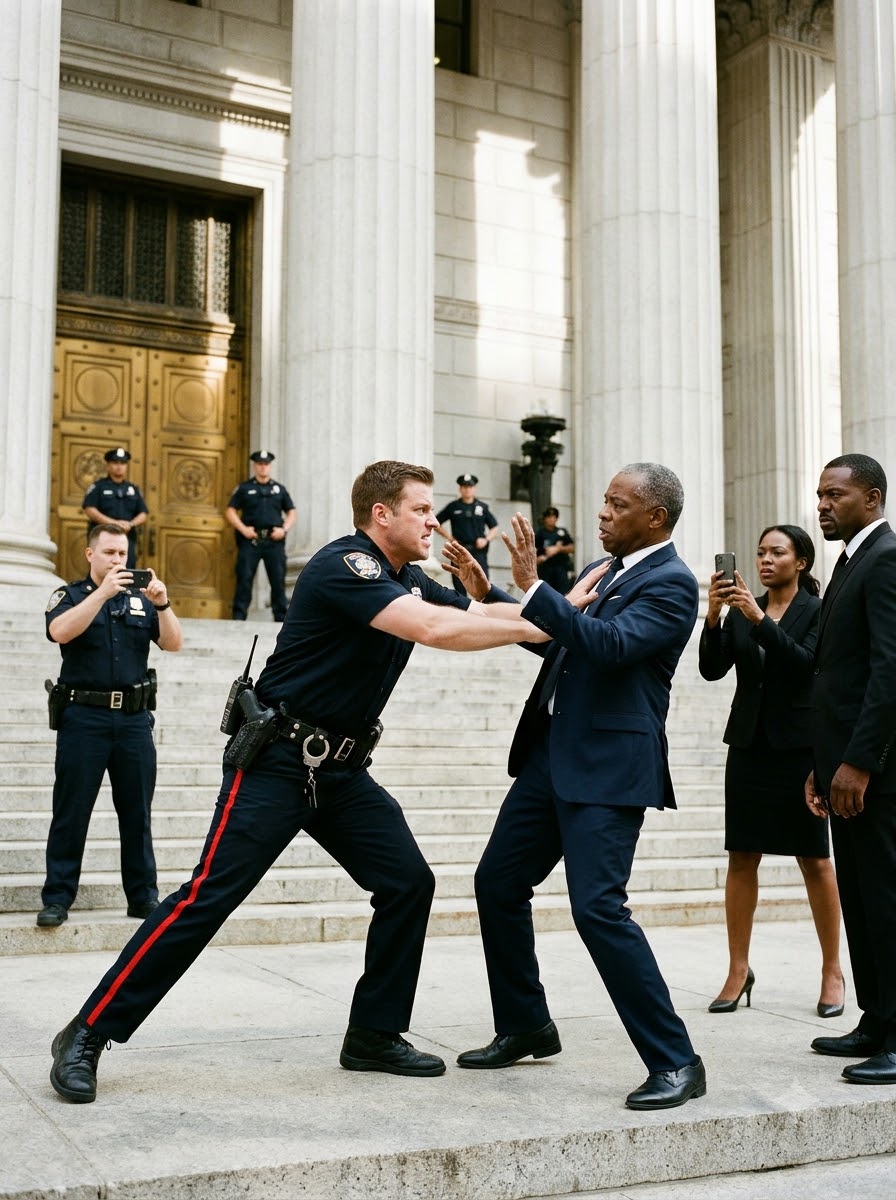
The young police cadet still had his white-gloved hands raised when the massive doors of the academy swung open behind him.
A few feet away, a seventy-two-year-old Black man struggled on one knee beside the front-row seats, clutching a stone railing for support. His dark blue military cap had rolled across the concrete, and his cane lay awkwardly near the steps.
Only moments earlier, families had been laughing, arranging flowers, and taking graduation photographs. Now the entire courtyard had fallen silent.
Then Police Commissioner Andre Booker emerged into the morning sunlight.
He took one look at the elderly man, turned toward the cadet, and spoke with a controlled fury that carried across the plaza.
“Get your hands off my father.”
Cadet Tyler Crane froze.
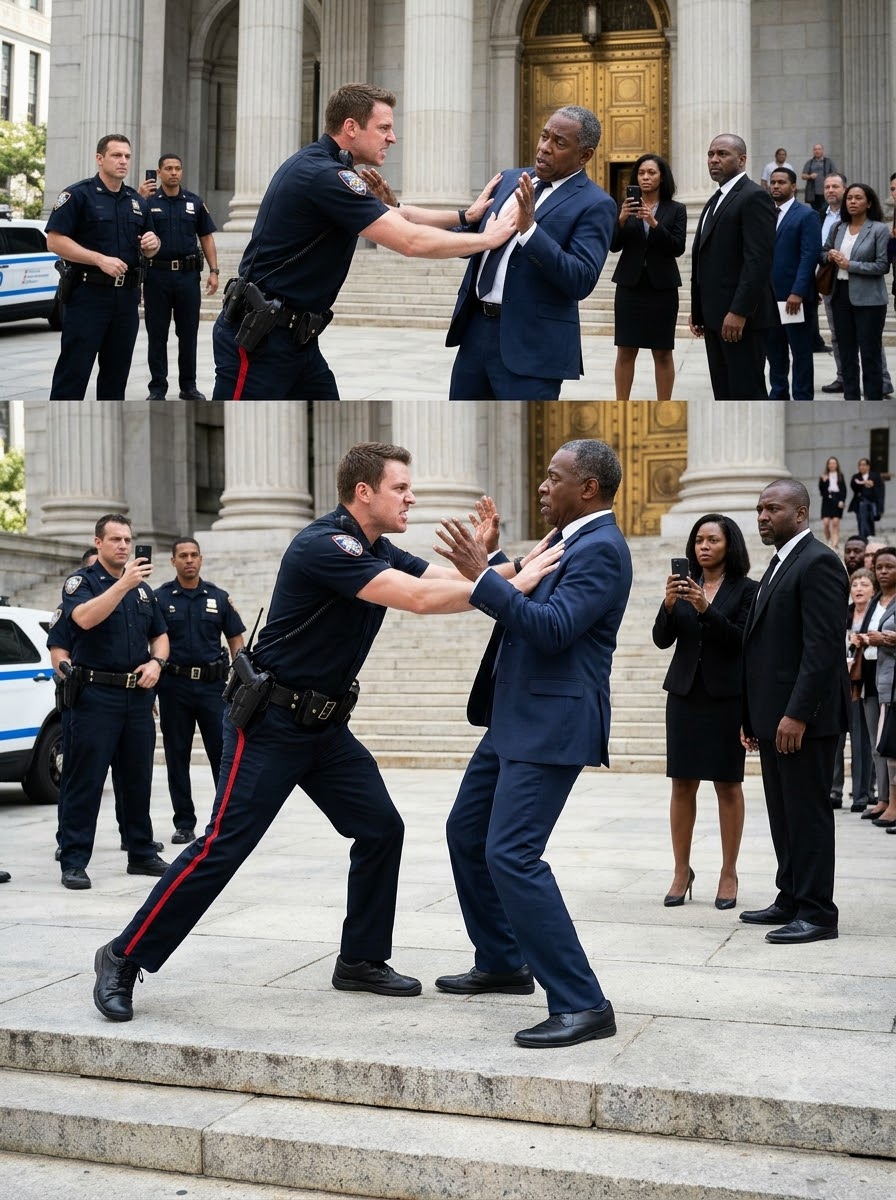
Less than thirty seconds earlier, his shoulders had been squared with absolute confidence. Now that confidence seemed to drain out of him. His face turned so pale beneath his ceremonial cap that one nearby officer later remarked that he looked ready to faint.
Tyler glanced at the commissioner, then at the elderly man, and finally at the gold VIP credential lying beside the cane.
Only then did the truth begin to register.
The man he had decided did not belong in the front row was the father of the highest-ranking police officer in the department.
Andre did not raise his voice again.
He walked straight past Tyler, ignoring the salute the cadet hurriedly attempted, and knelt beside his father.
“Easy, Dad,” he murmured, sliding a careful hand beneath the older man’s elbow.
The elderly man grimaced when he tried putting weight on his right knee.
“I’m fine, Dre,” he said. “Just embarrassed more than anything.”
His name was Samuel Booker, although nearly everyone close to him called him Sam.
For thirty-six years, Samuel had repaired buses and heavy vehicles for the Cleveland Metropolitan Transit Authority, eventually retiring as a maintenance superintendent. Before that, he had spent six years in the United States Army working as a diesel mechanic.
He had never been rich. He did not fill his walls with military decorations, and he had never enjoyed receiving special treatment because of his son’s position.
That morning, he had come to the Lake Erie Metropolitan Police Academy for one simple reason.
Andre had personally asked him to sit in the front row while he delivered the commencement address.
Samuel had resisted the invitation at first.
“Front row is for politicians and people who like cameras,” he told Andre over the telephone.
His son reminded him that Samuel was neither a politician nor someone who particularly enjoyed being photographed.
Andre explained that the graduating recruits had been encouraged to invite the people who had taught them the meaning of service.
And Andre had chosen his father.
Eventually, Samuel agreed.
He did not know the academy had also identified him as a special guest in its printed graduation program.
That morning began in Samuel’s modest brick home on Cleveland’s east side.
He woke before six, even though he did not need to leave until eight. He brewed coffee in the dented metal pot he had owned since his wife was alive, then carefully laid his clothes across the bed.
His brown sport coat was nearly fifteen years old, but it was spotless. His trousers had been freshly pressed. On the dresser sat a dark blue cap bearing the faded insignia of the Army maintenance battalion in which he had served as a young man.
Andre had offered to purchase him a new suit three different times.
Samuel had refused every offer.
His late wife, Lorraine, would have understood.
She had died seven years earlier after forty-four years of marriage. Samuel still kept her photograph beside the front door, positioned so that she seemed to watch everyone entering and leaving the house.
Before departing, he touched the frame.
“Your boy is making another speech today,” he said.
He had spoken to her that way almost every morning since her death.
Then he collected his cane, slipped the gold academy pass into his inside coat pocket, and drove across town.
Andre Booker had been police commissioner for fourteen months.
His career began when he joined the department as a patrol officer at twenty-four. He later worked homicide and internal investigations, commanded two districts, and became deputy chief before the mayor appointed him commissioner.
He inherited a department still struggling to restore public confidence after several widely publicized misconduct cases.
Andre rarely discussed those investigations with his father unless Samuel asked.
But Samuel understood the burden better than Andre knew.
He had raised his son to believe that authority became most dangerous when the person holding it started enjoying the feeling of being obeyed.
When Andre was twelve, Samuel caught him ordering neighborhood children away from a basketball court because an older cousin had temporarily left him in charge.
Samuel made Andre go back outside and apologize to every child.
Andre complained afterward that nobody had been listening to him.
Samuel answered, “Being in charge doesn’t mean people become smaller so you can feel bigger.”
Thirty-four years later, Andre would remember those words while standing on the academy steps.
Graduation day carried additional significance.
The class of 118 recruits was the first to complete a revised training curriculum Andre had helped approve.
The program included expanded instruction in constitutional stops, de-escalation, procedural justice, bystander responsibility, and the subtle ways racial assumptions could influence decisions without an officer ever using openly racist language.
Andre intended to remind the graduates that written examinations and firearms qualifications were only the beginning of understanding what a badge could do to another human being.
Samuel knew little about the curriculum.
He only knew his son sounded unusually nervous about the speech.
That amused him.
Andre had testified before city council and spoken at police funerals without appearing shaken.
Samuel promised to arrive early.
At 8:43 that morning, almost an hour before the processional, he reached the academy.
A uniformed usher checked his gold credential at the outer gate.
“Mr. Booker, Section A, Row One, Seat Eight,” she said warmly.
Samuel asked whether he truly needed to sit that close to the podium.
The usher laughed and told him the commissioner apparently had not left any room for negotiation.
She offered to arrange an escort because of the long stairs.
Samuel thanked her but said he could manage.
The courtyard had been transformed for the ceremony.
Blue-and-white banners reading Integrity, Courage, Service hung above rows of folding chairs arranged across the bright concrete plaza.
Families carried bouquets, balloons, cameras, and restless children already growing impatient.
Inside the main academy building, graduating recruits were preparing for inspection.
Cadets assigned to crowd control wore full dress uniforms, white gloves, and body cameras as part of their final practical assignment.
Tyler Crane was among them.
At twenty-five, Tyler had entered the academy after four years in private security.
His instructors considered him physically confident, decisive, and exceptionally comfortable issuing commands.
Those qualities had earned him high marks during tactical exercises.
His file also contained several written observations advising him to slow down before interpreting behavior as noncompliance.
None of those concerns had resulted in formal discipline.
Tyler dismissed the criticism as unnecessary softness.
He believed instructors wanted recruits to sound courteous when real police work demanded control.
His father had once served as a county deputy, and Tyler had grown up listening to stories about officers who supposedly lost control of situations because they hesitated.
He learned to associate confidence with respect and uncertainty with weakness.
He also developed the belief that people who challenged authority were usually trying to gain an advantage.
Those ideas did not automatically make him cruel.
But together they produced a young man more frightened of appearing mistaken than of actually being wrong.
His graduation assignment was straightforward.
Keep the center aisle unobstructed.
Help elderly visitors.
Direct guests toward ushers.
Check credentials when someone crossed the rope separating general seating from reserved seats.
He had no authority to make independent seating decisions.
And he certainly had no authority to remove a guest because another family disliked the person’s appearance.
That family arrived twenty minutes before Samuel.
Charles and Meredith Harlan had supported the academy foundation for nearly fifteen years.
Charles owned several commercial car dealerships and regularly donated vehicles to youth outreach programs.
Their oldest son was a detective, their daughter had married a lieutenant, and Meredith frequently described them as a “law-enforcement family,” although she had never served herself.
Their donations entitled them to four front-row sponsor seats.
Tyler recognized the name.
At a fundraising event two months earlier, Charles had shaken his hand and said recruits like him represented “the kind of policing people used to respect.”
Tyler remembered the compliment.
Praise from influential people felt like a preview of the opportunities awaiting someone who impressed the right individuals.
So when Charles raised two fingers from his seat that morning, Tyler immediately approached.
“We’ve got a problem,” Charles said.
He gestured toward Samuel, who was slowly checking the seat numbers.
Meredith drew her cream-colored designer handbag closer.
She complained that the elderly man had been “wandering around the sponsor section” for several minutes.
In reality, Samuel had been there less than forty seconds.
Tyler did not question the exaggeration.
Charles explained that his family had paid for platinum sponsorship seating and did not appreciate random visitors entering the front row.
Meredith added, “He looks lost, and I don’t think he has any business down here.”
She lowered her voice on the final words.
Tyler’s body camera nevertheless captured them clearly.
Neither Harlan told Tyler to use physical force.
But both encouraged him to treat Samuel as someone who needed removing.
Tyler looked down the aisle.
He saw an elderly Black man wearing an old but clean sport coat, inexpensive shoes, and a faded Army cap.
There was no visible lanyard because Samuel’s gold credential remained inside his jacket.
Around him sat wealthy white families in expensive clothing.
Within seconds, Tyler accepted the Harlans’ assumption.
He walked toward Samuel.
“Sir, you need to stop right there.”
Samuel stopped immediately.
“Morning, son,” he replied pleasantly.
He began explaining that he was searching for Row One, Seat Eight.
Tyler interrupted.
“This is reserved seating.”
Samuel nodded.
He already knew.
Tyler pointed toward the bleachers and told him general admission was farther back.
Samuel explained that he had been assigned a front-row seat.
“Everybody thinks they’ve got some reason to be up front today,” Tyler replied.
Samuel’s expression shifted.
At seventy-two, he had lived long enough as a Black man in America to recognize when an ordinary conversation was becoming something else.
Still, he remained patient.
“I have the academy pass right here.”
He reached inside his jacket.
Tyler immediately raised a white-gloved hand.
“Don’t reach into your coat while I’m talking to you.”
Samuel stopped.
“I’m reaching for the pass you’re telling me I need.”
“I didn’t tell you to reach.”
Samuel studied him.
“How am I supposed to show you the credential without taking it out?”
Nearby guests began turning toward them.
Tyler noticed the growing attention.
Instead of calming down, he felt pressure to demonstrate that he controlled the situation.
“Pull it out slowly,” he ordered.
Samuel complied.
He displayed the gold lanyard at chest height.
“Section A, Row One, Seat Eight.”
Tyler did not examine it.
Behind him, Meredith said, “Those things get passed around.”
Tyler glanced toward her.
That single comment gave him an excuse to distrust the credential without checking it.
He faced Samuel again.
“This section is for command staff, academy sponsors, and real law-enforcement families.”
Samuel stared at him.
Two people in the second row would later remember the phrase “real law-enforcement families” precisely because of the contempt with which Tyler delivered it.
“What makes you think I’m not one?” Samuel asked.
“Because I’m standing here explaining this and you’re still arguing.”
Samuel replied that he was not arguing.
He was showing his pass.
Tyler knocked Samuel’s hand aside without inspecting it.
The gold credential swung against Samuel’s coat.
“Don’t wave things in my face.”
Samuel’s patience began wearing thin.
“Young man, you haven’t looked at anything I’ve shown you.”
Tyler stepped closer.
“And you haven’t followed a simple instruction.”
Charles Harlan watched from his chair.
He could have acknowledged that his family might have been mistaken.
Meredith could have suggested checking the seating chart.
Neither did.
Instead, Meredith remarked loudly, “This is exactly why they need better security at these events.”
Samuel turned toward her.
Tyler interpreted the movement as another challenge.
“I’m talking to you.”
Samuel faced him again.
“And I’m listening.”
Tyler ordered him to return to the rear section.
Samuel planted his cane firmly against the concrete.
“No.”
He did not shout.
It was simply the first instruction he refused.
Tyler’s expression hardened.
“Excuse me?”
Samuel raised his credential again.
“I have been assigned to Seat Eight, and unless someone with the seating chart tells me otherwise, I am going to Seat Eight.”
The solution was less than thirty feet away.
An usher stood nearby holding a tablet containing the complete guest manifest.
Tyler never called her.
Instead, he stepped directly into Samuel’s path and placed a gloved hand against the elderly man’s chest.
“Do not put your hands on me,” Samuel said immediately.
“Then move where I’m telling you.”
Samuel stepped backward slightly to regain personal space.
His cane caught near the edge of a folding chair.
Tyler interpreted the movement as resistance.
“Stop pulling away.”
Samuel looked astonished.
“You are the one touching me.”
Tyler pushed him again.
Harder.
Samuel’s right heel slipped against the smooth concrete near the first step.
He instinctively twisted to protect the knee that had been replaced four years earlier.
But his cane slid.
His right knee struck the stone first.
Then his left hand.
Then his shoulder.
His blue Army cap flew off and rolled into the aisle.
A wave of horrified gasps swept through the front rows.
One woman rose immediately.
“He didn’t do anything!”
Tyler remained standing above Samuel, pointing toward the upper seating area.
“I told you to move.”
Samuel did not answer.
He gripped the railing and tried to stand.
Pain shot through his replaced knee.
He dropped back down.
The physical pain was sharp.
The humiliation was worse.
At that exact moment, the heavy academy doors opened.
Andre Booker stepped outside.
For one frozen second, he did not see the scene as police commissioner.
He saw his father on one knee.
His cap on the concrete.
A young cadet towering above him.
“Dad?”
Samuel looked up.
Tyler turned.
The commissioner’s gold stars were impossible to miss.
Behind Andre came Academy Commander Captain Elena Ruiz, Deputy Chief Franklin Hayes, and Lieutenant Raymond Park.
All three stopped.
Ruiz immediately recognized Samuel because she had personally approved the VIP seating list.
Andre descended the steps.
“Get your hands off my father.”
Tyler snapped into a salute.
“Sir.”
His voice cracked.
Andre ignored him.
He knelt beside Samuel.
Samuel attempted a joke.
“You’re late.”
Andre almost laughed.
Then he noticed the swelling beneath his father’s trouser leg.
“What happened?”
Samuel initially said he had lost his footing.
Tyler visibly relaxed.
Then a woman in the second row stood.
“No, he didn’t.”
Everyone turned.
Denise Walton, a public-school principal whose daughter was graduating that morning, pointed toward Tyler.
“That cadet shoved him.”
Samuel closed his eyes.
Andre looked at his father.
“Dad?”
Samuel sighed.
“He gave me a push.”
Tyler immediately tried to explain.
“Commissioner, sir, I didn’t know who he was.”
Andre rose slowly.
“That sentence is not helping you.”
Tyler fell silent.
Andre retrieved Samuel’s cap, brushed the dust from its brim, and handed it back.
Samuel then displayed the gold credential.
Captain Ruiz read it from several feet away.
SAMUEL BOOKER — COMMISSIONER’S FAMILY — VIP FRONT ROW — SEAT 8.
She turned toward Tyler.
“Did you see that pass?”
Tyler said there had been confusion.
Ruiz repeated the question.
“Yes, ma’am.”
The admission seemed to diminish him physically.
Tyler began gesturing toward the Harlans.
“They complained. They said he didn’t belong in the sponsor section.”
Andre followed his gaze.
Charles immediately straightened.
Meredith stared into her handbag.
“Commissioner, this has obviously become a terrible misunderstanding,” Charles said.
He explained that his family had noticed someone moving through restricted seating.
Meredith added that they had never requested physical force.
Both statements were technically accurate.
Andre asked whether either of them had examined Samuel’s pass.
Meredith said she had seen something gold but could not tell whether it was genuine.
“Did you ask anyone to verify it?”
She looked away.
“That wasn’t my responsibility.”
“Correct,” Andre answered. “It was his.”
He turned back toward Tyler.
“Captain Ruiz, remove Cadet Crane from ceremonial duty and preserve his body camera.”
Ruiz acknowledged the order.
Andre instructed an independent academy supervisor to secure the courtyard recordings, witness names, seating records, and original VIP manifest.
Tyler whispered, “Sir, my family is here.”
Andre met his eyes.
“So is mine.”
Nothing more needed saying.
Ruiz and Lieutenant Park escorted Tyler toward a side security office.
They did not handcuff him.
They did not strip his uniform in front of the crowd.
They did not stage a public humiliation.
Andre refused to answer one abuse of authority with another.
Samuel noticed.
“You’re learning,” he said quietly.
Andre looked down.
“From who?”
Samuel put on his dusty cap.
“Your mother, probably.”
Paramedics examined his knee.
The replacement joint appeared stable, but swelling suggested a severe bruise and possible ligament strain.
They recommended an X-ray.
Samuel refused to leave before the ceremony.
Andre argued.
“Dad, there will be another graduation.”
“For you, maybe,” Samuel answered, looking toward the cadets assembling inside. “Not for them.”
Andre insisted his health mattered more.
Samuel replied that his knee hurt but his dignity was still functioning.
Then he added, “If you cancel their day because one fool forgot how to use a little authority, you give him more of this ceremony than he deserves.”
Andre recognized that tone.
Lorraine Booker had spent forty-four years teaching him when an argument was over.
Captain Ruiz returned from the security office.
Her expression told Andre the recording was troubling.
She asked to speak privately.
They moved several yards away.
Ruiz explained that Tyler’s body camera had clearly captured the VIP credential.
“How clearly?” Andre asked.
“Clearly enough that there won’t be an honest argument he didn’t see it.”
The recording also preserved the Harlans’ remarks.
Meredith had said Samuel did not look like someone who belonged in the front row.
Charles had complained, “We support this academy too much to spend the morning dealing with people wandering through sponsor seating.”
Andre closed his eyes briefly.
“And Tyler?”
Ruiz looked toward the building.
“He took their assumption and made it an order.”
The graduation was delayed seventeen minutes.
Ushers quietly reassigned the Harlans to general admission after Charles complained that sitting near Samuel would now be uncomfortable.
He initially refused to move, citing years of financial contributions.
Deputy Chief Hayes informed him that donations did not purchase authority over other guests.
Charles demanded to speak with the commissioner.
Hayes replied that the commissioner was attending to his injured father.
Eventually, the Harlans accepted the new seats.
Nobody marched them through the aisle.
Nobody invited the crowd to applaud their embarrassment.
Samuel was helped into Seat Eight.
Denise Walton sat behind him and asked whether he needed anything.
Samuel thanked her.
“You already did enough by speaking.”
The graduating class eventually entered the courtyard.
There were 117 cadets instead of 118.
Most did not yet understand why.
Andre approached the podium.
He looked at his prepared speech.
Then folded it shut.
“My father taught me something when I was twelve,” he began.
Samuel lowered his eyes.
Andre told the story of the neighborhood basketball court.
He described how Samuel had made him apologize after he treated other children as though being temporarily in charge gave him the right to diminish them.
Everyone understood why he had chosen that memory.
“Authority will constantly tempt you to make a mistake feel permanent,” Andre told the graduates.
“You will stop someone, question someone, misunderstand someone, or read a situation badly because you are human, and the badge will give you tools for protecting that first judgment from correction.”
Samuel watched him closely.
“The measure of your character is not whether you are never wrong. It is whether learning you are wrong makes you safer or makes you more dangerous.”
The plaza remained silent.
Andre never mentioned Tyler’s name.
He did not describe Samuel’s injury.
He did not need to.
When the oath was administered, Samuel slowly stood with his cane.
The newly graduated officers raised their right hands and promised to serve without favor, prejudice, or malice.
Samuel listened to those words more carefully than ever before.
Afterward, Captain Ruiz approached him.
She explained that the class wished to honor him.
Samuel immediately refused.
“They don’t know me.”
Ruiz smiled.
“They know enough.”
Samuel glanced toward Andre.
His son shrugged.
“Not my idea.”
The tactical commander called the graduates to attention.
Rather than arranging the theatrical salute some administrators had suggested, Ruiz simply asked them to face the front row.
She introduced Samuel as a retired Army mechanic, longtime public employee, father, widower, and honored guest.
The class applauded.
Samuel hated the attention.
Andre knew because his father’s mouth tightened exactly as it did whenever restaurant employees sang Happy Birthday.
Later, Samuel admitted that one detail had mattered.
Ruiz described the life he had lived before mentioning whose father he was.
That difference stayed with him.
After graduation, Andre accompanied Samuel to the hospital.
X-rays revealed no damage to the prosthetic joint.
But Samuel had suffered a severe contusion and a sprained wrist while breaking his fall.
Doctors sent him home with a knee brace and strict instructions to rest.
Within two days, Samuel had ignored half those instructions.
Andre confiscated the keys to his lawn mower.
Samuel accused the commissioner of abusing his authority.
They laughed.
For a few hours, the academy seemed far away.
But inside the department, the investigation was already underway.
Because Samuel was Andre’s father, the commissioner formally recused himself from Tyler Crane’s disciplinary proceedings.
He requested oversight from the city’s independent inspector general.
Some officers considered that unnecessary.
Andre considered it essential.
If Tyler deserved dismissal, the evidence should establish that without the victim’s son directing the result.
If dismissal was not justified, Andre had no right to manufacture it.
The first body-camera review established the basic facts in less than an hour.
Tyler had been assigned to assist with crowd control, not exercise independent enforcement authority.
Samuel had complied.
He had presented a valid VIP credential.
Tyler refused to inspect it.
He used physical force despite the absence of any safety threat.
His subsequent claim that Samuel had ignored repeated lawful instructions was contradicted by the recording.
Investigators also examined the Harlans’ involvement.
The family had made biased assumptions and pressured Tyler.
But there was no evidence they had ordered or requested physical force.
Their conduct would be addressed separately through academy foundation policies.
The distinction frustrated people online once the incident became public.
The first viral recording came from a guest in the third row.
It showed Samuel falling, Andre emerging from the building, and Tyler turning pale after hearing the word father.
Within hours, millions had watched it.
The most widely shared caption read:
CADET SHOVES WRONG BLACK MAN AT POLICE GRADUATION.
Samuel disliked it immediately.
“There wasn’t a right Black man to shove,” he told Andre.
Andre stared at him.
“That’s my line.”
Samuel smiled.
“I was saying it before you learned to drive.”
The department released a brief statement confirming that a cadet had been removed from graduation pending independent review.
It also confirmed Samuel was recovering.
Andre refused to discuss possible discipline.
Reporters nevertheless surrounded him outside headquarters.
One asked whether the incident proved racial bias inside his academy.
Andre explained that a single recording could establish one cadet’s conduct, but broader institutional conclusions required broader evidence.
Another reporter asked whether Tyler would have shoved Samuel if he had been white.
Andre paused.
“I can tell you what concerns me,” he answered.
“A wealthy white family looked at an elderly Black man, decided he did not belong beside them, and a cadet accepted their assumption without checking the credential in the man’s hand.”
He allowed the words to settle.
“That deserves investigation.”
The inspector general began examining Tyler’s academy records.
And what investigators discovered suggested that the shove had not emerged from nowhere.
PART 2
The graduation footage had shown one terrible decision.
Tyler Crane’s training file began revealing the decisions that had preceded it.
Several written evaluations contained warnings that had seemed relatively minor when instructors first recorded them.
During a community-engagement exercise, Tyler described a Black homeowner who questioned officers about a training scenario as displaying “anti-police hostility.”
An instructor corrected the assessment.
The homeowner had merely asked why the recruits were blocking his driveway.
On another occasion, during a ride-along, Tyler suggested questioning two young Black men walking through an affluent neighborhood because they “didn’t look residential.”
His field-training officer declined.
The report concluded with a familiar recommendation:
Needs additional articulation training.
No formal discipline followed.
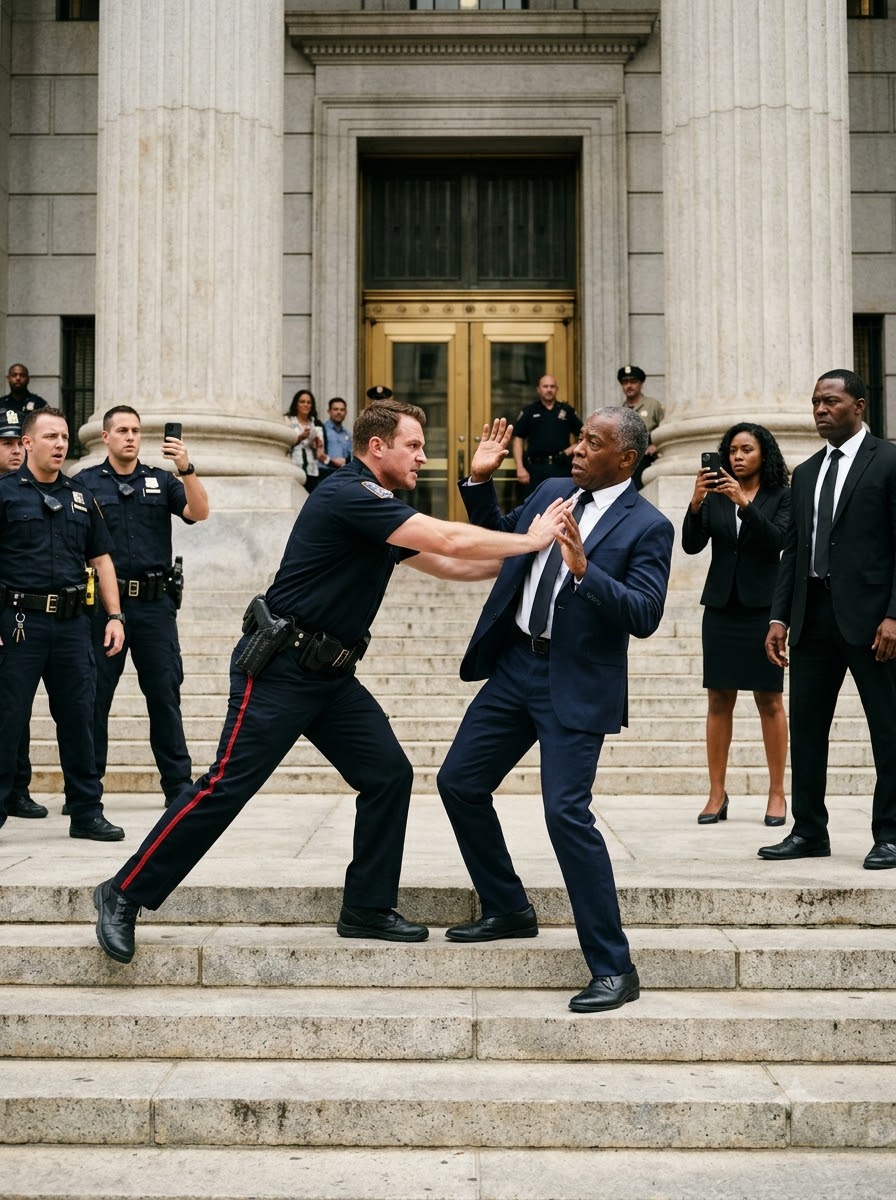
Another instructor praised Tyler’s exceptional command presence while noting that he sometimes issued instructions before determining whether he possessed the legal authority to require compliance.
At the time, those weaknesses had been considered correctable.
Perhaps they were.
The question now was whether anyone had actually corrected them.
Captain Elena Ruiz ordered a review of Tyler’s entire cohort.
She refused to assume one cadet represented the other 117 graduates.
Most had strong evaluations and no meaningful misconduct concerns.
Several had challenged Tyler during training exercises.
One Black recruit, Isaiah Coleman, told investigators he had once warned Tyler, “You decide who the problem is too fast.”
Tyler laughed.
When investigators asked why Isaiah had not formally reported the exchange, he replied, “Because a bad attitude isn’t a disciplinary complaint.”
He was right.
That was part of the difficulty.
People could carry assumptions for years without doing anything formally punishable.
Training was supposed to expose those assumptions before real people suffered the consequences.
Sergeant Gregory Walsh, Tyler’s lead instructor, took the investigation personally.
Walsh had recommended Tyler for graduation despite three written concerns.
“I thought confidence was easier to soften than hesitation was to fix,” he admitted.
The inspector asked him to explain.
Walsh said policing could punish indecision quickly.
A hesitant officer might endanger himself or others.
He believed Tyler’s tendency to act too aggressively would improve with experience.
Samuel’s fall forced Walsh to confront a possibility he had not taken seriously enough.
The academy might have been mistaking unnecessary aggression for an unfinished form of leadership.
Walsh was not dismissed.
Investigators found no evidence that he had approved racial discrimination or unlawful force.
They did find that academy evaluation standards placed too much emphasis on command presence without requiring equal documentation of judgment, verification, and willingness to correct mistakes.
That became a reform issue rather than an effort to identify another villain.
The Harlans faced scrutiny of their own.
Charles initially issued a public statement explaining that his family had merely notified security about “an unidentified individual occupying a restricted donor area.”
Meredith said she regretted how the situation had escalated.
Neither mentioned race.
Then Tyler’s body-camera audio became public through the investigation.
Meredith’s comment that Samuel did not look like he belonged in the front row was unmistakable.
So was another statement.
“People like that wander into these public ceremonies all the time.”
A reporter asked what she meant by “people like that.”
Meredith said she meant visitors without proper registration.
The reporter pointed out that Samuel had been dressed formally and was carrying a VIP credential.
Meredith ended the interview.
Charles’s dealership group began receiving angry telephone calls.
The academy foundation faced demands to return the family’s donations.
Samuel opposed that idea.
“Did they buy the building?” he asked when Andre mentioned the controversy.
Andre said no.
“Then why should the department pretend their money became dirty because they behaved badly?”
Samuel believed donations should support equipment, training, and scholarships.
They should never purchase obedience.
The academy revised its sponsor policies accordingly.
Financial contributions would no longer provide preferential grievance channels or vaguely defined privileges during public events.
Sponsors could still receive reserved seats.
But employees were explicitly instructed that donors possessed no authority over other guests.
Four months after the incident, Charles met Samuel privately in a community mediator’s office.
“I was arrogant,” Charles admitted.
Samuel nodded.
“Yes.”
Charles appeared surprised that Samuel offered no immediate reassurance.
He acknowledged that he had seen Samuel’s worn coat and assumed the older man had entered the wrong section.
“I didn’t think the cadet would put his hands on you.”
Samuel nodded again.
“You thought he would move me.”
Charles looked down.
“Yes.”
“That’s the part you should think about.”
Samuel asked for nothing more.
Meredith never met him.
She submitted a written apology through the foundation.
Samuel read it once and put it away.
He had no desire to collect expressions of remorse.
Tyler’s disciplinary case continued for five months.
He received legal representation, access to the evidence against him, and an opportunity to present witnesses.
His attorney argued that Tyler had acted under pressure during a crowded ceremony and received conflicting information from sponsor guests.
The hearing officer accepted that those circumstances explained why Tyler initially approached Samuel.
They did not justify his subsequent actions.
The most damaging evidence was not simply the shove.
It was everything that happened before it.
A credential had been displayed directly in front of Tyler.
An usher was nearby.
Samuel remained calm.
No crime had occurred.
Tyler repeatedly chose escalation instead of verification.
The hearing officer concluded that the pattern demonstrated judgment incompatible with police certification at that stage.
Tyler was dismissed from the academy before receiving a permanent badge.
Because he had completed most classroom and field requirements, his attorney appealed.
The dismissal was upheld.
Separately, the city prosecutor reviewed the physical confrontation.
Samuel initially told investigators he did not particularly care whether Tyler faced criminal charges.
The prosecutor explained that the decision did not belong entirely to the injured party.
After reviewing the footage, injuries, and surrounding circumstances, the office filed a misdemeanor assault charge.
Tyler eventually accepted a diversion agreement.
It required community service, bias-focused training, and no further offenses during a specified period.
Samuel did not oppose the agreement.
Public reaction remained divided.
Some accused the city of protecting someone connected to law enforcement.
Others argued that destroying a young man’s future over one shove was excessive.
Samuel ignored both camps.
One evening, Andre asked what he believed Tyler deserved.
Samuel was watching baseball.
“Why does everybody keep asking me that?”
Andre answered that Samuel was the person who had been hurt.
“That doesn’t make me the sentencing guidelines.”
Andre laughed.
Samuel lowered the television volume.
“Your academy decides whether he should be a cop, the prosecutor decides what charge fits, the judge decides the legal consequence, and that young man decides what kind of person he becomes afterward.”
Andre nodded.
Samuel added, “I only get to decide what I carry.”
He chose not to carry Tyler.
That did not mean he forgot what happened.
For months, Samuel avoided academy events.
Andre never pressured him to return.
Then a new class invited Samuel to speak at a community ethics seminar.
He declined twice.
The third invitation came directly from Isaiah Coleman, now a probationary officer.
Isaiah wrote a single paragraph.
Mr. Booker, you don’t owe the academy a speech, but some of us need to hear what the moment felt like before anybody knew whose father you were.
Samuel agreed.
Eight months after the shove, he walked through the same academy courtyard.
He wore the same brown coat.
There was no VIP pass around his neck.
Andre had tried to persuade him to wear something different.
Samuel accused his son of fashion discrimination.
Inside the classroom, forty recruits waited for a lecture about racism, authority, or forgiveness.
Samuel began by talking about buses.
He described a freezing morning in 1989 when one of his mechanics blamed a young apprentice for installing a faulty brake valve.
The apprentice insisted the replacement part had arrived defective.
His supervisor did not believe him.
Samuel inspected the component.
The apprentice was right.
A manufacturing defect had caused the problem.
“The mistake wasn’t blaming the kid at first,” Samuel explained. “We had evidence pointing that way.”
He looked across the classroom.
“The danger would’ve been refusing to change our minds after better evidence showed up.”
Then he said, “That is all I wanted from your cadet that morning.”
Check the pass.
Ask the usher.
Look at the seating chart.
Three simple opportunities.
Instead, Tyler had treated each request for verification as a challenge to his authority.
Samuel explained that race mattered because the original assumptions had not appeared out of nowhere.
The Harlans saw a Black man wearing an old coat and decided he was more likely to be lost than invited.
Tyler saw the same man and believed them.
Nobody demanded that the wealthy family prove they belonged.
“Prejudice isn’t always somebody yelling a slur,” Samuel said.
“Sometimes it’s deciding one person’s explanation needs proof while another person’s suspicion gets treated like proof.”
The sentence eventually entered the academy curriculum.
Andre pretended not to be proud.
Samuel noticed anyway.
The department also reviewed guest complaints from previous graduation ceremonies.
Most involved ordinary seating disagreements.
But one earlier incident concerned a Black grandmother who had been asked twice to leave reserved seating despite possessing the correct ticket.
Staff eventually apologized.
Another involved a Latino father wearing work clothes who was directed toward general admission until his daughter, a graduating recruit, located him.
Neither confrontation became violent.
Both had largely been forgotten.
Those reports changed how administrators understood Samuel’s experience.
Tyler’s shove was unusual.
The assumption beneath it was not.
Graduation procedures were revised.
Reserved credentials received large seat numbers visible from several feet away.
Ushers, rather than recruits, became responsible for resolving seating disputes.
Cadets assigned to event security were instructed that donor status could never substitute for access verification.
Removing a nonviolent guest required supervisory approval unless an immediate safety threat existed.
Critics complained that the rules were obvious.
Andre agreed.
“Most policies are written because something obvious turned out not to be obvious enough.”
Body-camera training changed as well.
Recruits began reviewing Tyler’s recording anonymously during ethics instruction.
The footage stopped before Andre emerged from the academy.
Samuel had specifically requested that edit.
The video showed Tyler approaching, refusing to inspect the credential, responding to the Harlans’ accusations, and escalating the confrontation.
Then the screen went black.
“What should happen next?” instructors asked.
The recruits could not rely on the dramatic reveal.
There was no commissioner.
No influential father.
No hidden status.
They had to evaluate Tyler’s conduct as if Samuel were exactly what the cadet had assumed: an ordinary elderly Black man who might have entered the wrong row.
That was the point.
If their answer changed once Andre appeared, the lesson had failed.
Two years later, Samuel attended another graduation.
This time, he did not sit in the front row.
His granddaughter Maya was becoming a police officer.
Samuel chose a seat beside her mother in Section C so they could embarrass Maya together.
Andre arrived in uniform and asked why his father had ignored the VIP ticket.
Samuel replied, “I am retired from front rows.”
Andre shook his head.
“You know nobody is going to bother you.”
“That’s not the reason.”
“What’s the reason?”
Samuel gestured toward his family.
“My seat is here.”
Andre accepted the answer.
Maya graduated near the top of her class.
When she crossed the stage, Samuel shouted her name loudly enough to violate at least three ceremony rules.
Nobody removed him.
Afterward, Maya hugged him.
“Grandpa, you are so embarrassing.”
Samuel considered the day a complete success.
Tyler Crane gradually disappeared from public attention.
He completed his diversion program and eventually found employment managing safety operations for a manufacturing company.
Several years after the incident, he wrote Samuel a letter.
The envelope remained unopened on Samuel’s kitchen counter for nearly two weeks.
When he finally read it, the first page sounded exactly like the apology he expected.
Tyler described his youth, the pressure he had felt, his fear, and the consequences his family had endured after his dismissal.
Samuel nearly stopped reading.
Then Tyler described something that had happened at the factory.
One afternoon, a supervisor accused a Black temporary worker of stealing an expensive torque tool because the man was carrying it toward another building.
Tyler admitted that his old instincts immediately told him the supervisor was probably correct.
Then he remembered the gold VIP credential.
He asked one question.
The worker produced a transfer order from his pocket.
The tool was supposed to be moved.
“Nothing dramatic happened,” Tyler wrote. “We checked the paper and he kept walking.”
Samuel read that paragraph twice.
Then he continued.
That was when I understood what you had been asking me to do. You weren’t asking me to believe you because you were important. You were asking me to check before I decided you weren’t.
Samuel folded the letter.
He did not cry.
But he wrote back.
His response contained three sentences.
That sounds like progress. Keep checking. I wish you well.
Andre later complained that Samuel could have offered more emotional wisdom.
Samuel told him stamps cost money.
Charles Harlan also changed, although not immediately.
His family stopped attending academy donor events for almost two years.
When Charles eventually returned, he did so without the platinum sponsor designation.
He funded a repair scholarship for police employees studying technical trades and requested that his name remain off the program.
Andre told Samuel about it.
“Guilt donation?” Samuel asked.
“Maybe.”
Samuel shrugged.
“If the scholarship pays tuition, the student probably won’t care why.”
That was nearly the last time he discussed Charles.
Meredith remained more complicated.
For years, she privately defended her conduct, insisting she genuinely believed Samuel was lost and that her words had been misunderstood.
Eventually, one friend asked her the same question Samuel had asked Charles.
Why did believing someone was lost make removing him more important than helping him?
According to Charles, Meredith had no answer.
Samuel never discovered whether she changed.
He decided it was not his responsibility.
Andre remained commissioner for another six years.
The academy incident followed him longer than many of the policies he introduced.
Reporters repeatedly referenced it when discussing race and policing.
Some presented Samuel’s experience as proof of systemic racism throughout the department.
Others presented Andre’s response as proof that the system could correct itself.
Andre rejected both oversimplifications.
“One incident can reveal a problem,” he said during a university forum. “It cannot honestly explain an entire institution by itself.”
Then he added, “What matters is what the institution does after the problem becomes visible.”
Complaint numbers increased during the two years following the academy reforms.
City council members demanded to know why reported misconduct appeared to be rising.
Andre explained that reporting had become easier and supervisors were now formally documenting minor complaints that previously might have been handled informally.
“An increase in reports can mean people finally believe reporting is worth their time,” he said.
Samuel watched the hearing on television.
“He stole that from me,” he told the empty room.
Lorraine’s photograph offered no opinion.
Samuel’s knee never completely recovered from the fall.
Doctors confirmed the implant remained intact, but arthritis around the joint progressed more rapidly, and he eventually required additional physical therapy.
Restitution under Tyler’s diversion agreement covered part of the medical costs.
The department’s insurance covered the remainder.
Samuel did not file a large civil lawsuit.
His attorney told him he probably could have pursued one.
Samuel asked what a likely settlement would accomplish.
The lawyer explained compensation, accountability, policy leverage, and litigation discovery.
Samuel listened carefully.
Then he explained that the independent investigation had already produced the records and institutional reforms he considered most important.
He submitted only a limited claim for medical expenses not otherwise covered.
Some people interpreted that decision as extraordinary forgiveness.
It was not.
Samuel simply did not believe every wrong required the same remedy.
Years later, he explained to Maya that litigation was sometimes precisely what forced institutions to change.
Other times, evidence had already accomplished that work.
“Know what you’re trying to fix before you pick the tool,” he told her.
It sounded like advice from a mechanic.
Samuel had never entirely stopped being one.
Maya carried the lesson into patrol.
During her second year, she stopped a truck because its license plate appeared to match a burglary bulletin.
The driver was a Black carpenter in his fifties.
He immediately pointed out that his plate differed from the reported number by one digit.
Maya checked before ordering him out of the vehicle.
He was right.
The entire encounter lasted three minutes.
She apologized.
He answered, “No problem.”
That evening, Maya called Samuel.
“You know what was weird?”
“What?”
“I didn’t feel embarrassed that he corrected me.”
Samuel smiled.
“That means you might survive this job.”
Maya laughed.
Then Samuel told her correction should feel cheaper than escalation.
She eventually began using the phrase when mentoring rookies.
Years passed.
Samuel grew older.
Andre retired.
The academy changed commanders twice.
Digital credentials replaced the old gold VIP passes.
The folding chairs were replaced too.
But the stone steps remained.
At eighty-one, Samuel returned for the graduation of Denise Walton’s grandson.
Denise had become a friend after the morning she spoke up from the second row.
She greeted Samuel near the entrance.
“You bringing trouble today?”
“Only if somebody steals my seat.”
“Front row?”
Samuel pointed toward the middle section.
“I learned my lesson.”
Denise laughed.
“Wrong lesson.”
They sat beneath a shade canopy installed after years of complaints from families.
Samuel remembered the Harlans complaining about the sunlight before the confrontation began.
It was strange what memories survived.
The recruits filed into the courtyard.
Samuel watched them and wondered how many would make mistakes during their first year.
Probably all of them.
That did not frighten him.
What frightened him was the possibility that any officer might believe a uniform made admitting a mistake optional.
After the ceremony, a young cadet assigned to crowd control approached Samuel.
For an instant, an old memory returned.
White gloves.
Dark uniform.
Authority walking toward him.
Then the cadet smiled.
“Sir, somebody left a phone beneath your chair.”
Samuel checked his pocket.
His own phone was there.
“Not mine.”
The cadet nodded.
“Thank you.”
Then he walked away.
Samuel exhaled.
Denise noticed.
“You went somewhere for a second.”
“Long time ago.”
She understood.
They watched families gathering for photographs.
Nobody else knew why that ordinary interaction mattered.
Samuel preferred it that way.
By eighty-four, his health began declining more quickly.
Andre visited nearly every day, often bringing groceries Samuel insisted he did not need.
One evening, father and son sat together on the porch while a summer storm moved across Lake Erie.
Andre finally asked a question he had avoided for more than a decade.
“Did I handle that morning right?”
Samuel turned toward him.
“You’ve been commissioner, retired, and became a grandfather before asking me that?”
“I’m patient.”
“No, you’re neurotic.”
Andre laughed.
Samuel considered the question more seriously.
“You handled the part that belonged to you.”
“What about stopping the ceremony?”
“You didn’t.”
“Moving the Harlans?”
“Your people did that.”
“Tyler?”
“Independent review.”
Andre nodded.
Samuel continued.
“You were angry enough to use your power personally and smart enough not to.”
Andre watched the rain.
“I wanted him gone before Dad finished checking your knee.”
“I know.”
“I wanted to tell the whole class exactly what he did.”
“I know.”
“I wanted those people in the front row walked out through the parking lot.”
Samuel smiled.
“I know.”
Andre asked how he could be so certain.
“Because you’re my son.”
They sat in silence for a while.
Then Samuel said something Andre would later write down.
“Power doesn’t prove who you are when you’re calm. It proves who you are when being unfair would feel good.”
Andre never forgot it.
The following spring, Samuel Booker died.
He was eighty-five.
There was no dramatic final speech.
No officers gathered around his bed.
He ate breakfast at home, fell asleep, and never woke.
Andre discovered him two hours later when he arrived with groceries.
The funeral filled the Baptist church Samuel had attended for almost fifty years.
Transit mechanics came wearing work shirts.
Police officers arrived in dress uniforms.
Army veterans brought old photographs.
Neighbors came because Samuel had repaired their lawn mowers without charging them.
His life had always been larger than the academy steps.
Andre made certain the funeral program reflected that.
The front page did not identify Samuel as the police commissioner’s father.
Instead, it read:
Samuel James Booker — Husband, Father, Grandfather, Soldier, Mechanic, Neighbor, Friend.
Andre believed his father would have approved.
Maya delivered the eulogy.
She described Samuel teaching her to change brake pads when she was thirteen.
Then she recalled the traffic stop where she verified a license plate before escalating.
Finally, she mentioned the academy.
She did not name Tyler.
She did not name the Harlans.
“My grandfather once told me the most dangerous part of authority is how easy it makes your first assumption feel official,” she said.
Several officers lowered their heads.
Maya continued.
“He wanted us to check.”
Not obey blindly.
Not distrust everyone.
Check.
The instruction seemed almost too simple for a funeral.
Samuel would have liked that.
After the service, Andre received a package from the academy.
Inside was the original gold VIP credential Samuel had carried on graduation day.
Investigators had retained it with the disciplinary evidence for years before electronically archiving the case.
Andre turned the card over.
A scrape crossed one corner where Tyler’s glove had knocked it against Samuel’s coat.
For a moment, Andre considered framing it.
Then he imagined his father asking why anybody would frame an old piece of plastic.
Andre placed it in a drawer.
Some objects did not need an audience.
Years later, Maya became an academy instructor.
On the morning of her first ethics class, she prepared the old body-camera recording.
The footage remained edited exactly as Samuel had requested.
It stopped before Commissioner Booker appeared.
Maya paused the video on the image of her grandfather holding out the gold credential.
Then she faced the recruits.
“Forget who he is.”
Nobody spoke.
“Forget the commissioner.”
“Forget the VIP program.”
“Forget everything you learned after this video went viral.”
She pointed toward Samuel.
“What do you know right now?”
One recruit answered, “Older man says he has a reserved seat.”
Another said, “He presented a credential.”
A third added, “No safety threat.”
Maya nodded.
“What don’t you know?”
“Whether the pass is valid.”
“Good.”
She looked around the room.
“What do you do?”
“Verify it.”
Maya smiled.
“Class over.”
The recruits laughed.
She continued teaching for another hour.
But the most important part of the lesson had already been delivered.
And the question Samuel had spent the rest of his life trying to answer was finally being asked before anyone saw the commissioner walk through the doors.
PART 3
Samuel Booker’s story survived because the academy eventually stopped teaching it as a warning about what might happen when someone mistreated a powerful person’s relative.
It became something much more important.
A warning against believing that a powerful connection should be necessary before ordinary dignity mattered.
Tyler Crane’s greatest mistake had never been failing to recognize the commissioner’s father.
Samuel had not expected recognition.
He had not arrived wearing a badge or announcing his relationship to the department’s highest-ranking officer.
He was simply an elderly guest searching for the seat assigned to him.
Tyler’s mistake was believing that respect should follow recognition rather than precede it.
The cadet looked at the Harlans and saw wealth, polished clothing, confidence, donor status, and a family history connected to law enforcement.
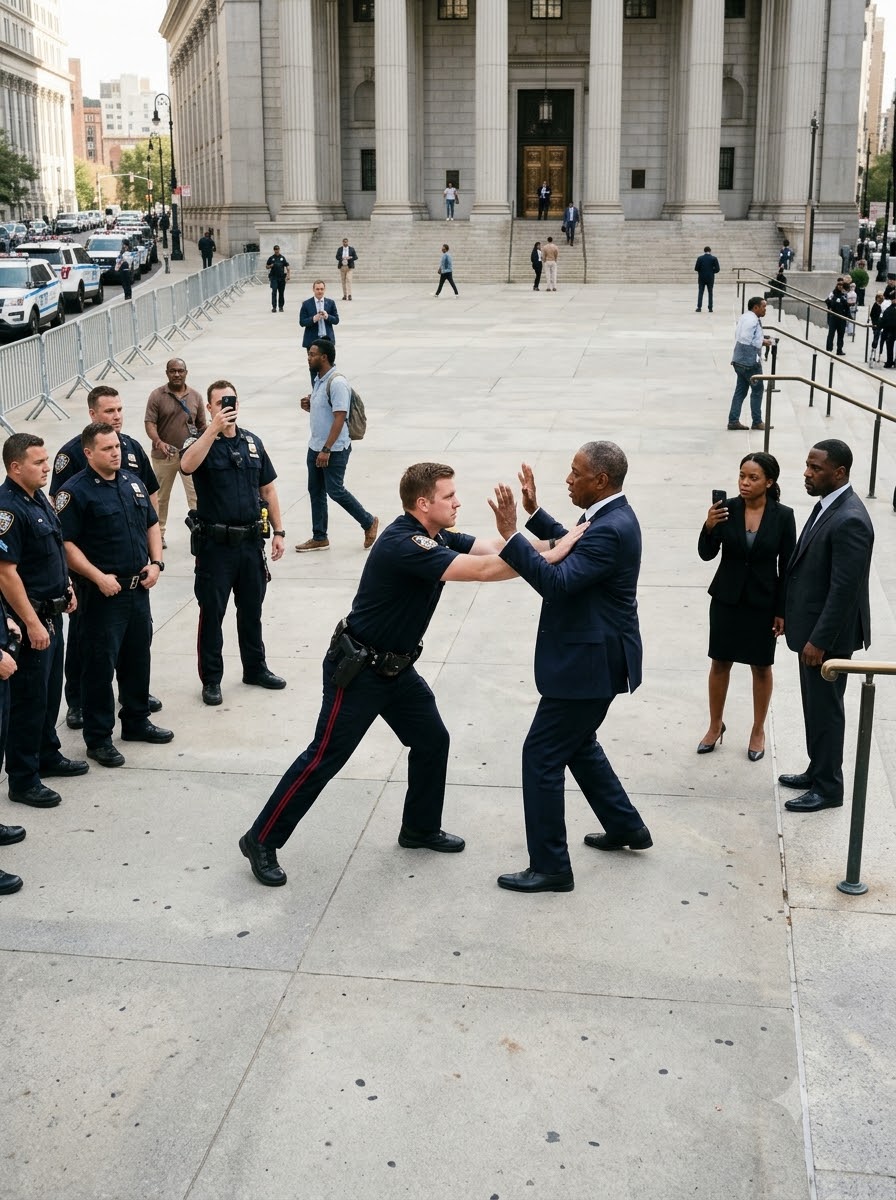
Everything about them matched his mental picture of people entitled to sit in the front row.
Then he looked at Samuel.
An elderly Black man.
An old brown coat.
Inexpensive shoes.
A faded Army cap.
A cane.
Tyler decided Samuel needed to justify his presence in a way nobody had asked the Harlans to justify theirs.
And when Samuel provided that justification, Tyler refused to examine it.
When Samuel asked him to verify the pass, Tyler interpreted the request as defiance.
When Samuel declined an improper instruction, Tyler interpreted his refusal as resistance.
When the confrontation became embarrassing, Tyler chose force instead of correction.
Race did not have to be shouted to influence the encounter.
Neither did class.
Neither did pride.
All three operated quietly.
That was why the incident remained relevant long after Tyler’s name disappeared from the headlines.
One young cadet made a serious mistake.
One wealthy family helped create the assumption behind it.
One academy had overlooked signs that confidence was becoming entitlement.
One commissioner happened to walk outside at the exact moment the consequences became impossible to ignore.
But the lasting work began after the dramatic reveal.
Reviewing the recording.
Examining training files.
Correcting evaluation standards.
Strengthening complaint procedures.
Separating donor influence from operational decisions.
Teaching recruits that command presence without judgment was merely volume wearing a uniform.
Samuel’s own life continued along a quieter path.
He never wanted to become the elderly Black father whose humiliation taught a police department a lesson.
He wanted to remain Lorraine’s husband.
Andre’s father.
Maya’s grandfather.
A mechanic who understood engines.
A neighbor who complained about property taxes.
A man who disliked expensive restaurants and loved terrible baseball.
The academy incident became part of his life.
It never deserved to become the whole of it.
Perhaps that was another lesson he left behind.
People who demean others are already trying to make those people smaller than they truly are.
The person who has been mistreated does not have to cooperate by building an entire identity around the moment someone failed to recognize their humanity.
Samuel returned to graduations.
He sat in different sections.
He argued with his son.
He laughed with Denise.
He watched Maya become the kind of officer Tyler had not yet learned to be.
His life kept accumulating new memories after the viral video ended.
That was why Andre eventually stopped hating the recording.
For years, all he could see was his father down on one knee.
Later, he began noticing something else.
Samuel reaching for the railing.
Trying to stand.
He was already attempting to rise before he knew anyone important had witnessed the confrontation.
Andre once told Maya that this moment explained her grandfather better than the commissioner’s dramatic arrival ever could.
Samuel had not waited for his son.
He was already getting up.
The academy doors simply happened to open.
Most people remembered Andre saying, “Get your hands off my father.”
It was a powerful sentence.
It carried family, authority, protection, and an immediate reversal of power.
But Andre spent the rest of his career wishing that sentence had never been necessary.
Samuel’s dignity had not appeared when his son stepped outside.
His VIP pass had not suddenly become valid when the commissioner’s gold stars entered the courtyard.
The shove had not become excessive because the injured man turned out to be related to someone powerful.
Everything that was true after the reveal had already been true before it.
An invited guest stood in the correct section.
A wealthy family decided he looked out of place.
A cadet accepted their assumption as credible information.
The guest produced proof.
The cadet refused to verify it.
Then he used the authority of his uniform to turn his unsupported assumption into physical force.
That was the story before anyone learned Samuel Booker’s relationship to the commissioner.
Years afterward, academy recruits continued watching the recording without seeing Andre emerge.
They were not told who Samuel was until after they had discussed Tyler’s decisions.
Some guessed the elderly man might have been a retired police chief.
Others assumed he was a judge.
One recruit suggested he might be the mayor’s father.
Maya corrected them every time.
“He was a citizen.”
That was enough.
Then she replayed the moment Samuel held out the gold pass.
“Here,” she told them, “is where the whole story could have ended.”
A hand reaches forward.
An officer examines the credential.
The seat number matches.
“Sorry for the confusion, sir.”
Samuel walks another eight feet.
He sits down.
The ceremony begins on schedule.
Nobody records a confrontation.
Nobody becomes famous.
Nobody loses a career.
No commissioner kneels on the concrete beside his injured father.
No city spends months examining how race, class, donor pressure, training, and pride converged inside one seemingly small decision.
The outcome would have been boring.
Ordinary.
Professional.
Exactly what Samuel would have preferred.
Instead, Tyler chose another path.
And that was why the lesson had never been that he shoved the wrong Black man.
There was no right Black man to shove.
There was only an elderly guest standing precisely where he had been invited to stand, holding the answer in his hand while a young cadet insisted he already knew better.
The uniform gave Tyler enough power to turn an assumption into force.
The camera gave everyone else enough evidence to examine what happened.
And Samuel Booker’s life gave the academy something more meaningful than either.
A reminder that respect should not begin only after authority discovers who someone knows.
It should exist before the first question is asked.
The final lesson was not about a commissioner’s father.
It was about an ordinary citizen who should never have needed a commissioner at all.
And every time Maya stopped the recording before Andre walked through the academy doors, she reminded her recruits of the same truth her grandfather had lived by:
Check the facts before protecting your pride.
Correct a mistake before turning it into an order.
And never allow a uniform to convince you that another person’s dignity depends on your willingness to recognize it.
Because the most important moment in Samuel Booker’s story was not when his powerful son arrived.
It was the moment before.
The moment when an elderly man held out a valid pass.
The moment when a young cadet could still have chosen to look.
The moment when everything could have ended with a simple apology and a seat number.
That opportunity had been there all along.
And the lesson Samuel left behind was that the next officer should recognize it before anyone falls.
