

PART 1
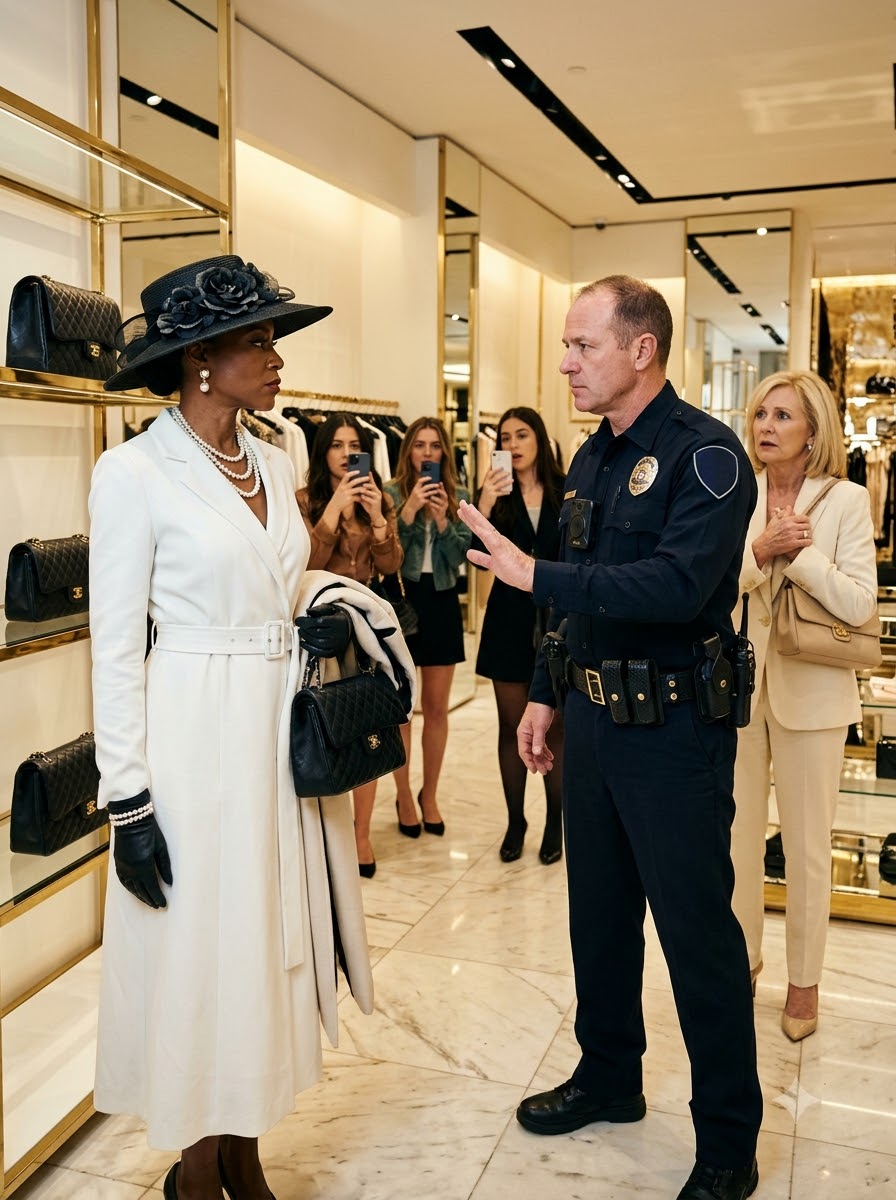
The fourth phone rose to record the confrontation just as Officer Paul Brennan warned that he might have to detain her.
By that point, almost everyone inside Vale Rowe’s Madison Avenue flagship had abandoned the pretense of shopping. An uncomfortable hush stretched from the luxury handbag displays to the sweeping marble staircase leading toward the corporate offices upstairs.
Camille Porter, thirty-six, stood in the middle of the showroom with three dresses draped neatly across her arm. Her other hand hung relaxed at her side.
A few feet away, a white woman wearing a pearl-gray coat observed the scene with the smug satisfaction of someone convinced that her suspicions had finally been justified.
Camille faced the officer.
“What exactly do you believe I stole?”
It was the third time she had asked.
Officer Brennan, forty-one, was a broad-shouldered patrolman who had arrived less than ten minutes earlier. Dispatch had described the incident as a possible shoplifting complaint at an upscale clothing store.
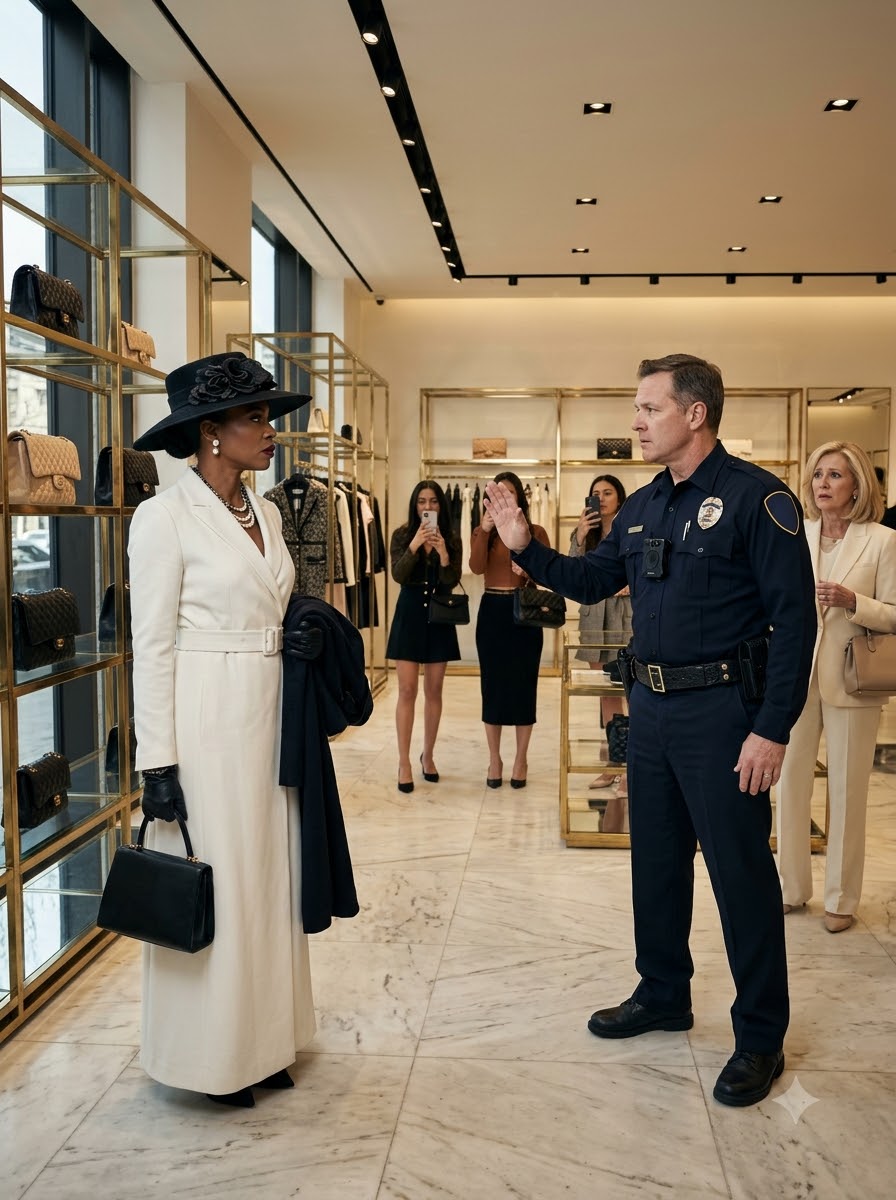
He had witnessed no theft.
He had not seen Camille hide merchandise, remove a security device, pass a checkout station, or attempt to leave without paying.
None of those things had occurred.
What Brennan had encountered was an uneasy store manager, an influential customer insisting that something suspicious had happened, and a Black woman who would not stop asking him to explain the accusation.
Somewhere along the way, he had begun interpreting her insistence on facts as evidence of defiance.
“Ma’am, put the dresses on the table,” Brennan instructed, gesturing toward a cream-suede display.
Camille glanced at the garments.
“Has the store reported any missing merchandise?”
Brennan turned toward Martin Keene, the boutique manager.
Martin looked as though he desperately wanted to disappear.
“No,” he admitted.
Camille nodded.
“Did anyone see me conceal anything?”
“No.”
“Did I try to leave without paying?”
“No.”
The woman in gray released an impatient sigh.
“She was behaving suspiciously.”
Her name was Evelyn Carrington.
Everyone employed at Vale Rowe knew who she was.
At fifty-six, Evelyn had spent almost $900,000 with the company over eleven years. Sales associates remembered her preferred fitting room, her favorite sparkling water, and the particular employee she allowed to address her by her first name.
Her daughters received handwritten birthday greetings from the boutique. Her alterations received priority treatment without additional charges. Private appointments regularly continued past closing whenever she wanted extra time.
None of those privileges gave Evelyn authority over other customers.
Nevertheless, years of special treatment had taught the staff to behave as though she possessed it.
Camille knew precisely how valuable Evelyn was to the business.
She knew her spending history, the complaints she had submitted, the complimentary credits managers had authorized, and the number of employees who privately described her as difficult but financially important.
Camille knew these details for a reason Evelyn could not have imagined.
Camille owned Vale Rowe.
Evelyn had never recognized her from the business publications she rarely bothered to read.
Forty minutes earlier, Camille had entered the flagship alone.
She wore tailored black trousers, comfortable leather flats, an ivory sweater, and a dark wool coat without a conspicuous luxury label. Her natural hair was secured in a low bun, small gold hoops framed her face, and an old black leather tote hung from her shoulder.
The tote had belonged to her mother.
There was no chauffeur waiting outside.
No assistant.
No security entourage.
No executive stationed near the entrance to announce her arrival.
Camille intended to conduct an unannounced inspection before the holiday shopping season.
The Madison Avenue location had recently undergone a $6.2 million renovation. She had approved redesigned fitting salons, improved customer-service counters, wider accessible pathways, and an updated security arrangement designed to reduce blind spots without making shoppers feel monitored.
She wanted to experience those improvements as an ordinary visitor.
Camille had learned that scheduled executive inspections often revealed what employees could perform when they knew leadership was watching.
Unannounced visits revealed what they considered normal.
During her first fifteen minutes, the experience seemed satisfactory.
An associate greeted her at the entrance. Another offered water. Employees allowed her to browse without hovering.
Then the store became busier.
Several salespeople were called into private appointments, and Camille began observing the operational details that had brought her there.
A camera near the fitting rooms pointed in the wrong direction.
Two clothing racks partially obstructed a hallway intended to remain accessible.
Decorative furniture blocked part of an emergency-access panel.
Camille mentally recorded each issue while continuing to shop.
She selected two evening gowns and a structured black dress suitable for daytime wear.
Then she moved toward the front windows to examine the fabrics under natural light.
Along the way, she repeatedly glanced at ceiling cameras, comparing their positions with the renovation plans.
From the jewelry counter, Evelyn Carrington noticed.
She watched Camille for several minutes before approaching Martin.
“Are your people keeping an eye on that woman?”
Martin looked confused.
“Why would we need to?”
Evelyn explained that Camille had been moving between departments, studying cameras, looking toward staff-only areas, and carrying expensive garments without a salesperson beside her.
Martin replied that customers were permitted to carry clothing around the showroom.
That should have settled the matter.
Instead, Evelyn brought up organized retail theft in Manhattan luxury stores.
Then she added that Camille did not look like a typical Vale Rowe customer.
Martin asked what she meant.
Evelyn told him he knew perfectly well.
He offered no objection.
That was the first opportunity to stop what followed.
And he let it pass.
Evelyn began trailing Camille through the boutique.
When Camille approached the front windows, Evelyn positioned herself between the customer and the entrance.
“Have you paid for those?”
Camille looked genuinely puzzled.
“I haven’t decided which ones I’m buying.”
“You’re standing awfully close to the exit.”
“I’m standing near the windows. The daylight helps me compare the colors.”
“There are fitting rooms for that.”
“I’m aware.”
Evelyn immediately disliked her composure.
“Do you have an appointment?”
“No.”
“Is anyone helping you?”
“Several employees have spoken with me.”
Evelyn narrowed her eyes.
“People don’t usually wander around here by themselves carrying that much merchandise.”
Camille studied her.
“People?”
Evelyn corrected herself.
“Customers.”
“Do you work here?”
“No.”
“Are you security?”
“No.”
“Management?”
“Obviously not.”
Camille nodded.
“Then I’m going to continue shopping.”
She walked past Evelyn.
That should have been the second opportunity for the incident to end.
But Evelyn summoned Martin again.
She complained that Camille had become confrontational and demanded that management intervene.
Martin approached Camille and asked whether she would leave the dresses with him while they resolved a concern.
Camille asked him to identify that concern.
No employee had witnessed concealment.
Nothing was missing.
She had not tried to leave.
Why, then, was she being asked to surrender merchandise she was considering purchasing?
Martin struggled to answer.
Evelyn supplied one.
“She’s making everybody uncomfortable.”
Camille glanced around.
A couple near the shoes continued shopping without appearing aware of the dispute. Other customers browsed normally. Two associates avoided looking in her direction.
“Everybody?” Camille asked.
Evelyn folded her arms.
“You know what I mean.”
Camille’s expression became cooler.
“I’m starting to understand.”
Martin suggested continuing the conversation in a private fitting salon.
Camille declined.
She had no reason to be removed from the public showroom merely because a stranger had made an accusation nobody could explain.
Evelyn interpreted the refusal as further proof of guilt.
Five minutes later, she called the police.
Martin could have prevented that escalation with a single statement.
He could have informed dispatch that no theft had been reported and the boutique did not require police assistance.
He could have reminded Evelyn that spending enormous sums of money did not make her a security officer.
But Martin had spent years learning that contradicting Evelyn could threaten his job.
Allowing an unsupported accusation against a stranger felt safer than upsetting an important customer.
Officer Brennan arrived expecting a routine retail-theft investigation.
Dispatch had identified the location and reported a suspected shoplifter.
Evelyn waited near the doors and immediately pointed Camille out.
Brennan did not ask why a customer rather than an employee was directing the investigation.
Within minutes, the officer was threatening detention while four shoppers recorded the encounter.
Camille still held the dresses.
No one had supplied a legitimate explanation for taking them.
Brennan extended his hand.
“I need the merchandise while I determine what happened.”
“You can determine that by asking the store whether anything was stolen.”
“I’m not going to debate procedure with you.”
“I’m not asking for a debate. I’m asking what evidence you have.”
A nervous laugh sounded near the fragrance display.
Brennan’s jaw tightened.
Evelyn stepped forward.
“She’s deliberately intimidating everybody.”
Camille looked almost amused.
“By asking questions?”
“She was walking toward the entrance with unpaid clothing.”
“The front windows are also near the entrance. Carrying dresses around a clothing store is normally called shopping.”
Several people laughed.
Evelyn flushed.
“I’m trying to protect this business.”
Camille turned toward her.
“From me?”
“Yes.”
The answer hung in the air.
Camille studied Evelyn before asking another question.
“Why me?”
“Because of your behavior.”
“What would make a white woman carrying three dresses through this store seem ordinary instead?”
Evelyn stiffened.
“Don’t make this about race.”
Camille had not mentioned Evelyn’s race.
Everyone seemed to notice that at once.
Brennan shifted his stance.
Martin lowered his eyes.
Camille allowed the silence to stretch before asking what a person who belonged at Vale Rowe was supposed to look like.
“You’re twisting my words,” Evelyn snapped.
“I’m asking you to explain them.”
Evelyn finally lost her composure.
“I spend more here every year than people like you probably make.”
She stopped speaking.
But the damage was already done.
The showroom fell silent.
Camille lowered her voice.
“People like me probably make what?”
“I didn’t mean anything by that.”
“Then finish the sentence.”
Brennan interrupted and demanded identification.
Camille asked whether she was being detained and what probable cause he had established.
The officer replied that he was trying to identify the people involved and warned that refusing would make everything more difficult.
Camille noticed how effortlessly the question of evidence had become a question of whether she was being cooperative enough.
She reached slowly toward her coat.
Brennan’s hand moved toward his belt.
Camille stopped immediately.
“Wallet.”
She waited for his acknowledgment before continuing.
Inside her slim black card holder were a driver’s license, corporate cards, and an executive credential displaying the Vale Rowe crest.
She gave Brennan only her license.
He read the name.
“Camille Porter.”
“Yes.”
Then he noticed the address.
A Manhattan condominium overlooking Central Park.
Something in his manner softened.
Camille noticed.
And the change disturbed her.
Her expensive address had not altered the facts.
It did not prove she was innocent.
It merely made the officer more willing to believe her.
Brennan checked her information.
No warrants appeared.
Camille remarked that she would have been surprised.
He did not smile.
Then a voice came from the staircase.
“What exactly is happening down there?”
Everyone turned.
A tall Black man in a navy suit stood halfway down the marble stairs. He was fifty-four, with silver beginning to appear at his temples, and his tie had been removed during an afternoon meeting.
His name was Julian Cross.
He was president of Vale Rowe’s North American retail division.
At first, Julian looked irritated by the disturbance.
Then he recognized the woman standing with the dresses.
His expression changed completely.
“Oh, no.”
He hurried down the remaining stairs.
“Camille?”
She did not answer.
Julian stopped a few feet away.
He looked at the officer, the raised phones, the three dresses, Evelyn, Martin, and finally Camille.
“What happened?”
Evelyn answered immediately.
“This woman was behaving suspiciously.”
Julian stared at her.
“You called the police?”
“She was wandering around with expensive clothing.”
“That is called shopping.”
A laugh escaped from the handbag section.
Evelyn reddened.
Brennan looked toward Julian.
“You know her?”
“Yes.”
The officer waited.
Julian swallowed.
“She founded Vale Rowe.”
Nobody spoke.
Then he added:
“She owns the company.”
Evelyn gave a short, disbelieving laugh.
“What?”
Julian gestured around the boutique.
“This brand. This flagship. The corporate offices upstairs.”
He faced Evelyn.
“Camille Porter is the controlling owner.”
Brennan looked down at the license.
Martin turned pale.
An associate covered her mouth.
Evelyn’s confident posture collapsed.
Then she began the sentence Camille had expected.
“Well, if I had known—”
Camille raised her hand.
“Stop.”
Evelyn fell silent.
“That is the problem.”
“I only meant—”
“If you had known I owned the company, you would have treated me differently.”
“No.”
“Yes.”
Camille held her gaze.
“You just told me.”
Evelyn glanced at the phones still recording.
“I didn’t mean it like that.”
Camille nodded faintly.
“Most people don’t.”
Brennan returned the license.
“Ms. Porter, it appears there’s been a misunderstanding.”
Camille put the card away.
“Was it a misunderstanding two minutes ago?”
He explained that he had responded to a complaint.
Camille acknowledged that a complaint had been made.
Then she asked whether he would have been equally careful with his explanation if Julian had never come downstairs.
Brennan glanced toward his body camera.
Camille followed his gaze.
“Please keep recording.”
He said nothing.
Martin stepped forward.
“Ms. Porter, I can explain.”
Camille turned toward him.
“You had forty minutes to explain before you knew my name.”
Martin stopped.
Julian began apologizing on behalf of the company.
“Not yet,” Camille told him.
She looked toward the sales associates.
“Who called Julian?”
A young Asian American woman near the accessories counter slowly raised her hand.
Lena Park was twenty-six and had worked for Vale Rowe for eleven months.
“I did.”
“Why?”
“Because something felt wrong.”
Lena hesitated.
“And I recognized you from the annual employee webcast.”
Martin immediately turned on her.
“You knew who she was?”
Lena flinched.
Camille stepped between them.
“No.”
Martin froze.
“Do not make her responsible for what happened.”
The showroom became quiet again.
Camille faced Lena.
“Thank you for making the call.”
Then she turned to Julian.
She wanted every relevant security recording preserved, including camera angles, available audio, staff schedules, register activity, incident logs, and any previous complaints connected to Evelyn Carrington.
Evelyn stared.
“Excuse me?”
Camille faced her.
“You called the police on another customer.”
“I reported suspicious behavior.”
“You reported a conclusion that nobody working here could support with evidence.”
“So I made a mistake.”
“Yes.”
“Why does that require a corporate investigation?”
“Because your mistake nearly became someone else’s detention.”
“That would have been his decision.”
Brennan looked sharply at Evelyn.
Now that consequences had appeared, responsibility was already being passed around.
“I never told him to arrest you,” Evelyn insisted.
A customer filming near the shoe department spoke up.
“You absolutely told him to.”
“Stay out of this.”
“No.”
Camille raised one hand.
“That’s enough.”
The argument stopped.
She turned toward Evelyn.
“You need to leave.”
Evelyn blinked.
“You’re throwing me out of a store I’ve supported for eleven years?”
“For today.”
“You cannot punish me for reporting suspicious activity.”
“I’m asking you to leave because you followed a shopper, interfered with her purchases, made an accusation without evidence, continued after employees confirmed nothing was missing, and encouraged police action without witnessing a theft.”
Evelyn stared at her.
Then her voice softened.
“This is humiliating.”
Camille met her eyes.
“Yes.”
She paused.
“Now imagine nobody comes downstairs to tell everyone you’re important.”
Evelyn had no answer.
She collected her handbag and headed toward the entrance.
At the doors, she turned toward Martin.
“You let this happen.”
Martin said nothing.
Camille nearly laughed.
Everyone seemed desperate to make the incident somebody else’s responsibility.
The doors closed behind Evelyn.
For a moment, the showroom remained motionless.
Camille looked toward the staircase, then at the officer who had threatened to detain her.
She knew the public confrontation was over.
What troubled her was the possibility that the same thing had happened before, to customers who had no regional president coming downstairs to recognize them.
And when she asked Julian for the flagship’s complaint history, the expression on his face suggested that the answers might be worse than either of them wanted to know.
PART 2
Brennan asked whether Camille would provide a formal statement.
She agreed, but requested that they continue upstairs so the customers could resume shopping.
Julian accompanied them into a conference room and sat at the far end of the table.
Camille remained across from Brennan.
The officer opened his notebook.
“Start from when you entered.”
Camille described arriving without an appointment, examining the renovated store, choosing the dresses, comparing the fabrics near the windows, and being approached by Evelyn.
She explained Martin’s involvement and the police call.
She carefully separated what she had witnessed from what she merely suspected.
When she finished, Brennan examined his notes.
“I want to clarify something.”
“Go ahead.”
“Dispatch coded the call as suspected shoplifting.”
“Whose information produced that classification?”
“The caller’s.”
“Evelyn?”
“Yes.”
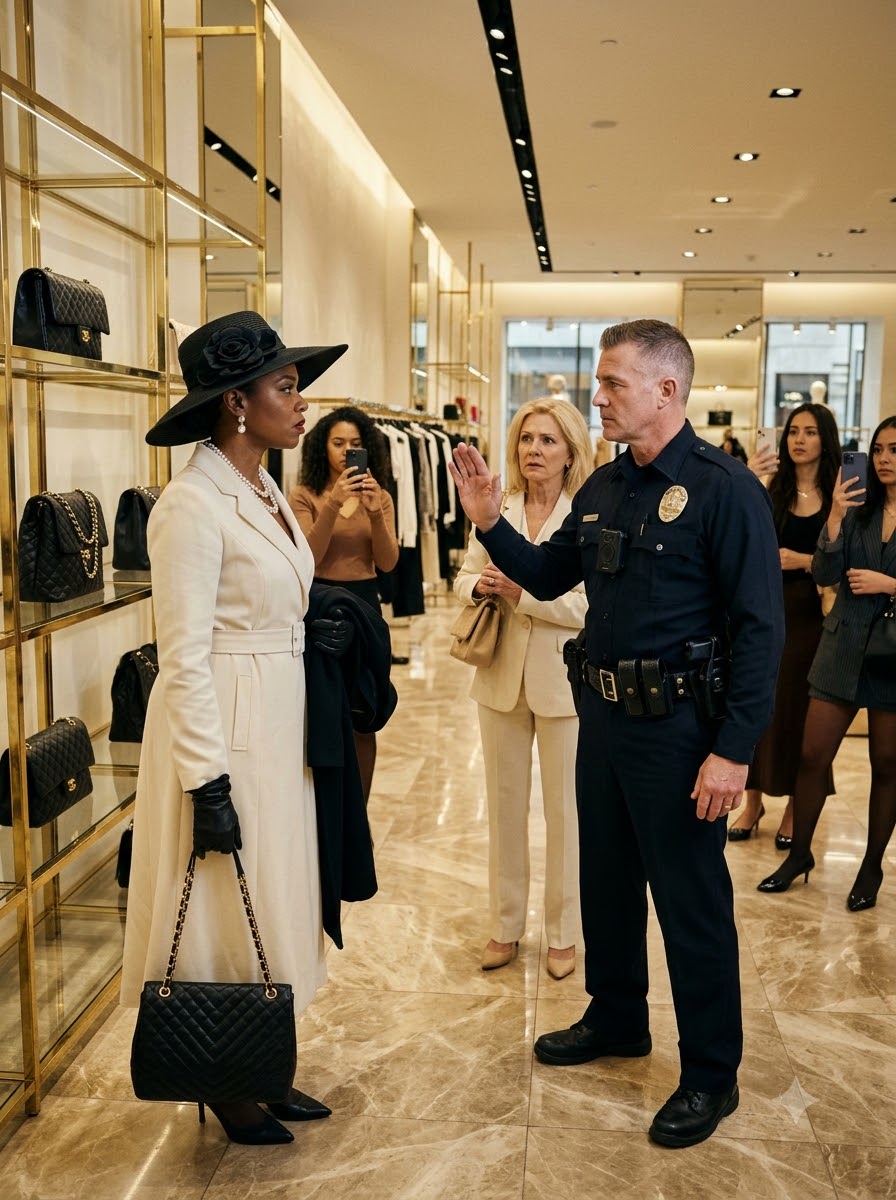
“Did a Vale Rowe employee tell you merchandise was missing?”
“No.”
“Did you ask?”
Brennan paused.
“I asked whether the dresses had been paid for.”
“That’s not the same question.”
He looked down.
“No.”
“Did you ask whether I had concealed merchandise?”
“No.”
“Whether I had crossed a final point of sale?”
“No.”
“Whether security had observed an actual theft?”
“No.”
Brennan sat quietly.
Eventually, he admitted that he had assumed the call probably involved a real theft because of how dispatch described it.
Camille nodded.
“Yes.”
“And when you challenged my questions, I treated it as resistance.”
“Yes.”
He rubbed his jaw.
“That was a mistake.”
Camille did not smile.
The acknowledgment mattered, but it had come after her identity changed the atmosphere.
Brennan explained that these calls usually followed a predictable pattern. Employees identified a suspected thief, security described the missing merchandise, cameras confirmed the behavior, and officers resolved the matter.
Camille told him he had relied on that familiar sequence before checking whether its essential facts existed.
He agreed.
Then she asked another question.
“Why did your tone change when you saw my address?”
Brennan looked uncomfortable.
“I don’t know.”
“You believed me more.”
He stared at the tabletop.
“Probably.”
“My address wasn’t evidence.”
“No.”
“My credit limit wouldn’t have been evidence.”
“No.”
“And owning the store doesn’t prove I couldn’t steal from it.”
He looked up.
“That’s true.”
“The question was always whether there was evidence of theft.”
Brennan nodded.
“There wasn’t.”
Camille told him she intended to submit a formal complaint.
He understood.
She did not threaten his job.
She did not raise her voice.
She wanted an accurate record of what had happened.
For that evening, that was enough.
After Brennan left, Camille stood at the conference-room window overlooking the showroom.
From above, Vale Rowe looked flawless.
Warm lighting reflected across cream marble. Garments hung precisely where the visual-merchandising teams had arranged them. Brass fixtures gleamed beneath the soft music.
Julian stood behind her.
“How bad is this?”
Camille turned.
“You tell me.”
“Bad.”
“Why did Martin hesitate?”
“I don’t know.”
“Don’t ask him yet.”
Julian frowned.
“Why not?”
“Because explanations improve once people know what answer you want.”
She pointed toward his laptop.
“I want the data first.”
“What data?”
“Every complaint from this location over the past three years.”
“Customer complaints?”
“All of them.”
“Security incidents?”
“Yes.”
“Police calls?”
“Yes.”
“Refunds and complimentary credits connected to complaints?”
Julian’s expression changed.
“You think this is bigger than today.”
Camille looked toward the entrance Evelyn had used.
“I think Evelyn expected everyone to believe her.”
She paused.
“People usually expect what experience has taught them to expect.”
The first report arrived before nine that evening.
It was incomplete.
But it already told a troubling story.
Twenty-one customer complaints over three years alleged unequal treatment.
Eleven involved Black shoppers.
Three involved Latino shoppers.
Two involved Asian shoppers.
The remaining cases concerned disability, age, accent, clothing, body size, or assumptions about income.
Most had been categorized as misunderstandings.
Communication problems.
Customer sensitivity.
No evidence of intentional discrimination.
Camille reread the last phrase.
Intentional.
For years, the company had focused on whether employees meant to discriminate.
It had paid less attention to whether certain groups repeatedly experienced the same treatment regardless of intent.
One complaint involved a Black physician asked to provide identification before trying on a $15,000 jacket.
No policy required identification.
Another involved a Black married couple followed by a security officer between floors while other shoppers were left alone.
A Latina customer had her handbag searched after a security alarm sounded.
The alarm was eventually traced to a scarf an employee had failed to deactivate.
The customer received an apology and store credit.
Then Camille found Evelyn Carrington’s name.
Twice.
Eighteen months earlier, Evelyn had complained about a young Black architecture student photographing display cases.
A salesperson had already given the student permission because she was studying retail design.
Eight months later, Evelyn accused a Latino man of circling the handbag department.
He had been waiting for his wife outside a fitting salon.
Employees questioned him anyway.
Neither incident resulted in a police call.
But staff had acted on Evelyn’s suspicions.
Her spending history had given those suspicions weight.
Julian read the files beside Camille.
“She’s done this before.”
“Yes.”
“And managers listened.”
“Yes.”
“Because she’s platinum.”
Camille opened another record.
“Not only because of her status.”
The previous year, assistant manager Claire Benton had refused Evelyn’s demand to reopen the boutique thirty minutes after closing.
Evelyn complained to regional leadership.
Claire received a written coaching notice for failing to maintain an important customer relationship.
Evelyn received $4,000 in complimentary credit.
Camille slid the report toward Julian.
“What did employees learn?”
He studied it.
“That saying no to Evelyn could hurt them.”
“Yes.”
“She complained, leadership rewarded her, and the next manager became more careful.”
“Yes.”
“Eventually her opinions began functioning like instructions.”
Camille nodded.
“Exactly.”
Julian stared at the document.
His signature appeared near the bottom.
Martin entered shortly before ten.
He had removed his jacket and looked considerably older than he had earlier.
Camille asked him to sit.
“Why didn’t you tell Officer Brennan I was simply shopping?”
“I should have.”
“That doesn’t answer my question.”
Martin swallowed.
“Evelyn.”
Camille waited.
“She’s difficult.”
“Still not an answer.”
He drew a breath.
“When Evelyn complains, regional leadership gets involved.”
Julian looked away.
“She threatens to move her business?”
“Yes.”
“Posts reviews?”
“Yes.”
“Contacts executives?”
“Yes.”
Martin continued.
“After what happened to Claire, everyone knew it was safer to keep Evelyn happy.”
Camille glanced at Julian.
He remained silent.
“When Evelyn accused me, what were you trying to protect?”
Martin hesitated.
Then answered.
“My job.”
Camille leaned back.
“You decided that protecting your job meant allowing her suspicion to become my problem.”
“Yes.”
“What if the officer had taken me away?”
“I didn’t think it would go that far.”
Camille’s expression hardened.
“That is easy to say when someone else bears the risk.”
Martin lowered his eyes.
After a long silence, Camille told him he would not be fired that night.
Relief appeared immediately.
Then she continued.
“You’re being placed on paid administrative leave while an independent review determines whether this reflects a broader management failure.”
His relief vanished.
“Understood.”
Camille turned toward Julian.
“And nobody who approved the system gets to make Martin the only person responsible.”
Julian understood exactly what she meant.
The following morning, Vale Rowe’s legal department received a letter from an attorney representing Denise Holloway.
Denise was forty-six, Black, and employed as a senior financial controller at a technology company.
Ten months earlier, she had visited the Madison Avenue boutique to purchase a winter coat for an anniversary trip.
Another customer claimed Denise’s shopping bag resembled one connected to a reported theft.
Security stopped her.
Police were called.
Denise spent forty-seven minutes in a private room while employees examined footage.
Nothing had been stolen.
The other customer had been mistaken.
Vale Rowe apologized and offered Denise a $1,000 gift certificate.
She refused.
Her complaint disappeared into customer relations.
Camille watched the archived security footage alone.
Denise stood beside nearly the same counter where Camille had been confronted.
Her hands were visible.
Her expression moved from confusion to embarrassment as other customers watched.
At one point, she asked the manager to review the cameras immediately.
He told her the police would sort things out first.
Camille paused the recording.
The cameras could have answered the question in minutes.
Instead, authority had been summoned before evidence.
Again.
Vale Rowe’s counsel contacted Denise’s attorney.
Camille asked to participate.
The attorney sounded skeptical.
“Why does the owner want to join this call?”
Camille answered plainly.
“Because something similar happened to me yesterday.”
Denise joined several minutes later.
“You own that store?”
“Yes.”
“And they accused you too?”
“Yes.”
Denise laughed without amusement.
“Did someone eventually recognize you?”
“Yes.”
“And suddenly everybody became polite.”
Camille fell quiet.
“Yes.”
“Of course.”
Denise explained what had disturbed her most.
After the employees concluded she had stolen nothing, they became exceptionally kind.
A manager brought water.
An officer apologized.
Someone offered transportation home.
Then they handed her a gift certificate as though she had won a prize.
“I spent forty-seven minutes wondering whether I was going to jail because a stranger looked at my bag.”
Camille looked toward the window.
“The apology couldn’t give you those minutes back.”
“No.”
That conversation affected Camille more deeply than her own confrontation.
She had been recognized.
Denise had been left with forty-seven minutes.
Camille ordered an independent review of all twenty-two Vale Rowe stores in the United States.
Her attorneys warned that a broad investigation could be expensive and might produce material discoverable in future lawsuits.
She understood the risks.
She hired the outside firm anyway.
“I don’t want the company grading its own exam.”
The investigation lasted five months.
Most employees had no record of misconduct.
Most stores showed no significant pattern.
Most wealthy clients behaved like ordinary customers who happened to spend more.
Camille insisted those findings remain prominent.
She did not want investigators inventing a larger scandal than the evidence supported.
Nevertheless, several weaknesses emerged.
Employees received extensive loss-prevention training but surprisingly little instruction about what observable facts should exist before police became involved.
VIP complaints received rapid attention.
Workers sometimes faced consequences for upsetting profitable customers even when those customers were unreasonable.
Managers could summon law enforcement without first reviewing readily available evidence.
None of those procedures explicitly mentioned race.
They did not have to.
They provided an easy route for an unsupported assumption to become an official accusation.
Evelyn’s assumption had traveled that route.
So had the accusation against Denise.
Other reports described a construction contractor wearing work boots who was told private appointments were fully booked, only to watch a casually dressed white couple enter without an appointment ten minutes later.
An older woman with a strong accent was repeatedly directed toward inexpensive accessories she had not requested.
A wheelchair user was told an upstairs salon was unavailable because the elevator was out of service.
Maintenance records showed no outage.
A twenty-year-old student carrying a vintage designer handbag inherited from her mother was questioned about whether it was authentic.
Camille hated reading these accounts.
Not because they threatened the brand.
Because the incidents had already happened.
Meanwhile, the Madison Avenue confrontation had reached the internet.
Someone uploaded a thirty-five-second video.
It showed Evelyn accusing Camille, Brennan demanding identification, Julian descending the stairs, and the declaration that Camille owned Vale Rowe.
Millions watched.
The reversal was irresistible.
Headlines quickly distorted the facts.
“RACIST SOCIALITE CALLS POLICE ON SECRET BILLIONAIRE.”
Camille was wealthy, but not a billionaire.
“BLACK WOMAN BUYS STORE AFTER EMPLOYEES PROFILE HER.”
Also false.
She had founded the company twelve years earlier.
Other posts claimed Brennan had been fired.
He had not.
Camille declined television interviews.
Her communications director argued that the attention offered an opportunity to present Vale Rowe as a company committed to change.
Camille asked what they would be celebrating.
“A company willing to change,” the director answered.
“After failing?”
“Yes.”
Camille shook her head.
“I’m not turning a corporate failure into leadership marketing.”
“The story is already public.”
“Then correct the facts.”
“Corrections don’t spread as quickly.”
“That doesn’t give us permission to invent a more flattering story.”
Vale Rowe released a deliberately restrained statement.
It acknowledged the incident, confirmed that records had been preserved, announced an independent review, and promised not to reach personnel conclusions before examining the evidence.
The internet found the statement unsatisfying.
Camille preferred it.
Evelyn gave one televised interview.
It went badly.
She insisted race had played no part in her suspicions.
The interviewer asked what Camille had stolen.
“Nothing.”
Had she concealed anything?
“No.”
Attempted to leave?
“No.”
Had employees reported missing merchandise?
“No.”
The interviewer paused.
“Then what made you think she was stealing?”
Evelyn struggled.
“She was watching people.”
“And cameras?”
“Yes.”
“Anything else?”
“She seemed uncomfortable.”
The clip spread rapidly.
Her attorney advised her to stop speaking publicly.
She followed that advice.
Eventually, Denise Holloway joined two other customers in a civil action against Vale Rowe.
One was the contractor denied a private appointment.
The other was a Black college professor detained after a security tag malfunctioned at another location.
Their attorneys argued that Vale Rowe had developed a culture in which customer status influenced whose suspicions received credibility.
The company had legitimate defenses.
Some complaints were ambiguous.
One reviewed allegation proved demonstrably false.
Another arose from a customer misunderstanding an employee’s explanation.
No executive had instructed employees to racially profile shoppers.
But Camille refused to equate a defensible legal position with responsible management.
Those were separate questions.
The independent review ultimately identified several unsupported complaints, several concerning incidents, and four clear policy failures.
Its deepest finding concerned the company’s treatment of premium clients.
Employees had learned to avoid upsetting customers whose purchases generated substantial revenue.
Lawyers recommended settlement.
Negotiations followed.
The final agreement totaled $680,000 across three claims, legal fees, and independent compliance obligations.
Denise received the largest individual portion.
The agreement did not declare that Vale Rowe’s leadership had intentionally discriminated.
Camille did not require that conclusion to recognize that her company had failed people.
The next morning, a headline announced:
“$680K SETTLEMENT AFTER BLACK OWNER PROFILED IN HER OWN STORE.”
Camille disliked it.
Her own experience was not why the settlement mattered.
Denise had mattered before Camille ever entered the flagship carrying three dresses.
Brennan’s department completed its own investigation.
Reviewers concluded that he had been permitted to respond to the complaint but had moved toward threatening detention without establishing the basic elements of retail theft.
He had not searched Camille, handcuffed her, or used force.
He received formal counseling and scenario-based retraining.
Online commenters demanded his dismissal.
Camille did not.
A reporter asked whether she believed his mistakes deserved consequences.
“They did have consequences,” she answered.
“Was retraining enough?”
“I don’t run the police department.”
The reporter pressed for her personal view.
Camille considered the question.
“I care more about whether the next person is treated correctly than whether strangers online feel satisfied by his punishment.”
Martin Keene faced a different outcome.
Investigators found that he had repeatedly allowed pressure from premium customers to influence store procedures.
He had also discouraged documentation of some complaints because he feared regional scrutiny.
He was terminated.
Julian Cross received formal discipline.
Some executives objected.
After all, Julian had been the person who came downstairs and stopped the confrontation.
Camille remained unmoved.
Recognizing the owner and making one correct decision did not erase years of inadequate oversight.
Julian admitted the truth privately.
“I knew Evelyn was difficult.”
“Yes.”
“I knew Martin bent rules for her.”
“Yes.”
“I didn’t realize how much.”
Camille looked at him.
“Why didn’t you?”
He sat silently.
Then answered.
“The numbers were good.”
That was the explanation.
Evelyn spent heavily.
Martin kept her satisfied.
The flagship performed well.
Leadership watched revenue.
Nobody closely examined what employees had learned to tolerate in order to maintain those results.
Lena Park unexpectedly attracted public attention when viewers learned she had called Julian.
She hated it.
Camille understood.
Lena eventually transferred into retail operations, where her ability to notice systemic problems rather than merely individual errors became valuable.
Two years later, during a project meeting, Lena brought up the confrontation.
“Remember when Martin asked why I hadn’t told him I recognized you?”
“Yes.”
“I almost told him.”
Camille looked up.
“Why didn’t you?”
Lena thought carefully.
“Because the moment I said you were Camille Porter, everyone would have become perfect.”
Camille stopped.
“We never would have learned what Martin might do to someone else.”
The observation stayed with her.
Lena looked down.
“I still wish I’d challenged him earlier.”
Camille nodded.
“You could have.”
Lena seemed surprised.
Camille did not offer reassurance that would erase the truth.
“Courage is easier when you already know how the story ends.”
Lena smiled.
“That should be on a training poster.”
“No.”
Camille pointed at her.
“Absolutely not.”
Vale Rowe suspended Evelyn’s platinum privileges.
It also introduced a customer-conduct policy applying equally to someone spending $500 and someone spending $500,000.
Harassing employees, targeting other shoppers, repeatedly misusing complaint procedures, and making knowingly reckless accusations could now result in restrictions.
High spending no longer guaranteed endless accommodation.
Several wealthy customers threatened to leave.
Most stayed.
One longtime client wrote to Camille:
“I buy your clothing because I like it, not because I expect the purchase to make me temporary management.”
Camille saved the message.
Two years passed before Evelyn wrote directly.
The first page of her letter contained explanations.
Stories about crime.
Fear of organized theft.
Previous experiences.
Concerns about Manhattan retail.
Camille nearly stopped reading.
Then the second page changed everything.
Evelyn admitted that none of those concerns explained why she had singled Camille out before any employee expressed suspicion.
For two years, she had insisted she would have behaved the same way toward any unfamiliar shopper.
She no longer believed that.
Then came the sentence Camille read twice.
“I think I had already decided you were pretending to belong, so anything you did became proof.”
Camille sat quietly.
She understood the trap.
Dress casually, and you did not belong.
Dress expensively, and you were trying too hard.
Remain silent, and you were evasive.
Ask questions, and you were aggressive.
Once Evelyn had created the story, no behavior could disprove it.
Evelyn also admitted that she expected employees to trust her because they had trusted her before.
Complaining produced attention.
Spending produced influence.
Repeated accommodation convinced her she possessed authority she had never been given.
The letter ended with an apology.
No demand for restored privileges.
No request for a meeting.
No insistence that Camille forgive her.
Camille replied briefly.
She accepted the apology.
Any future customer status would be determined through the independent conduct process.
Fairness could not depend on whether the owner personally liked someone.
Months after the settlement, Denise asked Camille to meet without lawyers.
They chose a small downtown coffee shop.
Denise stirred her drink.
“Six hundred eighty thousand dollars sounds like somebody won something.”
Camille nodded.
“Yes.”
“My cousins think I got all of it.”
“Did you?”
Denise smiled.
“Sadly, no.”
They laughed.
Then Denise grew serious.
“People kept congratulating me.”
“As though it were a prize,” Camille said.
“Yes.”
Denise looked through the window.
“I just wanted to buy a coat.”
Camille remained quiet.
“Litigation turns the worst afternoon of your year into a dollar amount, and then everybody debates whether that amount is too high.”
Denise looked back at her.
“What I wanted was forty-seven minutes back.”
“I understand.”
Denise shook her head.
“No.”
Camille stopped.
“You almost got detained.”
“Yes.”
“But you weren’t.”
“That’s true.”
“You got your reveal.”
Camille understood.
Denise had no regional president rushing downstairs.
No employee recognizing her.
No title capable of changing how the room treated her.
She had only a stranger’s accusation, the police, her fear, and forty-seven minutes.
Then an apology and a gift certificate.
“You’re right,” Camille said.
Denise looked surprised.
“I don’t know what your forty-seven minutes felt like.”
“No.”
“But I know they mattered before anything happened to me.”
Denise relaxed.
That honest acknowledgment became the beginning of a genuine relationship.
Later, Denise joined Vale Rowe’s external customer advisory council.
At her first meeting, she asked the loss-prevention team a question that unsettled the room.
“Why does your theft process notice the person before it notices the merchandise?”
Executives objected.
Their written policy, they insisted, focused on behavior.
Denise shook her head.
“I’m not asking what the manual says.”
She looked around the table.
“I’m asking what people actually watch first.”
That question would reshape Vale Rowe’s security procedures.
But Camille was beginning to understand that even the most expensive reforms could not guarantee fairness.
The real test would come years later, when another unfamiliar woman walked through the Madison Avenue store—and nobody important was there to recognize her.
PART 3
Denise’s question became central to Vale Rowe’s next security redesign.
The company improved inventory tracking and placed greater emphasis on the movement of merchandise rather than assumptions about the people carrying it.
Employees received clearer instructions to document observable conduct before describing someone as suspicious.
Managers were trained to verify available evidence before escalating an incident to law enforcement.
Camille did not believe technology could eliminate bias.
Bias could influence technology too.
A poorly designed system could simply disguise the same old assumptions beneath polished procedures and automated alerts.
What she wanted was a meaningful pause between suspicion and consequence.
A requirement to ask what had actually happened before someone with authority acted on what another person imagined.
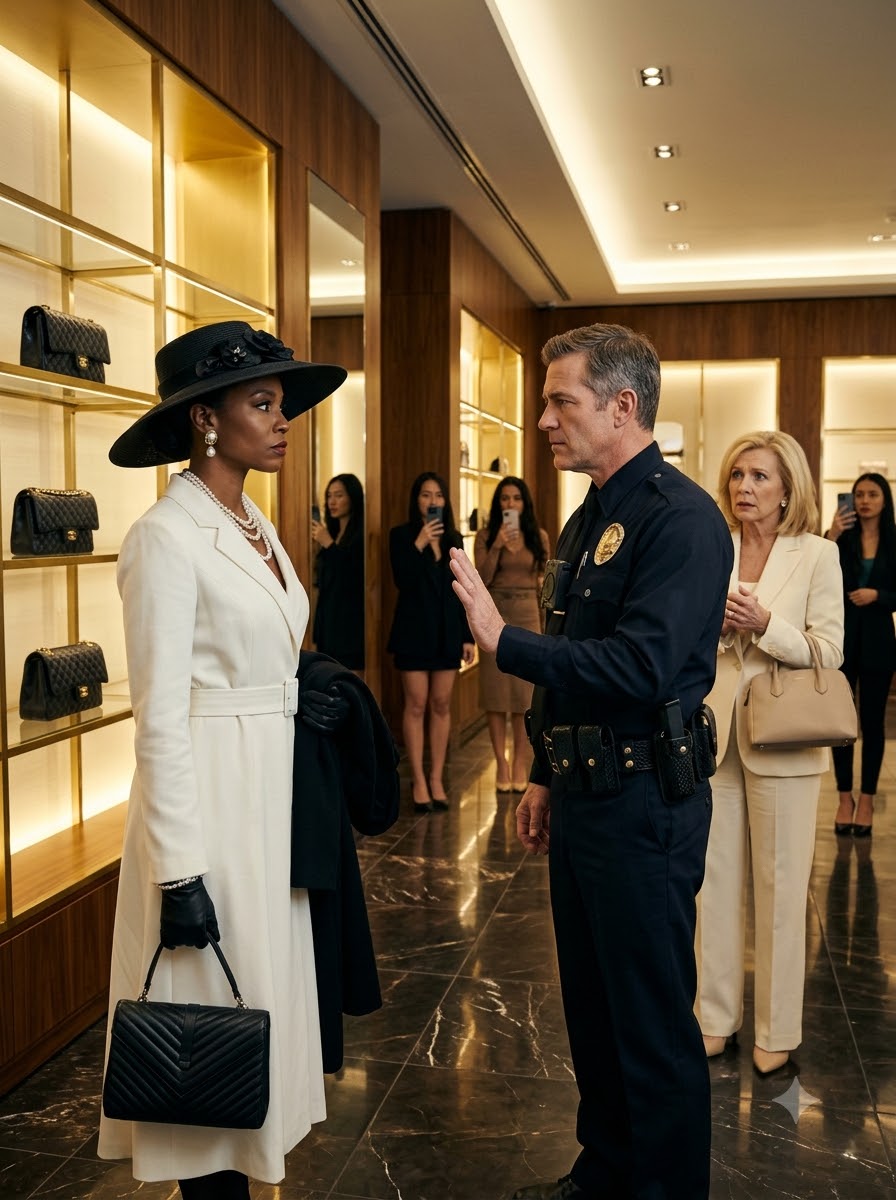
Five years after the Madison Avenue confrontation, Vale Rowe renovated its flagship again.
The marble staircase remained.
So did the gleaming floors.
The old jewelry counter disappeared.
Lena Park had become vice president of retail operations.
Julian Cross had accepted a position elsewhere.
Martin Keene worked for another retailer.
Paul Brennan had become a training supervisor.
Evelyn occasionally shopped quietly.
Denise consulted with banks, hotels, and retailers about systems for treating customers fairly.
Life continued.
The lawsuit became a few paragraphs in old annual reports.
The viral video remained online.
Most captions still described Camille as a billionaire.
She still was not one.
One afternoon, a young employee recognized her in the store.
“Ms. Porter?”
“Yes.”
“I watched that video when I was in college.”
Camille smiled.
“I apologize.”
The employee laughed.
“It actually made me want to work here.”
“That seems like questionable judgment.”
The young woman shook her head.
“I liked what you said afterward.”
“Which part?”
“That nobody should need an important title before people check the facts.”
Camille nodded.
“That part still works.”
The employee hesitated.
“Can I ask you something?”
“Of course.”
“What would you have done if Julian never came downstairs?”
Camille thought about it.
“I would have tried to stay safe.”
She continued.
“I would have documented what I could, filed complaints, and requested the security footage.”
The employee looked at her.
“What if you didn’t own Vale Rowe at all?”
Camille understood what she was really asking.
What could an ordinary person do when no dramatic reveal was coming?
“Safety first,” Camille answered.
“Ask what you’re accused of.”
“Ask what facts support it.”
“Get names if it’s safe.”
“Document what happened afterward.”
The employee nodded.
Camille added something else.
“But I don’t like making survival another test the victim has to pass.”
“What do you mean?”
“Whenever something like this happens, people start handing out instructions.”
Stay calm.
Never raise your voice.
Use perfect legal language.
Record everything.
Ask for a manager.
Do not move suddenly.
“All of that can help,” Camille said.
Then she paused.
“But the person holding authority has the greater responsibility.”
The employee waited.
Camille smiled faintly.
“You should not need extraordinary self-control to receive ordinary fairness.”
Lena later incorporated that sentence into training.
Camille complained.
Lena jokingly told her to fire her.
Camille declined.
Years later, Camille unexpectedly encountered Paul Brennan at LaGuardia Airport.
He recognized her first.
“Ms. Porter?”
She turned.
Gray had appeared at his temples.
Supervisor bars marked his uniform.
“Officer Brennan.”
“Lieutenant now.”
“Congratulations.”
He smiled awkwardly.
“I’ve wanted to tell you something.”
Camille waited.
“I use that body-camera footage in training.”
She raised an eyebrow.
“With department permission,” he added quickly.
“Important clarification.”
He laughed.
Then became serious.
“I stop the recording just before I mentioned detention.”
“What do you ask the recruits?”
“What offense I had actually established.”
“And what do they say?”
“Usually, none.”
Camille nodded.
Brennan glanced toward the security checkpoint.
“I assumed that because dispatch sent me to a shoplifting call, there was probably a shoplifter.”
“That’s understandable.”
“It isn’t sufficient.”
“No.”
He paused.
“I was angry with you afterward.”
Camille almost laughed.
“With me?”
“Yes.”
“Why?”
“You made me feel stupid.”
He raised one hand.
“I know how that sounds.”
Camille waited.
“I kept telling myself you embarrassed me by questioning everything I said.”
He looked at her.
“Eventually I realized I was embarrassed because I couldn’t answer your questions.”
Camille nodded.
“That’s different.”
“Yes.”
They stood quietly for a moment.
Then Brennan apologized.
There were no cameras.
No official investigation.
No audience.
No professional benefit.
Camille accepted his apology.
They shook hands and walked in different directions.
They were not friends.
That was perfectly fine.
Not every conflict needed friendship to end with honesty.
At sixty-two, Camille began writing a memoir.
Her editor insisted that the boutique incident deserved an entire chapter.
Camille resisted.
“It’s been overused.”
“That’s exactly why readers will recognize it.”
“I hate publishing already.”
“You signed a contract.”
The editor proposed a title:
“The Day She Called Police on the Wrong Woman.”
Camille threatened to remove the entire chapter.
Eventually, they settled on a different title.
“Before They Knew My Name.”
Camille focused the chapter almost entirely on the minutes before Julian appeared.
Evelyn’s assumption.
Martin’s fear.
Brennan’s expectation.
Lena’s hesitation.
Camille’s anger.
Because those moments revealed the truth more clearly than the dramatic announcement that followed.
A private individual made an unsupported assumption.
An organization failed to challenge it.
Police authority arrived.
The evidence remained thin.
Then status entered the room.
Suddenly, everybody became careful.
Camille wrote a passage that readers would quote more often than anything else in the memoir:
“The most revealing moment was not when someone announced that I owned the company. It was the moment immediately before. Nobody in that room yet knew I possessed enough power to matter to them. That is the version of ourselves worth examining.”
After publication, a woman in her seventies wrote Camille a letter from Ohio.
She was white.
She admitted that she became more patient with strangers after discovering they held important jobs.
Then she wrote:
“I thought fairness meant treating everyone the same, but apparently I wait to decide how much courtesy somebody deserves until I estimate how important they are.”
Camille kept the letter.
It recognized something larger than one confrontation in a luxury boutique.
Race mattered.
Class mattered.
Gender mattered.
Age and appearance mattered.
But beneath those differences often lay another habit.
People ranked strangers.
Then adjusted the amount of dignity they offered accordingly.
At seventy-three, Camille returned to the Madison Avenue flagship shortly before Vale Rowe sold part of its fashion division.
Lena walked beside her.
“Feeling sentimental?”
“No.”
“Terrible liar.”
Camille smiled.
They stopped near the place where Brennan had demanded the dresses.
“Here?” Lena asked.
“Almost.”
“Where was Evelyn?”
Camille pointed.
“Martin?”
“Over there.”
“And me?”
Camille looked toward the location of the former accessories counter.
“Back there.”
Lena laughed softly.
“I was terrified.”
“I know.”
“I thought Martin would fire me for calling Julian.”
“He might have.”
“Very comforting.”
Camille smiled.
Lena looked across the showroom.
“Was everything afterward worth it?”
“What do you mean?”
“The lawsuits. The training. The reviews. The settlement. All the reforms.”
Camille considered the question for a long moment.
“No.”
Lena looked surprised.
Camille continued.
“I wish Denise had never lost forty-seven minutes.”
“I wish nobody had followed that professor.”
“I wish the contractor had received his appointment.”
“I wish you hadn’t been afraid to call upstairs.”
She looked around the store.
“Reform is useful.”
Then she added:
“Prevention would have been better.”
Lena nodded.
“Is there anything you’re proud of?”
“Yes.”
“What?”
Camille looked toward the staircase.
“That we eventually stopped protecting ourselves from the truth.”
Long after Camille retired, the clearest evidence of change arrived without her witnessing it.
On a rainy Thursday afternoon, a Black woman in her forties entered the Madison Avenue flagship.
She wore jeans, comfortable shoes, and an ordinary black coat.
Nobody recognized her.
She selected four expensive dresses.
She carried them between two floors.
She compared fabrics near the windows.
She looked toward a security camera while searching for the restroom sign.
She changed her mind twice.
She spent fifteen minutes in a fitting room.
Then she returned two dresses and carried the remaining two into another department.
Nothing happened.
No wealthy shopper followed her.
No manager appeared to question her.
No officer arrived.
No phones rose to record a confrontation.
Eventually, she purchased one dress and left.
Nobody learned her profession.
Nobody investigated her address.
Nobody discovered whether she was wealthy, knew an attorney, owned a business, or had an influential relative upstairs.
She was simply a customer.
That was the ending Camille had always wanted.
Because Camille Porter had never deserved fair treatment because she owned Vale Rowe.
Denise Holloway had never deserved it because she later hired a lawyer.
There was no appropriate person to falsely accuse.
No acceptable Black woman.
No acceptable poor woman.
No acceptable stranger.
The relevant questions had always been simple.
Had Camille concealed merchandise?
No.
Had she attempted to leave without paying?
No.
Had the boutique reported missing inventory?
No.
Had an employee witnessed theft?
No.
Everything else had been a story layered over those facts.
Evelyn’s assumptions.
Martin’s fear.
Brennan’s expectation that a police call probably meant a crime had occurred.
Then Julian descended the staircase.
Everyone learned Camille’s name.
Their behavior changed.
The facts did not.
Years afterward, whenever someone described the incident as a wealthy woman calling the police on the wrong Black shopper, Camille corrected them.
Not wrong.
There had never been a right one.
And if Vale Rowe had learned anything worthwhile from the worst afternoon in its flagship’s history, it was that respect should come before recognition.
Everything afterward had simply been the cost of discovering what happens when it does not.
