

PART 1
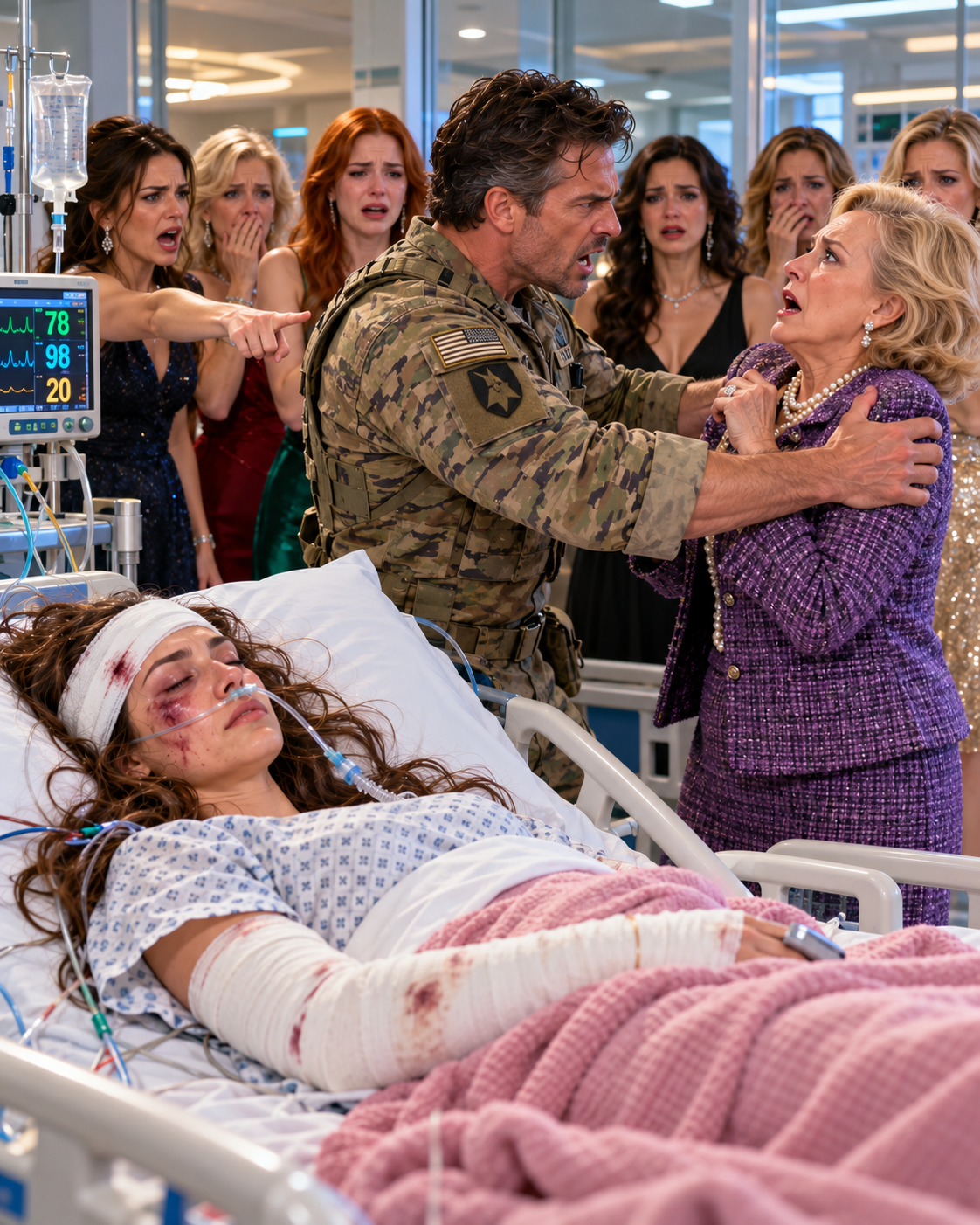
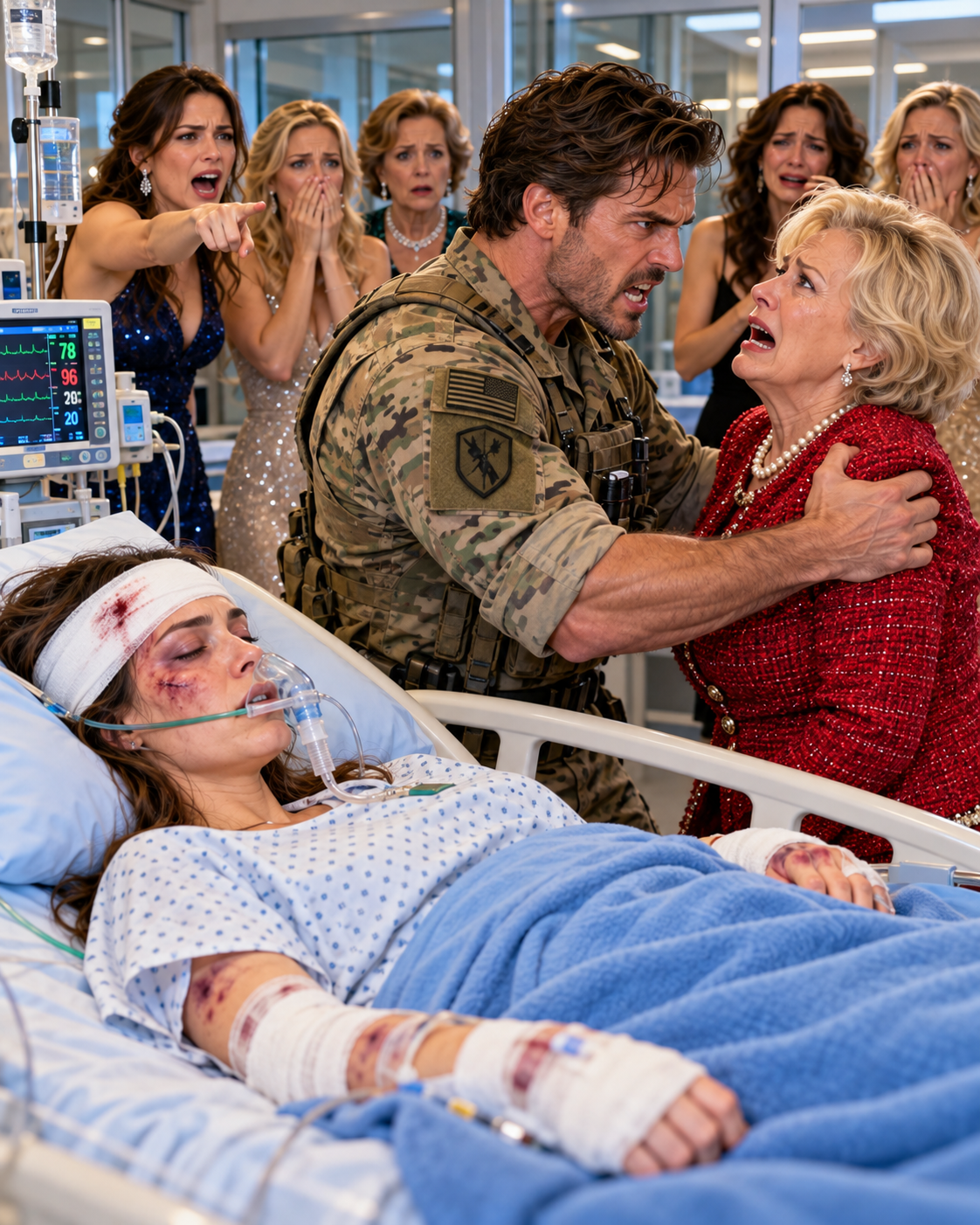
I stepped off a classified military transport and went straight to the intensive care unit, where my wife lay with twenty-seven broken bones and a fractured skull. Outside her room, her mother and six sisters were smiling as though they were waiting for lunch.
The detective assigned to her case leaned toward me and whispered, “Major, the family owns this entire county.”
I looked through the glass at my wife’s bruised, swollen face and answered, “Good. My authority extends well beyond this county.”
My name is Grant Rowan.
For seven months, I had been away on a classified Army assignment. Every day, I counted down the hours until I could return to my wife, Evelyn. In my mind, I could already see her standing on the porch of our farmhouse, pretending she hadn’t spent the afternoon watching the driveway.
Instead, eleven hours before my plane was scheduled to land at Fort Liberty, my phone rang.
The nurse on the other end didn’t waste time.
“Your wife is in intensive care. You need to get here immediately.”
By the time I arrived at Hawthorne Regional, desert dust still covered my boots.
Dr. Walter Keene met me outside the secured ward.
“Your wife is alive,” he told me cautiously.
“What happened to her?”
“Twenty-seven fractures. Five ribs, both wrists, her left femur, and multiple bones in her face and skull. She’s also suffering from internal bleeding and severe head trauma.”
For a moment, the entire hospital seemed to shrink around me.
“How many people attacked her?”
“Her injuries indicate more than one assailant. Someone appears to have held her down while another person inflicted most of the injuries.”
“What did they use?”
“Something heavy and metallic. Perhaps a fireplace tool or a framing hammer.”
I had seen soldiers pulled from destroyed military vehicles. I knew what catastrophic injuries looked like.
Nothing prepared me for Evelyn.
Her auburn hair had been shaved away in one section. Her face was so swollen I could barely recognize her. Both wrists were splinted, and her injured leg hung in traction.
I touched the uninjured part of her shoulder as gently as I could.
“Evelyn,” I murmured. “It’s Grant. I’m back.”
The ventilator breathed for her.
I waited for a movement, a flicker beneath her eyelids, anything.
There was nothing.
When I finally stepped into the corridor, I found Margaret Shaw seated beneath the fluorescent lights.
Evelyn’s mother wore a charcoal suit and a pearl necklace. Around her stood her six other daughters: Meredith, Jocelyn, Paige, Laurel, Sabrina, and Faith.
The Shaws controlled Shaw Aeronautics, a major defense contractor with connections reaching through North Carolina’s political establishment.
They had money, influence, and friends in places where ordinary people rarely got past the reception desk.
But what struck me wasn’t their wealth.
It was their behavior.
Meredith was scrolling through her phone. Paige laughed quietly at something Sabrina had said. Margaret checked her watch.
Nobody looked as though Evelyn might die.
Detective Harold Finch stood nearby.
I approached him.
“What happened at my house?”
“A burglary,” he answered. “Your wife walked in on the intruders.”
“What did they take?”
“Electronics. Other valuables. Cash, possibly.”
“Where did they get in?”
“Through the kitchen door at the back.”
“Was the door forced open?”
Finch hesitated. His eyes shifted toward Margaret.
“That’s still being examined.”
I felt my stomach tighten.
“How long has her family been at the hospital?”
He lowered his voice.
“They arrived before the ambulance did.”
“How could they have known?”
“I have no idea.”
He stepped closer.
“Major, there’s something you should understand. The Shaw family’s influence runs deep around here. The police department’s leadership, the district attorney, the hospital administration. Margaret practically finances half this county.”
“So?”
He glanced toward Evelyn’s room.
“There’s very little we can do.”
I looked back through the glass.
There was a narrow wound near Evelyn’s temple. Even beneath the swelling, I could see how deliberate the damage had been.
Someone had not simply struck my wife in anger.
Someone had taken time to hurt her.
Margaret approached me.
“Grant,” she said evenly, “the family will be taking responsibility for Evelyn’s care from this point forward.”
“She’s my wife.”
“And you’re hardly ever around.”
Meredith moved beside her mother.
“You were gone for seven months.”
“I was on deployment.”
Margaret’s expression hardened.
“Evelyn needed her family beside her.”
“She spent years trying to escape this family.”
Silence fell across the corridor.
I looked toward Faith, the youngest sister.
Unlike the others, she wouldn’t meet my eyes. Her hands were trembling, and she kept staring at the floor.
I stepped toward her.
“Faith, what happened inside my house?”
Margaret moved between us.
“You will not question my daughter.”
I held her gaze.
“Evelyn is your daughter, too.”
Her face turned cold.
“She hasn’t been my daughter for a very long time.”
It wasn’t a confession.
But it was close enough to tell me something was terribly wrong.
I leaned toward her.
“If Evelyn doesn’t survive, no corporation, political contributor, courthouse, or security gate anywhere in this country will be able to shield whoever is responsible.”
Margaret laughed without warmth.
“Grant, you’re just one soldier.”
I glanced through the window at my wife.
“No.”
Then I faced her again.
“I’m the husband none of you expected to return.”
They believed their influence had already buried whatever had happened to Evelyn.
They were wrong about two things.
She was still alive.
And I had come home.
That night, I refused to leave her bedside.
I sat in an undersized vinyl chair, listening to the ventilator and watching the monitors. Every electronic chime tightened something inside me, bringing back the instinctive alertness of night patrols.
Around two in the morning, the charge nurse entered.
She was a broad-shouldered woman in her fifties. Reading glasses hung from a beaded chain around her neck, and her badge identified her as Rosalind Bell, RN.
“You should sleep, Major,” she said.
“I’ve slept in worse chairs.”
She studied me before lowering her voice.
“Somebody from administration called up here twice tonight. Mr. Pratt. He wanted to know how soon your wife could be ‘stabilized for transfer.’”
“Transfer where?”
“A private facility in Asheville. The Shaw Foundation built its new wing.”
She straightened Evelyn’s blanket with obvious care.
“I’ve been a nurse for thirty-one years. Nobody asks to move a patient this sick unless they want her somewhere they control.”
“Thank you for telling me.”
“I didn’t tell you anything,” Rosalind said. “I just checked her IV.”
At dawn, Dr. Keene assured me he would not approve the transfer.
“Not while she’s on a ventilator,” he said. “Not for anybody’s foundation.”
Only then did I leave the hospital.
Our farmhouse stood at 4410 Larkspur Lane, twenty minutes away, at the end of a gravel road bordered by pine trees.
Evelyn had fallen in love with its wraparound porch. The previous summer, she’d painted the front door deep blue and sent me a photograph with paint smeared across her nose.
When I arrived, the first thing I noticed was the absence of crime scene tape.
My wife had nearly been beaten to death inside that house less than thirty-six hours earlier.
Yet the scene had already been released.
I examined the kitchen door.
The frame wasn’t splintered. There were no pry marks, no broken glass. The deadbolt functioned perfectly.
Beside the porch steps sat a ceramic frog Evelyn kept among her flowerpots.
I lifted it.
For six years, we’d hidden a spare key beneath that frog.
The key was gone.
Only four people outside our marriage knew about it. Evelyn had once joked that Margaret insisted on knowing where it was “in case of emergencies.”
Inside, the house was unnaturally quiet.
Someone had scattered couch cushions and pulled out a drawer, apparently hoping the mess would suggest burglary.
But the television remained mounted on the wall. My grandfather’s watch was untouched. Evelyn’s grandmother’s ring still rested in its jewelry box.
Two things were missing.
Her laptop.
And the iron poker from the fireplace.
I stared at the empty hook on the fireplace stand.
The brush, shovel, and tongs remained.
Only the poker was gone.
Near the hearth, I found a faint stain on the hardwood. Someone had scrubbed it, but not thoroughly enough.
I couldn’t make myself stare at it.
When I stepped outside, Abner Pruitt stood near the end of my driveway.
He was eighty-one, a retired Marine gunnery sergeant who lived across the road and raised his flag every morning at precisely 0800.
He held a cane in one hand and a coffee mug in the other.
“Major,” he said. “I’m sorry, son. I truly am.”
“Did you see anything, Gunny?”
“I told that detective. I don’t think anybody wrote it down.”
He glanced at the house.
“Black Escalade pulled in around nine-forty. No headlights on the last stretch, which struck me as peculiar. Two people went around back. Maybe three. Couldn’t tell in the dark.”
“And then?”
“Escalade left about ten-oh-five. Fast.”
He drank from his mug.
“Then a little white hatchback came tearing up the road maybe five minutes later. Young woman jumped out and ran inside. I heard her screaming from my porch.”
“Did you see her face?”
“Dark hair. Thin little thing.”
He paused.
“She was the one who stayed with Evelyn until the ambulance came. She was holding her hand when they wheeled her out. Then a whole fleet of fancy cars showed up and that girl got pulled away like she’d done something wrong.”
Faith.
She drove a white hatchback, the only inexpensive car in the Shaw family. Evelyn used to joke that it cost less than one of Margaret’s watches.
“Gunny, why didn’t anyone take your statement?”
“Oh, they took it,” Abner said dryly. “Young deputy wrote it all down in his little notebook. Then his sergeant told him I was old and probably confused.”
He snorted.
“I’ve been confused exactly once in my life, and that was my second marriage.”
I nearly smiled.
Then he reached into his flannel jacket and handed me a sealed envelope.
“Your wife came over two weeks ago,” he said. “Brought me a pecan pie. Sat on my porch a long while. She seemed scared, Grant. Not the kind of scared you can see. The kind people work hard to hide.”
On the envelope, Evelyn had written:
For Grant only. If needed.
“She made me promise,” Abner said. “Said if anything ever happened to her, I give this to you. Not to the police. Not to her family. Just you.”
Inside were a brass key, a folded photograph, and a letter.
Grant,
If you’re reading this, I was right to be afraid. Whatever they tell you, it wasn’t a stranger. Don’t let my mother be alone with me. Not for one minute.
And please, forgive me for not telling you the rest. I wanted to be sure before I brought it to your door.
It’s about the soldiers.
I unfolded the photograph.
It showed a forged metal component shaped like a thick star with a central ring. A tag attached to it carried serial numbers and two words written in red.
FAILED. CERTIFIED.
I recognized the component immediately.
It was a tail rotor hub assembly for an Army utility helicopter.
The kind of part whose failure could bring an aircraft down.
Taped to the back of the photograph was a business card.
Special Agent Nadia Reyes. Defense Criminal Investigative Service.
I called the number from my truck.
Reyes answered on the second ring.
When I identified myself, she fell silent.
“Major Rowan,” she said finally. “I’ve been trying to find a way to reach you without the wrong people noticing. Where are you?”
“In my driveway. Where my wife was nearly killed.”
“Don’t say anything else on this line. There’s a truck stop off Highway 24, east of the county line. Forty minutes.”
She was waiting in a rear booth when I arrived.
Reyes was a compact woman in her early forties with close-cropped hair and the steady composure of someone accustomed to listening to lies.
She pushed a coffee toward me.
“Your wife has been a confidential source for us for five months,” she said. “She missed a scheduled meeting four days ago. I’ve been sick about it ever since.”
“Tell me everything.”
Eight months earlier, Evelyn had returned to Shaw Aeronautics part-time, working in contract compliance.
Margaret had presented the opportunity as a peace offering, a chance to rejoin the family business.
Evelyn had told me she was curious. I had suspected it was a mistake, but I hadn’t interfered.
While reviewing company records, she discovered fatigue tests for a component designated SA-7.
“The parts were failing stress tests,” Reyes said quietly. “Hairline cracking at a fraction of the required cycle count. Instead of scrapping the batches, someone inside Shaw had the test data rewritten. The parts were certified and shipped. Over nine hundred of them, delivered to the Army over three years.”
My coffee sat untouched.
“Where did they go?”
Reyes looked at me with unmistakable sympathy.
“Major, I think you already know.”
I did.
During the second month of my deployment, a helicopter from my task force crashed on a routine resupply mission.
Four soldiers died.
Among them was Staff Sergeant Danny Okafor, twenty-nine years old, the father of twin daughters.
I had written the letter informing his wife.
“The aircraft that went down,” I said. “Did it have an SA-7?”
“It had one installed four months before the crash,” Reyes said. “Your wife found the maintenance records. That’s when she came to us. She said she couldn’t live with it. She said she’d read the letter you wrote to Sergeant Okafor’s widow because you’d asked her to check your grammar, and she couldn’t stop thinking about it.”
Outside the truck stop window, a driver was laughing with a waitress.
The sight felt impossibly ordinary.
While Evelyn had sent me cheerful emails about her garden and the neighbor’s dog stealing her gloves, she had been carrying the knowledge that my soldiers might have died because of her family’s fraud.
“Why didn’t she tell me?”
“Because you were deployed,” Reyes said gently. “And because she said if you knew, you’d come home and do something that ended your career.”
She hesitated.
“She also said you’d do it anyway, eventually. She wanted the evidence to be airtight first.”
I showed her the brass key.
“The key,” I said, holding up the little brass key. “What’s this for?”
“A safe deposit box. We never learned which bank. She said it held the originals, the raw test logs before they were altered. She was going to bring them to us the day after she missed our meeting.”
“Her laptop’s gone.”
“Then whoever took it knows what she had, but not necessarily where the originals are.”
Reyes leaned forward.
“Major, I need you to understand something. Without those originals, Shaw’s lawyers will bury this. With them, we can bring federal charges. Major fraud against the United States. Obstruction. And if we can tie the assault to the fraud, we’re talking about a very different kind of case.”
Before I could answer, my phone rang.
Dr. Keene.
“Major Rowan,” he said, his voice strained. “You need to come back. Right now. There are people here with court papers.”
At Hawthorne Regional, two security guards stood outside Evelyn’s room.
Between them was a thin man holding a folder.
His badge read LIONEL PRATT, VICE PRESIDENT OF PATIENT RELATIONS.
Margaret sat nearby, drinking tea from a china cup.
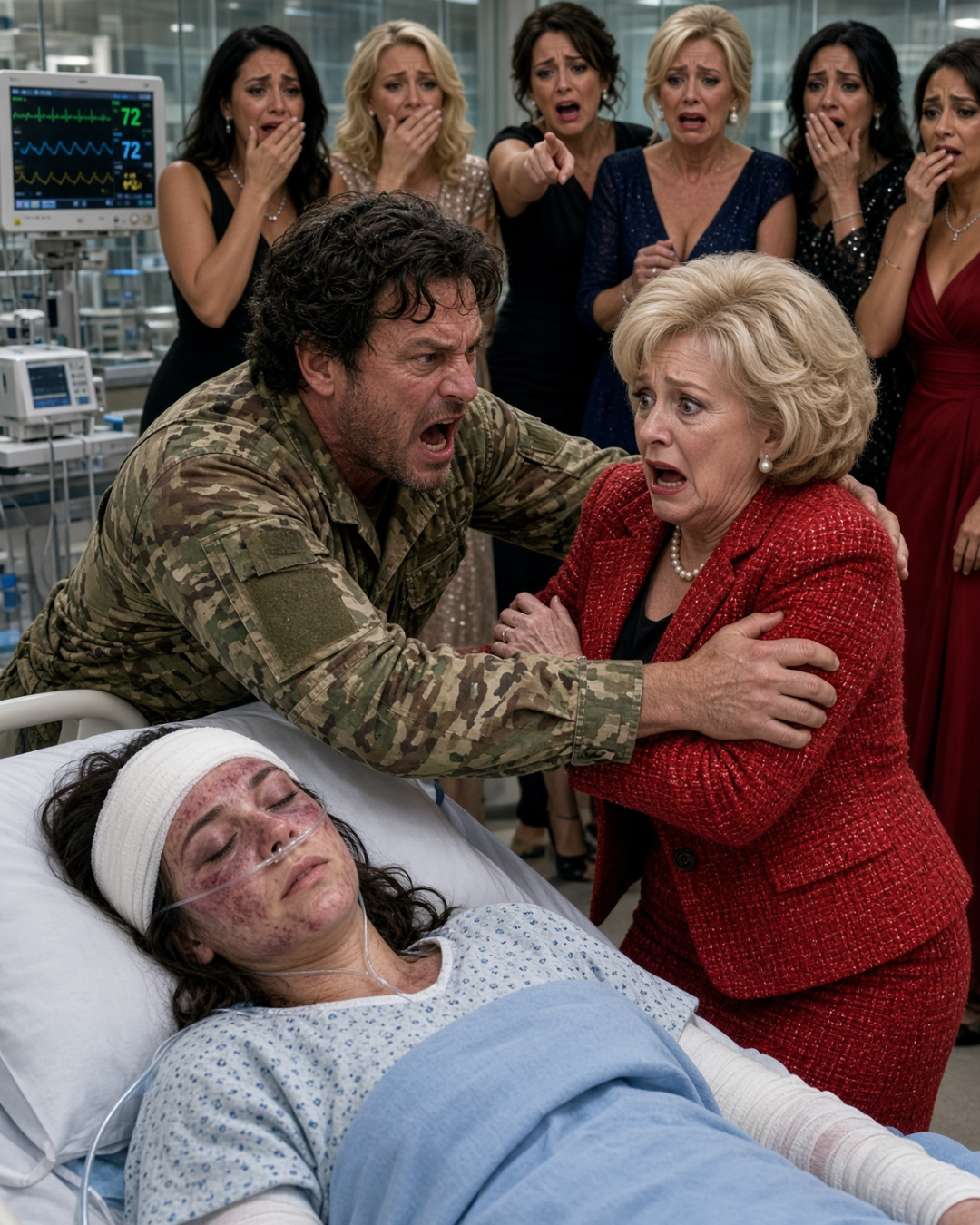
“Major Rowan,” Pratt said, smiling without warmth. “I’m afraid I have to inform you that Judge Raymond Tolliver has granted Mrs. Margaret Shaw temporary emergency guardianship of the patient.”
“On what grounds?”
Margaret put down her teacup.
“On the grounds,” she said, “that my daughter filed for divorce from you three weeks ago.”
She raised a document.
A petition for dissolution of marriage.
Evelyn’s signature appeared at the bottom, notarized and stamped.
“As of this afternoon,” Pratt continued, “you are not permitted in this room.”
I stared at the signature.
Three weeks earlier, Evelyn had been showing me nursery paint samples over a video call, laughing through tears because we were already planning for a child we hadn’t even started trying to conceive.
I knew that document was a lie.
But I also knew Margaret Shaw had a judge willing to make it official.
And my wife was lying unconscious on the other side of a door they had just forbidden me to open.
PART 2
For several seconds, I couldn’t speak.
Not because I believed the divorce petition, but because I understood what it meant.
Margaret wasn’t simply trying to keep me away from Evelyn.
She was using the courts to make sure I had no power to protect her.
“That signature is forged,” I said.
“That’s a matter for the court,” Pratt replied smoothly.
“Then I’ll take it to the court.”
“Of course.”
He gestured toward the hallway.
“Security will escort you out.”
The nearest guard was barely twenty-two. He looked uncomfortable enough that I refused to make his job harder.
I walked away voluntarily.
At the nurses’ station, I stopped beside Rosalind.
“Nobody touches her medications without Dr. Keene’s personal sign-off,” I said quietly.
Without looking up from her chart, she replied, “Already flagged her chart that way an hour ago, Major.”
Outside, the sky had turned slate gray.
I sat in my truck and did what years of military training had taught me to do when a situation became overwhelming.
I organized the problem.
Then I called Captain Lena Whitfield.
Lena and I had served together at Fort Liberty before she attended law school through the Army. She was now a Judge Advocate General officer, and one of the best legal minds I knew.
She answered immediately.
“Grant. I heard you were back. What’s wrong?”
I told her everything.
When I finished, she exhaled.
“Okay. First thing: guardianship is a state matter, so I can’t represent you in that courtroom. But I know a civilian attorney in Raleigh who would love nothing more than to embarrass a county judge. Second thing: send me a copy of that divorce petition the second you can get one.”
“Why?”
“Because forgers are lazy, and notaries leave records.”
That evening, an unfamiliar number appeared on my phone.
“Major. It’s Harold Finch. Don’t hang up.”
“Give me one reason.”
“Because I’m in the parking lot of the Waffle House on Route 17, and I’ve got something you need to hear.”
Finch sat inside an unmarked sedan with its engine off.
He looked older than he had at the hospital, his face drawn and gray at the temples.
“I owe you an apology,” he said. “What I said in that hallway. ‘There’s very little we can do.’ That was cowardice.”
“Why the change of heart?”
“Because this morning Chief Corbin closed the case. Officially a burglary. Suspects unknown. No further investigative action.”
His jaw tightened.
“Twenty-two years I’ve worn this badge. I’ve never seen a felony assault closed in under forty-eight hours.”
He handed me a USB drive.
“That’s the 911 call. Came from a prepaid phone. The chief ordered the original recording archived under a restricted code. I made a copy before he did.”
He played the recording on his phone.
A young woman’s voice came through, frantic and trembling.
“Please… she’s not breathing right… 4410 Larkspur Lane… please hurry, there’s so much… please, she’s my sister.”
Then the call ended.
Faith had not simply discovered Evelyn.
She had called for help and kept her alive.
“Detective,” I said, “who arrived at the hospital first? Before the ambulance?”
“Margaret, Meredith, and a man named Cole Brandt. He’s head of corporate security at Shaw Aeronautics. Former private military contractor.”
Finch’s mouth tightened.
“He walked into the ER like he owned it. Then the rest of the sisters showed up about thirty minutes later.”
“And Faith?”
“Faith came in the ambulance. Sat in the back with Evelyn, covered in her blood. When Margaret saw her, she took her by the arm and walked her into a family consultation room. Twenty minutes later, Faith came out and didn’t say another word to anyone.”
I sat quietly, absorbing that.
“Why are you helping me, Finch?”
He looked through the windshield at the rain.
“My daughter’s twenty-four,” he said. “She’s an Army nurse at Fort Campbell. If somebody did this to her and I found out the police just… stood in a hallway and let it happen?”
He shook his head.
“I’d burn the whole county down.”
At 7:15 the following morning, Lena called.
“You were right,” she said. “The notary on that divorce petition is a woman named Denise Harlow. She’s an executive assistant at Shaw Aeronautics. Her notary log for that date has no entry for Evelyn Rowan. None. And the date on the petition? Evelyn was at a dental appointment in Fayetteville at the exact hour it was supposedly signed in Hawthorne. I’ve got the receptionist’s statement.”
Hope rose in my chest for the first time since coming home.
“My colleague’s filing an emergency motion with the appeals court this morning,” Lena continued. “We’re asking for the guardianship to be vacated and for a different judge to review it. It won’t be instant, but it’s real.”
That hope lasted until two the next morning.
I was staying at a motel near the hospital when Dr. Keene called.
“Major,” he said, sounding more frightened than I had ever heard a physician sound. “Someone changed your wife’s medication order tonight. Get here. Now.”
I barely remember driving.
I remember Rosalind waiting near the elevator when the hospital doors opened.
“She’s okay,” she said immediately. “She’s okay, Major. Breathe.”
I forced air into my lungs.
“What happened?”
As we hurried down the corridor, she explained.
“At 1:12 a.m., an order came through to increase her sedation significantly and remove a safety limit on her pump. It was entered under Dr. Prakash’s credentials. Dr. Prakash is in Charleston at a conference. He hasn’t logged into this system in six days.”
“Who caught it?”
“I did.”
Her voice hardened.
“Because her chart has your flag on it, and because I don’t trust anyone who walks onto my unit at one in the morning carrying flowers.”
“Flowers?”
“A woman in scrubs came up about twenty minutes before the order appeared. Said she was a volunteer with the Shaw Foundation delivering arrangements to patients. She went in Evelyn’s room for maybe ninety seconds. I asked her to leave. She did.”
Rosalind shook her head.
“If that dose had gone in, Major, your wife would not have woken up. Ever.”
Dr. Keene met us outside Evelyn’s room.
Although the guardianship order remained in effect, he instructed security to let me pass.
“I’ll take responsibility,” he said. “Let him in.”
Evelyn lay motionless beneath the hospital blankets.
Pale. Injured. Still connected to the ventilator.
But alive.
I sat beside her and carefully held her fingers.
For a few minutes, I stopped trying to be a soldier.
I was simply a husband terrified of losing his wife.
Then I called Reyes.
At 3:40 a.m., she arrived with two FBI agents from Raleigh and Deputy U.S. Marshal Curtis Bray, a towering man whose presence filled the doorway.
“I’ve been on the phone with the U.S. Attorney’s office since your call,” Reyes said. “As of 3:15 this morning, Evelyn Rowan is formally designated a material federal witness in an active fraud investigation. That means federal protection.”
She turned toward the startled hospital administrator.
“And this is now a federal protective detail. Nobody enters this room without being cleared by Deputy Bray.”
Twenty minutes later, Lionel Pratt appeared in a rumpled suit.
“This is outrageous,” he sputtered. “There’s a valid state guardianship—”
“The guardianship doesn’t give anyone authority to interfere with a federal witness,” Reyes said pleasantly. “And Mr. Pratt? We’ll be subpoenaing this hospital’s access logs, security footage, and pharmacy records. Every single one. So I’d strongly recommend nobody deletes anything tonight.”
Pratt fell silent.
Standing beside Evelyn’s window, I remembered what I’d told Margaret.
My authority extends well beyond this county.
It had never truly been about my military rank.
The Shaws had defrauded the United States Army, and the investigation was now moving beyond the county officials they controlled.
By noon, federal investigators had obtained the hospital footage.
The woman in scrubs kept her face lowered, but the cameras captured her badge.
It belonged to a genuine Shaw Foundation volunteer who had been in Florida all week.
“Someone borrowed her identity,” Finch told me. “Badges are printed through Shaw’s corporate office. Cole Brandt’s department.”
“Can you find the woman?”
“Working on it. Quietly.”
That evening, I returned to the farmhouse for clean clothes.
A storm was moving in, and I needed a few minutes in the place where Evelyn’s presence still lingered.
Rain struck the windows when headlights appeared outside.
A white hatchback pulled into the driveway.
I stepped onto the porch before the engine stopped.
Faith climbed out without an umbrella.
She was twenty-six, thin, trembling, her dark hair plastered against her face.
“Grant,” she said. “I’m sorry. I’m so sorry. I should have come sooner.”
“Come inside.”
“No. Not until I say this.”
She wrapped her arms around herself.
“I made the 911 call. I found her. I held her hand and I begged her not to die.”
“I know,” I said. “I heard the recording. Faith, you saved her life.”
She began crying.
“I know who did it,” she whispered. “I know who was there. I’ll tell you everything. I’ll tell the FBI, I’ll tell a judge, I don’t care what Mother does to me anymore.”
“Then come inside and tell me.”
She shook her head.
“There’s something you have to understand first,” Faith said. “Something Evelyn never told you. Something none of us were ever allowed to say out loud.”
Thunder rolled above the pines.
“Evelyn isn’t who you think she is to us, Grant. She was never really one of us at all.”
Inside, I made coffee.
Faith held her mug with both hands as she explained the family history Margaret had spent thirty years concealing.
“Our father, Thomas Shaw, founded the company with his first wife, Catherine,” she began. “She was an engineer. Brilliant, everyone says. Most of the early patents were hers. Evelyn was their daughter.”
I stared at her.
“Catherine died of an aneurysm when Evelyn was two. Daddy married Mother eleven months later. Then came Meredith, Jocelyn, Paige, Laurel, Sabrina, and me.”
Faith gave a bitter little laugh.
“Six daughters. Mother always said she was trying to give him a son. I think she was really trying to erase Catherine.”
“Evelyn never said a word.”
“She was told never to. Mother formally adopted her when she was four. In public, we were seven sisters. At home…”
She stopped.
“At home, Evelyn was the ghost. The reminder. Mother never hit her. She did something worse. She made her invisible.”
Suddenly, years of Evelyn’s reluctance to attend family holidays made sense.
So did the unanswered phone calls and her insistence that I didn’t understand Margaret.
“That’s why she said Evelyn hasn’t been her daughter for a long time,” I said quietly.
“She never thought of her as a daughter at all.”
Faith placed her mug on the table.
“Daddy knew. Before he died, he changed his will. His founding shares in Shaw Aeronautics, the Class A voting shares, fifty-one percent of the company, went into a trust. Mother was named trustee. But the shares belong to Evelyn. They vest fully on her thirty-fifth birthday.”
“Her birthday is—”
“Nine days from now.”
I went still.
“Daddy did it because he didn’t trust Mother to run the company the way he and Catherine built it,” Faith explained. “He died twelve years ago. Boating accident on the lake. Mother has run Shaw Aeronautics ever since, as trustee, and Meredith has been groomed to take over. In nine days, all of that belongs to Evelyn.”
“And Evelyn knew about the SA-7 fraud,” I said slowly. “The minute she controlled the company, she’d expose it.”
Faith nodded.
“There’s a clause,” she said. “Mother’s lawyers found it last year. If Evelyn is legally incapacitated on her thirty-fifth birthday, the trustee keeps control until capacity is restored. Indefinitely.”
The pieces came together.
The guardianship.
The forged divorce.
The injuries to Evelyn’s hands and head.
They hadn’t necessarily needed to kill her.
They needed her unable to exercise her legal rights.
“Tell me about that night,” I said.
Faith closed her eyes.
“I was at the estate. I heard Mother in her study with Meredith and Cole Brandt. Mother said Evelyn had taken ‘Catherine’s road’ and was going to ‘hand Daddy’s company to the government.’ Meredith said they’d go get the laptop and ‘make her understand.’ Mother said…”
Her voice cracked.
“Mother said, ‘Make certain she can’t sign anything.’”
I stood and gripped the window frame.
“I didn’t believe they’d actually hurt her,” Faith whispered. “I thought they’d threaten her. Scare her. I got in my car twenty minutes after they left, because something felt wrong. When I got here, the back door was open and the Escalade was gone.”
She pressed her hands over her eyes.
“I called Mother first. That’s the part I’ll never forgive myself for. Twenty-six years of being trained, Grant. I called Mother before I called for help. Then I heard Evelyn trying to breathe and I grabbed the burner phone I keep in my glovebox, and I called 911.”
“Why did you have a burner phone?”
She smiled bitterly.
“Because I’m a Shaw. Mother reads our texts.”
“Did you see who did it?”
“No. But Meredith’s sleeve was soaked when she arrived at the hospital. And Cole’s knuckles were wrapped in a handkerchief.”
Faith looked at me.
“In that family consultation room, Mother told me if I ever spoke to anyone, she’d have me committed. She has the doctors to do it. She’s done it before, to Sabrina, when Sabrina tried to leave her husband.”
“Faith, will you give a statement to Agent Reyes?”
“Yes.”
She didn’t hesitate.
“But Grant, there’s one more thing. And it’s the reason I was afraid to come to you.”
“What is it?”
“Mother knew the exact day your plane was landing. She knew Evelyn was meeting a federal agent. She even knew the agent’s name. She said it in the study that night. ‘Reyes.’”
Faith lowered her voice.
“Grant, none of that came from inside our family. Somebody in your world has been feeding Mother information. Somebody in the Army.”
Very few people knew my exact return date.
My unit. My chain of command.
And Colonel Wade Hollister.
He had commanded my battalion years earlier, pinned a Bronze Star on my chest, and attended my wedding.
Now he worked in Army acquisitions at the Pentagon.
He also had influence over the contractor approvals and quality waivers that Shaw Aeronautics depended upon.
Reyes investigated him that night.
At six the next morning, she called.
“Hollister signed a quality waiver on the SA-7 hub two and a half years ago,” she said. “It allowed Shaw to self-certify their own fatigue testing. Without that waiver, the fraud doesn’t work.”
“Anything else?”
“His wife’s consulting company has received four hundred thousand dollars from a Shaw subsidiary in the last three years. And he’s been quietly offered a seat on the Shaw Aeronautics board when he retires next spring.”
I closed my eyes.
“Grant,” Reyes continued, “I need to tell you something you won’t like. Hollister had access to the coordination memo between my office and Army CID. It mentioned Evelyn as a source. He’s the leak. I’d stake my badge on it.”
The betrayal hurt more than I expected.
“I want to talk to him,” I said.
“Absolutely not.”
“He’ll talk to me, Nadia. He won’t talk to you.”
After a long pause, she agreed.
“You’ll wear a wire,” she said finally. “And you’ll do exactly what I tell you.”
Hollister met me at a steakhouse in Fayetteville.
He rose from his table with a politician’s smile and embraced me.
“Grant. God. I heard about Evelyn. I’m so sorry, son.”
“Thank you for coming, sir.”
For twenty minutes, we discussed my deployment and old acquaintances.
Then he leaned closer.
“Listen. I know this family is difficult. Margaret Shaw is a hard woman. But you need to let the professionals handle this. You’ve got a promising career. A lieutenant colonel’s leaf in your future. Don’t burn that down chasing ghosts.”
“Ghosts, sir?”
“These conspiracy ideas. Defective parts, test data. I’ve heard the rumors.”
He shook his head.
“Evelyn was under a lot of stress. That folder of hers with the test logs, it’s a misunderstanding. Old drafts. Nothing more.”
I put down my fork.
I had never mentioned Evelyn’s folder or her test logs to Hollister.
“Sir,” I said quietly, “how do you know about the test logs?”
He froze for a fraction of a second.
“You must have mentioned it,” he said.
“I didn’t.”
His smile remained, but his eyes changed.
“Grant,” he said, very softly, “think hard about what you do next. You have no idea how big this is.”
“I know exactly how big it is, sir. Staff Sergeant Danny Okafor was six-foot-two.”
I left forty dollars on the table and walked out.
In a van outside, Reyes removed her headphones.
“That,” she said, “is going to look very good in front of a grand jury.”
But we still needed the original test records.
Without them, Hollister and Shaw could argue that the questionable documents were merely preliminary drafts.
Faith unknowingly supplied the missing clue.
“Evelyn kept everything important at First Carolina Savings in Raleigh,” she told us. “Daddy’s old bank. She said it was the only place in the state Mother didn’t have an account.”
Inside the safe deposit box, we found a thick binder.
It contained original fatigue test sheets printed directly from the testing equipment, complete with timestamps and machine signatures.
Every record showed failures.
Beside them were the altered certified versions.
There was also a signed letter from a former Shaw engineer, Martin Greer.
I was ordered to change these results. I refused. I was fired. I kept copies. I’m willing to testify.
A sticky note in Evelyn’s handwriting read:
Martin is in Knoxville. He’s terrified. Be gentle with him.
Reyes held the binder carefully.
“This is it,” she said. “This is the whole case.”
As we left the bank, Dr. Keene called.
For the first time since my return, he sounded relieved.
“Major Rowan,” he said. “She’s awake. We took her off the ventilator an hour ago. She’s asking for you.”
I sat down on the curb.
Then Keene added something else.
“She said something else. She’s still very groggy. But she said one name, over and over, and she seemed frightened.”
“What name?”
“Laurel.”
I rushed back to Hawthorne Regional.
Evelyn’s eyes were open when I entered.
They were bloodshot and surrounded by bruises turning yellow-green, but they were the gray-green eyes I knew.
When she saw me, they filled with tears.
“Hey,” I said.
It was the only word I could manage.
Her voice was a damaged whisper.
“You… came home.”
“I told you I would.”
“I’m sorry,” she breathed. “I should have… told you.”
“Shh. You don’t owe me a single apology. Not one. Not ever.”
For an hour, I sat beside her.
Sometimes she slept. Sometimes she squeezed my fingers with the hand that wasn’t fully splinted.
Deputy Bray stood outside her door.
When Evelyn was strong enough, Reyes entered to take her statement.
She spoke in broken whispers.
Cole Brandt had wielded the fireplace poker.
Meredith had pinned her arms.
Margaret had stood in the doorway wearing her charcoal coat.
And Margaret had given the instruction.
“Her hands, Cole. Remember what I told you.”
Evelyn didn’t cry while describing the attack.
She turned toward the window.
Then she grabbed my sleeve.
“Laurel,” she whispered. “Grant. Laurel.”
“What about her?”
“She’s the one who… found the test logs first. Gave them to me. Months ago.”
She struggled for breath.
“She’s been… working against Mother. Secretly. If Mother knows… she’ll…”
I understood.
Laurel was the fourth sister, thirty-one years old, Shaw Aeronautics’ chief financial officer.
Quiet. Careful. Almost invisible at family gatherings.
Finch checked her phone.
It had been switched off for eleven hours.
A deputy found her gray sedan outside the Shaw lake house on Lake Norman, an hour north.
The same lake where Thomas Shaw had died twelve years earlier.
Then Margaret called me.
“Grant,” she said calmly. “I think it’s time you and I spoke. Without lawyers. Without your federal friends.”
“Where’s Laurel?”
“Laurel is here with me. She’s quite safe. She’s my daughter, after all.”
She paused.
“Come to the lake house. Alone. Tonight. Bring nothing and no one, and perhaps we can find a way for this family to survive what you’ve started.”
The call ended.
Reyes shook her head immediately.
“No,” she said flatly. “This is a trap.”
“Of course it’s a trap.”
“Then why are you smiling?”
“Because she still thinks I’m one soldier,” I said. “And she still thinks she’s the smartest person in every room.”
We spent three hours preparing.
FBI agents took positions along the lake road. A tactical team waited at a marina two coves away. Finch parked in a fishing truck near the gravel drive.
A recording device was concealed beneath my flannel shirt.
“If anything goes wrong,” Reyes said, “you say ‘red sky.’ We’ll be through the door in under ninety seconds.”
“Understood.”
Before leaving, I visited Evelyn.
She was awake, watching the evening news with the sound muted.
I told her where I was going.
Her fingers tightened around mine.
“Grant. Don’t,” she whispered. “She’s… not just cruel. She’s patient. You’ve only seen… what she lets you see.”
“I’ll come back. I always come back.”
She looked at me for a long moment.
“Ask her,” Evelyn whispered, “about my father’s boat.”
I stopped.
“What do you mean?”
“Daddy was… the best sailor I ever knew. He didn’t fall off that boat.”
Tears slipped down her bruised cheeks.
“I was twenty-three. Nobody believed me. Mother said I was grieving. She said I was… unwell. She sent me to a clinic for a month.”
I kissed her forehead.
“I believe you,” I said.
That night, the lake house glowed through the trees, its three stories of cedar and glass overlooking the black water.
As I parked, I saw two figures on the dock.
Laurel stood with her arms folded, watching me.
She wasn’t tied up.
She didn’t appear frightened.
Beside her stood Cole Brandt, his hand resting casually near the holster at his hip.
For one terrible moment, I wondered whether the sister Evelyn had risked everything to protect had been working for Margaret all along.
PART 3
“Major Rowan,” Brandt said. “Arms out, please.”
I obeyed.
He searched me carefully, running his hands over my chest twice.
I held my breath.
The recording device remained hidden.
“Inside,” he ordered.
Margaret waited in the great room beside a roaring stone fireplace.
She occupied a leather armchair, a glass of white wine in her hand, her pearls reflecting the firelight.
Laurel followed me inside and sat on the arm of the couch near her mother.
“Thank you for coming, Grant,” Margaret said. “Please. Sit.”
“I’ll stand.”
“Suit yourself.”
She sipped her wine.
“Let me be direct, since you clearly prefer it. You have caused this family a great deal of trouble. I’m prepared to make that trouble go away. For both of us.”
“I’m listening.”
“Twenty million dollars,” she said. “Deposited wherever you’d like. You resign your commission. You take Evelyn somewhere warm and quiet. She signs a simple document transferring the voting rights of her shares to the trust for a period of ten years. The federal investigation, I assure you, will find nothing worth prosecuting. And everyone goes on living.”
“And if I say no?”
Margaret smiled.
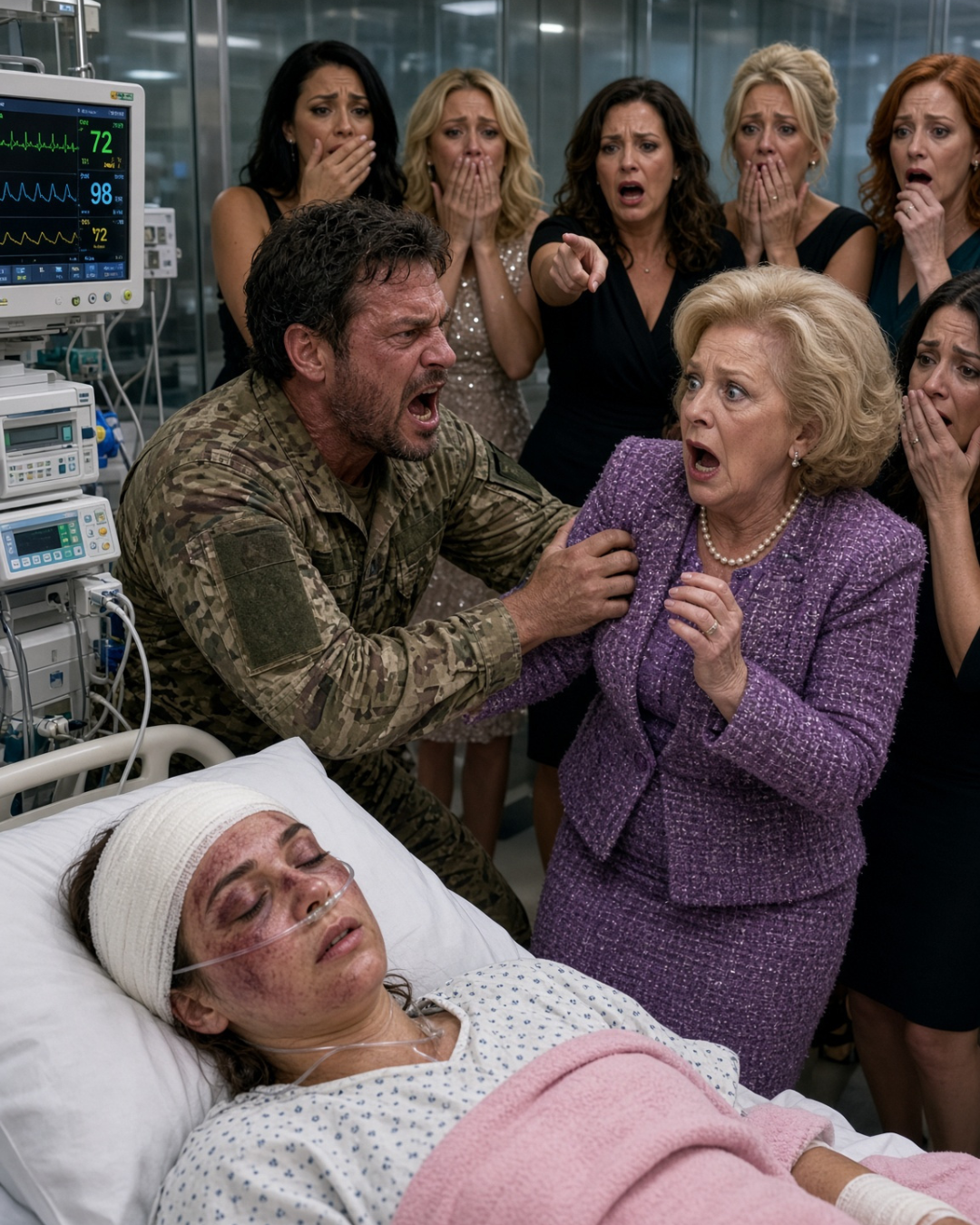
“Then Evelyn’s mental health history becomes public. Her hospitalization at twenty-three. Her ‘delusions’ about her father. A forged divorce petition becomes a genuine one, and a court discovers that your wife fabricated evidence against her own family out of spite.”
She tilted her head.
“And you, Major, become a disgraced officer who intimidated a grieving family. Colonel Hollister will see to that.”
“Hollister’s done.”
“Hollister,” she said, “is replaceable. Everyone is.”
“Is that what happened to Thomas?”
The room fell silent.
Margaret turned her eyes toward me.
“I beg your pardon?”
“Your husband. The best sailor Evelyn ever knew. He didn’t fall off a boat, did he, Margaret?”
For the first time, her composure faltered.
“Thomas,” she said, “was going to give everything to Catherine’s child. Everything I built. Twenty years I stood beside that man, and he was going to leave me as a caretaker for another woman’s daughter.”
Her voice became almost gentle.
“I gave him six children. And he looked at that girl as if she were the only one who mattered.”
“That’s not an answer.”
“It’s the only one you’re going to get.”
Brandt shifted near the door.
Margaret looked toward Laurel.
“Darling, would you show Grant the documents?”
Laurel rose, collected a leather folder from a side table, and walked toward me.
Halfway across the room, she stopped.
Then she turned to her mother.
“No, Mother,” she said quietly. “I don’t think I will.”
Margaret’s hand went still around her glass.
“Laurel.”
“Six months,” Laurel said. “For six months I’ve been meeting with Agent Reyes. I’m the one who found the SA-7 numbers. I’m the one who gave them to Evelyn, because I knew she was the only one of us brave enough to carry them. And when you asked me to come up here tonight and help you, I said yes.”
She loosened the top button of her blouse, revealing a thin wire.
“Because I wanted you to say it out loud. And you just did.”
Brandt drew his weapon.
“Red sky,” I said.
The next moments unfolded almost faster than I could register.
Brandt turned toward Laurel.
I moved between them.
Glass shattered as the FBI tactical team entered through the lake-facing doors. Almost simultaneously, agents forced their way through the front entrance.
Brandt found himself surrounded by rifles.
He lowered his weapon, placed it on the floor, and lay down.
Margaret remained in her chair.
She watched an FBI agent approach and read her rights.
Before standing, she carefully placed her wine glass on a coaster.
Laurel was trembling.
I put an arm around her shoulders.
“You were incredibly brave,” I told her.
“I was terrified,” she said. “Every single day.”
“That’s what brave is.”
At nearly the same moment, federal agents intercepted Meredith at a private hangar outside Charlotte.
She was boarding a Shaw corporate jet bound for the Cayman Islands.
Evelyn’s missing laptop was inside her carry-on bag.
Outside the lake house, floodlights illuminated Margaret as agents escorted her toward an FBI vehicle.
She looked at me before entering.
“You think this is over,” she said. “It isn’t. You have no idea what Evelyn will become when she has all that power. She’s Catherine’s daughter. She’ll ruin everything my family built.”
“No, Margaret,” I said. “She’ll fix it.”
The door closed.
An hour later, at the FBI’s Charlotte field office, Brandt requested an attorney and began negotiating.
When Reyes emerged from the interview room, her expression was difficult to read.
“He’s going to plead guilty to the assault,” she said. “And he’s offering something else in exchange for consideration.”
“What?”
“The truth about what happened to Thomas Shaw on Lake Norman twelve years ago.”
She paused.
“Grant, Brandt was working for Margaret back then, too. And he says he wasn’t the only one on that boat.”
The truth emerged gradually.
Twelve years earlier, Thomas Shaw had told Margaret he intended to change his will.
Two weeks afterward, he went sailing on Lake Norman at sunset, following his usual Sunday routine.
Brandt, then a younger security contractor, had been waiting aboard a fishing boat in a secluded cove.
Margaret had given him his orders.
The details of what happened on the water came out through Brandt’s sealed proffer to federal prosecutors and later through his testimony before a jury.
Thomas Shaw’s death had not been an accident.
Margaret was indicted on fourteen federal and state counts, including conspiracy to commit murder, attempted murder, major fraud against the United States, obstruction of justice, and witness tampering.
Her attorneys fought the charges for eleven months.
They lost every motion.
On sentencing day, Margaret wore her pearls.
The court sentenced her to life without parole.
Meredith received twenty-two years for aggravated assault and conspiracy.
Brandt pleaded guilty, testified against the others, and received twenty-five years.
Investigators identified the woman who had entered Evelyn’s hospital room carrying flowers.
Her name was Tara Vance, a Shaw Security employee.
She cooperated with prosecutors and was also sentenced to prison.
Colonel Wade Hollister was arrested at the Pentagon while wearing his dress uniform.
He was convicted of bribery and conspiracy and stripped of his rank.
Judge Raymond Tolliver resigned three days before the state judicial board could remove him. He was later charged for his involvement in the fraudulent guardianship.
Police Chief Dale Corbin was indicted for obstruction.
Lionel Pratt lost his position at Hawthorne Regional when the hospital board learned the extent of the investigation.
Harold Finch became interim police chief.
He called me on the day he was sworn in.
“Funny thing,” he said. “First thing I did was reopen eleven cases the old chief closed too fast. Turns out a lot of folks in this county have been waiting a long time for someone to just do their job.”
The Army reopened its investigation into the helicopter crash that killed Staff Sergeant Danny Okafor and three other soldiers.
The official cause was changed from pilot error to catastrophic mechanical failure involving a fraudulently certified tail rotor hub.
Every SA-7 assembly still in service was grounded and replaced within sixty days.
Engineers believed the recall had prevented further deaths.
I traveled to Georgia to speak personally with Danny’s widow, Grace.
She sat at her kitchen table while their twin daughters colored in the next room.
I explained everything.
She listened without interrupting.
When I finished, she was quiet.
“They told me he made a mistake,” she said finally. “For a year, I’ve been angry at a man who didn’t do anything wrong.”
“He didn’t do anything wrong,” I said. “He did everything right.”
Then Grace began to cry.
I cried with her.
Nothing we uncovered could bring Danny or the other soldiers home.
But their families deserved to know the truth.
Evelyn celebrated her thirty-fifth birthday in a rehabilitation hospital in Raleigh.
Her leg remained in a cast. A bandage covered the healing scar on her scalp.
Four days earlier, her physicians had certified that she was fully competent.
The trust attorneys arrived with the necessary documents.
Evelyn’s wrists were still weak.
Her hand trembled as she lifted the pen.
But she signed her own name.
Every letter.
When she finished, she placed the pen on the table and smiled at me.
Her face hadn’t completely healed. The smile was crooked.
It was the most beautiful thing I had ever seen.
As the majority owner of Shaw Aeronautics, Evelyn immediately began changing the company.
She appointed an independent board and hired a chief executive with an unblemished record in safety.
She opened the entire testing archive to federal investigators.
Then she established the Catherine Shaw Foundation, using her own shares to support families of service members killed in aviation accidents.
The foundation’s first scholarships went to Danny Okafor’s twin daughters in Georgia.
Six months later, the company was renamed.
Evelyn said the Shaw name had carried enough weight for one lifetime.
Faith testified at every trial.
She faced Margaret without looking away.
Afterward, she moved into a small cottage at the edge of our property and returned to school to become a trauma nurse.
Rosalind Bell wrote her recommendation letter.
Laurel became chief compliance officer of the reorganized company.
She and Evelyn spoke almost every day.
Sometimes their conversations concerned work.
More often, they simply talked as sisters.
The relationships with Jocelyn, Paige, and Sabrina were more complicated.
They hadn’t physically attacked Evelyn.
But they had known the family was dangerous, and they had chosen comfort and silence instead of protecting her.
Evelyn didn’t pretend those choices were harmless.
One spring afternoon, Sabrina arrived at our farmhouse carrying a casserole she had clearly burned.
She stood on the porch crying and apologized for every year she had looked the other way.
Evelyn invited her inside.
That night, she explained her decision to me.
“Forgiveness isn’t the same as forgetting,” she said. “And it isn’t the same as trust. But it’s a door. I’d rather leave it open a crack than nail it shut and become someone like her.”
Abner Pruitt lived long enough to see everything change.
Every Sunday, he came over for supper.
He insisted Evelyn’s pecan pie was the second-best he’d ever tasted, but he refused to reveal who made the best one.
Not once.
That fall, after twenty years of military service, I submitted my retirement papers.
I had been offered promotion twice.
There had been a time when I would have accepted without hesitation.
But I had spent too many years serving in distant places while the person I loved waited at home.
Now I wanted to be there.
Exactly one year after stepping off that military transport with desert dust on my boots, I drove along the gravel road toward our farmhouse.
The front door was still deep blue.
Evelyn stood on the porch.
Her auburn hair had grown back to her chin. She was thinner than before, and the scar near her temple caught the afternoon light.
One hand rested on the railing.
The other held a carved wooden cane Abner had made for her.
She was watching the driveway, although she was clearly trying to appear as though she hadn’t been.
I climbed out of the truck.
Evelyn started down the steps.
All five of them.
Slowly and carefully, refusing the hand I offered despite her physical therapist’s instructions.
At the bottom, she left the cane behind and walked across the gravel.
I met her halfway.
“You were gone a long time, Major,” she said.
“I’m home now.”
“For good?”
“For good.”
She pressed her face against my chest.
I wrapped my arms around her and held her as though I could make up for every moment I had feared I would never see her again.
People in Hawthorne County still ask how one soldier managed to bring down one of North Carolina’s most powerful families.
I always tell them the same truth.
I didn’t do it alone.
A frightened young woman made a phone call in the dark.
A detective who had spent years swallowing his conscience finally decided to speak.
A night nurse trusted her instincts.
A quiet sister risked everything to expose the people who controlled her life.
An elderly Marine kept a promise made over pecan pie.
And a woman with twenty-seven broken bones refused to let anyone else write her name for her.
The people who share your blood aren’t always the people who deserve to be called family.
Family is the person who runs toward you when everything is falling apart.
It’s the person who tells the truth even when telling it could cost everything.
It’s the person who stays when leaving would be easier.
Margaret Shaw believed money could make the truth disappear.
She believed a powerful name could silence witnesses, control judges, and turn violence into a story nobody dared question.
She was wrong.
Because the truth had been there from the beginning.
Lying in a hospital bed.
Still breathing.
Still fighting.
Waiting for someone to come home.
THE END
