

PART 1
I counted every slap.
One.
Two.
Three.
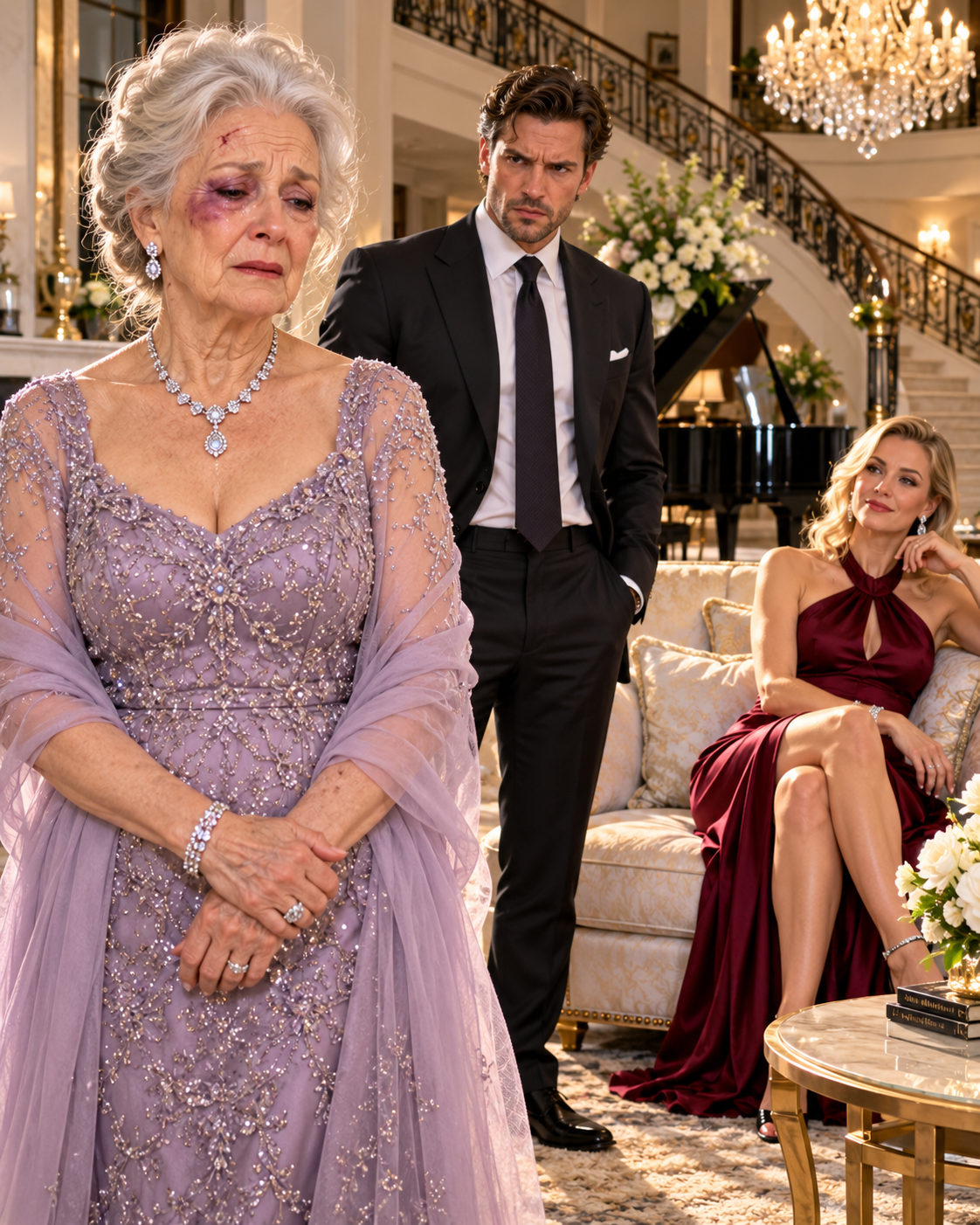
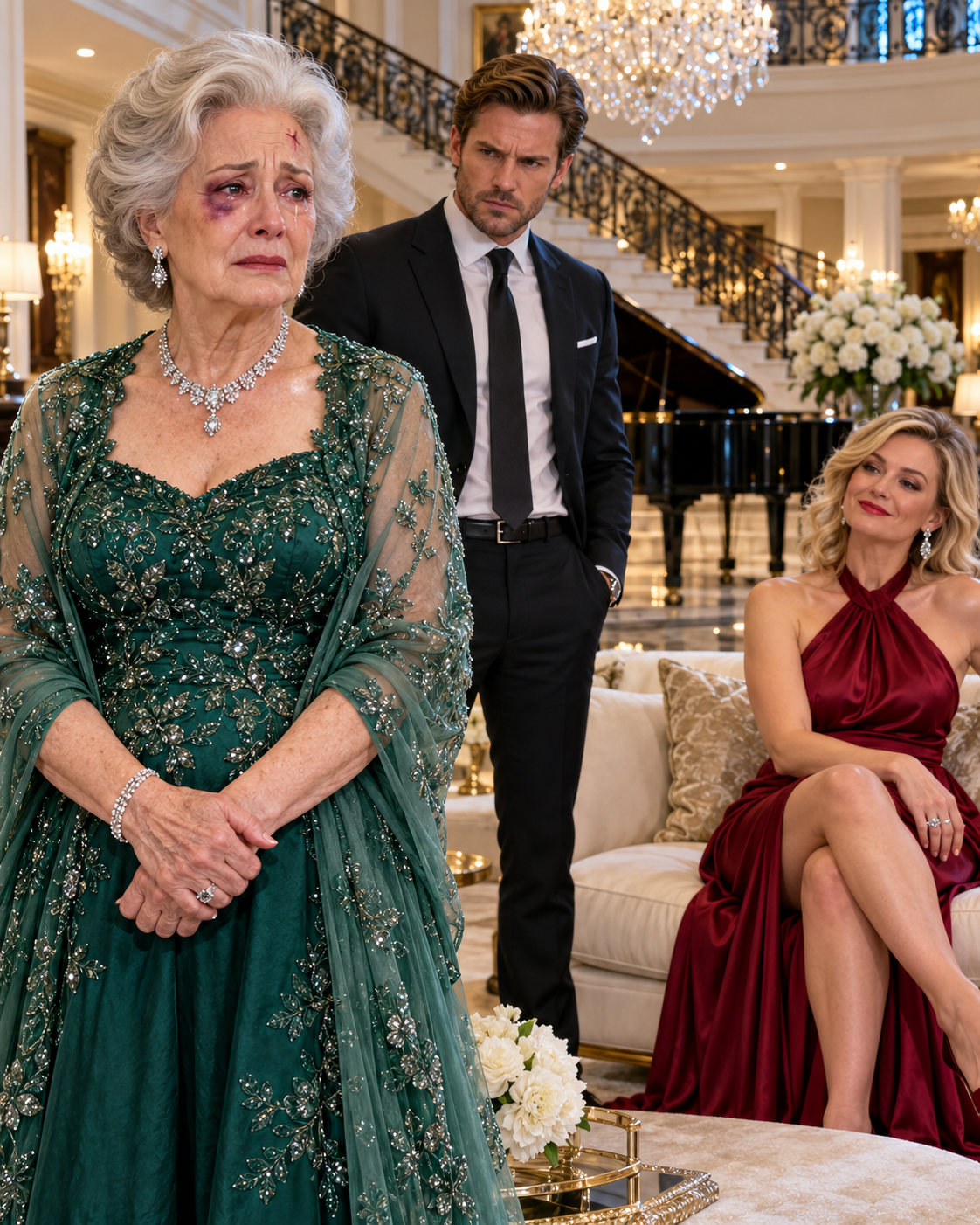
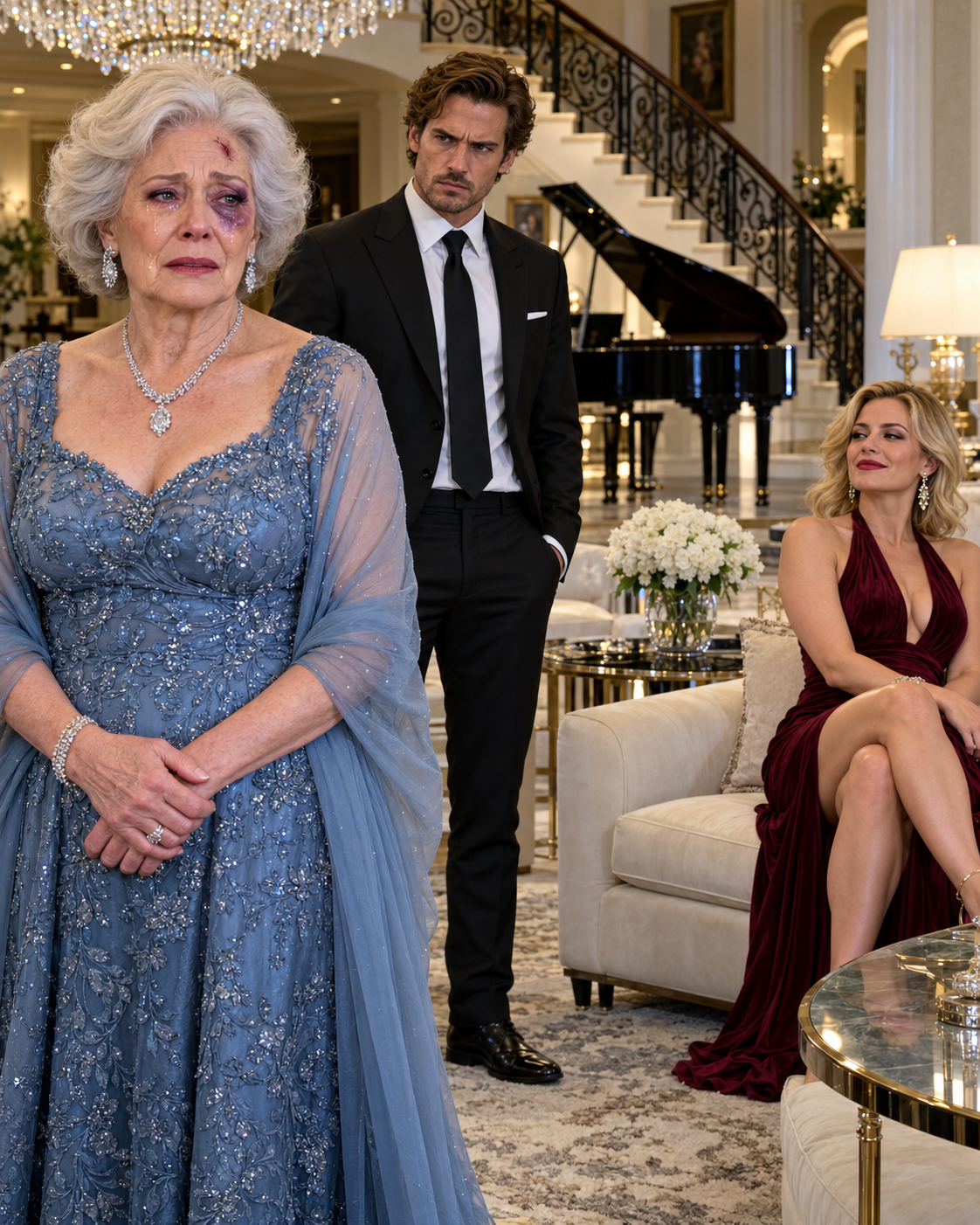
By the time my son’s hand struck my face for the thirtieth time, my lip had split open, the metallic taste of blood filled my mouth, and the last piece of denial I had clung to as his mother finally disappeared.
He believed he was teaching me my place.
His wife, Kristen, remained seated nearby, observing everything with the small, merciless smile of someone who takes pleasure in another person’s humiliation.
My son had convinced himself that being young, having a temper, and living in a magnificent River Oaks mansion made him untouchable.
What he didn’t understand was that while he was pretending to be a king, I had already made the decision to reclaim everything.
My name is Gloria Sutter. I’m sixty-eight years old, and for four decades I worked on the construction of roads, bridges, and commercial developments throughout Texas. I’ve negotiated deals that could make or destroy companies, survived financial downturns, buried people I loved, and encountered far too many individuals who confused having money with having character.
This is the story of how I sold the house my son believed belonged to him while he sat comfortably at work, certain that his future was secure.
It began on a bitterly cold Tuesday in February.
I was attending Trevor’s thirtieth birthday dinner.
I left my aging sedan a couple of blocks from his house because the driveway was already filled with expensive luxury vehicles, the sort driven by people more concerned with displaying wealth than understanding how it was earned.
In my hands, I carried a modest present wrapped in plain brown paper.
From the street, the mansion was breathtaking.
It should have been.
I had paid for every inch of it.
Five years earlier, after completing one of the most profitable transactions of my career, I purchased the River Oaks property without financing. I allowed Trevor and Kristen to move in and told them to consider the place theirs.
But there was one crucial detail I never shared with either of them.
Neither Trevor nor Kristen appeared on the deed.
The property was legally held by Cedarline Capital, a limited liability company of which I was the sole owner.
In their minds, I had given them a mansion.
In mine, I had given them an opportunity to demonstrate the sort of people they intended to become.
And for years, they had been failing that test.
The warning signs hadn’t appeared overnight.
Gradually, Trevor stopped speaking to me as his mother and began addressing me like an unwanted obligation. Kristen demanded advance notice whenever I visited, despite the fact that I legally owned the residence.
They disliked my old car.
They criticized my practical clothes.
They were embarrassed by my rough hands, the years visible on my face, and the fact that I didn’t dress or behave like the wealthy socialites they wanted to impress.
At parties, they introduced me with an awkwardness that made it sound as though I were an embarrassing relic from another generation, a woman who had somehow stumbled into money through luck.
Sometimes that attitude made me smile.
They had no idea how much I understood about their world.
After all, I had helped construct it.
The confrontation that evening began over something that appeared insignificant.
But the truth was that nothing about it was insignificant.
I had brought Trevor an antique locket that I had painstakingly restored. It resembled the jewelry his grandmother had always admired, and I thought he might appreciate the connection to his family’s history.
He barely examined it.
Instead, he tossed the gift aside and announced, in front of his guests, that he was tired of me arriving at his home and expecting gratitude for something that no longer concerned me.
I didn’t raise my voice.
I simply reminded him that he shouldn’t forget who had laid the foundation beneath his feet.
Those words were enough.
Trevor rose abruptly.
He shoved me with such force that my ribs struck the edge of the dining table.
Then his hand began coming toward my face.
Again.
And again.
And again.
I counted each blow.
Not because I was incapable of defending myself.
I had spent forty years dealing with construction sites, stubborn contractors, and men who believed intimidation was a substitute for authority.
I counted because something inside me had finally reached its limit.
With every strike, another piece of my hope disappeared.
My respect.
My excuses.
My belief that the boy I remembered still existed somewhere inside the man standing before me.
When Trevor finally stopped, he was breathing heavily, wearing the expression of someone convinced he had won.
Kristen continued watching me as though I had caused the entire scene.
I wiped blood from my mouth and looked at my son.
In that moment, I understood a truth that too many parents discover after years of sacrifice.
Sometimes you don’t raise a grateful child.
Sometimes you simply finance an ungrateful adult.
I didn’t scream at him.
I didn’t promise revenge.
I didn’t call the police.
I retrieved the gift he had discarded, turned around, and left.
The following morning, at precisely 8:06, I telephoned my attorney.
At 8:23, I contacted Cedarline Capital’s manager.
By 9:10, the River Oaks mansion had been offered in a fast private sale to a buyer who had been waiting for a property of that kind.
And at 11:49, while Trevor sat at his office desk believing everything in his world remained exactly where he had left it, I signed the final documents.
Then my phone rang.
His name appeared on the screen.
I already understood what had happened.
Someone had arrived at the mansion and knocked on the door.
And that person hadn’t come for a social visit.
I allowed the phone to ring three times.
Not because the situation entertained me, but because sixty-eight years of living had taught me that silence sometimes communicates more effectively than any argument.
On the fourth ring, I answered.
“Gloria Sutter,” I said.
For a brief moment, the only sound was breathing.
Fast, uneven, frightened breathing.
The kind that escapes a man when the ground beneath him begins giving way and he hasn’t yet accepted that he’s falling.
“What did you do?” Trevor asked.
He was trying to keep his voice low, but I could hear panic underneath his anger.
I was still seated in my attorney’s conference room, the signing pen resting in my hand.
Across the table, Howard Pierce, who had represented me for thirty-two years, carefully gathered the documents and slipped them into a blue folder.
Howard didn’t appear surprised.
He had watched wealthy people destroy fortunes, siblings fight over inheritances, and grown children reveal their true character when they believed money was within reach.
“I’m not sure what you mean,” I replied.
“Don’t play games with me.” Trevor’s voice grew louder. “There are people at my house.”
I glanced toward the conference-room window.
Beyond it, downtown Houston glittered beneath the weak February sunlight, a landscape of glass towers, steel, and ambition.
“Your house?” I asked.
The silence afterward was so deeply satisfying that I almost felt guilty.
Almost.
From somewhere near him, Kristen interrupted.
“Put it on speaker.”
A moment later, Trevor’s voice became louder.
“Mom. Tell these people to leave.”
“I can’t do that.”
“You can and you will.”
“No,” I answered. “They represent the new owner.”
Something scraped violently against the floor on his end.
“The new what?”
“The new owner.”
“You sold my house?”
“I sold my property.”
“Your property? You gave that house to me!”
“I let you live there.”
“That’s the same thing.”
“No, Trevor,” I said softly. “It isn’t.”
For years, I had imagined that a confrontation like this might eventually happen.
In the versions I pictured, my son was ashamed but not cruel.
He apologized.
He remembered the little boy who once held my hand while we walked through construction sites, asking why enormous cranes didn’t topple over.
But after thirty slaps, I had no room left for comforting fantasies.
Kristen joined the conversation.
“Gloria, this is insane. You can’t just sell our home without telling us.”
“I didn’t sell your home. I sold a residence owned by Cedarline Capital, an entity in which neither of you has any legal interest.”
Her carefully cultivated sweetness disappeared immediately.
“You bitter old woman.”
Howard lifted an eyebrow.
I settled back in my chair.
“Good morning to you too, Kristen.”
“You think this is funny? You think you can humiliate us over one little argument?”
“One little argument,” I repeated.
Trevor snapped, “You embarrassed me in front of my friends.”
My tongue brushed against my swollen, split lip.
“I embarrassed you?”
“You came into my house acting like you owned the place.”
“I did.”
Another silence followed.
But this one wasn’t simply surprise.
It was the silence of people discovering that every exit had been closed.
Trevor spoke again, this time more cautiously.
“Mom, listen. Whatever this is, undo it. We’ll talk.”
“There is nothing to talk about.”
“You can’t kick us out.”
“I’m not kicking you out.”
“Then what do you call this?”
“A transfer of ownership.”
Kristen released a bitter laugh.
“You’re enjoying this.”
I looked at my hands.
They were thick, scarred hands, shaped by decades of work.
Those hands had signed paychecks for hundreds of employees, carried lumber, comforted grieving friends, and held my husband Raymond’s fingers while cancer slowly took him away.
They had built the world Trevor lived in.
But they had never struck my son.
“No,” I said. “I’m not enjoying it. I’m finishing it.”
Trevor muttered a curse.
“Who bought it?”
“That’s not your concern.”
“It is when strangers are standing in my foyer telling my wife we have thirty days.”
“Then you should speak with them politely.”
Kristen’s voice rose sharply.
“Thirty days? Gloria, do you understand what this will do to us socially?”
There it was.
Not what the situation would do to their marriage.
Not how it might affect their finances.
Not whether their family could survive.
Socially.
I closed my eyes.
The truth stood exposed, stripped of every polite disguise.
“You should have considered that before last night,” I told her.
Trevor lowered his voice.
“Mom. I made a mistake.”
“No. A mistake is missing a turn. A mistake is forgetting an appointment. You hit your mother thirty times in front of your wife and your guests.”
“You were counting?”
“Yes.”
That single word seemed to stop him.
“I was angry,” he said.
“So was I.”
“You pushed me.”
“I reminded you who paid for the roof over your head.”
“You always do this. You always hold money over me.”
“No, Trevor. I held back the truth from you. There’s a difference.”
In the background, I could hear the ordinary sounds of his workplace.
Telephones ringing.
A printer running.
Someone laughing.
People continuing their day without realizing that my son’s carefully manufactured world was collapsing.
Then Trevor said, “I’ll sue.”
Howard gave a faint smile.
“You’re welcome to try. Howard Pierce is sitting across from me. He reviewed every document before the sale.”
“Put him on.”
“No.”
“You think this makes you powerful?”
I glanced at the blue folder containing the signed documents.
“No. It reminds me I should have stopped protecting you sooner.”
Then I ended the call.
Howard removed his glasses and polished them with a white cloth.
“He’ll come after you.”
“I know.”
“Legally, he has nothing.”
“I know that too.”
“But angry people don’t always start with the law.”
“Neither do frightened ones.”
He gave a small nod.
Then he opened another folder.
“There’s something else you need to see.”
He pushed a thick packet across the conference table.
At first, I assumed it contained additional closing paperwork.
But the first page told a different story.
Bank statements.
Credit reports.
Loan records.
Kristen’s name appeared repeatedly.
So did Trevor’s.
Credit lines.
Private lenders.
Luxury vehicle payments.
Financing for expensive jewelry.
A second-mortgage application that had been rejected because neither of them owned the property.
There was also a business loan Trevor had personally guaranteed for a startup that looked as though it existed mostly on promises, vanity, and impressive-looking documents.
“What is this?” I asked.
“Information my office gathered when you asked me to look into Cedarline’s exposure.”
I continued turning pages.
The figures were terrible.
Not merely uncomfortable.
Catastrophic.
“They’re broke,” Howard said.
I stared at him.
My son was living in a seven-million-dollar mansion.
And he was broke.
“How long?”
“At least eighteen months. They’ve been using appearances as collateral. Parties. Social circles. Promises. Trevor has been telling people he controls family real estate assets.”
I looked up.
“He’s been using my name?”
“Your name, your company’s reputation, and the house.”
A cold, familiar feeling settled inside my chest.
I had experienced it in business meetings whenever a contractor looked me directly in the eye and lied.
It wasn’t exactly anger.
It was clarity.
“What did he borrow?”
“We don’t know everything yet.”
Howard tapped the final page.
“But this one concerns me.”
It was a promissory note.
Two million dollars.
Borrower: Trevor Sutter.
Due date: Friday.
Lender: Kessler Private Group.
“Who are they?”
“Not a bank.”
Howard didn’t elaborate.
He didn’t need to.
After four decades in business, I understood the difference between legitimate lenders, ambitious investors, and the quieter sort of money that operated behind closed doors.
Kessler sounded like the third kind.
“What did he put up?”
Howard’s expression tightened.
“The house.”
“He couldn’t.”
“He didn’t, legally. But he represented that he had beneficial ownership and that the title transfer was pending.”
“He lied.”
“Yes.”
“And they believed him?”
“They believed the lifestyle. They believed the address. They believed your last name.”
I let out a short, humorless laugh.
Trevor had constructed a kingdom out of borrowed reflections and convinced himself he was its ruler.
Now every mirror was beginning to shatter.
My phone vibrated.
Trevor.
I ignored it.
It vibrated again.
Kristen.
Then a number I didn’t recognize.
“Don’t pick up unknown calls,” Howard advised.
I turned the phone facedown.
For the first time that morning, grief settled over me.
Not grief over the mansion.
Not over the money.
I had lost money before.
Money could be earned again.
It could build shelter, create opportunity, or become a weapon.
But money wasn’t the same as family.
I mourned the little boy who used to fall asleep in my truck after visiting construction sites, his dusty boots dangling above the floor.
I mourned the teenager who withdrew into silence after Raymond died, then discovered that expensive possessions could temporarily distract him from loneliness.
And I mourned my own failures.
Because parents don’t get to stand outside the wreckage of their children’s lives and pretend they had no influence on the road that led there.
But grieving him didn’t mean I had to surrender to him.
“What happens now?” I asked.
“The buyers take possession according to the agreement. Trevor and Kristen receive formal notice. If they refuse to vacate, it becomes a civil matter.”
“And Kessler?”
“That depends on how patient they are.”
Almost immediately, my phone vibrated again.
Another unknown number.
This time, a text appeared.
I picked it up before Howard could object.
Mrs. Sutter, we should speak before your son creates further complications.
Howard read the message.
Then read it again.
“Do not respond.”
Before I could put the phone down, another message arrived.
Your son gave us your address too.
For a moment, the entire room seemed to vanish.
I wasn’t frightened in the ordinary sense.
I was finally beginning to understand how much damage Trevor had done.
He hadn’t simply insulted me.
He hadn’t merely assaulted me.
He had taken the reputation I spent forty years building and carried it into dangerous rooms as though it were a stack of gambling chips.
I stood.
“I’m going home.”
“I don’t think that’s wise.”
“I’m not asking.”
“Then I’m sending someone to meet you there.”
“No police.”
“Security, then.”
I paused near the door.
The previous night, I had refused to involve the police because I couldn’t bear the thought of seeing my son taken away in handcuffs.
That had been my final act of mercy toward him.
I wasn’t sure I had any mercy left.
“Fine,” I said.
Houston traffic flowed around me as I drove home.
I insisted on driving myself.
I always had.
My old sedan smelled of worn leather, construction dust, and the peppermints I kept in the center console.
My face throbbed.
My ribs ached where Trevor had shoved me against the table.
At a red light, I examined myself in the rearview mirror.
One bruised eye.
A swollen lip.
Gray hair carefully combed into place.
“You old fool,” I whispered.
I wasn’t trying to hurt myself with those words.
I was admitting the truth.
I had mistaken financial provision for good parenting.
I had confused silence with patience.
And I had treated Trevor’s comfort as evidence that he was stable.
My own home was nothing like the River Oaks mansion.
It stood beneath old live oaks on three acres outside the city’s busiest neighborhoods.
Low brick walls.
A wide porch.
Solid construction.
Nothing flashy.
Raymond had personally selected the kitchen tiles.
He had planted rosemary near the back steps.
Even years after his death, I couldn’t bring myself to cut the plants back too severely.
As I approached the driveway, I noticed a black SUV parked near the gate.
Its engine was running.
Two men sat inside.
They weren’t police officers.
And they certainly weren’t neighbors.
I stopped twenty yards away.
The passenger door opened.
A clean-shaven man of about forty-five stepped out.
He wore a charcoal coat, polished shoes, and no tie.
His relaxed posture suggested that making other people uncomfortable was something he did regularly.
He raised one hand.
My phone rang.
The same unknown number.
This time, I answered.
“Mrs. Sutter,” the man said, his voice coming through my phone and carrying across the driveway. “My name is Lyle Voss.”
“Kessler Private Group?”
“A related office.”
“That sounds intentionally vague.”
“It is.”
I remained inside my car.
“You’re trespassing.”
“We’re outside your gate.”
“You’re threatening me.”
“We’re introducing ourselves.”
A white pickup turned into the driveway behind me.
Security.
Howard had sent two retired officers he’d employed before.
I recognized one of them, a broad-shouldered man named Ortega.
Voss glanced toward the pickup.
A faint smile appeared.
“I see you’ve made arrangements.”
“I like to know who’s visiting.”
“So do we.”
Ortega approached my driver’s window.
I lowered it.
“You okay, Mrs. Sutter?”
“I’m fine.”
He looked toward Voss.
“You invited?”
“No,” I answered.
Ortega positioned one hand near his belt.
Not directly on a weapon.
But close enough to communicate that he was paying attention.
Voss remained perfectly still.
“I only need five minutes,” he said.
“You have two.”
He nodded as though my response amused him.
“Your son owes money.”
“My son is thirty years old.”
“He used your name.”
“That was a mistake.”
“He used your property.”
“That was fraud.”
“He used your reputation.”
“That was stupidity.”
Voss’s gaze sharpened.
“You don’t seem surprised.”
“I was given documents this morning.”
“Then you understand why we’re concerned.”
“I understand why you should be.”
He smiled.
“Women like you interest me. You built things. Kept records. Stayed quiet. Then, overnight, you moved with precision.”
“I sold a house I owned.”
“You removed our perceived collateral.”
“Perceived collateral isn’t collateral.”
“No. But perception has value.”
“Not to me.”
Voss slowly reached into his coat.
Ortega shifted his stance.
But Voss merely withdrew an envelope.
“I’m not here to threaten you. I’m here to ask whether you intend to cover Trevor’s obligation.”
I laughed.
The sound startled even me.
Voss waited patiently.
“No,” I said.
“He is your son.”
“Yes.”
“And you’ll let him fall?”
I looked beyond him toward the bare branches of the trees.
“I let him stand for years. He chose where to walk.”
Voss studied me.
Then he placed the envelope on the stone gatepost.
“In that case, you should know what he signed.”
“I already know enough.”
“No,” Voss said. “You don’t.”
He turned toward his vehicle.
Then stopped.
“Your son didn’t borrow two million dollars for a business.”
I remained silent.
He opened the passenger door.
“He borrowed it to keep his wife quiet.”
Then he climbed into the SUV.
The vehicle backed away and disappeared down the road.
I remained in my car long after it was gone.
Ortega retrieved the envelope carefully.
“Want me to open it?”
“No,” I answered.
But I accepted it from him.
Inside my house, everything was quiet.
The air carried the familiar scent of cedar.
Raymond’s photograph stood on the hallway table, his smile frozen in a summer that had ended twenty years earlier.
I stopped in front of it.
“You’d tell me to sit down first,” I murmured.
So I went into the kitchen and sat.
Then I opened the envelope.
Five photographs slid onto the table.
The first showed Trevor outside a hotel, his arm wrapped around a woman who was not Kristen.
The second showed him entering that same hotel at night.
In the third, Kristen sat across from Lyle Voss in a restaurant booth.
The fourth was a copy of a wire transfer.
And the fifth was a legal document marked Confidential Separation Agreement.
I read the first page.
Then the second.
Then I stopped breathing for a moment.
Kristen knew about everything.
The affair.
The debts.
The deception.
She hadn’t been an innocent wife caught in Trevor’s collapse.
She had been controlling the situation from behind the scenes.
The documents indicated that she was preparing to divorce Trevor and demand half of everything he claimed to own.
That included alleged interests in Cedarline Capital, assets belonging to my company, and the River Oaks mansion.
She had employed private investigators.
Collected evidence.
Met with Kessler representatives.
And used that information to negotiate from a position of power.
Then I reached a clause that made my blood run cold.
Upon execution, Trevor Sutter agrees to assist in the petition for Gloria Sutter to be declared financially incompetent should such declaration be necessary to transfer disputed family-controlled assets.
I read those words three times.
Financially incompetent.
My son and his wife hadn’t merely been waiting to inherit my wealth.
They had considered declaring me incapable of managing my own affairs so they could seize control while I was still alive.
I stared at Raymond’s photograph.
The house remained silent.
Then my phone rang.
Trevor.
I answered.
His voice sounded smaller than before.
“Mom. I need to come over.”
“No.”
“Please.”
Once, that word had belonged to a little boy asking for another bedtime story.
Please for pancakes.
Please don’t go to work today.
Now it sounded broken.
“Why?” I asked.
“I messed up.”
“Yes.”
“No, Mom. Worse than you know.”
“I’m beginning to understand.”
He exhaled shakily.
“Kristen left the house. She took jewelry, cash, documents. She said she’s going to ruin me.”
Of course she had.
People who prey on weakness recognize it before the person being exploited does.
“Where are you?”
“In my car. Outside your gate.”
I walked to the front window.
There was his silver sports car, parked crookedly beyond the gate.
Through the windshield, I could see Trevor leaning over the steering wheel.
For an instant, I saw my little boy again.
Then he raised his head.
And I saw the man who had split my lip.
“Stay there,” I told him.
I ended the call.
I didn’t hurry.
I gathered the photographs, the separation agreement, and the Kessler note, returned them to the envelope, and walked outside.
The cold air struck my bruised face.
Trevor climbed out of his car when he saw me.
His expensive suit was wrinkled.
His hair was disheveled.
A red mark showed on his neck.
He looked a decade older than he had at his birthday dinner.
I stopped on my side of the gate.
Iron bars separated us.
Somehow, that felt appropriate.
He looked at my swollen face.
Then he flinched.
For a brief moment, unmistakable shame crossed his expression.
“I’m sorry,” he said. “For last night. For all of it. I shouldn’t have touched you.”
“No. You shouldn’t have.”
“Can I come in?”
“No.”
His face tightened.
“Mom, please. Those people, Kessler, they’re serious.”
“I know.”
“They’re going to destroy me.”
“You’ve been helping.”
He gripped the gate.
“I didn’t know what else to do.”
“You could have told the truth.”
“You don’t know what it’s like.”
I almost smiled.
“I don’t know what it’s like?”
He lowered his eyes.
“I was drowning. Everyone expected me to be successful. Gloria Sutter’s son. I couldn’t just be normal. I couldn’t fail.”
“So you lied.”
“At first, just a little.”
“That’s how most collapses begin.”
“I thought I could fix it.”
“With two million dollars from people like Lyle Voss?”
His eyes widened.
“You met Voss?”
“He came here.”
Fear swept across Trevor’s face.
“What did he say?”
“That you borrowed money to keep Kristen quiet.”
Trevor released the bars.
“Mom…”
I raised the envelope.
“She was planning to take everything. Including me.”
He opened his mouth.
Nothing came out.
“That part surprised me,” I said. “Not because of Kristen. Because of you.”
“I didn’t agree to that.”
“Your name is on the draft.”
“I didn’t sign it.”
“But you discussed it.”
He turned away.
There are moments when a mother desperately wants her child to lie convincingly.
A beautiful lie.
A reassuring lie.
Something she can cling to long enough to sleep.
Trevor couldn’t give me even that.
“I was scared,” he whispered.
I nodded.
“And last night?”
He rubbed his face.
“I was drunk.”
“You weren’t too drunk to count my weakness.”
“I thought you were trying to shame me.”
“No, Trevor. I was trying to remind you that you still had a mother before you made an enemy.”
He stared through the gate.
A passing car slowed, then continued down the road.
“Will you help me?” he asked.
There it was.
Not a question about forgiveness.
Not an offer to repair what he’d broken.
Only another request for rescue.
I studied him for a long time.
“Yes,” I said.
Relief flooded his face.
Then I continued.
“I will help you tell the truth.”
His expression changed immediately.
“What?”
“I will help you speak to Howard. I will help you document the fraud. I will help you surrender what you can’t keep and face the people you owe. I will pay for an attorney, not a rescue. I will pay for safety, not your lifestyle. I won’t give you cash. I won’t hide assets. I won’t lie for you.”
“Mom, they’ll ruin me.”
“You are already ruined. Now you have to decide whether you’ll be rebuilt or buried.”
His eyes hardened.
Not completely.
But enough.
“So that’s it? You sell my home, and now you lecture me from behind a gate?”
“I sold my property after you assaulted me.”
His jaw clenched.
“And there he is,” I said quietly.
“What?”
“The man from last night.”
He looked down.
His breathing grew heavier.
“I’m trying.”
“No. You’re bargaining.”
He covered his face, then dragged both hands downward.
“What do you want from me?”
“The truth.”
“I told you.”
“All of it.”
Trevor went still.
I watched his face carefully.
He blinked once.
Too slowly.
There was something else.
“Trevor,” I said.
Before he could respond, his phone rang.
He glanced at the screen.
All the color drained from his face.
He turned the phone toward me.
Kristen.
He answered with trembling fingers and activated the speaker.
Her voice came through bright and icy.
“Are you with her?”
Trevor looked at me.
Neither of us answered.
Kristen laughed.
“Of course you are. Poor Trevor. Running to Mommy after playing rich man for five years.”
“What do you want?” he demanded.
“I want what I’m owed.”
“You stole from me.”
“I protected myself.”
“You talked to Kessler.”
“I talked to everyone.”
A chill ran through me.
Everyone.
“Gloria,” Kristen continued, “since I know you’re listening, you should check your email.”
My phone vibrated inside my coat.
A new message had arrived from an unfamiliar address.
Its subject line read:
Raymond Sutter Trust Documents.
My hand stopped halfway toward the phone.
Kristen’s voice became almost affectionate.
“You really should have told Trevor what his father left him.”
Everything around me seemed to narrow.
The gate.
Trevor’s pale face.
The scent of rosemary drifting through the cold air.
My dead husband’s name appearing in an email sent by a stranger.
“Mom?” Trevor whispered. “What is she talking about?”
I opened the attachment.
It was a scanned document.
At the top were words I hadn’t seen in seventeen years.
The Raymond Sutter Irrevocable Family Trust.
Below was a signature page.
My signature.
Raymond’s signature.
And a third signature I didn’t recognize.
Trustee: Kristen Lynn Sutter.
My blood turned cold.
Kristen hadn’t been part of our family seventeen years earlier.
She hadn’t even met Trevor.
Yet somehow, her name appeared on my dead husband’s trust.
I stared at the impossible signature.
Then Kristen laughed through the speaker.
“Now let’s talk about who really owns what.”
PART 2
For Trevor’s inheritance, only if he earns it.
I read those seven words three times.
By the third reading, my knees had begun to weaken.
I was back inside my house, seated in Raymond’s old chair, holding an amendment that had remained hidden from my understanding for years.
Rain tapped gently against the windows.
The sound reminded me of the way Raymond used to drum his fingers on the kitchen table whenever he was thinking through a difficult problem.
I unfolded the document carefully.
My hands suddenly felt older than sixty-eight.
Raymond had always understood our son in ways I refused to.
He noticed Trevor’s arrogance long before I could bring myself to acknowledge it.
He saw how Trevor interrupted waiters, dismissed people who couldn’t advance his ambitions, and measured affection through expensive possessions and impressive bank balances.
Whenever Raymond expressed concern, I offered the same comforting explanation.
“He’ll grow out of it.”
And Raymond would look at me with a sadness I didn’t understand at the time.
“Gloria, some people don’t grow out of cruelty. They grow into it.”
The amendment was attached to the family trust I remembered signing before Raymond’s illness became unbearable.
Back then, I had assumed we were completing ordinary estate-planning paperwork.
I had been wrong.
Raymond had included one final condition.
Trevor could receive his inheritance only after demonstrating humility, responsibility, and genuine care for others over twelve consecutive months.
If he failed, the money would instead be directed to a charitable foundation.
The foundation would support widowed parents, apprentices entering construction trades, and victims of domestic abuse.
I read the condition again.
It wasn’t an arbitrary punishment.
It was Raymond’s final attempt to give our son a reason to become a decent man.
At the bottom of the amendment, written in my husband’s unmistakably careful handwriting, was a message intended for me.
Gloria, love him. But do not rescue the monster he may choose to become.
I slowly lowered the paper.
For years, I had believed I was shielding Trevor from unnecessary suffering.
Now I wondered whether I had simply protected him from the responsibilities of adulthood.
My phone vibrated.
It wasn’t Trevor.
It wasn’t Kristen.
The message came from an unfamiliar number.
Mrs. Sutter, this is Deputy Collins. Your son is creating a disturbance at the property. He is demanding to speak with you. We may need your statement regarding last night.
I stared at the words until they blurred.
Last night.
Thirty slaps.
Blood in my mouth.
Kristen smiling as though she were watching entertainment.
I walked to the bathroom.
The woman reflected in the mirror looked tired.
The swelling beneath my eye had darkened.
My lip had split again.
A thin red mark crossed my cheek where Trevor’s ring had broken the skin.
For the first time since the assault, I allowed myself to feel what had happened.
Not simply the physical pain.
The grief.
My own child had struck me thirty times.
And I had counted because counting was easier than crying.
I called Deputy Collins.
He answered on the second ring.
“Mrs. Sutter?”
“Yes.”
“Ma’am, I need to ask plainly. Were you assaulted by Trevor Sutter last night?”
I closed my eyes.
For a moment, I heard Raymond’s voice.
Love him. But do not rescue the monster he may choose to become.
Then I answered.
“Yes,” I said. “He hit me thirty times. I counted.”
Silence followed.
Then Deputy Collins spoke gently.
“Ma’am, I’m sorry. Are you willing to give a statement?”
“I am.”
Those two words were among the hardest I had ever spoken about my son.
But they were also the first words in years that made me feel as though I were standing on solid ground.
Deputy Collins came to my home personally.
He photographed my injured face and the bruising along my ribs.
He listened while I explained everything that had happened at Trevor’s birthday dinner.
He recorded my words without treating me as though my age made me fragile, confused, or unreliable.
When he finished, I gave him a copy of the dining-room security footage.
Trevor and Kristen had never paid attention to the cameras installed inside the mansion.
Just like the property itself, those cameras belonged to Cedarline Capital.
Howard had retrieved the recordings that morning.
Deputy Collins opened the video on his tablet.
I watched his expression change as the footage played.
He saw Trevor shove me into the table.
He saw the first strike.
Then the next.
And the next.
He watched until the assault ended.
“It’s all here,” Collins said quietly, watching it on his tablet. “Every blow.”
“I know. I counted.”
He didn’t arrest Trevor at my gate.
By then, Trevor had already driven away.
Perhaps he had finally found enough courage to leave.
Or perhaps he was simply frightened of what would happen if he stayed.
But by evening, there was a warrant.
And by nine o’clock, Howard sat at my kitchen table with a thermos of coffee and an expression that made him look much older than he had that morning.
“I need to talk to you about the trust,” he said. “The one Kristen emailed.”
I folded my hands.
“It can’t be real. She wasn’t in our lives.”
“It isn’t.”
Howard laid two documents beside each other.
“This is the real Raymond Sutter Trust, which I drafted and which sits in my safe. Trustee: my firm. Beneficiary: Trevor, subject to the conditions Raymond added.”
He pointed toward the second document.
“This is the copy Kristen sent. Same text, same signature page. Except that someone lifted your signature and Raymond’s from the original, and placed a third line under them.”
“Forged.”
“Cleanly, but yes. A professional would spot it in ten minutes. The paper stock is wrong, the notary stamp is from a commission that expired in 2019, and the date was altered.”
He removed his glasses.
“Gloria, I don’t think she was trying to fool a court. I think she was trying to fool you, tonight, long enough to frighten you into talking.”
I studied the fraudulent document.
Kristen had created something that looked convincing enough to frighten an exhausted woman who had just discovered her son was willing to betray her.
She hadn’t needed the document to withstand a proper legal examination.
She had needed me to panic.
To make a phone call.
To negotiate.
To surrender something before anyone checked whether her claims were true.
“And Trevor?” I asked.
“Probably Trevor too.”
Howard’s mouth tightened.
“It wouldn’t surprise me if she’s been telling him for months that he’s about to be disinherited.”
Suddenly, the pieces fit together.
Trevor was vain, frightened, and desperate to maintain an image of success.
Kristen knew exactly which fears to exploit.
He had borrowed two million dollars from Kessler, not to build a legitimate business, but to buy her silence about his affair.
After receiving the money, she had continued planning how to seize everything else.
“She also filed something this afternoon,” Howard said.
I looked up.
“An emergency petition in probate court. She’s asking for a temporary guardian over your financial affairs, citing erratic behavior, the sudden sale of a major asset, and your son’s testimony that you’ve been confused.”
I stared at him.
“My son’s testimony.”
“A sworn statement. Signed this morning, an hour before he showed up at your gate.”
For a long moment, I couldn’t speak.
The rain continued sliding down the kitchen windows.
The old house creaked and settled around us.
It reminded me of nights when Raymond used to walk through the rooms, checking the locks before coming to bed.
Trevor had arrived at my gate with tears in his eyes.
He had apologized.
He had begged for help.
And only an hour before that performance, he had signed a sworn statement claiming his mother was no longer mentally capable of managing her life.
The realization hurt more than I expected.
Even after thirty slaps, some part of me had wanted to believe his apology.
“When is the hearing?” I asked.
“Thursday. Nine a.m.”
I looked at the documents.
“Then we’ll be ready,” I said.
Thursday morning arrived beneath a gray Houston sky.
The probate courtroom was smaller than I had imagined.
Its pale wooden paneling and faded carpet gave it the appearance of an office that had seen too many family disputes and too little happiness.
I wore my navy suit.
The same one I had worn to Raymond’s funeral.
I applied makeup over the bruising, but not enough to hide every mark.
If the judge looked closely, I wanted her to see what my son had done.
Kristen sat at the petitioner’s table wearing cream silk and pearls.
She looked like a carefully styled photograph of a grieving wife.
Her attorney was a polished man carrying an expensive leather portfolio.
Trevor sat beside her.
He looked thinner.
His eyes remained fixed on the table.
He didn’t glance in my direction.
Deputy Collins waited outside the courtroom.
Howard had requested an unusual courtesy from the judge.
He wanted me to have the opportunity to speak before the deputy took any further action concerning the assault warrant.
Judge Alvarez was a gray-haired woman whose expression suggested she had little patience for nonsense.
She looked at me over her glasses.
“Mrs. Sutter, you understand this is a petition regarding your capacity?”
“I do, Your Honor.”
“You’re represented?”
“By Howard Pierce, who has been my attorney for thirty-two years. But with the court’s permission, I’d like to speak for myself.”
“Granted.”
I stood.
My ribs still hurt when I moved.
I refused to show it.
“Your Honor, my daughter-in-law says I’m confused. She says I sold a house in a fit of anger, and that I can’t manage my own affairs. I’m sixty-eight. I built roads and bridges in this state for forty years. Last night, Mr. Pierce had me examined by two independent physicians. Their reports are in the folder before you. I’d also like to submit the closing documents for the sale, which I read line by line before I signed them.”
Judge Alvarez opened the folder.
She read silently for several minutes.
The only sound came from a clock somewhere behind her.
Finally, she looked up.
“These evaluations are thorough,” she said at last. “And unambiguous.”
I nodded.
“Thank you, Your Honor. I’d also like to submit three other things.”
Howard stood and delivered the documents individually.
“The first is the true trust instrument, with the original notary record. The second is the forged copy Mrs. Sutter’s daughter-in-law emailed her two days ago, with an affidavit from a forensic document examiner. The third is a recording.”
Kristen’s attorney immediately began rising.
“Objection, Your Honor. We haven’t seen—”
“You will,” Judge Alvarez said. “Sit down.”
Howard activated the recording.
Kristen’s voice filled the courtroom through a small speaker.
“Poor Trevor. Running to Mommy after playing rich man for five years.”
“You really should have told Trevor what his father left him.”
“Now let’s talk about who really owns what.”
Judge Alvarez stopped the audio.
She studied Kristen for several seconds.
Suddenly, the cream silk, pearls, and carefully arranged expression looked exactly like what they were.
A costume.
“Mrs. Sutter,” she said. “Is this your voice?”
Kristen’s lawyer touched her arm.
She pulled away.
“This is a family misunderstanding—”
“The document you emailed to the respondent bears a forged signature. Did you create it?”
Kristen remained silent.
Judge Alvarez continued.
“I’ll rephrase. Do you wish to consult counsel before answering?”
Her attorney leaned closer and whispered urgently.
Kristen’s face shifted through several expressions before becoming completely blank.
“I’d like to withdraw the petition,” she said.
Judge Alvarez looked down at her papers.
“I’m sure you would.”
She wrote something.
“The petition is denied with prejudice. I’m referring the forged document to the district attorney’s office. Counsel, you may want to speak with your client about her exposure.”
Kristen rose.
She left the courtroom without looking at Trevor.
Without looking at me.
Her attorney gathered his belongings and hurried after her, carrying his leather portfolio like someone escaping a building that had just caught fire.
And suddenly, Trevor was alone at the petitioner’s table.
He continued staring at the wood in front of him.
Judge Alvarez picked up another document.
“Mr. Sutter, I have your sworn statement here.”
His shoulders tightened.
“Is it accurate?”
Trevor slowly raised his head.
For the first time since I had spoken to him through the gate, I looked directly at his face.
He no longer resembled the arrogant man who had presided over his birthday dinner.
He looked like a frightened boy waiting outside a principal’s office.
“No, Your Honor,” he said.
His voice cracked.
“My mother isn’t confused. I signed it because my wife told me I had to. She said it was the only way to keep the Kessler people away. She said if I didn’t, they’d…”
He stopped.
Then he swallowed.
“But that’s not an excuse. I knew it was false. I did it anyway.”
Judge Alvarez studied him over her glasses.
“You understand that false statements to this court are a crime.”
“Yes.”
“And that you’re also facing charges in another matter.”
“Yes, Your Honor.”
She leaned back.
“I’m going to give you something I rarely give anyone who stands where you’re standing, Mr. Sutter. A chance to decide, right now, which kind of man you’re going to be.”
Trevor didn’t move.
The judge continued.
“Do you want to say anything to your mother?”
He turned toward me.
And for the first time in thirty years, I thought my son might be looking at me without calculating what he could get from me.
“I’m sorry,” he said. “I’m not asking you to forgive me. I’m just… I’m sorry for all of it.”
I didn’t respond.
I wasn’t ready.
Judge Alvarez allowed the silence to remain.
Then she nodded.
“Then you can start by telling the truth to the people who need to hear it.”
Trevor lowered his head.
For one brief moment, I thought that perhaps the worst part of our family’s nightmare was finally over.
But outside the courtroom, Howard caught my arm.
His expression was serious.
“Gloria,” he said, “before you make any decisions about Trevor, you need to understand what happens next.”
I looked at him.
“What happens next?”
He glanced toward the hallway where Deputy Collins was waiting.
“The criminal cases. The Kessler investigation. Kristen’s fraud.”
Then he lowered his voice.
“And Raymond’s twelve-month condition.”
I looked back through the courtroom doorway.
Trevor was still sitting alone.
Howard continued.
“Your husband made the inheritance conditional for a reason. You cannot simply erase what happened because your son finally told the truth once.”
I knew he was right.
An apology in a courtroom wasn’t a new life.
A confession wasn’t proof of lasting change.
And for the first time, I understood that my greatest test wasn’t whether I could take everything away from Trevor.
It was whether I could stand aside long enough to discover what kind of man he would become without me rescuing him.
PART 3
It took eight months.
Eight long months of legal proceedings, uncomfortable truths, investigations, consequences, and decisions that nobody in our family could undo.
Trevor pleaded guilty to misdemeanor assault and to a false-statement charge.
Because I asked the prosecutor to consider his cooperation, and because Trevor assisted the district attorney’s office in the investigation involving Kristen, he received probation, a restitution order, and two hundred hours of community service.
It was less punishment than his actions deserved.
But it was more accountability than he would ever have faced if I had simply called the police on the night of his birthday and allowed the matter to end with an arrest.

The consequences reached far beyond Trevor.
Kristen was arrested on forgery and fraud charges.
She attempted to negotiate her way out of the situation, but Trevor had kept something she hadn’t anticipated.
A notebook.
It wasn’t sophisticated.
It was a messy, frightened collection of dates, conversations, threats, and wire transfers.
But it documented what had happened.
He handed the notebook to investigators without anyone asking him to.
Kristen ultimately accepted a plea agreement.
She received eighteen months in prison and was prohibited from ever holding fiduciary authority again.
The investigation into Kessler Private Group unfolded more slowly.
Howard provided everything he had gathered to the state attorney general and a federal task force.
We discovered that investigators had already been quietly building a case against Lyle Voss for years.
The two-million-dollar promissory note was voided as an unlawful loan supported by fraudulent representations about ownership of the River Oaks property.
Voss was indicted in the spring.
I never saw him again.
And I certainly never missed him.
Meanwhile, the River Oaks house sale closed according to schedule.
I didn’t keep a single dollar from that transaction.
Instead, Howard helped establish a fund connected to Raymond’s charitable foundation, exactly as the trust amendment had envisioned.
The money would support widowed parents struggling to rebuild their lives.
It would finance apprenticeships for young people entering construction trades.
And it would provide assistance to people escaping domestic abuse.
For years, I had used money to make Trevor’s life comfortable.
Now that same money would help people who genuinely needed protection, stability, and opportunity.
On the foundation’s first day of operation, I visited the building alone.
I didn’t make an announcement.
I didn’t invite photographers.
I didn’t want a ceremony.
I simply walked through the entrance and sat in the lobby for an hour.
A young woman behind the reception desk eventually approached me.
She asked whether I needed assistance.
I told her I was only looking around.
She smiled.
Then she brought me a cup of coffee.
I sat there holding that warm paper cup, thinking about the thousands of hours I had spent building my business.
About payroll deadlines.
Construction schedules.
Economic downturns.
Employees who had depended on me.
And about Raymond, who had somehow understood that the most important thing we could leave behind wasn’t necessarily money for our own child.
Sometimes it was a chance for someone else’s child to survive.
Trevor began his community service at a construction-trades training center supported by the foundation.
For two hundred hours, he swept floors, moved lumber, organized equipment, and worked alongside crews of nineteen-year-old apprentices.
Most of them had no idea who he was.
They didn’t recognize his surname.
They didn’t care that he had once lived in a seven-million-dollar mansion.
They didn’t know about his expensive cars, private parties, or wealthy social circle.
To them, he was simply another man expected to do his share of the work.
Several of those young workers apparently enjoyed telling him what to do.
I heard they found it especially entertaining when he had to carry heavy materials or clean up after a long day.
And for once, Trevor couldn’t escape an uncomfortable task by reaching for his mother’s money.
When his two hundred hours were finished, he kept going.
Nobody required him to.
He simply continued showing up.
I didn’t see my son for four months.
Howard occasionally mentioned how he was doing.
Trevor had moved into a small studio apartment.
He had found employment with a modest property-management company.
He answered telephones.
Repaired leaking sinks.
Handled maintenance requests.
And learned how ordinary people lived when they didn’t have someone else paying for their comfort.
Whenever Howard began telling me these things, I said I didn’t want to hear any more.
That wasn’t entirely true.
I listened to every word.
I wanted to know whether Trevor was safe.
Whether he was working.
Whether he was still trying.
But I refused to interfere.
For the first time in his adult life, he had to live with the consequences of his own decisions.
The twelve-month requirement in Raymond’s trust was never mine to waive.
My husband had written it into the document deliberately.
I kept it exactly as he had left it.
Even though I could have tried to undo it in a single afternoon.
Even though part of me wanted to make things easier for Trevor.
Even though there were nights when I lay awake wondering whether he had enough money for groceries.
Trevor, to his credit, never asked me to change the condition.
That mattered more than he probably understood.
In the past, whenever he encountered difficulty, he had reached for the nearest person who might solve it for him.
Usually, that person was me.
Now he was beginning to understand that help and rescue were not the same thing.
Help could give someone the tools to stand.
Rescue could teach them that they never needed to.
For decades, I had confused the two.
I had told myself that giving Trevor a magnificent home would provide security.
Instead, it had allowed him to pretend he possessed wealth he had never earned.
I had believed that paying his expenses would give him freedom.
Instead, it had prevented him from learning responsibility.
I had convinced myself that overlooking his arrogance was an expression of unconditional love.
Instead, I had taught him that cruelty carried no consequences.
The hardest part wasn’t admitting that Trevor had become someone capable of hurting me.
The hardest part was acknowledging that I had spent years making it easier for him to avoid becoming better.
Raymond had seen the danger.
He had warned me.
But after his death, I couldn’t bear the thought of losing Trevor emotionally too.
So I gave more.
And more.
And more.
Whenever my son demanded something, I found a way to provide it.
Whenever he behaved badly, I explained it away.
Whenever Kristen insulted me, I told myself that marriage required patience.
Whenever Trevor acted as though my presence embarrassed him, I reminded myself that young people sometimes needed space.
I had made excuses until the excuses became a wall between me and reality.
Then my son struck me thirty times.
And that wall finally collapsed.
During the months that followed, I spent a great deal of time at my own home.
I worked in the garden.
I walked beneath the live oaks.
I drank coffee on the porch where Raymond and I had once planned our retirement.
Sometimes I looked toward the gate and remembered Trevor standing outside it, gripping the iron bars and begging me to save him.
I thought about the choice I had made.
I had said yes.
But not to the rescue he wanted.
I had offered him an attorney.
Safety.
A chance to tell the truth.
A chance to face what he had done without being abandoned completely.
I had refused to give him cash.
Refused to conceal assets.
Refused to lie.
Refused to let his fear become another excuse for dishonesty.
At the time, he had looked at me as though I were betraying him.
Perhaps, in a strange way, he needed to feel that.
He had spent so long believing love meant never hearing the word no.
But love without boundaries had nearly destroyed us both.
I didn’t know whether he would truly change.
I didn’t know whether his remorse would last once the immediate fear disappeared.
I didn’t know whether he would eventually resent me for refusing to make his problems vanish.
And I didn’t know whether I would ever be able to look at him without remembering the birthday dinner.
Healing, I discovered, wasn’t a straight road.
Some mornings I felt peaceful.
Other mornings I remembered his hand coming toward my face and felt anger so sharp that I had to sit down.
Sometimes I missed him.
Sometimes I didn’t want to hear his name.
Both feelings were real.
Neither canceled the other.
I learned that being a mother didn’t require me to deny what had happened.
And being a victim of my son’s violence didn’t require me to stop loving him.
Those truths could exist together.
But forgiveness was another matter.
Forgiveness couldn’t be demanded.
It couldn’t be purchased.
And it couldn’t be hurried simply because the person who caused the pain had begun to regret it.
Then October arrived.
Almost a year had passed since Trevor’s birthday dinner.
One Sunday morning, I was sitting on my porch with a cup of coffee when I heard a vehicle turning into the driveway.
I looked up.
A dented gray pickup was moving slowly along the gravel.
The driver approached with such hesitation that I wondered whether he might turn around before reaching the house.
Then the truck stopped.
Trevor climbed out.
He wasn’t wearing an expensive suit.
There were no polished dress shoes.
No luxury watch displayed beneath a tailored sleeve.
He wore work boots and a canvas jacket bearing the logo of a construction crew.
His hair was ordinary.
His face looked tired.
His hands were rough.
The expensive polish that had once seemed so important to him was gone.
For a moment, I thought he looked exactly like Raymond at thirty.
Trevor stood at the foot of the porch steps.
“I didn’t know if I should come.”
I held my coffee.
“Neither did I,” I said. “But the coffee’s hot.”
He climbed onto the bottom step and sat there.
He didn’t take the chair beside mine.
He didn’t assume he was welcome to occupy whatever space he wanted.
He simply sat.
We watched leaves fall from the live oaks.
For a long while, neither of us spoke.
Then Trevor broke the silence.
“I never counted them. The slaps. I didn’t know how many it was until the footage.”
“I know.”
He looked down at his hands.
“Thirty.”
His voice trembled.
“I think about it every day. That you stood there and took every one of them and didn’t hit back.”
“I could have.”
“I know.”
He swallowed.
“That’s the part I can’t forgive. Not what I did. That I did it to someone who could have stopped me, and chose not to. And you still gave me a lawyer. You still said yes at the gate.”
I looked toward the garden.
“I didn’t say yes to what you wanted.”
“No.”
He released a small, broken laugh.
“You said yes to what I needed.”
We remained quiet.
A breeze moved through the rosemary growing near the back steps.
Its familiar scent drifted toward the porch.
For a moment, I could almost imagine Raymond sitting beside us.
I looked at Trevor.
“Your father would have liked this,” I said.
He turned toward me.
“Would he?”
“Not the way it happened. But the part where you came back and sat on the step.”
Trevor studied his hands again.
There was a healing blister near the base of one thumb.
His fingers were rough from work.
Hands that were beginning to resemble the hands of the people who had built the world he once took for granted.
“I got my twelve-month letter this week,” he said.
“I know. Howard told me.”
“He said I passed.”
“You did.”
Trevor hesitated.
“I’m not sure I did it the right way. I wasn’t trying to earn the money. I stopped thinking about the money around month three.”
I smiled faintly.
“That’s the right way,” I said.
Neither of us cried.
We had never been that sort of family.
We didn’t easily express grief through tears or affection through grand speeches.
But after a while, I reached over and rested my hand on Trevor’s shoulder.
It was the same gesture I used when he was little and woke from a nightmare.
For a moment, he didn’t move.
Then he leaned, very slightly, into my hand.
“Mom,” he said. “I don’t want the house. Or the trust, if there’s any way to give it to the foundation.”
I studied him.
There was no performance in his voice.
No audience.
No wealthy friends waiting to be impressed.
No Kristen watching from a chair.
Only my son, sitting on the bottom step of an old brick house, asking whether the money he had once believed defined him could be used to help someone else.
“There’s a way.”
“Then I’d like to.”
“Then we’ll talk to Howard.”
I didn’t forgive him that day.
Not completely.
Forgiveness, I had learned, takes longer than a conversation on a porch.
And nobody is entitled to receive it merely because they finally understand the damage they caused.
But I sat beside my son in the house Raymond had helped build.
I listened to the wind moving through the trees.
I smelled the rosemary near the steps.
And for the first time in a very long while, I allowed myself to believe that I might not have raised a monster after all.
I had raised a man who had made monstrous choices.
A man who had allowed pride, fear, and greed to turn him into someone capable of terrible cruelty.
But perhaps he was also a man who could begin choosing differently.
One honest decision at a time.
One difficult day at a time.
One responsibility accepted without excuses.
One act of kindness performed without expecting payment.
Raymond had been right about something important.
Some people grow into cruelty.
But he hadn’t lived long enough to see that some of those same people can grow out of it.
Not quickly.
Not painlessly.
Not because someone shields them from every consequence.
Sometimes change comes late.
Sometimes it costs almost everything.
And sometimes it begins only after the person who has always cushioned the fall finally refuses to do so again.
I had spent sixty-eight years building things other people could stand on.
Roads.
Bridges.
Buildings.
Businesses.
Homes.
I had poured concrete, negotiated contracts, managed crews, and created structures meant to withstand years of pressure.
But the hardest thing I ever built wasn’t made of steel, brick, or stone.
It was a gate.
A gate that finally allowed me to say no.
A gate that separated love from surrender.
A gate that reminded my son that my home, my dignity, and my life were not his to control.
I’m glad I kept it closed.
I’m gladder still that I left it unlocked.
The End.
