

PART 1: The Stranger Who Answered My Front Door
While my wife and I were spending the winter in Arizona, our thirty-six-year-old son secretly moved his girlfriend into our house and began charging her younger brother $600 a month to live in our basement.
We were supposed to be gone until Mother’s Day.
Instead, we drove 1,480 miles home two months early.
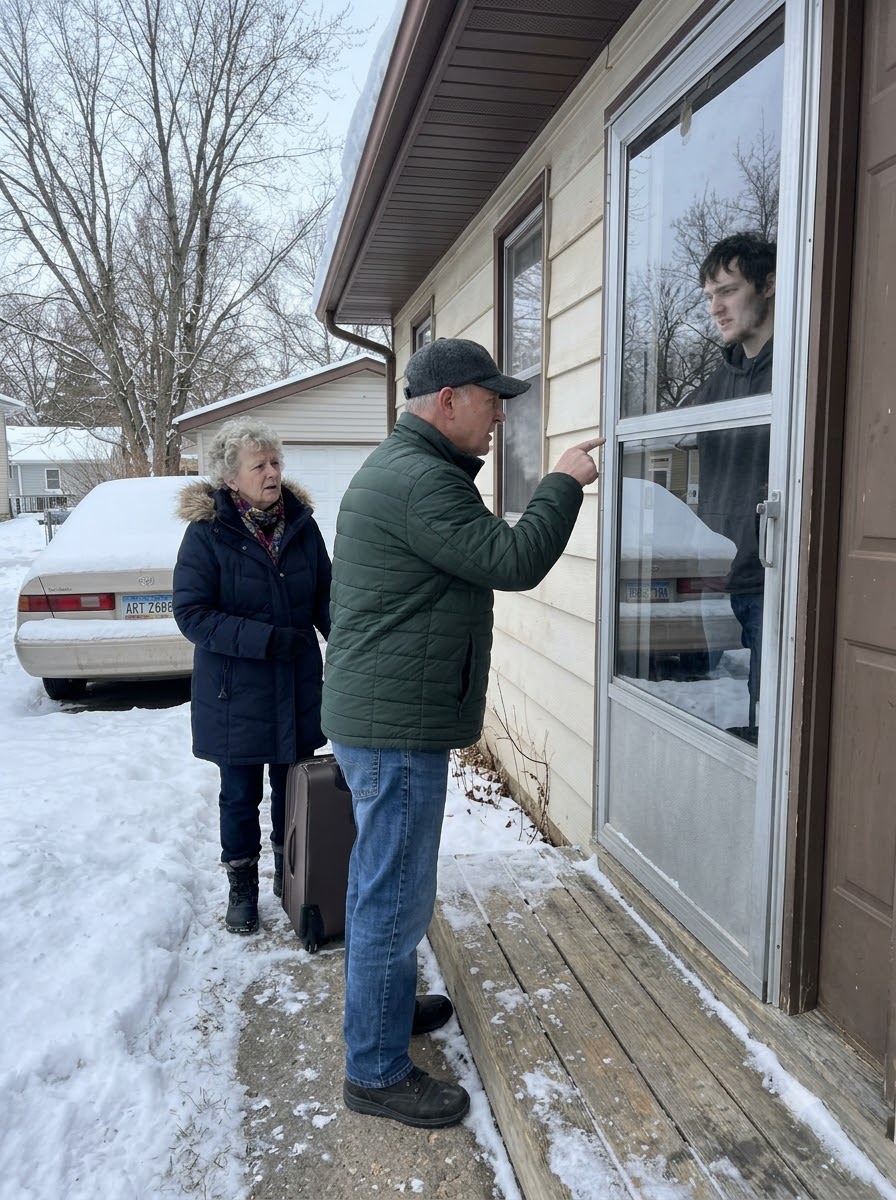
And on a cold Tuesday afternoon in March, I stood on my own front porch and knocked on a door I had been unlocking for forty-three years.
A stranger answered.
He was a young fellow in a dark T-shirt and jeans, probably twenty-five or twenty-six, with a day’s worth of stubble and the expression of a man who had just been interrupted during his afternoon.
He looked at me.
Then at my wife, Ardis.
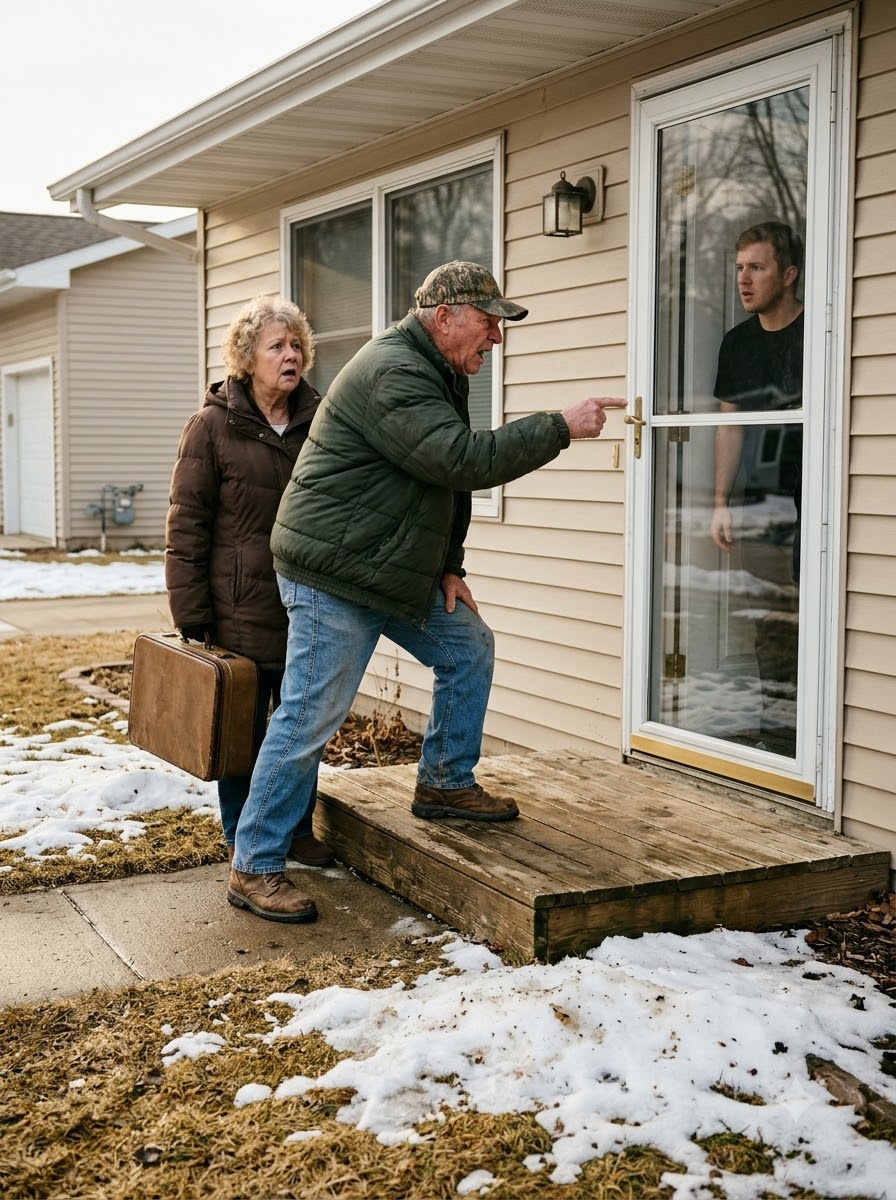
Then at the suitcase sitting beside my boots.
“Can I help you?”
I studied him for a moment.
“That depends,” I said. “Are you living here?”
He frowned.
“Yeah.”
“How long?”
“Since January.”
I nodded slowly.
“Well, that’s interesting. Because I’ve been living here since 1981.”
The young man’s expression changed.
Behind me, Ardis drew a sharp breath.
And that was how we met the man who had been paying our son to live in our basement.
But the story really began three weeks earlier, with a telephone call from our neighbor Vern.
Vern is seventy-five years old, retired from the county road department, and has lived across the street from us for thirty-one years.
He is not a man who calls just to visit.
If Vern telephones while you’re fifteen hundred miles away, something is wrong.
It was a Wednesday morning in February.
I was standing outside our rented park model in Mesa, Arizona, holding a cup of coffee.
The thermometer said eighty-one degrees.
There wasn’t a cloud in the sky.
Ardis had gone down to the pool with her library book, and I was considering whether I had enough ambition to wash the Toyota.
My phone rang.
“Gordon?”
“Morning, Vern.”
There was a pause.
Then he said, “There’s a fella living in your basement.”
I looked toward the swimming pool.
“What?”
“Your basement. There’s a young man staying down there.”
I set my coffee on the railing.
“How do you know?”
“Ran into him at the Casey’s yesterday. He was buying cigarettes and a breakfast sandwich. We got talking.”
Vern cleared his throat.
“He told me he rents the basement from Brett. Six hundred dollars a month.”
I didn’t say anything.
Vern continued.
“Now, I don’t know what arrangement you’ve got with your boy, Gordon. Maybe it’s none of my business.”
“Keep talking.”
“Well, Brett’s girlfriend moved in around Christmas. I’ve seen her car there plenty. Then this other fellow showed up after New Year’s.”
I looked down at my slippers.
“You’re sure he’s paying Brett?”
“That’s what he said.”
“Did he say his name?”
“Austin, I believe.”
I thanked Vern.
He hesitated before hanging up.
“Didn’t want to stir up trouble.”
“You didn’t,” I said. “You told me something I needed to know.”
After the call ended, I sat on the little wooden step outside our rental.
The sun was warm on my face.
A golf cart hummed past.
Somewhere nearby, somebody was laughing.
And I felt colder than I had all winter.
Brett is our only son.
He is thirty-six years old, divorced, and has an eight-year-old daughter named Lily who lives with her mother in the next county.
He has always been a good-hearted boy.
Not always responsible.
Not always careful.
But good-hearted.
He was the sort of child who brought injured birds home in shoeboxes and gave away his lunch money when another kid forgot his.
As an adult, though, he had developed a habit that worried Ardis and me.
He never wanted anyone to know when things were going badly.
If his truck needed repairs, he said everything was fine.
If he looked exhausted, he said he’d been busy.
If we asked about money, he changed the subject.
Still, we trusted him.
Before leaving for Arizona in November, I’d handed him our spare house key.
“Just check the furnace once a week,” I told him. “Run the faucets during cold snaps. Make sure the pipes don’t freeze.”
“Got it, Dad.”
“And don’t forget your mother’s African violets.”
He laughed.
“Those flowers get better treatment than I do.”
Ardis smacked his arm playfully.
“Then maybe you should bloom once in a while.”
That was the arrangement.
No rent.
No guests.
No permission to move anyone into the house.
Certainly no permission to turn our basement into an income property.
When Ardis returned from the pool that Wednesday, she knew something was wrong before I spoke.
She had a towel over one shoulder and a paperback tucked beneath her arm.
“Is it Brett?”
I nodded.
I told her everything.
She sat beside me on the step.
For a long time, she didn’t speak.
Then she asked, “What are you going to do?”
I considered calling the sheriff.
For about a minute.
But I knew how that conversation would go.
A deputy would ask whether the young man was paying rent.
I’d say yes.
Then he’d explain that removing a paying occupant could be a civil matter, regardless of whether Brett had the right to rent the place.
Besides, our town had only about 2,200 people.
The sheriff’s log was printed in the local newspaper.
I wasn’t eager to see my son’s name there.
Calling Brett didn’t appeal to me either.
He would have an explanation ready before I finished my first sentence.
And if I told him we were coming home, he’d have two days to clear everyone out.
I wanted to know what was really happening.
I wanted to look my son in the eye.
So I told Ardis we were leaving.
She didn’t argue.
We packed the following two days, settled our rental arrangements, and left Mesa at daybreak Sunday.
We were supposed to stay until Mother’s Day.
Instead, we spent two nights in roadside motels, one in Tucumcari and another in Salina.
We drove through long stretches of open country with barely any conversation.
Ardis knitted for a while.
Then she put the yarn away.
Outside Concordia, Kansas, she finally spoke.
“He never asks us for a dime.”
I kept my eyes on the road.
“Maybe that’s the trouble.”
She turned toward me.
“What do you mean?”
“I don’t know yet.”
And that was the truth.
I knew Brett had betrayed our trust.
What I didn’t know was why.
We reached our street Tuesday at 2:30 in the afternoon.
Gray piles of snow lined the curbs.
The Hendersons’ porch still had Christmas lights hanging along the railing.
A black pickup I didn’t recognize was parked in front of our house.
Brett’s truck was nowhere to be seen.
Across the street, Vern’s curtain moved.
So did the Hendersons’.
In a small town, news travels faster than weather.
I pulled our old tan Toyota into the driveway.
Ardis took her suitcase from the trunk and rolled it up the walkway.
Then she placed it beside my boots.
I don’t know why.
Perhaps she needed something solid to hold on to.
Through the front window, I could see her African violets.
Purple.
Healthy.
Still blooming.
“Somebody’s been watering them,” she said softly.
I had my house key in my coat pocket.
I’d carried it all the way from Arizona.
But I knocked anyway.
Three times.
Exactly the way my father used to knock.
Footsteps sounded inside.
Then the storm door opened.
And a stranger asked what we wanted.
I looked at him.
“My name is Gordon Haldane,” I said. “This is my wife, Ardis.”
He nodded uncertainly.
“Okay?”
“We own this house.”
The young man stared.
Then he looked over his shoulder into the hallway.
“Wait. What?”
“I believe you’re renting our basement.”
His face went pale.
“Brett said it was his house.”
And in that moment, I realized our son hadn’t simply taken advantage of us.
He had lied to someone else, too.
PART 2: The Six Hundred Dollars
The young man introduced himself as Austin Mercer.
He was twenty-six years old, worked at an auto-parts warehouse, and had been living in our basement since the first week of January.
He stepped aside to let us in.
“I’m sorry,” he kept saying. “I didn’t know.”
I believed him.
There is a particular look a man gets when he realizes he’s been fooled and has no idea what it might cost him.
Austin had that look.
Our living room was mostly the way we’d left it.
Ardis’s crocheted blanket was folded over the couch.
My recliner stood beside the window.
But there were things that didn’t belong.
A pair of women’s boots near the coat rack.
A pink jacket over the dining-room chair.
Two extra coffee mugs in the sink.
And a framed photograph of Brett and a young woman sitting on the mantel beside our wedding picture.
Ardis noticed that last detail.
She picked up the photograph.
“Jade,” she said quietly.
Jade was Brett’s girlfriend.
We’d met her twice.
She was thirty-two, worked irregular shifts at a local restaurant, and seemed pleasant enough.
We didn’t know her particularly well.
I turned back to Austin.
“Where’s your sister?”
“At work.”
“And Brett?”
“He said he had deliveries today.”
I frowned.
“Deliveries?”
Austin looked confused.
“Yeah. He’s been doing delivery routes since December.”
I felt something shift in my stomach.
Brett had told us he was still working at the factory.
He’d worked there nearly eleven years.
“Does he still work at Midwestern Components?” I asked.
Austin hesitated.
“I don’t think so.”
Ardis set down the photograph.
“What do you mean?”
“He got laid off, didn’t he?”
The room went quiet.
Austin looked from one of us to the other.
“Oh, man. You didn’t know that either?”
I sat down in my own recliner.
It was the first time I’d sat in it since November.
Suddenly, it didn’t feel familiar.
“Start at the beginning,” I told him.
Austin explained that he’d lost his apartment after the building was sold and the new owner increased the rent beyond what he could afford.
He had been staying on friends’ couches when Jade mentioned that Brett had a finished basement available.
Brett offered it for $600 a month, utilities included.
Austin paid a security deposit and his first month’s rent.
He’d also paid for February and March.
He showed me the transfers on his phone.
Each payment went directly to Brett.
The memo line read: Basement rent.
I stared at the screen.
My son had collected more than two thousand dollars from a man who believed he had a legitimate rental agreement.
“Did Brett give you anything in writing?” I asked.
Austin nodded.
He went downstairs and returned with a single sheet of paper.
It was a simple rental agreement.
Brett had signed it as the property owner.
I recognized his signature immediately.
That hurt worse than the money.
Because this wasn’t a misunderstanding.
He had made a deliberate choice to misrepresent something that belonged to his mother and me.
Ardis read the paper.
Then she folded it carefully.
“Where were you living before?” she asked Austin.
He told her about the apartment.
About sleeping on a friend’s couch.
About how difficult it had been to find a place he could afford.
She listened without interrupting.
Finally, she said, “Well, you’re not going out into the cold this afternoon.”
Austin looked stunned.
“Ma’am?”
“You paid for a place to stay in good faith. Whatever Brett has done, you didn’t do it.”
I looked at my wife.
She looked back.
We’d been married fifty-one years.
Sometimes an entire conversation could pass between us without either one speaking.
This was one of those times.
I nodded.
“She’s right. We’re going to sort this out properly.”
Austin’s shoulders dropped.
“Thank you.”
He looked close to tears.
About an hour later, Jade came home.
She walked through the door carrying grocery bags and stopped so suddenly that a carton of eggs slipped from her arm.
Ardis caught it before it hit the floor.
For a moment, the two women simply stared at each other.
“Mrs. Haldane?”
“Hello, Jade.”
Jade’s face drained of color.
“You’re home early.”
“Yes,” Ardis replied. “We are.”
Jade looked toward Austin.
He shook his head.
“They know.”
She closed her eyes.
I asked her to sit down.
She didn’t want to.
But eventually, she did.
At first, she tried to explain that Brett had meant to tell us.
I stopped her.
“Jade, I’m not interested in what he meant to do. I’m interested in what actually happened.”
She looked at her hands.
Then she told us the truth.
Brett had lost his factory job just before Christmas.
The company had cut positions after losing a major contract.
He had been among those let go.
At first, he believed he’d find another job quickly.
Then the holidays passed.
His savings disappeared.
His truck payment came due.
He still owed child support for Lily.
And he was too embarrassed to tell us.
“He didn’t want you worrying,” Jade whispered.
I almost laughed.
Not because it was funny.
Because we had just driven 1,480 miles home after discovering he’d rented out our basement behind our backs.
“Well,” I said, “that plan didn’t work.”
Jade’s eyes filled with tears.
She explained that Brett had been taking delivery jobs whenever he could find them.
Some days he worked twelve hours.
Other days there was no work at all.
He’d moved into our house because he could no longer afford his apartment.
She’d joined him because she was struggling with rent herself.
Then Austin needed somewhere to live.
And Brett saw a way to bring in another $600 a month.
“He said he’d put everything back before you came home,” Jade said.
I stared at her.
“So the plan was to use our house, collect rent, and make sure we never found out?”
She didn’t answer.
She didn’t have to.
Then Ardis asked something I hadn’t thought to ask.
“Where’s Brett been sleeping?”
Jade looked surprised.
“Here. In his old bedroom.”
Ardis lowered her eyes.
Our son’s childhood bedroom was at the end of the hallway.
We had left it mostly untouched after he moved out.
I walked down the hall.
The door was open.
There was a sleeping bag on the floor, a pile of work clothes in the corner, and a stack of unpaid bills on the dresser.
I picked up the top envelope.
A truck loan notice.
Another was from a collection agency.
The third was a reminder about overdue child support.
I didn’t open them.
I didn’t need to.
For the first time since Vern’s telephone call, my anger began making room for something else.
Fear.
Not fear of what Brett had done to us.
Fear of how desperate he’d become before doing it.
And fear that we’d somehow raised a son who believed he had nowhere to turn.
PART 3: The Drive to the Grain Elevator
Brett came home shortly after six.
I heard his truck before I saw it.
The engine had developed a rough rattle that hadn’t been there the last time I rode in it.
He pulled into the driveway, climbed out carrying a paper bag from a fast-food restaurant, and headed toward the front door.
When he stepped inside and saw Ardis sitting at the kitchen table, he froze.
Then he saw me.
“Dad?”
I stood beside the sink.
“Evening, Brett.”
He looked from me to his mother.
“What are you doing here?”
“Living in our house,” I answered. “Or trying to.”
His face went white.
Jade appeared in the hallway.
Austin stayed downstairs.
For several seconds, nobody spoke.
Then Brett set the food on the counter.
“I can explain.”
“I’m sure you can.”
“Dad, listen—”
“Get your coat.”
He stared.
“What?”
“We’re going for a drive.”
Ardis looked at me.
I gave her a small nod.
She understood.
I wasn’t taking him somewhere to threaten him.
I needed to speak to my son without an audience.
We climbed into the Toyota.
Brett sat in the passenger seat, staring straight ahead.
I drove through town, past the hardware store, the post office, and the diner where Ardis and I used to take him for pancakes on Saturday mornings.
Then I turned onto the road leading to the old grain elevator.
I’d worked there for forty years.
Started sweeping floors at twenty-two.
Ended up supervising the loading crews.
It wasn’t glamorous work.
But it put food on our table and helped pay for our house.
I parked near the chain-link fence.
The elevator rose against the darkening sky.
For a while, neither of us spoke.
Then I asked, “How long have you been out of work?”
Brett stared at his hands.
“Since December nineteenth.”
“Why didn’t you tell us?”
He swallowed.
“I thought I’d find something.”
“That wasn’t my question.”
He looked out the window.
“I didn’t want you thinking I was a failure.”
Those words landed harder than I expected.
I turned off the engine.
“Brett, look at me.”
He didn’t.
“Son.”
Finally, he turned.
His eyes were red.
“I know I screwed up,” he said. “I know what I did was wrong.”
“Then why’d you do it?”
He took a shaky breath.
“Because I was scared.”
And then everything came spilling out.
He’d been laid off without much warning.
He’d used what savings he had to keep up with his truck payments and child support.
He’d applied for jobs all over the county.
Some employers never called back.
Others offered wages too low to cover his obligations.
He started taking delivery work.
But his truck needed repairs, and every mile he drove seemed to cost him money.
He moved into our house thinking it would only be for a few weeks.
Then Jade’s lease ended.
Then Austin lost his apartment.
Brett convinced himself that charging Austin rent would help everyone.
Austin would have somewhere affordable to stay.
Brett could catch up on his bills.
And we’d never know because he’d have everything cleared out before Mother’s Day.
“I wasn’t trying to steal from you,” he said.
I looked at him.
“You signed a rental agreement saying you owned our house.”
He lowered his head.
“I know.”
“You collected money for property that isn’t yours.”
“I know.”
“And you lied to your mother and me for months.”
His voice broke.
“I know, Dad.”
I let the silence settle.
Then I said something I hadn’t planned to say.
“In 1985, I went six weeks without a paycheck.”
Brett looked up.
“What?”
“The elevator had a shutdown. Equipment problems. Management was fighting with the contractors. Work dried up for a while.”
I stared through the windshield.
“You were a little boy. Your mother was working part-time. We had a mortgage and almost nothing in savings.”
He frowned.
“You never told me that.”
“No.”
“How’d you manage?”
I rubbed my hands together.
“I borrowed four hundred dollars from my father.”
Brett looked genuinely shocked.
“Grandpa?”
“Yes.”
“You always said you never borrowed money from anybody.”
“I know what I said.”
I remembered that afternoon as clearly as if it had happened yesterday.
My father had been sitting at his kitchen table, reading the newspaper.
I’d walked in with my hat in my hands and spent fifteen minutes talking about the weather before I finally asked for help.
He hadn’t lectured me.
He hadn’t called me irresponsible.
He’d simply opened a drawer, taken out his checkbook, and asked how much I needed.
Four hundred dollars.
It kept our mortgage current.
I repaid every cent.
But I never told Brett.
And for forty years, I’d carried the shame of needing that money.
“Why didn’t you tell me?” Brett asked.
I looked at him.
“Because I was embarrassed.”
He gave a sad little laugh.
“Sounds familiar.”
I nodded.
“Yes, it does.”
He wiped his face with his sleeve.
“Dad, you never missed a day of work. You always paid your bills. You always had everything figured out.”
“No, son. I didn’t.”
“That’s how it looked.”
And there it was.
The truth I hadn’t expected to find.
I had spent my life trying to be a strong father.
A dependable father.
A man who never complained and never needed help.
But somewhere along the way, my son had learned the wrong lesson.
He thought strength meant never admitting you were struggling.
He thought responsibility meant solving every problem alone.
And when he couldn’t, he began lying to protect the image he believed I expected him to maintain.
That didn’t excuse what he’d done.
Not one bit.
But it helped me understand how we’d arrived there.
“I was wrong to hide that from you,” I said.
Brett shook his head.
“You didn’t do anything wrong.”
“Yes, I did. I made you believe your father had never needed help.”
He stared at the floor.
Then he said something that nearly broke me.
“I thought if you knew I couldn’t even keep my job, you’d stop being proud of me.”
I had to look away.
Because I realized I couldn’t remember the last time I’d told my son I was proud of him.
I’d told him to keep his truck maintained.
To pay his bills.
To show up for Lily.
To work hard.
But I couldn’t remember the last time I’d simply told him that I loved him without attaching advice to it.
“Brett,” I said quietly, “I’m disappointed in what you did.”
He nodded.
“But I’m not ashamed of you.”
His face crumpled.
“And losing your job doesn’t make you a failure.”
He covered his eyes.
For a long time, we sat in the parked car while my thirty-six-year-old son cried.
Then I reached over and put my hand on his shoulder.
“We’re going to fix this,” I told him.
He nodded.
“But we’re going to fix it honestly.”
PART 4: What Happened Around Our Kitchen Table
When we returned home, Ardis had made coffee.
She’d also put a plate of sandwiches on the kitchen table.
That was my wife.
She could be furious with you and still worry whether you’d eaten.
Jade sat beside Brett.
Austin came upstairs from the basement.
For the first time, all five of us sat together.
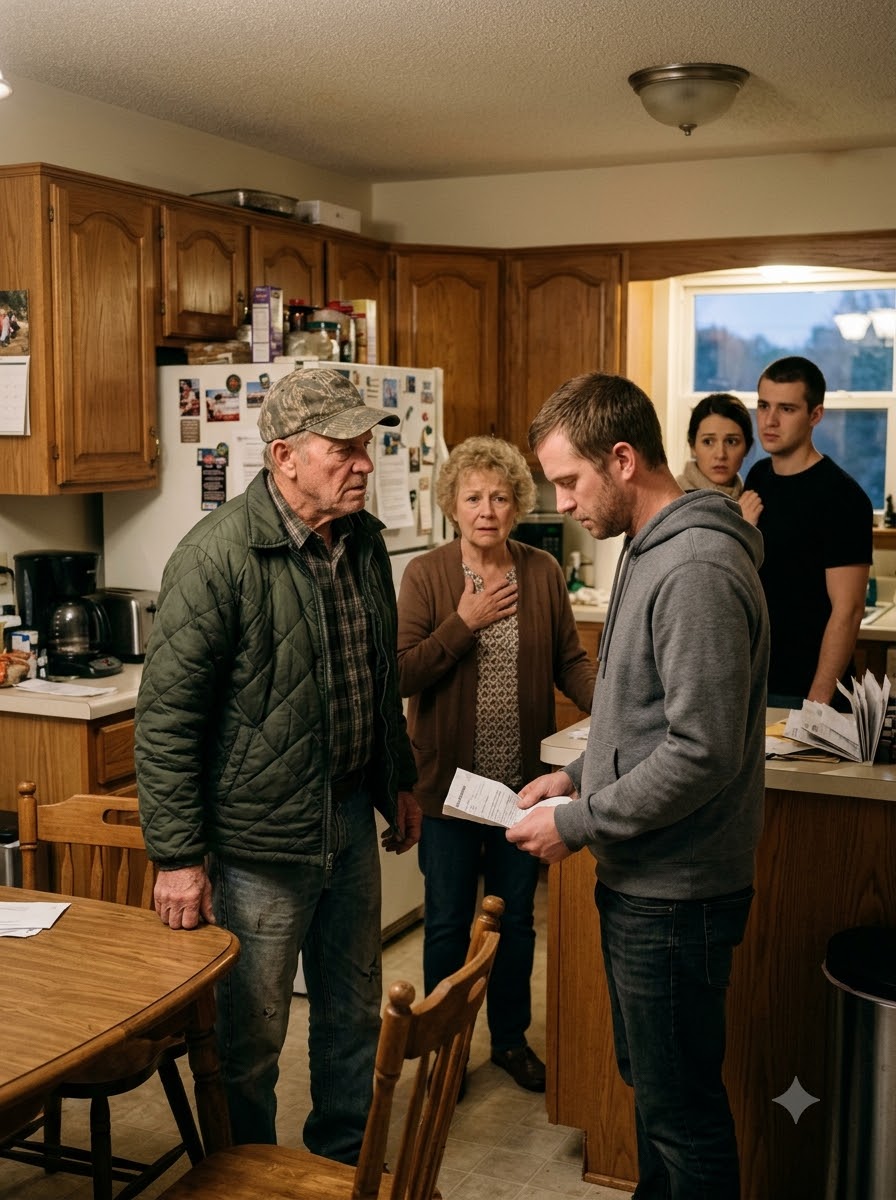
I placed the rental agreement in the middle of the table.
Nobody touched it.
“Here’s what we’re going to do,” I said.
I looked at Brett.
“First, you’re going to apologize to Austin.”
Brett turned toward him.
“I’m sorry, man. I should’ve told you the truth.”
Austin stared at the table.
“I thought I was renting from the owner.”
“I know.”
“I gave you a deposit. I paid you every month. I trusted you.”
Brett nodded.
“I know.”
Austin’s voice hardened.
“You put me in a bad position. I don’t have money to find another apartment tomorrow.”
That was fair.
And Brett didn’t argue.
I told them we would not throw anyone out into the March cold.
But from that point forward, there would be no secret arrangements.
No more money collected by Brett.
No pretending he owned property that belonged to his mother and me.
We would review what Austin had paid, document everything, and work out a lawful, reasonable arrangement that gave him time to find another place if he chose to leave.
Brett would repay the rent money he’d taken, with the repayment schedule written down so nobody had to rely on another promise.
Austin looked relieved, though still understandably angry.
Then I turned to Jade.
“You’ve been living here since Christmas?”
She nodded.
“Yes, sir.”
“Did you know Brett didn’t own the house?”
“Yes.”
“Then you owe Ardis an apology, too.”
Jade looked at my wife.
“I’m sorry. You were always kind to me, and I took advantage of that.”
Ardis folded her hands.
“Jade, I don’t mind helping people. I mind being lied to.”
Jade began crying.
Ardis reached across the table and handed her a tissue.
“Those are two different things.”
We talked for nearly three hours.
Not everything was settled.
There were questions about money.
About jobs.
About where everyone would live.
About what Brett owed Austin and what responsibility he needed to take for the decisions he’d made.
But something important had changed.
Nobody was pretending anymore.
The following morning, Brett brought over every bill he’d been avoiding.
We spread them across the kitchen table.
Truck payments.
Credit cards.
Insurance.
Child support.
Late fees.
It was an ugly pile.
But it was a real pile.
And real problems can be addressed.
Imaginary perfection cannot.
I helped him make a budget.
Ardis helped him update his résumé.
We made it clear that we would not simply hand him money to erase the consequences of his choices.
But we would help him find a way forward.
He contacted his daughter’s mother and began discussing how to address his overdue support properly.
He applied for jobs.
He spoke with the lender about his truck.
And he began making payments toward what he owed Austin.
Over the next several weeks, we put a temporary written housing arrangement in place with everyone’s agreement while Austin searched for another apartment.
Jade continued working.
Brett kept taking deliveries while looking for steadier employment.
Some evenings were tense.
There were arguments.
There were moments when I wondered whether we had made the right decision by allowing everyone time to sort things out.
But whenever I felt my temper rising, I remembered that conversation outside the grain elevator.
I remembered my father opening his checkbook in 1985.
And I remembered how much it had meant that he helped me without making me feel small.
One Sunday afternoon, Brett came over while I was working in the garage.
He had an envelope in his hand.
“What’s that?” I asked.
“First payment toward Austin’s money.”
I nodded.
“Good.”
He hesitated.
“Dad?”
“Yeah?”
“Thanks for not calling the sheriff.”
I put down my wrench.
“Don’t thank me for that.”
He looked confused.
“Thank me when you’ve finished making things right.”
He nodded.
Then I added, “And next time you’re in trouble, call me before it gets this bad.”
He smiled faintly.
“Even if I mess up?”
“Especially then.”
A month later, Brett found a full-time position at a distribution center about thirty miles away.
The pay wasn’t quite what he’d made at the factory.
But it was steady.
He kept up his repayment plan.
Austin eventually found an apartment closer to his warehouse job, and we helped him move his furniture.
On the day he left, he shook my hand.
“Mr. Haldane, thanks for not making me pay for somebody else’s mistake.”
I looked at him.
“You’d already paid enough.”
He laughed.
Then he climbed into his pickup and drove away.
Jade and Brett stayed together, though they found their own place once they had enough saved.
They didn’t move far.
Just across town.
And when Brett finally handed back our spare house key, he placed it carefully on the kitchen table.
“I should’ve asked for help,” he said.
“Yes,” I answered. “You should have.”
Then I pushed the key back toward him.
He stared.
“Dad?”
“Keep it.”
His eyes widened.
“But—”
“Your mother and I still need somebody to check the furnace when we go south.”
He laughed.
Then his expression grew serious.
“You sure?”
I nodded.
“One condition.”
“Anything.”
“No tenants.”
He laughed so hard Ardis came in from the living room to see what was happening.
That summer, Brett brought Lily over for supper one Saturday.
She was eight years old and had recently lost one of her front teeth.
After dinner, she followed me into the backyard while I watered the tomatoes.
“Grandpa?”
“Yes, sweetheart?”
“Daddy says he made a big mistake.”
I turned off the hose.
“Did he?”
She nodded.
“He says you were really mad.”
“I was.”
“Are you still mad?”
I thought about it.
“No. Not the same way.”
She considered that.
Then she asked, “Can people still be good if they make mistakes?”
I knelt beside her.
“Of course they can.”
“Even big ones?”
“Even big ones.”
She looked relieved.
“That’s good. Because I broke Mom’s favorite mug last week.”
I laughed.
“Did you tell her?”
“Yes.”
“What happened?”
“She was sad. But she said thank you for telling the truth.”
I smiled.
“Your mom sounds pretty smart.”
Lily nodded solemnly.
“She is.”
Then she ran off to chase a butterfly.
I stood there watching her and thought about how easily a family’s habits get passed down.
The things we say.
The things we don’t say.
The way we handle disappointment.
The way we respond when someone admits they’ve failed.
For forty years, I had believed the story about borrowing money from my father was something I should keep to myself.
I thought it made me look weak.
But telling Brett that story had done more good than all the lectures I’d ever given him about responsibility.
Because he’d finally seen me as a man.
Not a perfect father.
Not a man who had always known what to do.
Just a man who had struggled, made mistakes, accepted help, and kept going.
That fall, Ardis and I began talking about Arizona again.
We hadn’t decided whether we’d spend the entire winter there.
The drive was getting harder on both of us.
But one evening, while we were sitting on the porch, Brett stopped by after work.
He had a bag of groceries for his mother and a new furnace filter for me.
“Thought I’d save you a trip to the hardware store,” he said.
Ardis smiled.
“Well, look at you.”
He shrugged.
“Just trying to be useful.”
After he left, Ardis leaned against my shoulder.
“You think he’ll be all right?”
I watched Brett’s truck disappear down the street.
“I think he’s learning.”
She nodded.
Then she said, “So are we.”
I reached for her hand.
She was right.
We had driven 1,480 miles home because our son had betrayed our trust.
We found strangers living in our house.
We discovered lies, unpaid bills, and a rental agreement Brett had no right to sign.
None of that was acceptable.
And none of it disappeared simply because we understood why he’d done it.
He still had to repay the money.
He still had to rebuild trust.
He still had to learn that desperation did not give him permission to take advantage of other people.
But I had something to learn, too.
For most of my life, I’d believed being a good father meant providing for my family, never complaining, and showing my children what strength looked like.
I thought that if I never let them see me struggle, they’d grow up strong.
Instead, my son grew up believing that struggling was something to hide.
I had taught him how to work.
I had taught him how to save.
I had taught him how to fix an engine and change a tire.
But I hadn’t taught him how to ask for help without feeling ashamed.
And that might have been the most important lesson of all.
A few weeks before Thanksgiving, Brett came over to help me clean the garage.
We worked side by side for most of the afternoon.
As we were putting away the tools, he stopped and looked at me.
“Dad?”
“Yeah?”
“I don’t think I ever told you how scared I was that day you came home.”
I smiled.
“I imagine you were.”
“I thought you’d never trust me again.”
I set the toolbox on the shelf.
“Trust takes time to rebuild, son.”
“I know.”
“But I’m not going anywhere.”
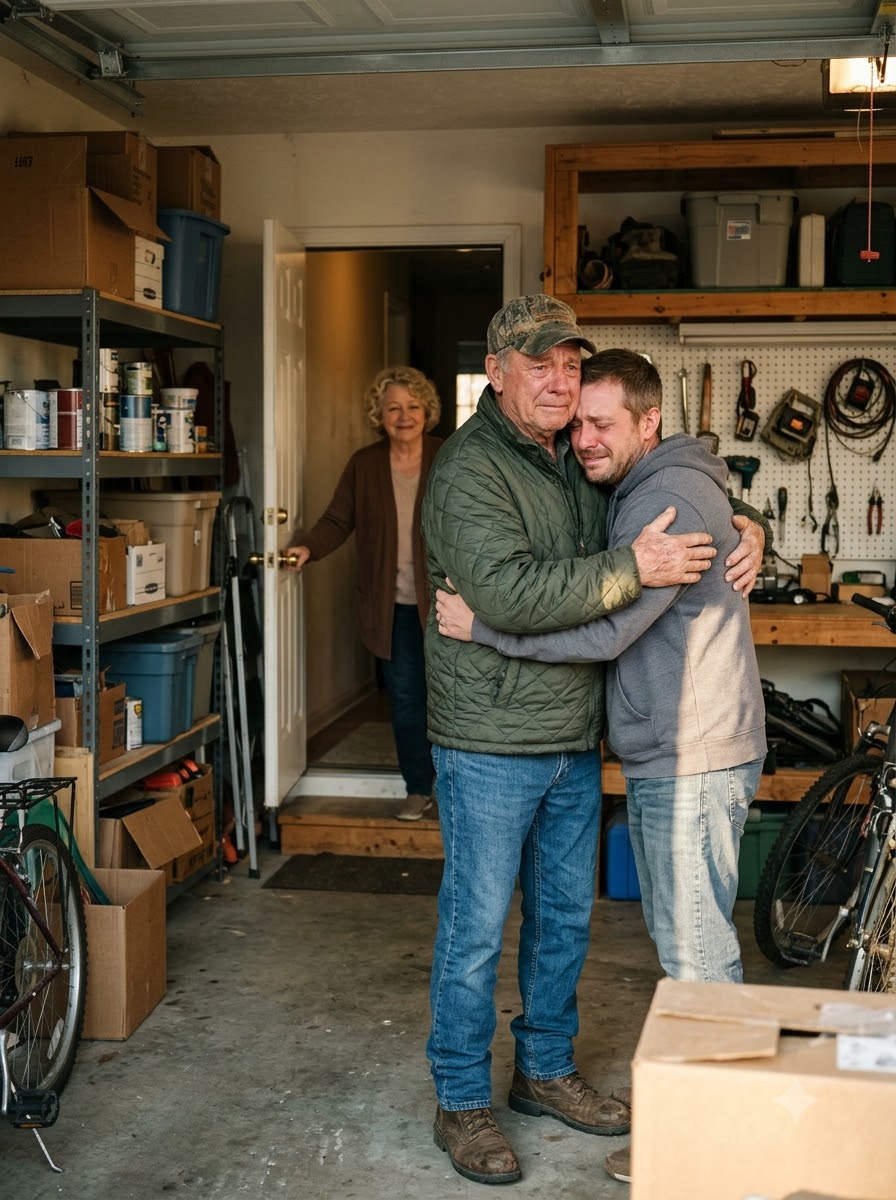
His eyes grew wet.
He nodded.
Then he stepped forward and hugged me.
Not one of those quick, awkward hugs men sometimes give each other at Christmas.
A real hug.
The kind he used to give me when he was a little boy and had fallen off his bicycle.
I held him for a moment.
Then I patted his back.
“All right,” I said. “Now help me carry that ladder.”
He laughed.
And we went back to work.
That evening, I sat at the kitchen table with Ardis.
The house was quiet again.
The basement was empty.
Her African violets were blooming on the windowsill.
Everything was where it belonged.
But something inside our family had changed.
We had stopped pretending that love meant never disappointing one another.
We had stopped confusing pride with strength.
And we had begun learning that honesty, even when it hurts, is the only solid foundation a family can stand on.
I still believe Brett was wrong to do what he did.
I still believe a man must take responsibility for his choices.
But I no longer believe that responsibility means facing every hardship alone.
Because sometimes the strongest thing a grown man can say is, “Dad, I need help.”
And sometimes the most important thing a father can answer is, “I’m here. Now tell me the truth.”
Being a good father doesn’t mean raising children who never struggle. It means making sure they know that when life becomes too heavy, they can come home, tell the truth, and ask for help without losing your love.
