

PART 1
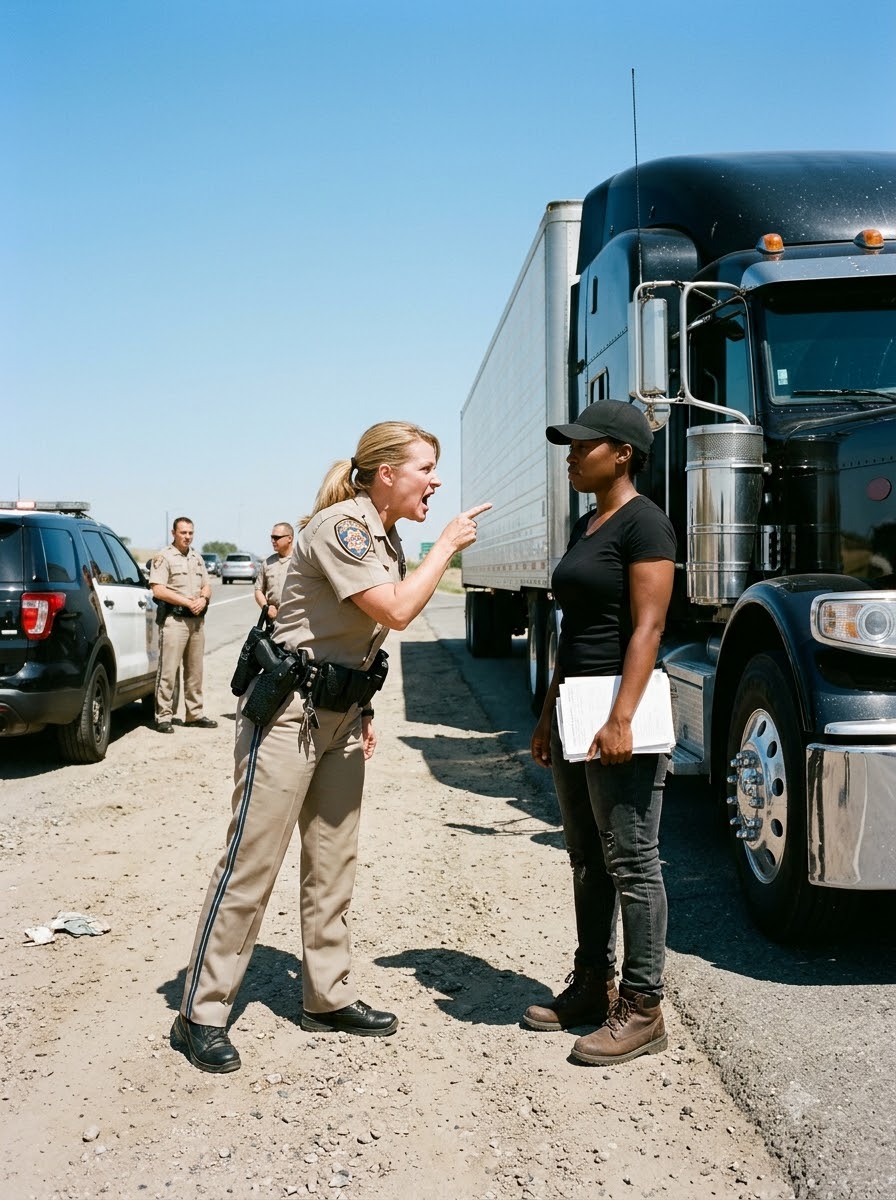
“Keep your hands where I can see them, freight trash.”
Deputy Boyd Keller’s voice sliced through the truck stop parking lot.
He stood beside fuel pump seven, holding Mariah Reed’s commercial driver’s license between two fingers as though touching it disgusted him.
Then he dropped it.
The plastic card struck the pavement, bounced once, and landed faceup beneath the afternoon sunlight.
The name printed across it was Tessa Boone.
Independent truck driver.
Valid commercial license.
No criminal history.
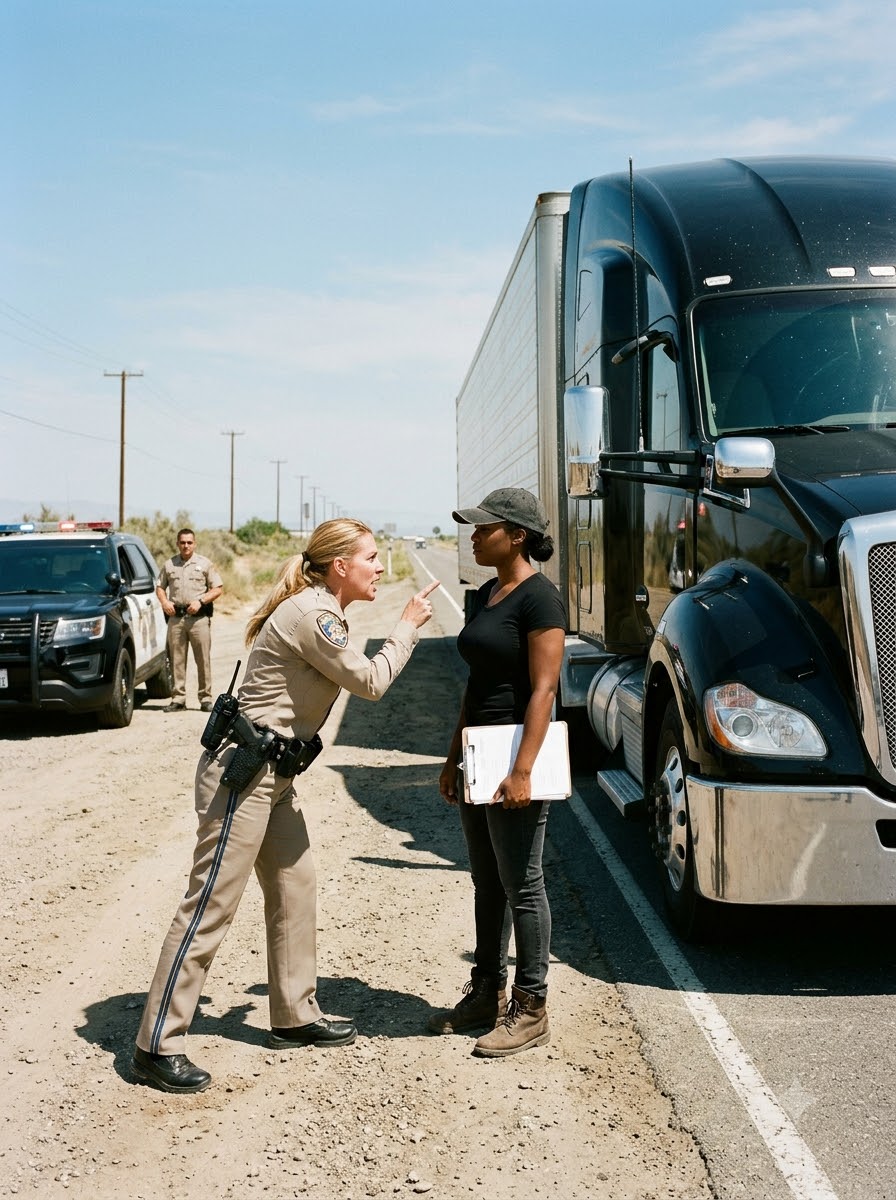
All the documents necessary to operate legally.
Keller placed his boot directly over the card.
Then he twisted his foot.
Slowly.
Deliberately.
As if grinding the name into the asphalt would somehow erase the woman standing before him.
Several truckers stopped fueling their vehicles.
A mother beside an SUV instinctively raised a hand toward her child’s face.
Near the vending machines, a teenage boy lifted his phone and began recording.
Keller noticed.
Instead of stopping, he smiled.
“Look at her,” he announced. “Big rig, big mouth, no respect.”
Deputy Trent Shaw laughed.
Then he seized Mariah’s arms and wrenched them behind her back.
The handcuffs closed so tightly that pain shot through both shoulders.
Her cheek struck the sun-heated metal door of her semi.
The surface burned her skin.
Mariah made no sound.
She didn’t shout.
She didn’t curse.
She didn’t resist.
Every instinct in her body demanded action, but she forced those instincts into silence.
That was what her training required.
Pain was something her body experienced.
Fear was something her mission accounted for.
Neither was allowed to control her decisions.
A concealed communications device inside her ear clicked.
Then a familiar voice spoke.
“Reed, hold position. Do not engage.”
Mariah inhaled slowly and kept her expression unreadable.
Keller leaned toward her.
His breath carried the stale smell of coffee and tobacco.
He believed he had stopped an ordinary Black woman driving a freight truck.
He believed she was isolated.
He believed the badge on his chest made him untouchable.
He was mistaken about every one of those things.
Three weeks earlier, Special Agent Mariah Reed had entered Briar County under the identity of Tessa Boone.
The identity had been constructed with meticulous care.
A long-haul driver originally from Memphis.
No relatives nearby.
No visible connection to federal law enforcement.
A weathered black Peterbilt.
A scratched trailer.
Legitimate freight documents.
A clean inspection record.
Everything about Tessa Boone was designed to withstand casual scrutiny.
For eight months, teenage girls had been disappearing along the Interstate 19 corridor.
Their disappearances rarely attracted national attention.
They vanished from inexpensive motels, roadside restaurants, bus stations, rest areas, and parking lots used by exhausted travelers.
Some were in foster care.
Some had run away from home.
Others had been traveling with family members before disappearing during brief stops.
Their cases crossed county boundaries and became tangled in jurisdictional disputes.
One department insisted another was responsible.
Another claimed security cameras had malfunctioned.
Some officers dismissed the missing girls as runaways.
Eventually, too many investigative files ended with the same phrase.
No further leads.
Mariah’s federal task force had uncovered a connection.
A matte-black transport truck appeared near several disappearance locations.
Its temporary license plates changed frequently.
It had no company markings.
A modified exhaust stack curved behind the cab.
Whenever federal surveillance approached its route, an unexpected local traffic stop or road closure disrupted the operation.
The timing was too consistent to dismiss.
Someone inside local law enforcement appeared to be protecting the truck.
That was why Mariah had become Tessa Boone.
And why she was now standing beside pump seven with her wrists trapped behind her back.
Earlier that afternoon, the Briar County rest stop had appeared entirely ordinary.
Heat shimmered over the parking lot.
A child complained about losing money in a vending machine.
Two drivers argued over a fuel receipt.
Two sheriff’s cruisers waited beneath a dying sycamore tree.
Mariah arrived at 2:12 p.m.
Exactly as planned.
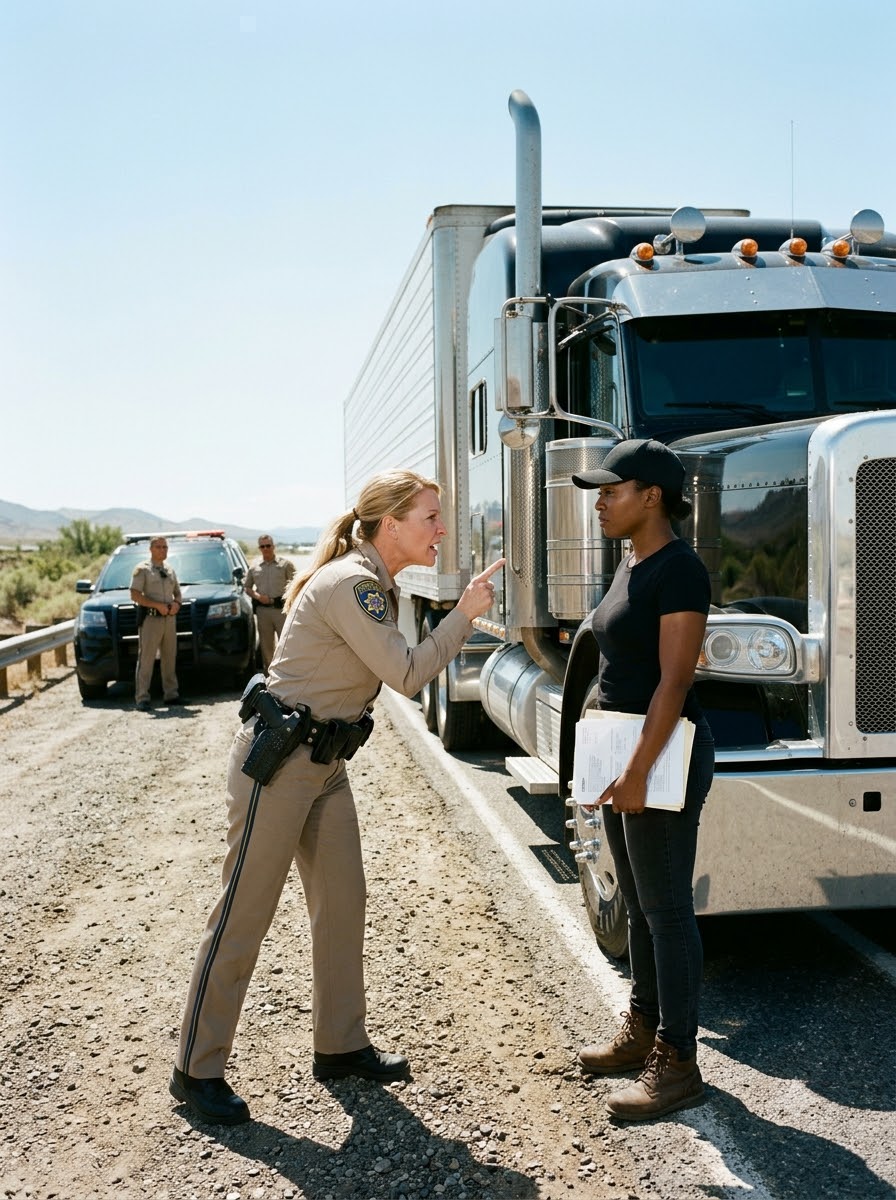
She parked her Peterbilt, shut down the engine, and climbed from the cab carrying a clipboard.
The black transport truck was expected within the hour.
She pretended to inspect her freight documents while watching the highway entrance.
Then footsteps approached.
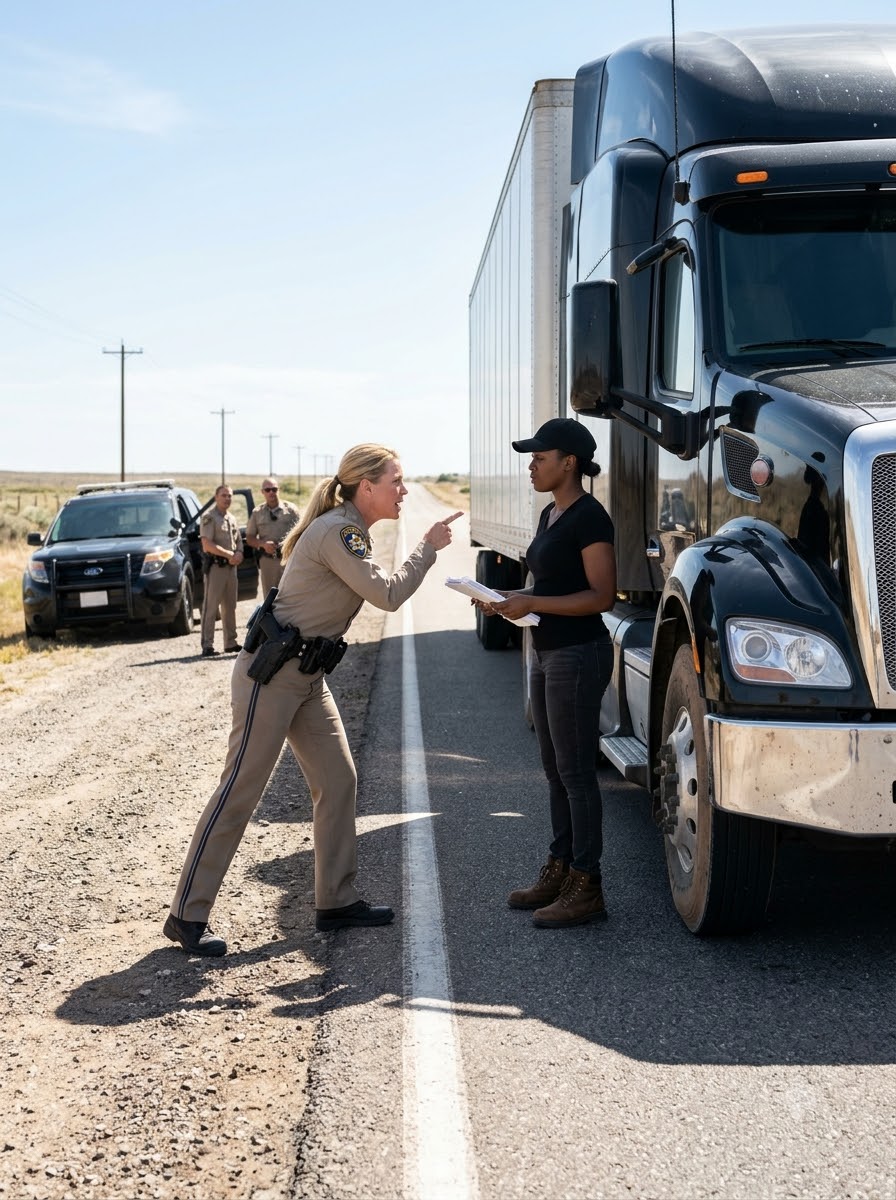
“Well, well,” Deputy Shaw called. “Don’t see many lady drivers in a rig like this.”
Mariah turned at a measured pace.
“Afternoon, Deputy. Just doing my safety inspection.”
Shaw was tall and heavyset, with a flushed face and a grin that seemed permanently attached to him.
He looked Mariah over with obvious contempt.
Keller approached behind him.
Unlike Shaw, Keller didn’t waste movement.
His uniform was immaculate.
His boots shone.
His pale eyes studied people with the cold calculation of someone accustomed to deciding their worth before hearing them speak.
“This is a rest area,” Keller said. “Not a freight depot. How long are you staying?”
“Ten minutes, maybe less. My documents are current if you’d like to check.”
Mariah offered the clipboard.
Keller ignored it.
Instead, he grabbed her wrist.
His fingers tightened.
“Funny thing about paperwork,” he said. “It only matters when the person holding it looks honest.”
Mariah instantly recognized several ways to escape his grip.
She could break his thumb.
Turn into his arm.
Strike his ribs.
Sweep his leg.
Disable him before Shaw could react.
Her training supplied the possibilities automatically.
But using any of them would expose her cover and possibly destroy the investigation.
She pressed her thumb against a concealed transmitter beneath her sleeve.
Two quick taps.
An escalation signal.
“Deputy, you’re hurting my wrist,” she said clearly. “I’ve given you my license and freight documents. You have no reason to put your hands on me.”
Shaw chuckled.
“You hear that, Boyd? She knows words.”
Keller forced her arm behind her back.
“Resisting.”
He pronounced the accusation with practiced confidence.
A moment later, Mariah’s face struck the truck door.
The crowd gasped.
Her concealed earpiece crackled again.
This time, the voice was urgent.
“Reed, abort. Abort now. Target is moving. We are compromised.”
Cold dread passed through her.
Beyond the rest stop building, the black transport truck appeared.
It rolled across the lot, turned sharply, and accelerated toward the eastbound ramp.
The vehicle they had been hunting.
The vehicle that might contain missing girls.
And it was leaving while Keller deliberately occupied her.
Shaw pushed her toward the patrol car.
“Not so tough now, are you?”
Mariah remained silent.
Her mind worked rapidly.
Primary communications active.
Backup tracking device secured at her ankle.
Emergency blade concealed in her belt.
Two deputies.
One patrol vehicle.
Multiple civilian witnesses.
The transport truck was leaving, but it hadn’t vanished yet.
If she could activate her backup tracker, the task force might still locate her and reconstruct the deputies’ movements.
She shifted her cuffed hands slightly while walking.
Keller noticed.
His eyes met hers in the cruiser’s side mirror.
“I wouldn’t.”
He stopped the car near the gravel shoulder.
Opened the rear door.
Grabbed her ankle.
And discovered the hidden device.
Mariah watched him crush it beneath his boot.
Keller leaned close.
“You’re smarter than the usual ones,” he whispered. “That makes you dangerous.”
She held his gaze.
His smile widened.
“But not dangerous enough.”
They transported her to the Briar County station.
Not through the public entrance.
Through a side door.
Away from the main reception desk.
Away from civilian witnesses.
Mariah observed the old security camera above the hallway, the placement of the doors, and the absence of ordinary booking procedures.
The building smelled of cleaning chemicals, dust, and stale coffee.
A wall clock ticked above faded public-safety notices.
Somewhere down the corridor, a malfunctioning printer repeatedly attempted to feed paper.
At intake, Mariah supplied her cover identity.
“Tessa Boone.”
Keller examined her face.
“You don’t look like a Tessa.”
“That’s the name my mother gave me.”
Shaw shoved her toward a holding cell.
“Cute.”
The door slammed.
Twenty miles away, Senior Agent Victor Hale watched Mariah’s tracking signals disappear from a surveillance van concealed behind an abandoned feed store.
First the primary connection.
Then the backup.
Then the transport truck’s tracker vanished near the eastern junction.
Hale rose abruptly.
“Status.”
A young analyst looked toward him.
“Primary signal gone. Backup gone. Truck tracker lost.”
“Get the highway cameras.”
“We’re working on them.”
Another agent entered carrying a tablet.
“Sir, you need to see this.”
On the screen was a recording from the rest stop.
Mariah pinned against her truck.
Keller grinding her license beneath his boot.
Shaw handcuffing her.
And Keller’s voice:
“Hands where I can see them, freight trash.”
The caption identified Briar County deputies mistreating a Black female truck driver.
The video was spreading.
Hale watched it twice.
Then he looked at the empty tracking screens.
“This wasn’t random.”
Back at the station, Keller personally searched Mariah’s belongings.
He examined her wallet, keys, burner phone, cash, freight documents, and clothing.
He searched with the concentration of someone who suspected a hidden threat.
A female deputy stood near the doorway during the more intrusive parts of the search.
She appeared uncomfortable.
But she did nothing.
Inside Mariah’s sock, Keller discovered a second encrypted phone.
He switched it on.
A satellite connection indicator appeared.
For an instant, an FBI emblem flashed across the display before the security screen changed.
Keller went completely still.
Mariah watched his face.
There was no genuine confusion.
Only recognition.
He understood what he had found.
Without speaking, he left the room.
Then he ordered the station’s front doors locked.
Nobody was permitted to enter or leave.
Mariah was taken to the evidence room and handcuffed to a metal chair secured to the floor.
Shelves crowded the walls.
Boxes of old case files sat beside confiscated property.
The air was stale and unpleasantly warm.
Keller placed the encrypted phone on a table.
“I had a feeling about you,” he said quietly.
Mariah said nothing.
Shaw stood near the entrance.
“She a fed?”
Keller ignored the question.
He leaned toward Mariah.
“FBI? Homeland Security? Some little task force trying to interfere in county business?”
She kept her expression blank.
Keller stepped into the hallway and made a phone call.
Although he lowered his voice, Mariah caught fragments.
“We’ve got a problem.”
A pause.
“She had federal equipment.”
Another pause.
“No. Nobody outside knows she’s here.”
Then:
“What do you want done?”
Mariah watched his expression as he listened.
That conversation told her more than he realized.
In the dispatch room, Officer Luis Navarro pretended to enter old traffic warnings into the system.
He was twenty-six and still relatively new to the department.
He had witnessed Keller intimidate drivers before.
He had watched Shaw turn routine traffic contacts into opportunities for threats and humiliation.
He had heard rumors about particular trucks receiving protection along county roads.
For months, Navarro had convinced himself he needed more proof before acting.
Now a woman had been dragged into the evidence room with an encrypted FBI phone among her belongings.
He had his proof.
Through the glass, Navarro watched Keller return to Mariah.
The deputy switched off the overhead light and raised the thermostat.
“You know what happens to people who cause trouble around here?” Keller asked.
Mariah remained silent.
“They disappear. Empty highways. Deep woods. Terrible luck.”
Her wrists throbbed.
Her shoulder ached.
Blood lingered on her lips.
But her mind remained focused.
Distance to Keller.
Distance to Shaw.
Ventilation opening above the shelving.
A possible utility exit beyond the evidence lockers.
She could attempt an escape.
Not yet.
In the hallway, Shaw began deleting security recordings from a department computer.
He moved with disturbing familiarity.
This was not the first time he had erased evidence.
Then the station telephone rang.
Navarro answered.
“This is Senior Agent Victor Hale with the Federal Bureau of Investigation. I need your commanding officer immediately.”
Navarro looked toward the evidence room.
Keller noticed.
He crossed the dispatch office and took the receiver.
“Briar County Sheriff’s substation. Deputy Keller.”
He listened.
Then smiled.
“No federal detainee here, Agent. Maybe you should check whether someone is filing false reports about my department.”
He ended the call.
Then turned toward Navarro.
“You heard nothing.”
Navarro nodded.
But the decision he would make next had already begun forming.
That night, the station gradually quieted.
Shaw left to investigate a supposed perimeter alert.
Keller met privately with two men who arrived through the rear parking lot.
The desk sergeant watched television.
Navarro waited until the corridor was empty.
Then he copied surviving security footage onto a USB drive.
He downloaded dispatch records, visitor logs, and the side-entrance camera archive.
His hands shook so badly that he dropped the drive beneath the desk.
He crawled after it, recovered it, and completed the transfer.
Then he filled a paper cup with water, took a small first-aid kit, and unlocked the evidence room.
Mariah opened her eyes immediately.
“Don’t make noise,” Navarro whispered.
She studied him.
Then accepted the water.
“I know you’re not a truck driver,” he said. “And I know Keller is involved in something. I just don’t know how far it goes.”
Mariah spoke quietly.
“A black transport truck left the rest stop. There may be missing girls inside. If you don’t get help quickly, they could disappear again.”
Navarro went pale.
“Girls?”
“Contact Victor Hale. Tell him: Orchard Red. Reed is alive. Briar station compromised. Keller directly involved.”
Navarro repeated the message.
“Orchard Red.”
Then he looked through the small window.
Outside, Keller stood beside an unmarked SUV.
Three masked men waited near the tree line.
Keller handed them a thick envelope.
His voice carried faintly.
“Federal problem. No body. No trace.”
Navarro stepped away from the window.
Mariah read his expression.
“They’re moving me tonight.”
He didn’t answer.
“I’ll call Hale,” he whispered.
“Not from here. They’ll trace it. Leave the building, send the evidence, then make contact.”
“What happens to you?”
Mariah glanced toward the ventilation opening.
“I have a plan.”
After Navarro left, she began working.
The metal rim of the paper cup became a makeshift tool.
She reached the ventilation cover and slowly loosened its old screws.
Her wrists were numb.
Blood marked one cuff.
Every movement hurt.
From the hallway came Keller’s voice.
“Get the van ready.”
At 11:43 p.m., the ventilation cover finally came loose.
Eight minutes later, Mariah forced herself through the narrow opening.
The metal scraped her ribs.
Dust filled her mouth.
She pulled herself into the duct just as the evidence room door opened.
Shaw shouted.
“She escaped!”
Alarms erupted.
Boots pounded through the station.
Mariah crawled through the duct until it opened above the basement archives.
She dropped between rusted filing cabinets.
The impact sent pain through her injured shoulder.
She rolled, stood, and kept moving.
Assess.
Adapt.
Survive.
Above her, men shouted the name Tessa Boone.
They still believed that knowing her alias meant controlling her.
In the basement, she found an electrical panel behind broken chairs.
After restoring power to several old monitors, she accessed surviving exterior camera feeds.
Three recordings appeared.
The black transport truck.
Leaving the rest stop.
Turning onto the highway.
Taking Route 22 east.
Toward Merritt Cold Storage.
An abandoned meat-processing facility closed years earlier.
Remote.
Isolated.
Surrounded by thick concrete walls.
Large loading bays.
Former freezer rooms.
Mariah stared at the footage.
“Found you.”
Then Keller’s voice echoed from the basement stairwell.
“She’s down there! Lock the exits!”
Mariah searched an old equipment locker.
Inside were dusty riot shields, an outdated stun device, a damaged baton, and plastic restraints.
She took what she could carry.
At the end of a storage corridor stood a rusted emergency door secured by a keypad.
She remembered the station’s founding year from a plaque upstairs.
She entered the numbers.
The lock clicked.
Shaw rounded the corner.
“You little—”
Mariah slammed into the door.
It burst open.
The emergency alarm shrieked.
Cold night air struck her face.
She ran barefoot across gravel toward the woods.
Behind her, deputies shouted.
Ahead, the trees swallowed the light.
And somewhere beyond those trees, a transport truck carrying missing girls was heading toward a place designed to keep people from ever being found.
PART 2
By sunrise, Mariah Reed was deep inside the pine forests beyond Briar County.
Her bare feet were cut and bleeding.
Her ribs ached with every breath.
The injuries along her wrists had begun to swell.
She moved through a shallow creek, allowing the water to conceal her tracks.
Twice during the night, she had heard search dogs.
Both times, she entered the water and continued downstream.
The cold slowed her movements, but it also gave her something to concentrate on besides pain.
Her training had taught her a simple distinction.
Pain provided information.
It did not issue orders.
Five miles east of the station, she reached an abandoned hunting blind.
Beneath loose boards and fallen leaves was an emergency equipment cache.
She opened the concealed steel container.
Inside were clean clothing, medical supplies, a compact firearm, ammunition, a burner phone, maps, cash, and a folded surveillance drone.
There was also a laminated photograph.
Lily Moreno.
Fourteen years old when she vanished from a bus transfer station near Interstate 19.
In the photograph, Lily wore braces and smiled while holding a blue ribbon from a county science fair.
If she was alive, she would now be sixteen.
Her disappearance had helped bring Mariah to Briar County.
Mariah placed the photograph on the tailgate of an abandoned farm truck beside the cache.
Then she treated her injuries.
She cleaned the cuts on her feet.
Bandaged her wrists.
And stitched the wound along her ribs without anesthesia.
Her hands remained steady until the third stitch.
Then they began shaking.
She paused.
Controlled her breathing.
And finished.
By noon, the smokestack of Merritt Cold Storage was visible through the trees.
The abandoned facility stood behind a damaged fence at the end of a cracked service road.
Weeds pushed through the asphalt.
Warning signs hung crookedly from rusted posts.
From a distance, the building appeared deserted.
But the power lines were active.
Fresh tire tracks marked the loading area.
A side entrance showed recent scratches around its lock.
Mariah launched the drone.
The aerial camera revealed a black SUV parked near the rear entrance.
Two armed guards patrolled the loading dock.
Inside the building, thermal imaging detected multiple people.
Some heat signatures were small.
Far too small.
Mariah’s jaw tightened.
Then another vehicle arrived.
Boyd Keller climbed out wearing civilian clothing.
He carried a briefcase.
Two men met him near the entrance.
They exchanged a few words before disappearing inside.
Mariah recorded the vehicles, license plates, guard positions, and entrances.
Then she attempted to contact the FBI through a secure communications channel.
“This is Special Agent Mariah Reed. Authentication code Delta 662. Requesting immediate tactical response at—”
Static interrupted.
A distorted voice answered.
“Agent Reed. You’re still alive? That’s inconvenient.”
Mariah recognized the voice.
Trent Shaw.
The connection ended.
She stared at the device.
If Shaw could interfere with a federal communications channel, someone had provided him with access he should never have possessed.
The corruption extended beyond the county sheriff’s office.
Someone inside the federal operation was compromised.
Mariah sat in the cab of her truck, concealed approximately half a mile from the plant.
She considered her options.
Waiting for confirmation might give the traffickers time to move the girls.
Contacting the wrong official might expose her location.
Attempting a rescue alone carried enormous risk.
Then she made a decision that could end her career, regardless of whether she survived.
She would make the evidence public.
Mariah mounted the burner phone on the dashboard and activated a satellite connection.
She looked into the camera.
Her face was bruised.
Her lip was split.
Dried blood stained her clothing.
But her voice remained steady.
“My name is Special Agent Mariah Reed, Federal Bureau of Investigation, undercover operations.”
She paused.
“What I am about to release documents a human-trafficking operation protected by Deputy Boyd Keller and members of the Briar County Sheriff’s Office.”
She uploaded the material she had collected.
Drone recordings.
The rest stop confrontation.
Station footage Navarro had preserved.
Vehicle movements.
Missing-person timelines.
Financial records.
Telephone logs.
Names.
Dates.
Locations.
The files went to federal oversight offices, prosecutors, state police leadership, news organizations, and public platforms prepared for an emergency disclosure.
No single official would be able to quietly suppress the information.
Mariah faced the camera again.
“To Deputy Keller and everyone protecting him: no more darkness. No more missing girls. No more locked doors. Tonight, the whole country sees you.”
She sent the final transmission.
Then she started the Peterbilt.
The engine roared.
The truck accelerated down the service road.
Its reinforced bumper struck the front gate.
Metal tore free from the hinges.
The gate collapsed.
Armed guards scattered.
Smoke canisters flew from the cab as the truck stopped near the loading dock.
White smoke spread across the entrance.
Gunfire cracked through the haze.
Mariah moved into the building.
The abandoned plant smelled of rust, old machinery, and cold concrete.
Water dripped from overhead pipes.
Emergency lights flickered along narrow corridors.
A guard emerged through the smoke carrying a rifle.
Mariah moved before he could aim properly.
She drove him against a support beam and disarmed him.
Another attacker approached from behind.
She ducked his strike, hit his leg with the baton, and secured his wrists before moving on.
Her priority was not the armed men.
It was the small heat signatures she had seen on the drone.
She followed the corridor toward the old processing rooms.
Then she heard a faint cry.
Inside, a masked guard stood behind a teenage girl.
He pressed a pistol against her head.
“One more step,” he shouted, “and she dies.”
Mariah stopped.
Raised her hands.
“Let her go.”
“Drop your weapon!”
She placed her pistol on the floor.
The girl’s terrified eyes met hers.
Mariah saw that she was frightened but alert.
Still capable of understanding.
Still watching.
Mariah moved one hand slightly toward the smoke canister near her boot.
The girl noticed.
Mariah pulled the pin and rolled the canister forward.
Smoke burst between them.
The girl dropped.
Mariah lunged.
She struck the guard low, drove him against a steel table, and forced the weapon from his hand.
The girl crawled away.
Mariah secured the attacker and turned toward her.
“What’s your name?”
“Jade.”
“Are there others?”
Jade nodded desperately.
“Freezer room. Back hallway. Please.”
Mariah ran.
The freezer door was secured with a heavy chain and padlock.
She broke the lock and pulled the door open.
Cold air poured into the corridor.
Inside were twelve girls huddled together on the floor.
Some were barefoot.
Others had plastic sheeting wrapped around their shoulders.
Several stared without expression.
The youngest appeared no older than ten.
Mariah felt something tighten in her chest.
She raised her FBI credentials.
“I’m FBI,” she told them gently. “I’m getting you out.”
For a moment, nobody moved.
Then one girl began crying.
Another followed.
Mariah gathered emergency blankets from her truck and guided the girls toward the loading area.
She brought them into the trailer, where she had stored water, food, medical supplies, and a reinforced internal locking system.
“Stay together,” she instructed.
She showed them the lock.
“Don’t open this door for anyone unless you hear three knocks, a pause, and then two more.”
Jade grabbed her sleeve.
“Don’t go back.”
Mariah looked toward the plant.
“Keller is still inside.”
Jade understood.
Slowly, she released her grip.
Mariah returned to the building.
Smoke drifted through the corridors.
Sirens sounded somewhere in the distance.
But help was not yet close enough.
Four armed men moved through the central passage.
Mariah used the machinery and poor visibility to move between them.
She disarmed one attacker.
Disabled another.
A rifle stock struck her shoulder.
A bullet grazed her thigh.
A punch reopened the wound on her lip.
She kept moving.
Every injury registered.
None stopped her.
At the upper office level, she found Keller.
He stood behind a metal desk.
One arm restrained a young girl.
A knife rested against her throat.
Keller’s face was pale with anger.
But his eyes remained calculating.
“Well,” he said. “The trucker finally found her badge.”
Mariah aimed her weapon.
“It’s over.”
Keller laughed.
“You people always say that before you understand how things work.”
He tightened his grip on the girl.
“I control deputies. Dispatchers. Judges who spend weekends fishing on my property. I’ve got people inside your own Bureau telling me when you’re coming.”
“Release her.”
Keller smiled.
“You know what happened to Senior Agent Hale?”
Mariah felt her stomach tighten.
“Let her go.”
“Terrible road. Dangerous curve. Tragic accident.”
“You’re lying.”
“Am I?”
The girl closed her eyes.
Mariah noticed a metal coffee mug near Keller’s elbow.
She shifted her aim.
Fired.
The mug shattered.
Hot coffee and fragments scattered across Keller’s face.
He recoiled.
The girl twisted away.
“Run!” Mariah shouted.
The girl fled.
Mariah fired again.
The shot struck Keller’s shoulder.
But before she could reposition, he lunged across the desk and tackled her.
They hit the floor.
Her pistol slid beneath a filing cabinet.
Keller punched her wounded ribs.
Pain exploded through her side.
Then his hands closed around her throat.
“You should’ve stayed on the ground at the rest stop,” he growled.
Mariah struggled for air.
Her vision began darkening.
She reached blindly along the floor.
Her fingers closed around a broken chair leg.
She swung.
The wood struck Keller’s temple.
His grip loosened.
Mariah drove her knee into his ribs and rolled away.
Keller staggered.
Then lunged again.
This time, she used his momentum against him.
She trapped his arm and forced him toward an exposed furnace pipe.
One handcuff closed around his wrist.
The other locked around the pipe.
Keller pulled violently.
The pipe held.
He spat blood.
“You think this ends with me?”
Mariah lifted his face toward the camera attached to her vest.
Its recording indicator glowed red.
“No,” she answered.
“It starts with you.”
Outside, sirens grew louder.
Federal tactical teams and state police entered the property.
Emergency medical crews followed.
Mariah moved Keller toward the side exit and shouted to the responding officers.
“Federal agent! Twelve victims secured in my trailer. They need medical attention immediately!”
Paramedics hurried past her.
The trailer doors opened.
One by one, the girls emerged wrapped in silver emergency blankets.
Some cried.
Others stared silently.
Several held tightly to one another.
Medical personnel moved carefully, allowing them to remain together.
Then someone stumbled into the light.
Luis Navarro.
His uniform was torn.
His cheek was bruised.
He held a USB drive tightly in one hand.
“I got out,” he said.
Mariah turned toward him.
“I sent Hale the files before they cut my connection.”
Her heart seemed to stop.
“Hale?”
Navarro swallowed.
“He’s alive. They attacked his vehicle, but he survived. He’s in surgery.”
Mariah closed her eyes briefly.
Relief nearly brought her to her knees.
Keller struggled against the restraints.
Federal marshals took custody of him and secured him inside an armored transport vehicle.
Mariah watched him.
The man who had crushed her driver’s license.
The man who believed he could erase her identity.
The man who had used law enforcement authority to protect a trafficking operation.
“You hear those girls crying?” she asked.
Keller glared at her.
“That’s the sound of your world ending.”
The transport door closed.
And suddenly, the adrenaline keeping Mariah upright disappeared.
Her knees buckled.
A medic caught her before she hit the ground.
As the ambulance doors closed, she saw Keller being driven away.
For the first time, his expression carried the unmistakable realization that the power he had relied on was gone.
Mariah lost consciousness.
When she opened her eyes again, she was in a hospital bed.
A television played quietly in the corner.
A breaking-news banner announced that federal and state authorities had dismantled a human-trafficking network connected to corrupt sheriff’s deputies.
Twelve missing girls had been recovered alive.
Mariah tried to move.
Pain spread through her ribs.
Her throat burned.
Her leg throbbed.
Everything hurt.
But she was alive.
Assistant Director Dana Whitmore sat beside her bed.
Dark circles surrounded her eyes.
A thick folder rested on her lap.
“How are you feeling, Agent Reed?”
Mariah managed a faint smile.
“Like somebody parked a truck on top of me.”
“That’s a reasonably accurate assessment.”
“Hale?”
“Alive. Still critical, but alive. He woke up long enough to ask whether you were continuing to cause problems.”
Mariah exhaled.
“Good.”
Whitmore leaned forward.
“We found the leak.”
Mariah turned her head.
“Inside the Bureau?”
“A contract analyst assigned to the trafficking task force. Keller paid him for surveillance routes and operational updates.”
She opened the folder.
“Navarro’s files and your public disclosure gave us enough to arrest him before he could disappear.”
Mariah stared at the ceiling.
“And the girls?”
“All twelve survived. Five remain hospitalized. Seven are receiving support through family services. We’re still identifying victims from earlier transport routes.”
The words settled heavily.
Earlier routes.
There were other girls.
Other families.
Other disappearances that might never end with a hospital reunion.
A nurse appeared at the doorway.
Beside her stood a woman holding a folded photograph.
Her eyes were swollen from crying.
“My name is Carmen Moreno,” she said. “Lily is my daughter.”
Mariah tried to sit upright.
Whitmore gently stopped her.
Carmen approached the bed.
“She is alive,” the woman whispered.
Her voice broke.
“She’s alive because of you.”
Mariah swallowed.
“How is she?”
“Sleeping. She asked whether the woman who came through the smoke was real.”
For the first time since the rest stop, Mariah’s eyes filled with tears.
“Tell her yes.”
Over the following two days, more families visited.
Parents.
Grandparents.
Brothers and sisters.
People who had spent months imagining terrible possibilities and were now learning how to accept relief.
Mariah listened to their thanks.
But her thoughts repeatedly returned to the victims they had not found.
The unanswered files.
The missing names.
The families still waiting.
Survival had not erased the work remaining.
Three weeks later, Mariah entered federal court.
Boyd Keller sat at the defense table wearing a suit.
The clothing changed nothing about the man.
Shaw sat nearby, looking smaller than he had at the truck stop.
Other deputies and trafficking operators occupied the courtroom with their attorneys.
The prosecution began presenting its evidence.
First came the rest stop recording.
Keller crushing the driver’s license.
Shaw forcing the handcuffs onto Mariah.
The witnesses standing nearby.
Then the station footage.
The evidence room.
The telephone call.
The attempted deletion of recordings.
The meeting beside the unmarked SUV.
Then the recordings from Merritt Cold Storage.
The imprisoned girls.
The freezer.
The armed guards.
Keller restrained beside the furnace pipe.
Mariah testified carefully.
She answered every question.
She identified the events in sequence.
When Keller’s attorney suggested that she had recklessly escalated the operation by entering the plant without waiting for additional authorization, she looked directly at the jury.
“The girls were locked in a freezer,” she said.
“Waiting would have been the reckless choice.”
The jury deliberated for less than four hours.
And when the verdicts were read, Boyd Keller finally faced a room where his badge could no longer decide whose version of the truth mattered.
PART 3
“Guilty.”
The first verdict echoed through the federal courtroom.
Then another followed.
Conspiracy.
Human trafficking.
Kidnapping.
Civil-rights violations.
Evidence tampering.
Attempted murder of a federal agent.
Count after count.
Guilty.
Boyd Keller stared straight ahead.
His expression barely changed.
Beside him, Trent Shaw began crying.
The officers who had once treated their uniforms as protection from consequences now sat surrounded by lawyers, court officers, and the evidence they had tried to destroy.
Mariah watched quietly.
She felt no need to celebrate.
The girls had been rescued.
The conspiracy had been exposed.
But the suffering that brought everyone into that courtroom could not be undone by a verdict.
At sentencing, Judge Alana Mercer addressed Keller directly.
“You used law enforcement authority to prey upon vulnerable people and protect those who exploited them.”
The courtroom remained silent.
“You treated human beings as cargo. You treated your badge as permission to decide who could be harmed and who would receive help.”
Keller looked toward the bench.
The judge continued.
“This court cannot restore everything your victims lost. But it can ensure that you never again stand between vulnerable people and the protection they deserve.”
Keller received life imprisonment without parole.
Shaw received a thirty-year sentence after cooperating with prosecutors.
Other members of the trafficking organization received lengthy prison terms.
The compromised federal contract analyst was sentenced to twenty-two years.
Investigators continued reviewing earlier disappearance cases and the routes used by the trafficking network.
The Briar County Sheriff’s Office came under federal oversight.
Parts of the department were dissolved and reorganized under state supervision.
Policies were rewritten.
Evidence procedures were examined.
Complaints that had once disappeared into internal files received independent review.
Luis Navarro testified about the misconduct he had witnessed.
He acknowledged the times he had remained silent before deciding to act.
After the proceedings, he resigned from the department.
Later, he joined a victims’ recovery organization.
His new work involved helping families navigate the complicated process of locating missing loved ones, documenting abuse, and rebuilding their lives after rescue.
Victor Hale survived the attack on his vehicle.
His recovery was long.
He eventually walked with a cane.
He complained about it constantly.
Mariah considered the complaining an encouraging sign.
Whenever she visited, Hale insisted that his injuries were inconvenient rather than serious.
“You should’ve seen the other guy,” he joked once.
Mariah looked at his cane.
“I did. He was a guardrail.”
Hale laughed, then immediately regretted it when the movement hurt his ribs.
For all his complaints, he never forgot the operation.
Neither did Mariah.
Two months after the rescue, the FBI organized a private ceremony.
There were no reporters.
No television cameras.
No public spectacle.
Only agents, surviving victims, their families, and a row of empty chairs honoring those who had not been brought home.
Mariah attended with one arm still supported in a sling.
She received the Director’s Medal for Valor.
Applause filled the room.
But her attention moved past the officials and decorations.
In the audience sat Lily Moreno beside her mother.
The girl was thinner than in the photograph Mariah had carried.
Her smile was cautious.
But she was alive.
She was sitting with her mother.
And she had a future again.
Mariah looked at her longer than she looked at the medal.
That was what mattered.
Not the recognition.
Not the headlines.
Not the dramatic arrest.
Lily was alive.
Later that week, Mariah entered Assistant Director Whitmore’s office.
She placed a letter on the desk.
Whitmore read the first line.
Then sighed.
“No.”
Mariah almost smiled.
“That’s not how resignations work.”
“You’re one of the best agents I have.”
“I know.”
“Modest, too.”
“I learned from Hale.”
Whitmore leaned back.
“Why are you leaving?”
Mariah looked toward the window.
“The Bureau saved those girls,” she said. “But we almost lost them.”
Whitmore listened.
“We nearly lost the operation because of compromised communications, jurisdictional delays, a corrupt chain of command, and people protecting institutions instead of children.”
“Which is why we need agents like you inside.”
“I was inside.”
Mariah paused.
“Now I need to work closer to the places where people disappear.”
Whitmore lowered her eyes to the letter.
Mariah had written it plainly.
The Bureau had given her training, discipline, resources, and purpose.
She would always respect that.
But she wanted to continue her work closer to highways, truck stops, bus terminals, motels, and overlooked places where victims disappeared before formal systems recognized the danger.
The letter ended with two sentences.
“I am not leaving the fight.
I am changing vehicles.”
Whitmore read them twice.
Then placed the letter on her desk.
For several moments, neither woman spoke.
Finally, Whitmore nodded.
“You know this won’t be easier.”
“I know.”
“You won’t have the same authority.”
“I know.”
“You’ll have to rely on cooperation, warrants, documentation, and people who don’t always agree with you.”
Mariah gave a small smile.
“So, almost exactly what I was already doing.”
Whitmore laughed softly.
Then her expression became serious.
“Be careful.”
Mariah stood.
“I will.”
Six months later, a black semi pulled into a truck stop beside Interstate 40.
The trailer carried a new blue-and-white logo.
North Star Recovery Response
Rescue. Documentation. Return.
Below it were the words:
Licensed Security Contractor
Federal Victim Services Partner
Mariah stepped down from the cab.
She wore black cargo pants, sturdy boots, and a fitted jacket without an FBI insignia.
Her credentials were different now.
Her purpose remained unchanged.
Luis Navarro stood near the trailer doors checking communications equipment.
A former prosecutor named Hannah Price reviewed warrants on a tablet.
Two experienced combat medics organized trauma bags and emergency supplies.
A retired dispatcher monitored camera feeds and incident reports from rest stops across several states.
Mariah looked toward the team.
“Morning briefing in five minutes.”
Her phone vibrated.
A news alert appeared.
Boyd Keller’s appeal had been denied.
His life sentence remained in place.
Mariah read the notification once.
Then put the phone away.
There was work to do.
At her next layover, she checked the team’s evidence procedures.
Every operation required lawful authorization.
Every recording needed secure preservation.
Every victim contact had to be documented carefully.
Every cooperating agency needed a clearly defined responsibility.
Mariah had learned how easily corrupt officers could turn paperwork into a weapon.
She intended to make sure her team used documentation for the opposite purpose.
To protect people.
To preserve facts.
To ensure that the truth could survive examination in court.
There would be no unnecessary shortcuts.
No reckless performances.
No operations conducted merely to make someone look heroic.
The people they were trying to help deserved more than that.
As the team prepared for departure, a school bus stopped near the far side of the parking lot.
A teenage girl climbed down.
Her backpack was covered with colorful pins.
Mariah recognized her immediately.
Lily Moreno.
Now seventeen.
Taller than the girl in the old photograph.
Her smile came more easily than it had in the hospital.
She raised a hand.
Mariah waved back.
“You coming to group next week?” Lily called.
“Wouldn’t miss it.”
“I’m presenting my science project.”
“I expect fireworks.”
“No explosives this time.”
Mariah raised an eyebrow.
“This time?”
Lily grinned.
Then climbed back onto the bus.
Mariah watched until it pulled away.
That was the work.
Not medals.
Not public praise.
Not seeing Keller taken away in handcuffs.
A girl boarding a school bus.
Homework in her backpack.
A science project waiting to be presented.
A future that someone had tried to steal but had failed to destroy.
Inside the trailer, the team completed its preparations.
Legal authorization confirmed.
Medical supplies stocked.
Communications tested.
Backup personnel notified.
Cameras functioning.
Evidence procedures established.
Mariah climbed into the driver’s seat.
She adjusted the mirrors.
The engine started with a deep rumble.
Sunlight spread across the highway.
Somewhere ahead, another person might be waiting for help.
Someone frightened.
Someone trapped.
Someone who had been told that nobody would believe them.
And somewhere else, a person with authority might believe that distance, darkness, and official paperwork would protect their misconduct.
Mariah knew better.
She had seen what happened when people treated a badge as permission to control others.
She had experienced it with her own wrists in handcuffs.
She had felt the heat of her truck door against her face.
She had watched Keller crush the license bearing her undercover identity.
He believed he could humiliate her because she appeared powerless.
He believed she was alone.
He believed nobody important would intervene.
But what brought him down was not simply the discovery that she was an FBI agent.
It was the evidence.
The witnesses.
The recordings.
The officers who finally refused to remain silent.
The families who continued searching.
The victims who survived long enough to tell the truth.
Years later, people still repeated the story in a simpler form.
A corrupt deputy stopped a Black woman truck driver.
He insulted her.
Threw her license onto the pavement.
Handcuffed her.
Then discovered she was an undercover FBI agent investigating his trafficking operation.
She escaped.
Located the hidden facility.
Rescued twelve girls.
Exposed the conspiracy.
And helped send him to prison for life.
That version was true.
But it was incomplete.
The larger story began long before Keller stepped into the truck stop parking lot.
It began with girls disappearing from places most travelers passed without noticing.
With reports dismissed because victims lacked influence.
With departments refusing responsibility.
With cameras that supposedly failed.
With officers who learned that nobody would question the absence of evidence.
With frightened families who continued searching when official investigations went cold.
And with people who eventually decided that silence was no longer acceptable.
Navarro could have remained behind his dispatch desk.
He could have convinced himself that Keller’s actions were someone else’s responsibility.
Instead, he copied the records.
Preserved the footage.
Carried the evidence out.
And risked his career and safety to help.
Hale could have accepted the loss of Mariah’s tracking signals as the end of the operation.
Instead, he continued searching.
The families could have surrendered to exhaustion.
They didn’t.
And Mariah could have allowed the handcuffs, injuries, and threats to convince her that survival was enough.
But she knew the girls were still waiting.
She understood that every hour mattered.
So she kept moving.
Through the station.
Through the ventilation duct.
Through the forest.
Across the abandoned service road.
And into the building where children were being held.
Not because she felt no fear.
But because fear did not get to make the decision.
Boyd Keller believed his authority came from the badge on his chest.
Mariah understood that genuine authority carried responsibility.
Keller used his position to hide victims.
Mariah used her training to find them.
Keller attempted to destroy records.
Mariah preserved them.
Keller relied on silence.
Mariah made the truth impossible to ignore.
And when the federal case ended, she chose to continue the work without the title that had once identified her.
Because the title had never been the source of her courage.
The badge had never been the source of her dignity.
Those things belonged to her long before anyone knew her real name.
On the highway, Mariah guided the black semi into the morning traffic.
The road stretched ahead.
There would be more investigations.
More frightened witnesses.
More missing-person reports.
More difficult decisions.
And more people who believed they were beyond accountability.
She knew she could not rescue everyone.
She knew some cases would remain unresolved.
She knew that even a successful operation could leave behind grief no verdict could erase.
But she also knew what it meant to see a girl step onto a school bus again.
To hear a mother say her daughter was alive.
To watch someone who had been treated as disposable discover that their life mattered.
That was enough reason to keep going.
Not because the work was finished.
But because it wasn’t.
The truck moved toward the open highway.
Mariah checked her mirrors.
Then continued driving.
Ready to stop wherever someone needed help.
Ready to preserve the truth.
Ready to bring another person home.
