

PART 1
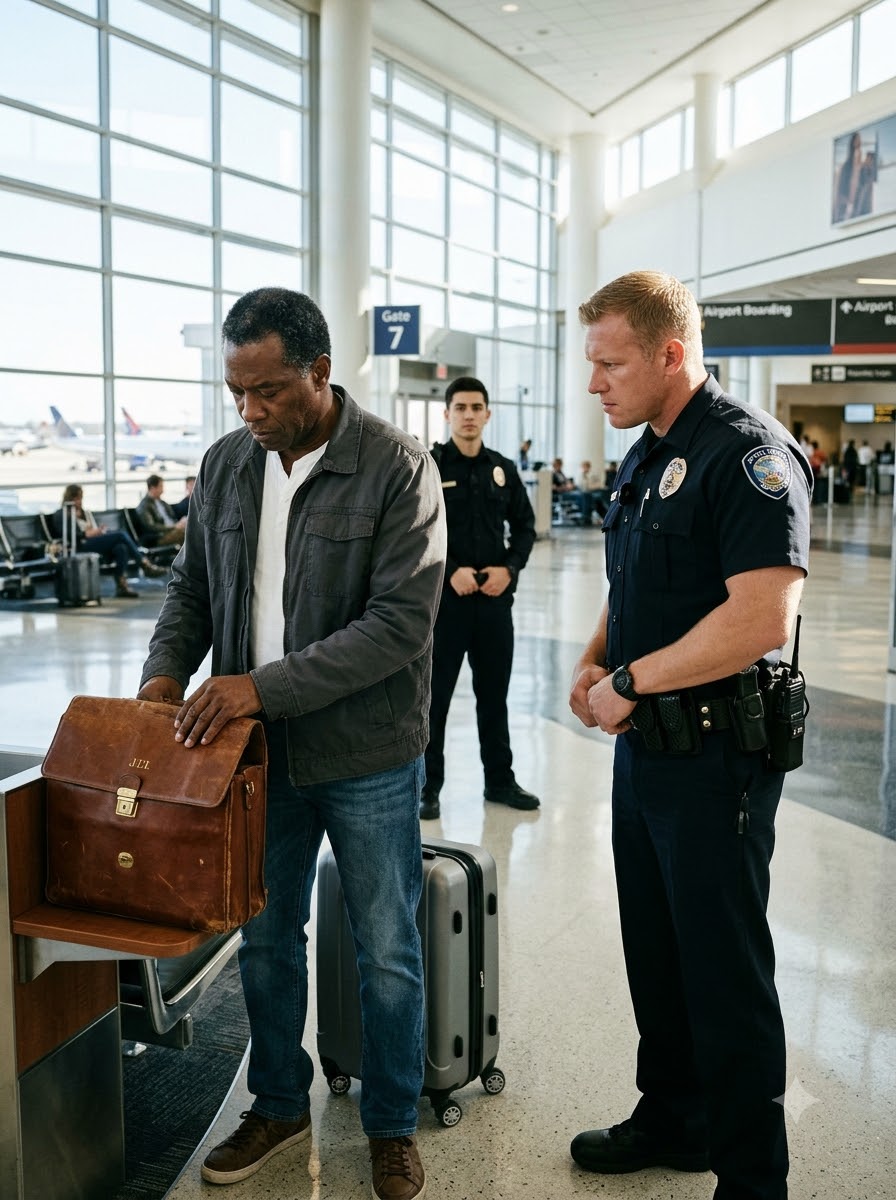
“Step away from the baggage carousel. Men dressed like you don’t usually own luggage like that.”
Officer Brett Callaway delivered the words without raising his voice.
He didn’t need to shout. At forty-six, he had learned that a quiet command, spoken with absolute certainty, could intimidate people more effectively than anger.
The Tuesday morning crowd at Chesapeake International Airport continued moving around carousel 7. Suitcase wheels rattled against polished floors. Recorded announcements echoed overhead. Exhausted travelers checked their phones, searched for luggage, and hurried toward the exits.
Nobody paid much attention to the confrontation at first.
But within minutes, nearly everyone in that section of the terminal would be watching.
And before the morning ended, federal agents would secure the terminal’s exits—not because of a terrorist threat or a stolen suitcase, but because of what Callaway was about to do.
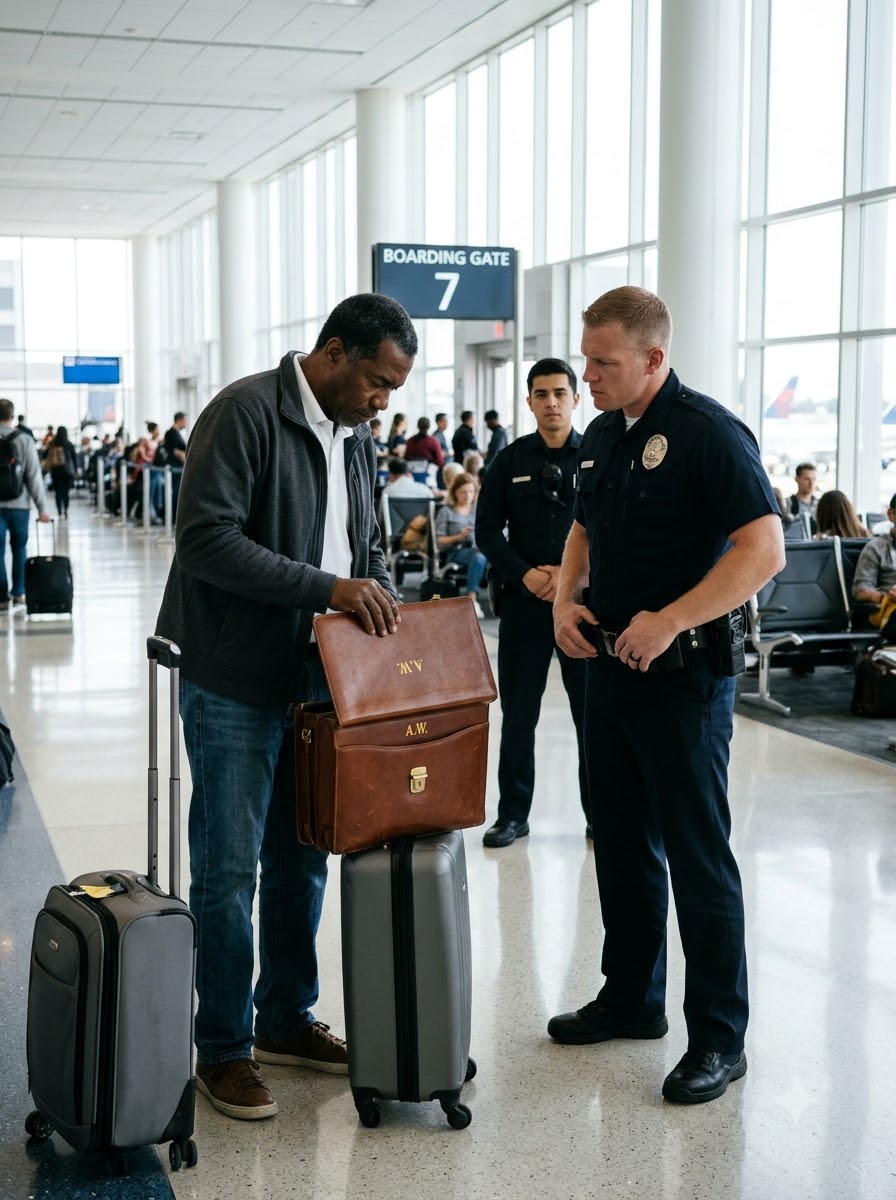
The man standing before him was Marcus Winston Webb.
Fifty-four years old. Tall. Black. Broad-shouldered. Calm.
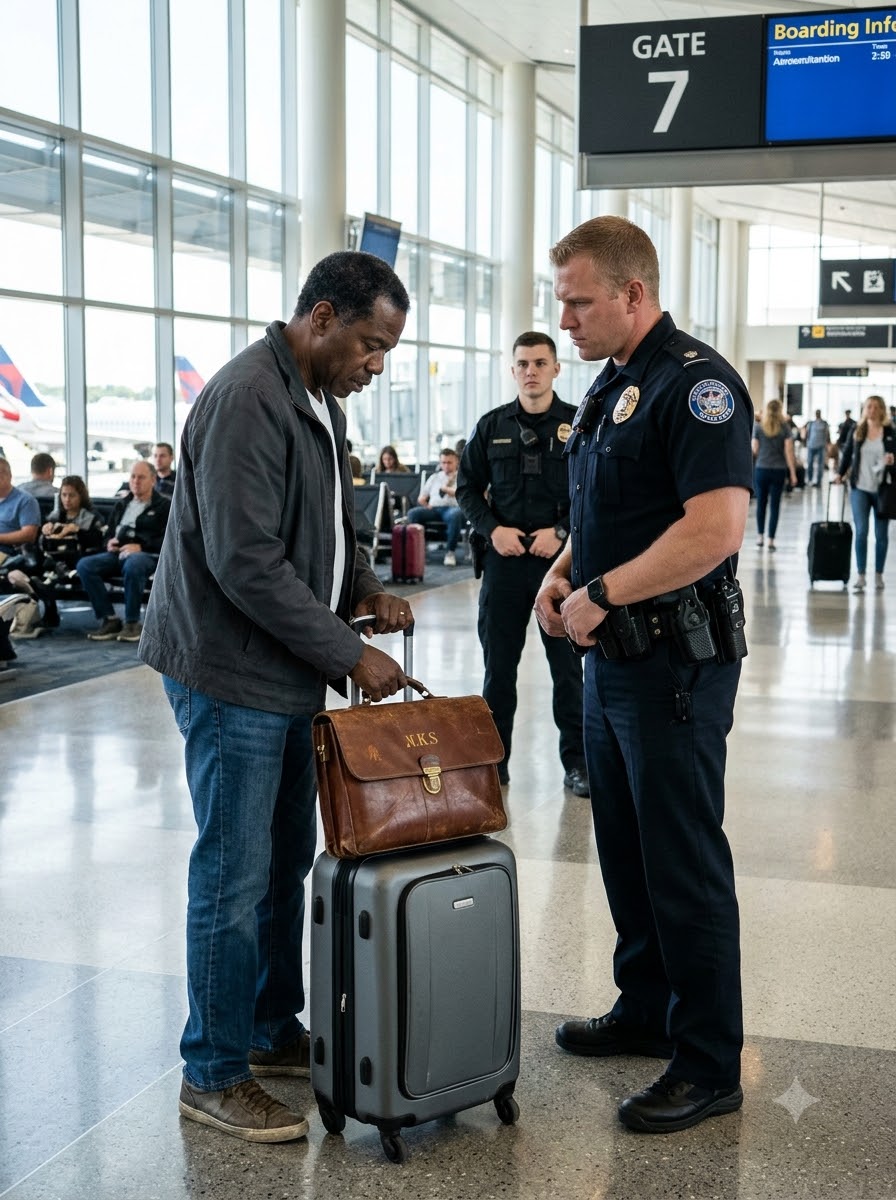
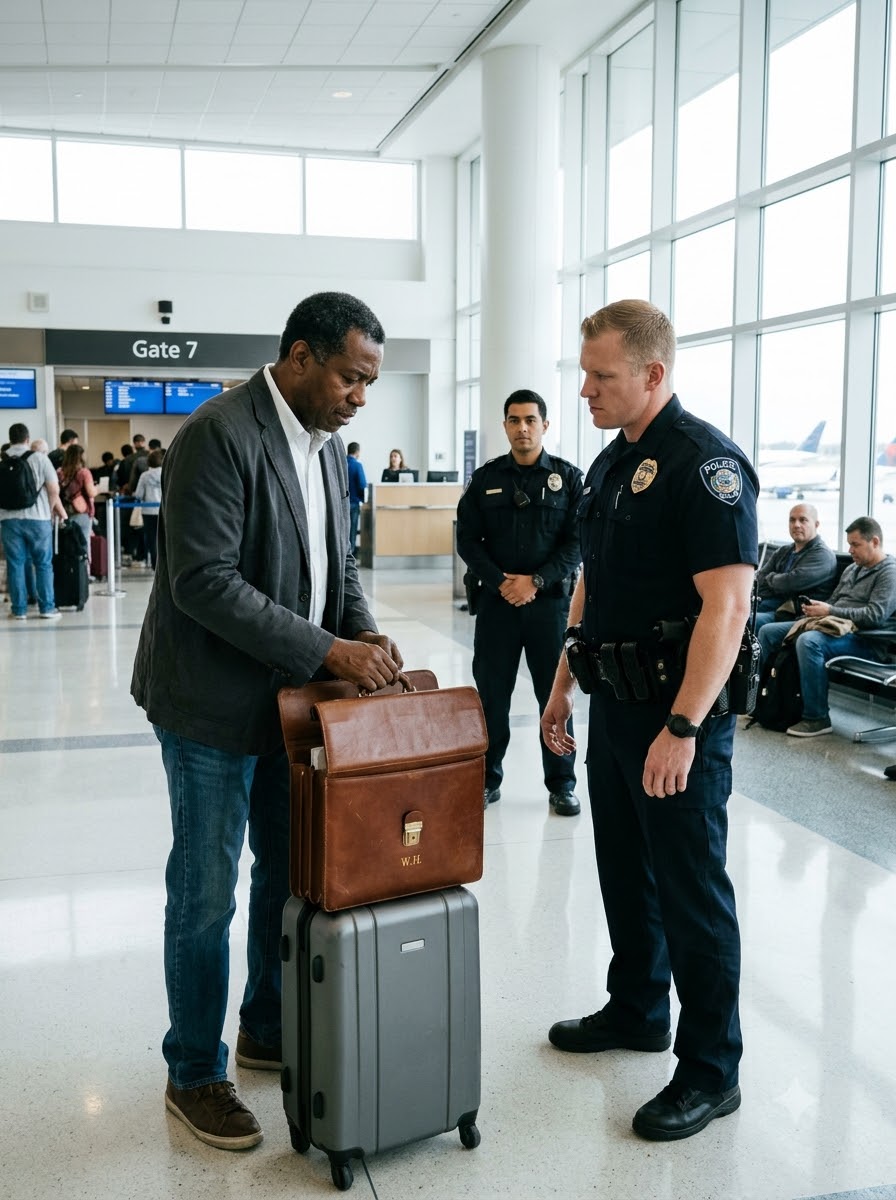
He wore a charcoal jacket, dark jeans, a white shirt without a tie, and comfortable leather sneakers. Beside him stood a gray rolling suitcase with a red leather luggage tag. In his right hand was a locked leather briefcase.
Nothing about his clothing suggested extraordinary authority.
That was intentional.
Marcus had spent thirty-one years with the Federal Bureau of Investigation. He had learned that arriving somewhere surrounded by security personnel changed everything. Employees suddenly became attentive. Supervisors appeared. Problems vanished before anyone important could witness them.
Marcus preferred seeing the world as it actually operated.
So he traveled commercially, collected his own luggage, and moved through airports like everyone else.
What Callaway didn’t know—or refused to consider—was that Marcus was the FBI’s deputy director.
And that the credentials proving it were inside his jacket.
Fourteen minutes before approaching Marcus, Callaway had deliberately disabled the video function on his body camera.
His partner, Officer Danny Souza, had done the same moments later.
Both cameras remained powered, their GPS systems functioning normally, but neither recorded video.
It wasn’t a malfunction.
It was procedure within an unofficial operation neither officer intended to document.
Earlier that morning, they had stopped two other Black travelers without recording the encounters in their activity reports. Both travelers eventually continued their journeys, carrying nothing away except the knowledge that uniformed officers had questioned them without explaining why.
Souza had remained silent.
He was thirty-eight, observant, and increasingly uncomfortable with the methods his partner considered routine.
But discomfort had never made him intervene.
At 8:19 a.m., Callaway sent a photograph to a private group chat used by several interdiction officers.
The image came from an internal airport camera.
It showed Marcus approaching baggage claim with his suitcase and leather briefcase.
Callaway’s message read:
“Solo premium incoming carousel 7 locked leather case. Easy numbers before shift end.”
He had selected Marcus before speaking to him.
There had been no stolen-luggage complaint.
No suspicious behavior.
No dispatch report.
Only a traveler whose expensive-looking belongings and ordinary clothing had convinced Callaway that he might be an easy target.
Marcus knew none of this.
He was thinking about getting home to Annapolis.
His mother, Evelyn, would turn eighty-two the following morning. Inside his briefcase was a small wooden jewelry box containing a silver bracelet he had purchased in Chicago.
One word was engraved into it.
Courage.
His late father, Raymond, had used that word throughout Marcus’s childhood—not as reassurance, but as an instruction.
Do the difficult thing even when you don’t feel ready.
Marcus planned to leave the bracelet beside his mother’s breakfast plate, continuing a birthday tradition his father had begun decades earlier.
He was also wondering whether his wife, Renee, a trauma nurse, would finish her hospital shift early enough for dinner.
Then Callaway stepped directly into his path.
Marcus stopped and placed his suitcase beside him.
“This bag has my initials on the tag,” he said evenly. “I can show you the airline receipt on my phone.”
“I’ll tell you what you can show me,” Callaway replied. “Step to the side.”
Marcus glanced at the red tag.
MWW.
Gold letters, plainly visible.
“The tag is right there. The receipt is on my phone. You can verify both in less than thirty seconds.”
Callaway didn’t look.
His attention remained on the briefcase.
“We’ve received reports of luggage theft at this carousel.”
“Was there a dispatch call?”
Callaway hesitated.
“Ask your unit for the incident number,” Marcus continued.
“You don’t run this airport.”
“No,” Marcus replied. “The law does.”
Behind Callaway, Souza could see the luggage tag clearly.
He also knew there had been no dispatch call.
He said nothing.
Several travelers had begun noticing the confrontation.
Clare Navarro, an off-duty flight attendant in a dark green jacket, stood near the carousel with her crew bag.
Years of watching passengers had taught her to recognize the difference between ordinary discomfort and a situation about to become dangerous.
She noticed Marcus’s stillness.
Then she noticed Callaway’s attention moving from the luggage tag to the briefcase.
Her thumb hovered over her phone’s camera.
Nearby, Linda Garza, a fifty-three-year-old school administrator, watched from a bench.
George Whitfield, a retired civil engineer in his early sixties, stood beneath the departure screens.
Both could see the initials on Marcus’s luggage.
Neither understood why the officer refused to check them.
Marcus kept his hands visible.
“Officer, I have identification in my inside jacket pocket. I’m going to reach for it slowly. My left hand will open my jacket, and my right hand will reach inside.”
He narrated each movement before making it.
It was a habit developed through decades of federal training.
But before his fingers reached the pocket, Callaway struck his arm.
The leather briefcase flew from Marcus’s hand.
It slammed against the tile and slid several feet.
The noise echoed through baggage claim.
Travelers turned.
A woman gasped.
Clare pressed record.
Marcus did not reach for the fallen case.
Instead, he raised his empty palms.
“My name is Marcus Winston Webb,” he said. “I am the deputy director of the Federal Bureau of Investigation. My credentials are in my inside left pocket.”
For one brief instant, something changed in Callaway’s face.
He had heard the title.
He understood what it meant.
Then he laughed.
“And I’m the attorney general.”
Souza shifted uneasily.
“Brett—”
Callaway silenced him with a look.
Marcus remained motionless.
“Call the FBI’s Washington field office. My identity can be verified immediately.”
“Step aside or we’re taking you to secondary screening.”
“Ask dispatch for the theft report you mentioned.”
Callaway said nothing.
“There’s no report,” Marcus continued. “Because there was no theft.”
Linda stood.
“He showed you his luggage tag. I saw it from right here. Why won’t you look?”
“Ma’am, step back unless you want to be detained.”
Linda refused to move.
George stepped closer, positioning himself where the recording phones could capture his presence.
Marcus looked toward Souza.
The younger officer avoided his eyes.
Then Marcus noticed something else.
Both officers’ body cameras were dark.
“Your cameras aren’t recording,” he said.
Callaway’s expression tightened.
“Two cameras don’t stop recording in the same way at almost the same time by coincidence.”
Souza instinctively touched the device on his chest.
Marcus continued.
“You’ve chosen not to record this encounter. But other people are recording it now.”
A young traveler named Ethan Ross had already begun filming.
He posted a short clip online.
Airport cop knocked a man’s briefcase away. Won’t let him show identification. Carousel 7, Chesapeake.
The video began spreading.
Callaway raised his radio.
“Possible theft suspect at carousel 7. Male subject refusing lawful commands. Possible fraudulent federal identification. Send backup.”
Marcus waited until the transmission ended.
“You just reported a theft that nobody reported to you.”
Callaway stared at him.
“You’ve ignored my luggage tag, my receipt, and my identification. Those are three separate ways to verify ownership.”
He paused.
“If I’m wrong, checking them gives you your answer. If I’m right, you already know what you’re doing.”
Callaway still refused.
Officer Trent Hollis arrived as backup.
Twenty-nine years old, with less than two years on the interdiction unit, he immediately noticed the crowd, the phones, and the dark indicators on his colleagues’ cameras.
His own camera was operating.
He left it on.
Clare moved closer.
“I heard him offer identification before you touched his briefcase.”
“Back up,” Callaway ordered.
She kept filming.
Linda raised her voice.
“I watched the entire thing. You haven’t checked a single piece of evidence he offered.”
George spoke next.
“I’ve traveled through this airport dozens of times. What I’m seeing isn’t suspicious behavior from that man.”
Callaway ignored him.
The crowd continued growing.
Seven phones were raised.
Several people were streaming live.
Travelers who had intended to leave now remained, watching.
The attention was changing the situation, and Callaway knew it.
He stepped forward and seized Marcus by the elbow.
“Secondary screening. Now. Refuse, and I’ll add obstruction.”
Marcus did not resist.
He turned slightly toward the cameras.
“You are making the worst mistake of your career,” he said quietly. “And it is all on camera.”
Callaway marched him toward a gray service door.
In the corridor, the handcuffs came out.
Two metallic clicks.
Marcus’s wrists were secured behind his back.
He straightened his shoulders.
No shouting.
No struggle.
No pleading.
He fixed his eyes on the wall ahead.
For sixteen years, he had taught young agents that dignity sometimes meant refusing to give an aggressor the emotional reaction he wanted.
Now he practiced the lesson himself.
Behind them, Callaway kicked the fallen briefcase out of the walkway.
The movement dislodged the small wooden jewelry box.
Its lid opened.
A silver bracelet slid across the velvet lining.
Clare saw it.
She crouched, retrieved the bracelet and box, and held them carefully while continuing to record.
The engraving caught the fluorescent light.
Courage.
As the service door closed, Linda called after them.
“We all saw this! You don’t get to close a door and make it disappear!”
The door slammed.
For several seconds, the crowd stood silent.
Then everyone began speaking.
Ethan’s live stream had attracted thousands of viewers.
Clare backed up her recording and sent copies to attorneys she trusted.
She began writing down everything she had witnessed, in sequence, before anyone could influence her recollection.
Souza lingered outside the service door.
He looked at the witnesses.
At Clare holding the wooden box.
At Hollis, whose camera was still recording.
Then he followed Callaway inside.
Beyond the door, Marcus was pushed through a cold, white service corridor.
Pain shot through his right shoulder when Callaway pulled on the cuffs.
He stumbled slightly but recovered before the officer could describe it as resistance.
The institutional smell of cleaning chemicals brought back an old memory.
Atlanta.
Marcus had been twenty-six, a newly assigned FBI agent arriving for his first field assignment.
An airport officer had stopped him near baggage claim and questioned why he was there.
Marcus had explained that he had arrived on a flight and was collecting his luggage.
The explanation had not satisfied the officer.
Only after Marcus produced his federal credentials did the encounter end.
Later, his training supervisor, Frank Doyle, asked what he had learned.
“I showed my badge, and it ended.”
Frank considered that.
“Did the badge fix it,” he asked, “or did it just end it?”
Marcus had spent decades considering the distinction.
A badge could stop an encounter.
It could not necessarily change the assumption that caused it.
His father understood that even better.
Raymond Webb had worked as a postal employee for twenty-three years.
For six of those years, one building supervisor insisted that Raymond use the service entrance.
The instruction was never written down.
When the supervisor left, the requirement disappeared.
Raymond had once told Marcus:
“The badge helps some people some of the time. What it really does is show you which people those are.”
Now, handcuffed in an airport corridor, Marcus heard those words again.
Callaway stopped before a metal door.
INTERVIEW ROOM 3.
He pushed Marcus inside.
A metal table stood beneath a harsh overhead light.
Two chairs faced each other.
A ceiling camera displayed a steady red recording indicator.
Callaway fastened Marcus’s cuff to a steel ring attached to the table.
Then he began emptying Marcus’s pockets.
Wallet.
Phone.
Watch.
Wedding ring.
Federal credentials.
Each object struck the tabletop with deliberate force.
Souza watched as Callaway opened the credential case.
The FBI badge reflected the overhead light.
Below it were Marcus’s photograph, full name, security markings, and official title.
DEPUTY DIRECTOR — FEDERAL BUREAU OF INVESTIGATION.
Souza leaned forward.
“Brett. We need to verify this immediately.”
Callaway stared at the credentials.
Then he made another choice.
“High-quality counterfeit.”
Marcus looked directly at him.
“Call Assistant Director Priya Okafor at the Washington field office. She can confirm my identity in minutes.”
Callaway ignored the instruction.
Instead, he sat at the computer and began writing his report.
Marcus asked a series of questions.
“Who reported the stolen suitcase?”
No answer.
“What flight did its owner arrive on?”
Typing.
“What color was the missing bag?”
Nothing.
“When did dispatch receive the complaint?”
Callaway continued typing.
“What is the incident number?”
Silence.
Marcus leaned back as far as the cuffs allowed.
“You’re creating answers because there was never a legitimate question.”
Souza finally spoke.
“He’s right about dispatch, Brett. There wasn’t a call.”
“Stay out of this.”
“I’m already in it.”
Callaway glared at him.
Then he lifted the encrypted federal laptop from Marcus’s briefcase.
“Don’t open that computer,” Marcus warned.
Callaway paused.
“That equipment belongs to the federal government and contains protected material. You have no authorization to access it, and I do not consent to a search.”
“Something you’re hiding?”
“My credentials are on the table. My luggage receipt is on my phone. My name is on the suitcase.”
Marcus held his gaze.
“You’ve ignored all three. This isn’t an investigation. An investigation requires questions you’re willing to answer with facts.”
Callaway set the laptop down unopened.
Souza moved toward the corner.
His fingers reached his body camera.
This time, he switched it on.
Quietly.
Without telling Callaway.
The camera began recording.
Neither officer knew that the ceiling camera was also connected to a federal monitoring system.
The recording had already been preserved through a separate evidence channel after the video of the confrontation reached federal authorities.
Callaway believed he controlled the room.
He did not.
Then three electronic tones sounded outside.
Magnetic locks engaged along the secured corridor.
Callaway stopped typing.
His radio crackled.
“Federal protective detail entering east corridor. All units hold position. Supervisor to Interview Room 3 immediately.”
For the first time that morning, Callaway looked frightened.
Marcus watched him.
“Put the laptop down, Officer Callaway.”
Footsteps approached.
Several pairs.
Fast.
Deliberate.
And when the door handle began turning, Marcus knew the encounter had entered a new phase.
But what was coming through that door would expose far more than one officer’s misconduct.
PART 2
The door opened inward.
Assistant Director Priya Okafor entered first.
She was forty-seven, with closely cropped natural hair, a dark professional suit, and the composed bearing of someone accustomed to entering difficult rooms without surrendering control of them.
Two federal agents followed.
Behind them stood airport duty commander Thomas Blake.
Priya took in the room almost instantly.
Marcus’s cuffed wrist.
The deep red marks around his skin.
The open FBI credentials.
The encrypted laptop beside Callaway.
Souza’s activated body camera.
The computer terminal displaying an unfinished report.
Then she looked at Marcus.
“Release Deputy Director Webb.”
Callaway responded too quickly.
“We have a possible theft suspect in custody. Fraudulent federal identification is also suspected, and the subject refused lawful commands.”
Priya’s expression remained unchanged.
“Who reported the theft?”
“An anonymous traveler.”
“What’s the incident number?”
Callaway said nothing.
Priya waited.
Then she turned to Souza.
“Were you dispatched to a stolen-luggage complaint before approaching Deputy Director Webb?”
“No, ma’am.”
“Did either of you verify the luggage tag against his identification?”
Souza lowered his eyes.
“No.”
“Did he offer identification?”
“Yes.”
“Did Officer Callaway allow him to produce it?”
“No.”
The room fell silent.
Priya turned toward Blake.
“I want every camera recording from carousel 7 to this room preserved. All dispatch audio beginning at 7:45 this morning. Both officers’ body-camera audit histories. Every version of the incident report, including timestamps, logins, and edits.”
Blake shifted uneasily.
“Our department has an internal review process.”
“Your department will preserve the evidence,” Priya replied. “It will not control this investigation.”
Callaway finally asked:
“Are you arresting me?”
“Not tonight.”
Priya’s voice remained level.
“Tonight, I’m making certain you cannot rewrite what happened before morning.”
Souza unlocked Marcus’s cuffs.
Marcus stood slowly.
Pain spread through his shoulder.
Priya photographed his wrists before the marks could fade.
She also documented the position of the credentials, laptop, and personal belongings.
Marcus collected his wedding ring and watch.
Callaway made one final attempt.
“He refused a lawful search. That’s obstruction.”
Marcus turned toward him.
“My title brought federal agents through that door,” he said. “That’s the problem.”
Callaway stared.
“If I were a teacher, contractor, or graduate student, you would already be writing a report designed to make your suspicion look like my guilt.”
He paused.
“The difference today is that people with cameras refused to look away.”
Outside, the terminal had not returned to normal.
The crowd near carousel 7 remained.
Some travelers had missed connections.
Others had stayed deliberately.
When Marcus emerged, people moved aside.
Clare approached him with the wooden box.
He opened it.
The bracelet was undamaged.
Courage.
“Thank you,” he said.
She nodded.
“How much did you record?” Marcus asked.
“Everything. From the first words until the door closed. I’ve already made multiple backups.”
“Keep another copy somewhere the airport administration can’t access.”
“Already done.”
Marcus looked at her for a moment.
“Thank you for not looking away.”
Clare’s expression softened.
Nearby, Linda Garza approached.
“Are you all right?”
“I’m going to be.”
“That isn’t the same thing.”
“No,” Marcus admitted. “But it’s what I have right now.”
Linda offered to provide a formal statement.
She had seen the luggage tag.
Heard the nonexistent theft report.
Watched Callaway refuse every opportunity to verify ownership.
“I’ve spent too much of my life stepping back when something like this happens,” she said. “I’m tired of where that gets us.”
George Whitfield approached next.
He also wanted to testify.
But before leaving, he admitted something.
“When I first saw that officer stop you, I assumed there must be an official reason. Something I didn’t understand.”
Marcus listened.
“I’ve made that assumption before,” George continued. “Today I realized how easily it becomes an excuse not to act.”
Marcus nodded.
“Recognizing that matters.”
At the airport medical clinic, physician assistant Maria Ruiz documented Marcus’s injuries.
Red abrasions around both wrists.
Swelling in his right shoulder.
Bruising along his ribs.
“This may hurt more tomorrow,” she warned.
“I know.”
He accepted the medical report and placed it beside the bracelet in his jacket.
Meanwhile, Priya’s team secured the evidence.
Callaway and Souza were separated.
Their department access was restricted.
Their personal devices were preserved for review through appropriate procedures.
Both were placed on administrative leave.
Hollis, the young backup officer, cooperated immediately.
His body camera provided an uninterrupted independent recording of part of the confrontation.
By that evening, Clare’s full video had spread widely.
Four minutes and twelve seconds.
Unedited.
It showed Marcus offering the luggage tag, airline receipt, and federal identification.
It showed Callaway striking the briefcase away.
It showed both officers’ dark body cameras.
It showed the handcuffs.
And it captured a sentence Callaway had omitted from his report.
“A man carrying a case like that in those clothes usually means stolen money or something worse.”
The airport authority initially released a statement claiming officers had responded to suspicious activity near baggage claim.
But no complaint existed.
The following day, independent special counsel Celia Monroe was appointed to investigate.
At sixty-one, Celia had spent decades handling civil-rights and public-corruption cases.
She began not with witness interviews, but with the body-camera equipment.
Digital examiner Patrick Solless opened Callaway’s camera audit log.
At 8:20 a.m., Callaway had entered a specific button sequence disabling video.
Seconds later, Souza’s camera recorded the same command.
Both devices continued tracking location.
Neither had malfunctioned.
“Could this happen accidentally?” Celia asked.
“Not like this,” Patrick answered. “Both officers entered a deliberate sequence.”
Celia requested the previous thirty days of camera audit histories.
Then she moved to dispatch.
Supervisor Diana Reyes reviewed the morning’s recordings.
There was no stolen-baggage report before Callaway contacted Marcus.
The first relevant transmission was Callaway’s own request for backup.
The airline’s baggage records confirmed Marcus’s suitcase had traveled under his name.
The tag matched his receipt.
Then Diana examined the incident report’s edit history.
A supposed anonymous witness had been added after the detention.
The entry came through a terminal associated with Callaway but used override credentials belonging to Commander Blake.
Celia ordered the complete version history preserved.
The evidence was beginning to reveal a sequence.
First, Callaway selected Marcus.
Then he disabled recording.
Then he stopped him.
Then he created a reason.
But why had Marcus been selected?
The answer arrived through a civilian analyst named Maya Reyes.
Thirty-two years old, Maya had worked for the airport police division for four years.
She understood the unit’s statistics better than many of its supervisors.
When she entered the federal evidence office, she carried an encrypted drive.
Her hands were tense, but her voice was steady.
“There are two databases,” she said.
The first contained the public performance statistics.
Contacts.
Seizures.
Arrests.
Productivity.
It made the interdiction unit appear efficient.
The second database contained information excluded from those reports.
Race.
Estimated income.
Type of luggage.
Local connections.
Whether a traveler mentioned legal representation.
Whether the officer’s body camera was active.
And a field labeled:
TRAVELER LEVERAGE.
Celia leaned forward.
“What does that mean?”
Maya answered carefully.
“It estimates how difficult someone will be to pressure.”
Travelers classified as low leverage were usually alone, from out of state, financially vulnerable, or unlikely to hire attorneys.
High-leverage travelers had resources, legal knowledge, or connections that made complaints harder to dismiss.
Officers were informally encouraged to prioritize low-leverage targets.
Maya had discovered that Black travelers were stopped disproportionately often, while those contacts produced prohibited items at lower rates than stops involving white travelers.
The unit’s productivity statistics were misleading.
The encounters generated numbers, but not meaningful security results.
When Maya reported the disparity, the police chief ordered the racial comparisons removed.
She refused.
The report was changed anyway.
Her access was reduced.
Her performance review described her as resistant to collaborative leadership.
She preserved the original data.
Now she handed it to Celia.
“I thought keeping the files was enough,” Maya admitted. “Then I saw what happened at carousel 7.”
She opened the database.
Marcus Webb’s entry had been created before Callaway approached him.
Attached was the airport-camera photograph.
Beside it:
“Solo Premium Carousel 7 locked leather case. Easy numbers before shift end.”
Celia read the entry twice.
“How many contacts can you document using this classification?”
“One hundred sixteen over eighteen months.”
“And the deleted records?”
“I don’t know how many.”
Celia looked toward her investigators.
“We start with the people, not the percentages.”
While forensic examiners copied Maya’s drive, an alert appeared.
Someone had initiated a remote deletion process.
The target was years of complaint files and records connected to the leverage system.
Those materials were already subject to a federal preservation demand.
Celia called Commander Blake.
“Someone is destroying evidence. Seal the server room immediately.”
Blake began citing operational procedures.
“This is not a request to take over your systems,” Celia interrupted. “It is a demand that you stop an active attempt to destroy evidence.”
Within a minute, the server room was secured.
Investigators traced the deletion command to credentials belonging to Police Chief Gerald Hart.
A two-factor authentication code had been sent to his personal phone.
A technology manager arrived carrying written instructions for emergency data maintenance.
Beneath the chief’s signature was a handwritten sentence.
“Legal exposure exceeds archive value. Complete before outside imaging.”
Celia stared at the page.
The evidence no longer suggested a few officers making independent mistakes.
It suggested an organized operation.
The deleted index was recovered from a mirrored backup.
Nothing essential was lost.
But the attempted destruction became additional evidence.
One database entry led investigators to Baltimore.
Damon Price was thirty-three and owned a growing electrical contracting business.
Three years earlier, he had flown through Chesapeake carrying $9,200 in cash.
The money was a legitimate payment from a church for renovation work.
Damon had a signed contract.
An invoice.
A payment receipt.
The church treasurer’s contact information.
But Callaway had stopped him near the rideshare exit.
The officer claimed a detection dog had alerted to his backpack.
No canine handler appeared in the records.
No alert was documented.
No drugs were found.
Damon was never charged.
Yet his $9,200 was seized under civil forfeiture procedures.
He spent eleven months trying to recover it.
Legal fees consumed approximately $4,000.
He borrowed from his mother to meet payroll.
He lost the church project because he couldn’t purchase materials on schedule.
When the money was finally returned, the financial damage had already been done.
Damon had filed a complaint.
The airport dismissed it as a procedural disagreement.
Now investigators found his name in the hidden database.
His leverage classification read:
“Remote business. Cash dependent. Likely depart.”
They visited him at his office.
Damon opened a locked drawer and produced a thick folder.
Every letter.
Every receipt.
Every invoice.
Every communication with the airport.
“I kept all of it,” he explained. “I needed proof that what happened was real.”
He played a voicemail from Callaway.
“If the money is clean, you can prove it in court. That’s what the process is for.”
Damon stopped the recording.
“That was the rule there,” he said. “Innocence was something you had to purchase back.”
When investigators showed him the leverage entry, he stared at it.
“He knew I had a business?”
“Yes.”
“He knew taking the money could ruin it?”
The investigator hesitated.
“Yes.”
Damon closed his folder.
“Then it wasn’t a mistake. He calculated what he could take and how much I could afford to fight.”
His voice hardened.
“They had my complaint three years ago. They had my documents. They chose not to care.”
The investigation expanded.
Souza requested another interview.
He arrived with attorney Rebecca Solano, who warned him that cooperation would not erase his responsibility.
Souza understood.
He had watched the video with his twenty-four-year-old son.
His son had said:
“Dad, you’re the one standing there doing nothing.”
Souza tried explaining that the video lacked context.
His son answered:
“What context makes a lie true?”
Souza had no response.
Now he told Celia everything.
The camera shutdowns were intentional.
Officers used positioning to create an impression of danger.
Consensual searches were conducted in ways that made refusal difficult.
Cash seizures produced performance numbers.
Travelers were left to pay the cost of recovering their own property.
The unit avoided explicitly racial language.
Instead, officers spoke of people who didn’t fit their “expected profile.”
Premium luggage.
Ordinary clothing.
Travelers without apparent wealth or influence.
“How many false or incomplete reports did you sign?” Celia asked.
Souza stared at the table.
“More than twenty.”
“How many times did you intervene when Callaway used unnecessary force?”
A long silence followed.
“Never.”
Then Souza revealed something else.
Callaway owned a second phone.
It was hidden at his house beneath old uniform shirts.
The phone contained a private group chat.
The officers called it Easy Numbers.
Federal agents obtained a warrant.
The next morning, they searched Callaway’s home with their cameras recording.
The phone was exactly where Souza said it would be.
Inside were photographs of travelers, seized cash, and private conversations mocking how difficult it would be for victims to recover their property.
One photograph showed Damon Price’s $9,200 spread across a patrol vehicle.
Another showed Marcus approaching carousel 7.
There were messages from senior officers.
One, sent by Chief Hart, instructed the unit to close a complaint involving a traveler who might appeal to oversight authorities.
“No clean camera, no clean complaint. Close it and move.”
Celia placed the phone on the evidence table.
Now the structure was visible.
Callaway supplied the actions.
Souza described the methods.
Maya documented the targeting system.
Damon demonstrated the human cost.
The cameras and dispatch records exposed the lies.
And the messages connected the scheme to leadership.
Thirty-one days after the confrontation at carousel 7, a federal grand jury returned indictments.
Callaway faced charges involving civil-rights violations, obstruction, false records, and conspiracy.
Chief Gerald Hart faced obstruction and conspiracy charges.
Commander Thomas Blake faced charges connected to evidence tampering.
Souza was also charged, although his cooperation would be considered later.
Federal agents arrested Callaway the following morning.
Their cameras remained on.
They presented the warrant.
They allowed him to contact counsel.
They documented every step.
He received the procedural protections he had repeatedly denied others.
But the question of whether a jury would hold him accountable remained unanswered.
And five months later, the people he had targeted finally entered the same courtroom.
PART 3
The federal trial opened with Marcus Webb seated beside his wife, Renee.
She had taken time away from the hospital to attend.
That alone told Marcus how much the case had affected her.
Outside, reporters gathered behind barriers.
Inside, twelve jurors would decide what the evidence proved.
Special Counsel Celia Monroe addressed them.
“Police officers can make mistakes without committing crimes,” she began.
“This case is not about an ordinary mistake.”
She explained that prosecutors intended to establish four things.
Callaway had prepared to conceal his actions before contacting Marcus.
He had selected a traveler based on perceived vulnerability rather than behavior.
He had rejected evidence contradicting his accusation.
And he had invented a witness after the detention.
“None of those decisions,” Celia said, “was accidental.”
The defense argued that airport security required rapid decisions under pressure.
Officers sometimes confronted uncertain situations.
Not every error was criminal misconduct.
The argument had a legitimate general principle behind it.
But it could not explain the evidence in this case.
Why had the cameras been disabled before the encounter?
Why was there no theft report?
Why did the alleged anonymous witness appear only after Marcus was handcuffed?
Why had officers maintained a secret database measuring travelers’ vulnerability?
And why did the private messages describe targeted travelers as easy numbers?
Clare Navarro testified first among the principal eyewitnesses.
Her complete video played for the jury.
Four minutes and twelve seconds.
No edits.
No commentary.
The courtroom watched Marcus offer his luggage tag.
His receipt.
His identification.
They saw Callaway refuse.
They saw the briefcase strike the floor.
They saw the dark body cameras.
They heard the officer’s remark about expensive luggage and stolen money.
Celia asked Clare why she continued filming after Callaway threatened to detain her.
“Because I realized that whatever happened next might disappear unless someone kept a record.”
Maya Reyes explained the hidden database.
She described the traveler-leverage categories.
The targeting practices.
The racial disparities.
The altered public reports.
Then she opened Marcus’s entry.
The photograph.
The timestamp.
The message.
“Solo Premium Carousel 7 locked leather case. Easy numbers before shift end.”
The jury saw that the selection had occurred before Callaway spoke to Marcus.
Damon Price testified with his church contract and financial records.
He described the seizure of his $9,200.
The eleven-month recovery process.
The legal bills.
The payroll loans.
The contract he lost.
Then prosecutors played Callaway’s voicemail.
“If the money is clean, you can prove it in court.”
Damon looked toward the jury.
“He thought I was affordable,” he said.
“Not dangerous. Just affordable.”
Souza admitted that he had deliberately disabled his camera.
He admitted signing false reports.
He acknowledged lying during his first interview.
He admitted that he had watched Callaway mistreat travelers without intervening.
During cross-examination, the defense challenged his credibility.
Why should jurors trust someone who had lied before?
Souza did not try to portray himself as courageous.
“Don’t believe me because I finally came forward,” he answered. “I came forward too late for that.”
He looked toward the jury.
“Believe the records we created when we thought nobody would ever see them.”
Marcus was the final major fact witness.
He had testified in federal court many times during his career.
But never before had he been asked to describe his own humiliation while recordings of it were presented as evidence.
Renee sat in the front row.
Celia began carefully.
“What did you feel when Officer Callaway refused to check your luggage tag?”
Marcus considered the question.
“I felt myself being treated as a category rather than a person.”
He paused.
“I recognized it before I could fully name it.”
“What frightened you most?”
“That I offered him every reasonable way to verify the facts, and he treated each offer as another reason to suspect me.”
Marcus looked toward the jury.
“Once reason stopped mattering, I was left facing an armed officer who had already decided what my actions meant.”
The defense displayed a slowed frame showing Marcus moving his hand toward his jacket.
“Could that movement have appeared threatening to an officer making a quick decision?”
Marcus answered without hesitation.
“Not when the recording includes me explaining exactly what I was about to do.”
He repeated his words from the airport.
“My identification is in my inside left pocket. I am reaching for it slowly.”
Then he added:
“The footage contains those statements. They were spoken before I moved.”
The defense’s final question was direct.
“Isn’t it possible this case received extraordinary attention because of your position in the FBI?”
“Yes,” Marcus replied.
The answer surprised several people.
“My title brought federal agents to that room faster than they would have arrived for someone without it.”
He paused.
“That is a problem.”
Then he continued.
“But my title didn’t disable those body cameras. It didn’t create the false theft report. It didn’t build a hidden database or write the messages in Easy Numbers.”
He looked directly toward the jury.
“The evidence existed before I walked into the airport. My position only made it harder to ignore.”
Callaway did not testify.
The jury deliberated for nine hours.
Marcus waited with Renee, Maya, and Damon.
Nobody wanted to discuss the verdict.
Damon spoke about the community center his company had eventually rewired.
He described the new lighting and electrical panels.
The satisfaction of completing the project despite the financial harm the original seizure had caused.
Maya stared at an untouched cup of coffee.
Renee tried reading a novel but kept returning to the same page.
A television in the corner showed a reporter describing Marcus as the man whose arrest had exposed the airport scheme.
Damon shook his head.
“That’s not right.”
Marcus agreed.
“No. It isn’t.”
Damon looked toward him.
“My complaint exposed it three years ago.”
“Yes,” Marcus said.
He continued.
“Your complaint. Maya’s analysis. Clare’s recording. And all the other people who fought to recover money the airport should never have taken.”
Marcus leaned forward.
“My arrest made ignoring the evidence more expensive. That’s what my position changed.”
Damon considered that.
“Then use it,” he said. “Don’t apologize for having influence. Use it for something that matters.”
The door opened.
The verdict had arrived.
In court, the clerk read the jury’s findings.
Guilty of willfully depriving Marcus Webb of his constitutional rights.
Guilty of obstruction.
Guilty of falsifying an official record.
Guilty of conspiracy connected to the Easy Numbers operation.
Callaway’s shoulders lowered with each count.
He stared at the defense table.
Renee reached for Marcus’s hand.
Maya covered her mouth.
Damon bowed his head.
Marcus felt relief.
Not celebration.
Not revenge.
Just the gradual release of something he had been carrying for five months.
Across the courtroom, members of Callaway’s family cried.
Marcus noticed.
They were experiencing consequences they had not personally created.
He could acknowledge their pain without excusing the choices that had caused it.
At sentencing, Callaway spoke about long shifts, stress, and the pressure of making difficult decisions.
He apologized for the situation.
But he never plainly acknowledged selecting Marcus as a target.
He never admitted inventing a theft allegation.
He never directly confronted the people whose money and dignity had been taken.
The judge addressed that distinction.
“An encounter does not lose control by itself,” she told him.
“You engineered this one. You concealed your actions and relied on your uniform to make your version more credible than the people you targeted.”
She paused.
“An apology focused on consequences rather than choices is not the same as remorse.”
Callaway received a federal prison sentence and was permanently barred from law enforcement.
Chief Gerald Hart pleaded guilty to obstruction and conspiracy.
Commander Thomas Blake was convicted for his role in evidence tampering and misconduct.
Souza received a reduced sentence because of his cooperation, but his law-enforcement certification was permanently revoked.
The consequences extended beyond those four men.
Damon Price received formal confirmation that his seized $9,200 had no connection to criminal activity.
His legal fees were repaid with interest.
Thirty-eight other travelers recovered funds through the resulting review.
The public report identified each person, the amount taken, how long it had been held, and why the original seizure justification had failed.
Their experiences were no longer hidden inside vague productivity statistics.
The airport also changed its procedures.
Body cameras were configured to activate automatically when officers began assigned field duties.
Consensual searches required recorded confirmation that travelers could refuse and leave when legally free to do so.
Seized funds could no longer flow back into the airport police budget.
Complaint data went directly to independent civilian oversight before department executives could alter public summaries.
Maya Reyes became the oversight office’s lead analyst.
Her first published report included a sentence above every statistical table:
“Numbers are not performance if the conduct producing them was unlawful.”
Clare Navarro returned to Chesapeake on a later layover.
She walked past carousel 7.
Ordered coffee from the same kiosk.
And continued toward her gate.
In her crew bag was a copy of a withdrawn disciplinary notice issued after she had helped preserve the video.
She kept it as a reminder.
Someone had tried to discourage her from documenting what happened.
The attempt had failed.
And the attempt itself had become part of the record.
Marcus returned to Annapolis after the verdict.
But he did not go home first.
He drove to his mother’s house.
Evelyn Webb sat at the kitchen table in a blue dress.
The silver bracelet rested around her wrist.
Courage.
The engraving faced upward.
Marcus had eventually placed the wooden box beside her breakfast plate, just as he had intended.
A little late.
But intact.
Evelyn looked toward his hands.
The handcuff marks had disappeared months earlier.
Still, she studied his wrists as though she could see where the steel had been.
“Do you remember why you joined the bureau?” she asked.
Marcus smiled faintly.
He had answered that question before.
But thirty-one years of service had changed the answer.
“I thought carrying a badge might mean people who looked like me would have to prove themselves one fewer time.”
Evelyn nodded.
“And did it?”
Marcus looked at his hands.
Then at the bracelet.
“For some people. Sometimes.”
He paused.
“Not enough.”
His mother reached across the table.
Her grip was still surprisingly strong.
“Then stop asking the badge to do all the work,” she said.
Marcus looked at her.
“You did the work. The truth did the rest.”
She stood and brought out the birthday cake.
One day late.
Still worth sharing.
She poured his coffee.
Outside, the neighborhood continued its ordinary morning.
A car passed.
Someone walked a dog.
The world moved forward, largely unaware of what had happened in an airport months earlier.
Marcus watched his mother adjust the bracelet.
And for a moment, he remembered his father.
Years earlier, Raymond had been hospitalized after a cardiac warning.
Marcus had visited him after a long drive.
They had talked about a young Black federal agent whose colleagues repeatedly demanded credentials despite having worked with him for months.
Marcus wanted to fix the problem.
Raymond listened.
Then asked whether Marcus could eliminate the assumptions behind those incidents.
Marcus admitted he couldn’t.
Not alone.
Not in one career.
Raymond had looked toward the hospital window.
“You can’t fix the whole thing by yourself,” he told his son.
“But you can make the room cost something.”
Marcus had frowned.
His father explained.
“When wrongdoing costs nothing, it becomes comfortable. People stop seeing it as a choice. They begin treating it like a fact.”
Marcus had asked whether changing one incident at a time could ever be enough.
Raymond answered:
“Not enough and nothing aren’t the same thing.”
Then he said something Marcus never forgot.
“Justice doesn’t come all at once. It comes one room at a time. And somebody has to be willing to make the room cost something before the next person walks in.”
Now Marcus understood those words differently.
He had spent decades carrying federal authority.
But the badge had not protected him at carousel 7.
His title had not persuaded Callaway.
His credentials had not stopped the handcuffs.
What changed the outcome was a collection of choices made by people who refused to let the official story replace the truth.
Clare kept recording.
Linda refused to step away.
George acknowledged his mistaken assumptions.
Hollis kept his camera on.
Souza eventually told the truth, even though he had waited far too long.
Maya preserved the hidden data.
Damon kept every document and refused to accept that his loss was merely procedural.
And investigators followed the evidence beyond the person whose arrest had attracted public attention.
That was what made the difference.
Not one powerful man being recognized.
But an institution finally being forced to confront the people it had already failed.
The airport officers had believed that authority meant controlling the story.
They thought dark cameras would erase the encounter.
They thought a fabricated report would become the accepted truth.
They thought travelers would calculate the cost of resistance and decide to surrender.
For years, those calculations had worked.
Then one morning, the wrong man was selected.
Not because Marcus Webb deserved better treatment than anyone else.
But because his position made it impossible to quietly dismiss the same evidence that should have mattered for everyone.
The federal agents secured the terminal.
The handcuffs came off.
The hidden records emerged.
And the people whose complaints had once disappeared finally had their stories examined.
Marcus looked again at the bracelet on Evelyn’s wrist.
Courage.
His father’s word.
Not a decoration.
Not a promise that doing the right thing would be easy.
An instruction.
Make the room cost something.
One room at a time.
Even when you’re tired.
Even when part of the cost falls on you.
Because justice rarely arrives all at once.
Sometimes it begins with a person who refuses to look away.
Sometimes it begins with a camera left recording.
Sometimes it begins with a complaint preserved in a drawer for three years.
And sometimes it begins at an airport baggage carousel, when an officer decides a man’s appearance matters more than the facts directly in front of him.
The badge had never been the source of Marcus Webb’s dignity.
Neither had his title.
Those things only made his authority recognizable.
His dignity had existed long before anyone knew his name.
And it would have existed even if no federal agents had ever opened that interview-room door.
That was the truth Marcus wanted the airport to remember.
Not that it had handcuffed the wrong important man.
But that there had never been a right person to treat that way.
And that the people who came before him had deserved to be believed, heard, and protected long before his name made the entire country pay attention.
