

PART 1
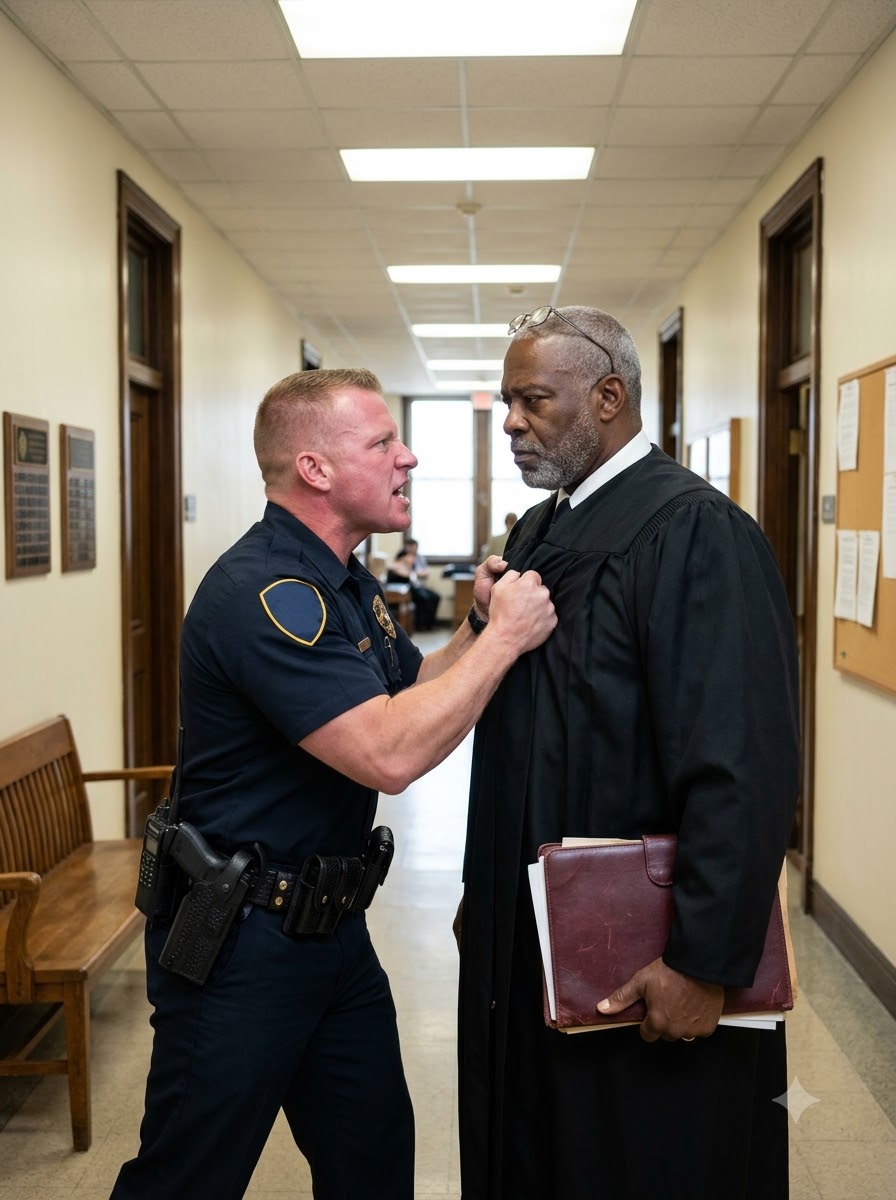
Judge Isaiah Bennett knew the third-floor hallway of the Franklin County Courthouse better than almost any other place in the building. He had traveled that corridor thousands of times, often while mentally reviewing the cases awaiting him.
On Wednesday morning, he emerged from his chambers carrying a brown leather case beneath his arm. His reading glasses rested on his head, and twenty-three matters were scheduled on his docket.
There were bond hearings, probation violations, two motions to suppress, a custody dispute that had dragged on six months longer than anticipated, and a sentencing hearing that had occupied his thoughts for much of the previous night.
It appeared to be another ordinary workday.
Nothing suggested that, within six minutes, he would be standing in that familiar hallway with steel handcuffs fastened around his wrists.
Isaiah was fifty-three years old and had served as a judge for eight years. Before his appointment to the state bench, he had worked as a public defender, a civil-rights attorney, and an assistant United States attorney.
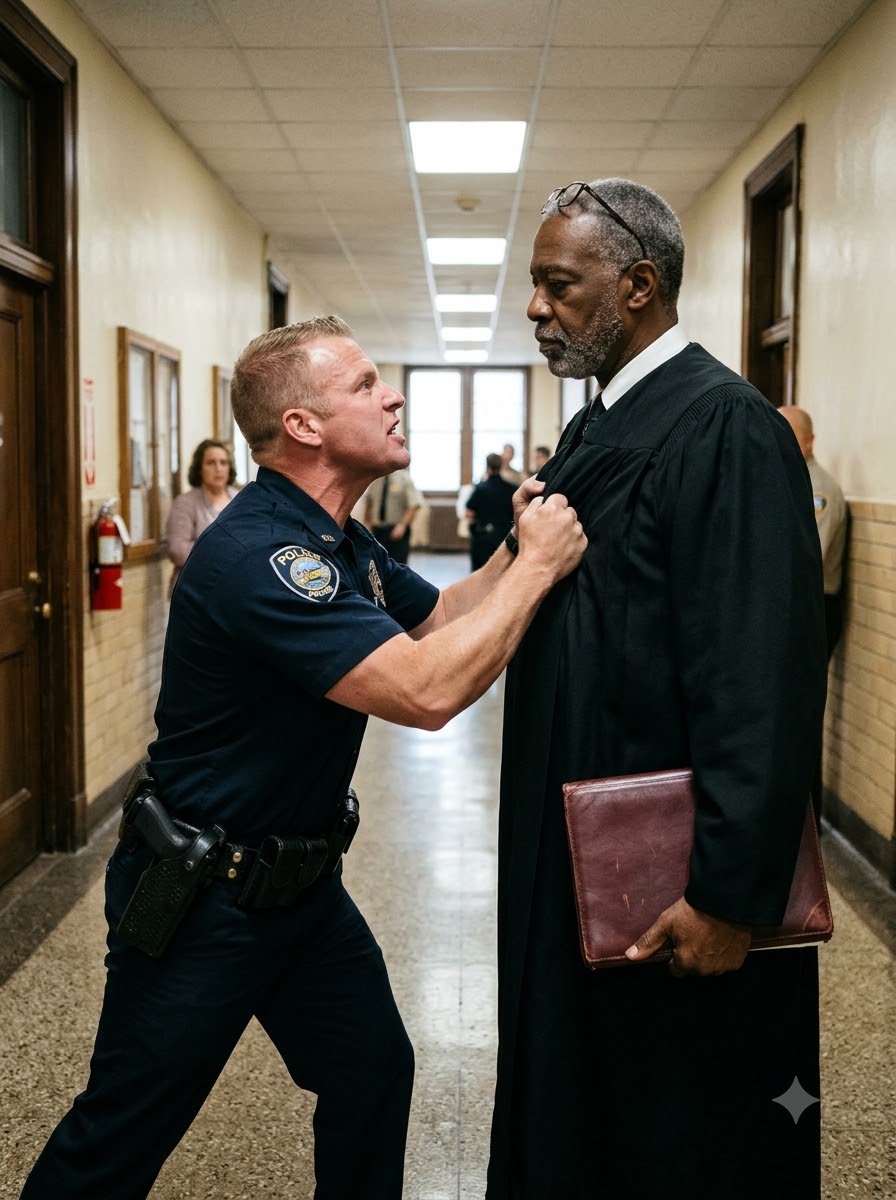
He was a tall Black man, six feet five inches, broad-shouldered, with dark skin and a neatly maintained beard beginning to gray around his chin.
His composure came from decades of listening to angry people without allowing their emotions to dictate his own behavior.
Some mistook his restraint for weakness.
Those who appeared before him in court usually discovered otherwise.
That morning, Isaiah wore his customary black judicial robe over a white shirt and charcoal tie.
Beside the door he had just exited, a brass plaque clearly identified the room:
CHAMBERS — HON. ISAIAH T. BENNETT.
Another sign directed visitors toward Courtroom 3A, approximately twenty feet farther along the hallway.
Isaiah checked his watch.
Ninety seconds remained before the bailiff would call the courtroom to order.
He turned toward the entrance.
A uniformed police officer stepped directly into his path.
Isaiah stopped walking.
The officer was white, approximately thirty-seven or thirty-eight years old, with a stocky chest, broad shoulders, and sandy-blond hair cut short along the sides.
A body camera was mounted at the center of his uniform.
The metal nameplate above his pocket read HELLER.
Isaiah did not recognize him, but courthouse security assignments changed frequently. City police officers were sometimes brought in to supplement the sheriff’s deputies.
The officer examined Isaiah from his polished shoes to the black robe covering his shoulders.
Then a mocking smile appeared.
“Where do you think you’re going?”
Isaiah glanced toward the courtroom.
“To work.”
Officer Grant Heller shifted farther across the corridor.
“I asked where you’re going.”
Isaiah met his gaze.
“Courtroom 3A.”
Heller looked at the robe again.
A short laugh escaped him.
“That supposed to be funny?”
Isaiah paused.
“What?”
Heller gestured toward his clothing.
“The outfit.”
Isaiah briefly glanced down.
Then he looked back at the officer.
“What about it?”
“You can’t walk around back here dressed like that.”
Isaiah considered the statement.
“I dress like this most weekdays.”
Heller grinned.
“Sure you do.”
Isaiah now understood what was happening.
He had encountered situations like this before. Over the years, he had learned to recognize the moment when an innocent misunderstanding stopped being a misunderstanding because someone refused to consider the facts.
What made this occasion remarkable was its location.
They were standing only a few steps from a door bearing his name.
“My name is Isaiah Bennett.”
Heller crossed his arms.
“Okay.”
“I am the presiding judge in Courtroom 3A.”
The officer stared at him.
Then laughed once more.
There was no nervousness in the sound.
He was not laughing because he suspected Isaiah was joking.
He was laughing because the possibility that Isaiah was telling the truth seemed ridiculous to him.
“Yeah, right.”
Isaiah’s expression remained controlled.
“My chambers are behind you.”
Heller made no attempt to turn around.
“The restricted corridor is for court staff.”
“I know.”
“So I’m going to need you to take off the robe.”
“No.”
Heller tilted his head.
“What did you say?”
“I said no.”
“You’re not listening.”
“I am listening extremely carefully.”
The officer moved closer.
Isaiah caught the smell of coffee on his breath.
“You’ve got about five seconds to stop playing games.”
Isaiah glanced at the officer’s nameplate.
“Officer Heller.”
Heller raised his eyebrows.
“You know me?”
“Your name is attached to your chest.”
The answer clearly irritated him.
Before the officer could respond, Isaiah continued.
“You have several simple options available.”
“Do I?”
“Yes.”
Isaiah indicated the door behind Heller.
“Read the plaque.”
The officer refused to look.
“Or use your radio and ask courthouse administration whether Judge Isaiah Bennett is assigned to 3A.”
Heller maintained his stare.
“Or ask any clerk in this hallway.”
Isaiah looked past him.
A woman had just emerged from the records room carrying three case files.
It was Sofia Alvarez, who had served as Isaiah’s courtroom clerk for five years.
She slowed when she noticed the confrontation.
Isaiah nodded toward her.
“You can ask Ms. Alvarez.”
Heller partially turned.
Sofia immediately recognized that something was wrong.
“Judge Bennett?”
Heller looked sharply back at Isaiah.
Sofia approached.
“Is everything okay?”
Heller raised one hand.
“Stay there.”
She stopped.
“Officer, he’s—”
“I said stay there.”
Sofia stared in disbelief.
Isaiah addressed Heller.
“She is attempting to answer your question.”
“I didn’t ask her anything.”
“That appears to be part of the problem.”
Heller clenched his jaw.
“You think you’re clever?”
“No.”
Isaiah adjusted the leather case under his arm.
“I think you are approximately thirty seconds away from making a mistake that can still be avoided.”
Heller took another step forward.
“Take off the costume.”
The word carried a different weight this time.
Sofia’s eyes widened.
Isaiah did not move.
“Officer Heller.”
“What?”
“It is not a costume.”
Heller looked toward Sofia.
“You know this guy?”
She gave a brief laugh of astonishment.
“Yes.”
“How?”
“He’s my judge.”
For a moment, Heller simply stared.
Then his expression shifted.
But not toward understanding.
Toward suspicion.
“You two together on this?”
Sofia blinked.
“Together on what?”
Isaiah’s patience began to wear thin.
“She is a courthouse employee identifying the judge she works for.”
Heller pointed at her.
“Back up.”
“Officer—”
“Now.”
Sofia retreated.
Heller turned back toward Isaiah.
“You people really think this is going to work?”
Isaiah became completely still.
“What people?”
Heller hesitated.
Only for a fraction of a second.
Then he answered.
“People who come into secure buildings pretending to be somebody they’re not.”
Isaiah held his gaze.
“You are standing beside a brass sign with my name on it.”
Heller did not turn.
“You are speaking to the clerk assigned to my courtroom.”
No response.
“You have a radio.”
Still nothing.
“You have a body camera recording all of this.”
Heller’s lips tightened.
“And you continue choosing disbelief.”
“I’m choosing security.”
“No.”
Isaiah spoke quietly.
“You are choosing certainty.”
The distinction angered Heller more than shouting would have.
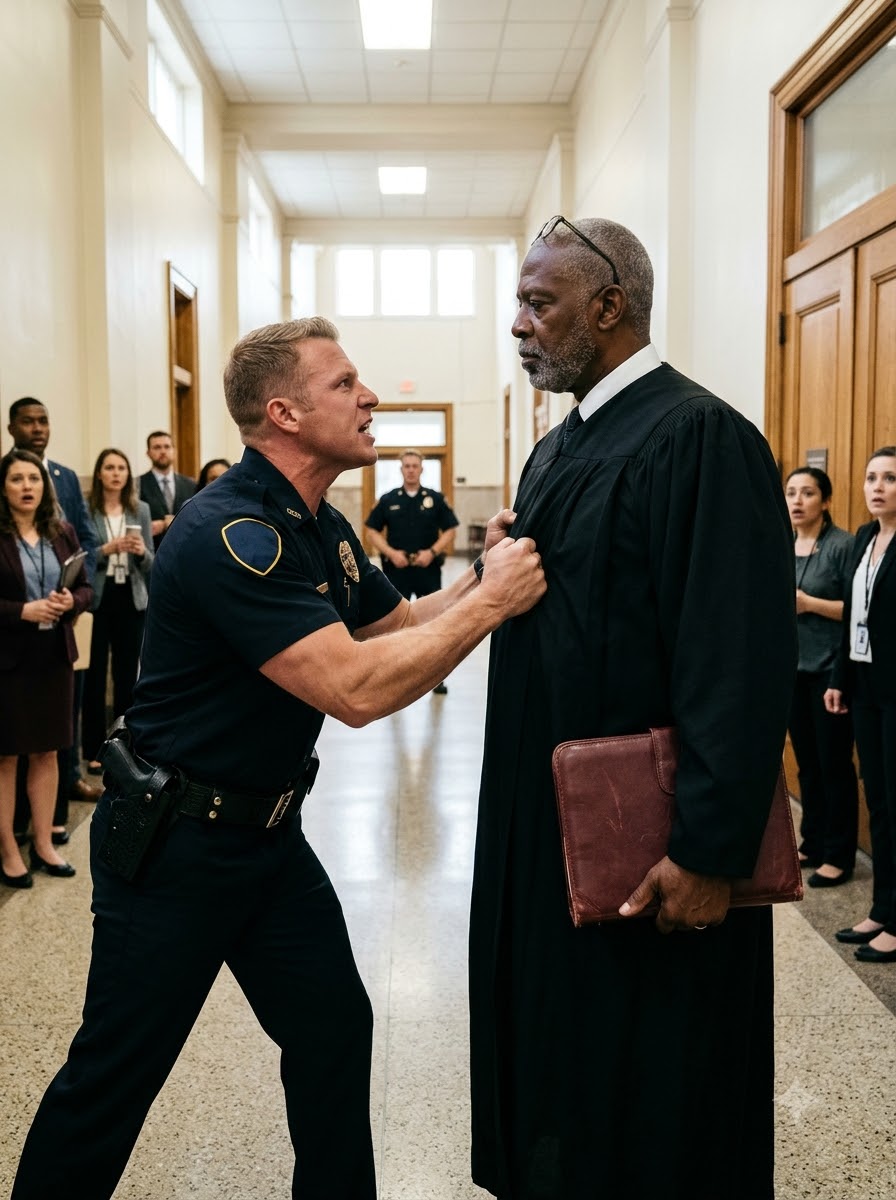
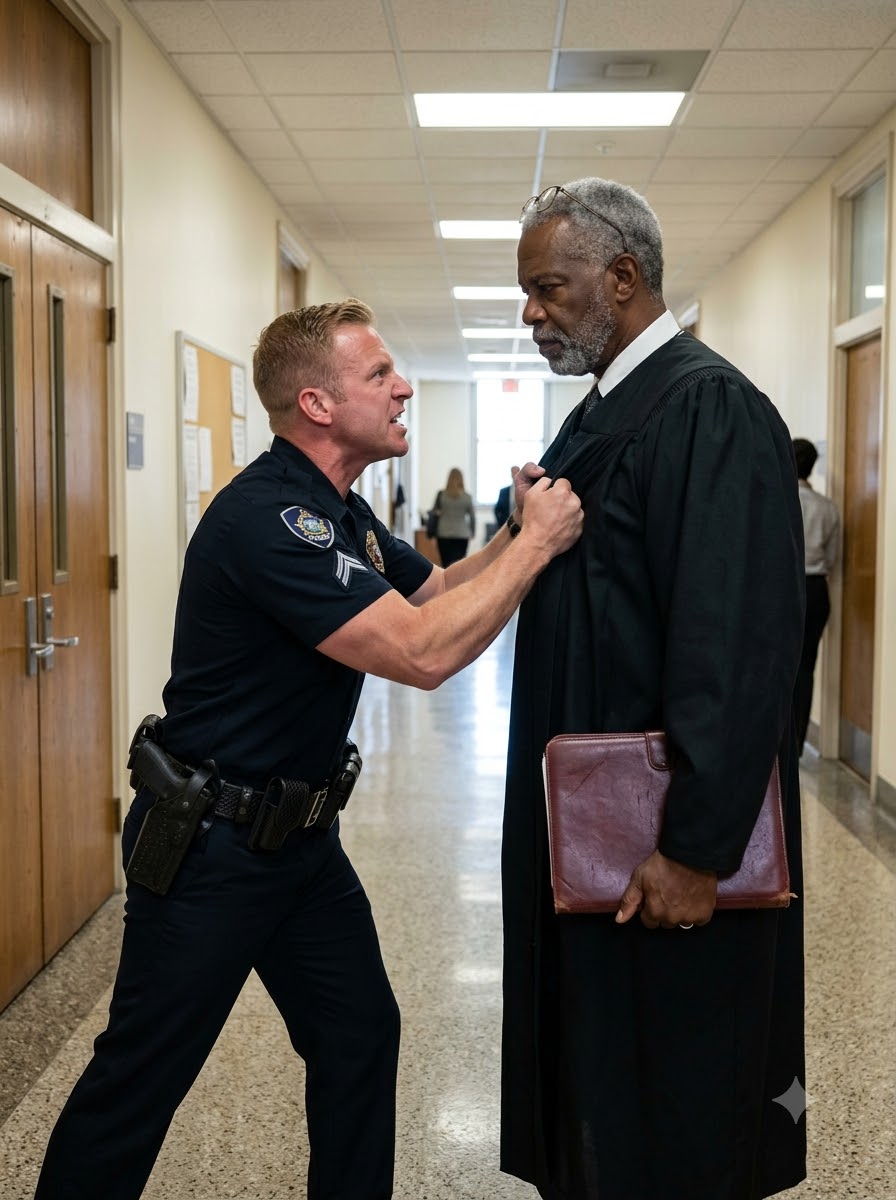
He reached forward and grabbed the front of Isaiah’s judicial robe.
Sofia gasped.
Isaiah lowered his eyes to the officer’s fist gripping the black fabric.
Then looked directly at him.
“Take your hand off me.”
Heller tightened his hold.
“You going to make me?”
“No.”
Isaiah’s voice grew colder.
“I’m going to ask you once.”
Heller smiled.
“What happens after once?”
Isaiah glanced at the body camera.
“Everything after once becomes evidence.”
Heller released the robe.
For one brief moment, Isaiah thought the officer had finally recognized the seriousness of his actions.
Then Heller reached behind his belt.
He produced a pair of handcuffs.
Sofia whispered, “You cannot be serious.”
Isaiah looked at the metal restraints.
“Heller.”
“You’re being detained.”
“For what?”
“Impersonating court personnel.”
Isaiah almost smiled.
There was nothing amusing about the situation.
But the accusation was so illogical that further argument seemed almost pointless.
“What evidence establishes impersonation?”
“You’re wearing a judge’s robe in a restricted hallway while claiming to be a judge.”
Isaiah nodded slowly.
“So the evidence that I am pretending to be a judge is that I look like a judge and say that I am one.”
Heller’s face reddened.
“Turn around.”
“No.”
The officer reached for Isaiah’s arm.
Isaiah did not resist.
He understood exactly how the scene would appear on the recording.
A large Black man.
An armed police officer.
A frightened courthouse clerk.
There was no physical response Isaiah could make that would improve the situation.
Heller seized his left wrist.
The first cuff snapped shut.
Click.
Sofia stepped forward.
“Officer Heller, stop.”
“Back up!”
She froze.
Isaiah looked down at the cuff.
Then at Heller.
“Do not twist my arm.”
“Stop resisting.”
“I am not moving.”
Heller pulled Isaiah’s wrist behind his back.
Isaiah complied.
“My other hand contains sealed judicial materials.”
“Drop them.”
“No.”
“Drop the bag.”
“I will place it down.”
“I said drop it.”
Isaiah looked at him steadily.
“You do not want sealed criminal files scattered across this hallway.”
Heller hesitated.
Isaiah carefully lowered the leather case onto a nearby bench.
Then offered his other wrist.
The second cuff locked into place.
Heller stepped away.
Isaiah raised his restrained hands slightly.
Red pressure marks were already appearing around his skin.
The officer smiled.
“Not so important now, huh?”
Isaiah watched him.
“That is an interesting thing to say while your camera is recording.”
Heller’s smile vanished.
“You’re going downstairs.”
“My courtroom is opening now.”
“You don’t have a courtroom.”
Isaiah glanced toward the wooden double doors.
“Officer Heller.”
“What?”
“You have one final chance to verify who I am before this hallway fills with witnesses.”
Heller rolled his eyes.
“We’re done talking.”
Isaiah nodded.
“All right.”
He raised his cuffed wrists a little.
“When those doors open, pay attention to what happens.”
Heller appeared entertained by the warning.
Then the courtroom doors swung open.
Bailiff Leonard Hayes stepped into the corridor.
“Judge Bennett, everyone’s ready—”
He stopped mid-sentence.
His expression went blank.
His gaze dropped to Isaiah’s wrists.
Then moved to Heller.
“What the hell are you doing?”
Heller turned toward him.
Behind Leonard stood Assistant State’s Attorney Emily Graves.
Defense attorney Samuel Pike stood beside her.
The court reporter leaned around them.
Two defendants waiting for their cases to be called stepped closer.
Inside Courtroom 3A, people began noticing the commotion.
Someone whispered.
The deputy clerk, responding automatically to the judge’s appearance, made the announcement she had delivered hundreds of times before.
“All rise.”
Every person in the courtroom stood.
Nearly fifty people.
Attorneys.
Defendants.
Relatives.
Witnesses.
Court employees.
Probation officers.
Observers awaiting traffic appeals.
They rose because Judge Isaiah Bennett had appeared at the entrance to his courtroom.
Wearing his judicial robe.
With handcuffs around both wrists.
Heller stared into the room.
Then back at Isaiah.
Finally, he turned toward the wall behind him.
Less than five feet away was the brass plaque.
HON. ISAIAH T. BENNETT.
The blood drained from his face.
Leonard stepped toward him.
“Take them off.”
Heller remained motionless.
The bailiff’s voice hardened.
“Officer.”
Heller looked at him.
“Take those cuffs off the judge.”
The handcuff key nearly slipped from Heller’s fingers.
He unlocked Isaiah’s right wrist.
Then his left.
He returned the cuffs to his belt.
Red marks encircled both wrists.
Heller opened his mouth.
“Judge, I didn’t—”
Isaiah raised one hand.
“Stop.”
Heller fell silent.
Isaiah bent down and retrieved his leather case.
He straightened his robe.
Then faced the courtroom.
Everyone was still standing.
“Please sit.”
The chairs lowered slowly.
Nobody spoke.
Isaiah turned toward Leonard.
“Mr. Hayes.”
“Yes, Judge?”
“Contact courthouse administration.”
“Yes.”
“And the officer’s supervising sergeant.”
“Right away.”
Isaiah looked at Sofia.
Her fear had turned into anger.
“Ms. Alvarez.”
“Yes, Judge?”
“Have every hallway camera from this floor preserved immediately.”
She nodded.
“Done.”
“And make a written request preserving Officer Heller’s body-camera recording from the beginning of his shift.”
Heller swallowed.
Isaiah turned directly toward him.
“Do not turn that camera off unless your supervisor orders you to.”
“Yes, sir.”
Isaiah’s expression hardened.
“Judge.”
Heller looked confused.
Isaiah repeated himself.
“The correct form of address in this building is Judge Bennett.”
Heller flushed.
“Yes, Judge.”
Isaiah began walking toward the courtroom.
Then paused.
“One more thing.”
Heller waited.
“You will not apologize to me right now.”
The officer appeared surprised.
“You will not explain.”
Isaiah continued.
“You will not ask me to understand your intentions.”
His tone remained controlled.
“This matter is no longer between you and me.”
Heller stood completely still.
“I am now a witness.”
Isaiah entered Courtroom 3A.
The doors closed behind him.
He walked to the bench and sat down.
His leather case rested beside him.
For several seconds, the room remained unbearably quiet.
Isaiah adjusted the microphone.
“I assume everyone has questions.”
A few nervous smiles appeared.
“You are not going to get answers from me today.”
He turned toward the clerk.
“We’ll take a fifteen-minute recess.”
The gavel struck once.
Isaiah returned to chambers.
Sofia followed him inside.
“Are you okay?”
Isaiah removed his robe and draped it over the back of a chair.
His hands trembled slightly.
Not enough for most people to notice.
Enough for Sofia.
“I’m fine.”
She stared at him.
“No.”
Isaiah let out a breath.
“Then no.”
Sofia sat down.
“He grabbed your robe.”
“I remember.”
“He called me part of some fake scheme.”
“I remember that too.”
She looked toward the door.
“He was standing beside your name.”
Isaiah said nothing.
“I told him.”
“Yes.”
“You told him.”
“Yes.”
“The courtroom was right there.”
Isaiah lowered himself into his chair.
Sofia shook her head.
“What else were you supposed to prove?”
Isaiah stared at the marks circling his wrists.
“That is what I want to know.”
Four minutes later, Sergeant Raymond Cole arrived.
He had spent twenty-four years in law enforcement, including nearly a decade working courthouse assignments.
He entered chambers looking pale.
“Judge Bennett.”
Isaiah stood.
“Sergeant.”
“I cannot apologize enough.”
Isaiah raised his hand.
“Please don’t.”
Cole stopped.
Isaiah indicated a chair.
“Sit.”
Courthouse administrator Patricia Lang arrived moments later.
She already had a legal pad open.
Isaiah appreciated that.
“I’m going to request preservation of evidence.”
Patricia nodded.
“All corridor cameras?”
“Yes.”
“Anything else?”
“Officer Heller’s complete body-camera file from the start of his shift until he is formally relieved.”
She wrote it down.
“Radio traffic.”
“Courthouse assignment records.”
“Access logs.”
“Security briefing materials from this morning.”
Cole nodded.
Isaiah looked toward him.
“And I want any prior complaint involving Officer Heller and identity verification inside government buildings preserved.”
Something changed in Cole’s expression.
It was brief.
But Isaiah saw it.
“There are previous complaints.”
Cole looked away.
“I did not say that.”
“You didn’t need to.”
The room went silent.
Patricia’s pen stopped for half a second.
Isaiah continued.
“This needs to go outside your ordinary internal review.”
Cole looked up.
“We have professional standards.”
“You do.”
Isaiah held his gaze.
“And I have presided over cases involving your department.”
Cole understood the implication.
Isaiah continued.
“I know several of your investigators.”
He sat down.
“I will not select who reviews this.”
“Judge—”
“I don’t want special treatment.”
Cole stopped speaking.
Isaiah’s voice became firmer.
“I want ordinary procedure done correctly.”
Cole nodded.
“Yes, Judge.”
“I am the complainant.”
Isaiah glanced toward the courtroom.
“And I have cases waiting.”
Patricia stared at him.
“You’re going back in there?”
“Yes.”
“You were just handcuffed.”
“Yes.”
“Isaiah.”
He looked at her.
“People downstairs have spent weeks waiting for hearings.”
He rose.
“My terrible morning doesn’t suspend their lives.”
Patricia plainly disagreed.
But she stepped aside.
Isaiah returned to the courtroom.
For the following four hours, no one watching him from the gallery would have known what had happened in the hallway.
He heard a probation matter.
Denied one bond application.
Reduced another.
Ordered counseling rather than incarceration for a nineteen-year-old with no criminal history.
Dismissed an eviction case because the landlord had failed to provide the required lawful notice.
He listened carefully.
Asked precise questions.
Applied the law.
But whenever his robe shifted against his wrists, he felt the marks left by the handcuffs.
At lunchtime, he drove home.
His wife opened the front door before he reached the porch.
Dr. Monica Bennett was fifty years old, a trauma surgeon, and usually among the calmest people Isaiah knew.
That afternoon, she looked capable of performing surgery without anesthesia.
“Show me your wrists.”
Isaiah extended both hands.
Monica examined them.
“Pain?”
“Not really.”
“Any tingling?”
“No.”
“Shoulder?”
“Fine.”
She looked into his eyes.
“Now answer the actual question.”
Isaiah removed his jacket.
“I’m angry.”
“I know.”
He walked toward the kitchen.
Monica followed.
“I’m embarrassed.”
She stopped.
Isaiah heard the word himself.
“Why?”
“I should have handled it differently.”
Monica stared.
“How?”
“I don’t know.”
“You identified yourself.”
“Yes.”
“The clerk identified you.”
“Yes.”
“You were wearing a judicial robe.”
“Yes.”
“Standing beside your own chambers.”
“Yes.”
Monica crossed her arms.
“Should you have performed a song?”
Isaiah nearly laughed.
She did not.
“Maybe a PowerPoint presentation?”
“Monica.”
“Asked Sofia to bring references?”
Isaiah sat down.
Monica took the chair opposite him.
“If a man refuses evidence because the person giving him the evidence does not fit whatever picture he already built inside his head, you cannot explain your way out of that.”
Isaiah lowered his gaze.
Monica’s expression softened.
“What bothered you most?”
He considered the question.
“The courtroom.”
“When everyone stood?”
“Yes.”
“Why?”
“That was when he believed me.”
Monica fell silent.
Isaiah rubbed his thumb over one of the cuff marks.
“He didn’t believe me when I said my name.”
“No.”
“He didn’t believe Sofia.”
“No.”
“He refused to read the door.”
She waited.
“He believed fifty people standing.”
Monica understood.
Isaiah looked at her.
“Same man.”
“Same robe.”
“Same hallway.”
“Suddenly credible because the room recognized me.”
His jaw tightened.
“That’s the part I can’t shake.”
Neither of them spoke for a while.
The following morning, an independent investigation began.
Franklin County referred the incident to the State Office of Professional Integrity to prevent conflicts involving the courthouse and police department.
Investigator Dana Whitfield spent nearly three hours interviewing Isaiah.
She worked carefully.
Dates.
Statements.
Distances.
The order in which events occurred.
She accepted no shortcuts.
Near the end of the interview, she asked the question Isaiah knew would eventually come.
“Judge Bennett, do you believe Officer Heller treated you differently because you are Black?”
Isaiah paused.
“I believe race matters to what happened.”
Dana waited.
“That is different from saying I know exactly what he thought.”
“Explain.”
Isaiah leaned back.
“He received information that should normally reduce suspicion.”
“Your statement.”
“Yes.”
“Sofia Alvarez confirming you?”
“Yes.”
“The chambers sign.”
“Yes.”
“Location.”
“Yes.”
Dana nodded.
Isaiah continued.
“But instead of reducing suspicion, every new piece of information became another reason to suspect deception.”
“You believe that pattern may reflect bias.”
“I believe you should look at whether he does that equally.”
Dana wrote something in her notes.
“You’re careful with language.”
“I’m a judge.”
“Occupational hazard?”
“Sometimes.”
Later that afternoon, Dana received the preserved body-camera footage.
The recording was clear.
Heller’s voice.
The word costume.
Isaiah identifying himself.
Sofia confirming his identity.
Heller accusing her of helping him deceive security.
The officer grabbing the robe.
The handcuffs closing.
And the remark:
“Not so important now, huh?”
Then the courtroom doors opened.
Nearly fifty people stood.
Heller turned toward the chambers plaque.
His entire demeanor changed.
Dana watched the recording.
Then watched it again.
But what troubled her most was not simply what Heller had done to Judge Isaiah Bennett.
It was the possibility that this had happened before.
And when she requested Officer Heller’s previous complaint files, the first folder placed on her desk revealed that the courthouse had already been warned.
More than once.
PART 2
Officer Grant Heller’s attorney reviewed the same body-camera footage that Dana Whitfield had examined.
His initial explanation centered on courthouse security.
There had recently been unauthorized-entry incidents involving people falsely claiming government business.
That much was accurate.
Two individuals had attempted to enter restricted areas using outdated contractor passes.
Another person had followed a courthouse employee into a staff elevator without authorization.
But none of those individuals had been wearing judicial robes.
None had identified themselves as sitting judges.
And none had a courtroom clerk standing nearby confirming their identity.
Heller’s lawyer next argued that Isaiah had been uncooperative.
The footage undermined nearly every part of that defense.
Isaiah had repeatedly offered reasonable methods of verification.
He had given his name.
Identified his courtroom.
Pointed out his chambers.
Directed Heller to the brass plaque.
Offered the assistance of his clerk.
Suggested using the radio.
Heller had refused every option.
The defense then turned toward officer safety.
Isaiah’s height became part of the argument.
During Heller’s interview, Dana addressed that claim directly.
“Did Judge Bennett threaten you?”
“No.”
“Raise his voice?”
“Not exactly.”
“Move toward you?”
“No.”
“Clench his fists?”
“No.”
“Attempt to leave?”
“He refused to follow orders.”
“Which order?”
“To leave the restricted corridor.”
“Did he explain why he believed he had authority to remain there?”
“He said he was a judge.”
Dana paused.
“And did you verify that statement?”
Heller looked down.
“No.”
The admission became a turning point.
Then Dana and her team opened the older complaint files.
There were eight.
Isaiah would not learn every detail until several months later.
The first significant complaint came from Danielle Mercer, a Black criminal-defense attorney who had practiced for twelve years.
Heller had stopped her outside a restricted consultation room.
Danielle produced her state bar identification.
Heller demanded her driver’s license as well.
A white attorney standing beside her was not asked to provide any identification.
Danielle filed a complaint.
The department categorized the incident as a communication breakdown.
No formal disciplinary action followed.
Another complaint involved Malik Owens, a Black certified court interpreter.
One morning, his courthouse badge failed to activate an electronic access point.
Heller questioned whether the badge was genuine, even after another courthouse employee confirmed Malik’s identity.
Malik reported the encounter.
Investigators concluded that Heller had acted “with an abundance of caution.”
A third complaint came from Luis Ortega, a Latino process server.
Heller questioned him for nearly twenty minutes despite his county-issued credentials.
Another involved Devon Harris, a Black law student shadowing a public defender.
Heller told Devon he “looked like he was wandering around.”
The public defender explained that Devon was accompanying her.
Heller nevertheless ordered him back to the lobby until a supervisor arrived.
Three additional complaints involved courthouse visitors.
Only one complaint came from a white individual.
That man had argued with Heller after being asked to identify himself near a records office.
His complaint resulted in mandatory counseling about professional tone.
Each case had appeared defensible when reviewed separately.
Together, they told a different story.
Dana created a spreadsheet.
Race.
Location.
Initial reason for suspicion.
Evidence offered to verify identity.
Heller’s response after receiving that evidence.
A troubling pattern emerged.
When Heller believed someone belonged in a particular space, ordinary explanations satisfied him.
When someone did not match his expectations, the same explanations became reasons for further suspicion.
Identification cards might be counterfeit.
Coworkers might be lying.
Badges might be borrowed.
Professional clothing might be a costume.
The issue was not that Heller asked people questions.
Courthouse security depended on asking questions.
The issue was that some people were permitted to answer them.
Others were forced to continue proving themselves even after the original basis for suspicion had disappeared.
Sergeant Raymond Cole had personally reviewed two of the earlier complaints.
Danielle Mercer’s.
And Malik Owens’s.
During Cole’s interview, Dana placed those files beside the documentation from Isaiah’s detention.
Cole read them without speaking.
Then leaned back.
“I missed it.”
Dana asked, “What did you miss?”
“The repetition.”
“Why?”
He stared at the paperwork.
“Because every time, I asked whether Heller could explain why he stopped the person.”
“And could he?”
“Yes.”
Cole rubbed his forehead.
“But I never asked why he kept escalating after the explanation.”
Dana waited.
Cole looked at her.
“I evaluated the first thirty seconds.”
“Not the next ten minutes.”
That statement became one of the most important observations in the investigation’s final report.
Heller was placed on administrative leave.
Three weeks later, Isaiah was presiding over an ordinary motions hearing when Danielle Mercer appeared at the defense table.
He had known Danielle professionally for years.
Until recently, he had not known that she had previously filed a complaint against Heller.
After the hearing, she asked whether they could speak privately.
Isaiah invited her into chambers.
Danielle closed the door.
“I’m sorry.”
Isaiah looked puzzled.
“For what?”
“What happened to you.”
“Thank you.”
Danielle folded her arms.
Then exhaled.
“I’m also angry.”
Isaiah understood.
“At me?”
“No.”
She shook her head.
“At how fast people cared.”
Isaiah remained silent.
Danielle sat down.
“He stopped me fourteen months ago.”
“I know some of it.”
“He was standing beside a white attorney.”
Isaiah nodded.
“I handed him my bar card.”
“He wanted a driver’s license too.”
“I asked whether my colleague needed to show one.”
“He said I was becoming argumentative.”
Danielle laughed without humor.
“My colleague took out his wallet.”
“Heller told him he didn’t need it.”
Isaiah glanced toward his desk.
Danielle continued.
“That was the part I wrote in the complaint three times.”
“He didn’t need proof from him.”
“He needed layers from me.”
Her expression hardened.
“The complaint came back saying we had a communication problem.”
Isaiah exhaled slowly.
Danielle looked directly at him.
“Then he does it to a Black judge.”
“And suddenly investigators discover vocabulary like pattern and bias.”
Isaiah had no defensible explanation for that disparity.
He did not attempt to invent one.
“You’re right.”
Danielle looked surprised.
“I thought you’d say your situation was more serious.”
“It was more visible.”
Isaiah held her gaze.
“That is not the same thing.”
Some of the tension left her shoulders.
“My complaint should not have needed yours.”
“No.”
“Malik’s either.”
“No.”
Isaiah leaned back.
“If the system requires the victim to be powerful before it becomes curious, the system is not functioning.”
Danielle considered his words.
“That sounds like something you should say publicly.”
Isaiah shook his head.
“Not yet.”
The conversation altered what Isaiah wanted from the investigation.
Initially, he had hoped for a straightforward resolution.
Preserve the footage.
Establish the facts.
Finish the investigation.
Put the humiliation behind him.
After speaking with Danielle, those goals no longer seemed sufficient.
He wanted to know how many people had warned the courthouse before his encounter.
He wanted to understand why those warnings had failed.
The judicial ethics office advised caution.
Isaiah remained a sitting judge.
The police department employing Heller regularly appeared before him in unrelated proceedings.
Public statements could complicate future cases.
Isaiah agreed.
When reporters surrounded him outside the courthouse, he offered only one sentence.
“I am a witness in an active administrative investigation, and I expect the same fair process I would expect for anyone else.”
They pressed him for more.
He declined.
At home, Monica found his judicial restraint exhausting.
“You can complain to me.”
“I am complaining.”
“You sound like you’re dictating findings.”
Isaiah examined his dinner.
“The chicken is dry.”
Monica stared.
“That is not emotional honesty.”
“It is culinary honesty.”
She lightly kicked him beneath the table.
Isaiah smiled.
Then became thoughtful.
“I keep thinking about Danielle.”
Monica nodded.
“The lawyer?”
“And Malik.”
“The interpreter.”
“And everyone else.”
He leaned back.
“How many things disappear because the person involved doesn’t have enough status to make an institution uncomfortable?”
Monica considered the question.
“Probably more than you want to know.”
“I work there.”
“You didn’t dismiss their complaints.”
“No.”
“But you are inside the institution.”
Isaiah looked at her.
“That is what bothers me.”
Monica reached across the table and took his hand.
“Then help fix the institution.”
“I cannot order new policy because I’m angry.”
“Good.”
She squeezed his hand.
“Don’t.”
“What am I supposed to do?”
“The thing you keep telling everybody else.”
Isaiah frowned.
“What?”
“Follow the process.”
He smiled faintly.
“That is irritating.”
“I married a judge.”
“You knew what you were getting.”
“Absolutely not.”
Four months after the hallway incident, the independent investigative report was released.
It contained one hundred sixty-two pages.
The investigators concluded that Officer Grant Heller had no adequate legal basis for detaining Isaiah Bennett.
He had unnecessarily escalated the encounter.
He had failed to reconsider his suspicions after receiving multiple independent facts confirming Isaiah’s identity.
He had used demeaning and unprofessional language.
And he had applied handcuffs without reasonable justification.
The report also identified evidence consistent with biased decision-making.
It did not claim to know Heller’s private thoughts or beliefs.
Instead, its conclusions rested on his documented conduct.
Isaiah considered that distinction essential.
Heller was terminated.
The police union appealed.
An independent arbitrator ultimately upheld the dismissal.
Isaiah did not celebrate publicly.
He did not call a press conference.
He did not contact reporters.
He offered no opinion about whether Heller deserved another opportunity in law enforcement.
But the report contained findings Isaiah considered more consequential than the termination itself.
The courthouse had failed repeatedly before he became a complainant.
Its complaint-tracking system was fragmented.
Supervisors examined incidents individually without looking for recurring behavior.
No mechanism flagged repeated disputes involving identity verification by the same officer.
Security training emphasized identifying possible threats but devoted little attention to reconsidering suspicion when new information emerged.
Those weaknesses could no longer be ignored.
A courthouse review committee was established.
Isaiah initially declined to serve because his own experience remained too closely connected to the investigation.
Instead, Danielle Mercer joined.
So did Malik Owens.
A public defender nominated Devon Harris, who was preparing for the bar examination.
The people whose earlier complaints had been dismissed as isolated misunderstandings were now helping design the safeguards that should have existed before.
Isaiah believed that was exactly how it should be.
One of the first proposals involved a bright gold identification pin for judges to wear on their robes.
Courthouse administrator Patricia Lang enthusiastically supported it.
“It would make judges immediately recognizable.”
Isaiah shook his head.
“No.”
Patricia frowned.
“Why?”
“Because it fixes the wrong problem.”
She looked confused.
“The officer would have seen the pin.”
“He also could have seen the chambers sign.”
Isaiah leaned forward.
“Sofia told him.”
“I told him.”
“He had a radio.”
“Nothing was missing.”
Patricia considered his argument.
Isaiah continued.
“If our lesson is that judges need better badges, we are teaching officers to treat judges better.”
“What should the lesson be?”
“That information has to matter.”
He pointed at the proposal.
“If someone provides valid evidence contradicting your first assumption, suspicion should change.”
“And if it doesn’t?”
“Then the officer needs to explain why.”
The identification-pin proposal was abandoned.
Training was revised instead.
One question became standard in courthouse-security instruction:
What information would cause you to reduce suspicion?
A second question became even more important:
Are you verifying identity, or are you forcing someone to overcome your disbelief?
Six months later, Isaiah heard those words during a training presentation.
He smiled.
He recognized Danielle’s writing.
“Good sentence.”
He told her afterward.
She shrugged.
“Experience.”
A year after Heller’s dismissal, an envelope arrived at Isaiah’s home.
There was no return address.
Monica placed it beside his morning coffee.
“This looks suspicious.”
Isaiah glanced at her.
“I thought physicians avoided catastrophizing.”
“We embrace appropriate paranoia.”
Isaiah opened the envelope.
Inside was a letter from Grant Heller.
He nearly stopped reading after the opening sentence.
But he continued.
Heller wrote that he had spent months consumed by anger.
He blamed the courthouse.
The investigators.
The media.
Isaiah.
Sofia.
The union for failing to preserve his employment.
Nearly everyone except himself.
During the appeal process, his attorney had provided recordings associated with the earlier complaints.
Heller watched them one after another.
Danielle.
Malik.
Luis.
Devon.
Then Isaiah.
A paragraph halfway through the letter made Isaiah pause.
I kept telling myself every encounter had a different explanation. They did. The people were different. The locations were different. But I was the same person in every recording.
Isaiah continued reading.
When someone looked like they belonged, their explanation became information. When someone did not look like I expected, the same kind of explanation became something I thought they were using to fool me. I called that caution because admitting what it really was would have meant admitting I had been wrong for years.
Monica watched her husband’s expression.
“What?”
He handed her the letter.
She read it.
On the final page, Heller apologized for grabbing the robe.
For the handcuffs.
For accusing Sofia of participating in a deception.
For humiliating Isaiah.
But one sentence carried more weight than all the others.
When the courtroom stood, my first thought was that I had just arrested the wrong Black man. It took losing my job to understand that there was never a right Black man to treat that way.
Monica placed the pages on the table.
“Wow.”
Isaiah said nothing.
“You going to answer?”
“I don’t know.”
“Do you forgive him?”
Isaiah looked out the window.
“Forgiveness isn’t the same as pretending something didn’t matter.”
“I know.”
He picked up the letter.
“But acknowledgment matters.”
Three weeks later, Isaiah wrote a response.
It was brief.
He used no courthouse stationery.
No official letterhead.
No judicial title.
He signed it simply as Isaiah Bennett.
Mr. Heller, what happened cannot be undone, and acknowledgment does not erase consequences. But understanding the difference between verifying facts and defending assumptions is important. The real measure of that understanding will be how you treat people when there is no judge, camera, courtroom, or public consequence forcing you to reconsider. I accept your apology.
He mailed the letter.
Then returned to his ordinary life.
At least, he tried.
A year later, organizers invited him to speak at a statewide conference attended by judges, police supervisors, court administrators, and attorneys.
The original subject was docket management.
Nobody seriously expected that topic to remain unchanged.
The organizers asked Isaiah to discuss what had happened in the hallway.
He refused twice.
Then Danielle called him.
“Do it.”
“I don’t want to turn this into a story about a powerful judge humiliating a cop.”
“Then don’t.”
“What should I say?”
“Tell them about us.”
Isaiah understood immediately.
On the morning of the conference, he walked toward the stage wearing a navy suit.
No judicial robe.
More than six hundred people were waiting.
He stepped behind the podium.
Adjusted the microphone.
And began with a sentence that silenced the entire room.
“The least important fact about my arrest is that I was a judge.”
PART 3
The audience remained quiet as Isaiah Bennett began recounting the incident.
He described the courthouse corridor.
The judicial robe.
Officer Grant Heller.
The chambers plaque.
Sofia Alvarez.
The handcuffs.
The moment the courtroom doors opened.
The nearly fifty people who stood.
He did not exaggerate.
He did not raise his voice.
He did not need dramatic language to make the experience disturbing.
Then he displayed a slide.
Eight prior complaints.
Dates.
No personal names.
An attorney.
A court interpreter.
A process server.
A law student.
Several visitors.
A dispute near the records office.
Isaiah turned toward the audience.
“Most internet versions of my story end when the courtroom stood.”
He paused.
“That ending feels good.”
“Black judge revealed.”
“Officer embarrassed.”
“Instant justice.”
Isaiah shook his head.
“It is also the wrong ending.”
He pointed at the screen.
“The real story began here.”
He explained the complaints one by one.
He avoided unnecessary details that might expose private information.
But he provided enough context for the audience to recognize what the individual incidents had in common.
Viewed alone, one encounter appeared minor.
Another could be explained away.
A third seemed to involve little more than an officer’s tone.
But considered together, the complaints revealed a consistent pattern.
Isaiah surveyed the room.
“My title made the contradiction impossible to ignore.”
He paused.
“That should trouble you.”
A police chief seated near the front shifted in his chair.
Isaiah continued.
“The problem was never that Officer Heller failed to recognize a judge.”
“The problem was that he treated recognition as the source of dignity.”
He looked across the audience.
“My robe did not create my right to reasonable treatment.”
“My chambers sign did not create it.”
“Fifty people standing did not create it.”
“Those things merely caused the system to care faster.”
Nobody moved.
Isaiah leaned toward the microphone.
“Build systems that care before status arrives.”
The sentence traveled far beyond the conference hall.
Newspapers quoted it.
Law-enforcement training departments printed it.
One state agency incorporated it into an ethics handbook.
Isaiah found the attention somewhat embarrassing.
He preferred something Danielle said to him afterward.
“The system didn’t finally work because it protected you.”
She paused.
“It worked because your case forced it to remember people it had already ignored.”
Isaiah carried those words with him.
Years passed.
Courtroom 3A remained his courtroom.
The third-floor hallway retained its beige walls.
The same fluorescent lights continued buzzing overhead.
His chambers plaque stayed beside the same wooden door.
For a while, passing the place where Heller had handcuffed him triggered a physical reaction.
His shoulders tightened.
His heartbeat quickened.
He sometimes remembered the pressure of metal against his wrists before he consciously recalled why.
But gradually, those reactions faded.
The hallway became ordinary again.
A place he walked through on his way to work.
Isaiah discovered that this return to normality meant more to him than he had expected.
Four years later, he emerged from chambers wearing his black robe.
A young courthouse officer stood near the elevator.
The officer was white, thin, visibly nervous, and approximately twenty-six years old.
“Good morning, Judge Bennett.”
Isaiah stopped.
“Morning.”
The officer hesitated.
“Can I ask you something?”
Isaiah checked his watch.
“One question.”
“I watched the Heller video during academy training.”
Isaiah sighed.
“I’m sorry.”
The young officer smiled.
“It was useful.”
“That sounds slightly better.”
He shifted his weight.
“What would you actually have wanted him to do?”
Isaiah considered the question.
The obvious answers came immediately.
Read the sign.
Listen to Sofia.
Use the radio.
Do not grab my robe.
Do not handcuff me.
But then he remembered Danielle.
Malik.
Luis.
Devon.
And the others whose complaints had preceded his.
“I wanted him to become curious before becoming certain.”
The young officer frowned slightly.
Isaiah explained.
“Your job sometimes requires suspicion.”
“Absolutely.”
“But suspicion should create questions.”
“Not conclusions.”
The officer nodded.
Isaiah continued.
“If every answer only makes you more convinced that the person is lying, then you are no longer investigating.”
“What are you doing?”
“Protecting your first assumption.”
The young officer thought about that.
“That makes sense.”
Isaiah turned toward Courtroom 3A.
Then looked back.
“And read the signs.”
The officer laughed.
“Yes, Judge.”
Isaiah entered the courtroom.
The bailiff announced:
“All rise.”
Everyone stood.
For a brief moment, Isaiah remembered another morning.
Cold metal against his skin.
Heller gripping the black robe.
The courtroom doors opening.
The officer’s expression changing.
Then the memory receded.
Today, the announcement meant nothing extraordinary.
It was simply courtroom procedure.
Isaiah walked toward the bench.
Attorneys stood at both tables.
A young defendant waited beside his lawyer.
Family members occupied the rear benches.
A courthouse deputy stood near the wall.
The people gathered there came from different backgrounds.
Different races.
Different income levels.
Different personal histories.
They also carried different reasons for being frightened.
Isaiah looked around the room.
Equal justice sounded permanent when engraved into the stone of a courthouse.
Working inside one had taught him something different.
Justice required maintenance.
Every day.
By human beings.
And it could deteriorate when people became careless.
One ignored complaint mattered.
One supervisor accepting the easiest explanation mattered.
One officer confusing certainty with professionalism mattered.
But the opposite choices mattered as well.
One clerk speaking up.
One attorney documenting an encounter.
One interpreter filing a complaint even when others insisted it would accomplish nothing.
One supervisor finally acknowledging what he had failed to notice.
One institution deciding that embarrassment was less dangerous than refusing to investigate itself.
Those decisions accumulated.
Isaiah took his seat.
“Be seated.”
The first matter involved a twenty-year-old man accused of entering a restricted county facility after business hours.
The prosecutor began reading the police report.
“Security observed the defendant behaving suspiciously near the rear entrance.”
Isaiah raised one hand.
The prosecutor stopped.
“What specifically did he do?”
She looked down at the document.
“The report says suspicious behavior.”
“That is a conclusion.”
Isaiah leaned forward.
“What behavior?”
The prosecutor located the relevant passage.
“He approached the employee entrance twice.”
“Good.”
“What else?”
“He tried one door.”
“Was it locked?”
“Yes.”
“Anything else?”
“He looked through the glass.”
Isaiah nodded.
“Now we have facts.”
The prosecutor continued presenting the report.
Isaiah listened.
Beneath his robe, his wrists bore no scars.
Only the memory remained.
And that was sufficient.
The black robe Officer Grant Heller had dismissed as a costume had never been the reason Isaiah Bennett deserved respect.
The brass plaque outside his chambers had never created his credibility.
The fifty people who stood when the courtroom doors opened had never transformed him from a suspicious stranger into someone worthy of humane treatment.
Those things were symbols of authority.
His dignity had existed before any of them.
Heller’s most visible mistake was arresting a judge.
But that was not the beginning of the failure.
It was simply the moment the failure became impossible for others to ignore.
The deeper mistake had occurred earlier.
An officer had looked at another human being and reached a conclusion before gathering the facts.
Then, instead of allowing new information to challenge that conclusion, he treated every contradiction as further evidence of deception.
The clerk became an accomplice.
The brass plaque became meaningless.
The judicial robe became a costume.
The judge’s own name became a lie.
By the time Heller produced the handcuffs, the available evidence no longer influenced his judgment.
Only his expectations mattered.
That was why Isaiah eventually stopped describing the incident with the simple statement:
A white officer arrested a Black judge.
The statement was accurate.
But it did not tell the entire story.
Isaiah preferred a different explanation.
A man entrusted with authority became certain before he became curious.
An institution had received repeated warnings and treated each one as an isolated misunderstanding.
Then, one Wednesday morning, the contradiction became too visible to dismiss.
The courtroom doors opened.
Fifty people rose.
Two handcuffs were removed.
And the courthouse finally began asking a question it should have considered long before Judge Isaiah Bennett walked into that hallway:
How much proof should a person have to provide before the truth is finally allowed to count?
