

PART 1
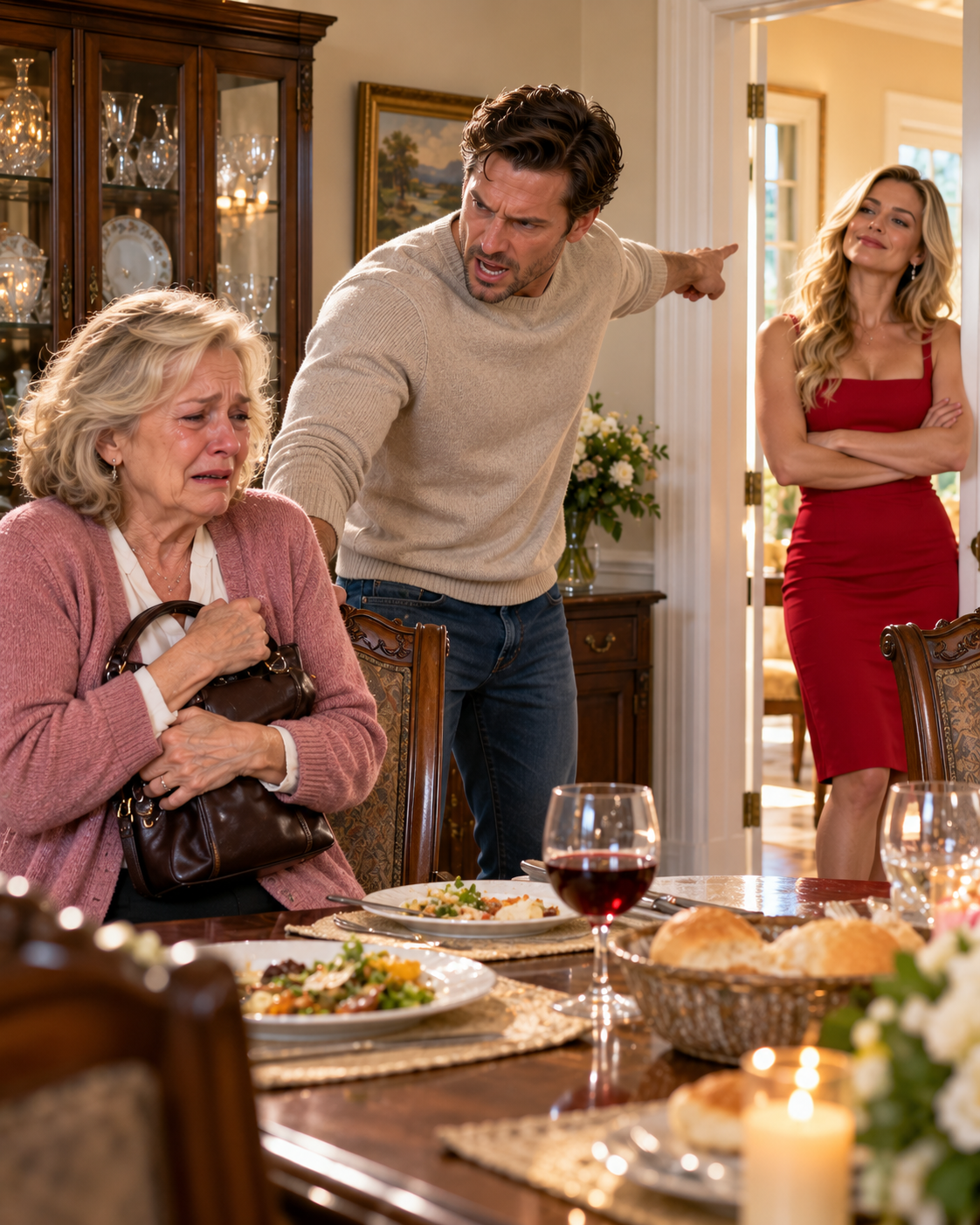
My son pointed toward his front door and said something I never imagined I’d hear from the boy I’d raised.
“Either you apologize to Khloe right now or you walk out of my house and never come back.”
My nine-year-old grandson sat nearby, crying quietly.
My daughter-in-law stood beside my son with her arms crossed.
I picked up my handbag and walked out.
Neither of them understood how much of their comfortable life depended on the support I’d been providing without asking for recognition.
My son, Theo, had never spoken to me with such cruelty before that evening.
He stood beside the dining table, gesturing toward the entrance as though I were an unwelcome guest.
“Either you apologize to Khloe right now or you walk out of my house and never come back.”
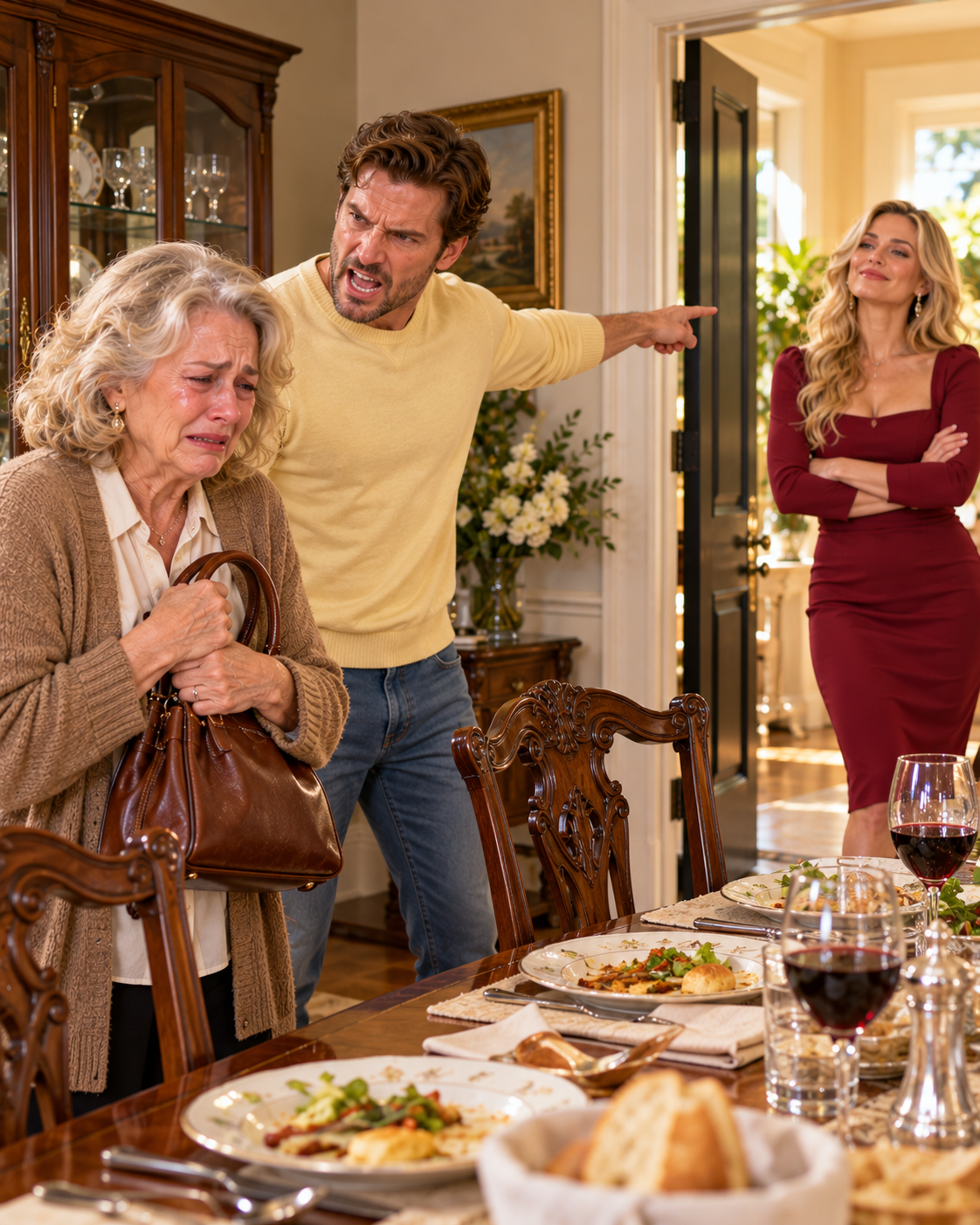
Hugo, my nine-year-old grandson, stared down at his dinner, trying desperately not to cry.
Even now, I remember the smallest details of that night.
The circular mark left by Theo’s water glass.
Cheyenne reaching beneath the table to hold her brother’s hand.
The terrible silence that followed my son’s ultimatum.
At sixty-eight, I suddenly felt like a stranger in the family I’d spent my life loving.
The disagreement had started with something simple.
Hugo had asked whether I could spend Thanksgiving with them.
Before I could answer, Khloe announced that she wanted the holiday to include only her immediate family.
I could have accepted that.
Parents have every right to decide how they want to celebrate holidays.
But Khloe didn’t stop there.
She said she was tired of my suggestions and resented feeling judged in her own home.
She brought up the time I’d reminded Hugo to wear another layer before going outside.
Then she mentioned a comment I’d made about Cheyenne’s bedtime.
I’d intended both remarks as ordinary grandmotherly concern.
Still, I understood that worrying about my grandchildren didn’t automatically give me the right to offer unsolicited advice.
“Maybe I should have kept those opinions to myself,” I said. “But I wasn’t trying to hurt you.”
Khloe accused me of always needing to be right.
She claimed I made Theo feel guilty whenever someone disagreed with me.
When I gently objected to her tone, she pushed back her chair.
“If you really cared about your grandchildren,” she said, “you would know when you’re not welcome.”
Hugo’s eyes filled with tears.
Cheyenne became unusually quiet.
I wanted to reassure them that disagreements between adults weren’t their responsibility.
But before I could speak, Theo slammed his palm onto the table.
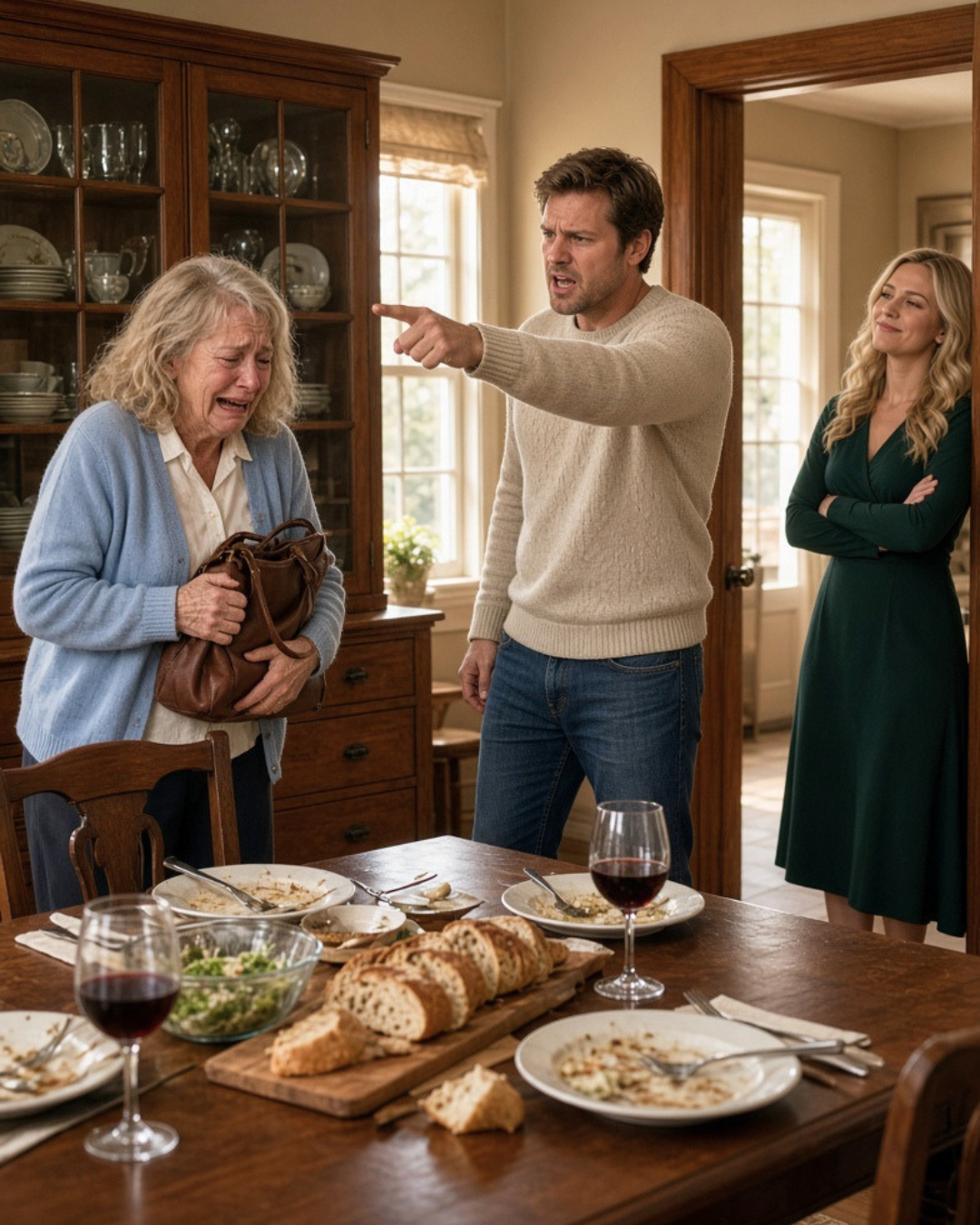
“That’s enough, Mom. Khloe has put up with this for far too long. Apologize to my wife.”
I asked whether he understood what he was demanding.
He stood and repeated his ultimatum.
Apologize.
Or leave forever.
Khloe remained beside him, arms crossed.
Neither seemed concerned that their children were watching.
I didn’t raise my voice.
I stood, collected my handbag, and answered, “I understand.”
Then I bent down and embraced Hugo and Cheyenne.
I told them their grandmother loved them.
I reminded them that adult disagreements were never their fault.
And I walked out.
The door closed behind me.
I sat in my car for several minutes.
Part of me hoped Theo would come outside.
Maybe he’d apologize for making the children witness the confrontation.
Maybe he’d ask whether I was all right.
But he never appeared.
Eventually, I drove home.
It was the same house I’d shared with my husband, Sebastian, before he died six years earlier.
And when I opened the door, the silence felt heavier than ever.
To understand why that evening devastated me, you need to understand how completely my life had become intertwined with Theo’s family.
Theo was my only son.
After Sebastian died, loneliness had become an almost constant presence.
The empty chair where my husband used to drink coffee seemed to remind me of his absence every morning.
I’d spent decades working as a nurse.
Retirement provided a comfortable enough pension, but it also left me with long days and very little structure.
At first, I visited Theo and Khloe twice a week.
I helped collect the children from school, prepared occasional breakfasts, and assisted during busy afternoons.
Gradually, those visits became more frequent.
Soon I was arriving before the children woke up.
I made breakfast.
Checked their schoolbags.
Drove them to appointments and activities.
Then I returned to clean the kitchen, start the laundry, and prepare dinner.
Often, I stayed until every remaining chore was finished.
Cheyenne had dance lessons.
Hugo had homework and a busy schedule.
I moved between their obligations with the same efficiency I’d developed during my years working in hospitals.
I knew exactly which lunchbox belonged to Hugo.
I knew where Cheyenne kept her favorite hair accessories.
And I knew the family’s daily routine almost as well as my own.
In the beginning, Theo thanked me frequently.
Being needed helped ease the loneliness I felt whenever I returned home.
But over time, something changed.
Requests gradually became expectations.
Khloe began leaving written instructions and schedules on the kitchen counter.
Theo informed me when I needed to collect the children without checking whether I was available.
My own appointments and plans rarely entered the conversation.
I understood that both parents worked.
I knew raising two children while managing jobs could be exhausting.
But whenever I rearranged a medical appointment to collect one of the children, nobody knew what I’d given up.
They simply saw me arrive on time.
I should have established boundaries much earlier.
Instead, I convinced myself that helping was what families did.
I took pride in being dependable.
Even when my role began resembling a full-time job without scheduled hours or a day off.
The financial assistance developed in much the same way.
Two summers before our argument, Khloe became worried about a leaking roof.
I paid nearly $25,000 to have it replaced.
I couldn’t bear the thought of water damaging the bedrooms where my grandchildren slept.
I also paid Cheyenne’s dance tuition.
Her costumes.
Transportation.
The family’s monthly phone charges were automatically deducted from my account.
Groceries and children’s clothing regularly ended up in my shopping cart.
And whenever an unexpected expense appeared, I was usually the first person to offer help.
I’d even co-signed the financing for Theo’s truck.
Sebastian and I had saved carefully throughout our lives.
I believed that money could help provide our son and grandchildren with a more secure future.
I never expected repayment.
But eventually, I realized that what I’d intended as voluntary generosity had become a permanent part of their household budget.
And there was something else they didn’t know.
For almost a year, I’d been receiving treatment for osteoporosis and persistent joint pain.
My doctor had warned me against lifting heavy objects, standing for long periods, and failing to rest after extended drives.
I hadn’t told Theo or Khloe.
I worried they’d interpret my health problems as criticism or an excuse to stop helping.
Looking back, I should have known better.
After decades in nursing, I understood the risks of ignoring medical advice.
Yet I kept doing exactly that.
On especially painful evenings, I’d return home and sit in my coat because my knees hurt too badly to climb the stairs immediately.
Cleaning left my fingers stiff.
Long afternoons made my back ache.
Every night, I promised myself I’d slow down the following morning.
Then the phone would ring.
And I’d forget my promise.
One afternoon, after I’d finished cleaning Khloe’s kitchen, she remarked that someone who’d spent the entire day at home had no reason to feel tired.
I told her I was fine.
But that night, while placing my medication beside the bed, I wondered when telling my own family the truth had become something I was afraid to do.
I postponed physiotherapy sessions to fit around Cheyenne’s dance schedule.
I delayed purchasing a supportive chair my doctor had recommended because Theo mentioned another shortage of money.
Nobody explicitly ordered me to make those sacrifices.
I made those decisions myself.
And accepting responsibility for them became an important part of understanding how I’d reached this point.
Every sacrifice seemed easy to justify.
I imagined Cheyenne smiling in her dance costume.
Or Hugo waving goodbye outside school.
Then I’d feel guilty for wanting a quiet morning.
Somewhere along the way, I’d forgotten that loving my grandchildren didn’t require ignoring my doctor’s advice.
Money I’d saved for my own treatment was gradually being spent on their household.
And almost nobody asked how I was feeling.
I was terrified of disappointing people who had become accustomed to never hearing me say no.
The argument at dinner finally revealed just how unhealthy our arrangement had become.
My older sister, Nora, had been warning me for years.
After her divorce, she’d settled in Newport, Oregon.
Her coastal property included a guesthouse overlooking nearby marshland.
She invited me to visit repeatedly.
And every time, I had an excuse.
A school pickup.
A dance lesson.
Something Khloe needed.
Eventually, Nora asked me a question I couldn’t forget.
“Camila, who will take care of you when you don’t have the strength to take care of everyone else?”
I’d laughed it off.
Because answering honestly would have meant admitting something painful.
Constantly helping Theo’s family had become my way of avoiding the grief of losing Sebastian.
Feeling indispensable was easier than sitting alone with my memories.
The morning after Theo ordered me out, I sat at my kitchen table with my aching knee resting on another chair.
Then I called Nora.
She immediately recognized that something was wrong.
“Camila, what’s wrong?”
“Is the guesthouse still available?” I asked.
She said it was and wondered whether I was finally planning a visit.
“Not just a visit,” I told her. “I need to move for a while. I need treatment, and I need some rest.”
Nora didn’t demand an explanation.
“Then come here, little sister,” she said. “We’ll figure things out one day at a time.”
For the first time since leaving Theo’s house, I felt as though someone wanted me around without expecting anything in return.
After ending the call, I opened the financial records Sebastian had organized before his death.
I listed every recurring payment connected to Theo’s household.
Phone bills.
Dance tuition.
Bank transfers.
Groceries.
The truck financing.
The totals shocked me.
What I’d thought of as occasional assistance had become a substantial contribution to another family’s regular expenses.
I contacted my bank.
I asked about stopping automatic transfers, canceling an additional card, and protecting the savings I still had.
I also requested information about my responsibilities as guarantor on Theo’s vehicle loan.
I understood that co-signing a debt created obligations that couldn’t simply disappear because I changed my mind.
The following Tuesday, I went to the bank carrying my documents.
Preston Hail, who’d helped me after Sebastian died, met with me.
He seemed surprised by my requests.
But he carefully explained which payments could be stopped immediately and which required notice or additional arrangements.
“Are you certain?” he asked when we reached the recurring transfers. “You’ve kept some of these going for a long time.”
“I know,” I told him. “That’s why I need to stop.”
We canceled the transactions I controlled.
We arranged changes to the others.
And I transferred my accessible savings into an account solely in my name.
Preston didn’t criticize me.
He simply respected my right to decide how my own money would be used.
Three days later, as I prepared for Newport, Khloe called.
She didn’t ask how I was feeling.
She didn’t ask whether I’d been sleeping or whether my knee had improved.
Instead, she demanded, “What have you done?”
The phone and dance payments hadn’t gone through as she’d expected.
She was furious that I hadn’t warned them.
I explained that my medical needs required me to make different decisions about my money.
“But we’ve always relied on you,” she said. “Do you know what kind of problems this causes us?”
Before I could answer, she changed the subject.
“Anyway, you’re still coming over at one to watch the kids, right? I’ve made plans with a friend.”
I looked at my half-packed suitcase.
Apparently, the ultimatum Theo had delivered at dinner no longer mattered now that Khloe needed childcare.
For years, I’d organized my life around being useful to them.
But this time, I answered differently.
“No, Khloe,” I said. “I’m not coming this afternoon. You’ll need to make another arrangement.”
She called me selfish.
I listened.
I felt the familiar anxiety of disappointing her.
But I didn’t change my answer.
And when she threatened to keep the family away from me unless I resumed helping, I finally asked the question I’d been afraid to say aloud.
PART 2
Khloe’s voice grew colder.
She warned that if I stopped helping with money and childcare, I shouldn’t expect invitations to their home.
She said the family wouldn’t come to visit me either.
After spending years helping raise Hugo and Cheyenne, those words hurt more than I wanted to admit.
I held the phone tightly.
“Do you really believe I have to pay your bills and watch your children to earn a place in this family?”
Khloe insisted I was twisting her words.
But I knew what I’d heard.
I told her I would respect whatever decisions she and Theo made about visits.
However, I would no longer organize my life around their household’s demands.
When she ended the call, I remained seated for a long time.
I was upset.
Part of me wanted to call back and promise to continue helping, simply to restore the relationship.
But I knew that would only return us to the same unhealthy arrangement.
For once, I allowed myself to feel uncomfortable without immediately trying to fix everyone else’s problems.
During the next ten days, I made another important decision.
I would sell my house in Maple Oak.
It was the home Sebastian and I had shared for years.
He’d planted the flowers outside.
We’d selected curtains together.
Every room contained memories of our marriage.
Selling it wasn’t an act of revenge against Theo.
The house had simply become too difficult for me to maintain.
And I didn’t want to spend my remaining retirement years caring for rooms I no longer had the strength to enjoy.
I contacted Peter, a real estate agent who’d previously helped one of my neighbors.
He asked whether I’d thought carefully about selling.
I appreciated that he took the decision seriously.
We discussed the property’s condition, a reasonable listing price, and how much money I’d have after moving expenses.
Several potential buyers came to see the house.
Eventually, a young couple named Daniel and Emily visited.
Emily was an elementary school teacher.
Daniel worked as a technician.
They stood near the window admiring Sebastian’s garden and talked about drinking morning coffee on the porch.
When I explained that my late husband had planted the flowers, Emily promised she’d take good care of them.
Their offer was fair.
The inspection and closing conditions were straightforward.
After reviewing the documents, I accepted.
For the first time in years, I was making plans based on my own future rather than somebody else’s immediate needs.
Meanwhile, Khloe began posting messages online about protecting her peace and distancing herself from toxic people.
I didn’t respond.
Theo called four times during one weekend.
I allowed each call to go to voicemail.
His final message sounded more worried than angry.
“Mom, where are you? Is everything okay? Please call me back.”
I listened.
But I wasn’t ready to return his call.
For years, I’d answered every time my phone rang.
I’d dropped appointments, interrupted meals, and abandoned plans whenever Theo or Khloe needed something.
Now I needed space to make decisions without being pulled back into the same pattern.
When the house sale closed, I handed Daniel and Emily their keys.
Then I stood for a moment in the empty sitting room.
I remembered Theo as a little boy, sitting at the dining table and asking Sebastian for another helping of dessert.
The memory brought tears to my eyes.
But feeling sad didn’t mean I’d made the wrong decision.
I packed several photographs of Sebastian.
My old nursing notebook.
My medical records.
And the clothes I needed.
Then I left Maple Oak and traveled to Oregon.
Nora was waiting for me in Newport.
The moment she saw me, she wrapped her arms around me.
“You finally made it,” she whispered as I cried against her shoulder.
Her guesthouse had cedar siding and a small porch overlooking the wetlands.
She carried my luggage inside.
Then she asked whether I’d prefer something to eat or whether I wanted to rest first.
Such a simple question.
Yet it had been years since someone had offered me a choice based entirely on what would make me comfortable.
That evening, we went to a casual seafood restaurant.
We ordered shrimp and sat talking.
I didn’t need to check a school schedule.
I didn’t have to rush home to prepare dinner for anyone.
And I wasn’t expected to wash the dishes afterward.
Nora asked whether I regretted leaving.
“I miss them,” I told her. “But I don’t regret needing a life of my own.”
The first days in Newport were quieter than anything I’d experienced in years.
At first, the peace felt strange.
I kept expecting my phone to ring with another request.
But gradually, I began enjoying mornings that belonged entirely to me.
Nora took me to a farmers market.
We spent time choosing tomatoes, fresh basil, and a small jar of honey.
There was no hurry.
No schedule to coordinate.
No child waiting to be collected.
I hadn’t realized how much pleasure I’d lost in ordinary activities.
One afternoon, I sat on Nora’s porch and switched my phone on again.
Missed calls and messages filled the screen.
Almost immediately, Theo called.
I answered.
“Mom, I went to the house,” he said. “There are strangers living there. What happened?”
“I sold it,” I replied. “I’ve moved to Newport.”
He sounded stunned.
He couldn’t believe I’d made such an important decision without consulting him.
Then he said something that made me go completely still.
“I always thought that house would belong to me someday.”
For a moment, I couldn’t find the words.
Sebastian and I had worked hard to purchase that home.
We’d never promised it to Theo.
And I was still alive.
“I’m still alive, Theo,” I said. “I need to pay for my own care and plan for my future.”
He began protesting.
Then Khloe took the phone.
She described the house as a family asset.
She demanded to know why I hadn’t considered Theo’s future before selling it.
I reminded her of the roof replacement.
The dance lessons.
The phone bills.
The groceries.
And the years of assistance I’d provided.
Then I asked why neither of them seemed concerned about my own future.
When I explained that I’d postponed physiotherapy and spent money reserved for medical care, Theo sounded genuinely distressed.
“Mom, why didn’t you tell me?”
I closed my eyes.
“Because I didn’t want to be another problem,” I admitted. “But you’ve spent this conversation asking about the house and the payments. You didn’t ask whether I got here safely.”
Neither answered immediately.
Eventually, Theo asked me to return so we could discuss the family’s financial situation.
I explained that I intended to remain in Newport.
I needed to prioritize my health.
I wasn’t abandoning my grandchildren.
I wasn’t saying I’d stopped loving Theo or Khloe.
But their household responsibilities belonged to them.
And I would no longer sacrifice my health and financial security to manage those responsibilities.
I told him we could talk again when everyone was prepared to treat one another respectfully.
After ending the call, I sat quietly on the porch.
I was still worried about Hugo and Cheyenne.
I still missed them.
But I also knew that returning immediately would teach their parents that my boundaries could be ignored whenever they became inconvenient.
In the weeks that followed, I attended every medical appointment.
I rested when my body needed rest.
And for the first time in almost a year, I stopped treating my doctor’s recommendations as optional.
Nora suggested we enroll in a watercolor class.
My first painting looked like a landscape disappearing beneath a puddle.
We laughed until our sides hurt.
We visited exhibitions.
Attended reading groups.
And met women who’d spent decades working, raising children, teaching, and caring for relatives.
Many of them were discovering the same thing I was.
They could enjoy their own lives without apologizing for it.
I still grieved Sebastian.
But I no longer tried to bury that grief beneath endless chores.
Occasionally, Pamela, Theo’s cousin, called with news from home.
Without my daily assistance, mornings had become difficult.
Theo now had to get the children ready for school before work.
Khloe needed to rearrange extracurricular activities and manage pickups and meals.
They argued about household responsibilities.
They reviewed expenses I’d previously paid without discussion.
Hearing about their difficulties didn’t make me happy.
I wanted Hugo and Cheyenne to have a peaceful, stable home.
But gradually, Pamela reported changes.
Theo adjusted his working hours.
Khloe reorganized the children’s activities.
And the couple began dividing household tasks more fairly.
One afternoon, Pamela described finding Khloe sitting outside, overwhelmed by everything she needed to accomplish.
I remembered the countless afternoons I’d managed those same responsibilities while postponing my medical appointments.
Still, I was relieved that they were beginning to adapt.
They were learning to manage their own household.
And I was learning that I could love them without being constantly available.
Nearly six months passed.
Then one afternoon, while Nora and I were drinking tea, my phone rang.
It was Theo.
I answered cautiously.
For a moment, he said nothing.
Then he asked a question I hadn’t heard from him in a very long time.
“Mom, how are you?”
And before I could respond, he began to apologize.
PART 3
“I know that comes too late,” Theo said. “I’m sorry I let you walk out that night. I shouldn’t have made you choose between apologizing to Khloe and being part of our family.”
I sat quietly, listening.
For months, I’d imagined what I might say if my son finally acknowledged what had happened.
Now that the moment had arrived, I found myself struggling to speak.
Eventually, I explained what had hurt me most.
It wasn’t simply the money.
It wasn’t the housework.
It wasn’t even the endless childcare arrangements.
It was realizing that my son could treat me as disposable when I needed him to recognize that I was a person with needs of my own.
I’d spent years being useful to his family.
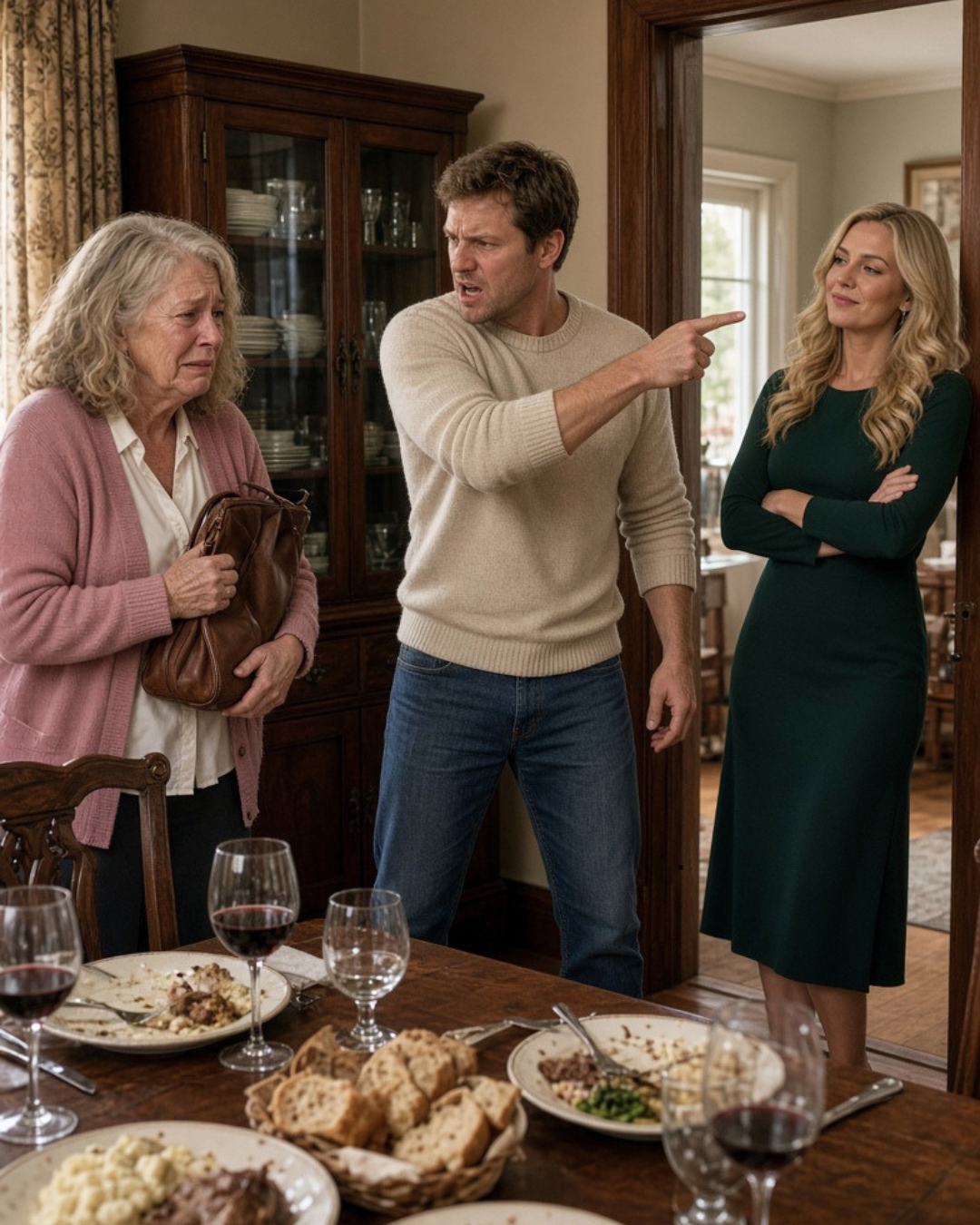
And when I stopped agreeing with everything they wanted, he told me to leave forever.
Theo didn’t interrupt.
He didn’t try to justify his behavior.
Instead, he listened.
Then he admitted that managing the children’s schedules, preparing meals, and paying household expenses had forced him to recognize how much I’d been doing.
“I didn’t know about your pain,” he said. “But I should have been paying attention.”
I appreciated those words.
But I also needed him to understand that an apology wouldn’t mean I was returning to our previous arrangement.
I told him I wouldn’t move back.
I wouldn’t resume daily childcare.
And I wouldn’t become responsible for their household expenses again.
Theo assured me he wasn’t asking for any of those things.
He simply wanted to apologize.
And he hoped that someday I could forgive him.
We talked for a long time.
He told me about Hugo’s schoolwork and Cheyenne’s dancing.
Both children continued asking when they could see their grandmother.
I told him I missed them terribly.
I loved them.
I loved Theo.
And despite everything, I still cared about Khloe.
But I wanted our relationship to be built on affection freely given.
Not on the expectation that I would always provide money, labor, or childcare.
When we ended the conversation, I felt cautiously hopeful.
I knew that one apology couldn’t erase years of unhealthy habits.
Real change would have to be demonstrated over time.
Later that summer, Theo sent me details of a planned family trip to Newport.
He’d booked their accommodation himself.
He hadn’t asked me to pay.
He hadn’t expected me to host everyone.
It might have seemed like a small thing.
But to me, it mattered.
For the first time in years, my son was approaching a visit as someone who wanted to spend time with his mother.
Not as someone arranging another task for her to complete.
When they arrived, I was waiting outside their inn.
Hugo spotted me first.
He ran toward me with Cheyenne close behind.
Both children threw their arms around me.
I hugged them tightly.
They talked excitedly about school, dancing, and everything that had happened since we’d last been together.
I held them until my knees reminded me to straighten up.
Then Theo embraced me.
He whispered that he was grateful I’d agreed to see them.
We spent the next few days together.
We walked along the beach.
Shared meals.
And sat talking on Nora’s porch.
Hugo proudly told me about the books he’d been reading.
Cheyenne asked whether we could bake together.
I agreed.
And when we finished, her parents helped clean the kitchen without being asked.
During another meal, Theo set the table while Khloe put away the food.
None of those actions was dramatic.
But they represented something I’d rarely experienced during the years when I’d been helping their household.
Ordinary consideration.
I was no longer expected to take responsibility for every unfinished task.
One afternoon, while the children played outside, Khloe came to sit beside me.
She apologized.
She admitted she’d behaved as though my energy and time were unlimited.
She acknowledged that she’d failed to recognize how much pain I was experiencing.
I listened carefully.
Then I admitted something too.
I should have explained my limitations much sooner.
I’d hidden my health problems and continued helping even when I was physically exhausted.
That had contributed to the unhealthy arrangement.
But I also made one thing clear.
My boundaries needed to be respected even when they were inconvenient.
Khloe nodded.
“I don’t want you to feel useful only when we’re asking something from you,” she said.
I believed she meant it.
Still, I understood that lasting change would require more than emotional promises.
It would have to appear in everyday behavior.
Before they returned home, Theo told me they hoped to visit every few months.
He said they would organize the travel themselves.
I told him I’d be happy to see them whenever my health allowed.
And I promised that if I needed to rest, I would say so.
He accepted that without arguing.
After they left, Nora and I sat together overlooking the marsh.
The afternoon was peaceful.
I missed Hugo and Cheyenne already.
I missed Theo too.
But the quiet no longer felt like abandonment.
It felt like a life I was finally allowed to enjoy.
For years, I’d believed that being a good mother meant making myself available whenever my son needed something.
After Sebastian died, I’d filled the empty spaces in my days with obligations to Theo’s family.
I told myself I was helping because I loved them.
And that was true.
But I’d also been afraid.
Afraid of loneliness.
Afraid of disappointing them.
Afraid that if I stopped being useful, there would no longer be a place for me in their lives.
That fear had led me to ignore my health, postpone treatment, and spend money I’d saved for my own future.
I hadn’t realized how much I’d given up until Theo told me to leave.
At the time, his words felt like the end of my family.
But walking away forced me to confront something I’d avoided for years.
I could love my son without organizing his household.
I could adore my grandchildren without being responsible for every school pickup.
And I could care about Khloe without allowing her expectations to determine how I spent my retirement.
Selling the house hadn’t erased my memories of Sebastian.
Moving to Newport hadn’t erased my love for my family.
And stopping the payments hadn’t made me selfish.
Those decisions had simply given me the chance to care for myself with the same attention I’d spent decades giving everyone else.
I still wanted Theo and his family in my life.
But I no longer believed I had to earn their affection through endless sacrifice.
At sixty-eight, I’d finally discovered something that should have been obvious all along.
Being a mother doesn’t mean surrendering the rest of your life.
Being a grandmother doesn’t mean ignoring your own health.
And loving your family doesn’t require allowing them to treat your generosity as an obligation.
That evening, as Nora and I watched the light fade across the wetlands, I thought about the night Theo had pointed toward his front door.
He’d believed that ordering me to leave would force me to apologize.
Instead, it had forced me to recognize how badly I needed a life of my own.
I hadn’t stopped loving my family.
I’d simply stopped abandoning myself to prove that I did.
