


PART 1: The Divorce Papers and the Stranger at Sea
“I don’t think we’re meant to grow old together.”
Those were the words my husband spoke on a Thursday evening in October, standing in our kitchen without even removing his coat.
I was standing at the stove, stirring a pot of his favorite chili. I had added extra beans and a touch of cinnamon, exactly the way he liked it. Greg always said that particular flavor reminded him of Sunday afternoons at his grandmother’s house.
The radio was playing softly, and I was humming along.
At first, I didn’t even turn around.
“What did you say, honey?”
He didn’t repeat himself.
Instead, I heard the quiet rustling of paper, followed by a dull sound as something landed on the kitchen table.
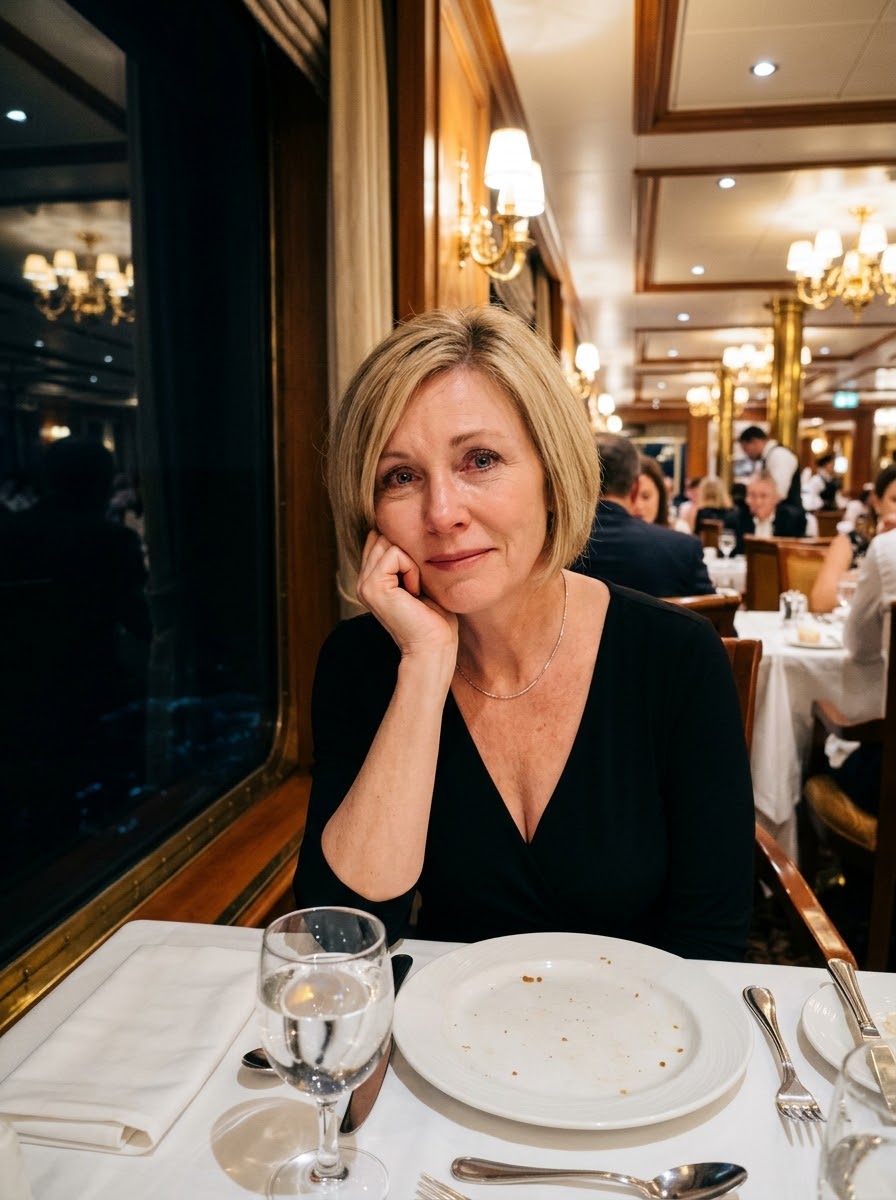
When I turned, Greg was standing beside the table with both hands tucked into his coat pockets.
A thick manila envelope lay beside the salt shaker.
He wasn’t looking at me.
His eyes were fixed on the envelope.
“What’s that?” I asked.
“Papers,” he said.
“What papers?”
Finally, he raised his head.
The edges of his eyes were red.
“Divorce papers, Claire.”
I laughed.
I genuinely laughed out loud.
There I was, holding a wooden spoon covered in chili, laughing because what he had just said seemed utterly impossible.
We had been married for twenty-two years.
Our daughter was attending college. We had a mortgage, a golden retriever named Biscuit, and a spring vacation to the Smoky Mountains already planned.
We still held hands while shopping for groceries.
Every morning before work, Greg kissed my forehead.
“Very funny,” I said. “Take your coat off. Dinner’s almost ready.”
He remained perfectly still.
“I’m not joking.”
My smile slowly disappeared.
“Greg.”
“I’m sorry,” he said quietly. “I’ve already signed them. I’ve talked to a lawyer. I’m going to stay at a hotel tonight, and I’ll find an apartment this weekend.”
The wooden spoon fell from my fingers and struck the floor.
Chili splashed across the tiles.
Biscuit rushed over and began licking it up.
Neither of us tried to stop him.
“I don’t understand,” I said. My voice sounded unfamiliar, as though it belonged to someone standing far away. “What happened? What did I do?”
“You didn’t do anything.”
“Then why?”
Greg drew a long breath.
“We’ve grown apart,” he said. “We’re too different now. We want different things.”
“What things? What do I want that you don’t want? Tell me one thing.”
He said nothing.
“Is there someone else?” I asked. My throat tightened until the words barely came out. “Just tell me. I’d rather know. Is there someone else?”
“No,” he answered immediately, with such certainty that I believed him. “There is no one else, Claire. I swear to God. There’s never been anyone else.”
“Then I don’t understand!”
I was shouting.
I almost never raised my voice. During twenty-two years of marriage, I could count the times I’d shouted at Greg on one hand.
He flinched as though I’d struck him.
“I’m sorry,” he whispered. “I’m so sorry.”
Then he turned and walked through the back door.
I heard his engine start.
His car backed out of the driveway, turned onto the street, and disappeared.
I remained in the kitchen, chili splattered over my shoes, staring at the manila envelope beside the salt shaker.
I kept expecting Greg to return and admit that the entire thing had been some horrible, ridiculous joke.
He never came back.
The next three weeks were the most miserable of my life.
I telephoned him every day, sometimes three or four times.
Usually, he ignored my calls.
When he answered, he was gentle and kind, but he repeated the same explanation.
“We’ve grown apart, Claire. We’re too different now.”
It sounded like a recording.
“Different how?” I’d ask. “Give me an example. Just one.”
“I don’t want to fight about this.”
“I’m not fighting! I’m asking!”
“I have to go.”
Click.
Greg rented a small one-bedroom apartment across town, above a dry cleaner.
One Saturday morning, while I was shopping, he came home and collected his clothes, books, and reading glasses from the nightstand.
He left his house key on the kitchen counter, in the exact place where the envelope had been.
He didn’t take Biscuit.
Our dog spent two days sitting beside the back door, waiting for him.
And, if I’m being truthful, so did I.
Everyone received the same explanation.
His brother-in-law. My sister. Our church friends. The men he played poker with on the first Friday of each month.
“We’ve grown apart. We’re too different now.”
Nobody believed him.
“Greg?” my friend Patty asked when I told her over coffee. “Greg Whitman? Claire, that man looks at you like you hung the moon. I’ve seen him do it at every single barbecue for twenty years.”
“I know.”
“Something’s wrong. Something’s very wrong.”
“I know,” I repeated.
The most painful conversation was with our daughter, Sophie.
She was a junior at the state university, three hours away.
The night after Greg told her, she called me sobbing so hard I could barely understand her.
“Mom, what is going on? Dad called me and said you guys are getting a divorce. He said you grew apart. What does that even mean?”
“I don’t know, baby.”
“What do you mean, you don’t know? You were there!”
“I mean I don’t know,” I said, my voice breaking. “He won’t tell me either.”
She remained silent for a long moment.
“He sounded weird, Mom,” she finally said. “On the phone. He sounded really, really weird. Like he was reading off a card.”
Every night, I lay awake searching for an explanation.
I checked his old emails on our family computer.
Nothing.
I examined two years of bank statements, highlighting every transaction.
There were no suspicious charges, hotel bookings, unfamiliar jewelry purchases, or dinners for two at restaurants I’d never visited.
I even called his office secretary, Denise, to ask whether something had happened at work.
She sounded equally bewildered.
“He’s been a little quiet lately,” she said. “And he took a few personal days this summer. But Claire, he talks about you all the time. Every day. I don’t understand this at all.”
Personal days.
I couldn’t remember Greg mentioning any.
I began mentally replaying the previous year.
Every conversation.
Every evening.
Every seemingly insignificant change in his behavior.
And I realized there had been signs.
Small things I’d dismissed.
Greg had become irritable. Not cruel, but unexpectedly short-tempered.
Once, he shouted at a waiter because his eggs were served on a cold plate.
Afterward, he sat in the car with his forehead resting against the steering wheel for ten minutes, apologizing repeatedly.
He’d also started dropping things.
A coffee mug in July.
A wineglass during our anniversary dinner.
His car keys, constantly.
He’d developed nervous habits too.
His fingers tapped against tables, and his knee bounced uncontrollably.
Once, during church, I placed my hand on his knee to make him stop.
He looked at me with an expression I’d never seen before.
Almost fear.
I’d assumed he was stressed about work.
Or simply getting older.
I’d considered plenty of explanations.
But never that he was preparing to leave me.
“You’re going on a cruise.”
My sister Lynn announced it as firmly as a doctor delivering a diagnosis.
She stood in my living room, purse hanging from her shoulder and car keys still in her hand.
She had used her spare key to enter, as she often did when she suspected I was deliberately ignoring her calls.
I was curled on the couch wearing Greg’s old flannel shirt.
I hadn’t washed my hair in four days.
A tissue box rested on my lap, and a cup of cold tea sat on the coffee table, where I’d left it the previous day.
“I’m not going on a cruise,” I said.
“Yes, you are. It’s already booked. It leaves from Miami in nine days. Seven nights in the Caribbean. I got you a room with a balcony.”
“Lynn. I can’t afford a cruise.”
“You’re not paying for it. I am. Well, technically Rob is, but he doesn’t know yet.”
“I can’t just leave.”
“Why not?”
I opened my mouth.
Then closed it again.
“Exactly,” Lynn said.
She sat on the arm of the couch and brushed my greasy hair away from my face, just as she’d done when we were children.
“Claire, look at you. You’re not sleeping. You’re not eating. You’ve lost ten pounds. Patty told me you called Greg’s secretary. His secretary, Claire.”
“I needed to know.”
“I know you did. But you’ve been searching for answers for three weeks, and you haven’t found a single one. If you keep this up, you’re going to drive yourself crazy. Maybe the answer is that there isn’t one. Maybe he’s just having a midlife crisis, and he’s going to wake up in six months with a red sports car and a lot of regret.”
“That’s not Greg.”
“I know it’s not.” She sighed. “That’s what scares me.”
I looked down at the crumpled tissues.
“Go,” she said softly. “Just go. Sit on a balcony and look at the ocean. Eat too much shrimp. Let somebody else make your bed for a week. Get away from this house and that kitchen table and that stupid salt shaker you keep staring at.”
I hadn’t realized she’d noticed the salt shaker.
“Biscuit,” I said weakly.
“Biscuit can stay with me. The kids will love it.”
Nine days later, I boarded a Caribbean cruise alone.
The first two evenings were miserable.
Couples seemed to be everywhere.
They held hands along the railings, shared desserts, and slow-danced to Frank Sinatra songs in the piano bar.
There were elderly couples, newlyweds, and young honeymooners wearing matching shirts printed with “JUST MARRIED.”
On my first evening, I ate a cheeseburger alone in my cabin and cried until I fell asleep.
The following night, I reached the dining room and sat at a table for two.
But the sight of the empty chair across from me was unbearable.
I got up and left.
Then, on the third day, something shifted.
I was sitting beside the pool with an open book I wasn’t really reading when a shadow fell across the pages.
“Is anybody sitting here, sweetheart?”
I looked up at an older woman with short silver hair, enormous sunglasses, and a straw hat decorated with an artificial sunflower.
Behind her stood a tall elderly man with a white mustache, carrying two colorful drinks with tiny umbrellas.
“No,” I said. “Go ahead.”
“Oh, good.”
She settled into the lounge chair beside mine.
“My name’s June. That handsome devil is Walt. We’re from Oregon. Fifty-one years married, and he still can’t carry two drinks without spilling one.”
“I spilled half of one,” Walt said, handing her the fuller glass. “That’s not the same thing.”
I laughed.
The sound surprised me.
It was the first genuine laugh I’d managed in nearly a month.
June and Walt Kessler practically adopted me.
By the end of that afternoon, June knew my entire story.
She hadn’t interrogated me or pushed for details.
She simply had the kind of face that made people want to confide in her.
When I described the divorce papers beside the salt shaker, she reached for my hand.
“Well,” she said. “That’s just plain rotten.”
“It is,” Walt agreed from behind his newspaper.
“You’re eating dinner with us tonight,” June declared. “And tomorrow night. And every night after that. I won’t hear another word about it.”
“I couldn’t impose.”
“Honey, Walt’s been telling me the same six fishing stories since 1974. You’d be doing me a favor.”
“Seven,” Walt corrected her. “There are seven fishing stories.”
That evening, I joined them at a table beside the dining room’s enormous window.
I returned the following night.
June told me about their three sons and eleven grandchildren.
Walt shared two of his seven fishing stories.
They debated everything from their favorite pies to the proper way to fold fitted sheets.
They completed each other’s sentences.
And every so often, Walt reached under the table and squeezed June’s knee without seeming to realize he was doing it.
Watching them hurt.
But somehow, it also comforted me.
Their marriage reminded me that enduring love was real.
That the love I’d believed in throughout twenty-two years with Greg wasn’t merely something I’d invented.
By the fourth day, I was finally sleeping through the night.
I even began enjoying myself.
I went snorkeling in Cozumel and spotted a sea turtle.
I bought Sophie a ridiculous parrot T-shirt.
One evening, I sat on my balcony with a glass of wine, watching the sunset paint the sky pink, orange, and gold.
For almost five entire minutes, Greg didn’t cross my mind.
That night, I wore the blue dress Lynn had insisted I pack.
For the first time in a month, I applied makeup.
I even put on earrings.
When I entered the dining room, our usual table beside the window was empty.
Arnel, our kind young waiter from the Philippines, approached carrying a folded note.
“From Mrs. Kessler,” he said with a smile.
I unfolded it.
June’s large, looping handwriting filled the paper.
“Running late! Walt fell asleep in the hot tub. Lord help me. Order the lobster. See you soon. — J”
I laughed and sat down.
The dining room was crowded and lively.
Silverware clinked against plates. Guests laughed. A pianist played softly in the corner.
Beyond the window, the ocean was black, with moonlight stretching across it like a long silver road.
I was watching that shimmering path when someone stopped beside my table.
“Excuse me.”
I looked up.
A man stood beside the empty chair.
He appeared to be around my age, perhaps slightly younger.
He was tall and fit, with broad shoulders and closely cropped graying hair.
His navy blazer looked expensive, and his crisp white shirt was open at the collar.
Something about him seemed strangely familiar.
I couldn’t identify it.
Perhaps his eyes.
Or his jaw.
Or the way he stood with one hand resting against the chair.
“May I?” he asked, indicating the empty seat.
“Oh, I’m sorry, I’m waiting for some friends…”
Before I finished speaking, he sat down.
I was so startled that I couldn’t respond.
I remained motionless with my napkin in my lap.
He didn’t introduce himself.
He didn’t smile.
Instead, he studied my face for several long seconds, as though trying to memorize it.
The silence continued until I felt heat rising in my cheeks.
“I’m sorry,” I said, “but do I know you?”
He inhaled slowly and folded his hands on the white tablecloth.
Then he leaned forward.
“I’m the reason your husband divorced you.”
My entire body went rigid.
The piano continued playing.
Someone at the next table laughed.
A waiter passed with a tray of champagne glasses.
Yet all those sounds seemed to disappear.
Only his words remained.
I’m the reason your husband divorced you.
Terrible possibilities raced through my mind.
Was this man Greg’s lover?
Was that why Greg had seemed so frightened and distant?
Had they been involved for years without my knowledge?
Was that the truth behind the monthly poker nights, the late evenings at work, and those mysterious personal days?
Had my entire marriage been built on lies?
I remembered how firmly Greg had denied another person existed.
Perhaps he’d been able to swear there wasn’t another woman because the person was a man.
My hands began trembling.
I gripped my napkin so tightly that my fingernails pressed into my palms.
The stranger slowly shook his head, almost as though he understood exactly what I was thinking.
“No,” he said softly. “It’s not what you think.”
“Then what is it?” I whispered. “Who are you? How do you know my husband? How do you know me?”
He didn’t answer.
Instead, he slipped his hand into the inside pocket of his blazer.
He removed something and placed it carefully on the table.
Then he pushed it toward me with two fingers.
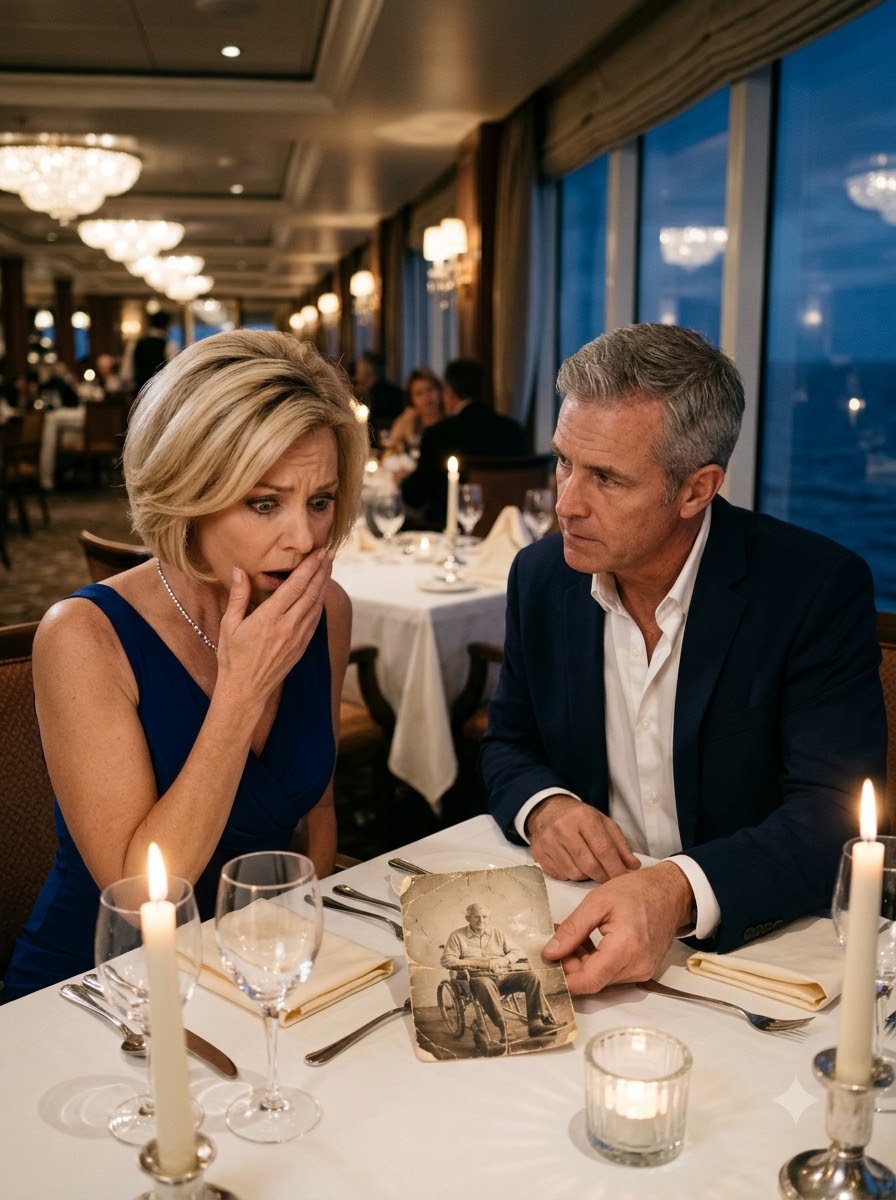
It was an old photograph.
Its colors had faded, its corners were curled, and it had the white border common on photographs once developed at drugstores.
I looked down.
And the moment I saw the face, every drop of blood seemed to leave my body.
It was Greg.
Or at least, that was what I thought.
The same strong jaw.
The same deep brown eyes.
The same crease between his eyebrows when he concentrated.
Even the stubborn cowlick he’d tried to flatten every morning throughout our marriage.
But it wasn’t Greg.
It couldn’t be.
The man in the photograph sat in a wheelchair on a nursing home patio.
He was much thinner than my husband.
His arms rested in unnatural positions across his lap.
His head leaned to one side.
One hand appeared blurred, as though it had moved while the photograph was taken.
His eyes looked exactly like Greg’s.
But their expression was vacant.
“Who is this?” I whispered.
“That’s my father,” the stranger replied. “His name was Raymond Cole. That picture was taken in 1998. He was fifty-four years old.”
I couldn’t stop staring.
Fifty-four.
Greg had turned fifty-two in August.
“Why does he look like my husband?”
The man hesitated.
When he finally answered, his voice was extraordinarily gentle.
“Because he was your husband’s father too.”
I lifted my head.
Suddenly, I understood why the stranger’s face had seemed so familiar.
He shared Greg’s eyes, jaw, and that unmistakable crease between his eyebrows.
“My name is Elliot,” he said. “Elliot Cole. I’m Greg’s half-brother.”
I stared at him, then at the photograph, unable to speak.
Finally, I managed to say, “Greg doesn’t have a brother.”
But Elliot was already reaching into his pocket again.
And what he showed me next would explain not only the divorce, but the frightening changes I’d been noticing in my husband for months.
PART 2: The Secret Greg Was Willing to Destroy Our Marriage to Hide
“Greg’s an only child. His father walked out when he was two years old. His mother raised him by herself. He never even knew his father’s name.”
“I know,” Elliot replied. “Neither did I. Not until last year.”
He lifted the water glass from the empty place setting and took a long drink.
His hand trembled slightly.
“Our father left Greg’s mother in 1975,” he explained. “He moved to Ohio. Married my mother two years later. I was born in ‘78. He never told us he had another son. Not once. I didn’t find out until I was forty-six years old.”
“How?”
Elliot gave a faint smile.
“One of those DNA kits. The kind you spit in a tube and mail off.”
My heart seemed to miss a beat.
“Last Christmas,” I said slowly. “Our daughter gave Greg one of those kits. As a joke. Because he always said he had no idea where his family came from. She wanted him to find out if he was Irish or Italian or whatever.”
“She did,” Elliot answered. “And he found out a lot more than that.”
He took out his phone, tapped the screen several times, and turned it toward me.
A message from a genealogy website appeared, dated the previous March.
“You have a new DNA match: Gregory Whitman. Predicted relationship: Half-sibling. Shared DNA: 24%.”
“I sent him a message first,” Elliot explained. “He didn’t answer for almost a month. Then one night, he wrote back. Just one line. He said, ‘I think we need to talk.’”
“Last March,” I repeated.
My thoughts raced backward through the calendar.
Last March.
Last spring.
“We met in April,” Elliot continued. “At a diner off the interstate, halfway between his town and mine. We sat in a booth for four hours. He brought a picture of you. And one of your daughter. Sophie, right?”
I nodded silently.
“He was so proud of you two,” Elliot said. “He kept pulling out his phone and showing me pictures. Sophie’s high school graduation. You at the beach in a big floppy hat. You and him on your twentieth anniversary at some Italian restaurant.”
“Luigi’s,” I whispered. “He took me to Luigi’s.”
Elliot nodded.
“He was so happy that day. He kept saying, ‘I can’t believe I have a brother. I can’t believe I have a brother.’ Like a little kid on Christmas morning.”
His gaze fell to the photograph.
“And then he asked me about our father.”
The pianist stopped playing for a break.
In the sudden quiet, I could hear the steady rush of ocean water against the ship.
“What did you tell him?” I asked.
Elliot drew a long breath.
“I told him the truth,” he answered. “I told him our father died in 2003. In a nursing home in Dayton, Ohio. He was fifty-nine years old.”
He touched the photograph.
“I told him our father had Huntington’s disease.”
I recognized the name vaguely.
Perhaps from a television medical drama or an article I’d read in a doctor’s waiting room.
It was one of those rare illnesses I had always assumed happened to other families.
“What is that?” I asked. “What does that mean?”
Elliot met my eyes.
They were Greg’s eyes, filled with the same sorrowful kindness I’d seen the night he left our kitchen.
“It’s a disease that slowly destroys your brain,” he explained. “Your body stops doing what you tell it to. You start dropping things. Your hands move on their own. You get angry for no reason. You forget things. You lose your balance. Then you lose your ability to walk. To talk. To swallow. To recognize the people you love.”
My hands shook so badly that I pressed them flat against the tablecloth.
“And it’s genetic,” he continued quietly. “If one of your parents has it, you have a fifty-fifty chance of getting it too.”
I stared at him.
The dropped coffee mugs.
The spilled wine during our anniversary dinner.
Greg’s keys slipping from his fingers again and again.
His restless knee during church.
The constant tapping of his fingers.
That afternoon when he’d shouted at a waiter about cold eggs, then sat in the car with his forehead against the steering wheel, repeating, “I don’t know what’s wrong with me. I don’t know what’s wrong with me.”
“No,” I whispered.
It was barely a word.
“Claire,” Elliot said.
“No. No, no, no.”
“I’m so sorry.”
“He’s fine,” I insisted. “He’s fine. He’s just stressed. He’s fifty-two. Men get forgetful at fifty-two. He’s fine.”
But even as I spoke, something inside me already knew.
It was like sensing an approaching storm before the first dark cloud appeared.
“After I told him about our father,” Elliot continued, “he asked me if I’d been tested. I told him yes. I got tested when I was thirty, after Dad died. I told him I came back negative. I didn’t get the gene. I got lucky.”
He stopped briefly.
“Greg went and got tested in June.”
The personal days.
Denise had mentioned Greg taking several personal days that summer.
“Genetic counseling first,” Elliot explained. “Then the blood test. Then you wait. A few weeks. I drove up and sat with him in the parking lot of the clinic when he went back for the results. He wouldn’t let me come inside. He said he needed to hear it by himself.”
I already knew what Elliot was about to say.
Still, I needed to hear it aloud.
“He came out of that building about forty minutes later,” Elliot said. “He got in my car, and he sat there, and he didn’t say anything for a long time. Then he just said, ‘Well. Now I know.’”
I covered my mouth.
“He’s positive,” Elliot said. “He has the gene. And the doctor said some of the things he’d been noticing, the clumsiness, the mood swings, the fidgeting… she thinks it’s already started. Early stages. Very early. But started.”
I couldn’t remember when the tears began.
By then, they were streaming down my cheeks and falling onto the beautiful blue dress Lynn had insisted I bring.
A couple at the neighboring table glanced toward us before quickly looking away.
“Why didn’t he tell me?” I asked, my voice shaking. “Why didn’t he come home and tell me? We’ve been married twenty-two years. I’m his wife. Why would he hide this from me?”
Elliot looked at his father’s photograph for a long moment.
“Because of me,” he answered.
“What?”
“That’s what I meant when I said I’m the reason.”
He swallowed.
“That day at the diner, Greg asked me what it was like. Taking care of our father. And I told him. All of it. I didn’t hold anything back. I didn’t know then that he might have it too. I just thought he wanted to know about the father he never met.”
He rubbed his face with both hands.
“I told him about my mother,” he continued. “Her name was Carol. She was a nurse. She was the strongest, funniest, most beautiful woman I’ve ever known. And she took care of my father for fourteen years.”
His voice cracked.
“She fed him with a spoon. She bathed him. She changed him like a baby. She lifted him out of bed every morning until she wrecked her back so badly she needed surgery. She spent every penny they’d ever saved. She sold our house. She lost every friend she had, because she never had time to see anyone. And at the end, he didn’t even know who she was. He’d scream at her. He’d call her by his first wife’s name. Greg’s mother’s name.”
I closed my eyes.
“My mother died two years after him,” Elliot said. “She was only sixty-one. The doctors said it was her heart. But I’ve always believed she just wore it out. She gave every single bit of it to him, and there was nothing left for her.”
The pianist returned and began playing a slow, melancholy melody.
I wanted him to stop.
“I told Greg all of that,” Elliot said quietly. “Every bit of it. And when he got his results in July, he called me that night. He was drunk. I’d never heard him drunk before. And he said to me, ‘Elliot, I won’t do that to Claire. I won’t let her become your mother. I won’t let her spend fifteen years wiping my chin and watching me forget her name.’”
I struggled to breathe.
“I told him he was being crazy,” Elliot continued. “I told him he had to tell you. That you had a right to know. That you might want to make your own choice. He hung up on me.”
“He decided,” I whispered. “He just… decided. For me.”
“He thought if he told you the truth, you’d never leave him. And he was right, wasn’t he?”
“Of course I wouldn’t leave him!”
“That’s exactly why he did it this way.”
Elliot leaned forward.
“He thought if he told you he’d stopped loving you, you’d be hurt. You’d be angry. But you’d move on. You’d heal. You’re only fifty, Claire. He told me that. He said, ‘She’s only fifty. She’s still got her whole life. She can still find somebody who’ll grow old with her.’”
I don’t think we’re meant to grow old together.
Those were the words Greg had spoken in our kitchen, still wearing his coat.
He hadn’t been lying.
He’d been telling me the truth in the most painful, misguided expression of love he could imagine.
“And Sophie?” I asked. “What about our daughter?”
Elliot’s expression changed.
“That’s the other reason I’m here,” he answered.
I felt as though the floor beneath me had vanished.
Fifty-fifty.
If a parent carried the gene, their child had a fifty-percent chance of inheriting it.
“Oh, God,” I whispered. “Oh, God. Sophie.”
“Greg didn’t want to tell her,” Elliot explained. “He said she’s twenty years old. She’s got finals. She’s got her whole life. He said he’d tell her someday, when she’s older. When she’s settled. Maybe when she’s thinking about having kids of her own.”
He shook his head.
“But I grew up watching my father fall apart without knowing why. Nobody told me anything until I was a teenager. I spent years terrified, and I didn’t even know what I was terrified of. I don’t want that for my niece.”
My niece.
He said those words so naturally, as though he’d been practicing them.
“Why now?” I asked. “Why come find me here? On a cruise ship in the middle of the ocean?”
He almost laughed.
“Greg called me a few weeks ago. He said your sister had booked you a cruise. He sounded so relieved. He said, ‘Good. She needs it. She’ll be okay.’ He told me the name of the ship.”
Elliot shrugged.
“I live in Tampa. I own a construction company. I booked the last cabin they had left the next morning.”
“Why didn’t you just call me? Or come to the house?”
“Because if I’d shown up at your front door, you’d have called Greg. And Greg would have told you I was a crazy man and to slam the door in my face.”
He hesitated.
“And honestly, Claire, I almost didn’t do it at all. I’ve been on this ship for four days. I’ve walked past you three times. I sat two tables away from you at breakfast yesterday. I couldn’t do it. I kept thinking, who am I to blow up this woman’s life? I’m a stranger. I met her husband once in a diner.”
“So what changed?”
He looked down at Raymond’s photograph.
“Tonight I saw you sitting here alone,” he said. “Looking out the window. And I thought about my mother. And I thought, if it had been her, she would have wanted to know. She would have wanted to choose.”
I stood abruptly.
I hadn’t intended to.
My chair scraped loudly across the floor, and several people turned toward me.
“I’m sorry,” I said, uncertain whether I was apologizing to Elliot, the other guests, or myself. “I can’t… I need air. I need to…”
I couldn’t finish.
I grabbed my purse and hurried out of the dining room.
I didn’t stop until I reached the open deck.
The warm, salty wind struck my face and tore strands of hair loose from their clip.
Beyond the railing, the ocean stretched endlessly into darkness.
Moonlight still formed a silver path across the water.
I gripped the railing with both hands.
And I screamed.
I didn’t care who heard.
A young couple at the far end of the deck glanced toward me and hurried back inside.
I screamed at Greg.
At the stubborn, wonderful, infuriating man I’d married.
For deciding my future without asking me.
For lying to our daughter.
For lying to everyone.
For allowing me to spend a month believing I’d somehow destroyed our marriage.
For letting me think he no longer loved me.
I screamed at Elliot for telling me the truth.
And for not telling me sooner.
I screamed at Raymond Cole, a stranger who’d abandoned his two-year-old son and left behind nothing but a genetic disease and an unruly cowlick.
I screamed at God.
Eventually, I ran out of breath.
I remained at the railing, sobbing.
I don’t know how long I stood there.
Long enough for my hands to grow numb against the cold metal.
Then I felt a warm hand on my back.
“Oh, sweetheart.”
June stood beside me, wearing a spa bathrobe over her dinner clothes.
Her silver hair was still damp.
Walt waited several feet behind her, holding his hat.
“Arnel told us you ran out of the dining room,” June explained. “He said some man upset you. Walt’s ready to throw him overboard. Just say the word.”
“I’m too old to throw anybody overboard,” Walt said. “But I’ll give it my best shot.”
I laughed.
Then I cried harder.
June wrapped her arms around me and held me as though I were one of her eleven grandchildren.
We sat on a bench sheltered from the strongest wind.
And I told them everything.
The photograph.
The DNA test.
Raymond Cole in his wheelchair.
Carol, the nurse who sacrificed everything caring for him.
Greg’s diagnosis.
The clinic parking lot.
And Sophie.
When I finished, June remained silent for a long time.
Walt sat on my other side, holding my hand in his large, rough, warm fingers.
“You want to know something, Claire?” June finally asked.
I nodded.
“Six years ago, Walt had a stroke.”
I turned toward Walt.
He shrugged as though it were insignificant.
“A bad one,” June continued. “He couldn’t talk for four months. Couldn’t walk for almost a year. I had to feed him. Bathe him. Help him in the bathroom. All of it.”
“She was terrible at it,” Walt said. “Got soap in my eyes every single time.”
June swatted his arm.
Then she turned back to me.
“Our kids wanted to put him in a home. The doctors told me I should think about it. Everybody said, June, you’re seventy-three years old, you can’t do this. You’ll kill yourself.”
“Why didn’t you?” I asked.
She looked at me as though I’d asked why the sun rose every morning.
“Because I stood up in a church in 1973 and told God and everybody I’d do it,” she replied. “In sickness and in health. I didn’t put any fine print on it. I didn’t say, in sickness and in health, unless it gets real hard and real messy.”
June squeezed my hand.
“Now, I’m not going to sit here and tell you it was easy,” she said. “There were nights I sat in the garage and cried so hard I threw up. There were days I hated him. Days I hated myself. Days I wanted to get in the car and drive to Mexico and never come back.”
“Sounds about right,” Walt said.
“But it was mine, Claire. Do you understand? It was my choice. Nobody took it away from me. And I’d make it again tomorrow.”
She looked toward the dark water.
“Your husband loves you. That much is plain. He loves you so much he’d rather break your heart than watch you suffer. But that man didn’t divorce you because he stopped loving you. He divorced you because he’s scared to death. And scared people make terrible decisions.”
“He took the choice away from me,” I whispered.
“Then I suppose,” June said gently, “you’d better go take it back.”
I didn’t sleep that night.
I lay in my cabin with the balcony door open, listening to the ocean and remembering twenty-two years of marriage.
The first time I met Greg, he was twenty-eight and standing behind me in a hardware store checkout line, holding a single lightbulb.
My shopping cart was filled with paint cans, and one damaged wheel kept dragging it left.
He laughed and said, “That cart’s got a mind of its own,” before walking me to my car and loading every paint can into the trunk.
I remembered our wedding.
A small church with a leaking roof.
Rain fell so heavily that the entire front row got wet.
Greg stood at the altar in a rented tuxedo, his cowlick sticking up, tears shining in his eyes.
When the pastor reached the vows about sickness and health, Greg squeezed my hands so tightly they hurt.
I remembered Sophie’s birth.
Thirty-one hours of labor.
Greg stayed beside me the entire time, refusing to leave even to eat, sleep, or use the bathroom until a nurse insisted.
And I remembered my mother’s final year.
The cancer.
All those nights I slept in a recliner beside her hospital bed.
Every evening, Greg drove forty minutes each way to bring me dinner and fresh clothes.
Then he returned home to care for Sophie.
He never complained.
Not once.
“I watched you take care of your mother,” he’d once told me near the end of that year. “I don’t know how you do it. I don’t think I could ever be that strong.”
Was that what he’d remembered while sitting outside the clinic?
Had he pictured me exhausted in a hospital recliner beside my dying mother?
Had he decided he would never make me endure that again?
Around four in the morning, I got up, switched on the light, and opened my purse.
Inside was the manila envelope containing our divorce papers.
I’d brought them on the cruise, although I couldn’t explain why.
Lynn had urged me to leave them home.
But at the last moment, I’d slipped them into my bag.
Perhaps I thought I’d finally sign them in the middle of the ocean.
Or throw them overboard.
Greg’s signature appeared on every required page.
His handwriting was careful and neat, just as it had always been.
But on the final page, the letters were slightly unsteady.
The G in Greg wobbled.
I hadn’t noticed before.
Beneath his signature was an empty line.
Waiting for mine.
Three weeks had passed, and I still hadn’t signed.
I returned the documents to their envelope.
At seven the following morning, I knocked on Elliot Cole’s cabin door.
He opened it wearing a T-shirt and sweatpants.
His hair stuck up in front.
The same cowlick.
I almost started crying in the hallway.
“Claire,” he said anxiously. “Are you okay? I wanted to come find you last night, but I thought you probably didn’t want to see me.”
“I didn’t,” I answered. “But I do now.”
He stepped aside.
His cabin was considerably nicer than mine, with a sitting area and a large window.
A coffee pot sat on the counter.
Without asking, Elliot poured me a cup with cream and sugar.
When he noticed my expression, he explained.
“Greg told me how you take your coffee. He told me a lot of things about you.”
I sat down and wrapped both hands around the mug.
“How is he?” I asked. “Really. Tell me everything. Don’t leave anything out.”
Elliot sat opposite me.
“He’s not doing great,” he admitted. “Physically, it’s still early. His doctor says he could have years before it gets really bad. Maybe a lot of years. Huntington’s moves slowly. But he’s already having trouble at work. He told his boss he wants to retire early. He said he’d rather leave on his own terms than get let go for making mistakes.”
“He loves his job.”
“I know.”
Elliot rubbed his eyes.
“And he’s alone, Claire. He’s sitting in a one-bedroom apartment above a dry cleaner, eating TV dinners and watching old baseball games. He calls me sometimes at two in the morning because he can’t sleep. Last week he told me he drove past your house three times and just sat at the end of the street with the lights off.”
I set down my coffee before my shaking hands spilled it.
“He’s punishing himself,” Elliot continued. “Like he’s already dead. Like he has to get used to being alone before it happens.”
“When’s the next port?”
“Tomorrow morning. Grand Cayman.”
“Can you fly home from Grand Cayman?”
Elliot studied me for a moment.
Then a slow smile appeared.
It was Greg’s smile.
Exactly the same crooked smile, slightly higher on the left.
“I already checked,” he said. “There’s a flight to Miami at two in the afternoon. Then you can connect home from there.”
“I’ll be on it.”
He nodded.
“Do you want me to come with you?”
I considered his offer.
“No,” I finally answered. “This is between me and my husband. But Elliot?”
“Yeah?”
“Come for Thanksgiving. Greg has a brother. Sophie has an uncle. I’m not letting another member of this family disappear into a phone call at two in the morning.”
Tears filled his eyes.
He looked down at his coffee and nodded.
“Okay,” he said hoarsely. “Okay. I’d like that.”
That evening, I said goodbye to June and Walt over dinner.
June cried and made me promise to call.
Walt shook my hand, then pulled me into a hug so strong my feet nearly left the floor.
“You go get your man,” he whispered.
“And if he gives you any trouble,” June added, “you tell him a seventy-nine-year-old woman from Oregon is ready to fly out there and box his ears.”
The following morning, I walked down the gangway in Grand Cayman with my suitcase, purse, and manila envelope.
Elliot waved from the deck until the ship disappeared from view.
At eleven that night, Lynn collected me from the airport.
The moment she saw my face, she stopped in the middle of the sidewalk.
“What happened?” she demanded. “Claire, you were supposed to be gone three more days. What happened? Are you sick?”
“I’m not sick,” I answered. “Greg is.”
I explained everything during the drive.
Halfway home, Lynn pulled onto the shoulder of the highway.
She cried so hard she had to turn on her hazard lights.
She had always loved Greg like a brother.
Twenty-three years earlier, she’d introduced him to our family at Thanksgiving and announced, “This one’s a keeper, everybody. Don’t scare him off.”
“That idiot,” she kept saying, wiping her eyes with fast-food napkins from her glove compartment. “That stupid, sweet, stupid idiot.”
“I know.”
“Where do you want to go? Home?”
I glanced at the dashboard clock.
It was almost midnight.
“No,” I said. “Take me to his apartment.”
Greg’s apartment occupied the second floor of an aging brick building on Delaney Street.
Downstairs, a dry cleaner’s flickering neon sign announced “OPEN 7 DAYS.”
A rusty metal staircase ran along the outside of the building.
One upstairs light was glowing.
Lynn parked beside the curb.
“Do you want me to come up with you?”
“No.”
“I’m going to wait right here.”
“You don’t have to.”
“I’m going to wait right here,” she repeated, switching off the engine and folding her arms.
I climbed the stairs.
Every metal step rang beneath my shoes.
At the top, I stood outside Greg’s door for an entire minute, my fist raised.
Then I knocked.
No answer.
I knocked again, harder.
“Who is it?”
His voice sounded exhausted and rough.
As though I’d awakened him.
Or interrupted him crying.
“It’s me.”
Silence.
A terribly long silence.
Finally, the lock clicked.
The door opened.
Greg stood before me wearing a gray T-shirt and the plaid pajama pants I’d bought him two Christmases earlier.
He hadn’t shaved in days.
His hair was disheveled, his cowlick sticking straight up.
He looked fifteen pounds thinner.
He stared at me as though I were a ghost.
“Claire? What are you… You’re supposed to be on the cruise. Lynn said…”
“I got off early,” I answered.
“Why? What happened? Are you okay? Is Sophie okay?”
“Sophie’s fine.”
“Then why are you…”
“I met your brother.”
His face went completely white.
He grabbed the doorframe with one hand.
And then I saw it.
His other hand hung beside his body.
His fingers were twitching.
Curling and uncurling without his control.
He noticed me looking.
Immediately, he shoved the hand into his pocket.
“I don’t know what you’re talking about,” he said.
“Don’t.”
My voice sounded stronger than I’d expected.
“Don’t you dare, Greg Whitman. Don’t you dare stand there and lie to my face one more time.”
He opened his mouth.
Then closed it.
“Elliot found me on the ship,” I said. “He showed me a picture of your father. He told me about the DNA test. He told me about the diner. He told me about Carol.”
My voice broke.
“He told me about the parking lot at the clinic, Greg.”
Greg said nothing.
Tears filled his eyes.
“Can I come in?” I asked. “Or are we going to do this out here so the whole dry cleaner can hear?”
After a long moment, he stepped aside.
I entered the apartment.
It was small and nearly empty.
A blanket and pillow lay on the couch, suggesting he slept there instead of in the bedroom.
An old baseball game played silently on the television.
A dozen orange prescription bottles stood in a neat row on the kitchen counter.
Beside them was a stack of pamphlets.
The title of the top one was clearly visible.
“Living with Huntington’s Disease: A Guide for Patients and Families.”
Next to the pamphlets stood a framed photograph.
Our wedding picture.
The one that had hung in our hallway for years.
I hadn’t even noticed it was missing.
I turned toward Greg.
He stood against the closed door, looking as though he needed an escape route.
“How long were you going to do this?” I asked.
“Claire…”
“How long, Greg? A year? Five years? Were you just going to sit in this apartment and fall apart all by yourself until somebody found you on the floor?”
“I was going to move,” he answered quietly. “Somewhere far away. Arizona, maybe. Somewhere you wouldn’t have to see it.”
“See what?”
“Me.”
His voice cracked.
“See me become him.”
He removed his hand from his pocket and held it between us.
His fingers jerked and twisted uncontrollably.
“Look at this, Claire. Look at it. I can’t make it stop. Some days I can’t hold a fork. Last week I fell down the stairs out there. I’ve been forgetting words. I sat in a meeting at work and forgot my boss’s name. Ted Morrison. I’ve known Ted Morrison for nineteen years.”
Tears streamed down his face and disappeared into his beard.
“And it’s going to get worse. It only ever gets worse. In five years, I might not be able to walk. In ten, I might not be able to talk. I’m going to scream at you for no reason. I’m going to forget your name. I’m going to need you to feed me and wipe me and…”
He couldn’t finish.
“I watched you with your mother,” he finally said. “I watched what it did to you. You were a ghost that whole year. You barely slept. You barely ate. You lost so much weight that I was scared you’d get sick too. And that was one year, Claire. One year. This could be fifteen. Twenty.”
“That’s my decision to make.”
“No, it’s not!”
He shouted, then winced as though the sudden outburst frightened him.
“It’s not. Because you’d say yes. You’d say yes without even thinking about it. You’d give up the whole rest of your life for me, and I’d have to watch you do it, and I can’t. I won’t. Elliot’s mom gave up everything, and it killed her. I’m not going to let that happen to you.”
“So you lied to me.”
“Yes.”
“You lied to Sophie.”
“Yes.”
“You let me think you stopped loving me.”
Greg slid down the door until he was sitting on the floor, his knees drawn against his chest.
“I never stopped loving you,” he whispered. “Not for one second. Not ever.”
I walked across the room and sat beside him.
“I know that, you stupid man,” I said. “I’ve always known that. That’s why I couldn’t sleep for a month. Because nothing you said ever made any sense.”
We sat quietly on the floor.
The baseball game flickered across the silent television.
Beneath us, the dry cleaner’s machines hummed.
“You remember our wedding?” I finally asked.
He laughed through his tears.
“It rained. The roof leaked on your Aunt Doris.”
“Do you remember what you said? When Pastor Jim got to the part about sickness and health?”
He didn’t answer.
“You squeezed my hands so hard they hurt,” I reminded him. “And you looked right at me, and you said it louder than any of the other parts. In sickness and in health. Everybody in the church heard you. My mother leaned over to Lynn afterward and said, ‘That boy means it.’”
“I did mean it,” he said. “I meant it for you. If you got sick, I’d take care of you forever. I’d never leave.”
“So it only goes one way?”
He looked at me.
“You get to keep the promise,” I said, “but I don’t? You get to be the strong one, the one who takes care of everybody, the one who drives forty minutes each way every night with dinner and a clean shirt? But the second it’s your turn to be the one who needs help, I’m not allowed?”
“That’s not…”
“That’s exactly what it is, Greg. You decided I wasn’t strong enough. You decided for me. You took my promise away from me without even asking.”
He buried his face in his hands.
His shoulders trembled.
I reached into my purse and removed the manila envelope.
Greg saw it and went still.
“You never signed them,” he said.
“No.”
“Why not?”
“Because I’m not a quitter,” I answered. “And neither are you. You’re just scared.”
I pulled the divorce papers from the envelope.
Page after page carried his careful signature.
Beneath each was an empty line waiting for mine.
And I tore them in half.
Then in half again.
And again.
And again.
Until little white scraps covered the floor between us like snow.
Greg stared at the pieces.
Then a sound escaped him unlike anything I’d heard during twenty-two years of marriage.
A deep, broken sob, as though something inside him had finally given way.
I wrapped my arms around him.
He pressed his face against my shoulder and cried like a child.
As though he’d been holding back those tears since the day outside the clinic.
Perhaps since the diner.
Perhaps since he was two years old, when his father disappeared from his life.
I held him and refused to let go.
“I’m so scared, Claire,” he whispered. “I’m so scared.”
“I know. I’m scared too.”
“I don’t want you to see me like that.”
“I’ve seen you throw up on a roller coaster at Six Flags,” I said. “I’ve seen you get stuck in our chimney trying to fix the flue on Christmas Eve. I’ve seen you cry at a dog food commercial. I can handle it.”
He gave a shaky laugh against my shoulder.
“The dog food commercial was very sad,” he said.
“It was a dog food commercial, Greg.”
“The old dog was waiting by the door for the little boy to come home from college.”
“I know. I was there.”
We laughed.
Then cried.
Then laughed again.
We remained on the floor of that lonely apartment, surrounded by shredded divorce papers, until nearly three in the morning.
Around one-thirty, I sent Lynn a message telling her to go home.
She replied with a single word.
“FINALLY.”
Greg returned home that weekend.
Biscuit went absolutely wild.
He raced around the kitchen, barking, whining, and knocking over chairs.
Then he leaped at Greg so enthusiastically that he nearly knocked him down.
Greg sat on the floor and let Biscuit lick his face for five uninterrupted minutes.
When he finally stood, he walked over to the kitchen table.
He picked up the salt shaker and moved it to the opposite side.
“I never want to see it in that spot again,” he said.
But there was still one conversation we couldn’t avoid.
And this time, the truth wasn’t only about Greg.
It was about Sophie, too.
PART 3: The Promise We Almost Lost
The following Saturday, Greg and I drove three hours to Sophie’s university.
He held my hand throughout the journey, even when his fingers began twitching.
He no longer tried to hide the movements from me.
Sophie agreed to meet us at a small coffee shop across the street from her dormitory.
When she entered and saw us sitting together, holding hands, she stopped in the doorway.
“Oh my God,” she exclaimed. “Are you guys back together?”
“Sit down, sweetheart,” Greg said.
Something in his voice immediately caught her attention.
Her smile faded, and she slowly took a seat.
Greg told her everything.
I let him speak because it was his story to share, but I kept my hand wrapped around his beneath the table.
He began with the DNA kit she’d given him for Christmas as a joke.
Then he explained the grandfather she’d never known existed.
Uncle Elliot.
The clinic.
The diagnosis.
And finally, what his illness might mean for her.
Fifty-fifty.
Sophie didn’t interrupt.
She sat holding a cup of hot chocolate, her face growing paler with every sentence.

When Greg finished, she remained silent.
Then she stood so abruptly that her chair toppled backward.
“You lied to me,” she said, her voice trembling. “You lied to me for months. You told me you and Mom grew apart. You let me think my family was falling apart for no reason. I’ve been crying myself to sleep, Dad. I’ve been failing my statistics class because I can’t concentrate. And the whole time…”
“I know,” Greg answered. “I’m sorry. I’m so sorry, Sophie.”
“And you weren’t even going to tell me? About me? About my own body?”
“I was going to tell you someday. When you were older.”
“When? When I was thirty? When I was pregnant?”
Tears began rolling down her cheeks.
“Dad, it’s my life. It’s my body. You don’t get to decide when I’m allowed to know about it.”
Greg looked toward me.
I could see him recognizing the words.
They were almost identical to what I’d told him while we sat on the floor of his apartment.
Now our daughter was telling him the same thing.
“You’re right,” he said quietly. “You’re absolutely right. I made a mistake. I made a lot of mistakes. I thought I was protecting the people I love. But I was really just protecting myself from watching you get hurt.”
Sophie stood trembling, her fists clenched and tears streaming down her face.
Then she moved around the table.
She climbed into her father’s lap as though she were six years old again and wrapped both arms around his neck.
“I’m so mad at you,” she sobbed against his shoulder.
“I know, baby.”
“I’m so scared.”
“I know. So am I.”
“Don’t you ever lie to me again.”
“Never,” he promised. “Never again. I promise.”
People throughout the coffee shop were watching.
I didn’t care.
I stood and wrapped my arms around both of them.
The three of us remained together in the middle of that crowded coffee shop until a nervous young barista approached and asked whether we needed napkins.
“Yes,” all three of us answered simultaneously.
During the drive home that evening, Greg asked me a question.
“Do you think she’ll get tested?”
I looked through the window at the dark highway stretching ahead.
“I don’t know,” I replied. “That’s her choice to make. Not ours.”
He nodded thoughtfully.
“Not ours,” he repeated, as though he were learning an entirely new word.
Two weeks later, Sophie called.
She had met with a genetic counselor at the university health center.
She’d been reading extensively and discussing her options with friends, her roommate, and her favorite professor.
“I’m not getting tested,” she told us. “Not yet. Maybe not for a long time. The counselor said a lot of people wait. Some people never do it. I want to finish school first. I want to live my life for a while without knowing. And when I’m ready, I’ll decide.”
“That sounds very wise,” Greg replied.
“I’m a very wise person,” Sophie said. “I get it from Mom.”
Elliot arrived for Thanksgiving.
He appeared on our front porch Wednesday afternoon carrying a pecan pie from an expensive Tampa bakery and a bottle of wine that probably cost more than our turkey.
He stood nervously on the doormat, looking like a child arriving for his first day of school.
Greg opened the door.
For a moment, the brothers simply stared at one another.
The same eyes.
The same jaw.
The same stubborn cowlick.
Then Greg pulled Elliot into such a powerful embrace that the pie nearly fell onto the porch.
“Thank you,” I heard Greg whisper against his shoulder. “Thank you for not listening to me.”
“Somebody had to,” Elliot replied.
When Sophie saw her uncle, she burst into laughter.
“Oh my God,” she exclaimed. “There’s two of you. There’s actually two of you.”
That Thanksgiving was louder and happier than any we’d celebrated in years.
Lynn came with her husband and children.
Patty joined us for pie.
Elliot shared embarrassing stories about Raymond Cole’s terrible singing voice.
Greg laughed until tears rolled down his cheeks.
And I realized it was the first time he’d ever heard a funny story about his own father.
Later that evening, after everyone had gone to bed, I discovered Greg and Elliot sitting together on the back porch in the cold.
They were looking through old photographs Elliot had brought.
Raymond Cole as a young Navy serviceman.
Raymond fishing on an Ohio lake.
Raymond holding a baby who might have been Elliot.
And one particularly old black-and-white photograph with a torn corner.
It showed a tall young man holding a little boy dressed in overalls on his knee.
“That’s you,” Elliot said softly. “Mom found it in his things after he died. He kept it in his wallet for thirty years. She never knew who the boy was.”
Greg held the photograph in his trembling hand for a long time.
I quietly went back inside, leaving the brothers alone together.
Life has been difficult since then.
I won’t pretend otherwise.
Greg retired in January.
Some days are good.
Others are terribly hard.
Sometimes he becomes angry and says things that don’t sound like him.
Then he cries and apologizes for an hour.
On other mornings, he drops his coffee cup three times before nine, and we end up laughing while reaching for the mop.
We bought plastic cups.
Lots of them.
Every Tuesday evening, we attend a support group at the hospital.
We’ve met families traveling the same difficult road.
Pete, whose wife received her diagnosis at forty.
Carmen, a young woman caring for her father much as Carol once cared for Raymond.
We sit in a circle of folding chairs, drink terrible coffee, and speak openly about what we’re experiencing.
And every Sunday, June calls from Oregon.
“How’s my boy?” she always asks.
She calls Greg “my boy” now, even though she’s never met him.
“He’s fine,” I tell her. “Some days he’s fine. Some days he’s not.”
“Well,” she always replies. “That’s marriage, sweetheart. That’s just marriage.”
One year after I boarded that cruise alone, I went on the same cruise again.
But this time, I had company.
Greg now walks with a cane.
His hands tremble more than they once did.
Sometimes he stops halfway through a sentence, waiting for a word to return.
But on our first evening aboard, he dressed in his navy suit and his good tie.
I helped fasten the buttons on his shirt.
Then we walked into the dining room arm in arm.
Arnel was still working there.
The moment he recognized me, his entire face brightened.
“Mrs. Whitman! You came back!”
“I did,” I answered. “And I brought my husband.”
He escorted us to a table beside the large window.
The same table where everything had changed.
I’d specifically requested it when making the reservation.
And waiting there, wearing a straw hat decorated with an artificial sunflower, sat June Kessler.
Walt sat beside her, his white mustache unmistakable, holding a colorful drink with a tiny umbrella.
I screamed.
I couldn’t help myself.
Half the dining room turned toward us.
“Surprise,” Lynn said behind me.
She’d arranged everything.
Of course she had.
June stood and walked straight past me.
She took Greg’s face between her hands.
“So you’re the idiot,” she said.
Greg blinked.
“Yes, ma’am. I’m the idiot.”
“Well.”
She studied him from head to toe before pulling him into a hug.
“You’re a handsome idiot. I’ll give you that.”
We shared dinner together.
Walt told three of his seven fishing stories.
Greg retold the adventure of getting stuck in our chimney.
June laughed so hard she snorted, then immediately blamed Walt.
Halfway through dessert, the pianist began playing an old Frank Sinatra song.
A slow one.
Greg put down his fork.
“Claire,” he said. “Would you dance with me?”
I looked toward the cane leaning against his chair.
“Are you sure?”
“No,” he answered. “I might fall down. I might step on your feet. I might forget which foot goes where. But I’d like to try anyway.”
So we danced.
It wasn’t graceful.
His feet didn’t always move where he intended.
His hand trembled against my back.
Twice, I had to support his weight.
But we remained on that small dance floor in the middle of the ocean throughout the entire song, swaying together and holding each other close.
When the music ended, Greg didn’t release me.
“I have something for you,” he said.
He reached into his jacket pocket.
It took several attempts.
His fingers kept missing what he was trying to grasp.
I recognized the gesture.
A year earlier, at that very same table, I’d watched another man reach into his pocket.
It had been the worst and best night of my life.
One small movement had changed everything.
Now Greg finally pulled out a folded piece of paper.
He opened it with trembling hands.
The page was covered in handwriting.
His handwriting.
The letters were crooked and shaky, slanting in different directions.
Several words had been crossed out and rewritten.
It must have taken him days to finish.
“I wanted to say this while I still can,” he explained. “While I can still remember all the words.”
He cleared his throat.
“Claire. I promised you twenty-three years ago, in a church with a leaky roof, that I’d love you in sickness and in health. Then I got sick, and I forgot that the promise was yours too. I tried to take it away from you. I’m sorry. I’ll be sorry for the rest of my life. However long that is.”
My eyes filled with tears.
Behind us, June was already crying into her napkin.
“I can’t promise you I’ll always remember your name,” Greg read. “I can’t promise you I’ll always be kind. I can’t promise you I’ll always be able to hold your hand. But I can promise you this. Every day that I’m still me, I’m going to spend it loving you. And on the days that I’m not me anymore, I hope you’ll remember tonight. I hope you’ll remember that I knew exactly who you were. And I chose you. I would choose you every single time.”
He carefully folded the paper and placed it in my hand.
“Will you grow old with me?” he asked. “Whatever that looks like?”
One year earlier, standing in our kitchen, Greg had told me we weren’t meant to grow old together.
He had been wrong.
We simply hadn’t understood what growing old together might look like.
Perhaps it wouldn’t mean sitting in rocking chairs on a porch or walking hand in hand along a beach at eighty.
Maybe those moments would never come.
Instead, it might mean plastic cups and hospital support groups.
Unsteady signatures and dropped car keys.
A husband reaching into his pocket three times before his fingers finally found what he needed.
It meant staying.
“Yes,” I answered. “Yes, you stupid, wonderful man. Every single day.”
And there, on a dance floor in the middle of the ocean, while an elderly woman from Oregon cried into her napkin and my sister took photographs, I kissed my husband.
Love doesn’t guarantee that terrible things will never happen.
Love is what you choose to do when they do.
