

PART 1
In the unforgiving discipline of structural engineering, there is a fundamental, terrifying principle known as catastrophic failure. It is the precise, mathematically irreversible second when a load-bearing column buckles under a shear force it was never tempered to sustain alone. When that threshold is crossed, thousands of tons of cured concrete, tempered glass, and reinforced carbon steel collapse in a span of four heartbeats. Decades of meticulous calculations are reduced to a choking plume of pulverized cement and twisted rebar.
Yet ask any seasoned forensic investigator, and they will tell you an undeniable truth: catastrophic failure is never truly sudden. It is the delayed punctuation mark on a long, covert history of microscopic stress fractures, deferred maintenance, willful blindness, and the reckless, arrogant assumption that a material will continue to bear a load simply because it hasn’t given way yet.
For thirty-one years of my life, I was that load-bearing column.
I stood beneath the crushing, architectural anomaly that was my family. I absorbed the kinetic shocks of my mother Beatrice’s insatiable, predatory vanity. I underpinned the manicured, high-society facade of my younger sister, Brittany. I underwrote and bankrolled the fragile, desperate corporate illusion of my husband, Preston Sterling. I endured it because I possessed the rigid naiveté of an engineer who believed that blood ties and marital vows were immutable blueprints—an unyielding granite bedrock that excused every hairline crack in their moral fiber.
I was profoundly, mathematically mistaken.
The cold grace of engineering, however, lies in its objectivity: once a structural engineer finally identifies a compromised support, she does not sit in the rubble and weep over ruined mortar. She cords off the site. She calculates the blast radius. And she primes the demolition charges.
My realization did not arrive amidst the deafening roar of a Midtown construction site or across a drafting table. It came in the sterile, air-scrubbed stillness of VIP Suite 814 in the postoperative surgical recovery wing of Mount Sinai Hospital. Exactly fourteen hours earlier, a team of three transplant surgeons had cut through my abdominal wall and excised sixty percent of my right liver lobe.
The resection had been an emergency biological salvage mission for my ten-year-old nephew, Hudson. The boy’s biliary tree had collapsed beneath an aggressive, necrotizing cirrhosis. Without an immediate living-donor partial liver transplant, the pediatric palliative care team estimated he had less than three weeks before total systemic toxic shock took him. My tissue had registered as a six-point compatibility match.
I hadn’t hesitated for half a second. I cleared my calendar, signed the anatomical donation releases, and laid myself on a steel surgical gurney. I permitted medical specialists to slice through muscle and tissue so that my sister’s only child could live to see his eleventh birthday.
I woke to an ocean of localized, searing pain. Every shallow, ragged intake of breath pulled against thirty-eight stainless-steel surgical staples spanning my right hypochondrium like an iron zipper. A network of ribbed plastic drains protruded from beneath my lower ribs, channeling dark serosanguineous fluid into vacuum bulbs suspended from the frame of the bed. An automated intravenous pump clicked and whirred by my ear, metering a micro-dose of hydromorphone into my catheterized vein. My mouth tasted of copper and dry gauze; my throat was shredded from the plastic endotracheal tube that had breathed for me while my viscera were rearranged.
A soft, heavy metallic click cut through the sterile hum of the room.
I strained my neck, the muscles spasming with cold resistance. I expected to see Dr. Harrison’s surgical fellow checking my dressing, or an orderly wheeling in an incentive spirometer.
Instead, the door swung inward to admit the triumvirate: my husband, Preston; my sister, Brittany; and my mother, Beatrice.
They did not carry bouquets of flowers. They did not bear a hand-drawn recovery card from Hudson, or balloons, or the tearful, red-eyed gratitude of family members whose child had just been pulled from the edge of the grave. They moved with the crisp, calculated detachment of corporate liquidators entering the offices of a foreclosed asset.
Preston moved first. He turned back toward the heavy oak door, reached out a manicured hand, and deliberately turned the brass deadbolt until the lock engaged with an echoing thud.
He was dressed in a bespoke three-piece charcoal suit from Savile Row—a four-thousand-dollar piece of tailoring paid for on my corporate credit line. His dark hair was pomaded to perfection, his silver cufflinks gleaming under the fluorescent strip lights.
Brittany drifted in behind him, enveloped in a two-thousand-dollar cloud of camel-hair cashmere that I had charged to my personal account only forty-eight hours prior to my admission. She did not look at the IV pole or the fluid drains. She walked directly to the leather armchair beside my bed, pivoted with theatrical, feline grace, and sat down squarely across Preston’s lap.
Before I could force a single syllable past my cracked lips, Brittany reached up, twined her French-manicured fingers into the hair at the nape of my husband’s neck, and pulled his mouth down onto hers.
It was not a hurried, furtive peck. It was an open, wet, possessive kiss executed with unhurried choreography dead in the center of my field of vision. Preston’s hands settled firmly, familiarly onto the flare of her hips, his fingers digging into the expensive cashmere without a trace of hesitation.
On the telemetry monitor mounted behind my head, the green line tracking my heart rate instantly spiked, the rhythmic beep accelerating into a frantic, electronic alarm.
“What… are you doing?” I rasped, the words feeling like dry gravel scraping through my vocal cords. A cold, oily sweat broke across my collarbone. I tried to brace my forearms against the mattress to push my torso up, but the movement sent a lightning strike of agonizing tension through my core. “Preston?”
Brittany broke the contact with a soft, audible parting of lips. She rested her cheek against the lapel of Preston’s charcoal jacket, looking down at me from her perch with an expression of victorious, pitying condescension.
“You don’t need to look so bewildered, Victoria,” Brittany purred, her voice carrying the smooth, rehearsed cadence of an actress delivering an opening monologue. “The procedure is finished. Hudson is resting in the pediatric intensive care unit with half of your liver currently cleaning his blood. Which means our little domestic theater has officially served its operational purpose.”
My eyes darted to Preston. His face was entirely vacant of remorse—it was the flat, dead-eyed expression of an executive closing a minor subsidiary.
“You see, Victoria,” Brittany continued, trailing a manicured fingernail along Preston’s jawline, “Preston didn’t spend the last five years enduring your tedious rants about concrete curing times and tensile physics because he enjoyed your company. He stayed because he is Hudson’s biological father.”
The room seemed to lose atmospheric pressure. The sound of the HVAC unit died beneath a deafening, high-pitched ringing in my ears.
“Conceived ten years ago,” Brittany whispered, her eyes dancing with venomous pleasure, “while you were sweating in steel-toed boots on that commercial port project in Dubai. We have been a family since the beginning. We shared your Park Avenue penthouse. We shared your offshore investment dividends. And now, you’ve kindly provided the biological tissue to keep our son breathing. You’ve been our patron, Vicky. Our very generous, remarkably blind patron.”
My gaze swung desperately toward the corner of the room. Beatrice stood there, adjusting the gold links on her wrists, looking down at my bandaged body not with a mother’s horror, but with cold, appraising distaste.
“Mother?” The word was an involuntary, pathetic wheeze. “Did you… did you know this?”
Beatrice smoothed the front of her designer blouse with a sharp flick of her fingers. “Don’t play the martyr, Victoria. It doesn’t suit your bone structure. You were always an impossible, masculine girl. Cold. Rigid. Obsessed with dirty construction sites and steel girders while your sister understood the social arts. Brittany had the grace to carry a child. You barely had the grace to attend your own anniversary dinners. Hudson needed a family, and Preston needed an environment that wasn’t sterile. You should consider yourself lucky that your flesh could finally contribute something meaningful to this bloodline.”
Before the wave of betrayal could even crest, Preston stood up, dislodging Brittany with a practiced efficiency. He reached into the slim leather portfolio tucked beneath his arm and extracted a thick, paperclipped legal document.
Without bending down, he tossed the stack onto the bed.
The heavy ream of paper landed with brutal precision directly across my fresh surgical dressing.
The blunt impact compressed the raw incision. A blinding, white-hot explosion of agony tore through my abdomen. My breath caught in my throat with a strangled gasp, my fingers clawing into the cotton sheets as a wet, warm sensation immediately spread beneath the white surgical tape, staining the immaculate gauze a brilliant, fresh crimson.
“Uncontested marital dissolution and asset liquidation,” Preston stated, resting his hands casually on the bed’s steel footrail. “You waive all rights to the hedge fund allocations, the corporate investment portfolio, and the 72nd Street penthouse. Tucked inside the back page is a cashier’s check for five thousand dollars. That should cover the first month’s deposit on a modest one-bedroom out in Astoria. You have forty-eight hours after hospital discharge to vacate your personal effects from the penthouse, or the building’s maintenance staff will bag them for the municipal incinerator.”
Brittany stepped forward, pulling a sleek, heavy titanium pen from her designer handbag. She held it out, letting it dangle an inch above my shaking, IV-bruised fingers.
“Sign it, Vicky,” she whispered, leaning over the rail, her perfume filling my nostrils with the cloying scent of gardenias and rot. “Sign it right now, or Preston and I will drag you through a five-year forensic discovery process that will bleed your engineering firm dry before your incision even forms a scar.”
In the textbooks on catastrophic structural collapse, there is a concept known as the elastic limit. It defines the point beyond which an overloaded material can no longer deform without suffering permanent internal rupture. But people often forget the inverse corollary: once a material snaps, it ceases to absorb kinetic stress. The tension vanishes. What remains is only dead weight, trajectory, and acceleration.
The agony in my side was a roaring furnace, but inside my skull, the temperature dropped to absolute zero.
I did not reach for the pen. I did not scream. I did not produce a single tear to validate the grotesque audience gathered at the foot of my bed.
With agonizing, mechanical deliberation, my left arm moved. I reached past the pen, extending my index finger toward the small plastic control pad mounted to the wall beside my headboard. I pressed the raised red triangle of the medical emergency assist button and held it down.
Simultaneously, my right hand slid beneath the sterile linen fold, retrieving my personal smartphone from the utility ledge. The device had been running an encrypted ambient audio-recording application from the moment Preston had engaged the room’s deadbolt—a defensive protocol I had maintained through a decade of negotiating multi-million-dollar disputes with corrupt concrete subcontractors.
I pressed the red icon to stop the feed, routed the compressed audio file directly to my firm’s legal drop-box, and tapped the speed-dial contact resting at the top of my interface.
I raised the phone to my lips. My voice had lost its breathless rasp; it emerged with the cold, flat, iron timbre I used when condemning a six-story defective foundation.
“Winston?”
From the phone’s high-output speaker, the crisp, razor-sharp voice of Winston Carmichael, my corporate counsel and managing director of Vance Legal Infrastructure, cut through the quiet room like a diamond blade.
“I am on the line, Victoria. The encrypted feed came through without distortion. The entire dialogue is time-stamped and logged across our private cloud array.”
Preston’s posture stiffened instantly. His smirk fractured, his fingers tightening against the polished footrail. “What is that? Who is that on the phone?”
“Execute Clause Nine of the Sterling-Vance prenuptial agreement immediately,” I instructed, keeping my eyes fixed directly on my husband’s pale, suddenly rigid face. “Grounds of documented moral turpitude, intentional infliction of physical and emotional trauma, and material financial fraud. Dispatch the emergency locksmiths to the 72nd Street penthouse; change the biometrics and physical security tumblers within forty-five minutes. Freeze every secondary corporate card bearing Preston’s name. Terminate the financial lease guarantee on Brittany’s Park Avenue South apartment. And Winston?”
“Yes, Victoria?”
“Notify the Manhattan District Attorney’s Financial Crimes Bureau. Tell them we are ready to file the criminal documentation regarding the diversion of capital from the pediatric medical trust.”
Preston took a frantic half-step forward, reaching toward the bed. “Victoria, wait! You can’t do that! That penthouse is marital property! The lease on Brittany’s apartment is signed under our family LLC!”
“The penthouse was acquired via Vance Structural Holdings two years before I ever made the catastrophic error of standing beside you at an altar,” I said, every syllable dropping with the weight of an anvil. “Paid for in cash derived from my father’s maritime deep-foundation patents. You do not own a single grain of the oak flooring under your feet, Preston. And your five-thousand-dollar settlement check is a pathetic, laughable piece of scrap paper. You have forty-eight hours to collect your bespoke suits from the building superintendent’s basement storage room before they are handed over to the Salvation Army.”
Brittany lunged forward, her veneer cracking into pure, unfiltered panic. “You vindictive psycho! Hudson is your nephew! You can’t evict his mother while he’s lying in intensive care!”
“Hudson’s medical accounts are handled,” I replied coldly. “Yours are terminated.”
Before Preston could open his mouth to issue another demand, the heavy oak door shuddered violently. A second later, the brass deadbolt gave way with a deafening, splintering crack as the door was kicked open from the hallway.
Framed in the doorway stood Dr. Alistair Harrison, Chief of Abdominal Organ Transplantation at Mount Sinai. At sixty-two, he possessed the broad, menacing frame of an offshore dockworker poured into an immaculate white lab coat. Flanking him were two broad-shouldered hospital security officers and a uniformed lieutenant from the New York City Police Department.
Dr. Harrison’s eyes swept the room, instantly registering the blood soaking through the linen over my abdomen and the divorce papers lying across my body. His face darkened to the color of a bruised thundercloud.
Tucked firmly beneath his left arm was an embossed blue clinical binder—a binder that was about to vaporize the remaining ground beneath Preston Sterling’s feet.
To comprehend how three people could stand over a bleeding woman in an intensive recovery suite with such breathtaking, sociopathic audacity, one must first dissect the fundamental economics of our household.
I am not a creature of soft luxury. I do not operate in the ethereal, speculative world of contemporary art advisories, nor do I manage public relations boutiques from velvet sofas in Soho. I am a licensed senior structural engineer. My specific sub-discipline is the mathematical calculation of subterranean load distribution, friction-pile integrity, and hydrodynamic mitigation for commercial supertall structures.
My world is bounded by the laws of Newtonian mechanics, yield strengths, shear moduli, and hydraulic pressure differentials. It is an unglamorous, violently high-stakes industry where an arithmetic error of zero point zero two percent does not result in a mildly awkward board meeting—it results in sixty floors of structural steel twisting into a vertical graveyard.
My father, Richard Vance, constructed Vance Structural Engineering from the grease and silt of New York’s working waterfronts. He was an uncompromising man whose knuckles bore the permanent scars of rusted steel cables and whose breath carried the faint, indelible tang of black coffee and structural weld fumes. In the early 1990s, he engineered and patented the Vance Dynamic Grout-Injection Caisson, an innovative subterranean foundation method that transformed how deep-water shipping terminals absorbed the perpetual, punishing kinetic drag of Atlantic tides.
When a massive coronary tore through his chest during my sophomore year at the Massachusetts Institute of Technology, he left behind an empire worth tens of millions of dollars. But more importantly, he left behind an intellectual estate of twenty-two commercial foundation patents that paid perpetual, non-dilutable royalties on every major municipal infrastructure project constructed between Boston and Miami.
He left me his analytical brain. He left me his blueprints. He left me his unyielding, pathological commitment to structural integrity.
To my mother and sister, however, he left only a terrifyingly generous spending allowance.
Beatrice and Brittany were cultural chimeras, existing in a persistent state of aristocratic hallucination. They viewed vast sums of money not as the stored kinetic energy of grueling, dangerous labor, but as an invisible, atmospheric vapor that ought to condense into their designer purses simply because they possessed the proper genealogical lineage. Beatrice had spent three decades attempting to turn Brittany into an ornament of the upper crust, draining hundreds of thousands of dollars on equestrian trainers in Wellington, private elocution coaches, cotillion fees, and bespoke European finishing tours.
I was categorized early on as the “functional” Vance. I was the sturdy, unrefined draft horse meant to pull the gilded carriage through the mud while they lounged inside on velvet cushions. When I assumed operational control of Vance Engineering at the age of twenty-three, steered it clear of the 2008 commercial real estate collapse, and expanded our design portfolio into the Arabian Gulf, my family treated my corporate balance sheet as a bottomless public utility.
I absorbed the cost of Brittany’s twelve-thousand-four-hundred-dollar-a-month duplex on Park Avenue South without open complaint. I underwrote Beatrice’s memberships to two private country clubs, her seasonal restorative visits to clinics in Zurich, and her habit of bidding five figures on oil paintings at charity auctions.
When I married Preston Sterling five years ago, I committed my greatest engineering failure: I applied my professional philosophy to an irredeemably rotten personal relationship.
Preston had been a middling, insecure senior associate at a second-tier boutique investment fund, drowning beneath his personal debts and an insatiable desire to belong to the Manhattan financial aristocracy. I told myself that his arrogance was merely unchanneled ambition. I convinced myself that if I supplied the foundational footing—if I injected two point five million dollars of my father’s patent capital to establish his independent hedge fund, Sterling Crest Capital—his character would stabilize. I believed that love, like a poorly leveled foundation, could be leveled and reinforced through the sustained application of unyielding structural support.
That was my hubris. A narcissist does not view an unyielding column with gratitude; they simply view it as an obstruction that prevents them from knocking out a wall to enjoy a clearer view of the pool.
The singular, uncorrupted variable in this predatory ecosystem was my nephew, Hudson.
Born a decade ago, Hudson was a quiet, solemn child who seemed entirely out of place in his mother’s chaotic, narcissistic orbit. While Brittany spent her days recording staged parenting vlogs in pristine designer nurseries, Hudson would sit on the hardwood floor of my drafting office, his knees pulled up to his chest, utterly fascinated by the mechanical elevation schematics of suspension bridges. He had my father’s quiet, observant gray eyes. When he spoke, it was not with the frantic, performative desperation of his mother, but with a deliberate, soft-spoken precision.
When the pediatric hepatologists diagnosed him with late-stage, progressive biliary cirrhosis, the fragile framework of our family collapsed under the weight of their inherent uselessness.
Brittany took to social media with theatrical fury, crying on camera with perfectly applied mascara, launching crowdfunding drives that routed straight into her personal checking accounts to fund shopping sprees she claimed were necessary for “therapeutic stress management.” Beatrice claimed the sterile smell of the hospital corridors triggered her autonomic nervous system and refused to enter the pediatric pavilion. Preston vanished behind the frosted glass of his Wall Street suite, claiming the psychological strain made it impossible for him to execute his fiduciary responsibilities.
The task of finding an intervention landed entirely upon my shoulders.
The biological mechanics of a living-donor liver resection are nothing short of astounding. The liver is the sole internal human organ with the biological capability to regenerate complete mass from partial tissue. A healthy donor can sacrifice up to seventy percent of their hepatic volume; through rapid cellular hypertrophy and hyperplasia, the organ will rebuild its functional architecture within six to eight weeks.
I underwent the compatibility screens in complete isolation. I endured the twelve-hour fasts, the deep-tissue core biopsies, the intravenous contrast injections that turned my veins to liquid fire, and the psychological evaluations. When the transplant board certified that my vascular anatomy and tissue antigens were an optimal match, I did not view the impending surgery as a heroic sacrifice. I viewed it as a basic mathematical imperative. The load was catastrophic; I had the capacity to absorb it; therefore, I would step beneath the weight.
I cleared my calendar, handed executive operations to my Chief Financial Officer, Margaret, and signed the consent forms. I willingly lay back on a cold surgical steel table, closed my eyes beneath the inhalation mask, and allowed a team of four surgeons to split my abdomen from the xiphoid process to the navel, sawing through muscle and vessels to harvest six hundred and twenty grams of my living flesh.
I had known my family was shallow. I had known they were self-serving. But even in the coldest, most cynical corners of my analytical mind, I had not conceived that they viewed my biological sacrifice as a final, fleshy asset liquidation.
They had calculated that the sheer physical devastation of a major abdominal surgery, coupled with heavy narcotics and postoperative vulnerability, would leave me hollowed out, compliant, and defenseless. They had anticipated a broken woman who would weep, sign away her life’s work for five thousand dollars, and crawl into a dark corner to die of systemic shock.
They had completely miscalculated the tensile strength of the material they were attempting to fracture.
As Dr. Alistair Harrison advanced toward my bed, his massive hands gripping the blue binder, the temperature in Suite 814 plummeted to a deep freeze.
“Get your hands off that rail, Mr. Sterling,” Dr. Harrison said, his baritone rumbling through the room with the force of an oncoming subway train. “Step away from my patient before I have the security team pin you to the corridor tile.”
Preston did not back down immediately. Conditioned by a lifetime of private club privileges and the unearned arrogance of an expensive suit, he sneered, puffing out his chest.
“You’re out of line, Doctor,” Preston barked, waving a dismissive hand toward the doorway. “This is a privileged legal negotiation between a husband, his wife, and her immediate family. We are concluding a private domestic separation. Step outside and wait until we summon you.”
Dr. Harrison did not even alter his stride. He closed the distance between them, stepped directly into Preston’s personal space, and stared down at him from a height advantage of four solid inches. The surgical chief didn’t shout; his voice was low, granular, and vibrating with absolute authority.
“You are currently trespassing inside an intensive surgical recovery unit, Mr. Sterling. You have physically compromised a fresh, thirty-eight-staple resection wound by tossing a bundle of legal documents onto a postoperative patient’s abdomen. If she has herniated the fascial plane or torn an internal hepatic clip, I will personally sign the affidavit charging you with aggravated battery.”
Dr. Harrison extended two gloved fingers, plucked the blood-spotted manila folder off my stomach, and handed it backward to the surgical charge nurse without breaking eye contact with Preston.
“Get a fresh sterile dressing tray,” Harrison ordered the nurse. “Prep two units of packed red cells on standby. Check her drainage output and prep the localized ultrasound. If there is active pooling in the Morrison’s pouch, I want an operating room held open.”
“Hey! Those are confidential legal instruments!” Preston hissed, his cheeks mottling with rage as he reached to snatch the papers back. “You touch those again and I’ll have the hospital board revoke your privileges by noon! I know the chairman of your ethics committee!”
“The chairman of my ethics committee is currently reviewing the forensic billing reports from our pediatric ward,” Dr. Harrison replied, his voice chillingly smooth. “Which brings us to the precise reason I am in this room with hospital security and the NYPD.”
Harrison flipped open the embossed blue binder resting in his hands. He did not look at the text; he knew the numbers by heart.
“Mr. Sterling, before you continue to posture about your spousal rights, your legal entitlements, and the uncontested surrender of your wife’s private wealth, you need to turn your attention to page seven of the living-donor pediatric compatibility profile.”
Preston scoffed, crossing his arms over his chest in an attempt to reassert dominance. “I don’t need to read a medical report. I know the boy’s clinical history. I provided half of his genetic architecture. I am Hudson’s biological father. Brittany and I have already established this. We don’t need an academic lecture on pediatric genetics from a hospital bureaucrat.”
Dr. Harrison turned the binder around, angling the sharp white page directly into Preston’s face. He tapped a blunt, surgical index finger against a series of red-flagged diagnostic panels.
“What this panel demonstrates, Mr. Sterling, is that you did not provide that boy with a single chromosome. Not one.”
The smirk on Preston’s face froze. The muscles around his mouth spasmed, twitching upward in an absurd, disjointed attempt to maintain his condescending expression. “What are you talking about? That’s ridiculous. Brittany and I took a comprehensive private paternity test through a boutique clinic in Greenwich nine years ago. We have the notarized documentation.”
“As part of the mandatory protocols for pediatric living-donor liver transplantation,” Dr. Harrison stated, every word enunciated with clinical cruelty, “our genetics lab executes full high-resolution HLA typing, complete chromosomal sequencing, and hereditary metabolic mapping across the donor, the pediatric recipient, and both declared biological guardians. Because you signed the admissions documentation swearing biological paternity under penalty of perjury, the laboratory cross-referenced your genetic samples against Hudson’s.”
PART 2
Dr. Harrison paused, letting the heavy, sterile silence settle in the room.
“Furthermore, because you were admitted to this exact medical system four years ago for a sports hernia repair, we pulled your archived tissue profile. Page seven contains your verified chromosomal and urological history, Mr. Sterling. You present with a congenital, bilateral absence of the vas deferens, paired with complete non-obstructive azoospermia. You produce zero mature genetic gametes. You have been completely, irreversibly, biologically sterile since the moment you were born.”
The color drained from Preston’s face with horrifying velocity. The tan he had maintained from weekend visits to the Hamptons seemed to curdle, leaving his skin the color of wet sidewalk chalk. His arms dropped heavily to his sides.
“That’s… that’s an administrative error,” Preston stammered, his voice losing its resonance, cracking into a thin, breathless squeak. “You’ve mixed up the charts. Victoria put you up to this. She paid you to manipulate the lab data! She’s trying to sabotage my divorce terms!”
“A biological impossibility cannot be fabricated by a bank transfer, Mr. Sterling,” Dr. Harrison said calmly. “The Greenwich clinic test you referenced was an amateur forgery. You could not have fathered Hudson. You could not father an infant if the survival of the species depended upon it. The child carries fifty percent of the genetic markers of his mother, and fifty percent belonging to an entirely different male donor.”
A low, choked gasp came from the corner of the room.
Beatrice took a stumbling step backward, her hand flying to her throat, her manicured fingers clutching her pearl necklace so tightly the string threatened to snap. “Doctor… that is impossible. Brittany swore to me… she swore Preston was the father before they even moved in together…”
Dr. Harrison slowly turned his massive head toward Brittany.
My sister was pressed flat against the wall beside the wardrobe. The confident, smug expression she had worn five minutes ago had dissolved into an absolute, frantic panic. Her eyes darted wildly between Preston, the police lieutenant standing by the door, and the blue binder. Her chest rose and fell in ragged, shallow gasps.
“The question, Mr. Sterling,” Dr. Harrison said, his voice dropping into a devastating register of quiet pity, “is not whether your wife sacrificed her liver to save your child. The question is: which of the three distinct corporate executives listed in Brittany’s private fertility insurance appeals from 2014 actually fathered the boy you just blew up your entire life to claim?”
The air in the room seemed to ignite.
Preston stood entirely immobile for three agonizing seconds. I watched the gears of his mind spin out of control—ten years of clandestine hotel suites, secretive weekend retreats, stolen allowances, and whispered promises of an offshore future suddenly colliding with an absolute biological reality.
He spun on Brittany with a speed so violent his heel squealed against the hospital linoleum. His neck veins bulged against his starched collar, his face flushing from chalk-white to a deep, apoplectic purple.
“Whose kid is he?” Preston roared, the sound tearing from his throat like a wounded animal. “Whose son is he, Brittany?!”
Brittany flinched, throwing her arms up to shield her face. “Preston, back up! The doctor is lying! He’s in Victoria’s pocket, don’t you see that?! These big hospitals falsify tests all the time to avoid malpractice suits—”
“Mount Sinai does not falsify chromosomal living-donor panels!” Preston screamed, lunging forward, his hands clawing into the front of her two-thousand-dollar cashmere shawl. “Ten years! Ten goddamn years! I funneled eight thousand dollars a month out of Victoria’s accounts to pay your rent! I gave you cash from my firm’s capital reserves! I spent five years playing the dutiful, groveling husband in that penthouse just to keep your lifestyle afloat because I thought that boy was my legacy! WHO FATHERED HIM?!”
“Get your hands off me!” Brittany shrieked, her voice ascending into a shrill, hysterical pitch as tears cut black tracks through her mascara. “It doesn’t matter! We loved each other! You loved Hudson! I did what I had to do to survive!”
“WHO WAS IT?!”
“Sterling Montgomery!” Brittany screamed at the top of her lungs, covering her head as she broke down completely. “It was Sterling Montgomery, okay?! It was that weekend at his estate in Southampton before he terminated your contract! He had private jets, Preston! He had an eighty-million-dollar fund in Geneva! What was I supposed to do?! You were a miserable, entry-level analyst with empty pockets and no pedigree! He offered to take care of me! But his wife found the messages and cut him off, and then you came crawling back, and Hudson needed a father who had access to Vance capital!”
The name Sterling Montgomery hit Preston like a concrete pile driver to the solar plexus.
He took three stumbling steps backward, his hands falling limp, his breath catching in a dry, rattling heave. Sterling Montgomery was his former managing partner—the man who had publicly humiliated Preston at an annual investment summit, stripped him of his carried equity, and had him physically escorted from his firm five years ago.
Preston had spent the last half-decade obsessing over surpassing Montgomery’s status, unaware that the boy he believed was his secret bloodline, the child he had just destroyed his marriage to leverage, was the permanent genetic footprint of the man he hated most on earth.
Preston collapsed onto the edge of the leather armchair, burying his face in his hands, hyperventilating as the foundations of his reality turned to dust.
In the heavy silence that followed, Beatrice Vance executed the most predictable, nauseating maneuver of her life.
Realizing in an instant that her favored son-in-law was biologically irrelevant, financially ruined, and legally toxic, her maternal devotion flipped like a light switch. She turned her back on Brittany, took three brisk steps toward my bed, and composed her face into an expression of trembling, heartbroken maternal solidarity.
“Victoria… my precious Vicky,” Beatrice breathed, reaching out with manicured hands that shook with manufactured grief. “Do you see how sick this man is? Do you see the web of deceit this monster spun around your poor, naive sister? He preyed on her vulnerability! You know a mother only wants to protect her family… I was trying to preserve the peace, darling! Tell the officers to clear these horrible people out of here, and let Mother take care of you. We will get through this together, just the two of us—”
“Do not move another inch toward this bed, Beatrice,” I said.
The tone was not loud, but it possessed the unmistakable, unyielding coldness of reinforced steel under zero tension.
Beatrice froze mid-reach, her hands suspended over my covers.
“You stood there five minutes ago,” I said, looking directly into the shallow, desperate eyes of the woman who gave birth to me, “and told me I was a sterile workhorse whose only value was to be carved open for your golden child’s convenience. You watched him drop an eviction notice onto a bleeding wound.”
“Victoria, I was under duress—”
“You are a structural liability, Beatrice,” I whispered, every word steady, measured, and final. “And your account with this firm is over.”
Dr. Harrison stepped forward, his eyes locking with the police lieutenant. “Lieutenant. Remove these three individuals from my ward immediately. They are permanently barred from the surgical, postoperative, and pediatric wings of this hospital.”
As the two security officers took hold of Preston’s arms, the hedge fund manager looked up with wide, hollow eyes. “Victoria… wait. The accounts. We need to liquidate the accounts together… I have nothing left in the personal reserves…”
Dr. Harrison leaned down, his voice reaching Preston’s ears like a funeral toll. “The accounts are the least of your concerns, Mr. Sterling. The pediatric audit committee flagged your unauthorized six-figure transfers out of Hudson’s living-donor charity trust this morning. Detectives from the DA’s office are waiting for you in the first-floor reception. I’d suggest you keep those Savile Row trousers on, because the next uniform you’re issued won’t be made of wool.”
The officers hauled Preston through the doorway as Brittany sobbed hysterically into her ruined cashmere, dragged along by security while Beatrice trailed behind them, frantically calling her country club lawyers from a smartphone that was about to stop working.
The door swung shut. The room was silent.
Dr. Harrison turned to me, his expression softening as he reached for the ultrasound wand. “Let’s see to that dressing, Victoria. You’ve got a long way to go, and we have an empire to secure.”
By seven o’clock that evening, the physical agony of my missing liver lobe had been effectively counterbalanced by fifteen milligrams of continuous hydromorphone and the crystalline, absolute euphoria of executing an administrative demolition.
The surgical dressing had been replaced under Dr. Harrison’s meticulous supervision. Three torn staples had been re-secured with local anesthetic, my drainage lines were clearing to a healthy straw-colored amber, and I was propped up at a thirty-degree angle against four firm hospital pillows.
Sitting to my right, with his leather briefcase propped open on the rolling meal tray and a secure laptop humming on his knees, was Winston Carmichael.
Winston was fifty-eight years old, had represented my father through three decades of high-stakes municipal contracting battles, and possessed the cheerful, pitiless demeanor of an executioner who genuinely loved his trade. He wore round, wire-rimmed spectacles and dipped a vintage gold-nib fountain pen into a bottle of permanent black ink as we worked down the ledger.
“Let us review the residential liabilities first,” Winston said, adjusting his glasses and pulling up our primary corporate schedule on his encrypted display. “We will start with Brittany’s lease on the duplex at 342 Park Avenue South. The monthly commitment is twelve thousand, four hundred dollars, drafted on the first of every month directly from your personal liquid operating account. The lease is executed under her individual name, but you are the sole personal guarantor under your primary signature.”
I took a slow, deliberate sip of ice water through a bent straw. “What is the contractual liquidated damages fee for an immediate, unilateral withdrawal of the guarantor?”
“Twenty-five thousand dollars flat,” Winston replied without looking up from his legal pad. “The management corporation requires immediate notice of insolvency or dispute. Once I transmit the formal notice of withdrawal citing material misrepresentation and financial fraud, the landlord is legally mandated to issue a forty-eight-hour cure notice to the tenant. Given that Brittany’s personal liquid balance sits at precisely four hundred and twelve dollars, she cannot cure. They will commence expedited summary eviction proceedings before the weekend.”
“Execute the withdrawal right now,” I said, my voice steady. “Pay the twenty-five-thousand-dollar termination penalty from the firm’s litigation reserve. Consider it a microscopic maintenance fee to purge ten years of parasitic dry rot. Instruct the building management that they have my full authorization to change the electronic deadbolts by noon on Thursday.”
Winston’s fingers danced across his keyboard. A few keystrokes, an encrypted digital signature, and Brittany’s primary residential reality vanished into the municipal ether.
“Next,” Winston murmured, his pen moving down the ledger with clinical efficiency. “Preston’s discretionary executive expenses. We have a standing commercial arrangement with Huntsman & Sons on Savile Row. Three bespoke suits per quarter, billed automatically to your primary American Express Centurion line. Outstanding balance for the current spring fitting: fourteen thousand, eight hundred dollars.”
“Report the card as compromised by unauthorized domestic misappropriation,” I instructed, feeling the faint, rhythmic pulse of my surgical drains beneath the sheets. “Instruct the Savile Row liaisons that the corporate guarantor has been rescinded due to executive fraud. Any finished garments currently in transit are to be halted at customs or returned to London. Preston can settle his wardrobe invoices from his personal resources.”
“I have already taken the liberty of freezing his supplementary corporate card,” Winston added, a faint, predatory smile touching the corners of his mouth. “Along with his membership at SoHo House, his private box privileges at Arthur Ashe Stadium, and the temperature-controlled private wine locker at The Union Club. I believe his locker contained approximately thirty-eight thousand dollars worth of Bordeaux that was procured using Vance infrastructure dividends. I have instructed the club’s general manager that the locker is corporate property and is currently subject to an immediate legal freeze pending forensic inventory.”
“Beatrice’s accounts,” I demanded. “What is the exposure on her club profiles?”
Winston turned a page of his legal pad. “Eighty-five thousand dollars annually for the Southampton Bath and Tennis Club, plus her auxiliary line at the Metropolitan Museum of Art’s Chairman’s Council. Both were guaranteed through the Vance Family Trust, which you control exclusively as sole surviving trustee following your father’s passing.”
“Sever them both,” I said. “Send formal notifications to the respective membership boards tonight. Cite immediate administrative restructuring. If Beatrice wishes to retain her table at the Spring Gala, she may write a personal check from the allowance my father allocated to her lifetime annuity.”
Winston chuckled softly—a dry, rustling sound like autumn leaves on concrete. “You know as well as I do, Victoria, that her lifetime annuity is precisely four thousand dollars a month. Richard knew her spending habits intimately. That annuity barely covers her monthly maintenance fees at her cooperative apartment, let alone her dermatology invoices.”
“Then she can learn to apply her own cold cream,” I said coldly.
We spent the next ninety minutes moving through the spreadsheet like an artillery unit methodically reducing an enemy compound to rubble. We cancelled Brittany’s four-thousand-dollar-a-month boutique public relations firm. We shut down the recurring payments to her celebrity personal trainer, her raw-food personal chef service, and the private livery service that shuttled her between luxury Manhattan boutiques. Every single artery of capital that had flowed from my father’s patents into their unearned, gilded existence was systematically clamped, cauterized, and severed.
The final maneuver, however, was the masterstroke.
“The offshore structure,” I said, leaning forward slightly, ignoring the dull, throbbing ache along my right flank. “The Cayman Horizon Trust.”
Winston’s expression shifted, his gaze becoming lethal. “For sixty months, Preston systematically induced you to wire eight thousand dollars every four weeks into an exempt account registered in George Town, Grand Cayman. He represented to you that this was an emergency liquidity reserve for the future education and commercial security of your prospective children.”
“And where did the funds actually travel?”
“Our forensic accounting team executed a preliminary digital trace two hours ago,” Winston said, tapping a red folder on his lap. “The funds were split systematically. Forty percent went directly into an offshore debit vehicle utilized exclusively by Brittany Vance for international luxury travel and un-itemized cash withdrawals in Saint-Tropez and Zurich. The remaining sixty percent was funneled into an offshore margin trading account Preston used to take speculative short positions on maritime logistics stocks—trading against your own corporate clients, Victoria.”
A cold fury settled in my chest, replacing the last remnants of any lingering sentimentality. “What is the legal status of the trust under Clause Nine?”
“Because the initial funding was entirely derived from Vance Intellectual Property distributions, and because Preston executed the trust agreement under fraudulent pretenses regarding his reproductive capacity and familial duties, Clause Nine acts as a total reversionary tripwire,” Winston explained, his eyes glowing behind his lenses. “The Cayman court has already granted an ex parte emergency freezing order based on our allegations of wire fraud and grand larceny. Preston cannot access a single dollar. Furthermore, because he utilized five hundred thousand dollars from Hudson’s donor charity trust as collateral for his margin account, the Manhattan District Attorney has already drafted the indictment papers. They aren’t just going to sue him, Victoria. They are going to imprison him.”
I settled back against the pillows, closing my eyes as the hydromorphone metered its rhythmic dose into my vein.
The financial cost of this surgical counterstrike was immense. Between lease termination fees, emergency legal retainers, forensic accounting rates, and cancelled vendor deposits, I had incinerated roughly one hundred and eighty thousand dollars in a single afternoon.
Yet as I looked at the dark Manhattan skyline through the hospital window, I felt lighter than I had in a decade. It was the precise feeling an engineer experiences when a condemned, structurally rotten six-hundred-ton bridge span is finally dropped into a riverbed with three controlled detonations.
The weight was gone. The air was clear.
“They will wake up tomorrow morning to absolute systemic collapse,” Winston said quietly, snapping his briefcase shut. “Are you prepared for the violence of their desperation? A parasite does not starve quietly, Victoria.”
I turned my head toward him, my lips curling into a cold, unbreakable smile.
“Let them thrash, Winston. Gravity doesn’t care about their feelings. And tomorrow morning, they hit the ground.”
The digital shockwaves made landfall at precisely seven-fifteen the following morning.
When an individual’s financial ecosystem is terminated with algorithmic precision, the realization does not occur all at once. It arrives in a series of tiny, humiliating paper cuts that rapidly coalesce into an overwhelming, fatal hemorrhage.
With Winston’s strict tactical consent, I had temporarily unblocked my family’s numbers on my secondary device. We needed their communications preserved in real-time; every unhinged threat, every delusional demand, and every frantic admission of guilt was automatically scrubbed, transcribed, and logged onto our secure legal server as evidence of ongoing harassment.
The first voicemail arrived from Preston.
It was not the voice of the suave, Savile-Row-clad hedge fund managing partner who had smugly tossed divorce papers onto my bleeding stomach twenty-four hours earlier. It was the breathless, ragged, high-pitched scream of a man standing amidst the smoking crater of his own life.
“Victoria! Victoria, pick up the goddamn phone! What did you do to the accounts?! I arrived at the firm this morning and my security keycard was deactivated! The building superintendent wouldn’t let me into the executive elevator! He told me the managing board called an emergency session at six AM because the hospital audit committee delivered a criminal referral to the SEC! My corporate cards are declining! My Amex is frozen! I am standing in the lobby of your residential building and the doorman just handed me three contractor trash bags containing my shoes and my suits! You can’t do this to me! We are legally married! Call Winston and call off the DA right now, or I swear to God I will burn your firm to the ground! Pick up the phone!”
I deleted the audio file from the local storage, took a calm sip of warm black tea, and watched the telemetry line beside my bed trace an unbroken, serene sixty-two beats per minute.
At eight-oh-two AM, the digital barrage from Brittany began to detonate across my message application.
Brittany (8:02 AM): You sociopathic monster. You cancelled the lease on Park Avenue?! The building manager just slipped an expedited eviction notice under my front door! Where am I supposed to take Hudson when he gets out of the surgical ward?! You are literally making your own flesh and blood homeless while he is recovering from an organ transplant! Everyone is going to know what kind of demon you are!
Brittany (8:14 AM): Preston called me screaming. He says you froze the Cayman Horizon accounts. That money was put aside for Hudson’s future education! You have no legal right to touch it! That is my son’s money! Transfer two hundred thousand dollars into my personal checking account right now or I am calling the New York Post!
Brittany (8:39 AM): Vicky, please. Pick up. My pilates instructor just cancelled my sessions. My card declined at the grocery store. I don’t have enough cash to pay for the parking garage downstairs. I’m sorry about what happened in the room yesterday, okay?! Preston pressured me! He told me you would never find out! We’re sisters, Vicky. Blood is thicker than water. You can’t leave me on the street like a dog.
I stared down at the screen, marveling at the sheer, impenetrable density of her narcissism. She had slept with my husband for an entire decade. She had orchestrated an elaborate, multi-million-dollar paternity fraud. She had stood over my freshly butchered body and smirked while demanding I crawl into an outer-borough slum with five thousand dollars. And now, because her luxury credit card failed to clear a seventy-dollar grocery bill, she was evoking the sacred sanctity of sisterhood.
I engaged the keyboard, typing out a single, measured response with the clinical detachment of a building inspector issuing a condemnation placard:
Victoria (8:42 AM): The living-donor liver tissue currently functioning inside your child is the final biological distribution this family will ever receive from me. You only get one liver, Brittany. You only get one decade of undetected paternity fraud. Time has remarkable structural qualities. As for your residential status, I suggest you reach out to Sterling Montgomery. I understand he maintains several private estates in the Hamptons. Perhaps he has a carriage house available for the mother of his child.
I blocked her number permanently.
The final diplomatic offensive came from Beatrice.
Unlike her daughters, Beatrice was a creature of calculated, institutional survival. She did not send frantic text messages; she did not leave screaming voicemails that could be submitted into evidence. At eight-fifty-five AM, the landline on the bedside table chimed softly.
I signaled to the surgical resident who was checking my IV port to pause, hit the speakerphone button, and leaned back.
“Speak, Beatrice.”
“Victoria, my darling girl,” Beatrice cooed, her voice trembling with an exquisite, masterfully calibrated blend of maternal vulnerability and manufactured shock. “I have spent the entire night in prayer. I have not slept a single second. I am so profoundly, terribly ill over the grotesque display your sister and that wretched man subjected you to yesterday. I was completely blindsided, Vicky. Blindfolded and manipulated by their repulsive lies! I have formally disowned them both. I told Brittany this morning that she is dead to me. Now, darling… the general manager at the Southampton Bath and Tennis Club just contacted me regarding the most absurd clerical error with my seasonal dues—”
“It is not a clerical error, Beatrice,” I said, cutting through her theatrical purr like a concrete saw through drywall. “I spoke directly to the board president at seven AM. I have revoked my guarantee. Your membership has been terminated for non-payment.”
A sharp, audible intake of air hissed across the speaker. “Victoria! The Spring Gala is in three weeks! I am the third-ranking chair on the historical preservation committee! If my name is scrubbed from the program, I will be utterly ruined! The women at the council will tear me to pieces! You cannot subject your own mother to this level of public degradation over Brittany’s sins! I gave you life!”
“You gave me a bill, Beatrice,” I replied, my voice dropping an octave into pure, absolute frost. “You spent my entire adolescence telling me I was too unrefined, too rigid, and too plain to ever be loved, while you threw my father’s fortunes into Brittany’s vanity. You stood at the foot of my hospital bed yesterday and smoothed the lapel of the man who had just tossed an eviction notice onto my bleeding wound. You told me my flesh was finally serving a purpose.”
“I was trying to keep the family together!” she shrieked, the polished, aristocratic facade fracturing completely, the raw, screeching fishwife beneath finally clawing its way to the surface. “You are an ungrateful, unfeeling, cold-blooded little monster! You have tens of millions of dollars sitting in patent accounts and you’re going to let your mother be laughed out of high society over a few country club dues?! Richard would turn in his grave if he could see what a vindictive creature you’ve become!”
“If Richard were alive today, Beatrice,” I said, feeling a clean, liberating calm wash through my veins, “he would have changed the locks on you fifteen years ago. Enjoy your four-thousand-dollar annuity. I hope it stretches far enough to cover your vanity.”
I pressed the red disconnect button, severing the call mid-screech.
The room returned to its peaceful, clinical hum. The surgical resident looked up from my chart, his eyes wide with astonishment, a nervous smile tugging at his mouth.
“Vitals look remarkable, Ms. Vance,” he murmured, clearing his throat. “Blood pressure is one-ten over seventy. Liver enzymes are stabilizing faster than projected.”
“Clean foundations yield stable results, Doctor,” I replied, closing my eyes.
My phone vibrated against the meal tray. It was an urgent text from Winston, marked with an executive red alert:
Winston (9:15 AM): Preston has completely broken protocol. He just forced his way past the private security desk at Vance Engineering headquarters. He has bypassed the elevator locks and is heading directly for your executive suite on the forty-second floor.
PART 3
When a parasitic organism is abruptly severed from its host’s vascular system, it does not simply curl up and perish in dignified silence. It enters a state of frantic, violent shock. It scrambles across the wound, searching desperately for a microscopic fissure, a neglected duct, or an unsecured entryway back into the bloodstream.
Preston Sterling’s final, catastrophic descent into corporate madness occurred on the forty-second floor of the Vance Infrastructure Tower on Lexington Avenue.
By nine-twenty that morning, Preston had reached the executive lobby. His tailored suit was wrinkled and stained with dried coffee; his tie was pulled loose, his collar frayed, and his hair stood in wild, uncombed tufts. The man who had spent five years cultivating an aura of unflappable Wall Street aristocracy looked like an unhinged transient who had wandered in off the street.
He marched past the startled receptionist, slammed his palms onto the solid mahogany reception desk, and demanded an immediate emergency audience with Margaret Sullivan, my Chief Financial Officer.
Margaret was a sixty-four-year-old administrative titan who had begun her career as my father’s head of structural procurement in 1988. She possessed two master’s degrees, three black belts in shotokan karate, and a complete, clinical immunity to male entitlement. She had watched Preston leech off our firm’s distributions for half a decade with an icy, silent rage, waiting patiently for the day I would finally permit her to spring the steel jaws of our corporate traps.
Margaret emerged from the executive boardroom holding a single sheet of paper and a cup of black coffee. She did not invite Preston into an office. She stood in the center of the reception area, flanked by three uniformed, six-foot-two commercial security guards.
“Margaret! Thank God,” Preston gasped, his eyes wild, wiping a layer of greasy sweat from his forehead. “Victoria has had an acute psychiatric breakdown in the hospital. The postoperative narcotics have completely compromised her mental capacity. She’s issuing unauthorized corporate freezes, cancelling valid lines of credit, and communicating with the DA under the influence of severe delirium! As her legal husband and co-signatory on the domestic holding accounts, I need you to execute an immediate emergency wire of one hundred and fifty thousand dollars to my liquid operating account at Chase.”
Margaret took a slow, unhurried sip of her coffee. She looked at him through her frameless glasses with the same emotional engagement one might afford an interesting specimen of mold growing on a basement foundation.
“Mr. Sterling,” Margaret said, her voice carrying through the open floor plan where fifty of my junior engineers and draftspersons had stopped working to watch the spectacle. “Your status as a secondary corporate signatory on the Vance discretionary account was formally revoked at six-fifteen this morning pursuant to the immediate execution of Clause Nine of your prenuptial agreement.”
“The prenuptial agreement is invalid!” Preston shouted, his voice cracking into a spray of saliva. “She was under duress! I am her husband! I built this firm’s investment strategy!”
“You couldn’t build a garden shed with an instruction manual, Mr. Sterling,” Margaret replied coolly. “Furthermore, your hedge fund, Sterling Crest Capital, has just been placed into emergency receivership by the New York State Attorney General’s Office. Two detectives from the Financial Crimes Division arrived at our loading dock ten minutes ago with a warrant for your personal hard drives.”
Preston took a staggering step backward, his face draining of what little color remained. “A warrant? That’s… that’s impossible. I haven’t done anything illegal!”
Margaret stepped forward and extended the single sheet of paper she was holding. It was an enlarged, high-resolution color scan of the five-thousand-dollar cashier’s check Preston had dropped onto my surgical incision twenty-four hours earlier.
“Victoria asked me to deliver this to you personally,” Margaret said, her voice dropping into a razor-sharp whisper that sliced through the silent lobby. “She wants you to know that she has reviewed your proposed settlement. She has decided to decline. Officers, remove this individual from our commercial footprint. If he sets foot on Vance property again, have him arrested for criminal trespass.”
The two security guards seized Preston by the elbows. He thrashed violently, screaming obscenities, his designer leather shoes scraping uselessly against the polished Italian marble floor as they dragged him toward the service elevator.
His corporate workaround had lasted precisely eleven minutes.
While Preston was being escorted onto the Lexington Avenue sidewalk in full view of his former Wall Street peers, Brittany was attempting an escalation so spectacularly grotesque it bordered on avant-garde performance art.
Having realized that her eviction from Park Avenue South was absolute and that her social circle had blocked her calls, Brittany attempted to seize control of the public narrative. If she could not take my capital privately, she would extract it through weaponized public sympathy.
At two o’clock that afternoon, an emergency press advisory hit the inboxes of every society columnist and lifestyle blogger in the tri-state area. Brittany had booked the secondary banquet salon at a boutique hotel in Midtown, announcing an urgent, high-profile charity gala titled: The Hudson Vance Life & Miracle Foundation.
She had positioned herself as the tragic, heroic mother fighting against an unfeeling medical establishment and an estranged, vindictive family. She charged eight hundred dollars a plate, promising high-society patrons that their tax-deductible contributions would fund Hudson’s post-operative immunosuppressive medications and specialized pediatric nursing. She had even arranged for a massive, airbrushed photographic banner of Hudson in his pediatric hospital gown to be erected behind a podium draped in white velvet.
She had completely forgotten that Winston Carmichael spent twenty years serving on the advisory council for the New York State Charities Bureau.
At four-fifteen PM, forty-five minutes before the first cocktail guests and photographers were scheduled to arrive, Winston walked through the double doors of the banquet hall. He was not alone. Flanking him was an enforcement investigator from the State Attorney General’s Office and an armed lieutenant from the NYPD’s Major Case Squad.
Winston approached the banquet manager, who was watching Brittany frantically scream at the audio-visual technicians about the lighting angles on her banner.
Winston produced an expedited, emergency Cease-and-Desist Injunction signed by a justice of the New York State Supreme Court.
“Good afternoon,” Winston said to the manager with immaculate courtesy. “I am Winston Carmichael, lead trustee for the Richard Vance Pediatric Medical Trust. I believe you are hosting an event organized by a Ms. Brittany Vance?”
“Yes, sir,” the manager stammered, looking at the badges displayed by the state investigator. “The Hudson Vance Miracle Fund…”
“There is no such legal entity,” Winston stated flatly. “The organization is entirely unregistered, unlicensed, and legally fraudulent. Every single penny of Hudson’s medical expenses, surgical procedures, and post-operative home care has already been paid in full via an irrevocable, court-monitored medical trust established exclusively by his aunt, Victoria Vance. Ms. Brittany Vance is attempting to solicit private philanthropic donations to cover her personal residential liabilities and unpaid retail accounts.”
Winston tapped the court order against the manager’s clipboard.
“If you open those doors to a single paying guest, your establishment will be cited as an active, knowing co-conspirator in an organized scheme to defraud the public. Your liquor license will be suspended by six PM, and your premises will be cordoned off as a crime scene.”
The banquet manager turned the color of skim milk. Within ninety seconds, the hotel’s security staff swept into the salon.
They cut the power to the audiovisual system. They tore down the gaudy, airbrushed banner of my nephew. They commanded the catering staff to pack the champagne flutes back into their wooden crates and informed Brittany that she had fifteen minutes to clear her personal property from the loading dock before the police placed her under arrest for commercial fraud.
Brittany was left standing in the damp, subterranean parking garage of the hotel, draped in an evening gown she couldn’t afford, screaming hysterically at the empty concrete walls as the rental vans drove away with her centerpieces.
The workarounds had failed. The walls had closed in completely. The parasites were out of blood.
Late that evening, as I lay in the quiet recovery suite listening to the gentle hiss of the rain against the glass, Winston’s personal line rang through to my smartphone.
His voice was entirely stripped of its usual dry humor. It was low, solemn, and vibrating with an emotion I had never heard in him before.
“Victoria,” Winston said, his breath hitching slightly. “During the emergency forensic discovery audit we executed on your mother’s secondary accounts this afternoon… my investigators located an unlisted, off-book safe-deposit box at a private depository in Midtown. It was registered under Beatrice’s maiden name.”
I adjusted my pillows, feeling a strange, cold tension tighten across my chest. “What was inside, Winston?”
“A sealed mahogany document chest, Victoria. Marked with your father’s personal seal. And inside it… a private testamentary directive that Beatrice has kept illegally suppressed for over twelve years.”
The human liver is the only internal organ capable of true regeneration. Within forty-eight hours of my discharge from Mount Sinai, the remaining forty percent of my hepatic tissue was already expanding, driven by an ancient, unrelenting biological imperative to make itself whole.
I did not return to the Manhattan penthouse. I had no interest in breathing the stale, perfumed air of an apartment that had been tainted by five years of Preston’s performance and Brittany’s clandestine visits.
Instead, a private medical transport shuttled me two hours north, to a secluded, five-acre modernist estate I had designed and constructed three years earlier on a granite cliff overlooking the Hudson River. Built from board-formed concrete, dark cedar siding, and floor-to-ceiling glass, the house was an architectural masterclass in cantilevered structural engineering. It stood out over the river gorge, anchored deep into the subterranean bedrock by sixteen dynamic tension piles—an unshakeable sanctuary built to withstand Category 4 gales without a single creak in its frame.
There, surrounded by the quiet whisper of pine forests and the vast, gray expanse of the river below, my body did its heavy, silent work.
I walked the stone terraces every morning, my hands resting lightly over the silver surgical zipper spanning my abdomen. The raw, jagged crimson line gradually faded into a firm, pale scar—a permanent, physical ledger of the day I stopped permitting others to feed on my life force.
I did not abandon Hudson.
The child was innocent of his mother’s sociopathy and his nominal father’s greed. Through an ironclad, court-appointed special guardianship trust administered exclusively by Winston Carmichael, I assumed complete legal and financial responsibility for Hudson’s medical destiny.
I paid his pediatric immunologists directly from my firm’s accounts. I paid his physical therapists. I funded a dedicated, round-the-clock pediatric home health nurse to manage his medication regimens once he was discharged to his paternal grandmother’s estate in Connecticut—far away from Brittany’s toxic orbit.
When I visited Hudson three weeks after his release, his jaundiced skin had cleared to a healthy, vibrant cream. His gray eyes were bright and focused. He sat up in his bed, wrapped his thin arms around my neck, and buried his face in my sweater.
“Thank you for my liver, Aunt Vicky,” he whispered into my collar.
I held the boy tightly, feeling the steady, rhythmic pulse of his heart against my ribs. “You don’t ever have to thank me for that, Hudson. That piece of me was always yours. Now build something good with it.”
We spent the rest of the afternoon on the rug, assembling a four-foot-tall model of the Golden Gate Bridge out of steel architectural drafting kits. It was the only interaction I had experienced with a member of my biological family in a decade that was completely, mathematically sound.
Two months later, the golden leaves of the Hudson Valley had dropped, leaving the dark, skeletal forms of the oaks standing sharp against an iron-gray November sky.
Winston Carmichael arrived at my estate at three o’clock on a Tuesday afternoon. He carried no digital devices. He wore a heavy wool overcoat and carried a battered, dark mahogany leather portfolio tucked beneath his arm.
We sat across from each other at the massive walnut table in my dining room, the fire crackling in the hearth, steam curling from our mugs of black coffee.
Winston laid the portfolio on the table and slid a set of stamped, notarized documents toward me.
“The divorce decree has been finalized and entered into the state record by the Supreme Court of New York,” Winston said, his voice quiet and even. “Preston Sterling signed every single unconditional waiver forty-eight hours ago. He surrendered all claims to marital assets, all rights to future discovery, and all interests in your commercial patents. He is currently residing in a nine-hundred-square-foot basement rental in Jersey City, awaiting trial on three counts of grand larceny and federal wire fraud. His public defender indicated he will likely plead out to a four-year sentence.”
I looked down at the black ink of Preston’s signature. The man had reduced himself to a smudge on a legal document. I felt no vindictive joy. I felt only the profound, silent relief of an engineer who has finally removed a fractured, rotten support from a load-bearing wall.
“And Brittany?” I asked.
“Her Park Avenue duplex was formally repossessed by the landlord on Monday,” Winston replied. “Her personal accounts have been liquidated to satisfy unpaid retail judgments and her legal fees. She has relocated to a modest garden apartment in suburban Delaware, living off a small municipal family-support stipend. Her socialite friends have completely erased her from their rolls.”
“And Beatrice?”
“Beatrice was officially dropped from the Southampton Bath and Tennis Club roster last Friday,” Winston said, a faint glimmer of satisfaction in his eyes. “Her name has been removed from the historical gala program. She spends her afternoons calling my associate, begging for an advance on her monthly four-thousand-dollar annuity. I have instructed my staff to route her calls directly to the automated recording system.”
I nodded slowly, taking a sip of my coffee. The perimeter was secure. The cleanup was complete.
“Which brings us,” Winston said, leaning forward and resting his hands on the leather portfolio, “to the matter of your father.”
He unbuckled the brass clasps of the portfolio and extracted a thick, yellowed envelope made of heavy, archival vellum. The wax seal on the reverse was stamped with the distinctive, geometric insignia of Richard Vance’s professional engineering crest: a suspension bridge tower bisected by a drafting compass.
“As I mentioned over the phone,” Winston said, his tone dropping into a cadence of deep, solemn reverence, “Beatrice kept this instrument concealed in an unregistered safe-deposit box for twelve years. She was legally required to submit it to the probate court within thirty days of Richard’s death. She knew that if this document ever saw the light of day, her leverage over you would evaporate forever.”
My hands were completely steady as I broke the aged wax seal with a silver letter opener.
Inside was a single, folded sheet of parchment, covered in my father’s familiar, sharp, uncompromising architectural script:
To my daughter, Victoria,
If Winston has placed this letter into your hands, it means you have finally done what I was too cowardly to do during my lifetime: you have refused to let Beatrice and Brittany consume you.
I spent thirty years watching your mother turn this family into a hollow, predatory facade. I watched her groom your sister into an ornament that produces nothing, while treating your brilliant, generous mind as an unpaid utility meant to keep their gilded carriage rolling. I saw the stress fractures forming in your spirit when you were still just a girl in my drafting office, trying so desperately to earn the love of people who only know how to take.
I knew that if I left my true commercial legacy openly in my general will, Beatrice would bleed it dry, and she would use it to keep you chained to her vanity forever. I could not permit that.
The international maritime logistics patents—the deep-water caisson systems, the hydrodynamic friction dampeners, and the commercial infrastructure portfolios in Rotterdam and Singapore—were never part of the probate estate. Forty-eight hours before my heart finally gave out, I transferred the entirety of those intellectual properties into an irrevocable, off-shore sovereign trust.
The release trigger on that trust was simple, Victoria: it was conditioned entirely upon you severing all legal, financial, and personal entanglements with your mother and sister, or reaching your thirty-fifth birthday with your personal sovereignty intact.
You are the only true builder this family ever produced. You have my hands. You have my brain. You have my heart.
Now, go build an empire that is worthy of your foundation.
Your father,
Richard Vance
I lowered the letter onto the table, my throat tight, a single, silent tear escaping my eye and tracing down my cheek.
My father had known. Decades before I had the courage to admit that the people I loved were parasites, he had seen the load limits. He had calculated the stress points. And like the master engineer he was, he had built a subterranean fail-safe—a vault of absolute freedom, waiting patiently in the dark until I finally forged the key through my own self-respect.
“Winston,” I whispered, looking up through the glass at the great, rolling river below. “What is the valuation of the sovereign trust?”
Winston smiled—a broad, brilliant, triumphant smile that lit up his weathered face.
“With twelve years of accrued, non-dilutable commercial royalties from the Singapore port expansions, Victoria… the trust currently sits at eighty-four million, two hundred thousand dollars.”
Fourteen months later, the grand promenade of the David H. Koch Theater at Lincoln Center was transformed into a sea of black silk, tailored tuxedos, and blinding crystal chandeliers for the annual global gala of the American Institute of Architects.
That evening, I became the youngest woman in the history of the institution to be awarded the Pritzker Architecture Prize—the highest honor in global architecture—for my revolutionary design of the Aegis Tower in Lower Manhattan. It was a seventy-story commercial supertall structure engineered with an internal, flexible core capable of absorbing extreme seismic shear and hurricane-force kinetic loads through innovative, self-stabilizing counterweights.
I stood in the center of the grand reception hall, surrounded by three thousand of the world’s foremost engineers, structural designers, and civic leaders.
I wore a bespoke, emerald-green silk backless gown designed specifically for the occasion. The low, sculpted cut of the fabric across my right shoulder blade and flank did not conceal the four-inch silver surgical scar resting above my waistline.
I had refused the stylist’s suggestions to camouflage it with cosmetic creams or lace overlays. The scar was not a deformity. It was my certificate of graduation. It was the permanent, physical ledger of the exact day I stopped allowing myself to be consumed by people who refused to carry their own weight.
As the formal ceremony concluded and the applause of three thousand peers echoed across the three-tiered hall, I walked toward the media pavilion at the rear of the promenade.
A senior architectural correspondent from The New York Times stepped forward, extending a microphone as a dozen flashbulbs illuminated the emerald silk of my gown.
“Ms. Vance! Victoria!” the reporter called out, his voice cutting through the ambient hum of the gala. “Your designs are celebrated worldwide for their extraordinary, almost impossible resilience under catastrophic kinetic pressure. Yet the industry knows that you endured a life-altering, six-figure organ donation and a brutally publicized, catastrophic personal and marital betrayal in the very same year you engineered the Aegis blueprints. How did you maintain your structural vision through that level of personal devastation?”
I looked out across the blinding sea of cameras.
In my mind’s eye, I did not see the flashing lights of Manhattan.
I saw Preston Sterling, sitting in a drab, institutional visitation room in a state correctional facility, dressed in a standard-issue green jumpsuit, his hands trembling as he realized he would spend the next three years of his life eating off plastic trays.
I saw Brittany, sitting in a drafty garden apartment in Delaware, staring at an overdue electric bill while her former socialite acquaintances toasted each other on private yachts in Monaco.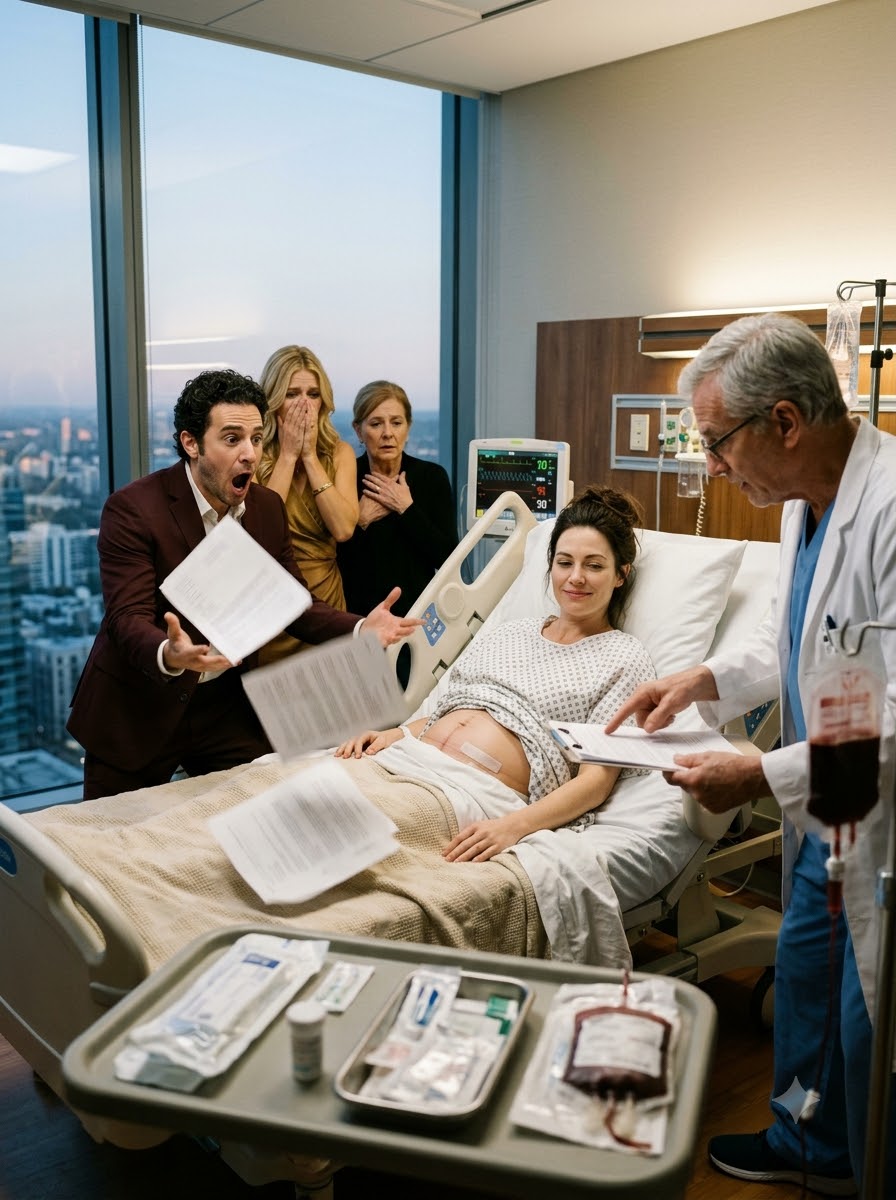
I saw Beatrice, sitting alone in her decaying cooperative apartment, applying discounted drugstore cream to her wrinkles, entirely erased from the guest lists of the only society she ever valued.
I had not taken a single dollar of revenge from them. I had simply done what every competent engineer does when confronted with defective materials: I had removed them from the job site. I had used a tiny fraction of my father’s eighty-four-million-dollar trust to quietly purchase the distressed secondary notes on their remaining consumer debts, ensuring that I was the ultimate, anonymous creditor who held their financial destinies in my hands. I didn’t enforce the debts with cruelty; I simply let the legal interest accrue, making sure that every breath they took was a quiet reminder of the foundation they had tried to dynamite.
I looked directly into the camera lens, my lips parting into a calm, radiant, untouchable smile.
“In structural mechanics,” I said, my voice carrying with clear, unhurried resonance through the crowded hall, “we teach our students that catastrophic failure is never caused by the weight of the load itself. It is caused by relying on materials that possess internal rot while pretending they are solid rock.”
I paused, resting one hand lightly on my hip, the silver thread of my scar catching the brilliant white light of the flashes.
“I spent thirty years of my life believing that blood and marriage required you to bleed until your foundation was hollowed out. I gave away sixty percent of an internal organ thinking it would finally purchase the basic decency of people who only saw me as an open vein and an open bank account. But biology is not destiny. And sacrifice without self-respect is not nobility—it is merely incompetent engineering.”
The hall was entirely silent, every ear attuned to the woman in emerald green.
“Anything will collapse if you keep piling weight onto a compromised column,” I concluded, my voice ringing like a bronze bell across the marble. “When you finally cut away the rot, you don’t lose your balance. You don’t fall into the abyss. You simply make room to rebuild on bedrock—stronger, whole, and entirely untouchable.”
Later that evening, after the last champagne glasses had been cleared and the great bronze doors of the theater were locked behind us, I stepped out onto the granite plaza of Lincoln Center.
The midnight air was crisp and clear, smelling of incoming snow and cold stone.
My phone chimed softly in my evening clutch. I pulled it out and looked at the glowing display. It was an automated notification from Winston Carmichael’s office:
Final distribution of secondary assets completed. Trustee accounts closed. Matter concluded permanently.
I did not open the attachment. I did not read the itemized ledger of their final ruin.
With a single, smooth flick of my thumb, I swiped the notification away into the digital void.
I slipped the phone back into my purse, drew a deep, effortless breath of the cold New York air into my fully regenerated body, and looked up at the towering skyline I had helped construct.
For the first time in thirty-one years, every single beam, every single pillar, and every single square inch of my foundation belonged entirely to me.
