

PART 1
The midday sun burned across a park in Atlanta. Two men sat quietly on a bench, their attention fixed on a cartel courier carrying three million dollars in illicit proceeds. Both were federal agents, only minutes from executing the most important arrest of their careers.
The individual about to wreck their operation, draw his sidearm, and humiliate them in public was not an assassin employed by the cartel.
He was a local police officer equipped with a badge, an injured pride, and longstanding bias.
And he had no conception that he was about to walk straight into a federal operation.
Heat lifted from the pavement of Centennial Olympic Park in downtown Atlanta with such intensity that stepping out of an air-conditioned structure felt like entering an oven.
It was a blistering Tuesday afternoon in mid-August.
Only a few people remained in the park. Tourists stayed under the scattered oak trees while office workers moved quickly toward the surrounding towers, iced coffees in hand.
Near the Fountain of Rings, two men occupied an aging green iron bench. To any ordinary observer, neither looked especially remarkable.
Special Agent Jonathan Paul leaned forward, elbows on his knees.
At forty-two, Jonathan was a veteran of the FBI’s Organized Crime Task Force.
He wore a faded gray hoodie, cut slightly large, over a plain white T-shirt and worn denim jeans. The garments had been selected to hide his Kevlar vest and the Glock 19 at his hip.
Beside him sat Special Agent Samuel Hayes.
Sam was thirty-one, a former Army Ranger whose strong analytical skills had accelerated his progress through Quantico.
His clothing was equally ordinary: an open flannel shirt, dark jeans, and heavy construction boots.
Both agents were Black.
To anyone acquainted with the neighborhood under surveillance, they looked like two working-class men taking a short break.
Their true identities and purpose were altogether different.
They were key participants in Operation Glass House, a federal case that had required two years to dismantle the distribution network of the Navarro Syndicate, a violent cartel active across the southeastern United States.
“Comms check,” Jonathan murmured, lips barely moving.
To anyone nearby he might have seemed to be chewing gum.
“Read you loud and clear, Paul,” answered Supervisory Special Agent Richard Cole through the flesh-colored earpiece seated deep in Jonathan’s right ear.
Cole sat three blocks away inside a mobile command center disguised as a delivery van. He watched several screens that carried surveillance feeds from the area.
“Target is three blocks north, approaching on foot. He has the briefcase.”
“Copy,” Sam whispered, adjusting his sunglasses.
“We have eyes on the drop zone.”
Their target was Arthur Penhaligan, an elusive money launderer known in criminal circles as the Ghost.
Penhaligan was expected to hand a ledger and a digital hardware wallet granting access to more than three million dollars in laundered cartel funds to a mid-level distributor.
If Jonathan and Sam intercepted the exchange, federal prosecutors would secure the decisive evidence required to indict twenty-two senior cartel members.
Everything rested on this moment.
Months of hazardous undercover buys, sleepless nights, and dangerous wiretap work had brought them to this single park bench.
While the two agents focused on their task, an unanticipated actor entered the scene.
The FBI command center had not foreseen his arrival.
A marked Atlanta Police Department patrol car moved slowly along Andrew Young International Boulevard.
Officer Brian Jenkins sat behind the wheel.
Jenkins had been on the force for ten years.
His personnel file was thick with allegations of excessive force, complaints of racial profiling, and internal-affairs inquiries.
He had avoided termination several times, shielded by a strong union representative and procedural technicalities.
As an unofficial sanction he had been moved to low-priority daytime patrols around city parks.
Jenkins resented the assignment bitterly.
He hated the oppressive heat.
He hated the duty.
Above all he could not accept any sense of disrespect.
As his cruiser passed the park’s outer edge, Jenkins scanned the grounds for someone on whom he could discharge his irritation.
His attention settled on the green iron bench near the fountains.
Two Black men sat there, one in a hoodie and the other in a flannel shirt, despite the eighty-five-degree temperature.
They remained unusually still, their gaze directed toward the pedestrian paths.
Jenkins did not recognize two federal agents conducting a tightly coordinated surveillance.
He saw an opportunity.
In his assessment they were suspicious men who had no legitimate reason to occupy his patrol area.
His prejudice supplied an immediate explanation.
Perhaps they were selling drugs.
Perhaps they were preparing to rob a tourist.
Or perhaps they were simply looking for trouble.
Without notifying his precinct dispatcher, Jenkins turned the wheel sharply.
His patrol car jolted over the curb and stopped aggressively across the pedestrian walkway, blocking access to the fountain area.
“Look at these two,” Jenkins muttered to himself, cutting the engine and releasing the retention strap on his duty holster.
It was a deliberate intimidation measure he often used before approaching anyone.
He stepped out and slammed the cruiser door, sending a sharp metallic sound across the otherwise quiet park.
On the bench, Sam noticed the patrol car’s light bar reflected in the fountain water at the edge of his vision.
“Paul,” Sam whispered, head completely still.
“We have a local at three o’clock, and he’s making a beeline right for us,” Sam whispered.
Jonathan cursed quietly under his breath.
“Cole, you got eyes on this APD cruiser?”
“I see him on the traffic cams,” Cole replied, tension in his voice.
“He’s not responding to our local liaison. He’s gone rogue. Do not blow your cover. Penhaligan is less than 60 seconds away. Play it cool. Brush the cop off. We cannot lose this drop,” Cole replied, his voice tense.
“Easier said than done,” Jonathan muttered.
From the corner of his eye he watched Jenkins approach with an exaggerated swagger.
The officer’s hand rested on his gun belt, chest pushed forward as though he were actively seeking an argument.
Jenkins stopped roughly ten feet from the bench and set his boots apart.
He adjusted his aviator sunglasses, then stared down at Jonathan and Sam with open contempt.
“Park’s closed for maintenance in this section,” Jenkins barked, his voice carrying an authority he had not earned.
The claim was plainly false.
A family of four was feeding pigeons fifty yards away, and a jogger had passed directly behind the bench moments earlier.
Jonathan leaned back slightly, deliberately adopting a casual, nonthreatening posture.
He understood precisely how such confrontations usually developed.
Long before he carried FBI credentials he had encountered officers who behaved like Jenkins.
“Just taking a load off, officer,” Jonathan said calmly, keeping a polite, even tone.
“It’s hot out here. We’re just catching some shade. We’ll be out of your hair in five minutes.”
Sam continued looking ahead, appearing to watch the water move through the fountain.
In fact he was tracking the park’s northern entrance.
A tall, thin white man in a sharply tailored gray suit had just entered, carrying a brushed-steel briefcase.
Arthur Penhaligan.
Their target had arrived.
“Target is on site,” Cole’s voice cracked urgently in their ears.
“He’s approaching the drop zone. Do not engage the officer. Maintain surveillance.”
Jonathan’s measured reply only irritated Jenkins further.
The officer wanted fear, submission, or anger—anything that would satisfy his ego.
Instead he received calm politeness.
He stepped closer, deliberately entering their personal space. The sour combination of cheap cologne and stale coffee surrounded him.
“I didn’t ask if you were catching shade,” Jenkins snapped, tightening his grip on his belt.
“I told you to move. What are you two doing out here anyway, dressed like it’s winter in the middle of August? You looking to score? You casing somebody?”
“No, sir,” Sam answered, finally turning his head just enough to acknowledge Jenkins while keeping Penhaligan in his peripheral vision.
“Just waiting for a friend, like my buddy said. We’ll be gone in a few.”
“Stand up,” Jenkins ordered.
Jonathan clenched his jaw.
Fifty yards away, Penhaligan had taken a seat at a café table, setting the briefcase on the ground between his shoes.
A heavyset man in a polo shirt, the cartel’s contact, was approaching him.
The exchange was seconds away.
“Officer,” Jonathan said, lowering his voice.
His tone shifted from polite civilian cooperation to something firmer and more authoritative.
“We aren’t doing anything wrong. We are sitting on a public bench. I strongly suggest you go check on that family over there or continue your patrol. We are busy.”
It was exactly the wrong response for someone like Jenkins.
The phrase “I strongly suggest” struck his fragile ego with force.
His face reddened beneath the sunglasses.
“Oh, you strongly suggest?” Jenkins sneered.
He unclipped his police radio.
“Dispatch, this is Unit 41. I need a secondary unit at the Olympic Park fountains. I have two noncompliant suspects refusing to vacate. Possible narcotics activity.”
“Unit 41. Copy. Secondary unit is en route,” the dispatcher replied.
“Paul. Hayes,” Cole shouted through the earpiece. “The handoff is happening. Look at Penhaligan.”
Jonathan and Sam shifted their attention toward the café.
The heavyset cartel associate had taken his seat opposite Penhaligan.
He was pushing a manila envelope across the tabletop.
“Let me see some ID,” Jenkins demanded, taking out his notepad.
“Both of you, right now. Legal names.”
Both agents carried identification documents under their undercover identities.
Jonathan was operating as Marcus Johnson.
Sam was using the name Terrence Wright.
Producing those documents would require them to divert attention from the target, reach into their pockets, and endure a prolonged interrogation resembling a traffic stop.
And Jenkins was clearly searching for a reason to arrest them.
Revealing their federal credentials would be worse.
If they displayed their FBI badges, Penhaligan could notice the disturbance, realize law enforcement was present in the park, and leave before the transaction finished.
“We don’t have our IDs on us, man,” Sam lied smoothly, trying to stall. “Left our wallets in the truck. It’s parked over by the CNN Center.”
“Is that right?” Jenkins smirked, moving close enough to reach them.
He enjoyed moments like this.
Moments when he believed he held absolute power over someone else.
“No ID. Refusing a lawful order. Suspicious behavior. You two are about ten seconds away from eating concrete. Stand up and put your hands behind your back.”
“Officer Jenkins,” Jonathan said, reading the name on the officer’s uniform.
He looked directly into Jenkins’s eyes, dropping every trace of his casual undercover persona.
His expression became cold and penetrating, carrying the clear authority of a federal agent.
“You are interfering with something much larger than you can understand right now. Walk back to your cruiser. Now.”
For a brief instant, Jenkins went still.
The sudden change in Jonathan’s demeanor had caught him off guard.
PART 2
This was not the frightened or angry response he normally received from the people he confronted.
It was an order.
But within seconds, Jenkins’s arrogance overrode the warning in his instincts.
He took one more step forward and placed his hand on the grip of his holstered sidearm, thumb resting on the retention strap he had already released.
“Last chance,” Jenkins said, voice rising. “Stand up and turn around, or I will put you both on the ground.”
Jonathan remained seated. His right hand stayed on his knee, inches from the hoodie hem that concealed his own weapon. Sam’s posture had not changed either, though his left foot had shifted slightly, ready to move if the situation deteriorated further. Fifty yards away the manila envelope had changed hands. The heavyset man was already rising from the café table, briefcase now in his possession, while Penhaligan remained seated and checked his phone.
Cole’s voice came through both earpieces, low and controlled. “Secondary unit is two minutes out. Penhaligan is still on site. Do not draw. Do not identify. If he moves on you, comply and we will extract you after the handoff clears the park.”
Jenkins interpreted the continued stillness as defiance. He keyed his radio again. “Unit 41, subjects are refusing commands. I’m going hands-on.” He stepped in, reached for Jonathan’s left arm, and yanked. The motion was abrupt and unbalanced. Jonathan allowed himself to be pulled partway upright so that the sudden force would not topple the bench or draw additional attention, but he kept his weight centered and his right side angled away from Jenkins. The hoodie shifted just enough that the outline of the vest became briefly visible beneath the fabric.
Jenkins noticed. His eyes dropped to the bulky shape under the gray material. “What the hell is that?” he demanded. His free hand moved fully onto the grip of his pistol. “You armed?”
Sam spoke for the first time in a full sentence since the officer’s arrival. “Officer, neither of us is reaching for anything. Take your hand off him.”
The command was quiet, but it carried none of the earlier civilian deference. Jenkins’s face flushed darker. He shoved Jonathan backward onto the bench and drew his sidearm in one continuous motion, leveling the muzzle at Jonathan’s chest from six feet away. The safety was already off. A woman feeding pigeons fifty yards distant looked up at the sudden movement and gathered her children. A jogger slowed, then stopped.
“Both of you, on the ground, now,” Jenkins shouted. “Hands where I can see them.”
Jonathan raised both hands slowly to shoulder height, palms open. Sam did the same. Neither man dropped to the pavement. The secondary APD unit had not yet arrived. At the café table Penhaligan had stood. He was looking toward the fountain, one hand still on the back of his chair. The heavyset man with the briefcase had already begun walking toward the northern exit at a measured pace.
Cole’s voice cut in again. “Paul, the package is moving. If you can delay him thirty seconds we still have a chance on the perimeter. Do not identify unless he fires.”
Jenkins advanced another step, pistol steady. “I said on the ground.”
Jonathan met his eyes. “You are pointing a firearm at two federal agents in the middle of an active operation. Lower the weapon and step back.”
The sentence was delivered without volume, yet it carried across the short distance. Jenkins blinked. For half a second the muzzle wavered. Then his training and his anger reasserted themselves. “Show me a badge or you’re both going down.”
Sam kept his hands raised. “Badge is in the truck. You already heard that.”
Jenkins’s radio crackled with the approaching secondary unit’s acknowledgment. He did not answer it. Instead he moved to his left, trying to create an angle that would let him cover both men at once. The motion placed him between the bench and the café. Penhaligan, still watching, took two steps toward the walkway that led out of the park. The heavyset man was now thirty yards from the northern gate.
Jonathan spoke again, still seated, hands visible. “Officer Jenkins, listen carefully. If you discharge that weapon you will be charged with assault on a federal officer. If you continue to obstruct this surveillance you will be charged with interference in a federal investigation. Lower the firearm, holster it, and walk to your vehicle. A supervisor is already en route who can confirm what I am telling you.”
Jenkins’s breathing had grown audible. Sweat ran from beneath his sunglasses. He glanced once toward the café, then back at the two men. The secondary cruiser’s lights appeared at the park entrance. Its siren was off, but the light bar was active. Jenkins keyed his radio with his free hand. “Unit 41, I have two armed suspects at gunpoint. Need immediate backup.”
The transmission went out before either agent could interrupt it. On the café side of the fountain, Penhaligan turned fully toward the sound of the approaching cruiser. He abandoned the table and began walking quickly toward the western edge of the park, phone already at his ear. The heavyset man with the briefcase broke into a jog. Cole’s voice in the earpieces was flat. “Package is rabbit. Perimeter teams are moving. Maintain position. Do not pursue.”
The secondary APD unit stopped behind Jenkins’s cruiser. Two officers exited, weapons drawn, and advanced along the walkway. Jenkins did not lower his pistol. “They won’t comply,” he called over his shoulder. “Possible narcotics, possible weapons under the hoodie.”
One of the arriving officers, a sergeant, slowed when he saw the raised hands and the absence of any aggressive movement from the bench. He looked at Jenkins, then at the two men. “Jenkins, what’s the actual PC?”
“Refusing to leave a closed section, no ID, suspicious clothing, possible vest,” Jenkins answered without taking his eyes off Jonathan.
The sergeant’s gaze moved to the hoodie. He took two more steps and stopped. “Sir, are you armed?”
Jonathan kept his hands where they were. “I am a federal agent. So is the man beside me. Your officer has interrupted an active surveillance. The target just left the park. If you will allow me to reach slowly into my right front pocket I will show you credentials that your dispatcher can verify in under a minute.”
The sergeant hesitated. Jenkins’s pistol remained leveled. “Don’t let him reach,” Jenkins said.
The sergeant raised one hand toward Jenkins without looking at him. “Holster it. Now.”
Jenkins did not move. The second arriving officer had circled wide and now stood at an angle that covered both the bench and Jenkins. Tourists who had been near the fountain were moving away. The family with the pigeons had already left the area. Penhaligan and the man with the briefcase were no longer visible.
Jonathan spoke to the sergeant. “My name is Jonathan Paul. His is Samuel Hayes. We are assigned to the Organized Crime Task Force out of the Atlanta field office. Supervisory Special Agent Richard Cole is in a mobile command post three blocks north. He has been monitoring this entire encounter on the traffic cameras and on our body-worn audio. If you contact your watch commander and request a patch to the FBI liaison on duty, they will confirm.”
The sergeant studied Jonathan’s face for three seconds, then looked at Sam. He keyed his own radio and requested the watch commander. While he waited, he kept his weapon at low ready and told Jenkins, again, to holster. This time Jenkins complied, though the motion was stiff and his hand remained near the grip. The secondary officer moved in and positioned himself between Jenkins and the bench.
Ninety seconds later the watch commander’s voice came back over the sergeant’s radio. The FBI liaison had already been contacted by Cole. Confirmation was immediate. The sergeant lowered his weapon. “Stand down,” he told his partner. He turned to Jenkins. “You are relieved. Go sit in your car.”
Jenkins stared at him. “They were—”
“Go sit in your car.”
Jenkins walked back to his cruiser. The two agents remained on the bench with their hands still visible until the sergeant nodded. Jonathan reached slowly into the hoodie pocket, produced a slim credential case, and held it open. The sergeant examined it, then handed it back. Sam did the same. Neither man stood until the sergeant explicitly cleared them to do so.
Cole’s voice returned in their ears. “Perimeter has both subjects in sight. Penhaligan is in a vehicle heading south on Centennial. The briefcase is still with the associate. We are not burned on the larger network. Local liaison is taking Jenkins into custody for interfering with a federal officer. You are clear to exfil. Medical is standing by if either of you needs it.”
Jonathan stood. The gray hoodie was damp across the shoulders. He looked once toward the northern exit where the heavyset man had disappeared, then toward the café table that Penhaligan had abandoned. The manila envelope was gone. Sam rose beside him. They walked together toward the western edge of the park, away from the cluster of APD vehicles, and did not speak until they reached the side street where an unmarked sedan waited with its engine running.
Inside the car Cole turned from the front passenger seat. “You both good?”
“Yeah,” Jonathan said. He removed the earpiece and set it on the console. “How much of the handoff did we actually get?”
“Enough for the hardware wallet and the partial ledger photos the associate took before he ran. Not the full sit-down we wanted, but the twenty-two are still chargeable on what we already have plus today’s partial. Penhaligan will be picked up before he reaches the airport.” Cole glanced at the park in the rearview mirror. “Jenkins is being transported. His sergeant already pulled the body-cam. It matches what we recorded.”
Sam leaned back against the seat. The flannel shirt stuck to his arms. “He was going to shoot one of us over a bench.”
“He was going to shoot one of you because you didn’t look the way he decided you should look,” Cole said. “Internal affairs has the file. So does our OPR. He won’t be on the street tomorrow.”
The sedan pulled away from the curb. In the park the Fountain of Rings continued its programmed cycle. The green iron bench sat empty. Jenkins’s cruiser remained where he had parked it, lights still flashing, while two officers stood beside the open driver’s door and waited for a tow. The secondary unit’s sergeant was already on the phone with the precinct captain. By the time the unmarked sedan reached the field office, the watch commander had issued a verbal order suspending Jenkins pending the outcome of the joint review. The body-camera footage, the FBI audio, and the traffic-camera timestamps were all preserved under dual custody.
Jonathan and Sam spent the next four hours in separate interview rooms giving statements. Neither minimized the moment Jenkins’s muzzle had been centered on Jonathan’s chest. Both noted the absence of any articulated probable cause beyond the false claim that the section was closed. Both described the visible approach of Penhaligan and the subsequent flight. When the statements were complete they were released. Medical staff checked blood pressure and offered water; neither agent required further treatment.
Jenkins was booked that evening on state charges of aggravated assault on a law-enforcement officer and interference with a federal investigation. The federal complaint was filed the following morning. His union representative appeared at the initial hearing and argued that Jenkins had reasonably believed he was confronting armed suspects. The argument did not survive the synchronized video. Bail was denied. Jenkins remained in custody.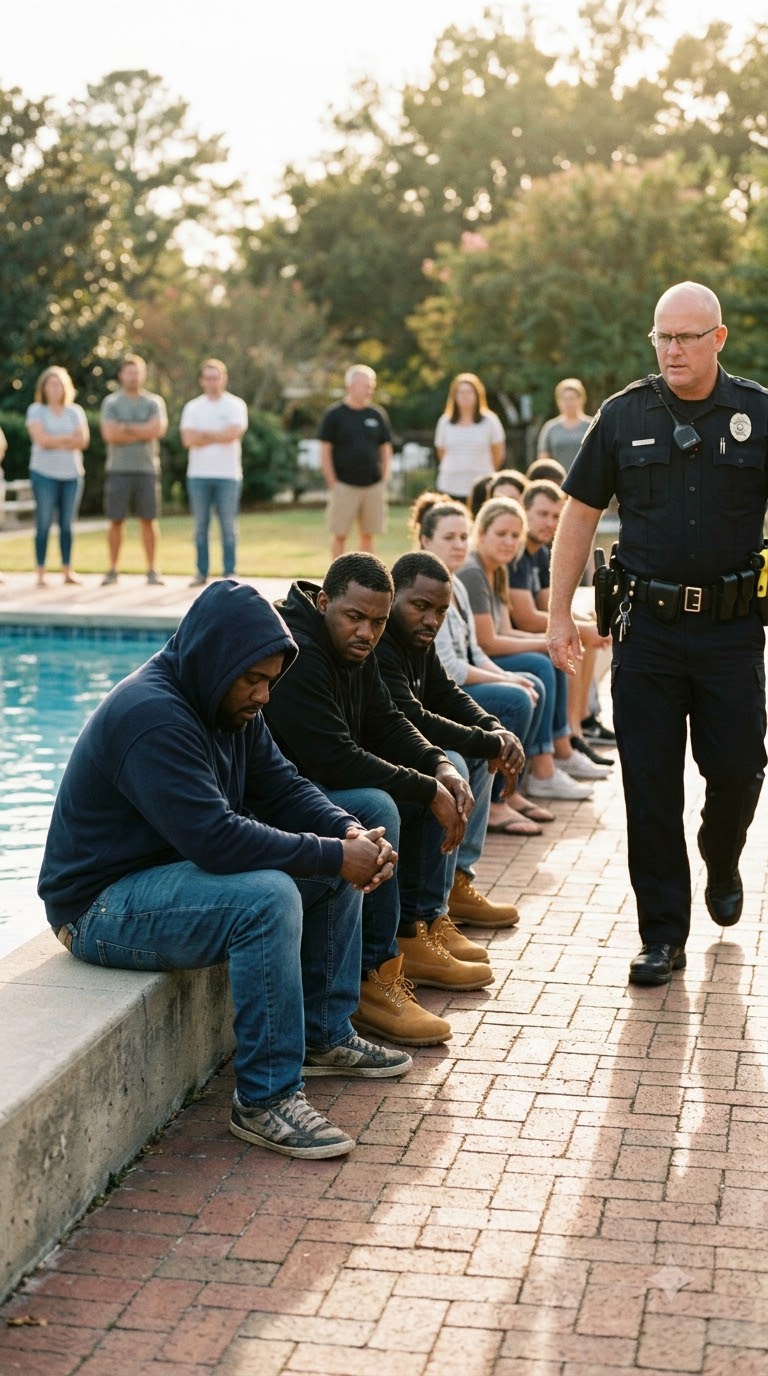
Three days later the partial evidence recovered from the associate’s briefcase and from Penhaligan’s phone was presented to a grand jury. Indictments were returned against eighteen of the twenty-two targeted cartel members. Penhaligan was arrested at a private airfield outside the city; the hardware wallet was still in his possession. The two agents who had sat on the green bench were not named in any public filing. Their undercover identities remained intact for the remaining cases.
Six weeks after the afternoon in the park, Jenkins entered a plea. He received a sentence of seven years in federal custody. The Atlanta Police Department separated him from employment the same week. The sergeant who had ordered him to holster received a formal commendation for preventing an officer-involved shooting. No public statement was issued by the FBI field office. The Fountain of Rings continued its cycle. The green iron bench remained in place. On most afternoons it was occupied by tourists or by office workers seeking shade. None of them knew that, for eleven minutes on a Tuesday in August, the bench had been the center of an operation whose outcome had depended on two men keeping their hands visible while a third man decided whether to pull a trigger.
