

PART 1
“You two are going to wish you’d taken an Uber.”
The crowbar struck the rear quarter panel with a report as abrupt as a firearm discharge. A deep, irregular dent bloomed across the ghost-silver paint, the sort of damage whose repair bill exceeded the annual income of most households in the county.
The officer wielding the tool showed no hesitation.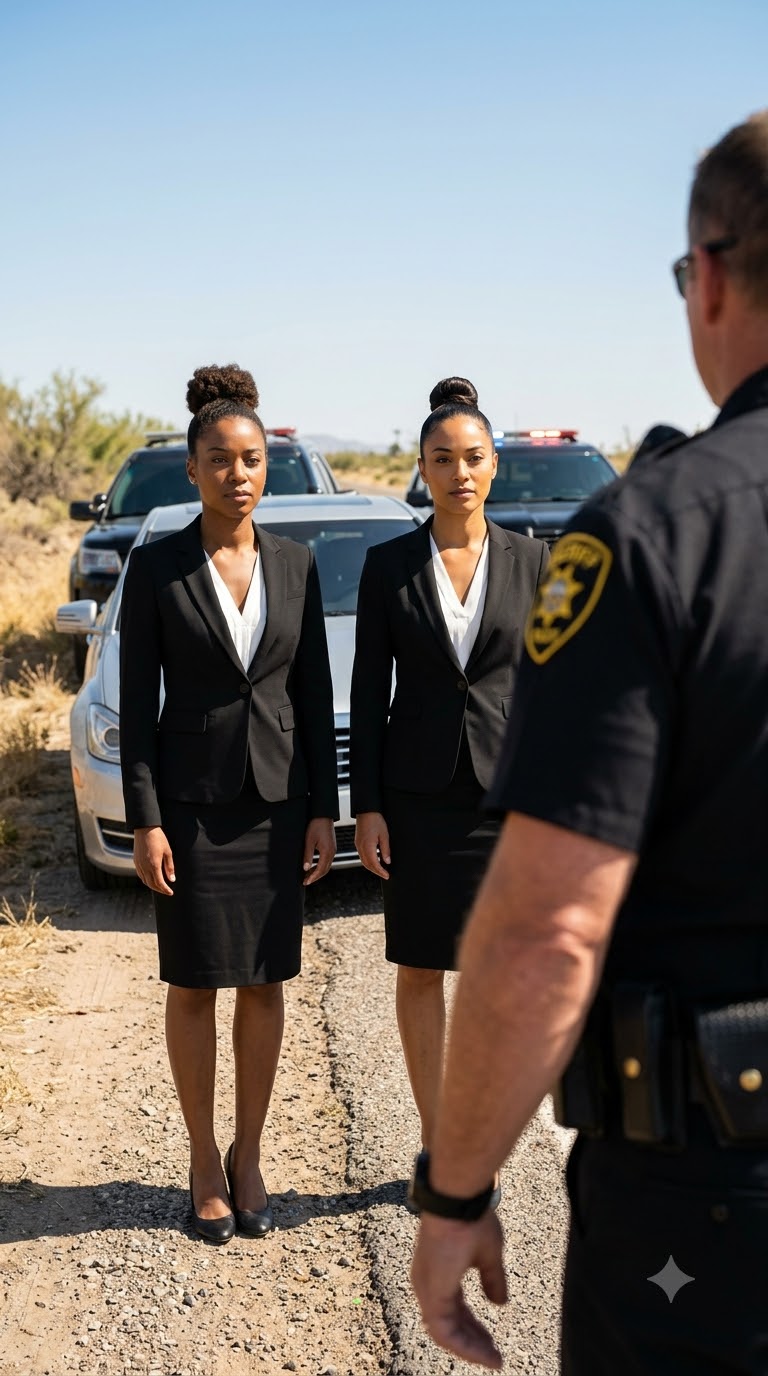
He pivoted toward the two Black women standing several paces away, palms slightly elevated, and offered a brief, unapologetic smile.
He had selected the wrong automobile.
He had directed his attention at the wrong pair of women.
And he remained unaware that a complete record of every error he was committing had already been captured and secured beyond any means of deletion available to him.
The crowbar belonged to Sergeant Develin Sharp.
Sharp had completed eleven years on the force. In that span he had accumulated zero documented use-of-force complaints against himself, filed 214 reports, and never declined a direct order issued by Captain Ford Calhoun.
Calhoun stood roughly twenty feet distant, arms folded, regarding Sharp’s work with the detached interest of a supervisor watching a subordinate mow a lawn.
The Rolls-Royce Phantom Ghost sat at an angle on the shoulder, hazard lamps pulsing in measured amber sequence.
Its exterior reflected light like polished platinum. Through the open rear door the cream leather and precise stitching remained visible, materials whose cost exceeded a typical residential mortgage payment in Duval County.
The vehicle identification number had been run and cleared twenty-two minutes earlier.
Registration was current.
Insurance was active and sufficient.
Both women’s licenses were authentic.
None of those verified facts had altered the course of events.
The sequence had begun in the manner common to such encounters—not with an explicit declaration of antagonism, but with antagonism presented as ordinary procedure.
Seven hours earlier, near 6:30 a.m., a private car service had deposited two women at the eastern gate of Riverside Memorial Gardens in Jacksonville, Florida.
The taller woman was slim, attired in a charcoal wool blazer and dark trousers. Her natural hair was gathered neatly at the crown; she carried a single white rose.
The shorter woman wore a gray raincoat under a clear sky. She held a compact leather portfolio beneath one arm, the posture of someone either concluding or about to begin a professional meeting.
They were forty-four-year-old twins.
They shared the same widely spaced eyes, matching jawlines, and an identical measured expression that outsiders sometimes read as emotional detachment.
It was not detachment.
It was the disciplined self-control of women who had understood early that displaying feeling in public supplied others with usable information.
And information, their father had taught them, was to be released only with deliberation.
Their father’s name was Gerald Voss.
He lay in the third row of Section D beneath a plain flat marker whose inscription read:
Beloved father. Patient man. Exact in all things.
Nadia, the taller twin, set the white rose beside the stone and remained silent for an extended interval.
Her shorter sister, Ranata, opened the leather portfolio and withdrew a single photograph.
The image showed the four of them twenty years earlier outside an Atlanta courthouse.
Their father wore his Sunday suit.
Their mother, deceased six years, stood next to him.
Nadia, then twenty-four, already moved with that distinctive economy of motion.
Ranata stood beside her, legal pad in hand, pen tucked behind one ear.
“He always said, ‘Power reveals character.’” Ranata spoke softly. “Not creates it reveals it.”
Nadia kept her eyes on the gravestone.
“He was exact about that distinction.”
They stayed at the cemetery for forty minutes.
Afterward they returned to the Rolls-Royce that Nadia kept in a Jacksonville storage facility and used only on the two or three occasions each year when she visited home.
She took the driver’s seat herself.
There was no chauffeur.
There was no security detail.
The arrangement was a conscious decision to maintain anonymity, a choice that would prove unexpectedly costly that morning.
They were traveling south on State Road 228, approximately eight miles from their hotel, when the emergency lights appeared behind them.
Red and white strobes filled the rearview mirror.
Nadia checked the speedometer.
She was traveling fifty-one miles per hour in a fifty-five-mile-per-hour zone.
She signaled, steered the Rolls-Royce onto the shoulder, and shut off the engine.
She placed her folded hands in her lap.
In the passenger seat Ranata closed the small notebook in which she had been writing.
She capped her pen.
She faced forward.
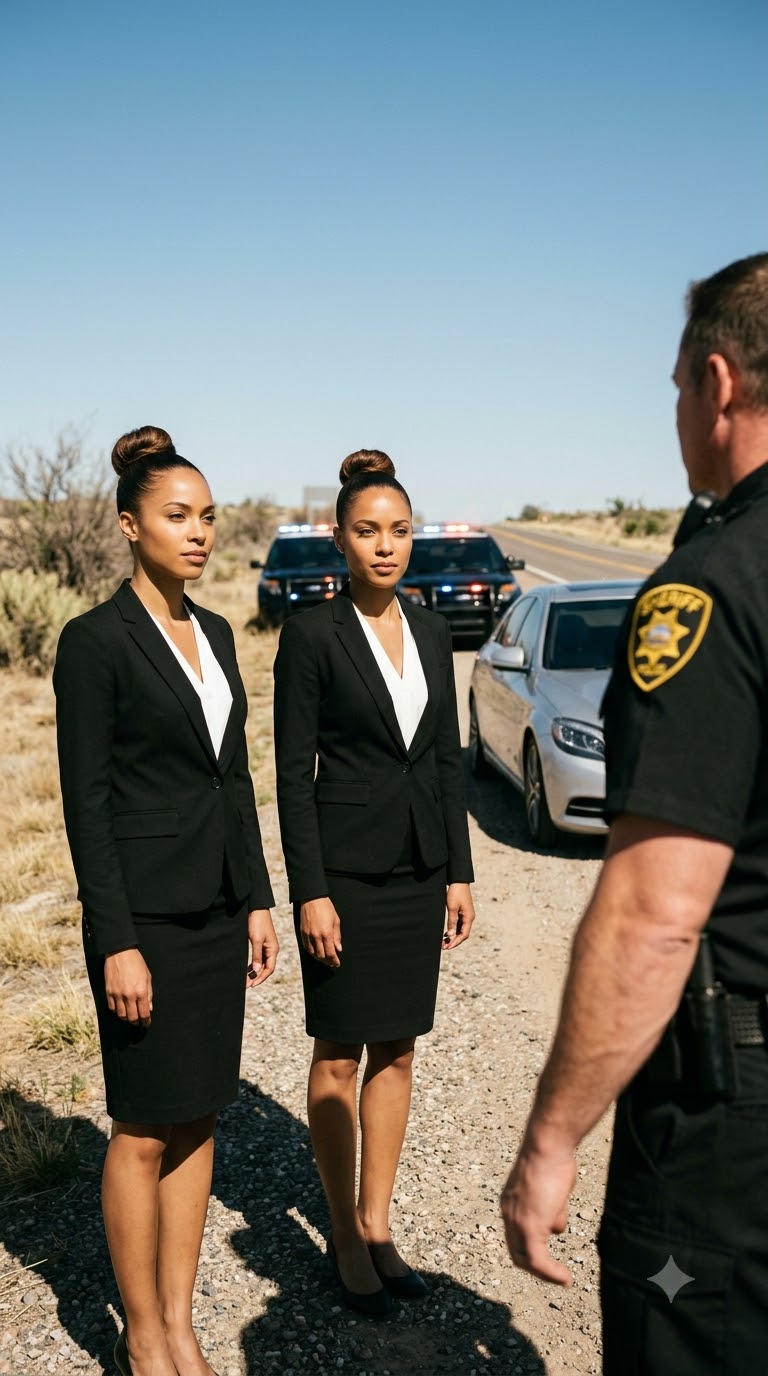
Two law-enforcement vehicles had stopped behind them.
One was a marked patrol cruiser.
The other was an unmarked Dodge Durango.
That was the first detail Nadia noted.
Two vehicles responding to what presented as a routine traffic stop on an otherwise empty roadway.
The second detail registered immediately afterward.
The man exiting the Durango was not in standard patrol uniform.
He wore a department polo and trousers.
Captain’s bars were affixed to his collar.
A captain had personally attended their traffic stop.
Ford Calhoun was fifty-three years old.
He had served nineteen years with the Jacksonville Sheriff’s Office, the last six as a precinct captain.
His personnel file listed thirty-one commendations and four substantiated misconduct complaints.
None of those complaints had resulted in discipline beyond a counseling memorandum.
Calhoun advanced toward the driver’s side of the Rolls-Royce at a deliberately unhurried pace, as though Nadia’s time were his to allocate.
He rapped the window twice with a knuckle.
Hard.
It was the knock of a man who did not intend to wait.
Nadia lowered the glass.
“License, registration, proof of insurance.”
There was no greeting.
There was no statement of the reason for the stop.
Calhoun rested one hand on the roof and leaned slightly inward.
His eyes moved across the interior with a focused attention that did not appear directed at possible contraband or evidence of an offense.
He seemed instead to be cataloguing elements that offended him personally.
The leather seating.
The matched wood trim.
The discreet rear-center display.
Without haste, without superfluous speech, and without any exaggerated motion, Nadia passed the requested documents through the window.
Calhoun accepted them.
He examined her driver’s license for a period longer than routine verification required.
Then he looked directly at Nadia.
His eyes returned to the license.
“This vehicle registered to you?”
Nadia answered in the same measured tone she had used at the cemetery. “Yes.”
Calhoun studied the registration card next, turning it under the morning light as though the paper itself might disclose a defect. The insurance card followed. He compared the names, the addresses, the dates of issuance. Nothing failed to match. The silence lengthened. Behind the Rolls-Royce, Sergeant Sharp stood beside the marked cruiser with his arms crossed, weight shifted onto one hip, watching.
Calhoun straightened. “Step out of the vehicle.”
Nadia did not move. “May I ask why?”
“Step out.”
The instruction carried no accompanying explanation of probable cause, no citation for a moving violation, no request for additional documentation. Nadia’s hands remained folded in her lap. Ranata, still seated, had not shifted her posture either. Both women kept their eyes forward or slightly lowered; neither reached for a phone, a door handle, or any object inside the cabin.
Calhoun repeated the order, louder. “Out. Now.”
Nadia opened the driver’s door and placed both feet on the asphalt. She stood, hands visible and empty at her sides. Ranata exited on the passenger side a moment later, portfolio still under one arm, the same deliberate calm intact. They positioned themselves a short distance from the car, not close enough to be accused of interfering, not so far as to invite an order to approach.
Sharp approached from the rear of the Rolls-Royce carrying a standard-issue crowbar. He did not announce its purpose. He did not request permission. He simply set the flat end against the rear quarter panel and drove it forward once. The impact produced the sound already described. Metal yielded. Paint fractured along the edges of the dent. Sharp withdrew the tool, examined the damage with professional interest, and looked toward the women.
“You two are going to wish you’d taken an Uber.”
Neither woman replied. Nadia’s gaze remained on Calhoun. Ranata’s remained on the damaged panel, then on Sharp, then on the open rear door of the Rolls-Royce. The morning air carried the faint scent of cut grass from a distant median and the warmer smell of the car’s still-cooling engine. Traffic on State Road 228 was light; two vehicles passed in the opposite direction without slowing. No additional officers had arrived. The body-worn cameras on both Calhoun and Sharp were activated; small red indicator lights were visible on the devices clipped to their vests.
Calhoun stepped closer to Nadia. “Whose car is this, really?”
“It is registered to me,” she said. “The documents you hold confirm that.”
“Documents can be arranged.” He glanced at the leather interior again. “People like you don’t usually drive something like this without an explanation that fits.”
Ranata spoke for the first time since the cemetery. Her voice was quiet enough that Sharp had to turn his head to hear it clearly. “People like us?”
PART 2
Calhoun ignored the question. He directed Sharp to continue the inspection. Sharp moved to the opposite rear quarter panel and applied the crowbar a second time. The second dent was shallower but longer, running parallel to the first. He then walked to the driver’s side front fender and struck once more, lower, where the metal curved toward the wheel well. Each impact was deliberate, measured, and unnecessary for any legitimate inventory or safety check. The Rolls-Royce’s hazard lights continued their slow pulse. The open rear door revealed the cream stitching and the edge of a folded wool blanket Nadia kept in the car for the rare occasions when the vehicle was driven in cooler weather.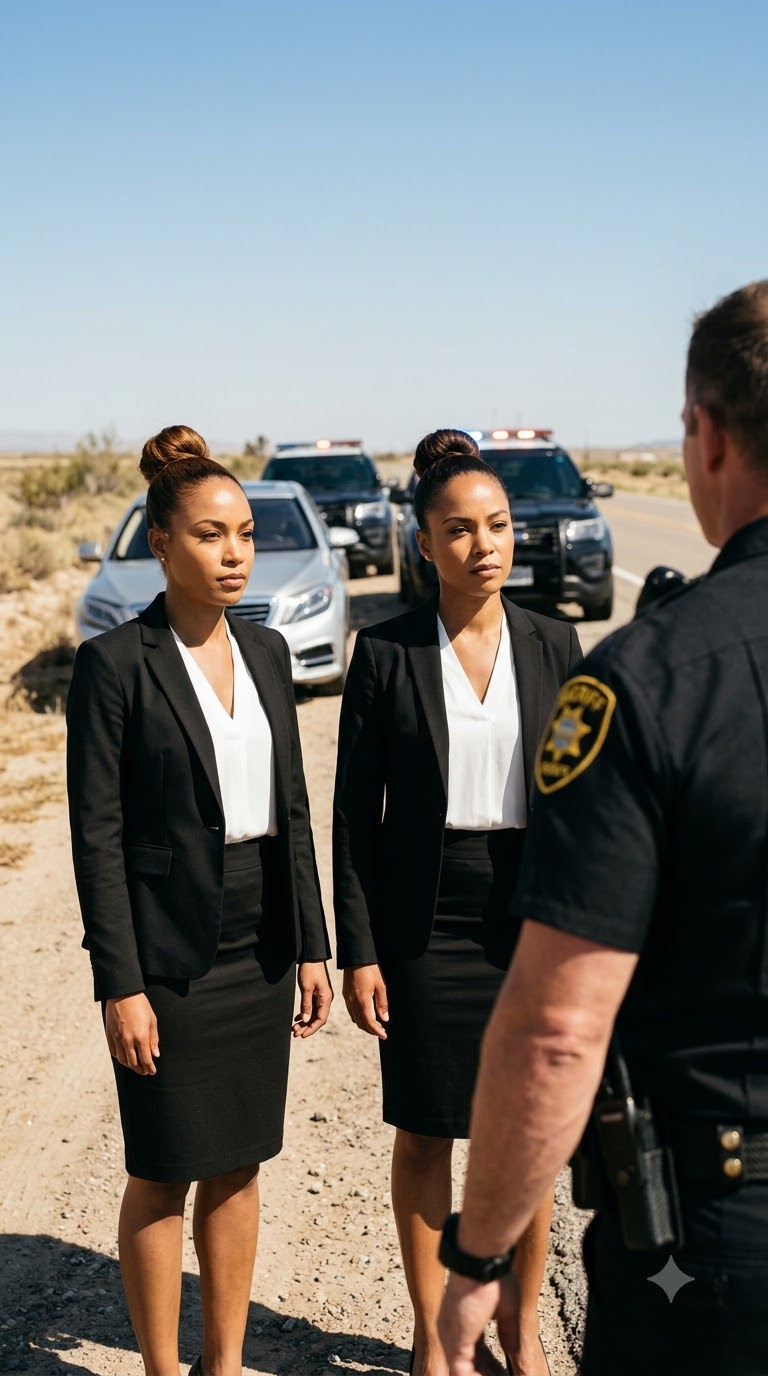
Nadia remained where she stood. Her posture had not changed. The charcoal blazer was unbuttoned; beneath it a simple black top was visible. She wore no jewelry except a thin silver watch whose face she did not consult. Ranata shifted her weight once, enough to keep circulation in her legs, and kept the portfolio pressed against her side. Neither woman raised her voice. Neither woman asked a second time for the basis of the stop. Both appeared to be waiting for the officers to exhaust the sequence of actions they had already chosen.
Calhoun returned to the documents. He photographed each one with his personal phone, then with the phone issued by the department. He asked Nadia to state her full name for the record. She did so. He asked Ranata the same. She answered. He asked their relationship. “Sisters,” Nadia said. “Twins.” Calhoun repeated the word as though testing its weight. He asked where they had been that morning. Nadia named the cemetery and the approximate time of arrival and departure. Ranata confirmed the account without elaboration. Calhoun asked why two women required a Rolls-Royce for a cemetery visit. Neither answered the implication embedded in the question. The silence that followed was longer than the previous ones.
Sharp set the crowbar on the trunk lid and opened the rear passenger door farther. He leaned inside, running a gloved hand along the seat seams, the center console, the rear of the front seats. He found nothing. He moved to the trunk, which Calhoun had already ordered unlocked via the key fob still in the ignition. The trunk contained a small overnight bag belonging to Ranata, a folded umbrella, and the emergency kit that had come with the vehicle. Sharp removed each item, set them on the asphalt, and photographed them. He replaced them without comment. The process consumed twelve additional minutes.
During that interval a third vehicle, a marked supervisor’s car, arrived and stopped on the opposite shoulder. The lieutenant who exited conferred briefly with Calhoun out of immediate earshot of the women. The lieutenant examined the damage to the Rolls-Royce, looked at the two women, and returned to his vehicle. He did not approach them. He did not request to review the body-camera footage in real time. After four minutes he drove away in the direction from which he had come.
Calhoun approached Nadia again. “We’re going to need the car towed for a full inventory. You’ll both be transported for questioning.”
Nadia met his eyes. “On what charge?”
“We’ll sort that at the station.”
“That is not an answer.”
Calhoun’s expression did not change. “Turn around. Hands behind your back.”
Nadia did not move. Ranata, standing three feet to her left, likewise remained still. The request had not been accompanied by a statement of probable cause sufficient to justify arrest. No warrant had been mentioned. No observation of a crime in progress had been articulated beyond the initial, unexplained stop. Sharp took a step forward, crowbar still in one hand. The lieutenant’s car was already out of sight.
Nadia spoke again, still without raising her voice. “Before you place either of us in restraints, you should know that every minute of this encounter has been recorded by devices that do not belong to your department and that are not subject to your control. Those recordings are already in the possession of people who will review them today.”
Calhoun studied her face. The statement did not produce an immediate change in his posture, but the interval before his next words lengthened. Sharp looked toward the Rolls-Royce as though expecting to see a camera mounted on the dashboard or the rearview mirror. Nothing of that description was visible.
“Turn around,” Calhoun repeated.
Nadia turned. She placed her hands behind her back, wrists crossed, and waited. The metal of the handcuffs was cool when Sharp applied them. The ratchet clicked twice on each wrist. Ranata submitted to the same process without resistance. Both women were walked to the marked cruiser and seated in the rear compartment. The door was closed. Through the reinforced glass they could see Calhoun and Sharp conferring beside the damaged Rolls-Royce. A flatbed tow truck appeared within eight minutes; its driver, summoned by radio, positioned the vehicle and began the process of loading the Rolls-Royce. The open rear door was closed. The hazard lights were extinguished. The car rose onto the bed, its ghost-silver bodywork now marked by three distinct dents and a long scrape along the lower rocker panel where the crowbar had slipped on the third strike.
Inside the cruiser the women sat without speaking. Nadia’s watch was still on her wrist; the handcuffs prevented her from checking the time, but she did not appear to need the information. Ranata’s portfolio had been taken and placed in the front passenger seat. Neither woman asked where they were being transported. Neither woman requested a telephone call. The cruiser pulled onto the roadway and accelerated. In the side mirror the tow truck and the Rolls-Royce diminished, then disappeared around a gentle curve.
The transport lasted twenty-three minutes. They arrived at a precinct building whose exterior brick and narrow windows suggested construction in the late 1970s. Inside, they were separated. Nadia was placed in an interview room whose table was bolted to the floor and whose single camera was mounted high in one corner. Ranata was taken to a second room of identical dimensions. Their personal effects were inventoried and sealed in plastic bags. No one read either woman her rights because, as the booking officer later noted in the log, neither had yet been formally charged with an offense. They were, the officer wrote, “detained pending further investigation.”
In the first interview room Nadia sat with her cuffed hands resting on the table. The door opened after forty-one minutes. The person who entered was not Calhoun and was not Sharp. She was a woman in her early fifties wearing a dark suit and an identification badge clipped to her lapel. The badge identified her as an assistant special agent in charge of the FBI’s Jacksonville resident agency. She closed the door, sat opposite Nadia, and placed a single sheet of paper on the table.
“Director Voss,” she said. “I’m Special Agent Morales. We received the live feed from your secondary recording devices at 7:14 this morning. The Director’s protective detail and the Office of the Inspector General were notified at 7:16. I am here to take your statement and to arrange your immediate release. Captain Calhoun and Sergeant Sharp have already been relieved of duty pending the outcome of the joint review. The vehicle is being recovered from the tow yard as we speak.”
Nadia looked at the paper. It was a one-page summary of the body-camera timestamps, the secondary-device timestamps, and the names of the two officers. She read it once. She set it down.
“My sister is in the other room,” she said.
“She is being released at the same time. A car is waiting.”
Nadia nodded once. The handcuffs were removed. She stood, straightened the charcoal blazer, and followed Agent Morales into the corridor. Ranata emerged from the adjacent room a moment later, portfolio restored to her hands, the same composed expression she had worn at the cemetery still in place. Neither woman spoke until they were outside the building and seated in the rear of an unmarked federal sedan.
Ranata broke the silence first. “He was exact about the distinction.”
Nadia watched the precinct recede in the side window. “Yes.”
The sedan carried them to a secure garage beneath a federal building three miles away. The Rolls-Royce was already there, still bearing the three dents and the scrape. A team of technicians was photographing every mark under controlled lighting. Nadia walked once around the vehicle, noting the locations of the damage without touching the metal. She then entered a conference room on the third floor where a video link had been established with the Office of the Inspector General in Washington and with the Jacksonville Sheriff’s Office internal-affairs bureau. The review lasted four hours. Body-camera footage was played in full. The secondary recordings—captured by two small devices Nadia carried in the blazer’s inner pocket and by a third device mounted discreetly inside the Rolls-Royce’s rear-center console—were synchronized and played alongside the officers’ footage. Timestamps matched. Audio matched. The sequence of the crowbar strikes was unambiguous.
By late afternoon both Calhoun and Sharp had been placed on administrative leave without pay. The lieutenant who had briefly appeared at the scene was interviewed and stated that he had been told the stop involved a possible stolen vehicle; he had not independently verified the claim. The tow-truck driver provided a written statement confirming that he had been dispatched for an inventory search and had observed the existing damage upon arrival. No contraband had been found in the vehicle at any point.
Nadia and Ranata returned to their hotel at 6:40 p.m. They ordered room service and ate without discussion of the day’s events until the plates were cleared. Ranata then opened the portfolio and removed the photograph taken outside the Atlanta courthouse. She set it on the table between them.
“He would have wanted the distinction preserved in the record,” she said.
Nadia studied the image. Their father stood between them, younger, the Sunday suit still fitting as it had on the day the photograph was made. “The record will contain it.”
The following morning the joint review issued its preliminary findings. Captain Ford Calhoun was recommended for termination. Sergeant Develin Sharp was recommended for termination. Both recommendations cited sustained violations of departmental use-of-force policy, false statements regarding the basis for the stop, and conduct unbecoming. The recommendations were forwarded to the sheriff and to the state attorney. Civil claims for property damage and for deprivation of rights under color of law were prepared by counsel retained that same morning; the claims named the two officers in their individual capacities and the sheriff’s office as an entity. The Rolls-Royce was transported to a specialist facility in Atlanta whose estimate for restoration of the bodywork and repaint exceeded the original purchase price of many new vehicles. Nadia authorized the work without negotiation.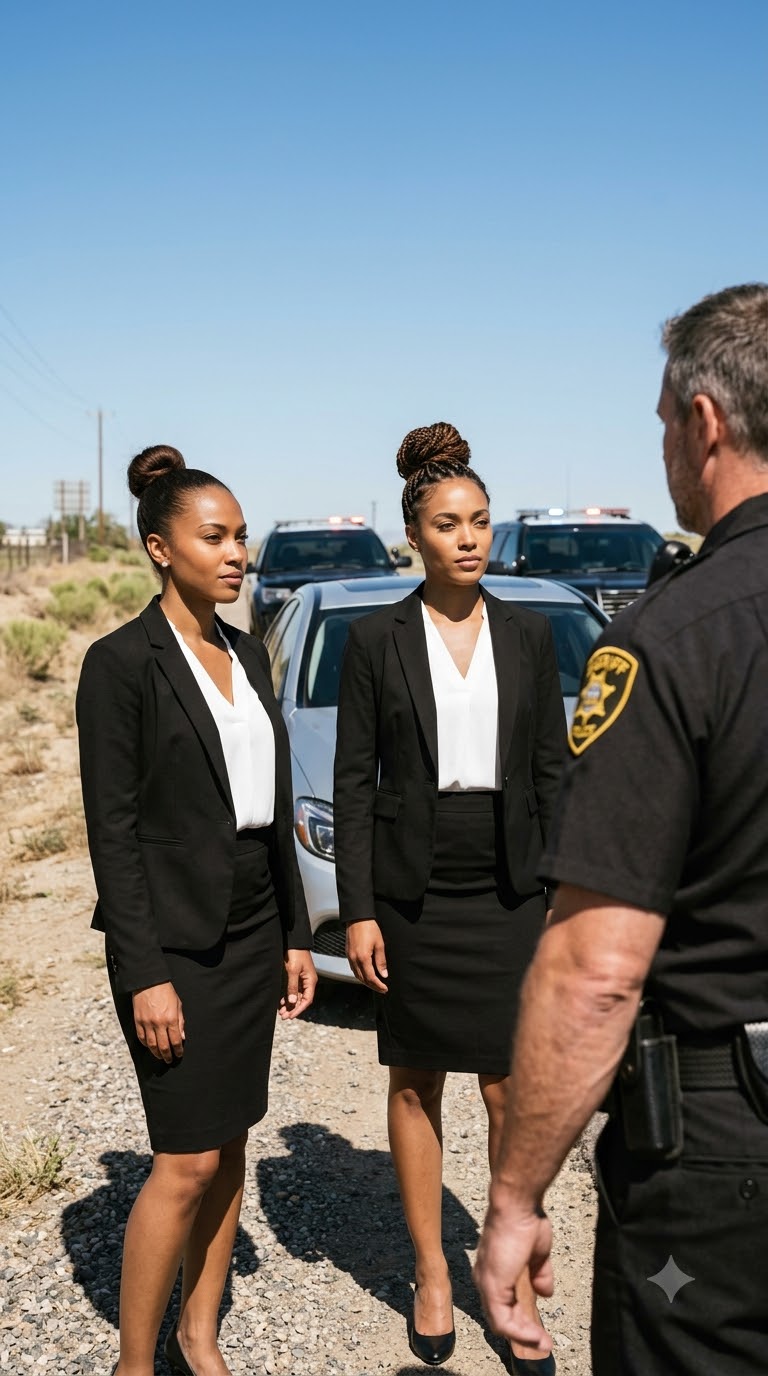
Three weeks later both officers were formally separated from the department. Calhoun’s separation agreement included a provision barring him from future law-enforcement employment in the state. Sharp’s agreement contained the same provision. Neither officer contested the terms in a public hearing. The civil claims were settled six months after filing; the settlement figures were not disclosed, but the sheriff’s office issued a public statement acknowledging that the stop and subsequent actions had lacked legal justification and that the department had implemented additional supervisory review requirements for captain-initiated traffic stops.
Nadia returned to Washington on the evening of the second day. She resumed her duties the following morning. The incident did not appear in any public schedule. Ranata remained in Jacksonville for an additional week, attending to the restoration of the Rolls-Royce and to the filing of the civil paperwork. On the morning she departed she visited the cemetery once more. She placed a second white rose beside the first, which had begun to wilt. She did not speak. She stood for twelve minutes, then returned to the rental car that had replaced the Rolls-Royce for the remainder of her stay.
The father’s marker remained unchanged. The inscription continued to read exactly as it had on the morning the stop occurred. Beloved father. Patient man. Exact in all things. The distinction he had insisted upon—between the creation of character and its revelation under the application of power—had been entered, with timestamps and synchronized audio, into multiple official records. Those records would be retained according to the retention schedules of the agencies that held them. No further public statement was issued by either sister. The Rolls-Royce, once restored, was returned to its storage facility in Jacksonville. It was driven twice more in the following year, both times without incident.
