

PART 1: CRY BEAUTIFULLY
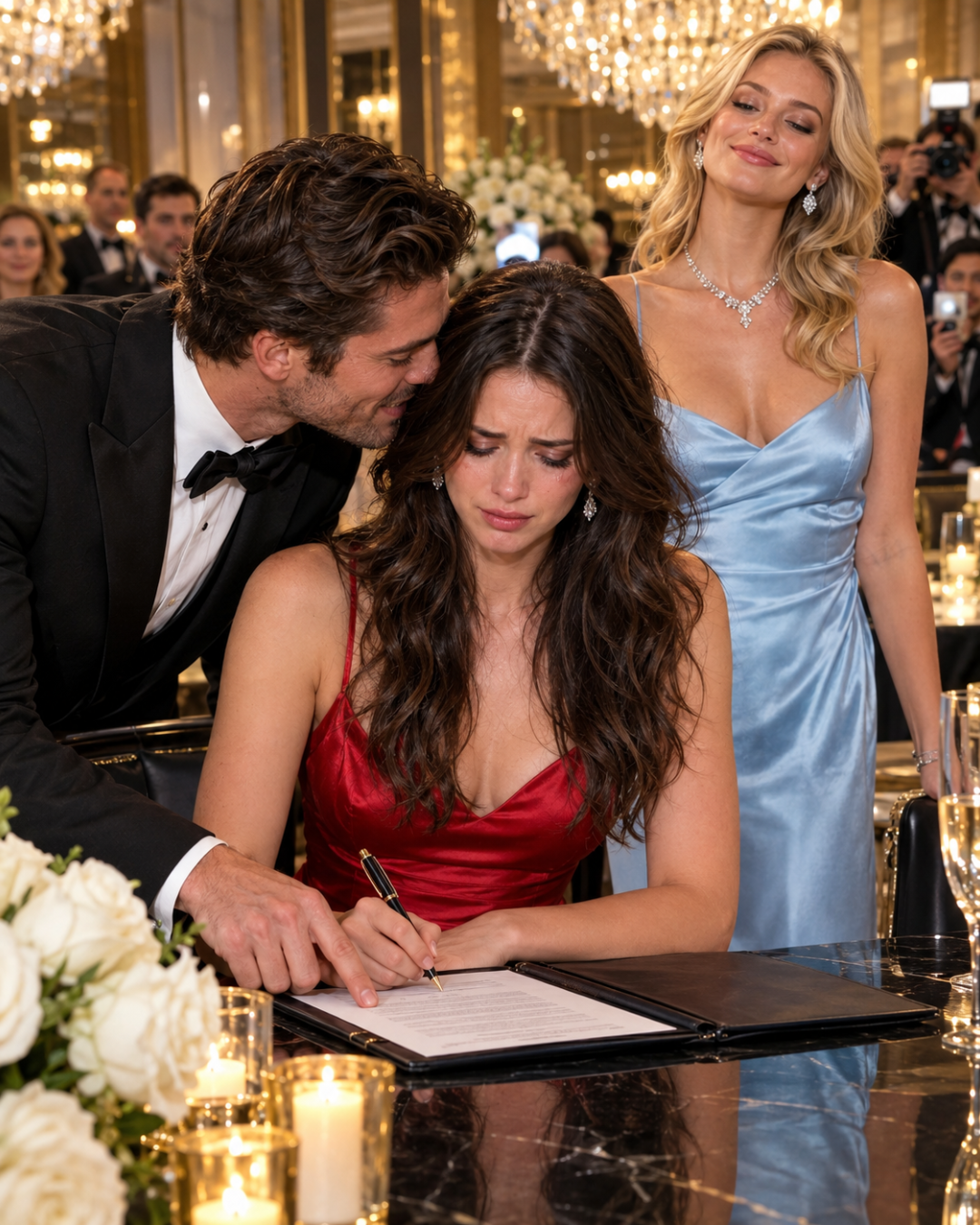
My husband wanted me to cry in front of three hundred guests, beneath glittering chandeliers, surrounded by white roses and cameras waiting to capture every tear.
Callum Ashford would never openly humiliate his wife in front of Manhattan’s most influential families. That wasn’t his style.
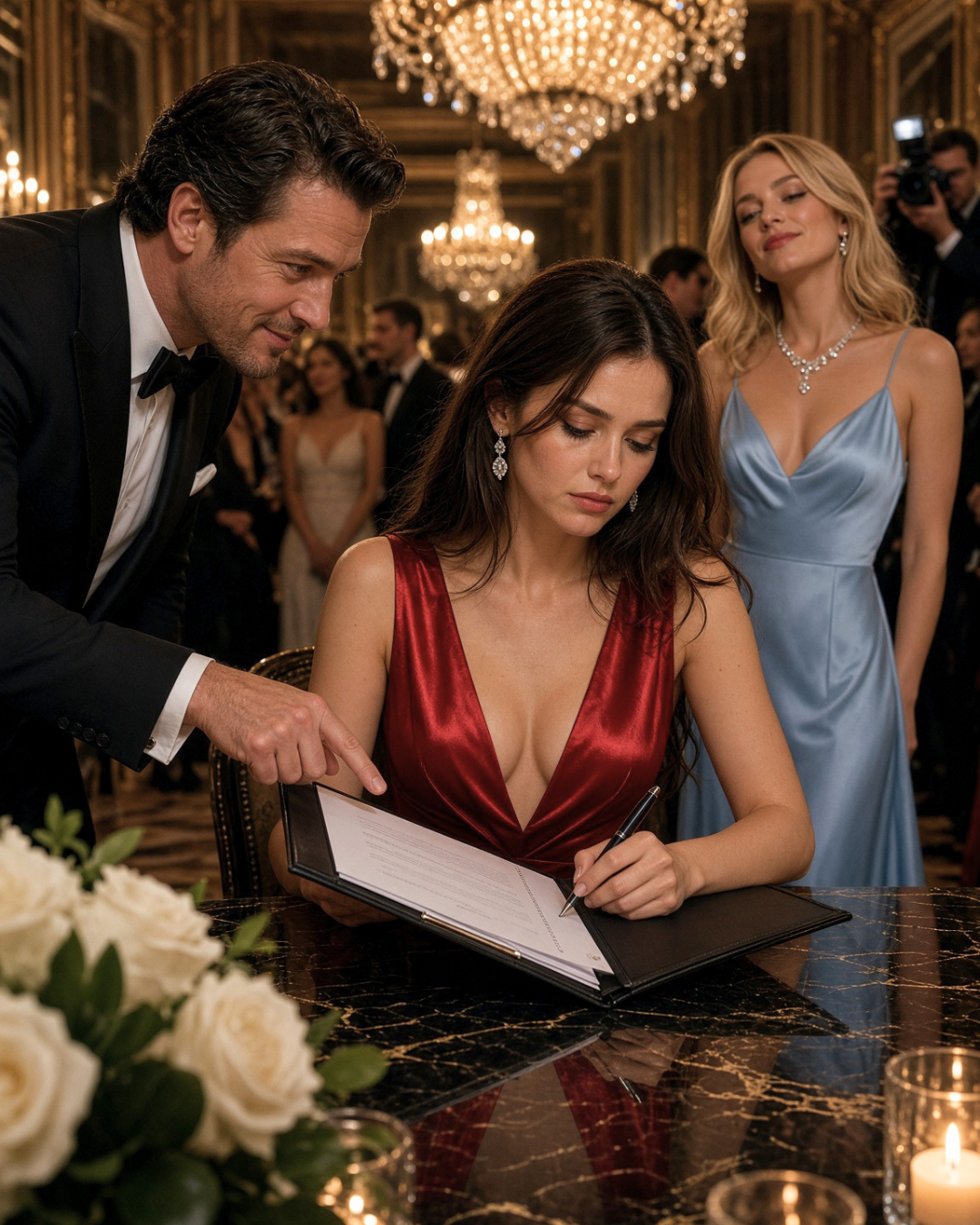
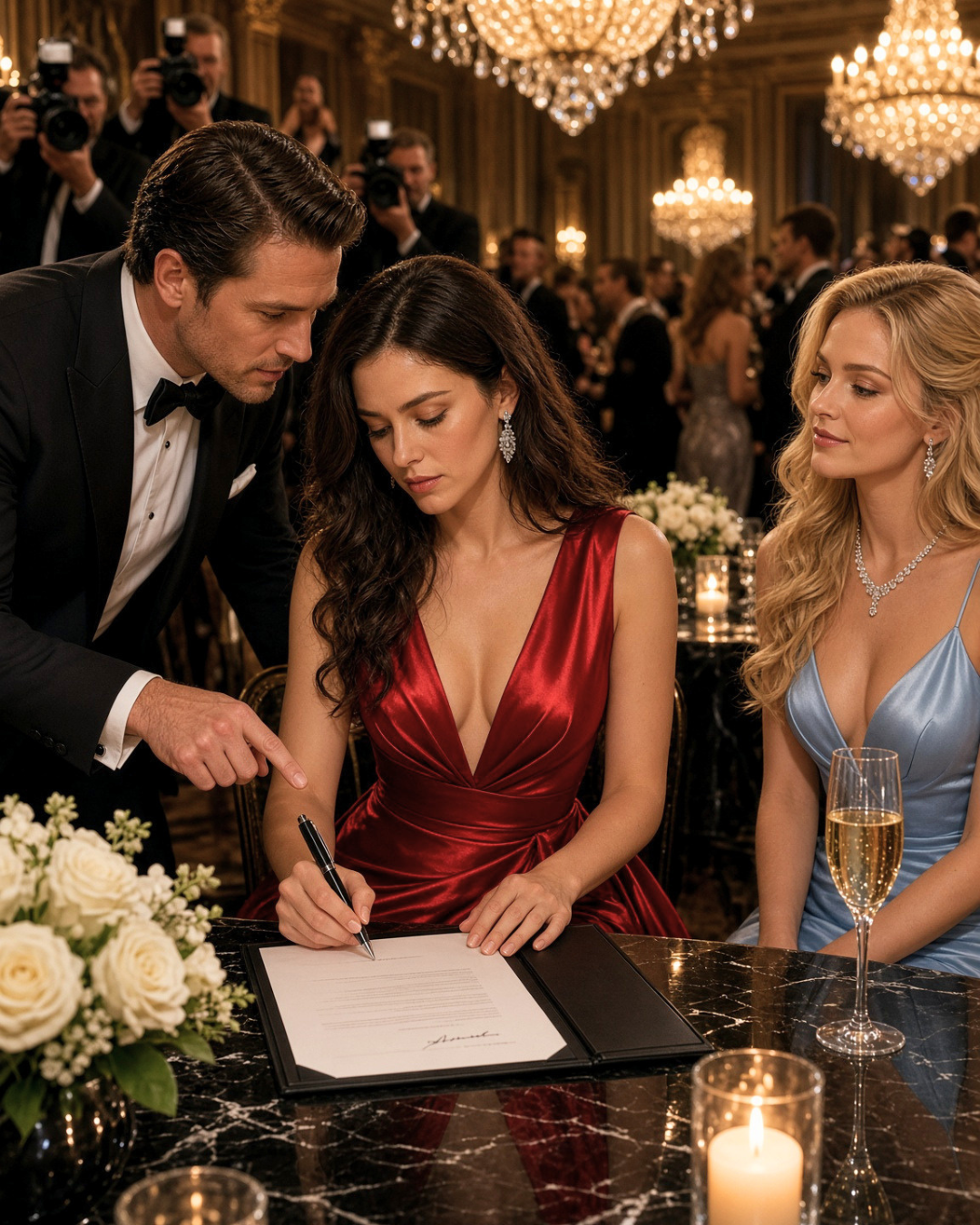
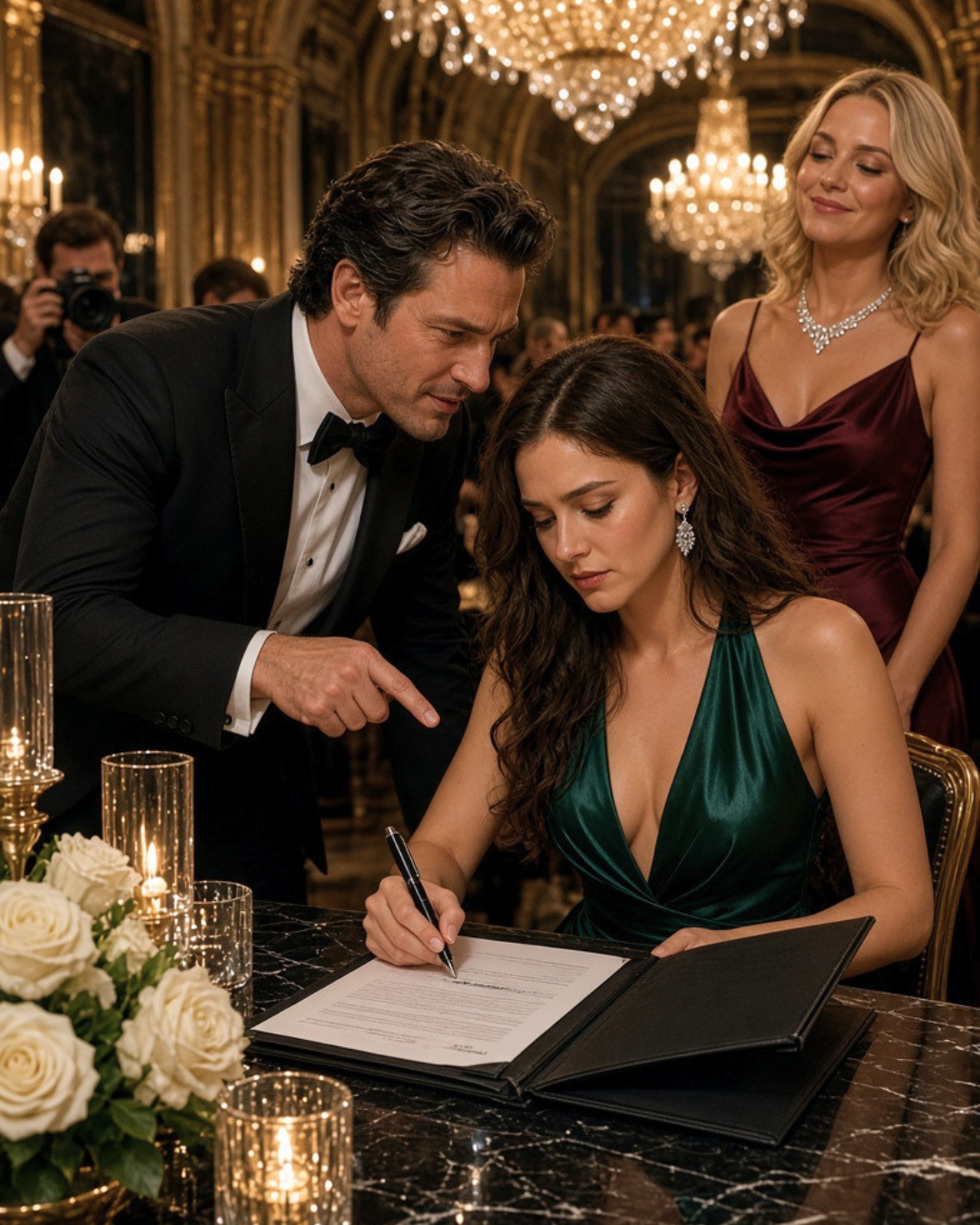
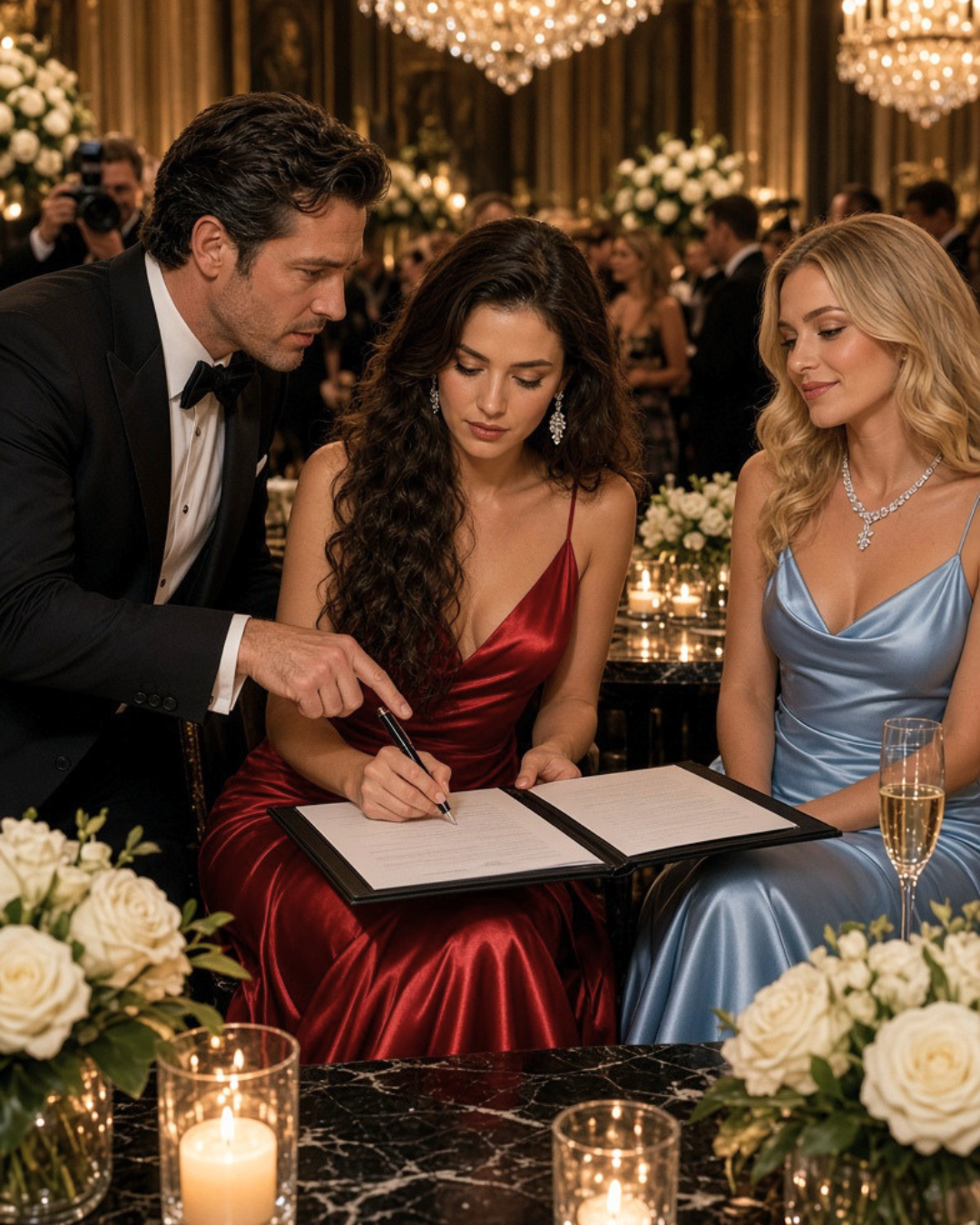
Instead, he leaned close enough to appear affectionate in photographs, his hand resting beside the divorce papers that Nathaniel Pierce had placed near my untouched dinner.
“Give them one last performance, Sloane,” Callum said under his breath, his pleasant expression perfectly intact.
“Cry beautifully.”
Across the table, Vivian Cross smiled into her champagne.
Her emerald silk gown made the diamond necklace around her throat even more conspicuous.
One hundred and eighty-six thousand dollars.
I knew the exact price.
Invoice AL-7721.
Ashford Luxe had classified the purchase as an executive client relations expense.
Not Callum’s money.
Not Vivian’s.
The company’s.
I had a copy of the invoice, along with other financial records, secured in a locked file upstairs.
Vivian touched the diamonds and met my eyes.
She knew I had discovered something.
She simply believed it was too late for me to do anything about it.
Around us, the Ashford Crown Hotel ballroom hummed with carefully disguised excitement.
Guests pretended to admire the flowers and sip champagne, but their attention kept returning to our table.
They were waiting for my marriage to collapse.
Callum stood and raised his glass.
“I know tonight was supposed to be a celebration of Ashford Luxe’s thirtieth anniversary.”
His voice carried the perfect mixture of warmth and regret.
“But sometimes honesty requires us to acknowledge painful changes.”
I kept my hands folded in my lap.
He turned toward me with the expression of a husband devastated by circumstances beyond his control.
Only hours earlier, I had overheard him discussing with a publicist which camera angle would make my distress appear most convincing.
“Sloane and I have been going through a difficult period,” he went on. “Out of respect for her privacy, I’ve tried to keep certain struggles within our family.”
The vague accusation worked exactly as intended.
Whispers spread across the ballroom.
For six months, anonymous sources and concerned friends had been describing me as jealous, emotionally unstable, and unable to cope with the pressures of Ashford society.
Their language sounded remarkably similar to the things Margaret Ashford said during Sunday lunches.
Callum lowered his gaze.
“I have tried to be patient.”
I almost laughed.
Across from him, Vivian looked down with a carefully restrained expression of sorrow.
She had learned the Ashford family’s favorite technique: make cruelty appear compassionate.
Callum continued.
“But there comes a point when two people must accept that love alone cannot repair what has been broken.”
Once, hearing him speak about love would have made my heart race.
That had been before the affairs, the suspicious expenses, and the medication Margaret suggested because she considered me “too emotional.”
Callum had repeated the story of my supposed fragility so often that strangers now believed it.
Nathaniel Pierce approached my chair carrying a black leather folder.
He had served the Ashford family for nearly twenty years.
“The papers are straightforward,” Nathaniel said softly.
He placed the folder before me.
“The apartment on East Seventy-Second remains yours,” he added. “There is also the agreed settlement.”
Agreed.
An interesting word, considering nobody had asked whether I agreed to anything.
Callum leaned closer.
“One final scene,” he said beneath his breath. “Then you can keep the apartment.”
He smelled faintly of champagne.
“Be grateful.”
Forty-seven pages lay before me, marked with yellow signature tabs.
My husband had turned our marriage into a public spectacle and expected me to reward him with tears.
I could already imagine the headlines.
A troubled wife breaking down.
A billionaire heir finally escaping an unhappy marriage.
A patient husband forced to make a difficult decision.
For three years, the Ashfords had described me as quiet, sweet, simple, and fragile.
Margaret selected my clothes because I supposedly “didn’t understand presentation.”
Callum answered interview questions for me.
His public relations team rewrote my charity speeches until nothing sounded like my own voice.
Whenever I objected, he kissed my forehead.
“You hate this stuff anyway.”
They treated my exclusion from important conversations as evidence that I wasn’t capable of participating.
What they failed to understand was that being overlooked had given me an advantage.
I heard conversations people assumed I couldn’t understand.
I noticed hotel expenses during Callum’s supposed business trips to London.
I photographed invoices.
Saved messages.
Compared travel dates.
And I read every page of the prenuptial agreement we had signed three days before our wedding.
Especially Section 14.
I accepted Nathaniel’s pen.
Then I signed.
Callum smiled.
The guests watched.
At the third signature, Nathaniel’s expression changed.
He seemed surprised that I wasn’t begging, arguing, or crying.
I completed the remaining signatures without hesitation.
Then I removed my wedding ring.
A pale line remained on my finger.
I placed the ring on the folder.
The small sound it made against the leather seemed unusually loud.
Callum’s smile weakened.
I looked at Nathaniel.
“Mr. Pierce?”
“Yes?”
“Before everyone continues enjoying the show, please confirm the morality clause.”
Nathaniel went completely still.
Callum laughed too quickly.
“Sloane, don’t be ridiculous.”
I didn’t look at him.
“I’m not asking you.”
I kept my attention on Nathaniel.
“I’m asking your attorney.”
Margaret rose abruptly.
“This is inappropriate.”
I turned toward my mother-in-law.
For three years, she had controlled how I dressed, spoke, smiled, and behaved.
Now genuine alarm had replaced her usual condescension.
Before she could continue, a voice sounded behind her.
“No.”
Everyone turned.
Julian Maddox entered the ballroom with two attorneys.
He wore a charcoal suit and carried no documents.
“This,” Julian announced, “is discovery.”
Callum stared at him.
“Who the hell invited you?”
“I did.”
My answer made him turn toward me.
But the real shock came moments later.
An older man entered, silver-haired and dressed in black.
He walked slowly, tapping a polished cane against the marble floor three times.
Guests near the press tables gasped.
“Everett Whitmore.”
“No way.”
“I thought he was dying.”
“He hasn’t been photographed in years.”
Seven years.
That was how long my grandfather had remained largely outside public view.
Everett Whitmore had built a regional property business into Whitmore Holdings, an international enterprise with interests in hotels, logistics, commercial real estate, and investments.
After my mother’s death, he had withdrawn from society.
The newspapers believed he was spending his final years in seclusion.
They didn’t know how involved he remained in my life.
Grandfather stopped beside me.
I had promised myself that Callum, Margaret, Vivian, and the cameras would see no tears.
But when Everett rested his hand on my shoulder, relief nearly broke my composure.
“My granddaughter asked a question,” Everett declared.
“I believe Mr. Pierce should answer.”
Callum stared at us.
“Granddaughter?”
Vivian’s fingers slipped from her necklace.
Margaret whispered, “No.”
I looked at her.
For the first time since our wedding, she seemed genuinely afraid of me.
Nathaniel opened the agreement.
“Section Fourteen,” he began.
Callum interrupted.
“Nathaniel.”
But the attorney continued.
“Material marital misconduct involving adultery, deliberate reputational harm, or unauthorized diversion of marital or corporate assets may trigger forfeiture of specified settlement protections and activate associated ownership provisions.”
Whispers spread through the ballroom.
Callum gripped the back of his chair.
“What ownership provisions?”
He had forgotten.
Three days before our wedding, he’d barely glanced at the agreement.
He’d been more interested in leaving for his bachelor weekend.
He had dismissed the document as something intended to make “the Whitmore people” comfortable.
He never considered that its provisions might someday apply to him.
I stood.
“Sit down, Sloane,” Margaret commanded.
I smiled.
“No.”
Julian approached.
“The clause alone is not your biggest problem.”
Callum turned sharply.
“What does that mean?”
Julian looked at me, allowing me to answer.
“It means adultery was only the easiest thing to prove.”
Vivian’s expression changed.
Callum looked between us.
“What have you done?”
I thought about the invoices, corporate credit cards, wire transfers, hotel bills, private flights, and the Central Park penthouse.
I remembered Callum telling Vivian that “Sloane doesn’t understand the business.”
I met his eyes.
“No, Callum.”
My voice was almost gentle.
“What have you?”
A camera clicked.
And for the first time that evening, Callum looked as though he understood that the performance was no longer his to control.
Eleven months after our wedding, he had first mocked my understanding of business.
We were returning from an Ashford Luxe board dinner when I asked why a hospitality subsidiary was leasing three residential properties that weren’t being used for guests.
Callum laughed and kissed my temple.
“You’re adorable when you try to understand this stuff.”
I looked at him.
“What stuff?”
“Corporate structuring.”
“I studied economics.”
“At Wellesley.”
“What does that mean?”
“It means you read about businesses. I run one.”
He squeezed my hand.
“Don’t make that face.”
“What face?”
“The one where you think I’m insulting you.”
“You are insulting me.”
“No.” He pressed a kiss to my knuckles. “I’m saving you from being bored.”
At the time, I tried to believe he meant well.
The following morning, I quietly researched the leases.
One property was legitimate executive housing.
Another had been vacant for fourteen months.
The third was a penthouse overlooking Central Park.
I eventually discovered that Vivian lived there.
By our second anniversary, our marriage had become an elaborate public performance.
Callum charmed strangers while barely acknowledging me at home.
Margaret’s assistant organized my appointments, clothing, charity lunches, exhibitions, and approved interview subjects.
The family knew Everett Whitmore was my grandfather.
They knew his only daughter, my mother, had died.
What they didn’t understand was how extensively he had structured his holdings for my benefit.
Before my wedding, Grandfather had told me:
“You need to know whether a man loves Sloane,” he advised before the wedding, “before he learns what Sloane owns.”
At twenty-six, I thought his warning was cynical.
By thirty, I understood.
Callum knew I had an inheritance.
He simply believed it was a modest trust that offered social prestige without meaningful influence.
Margaret believed much the same.
I initially allowed the misunderstanding to continue because Grandfather had advised discretion.
Later, I wanted to see what the Ashfords would do when they believed I had no power.
Nine months before the gala, Callum returned home at 2:13 in the morning.
I was waiting in the kitchen.
He smelled of cedar, champagne, and another woman’s perfume.
“Why are you awake?”
“I couldn’t sleep.”
“Again?”
That one word was another addition to the story he was constructing about my supposed instability.
“Where were you?”
“Client dinner.”
“Until two?”
He sighed.
“Sloane.”
“What?”
“Please don’t do this tonight.”
“Do what?”
“Interrogate me.”
I noticed muted rose lipstick inside his collar.
“Who was the client?”
He hesitated.
“Japanese group.”
“Which one?”
“Sloane.”
“Which one?”
He studied me with a mournful expression.
“You really need to speak to someone.”
Two weeks later, a gossip website published photographs of me leaving a therapist’s office.
I had visited once, at Margaret’s urging.
The article described me as “emotionally strained.”
Callum comforted me while I cried.
“I’ll handle it,” he promised.
I later discovered that his communications director had confirmed the photographs to the publication.
The affair was painful.
But his effort to make other people distrust my words was deliberate.
I stopped confronting him.
Instead, I began collecting evidence.
Copies of important records were stored outside our apartment.
I avoided keeping them in my personal email.
Only Julian knew.
When I first showed him the documents, he spent twenty minutes reading without speaking.
Then he asked:
“What do you want?”
“I want to know if I’m imagining this.”
“You’re not.”
“Then I want the truth.”
“Those are different objectives.”
“What does that mean?”
“It means proving an affair proves an affair. Proving misuse of corporate assets proves something much larger.”
I looked at Vivian’s necklace invoice.
“Could he lose the company?”
Julian considered the question.
“That depends on what he has done.”
“And the prenup?”
He looked up.
“You remember Section Fourteen?”
“Every word.”
“Does Callum?”
I remembered him checking his flight details while signing the agreement.
“No.”
“Then don’t remind him.”
I waited.
And Callum became careless.
Vivian moved from consultant to “brand strategist.”
She began appearing at family dinners.
Margaret openly admired her.
“Vivian understands the pressures Callum faces,” she said one evening while a stylist adjusted my dress.
“I’m sure she does.”
Margaret smiled.
“Jealousy is unattractive, Sloane.”
I lowered my eyes.
She mistook my silence for embarrassment.
Three months before the gala, I confirmed Vivian’s penthouse lease.
Two months before, I matched her travel dates to Callum’s private flights.
Six weeks before, Julian’s forensic team began tracing suspicious corporate hospitality payments.
Four weeks before the event, Callum finally asked for a divorce.
“I think this is healthier for both of us.”
“For both of us?”
“You’re miserable.”
“So are you?”
He hesitated.
“I’ve been unhappy for a long time.”
“Is there someone else?”
“No.”
He lied without blinking.
“What happens now?” I asked.
His shoulders relaxed.
“We’ll keep it private,” he explained. “Nathaniel will arrange something generous.”
“How generous?”
“The apartment.”
The apartment had belonged to me before our marriage.
“And in return?”
“No public accusations. No embarrassing interviews. No attempts to damage the company.”
“The company?”
“You know how emotional divorces get.”
He knelt in front of me and placed a hand on my knee.
“I don’t want us to become enemies.”
“Neither do I.”
He kissed my forehead.
“Good girl.”
That night, I called Julian.
“They’re moving.”
“I know.”
“How?”
“Ashford counsel requested documents related to the prenup.”
“When?”
“This afternoon.”
“Do they know?”
“Not yet.”
“What do we do?”
Julian paused.
“We let them choose the stage.”
The Ashfords chose their thirtieth-anniversary gala.
They planned the cameras, guests, and humiliation.
What they hadn’t planned was Everett Whitmore walking through the doors.
Back in the ballroom, Callum was still staring at my grandfather.
“You knew?” he demanded.
“You knew this whole time?”
“My grandfather being alive was never a secret.”
“You told me he was ill.”
“He is.”
Everett raised an eyebrow.
“Ill, Mr. Ashford. Not incompetent.”
A few guests laughed.
Margaret approached.
“Everett, surely this can be discussed privately.”
He turned toward her.
“Your son served my granddaughter divorce papers in front of three hundred people.”
“This was intended to prevent gossip.”
Everett glanced toward the cameras.
“Yes. Very discreet.”
Julian placed a notice on the table.
Callum looked down.
“What is that?”
“A notice,” Julian replied.
“Of what?”
Julian looked at me.
I pushed the document toward my husband.
“Of an emergency review of Ashford Luxe expenditures tied to assets in which Whitmore-controlled entities hold financial interests.”
Callum looked alarmed.
“How much?”
Margaret immediately intervened.
“Callum.”
He turned.
“Mother?”
Her gaze shifted toward Everett.
“Not here.”
Callum stared at her.
“How much?”
Everett answered.
“Enough.”
Nathaniel’s phone vibrated.
He checked the message.
His face turned pale.
Callum snapped, “What?”
Nathaniel looked up.
“The board has called an emergency session for tomorrow morning.”
The ballroom filled with whispers.
Across the table, Vivian slowly removed her diamond necklace.
And Callum finally realized that his mother had been hiding something about the company he believed belonged entirely to his family.
PART 2: THE PRICE OF SILENCE
By nine the next morning, television stations were replaying the moment I removed my wedding ring.
At 9:15, they were showing Everett Whitmore standing behind me.
By ten, Ashford Luxe shares were falling.
I sat in Julian’s office wearing the same black dress from the previous evening.
I hadn’t slept.
Callum had sent twenty-three messages.
The first were furious.
What the hell are you doing?
Call me.
You have no idea what you’ve started.
Then came legal threats, accusations of extortion, and claims that Nathaniel believed we were overreaching.
Around four in the morning, Callum changed tactics.
He begged for a private conversation.
He blamed Grandfather.
He insisted he never wanted things to become ugly.
At 5:07, he sent one final message.
I loved you.
I stared at it for a long time.
Then I placed the phone facedown.
Everett sat near the window, looking exhausted.
He noticed me watching him.
“You should sleep.”
“So should you.”
“At my age, sleep is a negotiation.”
I managed a faint smile.
Then I asked the question that had been haunting me.
“Did I make a mistake?”
“No.”
“You answered very quickly.”
“Because I’ve had several months to consider it.”
“I mean marrying him.”
Everett studied me.
“No.”
I stared at him.
“You don’t think marrying a man who cheated on me and tried to destroy my reputation was a mistake?”
“I think loving someone who deceives you is painful. I think staying once you know the truth can become a mistake.”
He rested a finger against his cane.
“But you didn’t stay because you were afraid to leave.”
“No.”
“You stayed because you needed to understand what had been done.”
I looked away.
“Maybe that’s what I tell myself.”
“Sloane.”
I met his eyes.
“You do not have to turn every wound into evidence.”
Those words nearly broke me.
For months, I had been saving messages, collecting receipts, documenting lies, and organizing records.
Somewhere along the way, I had begun believing that even my pain needed proof.
Before I could answer, Julian entered.
“The board is ready.”
Ashford Luxe occupied twelve floors of a Madison Avenue tower.
Reporters crowded outside when we arrived.
“Sloane, did you know about the affair?”
“Are you seeking control of Ashford Luxe?”
“Mr. Whitmore, are you attempting a takeover?”
“Did Callum Ashford misuse company funds?”
“Is Vivian Cross still employed?”
I walked past without answering.
Inside the elevator, my hands began shaking.
Julian noticed.
“You don’t have to speak unless you choose to.”
“I know.”
The elevator climbed.
I remembered years of being treated as an ornamental Mrs. Ashford.
Executives explained elementary concepts to me.
They praised Callum for repeating ideas I had suggested.
They assumed my silence meant ignorance.
Today, nobody smiled.
Callum was already seated in the boardroom.
He looked exhausted.
Margaret sat nearby.
Nathaniel had organized several stacks of documents.
Vivian was absent.
Callum noticed me.
“Can everyone give us a minute?”
“No,” I answered.
His jaw tightened.
“Sloane.”
“You wanted witnesses last night.”
“This isn’t a game.”
“No.”
I took the chair across from him.
“It isn’t.”
Independent directors and Whitmore-linked financiers entered.
Julian began with the financial records.
A Central Park penthouse.
Jewelry.
Private aircraft.
Hotel stays.
Consulting expenses.
Reimbursements.
Some expenses were legitimate.
Others lacked credible business purposes.
The amounts alone wouldn’t bankrupt Ashford Luxe.
The problem was how they had been approved, classified, and concealed.
Callum interrupted repeatedly.
“The flights were business development.”
“Vivian was a consultant.”
“The residence was used for executive purposes.”
“Client gifts are normal in luxury hospitality.”
Julian slid invoice AL-7721 across the table.
“Who was the client?”
Nobody answered.
Callum looked at me.
Nathaniel cleared his throat.
“We should be careful not to conflate marital allegations with corporate governance.”
“I agree,” I replied.
Everyone turned.
“That’s why I brought records showing the expenditures were coded as corporate rather than personal.”
I opened my folder.
I explained how Callum’s supposed investor trip to Miami had continued to St. Barts without any investors aboard.
Vivian’s firm had invoiced Ashford Luxe for “strategic market assessment” during the same weekend.
The penthouse showed no recorded executive occupant other than Vivian.
And her necklace had been charged to a discretionary hospitality budget.
Callum glared at me.
“You went through my accounts?”
“No.”
“How else would you have this?”
“Corporate records aren’t your accounts.”
“You had no authority.”
An independent director intervened.
“Actually, given the Whitmore financing agreements, her representatives had inspection rights under specified conditions.”
Callum turned toward Margaret.
“What financing agreements?”
She closed her eyes.
Everett answered.
“When your father expanded Ashford Luxe fourteen years ago, the company required capital.”
“My father raised that privately.”
“Yes.”
Everett folded his hands over his cane.
“From me.”
Callum went still.
“No.”
“Through several investment vehicles.”
“No.”
“Your mother knows.”
He turned toward Margaret.
“Mother?”
Her expression changed.
“Your father did what he had to do.”
“How much?”
“Callum—”
“How much?”
Everett replied.
“Enough that certain misconduct triggers rights your father hoped would never matter.”
Callum finally understood.
Section 14, the financing agreements, and the ownership provisions were separate legal instruments.
But together they protected Whitmore-controlled financial interests in Ashford Luxe.
Callum had assumed the company belonged entirely to his family.
He had never considered who financed its expansion.
Or what contractual rights those investors possessed.
“You set me up.”
I stared at him.
“No.”
“You married me knowing this.”
“I married you believing none of it would ever matter.”
“Bullshit.”
His fist struck the table.
“Sloane, you waited. You collected documents. You let me—”
“Let you what?”
My voice rose.
The room fell silent.
“Let you cheat on me?”
Callum froze.
“Let you buy her jewelry?”
I fought to steady my breathing.
“Let you tell reporters I was unstable?”
He looked away.
That reaction hurt more than I expected.
“You knew about that?” I demanded.
He didn’t answer.
“Look at me.”
“Sloane.”
“Did you know your communications team was feeding stories about my mental health to the press?”
His expression tightened.
“It wasn’t like that.”
The familiar excuse.
The same one he used whenever the truth threatened his image.
“How was it?”
He softened his voice.
“You were spiraling.”
“Because my husband was cheating on me.”
“We were having problems before Vivian.”
The name escaped before he realized what he’d admitted.
Nathaniel closed his eyes.
I stared at Callum.
“Thank you.”
“For what?”
“For finally saying her name.”
The board chair called a recess.
I left the room.
Callum followed.
“Sloane.”
I continued toward the elevators.
He grabbed my arm.
Julian moved forward, but I stopped him with a gesture.
“No.”
Then I looked at Callum’s hand.
“Take your hand off me.”
He released me.
“You’re destroying everything my family built.”
“I’m showing the board what you did with it.”
“You think Whitmore is clean? You think your grandfather built an empire by being nice?”
“This isn’t about nice.”
“You want revenge.”
I considered his accusation.
There had been moments when I imagined Callum begging for forgiveness.
I had pictured Margaret losing her social standing.
I had wondered how Vivian would react when the truth became public.
But standing before him, I felt no triumph.
Only exhaustion.
“I wanted you to stop lying about me.”
His expression softened briefly.
“Sloane—”
“You could have left me.”
“I know.”
“You could have told me you loved someone else.”
“I didn’t love her.”
That answer wounded me more deeply than I expected.
“Then why?”
He glanced toward the boardroom.
“I don’t know.”
I nodded.
“At least that’s finally honest.”
Then his phone rang.
He looked at the screen.
“Vivian?”
He answered.
“What did you do?”
He listened.
“What do you mean you resigned?”
Julian and I exchanged a glance.
Callum raised his voice.
“You cannot release anything. Vivian, listen to me.”
Another pause.
“What agreement?”
The call ended.
Margaret appeared.
“What happened?”
Callum looked at her.
“Vivian hired a lawyer.”
Nathaniel stepped into the hallway.
“What kind of lawyer?”
Callum looked toward me.
“She says she’s not taking the fall for me.”
Vivian had not suddenly become my friend.
She had knowingly participated in an affair with a married man.
She had accepted expensive gifts and enjoyed the humiliation of his wife.
But she wasn’t willing to sacrifice her own future to protect Callum.
Her attorney contacted Julian that afternoon.
Vivian would cooperate with the independent investigation.
She would provide records of expenses Callum had approved.
And she would make only claims she could support with evidence.
Three days later, we met with lawyers present.
Vivian arrived wearing a cream blouse and dark trousers.
There were no diamonds.
No emerald silk.
No triumphant smile.
She sat across from me.
“I assume you hate me.”
“I don’t know you well enough to hate you.”
She flinched.
“I didn’t know about the press stories.”
“Which ones?”
“The stories about your mental health.”
I studied her.
“Did you know he was married?”
“Yes.”
“Did you know I didn’t know about you?”
She hesitated.
“Yes.”
I nodded.
“Then don’t ask me to separate your part from his.”
“I’m not.”
“Good.”
She lowered her eyes.
“He told me the marriage was over.”
“They always say that.”
“He said you refused to accept it.”
“Did I look surprised at the gala?”
She couldn’t answer.
“He told me you were dependent on him. That your grandfather had left you some trust money but you couldn’t manage anything yourself.”
I recognized the portrait Callum had painted.
A woman wealthy enough to exploit.
But supposedly too helpless to defend herself.
“I believed him,” Vivian said.
“Because believing him gave you what you wanted.”
Her jaw tightened.
“Yes.”
She pushed several printed conversations toward me.
“What are these?”
“Approvals.”
“For the expenses?”
“Yes.”
“Why keep them?”
Vivian met my eyes.
“Because I’m not stupid either.”
For the first time, I almost laughed.
Callum believed he’d chosen two women he could control.
Both of us had saved evidence.
The messages confirmed that he approved private flights classified as business development.
Vivian’s penthouse was charged as executive housing.
The necklace was disguised as a gift for a nonexistent hospitality partner.
But one conversation hurt more than the financial records.
Vivian had written:
Sloane looked upset tonight. Does she know?
Callum answered:
She suspects. Doesn’t matter. Everyone already thinks she’s unstable. If she makes noise, it proves the point.
I read the message twice.
Then a third time.
It explained everything.
If I cried, he could call me unstable.
If I confronted him, he could call me paranoid.
If I remained silent, he could continue.
He had designed a situation in which every possible response supported the story he wanted people to believe.
Julian started speaking.
I raised my hand.
I needed a moment.
Vivian watched me.
“I didn’t respond.”
“You didn’t object either.”
“No.”
“Why?”
She looked directly at me.
“Because at the time, I wanted him to choose me.”
Her honesty didn’t earn forgiveness.
But it ended the pretense.
The investigation continued for twelve days.
The newspapers called it the Ashford Crisis.
The name sounded glamorous.
The reality was sleepless nights, legal meetings, and strangers discussing my marriage as though it were entertainment.
I stayed at Everett’s townhouse.
On the seventh night, I found him making tea.
“You’re doing it wrong,” I told him.
He looked offended.
“I have made tea longer than you’ve been alive.”
“You’re boiling it to death.”
“It is water.”
“That’s not a defense.”
He handed me the kettle.
For a few minutes, we were simply grandfather and granddaughter.
Then he spoke.
“He asked to see you.”
I stopped moving.
“Callum?”
“Yes.”
“What did you say?”
“That it was not my decision.”
I leaned against the counter.
“Do you think I should?”
“No.”
I looked at him.
He smiled.
“You asked what I think. Not what you should do.”
I laughed.
“Fine.”
Then I looked down at my tea.
“I need to see him.”
Callum arrived the following afternoon.
He looked thinner.
The board had suspended him pending its findings.
Margaret had stopped speaking publicly.
Vivian had resigned.
Nathaniel remained involved in company matters but no longer represented Callum personally.
We sat opposite each other in Everett’s library.
Technically, we were still married.
But the papers had been signed, and our attorneys were completing the remaining details.
Callum looked around.
“I remember this room.”
“We had dinner here before you proposed.”
“You wore blue.”
The fact that he remembered hurt.
“Yes.”
He rubbed his hands together.
“I did love you.”
I studied him.
“I think you believe that.”
“You don’t?”
“I think you loved the way I made you feel.”
“That’s unfair.”
“You liked that I wasn’t impressed by your name. Then after we married, you spent three years trying to make me impressed by it.”
He lowered his gaze.
“I screwed up.”
“That phrase is too small.”
“What do you want me to say?”
“The truth.”
“I cheated.”
“More.”
“I lied.”
“More.”
His jaw tightened.
“I used company money.”
“More.”
Silence.
I waited.
Finally, he looked up.
“I made people doubt you.”
My eyes filled.
Callum leaned forward.
“Sloane.”
I laughed bitterly through the tears.
“Is this what you wanted?”
He stopped.
“At the gala.”
I wiped my cheek.
“You wanted me to cry.”
His expression crumpled.
“I was angry.”
“No. You were confident.”
“Sloane—”
“You knew exactly what you were doing.”
He looked away.
“I spent months wondering what I had done to make you hate me.”
“I don’t hate you.”
“That’s what made it worse.”
He looked at me.
“If you’d hated me, maybe I could understand it. But you didn’t. You just decided my dignity was less important than your convenience.”
He stood.
“What happens to Ashford Luxe?”
Even then, he returned to the company.
The name.
The power.
The empire.
“The board decides what happens to the company.”
“And your grandfather?”
“He’ll enforce the rights he has.”
“You could stop him.”
“No.”
“You mean you won’t.”
“I mean I won’t interfere to protect you from consequences you created.”
His face hardened.
“So this is revenge.”
“No.”
I stepped closer.
“Revenge would be destroying Ashford Luxe because it carries your name.”
He looked confused.
“I don’t want it destroyed.”
The answer startled him.
“Thousands of people work there. They didn’t cheat on me. They didn’t lie about me. They didn’t approve Vivian’s necklace.”
I held his gaze.
“I want the company protected from you.”
He went silent.
“You planned all of this,” he whispered.
“No.”
I looked at the man I had once trusted completely.
“I planned to survive you.”
Callum left without another word.
That evening, Julian called.
“The board vote is tomorrow.”
I stood beside the library window.
“What are they recommending?”
“Callum’s removal as CEO.”
I closed my eyes.
“And the financing rights?”
“Whitmore’s position will increase substantially under the existing agreements.”
“What about the morality clause?”
“His divorce protections are materially affected. Your settlement position is significantly stronger.”
I remembered the apartment he’d pretended to give me.
“What does he keep?”
Julian hesitated.
“Sloane.”
“I’m asking.”
“He isn’t destitute. This is not a fairy tale. Rich men do not become poor because they behave badly.”
“I know.”
“But he is losing control.”
After the call, my phone rang again.
Margaret.
I answered.
“The vote is tomorrow,” she said.
“I know.”
“You can stop this.”
“No.”
“You have influence with Everett.”
“So do you, apparently. You knew about his financing.”
She fell silent.
Then she said:
“I was protecting my family.”
I closed my eyes.
“So was I.”
“You are not an Ashford anymore.”
I looked at the pale line where my wedding ring had been.
“No.”
The admission no longer hurt.
Margaret’s voice sharpened.
“If Callum loses the company, what do you think all this was for?”
I thought about the approved clothes, carefully managed interviews, charity events, planted stories, and all the ways I had been expected to disappear.
Then I answered.
“That’s the question you should have asked him before the gala.”
I ended the call.
The following morning, the board would decide whether Callum Ashford could remain in control of the company his family had spent thirty years building.
And for the first time in his life, neither his mother nor his lawyers could guarantee the outcome.
PART 3: THE CLAUSE THAT ENDED HIS EMPIRE
The board dismissed Callum Ashford at 11:42 the following morning.
I wasn’t in the boardroom when the vote took place.
I waited elsewhere in the building.
At 11:46, Julian stepped into the hallway and gave me a quiet nod.
There was no applause.
No dramatic confrontation.
No final speech from Callum.
Only the subdued finality of consequences.
An elevator opened.
A lawyer exhaled.
A news alert appeared on someone’s phone.
And the man who had expected to control the evening of our divorce had lost control of the company he considered his identity.
The board concluded that Ashford Luxe funds had been used for inadequately justified personal expenses.
Required approvals and disclosures had been breached.
Callum’s conduct had exposed the business to governance and reputational risks.
The independent directors removed him as CEO.
Whitmore-linked entities exercised contractual rights that had existed for years.
Ashford Luxe survived.
Its hotels continued operating.
Thousands of employees kept their jobs.
The company retained the Ashford name.
But Callum no longer controlled it.
Our divorce proceeded privately.
Section 14’s consequences for documented adultery and reputational misconduct substantially weakened the settlement protections he expected to receive.
The financial records strengthened my position.
I didn’t ask to take everything.
I kept the property that was already mine.
I refused to accept the fiction that Callum had generously given me my own apartment.
And I insisted on a public correction of the unfounded claims about my mental health.
He resisted that demand more fiercely than some of the financial terms.
Money could be replaced.
Admitting he’d lied about me meant surrendering the story he’d spent months constructing.
Eventually, he signed.
Three weeks later, I returned to my apartment on East Seventy-Second Street.
Most of Callum’s belongings were gone.
Only one box remained.
Inside were photographs.
Our wedding.
A holiday in Italy.
Christmas with Everett.
Callum asleep with his head resting in my lap.
A photograph of me laughing at something outside the frame.
I sat on the bedroom floor and looked through them.
Then I cried.
Not gracefully.
Not beautifully.
Not for cameras.
I cried in an old T-shirt, my face swollen and my nose running, until I couldn’t cry anymore.
Some of those memories had been real.
That was what hurt.
The coffee he’d brought me while I studied.
The evenings we’d spent talking.
The comfort he’d offered after my mother’s memorial.
Perhaps he had loved me once.
Perhaps he still believed he had.
But affection did not excuse deliberate cruelty.
The man who had once made me feel safe had later used his knowledge of my vulnerabilities to discredit me.
Both things could be true.
And I didn’t have to pretend otherwise.
Six months later, Ashford Luxe appointed a permanent CEO from outside the family.
Everett offered me a seat on the board over breakfast.
I refused.
He looked surprised.
“No?”
“No.”
“You spent a year learning that company.”
“I spent a year learning my husband.”
“There is overlap.”
I laughed.
“I’m serious.”
“So am I.”
I poured another cup of coffee.
“I don’t want my next decision to be about Callum.”
Everett considered that.
“Good.”
I eventually became more involved in overseeing the Whitmore interests held for my benefit.
Not because I wanted an empire.
But because I finally understood the danger of allowing other people to define my authority.
I read agreements.
Asked questions.
Examined financial records.
And refused to apologize when someone gave me an explanation that didn’t make sense.
Vivian disappeared from the society columns for a while.
Later, I heard she had resumed consulting work elsewhere.
We never became friends.
There was no reason we should.
But I saw her once more outside Julian’s office.
She stopped when she noticed me.
“I am sorry.”
I studied her.
I believed she meant it.
“I know.”
Her apology couldn’t undo the affair or the humiliation.
But it was an acknowledgment of what she had done.
And that was enough for the conversation to end.
Nathaniel Pierce approached me at another event months later.
He still handled certain company matters, although he no longer represented Callum personally.
“Ms. Whitmore.”
I smiled.
“You can call me Sloane.”
He looked uncomfortable.
“I owe you an apology.”
“For which part?”
He laughed unexpectedly.
“Fair.”
Then he glanced toward the ballroom.
“I should have stopped what happened that night.”
“Could you?”
He thought carefully.
“I could have refused to participate.”
I nodded.
“Then yes. You should have.”
He accepted the answer.
Before leaving, he hesitated.
“May I ask you something?”
“What?”
“When you asked me to confirm Section Fourteen… how certain were you that it would hold?”
I smiled.
“Certain enough.”
“That’s not an answer.”
“It is the only one you’re getting.”
He laughed and walked away.
The truth was that I had never been completely certain.
Contracts could be challenged.
Boards could protect powerful executives.
Public opinion could turn.
Even the strongest evidence could be disputed.
Section 14 wasn’t magic.
Neither were Everett’s investments.
Neither was the financial documentation Julian helped me collect.
They were tools.
Their value depended on my willingness to use them.
For years, I believed strength meant never showing weakness.
I thought being composed meant never crying.
But the months after the gala taught me something different.
Strength had been reading the invoices even when I was afraid of what they would reveal.
It had been questioning Callum’s explanations when he treated my questions as foolish.
It had been refusing to accept Margaret’s definition of who I was allowed to become.
It had been sitting across from Vivian and listening to truths I didn’t want to hear.
It had been protecting the employees of Ashford Luxe rather than seeking revenge against everyone connected to my husband.
And it had been allowing myself to grieve once the fight was over.
Near midnight at a later gathering, I stepped onto a terrace overlooking Manhattan.
The skyline shimmered beneath me.
Everett joined me.
“Cold?”
“A little.”
He started removing his coat.
“I don’t need it.”
“I wasn’t offering it. This is Italian.”
I laughed.
He smiled.
We stood together quietly.
Then he asked:
“Do you regret it?”
“Which part?”
“Any of it.”
I considered the question.
I remembered Callum’s first kiss.
Our wedding.
The promises he’d made.
The lies he’d told.
Vivian’s necklace.
Margaret’s pearls.
The divorce papers.
And Callum’s face when Everett entered the ballroom.
I thought about the younger woman I had been.
She had loved her husband.
She had trusted him.
She had believed that marriage meant offering someone the benefit of the doubt.
That didn’t make her stupid.
It didn’t make her weak.
I refused to blame her for another person’s choices.
“I regret what he chose to do,” I answered.
Everett waited.
“But I don’t regret loving him before I knew.”
He nodded thoughtfully.
“That sounds expensive.”
“It was.”
He laughed softly.
Inside, someone announced dessert.
Through the glass doors, I could see guests gathering beneath the lights.
I remembered the anniversary gala.
Callum had controlled the guest list.
The cameras.
The timing.
The lawyers.
He had even planned the expression he wanted on my face.
He imagined a fragile wife who would cry on command and thank him for the apartment she already owned.
He forgot one thing.
I had been listening.
His greatest mistake wasn’t simply having an affair.
It wasn’t buying Vivian a necklace with company money.
It wasn’t underestimating Everett Whitmore.
Or failing to read Section 14.
His greatest mistake was believing that my quietness meant I had no judgment of my own.
He mistook restraint for helplessness.
He assumed that because I loved him, I would accept whatever version of reality he offered.
And when he placed those divorce papers in front of me, he unknowingly gave me the opportunity to prove otherwise.
Ashford Luxe survived.
Its employees kept their livelihoods.
The business continued without the man who had treated it as an extension of himself.
Callum remained wealthy.
He wasn’t ruined in the theatrical sense.
But he lost the authority he valued most.
He lost the ability to decide what others believed about me.
And he lost the wife who had once trusted him completely.
I had cried.
But not for his audience.
I had suffered.
But I hadn’t surrendered my identity.
Losing my marriage did not mean losing myself.
Everett touched my arm.
“Ready?”
I looked toward the glass.
My reflection stared back.
My wedding ring was gone.
So were Margaret’s approved outfits and the husband who corrected my smile.
For the first time in years, I saw a woman who wasn’t trying to fit anyone else’s expectations.
“Yes,” I replied.
We walked back into the light.
Callum had demanded tears as his final spectacle.
Instead, I signed the papers, asked one question, and relied on a clause he should have read before dismissing me as helpless.
He got his final performance.
But he never got the one he planned.
THE END
