

PART 1
The heavy, cloying scent of funeral lilies filled the stale air of my living room, a sweet perfume meant to hide the smell of death. But death rested right here, on the mahogany fireplace mantle, inside a pristine white urn. It held the fresh ashes of my mother-in-law, Margaret, the woman I had bathed, fed, and cared for through two long, painful decades. Only three hours earlier, I had finished the cremation paperwork alone and carried her home to this empty house.
My husband, Mark, knew nothing.
I sat at the long dining table and squared the edges of a thick stack of legal papers. It was a petition for the dissolution of marriage, signed and notarized in my own hand. I slid the platinum wedding band I had worn for twenty years off my finger and set it in the center of the petition. A deep, cold peace had settled into me. My tears had dried up three nights ago.
Everything had broken apart under the harsh fluorescent lights of the emergency room. “Margaret, please, stay with me,” I had pleaded in the back of the ambulance, holding her thin, paralyzed hand. I dialed Mark’s number with shaking fingers. Ring. Ring. Voicemail. Again and again.

On the thirty-first call, the line opened. Relief caught in my throat, but the word “Mark?” never left my lips.
Under the thin crackle of static, I heard the steady crash of ocean waves. Mixed with the surf was not my husband’s voice, but the high, champagne-soaked laughter of a young woman.
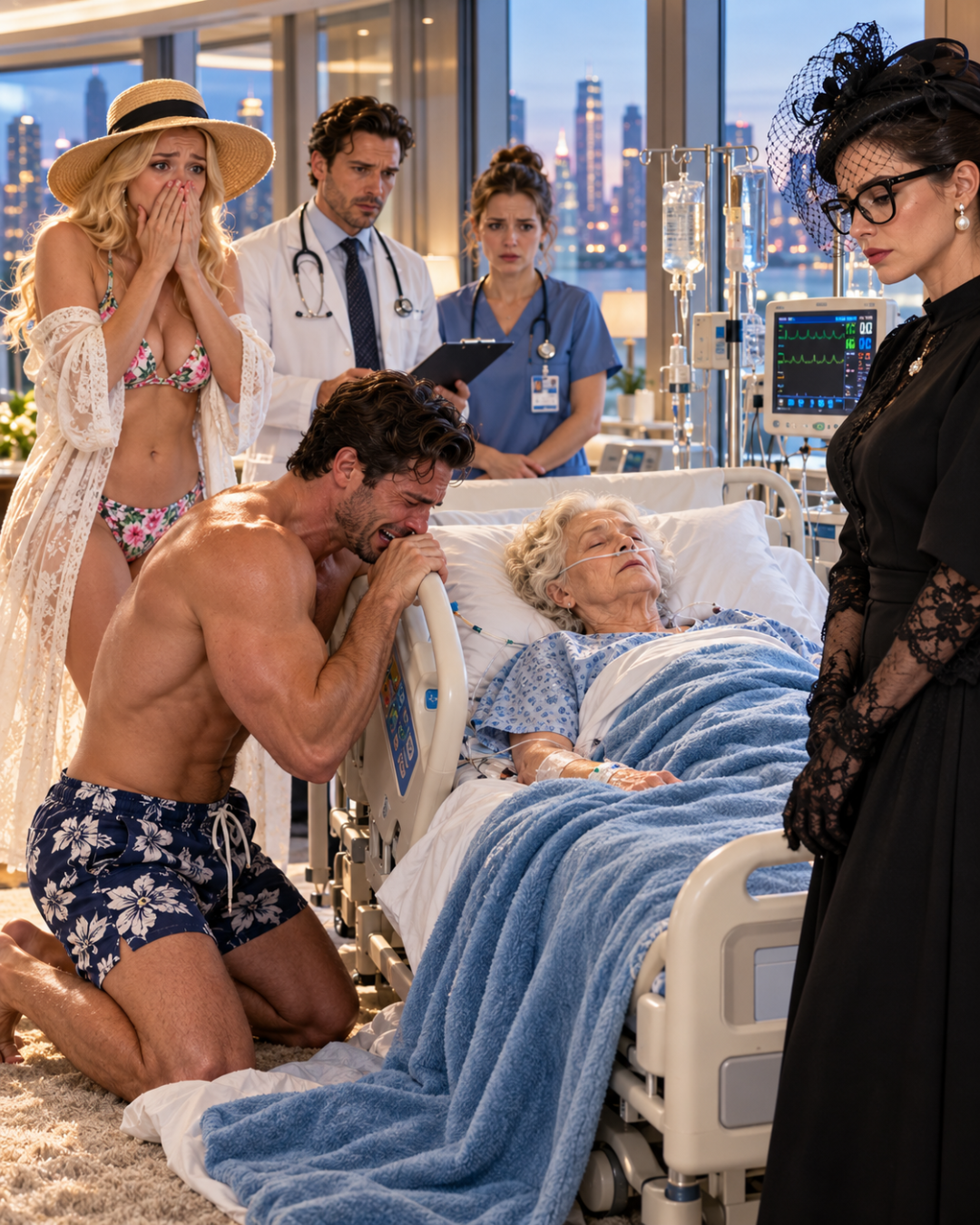
“Stop blowing up his phone, will you?” the female voice sneered, the words slurred with alcohol and thick with amusement. “He’s in the shower, old wife. We’re in Maui. Stop being so desperate and let him enjoy his vacation.”
Click.
I did not scream. I walked back into the trauma room on numb legs. The doctor had just stepped away, his eyes lowered. I sank beside her bed. “I am so sorry, Margaret. He isn’t coming.”
Then the impossible happened. Her fingers, which should have held no strength after the severe strokes, twitched.
Margaret’s eyes fluttered open. She had heard the sharp, mocking voice of Chloe, the mistress, coming from my phone’s speaker only moments earlier. A fierce, unnatural fire lit in Margaret’s cloudy eyes. It was not sorrow. It was pure maternal rage.
She squeezed my hand with desperate strength. Under the plastic oxygen mask, her pale lips moved. No sound came, but I read the words clearly: Destroy him.
Then, with the last of her strength, Margaret pressed a jagged piece of metal into my palm. It was a tiny silver lockbox key she had kept pinned to her undergarments for years. As my eyes widened, her chest fell still, and the heart monitor flattened into a long, endless hum.
Now, in the fading light of my empty living room, I gripped the handle of my single suitcase and walked out the front door. I was heading for the lock that matched this silver key.
The next morning, wearing a plain navy suit, I arrived at a quiet brick office building downtown. The brass plate on the door read: Attorney Harrison.
“I am glad you came, Claire,” Mr. Harrison said gently.
I set the silver key on his mahogany desk. He took a vintage wooden lockbox from his heavy iron safe. Click.
Inside was a thick envelope with my name, a Last Will and Testament leaving everything to me and cutting Mark out, and a navy-blue bank passbook showing a balance of $500,000. Beneath those lay a sealed folder marked with a corporate logo: a large Life Insurance Policy taken out on Margaret’s life only six months earlier, with Mark listed as the sole beneficiary.
Tucked inside was a handwritten note on personal stationery. Claire, my sweet girl. I am so sorry for enabling a monster. He bought this policy hoping my strokes would take me sooner. Use this money to destroy him.
As I turned back through the yellowing pages of a separate financial ledger hidden at the bottom, my grief turned into sharp clarity. Large, irregular sums had poured into the account over the past decade. Fifty thousand. One hundred thousand. The deposits came from Horizon Builders, a commercial subcontracting firm owned by Mark’s uncle, Richard.
Mr. Harrison’s face lost its color as he studied the ledger. He switched on the small office television and turned to the local news. The breaking news banner across the bottom of the screen froze my blood.
BREAKING: CEILING COLLAPSE AT ST. JUDE CHILDREN’S HOSPITAL WING. INVESTIGATORS CITE SUBSTANDARD MATERIALS. FEDERAL PROBE LAUNCHED.
I stared at the screen, then at the ledger in my hands. The dates of the large Horizon Builders deposits lined up exactly with the construction timeline of that hospital wing.
“My God,” Mr. Harrison whispered, adjusting his glasses with a shaking hand. “Mark isn’t on a romantic vacation in Maui, Claire. Hawaii is just a layover.”
I looked up at him as the truth settled over me. “He’s fleeing the country. He’s running before the FBI connects the collapsed roof to his fraudulent contracts.”
If I did not act at once, a murderer would vanish with millions.
PART 2
At 9:00 a.m. the next day, I walked into Margaret’s local bank branch. I presented the certified death certificate, the Last Will, and Attorney Harrison’s legal injunction, and I placed a hard legal freeze on the entire estate.
“Per federal regulations, no cash withdrawals or transfers can be processed until probate concludes,” the bank manager confirmed.
By freezing that account, I had not only cut off Mark’s spending money. I had cut his lifeline. The offshore shell account he was surely trying to wire money into from his Maui resort was now empty. He was trapped on American soil.
I returned to a cheap motel room near the train station and opened the smart-home security application on my tablet. Years earlier, I had installed hidden cameras in the living room and kitchen to watch Margaret’s safety. Now they were my private theater.
At exactly 8:00 p.m., the front door of my former home rattled open. Mark dragged his expensive leather luggage into the dark entryway.
Chloe stepped into view, wearing designer clothes paid for with blood money. “Ugh, it smells like old people and hospital bleach. You promised we could gut the whole thing before we fly to Bali, right?”
“Whatever you want, sweetheart,” Mark cooed, slapping the wall switch.
I watched his face twist in confusion when he saw the absence of my coats, my shoes, the medical bed. He stormed into the dining room. There, in the exact center of the table, sat the green divorce petition, held down by my platinum ring. Beside it lay a clear photocopy of the bank passbook. Right below the $500,000 total was the bank’s red stamp: ACCOUNT FROZEN – BENEFICIARY TRANSFER PENDING.

He dropped his suitcase. He picked up the photocopy with shaking hands. “No… no, no, no! How did she get into the lockbox?!” he shrieked to the empty walls.
Chloe snatched the papers from the table. “Wait. This says she gets everything? The money is frozen? Mark, the FBI is raiding Horizon Builders tomorrow! You said we had the cash to disappear tonight!”
“She took the ledger!” Mark sobbed, clutching his hair. “I’m ruined, Chloe. I don’t have access to a single dime. I… I have nothing.”
The loving mistress disappeared, replaced by a cold predator. “You dragged me into a federal indictment, promising me a mansion in Indonesia, and you are actually a broke, trapped fugitive?”
“Please, Chloe, just give me a few days to fix this! I’ll call Richard! I’ll frame Claire for the ledger!”
Smack. Chloe’s palm struck Mark’s cheek with the force of a gunshot.
“Don’t ever call my number again,” she spat. She turned, grabbed her designer bag, and the front door slammed shut, leaving Mark alone.
He fumbled for his phone. “Richard… Uncle Richard, pick up. Claire knows. She froze the escape funds. We have to execute the backup plan. We have to pin the hospital contracts on her.”
I sat in the dark motel room, the tablet glowing against my face. My husband was not only going to try to reclaim his money. He was going to sacrifice me to save himself. And with his connections, he might succeed.
The ambush was not set at the old family home, but in the cold glass-walled boardroom of Margaret’s bank in the financial district. Attorney Harrison had insisted on neutral ground to review the frozen assets.
When I walked through the double oak doors with Mr. Harrison, the air in the room felt thick enough to choke on.
Mark sat at the polished mahogany table, wearing a carefully arranged mask of deep, tragic exhaustion. Beside him was Uncle Richard, his face flushed purple, sweating through his custom suit. But the man at the head of the table made cold dread coil in my gut. It was Mr. Vance, a high-powered, ruthless defense attorney known for making federal charges disappear.
“Mrs. Claire,” Vance began, his voice slick with false sympathy. “We are here to resolve a tragic misunderstanding. You are grieving, clearly not in your right mind, which explains why you illegally locked my client out of his rightful family assets.”
I took a seat opposite Mark, my posture straight. “I reclaimed what was legally bequeathed to me through Margaret’s Will. There is no misunderstanding.”
Vance smiled—a thin, cold stretch of lips. He snapped open his leather briefcase and slid a thick manila folder across the table toward me.
“I suggest you look inside, Claire,” Mark whispered, his eyes dark and venomous.
I opened the folder. Inside were dozens of authorization forms, wire transfer requests, and material approval sheets for the St. Jude Children’s Hospital project. At the bottom of every page, approving the fraudulent, substandard steel and drywall, was a signature.
My signature.
My lungs seized. The room tilted. I stared at the looping cursive that perfectly matched my handwriting. During the years I cared for Margaret, Mark often brought home stacks of “medical insurance forms” and “tax deductibles” for me to sign while I was exhausted, juggling pill bottles and bedpans. He had been hiding these corporate authorizations in the middle of those stacks. He had been building my gallows for years.
“As you can see,” Vance said, his voice echoing in the silent boardroom, “Mark was entirely unaware of the embezzlement. It appears that you, Claire, leveraging your access to Margaret’s accounts, collaborated with rogue contractors at Horizon to siphon funds. When the hospital ceiling collapsed, you panicked, forged a Will, and froze the accounts to frame your husband.”
Uncle Richard leaned forward, slamming his fist on the table. “You greedy, murderous bitch. Children were hurt in that hospital because of your cheap materials!”
The sheer boldness of the accusation made me physically ill. They had perfectly arranged my destruction.
“Here is our offer,” Vance said, tapping a fresh legal document. “Sign over the entire estate to Mark right now. Surrender the original financial ledgers you stole. Do that, and Mark, out of the goodness of his heart, will not turn this evidence over to the FBI. Refuse, and you will be arrested for federal fraud, embezzlement, and criminal negligence before the sun sets.”
I looked at Mark. He finally met my eyes, a smirk of complete triumph at the corners of his mouth. He thought he had won. He thought I was still the quiet, obedient caregiver who would break under pressure.
“I decline,” I said, my voice barely above a whisper, but steady as stone.
Mark leaped to his feet. “Are you insane?! I will send you to federal prison for the rest of your pathetic life!”
“You are welcome to try,” a new voice boomed from the doorway.
PART 3
The heavy boardroom doors swung open. Three men in perfect suits stepped into the room. They were not police. They were the Board of Directors for Summit Engineering—the massive parent corporation Mark worked for. Leading them was Arthur Sterling, the ruthless Director of Corporate Compliance.
Mark recoiled, knocking his chair backward. “Mr. Sterling… what are you doing here?”
“Mrs. Claire invited us,” Sterling said, his eyes locking onto Mark with the warmth of absolute zero. “She mentioned there would be an audit of stolen Summit funds taking place today.”
I slowly reached into my purse. I did not pull out a pen to sign their fraudulent confession. I pulled out my tablet.
“Before you construct a fantasy where I am the mastermind, Mark,” I commanded, my voice cutting through his panic, “I suggest you let your bosses listen to your own history.”
I pressed play. The video feed from the hidden kitchen camera, recorded three months earlier, appeared on the large presentation screen on the boardroom wall.
Richard’s voice echoed clearly: “Mark, the auditors from Summit are sniffing around the old Horizon contracts again. If they look too closely at the invoices, they’ll see we overpriced the drywall by 400%. You need to move that cash out of your mother’s account into an offshore shell, now!”
Mark’s panicked face filled the screen: “I can’t! She locked the account! The old bat figured out the deposits weren’t my bonus. If I force her to go to the bank, Claire will ask questions!”
Richard’s voice: “Then you better pray she dies soon, Mark, or we are both going to federal prison.”
The video cut to black.
The silence that followed was a physical weight. The Summit executives stared at Mark with open disgust. Mr. Vance, the dirty lawyer, slowly slid his forged documents back into his briefcase, his face drained of color. He knew he had walked into an inescapable trap.
“That’s… that’s a deep fake!” Mark stammered, hyperventilating as he backed away from the screen. “She fabricated it!”
“It is a security camera inside a private residence, capturing a conversation to which the homeowner was a party,” Mr. Harrison countered smoothly. “And it was corroborated this morning by an anonymous tip.”
The boardroom doors opened one final time. A woman in a dark windbreaker bearing three unmistakable yellow letters—FBI—stepped inside.
“Mark Davis and Richard Davis,” Special Agent Harris announced, flashing her gold badge. “You are both under arrest for grand fraud, conspiracy, and criminal negligence resulting in bodily harm.”
“An anonymous tip?” Mark gasped, his eyes wild with terror.
“A young woman named Chloe,” Agent Harris replied dryly. “She seemed highly motivated by the reward money we offer for information leading to the arrest of federal fugitives. She handed over your laptop an hour ago.”
Mark let out a strangled whimper and slid down the boardroom wall, collapsing onto his knees on the carpet. “Please! I’ll pay it back. I’ll testify against Richard! He made me do it! I’ll take a plea deal!”
He was begging like a coward. But it was not over.
“There will be no plea deals,” Mr. Harrison said quietly, commanding the room once more. He reached into his briefcase and extracted an aged, slightly yellowed envelope carrying the faint scent of lavender.
“Margaret instructed me to open this only if Mark attempted to blame others for his actions. A condition he has tragically met.”
Mr. Harrison broke the seal. He did not pull out a document. He retrieved a tiny, frayed piece of baby-blue fabric. It was a knitted baby mitten.
Mark choked on a sob, his eyes widening in confusion. “That’s… she knitted that when I was born.”
“She kept it with her every single day,” I whispered, the memory of her clutching it in the dark tightening my chest.
Mr. Harrison turned the blue mitten over. Nestled inside the fabric was a tiny, black micro-recorder. He pressed play.
A blast of static hissed through the silent boardroom, followed by the violent, youthful roar of Mark’s voice from five years earlier—the very day Margaret had her first, paralyzing stroke.
Mark’s voice: “Listen to me! Unlock the account! If you refuse, I will forge your signature!”
Margaret’s fragile, weeping voice: “I saw the paperwork in your briefcase, Mark. The hospital… the steel. You built a hospital with rotting metal! I am calling the authorities. I won’t let you hurt children!”
A heavy, sickening crash sounded on the tape. The sound of a frail body hitting the floorboards. The boardroom held its breath.
Margaret’s voice, gasping, agonizingly weak: “My chest… Mark… my pills. On the counter. Please…”
There was a long, excruciating pause on the recording. Then, the distinct, brittle crunch of a plastic pill bottle being crushed under the heel of a leather shoe.
Mark’s voice, cold, demonic, and entirely devoid of humanity: “You aren’t calling anyone. I’m taking your phone. I’m taking the landline. You are going to lay on this floor until your brain bleeds out. Shut up and die, mother.”
PART 4
The audio cut to dead air.
The silence in the boardroom was no longer just heavy; it was apocalyptic. The executives from Summit Engineering looked physically ill. Agent Harris stood frozen, her hand hovering over her handcuffs, staring at Mark as if looking at a literal demon.
He had not merely neglected her. He had intentionally induced her paralyzing stroke. He had stood over his own mother, crushing her life-saving medication beneath his boot to protect his wealth, condemning her to twenty years of silent, locked-in agony.
“Every time I helped her in the night,” I said, my voice dropping to a harsh whisper as I looked down at the broken, trembling creature on the floor, “she was clutching that mitten, crying over the monster her sweet little boy had become.”
Agent Harris did not say another word. She did not read him his rights immediately. She grabbed Mark by the collar of his expensive suit, hauled him to his feet with brutal force, and slammed him face-first onto the mahogany table. The metallic click of the handcuffs echoing in the room was the most beautiful, vindicating sound I had ever heard.
“We’ll be adding attempted murder to your federal indictment,” Agent Harris hissed into his ear.
As they dragged him out of the boardroom, his desperate, pathetic screams echoing down the marble hallway, I realized the storm was finally, truly over. The architecture of deceit he had built over twenty years had collapsed, crushing him entirely.
Six months passed with the quiet grace of a fading storm. The oppressive heat of that chaotic summer surrendered to a crisp, coastal autumn breeze.
I stood on a grassy hill overlooking an ocean I had never known before, staring down at a modest, polished headstone. When Mark lost everything to federal seizure—crushed beneath the weight of civil judgments, corporate debt, and massive legal fees—no one in his family wanted the financial burden of managing a graveside. I had petitioned the state through Mr. Harrison, easily claiming custody of Margaret’s urn.
“It really feels like autumn now, Margaret,” I whispered, tracing the engraved letters with a soft cloth. The coastal wind gently rustled the nearby pines, and I felt a profound warmth settle over my shoulders.

The $500,000 inheritance she had sacrificed everything to protect had not been squandered. It was my armor, and eventually, my foundation.
My phone buzzed in my coat pocket. It was a number I did not recognize, preceded by an automated operator’s voice.
“You have a collect call from an inmate at the Marion Federal Penitentiary. Press one to accept.”
I pressed one.
“Claire? Claire, is that you?” Mark’s voice came through the receiver. It sounded remarkably small, frantic, and broken. The arrogance was entirely stripped away. “Please, don’t hang up. It’s hell in here. They know I was a corporate guy… they know about the hospital. You have the money. Please, hire a better lawyer for my appeal. I’ll do anything!”
I closed my eyes, listening to the desperate gasps of the man who had stolen two decades of my life. I looked out over the crashing, brilliant blue surf. This water did not sound like greed or a Hawaiian vacation; it sounded like absolution.
“It’s autumn now, Mark,” I said gently, my voice devoid of anger, devoid of love, devoid of anything but cold, impenetrable reality. “It’s time to pay the price.”
“Claire, please! I’m begging—”
I tapped the red icon on the screen. The line went dead. I popped the back off the phone, extracted the old SIM card that still tied me to that past life, and dropped it into a nearby trash bin.
I withdrew the tiny, frayed blue baby mitten from my pocket. Mr. Harrison had safely disposed of the recorder, leaving only the fabric. I gently laid it at the base of the headstone, a symbol of the agonizing duality of a mother’s love—the willingness to destroy the son she birthed in order to save the daughter she chose.
I turned on my heel and began the long walk down the sloping path toward town. I used a fraction of Margaret’s gift to buy a sunlit, older building on the edge of town.
I pushed open the glass door, the small bell chiming a cheerful greeting. The rich, earthy aroma of roasted tea leaves and the quiet hum of the espresso machine filled the air. I walked behind the counter, tying a canvas apron around my waist. I was no longer an unpaid nurse. I was no longer a convenient shadow or a scapegoat. I was the owner of my own life.
I poured amber liquid into a ceramic cup, watching the steam rise into the morning light. The path ahead belonged entirely to me, and it tasted remarkably sweet.
If you want more stories like this, or if you’d like to share your thoughts about what you would have done in my situation, I’d love to hear from you. Your perspective helps these stories reach more people, so don’t be shy about commenting or sharing.
