

PART 1
I stood in the workshop with fourteen copper vases of lavender, rosemary, and the white dahlias I had grown myself when the phone rang. The pruning shears were still in my hand when my father delivered the news as casually as if he were canceling a lunch.
“Why?” I asked.
He sighed. “Vanessa is going through a difficult time. Watching me walk you down the aisle would be painful for her.”
Vanessa, my older sister, had been protected from every consequence since we were children. Her marriage was collapsing, and somehow that collapse required my wedding to be rearranged around her feelings.
“She isn’t getting married,” I said. “I am.”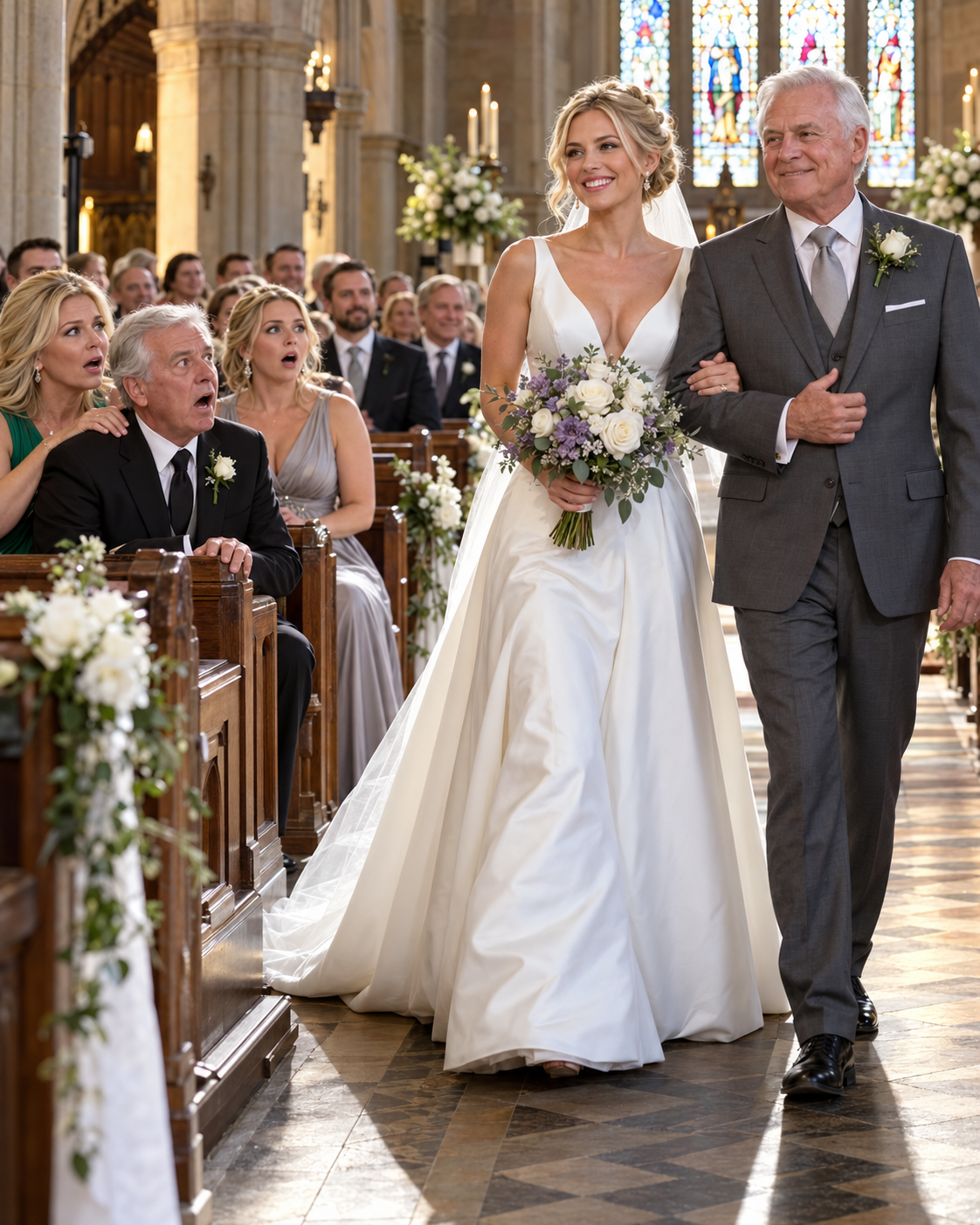
Dad lowered his voice. “She said she won’t bring Lily and Owen to Christmas if I walk you.”
There it was. My sister had turned her own children into bargaining chips, and my father had folded without even asking her to say the threat out loud a second time.
“So you chose her,” I said.
“Please don’t make this sound cruel.”
That was his talent. He could leave me standing alone and then act wounded when I named the leaving.
I looked at the oak shelves behind the workbench. Marcus’s father, Frank, had built them two years earlier. Inside the left panel he had carved my initials deep enough that every future coat of paint would still leave the letters visible. My own father had forgotten my birthday that same year.
“Okay,” I said.
“Darcy, I’m sorry.”
“No. You’re uncomfortable. That isn’t the same thing.”
I ended the call.
Ten minutes later my mother called.
“Your father told you,” she said. “So let’s not drag this out. Plenty of brides walk alone now. It’s empowering.”
“He promised me a year ago.”
“Things change. Vanessa is hurting. You have Marcus.”
“And that means I don’t get to be hurt?”
The silence that followed was not guilt. It was irritation.
“Just walk by yourself,” she said. “Smile and don’t embarrass anyone.”
I hung up before she could turn the humiliation into one more family duty I was expected to perform.
Twenty minutes later Marcus found me on the back step, staring at the garden. He sat beside me and put his arm around my shoulders. He did not tell me to forgive them. He did not tell me to keep the peace. After I finished explaining, he glanced toward the workshop and said, “You don’t have to walk alone.”
I knew the name before he spoke it.
“Frank?”
Marcus nodded. “My dad has treated you like a daughter since the first day I brought you home. He knows what an honor it would be.”
The next morning I drove to Frank’s house. He was in the driveway in a denim apron, feeding a length of cherry through the table saw. When he saw my truck he switched the machine off and removed his safety glasses. I told him everything. He listened without interrupting; his jaw tightened when I repeated Vanessa’s threat and my mother’s order to smile.
I looked down at my boots. “Mom says walking alone would be empowering,” I whispered. “But I don’t want to prove I can survive being abandoned. I want to walk with someone who is proud to be there.”
Frank slowly pulled off his work gloves.
“Are you asking me?”
I nodded.
His eyes filled at once. This broad-shouldered man who showed love by repairing engines and sanding wood until it felt like silk pulled me into a hug so steady that something inside me finally stopped shaking.
“Darcy,” he said, “it would be the greatest privilege of my life.”
On Saturday the converted stone barn glowed under clear autumn light. Nearly two hundred guests filled the wooden pews while a string quartet played near the altar. My parents arrived late enough that every head turned. Dad sat in the third row on the aisle, relaxed and smiling. Mom settled beside him in a dark blue dress. Vanessa took the next seat with her children, wearing the satisfied look of someone waiting to watch the damage she had ordered.
They expected me to enter alone. They expected downcast eyes, trembling hands, and a small, brave smile that would keep their reputations intact.
Instead I stood behind the closed oak doors, bouquet in one hand, Frank’s arm under the other. He wore a charcoal suit. His silver hair was neatly combed, though a faint streak of sawdust still clung near one cuff.
“Ready, kiddo?” he asked.
I tightened my grip.
“I am now.”
The music changed. The oak doors opened. Every guest stood. At first the room filled with warm smiles. Then people recognized the man beside me, and understanding moved through the barn in a sudden, electric wave.
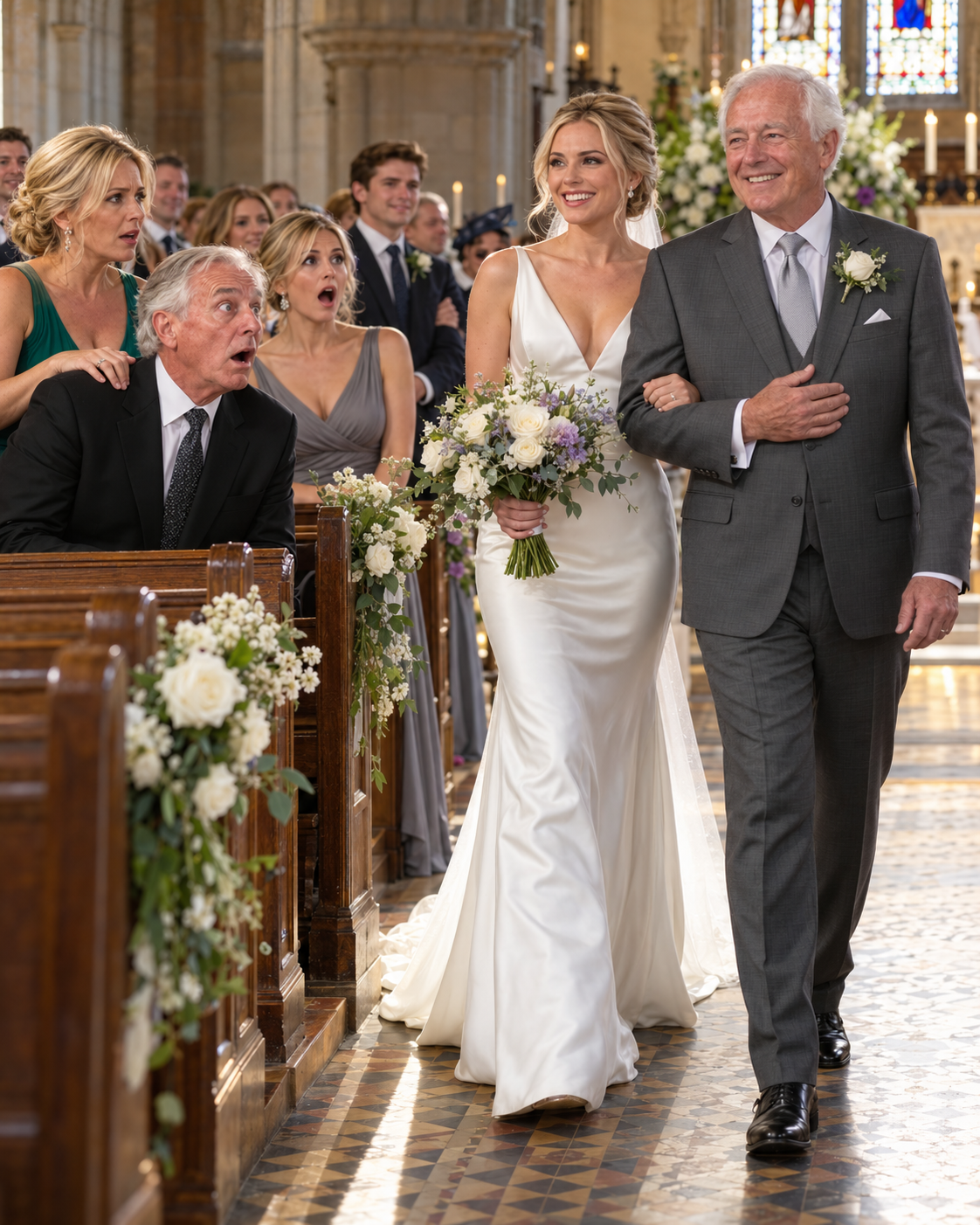
Frank walked with his shoulders straight, each step steady and deliberate. We passed the fifth row. Then the fourth. My father turned. His smile disappeared. He saw Frank’s hand resting over mine. He saw the pride on Frank’s face. He saw two hundred witnesses understanding that another man was doing the job he had refused three days earlier.
The color left Dad’s face. He gripped the pew in front of him and started to rise. Mom caught his sleeve and pulled him back into the seat, using the same command she had given me: don’t embarrass anyone. Vanessa’s smug expression collapsed.
Frank never looked away from the altar.
When we reached Marcus, the officiant smiled and asked, “Who presents Darcy to be married?”
Frank placed his calloused hand over mine.
Behind us, my father whispered his name.
Frank took a breath and turned toward the silent room.
“I do,” he said, voice clear and unhurried. “Frank Ellison. And I present her with a full and grateful heart.”
He looked once, briefly, toward the third row, then returned his attention to Marcus. “Take care of her the way she deserves. She’s already done the hard part of choosing well.”
Marcus’s eyes were wet, but he was smiling the way he smiled when he was trying not to laugh and cry at the same time. He nodded once. Frank stepped back, still holding my hand until the last possible moment, then released me with a small, steady pressure that felt like permission and blessing at once.
The officiant continued. The vows were the ones Marcus and I had written on the back porch two months earlier, simple enough that they did not need ornament and honest enough that they did not need defense. When Marcus said “I will,” the words landed in the quiet barn with the weight of something already proven. When I answered, my voice did not shake.
Somewhere in the third row a child whispered too loudly, “Why is Uncle Frank walking Aunt Darcy?” Vanessa shushed her without answering. The rest of the ceremony moved forward without further interruption. Rings were exchanged. Hands were held. The string quartet played the piece we had chosen because it sounded like walking home after a long day of honest work.
When the officiant pronounced us married, the applause rose in a single, generous wave. Frank was the first to stand. He clapped with both hands, the way a man claps for a finished roof or a mended engine that runs clean. My parents remained seated a moment longer than everyone else. When they finally rose, their clapping was polite and brief. Vanessa stood with her arms crossed until Lily tugged at her sleeve; only then did she manage a thin smile that never reached her eyes.
The recessional carried us past the same pews. This time I walked on Marcus’s arm. Frank followed a few steps behind, not as an escort now but as a witness who had already done what he came to do. As we passed the third row, my father looked at the floor. My mother looked straight ahead. Vanessa watched me the way someone watches a door they expected to stay locked and are surprised to see open.
Outside, the late-afternoon light turned the stone walls gold. Guests spilled onto the gravel and the grass, talking in the easy way people talk when a ceremony has given them something clear to feel. Marcus’s mother, Helen, found me first. She did not speak at once. She simply put both hands on my face, studied me for a second, and said, “You look like someone who was walked in by the right person.” Then she hugged me hard enough that the bouquet between us crushed a little, and the scent of rosemary rose between us.
Frank stood a short distance away, accepting handshakes and quiet congratulations from people who had known him for years. One of Marcus’s uncles clapped him on the shoulder and said, loud enough for anyone nearby to hear, “You did good, Frank.” Frank only nodded. He kept glancing toward me as if checking that I was still standing, still steady, still mine to worry over in the ordinary way a father worries.
The receiving line formed under the old oak that shaded the side of the barn. Most guests moved through quickly, offering hugs and short, warm sentences. When my parents reached us, the line slowed. Dad stopped first. He looked at Marcus, then at me, then at the empty space beside me where his own arm might have been.
“Darcy,” he said. His voice was low. “I didn’t know he was going to—”
“You knew he was willing,” I answered. “That was enough for me.”
Mom’s mouth tightened. “This wasn’t the plan.”
“The plan changed three days ago,” I said. “You both helped change it.”
Vanessa arrived with the children in tow. Lily, seven, stared up at Frank, who had stepped closer when he saw them. Owen, five, hid half behind his mother’s leg. Vanessa’s eyes moved from my face to Marcus’s to Frank’s and settled, finally, on the ground.
“You made your point,” she said quietly.
“I didn’t make a point,” I answered. “I got married. You can still come to Christmas if you want. Or not. That decision was never mine.”
Lily looked between us. “Are we going to Aunt Darcy’s house for Christmas?”
Vanessa did not answer. She took both children’s hands and moved on. Frank watched them go, then looked at me. “You don’t have to explain anything else today,” he said. “Today is finished. The rest can wait.”
The reception unfolded under strings of warm lights strung between the barn and the oak. Tables of reclaimed wood held the copper vases I had arranged that morning; the lavender and dahlias had opened further in the heat of the day. Marcus and I moved from table to table. At each one someone found a way to mention Frank without quite saying the obvious thing. A cousin of Marcus’s said, “Your father-in-law cleaned up nice.” An old friend of mine who had known my family for years simply squeezed my hand and said, “I’m glad you had him.”
Halfway through dinner, Frank stood. He did not have a microphone. He did not need one. The room quieted because people wanted to hear him.
“I didn’t plan to speak,” he said. “But I built the shelves in Darcy’s workshop, and I carved her initials into them because I already knew she was staying. Tonight I got to walk her to the man who is going to keep her. That’s more than I ever expected. Thank you for letting an old carpenter stand in the place that mattered.” He sat down again before anyone could applaud too long. Helen reached over and covered his hand with hers. Marcus looked at me across the table and mouthed, *That’s my dad.*
Later, when the dancing began, Frank claimed the first dance that was not ours. He moved carefully, the way a man moves when he is more used to tools than to polished floors, but he kept time and he kept me close enough that I could hear him when he spoke.
“Your father called me this morning,” he said. “Asked if I was really going to do it.”
“What did you tell him?”
“I told him the truth. That you asked, and that I said yes. He didn’t have much to say after that.” Frank turned us slowly. “You don’t owe him a softer version of today. You already gave him the chance to be here. He chose something else.”
I rested my forehead briefly against his shoulder. The suit still carried the faint, clean smell of sawdust under the cologne. “Thank you for saying yes.”
“Thank you for asking,” he answered. “Most people don’t ask for the thing they actually need. They ask for the thing that keeps everyone else comfortable. You didn’t do that.”
PART 2
When the song ended, he walked me back to Marcus and placed my hand in my husband’s with the same deliberate care he had used at the altar. Then he stepped aside and let the rest of the night belong to us.
My parents left before the cake was cut. Vanessa left with them. No one made a speech about their absence. The remaining guests simply filled the empty seats at their table with jackets and purses and went on talking. At some point Helen moved the centerpiece so the space looked intentional rather than abandoned. Marcus noticed and squeezed my hand under the table. We did not need to name what had happened. The empty chairs said it clearly enough.
Near midnight, after most of the guests had gone, Frank and Helen walked us to the truck. Frank opened the passenger door for me the way he always did when I visited, as if the habit had already been formed years earlier and the wedding had only confirmed it.
“Drive safe,” he said to Marcus. “And call your mother tomorrow so she doesn’t invent reasons to worry.”
Helen hugged me again. “The shelves will still be there when you get back,” she said. “Initials and all. Nothing about today changes the work you already did.”
We drove away under a sky full of ordinary stars. Marcus kept one hand on the wheel and the other resting on the console between us, palm up, waiting. I placed my hand in his. For a long stretch of dark road neither of us spoke. The silence was not heavy. It was the kind that follows a thing finished correctly.
“Frank told me Dad called him this morning,” I said at last.
“I know,” Marcus answered. “Dad told me on the way to the barn. He didn’t want you walking in without knowing your father had already tried to stop it one more time.”
I watched the white lines of the road appear and disappear under the headlights. “He still thought he could decide.”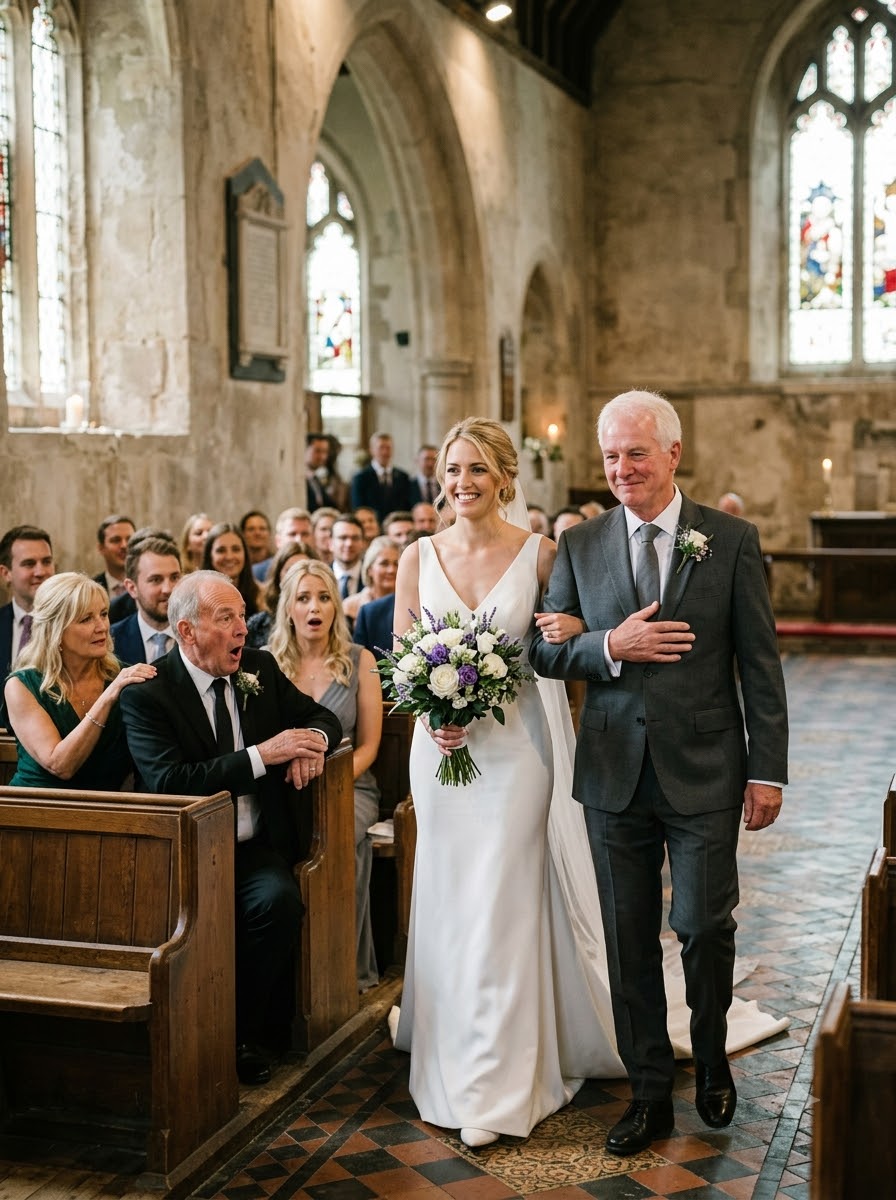
“He thought the threat with the kids would be enough,” Marcus said. “It wasn’t. Not for you, and not for my dad.”
We reached the small house we had rented for the first weeks of the marriage—the one with the wide back steps and the garden already half-planted. Marcus turned off the engine. Neither of us moved to get out.
“I keep thinking about Christmas,” I said. “If she follows through.”
“Then we’ll have Christmas here,” he answered. “Frank will bring the good sawhorses and we’ll put the tree on them so it doesn’t tip. Helen will complain about the lights being crooked and then fix them herself. Lily and Owen can come if Vanessa lets them. If she doesn’t, the day will still happen.” He looked at me. “You already walked in with the person who was willing. Everything after that is just deciding who gets to stay close.”
Inside, the house was quiet and smelled faintly of the cedar chest Frank had refinished for us as a wedding gift. I set the slightly crushed bouquet in one of the copper vases on the kitchen table. The rosemary stems were still green. I ran my thumb along one of them and the scent rose again, sharp and clean.
Marcus came up behind me and rested his chin on the top of my head. “You were steady the whole way down that aisle.”
“I had something to hold onto,” I said.
We stood there a while longer, listening to the ordinary sounds of a house settling—the tick of the old clock Frank had hung above the sink, the low hum of the refrigerator, the wind moving through the half-open window over the garden. Somewhere in the dark outside, the last of the autumn leaves shifted against one another. Nothing dramatic happened. No one called. No one arrived to demand an explanation or an apology or a revised version of the day that would make them more comfortable.
I washed my face, changed out of the dress, and folded it carefully over the back of the chair. Marcus was already in bed when I came in, one arm flung across the empty side the way he always slept when he was waiting. I slid in beside him. He turned, found my hand in the dark, and held it the same way Frank had held it at the altar—steady, calloused in the places that came from real work, unwilling to let go until the moment was finished.
“Tomorrow we can go see the shelves,” he said, already half-asleep. “Make sure the initials are still there.”
“They will be,” I answered.
Outside, the wind kept moving through the garden I had planted. Inside, the house held the quiet of people who had already chosen, clearly and in front of witnesses, who would walk with them when it mattered. The rest of the night passed without further interruption. When morning came, the light through the bedroom window was ordinary and gold, and the first thing I saw was the small, dark line of sawdust still caught in the cuff of the charcoal jacket Frank had left draped over the chair by the door—proof that the man who had walked me in had come from real work and had not tried to hide it.
We got up. We made coffee. We called Frank and Helen to say we were home and safe. Helen answered on the second ring and immediately asked whether the bouquet had survived the drive. Frank, in the background, told her to let us breathe. Their voices on the speaker filled the kitchen the way familiar tools fill a workshop—present, useful, already belonging to the place.
Later that afternoon we drove to the workshop. The oak shelves stood exactly where Frank had built them. I opened the left panel. The initials were still there, cut deep, the edges softened only by the two years of ordinary use. Marcus ran a finger along the letters and smiled.
“Still readable,” he said.
“Still mine,” I answered.
We closed the panel. Outside, the late light moved across the copper vases lined up on the workbench, empty now but ready for whatever would be cut and arranged next. The garden beyond the open door showed the first true colors of the season. Nothing in the workshop asked us to explain the day before. The work waited, ordinary and unfinished, exactly as it should. We stayed until the light changed, then locked the door behind us and drove home under the same clear sky that had covered the barn, already knowing which calls we would answer and which ones we would let ring.
