


Part 1: The Dream That Slowly Disappeared
My sixteen-year-old daughter had dreamed of becoming a ballerina for as long as I could remember. So when my husband’s best friend offered to drive her to ballet lessons three evenings a week, I thought he was giving her the opportunity of a lifetime.
We had trusted Derek for nearly thirty years.
He had watched Audrey grow up. She called him Uncle Derek. He was the kind of man we invited to Sunday dinners, family birthdays, and holiday celebrations without a second thought.
But just one month after he began driving her, something changed.
The daughter who used to dance around our kitchen stopped practicing.
Her ballet shoes remained buried inside her bag.
She barely spoke during dinner, and whenever I mentioned her lessons, her expression filled with sadness.
I thought she was exhausted.
I thought she was struggling with the pressures of being sixteen.
Then one afternoon, I arrived at her ballet studio unexpectedly.
Her instructor looked at me with an expression I will never forget.
“Mrs. Bennett, your daughter hasn’t attended a single class in almost two weeks. She told us you didn’t think she was talented enough to continue.”
I stared at her.
That was impossible.
I had never said anything like that.
I was still paying Audrey’s tuition. I had encouraged her every day. I had been looking forward to watching her perform in the spring recital.
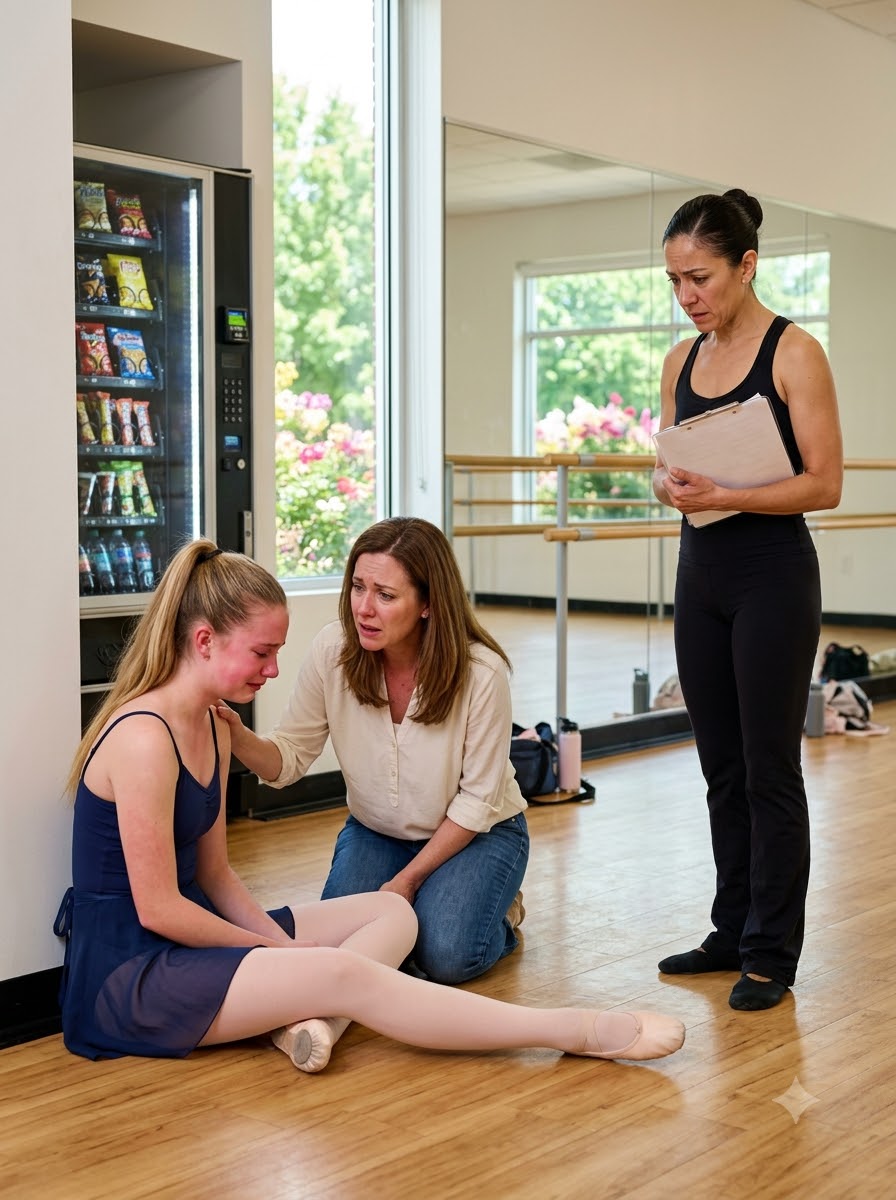
Then I found my daughter sitting alone beside a vending machine.
When I asked why she had stopped dancing, tears filled her eyes.
“Because Derek told me you and Dad were embarrassed by me. He said you wanted me to quit, but you were too ashamed to tell me yourself.”
For a moment, I couldn’t breathe.
The man we had trusted to help our daughter pursue her dream had apparently spent weeks convincing her that her own parents no longer believed in her.
And I had no idea why.
Audrey had loved dancing since she was little.
Even before she understood what ballet was, she turned ordinary moments into performances.
She practiced balancing beside the refrigerator while waiting for breakfast. She stretched in the living room, watched professional performances online, and copied movements she could barely pronounce.
Sometimes I would find her practicing turns in our narrow kitchen.
“Audrey, you’re going to bump into something,” I’d warn.
She’d laugh.
“Mom, that’s why I have to practice. I need better control.”
My husband, Scott, supervised construction sites, while I worked as a hospital administrator.
We were comfortable enough to provide for our family, but advanced dance training was expensive.
When Audrey was younger, we enrolled her in beginner classes whenever we could afford them.
Between lessons, she borrowed ballet books from the library and practiced with instructional videos.
She saved birthday money for dance shoes.
She asked for leotards instead of expensive electronics.
She never seemed to lose interest.
So when she received an invitation to join the advanced teen program at a respected ballet studio, I understood exactly how much it meant to her.
She burst through our front door one afternoon, waving her phone.
“Mom! They accepted me!”
I looked up from the kitchen counter.
“Who accepted you?”
“The studio! The advanced program!”
She practically pushed the screen into my hands.
I read the acceptance email, then read it again.
Not only had she been accepted, but she had also received a scholarship covering most of the tuition.
I hugged her immediately.
“Audrey, that’s wonderful!”
Her entire face lit up.
“Can I go? Please say yes.”
I wanted to say yes without hesitation.
Unfortunately, the studio was nearly fifty minutes from our house.
Public transportation involved two bus transfers, and classes ended after eight in the evening.
Scott and I both worked demanding schedules.
Getting her there three evenings every week would be difficult.
I studied the schedule, trying to find a solution.
Audrey noticed my hesitation.
“Mom?”
“We need to work out transportation.”
Her smile faded.
“You always say that.”
“Because I mean it, sweetheart.”
“Then why do you look worried?”
I didn’t know how to explain that wanting something desperately for your child didn’t always mean you could immediately provide it.
For two weeks, Scott and I tried everything.
We contacted coworkers, asked neighbors, and checked alternative schedules.
Nobody could reliably manage all three evenings.
Audrey suggested traveling by bus.
“I can get there early and wait inside,” she said.
“Getting home afterward is the difficult part,” I explained.
She nodded, but I could see her disappointment.
Then, during Sunday dinner, Derek offered a solution.
Derek had been Scott’s closest friend since high school.
Their friendship had survived college, career changes, marriages, and the challenges of raising children.
He was married to Laura, and their daughter Mia was Audrey’s age.
The girls had taken beginner ballet lessons together years earlier.
To Audrey, Derek was practically family.
That evening, she brought up the studio again.
“Dad, what if I take the earlier bus?”
Scott sighed.
“Sweetheart, we still have to figure out how to get you home.”
Audrey lowered her eyes.
Derek set down his fork.
“Why hasn’t anybody asked me?”
Scott frowned.
“Asked you what?”
“To drive her.”
I looked at him.
“Derek, that’s three evenings a week.”
He shrugged.
“My office is just down the street from the studio.”
“Really?”
“Sure. I can pick Audrey up after school, take her there, finish paperwork nearby while she’s in class, and bring her home afterward.”
Scott laughed.
“That’s a lot of driving.”
“Not really. I’d be working in that area anyway.”
Audrey looked at him hopefully.
“You’d actually do that?”
Derek smiled.
“Of course. Somebody has to help you become a Broadway star.”
She laughed.
“That’s musical theater, Uncle Derek.”
“See? You can teach me something too.”
Audrey jumped up and hugged him.
I thanked him repeatedly.
“Are you absolutely sure? We don’t want to inconvenience you.”
He waved away my concern.
“You’re family. Stop worrying.”
I believed him.
Scott believed him.
And Audrey was happier than I had seen her in weeks.
At first, the arrangement worked beautifully.
Derek collected her after school three evenings a week, drove her to the studio, completed paperwork nearby, and brought her home around nine.
Audrey would burst through the door, hungry and excited.
“Mom, you have to see what we learned!”
Sometimes she demonstrated combinations in the hallway while I prepared dinner.
Other evenings, she practiced turns in the kitchen.
Scott recorded her on his phone.
“Our future superstar!” he would announce.
“Dad, stop filming!”
But she was always laughing.
She talked constantly about Ms. Alvarez, her instructor, and the other dancers in the advanced program.
Once, she even corrected my posture.
“Mom, your shoulders are too tense.”
I laughed.
“Sweetheart, I spent nine hours dealing with hospital paperwork. My shoulders are allowed to be tense.”
She grinned and demonstrated how I should stand.
Those evenings became some of my happiest memories.
I believed Derek’s generosity had opened a door for my daughter.
Then, during the fourth week, everything began changing.
Audrey stopped practicing.
Her ballet bag stayed zipped.
She spent more time upstairs.
When I asked about her lessons, she gave brief, emotionless answers.
“How was class?”
“Fine.”
“What did you learn?”
“Just stuff.”
At first, I blamed exhaustion.
Advanced ballet was physically demanding, and Audrey still had schoolwork.
Then the studio emailed information about spring recital auditions.
I was excited.
Audrey had talked for years about performing on a proper stage.
At dinner, I asked what piece she planned to audition with.
Her fork stopped halfway to her mouth.
“I’m not auditioning.”
I stared at her.
“Why not?”
“Because I’m not ready.”
“Did your instructor say that?”
She shrugged.
“Can we not talk about ballet tonight?”
I didn’t want to pressure her.
“All right, sweetheart.”
But over the next two weeks, the situation worsened.
She became upset whenever I mentioned dancing.
When I offered to buy her new ballet shoes, she snapped.
“Mom, can you stop trying to fix everything?”
I stared at her.
“I was only offering.”
“I know.”
“Is something bothering you?”
“No.”
She hurried upstairs.
That evening, I told Scott I was worried.
He placed a hand on my shoulder.
“She’s sixteen. Teenagers go through phases.”
“But ballet has always been the thing that makes her happiest.”
“Maybe she’s tired.”
I wanted to believe him.
But the change felt too sudden.
It was as though someone had taken the happiness out of the one activity Audrey loved most.
Then Thursday evening came.
I was carrying the trash outside when Derek pulled into our driveway.
Audrey was leaning through his open driver’s-side window, gripping his sleeve.
“But you promised you’d talk to her,” I heard her say.
Derek looked uncomfortable.
“Audrey, not now.”
“Please.”
He noticed me approaching.
His expression changed immediately.
“Hey! Everything okay?”
I stopped beside the car.
“That’s what I was about to ask.”
Audrey released his sleeve and hurried into the house.
I watched her disappear.
Then I turned back toward Derek.
“What was that about?”
He laughed.
“Oh, nothing serious. She’s upset because we didn’t stop at the drive-through.”
I frowned.
“She has dinner waiting inside.”
“Exactly. I told her we’d be home soon enough.”
He smiled again.
“Teenagers, right?”
Before I could ask another question, he drove away.
Inside, I heard Audrey crying behind the downstairs bathroom door.
I knocked gently.
“Sweetheart?”
“Go away.”
“Audrey, what’s wrong?”
“Nothing.”
“Did something happen with Derek?”
“No!”
“Then please talk to me.”
She opened the door.
Tears covered her cheeks.
“Why can’t you just leave me alone?”
I stepped backward.
My daughter had never spoken to me like that.
But I wasn’t angry.
I was frightened.
Something was clearly hurting her, and somehow she seemed to believe I was responsible.
That night, I asked Scott to speak with Derek.
He looked confused.
“About what?”
“About whatever happened in the car.”
“Derek said she was upset about stopping for food.”
“Scott, I heard her asking him to talk to me about something.”
He sighed.
“They’ve probably had some little disagreement.”
“But why was she crying?”
“Claire, I’ve known Derek almost thirty years. He wouldn’t deliberately upset Audrey.”
I understood why Scott trusted him.
Until recently, I had trusted him just as completely.
But the next afternoon, I left work early and drove to the ballet studio without telling anyone.
I needed answers.
And when Ms. Alvarez finally told me that Audrey hadn’t attended a single class in almost two weeks, I realized my daughter’s sadness was not simply teenage exhaustion.
Someone had convinced her that we were ashamed of her.
The terrifying part was that the person responsible was someone we had welcomed into our family for nearly thirty years.
Part 2: The Lies He Told Our Daughter
I sat across from Ms. Alvarez in her small office, struggling to understand what she had just told me.
Audrey hadn’t attended class in almost two weeks.
Not one lesson.
Yet Derek had continued collecting her after school and bringing her home every evening as though nothing had changed.
“That can’t be right. She comes here three evenings a week.”
Ms. Alvarez nodded.
“Yes. She has been coming to the building, but she hasn’t participated in lessons.”
My heart began pounding.
“Why?”
The instructor hesitated.
“She told us her parents didn’t think she was talented enough to continue.”
I shook my head.
“No. Absolutely not.”
Ms. Alvarez looked surprised.
“Audrey said it was your decision.”
“I never told her that.”
I pulled out my phone and showed her the tuition payments.

Then I showed her the enrollment confirmation and the email about recital auditions.
“Look. I’ve been paying her tuition. I even asked her about recital auditions.”
Ms. Alvarez examined the screen.
Then she sighed.
“I had a feeling something wasn’t right.”
“Why didn’t anyone contact us?”
“She insisted you’d made the decision and begged me not to intervene. Our office sent messages about her absences.”
I checked my email immediately.
The messages had landed in my spam folder.
I felt sick.
While I had been worrying about Audrey’s exhaustion, she had been sitting somewhere inside the studio believing her own parents wanted her to quit.
“Was Audrey having trouble in class?” I asked.
“She’s been nervous about performing, but she’s improving. She earned her place in this program.”
Tears gathered in my eyes.
“Do you know where she goes during class?”
“I’ve seen her in the lobby, but I don’t know where she spends the rest of the time.”
I thanked her and hurried outside.
I found Audrey sitting alone near a vending machine.
She was still wearing her school clothes.
When she saw me, she stood abruptly.
“Mom? What are you doing here?”
I tried to keep my voice calm.
“I came to see you.”
Her expression hardened.
“Did you talk to Ms. Alvarez?”
“Yes.”
She looked away.
“So now you’re checking up on me?”
I shook my head.
“Audrey, I need you to tell me what’s happening.”
Tears appeared in her eyes.
“You know what’s happening.”
“No, sweetheart. I don’t.”
She stared at me.
“You don’t want me dancing here anymore.”
The words hit me harder than I expected.
“Who told you that?”
Her face crumpled.
“Derek.”
I went still.
She wiped her eyes.
“He said you and Dad agreed I wasn’t good enough for this program.”
I could barely speak.
Then she added the words that broke my heart.
“He said you were embarrassed to tell me because you knew how much ballet meant to me.”
For several seconds, I simply stared at my daughter.
The same girl who had practiced in our kitchen for years now believed we were secretly ashamed of her.
And she believed it because someone she trusted had told her so.
I sat beside her.
“Sweetheart, look at me.”
She kept her eyes lowered.
“I have never been ashamed of your dancing.”
She shook her head.
“But Derek said—”
“I know what he said. But it wasn’t true.”
I showed her the tuition payments.
Then the enrollment confirmation.
Then the recital email.
“I’ve been paying for your classes because I believe in you.”
Audrey studied the screen.
Confusion slowly replaced the hurt in her expression.
“But he told me you wanted me to stop.”
“I never said that.”
“He said Ms. Alvarez thought I wasn’t ready.”
I shook my head.
“She just told me you’re improving and that you earned your place here.”
Audrey stared at me.
Then she began crying.
“I thought you didn’t believe in me anymore.”
I pulled her into my arms.
“Never, sweetheart. Not for one second.”
She clung to me.
For a long time, neither of us spoke.
Then, slowly, she began explaining everything.
During the first few weeks, Derek had seemed supportive.
He asked about her lessons and listened when she described difficult combinations.
Then his questions changed.
He wondered aloud whether advanced ballet might be too demanding.
He suggested Audrey was putting too much pressure on herself.
He told her that perhaps she should consider something less competitive.
At first, she assumed he was simply concerned.
Then he began mentioning conversations she had never heard.
He claimed Ms. Alvarez had doubts about her ability.
He said Scott and I had privately discussed whether she belonged in the advanced program.
Eventually, he told her we had agreed she should quit.
“He said you didn’t want to hurt my feelings,” Audrey whispered.
I felt my stomach tighten.
“Why didn’t you ask me?”
“I wanted to. But he said you’d get upset if I brought it up.”
I stared at her.
“He told you that?”
She nodded.
“He said you were hoping I’d decide to quit by myself.”
Suddenly, every painful conversation from the previous weeks made sense.
When I asked about ballet, Audrey believed I was pretending to care.
When I offered new shoes, she thought I was being dishonest.
When I encouraged her to audition, she assumed I was trying to make her give up without directly telling her to stop.
My daughter hadn’t simply become withdrawn.
She believed her parents had betrayed her.
And Derek had carefully reinforced that belief during the very car rides we trusted him to provide.
On the drive home, Audrey told me she had been spending lesson time in the studio lobby or at a nearby café.
She did homework and waited for Derek to collect her.
She was afraid that continuing to dance would make us angry.
She thought Derek was protecting her from the embarrassment of hearing our supposed disappointment directly.
“Was that what you were asking him about yesterday?” I asked.
She nodded.
“I wanted him to talk to you about letting me audition.”
My hands tightened around the steering wheel.
“What did he say?”
“He told me I needed to accept your decision.”
I took a slow breath.
“Why didn’t you tell Dad?”
“He said Dad agreed with you.”
I pulled into a safe parking lot.
I needed a moment before driving any farther.
Audrey sat quietly beside me.
Then she whispered:
“Mom, are you going to tell Derek I told you?”
I turned toward her.
“Yes. But you’re not in trouble. You haven’t done anything wrong.”
Relief crossed her face, though she still looked frightened.
Then she said something I knew I would remember for years.
“He told me you always say nice things to my face but complain about me when I’m not there.”
I reached for her hand.
“Audrey, I am proud of you. Whether you become a professional dancer or decide to do something completely different, that will never change.”
Her eyes filled again.
“But I want to dance.”
I smiled through my tears.
“Then let’s find out how to get you back into class.”
When we reached home, I told Scott everything.
At first, he looked confused.
He kept asking whether Audrey might have misunderstood something Derek said.
Then Audrey showed him the messages on her phone.
One read:
Your mom says no auditions. Don’t make things harder by asking her.
Another said:
Your teacher thinks you should step back. I’m trying to spare you.
Scott read both messages twice.
His expression changed completely.
He looked toward Audrey.
“Sweetheart, I never agreed that you should quit ballet.”
She stared at him.
“Really?”
“Of course not.”
Her eyes filled with tears.
Scott pulled her into his arms.
For a moment, I watched my husband hold our daughter while the reality of what his oldest friend had done settled over him.
Then he looked at me.
“We need to talk to Derek.”
I nodded.
“But Audrey needs to be heard too.”
Scott agreed.
He called Derek and asked him to come over with Laura.
When they arrived, Derek looked annoyed.
“What’s so urgent that it couldn’t wait?”
I placed Audrey’s messages on the dining table.
“Can you explain these?”
Derek glanced down.
His expression changed.
Laura picked up the phone and began reading.
Then she turned toward her husband.
“Derek, why would you send these to Audrey?”
He shifted in his chair.
“She misunderstood. I was trying to manage her expectations.”
Audrey spoke quietly beside me.
“You told me Mom thought I was embarrassing myself.”
Derek turned toward her.
“Sweetheart, you were taking things too seriously.”
I interrupted.
“Please don’t dismiss her.”
Laura looked at her husband carefully.
Something seemed to occur to her.
Then she asked a question none of us had considered.
“Derek, is this because Mia didn’t get into the advanced program?”
The room fell silent.
I turned toward Laura.
Then toward Derek.
He rubbed his forehead.
“Mia worked just as hard,” he said finally.
Laura stared at him.
“What does that have to do with Audrey?”
Derek lowered his eyes.
“Every time Audrey came home excited about that program, I thought about how upset Mia was after being rejected.”
I couldn’t believe what I was hearing.
Mia was Derek and Laura’s daughter.
She was Audrey’s age, and the girls had been friends for years.
She had applied to the same advanced program.
But she hadn’t been accepted.
And apparently, Derek couldn’t bear watching Audrey succeed where his own daughter had been disappointed.
Scott leaned forward.
“So you convinced our daughter that we wanted her to quit?”
Derek shook his head.
“I wasn’t trying to hurt her.”
“But you did,” Scott answered.
Laura looked devastated.
“You made Audrey doubt herself because you were disappointed for Mia?”
Derek said nothing.
I looked at Audrey.
She was sitting perfectly still.
For weeks, she had believed her own parents were ashamed of her.
Now she was discovering that the entire story had come from someone else’s jealousy.
Scott spoke again.
“I trusted you with my daughter.”
Derek looked up.
“We’ve been friends for thirty years.”
“I know,” Scott replied quietly. “That’s why this is so difficult to understand.”
Laura turned toward Audrey.
“I’m so sorry, sweetheart.”
Then she faced Derek.
“You need to apologize to her.”
He hesitated.
Finally, he looked at Audrey.
“I’m sorry.”
Audrey stared back.
“For what?”
He swallowed.
“For lying to you. For making you doubt yourself.”
She didn’t answer.
And I didn’t ask her to forgive him.
An apology couldn’t erase the weeks she had spent believing her parents no longer supported her.
Scott told Derek he would not be welcome in our home for the time being.
Laura understood.
Derek looked stunned.
But neither Scott nor I changed our minds.
After they left, we sat beside Audrey.
Scott placed an arm around her shoulders.
“I should have listened when your mom said something was wrong,” he told her.
Audrey wiped her eyes.
Then she asked a question that nearly broke me all over again.
“Can I still dance?”
Part 3: The Girl Who Found Her Way Back to the Stage
For a moment, neither Scott nor I could speak.
Our daughter was sitting between us, still frightened that her dream had somehow been taken away.
After everything she had learned, after discovering that Derek had lied to her for weeks, she wasn’t asking whether we were angry.
She wasn’t asking whether he would be punished.
She wanted to know whether she could return to the one thing she loved.
“Can I still dance?”
I looked at Scott.
He nodded.
“We’ll do everything we can to help you.”
Audrey’s face crumpled again.
I pulled her close.
I wanted to promise that everything would immediately return to normal.
But I knew it wouldn’t be that simple.
She had missed nearly two weeks of advanced training.
She had lost confidence.
And the spring recital auditions were approaching.
That evening, I called Ms. Alvarez.
I explained what we had discovered and asked whether Audrey could return to the advanced program.
The instructor listened carefully.
Then she told me the auditions were the following week.
Audrey had missed important lessons, and catching up would be difficult.
But the opportunity hadn’t disappeared.
“She earned her place in this program,” Ms. Alvarez said. “If she wants to audition, I’ll help her prepare. She’ll still need to meet the same standards as everyone else.”
I thanked her.
When I ended the call, Audrey was waiting nearby.
I explained what Ms. Alvarez had said.
For a moment, she didn’t respond.
Then she quietly went upstairs.
I heard her bedroom door open.
A few minutes later, she returned carrying the ballet shoes that had remained untouched in her bag for weeks.
She stood at the kitchen entrance.
“Can I practice in the kitchen?” she asked.
I smiled.
“Of course.”
She slipped on her shoes.
Then she moved carefully across the floor.
At first, her movements were hesitant.
She tried a familiar combination, stopped, and began again.
Her confidence hadn’t returned simply because she now knew Derek had lied.
She still remembered his words.
She still worried that perhaps she wasn’t good enough.
There were evenings when she became frustrated with herself.
Sometimes she stopped practicing and sat quietly on the stairs.
Other times she struggled through a combination she had once performed without hesitation.
I learned not to fill every difficult moment with reassurance.
Sometimes she needed encouragement.
Sometimes she needed space.
And sometimes she simply needed someone to sit beside her until she was ready to try again.
Scott rearranged his schedule to take her to lessons.
Whenever possible, I handled the transportation myself.
Ms. Alvarez worked with Audrey to help her recover the training she had missed.
None of us pretended it would be easy.
But little by little, something familiar returned.
Audrey began talking about ballet at dinner again.
She described her instructor’s corrections.
She discussed the recital auditions.
She practiced while breakfast was cooking.
One morning, while I was standing beside the kitchen counter, she looked at me and smiled.
“Mom, your shoulders are too tense.”
I laughed.
For a moment, it felt like hearing my daughter again for the first time in weeks.
Scott occasionally attempted to imitate her turns.
His clumsy movements made her laugh so hard she had to stop practicing.
Those small moments mattered more than I could explain.
I hadn’t realized how much I missed hearing her laughter until it returned.
Then one evening, after finishing a particularly difficult combination, Audrey turned toward me.
Her cheeks were flushed, and she was breathing heavily.
But her eyes were bright.
“Mom, I think I’m ready to audition.”
I hugged her.
“Then go show them what you can do.”
Audrey auditioned the following week.
I won’t pretend it was easy.
She was nervous.
She knew she had missed valuable preparation time.
And despite everything we had told her, she still carried the memory of being made to feel inadequate.
But she walked into the studio.
She took her place.
And she danced.
She completed the audition.
When she came home afterward, she seemed exhausted.
I didn’t immediately ask how it had gone.
I waited until she was ready to talk.
Eventually, she sat beside me and began describing the experience.
Some parts had gone well.
Others had been difficult.
She wasn’t certain what the instructors would decide.
But she had finished.
And that alone meant something important.
A few days later, we received an email from the studio.
Audrey had earned a place in the spring recital.
I read the message aloud.
She covered her mouth.
“Really?”
I smiled.
“Really.”
She threw her arms around me.
Scott joined us, laughing.
For the first time in weeks, our home felt light again.
Audrey had earned her opportunity back through hard work, courage, and the willingness to try again after being hurt.
I was proud of her.
Not because she had been selected.
But because she had refused to let someone else’s jealousy decide what she was capable of becoming.
A few days later, Laura called.
Her voice sounded tired.
She explained that Mia had known nothing about Derek’s behavior.
When she learned what her father had done, she was deeply upset.
“Mia always wanted Audrey to succeed,” Laura told me. “This was Derek’s jealousy, not hers.”
I thanked her for telling me.
It mattered that Mia hadn’t participated in the deception.
She had experienced her own disappointment when she wasn’t accepted into the program.
That disappointment was real.
But she hadn’t tried to take Audrey’s opportunity away.
Her father had made that choice.
I told Laura that Audrey needed time before she felt comfortable seeing Mia again.
Laura understood.
I appreciated that.
I didn’t want another teenager carrying responsibility for the actions of an adult.
Audrey and Mia had been friends for years.
Perhaps, with time, they would find their way back to that friendship.
But I wasn’t going to force my daughter to pretend nothing had happened.
Trust had been damaged.
Rebuilding it would take patience.
As recital night approached, Audrey returned to many of her old habits.
Her ballet shoes no longer stayed hidden.
She practiced in the kitchen.
She talked about rehearsals during dinner.
Sometimes she still became anxious.
Sometimes she questioned whether she was ready.
But she no longer believed Scott and I were secretly ashamed of her.
She knew we were cheering for her.
And that changed everything.
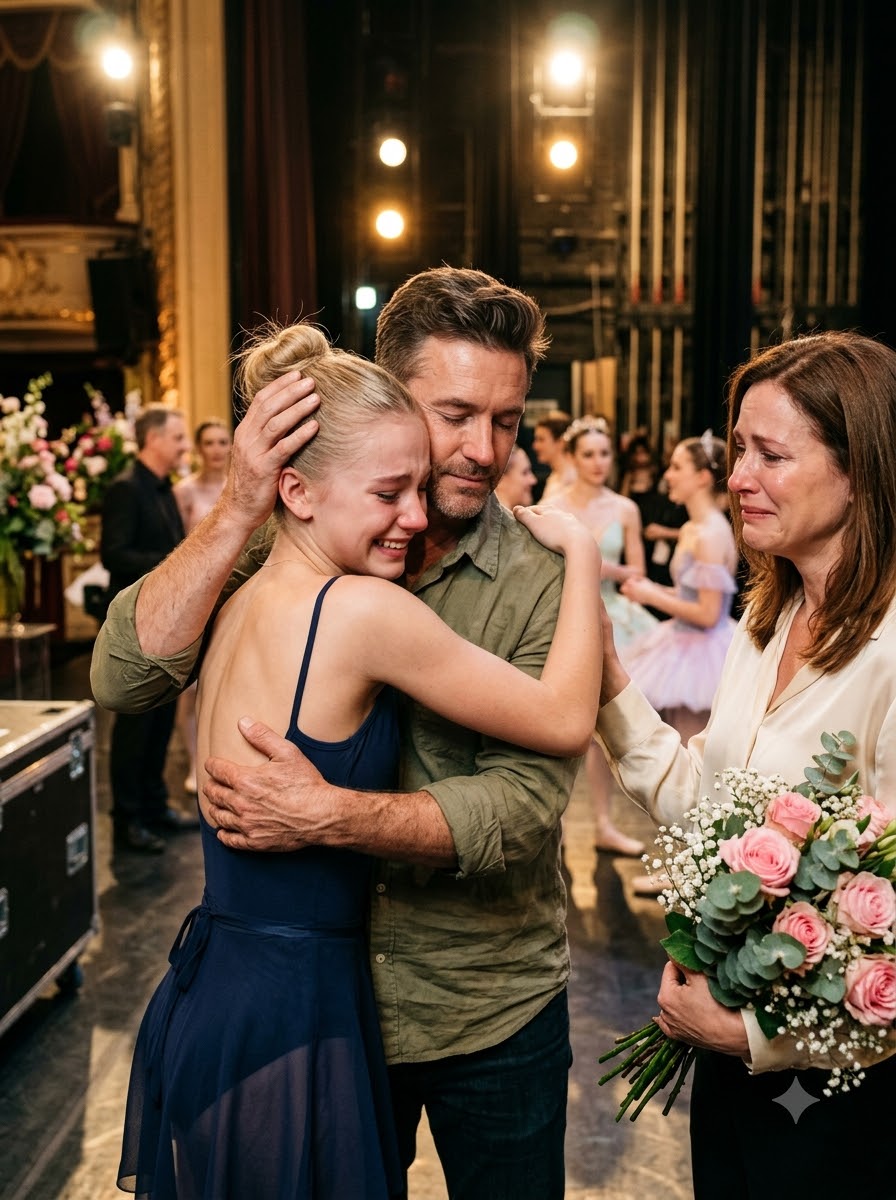
On the evening of the recital, Scott and I arrived early.
The auditorium was crowded with families.
Parents carried bouquets.
Children searched for familiar faces.
Backstage, dancers hurried between dressing rooms.
The atmosphere was filled with excitement and nervous anticipation.
I found Audrey standing near the entrance to the backstage area.
She was wearing her costume and carefully adjusting the ribbon near her shoulder.
For a moment, I simply watched her.
I remembered the little girl who had practiced beside our refrigerator.
I remembered the teenager who had burst through the front door waving her acceptance email.
And I remembered finding her alone beside the vending machine, convinced her parents no longer believed in her.
Now she was preparing to perform onstage.
I smiled.
“Nervous?”
She nodded.
“A little.”
I reached for her hand.
“You’ve worked so hard to get here.”
She looked down.
For a moment, I wondered whether she was remembering the weeks she had spent believing she wasn’t good enough.
Then she lifted her eyes.
“Mom?”
“Yes, sweetheart?”
She smiled.
“Watch this.”
I squeezed her hand.
“Always.”
A few minutes later, Audrey stepped onto the stage beneath the bright lights.
The audience grew quiet.
She took her position among the other dancers.
Then, just before the music began, she searched the front row.
Her eyes found mine.
I smiled.
And my daughter smiled back.
That single moment meant more to me than I could explain.
For weeks, someone she trusted had convinced her that the people who loved her most were ashamed of her dreams.
He had used our confidence in him to make her doubt her talent, her parents, and herself.
He had turned the car rides that were supposed to help her into the very thing that nearly destroyed her love of dancing.
But he hadn’t succeeded.
The truth had reached her.
She had found the courage to begin again.
And now she was standing on the stage she had dreamed about for years.
As the music started, I watched her dance.
I thought about how easily I had mistaken her silence for ordinary teenage moods.
How quickly Scott had dismissed my concerns because he trusted his oldest friend.
And how much pain might have been avoided if we had asked more questions and listened more carefully.
We had learned something that neither of us would forget.
Knowing someone for thirty years didn’t mean they could never disappoint you.
And loving your child didn’t mean you would automatically understand every struggle they were facing.
Sometimes love meant noticing when something had changed.
Sometimes it meant asking questions even when the answers might be uncomfortable.
And sometimes it meant standing beside your child while she rebuilt something another person had tried to take away.
That evening, I didn’t care whether Audrey danced perfectly.
I didn’t care whether she eventually became a professional ballerina.
I didn’t care whether her future led to Broadway, another stage, or an entirely different dream.
I cared that she was smiling again.
That she was doing something she loved.
And that she knew, without any doubt, that her parents were proud of her.
My daughter didn’t need to become a famous ballerina to make me proud.
She never had.
All I wanted was for her to understand that whatever dream she chose to pursue, she would never again have to wonder whether her mother was cheering for her.
Because from the moment she took her first uncertain steps across our kitchen floor to the night she stood beneath those stage lights, I had always believed in her.
And I always would.
