

PART 1
The Architect’s Final Checkmate
My survival began inside a sanctuary meant for rest, thick with deceit that tasted like oxidized copper.
In the towering Gothic nave of the Cathedral of St. John the Divine, the scent of thousands of white Casablanca lilies was no offering of peace. It formed an asphyxiating wall of perfume meant to hide the hostility rising from the front pews. I sat rigid on the polished oak bench, trembling fingers spread across the heavy curve of my belly. I was eight months pregnant. Beneath the black jersey of my dress, my unborn son kicked in erratic pulses, as if the bitter chill moving through my ribs had reached the womb.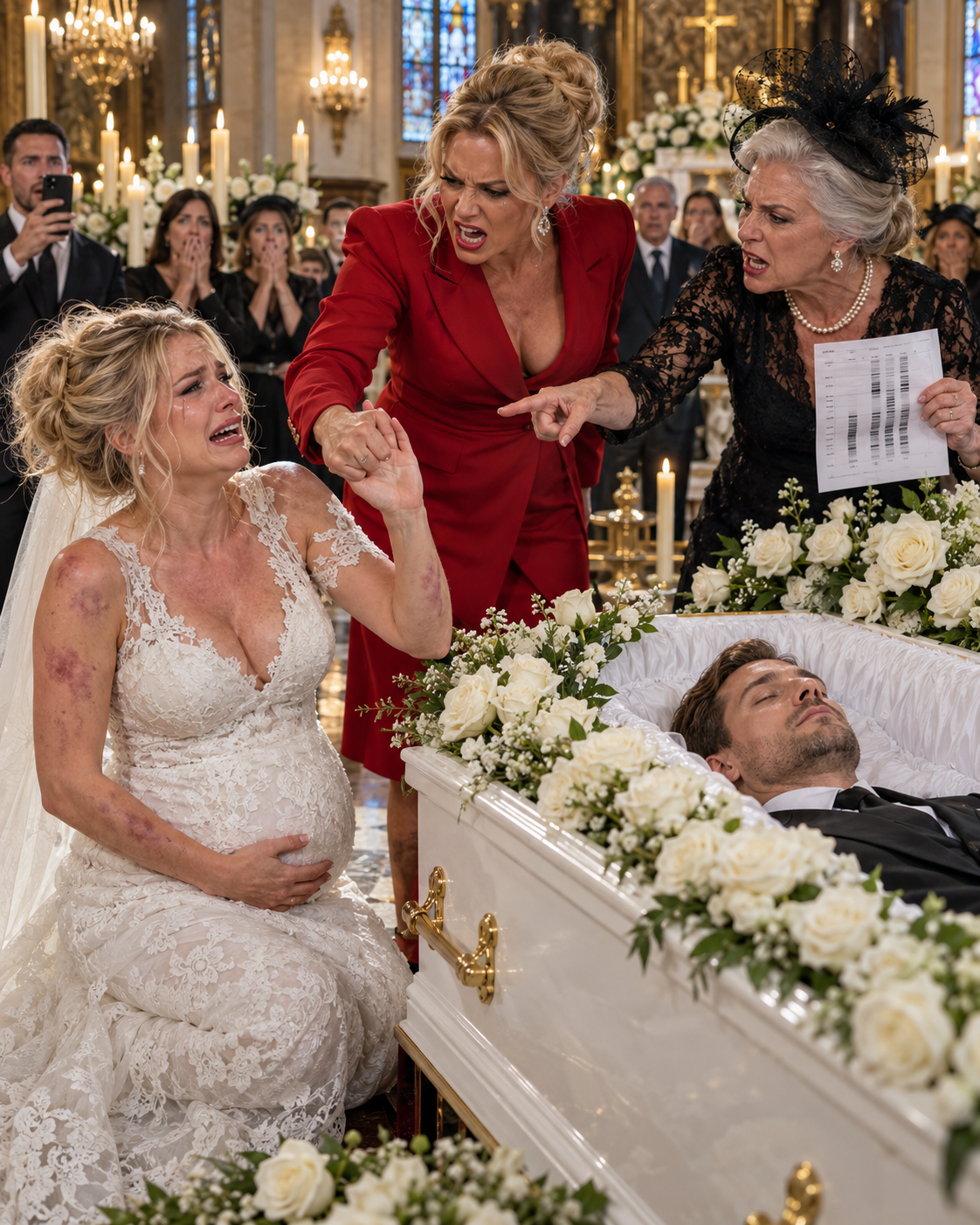
Grief dragged me like lead into dark water. Barely ninety-six hours had passed since two stone-faced state troopers stood on the granite steps of our Greenwich residence at three in the morning. Their cruiser’s lights painted the weeping willows and limestone facade in alternating crimson and electric blue, throwing shifting shadows into the marble foyer as they delivered the verdict that cut my life in two: a midnight crash on a jagged coastal bluff along Route 1. Complete mechanical failure. An explosion on impact. No survivors.
David was gone.
David Vance, thirty-four, the brilliant, reclusive polymath behind TechNova Solutions—a software and biomedical empire valued in eleven figures. To Wall Street and Silicon Valley he was an untouchable titan whose neural network algorithms had transformed modern diagnostics and defense systems. To me he was the man who made black coffee at dawn, who read Victorian poetry while I graded essays, and who curled his long frame around mine when the pressures of his lineage threatened to crush him.
I had been Sarah Cole, an ordinary high school literature teacher from upstate New York, before I entered his world. To David, our quiet apartment in Greenwich Village and later marriage had been an oasis of genuine humanity in a desert of manufactured status. To the dynasty that bore his name, I was an opportunist who had picked the lock of their private treasury.
Now David rested in a sealed, six-thousand-pound bronze-and-mahogany casket on the marble dais of the altar. Around him sat four hundred dignitaries: venture capitalists, foreign ambassadors, tech executives, and high-court judges. They had not come to grieve. They had come to measure the power vacuum, eyes darting hungrily across the altar like vultures over an unattended kill.
Across the central aisle sat the matriarch, Eleanor Vance.
She shed no tears behind the intricate lattice of her vintage French lace veil. Tailored in charcoal bespoke wool and adorned with South Sea pearls worth enough to buy an entire school district, Eleanor held a posture as unyielding as structural steel. She was not praying. Her manicured thumbs flicked across a secured satellite phone, pausing only to cast dissecting, venomous glances at my stomach. Her pale, flint-colored eyes held no maternal sorrow; they were the calculating eyes of an apex predator waiting for its prey’s heart to beat its final time.
Beside her sat Chloe Vance, David’s twenty-four-year-old sister. Chloe shifted continually on the cushioned pew, adjusting her oversized designer sunglasses and exhaling audibly to show her boredom. For four years, mother and daughter had waged a relentless, quiet campaign against me. They had scrubbed my name from benefit galas, seeded venomous rumors in society columns about my modest family, and treated my presence as an unsightly stain on their pedigree.
David had always stood between us like an iron fortress. He had publicly rebuked Eleanor during board meetings, stripped Chloe of her corporate allowances when her malice escalated, and made it clear that his fortune and loyalty lay with the family he was building with me.
“I have built the walls thick enough, Sarah,” David had whispered into my hair the morning he left for California, his voice frayed by an exhausting, sleepless week I had failed to understand. “Whatever storm breaks, do not run. Stand in the center of the room, hold your chin high, and let Marcus speak. Promise me.”
I had promised, kissing his jaw without realizing I was kissing a man already standing at the edge of an abyss.
The choir’s Latin dirge swelled to an operatic crescendo, reverberating against the ribbed vaulted ceiling. Suddenly Eleanor closed her phone with a distinct metallic snap. She slid the device into her crocodile clutch, lifted her chin, and stood.
She did not wait for the bishop to deliver the benediction. Ignoring liturgical order, the matriarch stepped out of her pew. The sharp strike of her stiletto heels against the cold flagstones echoed through the hall like the ticking of an execution clock.
She did not look toward the altar rail. Her eyes locked onto mine.
A sudden, suffocating hush fell over the four hundred attendees. The choir’s voices cracked and faded into ragged silence. In the pews, senators, financiers, and board members leaned forward, silk lapels rustling like dry autumn leaves before a storm.
My heart hammered against my ribs. Using the oak armrest for leverage, I forced my swollen ankles to bear my weight and stood. I laid one trembling palm against the cold bronze trim of David’s casket, praying to whatever remained of his spirit to steady my failing limbs.
Eleanor stopped two paces away. The scent of her custom tuberose and bitter almond perfume washed over me, sharp, suffocating, and medicinal.
“Step away from him, Sarah,” Eleanor commanded. Her tone was not hushed; it projected with crisp, theatrical precision, reaching the acoustic sweet spots of the cathedral’s nave.
“Eleanor, please,” I whispered, the words catching in my dry throat. “Whatever you have to say to me, say it tomorrow. Have some decency. Let us commit your son to the earth.”
“Commit him?” Eleanor produced a cold, humorless chuckle that rang off the stone apostles carved into the nearby pillars. “My son will never rest peacefully while an interloper attempts to seize his life’s work through bastardy and fraud.”
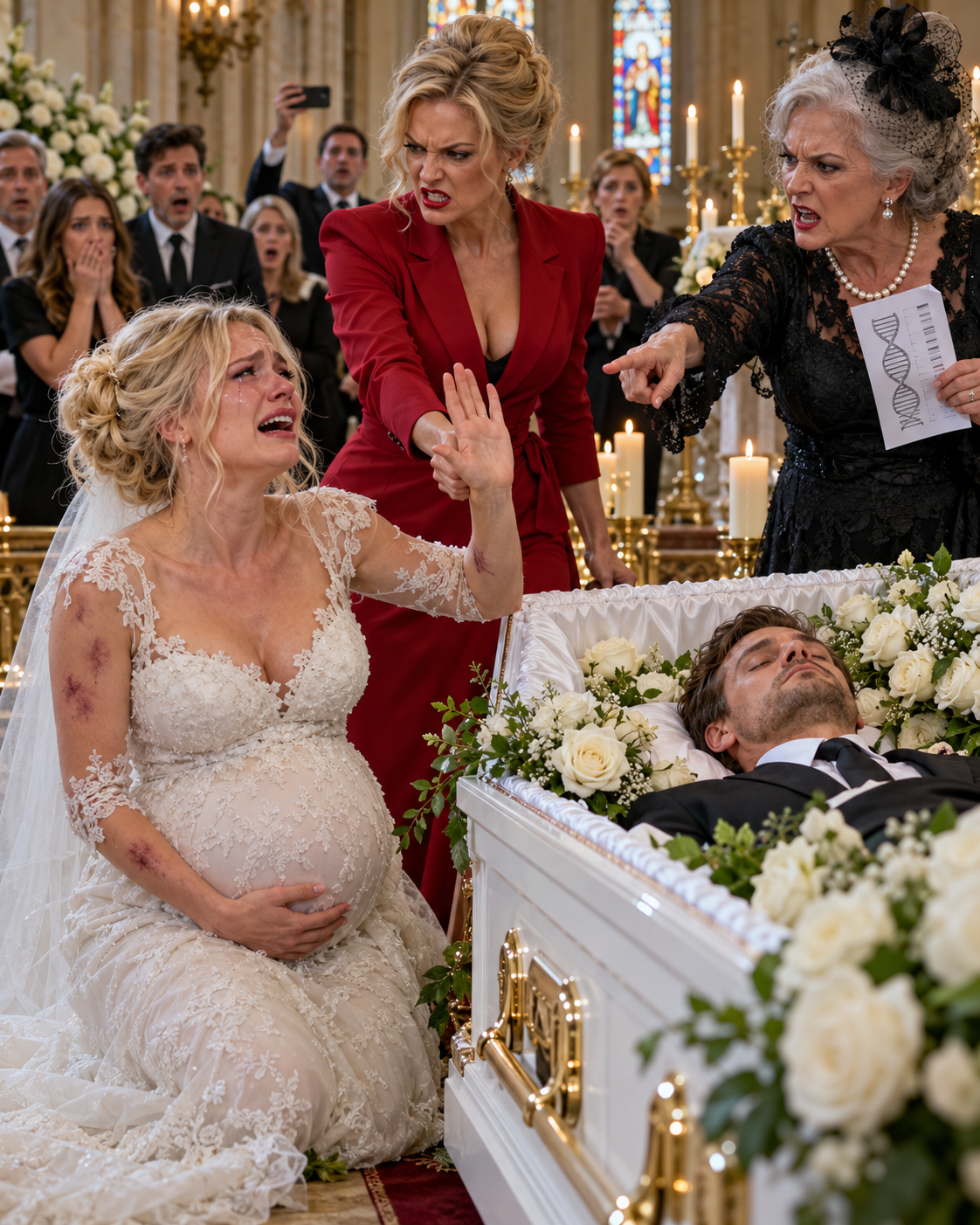
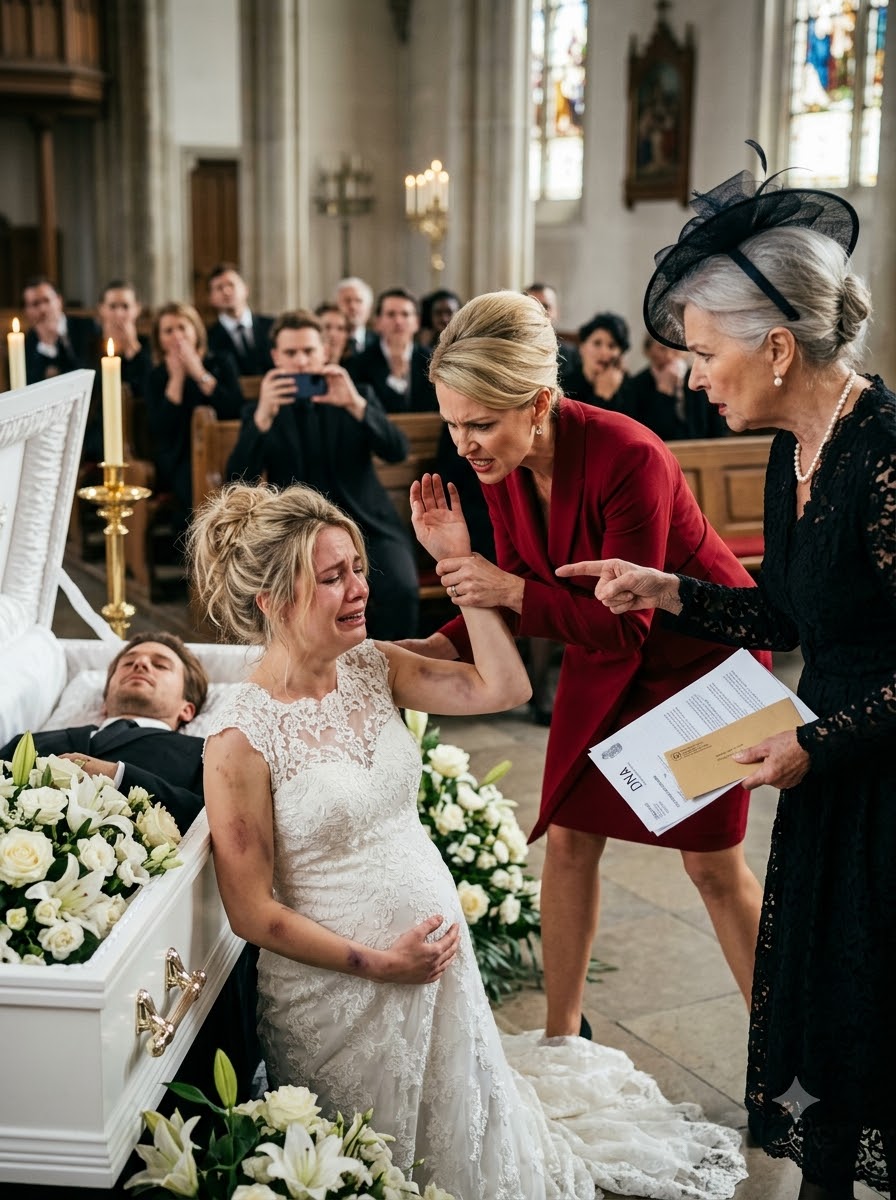
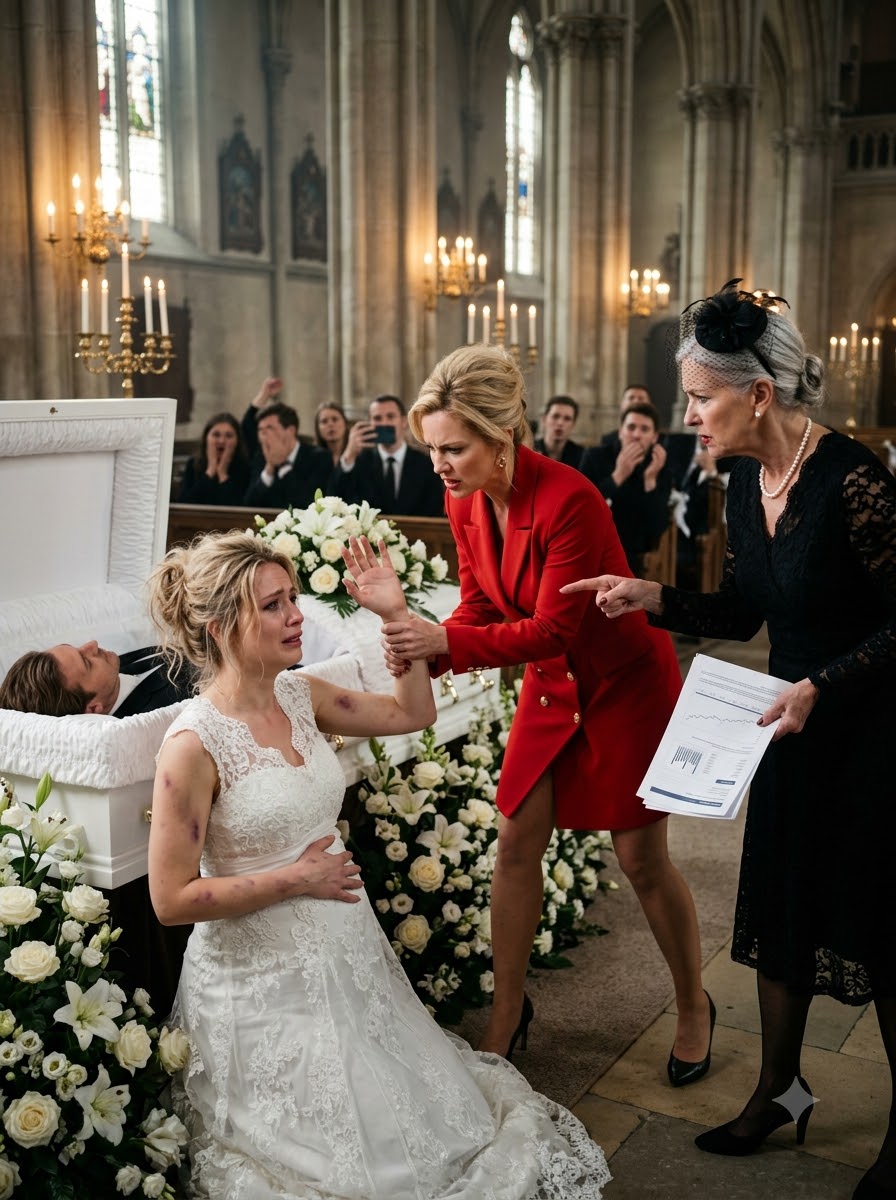
From beneath her tailored wool jacket, Eleanor produced a thick manila folder bound in red legal tape. With a swift, violent flick of her wrists, she slammed the dossier onto the polished mahogany lid of David’s casket.
The sound tore through the nave like a gunshot.
My eyes fell on the top sheet, printed on clinical, heavy-bond parchment bearing the official header of Clinical Genetics Laboratories of New York:
OFFICIAL GENETIC ANALYSIS REPORT
SUBJECT: UNBORN MALE FETUS (SARAH VANCE)
PUTATIVE FATHER: DAVID EMANUEL VANCE
ALLEGED PATERNITY INDEX: 0.00%
CONCLUSION: THE ALLEGED FATHER IS DEFINITIVELY EXCLUDED AS THE BIOLOGICAL PARENT.
The floor seemed to tilt beneath my shoes. The surrounding stained glass fractured into streaks of dizzying color. “This… this is an obscenity,” I stammered, my voice cracking as tears burned behind my eyes. “I have never touched another man in my life. David is the father of my son. You fabricated this!”
“Science does not lie, Sarah,” Eleanor announced, turning her back to me to project her voice toward the front pews where TechNova’s executive board sat in stunned silence. “This test was performed using fetal cell samples collected during her third-trimester prenatal workup at Presbyterian Hospital. This woman sought to cement herself to a ten-billion-dollar corporate trust through calculated deceit. But the bloodline remains pure.”
Eleanor swung back toward me, her veil trembling with suppressed fury. “The locks on the Fifth Avenue penthouse were changed three hours ago. Your wardrobe and personal items have been deposited on the pavement outside. Your credit accounts are frozen. TechNova will not provide you with a single penny, a single roof, or a single shred of legitimacy. You leave this cathedral a stranger, stripped of our name.”
Before breath could return to my lungs, Chloe slipped around her mother’s flank. A sneer of absolute triumph curled her lip as she grabbed my left hand.
“And this,” Chloe whispered, her manicured nails digging into my wrist, “never belonged to a penniless schoolteacher anyway.”
With a sudden, vicious yank, Chloe wrenched the four-carat emerald-cut diamond engagement ring and the matching platinum wedding band over my swollen, water-retaining knuckle.
The metal scraped against the flesh, shearing the skin. A sharp gasp tore from my throat as dark drops of blood welled up, dripping down my knuckles onto the black fabric of my maternity dress.
“Much better,” Chloe mocked, holding the glistening diamonds above her head so the photographers in the transept could capture the glitter. “My brother paid half a million dollars for this set. You aren’t fit to sweep our floors, let alone wear his ring.”
Whispers erupted across the pews, spreading like fire across dried brush.
“A zero percent match? Lord help her…”
“Eleanor always claimed the marriage was a trap…”
“The entire estate reverts to the mother now. Look at the board, they’re already taking notes…”
I staggered back against the carved marble chancel rail, clutching my bleeding hand against my chest, shielding my abdomen with my forearm. The humiliation was physical—a wave of dizziness so profound I felt my knees buckle. I was completely alone, pregnant, disgraced in front of the most powerful people on the eastern seaboard, and entirely defenseless.
Eleanor signaled with two gloved fingers toward the transept doors. “Security! Remove this trespasser from the property immediately. If she refuses to leave the altar, have the marshals carry her out.”
Two burly private security contractors in matching charcoal suits started down the steps, their rubber-soled shoes squeaking against the stone floor. I flattened myself against the cold bronze edge of David’s casket, closing my eyes and whispering a desperate, silent apology to my unborn child for failing to protect our dignity.
Then an ear-splitting concussion shook the cathedral walls.
CRASH.
The massive, iron-reinforced oak double doors at the cathedral’s western entrance flew open and slammed against the stone interior with the force of an explosion. The shockwave rattled the massive brass chandeliers suspended eighty feet above our heads.
A single, booming baritone voice cut through the cavernous space with the authority of an artillery shell.
“Per the explicit, legally binding instructions of David Vance,” the voice resonated, “no one leaves this sanctuary until the true evidence is presented.”
Every neck in the nave craned toward the entrance.
Walking down the center aisle, flanked by four federal agents in sharp dark suits, was Marcus Sterling—senior managing partner of Sterling & Vance LLP, chief general counsel to TechNova, and the only man David had ever trusted without reservation. Sterling was sixty-two, built like a lightweight boxer, with steel-gray hair and eyes as hard as polished slate. He did not walk with the hurried gait of a lawyer scrambling to file a stay; he advanced with the deliberate, heavy confidence of an inquisitor stepping onto an execution ground.
Behind him, two technicians wheeled portable data cases and heavy transmission monitors toward the chancel.
“Marcus?” Eleanor’s voice went sharp, the composed facade of the grieving matriarch cracking into an ugly sneer. “What is the meaning of this spectacle? This is a private memorial service! Officers, remove Mr. Sterling from this sanctuary immediately!”
The church’s private security guards stepped forward to intercept the attorney, but the two men flanking Sterling flashed federal gold shields from within their lapels.
“United States Marshals, Mrs. Vance,” Sterling said calmly, not breaking his stride until his polished Oxfords reached the bottom step of the altar. “Your private security will stand down, or they will be remanded into federal custody for obstruction of justice. Take your seat, Eleanor.”
“How dare you!” Eleanor hissed, her cheeks flushing a violent, mottled crimson. “My son lies in that casket! I am the head of this family! I hold the governing shares of TechNova!”
“You hold nothing,” Sterling replied, his voice deadpan and icy.
He drew an encrypted remote control from his breast pocket, pointed it toward the dark arches of the cathedral’s ceiling, and depressed a single toggle.
With a low, mechanical hum, a motorized high-definition projection screen lowered from the gloom above the choir loft, settling directly above the altar and hanging suspended over David’s casket.
Eleanor gathered herself, smoothing the lace over her lapels with trembling hands, forcing a condescending smile to return to her lips. “If this is David’s memorial montage, it is in flagrant violation of protocol to screen it without my review. Though I suppose it is only appropriate that his final tribute honors the woman who financed his education and built his career.”
She adjusted her veil, adopting an expression of pious, martyred sorrow for the cameras.
A sharp, electric tone echoed through the cathedral’s sound system. The projector snapped on, flooding the sanctuary with cold, luminescent white light. The digital feed resolved into an image that caused the breath to leave my body violently.
It was David.
He was seated behind the heavy mahogany desk in our private home study in Greenwich. He wore his favorite faded navy cashmere sweater, the sleeves pushed up to his elbows. But the sight of him made tears burn my eyes. His face was drawn and dangerously pale; heavy bruised circles sat beneath his eyes, and his hand shook slightly as he set down a pen. Yet his hazel eyes were laser-focused, burning with a cold, terrifying clarity.
“If you are watching this broadcast,” David’s voice boomed through the sanctuary’s line-array speakers, deep, rich, and unmistakably alive, “it means that my worst calculations were accurate. It means I did not survive long enough to dismantle the rot myself.”
A collective, horrified gasp rippled through the pews. Several board members rose halfway out of their seats, staring in disbelief at the twenty-foot image of their late chief executive.
On the screen, David’s gaze seemed to shift downward, settling directly upon where I stood clutching my bleeding hand. His expression shifted, melting into an expression of tender, heartbreaking warmth.
“Sarah,” he said softly, his voice filling every corner of the church like a private confession. “You were the only truth I ever found in a world constructed of manufactured illusions and transactional affection. If I have failed to protect you with my presence, know that I have fortified you with my foresight. Do not fear for our son.”
David tapped a key on his laptop, and the screen split in two. To the left, his recorded visage remained steady; to the right, high-resolution scans of signed legal instruments appeared.
“Three weeks ago,” David continued, “I executed a total restructuring of my personal and corporate holdings. Every share of Class-A voting stock in TechNova, every patent portfolio, every offshore reserve, and every deed belonging to the Vance estate was permanently transferred into the Aegis Irrevocable Blind Trust. The sole, absolute beneficiary of that trust is my wife, Sarah Vance, and our unborn child. The paperwork was filed with the Delaware Chancery Court and ratified by the Securities and Exchange Commission forty-eight hours before my departure.”
“No!” Eleanor shrieked, lunging toward the altar steps, her fingers clawing at the air. “It’s a fake! He was coerced! He was mentally incapacitated! Turn that off right now!”
“And to my mother, Eleanor,” David’s voice continued, cutting through her protests with relentless, mathematical detachment. His face on screen turned cold, shedding all warmth. “Did you truly believe your forensic accounting was as sophisticated as mine?”
The split screen changed again. The trust documents vanished, replaced by an intricate labyrinth of forensic accounting flowcharts, bank ledgers from Zurich and Grand Cayman, and certified wire transfer receipts.
“For thirty months,” David announced to the silent room, “Eleanor Vance and Chloe Vance have systematically diverted over thirty-four million dollars from the Vance Pediatric Research Foundation—a non-profit entity dedicated to funding cancer treatments for underprivileged children. The funds were routed through seventeen nested shell entities to cover Chloe’s catastrophic debts with high-stakes sportsbooks in Macau, and to backstop Eleanor’s insolvent boutique developments in Monaco.”
Murmurs of shock turned into open outrage. Two senior board directors looked away from Eleanor in utter disgust.
“Every transaction bears your digital signatures,” David noted coldly. “Every route has been verified by the Department of Justice. But the theft, Mother, is merely a misdemeanor compared to the trap you set in my home…”
The cathedral descended into an icy, petrified silence. Even the breathing of the crowd seemed to stop.
David’s image disappeared from the split screen, replaced by high-definition infrared surveillance video. A timestamp in the lower-right quadrant glowed in crisp green numbers: TUESDAY, 02:14:18 AM.
The camera looked down at the subterranean garage of our private Greenwich estate. David’s vintage dark-green Aston Martin sat parked beneath the overhead lights.
A figure emerged from the service corridor, clad in a full-length black overcoat and soft leather gloves, carrying a mechanic’s diagnostic case.
PART 2
The figure knelt beside the front-left wheel well of David’s car, systematically unclamping the protective housing and cutting the primary hydraulic brake lines, before splicing a remote kill-switch into the vehicle’s electronic stability control unit. The work took fourteen meticulous minutes.
When the task was finished, the saboteur stood, stepped into the light of the overhead halogen fixture, and lowered her cashmere scarf to wipe a bead of perspiration from her forehead.
The high-definition night-vision camera captured the face with terrifying clarity.
It was Eleanor Vance.
A collective shriek of horror ripped through the congregation. Socialites covered their mouths, backing into their pews. Three corporate officers immediately stood and headed toward the side exits, desperate to untangle themselves from the scene.
“You believed the brake failure on the coastal cliffs would appear to be an unfortunate mechanical error on a notorious stretch of highway,” David’s recorded voice echoed, resonant with sorrow and unyielding wrath. “You believed that with me dead, you could forge a medical report, humiliate my wife, strip her of her legal rights, and reclaim the fortune you squandered. But my security team upgraded the garage’s optical sensors three months ago. I knew what you were capable of, Eleanor. I knew the extent of your depravity.”
On the massive screen, David leaned back into his leather chair, a faint, melancholy smile playing on his lips.
“You destroyed your son for an inheritance that was already gone. You have ended our lineage in greed and shame. May God have more mercy on your soul than the law will have on your freedom.”
The projection flickered out. The vast nave was plunged back into the cold, gray light filtering through the stained glass windows.
A raw, animalistic howl tore from Eleanor’s throat. Her legs failed completely, and she crashed down onto the marble flagstones, her lace veil tearing from her hair and fluttering like a wounded bird onto the floor.
“It’s an artificial intelligence fabrication!” she screamed, her voice cracking as she clawed at the stone, looking frantically around the hall for allies who were already averting their eyes. “He was a computer programmer! He generated this video! It’s a lie! Chloe, tell them! Marcus, you treasonous dog, I hired you!”
Marcus Sterling did not answer. He merely raised his right hand toward the western doors.
Six uniformed officers of the New York Police Department and two state detectives advanced down the center aisle, their handcuffs glinting under the lights.
“Eleanor Vance,” Detective Miller announced, his voice ringing flatly across the altar as he forced her arms behind her back. “You are under arrest for attempted murder, criminal conspiracy, grand larceny, and corporate fraud. You have the right to remain silent.”
“Unhand me!” she shrieked, thrashing on the stone floor, her designer shoes slipping from her feet. “I am Eleanor Vance! I own this city! I own the governor! You cannot touch me!”
The sharp, metallic click of the steel handcuffs locking around her wrists silenced her threats. The officers hoisted her to her feet, dragging her down the marble steps as she kicked and cursed, her dignified facade entirely destroyed.
I stood beside the casket, my hand still throbbing from the severed skin, watching her removal not with joy, but with an immense, hollow stillness.
Then I turned toward Chloe.
The younger woman was pressed back against the communion rail, trembling so hard her teeth rattled audibly. The arrogance had vanished; in its place was a terrified twenty-something clutching a handful of stolen jewelry.
I walked toward her. My steps were slow, heavy, and deliberate.
I reached out my injured left hand, where dark crimson continued to bead along my torn knuckle.
“My ring, Chloe,” I said.
Chloe flinched violently. She fumbled with her purse, dropping it onto the floor, scattering compacts and lipstick across the marble. Weeping uncontrollably, she stripped the four-carat emerald diamond and the platinum band from her fingers and held them out with trembling hands.
“Sarah… please,” Chloe wept, sinking to her knees on the steps. “I didn’t know about the car! I swear to God I thought it was just the money! Please, don’t let them send me to prison!”
“Give me the ring,” I repeated softly.
She dropped the cold metal into my open palm.
Without breaking eye contact, I slid the platinum band and the diamond back over my wounded finger. The sharp sting of the cut was a sobering jolt: I had bled, but I was the one left standing.
As the officers escorted a sobbing Chloe toward the side doors in the custody of federal marshals, Marcus Sterling walked up the altar steps and stood beside me. He slipped a heavy, wax-sealed leather portfolio from his briefcase and extended it toward me.
“She was wrong about everything, Mrs. Vance,” Sterling said quietly. “David planned for every eventuality. He left this for your eyes only.”
I took the portfolio. Emblazoned beneath the Vance family signet in bold red ink were three words:
CONTINGENCY OMEGA — CLASSIFIED.
Six months later, the view from the forty-fourth floor of the TechNova Tower in Midtown Manhattan was blinding in its clarity.
I stood before the floor-to-ceiling glass wall, looking out over the sprawling grid of the city below. The late-afternoon sun cast long, burnished bronze reflections across the Hudson River. In my arms, I held David Jr.
He was five months old now—healthy, laughing, with his father’s thick dark hair and strikingly clear, observant hazel eyes. He clutched at the lapel of my tailored ivory silk blouse, babbling softly as he watched the distant yellow cabs crawl through the streets below.
Behind me, the great oval boardroom of TechNova was completely silent.
The thirty-two men and women seated around the Brazilian rosewood table were not the condescending socialites who had whispered during the funeral. They were division chiefs, chief technology officers, and institutional investors who had spent the last two quarters realizing that the former literature teacher was not a placeholder.
I had spent eighteen hours a day immersed in our source code repositories, patent applications, and supply-chain logistics. Aided by Marcus Sterling, I had systematically removed every director who had turned a blind eye to Eleanor’s financial draining of the company.
“The restructuring of our biomedical division is finalized,” I announced, turning away from the window, my voice cutting cleanly through the room. “We have reallocated eighty-five million dollars from legacy executive bonus reserves directly into the pediatric neural imaging project. The automated cancer detection algorithm David patented before his passing will be made available to public hospital networks at cost. TechNova will remain an industry leader, but we will not turn human suffering into speculative margins.”
The senior vice president of engineering, a veteran who had worked with David since the company’s founding, bowed his head in genuine respect. “The institutional markets have embraced the realignment, Chairwoman. The stock closed at an all-time high following the third-quarter audit. The firm is solid.”
“Then we are finished for today, ladies and gentlemen,” I said, offering a curt nod.
The directors gathered their devices and portfolios, filing out of the room with hushed deference. When the double doors sealed shut, only Marcus Sterling remained, his leather briefcase open on the table.
“Eleanor’s sentencing proceeding ended an hour ago,” Marcus noted, pushing his wire-rimmed glasses up his nose.
I rested David Jr. against my shoulder, feeling a cold stillness wash through my chest. “What was the outcome?”
“Life without parole at Bedford Hills Correctional,” Sterling answered evenly. “Her appeals were dismissed based on the infrared footage and the physical evidence recovered from the garage. Her private accounts were liquidated to cover federal restitution orders. She will spend the rest of her days behind concrete walls, Sarah.”
“And Chloe?”
“Chloe accepted the plea agreement for wire fraud and conspiracy,” Marcus continued. “Because she testified regarding Eleanor’s offshore shell network, she avoided state prison. She received eight years of criminal probation, full asset forfeiture, and her wages are subject to mandatory garnishment. She is currently living in a subsidized room in Queens, working cleaning shifts at an industrial laundry.”
A quiet breath escaped my lips. The sister who had mocked my modest origins was now learning the dignity of hard labor through survival.
“You managed it well, Marcus,” I said softly, looking at my sleeping son. “David would be proud.”
“David laid the foundation, Sarah,” Marcus answered, a rare, warm smile softening his features. “You were the one who held the walls.”
That night, I retreated to our new sanctuary—a secluded coastal property on the outer shores of Montauk. We had sold the Greenwich estate with its tragic garage and lingering ghosts. Here, high dunes, an automated security grid, and maritime patrols formed an impenetrable barrier against the outside world.
I placed David Jr. into his crib on the second floor, lingering to kiss his warm forehead as he drifted off into an easy sleep.
Downstairs, an autumn squall lashed against the heavy, impact-resistant windows. Rain streamed down the glass in gray sheets while a fire burned quietly in the stone hearth, casting amber light across the bookshelves of my study.
I sat at the desk to sort through the day’s correspondence—legal filings, corporate authorizations, and foundation reports.
Near the bottom of the stack, my fingertips brushed against a coarse, gray envelope.
My breath hitched.
The envelope was postmarked from Bedford Hills Correctional Facility, stamped with an inmate registration code in faded black ink. Eleanor.
For a long moment, I stared at the paper. My first impulse was to feed it straight into the roaring flames. She was broken. She was contained. She was nothing more than an echo screaming through concrete.
I picked up the brass letter opener, hesitated, and then tossed the sealed letter directly onto the glowing logs in the hearth.
“You have no power here,” I said into the empty room.
I watched the flames catch the corner of the gray paper, the heat curling the envelope into delicate, blackened ash. But as the thermal draft caused the paper to turn over once before disintegrating, my blood ran cold.
Drawn on the back in precise, mechanical charcoal strokes was an architectural section of the Montauk estate. It was not a rough sketch; it was an exact copy of the building’s engineering plans.
A neat black circle was drawn around the second-floor nursery window.
And beneath it, written in sharp, rigid script, was a single sentence:
The real architect is still outside.
Five years passed.
Five years of perpetual vigilance. Five years of private security details, rigorous background checks for every domestic employee, and sweeping counter-surveillance measures overseen by Marcus Sterling. We tracked down every fixer, every disbarred attorney, and every associate Eleanor had ever contacted. All had scattered the moment her bank accounts were seized. The prison letter had yielded no forensic leads—Eleanor refused to speak with investigators, spending her days staring silently at her cell wall.
Yet paranoia is a poison that seeps into the bones; you cannot raise a child in the shadows without fearing the dark.
Still, a child demands light.
On a crisp October afternoon, the air along Greenwich Street in Tribeca was clean, scented with roasting coffee and dry sycamore leaves. I walked out of a neighborhood bakery, holding the warm, energetic hand of my five-year-old son.
David Jr. had grown into an extraordinary child. He possessed his father’s sharp intellect, an easy, generous smile, and a persistent habit of taking apart the components of his mechanical toys to study how the gears interacted.
“Mom, are we still going to give the ducks the oats after we visit the garden?” he asked, looking up at me with large, earnest hazel eyes while holding a brown paper bag of cinnamon rolls.
“Of course, sweetheart,” I replied, smoothing down his unruly dark hair. “First we visit Dad, then the pond, then hot chocolate.”
As we stood at the intersection waiting for the pedestrian signal, my eyes drifted across the street toward a produce storefront.
Hunched against the brick wall was a thin woman in a faded, oil-stained utility jacket. Her hair was pulled back into a hasty, frayed bun, her knuckles red and cracked from the cold water as she pushed an industrial mop across the wet tile floor of the shop entrance. She moved like someone twice her age, though I knew she had just turned thirty.
She looked up. Her exhausted, hollow eyes met mine.
It was Chloe.
The surrounding sounds of traffic and conversation seemed to fade into a distant drone. Five years earlier, those eyes had gleamed with cruel delight as she ripped my wedding ring from my bleeding flesh on the steps of the altar.
I waited for a surge of anger to surface. I waited for the cold satisfaction of seeing someone who had tried to ruin me reduced to poverty.
Instead, I felt only a profound, quiet sorrow for a life hollowed out by vanity. Chloe was paying for her arrogance one floor at a time, entirely forgotten by the high-society circles that once indulged her. She looked at my wool coat, looked down at my thriving son, and then lowered her head, her thin shoulders shaking with silent, humiliated sobs as she turned her mop back toward the curb.
I did not sneer. I did not break my stride.
I squeezed my son’s hand, stepped onto the crosswalk, and left the remnants of the old dynasty behind us on the pavement.
An hour later, the afternoon sun hung low over the rolling hills of the cemetery, filtering through the amber and gold canopy of the weeping willows.
The private family plot sat atop a quiet ridge, surrounded by well-kept hedges and blooming heather. The simple black granite marker bearing David’s name was clean and unblemished.
David Jr. stepped onto the grass, carefully kneeling to lay a single white lily at the base of the stone, just as we did every autumn.
“Hello, Dad,” the little boy murmured, his fingers gently tracing the carved letters. “I solved the three-gear puzzle today. And I looked after Mom, just like you asked.”
A tear slipped silently down my cheek—not of despair, but of hard-earned closure. I touched the cool stone beside him, feeling the sharp edges of the granite under my palm.
“We held the line, David,” I whispered into the cool breeze. “TechNova is whole. Our son is safe, healthy, and kind. You built the sanctuary, and I defended it.”
I took a deep breath of the autumn air, feeling the lingering weight between my shoulders ease. The war was over. The estate was secure. The future belonged to my son.
“Come along, David,” I said gently, reaching out my hand. “The hot chocolate is waiting in the car.”
My son did not turn.
He remained kneeling on the grass, his head tilted, staring past the weeping willow toward a dense row of pines flanking the old cast-iron gate of the estate’s private lane.
“David?” I asked, my voice tightening as an old, familiar dread stirred in my stomach. “What are you looking at?”
The boy raised a small finger, pointing directly toward the shadows between the trees.
“Mommy,” he whispered, his innocent voice cutting through the stillness of the cemetery. “Why is that man standing there? And why is he wearing Daddy’s blue watch?”
A cold spike of adrenaline surged through my veins.
I whipped my head toward the tree line.
Standing fifty yards away in the violet dusk was a tall, broad-shouldered silhouette in a dark overcoat. His features were hidden by the evening shadows, but he stood completely motionless, his gaze fixed on my son.
As the wind stirred the branches, a lingering ray of late sunlight cut through the trees, glinting against the man’s left wrist.
There, shining undeniably against the dark cuff, was a custom platinum chronograph with an azure lapis-lazuli dial—a one-of-a-kind timepiece I had commissioned and personally engraved for David on our wedding morning.
The very watch that state investigators reported had melted into unrecognizable ash in the fire on Route 1.
The figure lifted his left hand, touched two fingers to his temple in a familiar, private salute, and stepped backward into the gathering dark of the woods.
