

PART 1
The noise came first. It wasn’t the sound of voices or footsteps, but the rough scrape of a man’s shoes against marble that had witnessed two decades of justice. Everyone inside Courtroom 4B of the Eastfield Federal Courthouse looked up from their phones, paperwork, and quiet morning routines.
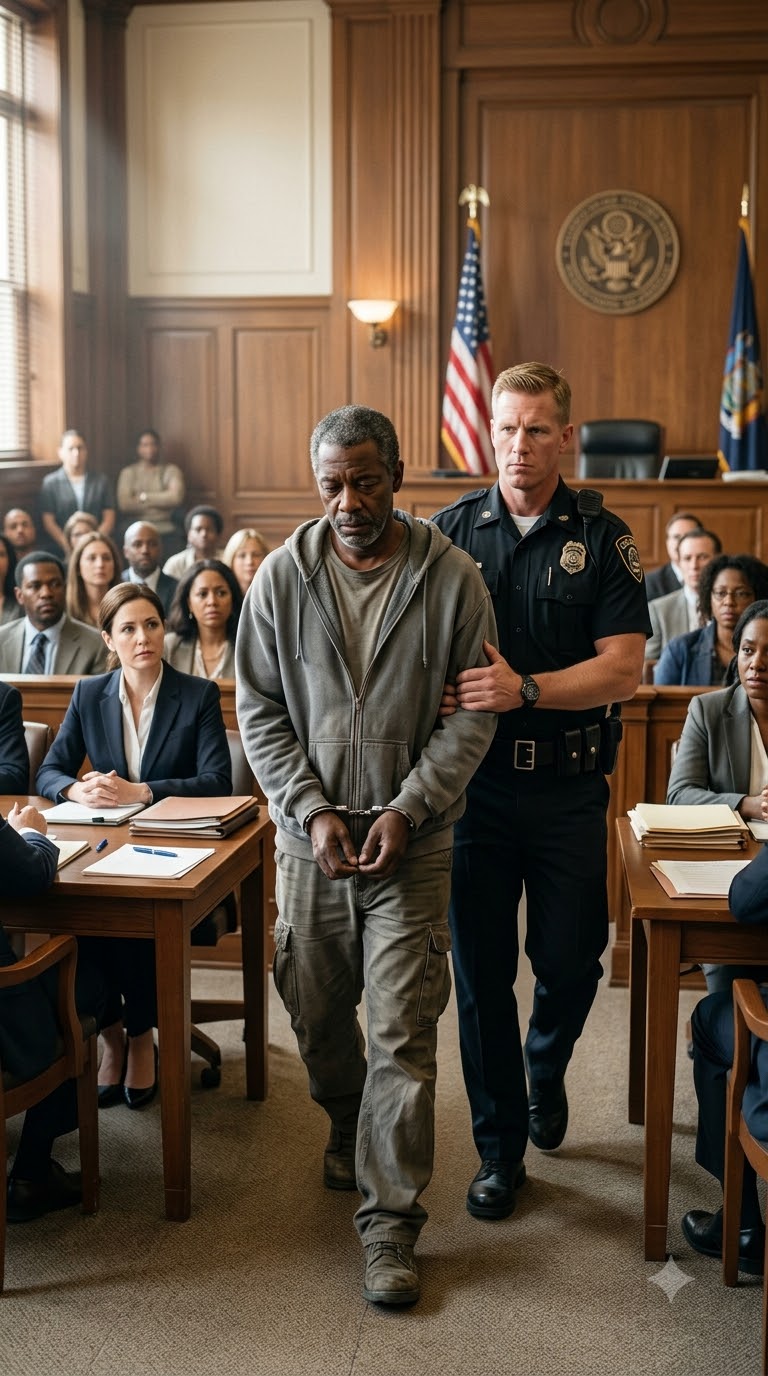
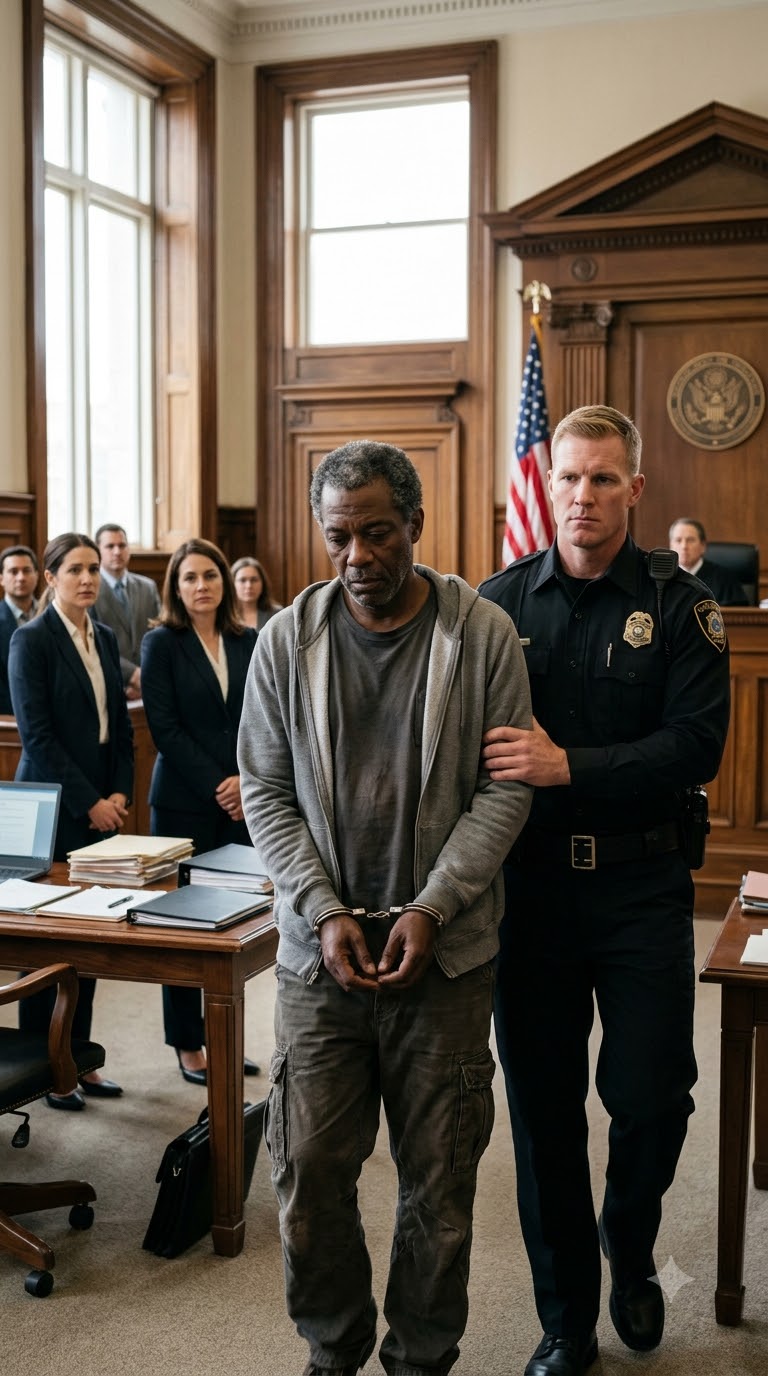
What they saw left the entire room stunned. Officer Derek Calloway, badge number 1147, a twelve-year veteran with two commendations hanging above his desk at home, was dragging a Black man in a torn gray hoodie across the floor by his collar. He wasn’t walking him.
He wasn’t escorting him. He was dragging him as though he were an object unworthy of even the slightest courtesy. Then he threw the man into the defendant’s chair like a sack of wet laundry.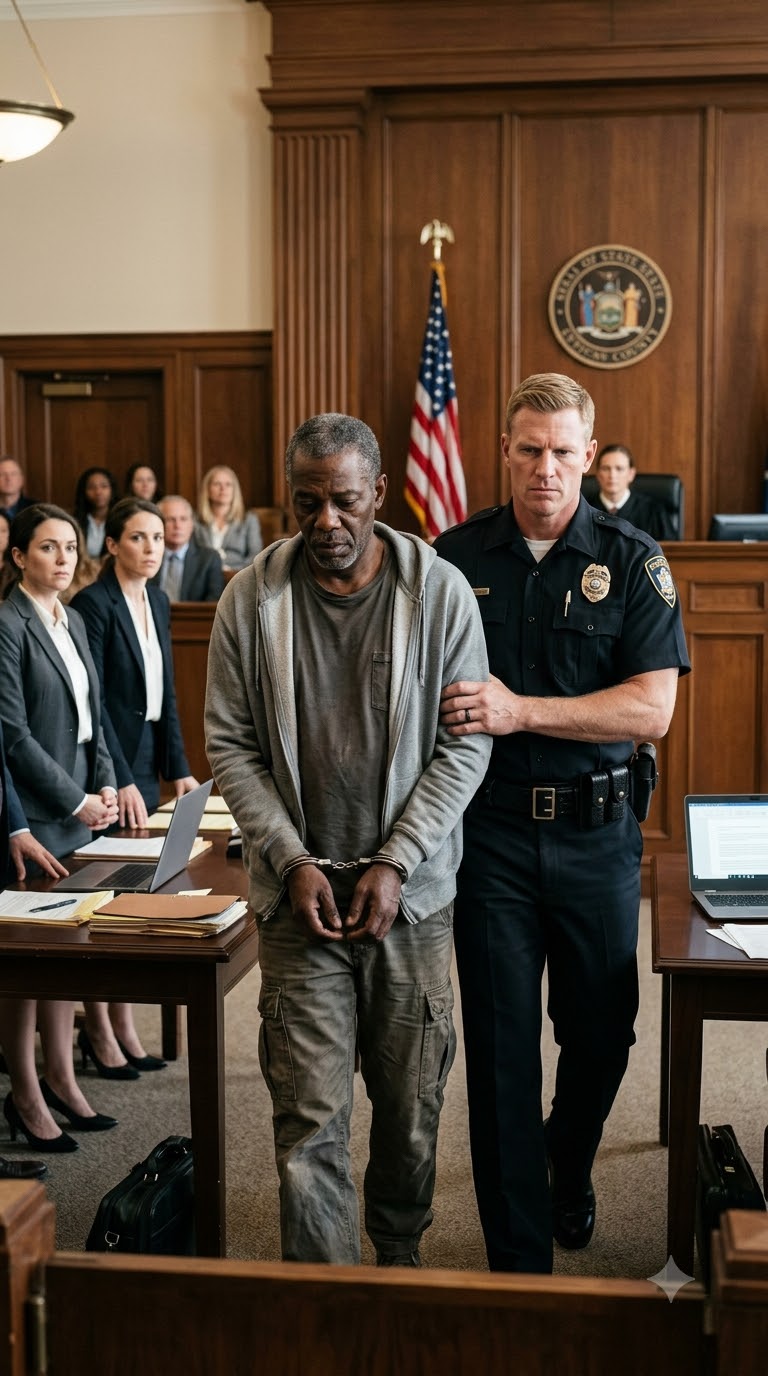
Bending down until his breath hit the man’s face, Calloway spoke loudly enough for everyone in the courtroom to hear. There was no hesitation in his voice and no trace of shame.
Another black vagrant who thinks he belongs somewhere he doesn’t.
Sit down and stay down. Trash belongs on the floor.
A woman in the back row covered her mouth. Everyone else fell silent.
The man in the torn hoodie didn’t flinch or respond. He didn’t even look at Calloway. Instead, he slowly and deliberately lifted his eyes toward the bench directly in front of him.
His bench.
The one he had occupied for twenty years.
What happened next would be recorded, watched seventy million times, and studied in law schools throughout America as one of the most devastating examples of justice turning against itself in a single morning. But every detail mattered, and to understand what happened, you need to know them all.
Six weeks before that morning, Marcus Webb had been a very different kind of man. Not a different person, but the same soul, the same mind, and the same steady hands that had signed hundreds of rulings and held a gavel so frequently that its wooden handle had been polished smooth to fit the exact shape of his palm.
Yet six weeks earlier, those hands had held something else.
They had held his wife’s hand in a fourth-floor hospital room at Eastfield General. And they had felt the precise moment Eleanor Webb, his wife of thirty-one years, who had shared decades of laughter, arguments, and quiet Sunday mornings with him, finally let go.
Cancer.
Fourteen months from diagnosis to the end. Fourteen months that had passed like fourteen days.
Marcus stayed in that hospital room for three hours after the nurses left. He didn’t cry.
He didn’t call anyone. He simply sat there, her hand still resting in his, staring through the window as sunlight crept across the wall. He couldn’t understand how the world outside could continue turning when the most important part of his own world had come to a stop.
He went home and stood in the kitchen.
His eyes settled on her coffee mug, the yellow one with the chipped handle she had always refused to throw away. It remained on the counter exactly where she had left it, in the spot where she had placed it that final morning when she felt well enough to make her own breakfast.
Then Marcus put on his oldest jacket, walked out the front door, and kept going.
He hadn’t planned it. He hadn’t told anyone.
During the first week, his clerk, Rachel Kim, called seventeen times before he finally sent a single text message.
I’m taking emergency leave. Handle the docket. I’m sorry.
Chief Judge Sandra Holloway called twice and left two voicemails that he never listened to. His sister in Atlanta called every day for three weeks until he eventually turned off his phone entirely.
He wasn’t trying to run away.
He needed to understand something.
For years, he had made decisions about people whose lives were shaped by circumstances he had never personally experienced. He needed to see the city through the eyes of those he had sentenced, without a title, a parking pass, or a nameplate identifying him as a judge.
He needed to discover whether justice looked the same from the sidewalk as it did from behind the bench.
He was beginning to realize that it didn’t.
For six weeks, Marcus slept at a shelter on Clement Street whenever a bed was available. When there wasn’t one, he spent the night on a bench in Riverside Park.
He ate at the community kitchen on Tuesdays and Thursdays. Every morning, he bought a $1.50 black coffee without sugar from an elderly Vietnamese man named Mr. Nguyen, who operated a small cart at the corner of Fifth and Madison between six and ten.
Mr. Nguyen never asked questions. He simply handed over the coffee and nodded.
Marcus had come to regard that small gesture as the kindest thing anyone had done for him in weeks.
He kept his wallet, judicial identification, and phone with him. His phone remained switched off, though he made sure it stayed charged.
He wasn’t pretending to be poor. He was trying to understand poverty, to learn what it felt like to become invisible in a city full of people, to watch store owners begin monitoring his movements the instant he entered their establishments.
He noticed how police cruisers slowed whenever they passed him. The difference was subtle, but unmistakable.
He paid attention to every one of those cruisers.
He remembered them all.
On Tuesday morning, March 14, Marcus sat on the broad stone steps outside the Eastfield Public Library. It was 7:22 a.m. The library wouldn’t open until nine.
He wasn’t waiting for the doors to open. He was sitting with his $1.50 coffee, watching the city awaken and thinking about a ruling he had written in 2019 concerning the limits of lawful loitering.
He wondered whether he had gotten it entirely right.
He was still considering the question when a police cruiser pulled up beside the curb.
Officer Derek Calloway stepped out first. Thirty-eight years old, broad-shouldered, and carrying himself with the confidence of a man who had gone twelve years without being told he was wrong.
His partner, Officer Dana Price, followed. She was younger, quieter, and possessed the observant eyes of someone who had learned early that surviving in Calloway’s orbit meant agreeing with everything and documenting nothing.
Calloway glanced at Marcus the way he habitually regarded certain people. He gave him a quick, dismissive inspection and reached his conclusion before speaking a single word.
Old hoodie. Worn shoes. Black. Sitting on government property before business hours.
Case closed.
Hey.
Calloway stopped three feet away. He didn’t introduce himself or explain why he had approached.
You can’t be here.
Marcus slowly raised his head.
I’m on a public sidewalk adjacent to a public building. There’s no ordinance restricting presence here before operating hours.
Calloway’s eyes narrowed.
He didn’t like the response. It was too complete. Too calm.
You got ID?
I do.
Marcus began reaching into his jacket pocket.
Calloway immediately extended his hand and grabbed Marcus’s wrist before he could retrieve anything.
Slowly.
The word wasn’t a precaution. It was an assertion of dominance, a declaration that Calloway controlled the pace of everything happening around him.
Marcus stopped moving.
He looked down at the hand gripping his wrist, then raised his eyes to Calloway’s face.
Officer, I’d like to show you my identification.
I’ll tell you when I want to see it.
Calloway released his wrist and stepped closer.
What are you doing out here this time of morning?
Drinking coffee.
Price nearly smiled.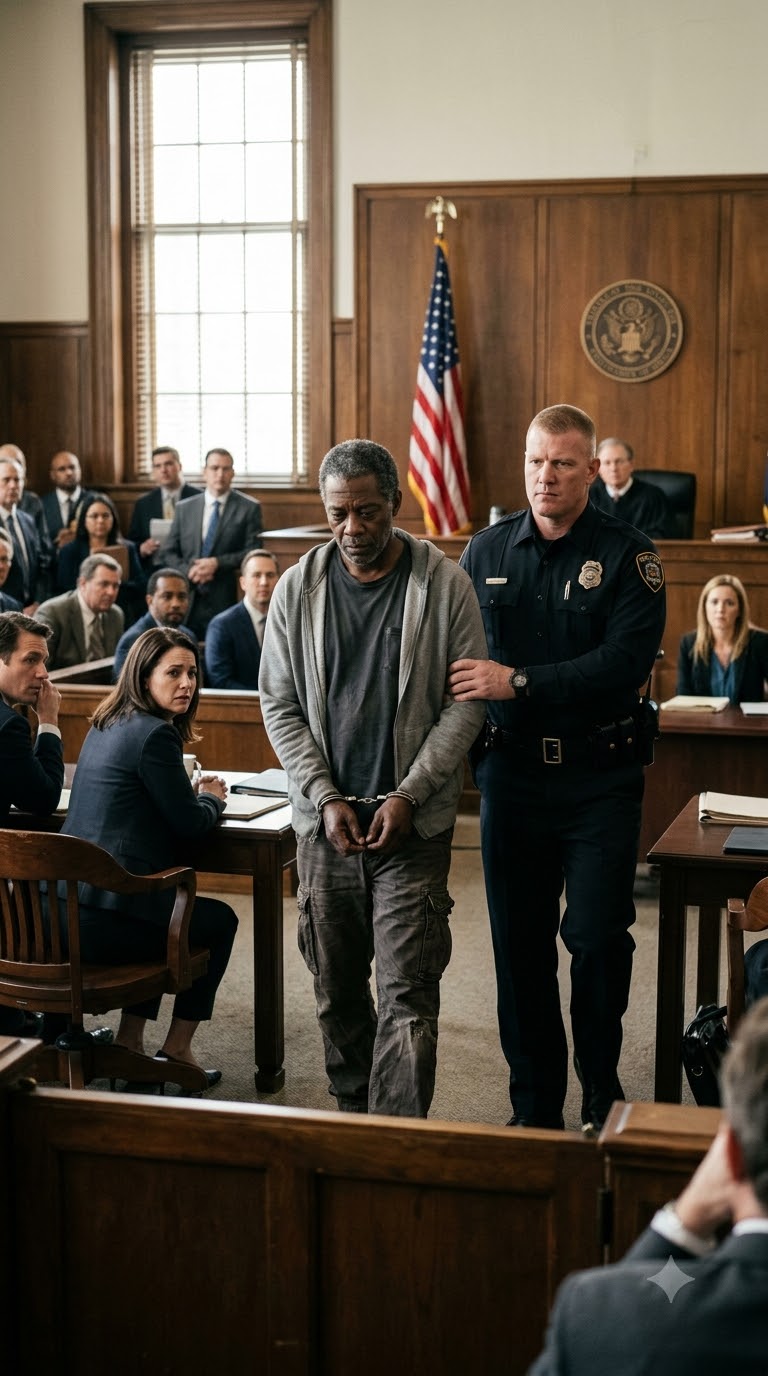
Nearly.
You got somewhere to be? Calloway asked.
Yes, Marcus replied.
Where?
Marcus held his gaze without wavering.
Work.
That was the wrong answer.
Not because it was untrue, but because Calloway looked at Marcus Webb, took in the worn hoodie, scuffed shoes, and paper coffee cup, and decided with the absolute confidence of a man who had never been corrected that the answer had to be a lie.
On your feet.
Calloway’s voice hardened.
You’re coming with me.
Before Marcus could respond, before he could retrieve his wallet or present his identification, the moment that would change everything had already begun unfolding on those library steps.
Calloway seized him by the collar.
The coffee slipped from Marcus’s hand. The cup struck the pavement, and its lid popped off.
Marcus said nothing.
He simply stared at the spilled coffee before raising his eyes toward the courthouse three blocks away, its white columns glowing in the morning sunlight.
And then he allowed himself to be taken away.
He had spent six weeks trying to understand what happened to people when the world decided they didn’t matter.
Now he was about to discover how much worse it could become when the people entrusted with protecting them decided the rules no longer applied.
The walk to the courthouse was less than three blocks, but Calloway treated it like a public demonstration of authority.
He kept one hand twisted into Marcus’s collar while ordering him forward. Whenever Marcus slowed to keep his balance, Calloway jerked him ahead again.
“Keep moving.”
Marcus complied.
Officer Price followed a few steps behind, repeatedly glancing at the people who had stopped to watch. One man raised his phone. A woman standing near a bus stop began recording.
“Officer, what’s he done?” the woman called.
Calloway didn’t answer.
“Sir, do you need help?” another bystander asked Marcus.
Marcus turned his head slightly.
“I’m all right.”
He wasn’t all right, but he didn’t want the situation to escalate. He had spent decades watching people become trapped in circumstances they hadn’t chosen, and he knew how quickly a simple encounter could turn into something irreversible.
He also knew that remaining calm would not necessarily protect him.
At the courthouse entrance, a security officer looked up from his desk.
“What’s going on?”
“Suspicious individual,” Calloway replied. “Refused to cooperate.”
Marcus had said nothing of the sort. He had provided a lawful explanation, offered identification, and asked to show it.
But Calloway’s version of events had already become the official story.
The security officer stepped aside.
Inside, the morning docket was underway. Attorneys were organizing their files, defendants were waiting for their cases to be called, and court staff were preparing for another ordinary day.
Then Calloway marched Marcus into Courtroom 4B.
He dragged him down the aisle and shoved him into the defendant’s chair.
The room went silent.
“Another black vagrant who thinks he belongs somewhere he doesn’t.”
“Sit down and stay down. Trash belongs on the floor.”
Marcus remained still, his hands resting on the arms of the chair.
He recognized the court reporter near the side wall. He recognized two attorneys seated at the counsel tables. He recognized the clerk who had worked in his courtroom for eleven years.
And he recognized the bailiff standing beside the bench.
Thomas Reed had served the Eastfield Federal Courthouse for nearly twenty-five years. He had witnessed angry defendants, frightened witnesses, grieving families, and officers who believed their badges made them untouchable.
He had also worked beside Marcus Webb for two decades.
But Thomas didn’t recognize the man in the torn hoodie immediately.
Not until Marcus raised his eyes.
PART 2
Something about that steady gaze stopped him cold.
Thomas leaned forward, studying the man’s face. He noticed the familiar lines around his eyes, the silver at his temples beneath the hood, and the unmistakable composure that had characterized the judge through countless difficult proceedings.
His expression changed.
He looked at Marcus again, then toward Calloway.
“Officer, step away from the defendant.”
Calloway turned with an irritated laugh.
“What?”
“I said, step away from him.”
Calloway straightened.
“He’s being detained. You have a problem with that?”
Thomas didn’t answer immediately. Instead, he approached the chair and looked directly at Marcus.
“Your Honor?”
Two words.
Quietly spoken, yet powerful enough to make several people turn in their seats.
Calloway stared at the bailiff.
“What did you just call him?”
Thomas stood upright.
Then he turned toward the courtroom and spoke with a voice that carried to every corner.
“All rise. The Honorable Judge Marcus Webb is present.”
For one suspended second, nobody moved.
Then the entire courtroom rose.
Attorneys stood. Court staff stood. The people in the gallery pushed themselves to their feet, their faces filled with disbelief.
Officer Calloway remained frozen beside the defendant’s chair.
His eyes moved from Thomas to Marcus, then to the bench.
“No,” he muttered. “That’s not possible.”
Marcus slowly stood.
He reached into his jacket and removed his judicial identification. He placed it on the table in front of him, where the clerk could clearly see the official seal and photograph.
Chief Judge Sandra Holloway, who had entered through the side door after hearing the commotion, stopped in her tracks.
“Marcus?”
He looked toward her.
“Good morning, Sandra.”
Her expression shifted from relief to confusion, then to a controlled anger that made the courtroom even quieter.
“What happened to you?”
Marcus glanced at Calloway.
“I believe Officer Calloway can explain that.”
Calloway finally found his voice.
“Your Honor, I had no idea who you were. I thought he was a vagrant who was refusing to cooperate.”
Marcus looked at him steadily.
“And if I had been?”
Calloway opened his mouth.
Nothing came out.
“If I had been homeless, Officer, would that have made it acceptable to grab me by the wrist, seize my collar, and drag me through a public building?”
“Sir, I was responding to a suspicious person.”
“Suspicious according to what evidence?”
Calloway shifted his weight.
“He was sitting on government property before business hours.”
“On a public sidewalk?”
“Yes, sir.”
“Did you observe him committing a crime?”
“No, sir, but—”
“Did you ask him to identify himself?”
Calloway hesitated.
“He said he had identification.”
“That wasn’t my question.”
“No, sir. I didn’t see it.”
“Why not?”
Calloway’s face reddened.
“Because I was concerned about the situation.”
Marcus paused.
“Officer, I offered you my identification. You grabbed my wrist before I could retrieve it. You refused to hear my explanation, and you decided what kind of person I was before you knew anything about me.”
He let the words settle.
“Then you brought me here and humiliated me in front of a courtroom full of people.”
Calloway swallowed.
“I apologize, Your Honor.”
Marcus studied him for several seconds.
“I appreciate the apology. But this is not about whether you recognize me. It is about whether you recognize the rights of people who have no power to make you answer for your actions.”
No one spoke.
Chief Judge Holloway approached the bench and instructed the clerk to preserve the courtroom record. She then ordered the security team to secure any available video footage from the courthouse entrance and adjoining corridors.
“Officer Calloway,” she said, “you will remain here while this incident is documented. Officer Price, I want your account of what happened from the moment you arrived at the library.”
Price stiffened.
Calloway immediately turned toward her.
“Dana, tell them we had a difficult subject who refused to cooperate.”
Price looked at him.
For twelve years, she had watched Calloway dominate conversations, dismiss complaints, and turn uncertainty into accusations. She had learned to keep quiet because silence was easier than becoming his next target.
But she had also watched Marcus offer identification before Calloway grabbed him.
She had heard the questions about the public sidewalk.
And she had seen the coffee spill when Calloway seized his collar.
Her hands trembled slightly.
“That isn’t what happened.”
Calloway’s expression hardened.
“What did you say?”
Price took a breath.
“Judge Webb was sitting on the library steps with a cup of coffee. He explained that he was on a public sidewalk. He offered identification. Officer Calloway grabbed his wrist before he could produce it.”
The courtroom remained silent.
Price continued.
“He did not threaten us. He did not attempt to flee. He did not refuse to cooperate.”
Calloway stared at her as though she had struck him.
“You’re going to do this to me?”
Price looked down briefly, then raised her eyes.
“I’m going to tell the truth.”
For the first time that morning, Marcus saw something change in her expression. She was still frightened, but beneath that fear was a determination he recognized.
It was the determination of someone who had finally decided that the cost of silence was greater than the cost of speaking.
Chief Judge Holloway instructed the court reporter to record Price’s statement and requested that the appropriate authorities be notified.
Calloway was escorted from the courtroom pending further review.
As he passed Marcus, he stopped.
“I didn’t know who you were,” he repeated.
Marcus met his eyes.
“That’s precisely the problem.”
The door closed behind him.
Only then did the courtroom begin to breathe again.
Within hours, the incident had reached courthouse administration. The recordings made by bystanders were shared with investigators, and security footage confirmed the officers’ arrival and their movement toward the building.
By that afternoon, the video of Calloway dragging Marcus across the courtroom floor had spread across social media.
People watched the footage in disbelief. Some focused on Calloway’s words. Others focused on Marcus’s expression, the quiet restraint of a man who had endured humiliation without surrendering his dignity.
But Marcus was troubled by the attention.
The public had discovered his identity. It had not necessarily discovered the lesson he had been trying to learn.
He returned to his chambers that evening for the first time in six weeks.
His desk remained exactly as he had left it. The folders were stacked neatly. His gavel rested beside the legal pad on which he had written his final notes before Eleanor’s death.
Rachel Kim stood in the doorway, her eyes filling with tears.
“Judge Webb.”
Marcus rose.
“Rachel.”
She crossed the room and embraced him.
For a moment, he allowed himself to lean into the comfort of a familiar presence.
“We were worried about you,” she whispered.
“I know.”
“Why didn’t you tell us where you were?”
He looked toward the window.
“Because I didn’t know what I was looking for.”
Rachel stepped back.
“And did you find it?”
Marcus considered the question.
“I found out how easy it is to believe you understand a problem when you’ve only studied it from a distance.”
He sat down behind his desk but didn’t touch the gavel.
“For twenty years, I listened to testimony, reviewed evidence, and made decisions according to the law. I believed I understood the people who came before me. But I never understood what it meant to have strangers decide your worth before you had the chance to speak.”
PART 3
Rachel pulled a chair closer.
“That doesn’t mean your work was meaningless.”
“No,” Marcus said. “But it means I have more to learn.”
He opened the top drawer of his desk and removed a photograph of Eleanor. It showed her sitting on their back porch, smiling into the sunlight with a yellow coffee mug in her hands.
Rachel glanced at it.
“She would have wanted you to come home.”
Marcus’s eyes softened.
“I think she would have wanted me to understand why I left.”
He placed the photograph beside the gavel.
For the first time since the hospital, he felt that returning to work might be more than a way to fill the hours.
It might be a responsibility he could finally approach with a clearer understanding of the lives his decisions affected.
The investigation into Calloway’s conduct lasted several weeks.
Investigators examined the available recordings, interviewed witnesses, and reviewed the officers’ accounts. Price’s testimony became a central part of the inquiry because it contradicted Calloway’s initial description of the encounter.
The findings raised questions not only about what had happened to Marcus but also about how similar complaints had been handled in the past.
Other people came forward.
Some described being questioned without a clear explanation. Others recalled being ordered to leave public spaces where they had a lawful right to remain. Several reported feeling that their complaints had been dismissed before anyone examined the evidence.
Each account required independent review. Not every allegation could be treated as proven simply because others had made similar claims.
But together, the reports made one thing clear: the courthouse incident could not be dismissed as an isolated misunderstanding without examining the broader circumstances.
Calloway was placed on administrative leave while the appropriate authorities assessed the evidence and determined what action was warranted. The judicial administration also referred the matter for an independent review of the conduct involved.
Marcus did not participate in the investigation as a judge.
He understood that the integrity of the process required him to separate his personal experience from any official decisions. He provided his account, preserved the evidence available to him, and allowed the responsible authorities to determine the consequences.
Some people expected him to demand the harshest possible punishment.
Others wanted him to forgive Calloway and move on.
Marcus refused to let either expectation dictate the outcome.
“Accountability is not revenge,” he told Chief Judge Holloway during a private meeting. “And forgiveness is not a substitute for accountability.”
Sandra nodded.
“Then what do you want?”
“I want the truth established. I want the rules applied fairly. And I want the next person sitting on those library steps to be treated as a human being, whether anyone knows their name or not.”
That became the principle guiding his next steps.
Marcus returned to the bench only after the appropriate administrative arrangements had been made. He did not preside over any proceeding involving Calloway or the investigation.
Instead, he began reviewing the procedures surrounding encounters between courthouse security personnel, police officers, and people who entered public buildings seeking help.
He asked for clearer documentation requirements, stronger safeguards for complaints, and training that emphasized the distinction between a person’s appearance and evidence of unlawful conduct.
He also requested that the courthouse work with local shelters and community organizations to help people understand their rights and access available services.
The changes were not dramatic enough to solve every problem. They could not erase years of mistrust or guarantee that every officer would behave honorably.
But they created a starting point.
For Marcus, that mattered.
One rainy Thursday morning, nearly two months after the incident, Marcus returned to the Eastfield Public Library.
He wore a plain dark coat and carried no briefcase. He sat on the same stone steps where Calloway had first approached him.
The city moved around him as it always had. Buses hissed at the curb. Office workers hurried beneath umbrellas. A delivery driver unloaded boxes while a woman spoke urgently into her phone.
A few minutes later, an elderly man approached the steps.
His coat was too thin for the weather, and he carried a small plastic bag containing what appeared to be everything he owned.
He stopped several feet from Marcus, uncertain whether the space was occupied.
“Mind if I sit here?”
Marcus shifted to make room.
“Not at all.”
The man lowered himself onto the step and rubbed his hands together.
“People don’t usually make room,” he said.
Marcus looked at him.
“That’s unfortunate.”
The man gave a weary laugh.
“Name’s Walter.”
“Marcus.”
They sat quietly for a while, watching the rain collect along the edge of the sidewalk.
Eventually, Walter glanced toward the courthouse.
“You work over there?”
“Yes.”
“Must be important.”
Marcus considered the answer.
“Sometimes the work is important. That doesn’t necessarily make the person doing it more important than anyone else.”
Walter looked at him with mild curiosity.
“You a lawyer?”
“Something like that.”
Walter smiled faintly.
“I used to think people in those buildings had all the answers.”
“And now?”
“Now I think they have the same problems as everybody else. They just get better chairs.”
Marcus laughed.
It was the first unguarded laugh he could remember having in weeks.
When the rain eased, he stood and brushed the dampness from his coat.
“Take care of yourself, Walter.”
“You too, Marcus.”
Marcus walked toward the courthouse, but he stopped halfway across the plaza.
For years, he had believed that justice was measured by the quality of a ruling, the precision of an argument, or the soundness of a legal principle.
Those things still mattered.
But they were not the whole measure.
Justice also existed in the moments before a case reached a courtroom. It existed in the questions an officer chose to ask, in the dignity granted to a stranger, and in the willingness of a witness to speak when silence would be easier.
It existed in whether a person could stand on a public sidewalk without having their humanity treated as a privilege they needed to earn.
Marcus thought of Eleanor and the yellow mug she had refused to discard.
She had often told him that people revealed themselves most clearly when they believed no one important was watching.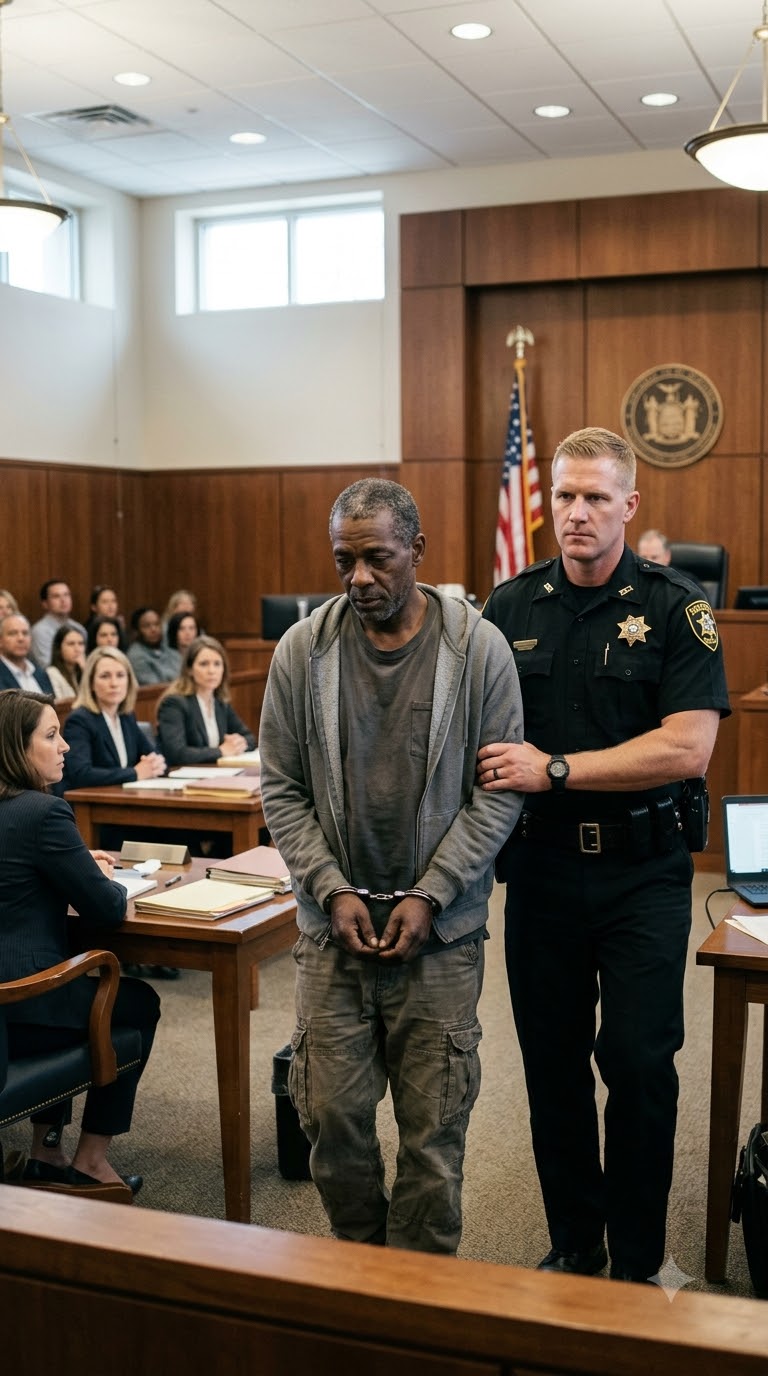
He had never fully understood what she meant.
Now he did.
The true test of character was not how someone treated a judge, a wealthy donor, or a powerful official.
It was how they treated a person they believed could do nothing for them.
And that morning, on the library steps, Marcus had discovered something else.
A person’s name might open doors. A title might command a room. A badge might grant authority.
But none of those things could create the dignity that every human being already possessed.
That dignity did not begin when the bailiff announced his name.
It had been there all along.
The courtroom had simply been forced to recognize it.
And Marcus Webb intended to spend the rest of his career making certain that justice did not require another person’s identity to be revealed before it finally appeared.
