

PART 1: The Homecoming That Broke Her Heart
The first thing I noticed when I stepped out of the cab was the smell of autumn.
Dry leaves drifted across the driveway, carried by a cool wind that smelled faintly of chimney smoke. The trees lining the street were turning gold and amber, and somewhere nearby, someone was burning wood.
I stood there with a military duffel bag over one shoulder and a small box of souvenirs tucked beneath my arm.
Twenty years.
That was how long I had given to the military.
Twenty years of deployments, missed holidays, dangerous assignments, sleepless nights, and sacrifices that people back home could never fully understand.
And now, after everything, I was finally standing in front of the house where I had grown up.
I had imagined this moment more times than I could count.
I imagined my mother opening the door and throwing her arms around me. I imagined my father smiling with pride, perhaps pretending not to be emotional. I even imagined my younger sister Harper rushing outside before I reached the porch.
Instead, I stood alone on the cracked stone path, wondering why the house suddenly seemed so small.
The windows were the same.
The porch railing still needed paint.
The old maple tree leaned over the driveway exactly as it had when I was a child.
Yet something felt different.
Maybe it was because I had changed.
Or maybe it was because I was finally about to discover that the home I remembered no longer existed.
My name is Chloe.
For two decades, I had served my country in places most people only heard about on the evening news.
I had spent nights studying maps in tactical operations centers, coordinating evacuations, helping keep soldiers alive, and making decisions where mistakes could cost lives.
But even when I was thousands of miles away, I never stopped thinking about my family.
I sent money when the roof needed replacing.
I helped pay for the furnace.
I covered Harper’s college tuition when my parents said they were struggling.
When Mom’s medical bills became overwhelming, I transferred money without asking questions.
When Harper needed help with rent, I sent another payment.
I called on Sundays whenever the signal allowed it.
I mailed birthday cards.
I sent Christmas packages.
I remembered anniversaries and family milestones even when I could not attend them.
Sometimes my gifts went unacknowledged.
Sometimes my calls went unanswered.
But I kept trying.
I told myself that military service was difficult for the families left behind, too.
I told myself they missed me but didn’t know how to say it.
I told myself that one day, when I finally came home, all those years of distance would disappear.
Standing in the driveway, I wanted to believe that day had arrived.
I walked toward the porch.
For a moment, an old memory surfaced.
I was nine years old, standing in the corner of the living room with a book clutched against my chest.
Harper had just won a science fair trophy.
My parents were celebrating.
They praised her intelligence, her effort, and her bright future.
I had placed second in my own competition.
No one asked about it.
Even then, I had learned that my accomplishments were easiest to overlook when Harper had something to celebrate.
I shook off the memory.
That was years ago.
People changed.
Families grew.
Surely twenty years of service had earned me something more than the indifference of childhood.
I knocked.
The door opened.
Harper stood in the entrance.
Her eyes widened.
“Chloe,” she murmured. “You didn’t call.”
I smiled and lifted the box in my hands.
“Figured I’d bring my own welcome.”
She moved aside, but only enough for me to pass.
There was no hug.
No excited question.
No smile that reached her eyes.
Inside, the house smelled of lemon cleaner and baked apples.
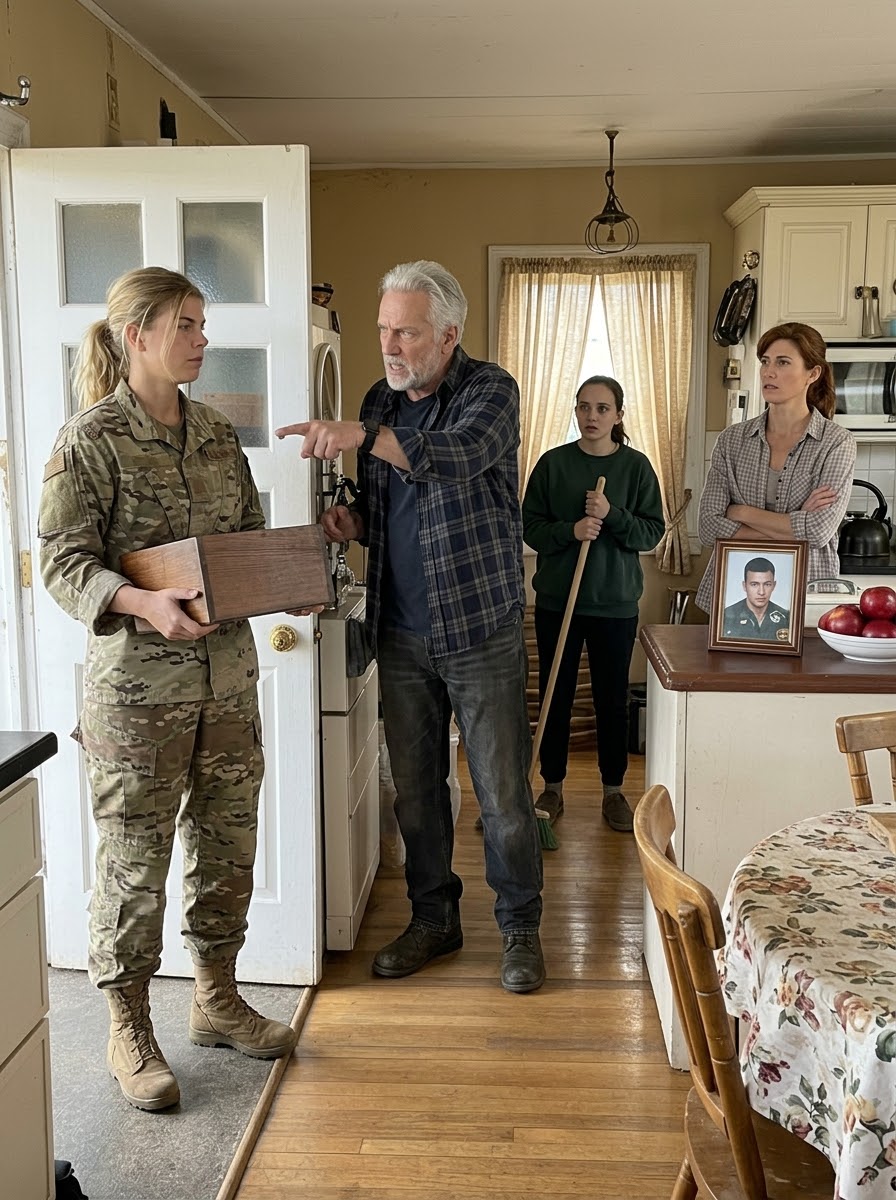
My mother, Eleanor, stood at the kitchen island, slicing fruit.
My father, Richard, was beside the coffee machine, looking at his phone.
Both looked up when I entered.
For one brief second, nobody spoke.
Then Mom said, “You’re here.”
Her voice was flat.
“You didn’t say anything.”
“I wanted it to be a surprise,” I replied.
I tried to sound cheerful.
The effort felt painfully obvious.
Dad set his coffee mug down.
“Did you just get out?”
I nodded.
“Last month.”
He studied my duffel bag.
“You didn’t bring much. Where’s the car? The Thunderbird?”
My heart lifted slightly.
The Thunderbird.
Of all the things I had left behind, that car had meant the most to me.
When I was seventeen, Dad and I had rebuilt its engine together.
We spent Saturday afternoons in the garage, our hands covered in grease, classic rock playing on the radio.
Back then, we didn’t need to talk much.
We understood each other through the work.
He showed me how to remove parts, clean them, repair them, and put them back together.
I learned patience from him.
I learned that something broken did not always need to be discarded.
Sometimes it only needed someone willing to understand how it worked.
That Thunderbird was the first thing I had ever truly felt belonged to me.
When I received my first military assignment, I drove it with the windows down and the radio turned up.
Later, when deployments made keeping it impractical, I left it in my parents’ garage.
The title remained in my name.
I trusted them to keep it safe.
“Sold it last year,” Dad said.
I stared at him.
For a moment, I thought I had misheard.
“You sold my car?”
“There wasn’t room for old junk. You weren’t using it.”
I felt something tighten beneath my ribs.
“That car was in my name.”
“It was in the garage of our house,” he replied. “We needed the space.”
He spoke as though that settled everything.
As though storing something in his garage meant he had the right to sell it.
As though the memories attached to that car had no value because I had been away.
I looked at Mom.
“You didn’t even tell me.”
She picked up an apple slice and shrugged.
“We didn’t think it mattered. You were gone.”
Gone.
That word had followed me through my entire adult life.
Whenever I missed a birthday, I was gone.
Whenever Harper needed help and I could only send money, I was gone.
Whenever a family holiday passed without me, I was gone.
It never seemed to matter why.
I had been serving my country.
I had been doing work that kept people alive.
But in my parents’ house, my absence had become proof that I no longer deserved a place in their lives.
Harper shifted near the staircase.
“I didn’t know either,” she mumbled.
I looked at her.
She avoided my eyes.
Dad crossed his arms.
“Chloe, you chose your path. Military life, discipline, independence. We respected that.”
I straightened my shoulders.
“I gave twenty years.”
His expression hardened.
“No one asked you to.”
The words struck harder than I expected.
Then he continued.
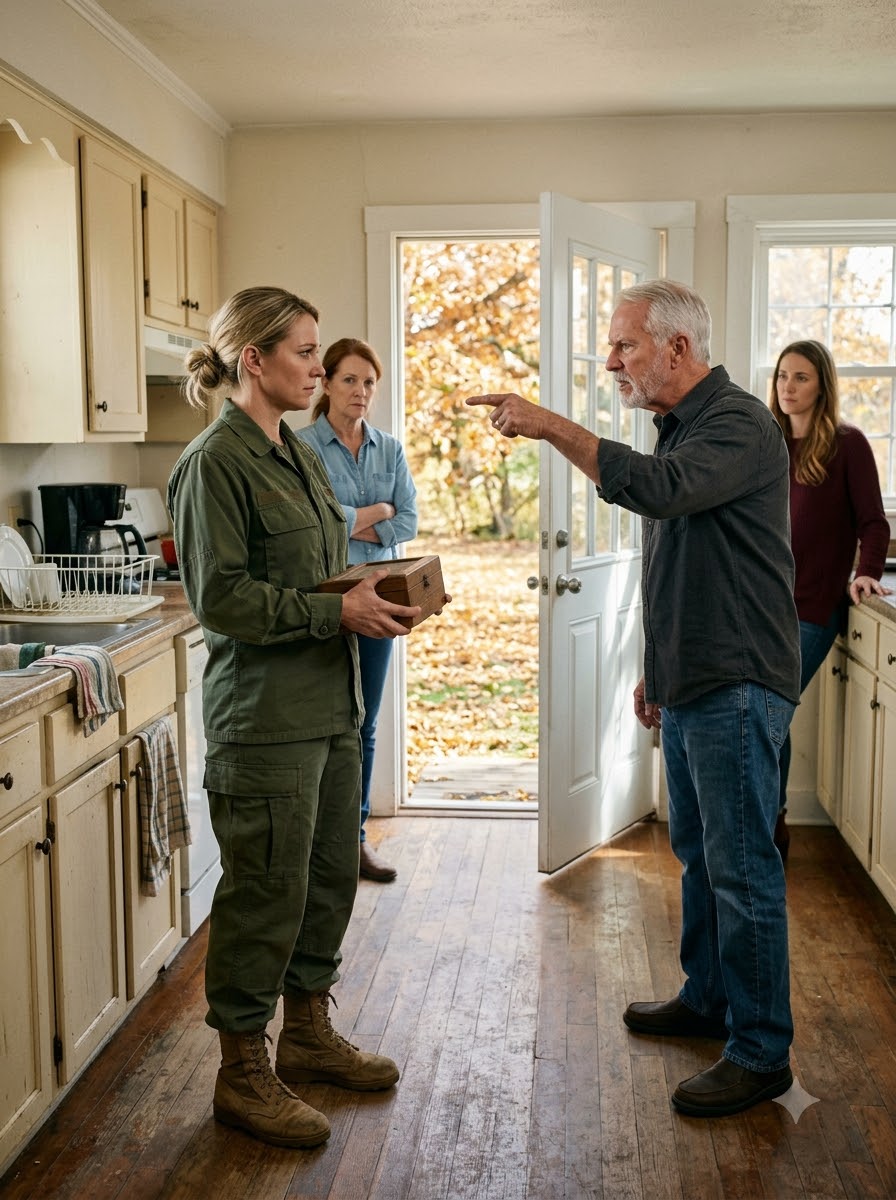
“You chose that over family. So maybe you should go back to the barracks where you belong.”
I could not move.
I had faced dangerous assignments without losing my composure.
I had stood in rooms where every decision mattered.
I had learned to remain calm when everyone around me was afraid.
But standing in my parents’ kitchen, I suddenly felt like the little girl holding a second-place ribbon nobody wanted to see.
I looked toward Mom.
Surely she would say something.
Surely she would tell Dad that was enough.
But Eleanor returned to cutting apples.
Harper stared at the floor.
And Richard picked up his coffee as though the conversation was finished.
I wanted to ask why.
Why had my service meant so little?
Why had they accepted my money but resented my absence?
Why had they sold the one possession that represented the best memories I had with my father?
But the answers were already standing in front of me.
I turned toward the door.
My boots sounded unusually loud against the floor.
The box of souvenirs was still in my hands.
Inside were handmade candles, small gifts from places I had served, and a unit coin I had chosen specifically for Dad.
I had carried those things across oceans because I believed my family would want them.
Now they felt unbearably heavy.
I placed the box on the hallway table.
No one stopped me.
No one asked where I was going.
Outside, the wind had grown colder.
The first drops of rain landed on my shoulders.
I walked down the driveway without looking back.
At the end of the street, I pulled out my phone and searched for transitional housing for veterans.
The nearest facility was forty-five minutes away.
I followed the directions.
By the time I arrived, my clothes were damp and my hands were cold.
The building was modest.
The furniture was worn.
The hallway smelled faintly of disinfectant and old heating pipes.
But the woman at the front desk greeted me kindly.
She asked whether I needed a room.
She showed me where to sign.
And she handed me a key.
That small act of welcome almost made me cry.
My room had a narrow bed, a wooden chair, and a radiator that hissed whenever the heat came on.
I placed my duffel on the floor.
Then I hung my uniform jacket over the chair.
For a long time, I stared at the ribbons.
Each one represented something I had endured.
A deployment.
A mission.
A responsibility.
A group of people who had depended on me.
I had spent twenty years becoming someone my country could rely on.
Yet I had come home to discover that the people who knew me first had no interest in knowing who I had become.
That evening, I went to the facility’s mess hall.
I was halfway through dinner when a familiar voice called my name.
“Chloe?”
I looked up.
A man stood beside my table.
His hair had thinned, and his face carried more lines than I remembered, but the grin was unmistakable.
“David Bell?”
He laughed.
“Still recognize me?”
David had served with me years earlier.
We had survived difficult assignments together, and he had always been one of the few people who could make me laugh after an exhausting day.
He sat across from me without waiting for an invitation.
We talked about his retirement, his bad knee, his VA appointments, and the fishing trips he had taken up.
For the first time that day, I felt comfortable.
Then David leaned forward.
“The DoD ceremony next month,” he said. “The one in Washington. Your name came up.”
I frowned.
“For what?”
“Recognition. The strategic work in Yemen. The evacuation corridor. The intel framework you built that they’re still using.”
I set down my fork.
David lowered his voice.
“Chloe, they’re naming you. Publicly. The Secretary of Defense is presenting it personally.”
I shook my head.
“That’s a long shot.”
“It’s not a shot at all. It’s confirmed.”
He looked at me seriously.
“You held our unit together when everything was falling apart. You led without needing permission. Someone finally noticed.”
I wanted to believe him.
But after the day I had experienced, praise felt strangely difficult to accept.
That night, back in my room, my laptop chimed.
An encrypted email had arrived.
I opened it.
Department of Defense letterhead.
A formal invitation.
A national recognition ceremony.
My name.
My rank.
My military record.
The date, time, and dress requirements.
Everything David had told me was true.
I sat on the edge of the narrow bed, reading the message again and again.
For twenty years, my family had treated my service as the reason I was absent.
Now the country I had served was preparing to honor the very work they had dismissed.
I thought about calling Mom.
I thought about telling Dad.
I even considered sending Harper a photograph of the invitation.
Then I remembered the kitchen.
The sold Thunderbird.
My father’s voice.
“So maybe you should go back to the barracks where you belong.”
I closed the email.
For once, I decided not to tell them anything.
They had spent twenty years refusing to see me.
And soon, they were going to learn exactly who they had turned away.
PART 2: The Ceremony That Changed Everything
The ceremony took place in Washington, in a hall lined with flags and filled with people who understood the meaning of service.
The floors were polished.
Fresh flowers decorated the entrance.
Rows of uniforms filled the room.
There were senior officers, military families, distinguished guests, and veterans whose faces carried the quiet gravity of people who had seen more than they usually discussed.
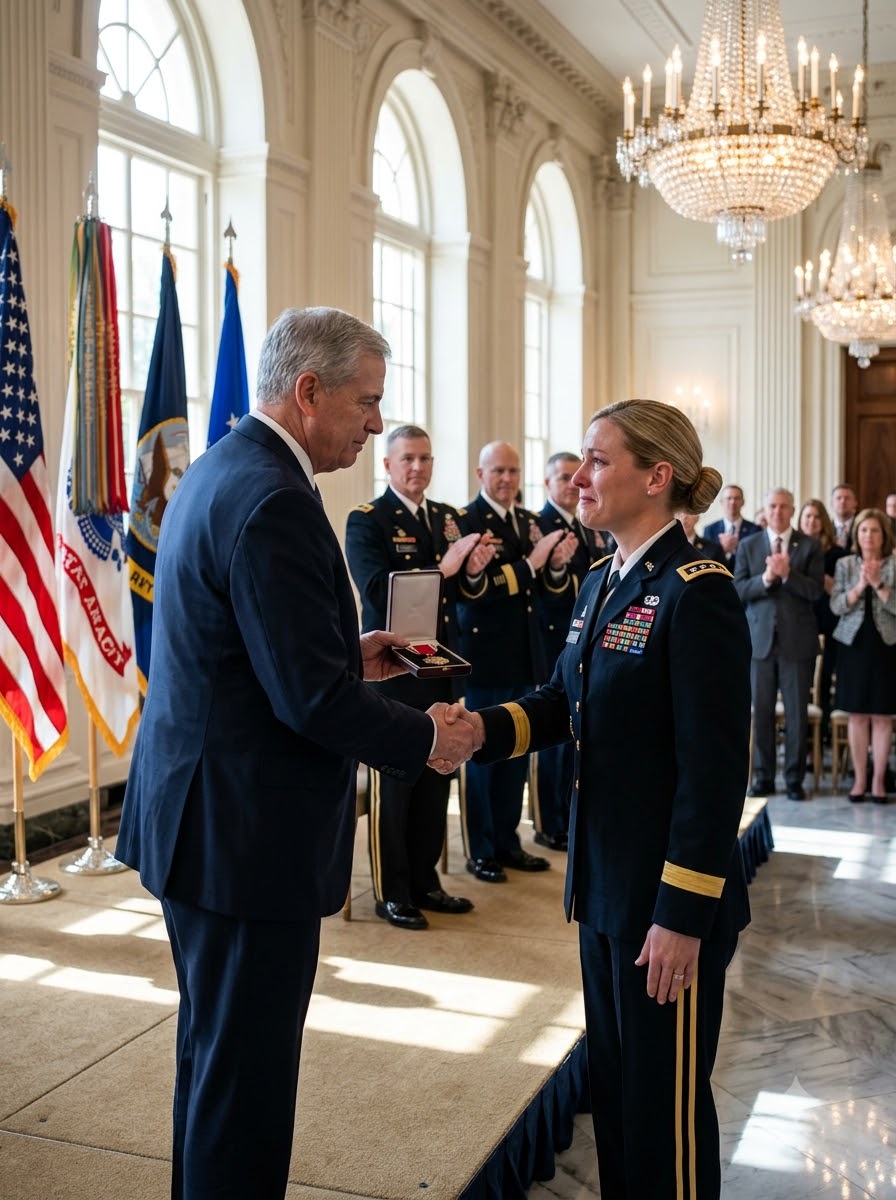
I stood in my dress blues.
Every crease was sharp.
Every ribbon was carefully arranged.
The four stars on my shoulders reflected the overhead lights.
For a moment, I remembered the narrow room at the veterans’ facility.
The duffel bag beside the bed.
The radiator hissing in the corner.
The silence after my father told me to leave.
Then the announcer called my name.
I walked toward the podium.
The Secretary of Defense began reading my record.
The strategic work in Yemen.
The evacuation corridor.
The intelligence framework that continued to support military operations.
The decisions made under pressure.
The lives protected because teams had remained coordinated when circumstances were falling apart.
I listened as the work of twenty years was described aloud.
Not as an inconvenience.
Not as an excuse for missing family gatherings.
Not as something that had taken me away from where I supposedly belonged.
But as service.
As leadership.
As sacrifice.
When the Secretary finished, the audience rose.
Applause filled the hall.
I stood there for a moment, overwhelmed by a feeling I had not expected.
I had never served for applause.
Most of the work I was proudest of had taken place in rooms where there were no cameras and no audience.
But hearing that work acknowledged mattered.
Especially after returning to a home where it had been treated as worthless.
When I stepped to the microphone, I did not speak about my parents.
I did not mention the Thunderbird.
I did not describe the humiliation of being turned away.
Instead, I spoke about service.
About the difference between being seen and being known.
About the young women in uniform who were told they did not belong.
About the importance of continuing to do meaningful work even when others failed to recognize it.
I spoke about leadership as responsibility rather than status.
And I spoke about the people who had stood beside me through difficult assignments.
When I finished, the applause returned.
This time, I allowed myself to smile.
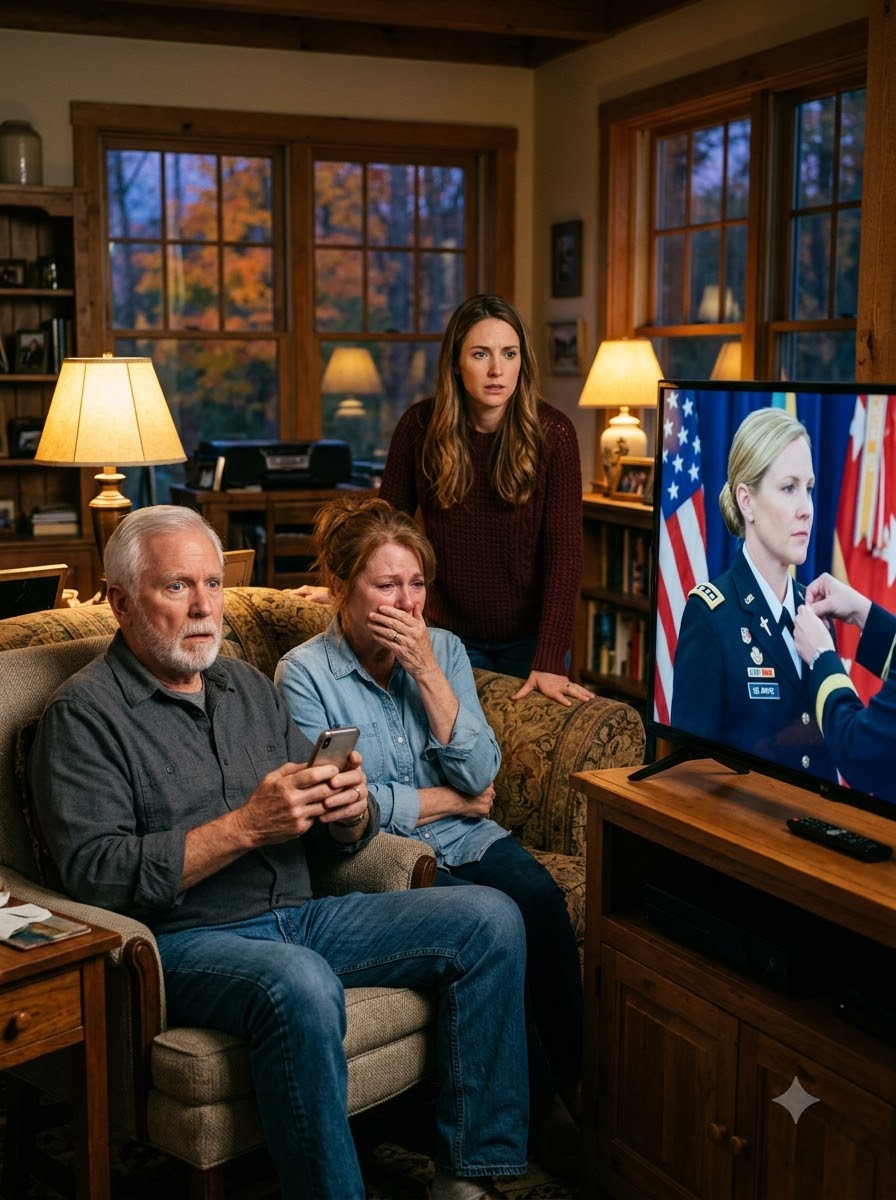
The ceremony was broadcast.
It was not the kind of event that interrupted every television program in the country.
But there was enough coverage.
An evening news segment.
My photograph.
My name displayed beneath a summary of the Yemen operation, portions of which had only recently been declassified.
Enough for someone watching television in rural Pennsylvania to recognize the woman standing at the podium.
And that evening, my phone began ringing.
Richard.
I watched his name appear on the screen.
I let the call go unanswered.
A minute later, he called again.
Then again.
By the end of the evening, there were fifteen missed calls.
Fifteen attempts to reach the daughter he had told to return to the barracks.
I stared at the notifications.
For twenty years, I had been the one making the calls.
I had called on Sundays.
I had called after deployments.
I had called on birthdays and holidays.
I had called to ask whether the furnace was repaired or whether Mom’s medical appointments had gone well.
So many times, no one had answered.
Now my father suddenly seemed desperate to speak with me.
I put the phone aside.
Then a voicemail arrived from Mom.
I listened.
“Chloe, we were wrong. I was wrong. I don’t even know where to start. But if you ever decide to call, please just know your mother is proud of you.”
Her voice trembled.
I listened a second time.
I wanted those words to mean everything.
For years, I had imagined hearing them.
I had wanted my mother to say she was proud.
I had wanted my father to recognize what I had accomplished.
I had wanted Harper to ask questions about the life I had built.
But hearing those words now felt different.
Because nothing about my service had changed between the morning they rejected me and the evening they saw me on television.
I was the same daughter.
The same soldier.
The same woman who had helped pay their bills and remembered their birthdays.
The only thing that had changed was that strangers had publicly recognized my worth.
And suddenly, my family wanted to recognize it too.
Then Harper sent a message.
I’m coming to the base. I need to look you in the eye.
I did not respond immediately.
Part of me wanted to ignore it.
Another part remembered two little girls playing barefoot in the grass.
One missing a front tooth.
The other holding a plastic sword.
Before the comparisons.
Before the resentment.
Before twenty years of distance.
Eventually, I agreed to meet her.
We chose a café near the veterans’ facility.
It was raining when Harper arrived.
She wore plain jeans and an oversized jacket.
There was no makeup on her face.
She looked nothing like the polished version of herself I had seen in family photographs and social media posts.
She sat across from me and folded her hands.
“I didn’t come to make excuses,” she said.
“Good.”
She swallowed.
“I was wrong. We were wrong. But you never said anything either.”
I raised an eyebrow.
“I did. Many times. You just didn’t listen. None of you thought I was worth listening to.”
Her lips trembled.
“That’s true. We treated you like a shadow. Like someone who had chosen a life we couldn’t understand, so we stopped trying.”
I looked out the window.
Rain slid down the glass.
Harper continued.
“I always thought I was the one who had it harder. The golden child. The one who had to keep the family together, to be perfect. They spoiled me, yes, but they expected everything too.”
She paused.
“And I leaned into it. I thought if I kept pretending you didn’t matter, maybe they’d never notice how much you did.”
I turned back toward her.
“You didn’t have to pretend. They’d already decided.”
Her eyes filled with tears.
“I didn’t come to ask you to forgive me. I just needed you to hear me say it. I see you now. I finally do.”
For a long moment, I said nothing.
Then I reached into my coat pocket.
I pulled out an old photograph.
Two little girls stood barefoot on a lawn.
One grinned with a missing front tooth.
The other held a plastic sword above her head like a trophy.
I slid it across the table.
Harper stared at it.
Her fingers touched the worn edge.
I stood.
There was no dramatic embrace.
No promise that everything would be different.
I simply left her with the photograph.
Some damage could not be repaired by one conversation.
But perhaps acknowledging it was the first step.
A week later, Richard came to the base.
He stood beyond the gate with his hands in his pockets.
He looked older than I remembered.
The lines around his mouth seemed deeper.
His shoulders were less certain.
For years, our relationship had depended on his authority and my willingness to comply.
Now neither of us seemed to know how to speak without those familiar roles.
“I had to pull strings to get here,” he said.
“You’re seeing me.”
He nodded.
Then he looked down.
“You’ve done more than any of us imagined. More than I ever gave you credit for.”
His voice cracked.
“I thought I was doing the right thing, keeping you grounded, keeping you close to the family path. But I was wrong.”
The flag above the gate moved in the breeze.
Richard looked at me.
“Is it too late to try again?”
I took a slow breath.
I had wanted that question for years.
But the woman standing before him was no longer the girl who waited for his approval.
“It’s not that you’re too late. It’s that I’m not starting from that place anymore. I’ve built a different life, one without waiting for someone to believe in me.”
His throat moved.
“I just wanted to tell you I’m proud,” he murmured, “even if I didn’t act like it.”
I nodded.
I was not angry enough to shout.
I was not ready to forgive.
And I no longer needed to pretend those were the only two choices.
I turned and walked back through the gate.
A month later, Harper sent another message.
She wanted me to come to dinner.
Mom would cook.
Dad wanted to talk.
They hoped we could begin again.
I considered refusing.
But there were things I needed to say while looking directly at them.
So I agreed.
When I arrived, the house smelled of roast meat and herbs.
Mom stood at the stove.
Dad poured wine.
Harper set the table.
For a moment, the scene almost looked like the family dinner I had spent years imagining.
We sat together.
Richard mentioned my ceremony speech.
He called it impressive and articulate.
I looked at him.
“Did you.”
He said many people were proud of me.
“Are they. Interesting.”
Silence settled over the table.
Then Richard raised his glass.
“To family. And to forgiveness.”
I looked at the glass.
I thought about the twenty years I had spent sending money and making calls.
I thought about the Thunderbird.
I thought about the box of gifts I had left in the hallway.
I thought about the cold rain and the veterans’ facility where strangers had welcomed me.
Then I gently placed my glass on the table.
“I’m not here to forgive.”
Richard’s expression fell.
Harper looked close to tears.
“Can’t we start over?” she asked.
I looked at each of them.
“Starting over doesn’t mean going back to what it was. And what it was never saw me.”
Mom lowered her eyes.
“We’re trying,” she whispered.
“I know. But you’re trying now that everyone else saw me first.”
No one answered.
I pushed my chair back.
The legs scraped softly against the wooden floor.
“This dinner, this house, it belongs to the three of you. It always did.”
I walked toward the front door.
No one followed.
Outside, the night was cool and clear.
The same stars I used to count through my childhood bedroom window shone above the roof.
Back then, I had wondered what kind of world was waiting beyond that street.
Now I knew.
I had found it.
And it was not inside that house.
But my story was not finished.
Because while my family was finally beginning to understand what they had lost, another young woman was about to remind me exactly why I had spent twenty years serving.
PART 3: The Life She Finally Claimed
Months later, I stood in my new office at the Pentagon annex.
Sunlight streamed through tall windows.
The room smelled faintly of fresh paint and polished wood.
A brass nameplate rested on the desk.
My name.
My rank.
A record of everything I had spent twenty years earning.
David Bell leaned against the doorway.
“Fits you better than your old barracks,” he said.
I smiled.
“Took me twenty years to earn this square footage.”
He laughed.
After he left, I stood beside the window and looked across the grounds.
For years, I had measured my life in assignments.
Deployment schedules.
Operational deadlines.
Mission objectives.
Now I had a new responsibility.
The work was different, but its purpose remained the same.
I wanted to make military service better for the people who came after me.
That afternoon, a young recruit asked to see me.
Her name was Sophia Morales.
She was barely past twenty.
She stood in front of my desk with the stiff posture of someone trying very hard not to reveal how nervous she felt.
I recognized the expression in her eyes.
Determination mixed with shame.
The look of someone who wanted desperately to belong but had been told repeatedly that she did not.
“People in my unit say I’m wasting time,” she said. “That I don’t belong.”
I studied her.
“Do you want to be here?”
“More than anything.”
“Then write your name with what you do. Not with what they say.”
She blinked.
I opened a cabinet and removed an old framed photograph.
My first squad.
Mud-streaked uniforms.
Tired faces.
Young soldiers who had not yet learned what the next twenty years would demand of them.
I was standing among them.
The smallest in the group.
Still unproven.
I placed the photograph on my desk.
“They called me dead weight once. Said I wouldn’t last a month. I lasted twenty years.”
Sophia looked at the picture.
I continued.
“You don’t need their permission to matter. Just consistency.”
For a moment, she said nothing.
Then she straightened.
“Thank you.”
I nodded.
She left the office looking a little taller than when she entered.
Afterward, I sat alone and looked at the photograph.
I remembered being her age.
I remembered the uncertainty.
The need to prove myself.
The desire to be accepted by people who had already decided I was not enough.
And I realized how much my understanding of belonging had changed.
When I was young, I believed belonging was something other people gave you.
Your family accepted you.
Your peers respected you.
Your superiors recognized you.
And if they did not, you tried harder.
You worked longer.
You sacrificed more.
You made yourself useful enough that eventually they would have to acknowledge your value.
I had spent years living that way.
At home and in uniform.
But the military had taught me something my family never had.
Real respect was built through action.
It did not require someone else to approve of your existence.
I opened the first major document of my new tenure.
A directive for ethics training reform intended to reach bases across the country.
It was the kind of work that would never receive the attention of a national ceremony.
There would be meetings.
Revisions.
Difficult conversations.
Arguments over procedures and implementation.
But it mattered.
Because somewhere, a young service member like Sophia was being told she did not belong.
Somewhere, a capable person was being dismissed because she did not fit someone else’s expectations.
And somewhere, a leader had the opportunity to make that environment better.
I picked up my pen.
Signed my name.
Then sat back and looked at the page.
The signature was the same one I had written on military documents for twenty years.
But for the first time, it felt entirely my own.
That evening, I drove to a lake I had visited as a child.
Dad had taken Harper and me there on one of our rare family outings before the distance between us became permanent.
The road curved through trees beginning to change color.
When I arrived, the water was still.
The sky was turning gold.
I parked the rental car near the shore and sat on its hood with a thermos of coffee.
For a long time, I watched the light move across the lake.
Then I thought about the Thunderbird.
I had tried not to dwell on it.
It was only a car, after all.
Metal.
Glass.
Rubber.
An engine.
Something that could be bought or sold.
But that was not what made losing it painful.
The Thunderbird represented the last time I remembered feeling close to my father without having to prove anything.
Those Saturday afternoons in the garage had been simple.
We worked side by side.
He taught me how an engine functioned.
I handed him tools.
Sometimes we argued about which part needed replacing.
Sometimes we laughed when something refused to fit.
And sometimes we simply worked in silence while classic rock played on the radio.
It had been one of the few places where I felt like his daughter rather than Harper’s less impressive older sister.
When he sold the car, he did more than dispose of an old vehicle.
He discarded something we had built together.
And he did it without even asking me.
Because in his mind, I was gone.
Gone meant unavailable.
Gone meant finished.
Gone meant I no longer had a claim to the things I loved.
He never understood that a person could be absent and still care.
That I could serve thousands of miles away and still remember every detail of the house where I grew up.
That I could miss Christmas dinner and still send money for the heating bill.
That I could spend nights in dangerous places and still wonder whether Mom was taking her medication or whether Harper had found a better job.
I had not chosen the military because I stopped loving my family.
I had chosen a life that included service to something larger than myself.
I had hoped my family would remain part of it.
Instead, they treated my choice as a rejection.
And after enough years, they began rejecting me in return.
I looked across the water.
The sun was disappearing behind the trees.
For the first time, I allowed myself to mourn the Thunderbird without telling myself it was foolish.
I missed that car.
I missed those Saturdays.
I missed the father who had once shown me how to repair something broken.
And I missed the family I had spent twenty years believing was waiting for me.
But I no longer needed to pretend those memories could restore what had happened afterward.
The past mattered.
It simply could not decide my future.
I finished my coffee as the lake darkened.
The first stars appeared.
I had seen those same stars from military bases, distant deployments, and operations centers where the nights seemed endless.
I had looked at them while wondering whether the people back home missed me.
Now I knew the answer was more complicated than I had wanted to believe.
My family had loved me in the limited way they understood love.
They had accepted my help.
They had expected my loyalty.
They had assumed I would always be available when they needed something.
But they had rarely made the effort to understand my life.
Their love had become a word attached to obligation rather than something expressed through attention.
And I had spent years trying to fill that gap with money, phone calls, gifts, and sacrifice.
I could not do it anymore.
I drove back in the dark.
The road was quiet.
The heater hummed.
The rental car smelled unfamiliar.
I thought about how strange it was that I had traveled across oceans, led people through dangerous situations, and stood before some of the most powerful officials in the country, yet the hardest lesson of my life had come from an ordinary afternoon in my parents’ kitchen.
I could not make people see me.
Not through service.
Not through sacrifice.
Not through money.
Not even through public recognition.
They had to choose to see me.
And if they did not, I still had the right to build a meaningful life.
When I returned to my room, I hung my jacket over the chair.
The ribbons caught the faint light from the parking lot outside.
I studied them.
They were not decorations.
They were records.
Each one represented a responsibility carried.
A decision made.
A difficult moment endured.
A group of people who had depended on someone remaining calm when everything around them threatened to collapse.
Those accomplishments were real before the ceremony.
They were real before the television broadcast.
They were real before my father called fifteen times.
And they would remain real whether my family ever understood them or not.
But I also knew that recognition from strangers could not completely erase the pain of being overlooked by the people I loved.
There was still a heaviness in my chest.
A small, stubborn ache.
It would probably remain for a long time.
Maybe forever.
I no longer considered that a failure.
Grief did not mean I had made the wrong decision.
Missing my family did not mean I needed to return to the same treatment.
Remembering good moments did not erase the harm that followed.
I could love them and still protect myself.
I could wish them well without returning to the place they had assigned me.
I could accept that they were trying to change without pretending their efforts had already repaired twenty years of neglect.
Those truths could exist together.
I turned off the light.
The room became quiet.
Somewhere in Pennsylvania, my parents were living with the consequences of choices they had made one small dismissal at a time.
A forgotten birthday.
An unanswered call.
A gift accepted without gratitude.
A car sold without permission.
A daughter turned away from the house where she grew up.
Perhaps they would eventually understand.
Perhaps Harper would continue trying to rebuild our relationship.
Perhaps Dad would learn how to express pride without waiting for someone else to recognize it first.
Perhaps Mom would finally understand that saying she was proud meant little if she had never made room for my life.
I hoped so.
But their understanding was no longer the condition for my happiness.
The next morning, there would be work waiting.
Documents to review.
Policies to improve.
Young service members to support.
People who needed someone to believe in them before the world decided they were impressive.
I would be there.
Not because I was trying to earn a place at my parents’ table.
Not because I needed another medal or ceremony.
But because I had chosen a life that mattered to me.
I thought about Sophia Morales.
The young recruit who had stood in my office wondering whether she belonged.
I hoped she would remember what I told her.
You don’t need their permission to matter. Just consistency.
It had taken me twenty years to understand those words for myself.
Twenty years of service.
Thousands of miles.
Countless nights away from home.
A sold Thunderbird.
A national ceremony.
Fifteen unanswered phone calls.
And one final dinner where I had refused to pretend that forgiveness meant returning to the past.
I had come home believing that the greatest reward for my service would be the welcome waiting behind my parents’ front door.
Instead, I learned that home was not always the place where you were born.
Sometimes it was the place you built after leaving.
Sometimes it was found among people who understood your sacrifices without demanding that you explain them.
Sometimes it was a quiet office, a photograph of your first squad, and a young soldier who left feeling stronger because you had taken the time to listen.
And sometimes it was simply the freedom to close your eyes at night without wondering whether you had done enough to deserve love.
The stone in my chest was still there.
But it felt smaller.
I lay back and stared into the darkness.
For years, I had waited for my family to give me the final word about who I was.
Now I understood that the final word had never belonged to them.
It belonged to me.
I thought of the Thunderbird one last time.
The open hood.
The smell of engine oil.
My father’s hands guiding mine.
The radio playing in the garage.
The girl I had been, believing that if she worked hard enough, she would always have a place to come home to.
I wished I could tell her that some things would be lost.
That people she loved would disappoint her.
That she would spend years searching for approval in places where it was never freely offered.
But I would also tell her that she would survive.
That she would become strong without becoming cruel.
That she would lead without needing to humiliate anyone.
That she would find people who respected her work and valued her presence.
And that one day, she would stop confusing being wanted with being useful.
I closed my eyes.
Then, quietly, to the empty room, to the ribbons hanging on the chair, and to the memory of a Thunderbird I would never drive again, I said the words I had spent my whole life learning to believe.
“I belong to myself.”
And that was enough.
THE END
