

PART 1: The Family That Tried to Destroy Me
At exactly 5:03 in the morning, my father broke through my apartment door because I had finally stopped paying the bills for a family that had quietly removed me from its future.
Forty-eight hours later, police officers discovered a handgun hidden inside my couch.
My parents and younger sister had already submitted sworn statements claiming I had pointed that weapon at them and threatened to kill them.
What they didn’t know was that the evidence they had planted would eventually expose a betrayal far worse than I could have imagined.
My name is Staff Sergeant Erin Callahan.
I’m thirty-one years old, an Army logistics noncommissioned officer stationed at Fort Bragg.
Eleven years in uniform had taught me to remain calm during emergencies, think clearly under pressure, and keep functioning when everyone around me panicked.
But nothing in my military career had prepared me for the sound of my own father trying to smash his way into my home.
“Erin! Open this door before I break it down!”
His voice echoed through the hallway.
I approached the entrance and looked through the peephole.
All three of them were standing outside.
My father.
My mother.
And my twenty-three-year-old sister, Kelsey.
I opened the door approximately three inches, leaving the security chain attached.
“Why are you here?”
Dad didn’t answer.
Instead, he drove his shoulder against the door.
The chain ripped away from the frame.
The door slammed into my cheek, sending a sharp burst of pain through my face.
My father charged inside.
Mom followed him.
Kelsey pushed past them in pink sweatpants, immediately turning her attention toward my desk.
“Give me your debit card,” Dad demanded.
I steadied myself against the wall.
“Get out.”
For five years, I had transferred approximately $850 every month to my family.
Sometimes more.
There were mortgage shortages, overdue utility bills, repairs to Dad’s truck, and an endless series of emergencies involving Kelsey.
Altogether, I had sent them $61,400.
I did it because I genuinely believed they were struggling.
After exhausting field exercises, I ate inexpensive noodles to save money.
I kept driving a car with a failing transmission because I thought every dollar I sent home might prevent my parents from losing their house.
I never questioned whether they appreciated the sacrifice.
They were my family.
That had always seemed like enough.
Then, one afternoon, my mother accidentally emailed me a scanned amendment to their living trust.
I opened the document expecting routine financial paperwork.
Instead, I discovered that my name had been removed entirely.
Kelsey would inherit everything.
The house.
The savings.
Every remaining family asset.
Beside my name, Dad had written:
“Erin is independent and has already built her own life.”
I stared at that sentence for a long time.
Apparently, being independent meant I could finance their lives without ever being considered part of their future.
I canceled the automatic transfer that afternoon.
Now my father stood inside my apartment with his hand extended.
“The bank rejected the mortgage payment. Card. Now.”
I looked directly at him.
“You removed me from the trust while treating me like an ATM.”
Mom seized my arm.
“Don’t punish the whole family because of some paperwork.”
I pulled free.
“You have ten seconds to leave.”
That was when Kelsey suddenly rushed toward my desk.
My wallet sat beside my closed Army laptop.
I caught her wrist before she could reach either one.
“That laptop is government property.”
She clawed at my hand.
Dad shoved both palms into my shoulders.
The impact sent me crashing backward into a bookshelf.
At the same moment, Mom wrapped an arm around my waist and began screaming that I was hurting Kelsey.
I managed to break free.
Then I positioned myself between them and the desk and pulled out my phone.
“I’m calling 911.”
Dad’s expression changed instantly.
“You’d call the police on your own family?”
“You forced your way into my apartment.”
I placed the dispatcher on speaker and gave my address.
Only then did they begin retreating toward the hallway.
But Dad stopped in the broken doorway.
He turned and smiled.
“You really think that uniform is going to protect you? I’ll call your command. I’ll tell them you have PTSD. I’ll tell them you’re unstable and dangerous.”
I kept my voice steady.
“Everything you’re saying is being recorded.”
His smile widened.
“Then record this,” he said. “By Friday, you won’t have a career anymore.”
They disappeared down the stairwell.
I told the dispatcher they were leaving, placed my phone near the entrance, and checked my Army laptop for damage.
I had no idea what my family discussed after reaching the parking lot.
I had no idea what they were preparing.
And I certainly didn’t realize my father’s final threat had been a promise.
Two mornings later, someone knocked on my door again.
I approached cautiously and checked the peephole.
A county deputy stood outside.
Beside him were two Military Police soldiers.
And behind them stood my company commander, Captain Maya Torres.
The deputy kept one hand close to his holster.
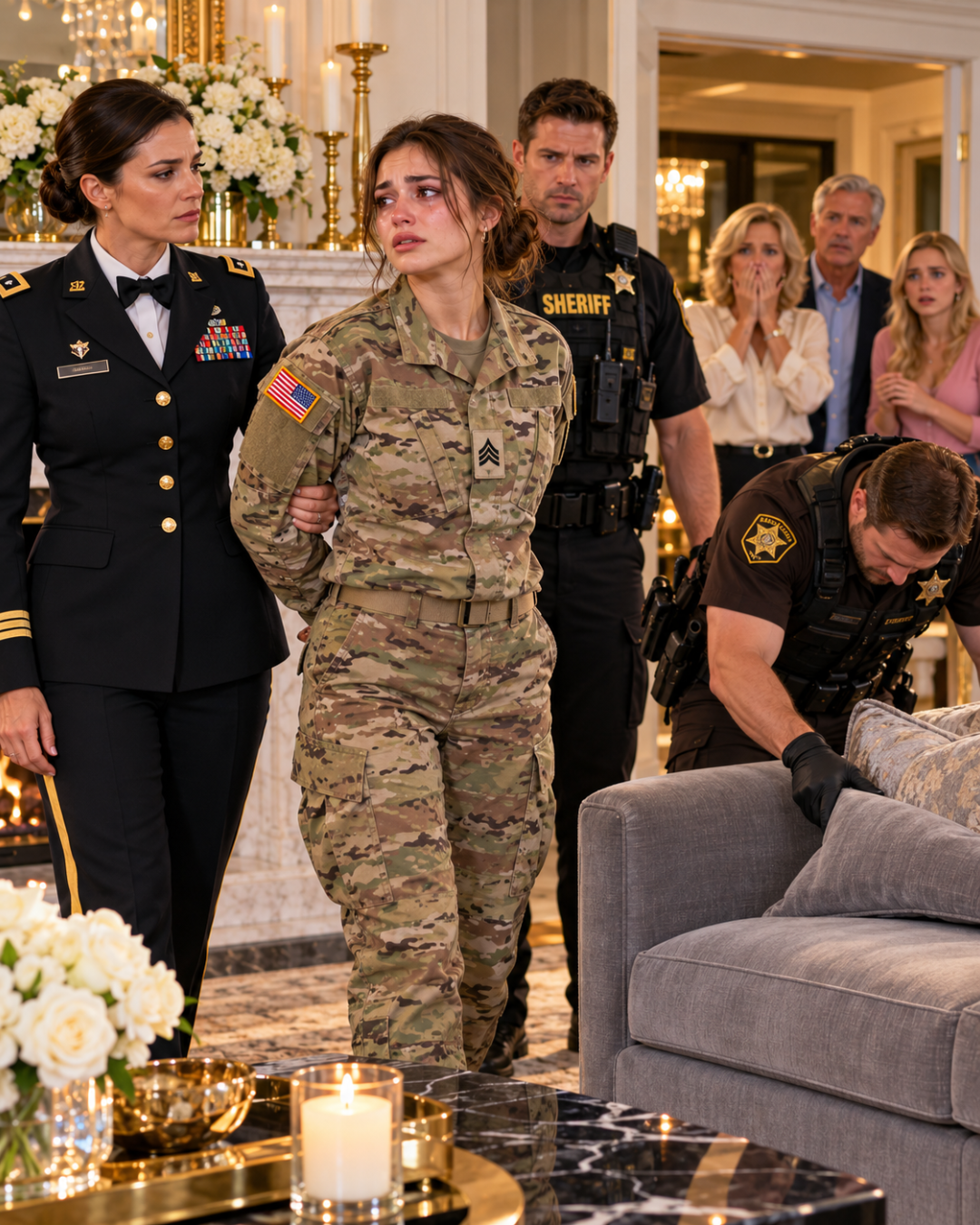
“Staff Sergeant Callahan, your family reported that you pointed a handgun at them and threatened to kill them. We have three sworn statements.”
My stomach dropped.
“That never happened.”
One military police soldier moved behind me.
The other raised a search warrant.
Captain Torres wouldn’t meet my eyes.
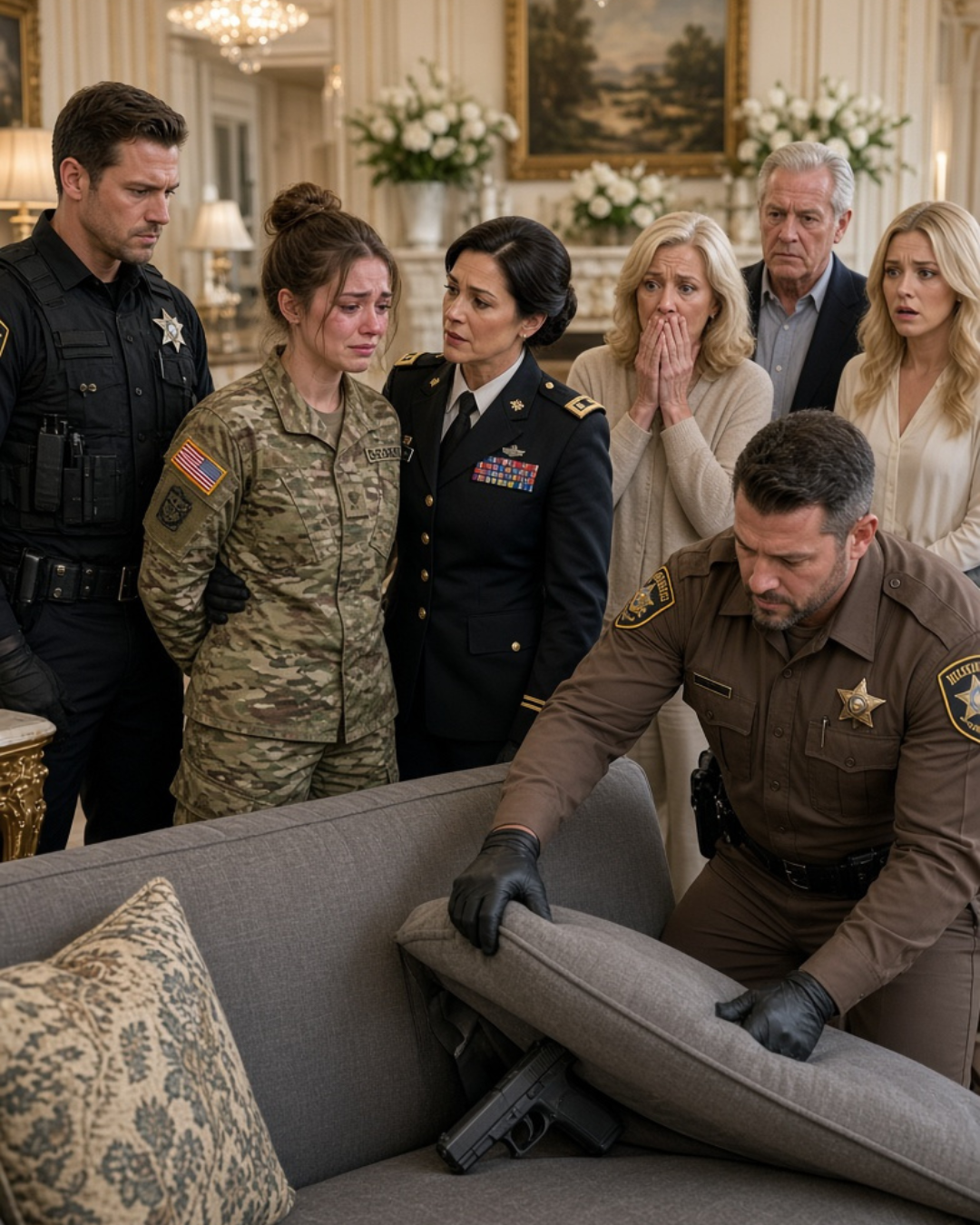
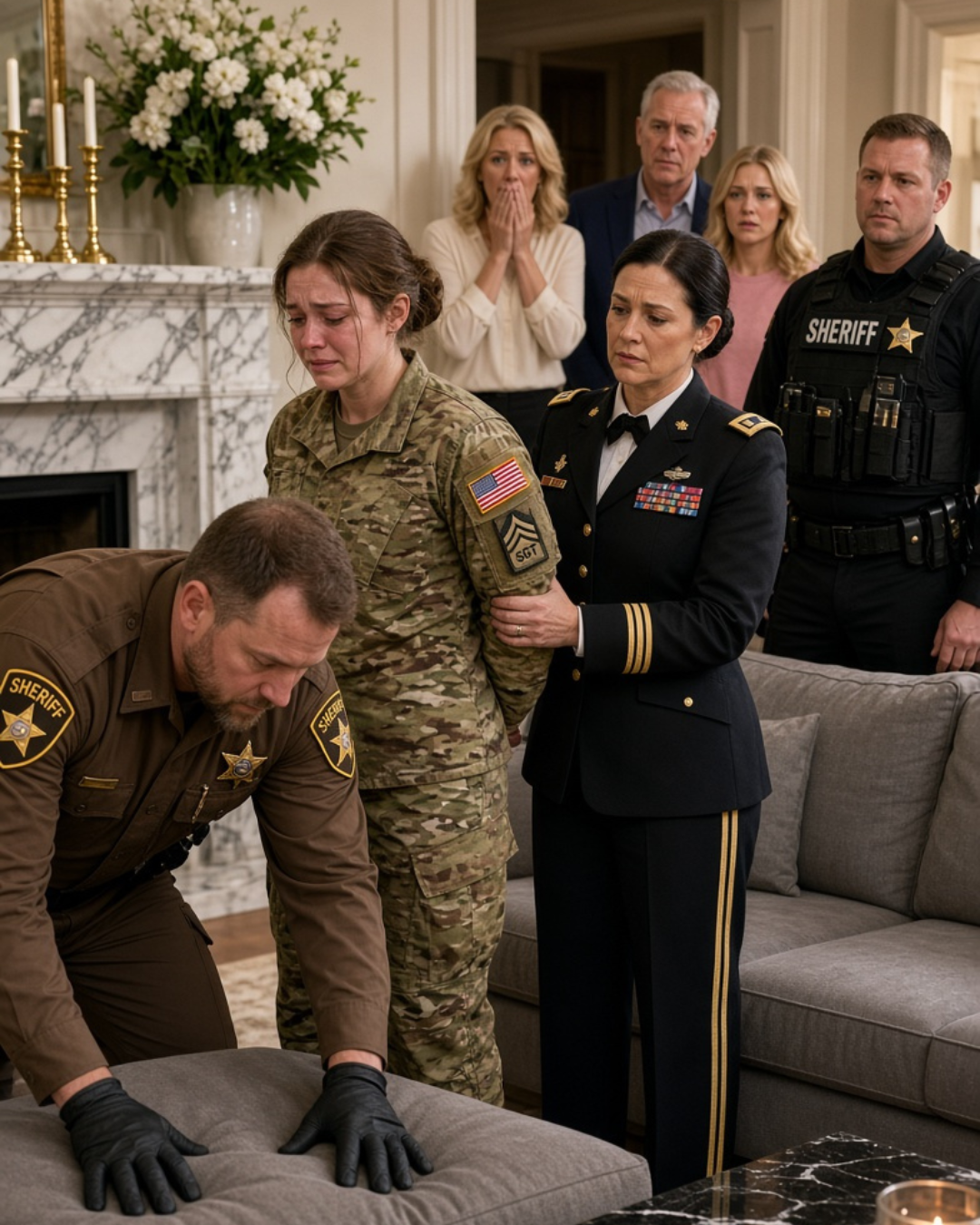
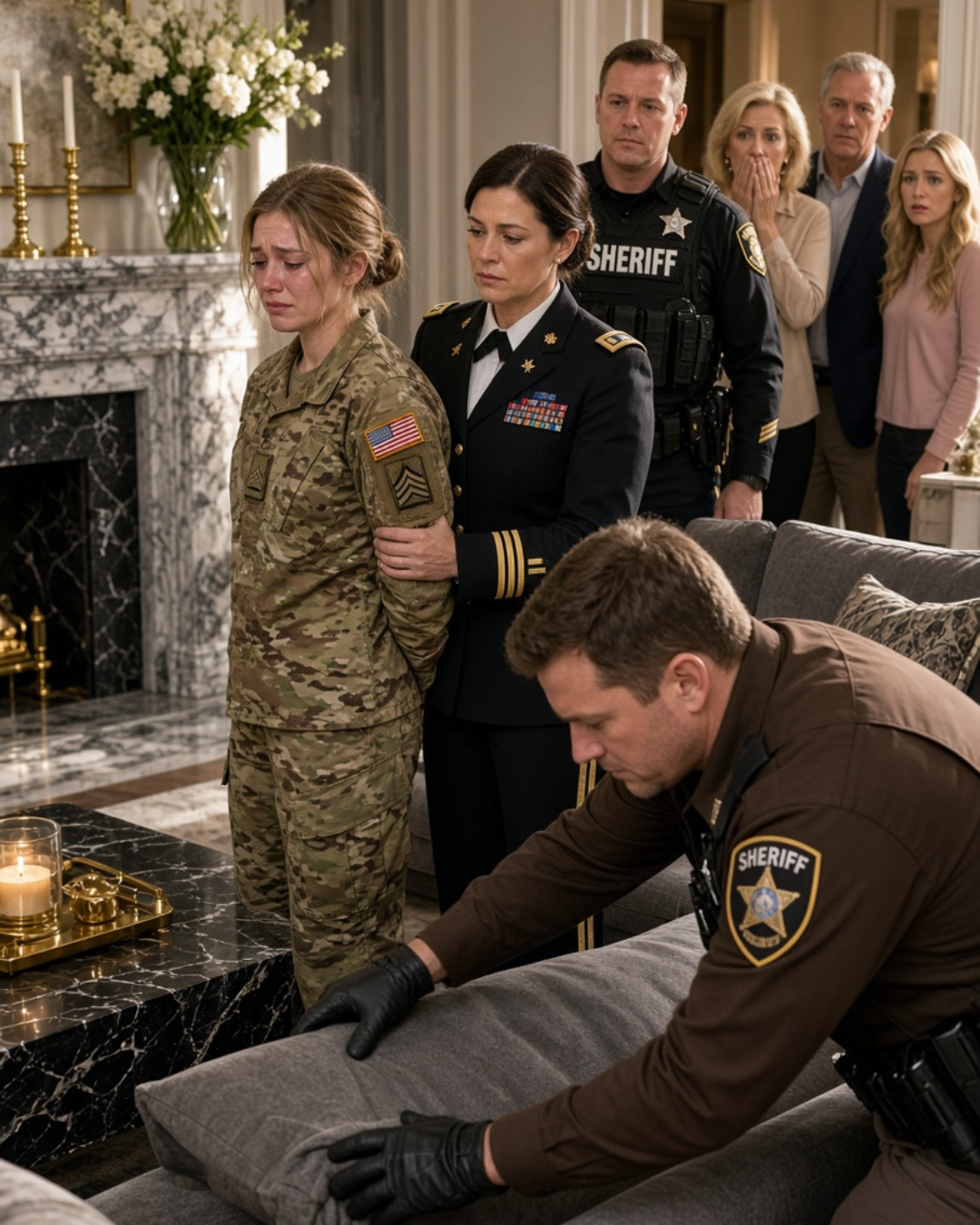
Then the deputy walked directly toward my couch.
He pulled on a glove.
Reached between the cushions.
And removed a black handgun.
My blood turned cold.
I had never seen that weapon before.
It had never belonged in my apartment.
“Turn around,” the deputy ordered. “Put your hands behind your back.”
Someone had planted the gun.
And somehow, the police knew exactly where to look.
I turned slowly.
The handcuffs closed around my wrists.
Not painfully.
Not dramatically.
Just tightly enough to make the nightmare real.
Captain Torres stood near the broken door.
Her face was pale and unreadable.
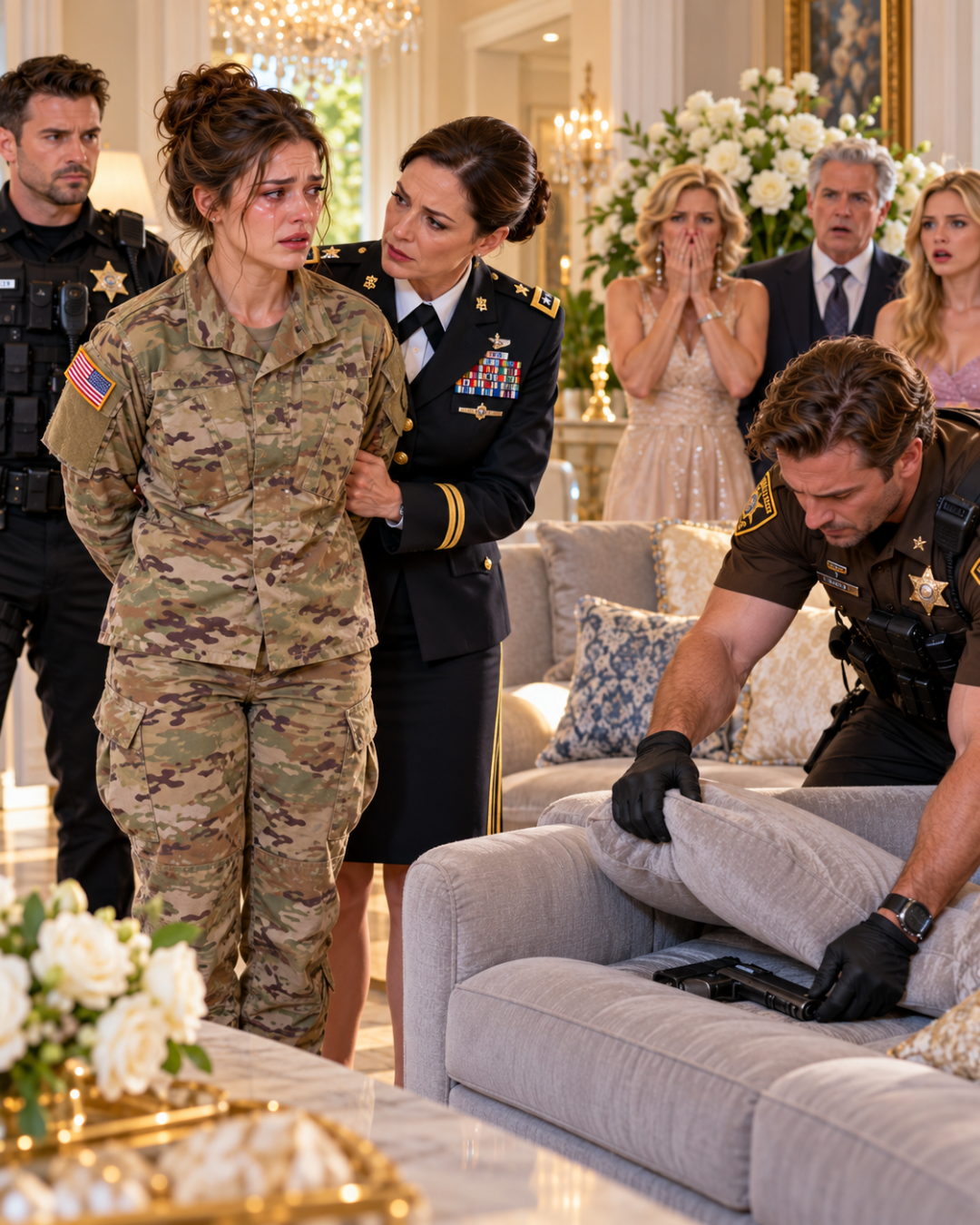
The deputy placed the handgun inside an evidence bag and carried it to the coffee table.
I couldn’t stop looking at it.
A black polymer frame.
A compact barrel.
A silver scratch along the slide.
“Deputy,” I said, forcing myself to remain calm, “I’m Staff Sergeant Callahan. I understand you’re following a warrant, but I need to tell you—”
“You can explain that downtown.”
“I am explaining it now.”
“Erin,” Captain Torres said quietly.
Hearing her use my first name stopped me.
She had commanded my company for fourteen months.
She knew my professional record.
She knew how carefully I handled difficult situations.
Yet she was looking at me as though the accusations had already become facts.
I met her eyes.
“Captain, you know me.”
Her expression tightened.
“I know what I was told.”
“That’s different.”
“Yes,” she answered. “It is.”
The deputy continued searching.
He checked the bedroom, bathroom, kitchen cabinets, and the storage closet where I kept my uniforms and field equipment.
The warrant authorized a search for firearms, ammunition, and evidence connected to the alleged threats.
They found nothing else.
No ammunition.
No threatening notes.
No suspicious messages.
Only the handgun hidden between my couch cushions.
When the search ended, the deputy placed a folded document on the counter.
“Your copy of the warrant.”
My hands were still cuffed.
Captain Torres picked it up and read the first page.
Her eyes moved down the document.
Then stopped.
“What?” I asked.
She looked toward the deputy.
“What?” I repeated.
He folded the paper again.
“You’ll have access to it once you’re processed.”
That answer told me something important.
The warrant had not been based solely on my family’s statements.
Someone had provided additional information convincing a judge that a weapon might be hidden inside my apartment.
“Who reported the location?” I asked.
Nobody answered.
A minute later, they escorted me outside.
The morning air was cool.
My apartment complex looked painfully ordinary.
A woman carried trash toward the bins.
A dog barked behind a balcony door.
A delivery truck idled near the curb.
I wondered how many neighbors were watching.
The county cruiser waited below the stairs.
A military police vehicle stood behind it.
Captain Torres held my apartment keys.
“Your landlord will secure the door,” she said.
“I want legal counsel.”
“You’re being taken in under civilian authority.”
“I still want counsel.”
“I heard you.”
She lowered her voice.
“Erin, if there’s any chance you know how that weapon got there, now is the time to be honest with me.”
A bitter laugh escaped me.
“If I knew how it got there, I wouldn’t be standing here asking you the same question.”
Her gaze shifted toward the apartment.
“Your father says you purchased it last year.”
“I have never owned a handgun.”
“He says you told him you kept one in the couch.”
“My father lies when he needs something.”
“That’s a serious accusation.”
“So is accusing me of threatening to kill my parents.”
She flinched.
Only slightly.
But I noticed.
For a moment, I remembered the trust she had once placed in me.
Captain Torres had told me that logistics meant ensuring people received what they needed before they even realized they needed it.
She had trusted me with difficult assignments because I noticed details others overlooked.
Now she stepped away.
“Call me when you have counsel,” she said.
The deputy opened the cruiser door.
Before climbing inside, I looked back.
My apartment door hung crookedly from its frame.
The broken security chain remained twisted beside the entrance.
Forty-eight hours earlier, I had believed the worst my family could do was demand more money.
I had been terribly wrong.
At the county station, officers photographed me, took my fingerprints, and placed my belongings into a plastic tray.
They retained my phone as evidence because the warrant covered communications connected to the alleged threats.
That frightened me more than the gun.
My phone contained messages with my parents, banking records, work contacts, and conversations with friends.
It also contained the recording of the 911 call from the morning my family forced their way inside.
If investigators listened carefully, they would hear Dad demanding my debit card.
They would hear me ordering them to leave.
They would hear Mom screaming that I was hurting Kelsey.
And most importantly, they would hear Dad’s final promise.
By Friday, you won’t have a career anymore.
I requested an attorney three times before one arrived.
Her name was Denise Holloway.
She was a civilian defense attorney in her early fifties, with gray hair arranged in a neat knot and a canvas folder beneath one arm.
She sat across from me in a small interview room.
Instead of immediately interrogating me, she opened her notebook.
“Tell me what happened,” she said.
So I told her everything.
The money.
The trust amendment.
The canceled transfers.
My parents’ forced entry.
The damaged door.
The 911 call.
My father’s threat.
And the deputy discovering a weapon I had never owned.
Denise listened without interrupting.
When I finished, she asked:
“Do you own any firearms?”
“No.”
“Have you ever owned one?”
“No.”
“Have you ever handled one?”
“I qualified with military weapons. I’ve carried issued rifles and sidearms during training and deployments. But I don’t own one personally.”
“Could someone have accessed your apartment?”
“My family forced their way in two days ago.”
“Anyone else?”
I started to say no.
Then I remembered something.
“Possibly.”
Denise looked up.
“A maintenance technician came by the day before my parents.”
“Why?”
“My kitchen sink was leaking beneath the cabinet. I submitted a request through the apartment portal. The technician came while I was at work.”
“Was the door locked?”
“Yes. I gave the office permission to enter.”
“Do you know his name?”
“Not yet.”
“Find out.”
She wrote it down.
“Anything else?”
I pictured the apartment.
My laptop.
My wallet.
The couch.
Then I remembered something I had dismissed.
“My couch,” I said.
“What about it?”
“After my parents left, I noticed one of the cushions was turned slightly sideways. I assumed Dad had knocked it loose when he pushed me.”
“Was that the cushion where the gun was found?”
I nodded.
“Did you move it?”
“I straightened it.”
“With the weapon underneath?”
“I didn’t see a weapon.”
“Did you reach between the cushions?”
“No. I only pushed the cushion back into place.”
Denise leaned backward.
“That matters.”
“Why?”
“Because if the gun was planted before your parents arrived, they may have expected it to remain hidden. If it was planted during their visit, the person who placed it had access while you were distracted.”
My stomach tightened.
“Kelsey went toward the desk,” I said. “My father shoved me into the bookshelf. My mother grabbed me.”
“Could Kelsey have reached the couch?”
“No. Not without passing behind me.”
“Did anyone sit on it?”
I replayed the confrontation.
Dad had stood near the couch for several seconds while demanding my debit card.
“I don’t know,” I admitted. “Everything happened quickly.”
Denise closed her notebook.
“Your immediate concern is the charge. The prosecutor may release you with conditions while the investigation continues, but your military situation is separate. Your command can suspend your access, remove you from duty, and begin an administrative review even if civilian charges are dismissed.”
“I know.”
“Do you have anyone outside your family who can help establish your whereabouts and habits?”
“My friend Tasha. She lives in the same building.”
“Good. And your bank records?”
“I can get them.”
“Not while they have your phone. But we’ll request them.”
A station employee entered and informed us that I could post bond.
Denise stood.
Then she stopped.
“Before we leave, one more question. Has your family ever threatened to accuse you of something?”
I looked at her.
“My father threatened to call my command.”
“Exactly what did he say?”
I repeated his words.
By Friday, you won’t have a career anymore.
Denise’s expression remained controlled.
But her fingers tightened around the folder.
“Write that down when we get out,” she said. “Exact wording, exact time, exact witnesses.”
I was released shortly after noon.
When I returned home, my apartment looked unfamiliar.
Drawers stood open.
Closet doors hung ajar.
Couch cushions lay scattered across the floor.
My private life had been transformed into evidence markers and empty spaces.
Tasha was waiting in the hallway.
She was twenty-nine, a civilian contractor working in medical administration at Fort Bragg, and the closest thing I had to family outside my parents and sister.
We had met three years earlier when I helped her carry a broken printer down two flights of stairs.
Since then, we had shared coffee, terrible takeout, and the comfortable silences that only real friendship allows.
Her eyes searched my face.
“Are you okay?”
“I don’t know.”
She stepped closer.
“Can I hug you?”
That question almost broke me.
I nodded.
She wrapped her arms around me carefully.
I held on for several seconds before letting go.
“I heard the deputy,” she said. “He knocked on my door yesterday and asked whether I’d seen you with a gun.”
“Did you tell him?”
“I told him the truth. I’ve never seen you with one.”
“Thank you.”
“What happened?”
I told her.
When I mentioned the maintenance visit, she looked toward her apartment.
“Did you have a camera?”
“No.”
“I do.”
I stared at her.
“What?”
She pointed across the hallway.
A small black camera was mounted above her door, angled toward the stairwell and part of the parking lot.
“It’s a doorbell camera,” she explained. “It records motion. I can check whether anyone came up here that afternoon.”
Hope arrived so suddenly it almost hurt.
The camera didn’t point directly at my entrance.
But it captured the landing.
Tasha opened the app and began reviewing recordings.
At 2:17 p.m., a man in a gray maintenance shirt climbed the stairs carrying a toolbox.
At 2:24, he left.
Then another recording appeared.
At 4:51, Kelsey arrived alone.
I stared at the screen.
“Kelsey came here before my parents?”
Tasha enlarged the frame.
My sister’s face was partially turned away.
But her pink sweatshirt was unmistakable.
“She wasn’t wearing that when she came with them,” I said.
On the recording, Kelsey stood outside my door for almost two minutes.
She looked toward the stairwell.
Then she tried the handle.
My heartbeat accelerated.
“She didn’t have a key,” I whispered.
Tasha continued playing the video.
Kelsey stepped back, took out her phone, and made a call.
Thirty seconds later, she walked downstairs.
There was no footage showing her entering.
But there was footage of her returning at 5:00 a.m. with our parents.
“Save it,” I said.
“I already did.”
“Send me a copy.”
“I sent it to the attorney.”
For the first time since the deputy pulled that handgun from my couch, the accusations against me showed a crack.
Not proof.
But a crack.
And I intended to find out what lay behind it.
That evening, Denise accompanied me to the installation legal assistance office.
She carried the search warrant and a preliminary evidence report.
The report confirmed the handgun had not been fired recently.
No usable fingerprints were recovered from the grip.
However, investigators had identified a partial print on the magazine base.
The serial number was intact.
The weapon was registered to someone named Harold Vance.
I had never heard the name.
Denise sat beside me while Lieutenant Aaron Malik, a military attorney, reviewed the documents.
He spoke with the careful precision of someone accustomed to separating evidence from fear.
“Your command has placed you on administrative suspension pending investigation,” he said. “You’re not being separated at this time.”
“Can I return to work?”
“Not until the weapon issue is resolved.”
“I didn’t do this.”
“I understand. But a military command has to manage risk while the civilian case is open.”
“Captain Torres thinks I’m dangerous.”
“She may be following procedure.”
“She wouldn’t even look at me.”
Lieutenant Malik folded his hands.
“Your relationship with your commander is important, but it’s not evidence.”
Denise handed him Tasha’s recording.
He watched it twice.
“Do you know whether Kelsey had a key?” he asked.
“No.”
“Could she have entered another way?”
“I don’t know.”
“Your parents said all three of them entered the apartment together?”
“Yes.”
“That conflicts with the footage.”
“Can we subpoena the security footage from the building?”
“We can request it. Denise can issue preservation letters today.”
The lieutenant examined the evidence report again.
“Harold Vance,” he said. “Does that name mean anything?”
“No.”
He entered the name into a database.
A few seconds later, his expression changed.
“What?” I asked.
He turned the screen toward us.
Harold Vance owned a pawn and sporting goods shop in Fayetteville.
The shop held a federal firearms license.
And the address was familiar.
Not because I had visited it.
Because I had seen it on my bank statements.
A recurring charge from Vance Outdoor Supply had appeared among my family’s expenses for the past two years.
I had assumed the purchases were equipment for Dad’s hunting trips.
“Why would my family have a transaction from that store?” I asked.
Denise looked at me.
“How often?”
“Several times. I didn’t pay attention. They used my card for household expenses.”
“Do you still have access to the bank account?”
“My laptop does. The bank app is on my phone, but I can log in through the browser.”
We returned to my apartment.
I opened my banking records and searched the merchant’s name.
Four transactions appeared.
Two were under one hundred dollars.
One was for $318.
The most recent had been made five days earlier.
Two days before my parents forced their way into my apartment.
I clicked the transaction.
The description contained an item number.
Denise called the shop.
A woman answered.
Denise identified herself as my attorney and asked whether the store could confirm if a firearm matching the serial number had been sold or transferred through the business.
The woman requested a written inquiry.
Denise sent it immediately.
While we waited, I examined the account more carefully.
The $318 charge had been made using my debit card.
But the purchase location was not my parents’ town.
It was Fayetteville.
Less than three miles from Fort Bragg.
My card had never left my wallet.
Or at least, I had never knowingly given it to anyone.
Tasha stood behind me.
“Erin,” she said quietly. “When was the last time you checked your wallet?”
“Before my parents came. It was on the desk.”
“Could someone have copied the card number?”
I remembered Kelsey rushing toward the desk.
Perhaps she hadn’t been trying to steal my wallet.
Perhaps she had been checking whether I had noticed something.
At 8:13 p.m., the shop returned Denise’s call.
The woman sounded nervous.
She confirmed the handgun had been purchased ten months earlier.
By a woman named Kelsey Callahan.
My sister.
I stared at the screen.
“The $318 charge?” Denise asked.
The clerk explained that Kelsey had paid cash for the firearm.
The debit-card transaction was for a different item purchased that same day.
A lockbox.
A small, foam-lined case designed to store a handgun.
Denise ended the call.
Nobody spoke.
“The gun was purchased by Kelsey,” I said.
“Apparently,” Denise replied.
“And I paid for the lockbox.”
“Apparently.”
Tasha sat on the arm of the couch.
“Why would she buy a gun?”
I looked toward the empty space where the police had discovered it.
“I don’t know.”
Denise’s expression remained thoughtful.
The shop sent another email at 9:02 p.m.
Attached was the firearm purchase record.
The customer name was Kelsey Callahan.
The serial number matched the handgun recovered from my apartment.
But the clerk had included something else.
Kelsey had returned four days earlier and asked whether the weapon could be transferred into another person’s name.
The clerk refused to process a transfer without the required parties and documentation.
Then I noticed a second attachment.
A scanned receipt for the lockbox.
The purchaser name was Erin Callahan.
But the signature was not mine.
It was my father’s handwriting.
And beneath the signature, in the field marked delivery address, was my apartment number.
I stared at the document.
My father had signed my name.
He had used my debit card.
And he had arranged for a gun storage box to be delivered directly to my home.
Suddenly, I understood something terrifying.
This hadn’t begun with an argument about money.
Someone had been preparing to destroy me before my father ever smashed through my door.
PART 2: The Evidence They Never Expected Me to Find
I knew my father’s handwriting better than almost anyone else’s.
I had seen it on school permission slips, birthday cards, mortgage papers, and handwritten notes throughout my childhood.
The slanted capital C.
The narrow spacing between his first and last names.
The heavy pressure at the end of each letter.
There was no mistaking the signature on the receipt.
He had signed my name.
For several seconds, the only sound in the apartment was the refrigerator humming.
Tasha stood behind my chair.
Denise remained on the phone with the shop clerk, asking questions in a carefully controlled voice.
“Please preserve the original receipt,” she instructed. “Do not mail it. Do not alter the file. We’ll send a formal request for the records tonight.”
When she ended the call, she looked at me.
“I’m sorry,” she said.
I kept staring at the scanned document.
“He bought the lockbox with my card.”
“He may have used your card information without permission.”
“He signed my name.”
“Yes.”
“And he delivered it to my apartment.”
“Yes.”
The facts were simple.
The betrayal was not.
My father had always ignored boundaries.
He borrowed money without asking because he assumed I would help.
He entered rooms without knocking because he treated privacy as rejection.
He made decisions for everyone because he believed his judgment mattered more than theirs.
But this required planning.
He had imagined a firearm inside my apartment.
Then he had created a financial record pointing directly toward me.
Tasha lowered herself into a chair.
“Could the store have made a mistake?”
Denise shook her head.
“The clerk confirmed the item number, date, card authorization, and delivery address. The receipt was scanned at the time of purchase.”
“Could someone have copied the signature?” I asked.
“Possibly. But that isn’t the question we need to answer tonight. We need to preserve every record and determine how your father obtained your card information.”
I looked at my hands.
Then remembered something.
“I sent them pictures of my card once.”
Tasha lifted her head.
“Why?”
“Dad said the utility company had changed its payment system. He needed the account and routing numbers for an automatic draft.”
“When?”
“Last year, maybe. I don’t remember exactly.”
“Did you send the front and back?”
I nodded.
Denise wrote something in her notebook.
“That gives him access to the card number and security code. It doesn’t explain the signature or the delivery.”
“No,” I said. “But it explains the lockbox.”
I opened the banking website again.
The purchase had occurred six days earlier, around lunchtime.
At that exact time, I had been attending a logistics briefing on post.
My debit card had been in my wallet.
Or at least, I believed it had been.
Denise leaned toward the screen.
“What’s this charge immediately after the lockbox?”
I clicked it.
A payment to my apartment management company.
My rent.
For the first time in months, my rent had been paid twice.
The first payment cleared through my normal automatic transfer.
The second was a smaller electronic payment submitted from an unfamiliar account.
The reference field contained six digits.
My apartment number followed by the final two numbers of my Social Security number.
My mouth went dry.
“Who would have access to that?” Tasha asked.
“My parents.”
Denise’s expression sharpened.
“Why would they pay your rent?”
“I don’t know.”
“Was it refunded?”
I opened the details.
The second payment had been rejected three days later.
The account holder’s name was partially hidden.
But the originating institution was listed.
A local credit union.
The same institution that held my parents’ mortgage.
I printed the record.
Then I printed every charge from Vance Outdoor Supply, every payment made from my account toward my parents’ expenses, and every transfer I had sent during the previous five years.
The printer worked steadily while pages accumulated in its tray.
For years, I had sent money without asking questions.
Mom would call while I was working.
“We’re short this month.”
“Dad’s truck needs something.”
“Kelsey had an unexpected expense.”
I would send whatever I could.
Then return to duty.
Now those transactions formed a pattern I could no longer ignore.
The payments to Vance Outdoor Supply began eight months after I started helping them.
The first two were small.
Then came the $318 charge for the lockbox.
There were also purchases involving a compact safe and replacement keys.
All were connected to cash payments or accounts associated with my family.
“Why would Kelsey buy a gun and then ask to transfer it?” Tasha wondered.
“Maybe she was afraid of something,” I said.
Denise tapped the receipt.
“Or someone was trying to create a chain of ownership that could later be denied.”
I looked at her.
“She bought the firearm. Your father purchased the lockbox using your card. The receipt placed the box at your apartment. Then the gun appeared inside it—or was moved from it—before your family reported that you threatened them.”
“But why leave the gun loose in the couch?”
“If the lockbox was removed, the gun would need another hiding place.”
I pictured the apartment.
The crooked couch cushion.
Dad standing near the sofa.
Kelsey arriving alone before dawn.
“What if the lockbox was in my apartment before they came?” I asked.
Tasha leaned forward.
“Where?”
“I don’t know. Maybe the maintenance closet. Maybe under the sink. The technician came the day before.”
Denise examined the receipt.
“The delivery address says your apartment number, but not the unit.”
I gave her the full address.
She called the shop again.
After several minutes, she ended the conversation.
“The store used a delivery service because your father paid for delivery. The driver’s name was Miguel Santos. The clerk says the box was delivered two days before the maintenance visit.”
“To my apartment?”
“That’s what the address says.”
“No one delivered anything to me.”
“Was anyone home?”
“I was at work.”
“Did the apartment office have permission to accept packages?”
“Yes. They place them in a secure room.”
Tasha stood.
“The office keeps package logs.”
The leasing office was closed, but its emergency number connected us to a night supervisor.
Denise explained that we needed to preserve a delivery record related to an active criminal investigation.
The supervisor checked the digital log.
“Can you at least tell us whether a package was logged for Erin Callahan?” Denise asked.
A pause followed.
“Yes. A small package was delivered six days ago. It was signed for by someone listed as an authorized resident.”
“Who?”
“I can’t disclose that over the phone.”
Denise remained calm.
“Please preserve the entry and all available camera footage. We’ll provide a formal request first thing in the morning.”
After the call ended, I stood beside the window.
Six days ago.
The same day my card paid for the lockbox.
The same day I was at work.
“Who is listed as an authorized resident?” Tasha asked.
“I never added anyone.”
“Could someone have called and pretended to be you?”
Denise closed her folder.
“We’ll find out tomorrow.”
I barely slept.
At 5:30 the following morning, I sat at my kitchen table with a cup of coffee that had gone cold.
My Army laptop remained locked inside its case.
My phone was still in police custody.
I had no duty assignment to report to.
No uniform to put on.
No familiar schedule.
For eleven years, every morning had begun with purpose.
Even during exhausting assignments, there was always a task waiting.
A convoy to coordinate.
A shortage to resolve.
Someone depending on me.
Now I watched sunlight spread across the floor and wondered how quickly a career could be suspended because of a lie.
At seven, Denise arrived with a document examiner named Paul Avery.
He was a soft-spoken man wearing wire-rimmed glasses and carrying a leather case.
“I’m not here to make a final determination,” he explained. “But I can compare the signature against known samples.”
“I have plenty of those,” I replied.
Dad’s signature appeared on the trust amendment.
Denise had also obtained several older documents.
Paul studied the signatures beneath a magnifying lamp.
He measured angles.
Spacing.
Pressure.
After twenty minutes, he looked up.
“The signature on the receipt was probably written by the same person who signed these documents,” he said. “There are consistent habits in the formation of the letters.”
“Probably?”
“A court would want a formal report, but the similarities are significant.”
Denise thanked him and placed the samples in a protective sleeve.
At eight, we met Caroline Wu, the apartment property manager.
Caroline was a compact woman in her forties who normally handled maintenance requests with cheerful efficiency.
That morning, she looked deeply uncomfortable.
The county deputy assigned to the investigation joined us.
Denise was there too.
Captain Torres had sent a military legal representative.
Caroline opened the package log.
The entry showed a small black lockbox received at 12:16 p.m. six days earlier.
The signature field read:
Erin Callahan.
The handwriting didn’t resemble mine.
The authorized recipient field listed my name, but Caroline explained that the delivery company had selected it from an existing database.
“Who signed for it?” Denise asked.
Caroline hesitated.
“I need to be precise. The driver didn’t bring it to the office. He requested access to the resident package room. One of our temporary clerks let him in.”
“Who was the clerk?”
Caroline clicked through another screen.
“Riley Benton.”
The name meant nothing to me.
“Was Riley working that day?” I asked.
“She was covering the front desk. She no longer works here.”
“Why not?”
Caroline glanced toward the deputy.
“She resigned two weeks ago.”
“Do you know where she went?”
“She listed a forwarding address, but I can provide it to law enforcement.”
The deputy wrote it down.
Denise asked about camera footage.
Caroline explained that the package room camera automatically overwrote recordings after seven days.
“It’s been six,” she said. “We may still have it.”
She contacted the maintenance supervisor.
Minutes later, the footage appeared.
A delivery driver entered the package room at 12:14 p.m.
He carried a cardboard box with a printed label.
Behind him walked a young woman wearing a gray office sweater.
Riley Benton.
She spoke briefly with the driver.
Then placed the box on a shelf.
She looked directly toward the camera.
Her face remained clearly visible.
The deputy paused the recording.
“Can you enhance the label?”
Caroline adjusted the image.
My apartment number was visible.
The box remained on the shelf for nearly twenty minutes.
Then Riley returned.
She picked it up and carried it out of the package room.
But she didn’t walk toward the front office.
She headed toward the rear exit used by maintenance staff.
The footage ended.
My pulse accelerated.
“She took it,” I said.
“Maybe,” the deputy replied. “We need to know where.”
Another camera covered the maintenance corridor.
Caroline opened the recording.
Riley appeared carrying the package.
She stopped near the maintenance storage room.
A man in a gray maintenance shirt approached.
I recognized him instantly.
He was the technician from Tasha’s camera.
The man who had supposedly repaired my sink.
They exchanged a few words.
There was no audio.
Riley handed him the box.
He glanced toward the camera.
Then the video skipped forward.
The next frame showed the technician leaving through the side door without the package.
The deputy leaned toward the screen.
“What date was this?”
“Four days ago,” Caroline answered.
“The day before my parents came,” I whispered.
Denise looked at me.
“What was the technician’s name?”
Caroline opened the maintenance schedule.
“Derek Sloan.”
I remembered seeing that name on the work order.
I had ignored it.
The deputy contacted his office and requested a warrant for Sloan’s address.
Captain Torres’s representative stepped aside to call my command.
I remained in the leasing office with Tasha.
I expected to feel relieved.
Instead, I felt deeply unsettled.
The evidence suggested my family hadn’t acted alone.
Someone had helped them obtain the lockbox, access my apartment, and position the weapon where the police would discover it.
But the discovery made the betrayal more complicated.
Not less.
“Do you think Kelsey knew?” Tasha asked.
“I don’t know.”
“She bought the gun.”
“Yes.”
“Maybe she was trying to protect herself.”
“From what?”
Tasha looked toward the frozen image of Riley.
“Your family has been asking you for money for years. Maybe something happened that they didn’t tell you.”
I thought about the trust amendment.
Kelsey’s name beside everything.
My own name removed with a sentence suggesting that independence made me less deserving of family consideration.
If there had been a crisis, why hadn’t anyone told me?
If Kelsey was afraid, why had she come to my apartment before dawn?
And if my parents were desperate, why had they decided destroying my career was the solution?
Those questions followed me home.
That afternoon, Lieutenant Malik called.
“The command has received the new evidence,” he said. “Your suspension remains in place for now, but they are no longer treating the weapon as conclusive evidence against you.”
“What does that mean?”
“It means the investigation has changed direction.”
“Will Captain Torres be told?”
“She already knows.”
I stared at the ceiling.
“Does she believe me?”
A pause followed.
“She asked whether you were safe.”
The answer should have comforted me.
Instead, it reminded me that she still hadn’t called.
“Can I have my phone back?”
“Not yet. The civilian investigators are reviewing it.”
“The 911 recording is on there.”
“We know.”
“Then why has no one mentioned it?”
“Because they’re building the case carefully.”
I understood.
But patience had become difficult.
That evening, the county deputy returned with another warrant.
He reviewed the maintenance records stored in my email account and found the original work order.
Derek Sloan had entered using a temporary access code issued by the leasing office.
The code was supposed to expire at six that evening.
Instead, it had been used again at 4:43 the following morning.
Fourteen minutes before Kelsey appeared on Tasha’s camera.
“Who used the code?” Denise asked.
The access system listed Derek Sloan.
The deputy requested exterior security footage.
Tasha’s camera captured the stairwell.
The building’s parking camera showed something more revealing.
At 4:39 a.m., a white service van entered the lot.
At 4:42, Derek Sloan carried a small black object from the vehicle.
At 4:45, he entered the building.
At 4:51, Kelsey arrived alone.
At 4:58, Sloan exited through the side door.
At 5:00, Kelsey returned with our parents.
The sequence was too precise to dismiss.
The deputy paused the recording.
Sloan carried a ring of keys.
One key had a bright red plastic tag.
“Maintenance master key,” Caroline explained.
My apartment door had been damaged two days earlier, but its lock still worked.
Sloan could have entered without leaving additional signs of forced entry.
He could have placed the handgun beneath the couch cushion.
He could have removed the lockbox.
But why had Kelsey tried the door handle if Sloan had already entered?
Perhaps she was checking whether he had finished.
Perhaps she was afraid he hadn’t.
The deputy called Derek Sloan.
Voicemail.
He tried again.
The number had been disconnected.
That was when my phone rang.
I didn’t recognize the number.
Denise answered first.
“Hello?”
Her expression changed.
She handed me the phone.
“Erin,” a trembling female voice said. “My name is Riley Benton. I used to work at your apartment complex.”
I stood.
“How did you get this number?”
“Your attorney left her card at the office. Caroline gave me a copy.”
“What happened?”
“I need to tell you the truth before they find me.”
“Who?”
Riley breathed unevenly.
“Your sister and your father.”
I looked at Denise.
She motioned for me to put the call on speaker.
Riley continued.
“I didn’t know what was in the box at first. Your father told me it was a document case. He said you were expecting it and that the delivery company had made a mistake.”
“Why did you take it to the maintenance room?”
“He gave me twenty dollars.”
“For what?”
“To let his friend pick it up without putting it through the normal package system.”
“Derek Sloan?”
“Yes.”
“Did you know he was going into my apartment?”
“No. Not then.”
Her voice broke.
“When did you find out?”
“Afterward. Derek came back to the office and asked me for a temporary access code. He said he needed to check a leak in your kitchen. I thought that was normal because he’d been assigned to your work order.”
“But he had already repaired the sink.”
“I know.”
“What did you see?”
“I saw him carry the box into the maintenance room. He opened it.”
My hand tightened around the phone.
“What was inside?”
“A black lockbox.”
“Was the gun inside?”
“I don’t know. The box was closed when he opened it, and he stood between me and the table. But I heard metal.”
Denise leaned closer.
“Did you see Derek take the box to my apartment?”
“No. He told me not to ask questions. Then your father called me later and said I could lose my job if I talked about the package.”
“Why did you quit?”
“Because I knew something was wrong.”
Riley’s breathing grew faster.
“Erin, I’m sorry. I should have said something sooner. But your father knew where I lived. He said your family had connections and that no one would believe a temporary clerk over a military sergeant.”
“He was wrong,” I said.
“I have something else.”
The room went still.
“What?”
“A recording.”
“Of what?”
“Your father and your sister. They came to my apartment the night after the package was delivered. I had a baby monitor camera in my living room because my niece stays with me sometimes. It records sound when there’s movement.”
Riley swallowed.
“They didn’t know it was on.”
“What did they say?”
“I don’t want to repeat it over the phone.”
“Riley, this is important.”
“I know. That’s why I’m calling. I’ll meet you somewhere public.”
Denise took the phone.
“Riley, this is Denise Holloway. Do not delete or alter the recording. Keep the original device if possible. We will arrange a secure meeting with law enforcement.”
“I’m scared.”
“I understand. But you are not alone now.”
The call ended.
I remained standing beside the table.
“What did she hear?” Tasha asked.
“I don’t know.”
Denise was already calling the deputy.
We had a witness.
We had surveillance footage.
We had the firearm purchase record.
And now we had a recording that might prove my family had deliberately arranged everything.
But the question that haunted me most remained unanswered.
Why had Kelsey agreed to participate?
The answer arrived the following morning.
Not from Riley.
From my mother.
She called from an unfamiliar number.
Denise sat beside me when I answered.
“Erin,” Mom whispered.
She sounded exhausted.
“Where are you?”
“I’m at home.”
“Are you alone?”
“No.”
She remained silent for several seconds.
“I should have told you,” she said.
“Tell me now.”
“I didn’t know how.”
“That has never stopped Dad before.”
A faint breath came through the phone.
“Your sister owes money.”
“I know she has expenses.”
“No. It’s more serious than that.”
I looked toward Denise.
“How serious?”
“Kelsey borrowed money from someone. A lot of it. Your father found out and tried to fix it.”
“By buying her a gun?”
“No.”
“By planting one in my apartment?”
Mom began crying.
“I don’t know what he planned. I swear I don’t.”
“Then what do you know?”
“I know Kelsey was afraid. She said someone was following her. She said she needed protection. Your father bought the gun through a friend, but Kelsey didn’t want it registered to her anymore.”
“She bought it under her own name.”
“Because she thought she had no choice.”
“And the lockbox?”
“Your father said he was moving it somewhere safe.”
“My apartment isn’t somewhere safe.”
“I know.”
“Did you know he used my card?”
“No.”
“Did you know he signed my name?”
“No.”
The answers came too quickly.
“Mom.”
Her voice fell.
“I knew he used your account. I didn’t know about the signature.”
I closed my eyes.
“You knew?”
“He told me the bank had approved a payment. I thought it was for the house.”
“Was it?”
“No.”
“What was the money for?”
She didn’t answer.
“Mom, what did Dad do?”
Her voice dropped to a whisper.
“He was trying to make it look as if you had bought the gun.”
Denise immediately began writing.
“Why?” I asked.
“Because Kelsey’s name was connected to it. The person she owed money to knew she had purchased it. Your father thought if the weapon appeared in your home, everyone would believe you were responsible, and Kelsey could say it had been stolen.”
The explanation was so twisted I could barely follow it.
“Why would anyone believe that?”
“Because your father said the police would see you as unstable. He said your military record would make you look dangerous.”
My fingers tightened around the phone.
“He told you that?”
“He was angry. He said you had turned against us. He said you would rather see the family suffer than help.”
The familiar wound opened again.
But this time, something colder lay beneath it.
“Did Kelsey know?”
Mom hesitated.
“She knew about the package.”
“Did she know the gun would be placed in my apartment?”
“She knew your father had arranged for Derek to enter.”
I felt the room tilt.
My sister knew.
The woman I had spent years protecting had known someone was entering my apartment to plant a firearm.
And she had allowed it to happen.
PART 3: The Truth That Finally Set Me Free
“She knew your father had arranged for Derek to enter,” Mom continued. “She thought he was only moving the gun. She didn’t know what he intended to do with it after that.”
I opened my eyes.
“But she came to my apartment before you and Dad arrived.”
“She was supposed to check whether Derek had left it beneath the cushion.”
“Why?”
“Your father told her the police would never search your apartment unless there was a reason. He said she needed to know whether the plan had worked.”
The meaning became horribly clear.
Kelsey hadn’t come to steal my debit card.
She had come to inspect the evidence my father had arranged to plant.
“And then what?” I asked.
“Then your father told her to come back with us and say you had threatened her.”
I stared at the table.
Mom began crying harder.
“I didn’t want this to happen.”
“You came anyway.”
“I was afraid of him.”
The sentence was quiet.
But it carried years of silence.
I remembered all the times Mom had called asking for money while Dad stood somewhere nearby.
All the times she had apologized for expenses she never explained.
I had mistaken helplessness for innocence.
Perhaps both could exist together.
“Why didn’t you tell me before the police came?”
“Because your father said Kelsey would be arrested. He said everything would fall apart.”
“Everything already fell apart.”
“I know.”
“Do you?”
“Yes,” she whispered. “I know now.”
Denise reached for the phone.
“Mrs. Callahan, we need you to preserve any messages, receipts, or documents related to the firearm, the lockbox, and your husband’s conversations with Derek Sloan. Do not contact him about this call.”
Mom drew a shaky breath.
“He knows I called.”
“How?”
“He was outside when I left. I told him I was going to the pharmacy.”
“Where are you now?”
“At my sister’s house.”
“Stay there. Law enforcement will contact you.”
Mom asked to speak to me again.
I took the phone.
“I’m sorry,” she whispered.
There had been a time when those words would have been enough to bring me back.
I would have said everything was okay.
I would have comforted her.
I would have tried to make her feel better before admitting how badly I had been hurt.
Not anymore.
“I don’t know what happens next,” I told her. “But I can’t protect you from the consequences of what you helped do.”
“I understand.”
“Do you?”
“I’m beginning to.”
The call ended.
For several minutes, nobody spoke.
Then Denise said:
“That statement is important, but we still need evidence that can be used in court.”
“I know.”
“We have Riley’s recording to obtain. We have the building footage. We have the purchase record. We have your father’s signature. We need to connect the decisions.”
The deputy arrived less than an hour later.
Riley had agreed to meet at the county station with her attorney.
She brought the baby monitor camera inside a canvas tote bag.
She hadn’t touched the memory card.
“I didn’t listen to it again,” she admitted. “I was too afraid.”
The deputy secured the device and copied its files.
The recording began with a door closing.
A television played faintly in the background.
Someone moved dishes across a counter.
Then my father’s voice filled the room.
“You did what we paid you to do,” he said. “Now stop asking questions.”
Riley’s recorded voice answered.
“You told me it was paperwork.”
“It was a box.”
“You took it from the package room.”
“And I paid you for your trouble.”
Then Kelsey spoke.
Her voice sounded thinner than I remembered.
“Dad, this isn’t what we discussed.”
“We discussed protecting you.”
“Not framing Erin.”
“Lower your voice.”
“You said the gun would be returned.”
“It will be, once the police finish.”
A long silence followed.
Then Kelsey said:
“What if they search her place and find it?”
“That’s the point.”
“And if they don’t?”
“They will.”
“How do you know?”
“Because I gave them a reason.”
My breath stopped.
Kelsey sounded close to tears.
“You said she would only be questioned.”
“She’ll be questioned, suspended, and then she’ll understand what it feels like to have everyone turn away.”
“That’s not what I wanted.”
“You wanted the debt gone.”
“I wanted help.”
“And I’m helping you.”
The recording continued.
Dad explained that the weapon belonged to Kelsey but needed to appear connected to me.
He said my military position would make the accusation believable.
And once I was “contained,” he would negotiate with the people Kelsey owed.
Then Mom’s voice appeared in the background.
“Please stop. This has gone too far.”
Dad answered:
“You’re part of this now.”
The recording ended.
Nobody moved.
I had expected the truth to bring relief.
Instead, something inside me seemed to break.
For years, I had wondered whether I had imagined the imbalance in our family.
Whether I had been too sensitive.
Too suspicious.
Too selfish.
Now there was a recording of my father explaining how he intended to destroy my career because I had stopped giving him money.
He had never viewed my sacrifice as love.
He had viewed it as a resource.
And when that resource disappeared, he decided to punish me.
The deputy asked whether I wanted to make a formal statement.
“Yes,” I said.
We spent the afternoon in an interview room.
I described the financial transfers.
The trust amendment.
The confrontation.
The forced entry.
And every detail I remembered from the morning my family stormed into my apartment.
Denise sat beside me.
Lieutenant Malik joined by secure call for the portions involving my command.
I explained how Kelsey moved toward my desk.
How Dad shoved me.
How Mom restrained me.
And why I called 911.
Then the deputy played the original emergency call.
My own voice sounded controlled.
Almost distant.
Dad’s threat came through clearly.
By Friday, you won’t have a career anymore.
When the recording ended, the deputy looked at me.
“You did the right thing by calling.”
“I almost didn’t.”
“Why?”
“Because they were my family.”
He nodded.
After the interview, Captain Torres requested a meeting.
We met in a small office at the installation legal center.
She stood when I entered.
“I owe you an apology,” she said.
I sat down.
“For what?”
“For assuming the statements were credible before hearing yours.”
“You were following procedure.”
“That doesn’t excuse treating you like a conclusion instead of a person.”
Her honesty made it difficult to remain angry.
She placed a folder on the desk.
“The command has reviewed the building footage, the purchase records, your 911 call, and the recording from Riley Benton. Your administrative suspension is lifted effective immediately.”
I stared at the folder.
“Am I being charged under the military justice system?”
“No.”
“Am I being removed from my position?”
“No.”
“Will this affect my promotion?”
“We’re reviewing the timeline, but there is no adverse finding against you.”
I released a breath I hadn’t realized I was holding.
Captain Torres folded her hands.
“Your access to government property and systems will be restored tomorrow morning. I can arrange temporary housing if you need it.”
“I don’t.”
“You should still consider taking leave.”
“I might.”
She looked down.
“When I first heard the allegation, I remembered your father saying you were unstable. I let that phrase stay in my mind longer than it should have.”
“My father knows how to make people doubt someone.”
“So do I,” she replied. “That’s why I should have been more careful.”
I studied her.
“Why didn’t you look at me?”
She swallowed.
“Because I was afraid that if I did, I would believe you before I had the facts. I thought distance was neutrality.”
“It felt like rejection.”
“I know.”
Her apology didn’t erase the pain.
But it gave that pain somewhere to rest.
“I’ll return to duty,” I said. “But I may need time before I’m ready to act as if nothing happened.”
“You won’t be expected to.”
She slid a form toward me.
“You’re entitled to counseling through the installation. Not because you did anything wrong. Because what happened was a betrayal, and betrayal affects judgment, sleep, and trust.”
I signed it.
“Thank you.”
Captain Torres stood and offered her hand.
This time, I took it.
The following morning, police located Derek Sloan at a motel outside Fayetteville.
He hadn’t traveled far.
His white service van was parked behind the building.
Inside, investigators found the empty cardboard packaging from the lockbox, copied apartment keys, and messages exchanged between him and my father.
The evidence confirmed what the recordings had suggested.
Derek had entered my apartment using the maintenance access system.
He had placed the handgun beneath the couch cushion.
Then he had removed the storage box and left.
Kelsey had purchased the weapon months earlier after borrowing money from a former coworker who later began pressuring her for repayment.
She believed having a gun would make her appear less vulnerable.
When Dad discovered the situation, he panicked.
Instead of helping Kelsey resolve the debt responsibly, he constructed a plan to transfer the risk onto me.
Kelsey met with investigators two days later.
She admitted buying the firearm, participating in the arrangement with Derek, and visiting my apartment before arriving with our parents.
She claimed she hadn’t understood how far Dad intended to go.
But the recording showed she knew more than she initially admitted.
Her fear explained some of her decisions.
It did not excuse them.
The county prosecutor declined to charge me and issued written confirmation that the weapon had been planted.
Charges were filed against my father involving conspiracy, fraud, and making a false report.
Derek faced additional charges connected to unlawful entry and falsified maintenance records.
Kelsey agreed to cooperate and entered a diversion program related to the financial offenses.
Mom gave a complete statement.
She admitted knowing enough to stop the plan.
And admitted she had failed to do so.
The legal process moved slowly.
People often imagine that truth arrives in one dramatic moment.
In reality, it comes through paperwork.
Interviews.
Court dates.
Signatures.
Evidence reports.
And long conversations with strangers who have no emotional connection to the damage being measured.
Dad continued denying the worst of it.
He claimed he only wanted to protect Kelsey.
He argued that the recording had been taken out of context.
He accused me of abandoning the family when I joined the Army.
He claimed my financial support had created resentment because it made everyone feel dependent.
Some of those statements contained fragments of truth.
I had been distant sometimes.
I had used work to avoid difficult conversations.
I had sent money instead of asking what was really happening.
I had confused sacrifice with closeness.
But none of those things justified what he had done.
After the investigation began, my mother’s attorney contacted me.
The family trust amendment could be revised.
My name could be restored.
I declined.
Not because I wanted revenge.
But because I no longer wanted an inheritance to prove I belonged to my own family.
I had spent years trying to earn a place they should have given me freely.
Without my monthly transfers, the mortgage became impossible to maintain.
My parents sold the house that spring.
Mom moved into a small apartment near her sister.
Dad stayed with a friend while awaiting trial.
Kelsey left the state after accepting a job with a medical supply company.
Before leaving, she wrote me a letter.
I read it once.
She apologized for the gun.
For the early-morning visit.
For watching me struggle financially while accepting every transfer as though she were entitled to it.
She admitted that she had spent her life believing Dad would solve every problem if she remained close enough to him.
Now she was beginning to understand that being protected from consequences was not the same thing as being loved.
I didn’t respond immediately.
Months passed before I agreed to see her.
We met at a quiet café halfway between Fayetteville and her new town.
She arrived early.
When she saw me, she stood.
“Hi,” she said.
“Hi.”
We sat across from each other.
For a while, neither of us touched the menus.
“I don’t expect you to forgive me,” she said.
“I’m not sure forgiveness is the first thing we need.”
She nodded.
“What is?”
“Honesty.”
“I can do that.”
“Then tell me why you let Dad go through with it.”
Kelsey lowered her eyes.
“Because I was scared,” she said. “Not just of the person I owed money to. I was scared of losing the house, of Dad finding out how bad things were, of everyone seeing that I had made choices I couldn’t undo.”
“You could have called me.”
“I know.”
“You knew I would help.”
“That’s the problem.”
I waited.
“You always helped,” she said. “You made it possible for me to keep pretending I was fine. Every time I needed money, you sent it. Every time Mom said you were independent, I believed that meant you didn’t need anything from us.”
Her words hurt.
But they weren’t an excuse.
“I needed you to ask,” I said.
“I know that now.”
“No, Kelsey. You know I was useful. That isn’t the same thing.”
Her eyes filled.
“I’m sorry.”
This time, I believed she meant it.
But believing an apology did not mean restoring the trust she had broken.
It didn’t mean giving her access to my apartment.
Or my finances.
Or the private parts of my life.
It meant we could begin somewhere honest.
“I’m not going to give you money anymore,” I said.
“I know.”
“If you need help finding a counselor or managing your debt, I can help you locate resources. I won’t pay the debt.”
“I understand.”
“And I won’t keep secrets for you.”
She nodded.
“I don’t want secrets anymore.”
We left the café after an hour.
There was no embrace.
No dramatic promise that everything would be different.
Just a careful goodbye.
And the understanding that rebuilding trust would require time.
My mother and I began speaking a few weeks later.
Our conversations were awkward.
She wanted to apologize repeatedly.
But apologies had become too easy in our family.
They always arrived after the damage.
Rarely before it.
So I asked questions.
Why had she remained silent?
Why had she allowed Dad to control every decision?
Why had she treated my financial help as a substitute for telling me the truth?
She answered slowly.
Sometimes she said:
“I don’t know.”
That was more honest than most of what I had heard from her before.
She started counseling.
She found part-time work at a clinic near her sister’s apartment.
And she stopped asking me to solve problems she refused to explain.
I learned that forgiveness could exist without giving someone unrestricted access to my life.
I could care about Mom and still refuse to lend her money.
I could hope Kelsey changed and still keep my accounts private.
I could remember happy moments with Dad and still testify truthfully about what he had done.
Those truths didn’t cancel one another.
They simply made my life more complicated.
And more real.
By summer, I had returned fully to duty.
Captain Torres assigned me to oversee a regional logistics exercise.
On the first morning, I stood beside a line of transport vehicles while soldiers checked manifests, fuel levels, and loading plans.
The work was familiar.
But I wasn’t the same woman who had left it.
I no longer believed staying calm meant carrying everything alone.
I asked for help sooner.
I documented important conversations.
I trusted patterns more than promises.
Tasha still lived across the hallway.
She had started teasing me about installing my own security camera.
“You’re not turning into a surveillance specialist,” she said one afternoon.
“No.”
“You checked the door lock three times.”
“Twice.”
“Four times yesterday.”
I smiled.
She nudged my shoulder.
“You’re allowed to feel safe again.”
Her words stayed with me.
For years, I had believed safety meant being strong enough to endure whatever people brought to my door.
I measured resilience by how much pain I could absorb without falling apart.
Now I understood it differently.
Safety meant knowing when to lock the door.
Knowing who had earned a key.
Knowing that love did not require surrendering judgment.
My apartment door was repaired in early June.
The landlord replaced the frame, security chain, and lock.
I chose a deeper shade of blue for the new paint.
Something calm.
Something steady.
When the repairs were finished, I stood in the hallway with my hand on the knob.
Inside, the couch had been moved to the opposite wall.
I had donated the old one after the investigation.
I couldn’t sit on it without remembering the evidence bag and the deputy’s gloved hand.
The replacement was smaller.
Softer.
Entirely mine.
On the coffee table sat a framed photograph of Tasha and me at the installation’s summer picnic.
Captain Torres stood in the background beside several soldiers, laughing.
My family wasn’t in the picture.
That no longer felt like an absence.
It felt like room.
A week later, I received the final notice from the prosecutor.
The charges against Dad would proceed, though the case would likely end in a negotiated plea.
The evidence was strong.
The recordings were clear.
My testimony had been supported by documents, footage, and independent witnesses.
The message ended with a sentence I read twice.
Your statement was essential to establishing the truth.
I closed the email.
For years, I had believed the truth would restore my family.
I imagined everyone eventually understanding what had happened.
Apologizing properly.
Choosing me.
Returning the years I had spent trying to earn their love.
But the truth did not restore the family I once knew.
It gave me permission to stop waiting for it.
That evening, Mom called.
She asked whether I wanted to join her for dinner the following weekend.
Kelsey might come too, if I was comfortable.
I considered the invitation.
“Not at your place,” I said.
“Okay.”
“And not if Dad will be there.”
“He won’t.”
“I’ll meet you at a restaurant.”
A pause followed.
“I’m glad you called,” she said.
“So am I.”
After hanging up, I went to the kitchen and started making pasta.
Tasha arrived ten minutes later carrying bread and sparkling water.
“You look different,” she said.
“Different how?”
“Lighter.”
I thought about it.
“Maybe I finally stopped carrying people who refused to stand beside me.”
She placed the bread on the counter.
“That sounds like something worth celebrating.”
We ate at the small table beside the window.
Outside, the apartment complex settled into evening.
Doors closed.
Cars arrived.
Footsteps passed through the hallway.
Then someone knocked.
For one brief second, my body reacted before my mind could.
My shoulders tightened.
My breathing shortened.
Then I checked the doorbell camera.
Captain Torres stood outside.
She held a folder and a paper bag.
I opened the door.
“Sorry to bother you,” she said. “I was nearby.”
“What’s in the bag?”
“Dessert. An attempt at diplomacy.”
Tasha laughed from the kitchen.
Captain Torres stepped inside only after I invited her.
The three of us shared pie at the table.
We talked about work.
The upcoming exercise.
And Tasha’s determination to convince me that one security camera was not excessive.
Nobody mentioned the gun.
Nobody needed to.
For a time, that weapon had been the center of my world.
A small object hidden beneath a cushion, placed there to make everyone question my honesty and judgment.
But it had not defined me.
The evidence had done what evidence was supposed to do.
It separated fact from accusation.
The harder work had been mine.
I had to separate love from obligation.
Forgiveness from surrender.
And family from the people who used that word while refusing to treat me like one.
After everyone left, I checked the lock once.
Then I turned off the lights and stood in my quiet apartment.
My future wasn’t the one my parents had written for me.
It wasn’t built around paying their bills, funding Kelsey’s emergencies, or proving that I was independent enough to deserve consideration.
It was smaller in some ways.
Calmer.
More honest.
And for the first time, it belonged entirely to me.
THE END.
