

Part 1: The Call That Changed Everything
I came home late from a twelve-hour shift, seven months pregnant, and my husband greeted me with a slap that split my lip in front of his mother. Ten minutes later, I was bleeding down my legs on his kitchen floor, terrified I was losing my baby. And they still thought I was the one without power. That’s their biggest mistake.
I walked into our house in Alexandria, Virginia, at 8:20 p.m., my feet swollen and my work uniform carrying the stale weight of a twelve-hour shift.
I never got the front door closed.
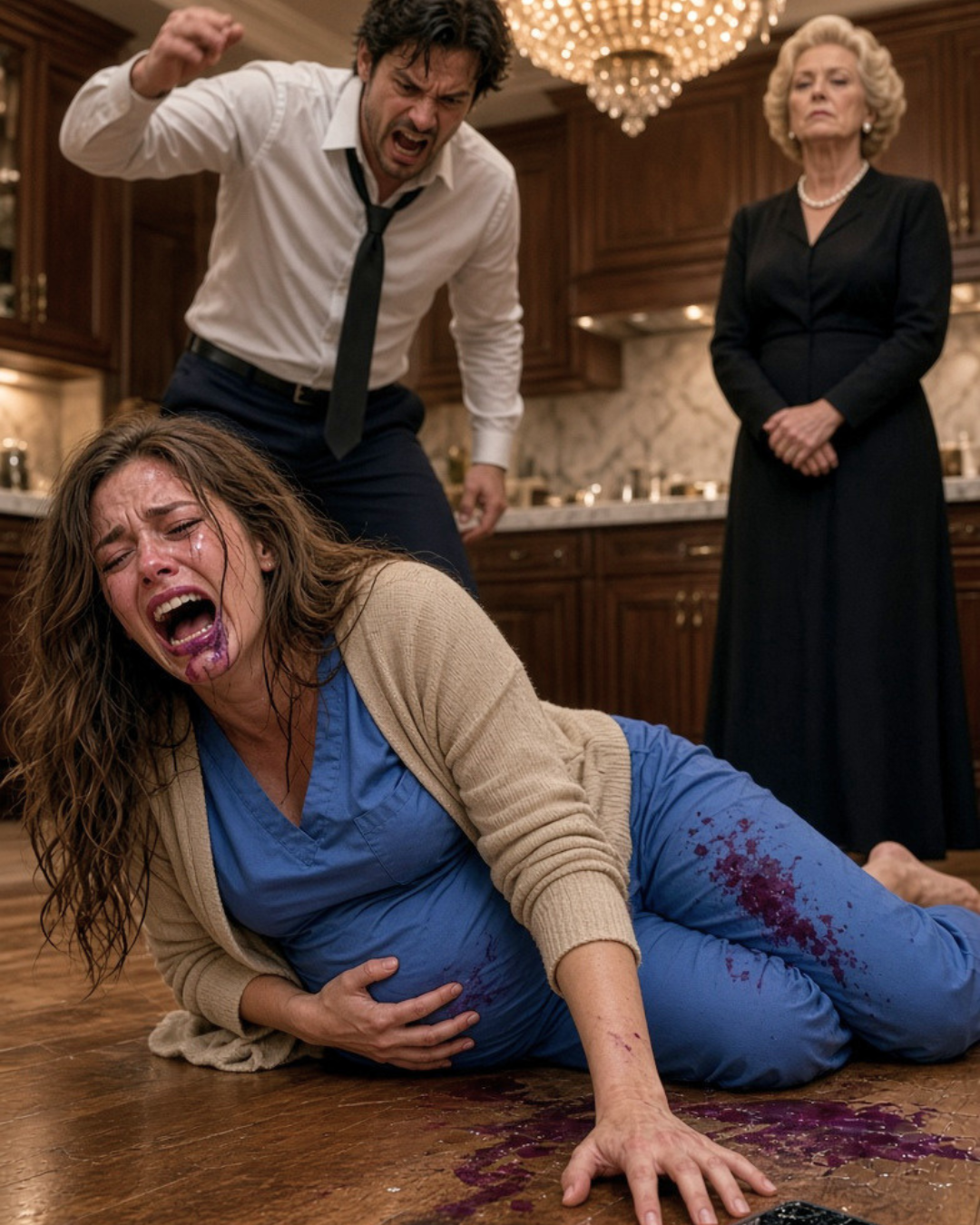
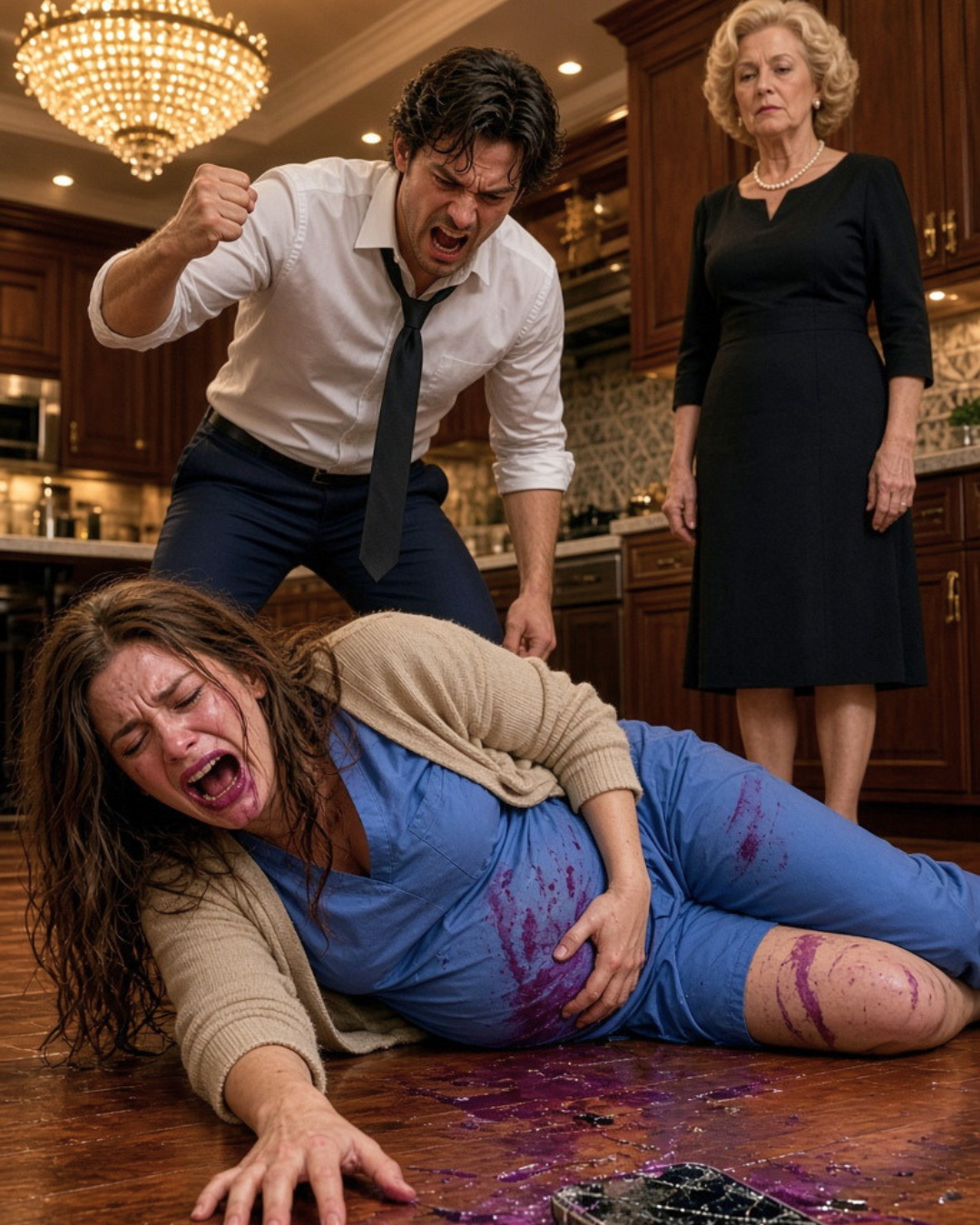
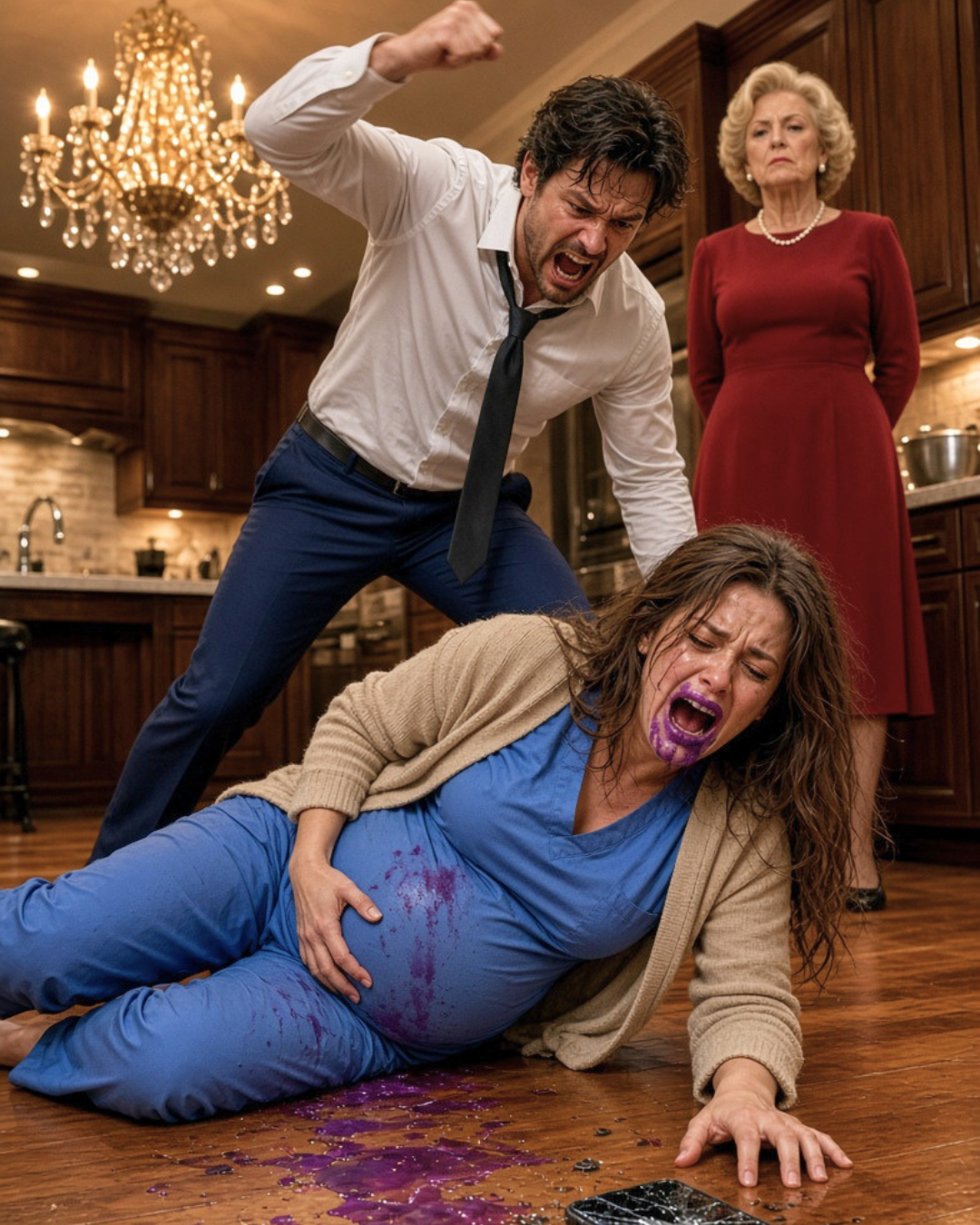
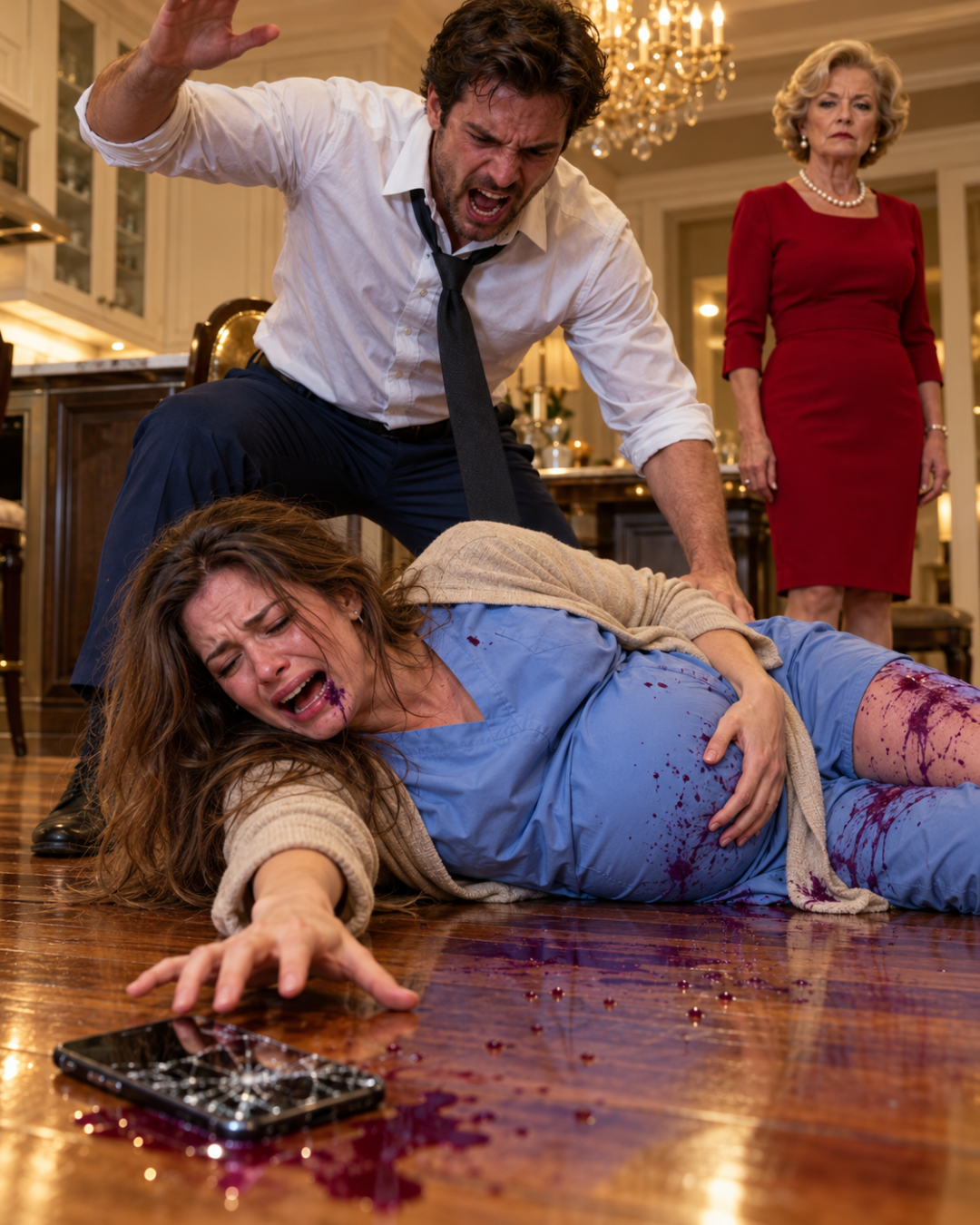
Carter slapped me so hard my shoulder slammed into the hallway wall.
“Do you have any idea what time it is, you useless b*tch?” he shouted. “Get in the kitchen and cook for my mother.”
His mother, Mrs. Eleanor, sat beneath a throw blanket in the living room, watching me with a thin smile.
“What are you waiting for?” she said. “A child needs discipline starting in the womb. A lazy mother raises a lazy child.”
My baby kicked hard inside me.
I pressed one hand to my stomach and tried to steady my breathing.
The stabbing pains had started that morning.
But in that house, pain only mattered when it belonged to Carter or his mother.
So I went into the kitchen.
I chopped onions while my eyes burned.
Stirred beans with a shaking hand.
Fried meat while grease snapped against my knuckles.
My abdomen kept tightening until it felt carved from stone, but Carter and his mother stayed in the living room watching television.
When I finally served dinner, Mrs. Eleanor took one bite.
Chewed twice.
Then spat it onto her expensive china.
“This is disgusting.”
Carter barely looked up from his phone.
“She ruins everything.”
I could still taste blood from my split lip.
“I’m late because I feel really sick.”
Mrs. Eleanor shoved her chair back.
“You feel sick? I’m sick of supporting a freeloading, clumsy daughter-in-law just because she happens to be pregnant.”
“I work full-time too,” I said.
Her hands hit my shoulder before I could move.
I stumbled backward.
My lower spine struck the edge of the granite counter.
Pain ripped through my abdomen.
My knees buckled.
Then warmth ran down my legs.
I looked down.
Blood was spreading beneath my uniform.
“My baby…”
Carter stood.
Not to help me.
“Don’t start with the dramatic bullsh*t.”
I reached for my phone on the kitchen island.
“I need to call 911.”
He got there first.
He snatched it from the counter and hurled it across the room.
The screen shattered against the hardwood.
“You’re not calling anyone,” he said.
Mrs. Eleanor folded her arms.
“If she loses the baby, it’s because she doesn’t know how to take care of herself. Don’t blame us later.”
Another cramp folded me over the counter.
I tried to move toward the broken phone.
Carter stepped into my path.
He leaned close enough for me to smell dinner on his breath.
“Listen carefully,” he said. “My uncle is a senior prosecutor in the D.A.’s office. I’m a practicing attorney. You’re not going to win a damn thing.”
For two years, I had lived under his shouting, his rules, and his mother’s contempt.
I cooked their meals and ate last.
I listened while they mocked my family as simple and blue-collar because I had wanted a life of my own—not one built on my father’s position.
But my father had once told me something I never forgot.
“You don’t flaunt real power, sweetheart. You use it only when there is no other way out.”
Standing there while my unborn son fought inside me, I knew I had reached that moment.
I lifted my head.
Looked Carter straight in the eyes.
“Then call my father.”
Carter laughed.
Mrs. Eleanor laughed with him.
“Your father?” she mocked. “That pathetic country bumpkin who never visits?”
Carter picked up my cracked phone and waved it inches from my face.
“Fine. Let’s hear how the old man plans to drive his pickup truck down here and rescue his princess.”
He opened the contact saved simply as Dad.

Turned on speaker.
Pressed call.
It rang once.
Twice.
Three times.
On the fourth ring, the line clicked open.
“Claire?”
My father’s voice came through the cracked speaker exactly the way it always did. Low. Unhurried. A little rough at the edges, like gravel under a slow tire.
Carter grinned and held the phone up between us like a microphone at a comedy club.
“Evening, Pops,” he said. “Your daughter’s having one of her little episodes. She wants you to come save her. Thought you might want to hear it yourself before you climb on your tractor.”
Mrs. Eleanor let out a delicate laugh from behind her hand.
There was a pause on the line. Not a long one. Just long enough for something to change.
“Put my daughter on,” my father said.
“She can hear you. You’re on speaker. We’re all family here.”
“Claire,” my father said, and his voice had shifted into a register I hadn’t heard since I was a teenager sitting in the back of a courtroom. “Sweetheart. Answer me with short words. Are you hurt?”
“Yes.” My voice cracked. “Dad, I’m bleeding. The baby. I hit the counter. There’s a lot of blood.”
“Is anyone stopping you from getting help?”
Carter’s grin tightened.
“Yes,” I said.
“Who?”
I looked at my husband. At the man I’d married under a white arbor two summers ago, believing his charm was kindness and his ambition was strength.
“Carter,” I said. “He broke my phone so I couldn’t call 911. His mother pushed me.”
Carter’s hand twitched as if he wanted to end the call, but pride wouldn’t let him. He had started this show. He wanted to finish it.
“Okay, that’s enough theater,” he said loudly. “Sir, your daughter tripped. She’s emotional. Pregnancy hormones. I’m an attorney, so I’d be very careful about any accusations you’re about to—”
“Mr. Hayes.”
Just two words. Carter actually stopped talking.
“I’m going to say this once, and I’d like you to listen as carefully as you’ve apparently been asking my daughter to listen to you,” my father said. “While you were talking, I called Alexandria emergency dispatch on my other line. Officers and paramedics are on their way to your address on Kingsbury Lane. They will be there in under four minutes. My daughter shares her location with me, so they know exactly which door to knock on.”
The color left Carter’s face in slow stages, like a tide going out.
“You also just admitted, on a call I am documenting, that you physically took a phone away from an injured woman who was trying to reach emergency services,” my father went on. “You’re an attorney. You know what that is in the Commonwealth of Virginia. I don’t need to explain it to you.”
Mrs. Eleanor rose from her chair, the throw blanket sliding to the floor.
“Who on earth do you think you are, threatening my son in his own home?”
“Ma’am,” my father said, “my name is Raymond Whitaker.”
The name meant nothing to her. I watched it mean nothing.
But Carter went completely still.
I had seen that stillness before, in animals on the side of the road when headlights find them.
“Whitaker,” Carter repeated. “Raymond Whitaker. As in…”
“As in the United States Attorney for the Eastern District of Virginia,” my father said. “My office is about two miles from where you’re standing. But tonight I’m not calling as anybody’s attorney. I’m calling as her father. And I am asking you, Carter, to step away from my daughter and unlock your front door.”
The kitchen was so silent I could hear the refrigerator humming.
Mrs. Eleanor looked from the phone to her son.
“Carter? What is he talking about? Her father raises cattle. He wore a flannel shirt to the wedding.”
“I do raise cattle,” my father said. “Forty-two head of Angus on my late wife’s farm in Rappahannock County. A man can do two things, ma’am.”
Somewhere outside, faint and growing, a siren began to rise.
Carter’s eyes went to the window. Then back to me. And for the first time in two years, I saw fear on his face, and I understood something that should have been obvious all along.
He had never been strong. He had only been loud in a room where no one was allowed to answer back.
He crouched down in front of me, lowering his voice to that soft, reasonable tone he used with clients.
“Claire. Baby. Listen to me. You slipped. You were tired, the floor was wet, you slipped. That’s what happened. We can fix this. Just tell them you slipped.”
Another cramp gripped me, so hard I couldn’t breathe. I curled forward, my forehead almost touching the cold granite.
“Claire,” my father said through the speaker, steady as bedrock. “Stay with me. Don’t answer him. Breathe in through your nose. You’re a nurse. You know how to do this. Count with me.”
“One,” I whispered.
“Two,” he said.
“Three.”
Headlights swept across the kitchen ceiling. Red and blue light spilled through the blinds and painted the walls like a heartbeat.
A fist pounded on the front door.
“Alexandria Police! Open the door!”
Carter didn’t move.
Mrs. Eleanor didn’t move.
So I lifted my face, filled my lungs, and screamed louder than I had ever let myself scream in that house.
“I’m in the kitchen! Please! I’m pregnant and I’m bleeding!”
The door didn’t stay closed long.
Two officers came in first, a tall man with a shaved head and a woman with her hair in a tight braid. Behind them came two paramedics with a stretcher and the kind of focused faces I saw every day at work.
“Ma’am, we’re here, we’ve got you,” the female officer said, kneeling beside me. Her name tag read RAMIREZ. “Can you tell me your name?”
“Claire,” I managed. “Claire Hayes. Thirty-one weeks. I think it’s a placental abruption.”
One of the paramedics looked at me sharply.
“You in healthcare?”
“Surgical ICU nurse. Inova Alexandria.”
“Then you know we’re moving fast.” He was already wrapping a blood pressure cuff around my arm. “Pressure’s low. Let’s get her on the stretcher. Now.”
Carter had found his voice again. He stood in the doorway between the kitchen and the dining room, hands spread, wearing his calm courtroom face.
“Officers, thank God you’re here. My wife fell. She’s been dizzy all week. I was trying to get her to sit down, and she panicked. There’s been a misunderstanding with her father on the phone—”
“Sir, I need you to step back into the living room,” the tall officer said.
“I’m an attorney—”
“Then you’ll understand the instruction. Step back.”
Officer Ramirez’s eyes moved around the kitchen as the paramedics lifted me.
I watched her take it in the way I take in a patient’s room.
The plates of food left untouched on the table. The china with the spat-out bite. My shattered phone lying face up near the wall, screen glowing through spiderweb cracks, the call still connected.
My split lip.
The red mark on my cheek in the exact shape of a hand.
“Ma’am,” she said quietly, walking beside the stretcher as they rolled me toward the door. “I’m going to ask you once, and you can answer however you want. Did you fall?”
I thought of two years of meals eaten alone at the counter after they’d finished.
Of Eleanor checking the baseboards with a white glove.
Of Carter telling me nobody would believe a nurse over a lawyer.
Of the promises I’d made to myself every night that tomorrow would be better if I just tried harder.
I thought of my son, who had no voice yet.
“No,” I said. “He slapped me when I came in. She pushed me into the counter. He threw my phone so I couldn’t call for help.”
Ramirez nodded once.
She didn’t look surprised. She looked like someone who had heard that sentence many times and had never once stopped caring about it.
“Thank you, Claire. Go take care of your baby. We’ll take care of the rest.”
As they wheeled me down the front steps, I saw our neighbor, Mrs. Patel, standing on her porch in a robe with her phone pressed to her chest.
She was an elderly widow who brought over mango pickle every Diwali and always asked how the baby was growing.
“I heard her scream,” she was telling a third officer who had just arrived. “And I’ve heard that man shouting before. Many times. I should have called sooner. I should have called months ago.”
The ambulance doors closed.
The siren started again, this time for me.
The paramedic, whose name was Danny, kept his hand on my shoulder the whole ride.
“Your dad’s still on the line,” he said, holding up my cracked phone. “Someone handed it to me. You want it?”
I nodded.
He held it near my ear.
“Dad?”
“I’m here.” There was road noise behind his voice now. An engine working hard. “I’m on the parkway. I’ll meet you there.”
“Dad, I’m sorry. I’m so sorry I didn’t tell you.”
“You don’t apologize to me tonight,” he said. “Not tonight and not ever for this. You hear me? You just keep that boy safe a little longer.”
They took me to my own hospital.
I had walked those halls thousands of times, in comfortable shoes and scrubs with a coffee in my hand.
Now I was looking up at the ceiling tiles as they flew past, at the faces of colleagues who recognized me and went pale.
“That’s Claire,” someone said. “Oh my God, that’s Claire from the SICU.”
Dr. Amara Okafor, the obstetrician on call, met us at the doors of Labor and Delivery.
She had delivered the twins of a nurse on my unit last spring, and I had always admired how she never raised her voice.
She didn’t raise it now either.
She just looked at the monitor, then at me, and said, “Claire, the baby’s heart rate is dropping. We’re going to deliver him now. Do you understand?”
“Is he going to live?”
She took my hand.
“He’s thirty-one weeks. That’s a fighter’s age. We’re going to give him every chance. I need you to fight with him.”
The last thing I remember before the anesthesia was the bright surgical light and the anesthesiologist’s voice asking me to count backward from ten.
I got to seven.
I was thinking, the whole time, of a little face I hadn’t seen yet.
Part 2: The Baby Who Refused to Give Up
When I woke up, the first thing I felt was emptiness.
Not in my heart. In my body.
The hard, round weight I had carried for seven months was gone, and my hands went to my stomach before my eyes were even open.
“He’s alive.”
My father’s voice. Right beside me.
I turned my head.
He was sitting in the vinyl recliner by the window, still in the clothes he must have been wearing at home when I called.
A faded green flannel shirt. Work jeans. Boots with dried Rappahannock mud on the heels.
His reading glasses were pushed up on his gray hair, and his eyes were red.
“He’s alive,” he said again, leaning forward. “Three pounds, eleven ounces. He’s in the NICU. He’s breathing with a little help, but the doctors say his heart is strong. They say he’s angry. He came out yelling.”
I started to cry.
Real crying, the kind that hurt my fresh incision and made me grip the bed rail.
My father didn’t tell me to stop.
He just moved his chair closer, took my hand in both of his rough ones, and let me.
When I could talk again, I asked the question I had been carrying since the kitchen.
“Are you angry with me?”
He looked at me for a long time.
“For what?”
“For marrying him. For hiding it. For not calling you a year ago.” My voice broke. “For pretending you were just a farmer so they wouldn’t treat me differently.”
My father took off his glasses and folded them slowly.
“Claire, when your mother died, you were twelve years old. You remember what happened after that?”
I did.
I remembered the newspaper articles when he became a federal prosecutor.
The reporters at her funeral.
The kids at school who either wanted something from me or were afraid of me.
The teacher who gave me an A I hadn’t earned because she knew who my father was.
I remembered deciding, at seventeen, to use my mother’s maiden name, Bennett, on my nursing school applications.
I wanted to know that every grade, every job, every friend was mine.
When I met Carter at a charity gala I’d been dragged to by a coworker, I was Claire Bennett, ICU nurse.
My father was simply “Dad, he has a farm out in the county, he works for the government.”
And when Carter’s family laughed at that, I let them, because it felt like proof that Carter loved me for me.
It turned out he had only loved what he thought he could control.
“You wanted to stand on your own feet,” my father said. “That’s not something I’ll ever be angry about. Your mother would have done the same. She did the same, matter of fact. Took her two years to tell her parents she was dating a public defender.”
I laughed through my tears, and it hurt.
“What happens now?”
His face changed.
Not colder. Just more careful.
“Now I tell you what I’m not going to do,” he said. “I’m not going to touch this case. Not one phone call, not one favor. The moment you’re the victim, I’m your father and nothing else. My office has no jurisdiction here anyway. This is a state matter. I’ve already formally notified my ethics officer that I have a personal interest, so everything is on the record.”
“But his uncle—”
“Gregory Hayes. Senior Assistant Commonwealth’s Attorney.” My father nodded. “I know him. Not well. Well enough. He can’t prosecute a case involving his own nephew, and he knows it. The Alexandria Commonwealth’s Attorney will almost certainly ask the court to appoint a special prosecutor from another jurisdiction to avoid any conflict.”
He squeezed my hand.
“Here’s what I need you to understand, sweetheart. The power that’s going to protect you is not my title. It’s the truth, written down properly, by the right people, in the right order. That’s what real power is. Not who yells loudest. Not who knows whom. Evidence and courage. You’ve already done the hardest part. You told that officer what happened.”
There was a soft knock on the door.
Dr. Okafor stepped in with a NICU nurse I recognized, a woman named Grace who had trained me on ventilators years ago.
“Someone’s asking for his mother,” Grace said, smiling. “Want to meet him?”
They brought a wheelchair.
It took two of them to get me into it, and my father insisted on pushing.
We went through the double doors of the NICU, where the light was dim and the only sounds were the soft chimes of monitors and the hush of people moving carefully around very small lives.
He was in an incubator near the window.
So tiny.
Red-skinned, wrinkled, a nasal cannula taped to his face and a little knitted cap on his head that one of the volunteers had made.
His fists were clenched.
His legs kicked at nothing.
“Can I touch him?”
Grace opened the porthole.
“Gently. Just rest your hand on him. He knows your voice.”
I slid my hand inside and laid two fingers on his chest.
His skin was impossibly warm.
He stopped kicking.
His fist uncurled, and his whole hand, smaller than my thumbnail, closed around the tip of my finger.
“Hi,” I whispered. “Hi, baby. I’m here. Mommy’s here. You’re safe now.”
Behind me, I heard my father make a sound I had only heard once before, at the edge of my mother’s grave.
“What’s his name?” Grace asked softly.
I had a list on my phone.
Carter had vetoed every name on it.
He wanted Carter Junior.
His mother wanted Eleanor’s father’s name, Prescott.
I looked at the boy holding my finger like a promise.
“Samuel,” I said. “Samuel Raymond.”
My father turned away toward the window.
He stayed that way for a long time.
The Hayes family did not go quietly.
I should have known they wouldn’t.
People who build their lives on intimidation don’t stop when it fails. They just look for a bigger room to shout in.
Carter was arraigned two days after Sam was born.
He was charged with assault and battery against a family member and with interfering with my emergency call.
Eleanor was charged with assault and battery causing bodily injury.
Both were released on bond with conditions not to contact me.
By the third day, the stories began.
It started with a post from one of Eleanor’s friends, a woman from her church committee.
Praying for the Hayes family during this terrible time. Sometimes people with mental health struggles say things that destroy innocent lives.
Then came others.
Carter’s college friends.
A cousin.
Someone shared an old photo of me crying at a family barbecue with the caption:
She’s always been unstable. Everyone who knows Carter knows he would never.
That barbecue was the day Eleanor told me, in front of twenty people, that my potato salad tasted like “something poor people bring to funerals.”
Then came the letter.
It arrived at my hospital room by courier, from a prestigious firm in Arlington.
Carter’s attorneys.
Four pages of careful, polished language suggesting that I had a “documented history of emotional volatility,” that I had “fallen while in a state of agitation,” and that Mr. Hayes was “deeply concerned about the infant’s welfare in the care of a mother who had made false and damaging allegations.”
At the bottom, a single line that made my blood run cold.
Our client intends to pursue all available remedies regarding custody of the minor child.
I read it three times.
Then I put it face down on my tray table and stared at the ceiling until Grace came in to tell me it was time for Sam’s feeding.
That night, I told my father.
He read the letter standing up, the way he read everything important.
When he finished, he folded it back along its creases and handed it to me.
“This is good,” he said.
“Good? Dad, he’s going to try to take Sam.”
“No. He’s going to try to scare you into dropping the charges. That’s what this letter is for. It’s not written for a judge. It’s written for you, at two in the morning, alone in a hospital bed.”
He sat down.
“When someone’s case is strong, they talk about facts. When their case is weak, they talk about you.”
“They’re telling everyone I’m crazy.”
“Let them talk. Talk isn’t evidence.” He paused. “But I’m not your lawyer, and I’m not going to be. You need one of your own. Somebody who has nothing to do with me.”
The next morning, a woman walked into my room carrying a canvas tote bag and a cup of black coffee.
She was in her sixties, small and silver-haired, with reading glasses on a beaded chain.
She looked like someone’s favorite librarian.
“Ms. Bennett? I’m Judith Moreland. I run a nonprofit legal clinic for survivors of domestic violence in Northern Virginia. A nurse on your floor called me. Said she’d heard you might need someone who doesn’t scare easily.”
It was Grace.
Of course it was Grace.
Judith pulled up a chair, read the letter, and actually smiled.
“Oh, I know this firm,” she said. “They bill eight hundred dollars an hour to write letters exactly like this. Do you know what they never put in these letters?”
“What?”
“Anything they can prove.”
She set the letter aside.
“Now. Tell me about the house. Everything. The layout. The doors. Who comes and goes. Is there anything in that house that records?”
I started to say no.
Then I stopped.
Six months earlier, Eleanor had insisted on installing a home camera system.
Not for security.
For me.
She wanted to see whether I was “actually cleaning” during the day on my days off.
There were cameras in the living room, the entryway, and one mounted above the kitchen cabinets, angled toward the stove, because Eleanor wanted to make sure I wasn’t “wasting groceries.”
Carter had laughed about it.
He’d called it Mom’s reality show.
“There’s a camera,” I said slowly. “In the kitchen. Facing the counter. And one in the front hallway.”
Judith’s pen stopped moving.
“Do the recordings go to the cloud?”
“Yes. Eleanor watches them on her tablet. She sends Carter clips of me when I do something wrong.”
Judith put the pen down very carefully, as though it might break.
“Claire,” she said, “I need to make one phone call to the detective assigned to your case. Right now. Before anyone in that family remembers those cameras exist.”
She stepped into the hallway.
I heard her voice, low and fast.
Twenty minutes later, she came back in.
“The detective is preparing a preservation request and a search warrant for the account,” she said. “Today. Not tomorrow. Today.”
It turned out that “today” was just in time.
Two days later, the detective, a quiet, sharp-eyed woman named Marisol Reyes, came to see me in person.
“Someone logged into the camera account the night after Carter was released,” she said. “From his phone. They deleted every clip from that evening.”
My heart dropped.
“But,” Detective Reyes said, “the company had already received our preservation request that same afternoon. Deleted files are held on their servers for thirty days. We have all of it.”
She pulled out a tablet and turned it toward me.
“I want you to know what’s on here before anyone else shows it to you. You don’t have to watch. But I wanted you to have the choice.”
I looked at the frozen image on the screen.
Our kitchen.
My back to the camera at the stove.
Eleanor at the table.
I didn’t press play.
I didn’t need to.
I had been there.
“It shows everything?”
“Everything,” Reyes said. “The slap in the hallway. The push. The phone. What they both said afterward.”
“And the deletion?”
“Is its own crime,” she said. “Destroying evidence after charges are filed. Your husband is a lawyer. He’ll have a very hard time saying he didn’t know better.”
Part 3: The Evidence They Couldn’t Erase
The hearing for the protective order was set for a Tuesday morning, nine days after Sam was born.
I had been discharged from the hospital by then, though I spent nearly every waking hour back in the NICU.
I was staying at a small extended-stay apartment near the hospital that my father had rented so I could walk to Sam.
He drove up from the farm every evening and back before dawn to feed the cattle, and I don’t think he slept more than four hours a night that whole month.
The morning of the hearing, I stood in front of the bathroom mirror in a navy dress that no longer fit quite right, my incision still sore, the bruise on my cheek faded to yellow.
I almost didn’t go.
Not because I was afraid of the judge.
Because I was afraid of Carter’s face.
Because for two years, that face had been the weather in my life.
Every morning I had looked at it to see whether today would be calm or a storm.
My father knocked on the bathroom door.
“You don’t have to look at him,” he said through it. “You look at the judge. You look at Judith. You look at me if you need to. He doesn’t get your eyes anymore.”
The courtroom at the Alexandria Juvenile and Domestic Relations District Court was smaller than I imagined.
Wood paneling.
Fluorescent lights.
A row of plastic chairs where other people sat waiting their turn, each holding some private catastrophe in their lap.
Carter was already at the respondent’s table when we walked in.
He was wearing his best charcoal suit, the one he wore when he wanted to win.
Beside him sat a tall attorney from the Arlington firm, and behind them, in the first row, sat Eleanor in pearls and a cream-colored jacket, as though she were attending a luncheon.
Beside Eleanor was a heavyset man in his sixties with a red face and a perfectly pressed gray suit.
Gregory Hayes.
The uncle.
He wasn’t there in any official capacity.
He couldn’t be.
But he sat in the front row with his arms folded and stared at Detective Reyes as she took her seat, and I understood immediately that his presence was a message.
Judith leaned close to me.
“Ignore the furniture,” she whispered.
The judge was a woman in her fifties named Patricia Lindgren, with short gray hair and an expression that gave away nothing.
Carter’s attorney spoke first.
He was smooth and reasonable.
He described a “tragic household accident,” a “strained marriage,” a “wife experiencing significant pregnancy-related stress.”
He suggested that the protective order was unnecessary, that Mr. Hayes posed no danger, and that Mr. Hayes wished only to be involved in the life of his newborn son.
Then Judith stood up.
She didn’t make a speech.
She simply asked Detective Reyes to take the stand, and then she asked the court’s permission to play the video.
Carter’s attorney objected.
He said the footage had not been properly authenticated.
Detective Reyes calmly produced the warrant, the provider’s certification, and the account login records, including the record showing that Carter’s phone had attempted to delete the footage.
Carter’s attorney sat down slowly.
I saw him glance at Carter, and I saw something pass between them that looked a lot like a man realizing his client had lied to him.
The judge nodded.
“Play it.”
I didn’t watch the screen.
I watched Judge Lindgren’s face.
I heard my own voice from that night, small and tired:
I’m late because I feel really sick.
I heard Eleanor:
You feel sick? I’m sick of supporting a freeloading, clumsy daughter-in-law.
I heard the thud.
I heard myself say my baby.
I heard the phone shatter.
I heard Carter say, with total confidence, the words that would follow him for the rest of his life:
My uncle is a senior prosecutor in the D.A.’s office. I’m a practicing attorney. You’re not going to win a damn thing.
In the front row, Gregory Hayes’s face went from red to a dull, sick gray.
Judge Lindgren’s expression didn’t change once during the video.
When it ended, she was silent for several seconds.
Then she turned to Carter’s attorney.
“Counsel, you described this as a household accident.”
“Your Honor, my client—”
“I’d like you to think carefully about whether you want to continue with that description in my courtroom.”
The attorney said nothing.
Judge Lindgren turned to me.
“Ms. Bennett, is there anything you’d like to say?”
Judith had told me I didn’t have to speak.
I had decided I would.
I stood up.
My hands were shaking, so I pressed them flat against the table.
“Your Honor, my son is in the neonatal intensive care unit right now. He weighs less than four pounds. He’s breathing on his own as of yesterday, and every hour he does that is a miracle.”
I swallowed.
“I’m not asking for revenge. I’m asking for the right to raise him somewhere nobody hits his mother. That’s all. That’s the whole thing I’m asking for.”
I sat down.
The judge granted a full protective order for two years, the maximum available.
No contact with me.
No contact with Sam, pending further orders from the custody court.
Carter was ordered to surrender his firearms.
Eleanor was named in the order as well.
As the bailiff called the next case, Carter finally turned and looked at me.
I had promised my father I wouldn’t look back.
But I did.
Just once.
And I was surprised at what I saw.
Not rage.
Not threat.
Just a frightened, smaller man than I remembered, searching my face for the woman who used to apologize for his anger.
She wasn’t there anymore.
On our way out, Detective Reyes stopped Judith in the hallway and spoke quietly to her.
Judith’s eyebrows rose.
In the car, she told us.
“Gregory Hayes called Reyes’s supervisor last week. Twice. Suggested that the detective was ‘overreaching,’ that her career might be better served by ‘moving on to more important cases.’”
My father’s hands tightened on the steering wheel.
“And?”
“And Reyes’s supervisor wrote down every word of it and forwarded it to the Commonwealth’s Attorney and the state bar.”
Judith smiled her librarian smile.
“Turns out not everybody in this town can be bought with a lunch invitation.”
On the twentieth night of Sam’s life, he stopped breathing.
It was almost two in the morning.
I was in the recliner beside his incubator, my head tipped back, half asleep, when the monitor began to alarm.
Not the gentle chime I had learned to ignore.
The other one.
I was on my feet before I was fully awake.
Sam’s tiny chest wasn’t moving.
His skin, which had finally begun to look pink, was going dusky at the lips.
“Grace!”
She was already there.
Two other nurses behind her.
A respiratory therapist.
Someone pulled me gently back by the shoulders as they opened the incubator and went to work.
I knew exactly what they were doing.
I had done it myself, on adults, hundreds of times.
Stimulation.
Suction.
The little bag and mask, squeezed with two fingers because the lungs were so small.
I could have recited every step.
None of that knowledge helped.
I stood against the wall with my hands over my mouth and watched my son’s heart rate number fall, and for the first time in my life, I prayed without any words at all.
Thirty seconds.
Forty-five.
Then the number climbed.
Sam’s chest rose.
Fell.
Rose again.
He let out a thin, furious wail, and every nurse in that NICU let out a breath at the same time.
“Apnea of prematurity,” the neonatologist told me afterward, sitting beside me in the family room with a cup of tea I couldn’t drink. “It’s common at his age. It’s frightening, but it’s part of the road. We’ll adjust his caffeine dose. He’s doing everything right, Claire. He’s just very new.”
I nodded.
I thanked her.
Then I went into the bathroom, locked the door, sat on the floor, and shook.
I didn’t call my father.
He’d just driven back to the farm three hours earlier.
So I was surprised, at three in the morning, when someone knocked softly on the family room door.
It wasn’t my father.
It was a young woman in a hooded sweatshirt, maybe twenty-four years old, with Carter’s dark eyes and Eleanor’s sharp cheekbones and none of their arrogance.
Her eyes were swollen from crying.
“Lily?”
Carter’s younger sister.
She lived in Richmond, finishing a graduate degree in social work.
At family dinners, she had always sat at the far end of the table and said almost nothing.
Eleanor called her “the disappointment.”
Carter called her “the ghost.”
“I’m not supposed to be here,” she said immediately, standing in the doorway as though she might bolt. “I know there’s a protective order. It doesn’t cover me, I checked. I’m not here for them. I swear I’m not here for them.”
“How did you know where I was?”
“Mrs. Patel. Your neighbor. She has my number from when I used to visit.”
Lily hugged her own arms.
“Can I come in? Just for a minute?”
I let her in.
She sat on the very edge of the couch and didn’t say anything for a long time.
Then she pulled a small external hard drive out of her pocket and set it on the table between us.
“I saw the posts,” she said. “What Mom’s friends are saying about you. About you being unstable.”
Her voice trembled.
“That’s what they said about me too. When I was sixteen. When I told my school counselor that my father hit my mother and that my mother hit me.”
The room went very quiet.
“My father died when I was nineteen. Heart attack. Everyone said what a great man he was. A pillar of the community. Carter gave the eulogy.”
She looked at the floor.
“Carter learned everything from him. How to make it sound like it was always your fault. How to be charming to everyone outside the house. And Mom learned that if she couldn’t stop it, she could at least make sure it landed on someone else. First me. Then you.”
She pushed the hard drive toward me.
“I kept things. Since I was fifteen. Voice memos. Texts. Emails. Pictures of bruises. Messages from Mom telling me to wear long sleeves to church. Messages from Carter, last year, laughing about how you ‘cry like a broken faucet.’ Messages from Uncle Greg, four years ago, telling my mother he’d ‘take care of’ a neighbor’s police report about my father. I was too scared to use any of it. I thought nobody would believe me.”
She wiped her eyes.
“Then I saw your face on that video. Detective Reyes’s name was on the court record. I called her last week. She told me to bring this to your attorney, too.”
I stared at the little black device on the table.
“Lily,” I said. “Why now?”
She looked toward the window, toward the NICU, where the monitors glowed softly in the dark.
“Because there’s a baby in there,” she said. “And I swore I’d never let it happen to another kid in this family. I’m done being the ghost.”
I didn’t plan to hug her.
I just did.
We stayed in that family room until the sun came up, two women who had survived the same house, talking about things we had never said out loud.
She told me Eleanor’s favorite cruelty was to praise you in public and dismantle you in private.
I told her about the white glove on the baseboards.
We laughed, horribly, at how much our stories matched.
At six o’clock, my father walked in with two coffees and stopped short.
Lily stood up quickly, bracing herself.
I watched my father look at her, at the Hayes family face, at the hard drive on the table, at my red eyes.
Then he held out one of the coffees to her.
“You must be the brave one,” he said. “Claire mentioned there was a brave one.”
Lily burst into tears again.
That afternoon, Sam’s breathing held steady for twelve full hours without a single episode.
Grace let me hold him skin to skin for the first time without wires getting in the way.
He curled against my chest like a comma in the middle of a sentence that wasn’t finished yet.
“You scared me last night,” I whispered into his little cap. “Don’t you ever do that again.”
He sighed and fell asleep.
Everything that happened next happened slowly, and then all at once.
That’s how justice works in real life.
Not like television.
Not one dramatic courtroom speech.
It’s subpoenas and paperwork and motions and a hundred quiet people doing their jobs correctly while the person who caused the harm keeps telling himself he’ll find a way out.
Because of Gregory Hayes’s position, the Alexandria Commonwealth’s Attorney petitioned the circuit court to appoint a special prosecutor.
The court appointed Daniel Okonkwo, the Commonwealth’s Attorney from a county two hours away, a man known for being so meticulous that defense attorneys privately called him “the Accountant.”
He met with me once in Judith’s office.
He was soft-spoken and wore a cardigan.
“I want to be clear with you about something,” he said. “I don’t know your father personally. I have never spoken to him. I will never speak to him about this case. If anyone ever suggests otherwise, I want you to tell me immediately. This case will stand or fall on what happened in that kitchen.”
“Good,” I said. “That’s exactly how I want it.”
He looked at me for a moment, then nodded, as if I had passed a test I didn’t know I was taking.
The evidence grew like a river after rain.
The kitchen video.
The hallway video.
The deletion records from Carter’s phone.
Officer Ramirez’s body camera footage of the scene, my bloodied uniform, my shattered phone.
The medical records showing a placental abruption consistent with blunt force.
Mrs. Patel’s statement, along with a written log she had kept for eight months of shouting she’d heard through our shared wall, dates and times written in neat cursive in a spiral notebook.
Lily’s hard drive.
And Detective Reyes’s sworn statement about the phone calls her supervisor had received from Gregory Hayes.
Eight weeks after Sam was born, the special prosecutor added new charges.
Carter was charged with destruction of evidence.
Eleanor was charged with an additional count of conspiracy after investigators found a text she’d sent her son the night of his release:
Delete the kitchen camera. All of it. Do it tonight before anyone thinks of it.
And then, on a gray Thursday morning, Gregory Hayes was placed on administrative leave.
The state bar opened a formal investigation into his conduct.
A separate inquiry was launched into his handling of the old police report Lily had documented, the one about her father.
Within two weeks, he resigned.
His farewell statement cited “personal health reasons.”
Nobody in Alexandria believed it.
I didn’t celebrate.
I wanted to, but when the news came, I was in the NICU watching Sam take his first full feeding from a bottle, and somehow that felt far more important than whatever was happening to the man who had tried to scare the detective on my case.
Carter’s legal team called Judith three days after his uncle resigned.
They wanted to talk about a plea.
“Here’s what’s happening on the other side,” Judith explained to me and my father around her small kitchen table, over rhubarb pie she insisted we eat. “Carter’s attorneys have now seen everything. They know the jury will see the video. They know the jury will hear him bragging about his uncle while you’re bleeding on the floor. They know the deletion makes him look guilty of everything else. And the Virginia State Bar is watching very closely. If he goes to trial and loses on every count, his license is almost certainly gone forever. If he pleads, there’s a slim chance he could practice again someday after a long suspension.”
“What does the special prosecutor want?” my father asked.
“Okonkwo doesn’t negotiate down much. He wants a guilty plea to the assault, the interference with the emergency call, and the destruction of evidence. Jail time. A long period of supervised probation. A batterer intervention program. Full compliance with the protective order. And Carter’s voluntary relinquishment of any claim to physical custody of Sam.”
My breath caught.
“He’d give up custody?”
“Supervised visitation only, at the discretion of the family court, and only if he completes every program and you consent to the arrangement,” Judith said gently. “That would be the deal. It’s your choice whether to support it, Claire. The prosecutor will listen to you.”
I looked at my father.
He shook his head slowly.
“Not my decision, sweetheart. Not now, not ever. You’re his mother.”
I thought about it for three days.
I thought about the man I had married.
The man who used to bring me coffee on Sundays the first summer we dated.
I thought about the moment he had picked up my phone and thrown it across the room.
I thought about Lily, telling me that Carter had learned everything from their father, and I wondered whether anyone had ever taught Carter anything else.
Then I thought about Sam’s hand closing around my finger.
I told Judith I would support the plea on one condition.
“He has to say it,” I said. “In court. Out loud. Not ‘mistakes were made.’ Not ‘I regret the situation.’ He has to say what he did.”
Judith smiled slowly.
“Oh, I’ll make sure Okonkwo puts that in writing.”
Eleanor refused any plea at all.
She told everyone at her church that she was being persecuted, that a “jealous, unstable girl” had turned her own children against her.
She hired a new attorney.
She insisted on a jury trial.
It lasted three days.
The jury watched the video twice.
They heard Lily testify, voice shaking but clear, about long sleeves at church and a mother who made sure the pain landed somewhere else.
They heard Mrs. Patel read from her spiral notebook.
They heard Dr. Okafor explain, in calm medical detail, what a placental abruption means for a mother and a baby at thirty-one weeks.
Eleanor took the stand in her own defense.
She told the jury I had “always been dramatic,” that I “threw myself backward,” that the food really was “inedible.”
The prosecutor asked her one question on cross-examination.
“Mrs. Hayes, when you told your son to delete the kitchen camera footage, what exactly were you hoping nobody would see?”
She opened her mouth.
Nothing came out.
The jury deliberated for under two hours.
Guilty on every count.
Part 4: The Power That Shows Up and Tells the Truth
Sentencing for Carter took place on a cold, bright morning in early February.
Sam was eleven weeks old.
He had come home from the NICU three weeks earlier, a little over five pounds, no oxygen, no monitors, just an indignant, healthy boy who hated wet diapers and loved being held against my heartbeat.
I didn’t bring him to court.
He stayed at Judith’s office with Lily, who had appointed herself his favorite aunt and took that job more seriously than anyone I had ever met.
Carter stood when the judge entered.
He looked thinner.
Older.
His expensive suit hung looser on his frame.
He had spent the previous weeks in a court-ordered batterer intervention intake program, and something in his posture had changed, though I couldn’t yet tell whether it was remorse or just exhaustion.
The judge asked whether he understood the terms of his plea.
He did.
The judge asked whether he had anything to say.
Carter turned toward the gallery.
Toward me.
His attorney put a hand on his arm, and Carter gently pulled away.
“Claire,” he said.
Then he stopped and turned back to the judge.
“Your Honor, may I address her?”
“You may address the court. She can hear you.”
He nodded, swallowing.
“On the night of October seventeenth, my wife came home from a twelve-hour shift. She was seven months pregnant. I slapped her in the face in our front hallway. My mother pushed her into the kitchen counter. My wife started bleeding and told us she needed to call 911. I took her phone and threw it so she couldn’t. I told her that because of my uncle and my law license, nobody would ever believe her. Later, I tried to delete the video of what happened.”
The courtroom was absolutely silent.
“My son was born nine weeks early because of what I did,” Carter said.
His voice cracked, and for the first time since I’d known him, he didn’t try to hide it.
“I used to tell myself my father was a good man. I used to tell myself that what happened in our house growing up was normal. It wasn’t. And I became exactly what I said I’d never be.”
He took a breath.
“I’m not asking for forgiveness. I don’t deserve it. I’m just saying it, because Claire asked me to say it out loud, and she was right. She was right about everything. I’m sorry.”
He sat down.
I had imagined that moment a hundred times.
In some versions I felt triumphant.
In others, I felt nothing at all.
What I actually felt was something quieter and heavier.
A kind of grief.
Not for him.
For the years.
For the woman who used to eat dinner standing up at the counter, believing she deserved it.
Then it was my turn.
Judith had helped me prepare a written statement.
I had read it so many times I knew it by heart.
But when I stood at the podium, I put the paper down.
“Your Honor,” I said, “I’m an ICU nurse. I’ve worked with a lot of patients who were hurt by people who were supposed to love them. Grandmothers. Teenagers. Men. Women. I used to wonder why they didn’t leave sooner. Why they didn’t call someone.”
I looked at my hands.
“Now I know. It isn’t because they’re weak. It’s because the person hurting them has spent years convincing them that nobody will listen. That the other side has all the power. That they’re alone.”
I looked up.
“The night my son was born, my husband told me I couldn’t win because of who his family knew. He was wrong. But not for the reasons people think.”
I turned slightly, so I could see my father in the second row, sitting very straight in his best suit, the only one he owned that didn’t smell faintly of hay.
“People keep saying I won because my father has an important job. My father didn’t make one phone call on this case except the one any father would make. He called 911. That’s it. That’s all the power he used. What actually saved me was a police officer who asked me the question kindly. A neighbor who kept a notebook. A nurse who called a legal clinic. A detective who refused to be scared. A special prosecutor who did his job carefully. A sister-in-law who decided she was done being silent. And a judge who looked at the evidence.”
My voice wavered.
I let it.
“That’s the kind of power I want my son to grow up knowing about. Not the kind you brag about. The kind that shows up and tells the truth.”
I sat down.
The judge sentenced Carter to twelve months in jail, with a portion suspended, followed by three years of supervised probation, mandatory completion of the batterer intervention program, continued compliance with the protective order, and the custody terms we had agreed upon.
The Virginia State Bar had already issued an order suspending his law license pending its own disciplinary proceedings, and Judith told me later that most people expected that suspension to be very long.
Eleanor’s sentencing came two weeks later.
Eighteen months, with part suspended, and probation.
She refused to make any statement.
When the deputies led her away, she looked at Lily in the gallery and said, loud enough for the whole room to hear, “You were always my disappointment.”
Lily didn’t flinch.
“I know, Mom,” she said quietly. “I’ve decided to be proud of that.”
The divorce was finalized in April.
Full legal and physical custody of Samuel Raymond Bennett, with my surname, by agreement.
Any future contact between Carter and Sam would happen only through supervised visitation, only after Carter completed every requirement, and only if a family court decided it was in Sam’s best interest.
On the day I signed the final papers, I walked out of the courthouse into a spring morning so bright it hurt my eyes.
My father was waiting by his old pickup truck.
Dented door.
Mud on the tires.
Lily was in the back seat with Sam strapped into his car seat, singing him a terrible off-key song about cows.
“Well?” my father said.
“It’s done,” I said.
He opened his arms, and I walked into them, and for a long moment neither of us said anything at all.
“Your mother would be so proud of you,” he finally said into my hair. “I’m so proud of you.”
“Dad?”
“Mm?”
“Can we go home? To the farm? Just for a while?”
He pulled back and looked at me with those red-rimmed eyes.
“Sweetheart,” he said, “I’ve been waiting two years for you to ask me that.”
One year later, on a warm October afternoon, the farm in Rappahannock County was full of people.
There were balloons tied to the split-rail fence and a hand-painted banner stretched between two old oak trees that read HAPPY FIRST BIRTHDAY, SAM, in Lily’s slightly crooked handwriting.
The Blue Ridge Mountains rolled away behind the pasture in waves of gold and red, and the Angus cattle watched the commotion from across the field with polite, bored curiosity.
Sam was walking.
Barely.
He’d taken his first steps three weeks earlier, from the kitchen table to my father’s boots, and now he refused to be carried anywhere.
He staggered across the grass in tiny denim overalls, arms raised for balance, falling every six steps and getting back up every single time with a look of total outrage, as though the ground had personally insulted him.
“He gets that from his mother,” my father said, watching from the porch with a glass of sweet tea.
“He gets that from his grandfather,” I said.
“From both of you,” Grace called from the picnic table, where she was cutting a sheet cake shaped, unevenly, like a tractor. “I’ve worked NICU for twenty years. I’ve never met a stubborner baby.”
Everyone was there.
Grace and half the nurses from my unit, who had organized a rotating meal train for three months after Sam came home.
Dr. Okafor, who brought a stuffed lamb and cried a little when Sam grabbed her necklace.
Mrs. Patel, who had moved out of the house next to my old one and now lived closer to her daughter in Fairfax, and who brought a tin of mango pickle “for when he has teeth.”
Officer Ramirez came in jeans and sunglasses, off duty, and spent most of the afternoon chasing Sam around the yard.
Detective Reyes came too.
She’d been promoted in the spring.
She didn’t talk about it much, but Judith told me her new supervisor had cited “integrity under pressure” in her review.
Judith herself sat in a lawn chair beneath the oak tree with a paperback, pretending not to enjoy herself, and failing.
And Lily, of course.
Lily, who had finished her master’s degree in social work in May and was now working at Judith’s legal clinic as a survivor advocate.
Lily, who had moved into the little guest cottage behind the farmhouse for the summer and stayed.
Lily, who called herself “Aunt Lily, Chief of Snacks,” and whom Sam adored above all people except me.
She hadn’t spoken to her mother since the trial.
She told me it was the most peaceful year of her life.
I had gone back to work in June, part-time at first.
Not to the surgical ICU.
I had transferred to Labor and Delivery at a smaller community hospital forty minutes from the farm, closer to home.
I’d also started something new with Judith and Grace.
We called it the Open Door Project.
It was simple.
A small fund and a network of volunteers that helped pregnant women and new mothers leaving abusive homes.
A safe phone, because so many abusers do exactly what Carter did and take the phone first.
A go-bag with diapers, clothes, and prenatal vitamins.
A ride to the hospital or a shelter.
A legal advocate who would sit with them.
A nurse they could call at three in the morning.
In the first six months, we had helped thirty-one women.
Thirty-one.
The same number of weeks Sam had been when he was born.
I hadn’t planned that.
Lily noticed it first, while updating our spreadsheet, and came to find me in the kitchen with tears in her eyes.
“That’s not a coincidence,” she said.
“It’s probably a coincidence,” I said.
“Fine,” she said. “Then it’s a good one.”
Late in the afternoon, after the cake had been destroyed and most of the guests were sitting on the porch watching the sun slide toward the mountains, a car I didn’t recognize turned down the long gravel drive.
The porch went quiet.
My father set down his tea and stood.
But it was only a young woman, maybe twenty years old, with a toddler on her hip and a nervous, apologetic smile.
She was one of the first women the Open Door Project had helped, back in March, a girl named Danielle who had shown up at the emergency department at three in the morning with a black eye and a phone her boyfriend had smashed, eight months pregnant.
“I’m sorry,” she said, stopping at the bottom of the porch steps. “Lily told me about the party. I wasn’t going to come. I just… I wanted to bring something.”
She held out a small card.
I opened it.
Inside, in blue ink, she had written:
You told me the night I came in that the kind of power that matters is the kind that shows up and tells the truth. I’m in nursing school now. I want to be the one who shows up. Happy birthday, Sam. Thank you for being born a fighter. So was my daughter.
I couldn’t speak.
I just hugged her, and her little girl grabbed my hair, and somewhere behind me I heard my father blow his nose very loudly and pretend it was allergies.
The sun went down in long ribbons of orange.
That night, after the guests had gone and the dishes were done and Lily had walked back to her cottage with a plate of leftover cake, I found my father sitting on the porch steps in the dark, looking out at the field.
I sat down beside him with Sam asleep on my shoulder, his breath warm and slow against my neck.
For a while, we just listened.
Crickets.
The wind in the oaks.
A cow somewhere complaining softly to another cow.
“Dad,” I said. “Can I ask you something?”
“Always.”
“That night. When Carter called you on speaker and they were laughing. Did you know right away?”
He was quiet for a long time.
“I knew the moment I heard your voice,” he said. “Not because you said anything specific. Because of the way you said Dad. You hadn’t said it like that since you were twelve, the night the hospital called about your mother.”
He looked down at his hands.
“I want to tell you something I’ve never told anybody. When I picked up that phone and heard him laughing, the first thing I wanted to do was use every ounce of whatever power I’ve got. Make calls. Make his whole family disappear. I wanted it so bad I could taste it.”
“But you didn’t.”
“No. I called 911. Like any father should.”
He shook his head slowly.
“Because the second you use power to get revenge, you become the kind of person who throws a phone across a room. Real power isn’t the ability to hurt someone. It’s the discipline not to. It’s knowing the truth is strong enough on its own if you’re patient and you let the right people do their jobs.”
He reached over and touched Sam’s tiny foot, curled in its sock.
“Your mother used to say the strongest thing in any room is the person who refuses to stay silent. That night, that was you. Not me. You screamed for help in a house where you’d been taught your voice didn’t count. That’s what saved him. That’s what saved you.”
I leaned my head against his shoulder.
Above the mountains, the stars were coming out one by one, so many of them that the sky looked crowded.
Sam stirred, made a small sleepy sound, and wrapped his hand around my finger, the same way he had on the first day of his life, when he was so small I could have held him in one palm.
I thought about the woman I had been two years ago.
Eating dinner alone at the counter.
Apologizing for being tired.
Believing that the people who shouted the loudest owned the world.
I wished I could go back and tell her what I knew now.
That the door is never as locked as they tell you it is.
That help is a phone call away, and if someone takes your phone, you scream until a neighbor hears.
That the people who mock you as powerless are usually the ones most afraid of what you’ll do when you finally stop being quiet.
And that one day, if you keep breathing, if you keep counting, if you hold on just a little bit longer, you will sit on a porch under an ocean of stars with your son asleep against your heart, safe, and free, and home.
“Happy birthday, Samuel,” I whispered.
He held on tighter.
And so did I.
THE END
