

Fifteen years after my father threw me out for joining the Air Force, I saw him again at my sister’s wedding.
He leaned over my table and said, “If it wasn’t for pity, no one would’ve invited you.”
I took a sip of wine and smiled.
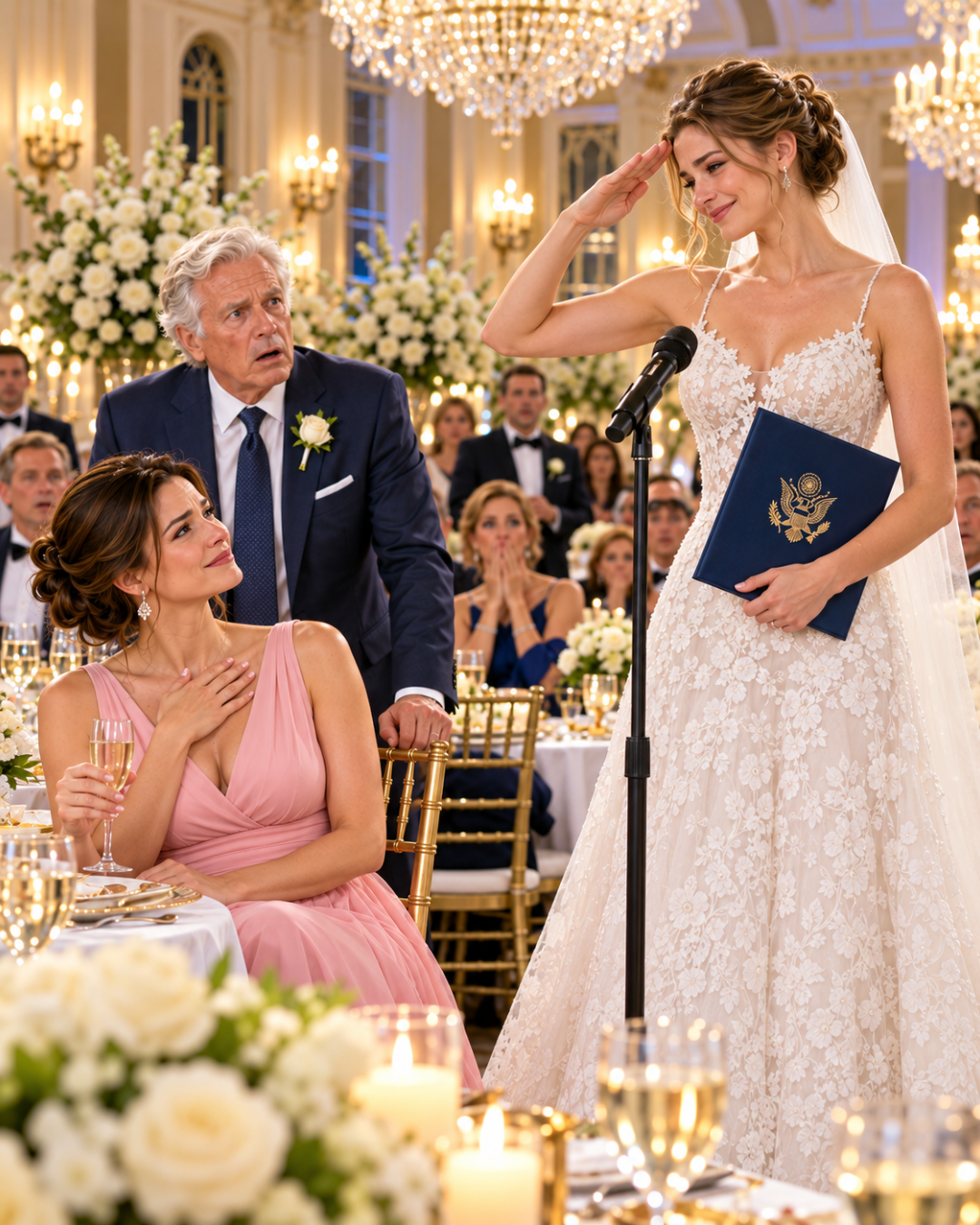
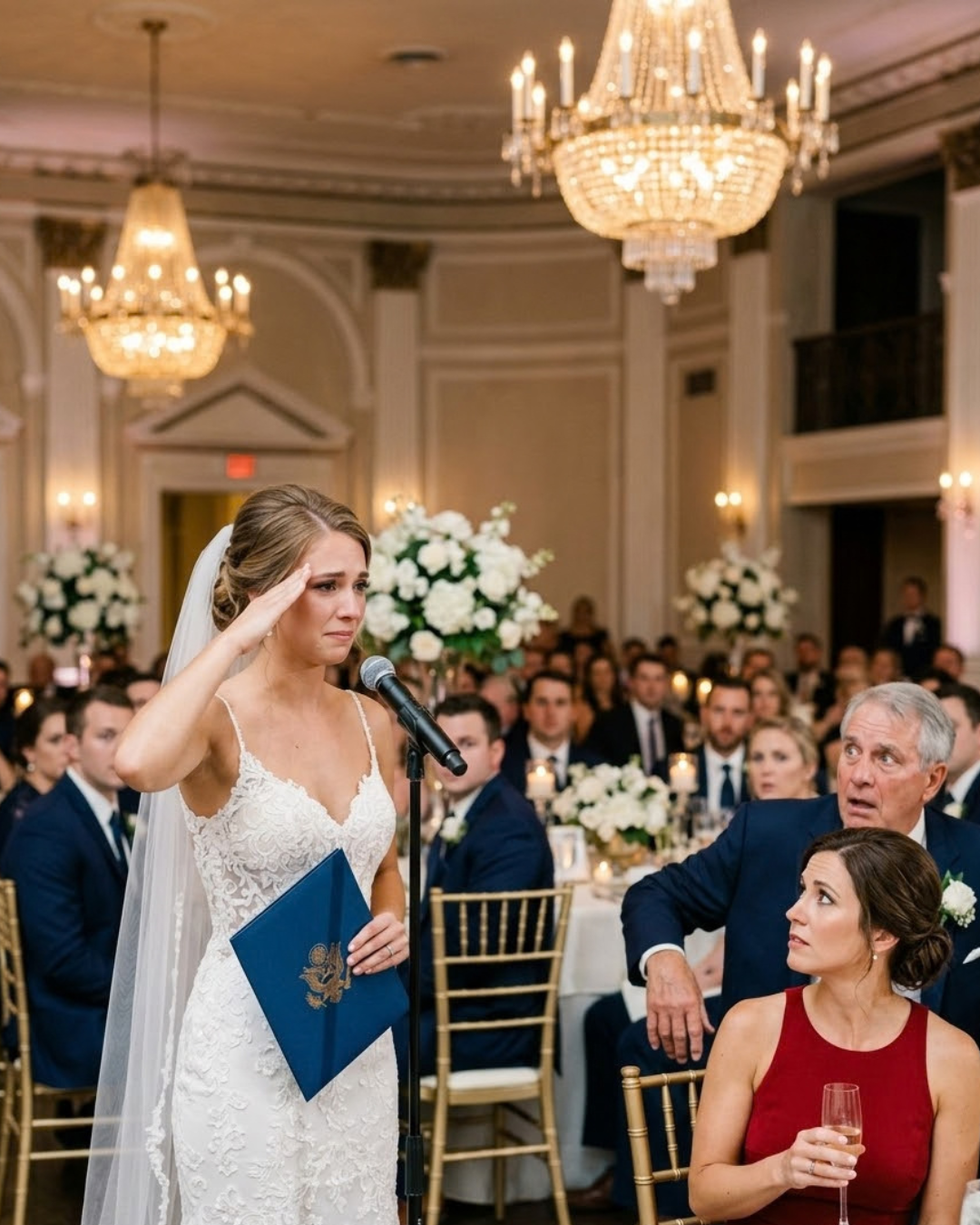
Minutes later, my sister walked to the microphone holding a Department of the Air Force envelope, saluted me, and said, “To Major General Evelyn…”…
The first insult arrived before dinner.
My father found me beside the cocktail tables with a glass of Pinot Noir in my hand and fifteen years of silence between us.
Gerald Ulette looked older than I remembered, though no softer.
His hair had turned almost entirely silver.
His suit likely cost more than my first car.
And he still wore the same expression I recalled from childhood—the one that suggested every room belonged to him if he remained in it long enough.
“I didn’t realize Clare’s guest list included charity cases,” he said.
Margaret appeared beside him in a red dress and pearls, smiling as though she had waited all afternoon to see whether my face would break.
I kept my voice steady.
“Hello, Dad.”
His eyes traveled over my navy dress, then toward the ballroom where nearly 250 guests drank champagne beneath crystal chandeliers.
“If you embarrass this family tonight,” he said, “I’ll make sure Clare regrets inviting you.”
That was the thing about my father.
Money was never only money.
It was leverage.
Clare’s apartment.
Her car.
Half the wedding.
The trust he reminded her about whenever she disagreed with him.
Everything Gerald paid for came with an invisible string, and eventually that string tightened into a leash.
I had learned that lesson at twenty-two.
Fifteen years earlier, I stood on the front porch of the house where I had grown up with one suitcase beside me and told my father I had accepted my commission into the United States Air Force instead of joining Ulette Insurance Group.
He stared at me as if I had announced I was leaving the country to become a pirate.
“You made your choice,” he said.
“I’m not choosing against you.”
“You’re choosing against this family.”
“I’m choosing my life.”
That sentence cost me everything he could take quickly.
By the end of the week, the locks had been changed.
My health insurance disappeared.
The credit card he had insisted I keep “for emergencies” was canceled.
Within a few months, photographs of me began vanishing from the walls.
Clare was fifteen then.
I still remember her crying from my old bedroom window while I stood beside my car.
She had braces, a pink sweatshirt, and both hands pressed to the glass.
Neither of us knew how to stop what was happening.
I promised I would call.
Dad made sure that became difficult too.
He monitored her phone.
Intercepted letters.
Told relatives I had abandoned the family because I cared more about “playing soldier” than the people who raised me.
For years, Clare and I communicated in fragments.
A birthday card sent through a friend.
An email from a school computer.
A Christmas message at two in the morning.
Then college gave her more freedom, and gradually we found each other again.
Quietly.
Carefully.
Never enough to satisfy either of us.
But enough that when a cream envelope arrived at my apartment three months before her wedding, I recognized her handwriting at once.
There was no return address.
Inside was an invitation and one handwritten sentence.
Please come. I need you there.
I stared at those words for a long time.
Then I booked a hotel and drove three hours to Greenfield Country Club.
When Clare saw me that afternoon, she ran across the bridal suite in her wedding dress and threw her arms around me.
The beads on her Vera Wang bodice pressed into my shoulder.
“You came.”
“You asked.”
She pulled back, already crying.
“Dad doesn’t know I sent it.”
My stomach tightened.
“Clare.”
“Margaret tried to stop it.”
“This is your wedding. I am not going to let me being here destroy it.”
She grabbed both my hands.
“No matter what Dad says, please stay.”
Something in her expression made me stop arguing.
I had seen that look before in places far from ballrooms.
Resolve.
“Okay,” I said.
She exhaled.
“Trust me.”
So I stayed.
I stayed when I saw the welcome display near the ballroom entrance.
THE ULETTE FAMILY
ESTABLISHED 1988
My birth year.
And yet the photographs beneath it somehow began with Clare.
I stayed when I found my place card at table twenty-two near the kitchen doors.
It did not say Evelyn Ulette.
It said:
Guest of the bride.
I stayed when Margaret introduced me to people during cocktail hour as if I were an uncomfortable rumor she had been forced to confirm.
“This is Gerald’s older daughter,” she told one couple. “She left the family years ago to do something with planes.”
“I’m in the Air Force,” I said.
Margaret gave me a little smile.
“Right.”
Then she looked at my bare left hand.
“Still just you and the uniform?”
A few people offered those thin, embarrassed smiles people use when they understand they are witnessing cruelty but do not want to become involved.
Nobody contradicted her.
They understood my father’s world.
Do not embarrass Gerald.
Do not challenge Margaret.
And definitely do not ask why Gerald Ulette’s missing daughter had suddenly appeared at the wedding and been seated beside the kitchen.
Dinner only made things worse.
My father stood at table one with a glass of Bordeaux and gave an impromptu speech about loyalty.
He spoke about people who “remember where they come from.”
About children who “respect what was built for them.”
Then he looked toward table twenty-two.
Just once.
Long enough.
Several people followed his eyes.
I lifted my wine and drank.
Fifteen years earlier, that speech would have destroyed me.
At twenty-two, I still believed my father’s approval was some certificate of worth I had failed to earn.
But I was thirty-seven now.
I had flown through sandstorms that turned daylight brown.
I had landed aircraft when visibility disappeared.
I had sat beside families on the worst days of their lives.
I had commanded people whose names and faces I carried with me long after missions ended.
My father still thought I was the daughter who ran away.
He had no idea how many people I had helped bring home.
After the entrée was served, Margaret brought her brother Richard to my table.
Richard Hail was my father’s business partner, broad through the shoulders, flushed from scotch, with a Rolex flashing beneath the candlelight.
“Military, huh?” he said.
“Yes.”
“Good for you. Somebody has to do it.”
I could hear the dismissal before the next sentence even came.
“I’ve always preferred people who build things instead of just following orders.”
The table went quiet.
I set down my fork.
Before I could answer, my father appeared.
Of course he did.
Soon all three of them were standing around my chair.
Gerald on my left.
Richard across from me.
Margaret behind my shoulder.
A little tribunal in formalwear.
My father leaned down.
“You see all these people?”
I looked around the ballroom.
“Yes.”
“Every one of them knows you’re the daughter who abandoned her family.”
I met his eyes.
He smiled.
“You’re still searching for something you’ll never get.”
“What’s that?”
“My approval.”
There it was.
The old wound, spoken out loud because he still believed naming it gave him power over it.
He expected tears.
Maybe anger.
Maybe for me to raise my voice and prove every ugly thing he had told people about me.
Instead, I said nothing.
My silence bothered him.
I could see it.
He straightened and let his voice carry farther.
“If it wasn’t for pity, no one would’ve invited you.”
Silverware stopped at the nearest tables.
A waiter froze with a bread basket in his hands.
Margaret touched my father’s arm, but not to stop him.
Just to keep the scene elegant.
I lifted my wine glass.
Took one slow sip.
And smiled.
“Funny thing about pity,” I said softly. “The people who offer it usually need it the most.”
For the first time in fifteen years, my father had no answer.
Across the ballroom, Clare rose from the head table.
Her new husband, David, leaned toward her and nodded.
Then he carefully moved her train aside as she stepped toward the stage.
The band softened.
Conversations died away.
Clare approached the microphone holding a kraft paper envelope in both hands.
Her face was pale.
Her shoulders were square.
My father relaxed into his chair as if he assumed this was finally the tribute he had been waiting for.
Margaret smiled.
Clare looked past both of them.
Straight at me.
“I need to honor someone tonight,” she said, her voice trembling through the speakers. “Someone this family tried very hard to erase.”
A murmur rolled through the room.
My father’s smile disappeared.
Clare raised the envelope.
Even from table twenty-two, I recognized the seal.
Department of the Air Force.
My hand tightened around the stem of my glass.
Clare unfolded the letter.
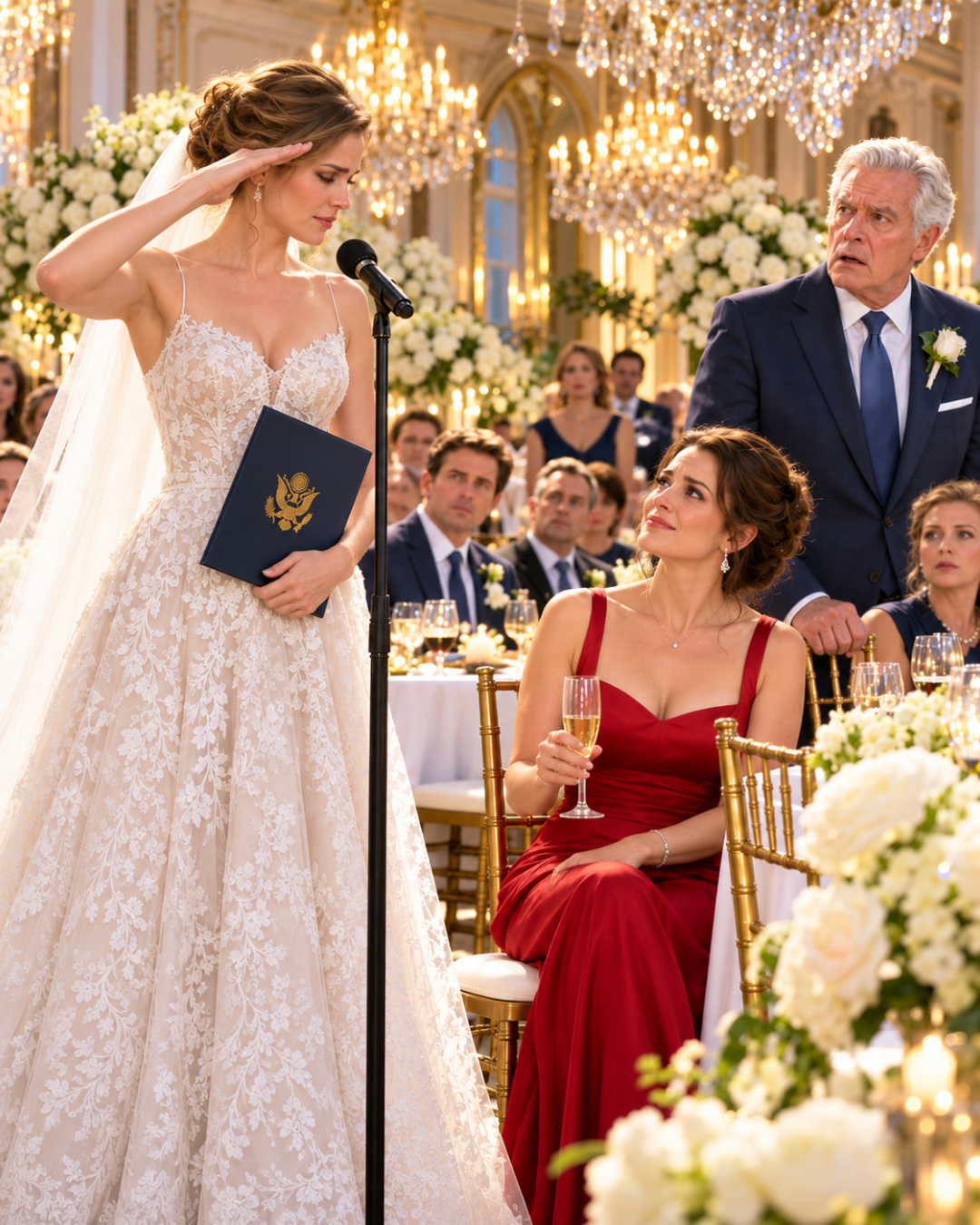
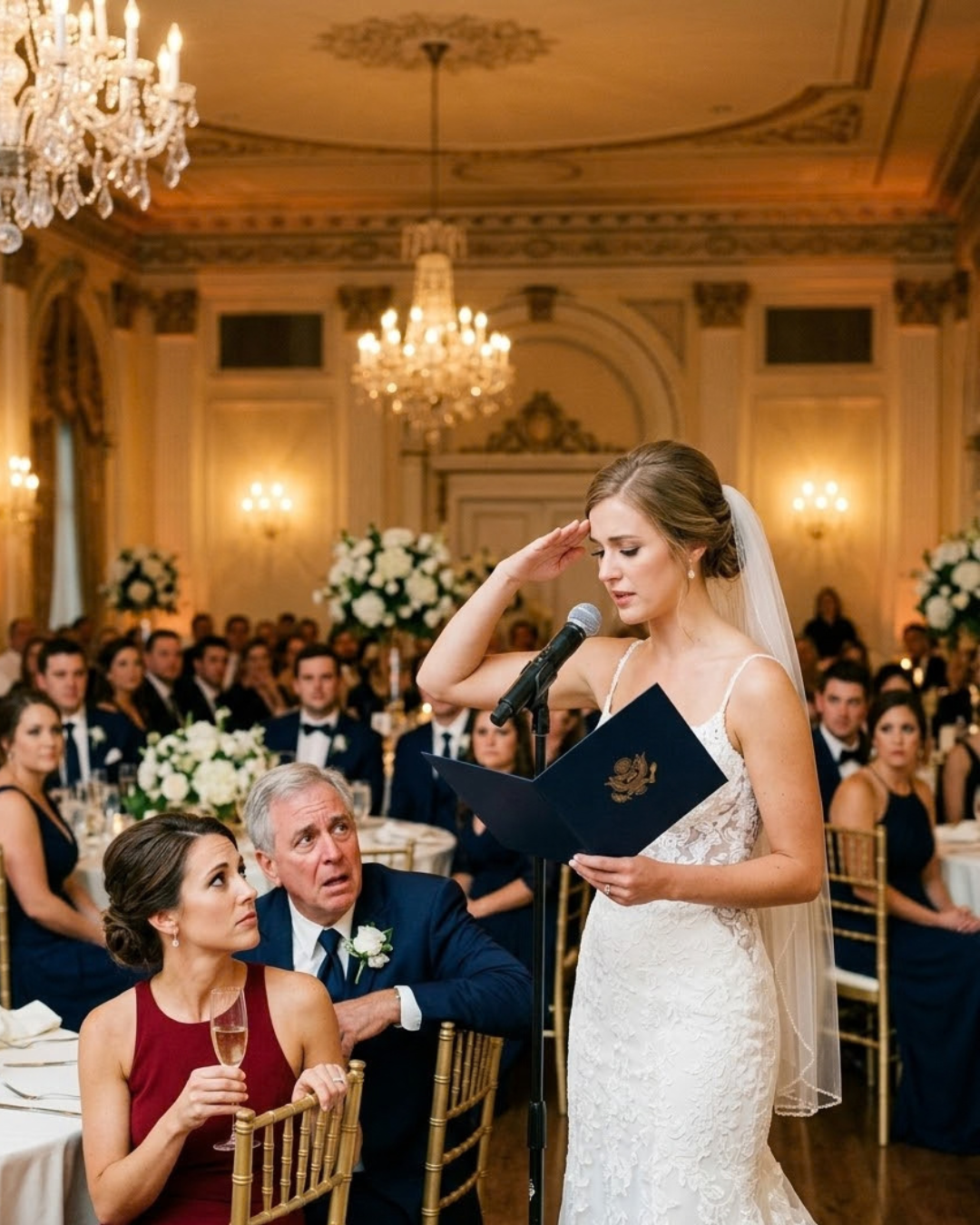
Then, with tears already shining on her face, my little sister came to attention.
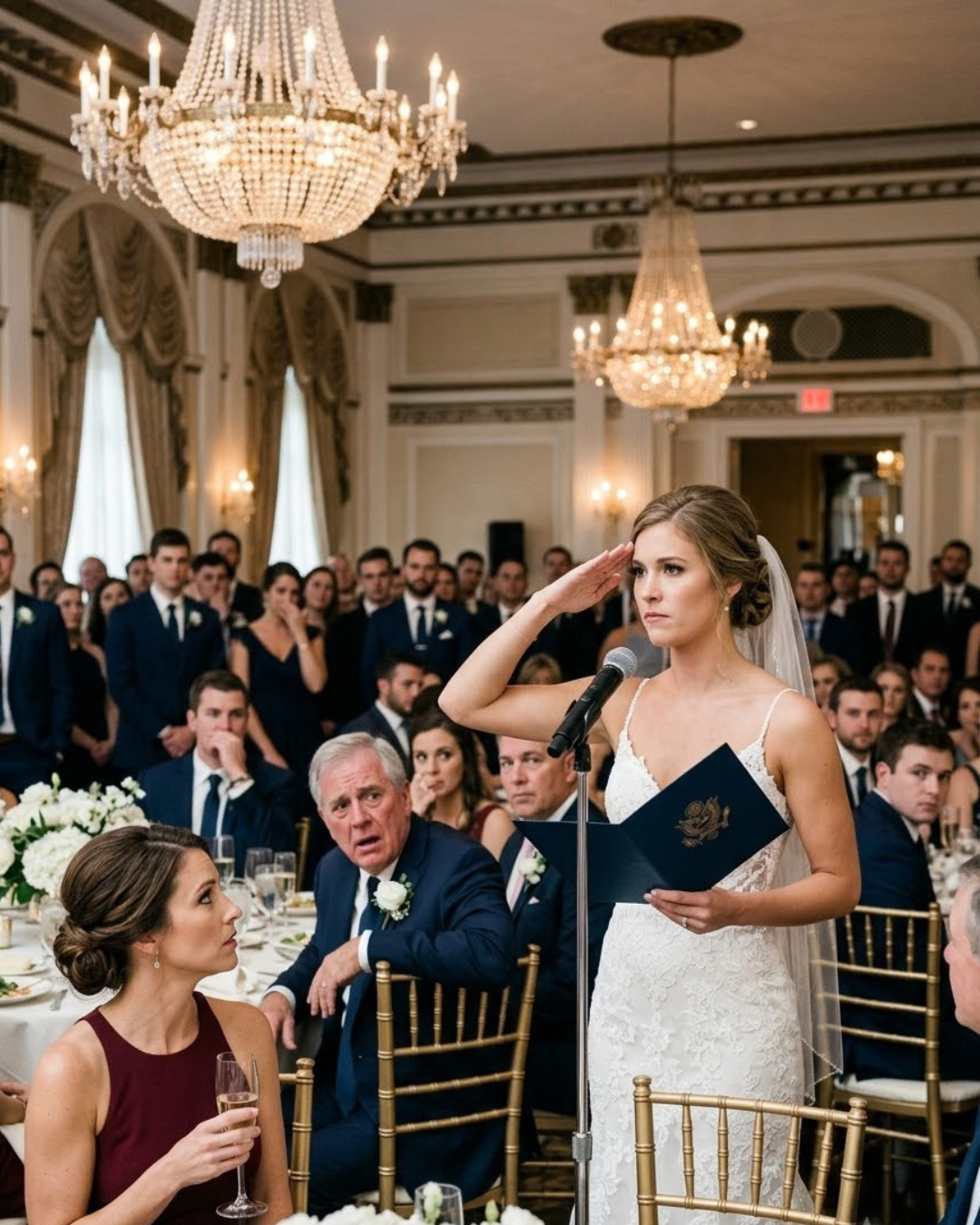
She raised her hand in a salute.
And said into the microphone:
“To my sister, Major General Evelyn Ulette.”
Every head in the ballroom turned toward me.
For three or four seconds, nobody made a sound.
Then a chair scraped somewhere near the middle of the room.
Someone whispered, “Major General?”
Another person said, “Two-star?”
Richard lowered his scotch.
Margaret’s face changed first.
The smile simply vanished.
My father looked from Clare to me as if one of us had violated a contract he had forgotten to read.
I did not stand immediately.
I couldn’t.
Not because I was ashamed.
Because my little sister was still saluting me, and suddenly I was seeing the fifteen-year-old girl behind the bride.
Braces.
Pink sweatshirt.
Hands pressed against my bedroom window.
I pushed my chair back.
Then I stood.
I returned her salute.
Clare’s mouth trembled.
The room erupted.
Not everyone stood, but enough did that the sound rolled through the ballroom like weather.
Applause.
Glasses clinking.
Chairs moving.
David stood beside Clare, clapping harder than anyone.
At a table near the dance floor, an older man in a dark suit rose slowly.
I recognized him only after he turned.
Retired Brigadier General Sam Whitaker.
He had commanded one of my first operational groups years earlier.
Beside him stood his wife, Anne.
I had no idea Clare knew them.
Sam raised his glass toward me.
That made the applause louder.
My father stayed seated.
Clare lowered her hand and looked down at the paper.
“This letter was sent to me after I contacted the Air Force public affairs office,” she said. “I asked if they could help me understand what Evelyn had actually done over the last fifteen years, because everything I knew about her came in pieces.”
I felt my stomach drop.
“Clare,” I whispered, though there was no chance she could hear me.
She continued.
“I learned that my sister didn’t disappear.”
Her voice broke.
“She served.”
The room went quiet again.
“She spent years in mobility and rescue operations. She commanded airmen overseas. She led missions I’m not going to pretend I understand well enough to describe. She has been decorated for service and leadership, and earlier this year she was promoted to Major General.”
Clare looked at Dad.
“But none of that is actually why I’m honoring her.”
That surprised me more than anything else.
She folded the official letter and set it on the podium.
“I’m honoring her because when I was fifteen and scared, Evelyn kept finding ways to remind me that I had a sister.”
I looked down.
“She mailed birthday cards through my friends because Dad wouldn’t let them come to the house. She called me from overseas at two in the morning because that was the only time I could safely answer. She sent me money for textbooks in college and made me promise never to tell anyone where it came from.”
My father’s jaw tightened.
That had not been part of any military record.
That had been Clare.
“She came to my graduation and sat in the back because she knew Dad would leave if he saw her.”
A few guests turned toward Gerald.
He stared at his wine.
“She was there when I had surgery three years ago. She sat outside recovery for six hours and left before Dad arrived because I begged her not to make me choose.”
Clare’s tears finally spilled.
“I am done asking her to disappear so other people can stay comfortable.”
David stepped closer and put a hand at the small of her back.
Clare looked at me again.
“You were never a charity case, Evie.”
That childhood nickname hit me harder than the rank.
“You were the person who kept showing up even when we made you do it from the shadows.”
The applause this time was different.
Less startled.
More personal.
I covered my mouth for a second.
Then Clare smiled through her tears.
“And before anyone worries that Dad paid for this microphone and therefore gets final approval—David and I paid for the reception ourselves.”
My father’s head snapped up.
That was when I knew there was more happening than my invitation.
Gerald stood.
“Clare.”
She looked at him.
“Sit down, Dad.”
A ripple passed through the room.
My father did not sit.
“You and I need to speak privately.”
“No.”
His face reddened.
Margaret whispered something to him.
Clare stayed at the microphone.
“You told me if Evelyn came tonight, you would pull your contribution to the wedding.”
Several guests shifted uncomfortably.
Gerald’s eyes hardened.
“This is neither the time nor place.”
“You made it the time and place when you humiliated my sister in front of half the room.”
He glanced toward me.
I could almost see him recalculating.
Fifteen years earlier, he could cancel my insurance, lock a door, and control the story.
Now there were two hundred fifty witnesses.
And for the first time, both daughters were adults standing outside his financial reach.
Clare continued.
“When you threatened to pull the money, David and I changed the wedding.”
David smiled slightly from behind her.
“We cut things. We paid the difference. His parents helped with the flowers. I sold the second dress Margaret insisted I needed.”
Margaret looked horrified.
“You sold the Monique Lhuillier?”
That nearly made me laugh.
Clare did.
“Yes, Margaret. Somehow civilization survived.”
Even a few guests at table one laughed.
My father did not.
“What about your trust?” he asked.
There it was.
The leash.
Clare looked almost sad.
“You can keep it.”
The room went completely still.
Dad stared at her.
“You have no idea what you’re saying.”
“I do.”
“You’re throwing away your future because she manipulated you.”
His finger pointed toward me.
I felt every muscle in my body tense.
Clare answered before I could.
“She didn’t even know about this speech.”
“That is absurd.”
“I begged her to come.”
He looked at me.
“You planned this.”
“No.”
My voice carried farther than I expected.
“I came because my sister asked me to attend her wedding.”
His eyes narrowed.
“And you expect me to believe you just happened to arrive here with some grand military title no one has ever heard about?”
That sentence told me everything.
He genuinely had not known.
Fifteen years of refusing to ask about me had become so complete that my life sounded fictional to him.
“I didn’t come here to announce my rank,” I said.
Richard gave an uncomfortable cough.
Dad ignored him.
“You expect everyone here to be impressed because the government gave you stars?”
Sam Whitaker stepped away from his table.
I immediately wished he wouldn’t.
Not because I feared my father.
Because I did not want this turning into a courtroom where other people proved my value to him.
Sam seemed to understand.
He stopped several feet away.
“Gerald,” he said calmly, “perhaps tonight should remain about your daughters.”
My father looked at him.
“And you are?”
“Sam Whitaker.”
Gerald clearly didn’t recognize the name.
Sam smiled politely.
“A friend of Evelyn’s.”
That was all he said.
I loved him for it.
My father looked around the room.
For once, no one rushed to support him.
Not Richard.
Not Margaret.
Not the business associates who had spent years laughing at his jokes.
People suddenly became very interested in their plates.
Power looks permanent when everyone agrees to participate in it.
The moment they stop, it can become embarrassingly ordinary.
Dad turned back toward Clare.
“I paid for your apartment for six years.”
“I know.”
“Your car.”
“I know.”
“Your college.”
“I know, Dad.”
“And this is your gratitude?”
Clare’s face softened.
That almost seemed to anger him more.
“You gave me things,” she said. “A lot of things. And I am grateful for the things. But gratitude does not mean you get to choose who I love.”
He looked stunned.
Clare stepped away from the microphone.
“I love Evelyn.”
Then she glanced toward David.
“And I love my husband. Those are two relationships you do not own.”
My father left the ballroom.
Margaret followed him less than a minute later.
Richard stayed.
That was probably the most shocking development of the evening.
He sat down at my table, picked up his scotch, stared into it, and finally said, “Well.”
I looked at him.
“Still prefer people who build things?”
His mouth twitched.
“I probably earned that.”
“You did.”
He nodded once.
Then he left me alone.
Clare came running across the ballroom.
I barely had time to open my arms before she collided with me.
“I am so sorry,” she whispered.
“For what?”
“For putting you on the spot.”
“You saluted me at your wedding.”
“That was David’s idea.”
I looked over her shoulder.
David raised both hands.
“Guilty.”
I hugged her tighter.
“You terrified me.”
“Good.”
“Clare.”
She laughed against my shoulder.
Then I felt her crying again.
“I wanted everyone to know.”
“They know.”
“No.” She pulled back. “Not about the rank. About you.”
That was when I cried.
Not when the room applauded.
Not when Sam stood.
Not when my father walked out.
When my sister said she wanted people to know me.
We spent the next hour doing something our father had prevented for most of our adult lives.
We enjoyed ourselves in the same room.
I met David’s parents properly.
His mother hugged me and whispered that Clare had talked about me for years.
Sam eventually came over and admitted Clare had tracked him down through a mutual contact after finding his name in an old article about one of my commands.
“You raised a resourceful sister,” he said.
“I had very little to do with that.”
Clare heard him.
“Yes, you did.”
Later, during dancing, I saw my father standing outside through the glass doors.
Alone.
Margaret was nowhere near him.
For a brief second, the daughter inside me wanted to go out.
Not the major general.
Not the officer.
The twenty-two-year-old with the suitcase.
She wanted him to come back inside, hold her face in both hands, and say he had been wrong.
Fifteen years had not completely killed that wish.
It had simply taught me not to obey it.
I stayed where I was.
Near midnight, Dad approached me in the hotel lobby.
The reception was winding down upstairs.
My shoes were in one hand.
I had changed into flats and was waiting for an elevator.
He walked toward me without Margaret.
For the first time that day, he looked his age.
“So,” he said. “Major General.”
I pressed the elevator button.
“Yes.”
“You could have told me.”
I looked at him.
“When?”
His face shifted.
“There were years, Evelyn.”
“Yes. There were.”
“You never called.”
“I called dozens of times after you threw me out.”
“You stopped.”
“Eventually.”
He folded his arms.
“You always were stubborn.”
The elevator did not arrive.
I almost smiled at the cruelty of hotel machinery.
“Why did you really join?” he asked.
The question was so late that for a second I didn’t know what to do with it.
“Because I wanted to serve.”
“You could have had the company.”
“I didn’t want the company.”
“I was trying to give you a future.”
“I had one.”
He looked toward the carpet.
“You made me look like a fool tonight.”
There it was.
Not I missed you.
Not I was wrong.
Not congratulations.
I nodded slowly.
“No, Dad. You did that yourself.”
His eyes hardened.
“Don’t speak to me like one of your subordinates.”
“I wouldn’t.”
The elevator doors opened.
I stepped inside.
He put one hand against the door before it closed.
“What happens now?”
I knew what he meant.
Clare.
The trust.
The family.
Him and me.
“I don’t know what Clare will do about you,” I said. “That’s between you and Clare.”
“And us?”
There are moments when you imagine revenge will taste sweet.
Mine didn’t.
It tasted like grief that had finally stopped asking to be fixed.
“You threw me out fifteen years ago because I chose a life you didn’t approve of. Since then, you have told people I abandoned you. Tonight, after all that time, the first thing you did was try to humiliate me.”
His hand fell from the door.
“I’m not angry anymore.”
His face softened slightly.
That wasn’t forgiveness.
“And I’m not coming back for your approval.”
The doors closed.
That was the last private conversation my father and I ever had.
He sent me an email three weeks later.
Four paragraphs.
Most of it explained his decisions.
How difficult I had been at twenty-two.
How worried he was about military life.
How embarrassed he had felt when I rejected the business.
How Clare had misunderstood his intentions.
There was one sentence near the end.
Perhaps I was harder on you than necessary.
Fifteen years earlier, I would have built an entire reconciliation around those words.
At thirty-seven, I understood the difference between regret and accountability.
I answered with three sentences.
I told him I was healthy.
I told him I wished him well.
And I told him I was not interested in rebuilding a relationship unless he could acknowledge what he had done without explaining why I deserved it.
He never replied.
Clare’s situation took longer.
Dad did remove her from the trust.
He also stopped paying the remaining balance on her car, though by then David and Clare had already prepared for it.
She cried when she told me.
Not because of the money.
Because even when you expect a parent to choose control over you, it hurts when they actually do.
I did not write her a check.
That may sound cold given everything that happened, but it mattered.
I helped her review the car loan.
David and I sat with her at their kitchen table and went through their budget.
She sold the car and bought something cheaper.
“You could help,” she said once, smiling.
“I could.”
“But you’re not going to.”
“Nope.”
“Good.”
She laughed.
It became a joke between us.
Clare had spent enough of her life being financially managed by someone who called it love.
I refused to become a kinder version of the same thing.
She and David built their life slowly.
On their first anniversary, they hosted dinner in their small townhouse.
Clare burned the potatoes.
David overcooked the steaks.
We ate everything anyway.
There were six people at the table.
No crystal chandeliers.
No place cards.
No trust funds.
No speeches.
It was one of the best family dinners I had ever attended.
A year after the wedding, Clare gave me a framed copy of the photograph from that night.
Not the salute.
I thought that was what she would choose.
Instead, it was taken later.
My shoes were off.
Her veil was crooked.
David was laughing.
Clare had one arm around my waist, and I had my forehead pressed against hers.
On the back she had written:
You came when I asked. You always did.
That photograph sits on the bookshelf in my office now.
I have official portraits in uniform.
Promotion photographs.
Flags.
Coins.
Awards.
Documents with my name and rank printed in places my father once told me I would never belong.
But Clare’s picture is the one people usually ask about.
Sometimes I tell them the whole story.
Sometimes I only say, “That’s my little sister.”
And that is enough.
For years, I thought the greatest thing I could achieve would be becoming successful enough that my father regretted throwing me away.
I was wrong.
The real victory was reaching a point where his regret, if he ever felt it, no longer determined anything about my life.
My father believed he erased a daughter when he changed those locks.
He didn’t.
He simply removed himself from the privilege of knowing the woman she became.
And on the night of my sister’s wedding, when Clare stood beneath those chandeliers and saluted me in front of everyone who had been taught to think I was the family failure, I finally understood something I should have known at twenty-two.
I had never needed a place at Gerald Ulette’s table to prove I belonged.
I already had people willing to stand beside me.
And this time, I wasn’t disappearing for anyone.
