

I arrived early to pick up my eight-year-old daughter from her private school.
Instead of waiting behind the gates, Sophie was sitting on the sidewalk beside a homeless teenage girl.
The girl was scratching math problems onto the pavement with a broken stick.
I almost rushed toward them.
Then Sophie laughed.
Not a courteous little smile.
A genuine laugh.
The first one I had heard since her mother died two years earlier.
I immediately told my driver:
“Stop the car.”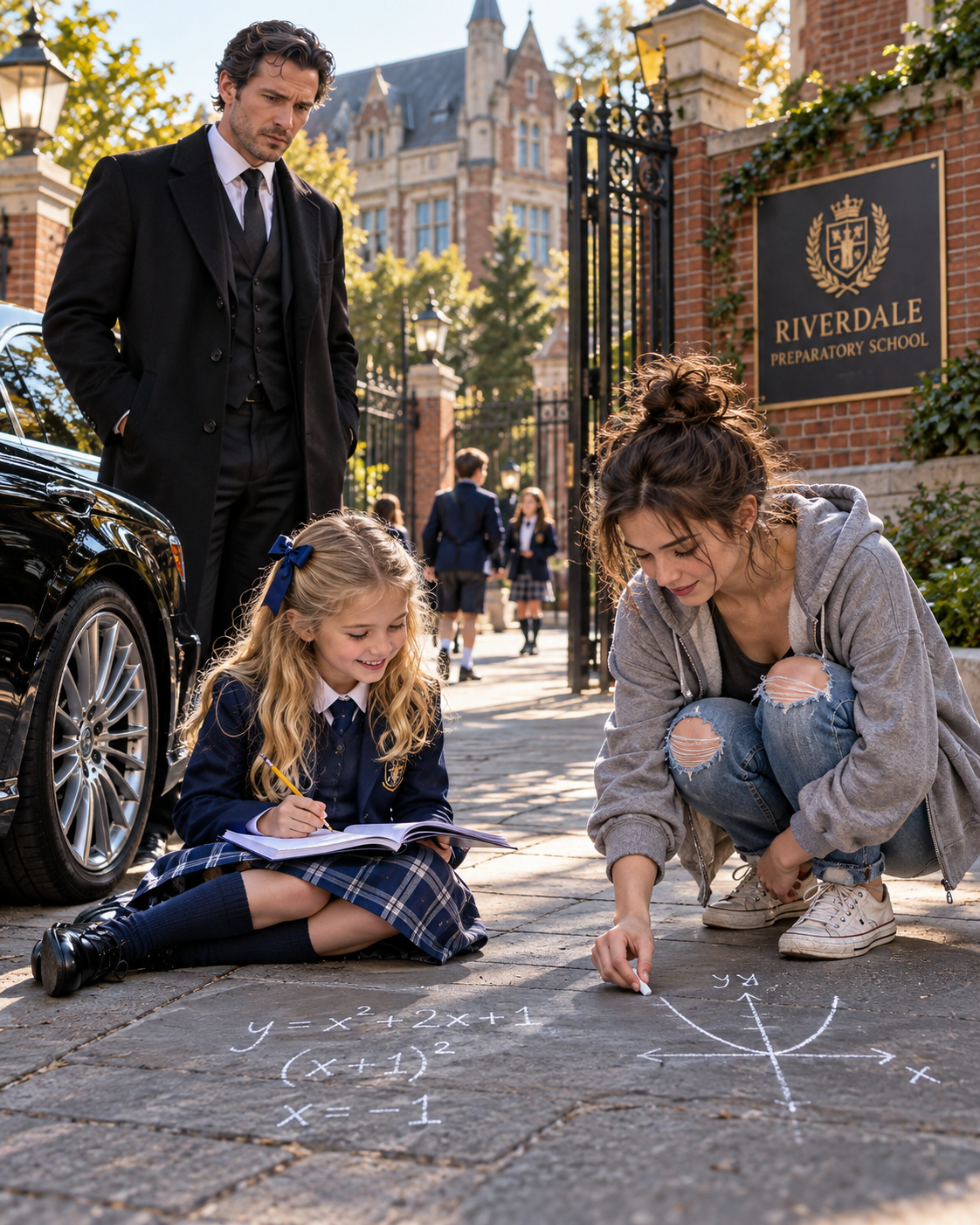
PART 1
My name is Daniel Harrison.
Most people in Chicago know me as an investor.
After my wife died, I became obsessed with controlling every detail of our lives.
Sophie’s school schedule.
Tutors.
Therapy.
Meals.
Weekends.
Every hour of our lives was organized.
I told myself structure would help her heal.
The truth was much simpler.
I couldn’t control losing my wife, so I tried to control everything else.
That afternoon, I arrived at Sophie’s school twenty minutes early.
Then I noticed her sitting on the curb.
Beside her was a teenage girl wearing an oversized coat and worn-out sneakers.
Her backpack had been repaired with strips of duct tape.
I immediately assumed she was homeless.
My first instinct was to take Sophie away from her.
Then I noticed the notebook balanced across Sophie’s knees.
The teenager pointed at the numbers she had drawn on the pavement.
“Don’t memorize it,” she told Sophie. “Look for the pattern.”
Sophie studied the problem.
Then her expression suddenly lit up.
“Oh! That’s why I kept getting it wrong!”
She laughed.
I stopped moving.
For two years, I had paid for expensive tutors, therapists, and specialists.
None of them had brought that sound back.
Yet this girl had done it with a broken stick and five minutes of patience.
I stepped out of the car.
Neither of them noticed me.
The teenager erased the problem with her sleeve and started drawing a harder one.
Sophie leaned closer.
And that was when I noticed something else.
The girl wasn’t improvising.
She understood mathematics better than most adults I knew.
PART 2
I stood several feet away and watched.
Normally, I would have interrupted.
That was what I did.
I intervened.
I asked questions.
I assessed risks.
I made decisions before Sophie ever had to make them herself.
But something about the way she was sitting beside that girl stopped me.
Sophie looked comfortable.
Not managed.
Not supervised.
Not analyzed.
Comfortable.
The teenager wrote another equation.
Sophie frowned.
“I don’t understand.”
“That’s okay.”
No frustration.
No sigh.
No glance at a clock.
The girl simply pointed at the first number.
“Start with what you know.”
Sophie thought about it.
Then she tried again.
A few seconds later, she smiled.
“I got it.”
“You did.”
The teenager held up her hand.
Sophie slapped it with hers.
I felt something tighten in my chest.
My wife, Emily, used to teach Sophie exactly like that.
Patiently.
Playfully.
Never making her feel embarrassed for getting something wrong.
Emily used to say that children learned faster when they weren’t afraid of disappointing the person teaching them.
I had forgotten that.
Or maybe grief had made me forget.
I stepped forward.
“Sophie.”
She turned.
Her smile disappeared instantly.
“Dad.”
The teenager looked up too.
And everything about her changed.
Her shoulders stiffened.
Her hand immediately reached for her backpack.
She stood.
Up close, she looked about sixteen or seventeen.
Maybe eighteen.
She was thinner than I had realized.
Her brown hair was tied back badly, as though she had done it without a mirror.
There were dark circles beneath her eyes.
But her gaze was sharp.
Alert.
“I’m sorry,” she said quickly. “I wasn’t bothering her.”
Sophie stood too.
“She wasn’t bothering me.”
I looked at my daughter.
Then at the teenager.
“I didn’t say she was.”
The girl adjusted the backpack on her shoulder.
“I should go.”
“Wait.”
She stopped.
Her expression became cautious.
I pointed toward the pavement.
“Where did you learn that?”
She glanced down.
“Learn what?”
“The method you were showing Sophie.”
The girl shrugged.
“School.”
“What school?”
Her expression closed immediately.
“That matters?”
The question caught me off guard.
“No.”
“Then why are you asking?”
I almost smiled.
Most adults became nervous when they learned who I was.
This girl didn’t seem impressed enough to be nervous.
Sophie tugged lightly on my sleeve.
“Dad, this is Maya.”
The teenager looked at Sophie.
“You weren’t supposed to introduce me like I’m your teacher.”
“You kind of are.”
“I showed you three problems.”
“Four.”
Maya rolled her eyes.
Sophie smiled again.
Another real smile.
I noticed.
Maya noticed me noticing.
For one brief second, something softened in her expression.
Then she looked toward the street.
“I really have to go.”
I reached for my wallet.
It was instinct.
A stupid instinct.
I pulled out several bills.
Maya’s face changed immediately.
“No.”
I stopped.
“I was only—”
“I know what you were doing.”
Her voice wasn’t angry.
That made it worse.
“I don’t need money for talking to your daughter.”
I slowly put the bills away.
“You helped her.”
“She helped me too.”
I glanced at Sophie.
“How?”
Maya looked embarrassed.
“She listened.”
Then she turned and walked away.
Sophie watched her disappear around the corner.
“Can we give her a ride?”
“She said she had somewhere to go.”
“She always says that.”
I looked down at my daughter.
“Always?”
Sophie froze.
That single word told me this wasn’t their first meeting.
“How long have you known her?”
Sophie stared at her shoes.
“Three weeks.”
“Three weeks?”
“She sits near the library sometimes.”
“What library?”
“The one two blocks away.”
My stomach tightened.
“You’ve been leaving school grounds?”
“No!”
She looked horrified.
“Maya comes here.”
“How often?”
Sophie hesitated.
“Sometimes.”
I felt the familiar urge to take control.
Call the school.
Call security.
Demand explanations.
Find out why an unknown teenager had been spending time outside an elementary school.
Then Sophie whispered:
“Please don’t make her go away.”
I looked at her.
Her eyes were already filling.
And suddenly this was no longer about security.
“Why would I make her go away?”
“Because you make everything go away when you think it might hurt me.”
The words hit harder than they should have.
I crouched in front of her.
“What does that mean?”
Sophie looked toward the corner where Maya had disappeared.
“You changed my classroom after Mom died.”
“You were struggling.”
“You stopped letting me sleep at Emma’s house.”
“You were having nightmares.”
“You hired Mrs. Bennett because I got a C.”
“You’ve always been good at math.”
“I know.”
Her voice cracked.
“That’s why getting a C made me sad. And then everybody started acting like something was wrong with me.”
I didn’t know what to say.
Sophie wiped her eyes angrily.
“Maya doesn’t ask me if I’m sad.”
That sentence nearly broke me.
“She just talks to me.”
I pulled Sophie into my arms.
For a moment, she stayed stiff.
Then her arms wrapped around my neck.
That evening, I canceled her tutoring session.
Her tutor seemed more surprised than Sophie.
We ate pizza in the kitchen.
Not the carefully prepared meal our housekeeper had planned.
Pizza.
Sophie ate two slices.
Then she asked:
“Are you mad?”
“No.”
“About Maya?”
“No.”
That wasn’t entirely true.
I was worried.
But I wasn’t angry.
“Can I see her again?”
I looked at my daughter.
“We’ll see.”
Her face fell.
I immediately realized that was the kind of answer I always gave when I intended to control the outcome.
So I corrected myself.
“Yes.”
She stared at me.
“Yes?”
“Yes. But I want to meet her properly.”
Sophie smiled.
“Okay.”
The next afternoon, I arrived early again.
Maya wasn’t there.
Sophie tried not to show her disappointment.
Neither was she there the following day.
Or the day after that.
By Friday, Sophie had stopped asking.
That worried me more.
After Sophie went to bed that night, I called the library near her school.
I described Maya.
The librarian was silent for a moment.
Then she said:
“I think I know who you mean.”
Her name was Maya Torres.
Seventeen years old.
She came to the library almost every day.
Used the computers.
Read mathematics textbooks.
Sometimes stayed until closing.
“Do you know where she lives?”
Another pause.
“I don’t think she has a permanent place.”
The next morning, I went to the library.
Alone.
I found Maya at a table near the back.
There were three books open in front of her.
Algebra.
Calculus.
Physics.
She saw me approaching and immediately closed them.
“What do you want?”
“To talk.”
“About Sophie?”
“Yes.”
Her expression hardened.
“I haven’t gone near the school again.”
“I know.”
“I wasn’t trying to cause trouble.”
“You didn’t.”
She looked suspicious.
I pulled out the chair opposite her.
“May I?”
“It’s a public library.”
I sat.
For several seconds, neither of us spoke.
Then I looked at the books.
“Calculus?”
She shrugged.
“It passes time.”
“You read calculus to pass time?”
“It’s cheaper than movies.”
I almost smiled.
She didn’t.
“How old are you?”
“Seventeen.”
“Are you in school?”
Silence.
“Maya.”
“You’re not my social worker.”
“No.”
“Then you don’t need to know.”
“You’re right.”
That surprised her.
I leaned back.
“But you helped my daughter.”
“I explained some math.”
“You made her laugh.”
Her eyes shifted away.
“That’s not something I can pay you for.”
“I already told you I don’t want money.”
“I know.”
I paused.
“But I’d like to understand who helped her.”
Maya stared at me for a long moment.
Then something in her posture changed.
Barely.
“My mom died last year.”
I said nothing.
“My stepdad disappeared before that.”
She rubbed her thumb against the edge of the book.
“We were already behind on rent.”
Her mother’s death had pushed everything over the edge.
Maya stayed with a friend for several months.
Then the friend’s family moved.
She spent time in a youth shelter.
Sometimes she slept there.
Sometimes it was full.
Sometimes she avoided it.
“Why aren’t you in school?”
“I was.”
“What happened?”
“Life.”
One word.
Enough.
“Were you good at math?”
For the first time, she smiled.
Barely.
“I was good at everything.”
There was no arrogance in it.
Just fact.
“What happened to your records?”
“Nothing happened to them.”
“Then you could go back.”
Maya laughed bitterly.
“You think that’s how it works?”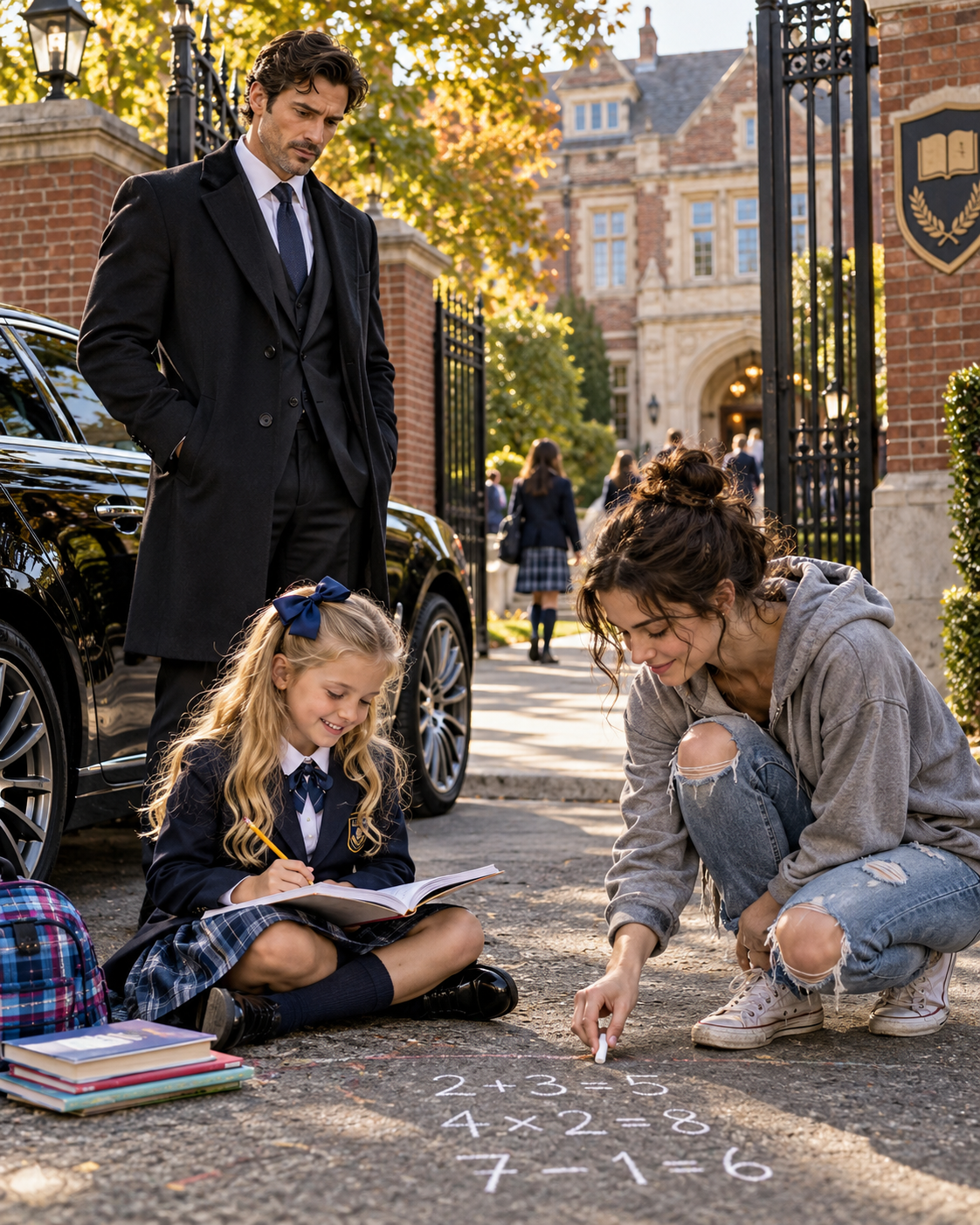
“No.”
I thought about my own life.
Drivers.
Assistants.
Attorneys.
People who solved problems before I knew they existed.
“No,” I repeated. “I probably have no idea how it works.”
That answer seemed to earn me something.
Not trust.
Maybe permission to remain seated.
Maya looked down at the calculus book.
“I missed too much.”
“Could you catch up?”
“Yes.”
No hesitation.
That told me everything.
I didn’t offer money again.
Instead, I asked:
“Would you be willing to tutor Sophie?”
Her head snapped up.
“What?”
“Two afternoons a week.”
“You’re joking.”
“No.”
“I’m homeless.”
“I’m aware.”
“You don’t know me.”
“That’s why there would be rules.”
Her eyes narrowed.
“What kind of rules?”
“Public place. Library. I’m nearby. You’re paid the same rate I pay her current tutor.”
“I told you—”
“This is work.”
She stopped.
“You wouldn’t be taking charity. You would be doing a job.”
Maya stared at me.
Then she asked:
“How much do you pay her tutor?”
I told her.
Her eyes widened.
“That’s ridiculous.”
“It probably is.”
“You pay someone that much to teach an eight-year-old fractions?”
“Chicago is an interesting city.”
She laughed.
Just once.
Then she shook her head.
“I can’t.”
“Why?”
“Because Sophie doesn’t need a tutor.”
I frowned.
“What?”
“She knows the math.”
“She got a C.”
“So?”
“So she’s struggling.”
“No. She’s distracted.”
That irritated me.
“You’ve known her three weeks.”
“And you’ve known her eight years.”
The words landed cleanly.
Maya continued.
“She knows how to do the problems. She freezes when she thinks getting one wrong means disappointing somebody.”
I said nothing.
“Every time she makes a mistake, she looks at the adult before she looks at the paper.”
My chest tightened.
“Yesterday she kept asking if I thought she was smart. Kids who know they’re allowed to fail don’t usually do that.”
I looked away.
Maya closed her book.
“You don’t need another tutor for her.”
“What does she need?”
She looked directly at me.
“To be eight.”
I sat there for a long time.
Then I nodded.
“Will you help me remember that?”
Maya studied me.
“Two afternoons.”
“Two afternoons.”
“At the library.”
“Yes.”
“And Sophie gets to choose what we work on.”
I almost objected.
Then stopped myself.
“Agreed.”
Maya extended her hand.
We shook.
That was how it started.
Two afternoons became three.
Math sometimes became chess.
Chess sometimes became reading.
Sometimes Maya and Sophie did absolutely nothing academic.
They sat outside the library eating pretzels and talking.
At first, that bothered me.
Then I learned to let it bother me without fixing it.
Sophie’s grades improved.
But that wasn’t what mattered.
She started laughing more.
She invited Emma over again.
She asked to join the school art club.
She left dirty socks on her bedroom floor.
For the first time in two years, I was thrilled to see dirty socks.
Maya changed too.
Slowly.
She agreed to meet with a counselor from a youth education program.
I didn’t arrange it secretly.
I asked first.
That distinction mattered.
She enrolled in a program that allowed her to complete the coursework she had missed.
She tested far ahead of her age in mathematics.
That surprised everyone except Sophie.
“I told you she’s a genius.”
Maya groaned.
“I’m not a genius.”
“You read calculus for fun.”
“I was bored.”
“That’s worse.”
I laughed.
Both girls looked at me.
For a second, I felt guilty.
Laughing still sometimes felt like betrayal.
Emily wasn’t there.
How could I be happy?
Then I remembered something she had said in the hospital.
Not at the end.
Weeks earlier.
She had been exhausted from treatment, and I had been trying to pretend everything would be fine.
She took my hand.
“If this goes badly, don’t turn Sophie’s life into a memorial for me.”
I had promised.
Then I had done exactly that.
I had turned every day into something careful and solemn.
As though happiness would mean we had forgotten her.
One evening, Sophie found me looking at Emily’s photograph.
“Do you miss Mom?”
“Every day.”
“Me too.”
She climbed onto the sofa beside me.
“Maya says missing someone and being happy can happen at the same time.”
I swallowed.
“Maya’s pretty smart.”
“I told you.”
Months passed.
One afternoon, Maya asked if she could speak to me without Sophie.
We sat at the library café.
She pushed an envelope across the table.
“What’s this?”
“Open it.”
Inside was a letter.
I read the first paragraph.
Then again.
Maya had been accepted into a residential academic program that partnered with a Chicago university.
Housing.
Classes.
Academic support.
A pathway toward college admission.
I looked up.
“You got in.”
She nodded.
But she wasn’t smiling.
“What’s wrong?”
“I’ll have to move.”
“How far?”
“Not far.”
“Then why do you look terrified?”
She stared at the table.
“Because good things disappear.”
The words were so quiet I almost missed them.
I understood.
Not her exact circumstances.
But the fear.
Grief teaches you to distrust happiness.
If something matters, you can lose it.
So sometimes it feels safer never to reach for it.
I slid the letter back toward her.
“Good things can disappear.”
She looked at me.
“That doesn’t mean you refuse them while they’re here.”
Her eyes filled.
She quickly looked away.
“I don’t know if I can do this.”
“Yes, you do.”
“You sound like Sophie.”
“I learned from her tutor.”
That made her laugh through the tears.
When we told Sophie, she cried.
Then she became furious.
“You’re leaving?”
“I’m moving twenty minutes away.”
“That’s leaving.”
“I’ll still see you.”
“When?”
Maya looked at me helplessly.
Normally, I would have answered.
Scheduled it.
Solved it.
Instead, I waited.
Maya crouched in front of Sophie.
“How about Saturdays?”
“Every Saturday?”
“Most Saturdays.”
Sophie frowned.
“Most isn’t every.”
“No.”
“Why not?”
“Because sometimes I’ll have homework. Sometimes you’ll have plans. Sometimes life changes.”
Sophie looked down.
Maya gently touched her shoulder.
“But changing doesn’t mean disappearing.”
I had to turn away.
Because suddenly I understood that Maya wasn’t only teaching Sophie.
She was teaching both of us.
The following year, Maya completed the program at the top of her class.
Sophie insisted we attend the ceremony.
I sat in the audience while Maya walked across the stage.
She wore a borrowed dress under her graduation gown.
Her sneakers were new.
Not because I bought them.
She had purchased them herself with money she saved from tutoring.
That detail mattered to her.
So it mattered to me.
When her name was announced, Sophie jumped out of her chair.
“That’s my tutor!”
Everyone around us laughed.
Maya looked into the audience.
She found Sophie.
Then me.
And smiled.
A real smile.
Afterward, she handed me an envelope.
“What is this?”
“Just read it later.”
I waited until Sophie was asleep.
Inside was a handwritten letter.
Maya thanked me for the tutoring job.
For treating her work as something valuable.
For helping her connect with the academic program.
But one sentence stayed with me.
You gave me somewhere to go before I knew where I was going.
I sat in my kitchen for a long time holding that letter.
Then I realized something.
She had done exactly the same thing for us.
Two years earlier, I had believed my job as a father was to remove every uncertainty from Sophie’s life.
I thought love meant preventing pain.
Preventing mistakes.
Preventing disappointment.
I was wrong.
I couldn’t protect Sophie from grief.
I couldn’t schedule her way out of missing her mother.
I couldn’t hire enough specialists to guarantee happiness.
What I could do was stay beside her while she figured out how to live with everything we had lost.
Maya taught me that.
Not intentionally.
Not with a lecture.
With a broken stick on a sidewalk.
Years later, Sophie barely remembers the expensive tutor I hired after Emily died.
She remembers Maya.
She remembers sitting on the pavement.
She remembers fractions drawn in chalk dust and dirt.
She remembers the afternoon she realized getting an answer wrong didn’t mean she was stupid.
And I remember the laugh.
That laugh changed everything.
Maya eventually went to college.
Mathematics, naturally.
She refused every offer I made to pay her tuition.
So I stopped offering.
Instead, when she asked whether my investment firm had summer internships, I told her to apply.
She did.
She earned one without my involvement.
I made sure of that.
Years later, she admitted she had known I would.
“You finally learned boundaries,” she told me.
“Expensive lesson.”
She smiled.
“Worth it?”
I looked across the room at Sophie.
Older now.
Laughing with friends.
Living a life I no longer tried to schedule minute by minute.
“Yes.”
Absolutely worth it.
People sometimes assume this is a story about a wealthy man rescuing a homeless girl.
It isn’t.
That version gets everything backward.
I had money.
Maya needed stability.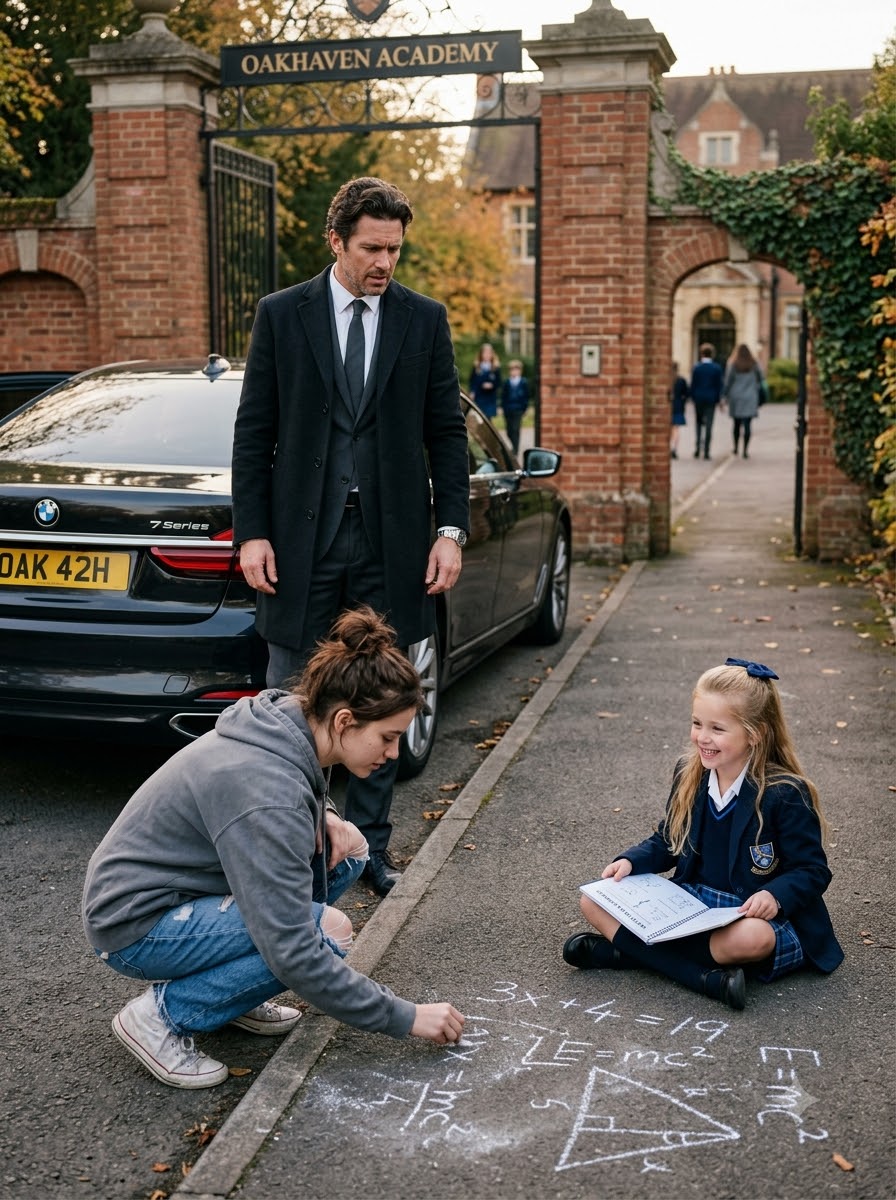
Those things were true.
But when I first saw her sitting beside my daughter, I was the one who didn’t understand what Sophie needed.
Maya did.
I thought Sophie needed the best schools.
The best tutors.
The best therapists.
A perfectly organized life.
Maya had nothing except a battered backpack, an oversized coat, worn sneakers, and a broken stick.
Yet she gave Sophie something I had forgotten how to give her.
Room to fail.
Room to laugh.
Room to be a child.
And Sophie gave Maya something too.
Someone who saw her as brilliant before seeing her as homeless.
Maybe that was why they understood each other so quickly.
Neither girl wanted to be defined by the worst thing that had happened to her.
Sophie wasn’t merely the child whose mother died.
Maya wasn’t merely the homeless teenager outside a private school.
They were two girls sitting on a sidewalk solving math problems.
Sometimes that was enough.
I still think about what would have happened if I had followed my first instinct that afternoon.
If I had rushed from the car.
Pulled Sophie away.
Called security.
Made assumptions.
I probably would have convinced myself I was protecting my daughter.
And I would have taken away the first genuine laugh she had given me in two years.
Instead, for once, I stopped.
I watched.
I listened.
And that changed three lives.
Mine included.
The most important lesson Maya ever taught Sophie wasn’t mathematics.
And the most important lesson she taught me had nothing to do with numbers.
It was much simpler.
“Don’t memorize it,” she told Sophie that first afternoon. “Look for the pattern.”
For years, my pattern had been fear.
Lose someone.
Hold tighter.
Feel uncertain.
Create another rule.
See Sophie struggle.
Hire another expert.
I had mistaken control for love.
Once I finally saw the pattern, I could change it.
Sometimes the person who changes your life doesn’t arrive with credentials, an appointment, or an explanation.
Sometimes she’s seventeen years old.
Sometimes her backpack is held together with duct tape.
Sometimes she’s sitting on a curb outside your daughter’s school, drawing equations on concrete with a broken stick.
And sometimes, before you decide who needs saving, you should stop long enough to ask yourself who is actually teaching whom.
