

I didn’t react. I’d faced gunfire with far better aim. Behind him, I noticed someone else—a young man in a dark suit sitting near the corner. His wheelchair nearly disappeared against the black-and-silver decorations. His face was pale, his eyes vacant. He wasn’t speaking to anyone. No one was speaking to him.
I knew who he was. Lieutenant Nathan Beckett, a combat engineer severely injured by an IED in Syria, the son of four-star General Harlon Beckett. I knew his file, but more importantly, I recognized that expression. It belonged to a soldier who had returned home while leaving part of himself behind.
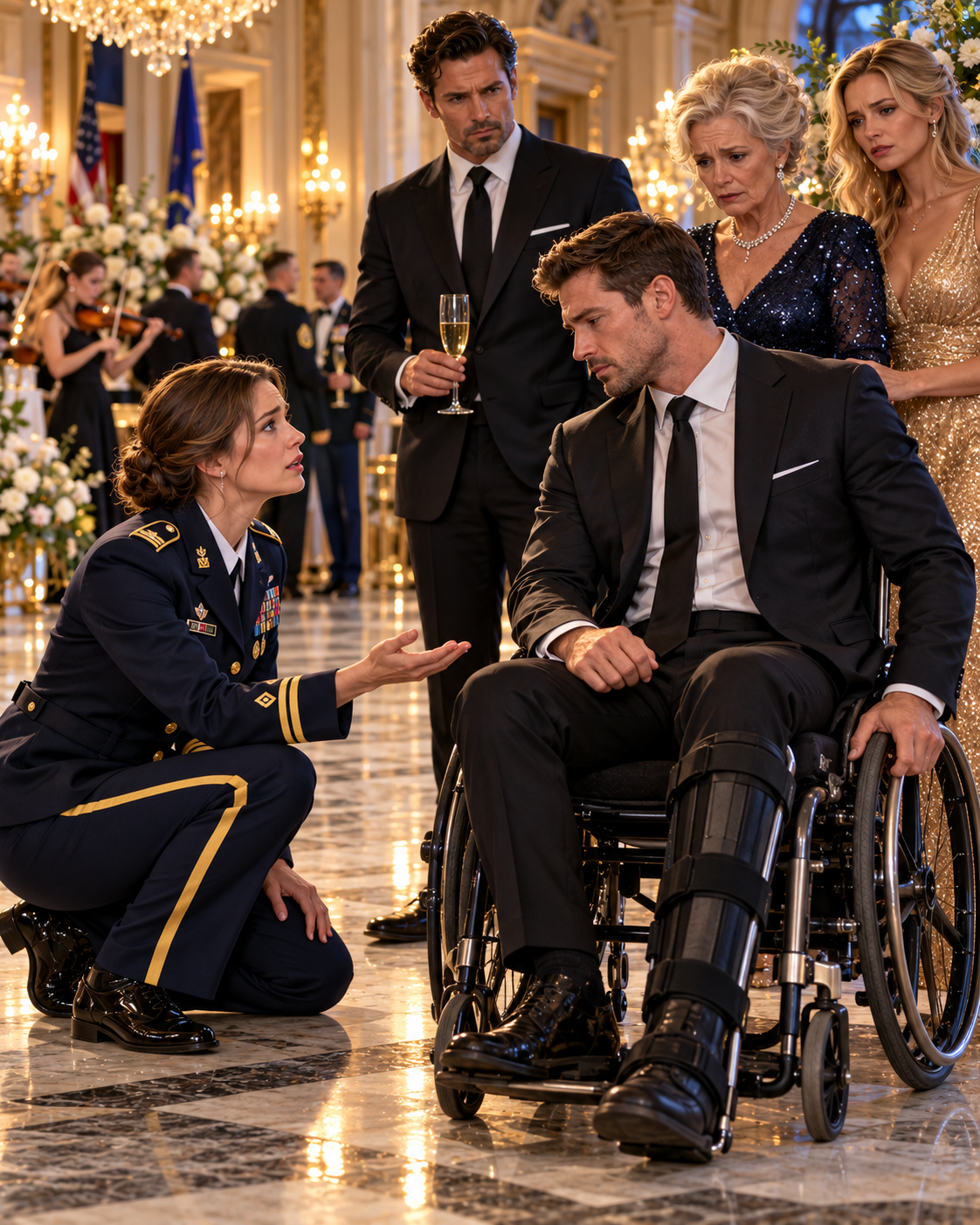
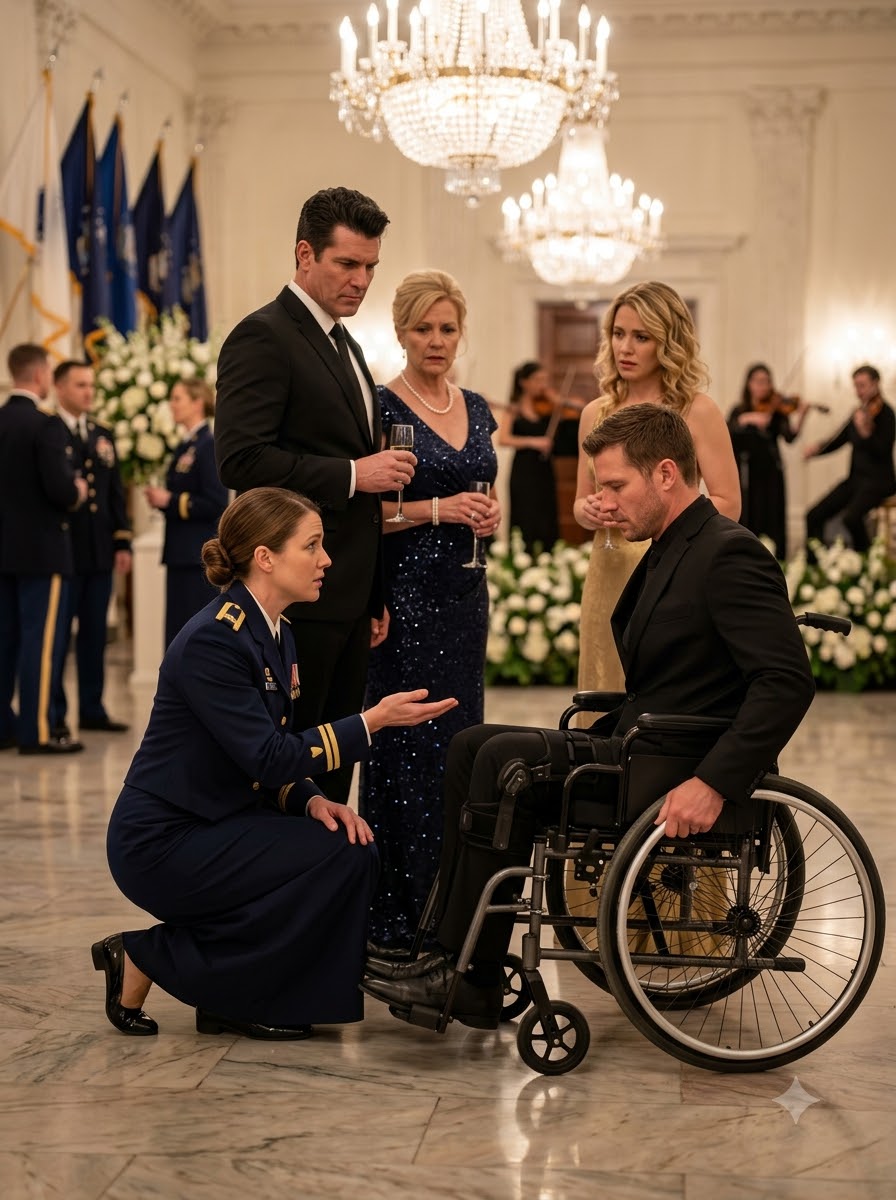
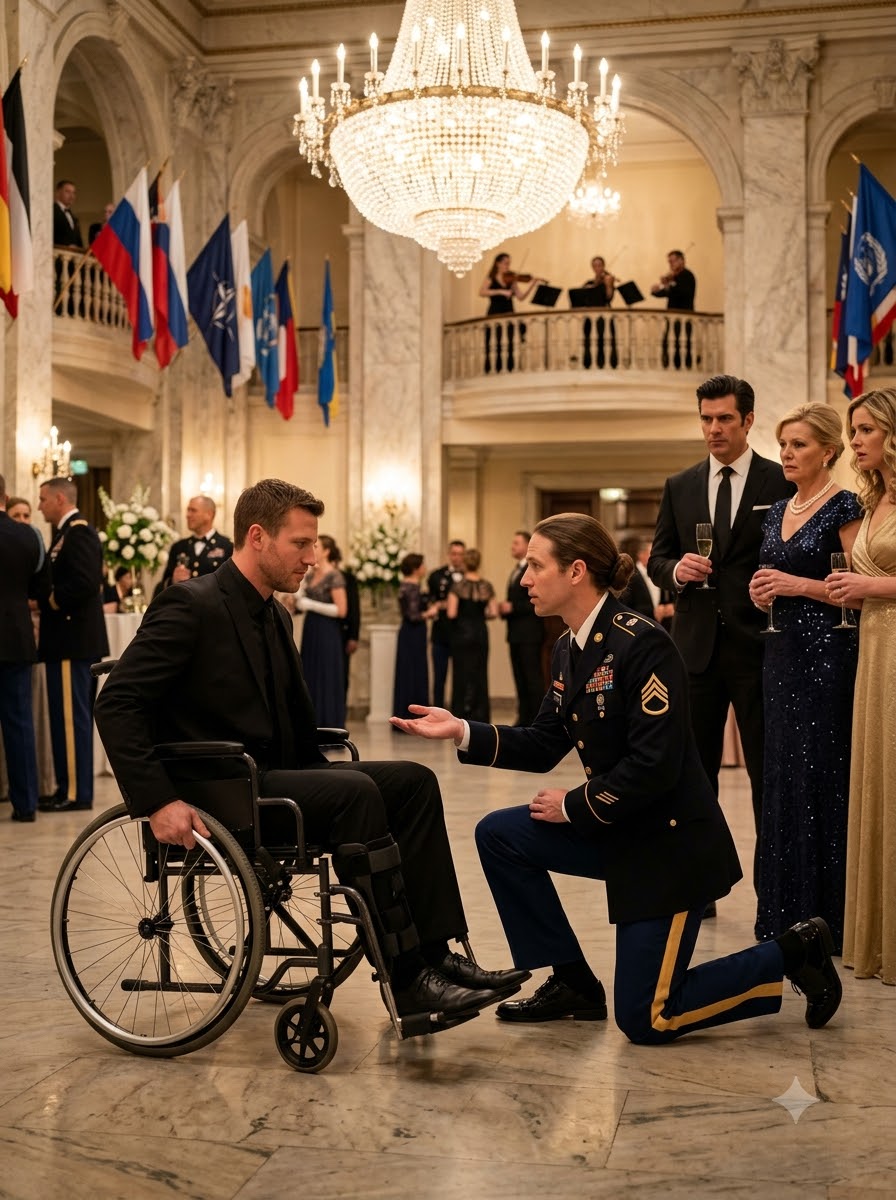
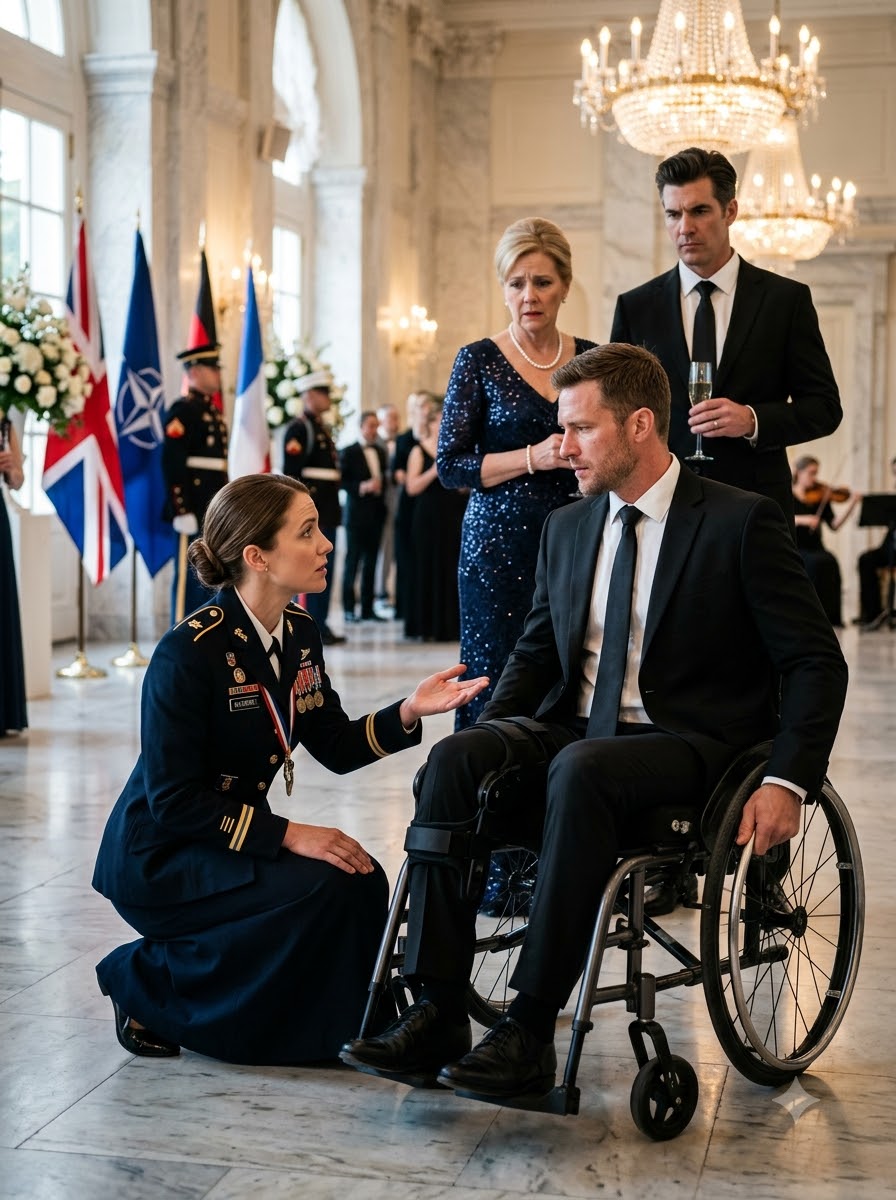
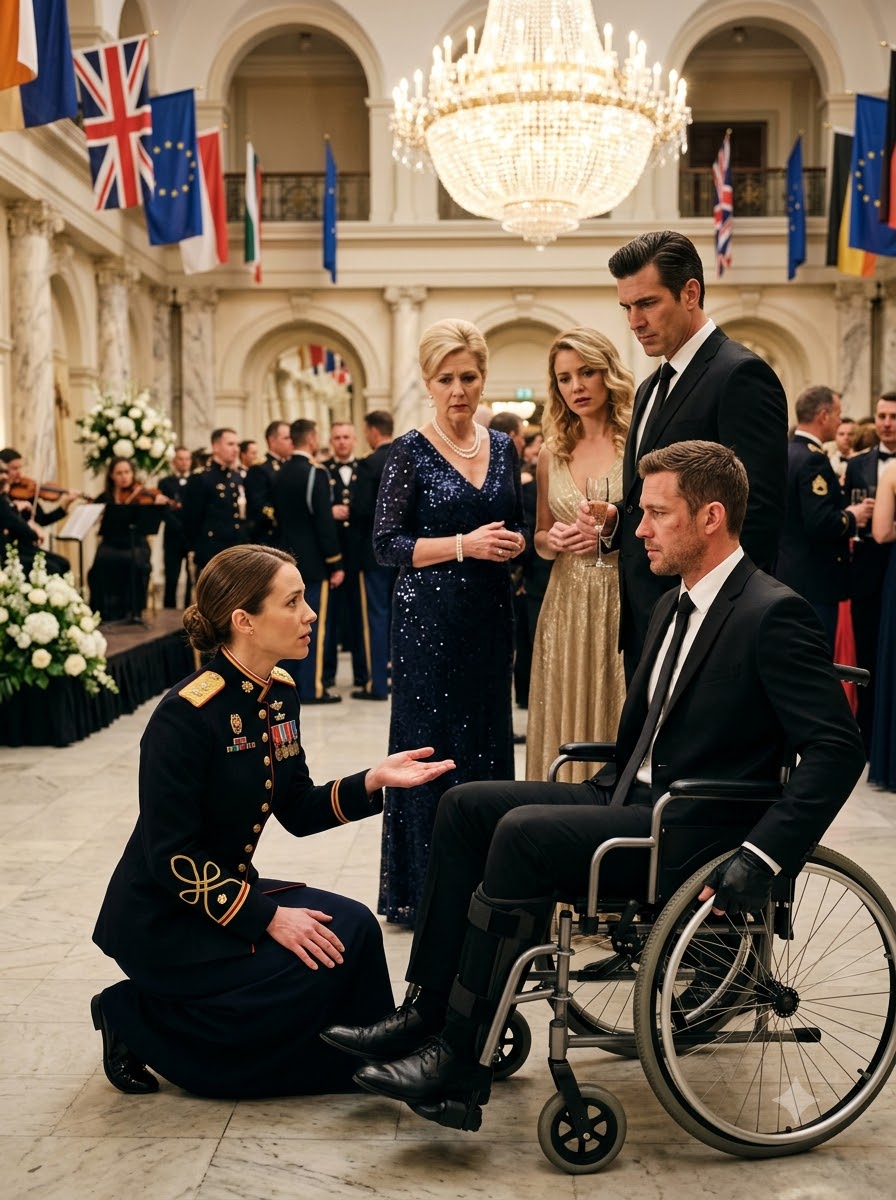
I turned away from Carson without saying anything and walked across the room where everyone could see me. Several conversations stopped. A few people stared. I knelt beside Nathan. He startled, but not violently. Just enough to reveal that kindness was no longer something he expected.
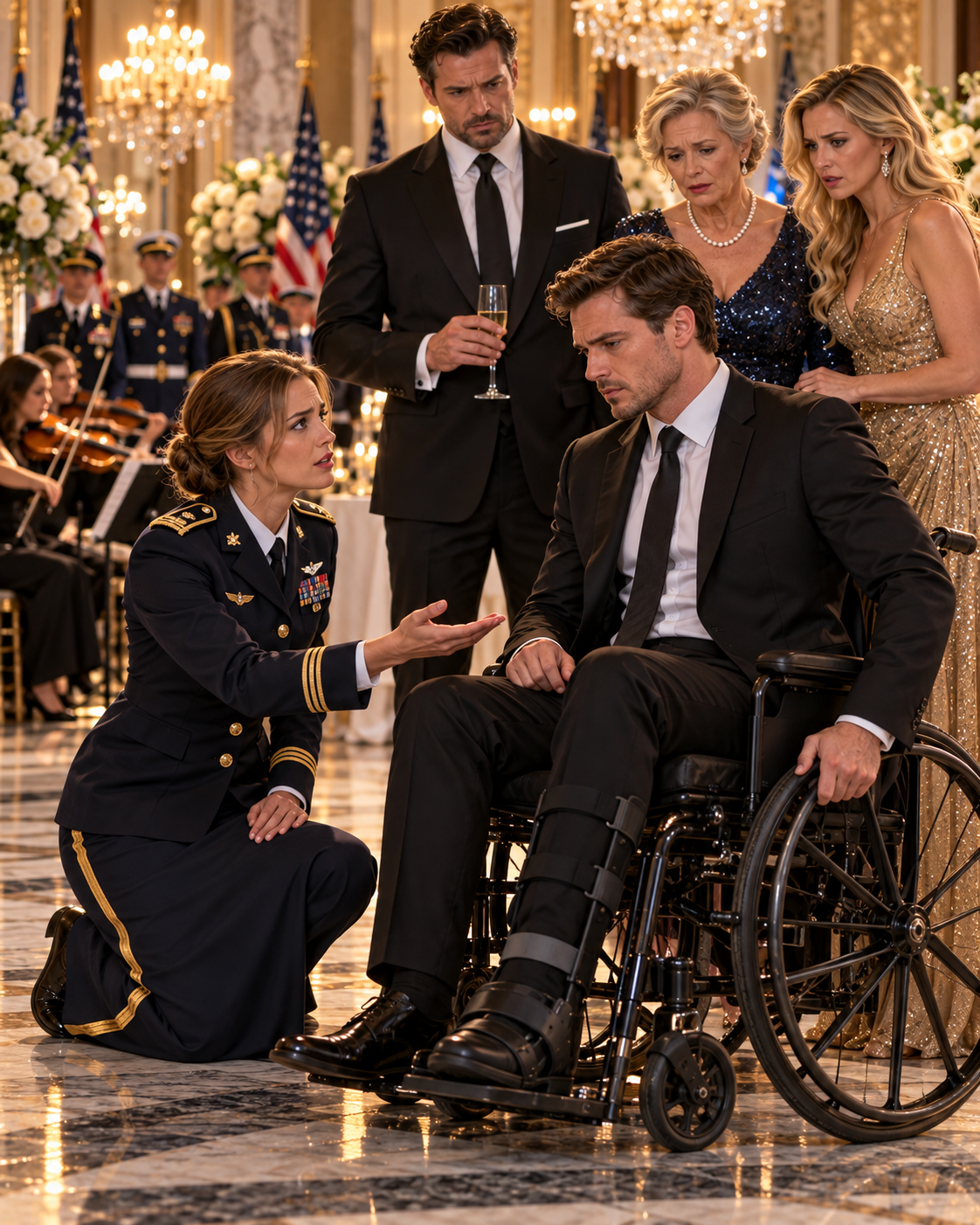
I asked gently, “Would you like to dance?”
He blinked. I waited. At first, there was no answer. His hand moved slightly in his lap, as if the memory of movement still remained somewhere inside his nerves. An awkward silence slowly gathered around us, heavier than the music. Then he nodded.
No one assisted him. I didn’t lift him. I simply stood and extended my hand. He gripped the side of his chair and pushed himself forward. The effort was awkward. His leg brace shifted slightly as he moved. He grunted. I waited. Then he stood. Not completely, but enough.
He carefully put one foot ahead of the other. His hand found mine. Not because he needed balance, but because he needed someone there. I didn’t lead him. We moved slowly. One shuffle, a breath, another shuffle. My uniform boots echoed alongside the mechanical movement of his brace.
The orchestra kept the same tempo, but the atmosphere in the room changed.
People began to notice. A woman gasped. The ballroom became completely still. Carson stared with his glass suspended in midair. My mother stepped slightly backward, looking around as though searching for someone to explain what was happening. My sister had gone pale. The string quartet continued playing, its haunting melody rising beneath the weight of something no one had prepared for.
Nathan tightened his hand around mine, not from fear, but determination. His brow creased. He looked upward, not at me, but beyond me. Then, slowly, he began turning, only a quarter spin and unsteady. But he was choosing to move. He was choosing the next step, and I followed.
We never completed a waltz, but we completed something else.
Nathan released a deep breath, nodded once, and carefully lowered himself back into his chair. His eyes, once empty, now carried something dangerously close to hope.
I straightened my uniform and fixed my collar. The silence continued.
Then came footsteps—slow and heavy.
General Harlon Beckett crossed the floor like a man caught between military discipline and personal grief. His chest carried four stars, but his eyes—his eyes were filled with tears. He stopped before us. The entire room seemed to hold its breath.
He looked at his son, then at me, and finally, with a voice breaking beneath years of discipline, he said, “Colonel, you just saved my son’s life.”
I didn’t smile. I only nodded.
Behind me, my family remained frozen, speechless.
For the first time, Carson had nothing to say.
The drive home was silent, but it wasn’t peaceful silence. It was the kind that simmers beneath boiling, waiting to spill over. The kind that makes the inside of a luxury SUV feel like a pressure cooker.
I sat behind the driver, watching my reflection in the tinted window. The metal bars across my chest caught faint flashes of the passing city lights. I didn’t straighten them. I left them crooked.
The silence broke the moment the driver closed the door.
My mother spoke first.
“Well, that was inappropriate,” she said, smoothing the silk scarf around her neck as though shame itself had disturbed it.
I said nothing. My eyes remained fixed on the window.
She leaned slightly forward, her voice turning sharp. “You couldn’t have just sat and clapped politely? Did you really need to turn that poor wounded boy into a spectacle?”
I turned my head just enough for her to see the side of my face, but not enough to give her anything she could interpret.
“Do you think General Beckett invited you to show off? You embarrassed him. You embarrassed us.”
I didn’t blink.
The SUV stopped at a red light. Outside, several young cadets laughed beside a bus stop. They wore civilian clothes and carried themselves casually. They looked weightless.
Then Carson spoke.
He didn’t raise his voice. He never had to. His tone remained clipped and cold.
“You planned that, didn’t you? You read his file. You wanted to make a move in front of a four-star.”
My stomach tightened. Not because I was shocked, but because it was so familiar. Carson always believed ambition was uglier when it came from someone like me. He was allowed to climb the ladder. I was expected to mop the floor beneath it.
Still, I said nothing.
He continued. “You choreographed the whole thing. That wasn’t medicine. That was theater. You’ve always wanted to be the exception, the story, the hero. The Army doesn’t need medics who perform. It needs soldiers who follow orders.”
That final word struck hard.
Follow.
It took me back to a day at a forward operating base in Kandahar six years earlier. We received word that a village child had stepped on something near the wire, probably an old mine. I was the closest. I ran.
When I reached him, he was still breathing. His legs were mangled, and he was crying in Pashto for his mother. I applied the tourniquets and called for evacuation.
Then command ordered me back.
“Stand down, Colonel. He’s not our mission.”
Not our mission.
The boy bled out in my arms before I even made it back across the line. That night, I wrote his name in my journal. I didn’t know how to spell it. I only drew the shape of his face.
I had followed orders, and he had died.
Tonight, I didn’t follow.
I let someone lead.
Inside the SUV, Carson’s voice came again.
“I spoke with your CO two weeks ago. Word is they’re reviewing your postfield eligibility. Some think you’re not suited for high-visibility ops anymore. You’re a liability.”
I slowly turned toward him.
“I didn’t know you still checked in on me.”
He blinked. The response caught him off guard. Not because it was true, but because I hadn’t said it angrily. He scoffed and turned toward his own window.
Mom spoke again. “We’re not trying to tear you down, Penelopey. We just don’t want you to keep drawing the wrong kind of attention.”
I smiled at the glass.
The wrong kind.
That was what they called it when I applied to Ranger School. When I rejected Carson’s offer to work in private defense. When I chose to remain enlisted instead of going civilian for more money.
The wrong kind of attention.
“I didn’t do it for attention,” I said quietly.
“Then why?” Carson snapped.
I could have told him that Nathan’s eyes reminded me of that boy lying in the dirt. I could have told him I didn’t want another name I couldn’t spell carved into my memory.
But I didn’t.
Instead, I said, “Because I was there, and I saw him, and no one else did.”
Carson scoffed again. “You keep thinking you’re different. That makes you dangerous.”
Dangerous?
I turned back toward the window. This time, my reflection looked straight back at me.
I remembered Nathan standing, his trembling hand in mine, the screech of his brace against the floor. I remembered the silence in the room, as if everyone’s breath had been pulled into a single second.
That wasn’t theater.
That was life.
“Do you know what the general said to me?” I asked.
Neither of them responded.
“He said, ‘Colonel, you just saved my son’s life.’”
Silence returned.
But this time, it belonged to me.
When I arrived home that night, I didn’t bother removing my dress uniform. I took off the medals and placed them carefully on my desk. Then I sat on the edge of the bed and stared at the floor while the faint hum of the heater buzzed in my ears like a distant wasp.
My thoughts weren’t at the gala anymore.
I was back there.
Forward operating base. Mitchell, southern Afghanistan. Dry heat and red dust filling your lungs. That place still remained in the corners of my body, buried inside old scar tissue and behind my left shoulder where the shrapnel had entered.
It was late afternoon. The light was harsh. I remembered the sandbags surrounding the medical tent like weak promises. I had just finished cleaning the dressing on Sergeant Mullen’s chest wound when the first round struck. Mortar, maybe 70 meters away.
The next one landed closer.
There were already four injured inside the tent, one unconscious and another intubated. Two corpsmen called for me. We were running low on morphine. The generator powering the AC had failed earlier that morning.
The third explosion brought down part of the north fence.
And that was when I heard it.
A scream.
It wasn’t loud, but it was different. Raw and desperate. It came from somewhere outside the tent near the triage area.
I stepped outside and saw him—a young private bleeding from the abdomen, trapped beneath a piece of collapsed structure. There was nobody else with him.
Protocol said to stay undercover. Reinforcements were already coming. It would only be a matter of minutes.
But I moved anyway.
I sprinted low with my head down. I could feel every round vibrating through the soles of my boots. I reached him and dropped to my knees, instinctively checking his pulse, breathing, and responsiveness.
His name was Lindley. Nineteen.
He kept saying, “Please don’t leave me. I didn’t plan to.”
I wedged my shoulder beneath the debris, braced myself, and pushed. My legs screamed that I had torn something, but I kept going until the structure shifted enough for me to pull him free.
We were halfway back to the tent when it happened.
Another blast.
Everything turned white and red.
I woke six hours later in the surgical bay of a mobile hospital. My leg was splinted. I had a grade-three concussion and three fractured ribs.
Mullen had survived. So had Lindley.
I hadn’t.
Not at least in the same way I had existed before.
For six weeks, I remained on a recovery cot. There were no visitors, only routine check-ins and charts. Most of my team had already rotated out. I heard from a few nurses and a chaplain. Even Lindley sent me a note that said, “You gave me another birthday.”
But Carson? He emailed me.
No phone call, no visit, just a message.
“Don’t blow this up. You got hurt doing something reckless. That doesn’t make you a hero. It makes you stupid. Stay quiet. Let it pass.”
I remember staring at the screen for what felt like a long time.
Then I deleted it.
I told myself he was simply being Carson. Tough love, misguided protection. But I knew that wasn’t the whole truth. His contempt for me hadn’t begun with that email. The message had only given it a louder voice, while I had become accustomed to staying quiet.
After I was discharged, I didn’t return home. I remained on base, completed the after-action reports, went through the physicals, and passed the physical recall six weeks ahead of schedule.
Nobody said much, except for one lieutenant colonel who told me, “You’re not built like most.”
He intended it as praise.
I carried it as a warning.
For a while, I tried convincing myself it wasn’t personal. Maybe Carson’s coldness was simply how he coped. Maybe being the older brother had made him harder. Maybe he believed I somehow made him look small.
But deep down, I understood.
His disdain wasn’t accidental. It wasn’t merely emotional distance or male pride.
It was structural.
He didn’t believe I belonged.
Not in the field, not in uniform, and not at the table.
To him, I was a story that had gotten lucky. A medic who had somehow stumbled into a few medals and a position she hadn’t earned.
He would insist it wasn’t about gender, but every sentence he spoke carried that weight. He called me reckless. He accused me of seeking attention. He said I didn’t understand real war.
And for years, I let him say it.
But that ended tonight.
Because when I reached out to Nathan Beckett, I wasn’t performing. I wasn’t disobeying. I wasn’t grandstanding.
I saw someone everyone else overlooked.
And for once, someone saw me, too.
Those seven words from General Beckett weren’t praise.
They were recognition.
For the first time in a long time, someone of that rank looked at me and didn’t see a nurse who had wandered onto a battlefield.
He saw a colonel who had earned every step.
Three days after the gala, a plain white envelope appeared at my quarters. There were no markings or insignia, only my name written in block letters.
I opened it carefully, making sure not to crease it.
Inside was a folded note, typed and signed at the bottom.
“Colonel Ward, I would be honored if you joined us at Walter Reed next Friday to speak with a group of young officers currently undergoing rehabilitation. Your presence and your example made a difference.
General Harlon Beckett.”
I read the message three times.
The invitation wasn’t an order. It hadn’t come through a superior officer or been wrapped in military formality.
It was personal and sincere.
For several moments, I remained still. My fingers stayed around the envelope as though it might disappear if I blinked.
Then I folded it, slipped it inside the back cover of my field notebook, and exhaled.
The following day, I received a phone call.
It wasn’t my commanding officer. It wasn’t anyone from Walter Reed.
It was Carson.
He didn’t even say hello.
“What the hell are you doing, Penny?”
I didn’t answer. I simply let him continue.
“I heard you’re planning to go to Walter Reed to give a speech. To stand there like some decorated war hero and pretend you’re the model officer.”
Again, I remained silent.
He continued.
“Do you even realize how damaging that is? You’re not just putting yourself in the spotlight. You’re dragging the family name into it. We’re under review for two defense contracts. You think it helps that my sister is out there playing savior for a general’s crippled son?”
My jaw tightened, but I held myself still.
“Carson,” I said slowly. “I didn’t do anything for the cameras.”
He gave a short, bitter laugh.
“No, but the cameras followed anyway. And now everyone’s calling you the miracle medic, the Beckett whisperer. You really think that’s going to go unnoticed?”
That was when I understood.
It wasn’t about me being dangerous.
It was about me being visible.
Carson had always preferred me invisible. Useful in private, easy to ignore in public.
“I’m going,” I said calmly.
He snapped, “Well, then don’t be surprised if things start unraveling for you, Colonel.”
Then he hung up.
That night, my CO sent me a message. It wasn’t accusatory, but it was cautious.
“Ward, heads up. There’s been some chatter. Someone’s flagged a few lines from your Kandahar report. Language suggesting you disobeyed a directive. Not formal, just internal circulation. Be smart.”
I didn’t need to ask where it originated.
I already knew.
The following morning, two separate news outlets posted articles online. Low-level clickbait pieces with vague accusations.
Field Medic or Liability.
Colonel’s Heroism Questioned After Gala Spotlight.
Controversy Behind the Uniform.
The Real Story of Penelopey Ward.
They cited anonymous sources, removed old mission reports from their context, and quoted an unnamed former soldier who claimed I had once endangered a unit by acting without clearance.
There was no evidence.
But evidence wasn’t necessary.
That was the strategy.
Carson understood the system. He didn’t have to get me formally reprimanded. He only needed to muddy the water enough that I couldn’t stand firmly in it.
He wanted to drown me in implication.
And it might have worked.
A few years earlier, it probably would have.
But not anymore.
I wasn’t going to make myself smaller. Not after everything I had pushed through. Not after watching Nathan Beckett stand before hundreds of strangers simply to take one step.
I knew what I had done.
I knew what I hadn’t done.
And I knew the price of silence.
That afternoon, I emailed General Beckett.
“Sir, I accept your invitation. I will be honored to meet your officers.
Colonel P. Ward.”
I didn’t copy my CO. I didn’t contact public affairs. I quietly packed my bag, printed my deployment files, and requested two days of personal leave.
Then I called a friend in the legal office.
“Do me a favor,” I said. “Check who accessed my personnel file this week.”
There was a pause.
Then she replied, “You already know, don’t you?”
I nodded, even though she couldn’t see me.
“Yes,” I said. “But I need proof.”
Over the years, I had learned that the truth didn’t always shout. Sometimes it whispered.
And sometimes it left behind a digital trail.
It took less than 36 hours to confirm what I had already suspected.
Carson hadn’t simply made a phone call or circulated a few half-truths. He had been operating behind the scenes for months, building connections with a coalition of defense contractors and conservative policymakers while quietly campaigning against the full integration of military medical personnel in frontline operations.
Their argument was that medics, particularly female officers serving in combat-adjacent roles, weakened unit cohesion and blurred operational clarity.
I had encountered hints of it before. Op-eds filled with veiled language. Congressional hearings raising concerns about deployment boundaries.
But I hadn’t understood how close it had become until I found my name in one of their internal memos.
It wasn’t public.
Not yet.
But a friend in defense affairs, someone I had previously trained in field trauma care, quietly flagged it for me.
The memo contained three names.
Colonel P. Ward.
Lieutenant T. Sims.
Major R. Levy.
All three of us were military medics. All three had received decorations for valor during the previous decade, and all three had appeared briefly in Department of Defense outreach videos promoting advanced combat medicine.
According to the memo, we were examples of inflated field presence and operational risk created by cross-functional ambiguity.
I read that sentence five times.
Cross-functional ambiguity.
That was the phrase they used for saving lives under fire.
My hands didn’t tremble. I had seen worse and heard worse. But something tightened beneath my ribs.
Not fear.
Not even anger.
Something else.
Something colder.
Carson wasn’t merely trying to silence me. He was helping construct a narrative designed to erase people like me entirely.
I needed evidence, not emotion.
So I began documenting everything quietly and methodically.
I tracked financial disclosures, followed connections between think tanks and contractors, and recorded the timing and keywords of articles. I collected statements from smaller forums and comments made publicly by people connected to Carson’s consulting firm.
I did it all without leaking anything, without ranting, without allowing anyone to see me flinch.
I didn’t need headlines.
I needed the truth to build into something neat and undeniable.
What I hadn’t expected was the email.
It arrived through a secure server. No name. No greeting. Just one line.
“He did the same to me. And worse.”
Attached was a scanned PDF containing divorce filings, settlement documents, and non-disclosure clauses.
At first, I assumed it was spam. Then I recognized the name.
Mera Stanton Ward.
Carson’s ex-wife.
I hadn’t heard her name in years. They had divorced five years earlier, quietly and without scandal. The family had dismissed it, saying the separation was amicable.
But Meera had disappeared afterward. She left DC, accepted a job in nonprofit health, and didn’t attend a single family holiday.
I opened the file.
It contained spreadsheets documenting financial control—how Carson had restricted her access to their joint accounts, limited what she could spend, and even manipulated her medical insurance coverage during the divorce.
There were emails as well. Messages in which he threatened to damage her professionally if she ever spoke publicly about their marriage.
Buried among them was a short forwarded thread, containing a message Carson had sent to a colleague three months earlier.
“If we can discredit Penelopey at the symposium, we’ll have enough momentum to shut down the pilot program at Walter Reed. Too much noise around female combat medics lately. She’s the symbol. Take her down. The narrative dies.”
I stared at the screen for a long time.
Not because it surprised me.
But because I finally had what I needed.
Not hearsay.
Not suspicion.
Proof.
Still, something felt wrong.
I emailed back.
“Why now?”
The response arrived quickly.
“Because I watched your speech at the gala. And because you didn’t flinch.”
This time, she signed it.
Meera.
It wasn’t forgiveness. It wasn’t solidarity. But it was enough.
Enough to understand that I wasn’t the only person who had been dismissed, undermined, or treated as disposable by a man who wore power like armor.
I organized the files, redacted anything that required it, and verified the sources. Then I made one final copy of the complete report and personally delivered it to the Office of the Inspector General.
No press.
No spectacle.
Just the truth.
After that, I drove to Walter Reed, slipped the general’s letter into my coat pocket, and walked through the main entrance without looking back.
Walter Reed didn’t feel like a hospital.
Not in the ordinary sense.
It breathed like a battlefield—quiet but watchful, filled with people who had seen the edge of everything and were still figuring out how to return from it.
The walls carried the faint smell of antiseptic and stubbornness, the kind that refuses to be dismissed.
The rehabilitation wing was bright, with natural light and softly colored walls.
But what struck me most was the sound.
Or rather, the absence of it.
Nobody cried. Nobody screamed.
But effort filled the air.
Every breath, every stretch, every clenched jaw seemed to say, We’re still here.
Nathan noticed me first.
He was across the room, balancing between the parallel bars. His uniform was gone, replaced by standard rehabilitation clothes—a loose shirt, fitted brace, and soft-soled shoes.
His father stood several feet away, arms folded, giving him space and refusing to interfere.
Nathan’s eyes met mine.
He didn’t smile.
Not yet.
But he nodded.
That was enough.
I joined the physical therapy team along the edge of the mats. I wasn’t wearing my uniform, only a plain navy shirt and slacks.
No rank.
No bars.
Only the memory of who I had been when I first started this work and the promise of who I would be now that I was returning to it.
I didn’t give instructions. I didn’t demonstrate anything.
I sat with a small group of officers, specialists, and enlisted personnel—men and women. Some were missing limbs. Others struggled to use the ones they still had.
Each carried more than physical pain.
It showed in their posture, in the hesitation before every movement, as though their bodies were asking permission from something their minds couldn’t identify.
I didn’t break that silence.
Instead, I told them a story.
Not about war.
Not about medals.
But about a child I had once treated.
Burns covered half his face, and he was too frightened to look in a mirror. He wouldn’t walk. Not because he was incapable of walking, but because he believed anyone who saw him would run.
So every day, I walked beside him.
Not ahead.
Not behind.
Beside.
Until one day, he released my sleeve.
I stopped the story there.
No dramatic ending.
Just the truth.
Nathan was listening.
He wasn’t sitting anymore.
Since I had arrived, he had taken two steps, unsteady but moving forward.
By the third, his arms began to tremble.
I moved closer, but I didn’t hold him. I only wanted him to know that I was watching.
He gritted his teeth. Sweat appeared along his hairline.
Another step.
He looked at me, then down at the floor.
His voice barely rose above a whisper.
“This one hurts.”
I nodded.
“Then it’s working.”
He blinked.
Then he took another step.
And another.
The room became still, not because everyone was amazed, but because everyone respected what they were witnessing.
Pain is ordinary here.
Progress is sacred.
Nathan reached the end of the bars and slowly turned. His father remained where he was.
I said nothing. I simply gave Nathan the room to experience whatever he needed to experience.
Then someone behind me spoke.
It was a young lieutenant I hadn’t met before. She looked around 24, with short-cropped hair and a missing left hand. She leaned against the doorframe with her arms crossed, watching.
“She doesn’t guide,” the lieutenant said, almost to herself. “She follows. But that’s what makes us move.”
Silence lasted for a moment.
Then Nathan, breathing hard, said, “I didn’t think I could do that.”
I replied, “That’s because you were taught to wait for someone to tell you when it was time.”
He looked down at his feet as though they belonged to someone else, then raised his eyes toward me.
“I don’t want to wait anymore.”
“Then don’t,” I said. “Just make sure the next step is yours.”
The rest of the day blurred together. More therapy, more notes, brief conversations with the staff. I signed several forms and agreed to consult on a new program, but my thoughts remained with that sentence.
She doesn’t guide.
She follows.
It wasn’t intended as praise.
Not in the conventional sense.
But it was the greatest honor I could have received.
Because in a world built around hierarchy and control, sometimes the most radical thing you can do is choose to walk beside someone.
Not lead.
Not fix.
But believe, and allow that belief to do the rest.
The hardest part of filing a report isn’t collecting the evidence.
It isn’t even writing the summary or arranging the timeline.
It’s pressing send.
It’s knowing that whatever happens next is no longer within your control.
I submitted the complete report on Carson to the Department of Defense Inspector General on a Thursday morning.
No ceremony.
No press leak.
No dramatic confrontation.
Only an email containing encrypted attachments and a single sentence in the body.
“Submitted in accordance with Title 10, U.S. Code, Section 1034, Military Whistleblower Protection Act.
Colonel P. Ward.”
By noon the following day, they had confirmed receipt and thanked me for cooperating in preserving the integrity of institutional conduct.
By Monday, Carson had been suspended pending investigation.
It wasn’t public yet, but I knew because my phone rang that afternoon.
It wasn’t a military number.
It wasn’t an unknown number.
It was my mother.
She didn’t even wait for me to say hello.
“What the hell did you do?”
Her voice was brittle and cold, the kind of cold that only sounds warm to people who have never been close to real fire.
“Carson just called,” she snapped. “They removed him from his position. No notice, no explanation. Do you understand what this does to his career? To our name?”
I took a slow breath while staring through the window of my temporary quarters at Walter Reed.
“Mom,” I said calmly. “I submitted evidence. I didn’t fabricate it.”
“You embarrassed this family,” she hissed. “You dragged your own brother through the mud for what? Some spotlight at a gala?”
I almost laughed.
Not because it was funny.
But because she still believed this was about a dance.
“You think I did this to embarrass him?” I asked. “You think I wanted this?”
There was a brief pause.
“You’ve always resented him,” she said. “Ever since you were kids. You could never stand not being the favorite.”
I let her words sit.
Then I said the only thing I could.
“Mom, I’m not angry. I’m not even hurt.”
“Then what are you?”
“I’m tired,” I said. “Tired of pretending silence is the same as peace.”
Another pause.
Then she said it.
“You’re just like your father.”
And hung up.
I didn’t call her back.
I didn’t need to.
I closed my phone, placed it gently on the table, and walked to the file cabinet beside my bed. I pulled out a folded piece of paper.
It was a letter my father had written fifteen years earlier, shortly before his deployment to Rammani.
He never came back.
There was nothing heroic about the letter. No dramatic farewell.
Only one line had stayed with me.
“The only thing more dangerous than doing what’s right is deciding to stay quiet when you know what’s wrong.”
That night, the Office of the Inspector General released an internal bulletin.
Carson’s access to DoD systems had been revoked. He was no longer allowed to serve in an advisory role until the full review was completed.
It would take weeks.
Maybe months.
But the process had begun.
I didn’t celebrate.
I didn’t gloat.
The next morning, I returned to the rehabilitation wing.
Nathan was already there, walking laps with another patient. He waved when he saw me.
I nodded.
The young lieutenant—Alexis, I had learned her name was—greeted me with a smile.
“He’s getting faster,” she said.
I looked toward Nathan.
“He’s not just moving,” I said. “He’s choosing.”
She tilted her head.
“How’d you get him to start?”
“I didn’t,” I replied. “He led. I followed.”
She grinned.
“That’s your thing, huh?”
I smiled back.
“It works.”
Later that afternoon, the general found me in the hallway.
He didn’t mention Carson. He didn’t ask about the investigation.
He simply said, “You stood still in a room full of pressure. That’s a rare thing.”
I shrugged.
“I just made space.”
He nodded thoughtfully.
As I turned to leave, Alexis’s voice drifted softly from behind me.
“She doesn’t guide. She follows. But that’s what makes us move.”
I said nothing.
I didn’t need to.
That sentence would stay with me longer than most medals.
Because ultimately, leadership isn’t about volume.
It’s about presence.
And I was finally finished being silent.
The room was smaller than I had expected for a meeting at the Pentagon called under routine protocol review.
It felt strangely intimate.
A round table surrounded by senior officers, several department representatives, and a glass wall overlooking the river.
No cameras.
No microphones.
But I knew better.
Nothing here was ever simply routine.
I sat near the far end in civilian clothes beside a legal liaison. I hadn’t been invited to speak, only to attend.
Observe.
Across from me sat Carson.
His suit was immaculate, his posture rigid, but his eyes flickered when he noticed me, only for a second. Then he looked away as though I were an unfortunate mark on an otherwise carefully planned day.
He hadn’t expected me to be there.
Good.
The chair of the review committee, a two-star with a quiet manner and precise delivery, began by going through the procedural matters.
I barely listened.
My attention stayed on the folder in his hands.
The one with my name on the tab.
Eventually, the words registered.
“As requested by General Harlon Beckett, we have reopened the inquiry into the Ward Lima forward operating report dated June 14th, 2017.”
Carson flinched.
So it was true.
General Beckett hadn’t simply thanked me with words. He had gone to the department and requested that my combat record be fully reviewed and properly credited.
It was the same report Carson and his allies had attempted to use against me.
The same report I had stopped defending years earlier because arguing with men who had already decided I didn’t belong in the field had begun to feel pointless.
The chair continued.
“Today we’ll hear from one individual who was present at Forward Operating Post Lima during the incident in question.”
Carson leaned forward. He didn’t look visibly nervous, but he was alert.
The door opened.
A woman entered, somewhere in her early 40s, with a strong build and a VA badge. Her short hair was streaked with gray, and she walked with a slight limp.
My breath caught.
It was Lieutenant Commander Dana Kelso.
I hadn’t seen her in six years.
She had been our surgical lead on the ground.
Brilliant under pressure, the kind of woman who never waited for permission to save lives. She simply acted and dealt with the politics afterward.
She took the seat across from me, facing the board.
Her voice was steady.
“I served with Colonel Ward at FOB Lima. During the June 14th attack, our unit was cut off for over eight hours. We had no comms, no reinforcements, no evac window.”
She stared straight ahead.
“During that time, Colonel Ward took command of the triage center. She stabilized nine critical injuries, including two abdominal bleeds, a partial amputation, and a collapsed lung. No one died under her care that night.”
Nobody spoke.
Dana’s voice remained steady.
“There was a moment around hour six when the secondary wall breached. We were overrun. Ward dragged one of the wounded, still on oxygen, back behind the inner defense line while taking shrapnel to her own leg. She refused morphine until everyone else was stable.”
Carson shifted in his chair.
Dana looked toward him briefly, then turned back to the board.
“I’ve read the redacted report. I’ve seen what’s been circulated about her judgment that night. I’m here to say, without her actions, we would have lost at least half the wounded, including me.”
The chair slowly nodded.
“Why was your statement not included in the initial report?”
Dana answered without hesitation.
“I was medevaced the next morning and placed in isolation due to infection risk. I submitted my account, but it was delayed in the chain of command. By the time it surfaced, the investigation had already closed.”
She paused before adding, “I didn’t know until recently that there was even a question about her performance.”
The room went still.
Then, for the first time, General Beckett, who had remained silent until that moment, spoke.
He turned toward the board. “I asked for this review, not because Colonel Ward asked me to. She didn’t.”
He turned toward Carson.
“I asked for it after watching my son, who hadn’t stood unaided in 14 months, walk six full steps under her watch. No pity. No stage. Just respect.”
Carson’s jaw tightened.
Beckett leaned forward.
“If this institution penalizes integrity because it makes some people uncomfortable, then we’re not protecting the uniform. We’re burying it.”
He settled back.
Silence returned.
But this time, it belonged to me.
By the time I walked out of the Pentagon that afternoon, the press had already caught wind of what had happened.
Not the complete story. Not the nuance.
Just enough to disturb the surface.
By nightfall, a headline appeared on a mid-tier defense blog.
Colonel Who Danced at Gala Now Central to Pentagon Firestorm.
Then came another.
Decorated Medic or Reckless Officer?
Internal Review Sparks Political Fallout.
The next morning, the major outlets picked it up.
I woke to seven missed calls, three voicemails, and a dozen emails from reporters. They wanted quotes, explanations, reactions.
They wanted a face.
I gave them none.
I didn’t arrange interviews. I didn’t hold a press conference. I didn’t appear on television.
Instead, I wrote a letter by hand.
It was scanned and submitted through the proper military channels. Then, in accordance with regulation, it was made available to registered media upon request.
It read:
“To whom it may concern,
I am not a hero. I am not a victim. I am a soldier who made a choice in a moment that mattered.
I didn’t act for medals. I didn’t act for headlines. I acted because someone needed help and I was there.
That’s the job.
There are people who believe that keeping your head down is the best way to survive in this system. I disagree.
Doing the right thing isn’t always convenient. It rarely comes with applause, but silence, when faced with harm, is complicity.
I’ve lived long enough in the shadow of that.
I do not regret speaking up. I only regret that it took this long to be heard.
Colonel Penelopey Ward
Army Medical Corps.”
That was everything I said.
But it was enough.
The next day, the story changed direction.
Not toward scandal.
Toward accountability.
Internal audits were opened. Contracts linked to Carson’s firm were frozen pending investigation. His security clearance was revoked.
Several publications quietly revised their earlier coverage, removing wording that had portrayed me as impulsive or unstable.
Carson, meanwhile, remained silent.
No rebuttal.
No statement to the press.
Just absence.
For the first time in his career, power wasn’t shielding him.
It was also the first time I realized that without that power, he didn’t know who he was.
Rumors spread that his partners were distancing themselves, that his name had stopped being considered for a think tank appointment, and that certain relationships built through private clubs and whispered promises were beginning to unravel.
And I went back to Walter Reed.
Same hallway.
Same rehabilitation wing.
Same faces.
Only now, something had changed.
When I entered the room, nobody stood or saluted, but they watched me.
Not because they were curious.
Because they recognized me.
Nathan was there helping another young patient adjust their leg brace. He smiled when he saw me.
I nodded.
In the far corner, Alexis was going through paperwork with a visiting therapist. She caught my eye and tilted her head thoughtfully.
“Nice letter,” she said.
“Too long,” I replied.
She smirked.
“No. Just long enough.”
Later, as I walked past the windows overlooking the rehabilitation garden, I thought about the word everyone kept using.
Hero.
I hated it because heroes suggested distance, perfection, elevation.
And that wasn’t what I wanted.
I wanted proximity.
Connection.
Change at ground level.
I didn’t want to be remembered for a headline.
I wanted to be remembered for the silence I broke.
Before I left that day, one of the younger patients approached me. He was barely 20, still wearing his pain like armor.
He looked at me awkwardly before asking, “Ma’am, did it feel worth it going up against someone that powerful?”
I thought about it for a moment.
Then I answered.
“It didn’t feel like going up. It felt like standing still while everything else tried to push me backward.”
He slowly nodded as though he understood.
And maybe he did.
That evening, alone in my quarters, I received one final notification from the DoD’s Office of Oversight.
Carson Ward, pending full review, was permanently removed from his advisory roles.
His influence had been deemed incompatible with the ethical standards of military partnership.
No ceremony.
No dramatic downfall.
Just a name removed.
I closed the email, folded my uniform for the following morning, and wrote the only words that mattered now in my field notebook.
I didn’t raise my voice to be loud.
I raised it to be clear.
There is a kind of quiet that only exists in recovery rooms. It isn’t filled with stillness, but with waiting.
Waiting for healing.
Waiting for strength.
Waiting to believe in either.
That morning at Walter Reed, the quiet didn’t feel heavy.
It hummed.
Not like something was missing, but like something was unfolding.
Nathan was leading group mobility exercises in the east rehabilitation wing, a room filled with mats, braces, sweat, and encouragement delivered in short, honest bursts.
I stood at the back with my arms folded, watching him. Not as an officer. Not even as a mentor.
But as a witness to how far he had come.
His walk wasn’t perfect. It was still uneven in places, but it was proud and steady, supported by conviction rather than pity.
He carried himself like someone who was no longer afraid of falling.
The group around him had changed over the previous few weeks. Younger soldiers, some barely finished with their first tours. One wore a carbon-fiber leg prosthetic. Another had undergone partial facial reconstruction.
None looked like anyone’s definition of ready.
But they were.
Not because they had fully healed.
Because they had begun.
Nathan noticed me watching and gave me a subtle nod.
Then he turned toward his group and said something I hadn’t expected.
“I took my first step because she didn’t push me.”
He pointed toward me.
“I knew she could have. She had the rank, the experience, the authority. But she didn’t give me orders. She gave me space. That’s what saved me. I wasn’t prepared for that. It’s easier to wear armor when people challenge you. Harder when they see you.”
He looked toward a young private in the front row.
The kid had come out of surgery only a month earlier. Below-the-knee amputation on the left side. His face carried an expression I had seen far too many times.
Fear pretending to be defiance.
Nathan stepped toward him and smiled.
“You up for something different today?”
The kid hesitated.
“Like what?”
Nathan walked over to a small speaker in the corner, tapped his phone, and soft instrumental music began playing.
Slow.
Steady.
Just enough rhythm to suggest movement.
Then Nathan held out his hand.
No one spoke.
The kid glanced around, then looked at his own leg.
“Man, I can’t dance.”
Nathan replied, “Neither could I.”
The kid blinked.
Then, to everyone’s surprise, he stood.
It wasn’t graceful.
It wasn’t quick.
But it was his choice.
Nathan didn’t lead.
He didn’t guide.
He mirrored.
Matched his pace.
Allowed the young man to falter, recover, and move again.
I watched the scene unfold exactly as it had between Nathan and me weeks before.
But this time, I wasn’t part of it.
I wasn’t the center.
I wasn’t the one reaching out.
I was the one letting go.
And that, I realized, was the point.
Recovery isn’t about returning to who you were.
It’s about creating room for someone else to rise.
When the music stopped, Nathan and the kid exchanged a brief nod.
No clapping.
No applause.
Just understanding.
One of the therapists turned toward me and whispered, “He’s really becoming something, isn’t he?”
I nodded.
“He already is.”
Later that day, I found Nathan near the courtyard benches, drinking water and adjusting his brace.
“Wasn’t expecting you to start a dance program,” I said.
He chuckled.
“Wasn’t planning on it. But it works.”
I sat beside him. The autumn breeze was picking up.
The air carried the scent of dry leaves and eucalyptus.
“Do you remember what you told me that first day?” I asked.
He thought for a moment.
“I remember you didn’t tell me what to do.”
I smiled.
“You said, ‘This one hurts.’ And I told you that meant it was working.”
He nodded while looking out toward the garden.
“Still true,” he said. “Hurts less, though.”
We sat quietly for a while.
Then he looked at me and asked, “Do you think I’m ready?”
“For what?”
“To do what you did for me. For someone else.”
I met his eyes.
“You already are.”
He looked down at his brace, adjusted the strap, then whispered almost to himself.
“She didn’t guide. She followed. But that’s what made us move.”
I didn’t answer.
That line no longer belonged to me.
It belonged to him now.
He asked me to meet him at the old overlook where we used to ride bikes as children, where our father would take us after long church Sundays and teach us to skip rocks into the canyon.
I didn’t respond to his text immediately.
I wasn’t sure I wanted to go.
But I showed up.
Not because I had to. Not because of nostalgia.
Just closure.
Carson was already there when I arrived. His back was turned toward me, both hands gripping the railing as though he were trying to keep himself anchored.
He didn’t turn when I approached. He didn’t greet me.
He simply looked out over the edge and said, “I used to think you’d always be behind me.”
I said nothing.
He continued.
“You were the kid who colored inside the lines. The one who cried when Mom forgot your birthday. You weren’t supposed to outrank me. You weren’t supposed to outshine me.”
At last, he turned around.
His face looked older than I remembered.
Or perhaps simply more burdened.
Carson had always worn our family’s expectations like medals, but now they sounded more like chains.
“I thought if I tore you down early enough, you’d stay manageable,” he admitted.
His voice remained steady.
It wasn’t a confession searching for forgiveness.
It was simply an observation.
“I didn’t hate you,” he added quickly. “I just didn’t want you to prove I wasn’t special.”
I let the silence remain between us for a moment.
Then I said, “You don’t have to be special to be good.”
He scoffed.
“Easy for you to say. You’ve got medals, articles, letters from generals. Me? I’m the one under review.”
He turned back toward the distant trees.
Then his voice became quieter.
“How did you survive it?”
I blinked.
“Survive what?”
Without looking at me, he asked.
“How did you keep living knowing the family thought you were a burden?”
The question struck harder than I expected.
It wasn’t delivered as an attack.
There was none of his usual bitterness in it.
It was raw.
Genuine.
I drew a breath before answering carefully, “I lived because I knew I didn’t need anyone to lead me to stand.”
He didn’t respond immediately.
Then he leaned against the railing, looking down as though he expected the ground to somehow answer him.
“I used to think control was strength,” he said quietly. “But the truth is, I was scared. If you succeeded without me, then I had no excuse.”
I remained silent.
“I kept telling myself you were reckless, emotional, naive. But I saw the reports. I saw what you did in Afghanistan. What you did for Nathan.”
Carson glanced toward me.
There was still no apology in his eyes.
But there was no anger either.
Only a man who had exhausted his illusions.
He said, “I thought leadership was about being followed.”
I replied, “It’s about stepping aside so others can move.”
A moment passed.
Then he asked, “Do you hate me?”
The wind moved around us.
I considered it. I thought about the scars he had left across my years, both through his words and through the silence that came afterward. I thought about how he had twisted my loyalty into something threatening.
But I also thought about Dad. About our childhood. About the hours we had spent building pillow forts and racing toward the ice cream truck.
And then I understood something.
“I don’t,” I said. “But I’m no longer waiting for you to change either.”
That reached him.
He nodded once.
It wasn’t understanding.
But perhaps it was acceptance.
“I’m leaving the advisory post,” he said finally. “It’s not official yet, but I don’t belong there. Not anymore.”
I didn’t offer congratulations or sympathy.
I simply stood beside him.
One final moment sharing the same air.
He pushed himself away from the railing and brushed imaginary dust from his coat.
“Well,” he muttered, “I guess you turned out all right.”
Then he walked away.
No embrace.
No farewell.
Only his footsteps disappearing into the gravel.
And for the first time in years, I didn’t follow.
I stayed.
They had said the event would be small. A closed military gathering. No cameras. No press.
But when I reached the base auditorium that morning, I found rows of uniforms, rows of medals, and rows of silence waiting to be filled.
The hall carried the scent of polished wood and formal restraint.
Every seat was occupied by someone who had fought, lost, bled, or helped someone find their way back from the edge.
Every face carried the weight of what it had taken to wear that uniform without collapsing beneath it.
I hadn’t worn my full dress blue since the day I was pinned colonel.
But this time, I stood differently.
Not because of what they were preparing to give me.
Because I had finally stopped needing their permission to stand tall.
General Beckett opened the ceremony. He looked older than the last time I had seen him, but there was something softer about him too.
“Today,” he said, his voice steady, “we award the Dedicatus Honor not just for battlefield courage, but for a deeper kind of valor. One that heals where others destroy. One that dares to restore what war has broken.”
I stood at attention.
Inside, though, I was holding my breath.
He continued.
“Colonel Penelopey Ward didn’t just save my son. She reminded a generation of warriors that recovery is not weakness. That the quiet work done without cameras, without headlines, is sometimes the greatest service of all.”
His voice cracked ever so slightly.
Then he nodded toward me.
I stepped forward.
The entire hall rose in a standing ovation.
It wasn’t thunderous.
This wasn’t that kind of crowd.
But it was deep and grounded, as though the air itself had become heavier with meaning.
He placed the medal around my neck.
It felt heavy.
He leaned closer and whispered, “This should have happened years ago. I’m sorry it didn’t.”
I nodded.
“It happened when it was needed most, sir.”
He smiled.
The applause continued as I turned toward the crowd.
I searched the room.
At the very end of the third row, I saw her.
Nathan’s mother.
Her hands were clasped tightly, a tear tracing down her cheek, pride visible in the way she held herself.
And then, in the farthest row at the back—no dress uniform, no name tag—just a man standing alone in a plain suit.
Carson.
His shoulders were rigid, his expression impossible to read.
Nobody around him acknowledged him.
He blended against the wall like a misplaced memory.
Forgotten.
Irrelevant.
But when our eyes met, he didn’t look away.
And for the first time, I saw water in his eyes.
Not the kind you force back because of pride.
The kind that appears when something inside you breaks and you finally realize it needed to.
He didn’t nod.
He didn’t smile.
But I saw it.
The quiet truth behind his silence.
He saw me now.
Not as the sister he had tried to diminish, but as the woman who had learned to stand on her own.
The woman who didn’t retaliate.
But restored.
As I walked down from the stage, I passed the aisle where he stood.
I didn’t stop.
But I slowed for half a second.
Just enough for him to know that I saw him too.
Not to forgive.
Not to forget.
But to release.
The medal rested against my chest like a heartbeat.
And in that moment, I didn’t feel victorious.
I felt free.
Not because justice had thundered through the halls.
Because it had whispered where it mattered.
I was just about to step away from the stage when I felt a hand brush my sleeve.
I turned.
And there was Nathan.
Still in uniform, still walking with a slight tremble in his left leg, but somehow taller.
Steadier.
His shoulders now carried a purpose he no longer feared.
“Colonel,” he said, voice low so only I could hear. “Today, would you follow me?”
I blinked.
For a second, the room around us seemed to blur, as though the question had rewound something buried deep inside me.
The boy who had once sat silently in a wheelchair was now the one asking me to follow.
I nodded once.
“Always.”
Nathan stepped forward first.
I didn’t ask where we were going.
I simply followed two steps behind him, the way I had once walked behind senior surgeons inside war-zone triage tents.
He passed the general, then his father, then Beckett’s surprised expression, which slowly shifted into quiet understanding.
Nathan approached the same podium where I had just received my medal.
He adjusted the microphone, then glanced back once to make sure I was still there. Then he began.
“My name is Nathan Beckett,” he said, his voice trembling slightly. “And I want to say something, not as a soldier’s son, but as a soldier still becoming.”
The room became so quiet you could have heard a pin drop.
“I was broken when Colonel Ward found me. Not just my spine. My belief. My will. My sense of mattering.”
He looked across the sea of faces, every one of them in uniform, every one waiting for what came next.
“She didn’t fix me. She didn’t push me. She didn’t even ask me to stand.”
He paused.
“She danced with me.”
People shifted quietly in their seats.
“She showed me dignity isn’t restored by pity or applause, but by being seen. Treated not as what you lost, but what you still are.”
He turned to his left and lifted his hand.
From the side aisle, a small group of soldiers began moving forward, one after another.
A young woman with a prosthetic arm.
A former Marine with tremors.
A quiet man whose eyes never seemed to settle in one place.
They each approached the stage.
They didn’t march.
They didn’t salute.
They simply took the microphone one at a time.
“I was ready to discharge myself. I didn’t believe I deserved care. She sat next to me for three hours and didn’t say a word. But she was there.”
“I was ashamed to be seen in public. Colonel Ward told me, ‘You earned every scar. Wear it like a story worth telling.’ I’ve never worn long sleeves since.”
“My mother said I should stop calling myself a soldier. Colonel said, ‘You still are, and you’ll always be.’”
Their voices didn’t shake the walls.
They shook something deeper.
Something quiet and lasting.
Like soil being gently turned, finally ready for new seeds.
I remained where I was as they spoke.
But I didn’t move forward.
This wasn’t my moment.
It belonged to them.
Every voice, every wound, every uncertain breath reminded me of something I had almost forgotten.
Leadership isn’t about commanding.
It’s about witnessing someone into becoming who they already were.
When the final soldier finished speaking, Nathan turned toward me again.
No ceremony.
No microphone.
Only that simple look of reverence.
“Colonel Ward,” he said, “thank you for not rescuing us.”
I frowned slightly.
He smiled.
“You let us rescue ourselves.”
My throat tightened.
He extended his hand once more, not as an injured son, not as a recovering soldier, but as an equal.
I stepped forward and took his hand.
We didn’t bow.
We didn’t salute.
We simply stood beside each other, surrounded by stories that never needed headlines to matter.
Then someone at the back of the room began clapping.
Slow.
Measured.
Intentional.
The sound grew, not into thunder, but into harmony, like the kind of applause given at the end of something that wasn’t flashy, but was true.
I didn’t say anything more.
I simply looked at Nathan, then at the others on the stage, and whispered, “Thank you for letting me follow.”
Because sometimes real leaders don’t lead.
They step aside and trust that the people they once held up can carry the torch forward even brighter.
There was no stage this time.
No polished podium.
No press.
No anthem.
Only a small clearing behind the rehabilitation center, illuminated by lanterns hanging between oak trees.
The light was soft and intentionally imperfect, like a memory you want to keep slightly blurred, as though it belongs to everyone.
We called it a movement gathering.
Not a ceremony.
Not a therapy exercise.
Just a dance.
The music wasn’t formal.
No military march.
No ballroom orchestra.
Only a playlist of old vinyl recordings and new acoustic covers playing through a half-broken speaker someone had taped to a wheelchair handle.
But the rhythm moved through us.
Not loudly.
Just enough to feel.
Nathan was there, of course.
He wore a tie that matched nothing and boots polished as though he still believed medals mattered.
He didn’t say much.
He didn’t have to.
Neither did I.
We didn’t lead the dance.
That wasn’t the point.
Some soldiers stepped forward nervously. Others rolled themselves into the center and simply swayed in their chairs. Some held onto partners and moved only inches at a time.
Every movement was enough.
Every inch mattered.
Across from me, a young private with two prosthetic legs guided her mother through a slow, turning shuffle.
Her mother cried the entire time.
Not from grief.
But because, at last, she saw her daughter moving without needing to prove anything.
Behind them, two veterans bumped shoulders while laughing in the middle of a step, stumbling through choreography that clearly didn’t exist.
To my left, one of the older nurses tapped a beat against her cane, teaching a rhythm nobody had asked to learn, yet everyone tried to follow anyway.
It was clumsy.
And it was beautiful.
Then I noticed him standing just beyond the circle of light.
Carson.
He wasn’t wearing a uniform.
He didn’t step inside.
He stood motionless, his hands buried in his coat pockets, his eyes moving across the crowd as though searching for someone to blame, only to find people healing instead.
He didn’t come closer.
He simply watched.
Our eyes met for a moment.
I held his gaze.
There was no coldness left inside me.
Not tonight.
I didn’t wave.
I didn’t walk over to him.
And I didn’t have to.
For once, I knew I owed him nothing.
Not anger.
Not forgiveness.
Only the space to witness something he could have been part of, but chose not to be.
He turned away before the final chorus played.
And this time, watching him leave didn’t leave me hollow.
I turned back toward the dance, where someone had just started another song, one that made absolutely no sense to waltz to.
But nobody cared.
A man with burn scars covering half his face spun a medic who had once carried his stretcher. She squealed as he turned too quickly, but he caught her wrist in time.
Someone dropped their cane during a step.
A kid caught it in midair and grinned as though he had just saved a life.
Maybe he had.
No applause.
Just rhythm.
Just us.
And somewhere inside that dimly lit clearing, the past finally loosened its grip.
I stepped into the center, where nobody looked at me as a colonel, a sister, or a daughter who had embarrassed her family name.
They simply looked at me as someone who had dared to dance first.
Nathan moved beside me and leaned closer.
“Colonel?” he asked, smiling.
I raised a brow.
“Tonight,” he whispered, “we dance for you.”
But I shook my head.
“No,” I said gently. “Tonight, we dance for us.” He nodded.
And once again, I allowed the rhythm to pull me in.
Not because I needed anyone to see me.
But because there was nothing left for me to prove.
Above us, the stars flickered between the branches.
And for a moment, the war I carried in my bones finally grew quiet.
This wasn’t revenge.
This was release.
This was healing.
Awkward.
Unscripted.
Brave.
And profoundly, deeply human.
I used to walk behind people.
Not because I was afraid.
Not because I was weak.
But because that was what I had been taught.
That nurses were support. That our place was behind the scenes, behind the glory, behind the ranks.
Even after I earned my commission, even while wearing this uniform, they still said it softly.
Sometimes cruelly.
Sometimes kindly.
“You’re still just a nurse.”
But what they never understood was this.
I never needed anyone to lead me.
Not then.
Not now.
I discovered that one step at a time.
I learned it inside triage tents filled with sweat and silence, when nobody gave orders and instinct was what saved lives.
I learned it the day I asked a wounded soldier to dance.
Not because he was ready.
But because he deserved to know that someone saw him.
I learned it when I kept moving forward, even as my brother tried to erase me from the story simply because I didn’t fit the version of a soldier he wanted to stand beside.
I once believed being dismissed by your own family was the deepest wound.
But it wasn’t.
The deeper pain was pretending that it didn’t matter.
So I stopped pretending.
I stopped waiting for someone else to guide me out of the shadows they had created.
And by moving forward on my own, quietly and without spectacle, I didn’t only lead other people.
I led myself beyond the narrow way they had chosen to see me.
Tonight, beneath these paper lanterns and bare trees, surrounded by people brave enough to move with trembling limbs and hearts held together by scars, I finally understand.
Every step we take, no matter how unsteady, becomes part of a story.
Mine isn’t about medals, defiance, or revenge.
It’s about becoming.
It’s about finding my way back to myself.
And wherever you are, whatever scars or silences you carry, I hope you know that it’s possible for you, too.
Before I say goodbye, I’d love to know: where are you watching from? Is it a quiet morning with a warm cup of coffee, or a late night where stories like this keep you company?
Let me know in the comments. I read everyone with gratitude.
And if this story touched your heart, please consider subscribing to the channel, not just to hear more stories like mine, but to be part of a community that still believes in kindness, healing, and second chances.
Thank you for spending your time with me today.
Wherever you are, I hope you carry this story with you.
And remember, sometimes the miracle doesn’t knock on your door.
It waits quietly until you’re ready to open your heart.
Take care.
I’m Colonel Penelopey Ward, and I finally know who I am.
We’ll see each other in the next story.
