

THREE DAYS BEFORE THE PROMOTION I HAD SPENT YEARS EARNING, MY MOTHER LOOKED AT ME AND SAID:
“We’re not driving nine hours for your silly little ceremony.”
My father heard every word—and laughed.
Three days later, I stood in a hall filled with nearly two hundred proud families, staring at the two empty seats reserved for mine.
Then Rear Admiral Elaine Mercer looked directly at me and said four words:
“Your family is here.”
When the doors behind me opened, I realized she wasn’t talking about my parents.
PART 1
My name is Nora Whitaker.
For most of my life, my parents had a way of making everything I accomplished seem smaller than it really was.
When I earned a scholarship, Mom pointed out that plenty of people received scholarships.
When I became an officer, Dad joked that at least I would have a steady paycheck.
When I received my first major assignment, Mom asked whether I would finally stop moving around so much.
Eventually, I stopped hoping they would be excited for me.
But this promotion was different.
I had spent years working toward it.
It represented late nights, difficult assignments, missed holidays, and decisions whose consequences extended far beyond my own career.
So three days before the ceremony, I went to my parents’ house.
Mom was standing in the kitchen, slowly peeling an apple.
Dad sat in the living room watching television.
My uniform bag was hanging from one arm.
“Have you decided what time you’re leaving Friday?” I asked.
Mom didn’t even raise her eyes.
“We’re not going.”
For a moment, I honestly thought I had misunderstood her.
“What?”
She dropped a strip of red apple peel into the trash.
“Nora, it’s a nine-hour drive.”
“I know.”
“For a ceremony.”
“It’s my promotion.”
She sighed.
“We are not driving nine hours just to clap at some ridiculous little ceremony.”
Dad laughed from the living room.
Not loudly.
Just enough for me to hear it.
I stood there for another moment.
“It isn’t little.”
Mom finally looked at me.
“Nora, you work in an office. Stop acting like you command a warship.”
Dad laughed again.
That one hurt more.
Because he knew better.
Maybe he didn’t know every detail of what I did.
But he knew enough.
Enough to know how many years I had spent earning that uniform.
Enough to understand that this mattered.
Still, I made one last attempt.
“I reserved two seats for you.”
Mom shrugged.
“Give them to somebody else.”
I nodded.
Then I picked up my keys.
I didn’t argue.
I didn’t plead.
I simply walked out.
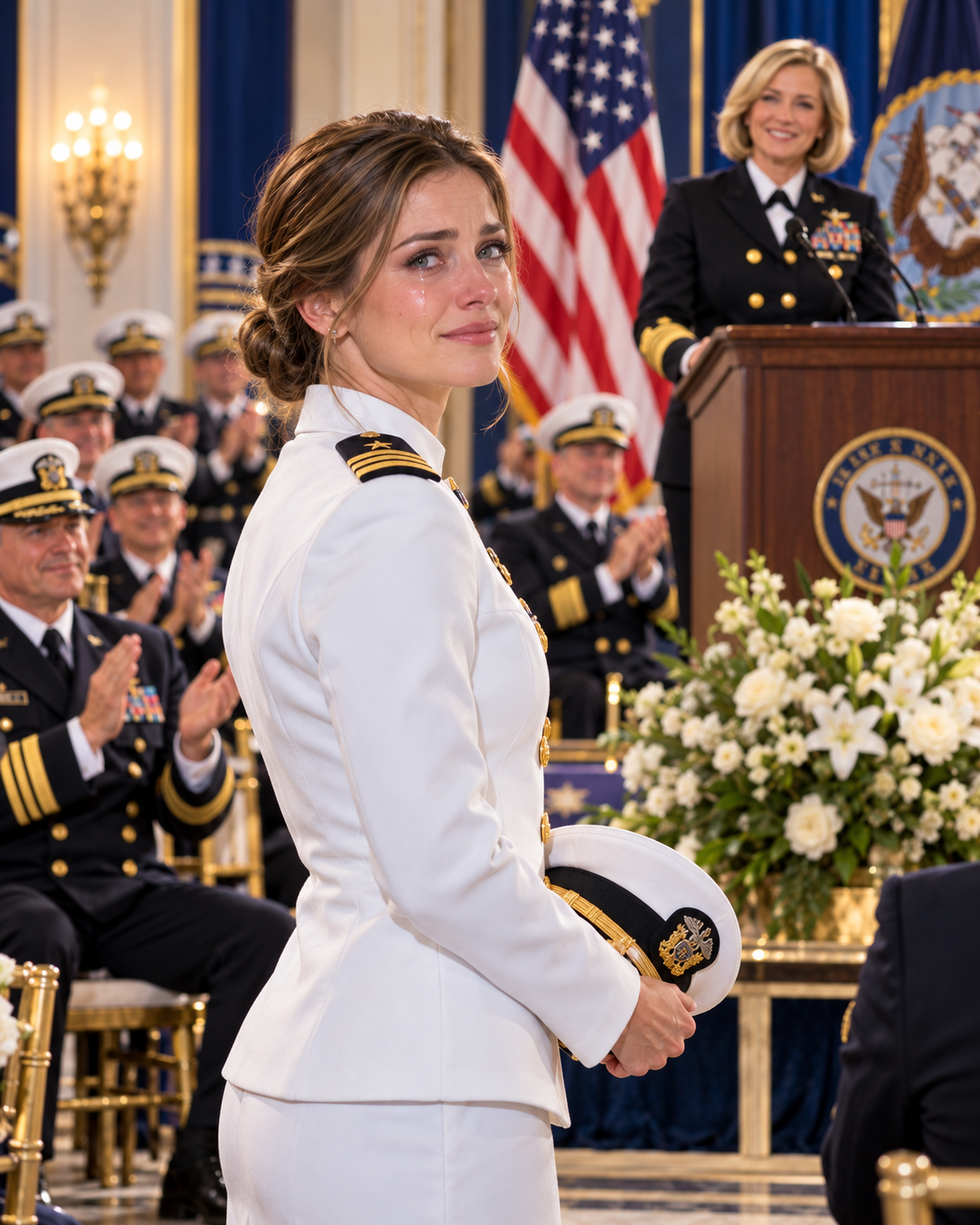
Three days later, I stood inside a Navy ceremonial hall wearing my dress uniform.
Nearly two hundred people filled the room.
Families held flowers.
Someone had brought balloons.
A little boy in a tie kept asking his mother when his dad would go onstage.
An older man in the front row was already wiping tears from his face.
Everywhere I looked, someone had come for someone.
Then I looked at my row.
Two empty seats.
Small white cards rested on them.
BEVERLY WHITAKER.
HOWARD WHITAKER.
My mother.
My father.
I told myself not to look again.
Then the back doors opened.
I looked.
Not them.
Five minutes later, they opened again.
Still not them.
Training teaches you to read a room.
Childhood teaches you something harder.
How to keep hoping long after you already know better.
Finally, Rear Admiral Elaine Mercer stepped to the podium.
I respected her enormously.
She was direct, disciplined, and never wasted words.
She spoke about the kind of service most people never see.
Late-night decisions.
Long stretches away from home.
Work that receives no headlines because success often means nothing went wrong.
Then she began announcing the names.
One by one, officers walked forward.
Families applauded.
Cameras flashed.
Then I heard:
“Commander Nora Whitaker.”
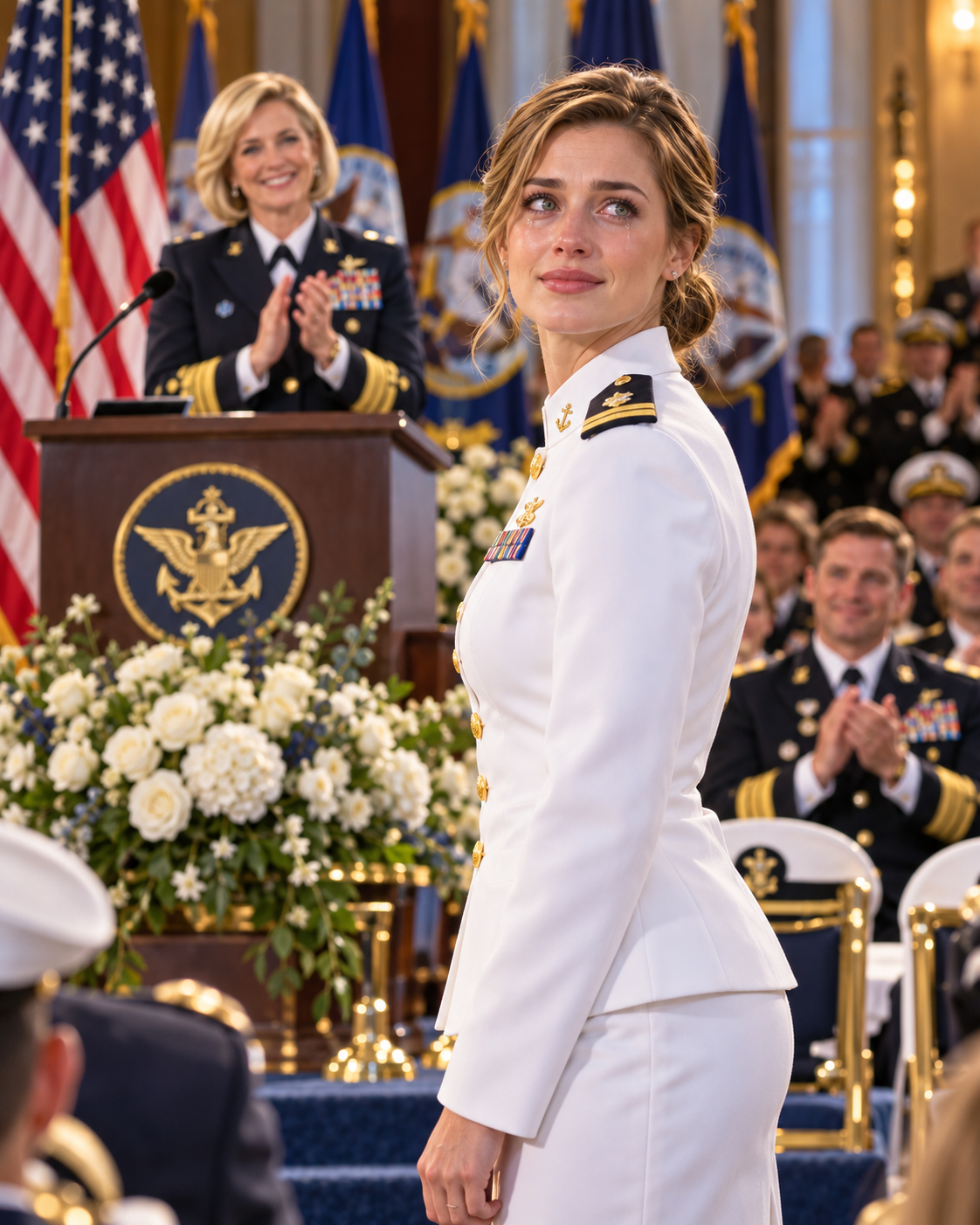
I stood.
For one second, my eyes moved back toward those two empty chairs.
Then I walked toward the stage.
Admiral Mercer shook my hand.
“Congratulations, Commander.”
“Thank you, ma’am.”
She was supposed to continue with the prepared remarks.
Instead, she looked past me.
Toward the empty seats.
Then she placed her notes on the podium.
The room became silent.
Mercer looked directly at me.
And said four words.
“Your family is here.”
I froze.
For a moment, I thought I had heard her wrong.
Then the large doors at the back of the hall opened.
Several uniformed officers walked in.
Then more followed.
Men and women I recognized immediately.
Former commanding officers.
Senior colleagues.
People I had served alongside during some of the most difficult years of my career.
A retired captain who had recommended me for my first leadership billet.
A former supervisor who had stayed with me until two in the morning after an operation went wrong.
An officer who had flown across the country for the ceremony without telling me.
Then another familiar face appeared.
And another.
They quietly filled the open space behind the final rows.
I stared at them.
Mercer leaned slightly closer.
“You didn’t think we’d let you stand up here alone, did you?”
My throat tightened.
For years, my parents had treated my career like something abstract.
Something small.
But the people walking into that room knew what the work had cost.
They knew the nights.
The missed holidays.
The mistakes I had learned from.
The responsibilities I had carried without bringing them home.
One of my former commanders raised his hand in a small salute.
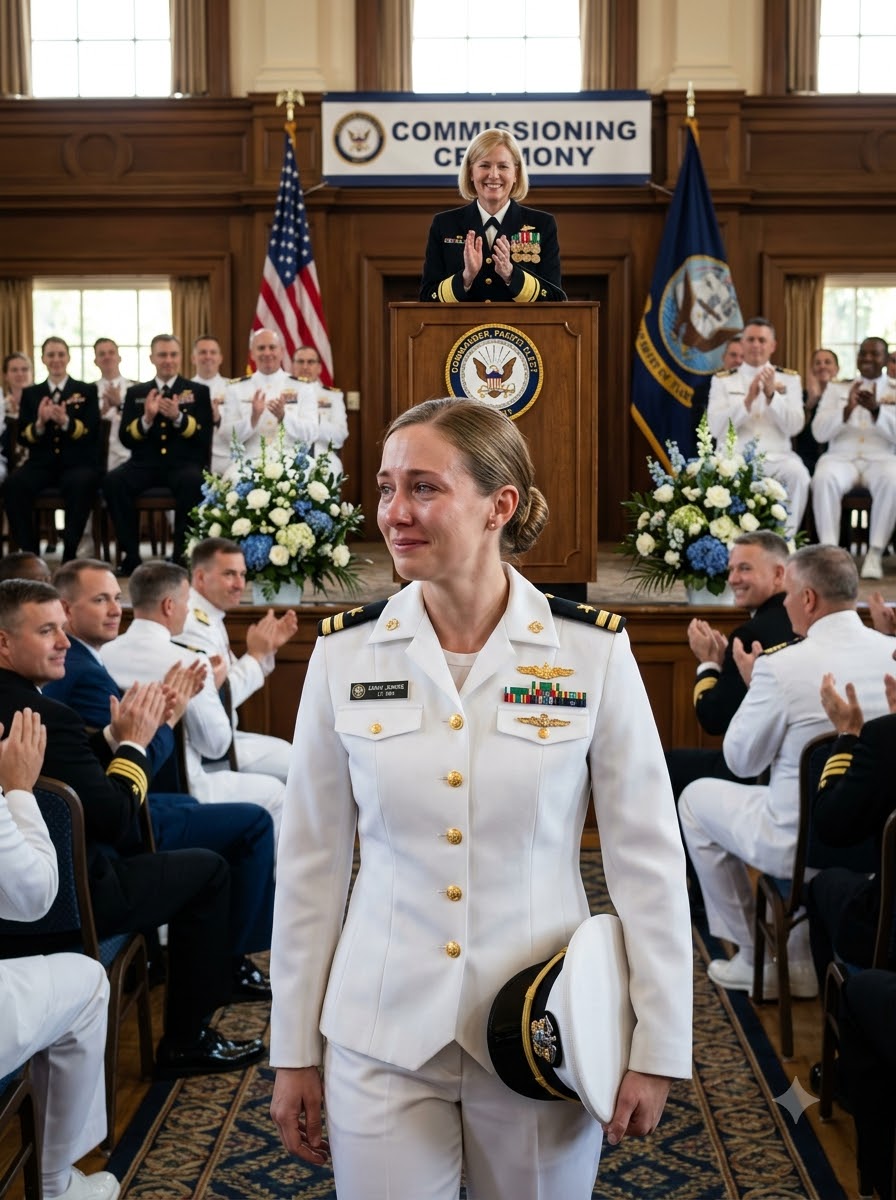
That was when the applause began.
Not loudly at first.
Then the entire room joined in.
I looked back at the two empty chairs.
For the first time that morning, they didn’t hurt.
Because behind them stood nearly twenty people who had crossed states, rearranged schedules, and walked through those doors simply because they believed I shouldn’t receive that promotion alone.
After the ceremony, Admiral Mercer handed me a small envelope.
“This came in yesterday.”
“From who?”
She smiled.
“Open it later.”
Before I could ask anything else, one of my former commanding officers approached.
He hugged me.
Then he said:
“There’s something you should know about why all of us are here.”
I looked around.
“What?”
He glanced toward Admiral Mercer.
“This wasn’t her idea.”
That surprised me.
“Then whose was it?”
He smiled.
“Someone heard your parents weren’t coming.”
My stomach tightened.
“Who?”
He didn’t answer.
Instead, he nodded toward the envelope in my hand.
“Read that first.”
I looked down at the envelope.
There was no return address.
Only my name.
NORA.
Nothing else.
My fingers suddenly felt strangely unsteady.
I opened it.
Inside was a single handwritten page.
Nora,
You once told me that leadership means showing up when someone else needs you.
Today, we decided to return the favor.
You earned this.
—A friend who remembers.
I read it twice.
Then a third time.
I knew the handwriting.
Daniel Reeves.
The retired captain who had recommended me for my first leadership billet.
I looked across the reception area.
He was standing near the far wall, watching me.
I walked toward him.
“You did this?”
He smiled.
“I made a few calls.”
“A few?”
He laughed quietly.
“Okay. Maybe more than a few.”
I looked around the room.
Nearly twenty people had come from different states.
Some had rearranged schedules.
Some had traveled for hours.
Some hadn’t seen me in years.
“You called all of them?”
Daniel shook his head.
“Not all of them.”
“Then how did they know?”
He looked toward Admiral Mercer.
“Because people talk.”
I lowered my voice.
“About me?”
“About what happened.”
My smile disappeared.
“What happened?”
Daniel hesitated.
Then he glanced toward the two empty chairs.
“Someone mentioned that your parents weren’t coming.”
I felt my stomach tighten again.
“Who?”
He looked uncomfortable.
“Your father.”
I stared at him.
“Dad?”
“He called an old friend. Someone he knew from years ago.”
“And?”
Daniel sighed.
“He complained that you expected them to drive nine hours for what he called ‘a little office promotion.’”
My face burned.
For a few seconds, I couldn’t say anything.
Daniel continued.
“That friend happened to know me.”
I looked around the room again.
Suddenly, everything made sense.
My father had tried to make my promotion sound insignificant.
Instead, his words had traveled through a community of people who knew exactly what that promotion represented.
“So you came.”
Daniel nodded.
“We came.”
I swallowed.
“Why?”
He looked at me as if the answer should have been obvious.
“Because we knew what it took to get you here.”
I looked down.
For years, I had thought my parents’ indifference meant maybe I was expecting too much.
Maybe I had made too much of my career.
Maybe everyone else saw it the way they did.
As a job.
A paycheck.
An office.
A uniform.
But standing in that room, surrounded by people who had lived pieces of those years with me, I realized something.
My parents’ opinion had never been an accurate measurement of my life.
It had only been the measurement they chose to use.
Daniel touched my shoulder.
“There’s one more thing.”
I looked at him.
“What?”
“Your mother called Admiral Mercer yesterday.”
My heart skipped.
“She did what?”
“She wanted to know whether you could bring extra guests.”
I frowned.
“Why?”
Daniel’s expression changed.
“I don’t know.”
Before I could ask anything else, my phone vibrated.
MOM.
I stared at the screen.
Daniel noticed the name.
“You going to answer?”
I almost didn’t.
Then I pressed the button.
“Hello?”
There was silence on the other end.
Then my mother’s voice.
“Who were all those people standing behind you?”
No congratulations.
No apology.
Just that.
I closed my eyes.
“They’re people I’ve served with.”
“I know that.”
Her voice sounded different.
Not angry.
Not exactly.
Something else.
“Where did they come from?”
“Different places.”
“Why were they there?”
I looked across the room.
Daniel had stepped away.
Admiral Mercer was speaking with several officers.
The room was still full of people who had shown up for me.
“Because they wanted to be there.”
My mother was quiet.
Then she said:
“Your father saw them.”
I didn’t respond.
“He said it looked like half the Navy was there.”
I almost laughed.
Instead, I asked:
“Did he regret not coming?”
Another silence.
“I don’t know.”
I waited.
Then Mom said something I had never expected to hear.
“You looked happy.”
My throat tightened.
“I was.”
She took a breath.
Then asked:
“Did you really think we weren’t proud of you?”
I stared at the empty chairs.
For years, I had assumed the answer.
But suddenly, I didn’t know.
“I thought you weren’t.”
My mother’s voice became softer.
“I don’t know how to talk about what you do.”
I said nothing.
She continued.
“Every time you told us about another assignment, I worried.”
I swallowed.
“You never acted worried.”
“I know.”
That sentence hurt in a different way.
Then she said:
“Your father doesn’t know how to say he’s proud either.”
I looked down at my uniform.
“Mom, he laughed when you called it a silly ceremony.”
“I know.”
“And you agreed.”
“I know.”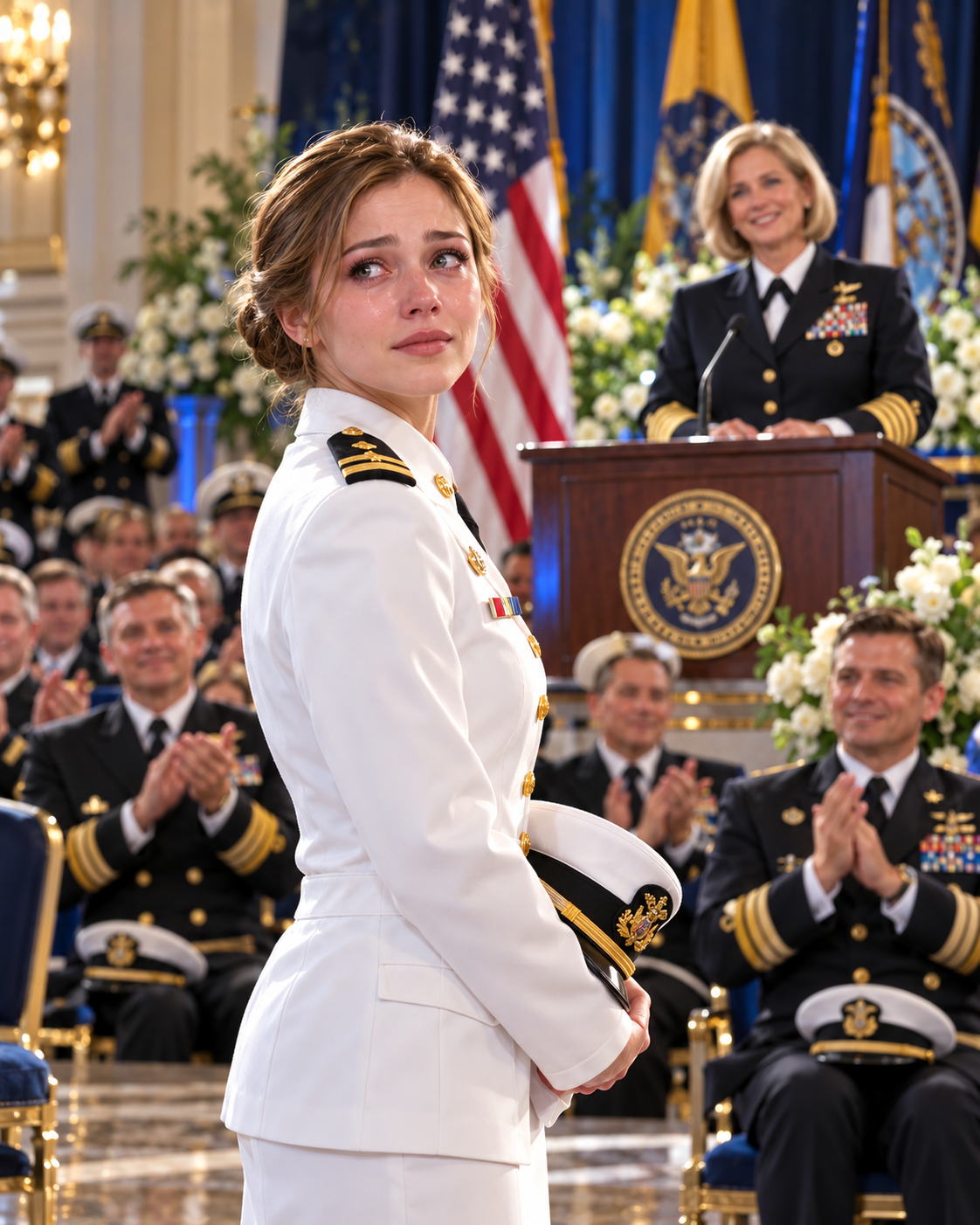
Neither of us spoke.
Finally, she said:
“We should have come.”
I closed my eyes.
There it was.
Not a dramatic apology.
Not a perfect explanation.
Just four words.
We should have come.
I felt tears gathering, and I hated that they were there.
Not because I was angry anymore.
Because some part of me had spent years waiting to hear exactly that.
“You could have,” I said.
“I know.”
Another silence.
Then:
“Can we come to dinner tomorrow?”
I almost said no.
The answer was sitting right there.
Simple.
Easy.
But I thought about the two empty chairs.
I thought about Daniel.
About Admiral Mercer.
About every person who had shown up without being asked.
Then I said:
“Yes.”
My mother exhaled.
“Okay.”
We hung up.
I remained still for several seconds.
Daniel returned.
“What happened?”
I looked at him.
“They want to have dinner.”
He smiled.
“Then go have dinner.”
I laughed quietly.
“That’s it?”
“That’s it.”
“But what am I supposed to say?”
Daniel shrugged.
“Tell them the truth.”
“What truth?”
“That the empty chairs hurt.”
My smile disappeared.
He continued.
“But don’t let them become the whole story.”
I thought about that.
Then nodded.
The next evening, I sat across from my parents at a small restaurant.
Dad looked older than I remembered.
Maybe because I was finally looking at him differently.
He didn’t mention the ceremony at first.
Neither did Mom.
We talked about ordinary things.
The weather.
The drive.
The restaurant.
Then Dad finally looked at me.
“I saw the pictures.”
I nodded.
“Daniel sent some to an old friend.”
Dad looked down.
“I didn’t know that many people cared.”
I didn’t answer.
He rubbed his hands together.
“I was wrong about the promotion.”
My chest tightened.
“You were.”
He nodded.
“I thought it was another title.”
“It isn’t.”
“I know that now.”
For a moment, I saw the father who used to watch me practice presentations at the kitchen table.
The father who had once stayed awake until I got home from school.
The father who had helped me move into my first apartment.
Somewhere along the way, he had become the man who laughed at the things that mattered most to me.
Maybe I had changed too.
“Why did you always make it sound small?” I asked.
Dad looked at me.
“I don’t know.”
That answer surprised me.
He continued.
“Maybe because I was afraid of how far away you were going.”
Mom reached across the table and placed her hand over his.
Neither of them spoke for a while.
Then Dad said:
“I should have been there.”
I nodded.
“You should have.”
He accepted that.
No argument.
No excuse.
Just a quiet acknowledgment.
Mom looked at me.
“We can’t change those years.”
“No.”
“But maybe we can stop missing the next ones.”
I looked at her.
That sentence stayed with me.
Because I knew she was right.
Forgiveness didn’t erase the empty chairs.
It didn’t rewrite the years when I had stopped sharing accomplishments because I already knew how they would respond.
But forgiveness didn’t have to erase anything.
It only had to make room for something different.
Months later, I received another envelope.
This one was from Admiral Mercer.
Inside was a photograph from the promotion ceremony.
I was standing at the front of the room.
Behind me were the people who had come for me.
And in the foreground, barely visible at the edge of the picture, were those two empty chairs.
On the back, Mercer had written:
“Remember who showed up.”
I kept that photograph.
Not because I wanted to remember who wasn’t there.
Because I wanted to remember who was.
Years later, I would still think about that morning whenever someone asked me what leadership meant.
I used to think leadership was about rank.
Authority.
Responsibility.
Being the person everyone looked toward when something went wrong.
But that day taught me something different.
Leadership was also about showing up.
Not just when it was convenient.
Not just when someone was watching.
Not just when the occasion was important enough to impress you.
You showed up because someone you cared about had reached a moment that mattered to them.
My parents eventually became part of my life again.
Not perfectly.
Not overnight.
But genuinely.
Dad came to another ceremony.
Mom attended a retirement dinner years later and cried through half of it.
And when I received another assignment, my mother didn’t ask whether I was finally going to stop moving around.
She asked when she needed to book her flight.
I laughed when she said it.
Then I hugged her.
Because sometimes people don’t change through one grand gesture.
Sometimes they change through a series of small choices.
A phone call.
A flight.
A seat filled instead of left empty.
And sometimes, the people who disappoint you at the beginning of your story aren’t necessarily the people who remain the same by the end.
But even if they never changed, I had learned something important.
Their inability to celebrate me did not make my accomplishments smaller.
Their empty chairs did not make my promotion less meaningful.
And their absence did not mean I was alone.
Because when I looked behind me that morning, nearly twenty people had already answered the question I had been quietly asking myself for years.
Did this matter?
Yes.
Did I matter?
Yes.
And had all those years been worth it?
Absolutely.
I didn’t need my parents to make the answer true.
But I was grateful they eventually learned how to say it.
And whenever I remember the moment Admiral Mercer looked at those two empty chairs and then looked back at me, I remember the words that changed the entire meaning of that day.
“Your family is here.”
She was right.
My family was there.
Not the family I had been born into.
The family built through years of shared work, trust, sacrifice, and showing up.
And for the first time in my life, I understood that sometimes family isn’t defined by who has your last name.
Sometimes it’s defined by who walks through the door when you thought nobody would.
Who stands behind you when you can’t see them.
Who crosses states just to make sure you don’t stand alone.
And who reminds you, when you have forgotten, that what you have done matters.
The two chairs my parents left empty became the smallest part of that day.
Because the room was never empty.
Not really.
It was full of people who had remembered.
People who had watched me struggle.
People who had watched me grow.
People who knew exactly what that uniform had cost.
And people who were proud enough to show up.
I kept the two white name cards from those chairs.
Not as a reminder of rejection.
As a reminder of perspective.
Sometimes an empty seat tells you who didn’t come.
But sometimes the people standing behind it tell you who did.
And those were the people I carried with me long after the ceremony ended.
The people who made sure I understood one simple truth:
You don’t measure your worth by who refuses to celebrate you.
You measure it by the life you built, the people you helped, and the people who choose to stand beside you when it matters most.
That day, I received the rank of Commander.
But the greater lesson had nothing to do with rank.
It was about belonging.
And finally understanding that I had never been standing alone.
