

CHAPTER 1: THE DIAGNOSIS AND THE DEPARTURE
The hospital room reeked of harsh bleach and the metallic tang of fear. It was a scent that never truly left my nostrils, clinging to the edges of my memory like a stubborn ghost. I was twenty-six, tangled in sterile white sheets, my body bruised and emptied by a labor that had felt more like a battlefield than a birth. In the plastic bassinet beside my bed lay Henry. He was three hours old, a tiny, fragile bundle of shallow breaths and erratic, jerking movements.
Dr. Aris Thorne, a neurologist with kind eyes but a mouth fixed in a grim, practiced line, had just left the room. Her words still lingered in the stagnant air, heavy and suffocating. Severe motor impairment. Lifelong physical therapy. Uncertainty. A different kind of life.
I remember nodding while she spoke, my mind like a television filled with static, understanding each individual word but refusing to piece them together into a reality I would have to live with. I reached out, my trembling index finger brushing Henry’s impossibly soft cheek. He didn’t turn toward my touch. He simply stared at the fluorescent lights, his tiny hands curled into tight, rigid fists.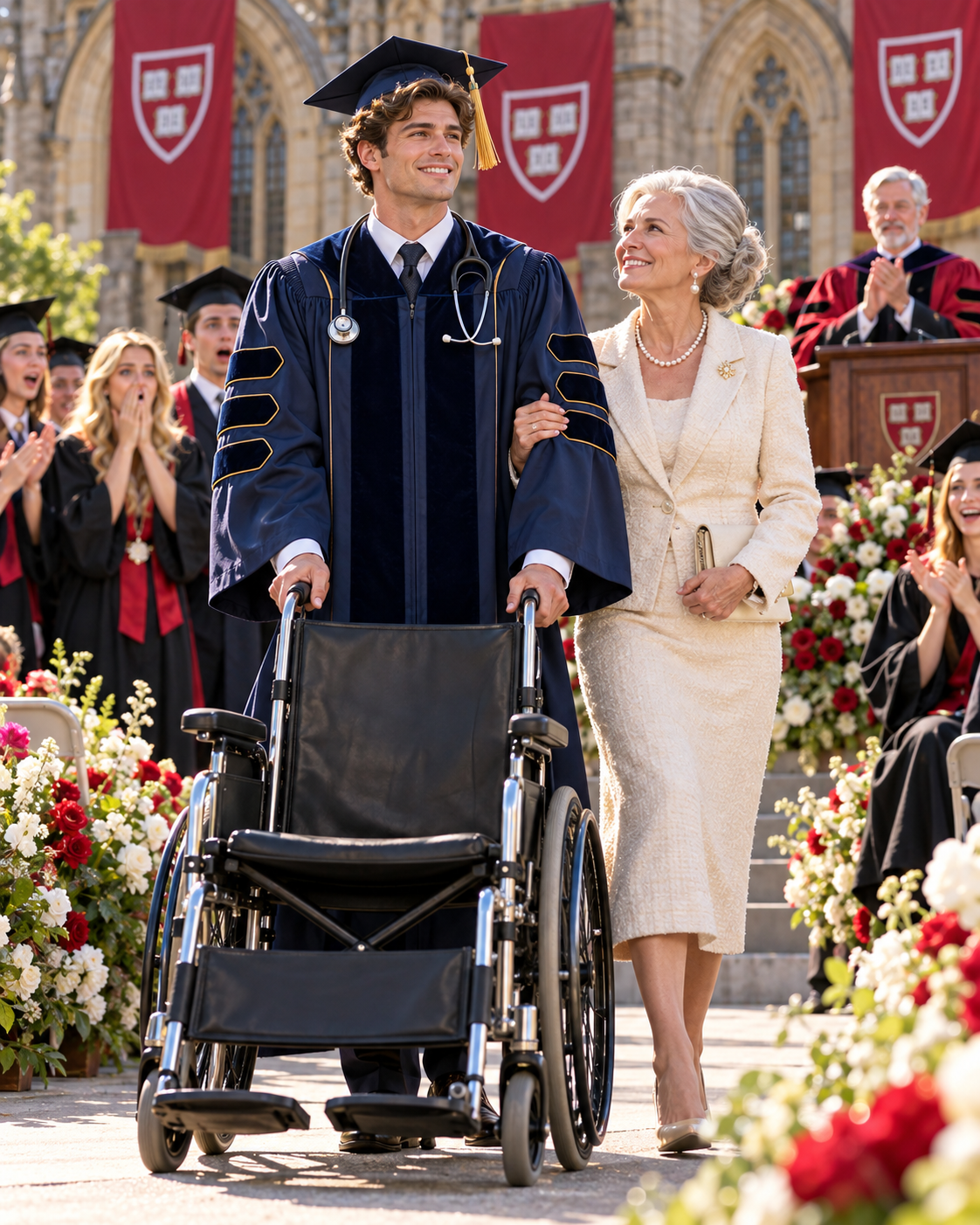
My husband, Warren, stood beside the window. The afternoon sunlight caught the crisp edge of his designer collar, highlighting the sharp, handsome profile that had once made my heart race. Now, he looked like a man trapped inside a burning building, calculating the quickest escape route.
“Warren?” I whispered, my voice cracked and dry. “Can you… can you hold him? Just for a minute. I need to get some water.”
He didn’t turn around. His broad shoulders remained tense, the fabric of his shirt stretched tight. “I can’t,” he said, the words coming out with a disturbing lack of emotion. It wasn’t anger. It wasn’t even panic. It was a cold, clinical refusal.
“What do you mean you can’t? He’s your son.”
Warren finally turned. His eyes, normally a warm hazel, were flat. He stared at the plastic bassinet not with a father’s protective instinct, but with the calculating gaze of an auditor discovering a fatal discrepancy in a ledger.
“I didn’t sign up for this, Eleanor,” he said softly.
Before I could absorb the sheer cruelty of his statement, his phone buzzed. He pulled it from his pocket, glanced at the screen, and a subtle, almost imperceptible shift softened his features. “I need to take this. I need air.”
He walked out. He didn’t slam the door. A slammed door would have meant passion, anger—something human I could fight against. Instead, the heavy oak door clicked shut with a quiet, devastating finality.
I waited. Ten minutes. Twenty. The thirst in my throat became a burning ache, but the dread gathering in my stomach was worse. Despite the pain radiating through my pelvis, I forced my legs over the edge of the bed. I needed to find him. I needed him to tell me we were going to survive this.
Leaning heavily against the cold hallway wall and dragging my IV pole behind me, I shuffled toward the waiting area. The corridor was unnervingly silent except for the rhythmic beeping of monitors from nearby rooms. As I approached the corner by the vending machines, I heard his voice. Low, soothing. The same voice he used to use with me.
“I know, baby. I’m leaving now. It’s a disaster in there.”
I froze. I pressed myself against the faded floral wallpaper, peering around the edge.
Warren wasn’t on the phone. He was standing in the alcove, his arms tightly wrapped around a woman. Her face was buried against his chest, her blonde hair falling in familiar, soft waves. It was Chloe. My college roommate. My maid of honor. My supposed best friend.
Clinging to Chloe’s leg, clutching a plastic toy dinosaur, was Liam, her perfectly healthy, robust three-year-old son from a previous marriage.
Warren pulled back slightly, cupping Chloe’s face. “I’m done here, Chloe. The kid is… it’s bad. I’m not spending the rest of my life pushing a wheelchair. I deserve a real family. We deserve it.” He looked down at Liam and ruffled the boy’s hair with a fatherly affection he had denied his own flesh and blood only moments earlier. “Let’s go home.”
My breath caught, a strangled, pathetic sound escaping my throat. Warren’s head snapped up. His eyes met mine. For a fraction of a second, I saw guilt. But it was immediately swallowed by a chilling, resolute defiance. He didn’t apologize. He didn’t release Chloe’s hand.
He simply turned his back on me and walked toward the elevators, taking my best friend and the ghost of my future with him.
I stood there, bleeding and broken, watching the elevator doors slide shut, realizing with terrifying clarity that the hardest battle of my life hadn’t been the birth. The true nightmare was only beginning.
CHAPTER 2: THE ARCHITECTURE OF SPITE
The years that followed were not the stuff of inspirational movies. There were no sweeping orchestral scores playing in the background as I wiped sweat from my forehead. There was only the grinding, relentless machinery of survival.
My life broke apart into a million exhausting responsibilities. By the time Henry was seven, I was working three jobs. I was a barista at dawn, a data entry clerk during the day, and a freelance copywriter late at night, typing furiously at the kitchen table while the steady hum of Henry’s oxygen concentrator kept time.
Henry’s mind was brilliant, terrifyingly sharp, trapped inside a body of rebellious muscles and uncooperative limbs. He couldn’t walk without heavy steel braces, and even then, every step was a battle of will against gravity. But his eyes missed nothing.
We lived in a cramped, two-bedroom apartment on the wrong side of Boston, where the heating rattled and the plumbing coughed. Across the river, in the affluent suburbs of Chestnut Hill, Warren and Chloe had built their fortress. I tried not to look, I truly did. But in the digital age, avoiding ghosts is impossible.
They appeared throughout my feed through mutual acquaintances. Warren and Chloe’s winter retreat in Aspen. Liam’s first-place trophy in the junior tennis league. Warren buying Liam a vintage Mustang for his sixteenth birthday.
They had taken the life that was supposed to be mine, erased the “burden” of my son from it, and displayed it for everyone to see. Warren had built an enormously successful real estate firm, presenting himself as the ultimate family man. The hypocrisy felt like a physical weight pressing against my chest.
One rainy Tuesday afternoon, when Henry was fifteen, we were at the free clinic waiting for a physical therapy adjustment. Henry sat in his wheelchair, a thick medical textbook resting on his knees. He was already consuming collegiate-level anatomy.
A woman sitting across from us, dressed in cashmere and overflowing with misplaced pity, leaned forward. “He’s so brave,” she whispered loudly to me, as though Henry were deaf as well as physically impaired. “It must be so hard on you. Did his father…?”
“His father is dead,” I lied smoothly, a defense mechanism sharpened over a decade.
Henry didn’t lift his eyes from the book. “He’s not dead, Mother. He’s just a coward. There’s a clinical difference.”
The woman gasped, clutching her purse, and hurried away. I sighed, rubbing my temples. “Henry, be nice.”
“I am being precise, Mother. Precision is better than nice.” He finally looked up, his dark eyes—so eerily similar to his father’s, yet completely free of his father’s weakness—locking onto mine. “I saw the article in The Globe today. Warren Vance named ‘Businessman of the Year’. They featured his ‘son’, Liam. Liam is failing basic chemistry, you know. I hacked into the school district’s server last week to check.”
My blood ran cold. “Henry, you can’t do things like that. It’s illegal. And why do you even care?”
“I don’t care about Liam. I care about the variables.” Henry carefully closed his book. “Warren Vance excised me like a tumor because he believed I was a depreciating asset. He invested in a healthy host organism—Liam. I am simply monitoring the return on his investment.”
He said it with such clinical detachment. But I saw his jaw tighten and his twisted hands grip the armrests of his chair until his knuckles turned white. He was gathering data. He was building a case.
“We don’t need them, Henry,” I said fiercely, kneeling beside his chair and taking his shaking hands in mine. “Everything we have, we built ourselves. We don’t look back.”
“I’m not looking back, Mother,” Henry replied, his voice eerily calm. “I’m looking at the anatomy of a failure. And I’m going to prove his hypothesis categorically wrong.”
That night, after Henry went to sleep, I found his notebook open on the kitchen counter. It wasn’t filled with teenage angst or doodles. Instead, it contained a meticulously drawn flowchart mapping the board of directors of Warren’s company alongside the admission requirements for the top ten medical schools in the country.
He wasn’t simply planning a career. He was planning an absolute, undeniable conquest. But the cost of that conquest was a price I wasn’t sure either of us could afford. CHAPTER 3: THE PRICE OF ADMISSION
The following seven years became a haze of caffeine, medical bills, and an obsessive, almost frightening dedication to academics. Henry didn’t merely excel in college; he dominated. He pushed professors to revise their syllabi to match his intellect, even while requiring accommodations for his physical limitations.
He refused anyone’s pity. When a well-intentioned academic advisor suggested he pursue a “less demanding” track instead of pre-med, Henry coldly recited the advisor’s own published research, identified a fundamental flaw in the methodology, and then demanded a new advisor.
He was merciless with himself. I watched him spend four hours mastering the fine motor control needed to keep a surgical scalpel steady, his hands bleeding from the strain, tears of frustration silently running down his face. I wanted to tell him to stop, to rest, but I knew my pity would have been a deeper betrayal than his father’s abandonment. So I simply bandaged his hands and poured him more coffee.
The financial pressure became a tightening noose. Even with full academic scholarships, the expense of his specialized medical equipment, custom wheelchairs, and ongoing surgeries drained me completely. I mortgaged my small life insurance policy. I sold the few pieces of jewelry my mother had left me. I was surviving on fumes, sustained only by the fierce fire burning in my son’s eyes.
Then came the spring of his senior year. The acceptance letters began arriving.
We sat at our battered kitchen table, the wood polished smooth by years of elbows and anxiety. A thick, embossed envelope rested in the center. The return address was Johns Hopkins University School of Medicine. The number one program in the world.
Henry stared at it. For once, his hands were perfectly still.
“Open it,” I whispered, my heart pounding against my ribs like a trapped bird.
With slow, deliberate movements, he slid a letter opener beneath the flap. He withdrew the heavy cream-colored paper and read it without a word. His face, normally an unreadable mask of calculation, gradually fractured. A single, ragged breath escaped his lips.
He pushed the letter toward me.
Dear Mr. Vance, It is with immense pleasure that we offer you a position…
I broke down. I threw my arms around his shoulders, burying my face against his neck and sobbing uncontrollably. The years of exhaustion, humiliation, and sheer terror of raising him alone dissolved in a tidal wave of vindication. We had done it. Against every obstacle, every cruel whisper, every closed door.
“We did it, mom,” he whispered, his voice thick. It was the first time in years he hadn’t called me ‘Mother’.
But the happiness was fragile and brief. Two days later, I was sorting through the mail when I found a sleek black envelope addressed to Henry. I hadn’t meant to pry, but the wax seal carried a crest I recognized immediately. It was the logo of Warren’s real estate conglomerate.
Henry rolled into the kitchen and noticed the envelope trembling in my hand. “I see the parasite has caught the scent of success,” he noted dryly, holding out his hand.
“Henry, don’t open it. Throw it away. It’s poison.”
“Information is never poison, Mother. Only ignorance is.” He tore it open.
Inside was a handwritten note on heavy cardstock and a cashier’s check. My eyes immediately caught the zeros. It was a check for two hundred thousand dollars. Enough to cover his entire medical school tuition and living expenses.
The note was short, written in Warren’s arrogant, sprawling handwriting.
Henry, saw the news in the alumni newsletter. Proud of you, son. Knew you had it in you. Let’s handle this tuition. Let’s talk. – Dad.
A wave of nausea hit me so violently that I had to grip the counter. “He wants to buy you,” I spat, my voice venomous. “Twenty-two years of nothing, and now he wants to buy the finished product.”
I expected Henry to tear the check into pieces. I expected righteous fury. Instead, Henry stared at the paper, a slow, terrifying smile spreading across his face. It was a predator’s smile.
“He doesn’t want to buy me,” Henry corrected softly. “He wants to buy his own redemption arc. He wants the PR of being the supportive father to the disabled genius.”
“Henry, please. I will work four jobs. I will sell my kidneys. Do not take his money.”
Henry carefully folded the check and slipped it into his breast pocket. “I am not taking his money, Mother. I am accepting his admission of guilt.” He looked at me, his eyes shining with a dark, brilliant light. “And I am going to invite him to graduation.”
I stared at my son, realizing that the boy I had protected from the world had become a man perfectly capable of destroying it. And I had no idea how far he was willing to go. CHAPTER 4: THE VIP SECTION
The next four years of medical school passed in a grueling, relentless blur. Henry flourished under the pressure, his brilliant mind racing ahead of his classmates while his physical limitations became mere footnotes beside his undeniable intellect. He chose neurology as his specialty, a form of poetic justice that neither of us failed to notice.
As graduation drew near, the media narrative began taking shape. The story was too compelling for the press to overlook: a severely disabled boy from a broken, working-class home graduating at the top of his class from the world’s most prestigious medical institution.
And, right on schedule, Warren Vance stepped into the spotlight.
It began with a flattering feature in a local business magazine, praising Warren’s “philanthropic” contributions to medical research. The article conveniently referenced his “deep pride” in his son, Henry, the incoming neurological resident.
I was furious. I called the magazine and demanded a retraction, shouting into the phone that Warren had never paid a cent in child support and hadn’t visited the hospital once in two decades. They politely ended the call. Truth doesn’t sell nearly as well as a heartwarming story about a reunited family.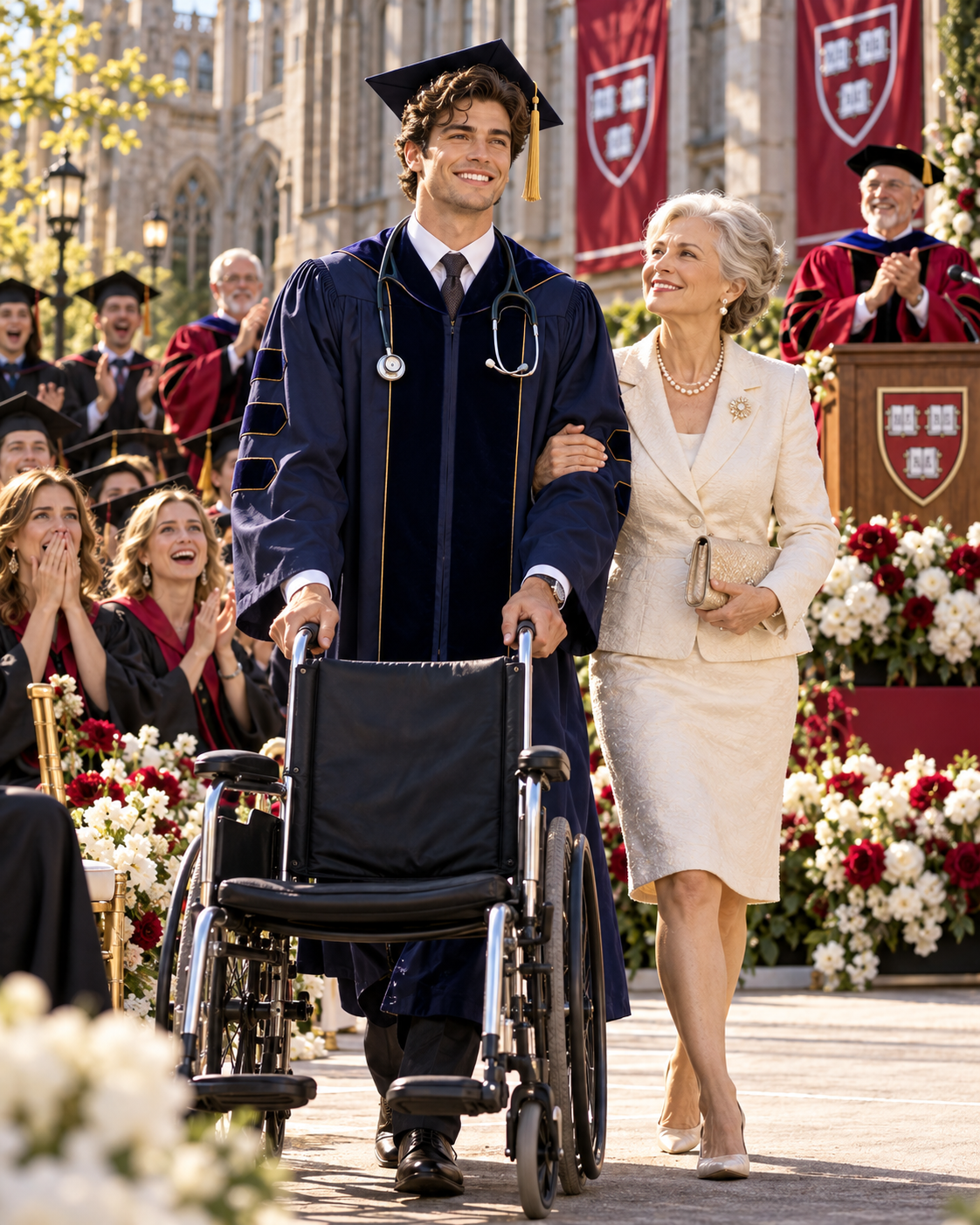
Then the invitations arrived.
“You didn’t,” I said, staring at the guest list Henry had left on the kitchen island of his cramped Baltimore apartment.
“I did,” Henry replied, straightening his tie in the mirror. He now moved with the aid of sleek, custom-built carbon fiber crutches, his upper body developed like a gymnast’s to compensate for his legs.
“Warren. Chloe. And Liam?” I read the names aloud, each syllable tasting like ash. “Henry, why? Why give them the satisfaction? Why let them taint this day? It’s our day.”
Henry turned toward me, his expression impossible to read. “They aren’t coming to celebrate, Mother. They are coming to claim ownership. Warren believes he purchased a seat at my table with that check—the check I never cashed, but which he undoubtedly told his PR team about. He needs the optics of a united family for his upcoming state senate run.”
“So you’re playing into his hands?”
“I am setting a stage,” Henry corrected. “Warren has spent twenty-six years controlling the narrative. He told the world I was a tragedy he bravely endured before finding happiness. Today, the world is watching me. The microphone is mine.”
Graduation day arrived as a chaotic symphony of black robes, tearful parents, and the oppressive humidity of late May. The grand auditorium was packed to capacity. I wore a simple navy dress I had saved for six months to afford, my hands clutching a damp tissue.
I sat in the general family section. But in the front row, enclosed by velvet ropes—the VIP section—sat Warren. He looked older and heavier, the silver in his hair carefully styled to project distinguished authority. Beside him sat Chloe, her face drawn tight by expensive cosmetic procedures, looking distinctly uneasy. And next to her was Liam.
Liam was twenty-nine now, bloated and dressed in a suit that barely concealed the lethargy of a life handed to him on a silver platter. I had heard through the grapevine that he had been fired from three of Warren’s subsidiary companies and was currently “finding himself.”
Before the ceremony began, Warren rose, turning to survey the crowd. He shook hands and accepted congratulations from senators and university donors as though he were the one receiving the medical degree. He spotted me in the upper rows.
He didn’t wave. He simply gave me a tight, patronizing nod. The nod of a king acknowledging a peasant who had tended his land.
My blood boiled. I wanted to scream. I wanted to leap over the pews and claw his eyes out. But then the orchestral music swelled, and the procession began.
When Henry’s name was announced—Dr. Henry Vance, Summa Cum Laude—the auditorium erupted. He crossed the stage, his movements slow and deliberate, relying on his crutches. Every step testified to pain and perseverance. The faculty rose. The audience rose.
Warren stood in the front row, applauding loudly, making certain the press photographer captured his profile—a perfect image of paternal pride.
Henry accepted his diploma. But instead of returning to his seat, he moved toward the podium. The Valedictorian address.
He adjusted the microphone. The room fell into a hushed, expectant silence.
“People love a good story,” Henry began, his voice echoing through the massive hall. It was a strong, steady baritone. “They see the white coat, they see the crutches, and they assume this is a narrative about overcoming adversity. They assume this is a story about my perseverance.”
He paused, his eyes moving across the crowd. Polite, encouraging murmurs followed.
Then his gaze settled on the front row. On Warren.
“But it isn’t,” Henry said softly, yet the words carried like gunshots. “If I am standing here today, holding this degree, it is not because I was born unusually strong. It is because I was born to someone who refused to let me be weak.”
The silence inside the room deepened, becoming heavy and charged.
“Twenty-six years ago, in a hospital room not far from here, a doctor delivered a grim prognosis regarding my physical capabilities,” Henry continued, his eyes never leaving Warren’s face. “The man who contributed half my DNA looked at my twisted legs, decided the return on investment was too low, and walked out the door.”
A collective, audible gasp moved through the auditorium. In the front row, Warren’s smile froze. The color drained from his face, leaving him a sickening shade of gray. Chloe shrank back into her seat, covering her mouth.
I gripped the wooden pew in front of me, my heart pounding so violently I thought my ribs would crack. He was doing it. He was executing the coup. CHAPTER 5: THE SURGICAL STRIKE
Henry didn’t raise his voice. He didn’t have to. The raw, unfiltered truth was the most devastating weapon in the room.
“He didn’t just leave,” Henry’s voice cut through the stunned silence, razor-sharp and merciless. “He left to build a ‘perfect’ family with my mother’s best friend. He took his wealth, his influence, and his name, and he bestowed it upon a healthy child he did not create, simply because that child was intact. Because that child was easy.”
He gestured vaguely toward Liam, who was now staring at his shoes, his face flushed a violent, humiliating red. The cameras that had been fixed on Henry suddenly swung toward them, flashing repeatedly as they captured Warren’s panicked, trapped expression. The VIP section had become a pillory.
“For twenty-six years, that man allowed the world to believe he was a victim of tragic circumstance,” Henry continued, his tone shifting from clinical to a quiet, burning reverence. “He allowed society to pity him for the ‘burden’ he bravely escaped.”
Henry finally turned away from Warren. He searched the upper rows, his eyes moving across the sea of faces until they found mine.
“But the burden wasn’t escaped. It was carried. It was carried by a twenty-six-year-old woman who had lost her husband, her best friend, and her financial security in a single afternoon.”
Tears clouded my vision. The faces around me disappeared. There was only Henry, standing at the pinnacle of the world, exposing the darkest corners of our history.
“My mother,” Henry said, his voice cracking just a fraction, “worked three jobs so I could have physical therapy. She skipped meals so I could buy medical textbooks. She carried me up three flights of stairs every day for ten years when the apartment elevator was broken. She absorbed the pity, the whispers, and the cruelty of a world that values perfection, and she transformed it into a shield for me.”
He leaned closer to the microphone. “So, no. This is not a proud moment for ‘both’ my parents. This moment, this degree, this life—it does not belong to the man in the front row who showed up today solely for a photo opportunity. He is nothing more than a biological technicality.”
A shocked murmur mixed with growing outrage swept across the crowd. Several prominent donors seated near Warren physically leaned away from him, their expressions becoming harder. The state senate run was disappearing before Warren’s eyes.
“This belongs entirely to Eleanor,” Henry declared, his voice carrying with absolute authority. “The woman who never missed a hard day. The woman who taught me that true strength isn’t found in a healthy body, but in an unbroken will.”
He paused. The silence inside the auditorium was absolute. The faint hum of the air conditioning was all that could be heard.
Then, more softly, speaking directly to me and ignoring the thousands of people between us: “Everything good in me, Mom, learned your name first.”
He stepped away from the podium.
For three seconds, no one moved. Then someone in the back row stood and began clapping. Another person followed. Then another. Within ten seconds, a thunderous, deafening standing ovation shook the walls. People were crying, cheering, and turning toward me with expressions of profound respect.
I looked down toward the VIP section. Warren was standing, struggling to button his jacket with trembling hands. Chloe was already power-walking up the aisle, desperate to escape the attention of the cameras. Liam followed behind her, looking completely lost.
Warren looked up, searching for Henry, but Henry had already turned his back and was slowly, deliberately leaving the stage on his crutches, surrounded by his cheering peers. Warren looked at me.
For the first time in twenty-six years, I didn’t see arrogance. I saw a man who had just been publicly stripped of everything he valued: his reputation, his facade, his legacy. He looked small. He looked pathetic.
I didn’t smile. I didn’t glare. I simply turned my head away, removing him from my line of sight, just as he had erased us decades ago.
But I knew Warren Vance. I knew the ego of a cornered narcissist. The public humiliation was total, but the private fallout was already racing toward us like a freight train.
CHAPTER 6: THE FINAL PRESCRIPTION
The reception took place in the university’s grand atrium, a sprawling glass-and-steel cathedral of academia. Henry and I were surrounded by professors, journalists, and a crowd of well-wishers. I felt lighter, as though a physical burden I hadn’t realized I was carrying had finally been lifted from my shoulders. I was getting two glasses of sparkling cider when I felt a heavy hand clamp around my elbow. The grip was painfully tight.
I spun around. It was Warren. His face was mottled red, the veins in his neck bulging against his silk collar. He smelled of scotch and expensive cologne covering sour sweat.
“You think this is funny?” he hissed, keeping his voice low but trembling with rage. He pulled me slightly away from the main thoroughfare, behind a large marble pillar. “You think you can destroy my life and just walk away?”
“Let go of me, Warren,” I said, my voice ice-cold. I didn’t retreat. I wasn’t the terrified twentysix-year-old girl in that hospital anymore.
“You put him up to this. You poisoned him against me!” Warren spat, saliva flying from his lips. “I came here in good faith! I offered to pay for everything! I gave him a chance to be part of a real family!”
“A real family?” A voice sliced through the air like a scalpel.
We both turned. Henry stood there, his crutches firmly planted against the marble floor. Two campus security guards stood behind him, watching closely, but Henry motioned them back with a subtle flick of his wrist.
“Take your hand off my mother,” Henry said. It wasn’t a request. It was a command delivered by a man completely in control of his surroundings.
Warren released my arm as though he had been burned, but immediately redirected his anger toward his son.
“You arrogant little bastard. You invited me here just to ambush me? To embarrass me?”
“I didn’t embarrass you, Warren,” Henry said, his tone completely emotionless. “I diagnosed you. I simply read your chart to the public. If the symptoms of your own behavior are embarrassing, that is a failure of your character, not my reporting.”
Warren sneered, moving closer to Henry. “You think you’re so smart. You think this piece of paper makes you better than me? Look at you. You’re broken. You’ll always be broken. You need me. You need my money, my connections to open doors for you.”
Henry didn’t flinch. He studied Warren with the detached curiosity of a scientist examining a dying microbe.
“I have the top residency in the country. I have publishers bidding on my research on neuroplasticity. The only thing I needed from you,” Henry said, his voice falling to a terrifyingly quiet register, “was the genetic material required to exist. And even that, frankly, was of substandard quality.”
Warren’s face turned purple. He lifted a hand, curling it into a fist. I gasped and stepped forward, but Henry didn’t blink. He simply stared at the raised fist.
“Do it,” Henry whispered. “Strike a disabled doctor in front of the press and the board of directors. Complete the narrative, Warren. I dare you.”
Warren’s fist trembled in the air. He looked beyond Henry, seeing the security guards tense and the cell phone cameras slowly rising from the crowd behind us. The cowardice that had defined his entire life froze him in place. Slowly, painfully, he lowered his hand.
Suddenly, Liam pushed through the crowd, looking frantic.
“Dad, we have to go. The press… they’re waiting by the car. They’re asking about the state senate run. They’re asking about the affair.”
Warren looked from Liam to Henry and finally toward me. There was nothing left in his eyes except the frantic, panicked realization of his own ruin. He had exchanged everything real for a fragile illusion, and Henry had just shattered it.
“Come on,” Warren muttered to Liam, turning away.
“Oh, and Liam?” Henry called out, stopping them in their tracks.
Liam turned, his face pale and sweating.
“When his empire crumbles, and the money dries up,” Henry said calmly, “do you honestly think he’s going to stay? A man who abandons his blood when it’s inconvenient will surely abandon a bad investment when it crashes. Good luck.”
Liam looked at Warren, a sudden, horrifying doubt appearing in his eyes. The seed of mistrust had been planted, deep and fatal.
Warren didn’t say another word. He practically dragged Liam toward the exit, disappearing into a crowd of flashing cameras and shouting reporters.
It was the last time I ever saw him.
Henry turned toward me. The cold, surgical mask he had worn for his father melted away, revealing only the exhausted, triumphant face of my son. He leaned heavily against his crutches, his shoulders slumping slightly.
“Are you okay?” I asked, reaching out to straighten his tie, my hands trembling.
He smiled, a genuine, warm smile that reached his eyes. “I’m perfectly fine, Mom. In fact, I think my prognosis is excellent.”
He offered me the arm that wasn’t supporting his weight on the crutch. I took it, looping my arm through his. Together, we stepped out from the shadows of the marble pillar and back into the brilliant, blinding light of the atrium.
We didn’t need to look back.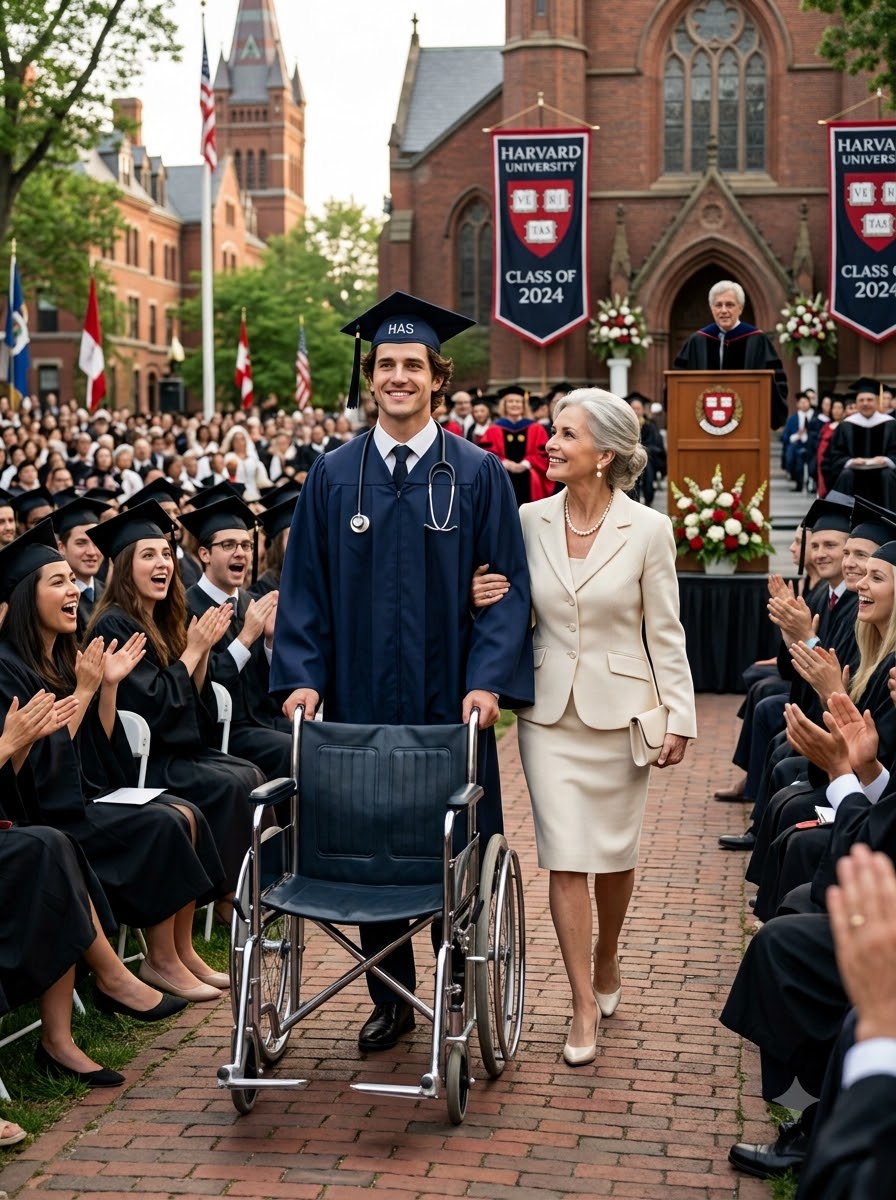
For twenty-six years, I had fought a war in the dark, believing I was fighting it alone. But as we walked into the warm spring air, surrounded by the sound of people calling his name with respect, I finally understood the truth.
I hadn’t been raising him alone. Every tear, every sacrifice, every moment of sheer, stubborn refusal to break—he had been watching. He had been learning.
And in the end, he didn’t just become a brilliant doctor. He became the exact kind of man his father never had the courage to be.
EPILOGUE
Years have a way of smoothing the jagged edges of the past.
Henry is now the Chief of Neurology at the hospital where he was born. He walks with a cane now, a sleek silver one that he carries more like a scepter than a medical device. He is married to a brilliant pediatric surgeon, and they have a daughter who runs faster than the wind and loves fiercely.
I sit in my garden in the home Henry bought for me—a beautiful, sprawling house in the exact same neighborhood where Warren used to live.
Warren’s real estate empire collapsed under the weight of scandal and bad investments shortly after graduation. He and Chloe divorced bitterly. Liam, I heard, moved to the West Coast and barely speaks to either of them.
Sometimes, I look at the old, scarred kitchen table I insisted on bringing to this new house. I trace the grooves in the wood where Henry used to press his pens so hard that the paper tore.
I remember the exhaustion, the fear, the isolation.
But mostly, I remember the quiet strength that forged us in that crucible.
They thought we were broken. They thought we were a tragedy.
But they didn’t understand that some things, when shattered, don’t turn to dust.
Sometimes, they turn into glass.
Sharp, resilient, and capable of cutting down anything that tries to stand in their way.
