

PART 1: THE THANKSGIVING THEY ASKED ME TO DISAPPEAR
Dad waited until everyone had lifted their glasses before making his announcement. Twelve people were gathered around the Thanksgiving table, and I was standing at the head of it inside the home I had paid for when he looked directly at me.
“The best Thanksgiving gift you could give this family would be to disappear from it.”
For several seconds, nobody moved. Then Jason laughed, Aunt Carol dropped her gaze toward her plate, and my stepmother Diane smiled into her wine as though she had finally gotten the ending she wanted.
What none of them appeared to remember was that Dad had not owned the house for years. Five years earlier, he had called me in tears because the bank was preparing to foreclose. Jason was buried in business debts, Diane claimed she had serious medical expenses, and Dad told me losing the family home would destroy him.
I bought the house myself, paid the remaining mortgage and back taxes, replaced the failing furnace, covered the insurance, and allowed Dad to remain there without paying rent. In return, he made me one promise.

“This will always be your home too.”
Now I stood beneath the chandelier I had paid to install, watching my family eat food purchased with money from my account while Dad told me I should leave. The irony was impossible to ignore, but I still needed to hear him confirm that he truly meant it.
“Is that really what you want?”
Diane answered before Dad had the chance.
“Don’t make this dramatic, Emily. You’ve never fit here. You’re always keeping score.”
Jason leaned back in his chair with a smug grin.
“She thinks paying a few bills makes her queen.”
I looked around the dining room and silently counted everything they reduced to “a few bills.” The roof, property taxes, insurance, repairs, and even the turkey in the center of the table were all being covered by money I provided.
Dad crossed his arms and stared at me as though I were the one ruining the evening.
“Maybe it’s time you built a life somewhere else and stopped holding things over us.”
Something inside me went completely still, but it was not heartbreak. I was no longer angry enough to argue because I had finally reached the point where I was simply finished.
“Okay.”
Jason stared at me in surprise.
“Okay?”
“You want me gone. I can respect that.”
Diane’s expression shifted for a brief moment because she had expected tears, shouting, or some emotional reaction she could later use against me. Instead, I took my plate into the kitchen, opened my phone, and started making decisions while everyone else continued talking in the dining room.
At 6:42 p.m., I texted my realtor, and six minutes later I canceled the catering reservation for our family Christmas party. At 7:03, I emailed my attorney, and soon afterward I arranged for every utility account in my name to end once the house sold.
Nobody noticed what I was doing because they were too occupied laughing and congratulating themselves. By the time the evening ended, they believed they had finally pushed me out of the family without realizing they had also pushed away the person financing the home around them.
Three days later, I accepted an all-cash offer from a couple who had been trying to purchase the property for nearly two years. Closing was scheduled for December 20, leaving everyone inside that house with far less time than they imagined.
The following Saturday, I packed everything that belonged to me before sunrise and left a single envelope on the kitchen counter. Inside was a short note containing exactly what needed to be said.
You asked me to disappear.
So I took my house with me.
Before noon, Dad had already called seventeen times, and I answered the eighteenth. The instant I heard his voice, I knew the family had finally realized that when they told me to leave, they had also told their safety net to walk out the door.
PART 2: WHAT THEY MISSED WASN’T ME
Dad’s voice erupted through the phone as soon as I answered his eighteenth call. I was sitting inside my car outside the small apartment I had just rented, watching rain streak across the windshield while he struggled to comprehend what had happened.
“What did you do?”
“I left.”
“The realtor is here!”
“Yes.”
“She says the house is under contract.”
“Yes.”
His anger turned into panic so quickly that I could hear the change in his breathing. For years, he had treated the house as though ownership were merely a technical detail that did not matter because he had lived there longer than anyone else.
“You can’t sell our home.”
“It isn’t your home, Dad. It’s mine.”
For several seconds, silence filled the line. Then Diane took the phone from him before he could respond.
“You vindictive little…”
I ended the call before she could finish.
About an hour later, Jason sent me a message threatening legal action and insisting that I had no right to force the family out without warning. I forwarded it directly to my attorney and said nothing because, for once, I had no desire to waste my energy arguing with people who had ignored the facts for years.
By Monday morning, everyone in the family knew the house had been sold. Aunt Carol called me first, but she did not ask whether I was okay or whether Dad had apologized.
Instead, she asked about Christmas.
“Where are we supposed to have dinner now?”
“There won’t be one.”
“But you already booked everything.”
“I canceled it.”
Her disappointment sounded almost offended, and that was when something painful finally became impossible to ignore. They did not miss me as a person; they missed the services attached to me.
They missed the house, the holiday dinners, the repairs, the emergency loans, and the person who solved every problem before anyone else had to feel uncomfortable. For years, I had confused being useful with being valued because the two had always seemed to arrive together. Dad came to my apartment that evening.
He appeared older than he had on Thanksgiving, but his opening words were not an apology. He stood in my small living room, staring at the boxes stacked against the walls.
“You should have warned us.”
“I asked if you meant what you said.”
He looked away.
“That was anger.”
“No. That was honesty.”
Dad lowered himself onto the edge of the chair and rubbed his hands together. Without the large dining room, familiar fireplace, and family gathered around him, he suddenly seemed far less confident.
“Where are we supposed to go?”
“You have five weeks before closing. The realtor gave you the same timeline she gave me.”
Panic spread across his face because he had apparently expected me to solve that problem too. Jason had nowhere suitable for them to stay, and Diane’s sister had already refused to let them move in.
Then Dad said the one thing he knew could still reach me.
“Your mother would be ashamed of you.”
I stared at him.
My mother had been dead for twelve years.
PART 3: THE LETTER MY MOTHER NEVER WANTED BURIED
I opened the box expecting to find old tax records or forgotten family papers. Instead, there were several account statements, a small collection of legal documents, and an envelope with my name written across the front in my mother’s handwriting.
My chest tightened the instant I saw it. Twelve years had passed since her death, but I recognized every curve of those familiar letters. Suddenly, the box felt much more significant than anything Dad had ever admitted.
Emily,
If your father ever makes you feel responsible for keeping this family together, remember that you are my daughter, not their safety net.
I read that sentence three times because it seemed to reach through every year I had spent rescuing everyone. For so long, I had convinced myself that helping Dad, Jason, and Diane was simply what a good daughter was supposed to do. Whenever something went wrong, I stepped in because refusing made me feel selfish or ungrateful.
Mom’s letter revealed an entirely different reality. She explained that even before becoming ill, she had watched Dad depend on me too heavily and feared that after she was gone, he would turn my reliability into an obligation while Jason learned to expect the same treatment.
She had recognized the pattern years before I did. The more I read, the clearer it became that the role I had accepted inside the family had never happened by accident.
You will always be generous, but generosity must remain a choice. The moment they make you feel guilty for saying no, it is no longer love asking something from you.
I sat at the kitchen table, the letter trembling slightly between my fingers, and finally understood that the guilt I had carried for years had never come from my mother. It came from the people who had learned to use her memory whenever they needed me to keep giving.
Beneath the letter, I discovered one final document that changed even more than I expected. Years before her death, Mom had opened a small investment account in my name and arranged for it to pass directly to me without Dad ever knowing about it.
The balance had grown steadily over the years, and that money eventually became part of what allowed me to save the family home when foreclosure threatened five years earlier. The house had not been preserved by Dad’s sacrifice or Jason’s help. It had been saved partly with money my mother had quietly set aside for me and partly through what I chose to do with it.
That realization completely changed the meaning of Thanksgiving. Dad had accused me of using money against the family while living in a house I had helped rescue partly because Mom had understood that one day they might depend on me too heavily.
The next morning, Dad returned to my apartment with Diane and Jason. This time, I allowed all three of them to speak without interrupting because I no longer needed to defend myself before they had finished saying what they truly believed.
Jason demanded that I cancel the sale, Diane called me selfish and vindictive, and Dad insisted that family members were supposed to forgive each other. When they finally exhausted their accusations, I placed Mom’s letter on the table between us.
Dad immediately recognized the handwriting, and the expression on his face changed before he even touched the page. For the first time since Thanksgiving, he looked less angry than afraid of what he was about to read.
“She knew. She knew exactly what this family would turn me into if I kept rescuing everyone.”
Dad picked up the letter and began reading. By the time he reached the end of the first paragraph, he slowly sat down. Jason, who always seemed to have another joke or accusation ready, suddenly had nothing to say.
For the first time in years, nobody in that room could use my mother’s memory against me without facing what she had actually wanted for me. The woman they had invoked to make me feel guilty had left behind the one message that finally gave me permission to stop.
PART 4: THE HOUSE FINALLY LEFT WITH ME
Dad continued staring at Mom’s letter long after everyone else had gone silent. Diane looked uncomfortable, Jason avoided my eyes, and for the first time since Thanksgiving, nobody tried to tell me what my mother would have wanted.
The letter had removed the one weapon they had always been able to use against me. They could still call me selfish or dramatic, but they could no longer pretend that sacrificing myself for the family had been Mom’s final wish.
Dad finally raised his eyes.
“Emily, we made mistakes. But you don’t have to sell the house.”
“I already did.”
“You can still stop it.”
“No. I can’t.”
The answer landed harder than I expected. Dad had spent years believing that every boundary I established could eventually be negotiated away with enough guilt, pressure, or family history.
This time, there was nothing left to negotiate.
The closing remained scheduled for December 20. During the following weeks, Dad and Diane began searching for an apartment, while Jason discovered that none of the people he had casually assumed would take him in were particularly eager to do so.
I stayed out of it.
For years, whenever one of them encountered a problem, I immediately started solving it before anyone else had to feel uncomfortable. Now I forced myself to let that discomfort remain exactly where it belonged.
Dad called several times during those weeks, sometimes angry and sometimes frightened. Every conversation eventually came back to the same question.
“How could you do this to us?”
I gave him the same answer each time.
“I didn’t do this to you. I stopped doing everything for you.”
The distinction mattered. On December 20, the sale officially closed exactly as scheduled. The funds reached my account that afternoon, and ownership of the house transferred to the couple who had been trying to purchase it for years.
Dad and Diane moved into a modest apartment across town. Jason went to stay with a friend after discovering that no one else was willing to finance a home for him either.
Christmas arrived five days later.
For the first time in years, I did not host dinner, purchase everyone’s gifts, organize the food, or spend half the evening solving some last-minute crisis. My family went to a restaurant instead and complained about the prices afterward.
I spent Christmas Eve with two close friends.
They brought food without needing to be asked.
One washed the dishes while the other packed away the leftovers, and nobody joked about how much I had spent or assumed I would cover everything simply because I was usually the person who could.
The evening was peaceful, almost ordinary.
That was exactly what made it feel so different.
A few weeks later, Dad sent me a letter.
I nearly left it unopened.
Then I recognized his handwriting and decided I wanted to know whether he was finally prepared to speak to me without asking for something in return.
There were no accusations inside.
No guilt.
No request for money.
Only an apology.
He wrote that losing the house had forced him to recognize how much of my adult life had revolved around rescuing everyone else. He admitted that when he told me to disappear, he had expected me to remain exactly where I had always been: useful, available, and forgiving.
I read the letter twice.
Then I put it away.
For the first time, forgiveness felt possible.
But going back to the family we had been was not.
PART 5: THE DIFFERENCE BETWEEN BEING NEEDED AND BEING LOVED
I eventually replied to Dad’s letter, but I waited before doing so. For once, I wanted my response to come from clarity instead of guilt, and I refused to let a single apology erase years of being treated like the family’s emergency fund.
I told him that I could forgive him. I also made it clear that access to my life was no longer automatic simply because we shared the same last name.
Dad did not argue.
That mattered more than I expected.
Over the following months, I decided exactly what to do with the money from the house sale. I moved part of it into savings, strengthened my retirement accounts, and used another portion to purchase a small cabin near the lake my mother had always loved.
The cabin was modest compared with the old family house, but it felt more like home than that place had in years. Nobody there expected me to prove my worth by paying bills, solving emergencies, or making myself smaller so everyone else could remain comfortable.
Dad and I spoke occasionally.
Our conversations were cautious at first, but gradually became more honest because I stopped rescuing him from every uncomfortable emotion. If he felt lonely, I listened without immediately rearranging my life, and if he had a problem, I allowed him to handle it unless he genuinely wanted my advice.
Jason took longer.
He sent me one angry message after Christmas, followed by another a few weeks later that sounded less defensive. I answered neither because I had finally learned that every relationship did not need to be repaired immediately simply because the other person was ready to talk.
Diane never apologized.
That surprised me less than it once would have.
By the following November, my life looked completely different. I invited six people to the cabin for Thanksgiving, all friends who had shown up for me in ways my family rarely had.
Everyone brought something.
One person arrived with a pie, another brought vegetables, and someone else carried in two bottles of wine. After dinner, nobody disappeared into the living room while I cleaned everything alone.
They washed the dishes.
They packed the leftovers.
They stayed because they genuinely wanted to be there.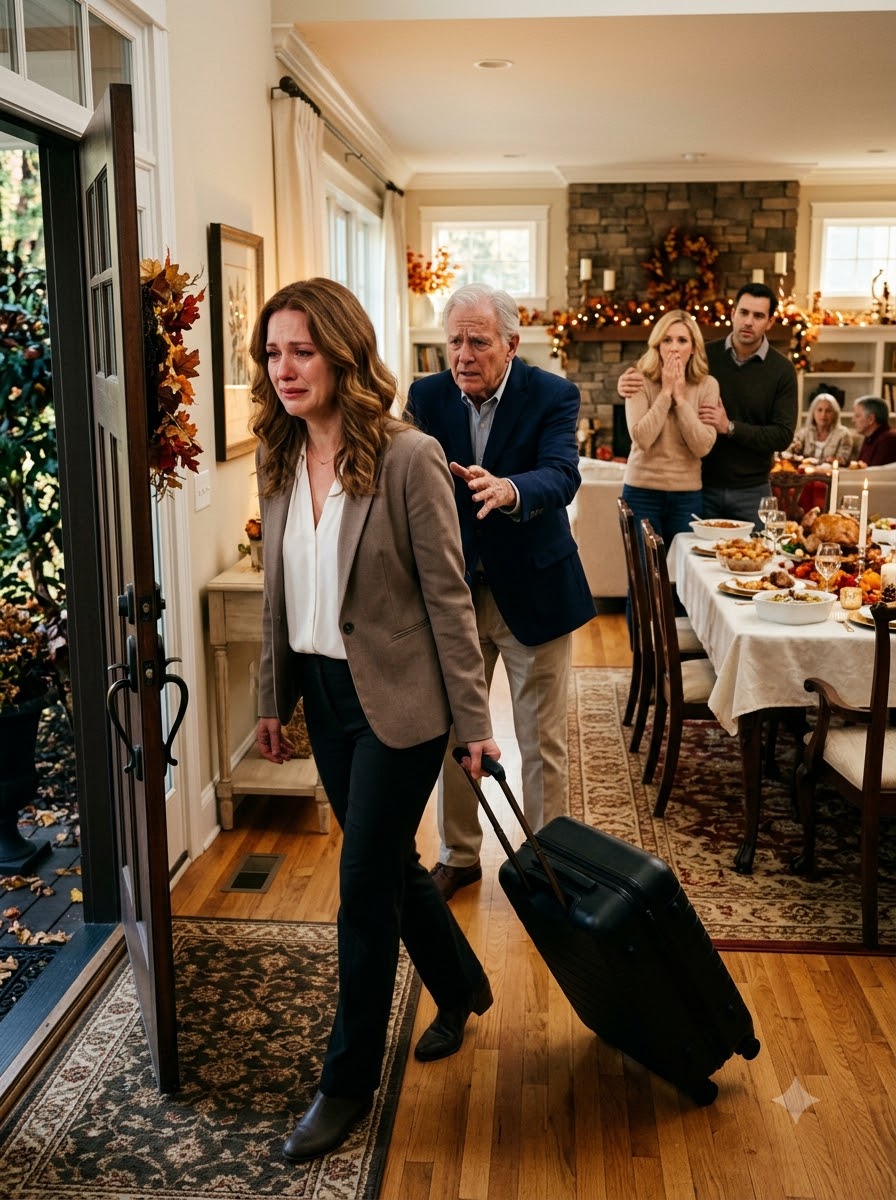
Before we ate, I looked around the table and realized how strange it felt not to be waiting for criticism. Nobody joked about what I had paid for, nobody asked me to fix anything, and nobody treated my generosity as something they were entitled to.
For years, I had believed that being needed meant being loved.
I had confused dependence with closeness because whenever my family called, there was always some problem only I could solve. The house, the dinners, the repairs, the loans, and the holidays had made me feel indispensable.
But being indispensable was not the same as being cherished.
That Thanksgiving, nobody needed my wallet.
They wanted my company.
The difference was almost painfully simple.
Later that evening, after everyone had left, I stood on the porch and watched the last light disappear behind the trees across the lake. For the first time in years, I did not feel responsible for keeping an entire family together.
I finally understood what my mother had tried to teach me.
I was allowed to love people without becoming their safety net.
And I was allowed to leave any table where my value depended on what I could provide.
