

PART 1: THE BOY WHO ANSWERED WITH SILENCE
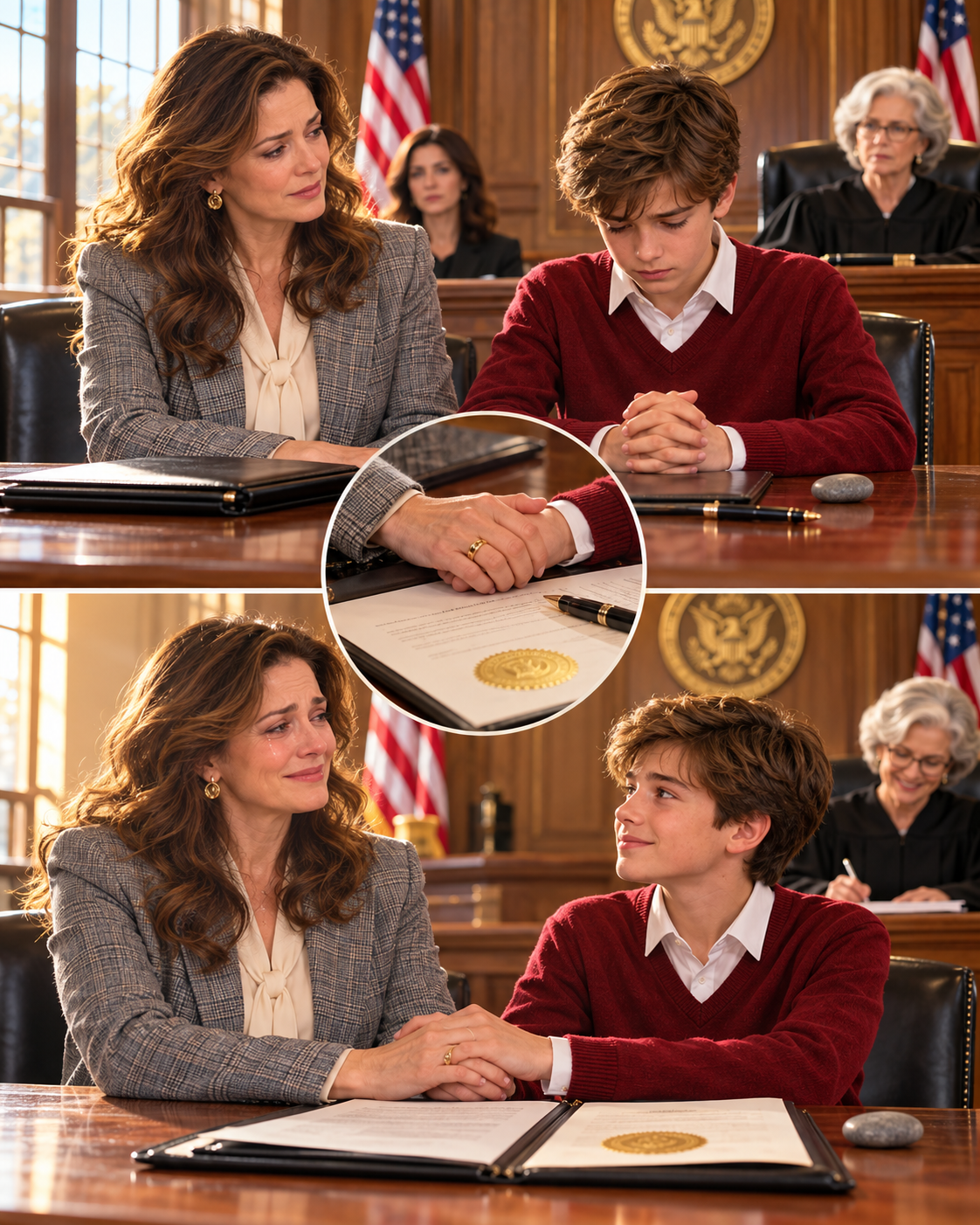
My foster son had not spoken a single word in five years.
Not to me.
Not to his teachers.
Not to doctors, therapists, caseworkers, judges, or the six foster families who had come before me.
So when a judge leaned forward in a courtroom full of strangers and asked Alan if he wanted me to become his mother, I expected what I had learned to expect from him.
A nod.
Maybe a trembling hand.
Maybe nothing at all.
Instead, my boy opened his mouth.
And the first words I ever heard from him nearly stopped my heart.
But before that morning, there had been five years of silence.
And before I understood what that silence meant, I had to learn how badly the world could punish a child simply because he refused to give adults the answer they wanted.
Alan was nine when he came to my house.
The first thing people told me about him was that he did not talk.
Not that he liked drawing.
Not that he was good at math.
Not that he could finish a puzzle faster than most adults.
Not that he hated raisins and loved blueberry waffles.
Not that he noticed when people were sad even when they smiled.
They told me about his silence.
As if silence were his whole personality.
As if it were something contagious.
As if I should be warned.
His caseworker, Karen, sat across from me in a small county office with a file open between us.
It was thick enough to make my stomach tighten.
Six placements.
Multiple evaluations.
School reports.
Behavioral reports.
Notes from therapists.
Incident summaries.
Most of them seemed to say the same thing in different language.
Alan did not respond verbally.
Alan failed to participate.
Alan refused to engage.
Alan was noncompliant.
Alan would not answer.
Alan showed limited emotional expression.
Alan’s silence continued despite intervention.
I read several pages before finally looking up.
“Does he understand people?”
Karen’s expression changed.
It was subtle, but I caught it.
Relief.
“Yes,” she said. “Absolutely.”
“Can he hear?”
“Yes.”
“Can he read?”
“Above grade level.”
“Can he write?”
“Yes.”
“Then why does everyone keep writing about him like he’s not there?”
Karen was quiet for a moment.
Then she closed the file.
“Because adults get uncomfortable when children don’t respond the way they’re supposed to.”
That was the first thing anyone said about Alan that made sense to me.
Karen told me there was no single diagnosis everyone agreed on. There had been theories. Trauma-related mutism. Severe anxiety. Selective mutism that had spread across nearly every social environment. A protective shutdown that had become more permanent with time.
Different professionals used different words.
None of them had found a way to make Alan speak.
Some had tried harder than others.
Sticker charts.
Rewards.
Consequences.
Speech exercises.
Private therapy.
Group therapy.
Promises.
Pressure.
Waiting.
One foster parent had apparently insisted he ask for dinner aloud before being served.
Another had taken away his tablet because he used it to type responses instead of speaking.
A teacher once kept him inside during recess because he would not verbally apologize after another student bumped into him and Alan pushed the boy away.
The more adults demanded speech, the more deeply Alan disappeared.
“Why did the placements end?” I asked.
Karen looked at the closed file beneath her hands.
“Different reasons.”
“That means the same reason.”
She sighed.
“Mostly, they felt they weren’t reaching him.”
I hated that sentence immediately.
Reaching him.
As if Alan had climbed into a locked tower.
As if all those adults had stood underneath throwing ropes and shouting instructions.
“What did he do?”
Karen frowned.
“What do you mean?”
“When they said they couldn’t reach him. What did he actually do?”
She opened the file again.
“Nothing dangerous. He’s never been violent beyond a few defensive incidents when people grabbed him unexpectedly. He follows routines. He does well academically when allowed to respond in writing. He keeps his room extremely organized. He doesn’t run away. He doesn’t steal. He’s never harmed himself.”
“So he was quiet.”
Karen looked at me for a long time.
“Yes.”
That was it.
Six homes had ended, at least partly, because a traumatized little boy was quiet.
I remember leaning back in my chair and staring at his photograph clipped to the inside of the file.
He looked younger than nine.
Thin face.
Brown hair that seemed like someone had combed it quickly for school picture day.
Gray-blue eyes fixed slightly to the side of the camera.
His mouth was closed.
Of course it was.
“What does he need?” I asked.
Karen answered without hesitation.
“Someone who won’t make speech the price of love.”
I don’t know if she had said that line before.
Maybe it was something from a training seminar.
Maybe another therapist had said it first.
It didn’t matter.
The sentence stayed with me.
Someone who won’t make speech the price of love.
I understood silence better than people knew.
My own life had not exploded dramatically.
There was no affair.
No screaming match.
No smashed plates.
No police at the door.
My marriage had simply died one quiet inch at a time.
Years of trying to have children.
Years of appointments.
Years of whispered conversations about treatments and money and disappointment.
Years of finding ways not to cry when friends announced pregnancies.
Then, eventually, years of not talking about it at all.
My husband, Daniel, and I became polite roommates inhabiting the ruins of something we had once thought would last forever.
By the time we divorced, we barely argued.
That almost made it worse.
There was no villain to hate.
Just grief.
He moved away.
I kept the house.
And for almost two years, every room reminded me of what had never happened there.
The second bedroom we had once painted pale yellow became a storage room.
The dining table had four chairs, though I only ever used one.
Sometimes I would come home from work, set my keys in the blue ceramic bowl by the door, and hear the hum of the refrigerator from the kitchen.
Nothing else.
The quiet felt enormous.
People assumed that was why I became a foster parent.
Maybe it was part of it.
But I had learned enough by then to know a foster child was not medicine for grief.
I wasn’t looking for someone to fill a hole.
I wasn’t looking for a substitute baby.
And when I saw Alan’s picture, I did not imagine him running into my arms and healing my life.
I looked at his careful expression and thought something much simpler.
He looks like he’s waiting for the next person to give up.
Three weeks later, he stood on my porch in the rain.
Karen was beside him.
Alan carried one worn navy duffel bag.
Everything he had apparently fit inside it.
“Hi,” I said.
His eyes went from my face to the doorway behind me.
“My name is Emily.”
Nothing.
I had prepared myself for nothing.
Still, standing there and receiving absolutely no response felt different than I had imagined.
Not rude.
Not cold.
Just closed.
I almost made the mistake every nervous adult makes around a silent child.
I almost filled the space.
Do you want to come inside?
Are you hungry?
Was the drive okay?
Do you like dogs? I don’t have one, but—
Instead, I stopped.
Then I stepped away from the doorway.
“You can come in whenever you’re ready.”
Karen looked at me.
Alan looked at the floor.
Rain tapped against the porch roof.
Five seconds passed.
Then ten.
Then Alan crossed the threshold.
I did not know it then, but that was the first time he chose me.
Not forever.
Not yet.
Just for one doorway.
His room was the old yellow room.
I had repainted it before he arrived.
Nothing childish.
Nothing that screamed, I decorated this for the child I imagined instead of the child you are.
Gray walls.
A navy comforter.
A wooden desk.
A bookshelf.
Warm lamp.
I showed him where the bathroom was and told him dinner would be ready at six.
Then I left him alone.
At six, he came downstairs.
That mattered.
I had made chicken noodle soup because it felt safe.
Warm.
Plain.
Something that did not require enthusiasm.
Alan sat across from me and ate quietly.
I had never been so aware of the sound of a spoon touching a bowl.
I resisted every urge to ask questions.
So I talked about things that required no answer.
“The heat works better upstairs than downstairs.”
Silence.
“That cabinet has glasses.”
Silence.
“If you wake up before me, you can get whatever you need.”
His spoon stopped for half a second.
Then continued.
“I leave for work at eight, but this week I’m taking you to school.”
Nothing.
When he finished, he carried his bowl to the sink.
Rinsed it.
Put it in the dishwasher.
Then went upstairs.
I sat alone at the table.
For one ridiculous moment, I wondered whether I had made a terrible mistake.
Not because he hadn’t talked.
Because I suddenly understood how easy it would be to become desperate for a sign.
A smile.
A nod.
Anything.
I could imagine myself working harder and harder to earn one.
And if I wasn’t careful, my need to know I was helping could become just another demand placed on him.
I cleared the table.
Beside my plate was a folded white napkin.
I almost threw it away.
Then I noticed something inside.
A baby carrot.
One baby carrot, wrapped carefully in the napkin.
I stared at it.
I had put carrots in the soup.
Alan had eaten everything else.
The next morning, I made oatmeal.
I added sliced banana and raisins.
Alan ate every piece of banana.
He left the raisins arranged in a neat pile along the edge of the bowl.
I looked at them.
Then at him.
“All right,” I said. “No raisins.”
His eyes lifted to mine for one second.
Then lowered again.
That single glance felt like a full sentence.
I understand you.
Or maybe:
Finally.
That was how our first conversation began.
Not with words.
With a carrot.
And a pile of raisins.
Over the following weeks, I began learning a language no one had written down.
Alan did not like people standing behind him.
So I stopped approaching his chair from the back.
He didn’t like sudden touch.
So I asked before moving close enough to brush lint from his shirt.
He preferred doors partly open during the day and closed at night.
He hated bright overhead lights after sunset.
He always checked that the front door was locked twice.
He liked his backpack hung on the second hook, never the first.
When something upset him, he aligned objects.
Pencils.
Forks.
Books.
Anything he could control when the rest of the world felt too large.
He tapped once against the table for no.
Twice for yes.
It happened so naturally that I couldn’t remember when it became a system.
“Blue shirt?”
One tap.
“Gray?”
Two.
“Toast?”
Two.
“Eggs?”
One.
“Do you want me to leave?”
Sometimes the answer took longer.
But he always answered.
And once I started listening, I realized Alan had never truly been silent.
The problem was that almost nobody had bothered learning how he spoke.
PART 2: I AM NOT IGNORING YOU
The first real fight I had over Alan happened at school.
He had been living with me for three months.
By then, our mornings had developed a rhythm.
I woke at six-thirty.
He appeared in the kitchen at six-forty-five.
He ate two blueberry waffles, one cut in half, one left whole.
I drank coffee.
He checked the weather on my phone.
If rain was expected, he placed my umbrella beside my purse.
I never asked him to.
He simply noticed things.
That morning, he seemed normal.
At least, normal for us.
He ate.
Packed his bag.
Put his empty plate in the dishwasher.
At school drop-off, he paused before closing the car door.
His hand remained on the frame.
“You okay?” I asked.
One tap against the metal.
No.
My entire body sharpened.
“Do you want to go inside?”
A pause.
Two taps.
Yes.
“Do you want me to come with you?”
One.
No.
I nodded.
“Okay.”
He closed the door and walked toward the building.
That afternoon, the school called.
His English teacher, Mrs. Crowley, wanted a meeting.
“Alan is refusing to participate,” she said.
I disliked the word immediately.
Refusing.
“What happened?”
“We had a class discussion. Every student was expected to share one answer.”
“You know Alan doesn’t speak.”
“We accommodate him extensively.”
“Then how was he supposed to answer?”
“I offered him several opportunities.”
I closed my eyes.
“What does that mean?”
“I told him he could read from his paper.”
“You told a child who does not speak that his accommodation was speaking from a piece of paper?”
There was a pause.
“I think you’re misunderstanding.”
“No. I think I’m understanding exactly.”
I was at the school forty minutes later.
Alan sat outside the principal’s office.
His backpack was between his shoes.
His shoulders were bent forward.
Smaller.
That was the word I always used in my head when adults had pushed too hard.
Smaller.
He could physically fold himself inward when he wanted to disappear.
I sat beside him.
I did not ask what happened.
After a moment, I rested my hand on the bench between us, palm up.
Not touching him.
Just there.
His eyes shifted toward it.
He did not take my hand.
But his shoulder loosened.
Inside the office, Mrs. Crowley explained that the class had been doing an exercise called “One Thing I Want You to Know.”
Students were supposed to write a sentence, then share it aloud.
Alan completed the writing.
He would not read it.
She encouraged him.
He still would not.
She waited.
The class waited.
Eventually, she told him everyone else had participated and that remaining silent was unfair to them.
That was when he tore the worksheet from his notebook, crushed it into a ball, and pushed his chair backward so hard it fell.
“And that behavior is unacceptable,” Mrs. Crowley finished.
I looked at the principal.
Then at the teacher.
“Where’s the worksheet?”
Mrs. Crowley frowned.
“The worksheet?”
“The one he wrote.”
“I don’t know. He threw it away.”
I stood.
There was a trash can near the teacher’s desk.
The crumpled paper was almost at the top.
I picked it out.
Smoothed it against the table.
The prompt at the top read:
ONE THING I WANT MY TEACHER TO KNOW ABOUT ME IS:
Beneath it, in Alan’s careful handwriting, were six words.
I am not ignoring you.
For several seconds, nobody spoke.
Then I looked at Mrs. Crowley.
“He did participate.”
She swallowed.
“Mrs. Bennett—”
“Emily.”
“I’m sorry?”
“I’m not married anymore. It’s Ms. Bennett. And he participated. You asked him to tell you something. He told you.”
“The purpose of the exercise was oral communication.”
“The purpose should have been communication.”
Her face tightened slightly.
I knew that expression.
I’d worn it myself in arguments before.
It meant a person was deciding whether being right mattered more than understanding.
“Alan cannot be exempt from every expectation,” she said.
“I agree.”
That surprised her.
I continued.
“He should do his homework. He should follow rules. He should treat people respectfully. He should clean up after himself. He should learn. He should be challenged. But speech is not a moral obligation.”
“I’m trying to help him.”
“So am I.”
“And what happens if everyone accepts this forever?”
There it was.
The fear beneath all the pressure.
Forever.
What if he never changes?
What if he never becomes easier?
I looked down at the sentence on his paper.
I am not ignoring you.
Then I said, “What happens if forcing him makes it worse?”
Nobody answered.
The school meeting eventually became less confrontational.
Plans were made.
Written responses would count.
He could use a tablet.
Teachers would not require verbal participation unless his treatment team specifically recommended it.
Most importantly, he would not be publicly pressured to speak.
On the drive home, Alan looked out the passenger window.
I wanted to tell him I was sorry.
But sometimes apologies from adults become another burden children have to comfort us for.
So I drove.
At a red light, I unfolded the worksheet.
“I read what you wrote.”
His fingers tightened around his backpack strap.
“I believe you.”
His face remained turned toward the window.
“I don’t think you’re ignoring anyone.”
The light turned green.
We drove three blocks.
Then I heard a small sound.
Tap.
I looked over.
His finger had touched the plastic door handle once.
No.
My heart sank.
“No?”
He tapped twice.
Then I understood.
No, I wasn’t wrong.
Yes, he’d heard me.
I smiled.
“Got it.”
That evening, I taped the worksheet inside a kitchen cabinet.
Not on the refrigerator.
Not somewhere visitors could see.
It was his sentence.
Not mine to display.
But I wanted to keep it.
Months passed.
Our language grew.
Alan began leaving notes.
Not emotional ones.
Practical ones.
MILK LOW.
LIGHT IN HALL FLICKERS.
NEED POSTER BOARD TUESDAY.
One morning, I found a square piece of paper beside the coffee machine.
YOU HAVE DENTIST 3:30.
I laughed so loudly he came around the corner to see what was wrong.
“I forgot.”
He looked at me.
“I completely forgot my own dentist appointment.”
His mouth twitched.
It wasn’t quite a smile.
But I saw it.
“Are you making fun of me?”
One tap.
No.
“That’s a lie.”
His mouth twitched again.
That was probably the first time I realized he had a sense of humor.
A dry one.
Quiet, obviously.
But devastating once you learned where to look.
Inside the house, Alan began changing too.
He stopped carrying his duffel bag from room to room.
For the first two months, it had stayed zipped beneath his bed.
Then beside the closet.
Then inside it.
Eventually, he unpacked everything.
I discovered this one Saturday while putting clean towels outside his door.
The navy bag was folded on the highest closet shelf.
Empty.
I stood there longer than I should have.
An empty bag shouldn’t have made me cry.
But foster care teaches you to recognize commitment in strange objects.
A toothbrush left in a cup instead of a travel case.
Shoes kicked beneath a couch.
A poster taped to a wall.
An empty duffel bag.
None of those things meant forever.
But they meant today.
Sometimes today had to be enough.
He started standing closer to me in public.
Not holding my hand.
Never that.
But at crosswalks, his shoulder would almost touch mine.
In grocery stores, he followed half a step behind.
When strangers moved too close, he shifted toward me instead of away.
He remembered things about me that I forgot about myself.
My keys belonged in the blue bowl.
Coffee filters were bought on the first Saturday of the month.
I hated grape jelly.
I sometimes rubbed my left wrist when I was nervous.
If I came home tired, Alan noticed before I said anything.
One evening, after an awful day at work, I collapsed onto the couch without taking off my shoes.
I had spent eight hours fixing another person’s mistakes and then had a forty-minute phone conversation with insurance over one of Alan’s therapy claims.
I closed my eyes.
A few minutes later, something warm settled over my legs.
I opened them.
Alan was walking away.
He had put a blanket over me.
“Thank you.”
He sat at the opposite end of the couch.
Television off.
No music.
Just us.
I looked at the space between us.
“You’re a good kid, you know that?”
His eyes stayed on the floor.
His fingers went still.
I’d learned enough by then to know I’d said too much.
So I added, lightly, “Terrible taste in breakfast food, though.”
He looked up.
I pointed toward the freezer.
“Blueberry waffles every day? Suspicious.”
His mouth twitched.
And just like that, the pressure left the room.
That was another thing Alan taught me.
Love did not always need to announce itself.
Sometimes love was knowing when to stop talking.
The moment I truly understood what he had become to me happened during my first winter with him.
I got sick.
Not dangerously sick.
The flu.
But the kind that hits so hard you wake in the middle of the night unsure what day it is.
I remember opening my eyes at around two in the morning.
My body ached.
My sheets were damp with sweat.
The room tilted when I tried to sit up.
For reasons I still can’t completely explain, fear rushed through me.
Maybe because I lived alone for so long.
Maybe because illness strips adulthood away faster than we like to admit.
I remember thinking:
There’s nobody here.
Then I saw the glass of water.
It sat on my nightstand.
Beside it were two fever tablets.
And the digital thermometer from the bathroom cabinet.
I stared at them.
My bedroom door was open.
Alan stood in the hallway.
His hair was messy.
He wore an old T-shirt and pajama pants.
“You did this?”
Two taps against the doorframe.
I swallowed.
“How did you know?”
He lifted his shoulders slightly.
Of course.
He noticed everything.
I took the medicine.
“Thank you.”
He didn’t move.
“I’m okay.”
One tap.
No.
I almost laughed.
“I will be okay.”
He remained in the doorway.
There was something in his face I had not seen before.
Not panic.
Not exactly.
Fear.
Pure, contained fear.
And suddenly I realized what being sick must mean to a child who had already lost homes.
Adults disappeared.
Placements ended.
People changed their minds.
Maybe in Alan’s world, nothing safe stayed safe for long.
I pulled the blanket higher.
“I’m not going anywhere tonight.”
His jaw tightened.
“I’m sick. That’s all.”
He watched me.
“Tomorrow I’ll probably be disgusting and complain a lot. But I’m not leaving.”
His eyes lowered.
Then he walked into my room.
Not far.
Just to the chair near the window.
He sat.
“You don’t have to stay.”
He stayed.
I slept.
When I woke at dawn, he was still there, curled awkwardly in the chair with his arms folded.
Something inside me broke open.
Not dramatically.
Not painfully.
More like a door I had kept locked without knowing it.
Love had been moving through my house for months.
Leaving carrots.
Sorting raisins.
Remembering appointments.
Fixing flickering lights.
Putting blankets across tired knees.
Setting medicine beside a sick woman’s bed.
It had simply never made a sound.
And for the first time, I understood that sound had nothing to do with whether love was real.
PART 3: THE WORD I NEVER CALLED HIM
By the time Alan turned twelve, I could identify his moods by the way he tied his shoes.
Angry meant tight knots.
Nervous meant he retied them twice.
Sad meant he sat with the laces loose until the last possible second.
Happy—
Happy meant he forgot to think about the laces at all.
Those mornings were rare.
But they existed.
The people around him changed too.
Some because they genuinely learned.
Some because I wore them down.
I became very good at saying, “No.”
No, you may not withhold something until he asks verbally.
No, you may not touch his face to make him look at you.
No, you may not surprise him with a room full of adults discussing his progress.
No, he is not being disrespectful because he doesn’t answer your greeting aloud.
No, silence does not mean he has nothing to say.
Alan’s new teachers were better.
Mrs. Crowley, to her credit, became better too.
She apologized to him.
Not to me.
To him.
She wrote it on paper because she finally understood the point.
I SHOULD HAVE LISTENED TO THE WAY YOU COMMUNICATE.
I’M SORRY I MADE YOU FEEL LIKE YOUR ANSWER DIDN’T COUNT.
Alan read the note.
Then folded it and put it in his binder.
He never wrote back.
But two weeks later, he stayed after class to help her stack books.
For Alan, that was forgiveness.
Therapy changed.
Instead of focusing every session on getting him to speak, his therapist, Dr. Patel, focused on safety, choice, and communication.
Alan wrote.
Drew.
Used scales and cards.
Sometimes he sat through an entire appointment without offering anything.
Dr. Patel did not punish him for it.
That mattered more than I can explain.
Once, after almost a year with her, Alan came out holding a card.
He gave it to me in the parking lot.
It said:
SHE DOESN’T MAKE ME TRY TO TALK.
I read it twice.
“Is that good?”
Two taps.
Yes.
I put the card in my purse.
“Then I’m glad.”
The speech itself became less important to me over time.
That surprised people.
They would ask, “Has he said anything yet?”
Usually with bright, hopeful faces.
I knew they meant well.
Still, I began resenting the question.
Anything.
As though his notes were nothing.
His laughter without sound was nothing.
His eye rolls were nothing.
His hand appearing beside mine on the kitchen counter was nothing.
His two taps were nothing.
His presence was nothing until his vocal cords participated.
“No,” I would say.
And when their faces fell, I sometimes added, “But he communicates constantly.”
People rarely knew what to do with that.
At thirteen, Alan fixed our dining table.
It had wobbled for years.
Daniel used to fold a piece of cardboard beneath one leg.
After the divorce, I left it like that.
One afternoon, I came home and found Alan lying on the floor with a screwdriver.
“What happened?”
He pointed to the table.
“It’s broken?”
One tap.
“No?”
He pointed again, annoyed this time.
I crouched.
The wobbling leg was gone.
Or rather, the wobble was gone.
He had tightened two joints and replaced a stripped screw with one from the garage.
I pushed the table.
Solid.
“You fixed it.”
He shrugged.
For some reason, my eyes filled.
Alan immediately looked alarmed.
“No. No, I’m okay.”
He stepped backward.
I laughed and wiped my face.
“This is ridiculous. I’m crying over furniture.”
His eyebrows lifted.
“I’ve been emotionally defeated by a table.”
His mouth twitched.
I touched the smooth wooden edge.
“Thank you.”
He stood there.
I wanted to say it then.
My son.
Thank you, my son.
The words rose all the way to the back of my throat.
And stopped.
Foster care teaches you terrible caution.
You learn not to say forever.
Not too early.
Not when a case could turn.
Not when a relative might appear.
Not when a court order could change.
Not when another adult could decide a child belongs somewhere else.
I had loved Alan for years by then.
But I rarely called him my son aloud.
Sometimes I thought it.
Sometimes it screamed inside me.
When he got an A in science.
When he had a fever.
When someone misunderstood him.
When he fell asleep on the couch during a movie.
My son.
My son.
My son.
But I was afraid to place the word between us.
What if it sounded like a promise I did not have legal authority to make?
What if it frightened him?
What if he had heard temporary mothers use permanent words before?
So I waited.
Then, one Tuesday afternoon, Karen called me.
Her voice sounded different.
Careful.
“Do you have a minute?”
My stomach dropped.
Those words never meant anything good in foster care.
“What happened?”
“Nothing happened.”
“Karen.”
“Emily, breathe.”
I stood in the kitchen with one hand gripping the counter.
“Tell me.”
“The permanency review happened this morning.”
I waited.
“There are no viable reunification options remaining.”
The room went strangely still.
I knew what she was saying.
But knowing and hearing are different things.
Karen continued.
“The department is prepared to support adoption.”
I sat down.
Hard.
The chair scraped against the floor.
“What?”
“If that’s something you’re still willing to consider.”
Still willing.
I looked toward the hallway.
Alan’s backpack hung from the second hook.
His sneakers were by the door.
A grocery list sat beneath a magnet.
WAFFLES.
BANANAS.
NO RAISINS.
I laughed once.
It came out like a sob.
“Still willing?”
Karen went quiet.
“Yes.”
“Of course I am.”
Then fear hit.
“What about Alan?”
“He’s old enough that his wishes will matter significantly.”
“He doesn’t speak.”
“He doesn’t have to verbally consent. He can write. His attorney can present his position. The judge may ask him questions, but accommodations can be made.”
“Does he know?”
“Not yet. I wanted to speak to you first.”
I looked toward the stairs.
My heart was beating so violently it hurt.
“What if he doesn’t want it?”
Karen’s voice softened.
“Then you’ll need to let him tell you that.”
That was the most frightening sentence anyone had ever spoken to me.
Not because I believed Alan didn’t love me.
But love and adoption were not identical.
A child could love a home and still fear permanence.
He could love me and still refuse the word mother.
He could want to stay without wanting to belong on paper.
He could have reasons he had never told me.
And if I truly meant everything I’d said about respecting his communication, I had to respect that answer too.
Even if it broke me.
That night, I made spaghetti.
Alan knew immediately something was wrong.
Of course he did.
He sat across from me without eating.
“I’m okay.”
He stared.
“Mostly.”
Still staring.
I put my fork down.
“Karen called.”
His shoulders tightened.
I hated how quickly fear moved through him at her name.
“It’s not bad.”
He waited.
“The court is considering adoption.”
He did not move.
I could hear the refrigerator humming.
“They asked whether I would want to adopt you.”
His face went unreadable.
I forced myself not to fill the silence.
Then I said, “I told them yes.”
His eyes lifted.
“If you want it.”
That mattered.
I needed him to understand that part.
“If you don’t, nothing about how I feel about you changes.”
His fingers curled beneath the table.
“You don’t have to decide tonight.”
He looked away.
“I want you here.”
His throat moved.
“I want you here whether you ever speak or not.”
His eyes returned to mine.
“I don’t want a version of you that’s easier for people.”
I didn’t realize I was crying until a tear hit my hand.
“I want you.”
Alan stood abruptly.
For one terrifying second, I thought he was leaving.
Instead, he walked to the counter where I’d placed the preliminary adoption paperwork.
He stared at the first page.
My name was printed there.
EMILY BENNETT.
His name below it.
ALAN REED.
He put his hand on the paper.
Palm flat.
Covering both names.
Then he looked at me.
I stopped breathing.
His hand remained there.
Both names beneath one palm.
He did not tap.
He did not write.
He didn’t need to.
I nodded slowly.
“Okay.”
Something softened in his face.
Then he returned to his spaghetti.
That should have been the happiest night of my life.
Instead, it was the beginning of the most frightening months Alan and I had ever shared.
Because the closer we came to becoming a legal family, the more terrified he seemed of losing it.
PART 4: WHAT IF SILENCE MEANS NO?
The adoption process was not cruel.
That almost made the tension worse.
No one stormed into our home trying to take Alan away.
No secret relative appeared.
No villain stood in court arguing that I was unfit.
It was paperwork.
Interviews.
Background checks.
Reports.
Home visits.
Legal reviews.
Questions.
Endless questions.
The ordinary machinery of a system trying to make an extraordinary decision permanent.
But permanence was exactly what frightened Alan.
At first, I didn’t recognize it.
He had always been organized.
Now he became rigid.
The pencils on his desk had to be perfectly aligned.
His books were arranged by height.
He checked the lock three times instead of two.
Then four.
He began waking before dawn.
Some mornings, I found him sitting at the kitchen table at five-thirty, fully dressed for school.
“Couldn’t sleep?”
Two taps.
Yes.
“Nightmare?”
He looked down.
No answer.
I did not press.
His appetite changed too.
Half a waffle.
Then none.
I started finding uneaten lunches in his backpack.
Dr. Patel noticed.
Karen noticed.
Everyone noticed.
And because everyone noticed, everyone began asking questions.
Which made everything worse.
The court needed documentation that Alan understood what adoption meant.
His attorney spoke with him privately.
Dr. Patel reviewed the concept.
Karen went through his rights.
Each person was kind.
Each person gave him writing options.
Still, by the time the third adult asked him whether he understood that adoption would permanently change his legal relationship with me, Alan’s hands shook so badly he couldn’t hold his pen.
I found him in his room that evening.
Pencils.
Eleven of them.
Perfectly aligned.
I sat on the floor outside his doorway.
“Too many questions?”
Two taps against the desk.
Yes.
“I’m sorry.”
He adjusted a pencil.
“Do you want me to tell them to slow down?”
Two taps.
Then, after a pause, one.
Yes.
No.
I waited.
Alan grabbed a sticky note.
He wrote:
THEY NEED TO KNOW.
“Yes.”
Another note.
IF I DON’T ANSWER RIGHT THEY MIGHT SAY NO.
My chest tightened.
“Alan.”
He stared at the paper.
“There is no right answer except your answer.”
His pencil moved.
WHAT IF THEY THINK QUIET MEANS NO?
There it was.
The fear beneath everything.
I got off the floor and sat in the chair near his desk, leaving space between us.
“Then we’ll make sure they understand.”
His jaw clenched.
“Your attorney understands.”
He wrote:
JUDGES?
“I think so.”
He looked at me sharply.
I smiled sadly.
“Okay. That wasn’t convincing.”
His mouth almost twitched.
Almost.
“I’ve never met this judge.”
Alan wrote another line.
WHAT IF SHE ASKS ME.
“Then you can write.”
WHAT IF I CAN’T.
“Then you can nod.”
WHAT IF I FREEZE.
The pencil stopped.
I wanted desperately to say:
Then I’ll answer for you.
But I couldn’t.
This was his choice.
His voice.
Even if that voice never became sound.
So I said, “Then we wait.”
He looked at me.
“As long as it takes.”
He shook his head.
I frowned.
“What?”
He wrote:
THEY DON’T WAIT FOREVER.
I couldn’t argue with that.
He knew the system better than I did.
Alan had spent years being moved by calendars, hearings, reviews, placement decisions, and adult schedules.
He knew better than any fourteen-year-old should that time could decide where you lived.
I leaned forward.
“I’m going to tell you something, and I need you to believe me even if the court takes longer than we want.”
He stared.
“You are not going to lose me because you can’t perform on command.”
His eyes filled.
Alan almost never cried.
Not the way adults expected children to cry.
Pain in him usually went still instead of spilling out.
That made the shine in his eyes unbearable.
“If the hearing gets delayed, I’m still here.”
His breathing changed.
“If they need another report, I’m still here.”
One tear escaped down his cheek.
“If you freeze completely and stare at the judge for an hour, I am still here.”
His face twisted.
I nearly reached for him.
Stopped myself.
Then Alan did something he almost never did.
He crossed the space first.
He pressed his forehead against my shoulder.
My body went rigid with surprise.
Then I slowly put one arm around him.
Not tight.
Not trapping.
Just enough.
He shook once.
Then again.
No sound.
I closed my eyes.
“I’ve got you.”
He stayed there less than a minute.
But after he pulled away, my shoulder was wet.
Neither of us mentioned it.
The final hearing was scheduled for six weeks later.
As the date approached, Alan changed again.
Not calmer.
Different.
He started spending longer periods alone in his room with the door shut.
Sometimes I saw his fingers pressed against the front of his throat.
Once, while passing the bathroom, I found him staring into the mirror with his mouth slightly open.
When he saw me, he closed it immediately.
I kept walking.
I didn’t ask.
A few nights later, I woke around midnight and went downstairs for water.
As I passed his bedroom, I heard something.
I stopped.
At first, I thought it was the bed frame creaking.
Then it came again.
A strained sound.
Low.
Broken.
Barely more than breath.
I stood outside his door, every nerve awake.
Another sound.
This one sharper.
Like someone trying to pull a word through a throat that had forgotten how.
My hand rose.
I knocked gently.
The sound stopped.
“Alan?”
Silence.
“Are you okay?”
Two taps from inside.
Yes.
I remained there.
“You don’t have to open the door.”
Nothing.
“You don’t have to do anything.”
Still nothing.
“I just wanted you to know I’m here.”
I walked away.
In the kitchen, I stood at the sink in the dark.
My hands were shaking.
I knew what I had heard.
He was trying.
Not for me.
I prayed not for me.
Not because he thought I needed it.
But what if he believed the court did?
What if every promise I’d made had been erased by the fear that a judge might interpret silence incorrectly?
The next morning, I found a note beside my coffee.
DON’T TELL THEM.
I stared at it.
Alan sat at the table.
I knew exactly what he meant.
“About last night?”
Two taps.
“Okay.”
He watched me carefully.
“I won’t.”
Some tension left his shoulders.
I sat down.
“But Alan?”
He waited.
“You don’t owe anyone words.”
His eyes lowered.
“Not me. Not the judge. Not anybody.”
His fingers pressed together beneath the table.
“If you never say a word your whole life, it will not change what you are to me.”
His eyes rose.
I came dangerously close to saying son.
Again, I stopped.
I wish now that I hadn’t.
But maybe the restraint mattered.
Maybe he needed to choose the word before I did.
The morning of the hearing arrived cold and bright.
I had barely slept.
Alan had definitely not slept.
I made waffles.
He did not eat them.
I poured coffee and forgot to drink it.
At eight-fifteen, we stood by the front door.
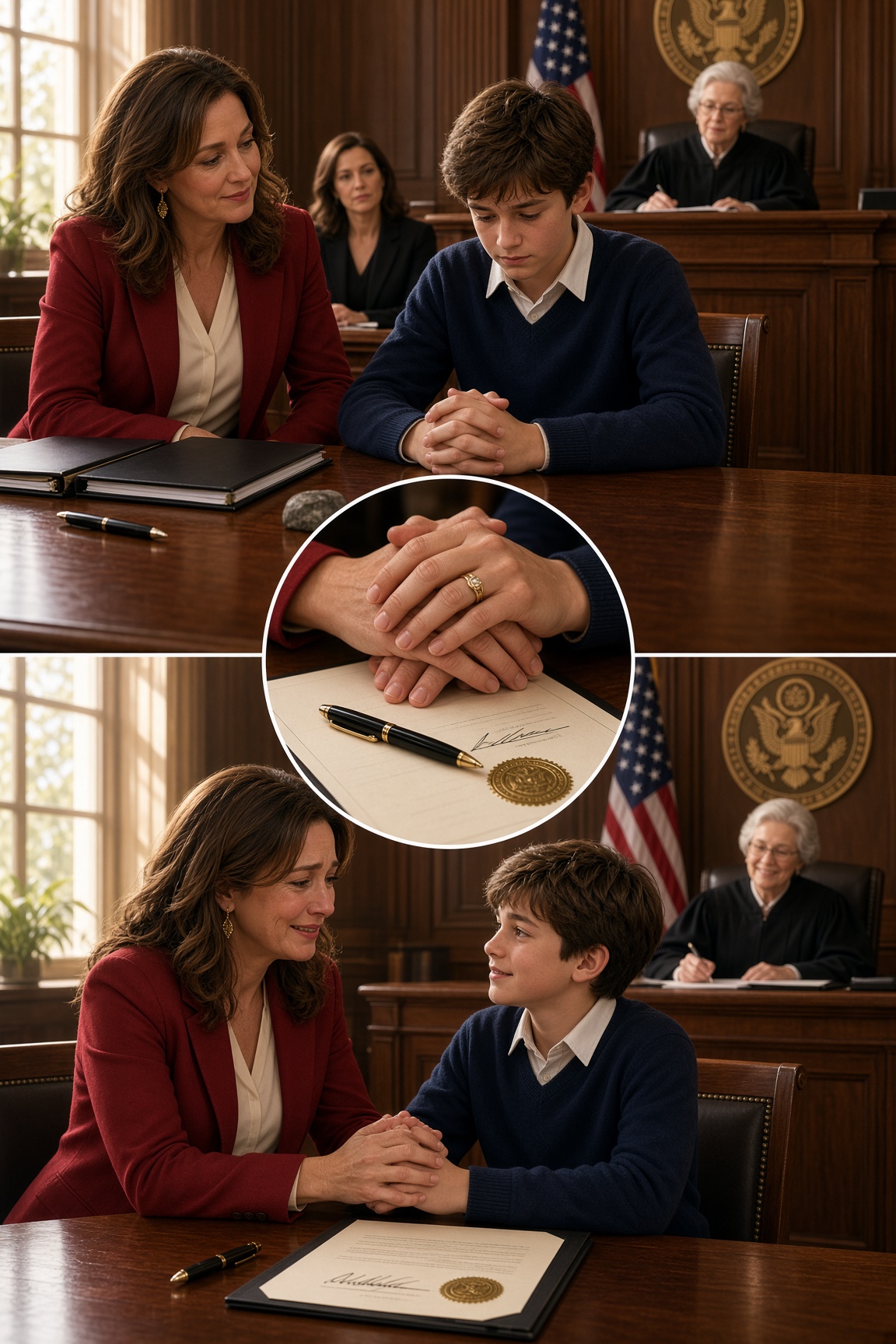
He wore dark slacks, a white shirt, and a navy sweater.
No tie.
He had tried one on the week before and hated the feeling around his throat.
I refused to make him wear it.
His hair was combed.
His hands trembled.
“You have everything?”
Two taps.
He checked his backpack anyway.
Notebook.
Pen.
Tablet.
Adoption paperwork.
A smooth gray stone Dr. Patel had given him for grounding.
I picked up my purse.
My keys were already beside it.
Alan had put them there.
Of course.
We drove to the courthouse without music.
Halfway there, I said, “We can still ask for accommodations.”
He looked out the window.
“You can write every answer.”
His hand tightened around the gray stone.
“You don’t have to prove anything.”
No response.
When we parked, neither of us moved.
The courthouse stood ahead of us.
Gray stone.
Wide steps.
Tall windows reflecting a pale winter sky.
“Scary building,” I said.
Alan looked at me.
“Very dramatic.”
His mouth twitched.
Thank God.
I smiled.
“Ready?”
He didn’t tap.
Instead, he opened the door.
We walked inside together.
PART 5: SHE ALREADY IS
The courtroom was smaller than I expected.
That made everything feel more intimate.
More exposed.
There were no television cameras.
No dramatic crowd.
Just polished wood, fluorescent lights, legal files, quiet conversations, and people who had enormous power over our lives speaking in ordinary voices.
Karen was there.
Alan’s attorney, Ms. Foster, was there.
Dr. Patel had submitted a letter but was not required to attend.
A court clerk shuffled papers near the front.
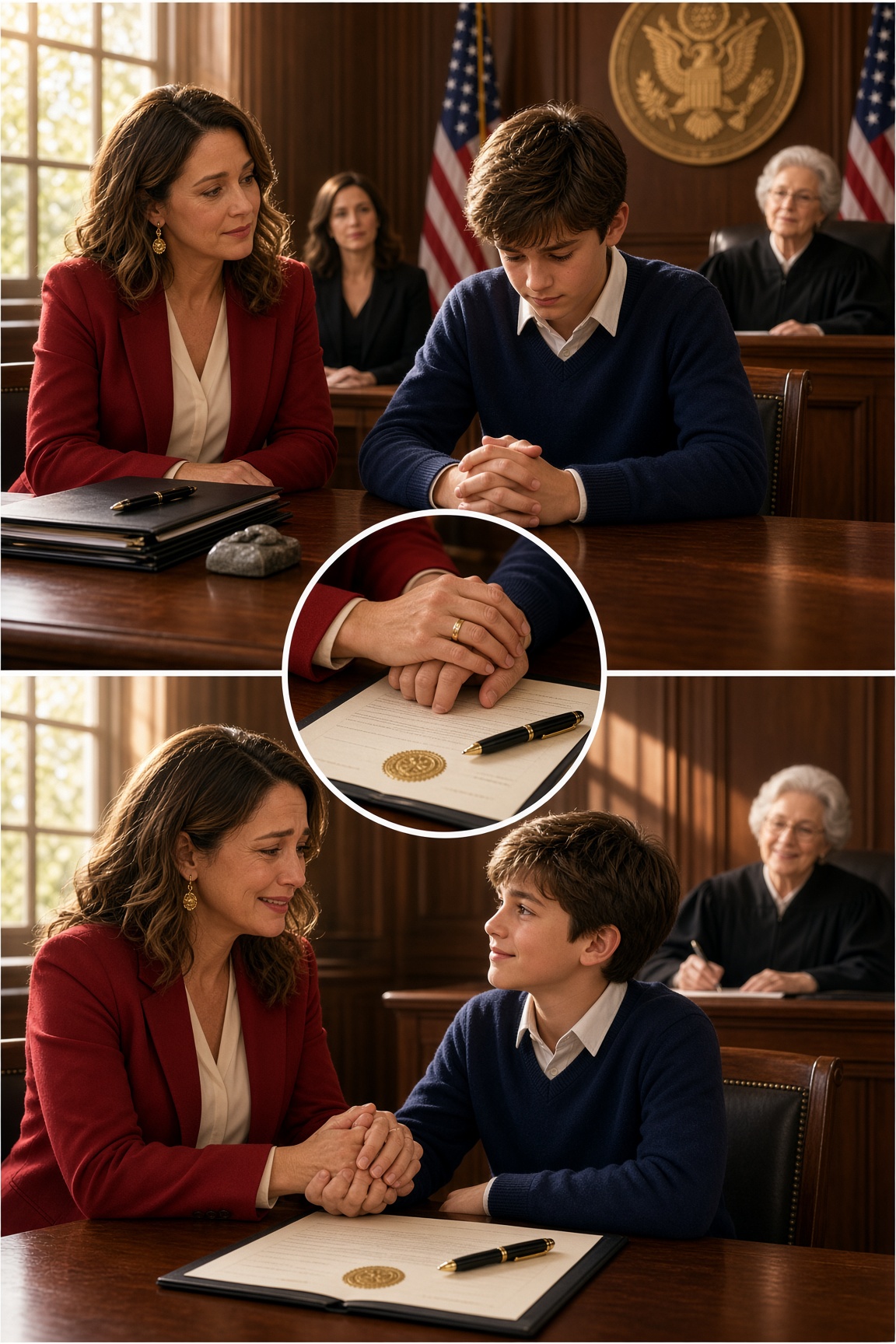
I sat beside Alan.
His knee bounced under the table.
I had seen him anxious thousands of times.
Never like this.
I wanted to take his hand.
Instead, I placed mine palm-up on my own knee.
An offer.
Nothing more.
For several minutes, he did not move.
Then his little finger touched mine.
Only the side of it.
Barely contact.
But I felt it through my entire body.
The judge entered.
We stood.
Judge Marianne Cole looked to be in her sixties.
Silver hair.
Glasses.
Calm face.
She reviewed the documents in front of her.
My name was stated.
Alan’s name was stated.
Case numbers.
Dates.
Formal language.
I answered questions.
Yes, I understood the legal responsibilities of adoption.
Yes, I understood that it was permanent.
Yes, I was willing to provide for Alan.
Yes, I wanted to become his legal parent.
Then the judge asked me something I had not expected.
“Ms. Bennett, why do you want to adopt Alan?”
I looked at him.
His eyes remained on the table.
Every prepared sentence disappeared from my head.
I could have talked about stability.
Attachment.
Family.
Commitment.
Instead, I said the truth.
“Because he’s my family.”
Alan’s finger pressed harder against mine.
I continued.
“I know that’s not the legal answer.”
The judge’s expression softened.
“It’s an acceptable answer.”
I swallowed.
“He came to me five years ago with one bag. He didn’t trust me. He had good reasons not to.”
My voice shook.
“I thought I was going to have to learn how to help him.”
I glanced at Alan.
“But mostly, he taught me how to listen.”
The courtroom was completely quiet.
“He doesn’t speak, Your Honor, but he’s never been empty. He’s funny. He’s stubborn. He’s observant. He fixes things without telling me. He remembers appointments better than I do. He hates raisins.”
Karen covered a smile.
Alan’s mouth twitched.
“He notices if I’m sick before I do. He puts my keys where they belong because apparently I’m incapable of doing that myself.”
The judge smiled.
My throat tightened.
“I don’t want to adopt him because I think I can change him. I don’t need him to become easier. I don’t need him to talk. I just want him to know that when he comes home, it’s his home. And that nobody is going to pack his things because loving him turned out to be harder than expected.”
I stopped.
Alan’s finger curled around mine.
Not my whole hand.
Just one finger.
But it was the closest thing to holding hands we had ever done.
The judge looked down for a moment.
Then she removed her glasses.
“Thank you, Ms. Bennett.”
I nodded.
My pulse hammered.
Then she turned toward Alan.
Everything inside me froze.
His attorney had explained this part.
The judge might address him directly.
He could use the tablet.
He could write.
He could nod.
He could decline.
Still, knowing something will happen does not prepare you for the moment it does.
“Alan,” Judge Cole said gently.
His head lifted.
“I understand that speaking is not how you usually communicate.”
His fingers tightened around mine.
“You don’t need to speak today.”
I felt him breathe.
“If you’d prefer to write, we’ll wait.”
She paused.
“If you would prefer to have your attorney explain your wishes, she can do that.”
Another pause.
“No one here will punish you for being quiet.”
Something changed in his face.
Not relief.
Pain.
His eyes moved briefly toward me.
Then back to the judge.
She continued.
“But because this decision concerns your life, I want to give you the opportunity to answer in whatever way feels possible.”
Alan’s chest rose.
Fell.
The judge waited.
No one rushed him.
That alone felt miraculous.
Twenty seconds passed.
Maybe thirty.
In a courtroom, thirty seconds of silence can feel like an hour.
Alan’s knee stopped bouncing.
He pulled his hand away from mine.
For one terrifying second, I thought he was shutting down.
Then he reached into his backpack.
He removed the notebook.
Opened it.
The pen shook in his hand.
Judge Cole waited.
Alan touched the pen to the paper.
Nothing happened.
His hand shook harder.
I could see panic rising in him.
His breathing became shallow.
His shoulders climbed toward his ears.
I wanted to stop everything.
I wanted to tell the judge we needed a break.
I wanted to put my body between Alan and every expectation in the room.
But before I could speak, Judge Cole said quietly, “There’s no hurry.”
Alan looked at her.
She leaned back slightly.
Not forward.
Not pressing.
“You’ve had many adults ask things of you, haven’t you?”
His throat moved.
She did not expect an answer.
“I am asking only because the law requires me to understand your wishes.”
Alan looked at the blank page.
“If you cannot answer today, that does not mean you’ve done anything wrong.”
His eyes squeezed shut.
I recognized that expression.
I’d seen it the night outside his bedroom.
The sound.
The struggle.
He was fighting something inside himself.
I whispered, “Alan.”
His eyes opened.
I should not have spoken.
I knew that immediately.
So I said the only thing that mattered.
“You don’t have to.”
He looked at me.
“You don’t owe us words.”
His eyes filled.
“We already understand each other.”
A tear slipped down his cheek.
My own vision blurred.
“Whatever happens, I’m still here.”
The judge gave us silence.
True silence.
Not the kind people use while waiting impatiently for someone to perform.
The kind that makes room.
Alan closed the notebook.
His attorney leaned slightly toward him.
“Do you want me to answer for you?” she whispered.
He shook his head.
No.
Then he put both hands flat on the table.
I saw his fingers trembling.
He inhaled.
His mouth opened.
Nothing came out.
My heart cracked.
He closed his mouth.
Breathed again.
I wanted to tell him to stop.
To protect himself.
Then I remembered the sounds from behind his bedroom door.
He had been doing this alone.
Practicing.
Trying.
Not because he owed us anything.
Because there was something he had decided he wanted to say.
Judge Cole waited.
Alan opened his mouth again.
A rough sound escaped.
Tiny.
Raw.
The kind of sound most people would have ignored.
I heard it like thunder.
My entire body went cold.
Karen’s hand flew to her mouth.
Alan swallowed.
His face twisted with effort.
And then I heard my foster son’s voice for the first time.
Thin.
Hoarse.
Frightened.
But unmistakably his.
“She…”
The word broke.
I stopped breathing.
Alan looked at me.
Five years.
Five years without a recorded word.
Five years of adults measuring him by the sound he did not make.
His lips trembled.
Then he looked back at the judge.
“She already is my mom.”
I don’t remember deciding to cry.
One moment I was sitting upright.
The next, my face was covered with my hands and tears were running between my fingers.
Someone behind me made a sound.
Karen was crying openly.
Even the court clerk had stopped moving.
But I heard almost none of it.
All I heard was Alan.
She already is my mom.
Not:
I want her to be.
Not:
Yes.
Not:
I consent.
She already is.
The legal decision hadn’t created the truth.
The truth had existed before the papers.
Before the hearing.
Before anyone gave us permission.
I lowered my hands.
Alan was staring at me.
He looked terrified.
Not of the judge.
Of me.
As if he had thrown something fragile across the room and didn’t know whether I would catch it.
I forced air into my lungs.
“Hey.”
My voice barely worked.
His eyes searched mine.
“I heard you.”
His face crumpled.
I reached my hand toward him.
Stopped before touching.
Waited.
Alan grabbed it.
Not one finger.
My entire hand.
He held on.
Hard.
Judge Cole looked down at her papers for several seconds.
I think she needed the time as much as the rest of us.
When she finally spoke, her voice was softer.
“Alan, thank you.”
He looked at her.
“You didn’t have to do that.”
His breathing was still uneven.
“But I’m honored you chose to.”
She put her glasses back on.
“For the record, I believe the young man’s wishes are clear.”
A tiny laugh moved through the room.
I cried harder.
The judge reviewed the final findings.
The words were formal again.
Best interests.
Consent.
Legal requirements.
Permanent parental relationship.
I understood almost none of them because Alan’s hand remained locked around mine.
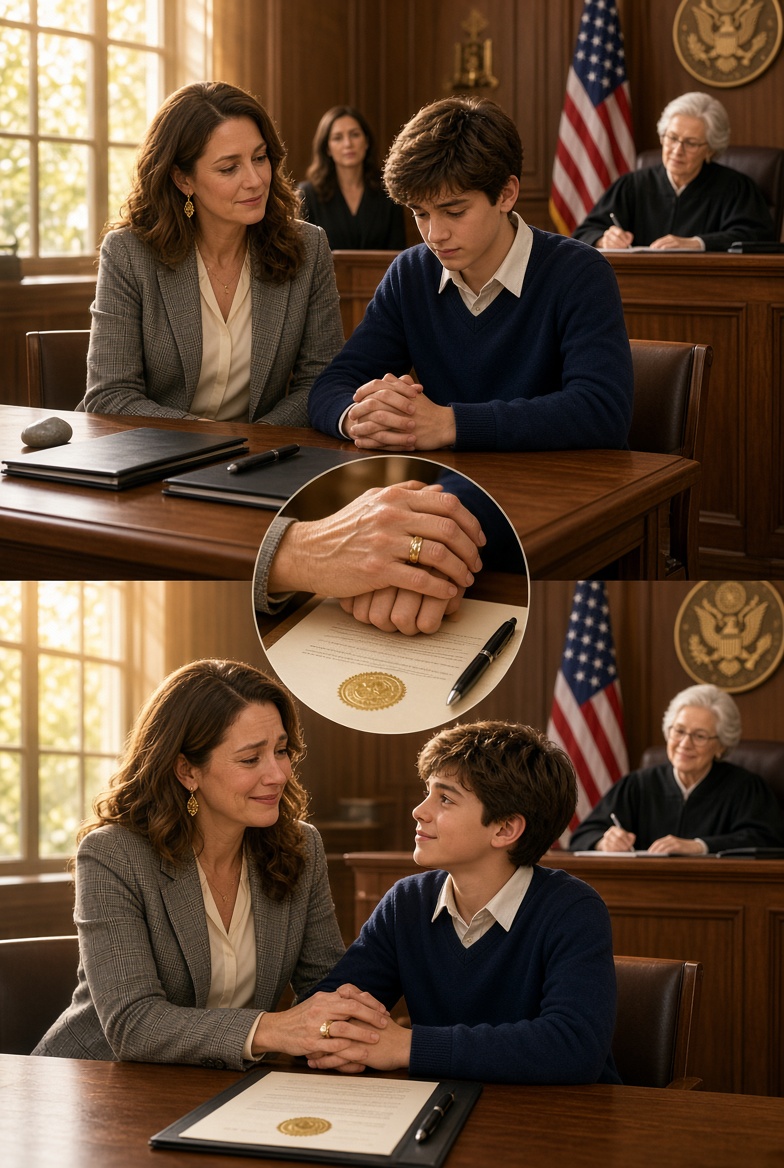
Then Judge Cole looked directly at us.
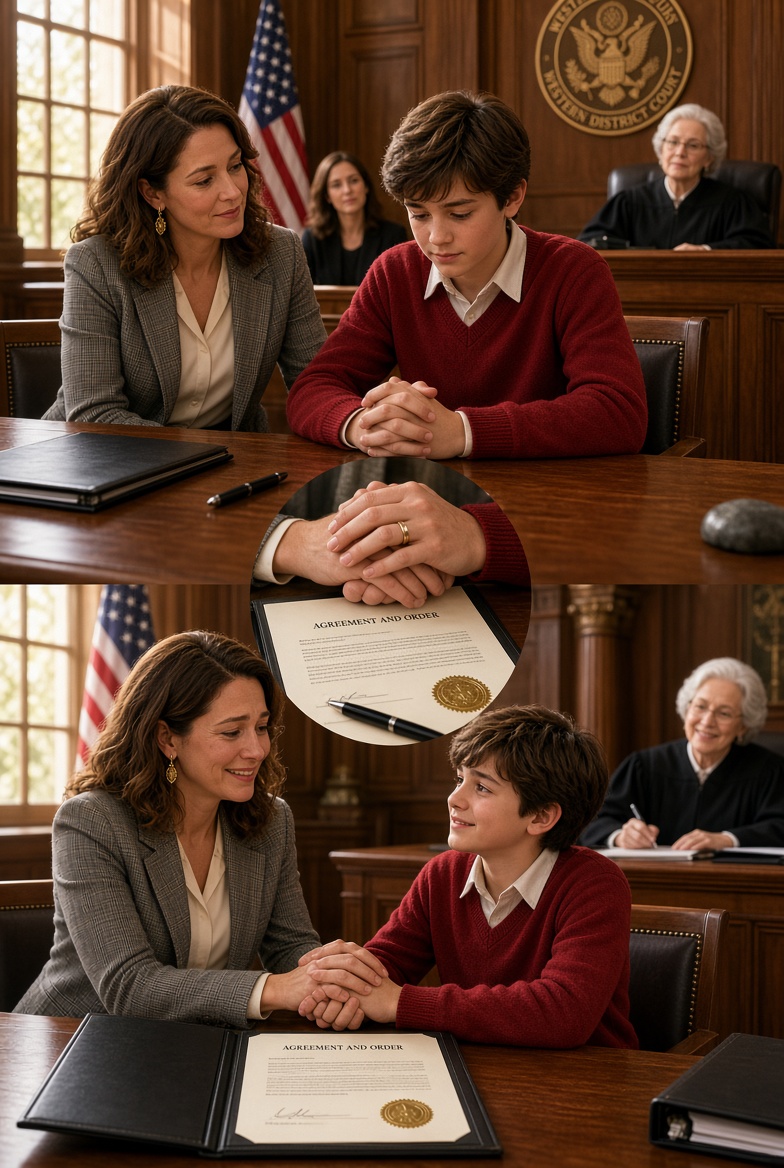
“It is the order of this court that the petition for adoption is granted.”
My heart stopped all over again.
“Effective today, Emily Bennett is recognized as Alan’s legal mother, with all rights and responsibilities arising from that relationship.”
She smiled.
“Although, based on what I’ve just heard, it appears the court may be somewhat late.”
Karen laughed through her tears.
So did I.
Alan lowered his head.
But I saw the smile.
Not a twitch.
Not almost.
A smile.
Full and trembling.
The judge signed the order.
The clerk stamped something.
People stood.
Someone handed me tissues.
Karen hugged me, then remembered herself before hugging Alan.
He surprised her by leaning in briefly.
His attorney shook his hand.
The judge asked whether we wanted a photograph.
Alan looked at me.
“Only if you want to,” I said.
Two taps against my wrist.
Yes.
We stood beside the bench.
I probably looked terrible.
My eyes were swollen.
My makeup had disappeared.
Alan’s hair had fallen over his forehead.
The judge held the adoption order.
At the last second, Alan moved closer.
His shoulder touched mine.
The camera flashed.
For years afterward, that photograph sat on our mantel.
People who saw it noticed the judge.
The document.
My ridiculous crying face.
Alan’s small smile.
But my favorite part was something almost invisible.
His hand.
At his side.
Two fingers hooked into the sleeve of my jacket.
Holding on.
Outside the courthouse, the winter air hit my face.
I laughed because I couldn’t seem to do anything else.
Alan stood beside me on the steps.
For several seconds, neither of us moved.
I wanted to hear his voice again.
The desire was immediate and fierce.
I hated myself for it.
One word could become hunger so quickly.
I reminded myself:
Speech is not the price of love.
Not even now.
Especially not now.
So I didn’t ask him to say anything.
I didn’t ask why he had chosen that moment.
I didn’t ask whether he’d been practicing.
I didn’t ask him to call me Mom again.
I simply said, “Want to go home?”
He looked at me.
Two taps against the courthouse railing.
Yes.
We started toward the car.
Halfway across the parking lot, I felt something catch my sleeve.
I stopped.
Alan stood behind me.
His mouth opened.
My heart jumped despite every promise I’d made myself.
He swallowed.
Then, in the same rough voice, he said, “Emily.”
It was strange hearing my name from him.
Beautiful.
Painful.
Five years of notes and taps suddenly existed beside a sound I’d never known.
I turned completely toward him.
“Yeah?”
His forehead creased.
He seemed frustrated.
The next word would not come.
I waited.
He tried again.
Nothing.
His breathing quickened.
I shook my head.
“You don’t have to.”
His eyes closed.
Then he reached into his backpack, pulled out his notebook, and wrote furiously.
He turned it toward me.
I HAVE BEEN TRYING FOR WEEKS.
My throat tightened.
“I know.”
His eyes widened.
“I heard you one night.”
He looked horrified.
I smiled through tears.
“I didn’t tell anybody.”
He stared at me.
“You asked me not to.”
His shoulders dropped.
He wrote again.
I THOUGHT IF I DIDN’T SAY IT THE JUDGE WOULDN’T BELIEVE ME.
There it was.
Exactly what I had feared.
I stepped closer but did not touch him.
“Alan, listen to me.”
He looked up.
“You never have to hurt yourself to prove you love me.”
His mouth tightened.
“Not ever.”
He looked down.
“And if speaking hurts or scares you, you don’t have to do it again tomorrow.”
His eyes returned to mine.
“Or next week. Or ever.”
He wrote:
BUT I WANT TO SOMETIMES.
I read the sentence.
Then looked at him.
“Okay.”
His brow furrowed, like he expected something larger.
I laughed softly.
“That’s it. Okay.”
I pointed to his notebook.
“You can talk this way.”
Then to his mouth.
“Or that way.”
Then I tapped twice on the railing.
“Or this way.”
For the first time in five years of knowing his history, I saw Alan laugh.
Not loudly.
There was barely any sound.
But there was breath in it.
A broken little exhale that belonged entirely to joy.
I laughed too.
On the drive home, we stopped for lunch.
The waitress asked what he wanted to drink.
Her pen hovered over the pad.
Alan froze.
I watched him.
The old moment.
The old pressure.
A stranger waiting.
A question requiring an answer.
I opened my mouth to help.
Alan held up one finger.
Wait.
I stopped.
He swallowed.
His lips parted.
No sound came.
The waitress looked confused.
I saw panic begin to rise in his eyes.
Then Alan picked up the paper menu and pointed to the word LEMONADE.
The waitress smiled.
“Lemonade. Got it.”
And walked away.
Alan looked at me.
I grinned.
“Worked perfectly.”
His shoulders relaxed.
That moment mattered almost as much as the courtroom.
Because speaking once did not magically cure him.
There was no miracle transformation.
Alan did not leave court chattering.
He did not suddenly become the version of himself everyone had spent years demanding.
Some days he spoke.
One word.
Two.
Occasionally a short sentence.
Other days, nothing.
After especially difficult weeks, he sometimes went completely silent again.
And we returned to notes.
Taps.
Looks.
Carrots, metaphorically speaking.
The difference was that now, speaking belonged to him.
It wasn’t something adults extracted.
It was something he could choose.
Three months after the adoption, I was cooking dinner when I burned the garlic bread.
Badly.
Smoke filled the kitchen.
The detector screamed.
I stood beneath it waving a dish towel like an idiot.
Alan appeared in the doorway.
He stared at me.
“Don’t,” I warned.
His shoulders shook.
“Do not judge me.”
He covered his mouth.
“Alan.”
Then a sound escaped.
A laugh.
A real one.
Rough but unmistakable.
I pointed the towel at him.
“This is your dinner too.”
He laughed harder.
And then, between breaths, he said, “Terrible.”
I froze.
He froze.
Then I narrowed my eyes.
“Did you just insult my cooking?”
His face changed.
For half a second, I thought he regretted speaking.
So I gasped dramatically.
“My own child.”
He stared.
“Betrayed in my own kitchen.”
His mouth opened.
“Burned.”
I stared at him.
“The bread is slightly overdone.”
He shook his head.
“Burned.”
I put one hand over my heart.
“This adoption was a mistake.”
The instant the words left my mouth, I knew I had made one.
Alan went completely still.
The smile disappeared.
My stomach dropped.
“No.”
I put the towel down immediately.
“Alan, no.”
His eyes went blank in the old way.
I moved slowly.
“I was joking.”
He stared at the floor.
“Bad joke.”
Silence.
“I am sorry.”
His breathing was shallow.
I stayed where I was.
“I will never joke about sending you away again.”
Nothing.
“That wasn’t funny.”
I waited.
“I was wrong.”
His fingers began moving.
Counting against his palm.
I wanted to touch him.
I didn’t.
Minutes passed.
The smoke detector had stopped.
The ruined garlic bread sat blackened on the counter.
Finally Alan went to the drawer, pulled out a sticky note, and wrote:
YOU SAID ADOPTION CAN’T END.
My eyes burned.
“That’s right.”
He looked at me.
“It can’t.”
His pencil remained in his hand.
“I’m your mother when I burn dinner.”
A tiny twitch.
“I’m your mother when you’re mad at me.”
His shoulders lowered slightly.
“I’m your mother when you don’t talk.”
Another fraction.
“And I’m your mother when you call my bread terrible.”
His eyes lifted.
I smiled.
“Which was rude, by the way.”
He stared at me.
Then wrote:
IT WAS BURNED.
I laughed.
“Okay. Fair.”
That note stayed on our refrigerator for years.
IT WAS BURNED.
People thought it was funny.
They didn’t know it was evidence.
Evidence that trust is not one grand courtroom moment.
It is built afterward.
Again and again.
Especially after mistakes.
Alan was sixteen when he first called me Mom without a judge asking him anything.
It happened on a completely ordinary Thursday.
That’s why I remember it so clearly.
No courtroom.
No adoption papers.
No audience.
I was standing in the laundry room trying to untangle a fitted sheet from the dryer.
Alan was upstairs.
I heard footsteps.
Then his voice.
Still quiet.
Still slightly rough even after two years of occasional speech.
“Mom?”
I stopped moving.
I had heard him say my name by then.
Yes.
No.
Okay.
School.
Hungry.
A growing collection of words, all given carefully.
But not Mom.
Not since the courtroom.
I had never asked.
I turned.
He stood at the bottom of the stairs.
His backpack hung from one shoulder.
I must have looked ridiculous because he frowned.
I realized I still had half the fitted sheet wrapped around my arm.
“Yeah?”
He lifted a permission form.
“Need this.”
That was all.
He crossed the room.
Handed me a form.
Needed a signature for a school trip.
Ordinary.
Completely ordinary.
I stared at the paper.
Alan stared at me.
“What?”
I laughed.
“Nothing.”
He narrowed his eyes.
I found a pen.
Signed.
Handed it back.
Then, because I knew him, because I knew what pressure could do, because I knew love sometimes meant pretending your heart had not just exploded—
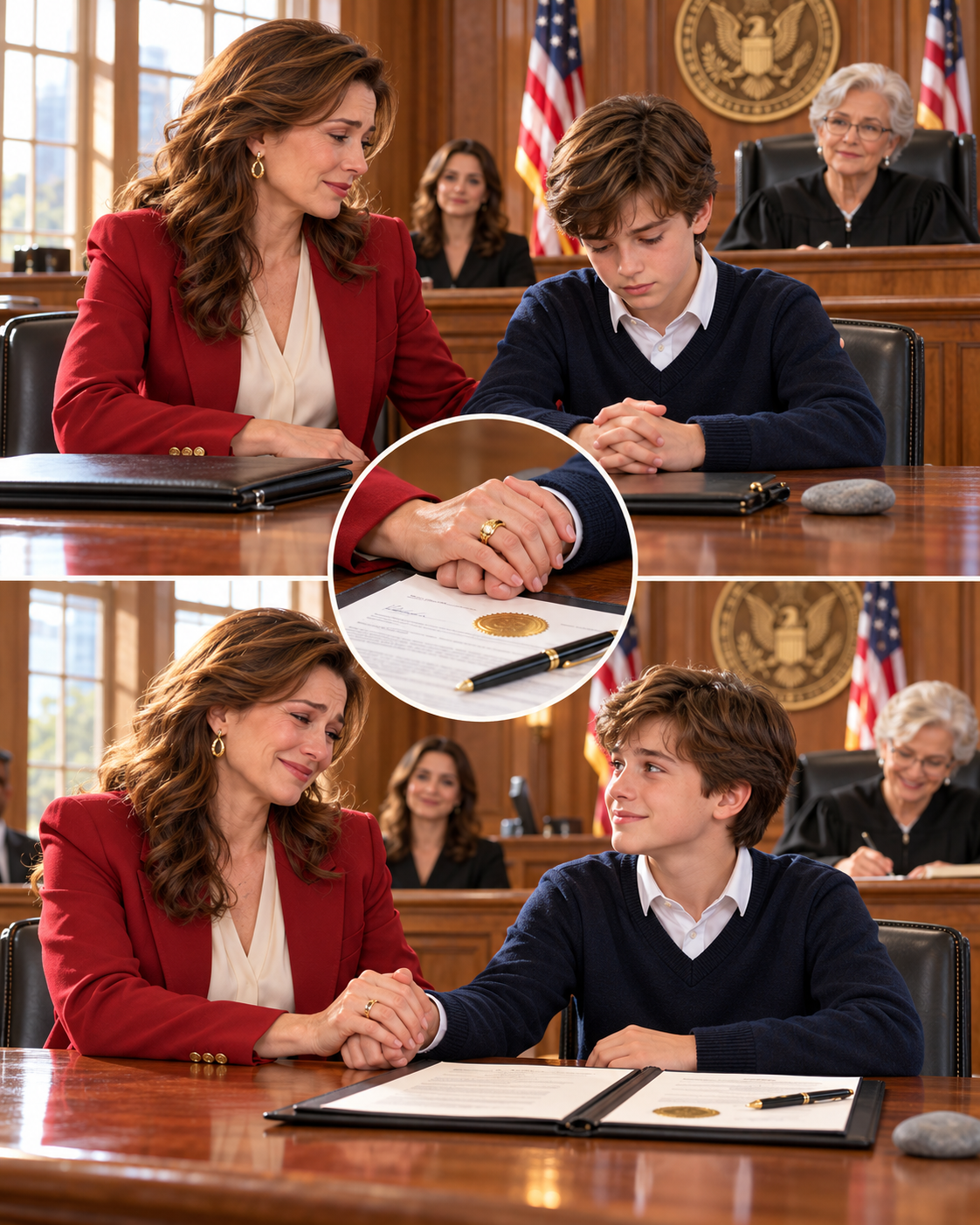
I went back to fighting the fitted sheet.
Alan started upstairs.
At the third step, he stopped.
“Mom?”
My eyes filled.
I looked over.
He held up the paper.
“You signed wrong line.”
I laughed so hard I had to sit on the dryer.
Alan stood on the stairs shaking his head at me.
And somehow that became one of the happiest moments of my life.
Not because he spoke.
Because the word had become ordinary.
Mom.
Not a legal declaration.
Not a performance.
Not proof.
Just the person who signed the wrong line on a permission slip.
Years later, people would sometimes ask Alan when he “found his voice.”
I never liked that phrase.
His voice had never been lost.
It was there in the baby carrot folded beside my plate.
In the raisins lined along his bowl.
In the sentence crumpled into a classroom trash can.
I am not ignoring you.
It was there in the blanket he placed across my legs.
In the water on my nightstand.
In the fixed table.
In the hand covering both our names on the adoption papers.
The world had been waiting for sound.
I had almost made that mistake too.
But Alan taught me something I wish every adult understood.
Silence is not absence.
It is not emptiness.
It is not disrespect.
Sometimes silence is fear.
Sometimes it is protection.
Sometimes it is the only part of yourself nobody has managed to take control of.
And sometimes, if you are patient enough, you realize a person has been speaking to you all along.
The last time I looked at our courthouse photograph, Alan was nineteen.
He had just finished his first semester of community college and was living at home while deciding what came next.
His old navy duffel bag was still on the highest shelf of his closet.
Empty.
He had never thrown it away.
I once asked whether he wanted me to donate it.
He shook his head.
No.
I didn’t ask why.
Some objects hold memories we don’t owe other people an explanation for.
That evening, I stood in the living room looking at the framed photograph.
Alan walked past with a bowl of cereal.
He stopped.
Looked at the picture.
Then at me.
“You cried a lot.”
His speech had grown stronger, though he still used silence whenever he needed it.
I turned toward him.
“You traumatized me.”
He rolled his eyes.
“I said six words.”
“Exactly. After five years. You could have warned me.”
He ate a spoonful of cereal.
“No.”
I laughed.
“Fair.”
He looked again at the photograph.
The judge.
The signed order.
My tear-streaked face.
His small smile.
Two fingers hooked through my sleeve.
After a moment he said, “You know what I almost said?”
I turned slowly.
“What?”
He stared at the photograph.
For a second, he was fourteen again.
Nervous hands.
White shirt.
Terrified eyes.
“What?”
I repeated.
Alan took another bite of cereal.
Then he said, “Nothing.”
I frowned.
He almost smiled.
“I almost didn’t talk.”
The humor disappeared from his face.
“I was scared.”
“I know.”
“I thought if I tried and couldn’t…”
He stopped.
Words still failed him sometimes.
I waited.
He gestured toward the picture.
“I thought they’d think I didn’t want you.”
My chest tightened even after all those years.
“I knew.”
He looked at me.
“I knew you wanted me.”
“Not them.”
“No.”
He was right.
The court needed evidence.
The system needed certainty.
And fourteen-year-old Alan had believed the only certainty adults would trust was sound.
He looked at the photograph again.
“So I practiced.”
“I heard.”
His face twisted.
“That was horrible.”
“It sounded painful.”
“It was.”
My heart hurt.
“I’m sorry.”
He shrugged.
Then, after a moment, said, “Worth it.”
My eyes immediately filled.
Alan groaned.
“Don’t.”
“I’m not doing anything.”
“You’re crying.”
“I’m aging.”
He shook his head.
“Allergies.”
“In January?”
“Very aggressive winter allergies.”
He laughed.
I looked back at the photograph.
“Do you remember exactly what the judge asked?”
He nodded.
Of course he did.
So did I.
She had looked at a silent boy and asked:
Do you want Emily Bennett to become your mother?
And Alan, terrified that silence might be mistaken for rejection, had pulled a voice through five years of fear.
She already is my mom.
At the time, I thought those words were the moment I became his mother.
I was wrong.
The court gave me legal rights that morning.
It gave Alan my last name later, when he chose to take it.
It gave us a certificate.
A photograph.
A permanent record.
But motherhood had happened much earlier.
Maybe it happened when I stopped putting raisins in his oatmeal.
Maybe when I fought with his teacher.
Maybe when he covered me with a blanket.
Maybe when he sat beside my bed through the night because he was afraid I would disappear.
Maybe it happened in hundreds of moments too small for a judge to record.
A locked door checked twice.
Keys in a blue bowl.
Blueberry waffles.
A repaired table.
A glass of water.
An empty duffel bag.
Maybe family is not created in one grand declaration.
Maybe it is created every time someone has the chance to leave and chooses to stay.
Alan finished his cereal.
He started toward the kitchen.
“Hey,” I said.
He looked back.
“I love you.”
When he was nine, words like that made him go still.
When he was fourteen, they made his eyes fill with fear.
At nineteen, he simply nodded.
Then he tapped the bowl twice with his spoon.
Yes.
Our oldest language.
The one we had never needed to replace.
I smiled.
Alan turned away.
Then, just before he disappeared into the kitchen, he said quietly,
“Love you too, Mom.”
And even after all those years, I heard everything that came before it.
The carrot.
The raisins.
The notes.
The taps.
The silence.
Especially the silence.
Because my son had never needed a voice to tell me he loved me.
I had only needed to learn how to listen.
