

“We went to Hawaii. Don’t worry, Mrs. Margaret. At your age, it’s better for you to stay home and rest.”
That was the note held to the refrigerator by a turkey-shaped magnet.
Margaret Collins read it three times as she stood alone in the silent kitchen of her son Daniel’s home in Scottsdale, Arizona.
Thanksgiving mornings had always carried the scent of cinnamon, fresh coffee, and butter. But that Thursday, the house smelled like nothing. There were no voices, no cartoons playing somewhere in the background, and no sound of her grandchildren racing down the hallway.
“Emily,” she called first.
Nothing.
“Jack.”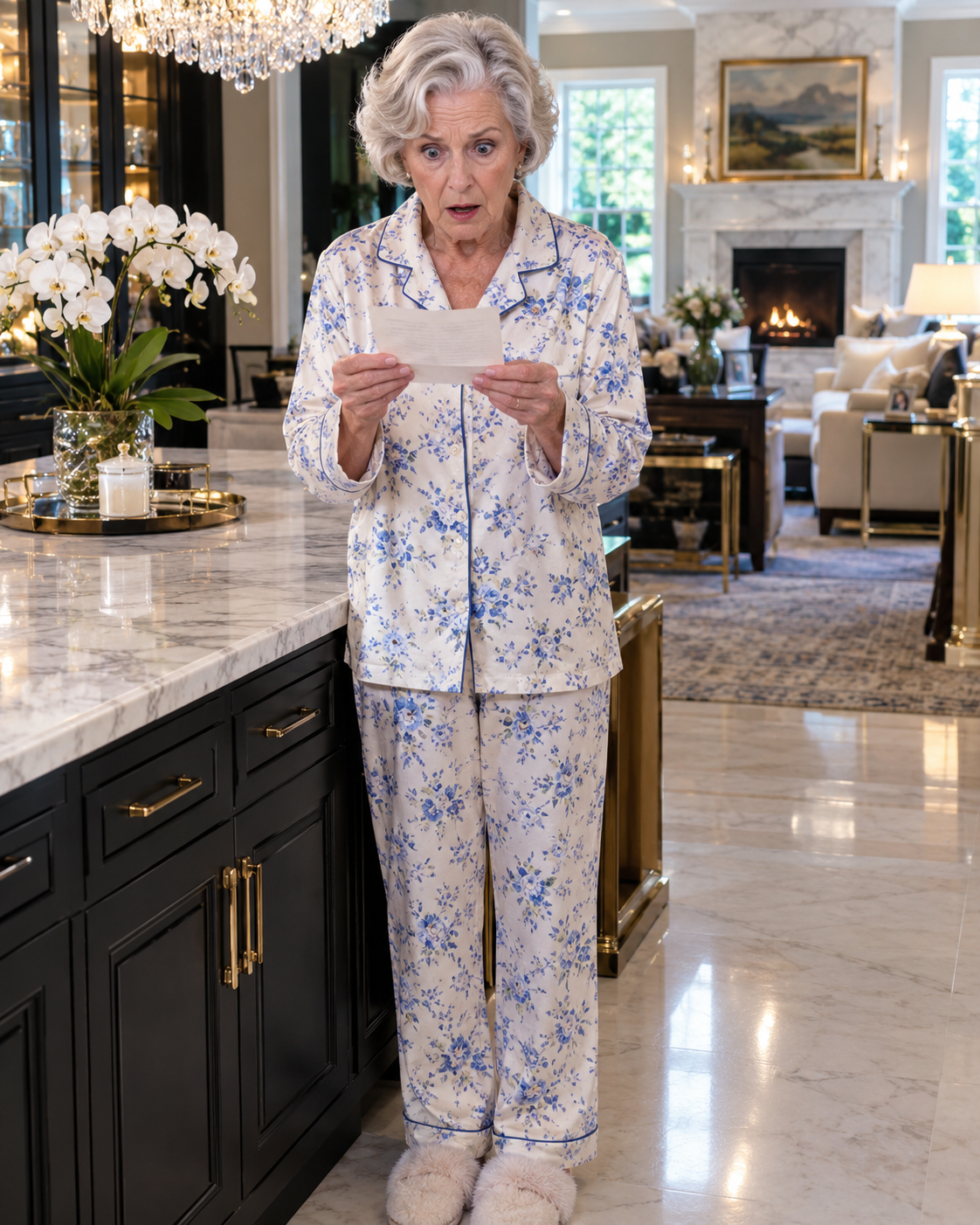
Silence.
She slowly went upstairs. The children’s beds were perfectly made. Their backpacks were gone, and so were their jackets. In the master bedroom, Daniel’s and Rebecca’s suitcases had disappeared too.
She returned downstairs with an unusual calm—the kind that comes before pain decides where to settle.
The SUV was gone from the garage.
Rebecca’s car was gone as well.
Only Margaret remained.
And the note.
“We decided to spend Thanksgiving in Hawaii this year. We didn’t tell you sooner because we knew you would insist on coming. The flight is long, and you get tired too easily now. We’ll be back in a week. There’s soup in the freezer.”
Margaret set the note on the table.
She was seventy-three, but she was not helpless. She didn’t need anyone deciding whether she could board an airplane, cross an airport, or sit beside the ocean.
What hurt most wasn’t that they had left without her.
It was that they had abandoned her like a plant someone remembered to water before leaving for vacation.
Four years earlier, after Arthur died, Daniel had told her,
“Mom, come live with us. I don’t want you alone. Besides, the kids would love having you close.”
Margaret sold her small apartment in Oak Park and moved to Arizona. She put some of the money toward the house’s down payment. She purchased the refrigerator, living room furniture, washer, dryer, curtains, dining table, and even the Italian coffee maker Rebecca proudly displayed to her friends.
At first, they called her a blessing.
Slowly, that blessing became an obligation.
Whenever Margaret wanted to go downtown with a friend, Rebecca would tighten her lips.
“And who’s picking the kids up from swim practice?”
If Margaret mentioned that her back hurt, Daniel would sigh.
“Mom, we’re only asking you to help with dinner. It’s not a big deal.”
Whenever she bought something for herself, Rebecca would remark, “Well, good thing you can still afford little things, because expenses here are getting brutal.”
The words that finally broke something inside Margaret came six months earlier. Rebecca had been on the patio, talking on the phone and assuming no one could hear her.
“We can’t ask her to leave. She watches the kids, pays for things, and still buys groceries. It isn’t really her. It’s her money that’s saving us.”
Margaret had said nothing.
She tucked that pain away like a needle hidden beneath fabric.
But that morning, with the house empty and the note resting on the table, she finally understood.
They had not asked her to live with them because they loved her.
They had kept her there because she was useful.
Margaret poured herself some coffee. She sat down and looked around at the dining table she had purchased, the curtains she had ordered, and the blender she had bought after Rebecca complained that “a nice house shouldn’t have old appliances.”
Then she went upstairs.
From the bottom drawer of her nightstand, she pulled out a blue folder.
Inside were all the receipts.
Arthur used to tease her gently.
“Maggie, you keep receipts for bread.”
For the first time that day, Margaret smiled.
“Thank you, my love,” she whispered.
She pulled out a notebook and wrote across the first page:
Things that belong to me.
Then she started making a list.
Refrigerator.
Living room set.
Dining table.
Washer.
Dryer.
Television.
Coffee maker.
Guest beds.
Curtains.
Lamps.
Dinnerware.
Patio furniture.
With every item, she felt herself breathe a little easier.
She searched for a moving company on her phone and called the first one that answered.
“Ma’am, it’s a holiday weekend, so we charge extra.”
“That’s fine,” Margaret said.
“When do you need the service?”
She glanced at the note again.
“Tomorrow at eight.”
That night, she didn’t cry. She packed two suitcases, gathered her documents, wrapped Arthur’s photograph in a towel, and put the blue folder inside her handbag.
Before going to bed, she returned to the kitchen. She took Rebecca’s note and placed it exactly where it had been.
Above it, in black pen, she wrote:
Thank you for showing me who was really family.
And then she understood that when Daniel returned from Hawaii, he would not be coming back to the same house.
Or the same mother.
The movers arrived Friday morning at exactly eight.
Three men climbed out of a white truck in front of the house. Their crew leader was Frank. He wore a gray cap, held a clipboard, and had the expression of a man hoping to stay out of family conflicts.
“Good morning, Mrs. Margaret. What are we moving?”
“Everything on this list,” she replied.
Frank studied the paper, then looked at the house.
“Are you sure?”
Margaret handed him the blue folder.
“The receipts are here. Everything is in my name.”
Frank checked several documents and nodded.
“Then we’ll get started.”
First came the ivory living room furniture. Then the coffee table, lamps, enormous television Daniel used for football games, eight-chair dining table, refrigerator, washer, dryer, coffee maker, fine dishes, entryway cabinet, and linen curtains.
With every item that disappeared through the door, Margaret felt the house grow emptier, as though it had finally stopped pretending to be a home.
By noon, the rooms echoed.
The kitchen looked completely different. No refrigerator, no blender, no coffee maker, no table. Only the cabinets and the note remained.
Margaret asked Frank to wait five minutes.
She went upstairs and looked around her room one final time.
She didn’t take the children’s toys. She didn’t take their clothes. She left everything that did not belong to her untouched.
At the front entrance, she placed the house keys inside a white envelope. She also left the electric, water, internet, and gas bills, each marked with the date she had stopped automatic payments from her account.
Beside Rebecca’s note, she placed another sheet of paper:
Daniel, starting today, your expenses belong to you again.
Then she walked out without turning around.
Her new apartment was in a retirement community in Santa Fe. It was small, bright, and peaceful. It had a balcony, clean floors, a simple kitchen, and a blooming bougainvillea outside the window.
The manager handed her the keys. “Welcome home, Mrs. Margaret.”
Home.
The word eased something tight inside her chest.
That afternoon, Frank and his crew arranged her furniture. Arthur’s photograph went onto a shelf. The blue teapot he had given her sat beside the stove. The ivory sofa looked beautiful again, not because it was expensive, but because it was no longer surrounded by contempt.
That evening, a neighbor named Helen knocked on her door carrying cornbread.
“I heard you arrived today. Around here, nobody eats dinner alone on their first day.”
Margaret tried to tell her she was fine and that it wasn’t necessary.
But Helen was already coming inside with two plates.
For an hour, they talked about plants, old television dramas, and aching knees. Margaret laughed for the first time in weeks.
Her phone began vibrating Monday night.
First Daniel.
Then Rebecca.
Then eighteen missed calls.
Margaret didn’t answer.
Instead, she opened the security camera app. Daniel had added her years earlier so she could let delivery drivers inside. He had never removed her access.
She watched the footage.
Rebecca walked in, tanned and carrying a beach hat.
“Finally home,” she said, laughing.
Then she stopped.
Daniel entered behind her with a suitcase.
“Where’s the living room set?”
He hurried into the kitchen.
“And the refrigerator?”
Rebecca screamed:
“This can’t be real! The old woman emptied the house!”
Margaret switched off her phone and continued drinking her tea.
Two days later, someone knocked on her door.
Two local police officers stood outside.
“Mrs. Margaret Collins?”
“That’s me.”
“We received a theft report.”
Margaret invited them inside, offered them coffee, and placed the blue folder on the table.
The older officer examined the receipts for several minutes.
“Everything is in your name.”
“That’s right.”
“Your son says you abandoned the house and took family property.”
Margaret took a slow breath.
“They went to Hawaii without telling me. They left a note saying I couldn’t handle the flight. I simply left a house where I was no longer a mother. I was a live-in employee with a pension.”
The younger officer lowered his eyes.
At that moment, Daniel’s voice came from the hallway.
“Mom, open up! We need to talk!”
Rebecca pounded on the door.
“Thief! Give us our things back!”
The older officer stood.
When Margaret opened the door, Daniel looked pale, while Rebecca’s eyes burned with anger.
“How could you do this to us?” Rebecca shouted.
Margaret looked at her without trembling.
“I asked myself the same thing when I read your note.”
Daniel tried to step inside, but the officer stopped him.
“There is no crime. The property belongs to Mrs. Margaret.”
Rebecca gave a bitter laugh.
“So now you think you’re independent?”
Margaret took the envelope containing copies of her receipts and placed it in Daniel’s hands.
“No. I’m only remembering that I always was.”
Then she closed the door while her son continued calling her Mom from the hallway.
Three weeks later, Daniel and Rebecca filed a civil lawsuit against Margaret.
They demanded compensation for “emotional distress, family harm, and loss of essential household property.”
Margaret read the notice while sitting beside the window of her apartment. Outside, the bougainvillea swayed in the cold December wind.
She wasn’t afraid.
She boiled water in Arthur’s blue teapot, pulled out her folder, and placed the lawsuit at the back, the way someone files away another unpleasant receipt.
The hearing arrived beneath gray skies.
Margaret wore a gray coat with pearl buttons. It had been Arthur’s favorite. She carefully fixed her hair, applied soft lipstick, and placed her documents inside a black handbag.
Helen walked her to the entrance.
“Don’t let them bend you, neighbor.”
Margaret smiled.
“I bent for too many years. Not today.”
Daniel and Rebecca sat across the room. He refused to look up. She did, staring at Margaret as though she were an intruder in a story where she was supposed to obey.
The judge asked them to speak.
Rebecca stood first.
“Your Honor, my mother-in-law took advantage of our absence. She entered our home, took furniture, appliances, and things necessary for my children. She left us without a refrigerator, without a washer, without a living room. It was cruel and vindictive.”
The judge made notes.
“Did Mrs. Margaret live with you?”
“Yes,” Daniel said.
“Did she pay rent?”
Daniel swallowed.
“No, but she helped around the house.”
Margaret nearly smiled.
Helped.
Such a small word for four years of cooking, caring for children, paying bills, buying groceries, and swallowing comments.
The judge turned toward her.
“Mrs. Margaret, you may respond.”
She stood.
“I do not deny that I moved out. I do not deny that I took things. What I deny is that I stole anything. Everything I removed was purchased with my money. Here are the receipts, bank statements, and proof.”
She handed over the blue folder.
The judge began examining it.
The silence became heavy.
“Refrigerator purchased by Margaret Collins.”
He turned another page.
“Washer and dryer.”
Another.
“Dining table.”
Another.
“Living room set.”
Another.
“Television.”
Rebecca began shifting in her seat.
The judge looked up. “Mr. Daniel, do you have purchase receipts for these items?”
Daniel tightened his hands.
“They were for the house.”
“That was not the question.”
“I don’t have receipts.”
“Mrs. Rebecca?”
Her jaw stiffened.
“She bought them because she wanted to. Nobody forced her.”
Margaret felt those words bring everything full circle.
Nobody forced her.
That was true.
Nobody forced her to give too much. Nobody forced her to remain silent. Nobody forced her to mistake sacrifice for love. But they also had no right to expect her to keep paying for their comfort.
The judge set the folder on the desk.
“The property belongs to the person who purchased it. There is no basis for compensation. The claim is dismissed.”
Rebecca opened her mouth.
“But she left us with nothing.”
The judge looked at her calmly.
“No. Mrs. Margaret took what belonged to her.”
Daniel closed his eyes.
For the first time, Margaret no longer saw her son as the little boy who hid beneath the table during thunderstorms. She saw an adult man who had allowed his mother to disappear inside his own family.
When they walked out of the courthouse, a light rain was falling.
Daniel caught up with her.
“Mom.”
Margaret stopped.
Rebecca remained a few steps behind them, her arms crossed.
“Mom, I didn’t want this to go so far.”
Margaret looked at him.
“How far did you want it to go, Daniel? Until I kept watching the children, paying bills, and warming soup while you went to the beach?”
He lowered his eyes.
“I thought it was better for you not to come. The flight was long.”
“You didn’t let me choose.”
“Rebecca said you would ruin the trip.”
The words slipped out like a loose stone.
Rebecca went pale.
Margaret did not look at her. She didn’t need to.
“And you chose to believe her.”
Daniel’s eyes were red.
“I was wrong.”
Margaret wanted to embrace him. A part of her always would. He was her son. She had held him through fevers, waited for him at midnight, and defended him against half the world.
But another part of her, buried for years beneath dirty dishes and unpaid gratitude, kept her standing straight.
“Yes,” she said. “You were.”
“Mom, I miss the kids. They miss you.”
Margaret’s voice cracked slightly.
“I miss them too. But I will not return to a house where I am treated like old furniture until someone needs me.”
Daniel had nothing to say.
“When you want me to see my grandchildren, bring them to my apartment. With respect. No shouting. No asking for money. No using my love as a wallet.”
Rebecca muttered,
“So dramatic.”
Margaret finally turned toward her.
“No, Rebecca. Dramatic was leaving a seventy-three-year-old woman alone on Thanksgiving with a note on the refrigerator. This is called consequence.”
And she walked toward the taxi without turning back.
The months that followed were not perfect. Freedom does not erase grief overnight. Some nights, Margaret sat beside the balcony and thought about Emily, about Jack, and about the laughter she no longer heard in the mornings.
But she also began living.
On Tuesdays, she attended book club with Helen. On Wednesdays, she taught other women how to use video calls. On Thursdays, she painted watercolors in the common room. On Sundays, she walked to the market and bought flowers simply because she liked them.
Her apartment slowly filled with little signs of finding herself again.
A lavender plant.
A new tablecloth.
A painting she created herself.
Arthur’s photo beside the television.
And a rule written on a card on the refrigerator:
My love is not to be used to abuse me.
In spring, Daniel brought Emily and Jack.
The children rushed to hug her.
“Grandma, why don’t you live with us anymore?” Jack asked.
Margaret gently stroked his hair.
“Because sometimes adults need to learn to take care of themselves too.”
Emily looked around the living room.
“Your house is pretty.”
Margaret smiled.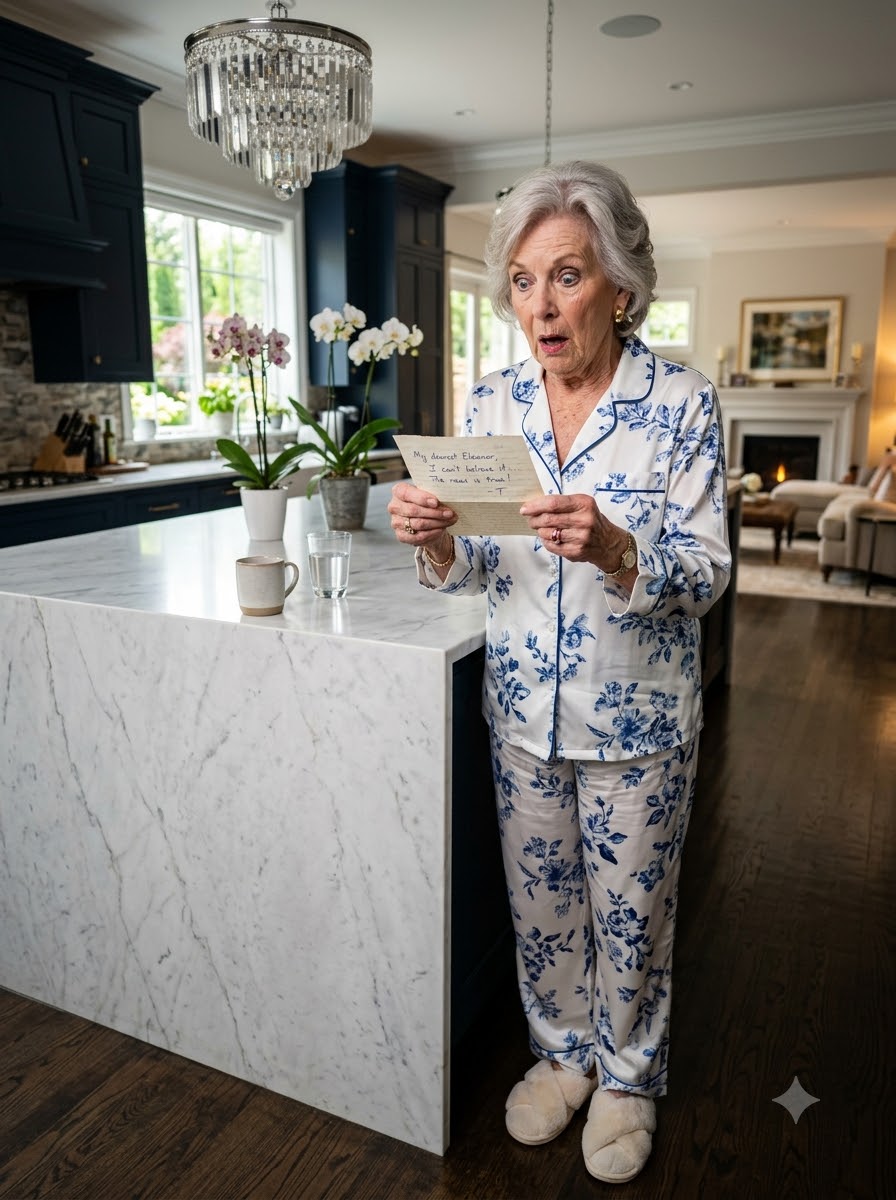
“Thank you. Everything here is peaceful.”
Daniel listened from the doorway. He did not ask for money. He did not complain. He did not step inside without permission.
It was a small beginning, but a genuine one.
The following Thanksgiving, Margaret woke early. This time, the silence did not hurt.
She prepared a small turkey, mashed potatoes, apple salad, and punch. She invited Helen, Mr. Walter from 3B, and Rose, a widow who always claimed she wasn’t hungry but always took a second serving.
She arranged six places at the table.
The final plate was for Arthur. Not because she believed he would sit down, but because some loves deserve to keep a place without taking up space.
The meal was simple, warm, and filled with laughter. No one gave her orders. No one asked how much she had spent. No one made her feel guilty for resting.
After dinner, Margaret stepped onto the balcony with her cup of tea.
She thought about that other morning, the note, the empty house, and her heart frozen solid.
She thought about the moving truck.
The blue folder.
The courtroom.
Daniel standing in the rain, learning too late that a mother can close the door too.
Margaret did not hate her son. Hatred was a burden she no longer wanted to carry anywhere.
But she was not sorry either.
Because sometimes a woman does not leave to punish anyone.
She leaves to save what remains of herself.
That night, before going to sleep, she turned off the lights, checked that the door was locked, and looked around.
Everything was hers.
Not just the furniture.
The peace too.
The time.
The voice.
She climbed into bed beneath her own roof with the quiet certainty of someone who had finally stopped asking permission to exist.
They had left her behind because they mistook her silence for weakness.
They were wrong.
Sometimes silence is the first sound of a new life.
