

Chapter 1: The Geometry of Hierarchy
The fluorescent fixtures hummed in an unforgiving, institutional frequency, bleaching the color from the mahogany table and sharpening every jawline into an accusation. At the far end of the executive suite sat my father, Arthur Vance, the founder and chief executive officer of Vanguard Enterprise Solutions. He sat with his elbows anchored to the leather armrests, his hands tented, his silver signet ring catching the cold overhead glare.
When he spoke, his cadence was measured, devoid of fury, which made it far more lethal.
“You are suspended indefinitely, Elena,” he said, the timbre of his voice vibrating through the glass-walled perimeter. “Until you tender a formal, unconditional apology to your sister.”
Across the table, the corporate secretary’s Montblanc pen froze mid-stroke over her legal pad.
To my left, my sister, Julianne Vance, tilted her chin upward. Her eyelashes fluttered in a choreographed pantomime of wounded vulnerability, her lips parting as if she were swallowing down an ocean of unearned hurt. But around the corners of her mouth, tucked beneath layers of curated victimhood, lingered the ghost of a triumphant smirk. It was a curve of the lips I had cataloged since childhood—the unmistakable expression of someone who understood that she did not need truth on her side so long as she owned the adjudicator.
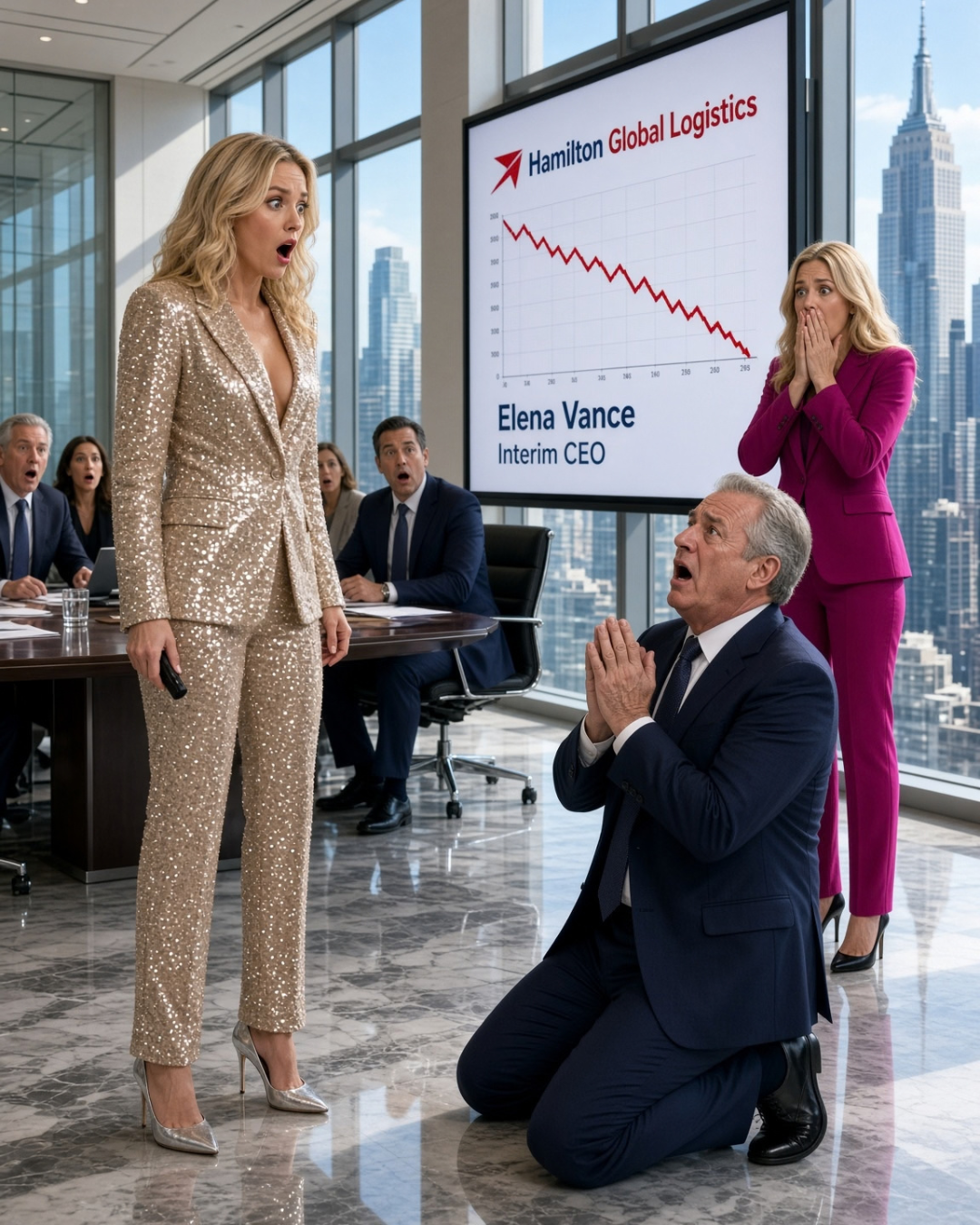
I stood behind the lectern, the presenter’s remote cold and slick in my palm. Behind me, the massive display screen remained frozen on slide forty-two: an unvarnished audit of Julianne’s flagship account, Hamilton Global Logistics. The numbers on that screen were crimson, incontrovertible, and damning. They told a tale of gross negligence, blown budgets, phantom milestones, and structural collapse.
Yet no one in the room was looking at the slide.
Not one department head met my gaze. Men and women whose careers I had insulated for six years suddenly found their leather portfolios, their manicured cuticles, or the condensation on their water tumblers infinitely captivating. The air had gone thin and stale, pressurized by an unwritten corporate law: When the patriarch draws a line, you do not stand on the side of the sacrifice.
I did not flinch. I did not drop my gaze. My pulse, usually a frantic snare drum during these orchestrated family ambushes, slowed into a flat, steady march.
“All right,” I said.
Two syllables. No inflection. No defensive tremor.
If my father had possessed the operational foresight he so aggressively claimed in trade publications, that quiet acquiescence would have terrified him. He was accustomed to my counter-arguments, my exhaustive binders of documentation, my desperate pleas for systemic reason. For fifteen years, he had operated on the comfortable premise that my devotion to the enterprise would always make me malleable.
He did not know that a bridge does not collapse while it groans under strain; it collapses only after it goes dead, rigid, and utterly silent.
I grew up in a household where quietness was celebrated as the ultimate domestic virtue. “A peaceful home is a righteous home,” my father would lecture over Sunday dinners, slicing his roast beef with surgical exactitude. It took me three decades to recognize that within the Vance household, peace was merely a euphemism for submission, and harmony was the code word for a rigid, autocratic hierarchy.
Julianne had mastered that hierarchy before she could properly tie her shoes. When we were children, during a fourth-grade regional science fair, Julianne forgot her presentation materials at home. Rather than face the teacher’s mild reprimand, she broke into breathless, theatrical sobs in the main hallway. My father arrived at the school within twenty minutes, sweeping past the principal with the gravity of a diplomat handling an international crisis. He berated the instructor, bought Julianne an expensive motorized diorama kit from an upscale hobby store downtown, and patted her curls while she beamed through her drying tears.
I had spent four weeks gathering river water samples in mason jars, cataloging microscopic algae under a plastic lens. When I quietly pointed out that Julianne hadn’t written a single sentence of her own poster board, my father rested a heavy, calloused hand on my shoulder.
“Elena,” he had murmured, his tone dripping with an intoxicating poison disguised as wisdom. “Your sister is sensitive. The world will be hard enough on her. You have a spine of steel. Be the reasonable one.”
The reasonable one. It was not praise; it was an assignment of unpaid labor. It was a life sentence.
The pattern solidified into bone. I remember the humid June afternoon during my senior year of high school when the courier delivered a thick, textured envelope from the Massachusetts Institute of Technology. My name was printed across the center in crisp, embossed font. I stood on the cold kitchen tiles, my knuckles white against the paper, feeling the weight of four years of sleepless nights, advanced placement exams, and solitary sacrifice finally paying their dividend.
When my father walked in, shedding his tailored suit jacket, I offered him the letter with trembling hands.
He skimmed the first two sentences, nodded once with the enthusiasm of a man reviewing a routine dental invoice, and tossed it onto the kitchen counter beside the utility bills. He didn’t even bother to unfold the scholarship addendum.
“Good,” he said, turning toward the refrigerator. “Solid work.”
Ten minutes later, the front door flew open. Julianne burst into the foyer, holding her left hand high in the air, a two-carat diamond ring glittering under the chandelier. Her high school boyfriend, the son of a prominent county commissioner, had proposed in the bed of his pickup truck.
Within ninety seconds, my father had uncorked a bottle of vintage champagne. Relatives were telephoned; neighbors were summoned across manicured lawns; the house swelled with laughter, clinking crystal, and breathless declarations of marital majesty. By midnight, my acceptance letter was buried underneath a grease-stained stack of catering napkins and half-empty flute glasses.
That was the evening I internalized the baseline operating principle of my family: Substance is invisible; spectacle is currency.
When my mother passed away three years later, the last structural support of our family disintegrated. My mother had been the quiet dampener in the system, the woman who would place a warm hand against the nape of my neck when she saw me burning midnight oil over algorithmic equations, the one who would subtly redirect my father’s heavy-handed favoritism. She was the only person capable of pulling him back from the edges of his own vanity.
With her gone, Julianne faced zero resistance. She learned that every mistake could be washed away with tears, every fiscal shortfall could be reframed as an act of creative bravery, and every technical disaster she engineered could be deposited onto my desk for silent, urgent repair.
Now, in the executive conference room, my father leaned back in his chair, mistaking my quietness for broken pride.
“Take the rest of the week,” Arthur added, gesturing vaguely toward the door with an air of dismissive benevolence. “Clear your head. When you’re ready to put this company and your family above your personal vanity, Julianne will accept your apology. Not before.”
Julianne gave a delicate sniffle, lowering her gaze with practiced modesty. “I just want us to be a team again, Elena. That’s all I’ve ever wanted.”
I switched off the projector. The blue light died instantly, plunging the presentation screen into ink-black darkness. I packed my laser remote into its velvet case, picked up my leather folder, and looked directly into my sister’s wide, false eyes.
You think you’ve backed me into a corner, I thought, my heart beating in a rhythm so calm it felt predatory. You have no idea that you’ve just unlocked the cage.

Chapter 2: The Architecture of Invisible Labor
The engineering department at Vanguard Enterprise Solutions occupied the third floor—a labyrinth of glass partitions, server racks, and ergonomic desks that smelled perpetually of cold brew coffee, ozone, and quiet desperation.
When I took over the division six years ago, it was a derelict outpost. The codebases were fragmented spaghettis of legacy scripts, the servers crashed under minor peak-hour loads, and the turnover rate was an absolute hemorrhage. I didn’t rebuild that department using corporate slogans or retreat seminars. I rebuilt it with fourteen-hour days, by rewriting broken database schemas on Saturday nights, and by cultivating a team of twenty brilliant developers who knew that no matter how chaotic the executive floor became, their vice president would stand as an unbreakable firewall between them and the boardroom.
Julianne, meanwhile, occupied the corner suite on the top floor as the Executive Vice President of Client Acquisition. Her office was an architectural triumph of white bouclé sofas, fiddle-leaf figs, and panoramic views of the city skyline.
Her methodology was deceptively simple: she took prospective Fortune 500 clients to five-star dinners, memorized the names of their spouses and golden retrievers, and promised them computational miracles.
“Four weeks,” she would tell a global shipping conglomerate with a dazzling, pearl-white smile. “Our technical team can completely overhaul your logistics pipeline and migrate your core database in four weeks.”
In the real world of systems architecture, migrating such infrastructure required sixteen weeks of rigorous regression testing, API mapping, and security certification. But Julianne did not inhabit the real world; she inhabited the narrative world. And whenever I flagged these impossible parameters in project inception meetings, my father would wave his hand like a monarch dismissing a peasant’s weather report.
“Julianne knows the client landscape, Elena,” he would bark, his jaw set in stubborn defiance. “She brings the business through the front door. Don’t drown her commercial instincts in technical pedantry. Just make it work.”
And so, we made it work.
We made it work through the quiet degradation of human health. My lead developer, Marcus Chang, developed a chronic eye twitch from seventy-hour workweeks under the buzzing LEDs. Pizza boxes piled up in the third-floor breakroom like structural pillars of corporate exploitation. I lived on cold espresso, ibuprofen, and the adrenaline of panic. I rewrote deployment scripts at two in the morning, absorbed the blame when Julianne’s unvetted timelines cracked, and stepped into executive debriefs with a composed face, masking the structural dry rot my sister was planting in every corner of the enterprise.
Julianne was rewarded with glowing profiles in regional business journals. The Charismatic Face of Modern Tech, one cover line had proclaimed, framing a high-gloss photograph of my sister resting her chin on her hand, looking thoughtfully into the middle distance.
My name was not mentioned once. I was merely “the back-end support.”
The tipping point arrived six months prior, under the name of Hamilton Global Logistics.
The contract was worth forty-two million dollars over three years—an enterprise deal that would elevate Vanguard from a mid-market player to a tier-one systems integrator. The negotiations had been tense, handled entirely by Julianne and Arthur over private club lunches.
When the fully executed contract finally landed on my desk, my blood turned to ice water.
Julianne had contractually committed Vanguard to a real-time, cross-border freight tracking architecture that required custom military-grade encryption protocols and zero-downtime database synchronization across three continents. More catastrophically, she had agreed to a punitive delivery deadline of ninety days, accompanied by a draconian liquidated-damages clause: if the system failed its beta stress-test on day ninety-one, Vanguard would be liable for a penalty of one hundred and fifty thousand dollars per day, escalating to full contract termination and legal damages at day one hundred and twenty.
I stormed into my father’s office, the contract rattling in my grip.
“Did you read Section 8?” I demanded, slamming the document down onto his immaculate mahogany desk. “Arthur, did you look at the compliance riders? This isn’t software deployment; this is an ambush. The server architecture alone will cost four times what Julianne budgeted, and the encryption standards she agreed to aren’t even commercially viable under current regulatory umbrellas.”
My father didn’t even pick up the file. He adjusted the knot of his silk tie, his eyes narrowing with deep, familiar irritation.
“Julianne secured the largest deal in the history of this firm, Elena. Your first instinct should be celebration, not microscopic criticism.”
“It isn’t criticism, it’s physics!” I shouted, the frustration finally cracking through my polished facade. “You cannot move ten tons of freight in a two-ton truck! If this system collapses during the live pilot, Hamilton won’t just sue us—they will bankrupt us!”
“Then engineer a bigger truck,” he said coldly. “You have sixty developers. You have a budget. Stop looking for excuses to diminish your sister’s victories. You’ve been doing it since she was six years old, and frankly, I am sick of the jealousy.”
Jealousy. The word was an old, blunt weapon he kept within arm’s reach, ready to bludgeon any fact that threatened his curated reality.
For the subsequent eighty-nine days, my team lived in hell. I moved a cot into my office. I spent nights debugging lines of C++ code while my skin grew gray and my hair began falling out in the shower. I caught Marcus Chang sobbing silently in the server room at three in the morning, his head buried in his hands, completely broken by the relentless, unachievable sprint.
“Go home, Marcus,” I had whispered, gently pulling his fingers away from his bloodshot eyes. “I’ll cover your shift.”
“We aren’t going to make it, Elena,” he choked out, his voice cracked with exhaustion. “The APIs aren’t handshake-compatible. She sold them vaporware.”
“I know,” I said softly, my voice devoid of warmth. “Go home to your kids. I will handle the code.”
I didn’t fix it. I couldn’t. What Julianne had promised was technically impossible within the laws of current computer science. What I did instead was build a defensive perimeter. Every impossible request, every frantic warning I emailed to Julianne, every budget request my father rejected, every unverified metric Julianne submitted to Hamilton’s executive board—I documented.
I printed every single email, timestamped every server crash report, and archived every Slack exchange where Julianne instructed the team to “just spoof the analytics so the client stays happy.”
I compiled it all into a private, encrypted digital vault. I didn’t do it out of malice; I did it out of survival. I had spent my entire life learning that when a disaster occurs in the Vance empire, someone must be designated as the scapegoat.
And then came the morning of the suspension.
At the ninety-day beta review, the Hamilton system suffered a catastrophic latency failure during a live demonstration to their chief operating officer. Rather than admitting that the technical parameters were mathematically impossible, Julianne stood before the board of directors and dropped the blame squarely between my shoulder blades.
“Elena’s engineering team refused to prioritize the interface optimization,” Julianne had murmured, wiping away a phantom tear with a lace handkerchief. “I gave them the roadmap. I gave them the resources. But my sister has always been resistant to my leadership. She deliberately dragged her feet. She wanted this deployment to stumble.”
My father didn’t ask for the telemetry data. He didn’t ask to see the server diagnostics. He simply slammed his palm onto the table, declared my behavior an act of gross insubordination, and demanded my suspension.
Standing outside the conference room now, the echo of my quiet “All right” still lingering in the pressurized air, I felt the final shackle drop from my wrist.
The hallway outside was dead silent. Colleagues scurried by with averted eyes, treating me like an infectious patient being escorted toward quarantine.
I walked toward the elevators, my heels clicking sharply against the polished terrazzo floor. Taped beside the bronze call button on the executive level was a freshly laminated organizational chart, signed off by my father that very morning.
At the absolute zenith of the chart sat Arthur Vance.
Directly beneath him, crowned with the newly minted title of Executive Vice President of Operations and Infrastructure, was Julianne Vance.
My name was gone.
Not demoted. Not shifted to a lateral advisory capacity. Erased. Replaced by a blank box labeled Department Head (Acting: J. Vance).
They hadn’t just suspended me. They had enacted a quiet, administrative coup d’état, stealing the six years of engineering infrastructure I had bled to construct, handing the keys to a woman who didn’t know the difference between an IP address and a domain name.
My smartphone buzzed against my thigh.
A text from Marcus: Elena, what just happened upstairs? The rumor mill is on fire. Are they replacing you?
Another from our senior systems architect: Elena, Julianne just sent an all-hands memo claiming she’s taking over direct deployment of the Hamilton migration. She wants us to bypass security staging. Do we follow this?
I stared at the glowing glass screen for a long, quiet second. Then, I flipped the phone onto silent mode, slid it into my blazer pocket, and stepped into the elevator.
The machine dropped, the gravity pulling in my stomach. When the doors slid open on the third floor, I didn’t head toward my team’s workstations to give a reassuring speech. I walked straight into my corner office, closed the frosted glass door, and turned the deadbolt until it clicked with a definitive, metallic snap.

Chapter 3: The Severance of Obedience
The silence of my office was absolute, insulated by double-paned acoustic glass designed to keep the screams of frustrated executives from leaking into the corridor.
I stood in the center of the room, looking at the life I had curated over six relentless years. On the wall hung my Master of Science diploma from MIT, framed in dark walnut. Beside it hung three corporate excellence plaques awarded by the regional chamber of commerce—plaques that bore the company name in massive typography and my name in tiny, modest letters along the brass base.
On the shelf sat a prototype server blade from the first scalable cloud cluster my team had ever brought online. We had worked forty-eight uninterrupted hours to save that contract from an electrical surge three winters ago, surviving on lukewarm tap water and stale donuts, cheering like children when the green diagnostic lights finally pulsed in unison.
My father had not even visited the floor that day. He had sent an email that read: Good that it’s resolved. Don’t let the maintenance costs overrun.
I walked to my desk, unclipped my hair, and pulled it back into a tight, severe bun using the elastic around my wrist. The ritual was familiar; it was the motion I made whenever a database collapsed or a deployment caught fire. It was the physical manifestation of entering operational clarity.
I opened the bottom left drawer of my desk.
Inside lay three thick, black expanding portfolios, secured with heavy elastic bands. These were not the company’s sanitized, optimistic project overviews. These were the post-mortems of reality.
I laid the first portfolio on the desk and unclasped the band.
Inside were the raw transaction logs of the Hamilton Global Logistics deployment. Every single change order Julianne had unilaterally signed without technical review. Every unvetted third-party integration she had bought off-the-shelf to hide structural deficits. Every email where she had explicitly ordered junior developers to mask fatal latency errors before investor demonstrations.
Next, I pulled out a slender manila folder labeled with a single word: CONTRACT.
Four years ago, when Vanguard was pursuing an eight-figure mezzanine financing round, the venture capital firm insisted that the core intellectual property—the proprietary distributed-ledger framework that powered our enterprise software—be legally tied to the key developer who designed it. That developer was me.
To satisfy the institutional investors, my father had been forced to execute an executive employment agreement with me. At the time, he had signed it with an impatient scrawl, barely reading the fine print drafted by his outside counsel, assuming his obedient, reasonable daughter would never hold a piece of paper over his head.
My fingers traced the crisp, legal embossing of Section 12.4: Unilateral Administrative Suspension and Material Alteration of Duties.
The language was poetry disguised as bureaucratic legalese:
“In the event that the Executive’s operational authority is suspended, stripped, or substantively altered without documented, adjudicated cause involving gross criminal negligence or proven corporate espionage, such action shall constitute immediate constructive termination without prejudice. Upon the occurrence of said constructive termination, all unvested equity options held by the Executive (representing twelve percent of total enterprise voting shares) shall instantly and irrevocably vest in full. Furthermore, the Executive’s covenant of non-competition and non-solicitation shall become null, void, and unenforceable ab initio, and the Corporation shall be obligated to tender an immediate lump-sum severance equivalent to twenty-four months of executive compensation.”
My father had signed it. The corporate seal was stamped in raised ink right beside his sweeping, grandiose signature.
He had suspended me in front of twelve department heads to soothe his golden child’s bruised ego. In doing so, he had pulled the pin on a legal grenade that had been sitting in his corporate vault for forty-eight months.
A sharp, arrogant tap sounded against the glass door.
I didn’t turn around immediately. I calmly slid the contract back into the portfolio, clicked my fountain pen shut, and rested my hands on the mahogany surface.
Outside stood Julianne.
She didn’t wait for an invitation. When the deadbolt resisted her hand, she frowned in irritation, knocked again with her gold knuckle ring, and then used her master key card to disengage the lock. The door swung open with a hiss of displaced air.
“Locking the door during business hours, Elena?” she asked, stepping inside and letting the door drift shut behind her. She was holding a bone-china mug of green tea, the steam carrying the scent of jasmine. “A little juvenile, don’t you think?”
She leaned against my bookshelf, her posture fluid, relaxed, radiating the casual entitlement of a victor visiting a fallen province. She brushed a speck of invisible dust from her cashmere lapel, took a delicate sip of her tea, and looked around my office with an appraising eye.
“You can end this little melodrama right now, you know,” she said, her voice dropping into that smooth, patronizing cadence she reserved for retail workers and technical subordinates. “Dad is furious, but I can calm him down. All you have to do is draft a brief memo to the department heads. Say that the stress of the Hamilton deployment got the better of you, that your technical analysis was skewed by personal exhaustion, and apologize for challenging my client management strategy.”
I looked up at her. For the first time in my life, I didn’t see my sister. I didn’t see the little girl who cried over school projects, nor the charismatic executive who stole the credit for my sixty-hour weeks. I saw a hollow, brittle structure held together by my father’s vanity and my own endless compliance.
“An apology,” I stated, keeping my tone deliberately flat.
“Yes,” she said, offering a tight, triumphant smile that didn’t reach her eyes. “A real one. Professional. Contrite. Do that, and I’ll convince Dad to let you come back as an Associate Systems Director under me next month. You’re good at the code, Elena. You just don’t have the stomach for high-level enterprise politics. You need to let those of us who understand relationships run the business.”
She checked her reflection in the dark bezel of my secondary computer monitor, smoothing an eyebrow with the tip of her pinky finger. She was utterly convinced she was offering me a lifeline.
“That’s it?” I asked.
She sighed, playing the role of the long-suffering saint to perfection. “That’s it. It’s that simple. Just apologize, swallow your pride, and we can keep this family together.”
I reached into the top drawer of my desk. I pulled out a stack of empty cardboard archive boxes that had been folded flat beneath my file folders. I slid one open, popped the bottom into place with a hollow thump, and set it on the desk.
Then, I picked up my MIT degree, lifted it off the brass picture hook, and placed it inside the box.
Julianne’s smile wavered. A minuscule crease appeared between her groomed eyebrows.
“What are you doing?” she asked, her voice losing a fraction of its velvet smoothness.
“I’m accepting your terms,” I said evenly.
“That… that doesn’t look like an apology.”
I reached for the framed patent certificate hanging beside the window—a cryptographic routing protocol that processed sixty percent of Vanguard’s transaction volume. I wrapped it in a sheet of brown packing paper and laid it over the degree.
“I told Arthur I accepted his suspension,” I said, looking her directly in the eye. “And I told you: all right.”
“Elena, stop being dramatic,” she snapped, her voice tightening, the first tendrils of genuine anxiety creeping into her tone. “Dad said you’re suspended, not fired. You can’t just take company property.”
“Every patent on this wall is registered in my individual name, licensed exclusively to Vanguard under an employment agreement that terminated precisely eleven minutes ago,” I whispered. My voice wasn’t raised, but it carried the weight of an iron vault door swinging shut. “Every personal credential, every academic degree, every award belongs to me. The code on those servers belongs to the corporation. I leave that to you, Julianne. You are, after all, the Executive Vice President of Operations.”
“You can’t leave,” she stammered, stepping forward, the green tea sloshing slightly against the rim of her porcelain cup. “We have the Hamilton alpha integration on Monday! Their technical liaison is flying in from London! I don’t know the… the root access protocols for the secondary migration layer!”
I slid my company laptop out of its docking station. I did not wipe it. I did not sabotage a single file. Sabotage is the weapon of the desperate and the incompetent; facts are the weapons of the sovereign.
I powered down the machine, placed it neatly in the exact center of my cleared desk, and rested my master keycard directly on top of the keyboard.
“You told the board you gave us the roadmap,” I said softly, my lips parting in the faintest, most devastating smile I had ever worn. “Follow it.”

Chapter 4: The Audit of Truth
Packing six years of your life does not take long when you have lived like a monk devoted to the monastery of corporate survival.
Within forty-five minutes, my office looked like a forensic crime scene. The walls were bare, marked only by faint, pale rectangles where my achievements had once hung. The bookshelves, once heavy with treatises on distributed architecture, algorithmic optimization, and enterprise database management, were desolate.
Julianne had fled ten minutes prior, her high heels clattering frantically down the corridor toward the executive elevators, desperate to find our father before my departure became an irreversible reality.
I sat down at my personal tablet—a private, air-gapped device tethered to my personal cellular hotspot.
For two hours, I didn’t write an emotional manifesto. I didn’t draft a bitter, weeping farewell. I performed what I had been trained to do better than anyone in this firm: I executed an audit.
I compiled a single master file titled Project_Hamilton_Operational_Reality_Index.pdf.
It contained sixty-two pages of unassailable documentation.
Exhibit A: The original server load requirements versus Julianne’s unapproved, cost-cutting modifications.
Exhibit B: The forty-seven specific technical warnings emailed to the Executive Suite, complete with read-receipt confirmations showing Arthur Vance had opened them and failed to respond.
Exhibit C: The financial ledger demonstrating that two point four million dollars earmarked for cloud security testing had been diverted by Julianne’s department into “Client Hospitality and Promotional Outreach.”
Exhibit D: The unvarnished diagnostic report from the morning’s failed beta test, showing that the failure was not due to back-end maintenance, but an architectural impossibility manufactured by Julianne’s unverified commitments.
At the very end of the file, I appended two documents.
The first was my formal letter of resignation, citing constructive termination under Section 12.4 of my executive employment agreement, effective immediately, accompanied by a formal demand for the immediate transfer of my twelve percent vested enterprise voting shares to my private brokerage account.
The second was a formal notice of assignment of intellectual property rights, alerting the board that the proprietary cryptographic routing pipeline—the beating heart of Vanguard’s commercial software—was utilized under a revocable enterprise license that expired sixty days following the termination of my active employment.
I did not send this file to a tabloid. I did not post it to a public forum.
I opened the enterprise email client on my personal tablet and populated the “To” field with precision:
The entire Board of Directors of Vanguard Enterprise Solutions.
Marcus Reed, the Senior Managing Partner of our outside general counsel.
The Chief Financial Officer and Chief Operating Officer.
And finally, Sir Alistair Vance-Cross, the Chairman of Hamilton Global Logistics, whose personal email I had been given during the initial technical discovery phase.
The clock on my screen read 6:42 PM.
The office floor outside was darkening. The engineers had begun to pack their bags, moving through the cubicles like ghosts, whispering among themselves about the seismic tremors they could feel vibrating through the executive bedrock.
I looked at the blue “Send” button.
My finger hovered over the glass. For a fleeting microsecond, the ghost of my childhood visited me—the voice of my mother asking me to maintain the peace, the heavy hand of my father on my shoulder reminding me to be the reasonable one. For thirty years, I had held the sky above their heads, letting my own vertebrae splinter under the weight so they could dance underneath the canopy and pretend they were gods.
No more.
I tapped the screen.
The digital chime of the outgoing message cut through the quiet of my bare office like a gunshot.
Within ninety seconds, my personal phone began to vibrate violently across the wood.
The first call was from Marcus Reed, Vanguard’s general counsel.
I declined it.
The second call was from the Chief Financial Officer.
I declined it.
The third call was from my father. The caller ID simply read: ARTHUR.
I let it vibrate until the screen went dark, sending him directly to the automated voicemail greeting I had recorded three years ago.
I picked up my two cardboard boxes, tucked my leather portfolio under my arm, and walked toward the heavy glass door.
I took one last look at the room. On the top shelf, I had left a single item behind: the small, rusted server blade from our three-day marathon three years ago. It sat completely alone on the empty white melamine shelf, covered in a thin skin of dust, a monument to a devotion that had been weighed, measured, exploited, and finally abandoned.
As the elevator doors slid shut, carrying me downward toward the subterranean parking garage, my phone buzzed with an incoming text from an unknown number.
I unlocked the screen.
The message was from David Sterling, the CEO of Aether Technologies—Vanguard’s fiercest and most sophisticated competitor:
“Elena. I hear the glass just shattered on the executive floor. My boardroom is open. My engineers need an absolute sovereign. Name your equity, name your terms. Let’s talk at dawn.”
I lowered the phone, looked at my reflection in the polished brass walls of the elevator, and allowed myself the first genuine breath of cold, clean air I had taken in fifteen years.
Chapter 5: The Reckoning at Dawn
The morning sun rose over the metropolitan skyline in sharp, amber angles, cutting through the smog and illuminating the granite façade of Vanguard Enterprise Solutions.
By 8:45 AM, the executive lobby was an open nerve.
Employees huddled near the artisanal espresso bar, whispering behind paper coffee cups, their eyes darting wildly toward the private elevators. Security guards stood with hands crossed at their belts, their postures unnaturally rigid. Everyone knew. In a corporate ecosystem, bad news travels with the velocity of an airborne pathogen.
When the private elevator doors opened on the penthouse floor, the silence was suffocating.
My father’s executive assistant, a woman who had served him for twenty-two years with monastic devotion, stood near the mahogany boardroom double doors. Her knuckles were white against the clipboard she pressed to her chest. When she saw me approach—dressed in a sharply tailored charcoal charcoal-wool suit, my hair pinned in an architectural chignon, holding only my slim leather portfolio—her eyes widened in sheer, unadulterated panic.
“Elena,” she whispered, her voice cracking under the strain. “He… they’ve been in there since five this morning. The board called an emergency session at dawn. Sir Alistair from Hamilton was on the transatlantic line before the sun came up.”
“Thank you, Margaret,” I said softly, my voice as calm as a frozen pond. “I know.”
I didn’t knock. I pushed the heavy oak doors open and stepped across the threshold.
The scene inside belonged in the aftermath of a military disaster.
The twelve-seat conference table was littered with crumpled paper cups, half-eaten pastries that had gone stale, and printed sheaves of my sixty-two-page audit. Marcus Reed, the outside general counsel, sat with his tie unknotted, massaging his temples while his legal associate frantically typed revisions on a secured laptop.
Julianne sat in the corner near the floor-to-ceiling windows. The triumphant, polished socialite from yesterday had vanished. Her silk blouse was creased, her mascara was smudged along the lower rims of her eyes, and her arms were wrapped tightly around her midsection as if she were trying to physically prevent herself from flying apart.
At the head of the table stood my father.
His face was the color of wet parchment. The proud, imperious posture that had dominated boardrooms for four decades was bowed, his shoulders sagging beneath his bespoke Brioni suit jacket. When he saw me, his jaw tightened, the veins along his temples throbbing with a frantic, desperate pulse.
“Elena,” Arthur said, his voice hoarse, scraping through his throat like sandpaper. “Sit down. We have… we have matters of extreme corporate urgency to rectify.”
I did not sit. I remained standing at the foot of the table, ten feet away from him, resting my hand lightly on the edge of the leather portfolio.
“I am no longer an employee of this corporation, Arthur,” I said, addressing him by his first name for the first time in my life. The syllable landed on the table like an iron weight. “Under the provisions of Section 12.4 of my executive contract, my resignation was completed and executed at 6:42 PM yesterday. I am here purely as a twelve percent shareholder and the primary licensor of the Core Routing Framework.”
Marcus Reed winced, lifting his head from his hands. “Arthur, please,” the lawyer pleaded softly. “Listen to her. She is entirely correct. We reviewed the covenants at midnight. The language is ironclad. The suspension you ordered yesterday morning triggered constructive termination without cause. There is no legal ambiguity here.”
“Shut up, Marcus!” Arthur roared, slamming his open hand onto the mahogany with a force that rattled the crystal water carafes. He turned his bloodshot eyes back to me, the desperation finally stripping away the last veneer of his paternal condescension. “You sent that file to the Board! You sent it to Alistair Vance-Cross! Do you have any idea what you’ve done? Hamilton has placed our contract into formal default review! They are threatening to invoke the four-million-dollar penalty clause by Friday!”
“I didn’t create that reality, Arthur,” I responded, my voice dropping into an icy, crystalline register that commanded every breath of oxygen in the room. “Julianne created it when she signed an impossible service agreement. You created it when you dismissed every single engineering warning I placed on your desk for three consecutive months. I merely turned on the lights in a room where you two preferred to dance in the dark.”
Julianne suddenly surged to her feet, her chair scraping violently against the floorboards.
“You did this to destroy me!” she shrieked, her voice shrill, the tears finally flowing, though they were no longer the soft, sympathetic tears of a wounded victim—they were the ugly, jagged tears of exposed narcissism. “You’ve always hated me! You’ve always been jealous because Dad loved me more! Because I could talk to people and you were just… you were just an awkward nerd sitting in a dark room with your stupid computers! You deliberately burned down the Hamilton deal just to humiliate me!”
I turned my head and looked at her. Really looked at her.
The childhood terror was gone. The resentment that had poisoned my adolescence had evaporated. I felt nothing toward her. No hatred, no vengeance, not even pity. She was simply an architectural defect in a building that was preparing to collapse under its own structural deceit.
“I didn’t burn down your deal, Julianne,” I said quietly, each word enunciated with surgical detachment. “I stopped maintaining the lie that you knew how to build it. If your talent is client relationships, go talk to Sir Alistair. Explain to him how charisma synchronizes a multi-threaded database across sixteen server farms. Charm the code into compiling. Go on. The floor is entirely yours.”
Julianne choked on her breath, her mouth opening and closing soundlessly. She turned toward our father, her hands outstretched in a frantic plea for rescue.
“Dad! Tell her! Make her fix it! Make her take the lead back!”
Arthur looked at Julianne. And in that singular, agonizing moment, I watched the scales finally fall from an old man’s eyes.
He didn’t look at her with paternal adoration. He looked at her with the cold, horrifying realization of an investor who has sunk his entire fortune into a gilded counterfeit. He saw the empty promises, the lack of operational depth, the terrifying void beneath the high-gloss packaging.
“You told me it was ready, Julianne,” Arthur whispered, his voice trembling with an emotion that sounded dangerously close to disgust. “You told me Elena was just being territorial. You swore to me on your mother’s memory that the beta staging was green.”
“Dad, I… I thought the engineering team would patch it!” she sobbed, retreating a step toward the glass window. “They always patched it before!”
“Because Elena stayed awake for three days straight to do it,” Marcus Reed muttered from the corner, his voice dripping with bitter finality. “Without Elena, this company doesn’t have an enterprise product. We have an advertising agency that writes bad checks.”
Arthur turned back to me. The rage had drained from his face, leaving behind a hollow, gray mask of defeat. He took two slow, shuffling steps toward the center of the table, his hands open, palms upward, in an unmistakable posture of surrender.
“Elena,” he murmured, his voice cracking. “My brilliant girl. We can… we can rewrite the executive structure today. Right now. I will remove Julianne from Operations. I’ll assign her to community outreach, completely out of the technical pipeline. I’ll make you Chief Operating Officer. Full executive parity. Half of my personal voting shares. Just… take the call with Sir Alistair. Tell him it was an internal staging miscommunication. Save the Hamilton account. Save your family’s company.”
I stood straight, looking into the eyes of the man whose approval I had spent twenty-five years starving for.
I remembered the cold kitchen tiles where my MIT letter lay beside the utility bills. I remembered my mother’s silent, exhausted eyes. I remembered the engineers sobbing in the server room while Julianne drank three-hundred-dollar bottles of wine on the company expense account.
“My family’s company died when Mom did,” I said softly. “What you have here is an empire of mirrors, Arthur. And I am no longer your glass cleaner.”
I unzipped the leather portfolio, extracted a single document, and slid it across the mahogany table until it tapped gently against Arthur’s trembling fingers.
“What… what is this?” he asked, blinking down at the pages through wet, aged eyes.
“That is an irrevocable notice of assignment,” I stated. “As of 8:00 AM this morning, I have signed an executive partnership agreement with Aether Technologies. As part of my compensation, my twelve percent voting shares in Vanguard, along with my proprietary routing patent, have been assigned to their corporate trust. When the board meets at noon, David Sterling will be holding the proxy vote.”
The room plunged into an icy, breathless vacuum.
Marcus Reed dropped his pen. It bounced off the edge of the desk and rolled silently onto the carpet.
Julianne sank slowly back into her chair, her face utterly bloodless, staring at me as if I were a ghost who had walked through an iron wall.
“You… you went to Sterling?” Arthur breathed, his voice barely a rasp. “He will liquidate us. He will tear this company down to the studs.”
“Then I suggest you review the studs,” I said, picking up my empty leather portfolio and tucking it securely beneath my arm. “Because you built them out of paper.”
I turned on my heel and walked toward the oak double doors.
“Elena!” my father’s voice rang out, cracking with an agonizing mixture of fury, panic, and heartbreak. “If you walk through that door, you are dead to this family! You hear me? You don’t have a father! You don’t have a sister! You have nothing!”
I stopped at the threshold. I didn’t turn around. I paused for a single beat, feeling the clean, unimpeded expansion of my lungs, the quiet rhythm of a heart that belonged entirely to itself.
“Arthur,” I said quietly, without looking back. “For thirty years, I had nothing. Today, I have the truth.”
I stepped through the doorway, let the heavy oak close behind me with a muted, definitive click, and walked out into the light.

Chapter 6: The Weight of Clean Air
The morning air outside the glass tower felt crisp, smelling faintly of river mist, asphalt, and early autumn leaves. The cacophony of the morning commute—the blaring yellow cabs, the hiss of city bus brakes, the hurried footsteps of thousands of people moving toward their own small battles—did not feel oppressive. It felt expansive, like an orchestra tuning its instruments for a symphony I was finally invited to hear.
I did not take a cab. I walked eight blocks down the avenue, my heels striking the concrete in a steady, unhurried cadence.
When I reached my brownstone apartment, the quiet that greeted me was not the suffocating, heavy silence of my childhood home. It was the warm, protective silence of a sanctuary.
My golden retriever, Cooper, greeted me at the door, his tail sweeping rhythmically against the hardwood floor, his dark eyes bright with uncritical affection. He didn’t care about enterprise software, or liquidated damages, or family dynasties built on shifting sands. He simply rested his broad, warm head against my knee.
I sat on the edge of the sofa, ran my fingers through his thick fur, and closed my eyes.
For the first time in as long as I could remember, my shoulders were level. The chronic tension that had lived between my shoulder blades like an embedded iron bolt had vanished. I felt light—so light that it felt as if gravity had forgotten my address.
At 11:30 AM, my tablet buzzed on the dining table.
It was a notification from the regional business wire:
“BREAKING: Vanguard Enterprise Solutions Faces Executive Upheaval as VP of Operations Resigns; Hamilton Global Logistics Initiates Contract Review; Aether Technologies Acquires Substantial Strategic Equity.”
Beneath the headline was a file photograph of the Vanguard tower, looking gray and solitary against an overcast sky.
I closed the browser tab. I didn’t read the comments. I didn’t search for Julianne’s name. The wreckage was behind me, and looking into the rearview mirror is only useful if you intend to turn around.
Two days later, I stepped into the glass atrium of Aether Technologies.
The contrast was shocking. The space was flooded with natural light from skylights three stories above. The engineers didn’t skulk through the hallways with lowered heads; they stood around whiteboards in lively, passionate debates, drinking coffee from ceramic mugs, challenging each other’s algorithms with open laughter and mutual respect.
David Sterling met me on the mezzanine level. He was a man in his late forties, dressed in dark denim and an unpretentious wool sweater, his eyes sharp, perceptive, and entirely devoid of theatrical pomp.
He didn’t offer me a patronizing speech about family values. He didn’t call me a rock star or promise me the moon. He held out his hand, gripped mine with firm, honest respect, and looked me directly in the eye.
“We have a lot of work to do, Elena,” he said, smiling faintly. “The Hamilton infrastructure is completely salvageable, but it needs your hands on the architectural controls. I’ve assigned thirty of our best developers to your lead. They’ve read your whitepapers. They’re terrified of your standards, but they’re honored to follow you.”
“My standards are non-negotiable, David,” I said, my voice steady, confident, sovereign.
“That,” he replied, gesturing toward the sunlit floor below, “is precisely why we bought the shares.”
Later that evening, standing before the floor-to-ceiling windows of my new office overlooking the harbor, I watched the cargo ships glide through the dark water, their navigation lights blinking steadily against the horizon.
I thought about the young girl sitting on the kitchen floor with her college acceptance letter buried under party napkins. I thought about the hundreds of midnight hours I had spent fixing disasters that weren’t mine, apologizing for crimes I hadn’t committed, shrinking myself down to fit into the crooked corners of a family that only valued my existence when they needed a foundation to bleed.
I had spent a lifetime believing that keeping the peace was an act of noble love.
Now, I understood the truth.
Silence is not peace. Silence in the face of exploitation is merely the grease that keeps the machinery of abuse turning. True peace does not ask you to amputate your dignity so that someone else can dance. True peace is the courage to stand up, close the ledger, and walk out of a burning house, even if you built every single brick with your own bare hands.
I took a slow, deep breath of the cool, conditioned air.
I was no longer the reasonable one.
I was free.
