

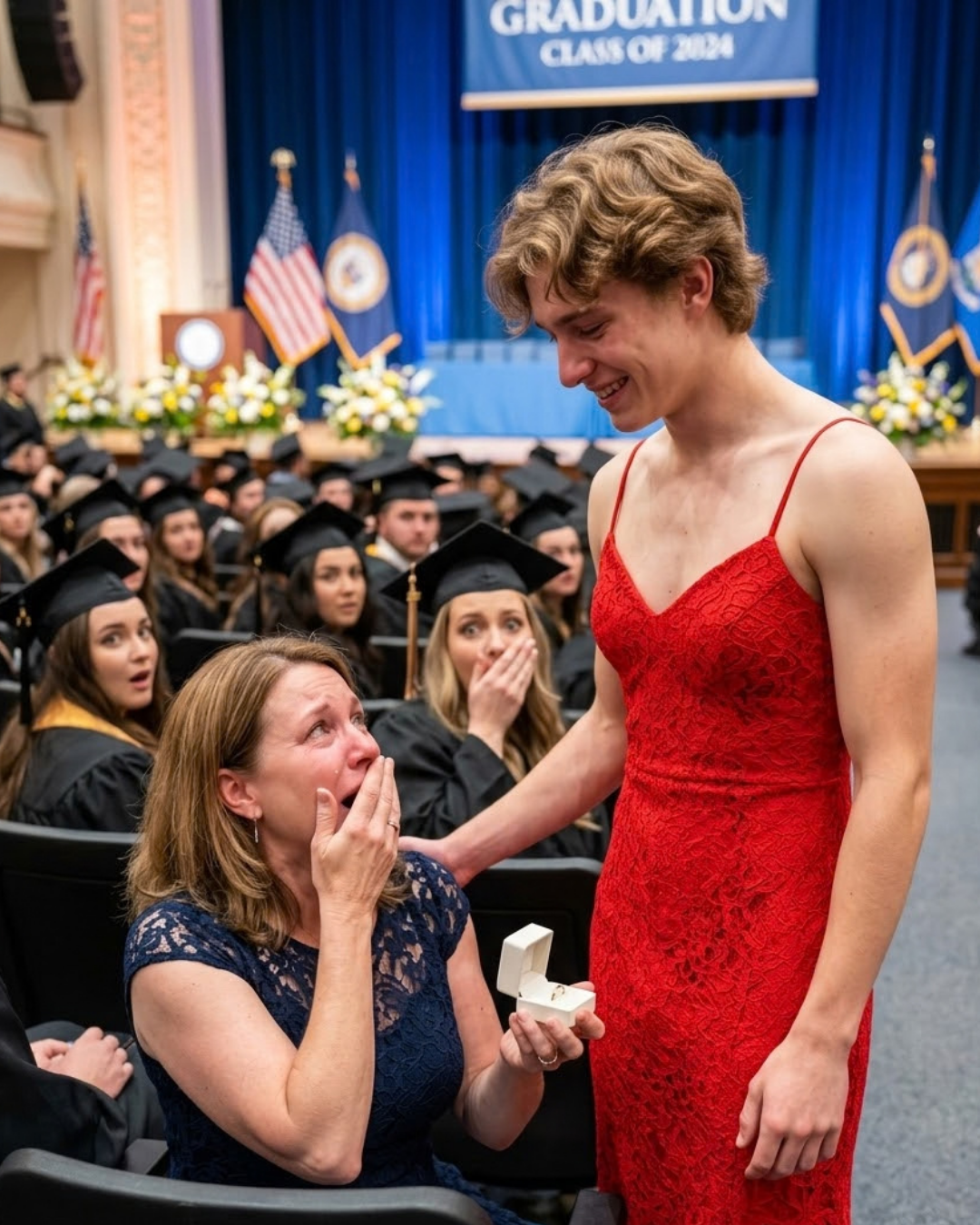
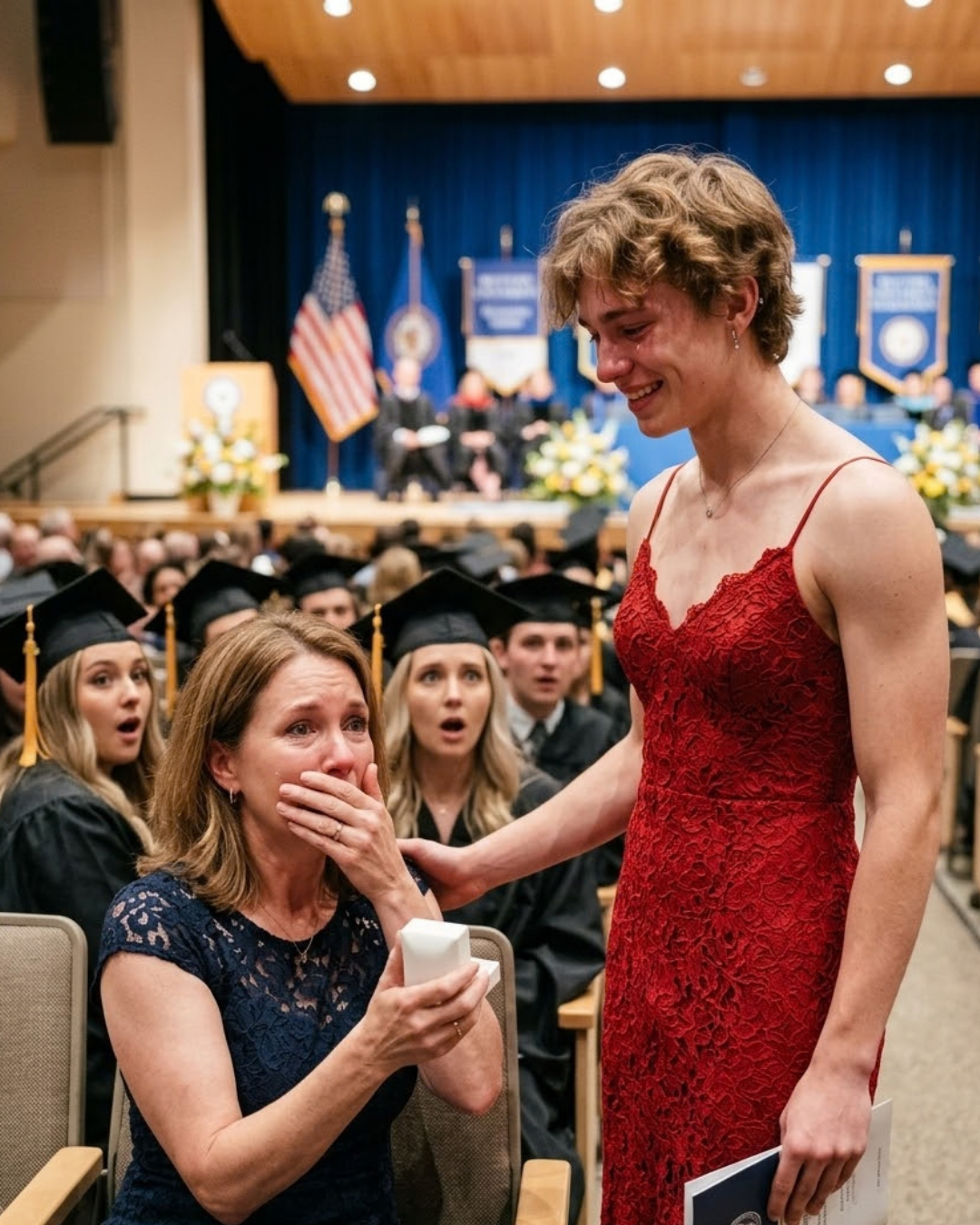
My son crossed the graduation stage in a bright red dress while hundreds of people laughed.
Someone behind me said loudly:
“What is wrong with that boy?”
I wanted to turn around.
Ethan didn’t.
He accepted his diploma, ignored the phones filming him, and walked straight down the center aisle toward me.
Then he stopped in front of my seat and whispered:
“This is for you, Mom… and for both of us.”
He reached into a hidden pocket in the dress and placed a tiny object in my hand.
The moment I saw it, I began to cry.
Because everyone believed my son was trying to make a statement.
They had no idea he was honoring a promise to someone who should have been sitting beside me that night.
And when I unfolded the letter tucked beneath the charm, I realized my son hadn’t worn that dress only for his sister.
He had worn it because three years earlier, she had asked him to help me survive something I had never admitted was still destroying me.
PART 1 – THE RED DRESS
My name is Laura Bennett.
I was forty-six years old the night my son Ethan graduated from high school.
Two weeks earlier, he came into our kitchen after midnight carrying a bright red dress.
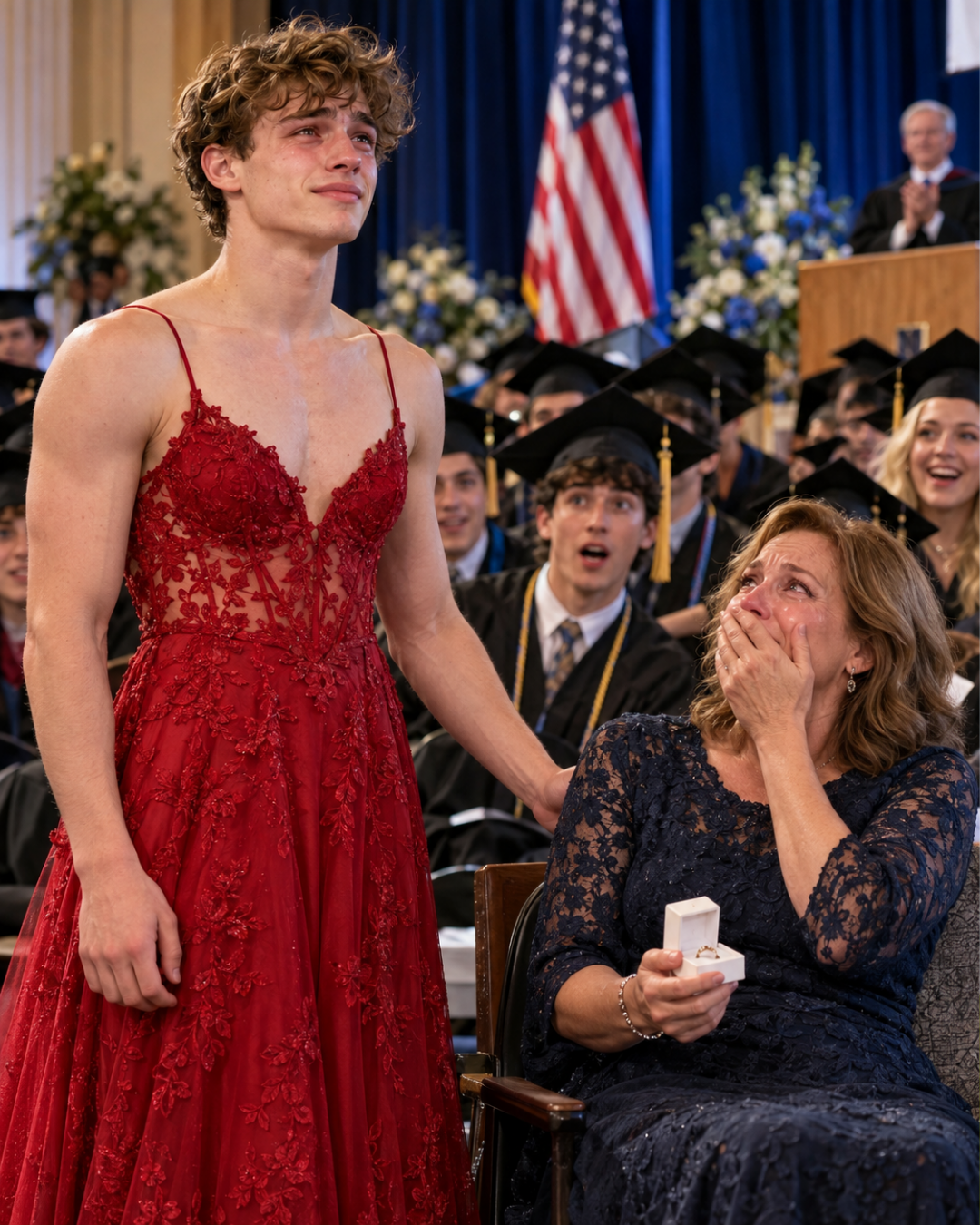
Not burgundy.
Not dark wine.
Bright red.
The kind of red that makes people turn their heads even when there is no reason to.
I stared at him.
He draped the dress over the back of a chair.
“Mom, I’m wearing this to graduation.”
I thought he was joking.
Ethan had always had a dry sense of humor.
Quiet boy.
Straight-A student.
Robotics club.
Cross-country.
The kind of kid who could deliver one sentence so seriously that you needed five seconds to realize he was teasing you.
But he wasn’t smiling.
“Ethan.”
“I’m serious.”
“Why?”
He looked at the dress.
Then at me.
“I made a promise.”
That was all.
I knew the dress.
Of course I did.
I had spent three years pretending I didn’t.
It had belonged to my daughter Sophie.
Ethan’s older sister.
Sophie should have been twenty-one that summer.
Instead, she had died at eighteen after nearly two years of treatment for leukemia.
The dress had arrived during the final winter of her life.
Still inside its garment bag.
Tag attached.
Sophie had ordered it online during one of the periods when her doctors believed she might be stable enough to return to college the following fall.
She never wore it.
After she died, I left her room almost exactly as it had been.
For months.
Then a year.
Then another.
I told people I was waiting until I was ready.
The truth was simpler.
I was afraid touching anything would confirm that she was never coming back for it.
So the red dress remained in the closet.
Until Ethan took it down.
“Please don’t,” I said.
His expression remained unchanged.
“Why?”
“Because people will laugh.”
“I know.”
“They’ll take pictures.”
“I know.”
“They’ll post them.”
“I know.”
“You may regret it.”
“I won’t.”
I hated how calm he sounded.
Not because he was wrong.
Because he sounded like Sophie.
She had been calm when everyone else panicked too.
Especially when she was sick.
I sat across from him.
“Is this about her?”
He looked down.
“Yes.”
“What promise?”
“I can’t tell you yet.”
“Why?”
“Because part of the promise is for graduation.”
I almost became angry.
Then I stopped.
Grief makes control feel tempting.
You lose one child.
Then spend years wanting to surround the other with enough rules to keep fate from noticing him.
I had already done too much of that.
So I tried another question.
“Does your father know?”
Ethan’s jaw tightened.
“No.”
Daniel and I were still married then.
Technically.
Emotionally, we had been living in separate rooms for almost two years.
Sophie’s illness had not created every problem between us.
But her death had taken away our ability to pretend those problems were small.
Daniel loved our daughter.
I need that understood.
He sat through chemotherapy.
Slept in hospital chairs.
Learned medication schedules.
Shaved his head when Sophie lost her hair the first time.
He was not a distant father.
But Daniel had one fatal weakness.
He could not tolerate helplessness.
If there was a problem, he needed a plan.
If there was pain, he needed a treatment.
If there was uncertainty, he needed someone to promise the future.
Doctors learned to be careful with him.
Sophie learned to be firmer.
I learned to absorb the arguments.
During her final months, those roles destroyed us.
When Ethan finally told Daniel about the dress, the explosion came exactly as I expected.
“No.”
Ethan stood in the living room.
The red dress folded over one arm.
Daniel stared at him.
“You are not wearing that.”
“I am.”
“It’s your graduation.”
“Yes.”
“You want hundreds of people taking videos of you like some kind of joke?”
“I don’t care.”
“I care.”
Ethan’s face hardened.
“Then don’t come.”
Daniel froze.
I said:
“Ethan.”
He looked at me.
“No, Mom.”
Then at his father.
“This is not about you.”
Daniel stood.
“You think your sister would want everyone laughing at you?”
“Yes.”
The answer came so quickly that Daniel lost his words.
Then Ethan said:
“She literally told me they would.”
That changed the room.
Daniel went pale.
“What are you talking about?”
Ethan looked down at the dress.
“I promised her.”
“When?”
“Before she died.”
“What exactly did she make you promise?”
Ethan’s eyes filled.
“I’m not telling you.”
Daniel laughed once.
Not because it was funny.
Because he was hurt.
“Of course.”
He looked at me.
“This is what happens when everybody turns Sophie into a saint whose every joke becomes a commandment.”
I flinched.
Ethan didn’t.
“She knew you’d say that too.”
Daniel’s face changed.
“What?”
Ethan went upstairs.
Daniel followed him with his eyes.
Then turned toward me.
“You’re going to let him do this?”
“He’s eighteen.”
“He is grieving.”
“So are we.”
“Three years later?”
I stared.
He realized immediately.
Bad sentence.
Very bad.
Grief does not expire because the calendar grows tired of it.
Daniel rubbed his face.
“I didn’t mean—”
“I know.”
That was the problem in our house.
Everybody knew what the other person meant.
Nobody knew how to live with what had actually been said.
Graduation night arrived.
Ethan wore the dress.
It fit badly in a way that made me cry before we even left.
Sophie had been five-foot-six.
Ethan was almost six feet.
The hem sat higher on him.
His shoulders changed the shape.
He wore black dress shoes beneath it because he refused heels.
Sophie would have found that hilarious.
Daniel stood in the doorway as Ethan came downstairs.
He stared.
Then said:
“I’m not going.”
Ethan nodded.
“Okay.”
No argument.
That hurt Daniel more than anger would have.
I drove Ethan.
At the auditorium, heads turned immediately.
A few students smiled.
A few looked confused.
One boy laughed openly.
Ethan kept walking.
The school counselor met us near the entrance.
“Ethan.”
“Yes?”
She lowered her voice.
“You still have time to choose something less distracting.”
He smiled politely.
“No, thank you.”
I almost laughed.
That was Sophie too.
Polite refusal sharper than shouting.
I sat in the third row.
Alone.
Daniel’s empty seat beside me felt enormous.
When the graduates entered, whispers moved through the room.
Then Ethan’s name was called.
“Ethan Bennett.”
He walked onto the stage.
Red fabric moved around his legs.
Someone laughed.
Then another.
A man behind me said:
“What is wrong with that boy?”
I gripped the edge of my chair.
Ethan didn’t look toward us.
He accepted his diploma.
Shook the principal’s hand.
Then, instead of returning directly to his seat, he walked down the center aisle.
Toward me.
The room grew quieter.
Phones followed him.
He stopped beside my seat.
His eyes were wet.
“This is for you, Mom.”
I stood.
Then he added:
“And for both of us.”
He reached into a pocket sewn into the dress.
I hadn’t known there was a pocket.
He placed something wrapped in tissue into my hand.
I unfolded it.
A tiny silver charm.
Hospital-bracelet shape.
Engraved on the back:
Sophie.
My knees almost gave out.
Then I saw the folded paper beneath it.
Across the top, in handwriting I hadn’t seen in nearly three years:
For Ethan’s graduation.
I knew that handwriting.
My daughter’s.
And suddenly I understood why the dress was red. Sophie bought the dress during one of her better months.
That phrase sounds strange if you have never lived through a long illness.
Better month.
Not healthy.
Not normal.
Just better.
Her counts were improving.
She had energy.
She talked about going back to school.
She ordered ridiculous things online because being eighteen and sick did not stop her from being eighteen.
The red dress was one of them.
Ethan was fourteen then.
One afternoon, he sat beside her hospital bed working on algebra.
Sophie showed him the photo.
“I’m wearing this when you graduate.”
Ethan laughed.
“That’s four years away.”
“I know.”
“You’ll be ancient.”
“I’ll be twenty-two.”
“Basically dead.”
She threw a tissue box at him.
Months later, when treatment stopped working, Sophie changed the joke.
“If I can’t go, you have to make sure something red crosses that stage.”
Ethan promised a red tie.
She said:
“Coward.”
He promised red shoes.
“Boring.”
Then, according to him, she looked toward the dress hanging in the closet at home.
“You know what would be funny?”
“No.”
“You wearing my dress.”
He told her absolutely not.
She made him promise anyway.
At fourteen, Ethan probably thought saying yes would end the conversation.
He didn’t understand that Sophie was making memory plans.
People who know they may die become strange architects.
They place pieces of themselves into future rooms.
Birthdays.
Graduations.
Weddings.
Songs.
Recipes.
Objects.
Things to be discovered later.
What neither Daniel nor I knew was that Sophie had also written Ethan a letter.
She didn’t leave it with us.
She gave it to Claire Donnelly, one of the pediatric oncology nurses who had cared for her through multiple admissions.
Sophie’s instructions were clear.
Give it to Ethan after he turned eighteen.
Not before.
Claire kept it in a sealed envelope inside her personal safe with a note identifying the circumstances.
After Ethan’s eighteenth birthday, she contacted him privately.
She gave him the letter.
He told no one.
Not me.
Not Daniel.
The first paragraph was classic Sophie.
Hey, idiot. If Claire actually gave you this, congratulations on becoming technically an adult. Please do not become boring.
Even through tears, I smiled.
Then:
If I’m somehow alive when you read this, burn it immediately because I will never recover from the embarrassment.
She wasn’t alive.
So he continued reading.
Sophie reminded him of the graduation promise.
Then came the sentence Ethan had quoted to Daniel.
If Dad tells you not to do it because people will laugh, remember that strangers laugh for a few seconds. Regret lasts much longer.
Daniel had heard that line only two weeks before graduation.
That was why he refused to come.
Not simply because Ethan wore a dress.
Because Sophie had predicted him.
She had preserved his worst instinct in a sentence years after her death.
He felt accused by someone he could no longer argue with.
But the final paragraph wasn’t about him.
It was about me.
Ethan had folded that portion separately.
He placed it into my hand in the auditorium.
I read:
One more thing. Mom is going to tell everyone she’s okay. She’s going to clean things, feed people, answer doctors, organize papers, and keep moving because that’s what she does when she’s falling apart. Don’t believe her every time.
My vision blurred.
Then:
If I die, she will think she failed me. She didn’t.
I stopped breathing.
Because Sophie was right.
For three years, I had believed exactly that.
The guilt came from one decision.
One impossible decision.
During Sophie’s final hospitalization, the doctors told us the leukemia was progressing despite treatment.
There was another experimental option.
A trial in another state.
Low chance of benefit.
High burden.
Sophie was exhausted.
She told me privately:
“I don’t want another hospital.”
Daniel wanted the trial.
Desperately.
He researched it.
Called specialists.
Spoke with another family.
He saw possibility.
Sophie saw more needles.
More vomiting.
More weeks away from home.
More dying in another building.
She asked me to support her decision to stop disease-directed treatment and enter hospice.
She was eighteen.
Legally an adult.
Medically capable of making her own decision.
Still our child.
Daniel believed she was giving up.
I believed she knew what she could endure.
We fought.
Sophie chose hospice.
She died five weeks later at home.
Daniel never said:
You killed her.
Not exactly.
He said:
“We should have tried.”
And:
“We had one more option.”
And once, during the worst fight of our marriage:
“You made it too easy for her to quit.”
That sentence stayed inside me for three years.
Sophie knew.
Apparently, she had known before she died that Daniel might blame me.
So she wrote:
Mom did not choose whether I lived or died. Cancer did that. Mom helped me choose how much more suffering I was willing to accept. There is a difference.
I covered my mouth.
People around us in the auditorium had stopped laughing.
Some were still recording.
I didn’t care anymore.
Then:
Ethan, when you graduate, give Mom the bracelet charm. Tell her it is not a receipt for something she owes me. It is proof that I was here. That is all.
I sobbed then.
Not quietly.
Ethan knelt beside me.
I kept reading.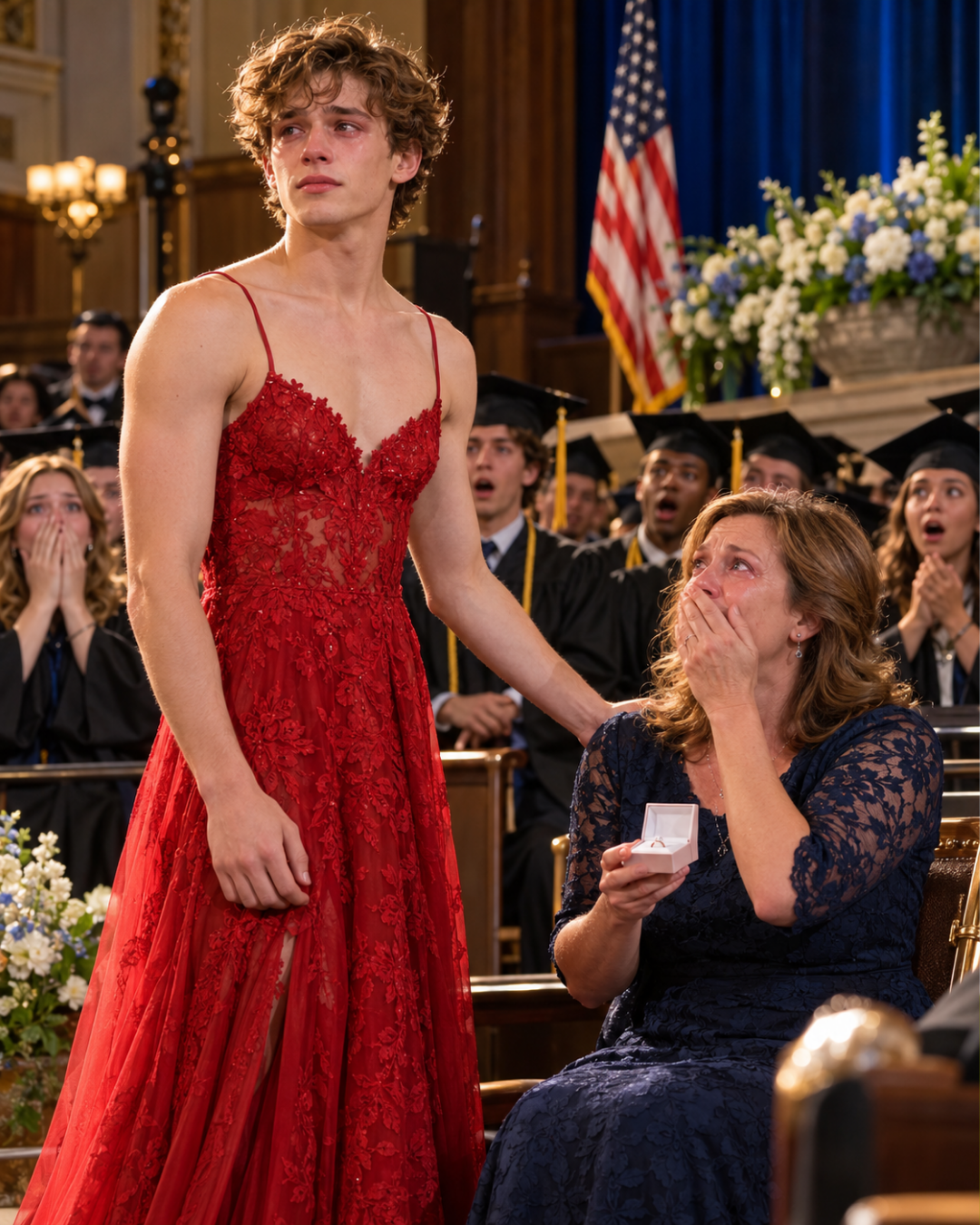
And make her do something she stopped doing because of me. She’ll know what I mean. If she pretends she doesn’t, remind her about the red piano bench.
The red piano bench.
I closed my eyes.
Before Sophie became ill, I taught piano lessons from our home.
Not professionally full-time.
Ten students.
Mostly children.
I loved it.
During Sophie’s treatment, I stopped.
After she died, I never started again.
The piano stayed closed.
The red bench collected dust.
Sophie’s final promise for Ethan wasn’t:
Make Mom forgive Dad.
Not:
Keep the family together.
It was:
Make her live again.
I looked at my son.
“That’s what you meant?”
He nodded.
“For both of us.”
He wiped his face.
“She said I wasn’t allowed to let us become a house where nobody did anything because she died.”
That line broke me.
Because that was exactly what we had become. By the next morning, Ethan’s graduation had turned into a small local social-media spectacle.
Not national news.
Not millions of people.
Enough.
A clip of him walking across the stage in Sophie’s red dress was shared hundreds of times.
Some captions were kind.
Brother honors late sister at graduation.
Others were cruel.
What is happening to boys?
Graduation is not the place for this nonsense.
People who knew nothing about Sophie made up their own explanations.
Politics.
Identity.
Rebellion.
Attention.
Ethan read some of them.
I asked him to stop.
He said:
“I’m okay.”
I almost repeated the family curse.
You’re strong.
Instead, I asked:
“Do you want me to sit with you?”
He nodded.
So we sat together.
He showed me the worst comments.
Some hurt.
Some were so ridiculous that we laughed.
Then another video appeared from a different angle.
A student had recorded Ethan walking toward me.
You could see him place the charm in my hand.
You could see me recognize Sophie’s handwriting.
The caption had been changed:
Before you laugh, maybe ask why.
That one spread too.
Still, Ethan didn’t issue a statement.
He didn’t owe strangers an explanation.
The school principal called.
He apologized for some of the behavior from the audience.
Then asked whether Ethan wanted the school to post the “real story.”
Ethan said no.
“Why?”
“Because Sophie isn’t content.”
I was proud of him.
Then Daniel called.
He had seen the videos.
I almost didn’t answer.
He asked:
“Did he give you the letter?”
“Yes.”
Silence.
“All of it?”
“Yes.”
Another silence.
“What did she say about me?”
That question told me exactly where Daniel’s mind had gone.
Not:
How are you?
Not:
How did Ethan handle the laughter?
What did Sophie say about me?
I said:
“You should ask Ethan.”
“He won’t talk to me.”
“Then maybe wait until he wants to.”
Daniel became angry.
“She left a letter involving me.”
“She left a letter to Ethan.”
“I’m his father.”
“He is eighteen.”
“I have a right—”
“No.”
The word surprised both of us.
Daniel stopped.
I continued.
“You do not have a right to Sophie’s private words because they make you uncomfortable.”
He breathed heavily.
Then:
“Did she blame me?”
I thought about the line.
If Dad tells you not to do it…
“Some of it will hurt.”
He laughed bitterly.
“Of course.”
“But no, Sophie did not write a letter about how terrible you were.”
“Then why won’t you tell me?”
“Because Ethan gets to decide.”
Daniel hung up.
Old Daniel.
If information existed, he needed control of it.
Later that afternoon, Ethan came downstairs.
“Dad texted me.”
“What did he say?”
“He wants the letter.”
“Do you want to give it to him?”
“No.”
“Okay.”
He stared at me.
“You’re not going to tell me I should?”
“No.”
That surprised him.
Then he smiled.
Tiny.
Progress.
Two days later, Claire Donnelly called me.
The nurse.
Sophie’s nurse.
I hadn’t spoken to her in years.
She said:
“I saw the graduation video.”
I started crying immediately.
She let me.
Then:
“Sophie would have laughed until she couldn’t breathe.”
“I know.”
“She was very proud of that dress.”
“I know.”
Claire told me something Ethan hadn’t.
Sophie wrote more than one letter.
Not many.
Three.
One for Ethan.
One for me.
One for Daniel.
My hands began shaking.
“Where are they?”
“Still with me.”
“Why?”
“Because her instructions were different.”
My letter was to be given only if I asked Claire directly whether Sophie had left anything for me.
Daniel’s was to be given if he ever contacted Claire without being prompted by someone else.
Sophie had designed a test.
Not a cruel one.
A revealing one.
Would we seek her?
Or only react when someone put her in front of us?
I asked:
“Did she leave me something?”
Claire became quiet.
“Yes.”
The next day, she brought it to my house.
The envelope had my name.
Sophie’s handwriting.
I held it for almost an hour before opening it.
The first sentence:
Mom, if you are reading this, you finally asked for something instead of waiting for everyone else to need you. Good.
I laughed through tears.
Then cried harder. Sophie’s letter to me was six pages.
She had written it over several days because her hands had grown weak.
Some lines were neat.
Others were shaky.
She began with ordinary things.
Thank you for washing my hair after chemo.
Sorry about the time I threw up in the car and blamed the smell on Ethan.
Please give my green sweater to Aunt Molly because she always stole it anyway.
Then she became serious.
I know you think hospice means you agreed to lose me. It doesn’t.
I stopped.
Read it again.
I chose it.
Dr. Patel explained everything. I understood the trial. I understood the odds. I understood what Dad wanted. I understood what you wanted too, even though you tried not to tell me.
What did I want?
I had spent years telling myself that I wanted Sophie to choose freely.
That was true.
But Sophie knew me.
You wanted one more Christmas. One more birthday. One more anything. You just didn’t make me pay for your wanting it.
I could barely see.
That sentence accomplished what years of therapy had not.
It separated desire from obligation.
Of course I wanted Sophie alive.
Supporting hospice didn’t mean I wanted less life.
It meant I refused to make her suffering prove my love.
She continued.
Dad loved me too. He just thought love meant fighting until there was literally nothing left to try.
Then:
Please don’t hate him forever for that. But also don’t let him blame you.
Balanced.
Very Sophie.
Then she mentioned the red piano bench.
You stopped teaching because you said the noise bothered me during treatment. That was true for maybe three weeks. After that, I wanted you to start again and you kept saying later. If I die, later is going to become never unless someone annoys you. Ethan is excellent at annoying you. I have assigned him this job.
I laughed.
Ethan, listening from across the room, raised both hands.
“Direct orders.”
“Apparently.”
The final page said:
I don’t need a shrine. I don’t need my room frozen. I don’t need everybody to be sad correctly. I need you to remember that loving someone who died does not require joining them halfway.
That sentence stayed with me.
Stay all the way alive.
I folded the letter.
Then sat on the floor.
Ethan joined me.
For years, I had told myself I was functioning.
I worked.
Cooked.
Paid bills.
Went to Ethan’s races.
Remembered birthdays.
That looked like living.
Sophie’s letter showed me the difference.
Functioning is not always participation.
I had removed every part of my life that felt unnecessary.
Music.
Friends.
Travel.
Anything joyful enough to create contrast with grief.
As if enjoying anything would insult her.
Ethan knew.
That was why he said:
“This is for both of us.”
He had stopped living too.
After Sophie died, he quit theater.
Stopped inviting friends over.
Became academically perfect.
Never got into trouble.
Never demanded anything.
My “easy child.”
I suddenly hated that phrase.
“Why did you quit theater?”
He looked surprised.
“What?”
“After Sophie.”
“I don’t know.”
“Yes, you do.”
He thought for a moment.
Then:
“Dad was always upset.”
“And me?”
“You were tired.”
“So?”
He looked down.
“I thought somebody had to stop needing things.”
My chest hurt.
There it was.
While Daniel and I drowned in our separate grief, Ethan made himself smaller.
Fourteen years old.
Dead sister.
Fighting parents.
He decided the kindest thing he could do was become low-maintenance.
I had praised him for being mature.
I wanted to apologize immediately.
Then I remembered something from grief counseling.
Do not ask children to reassure you about your failures.
So I said:
“You should not have had to do that.”
He nodded.
“I know now.”
“Did Sophie know?”
“Probably.”
Of course.
Then Ethan smiled.
“She told me if I turned into one of those guys who says ‘I’m fine’ while clearly not fine, she would haunt me.”
“That sounds like her.”
“She also said she would make the lights flicker.”
Right then, the kitchen light flickered.
We both froze.
Then burst out laughing.
Bad wiring.
Probably.
I didn’t care.
That weekend, Ethan and I opened Sophie’s room.
Not dramatically.
We had gone inside over the years.
But this time, we began sorting.
Keep.
Donate.
Family.
Trash.
The red dress stayed.
Ethan asked:
“What do you want to do with it?”
I touched the fabric.
“Not decide today.”
“Good.”
Choice without urgency.
We found Sophie’s old sheet music.
Then my teaching notebooks.
Then the piano keys beneath a layer of dust.
I sat on the red bench.
Played one scale.
Terrible.
Another.
Ethan leaned against the doorway.
“You’re rusty.”
“Leave.”
He smiled.
“No.”
That was the first time music entered our house in three years.
Daniel heard about it from Ethan.
He didn’t come home.
He was living in an apartment by then.
Our separation became official the following month. Daniel waited nineteen days before calling Claire.
I know because Claire told me later.
Not what he said.
Only that he had called.
She gave him Sophie’s envelope.
He didn’t contact us again for another week.
Then he asked Ethan to meet.
Ethan agreed only if I came too.
Daniel looked hurt by that.
He accepted it.
We met at a quiet diner.
Neutral ground.
Daniel had Sophie’s letter folded inside his jacket.
He looked exhausted.
“Did you read yours?”
I asked.
“Yes.”
Ethan stared at him.
“What did she say?”
Daniel almost smiled.
“You’re asking?”
“Yes.”
“So now I’m allowed to keep letters private?”
Fair shot.
Ethan looked down.
Daniel softened.
“Sorry.”
Then he pulled the letter out.
“I want to tell you.”
Sophie’s letter to Daniel was shorter than mine.
Four pages.
The opening line:
Dad, please stop researching for five minutes.
I laughed.
Daniel did too.
Then he cried.
She wrote about how safe he had made her feel as a child.
How he fixed bicycles.
Stayed beside her after her first biopsy.
Carried her downstairs when treatment made her too weak.
She didn’t erase his goodness.
Then:
You made me feel like dying meant I wasn’t trying hard enough.
Daniel stopped reading.
Ethan stared at the table.
Daniel continued.
I know you didn’t mean that. But every time you found another study, another hospital, another doctor, I started feeling like saying “I’m tired” was something I had to apologize for.
Daniel’s voice broke.
Then:
Mom wasn’t against you. She was listening to me. Please don’t punish her for hearing something you couldn’t hear yet.
I looked away.
Three years.
One sentence from the dead daughter we both loved, and the argument that had consumed our marriage suddenly looked painfully simple.
Daniel wanted survival.
I wanted Sophie’s choice respected.
Both came from love.
Only one of us had turned that difference into blame afterward.
Sophie wrote:
You told me once parents are supposed to fight for their children. Sometimes fighting for me meant letting me stop fighting my body. I know that is unfair. I’m sorry.
Daniel shook his head.
“No.”
As if Sophie were sitting there.
“No, baby.”
Then came the graduation part.
Ethan is going to do something stupid in my dress. Let him.
We all laughed.
Then:
If people laugh, sit there anyway. You spent my whole life telling us family shows up. Don’t change the rule because showing up is embarrassing.
Daniel stopped.
That was why he hadn’t attended.
And Sophie knew.
His shame filled the diner.
He looked at Ethan.
“I failed that.”
Ethan said nothing.
Daniel continued.
“I thought I was protecting you.”
“From what?”
“Humiliation.”
“I knew people would laugh.”
“I know.”
“You thought I didn’t understand?”
Daniel closed his eyes.
“Yes.”
Ethan leaned back.
“So you made it about what you could tolerate.”
That was a brutal sentence.
Daniel accepted it.
“Yes.”
Then:
“I’m sorry.”
Ethan asked:
“For missing graduation or for trying to stop me?”
“Both.”
Good.
No partial apology.
Then Daniel looked at me.
“I blamed you for hospice.”
“Yes.”
“I knew Sophie chose.”
“Yes.”
“I knew medically.”
That distinction mattered.
He had understood the facts.
Not emotionally.
“I kept thinking if you had argued harder, she might have tried the trial.”
“Maybe.”
Daniel flinched.
I continued.
“Maybe she would have.”
“Maybe it would have given us another month.”
“Maybe.”
“Maybe it would have made her sicker.”
“Yes.”
“None of us can know.”
“No.”
For three years, I had defended myself by saying the trial probably wouldn’t have worked.
That wasn’t the real issue.
Maybe it would have.
The issue was that Sophie had the right to decline.
Daniel whispered:
“I made you carry my uncertainty.”
I started crying.
“Yes.”
That was it.
He couldn’t live with not knowing whether another treatment might have helped.
So he turned uncertainty into blame.
If I had been wrong, then he didn’t have to accept that sometimes there is no answer.
Ethan looked at both of us.
“Can I say something terrible?”
Daniel nodded.
“Go ahead.”
“I’m tired of Sophie being the smartest person in this family and she’s dead.”
For one second, silence.
Then all three of us laughed so hard the waitress looked concerned.
It was the first real laugh Daniel and I had shared in years.
It didn’t save our marriage.
That mattered too.
Truth can heal something without restoring its old shape. The graduation video kept circulating.
Then the school district communications office contacted us.
They wanted permission to share Ethan’s story.
“Positive message about compassion and remembrance.”
Ethan refused.
They asked again.
He refused again.
Then a local television producer called.
Then a podcast.
Then a clothing company offered to donate dresses to a charity if Ethan appeared in a campaign.
That one made him furious.
“I wore Sophie’s dress because it was Sophie’s.”
“I know.”
“Not because I’m the dress guy.”
“I know.”
People love turning private grief into a public lesson.
Sometimes that can help.
Sometimes it takes the event away from you a second time.
Ethan wanted nothing to do with it.
His best friend, Caleb, eventually called.
This was the friend who had stopped responding before graduation.
Caleb came to our house.
He looked embarrassed.
“I’m sorry.”
Ethan stood in the doorway.
“For?”
“I thought you were doing it for attention.”
“At graduation?”
“Yes.”
“You didn’t ask?”
“No.”
“Why?”
Caleb looked down.
“Because I knew people would talk about you and I didn’t want to get dragged into it.”
There it was.
Teenage cowardice.
Ordinary.
Not monstrous.
Ethan said:
“You could have said that.”
“I know.”
“Instead you disappeared.”
“I know.”
Then Caleb looked at the red dress hanging behind the laundry-room door.
“I didn’t know about Sophie.”
“You knew she died.”
“I didn’t know about the promise.”
“You didn’t ask.”
Caleb nodded.
“Yeah.”
Ethan didn’t hug him.
Didn’t immediately restore the friendship.
He said:
“I need time.”
Caleb answered:
“Okay.”
They eventually became friends again.
Slowly.
Not because one apology erased abandonment.
Because Caleb began showing up.
That became a pattern in our lives.
Daniel showed up too.
He had missed graduation.
He couldn’t undo that.
So he stopped asking Ethan to minimize it.
When the graduation photos arrived, Daniel asked for one.
Ethan sent him the official stage photograph.
Red dress.
Diploma.
Daniel framed it in his apartment.
Not hidden.
When one of his coworkers asked, he told the truth.
“My son wore his late sister’s dress to keep a promise.”
No defensive joke.
No explanation that Ethan was normally masculine.
No attempt to control how others interpreted him.
That mattered.
Meanwhile, I restarted piano lessons.
One student.
A seven-year-old named Grace who hit the keys as though punishing them.
Then three students.
Then six.
The first afternoon the house filled with bad scales, I cried in the laundry room.
Ethan found me.
“You okay?”
“No.”
“Want me to make them stop?”
I laughed.
“No.”
Then:
“This is exactly what Sophie wanted.”
“I know.”
That made it harder.
Joy after grief can hurt because it proves that life continued.
During the first months, every lesson felt like betrayal.
Then less.
Eventually, music became music again.
I also moved Sophie’s clothes.
Not all.
Some.
We donated jackets.
Jeans.
Shoes.
Ethan kept the red dress.
I kept her green sweater.
Daniel asked for her old baseball cap.
Nobody fought over objects.
That felt like progress.
Then, six months after graduation, Ethan asked:
“Can we give the charm to Dad for one night?”
The hospital-bracelet charm.
I looked at him.
“Why?”
“He never held it.”
That stopped me.
The charm had been made from a cast of Sophie’s real hospital bracelet by a local jeweler Claire knew.
Sophie had ordered it before she died.
One side:
Sophie.
The other:
Still here.
I had never noticed the second engraving until weeks after graduation.
Ethan wanted Daniel to see it.
He gave it to him over dinner.
Daniel held the charm for almost ten minutes.
Then said:
“I thought I had to keep fighting because if I stopped, she would disappear.”
Ethan answered:
“She disappeared anyway.”
Daniel closed his eyes.
Then Ethan added:
“But not all the way.”
Daniel cried.
That was the first time I understood the charm too.
Sophie wasn’t “still here” because we preserved her room.
Or because we refused to move forward.
She was still here because love leaves influence.
Not instructions forever.
Influence.
The difference mattered. People assumed Sophie’s letters would bring Daniel and me back together.
They didn’t.
That surprised our relatives.
Especially my mother.
She said:
“But now you understand each other.”
Yes.
Understanding is not the same as wanting the marriage again.
Daniel and I had hurt each other for years before Sophie became sick.
We avoided difficult conversations.
He solved.
I absorbed.
He pushed.
I withdrew.
Then the crisis amplified everything.
Sophie’s illness turned our habits into weapons.
Her death finished what denial had been holding together.
The letters gave us compassion.
Not compatibility.
We separated formally seven months after Ethan graduated.
Filed for divorce three months later.
No dramatic affair.
No hidden money.
No villain.
We divided the house carefully.
Daniel moved permanently into his apartment.
I refinanced and stayed because the piano students were already coming there, and Ethan wanted one stable home through his first year of college.
Our finances were ordinary enough.
Retirement accounts.
Home equity.
Cars.
College savings.
Lawyers helped.
Nobody “won.”
That was important.
During mediation, Daniel asked:
“Do you think if Sophie hadn’t gotten sick, we’d still be married?”
I thought about it.
“Maybe.”
He looked relieved.
Then I continued.
“I don’t know if that would have meant we were happy.”
That hurt.
But truth isn’t always comforting.
He nodded.
“I think you’re right.”
We signed the final papers quietly.
Then got coffee.
People thought that was strange.
We had spent twenty-three years together.
Divorce didn’t erase every good thing.
Daniel said:
“I’m sorry I made hospice your decision.”
“It wasn’t mine.”
“I know.”
He smiled sadly.
“That’s what I mean.”
Then:
“Thank you for letting me be angry as long as you did.”
I shook my head.
“I shouldn’t have.”
He looked surprised.
“I thought absorbing it was love.”
There it was.
Our pattern.
Daniel solved.
I absorbed.
Sophie refused both.
Maybe that was why she understood us so clearly.
Ethan left for college in the fall.
He studied mechanical engineering.
No theater.
At first.
Then, during sophomore year, he auditioned for a campus production because a roommate dared him.
He got a supporting role.
I attended opening night.
Daniel attended too.
Separate seats.
Same row.
Afterward, Ethan found us in the lobby.
“Do not make this emotional.”
I hugged him anyway.
Daniel said:
“Your sister would be unbearable right now.”
Ethan laughed.
“She’d tell everyone she caused it.”
“She probably did.”
For the first time, saying Sophie’s name didn’t silence the room.
That felt like recovery.
Not forgetting.
Not moving on.
Integrating.
The therapist used that word.
I used to hate therapy words.
Now I understood why some existed. Claire Donnelly became part of our family in a way none of us expected.
After graduation, I asked her why Sophie had trusted her with the letters.
Claire smiled.
“Because I was not emotionally involved enough to interfere.”
Fair.
Sophie had apparently considered giving them to my sister Molly.
Then rejected the idea because:
“Aunt Molly will cave after Mom cries twice.”
Accurate.
Claire had promised:
No early delivery.
No telling us the letters existed.
No editing.
No deciding Sophie’s plan was too dramatic.
That must have been difficult.
After Sophie died, Claire saw us at the funeral.
She hugged me while carrying words from my dead daughter that she was forbidden to give me.
I asked:
“How did you do that?”
“Badly.”
She laughed softly.
“I went home and cried.”
Then:
“I almost broke the promise once.”
“When?”
“Your first wedding anniversary after Sophie died.”
Daniel and I had canceled dinner.
We spent the evening separately.
Claire heard through another nurse who remained friends with our family.
She almost drove over with both letters.
Then stopped.
“Sophie wanted you to ask.”
I used to think that was cruel.
Eventually, I understood.
Sophie had spent her final year watching all of us react.
Treatments decided the schedule.
Doctors entered rooms.
Family members gave advice.
Everyone anticipated needs.
She wanted one thing after her death to require us to choose.
Ask.
Seek.
Participate.
Daniel’s instruction was even more revealing.
He had to call Claire himself.
Not because someone told him.
It took the graduation dress to remind him that Claire existed.
But he eventually called.
That counted.
Claire also told me about Sophie’s final week.
There were details I had forgotten.
One afternoon, Sophie woke after sleeping most of the day.
She asked:
“Is Mom teaching piano?”
Claire said no.
Sophie rolled her eyes.
“She’s going to be annoying about this.”
Claire asked what she meant.
Sophie said:
“She thinks stopping her life makes mine longer.”
That sentence hurt.
Then Claire told me something else.
Sophie had been afraid I would turn her into a reason not to love anything deeply again.
Not only piano.
People.
Places.
The future.
She told Claire:
“Mom thinks grief is a debt.”
I sat quietly.
Because yes.
For years, every enjoyable thing felt like spending money that belonged to Sophie.
A vacation?
How dare I.
New clothes?
She would never buy anything again.
Laughing?
She was dead.
Love grief long enough and guilt becomes superstitious.
You begin believing sadness maintains connection.
Claire said:
“Sophie did not want that.”
I knew.
Still hard.
So I started small.
A weekend trip with my friend Melissa.
I almost canceled.
Didn’t.
Dinner at a restaurant Sophie loved.
I cried during dessert.
Still stayed.
I dated once.
Too soon.
Then again a year later.
A man named David who taught history at a community college.
After our third date, I told him about Sophie.
He didn’t say:
“Everything happens for a reason.”
Good.
He said:
“I’m sorry.”
Then asked:
“What was she like?”
Best question.
I talked for forty minutes.
We dated for almost two years.
It didn’t become permanent.
Still worthwhile.
That was another lesson.
Not everything valuable has to last forever. Four years after Ethan crossed the stage in the red dress, he graduated again.
College this time.
He called six weeks before commencement.
“Mom.”
“Yes?”
“I need to discuss clothes.”
I almost dropped the phone.
“No.”
He laughed.
“I’m wearing a suit.”
“Thank God.”
“Red tie.”
I became quiet.
“That’s what you originally promised Sophie.”
“I know.”
“Why not the dress?”
“Because the promise was high school.”
Fair.
Then:
“And because I’ve grown another inch.”
“Also fair.”
Daniel attended.
So did I.
We sat beside each other.
Not because we had reconciled.
Because our son had two parents.
Daniel wore a red pocket square.
His idea.
I wore Sophie’s green sweater beneath my coat even though it was too warm.
My choice.
Claire attended too.
When Ethan’s name was called, there was applause.
No laughter.
He crossed the stage.
Red tie.
Diploma.
Same calm walk.
This time, he returned to his seat.
No hidden object.
No letter.
No dramatic reveal.
I loved that.
Not every milestone needed Sophie physically inserted into it.
She had taught us to live.
Eventually, that meant allowing some days to belong to Ethan alone.
Afterward, Daniel asked him:
“Did you think about her up there?”
Ethan nodded.
“For a second.”
Daniel smiled.
“That’s enough.”
Years earlier, he might have expected grief to dominate.
Now he understood that love could be present without controlling the entire room.
We took photographs.
One of Ethan with me.
One with Daniel.
One with both of us.
One with Claire.
Then Ethan said:
“Okay. I’m done graduating.”
I laughed.
“Graduate school?”
“No.”
“PhD?”
“I’d rather die.”
Daniel and I said simultaneously:
“Bad phrase.”
All three of us froze.
Then Ethan smiled.
“Sorry.”
We laughed.
Even death language had once felt forbidden.
Now it was just language again.
That afternoon, Ethan gave me something.
Not from Sophie.
From him.
A small red notebook.
Inside, on the first page, he had written:
Things We Are Allowed to Do Without Feeling Guilty
I stared.
“What is this?”
He grinned.
“A list.”
Page one:
Mom teaches piano.
Dad goes to baseball games without saying Sophie should be there.
Ethan wears normal clothes to graduations.
I laughed.
Next:
We celebrate birthdays.
We go on trips.
We complain about stupid problems even though worse things have happened.
We say Sophie’s name.
We sometimes don’t.
Then the final line:
We keep living because she asked, not because we’re leaving her behind.
I hugged him.
No audience.
No phones.
Just us. Five years after high-school graduation, the red dress was still in my house.
Not in Sophie’s closet.
That room had changed.
I turned it into a music room and guest bedroom.
Her photographs remained.
Her books were mixed with mine.
The red dress hung in a garment bag inside a hall closet.
Not a shrine.
Not trash.
Memory.
Ethan was twenty-three.
Working for an engineering firm in Denver.
Daniel had remarried.
Her name was Caroline.
A pediatric physical therapist.
I liked her.
That surprised everybody except me.
She made Daniel softer without pretending his past had disappeared.
Before proposing, he told her about Sophie.
Hospice.
Our marriage.
The things he said afterward.
Graduation.
The letter.
All of it.
Caroline apparently asked:
“What did you learn?”
Daniel told me his answer later.
“That love does not give me the right to decide what fear somebody else should tolerate.”
Good answer.
I was not remarried.
Not lonely either.
Those are different.
I taught twelve piano students.
Three afternoons a week.
Worked part-time at the public library.
Traveled.
Had friends.
Dated when I wanted.
Didn’t when I didn’t.
On Sophie’s twenty-sixth birthday, Ethan came home.
We made her favorite lemon cake.
Daniel and Caroline came too.
So did Claire.
Nobody wore black.
Nobody gave a speech.
At some point, Ethan disappeared into the hall.
Then returned carrying the garment bag.
I stared.
“What are you doing?”
“Decision day.”
“What decision?”
“The dress.”
I looked at him.
For five years, we had never decided what to do with it.
Keep forever?
Donate?
Alter?
Store?
Ethan unzipped the bag.
The fabric was still bright.
He smiled.
“I’m not wearing it again.”
“Good.”
Daniel laughed.
Then Ethan said:
“I think Sophie would hate it sitting in plastic forever.”
Probably true.
Claire asked:
“What do you want to do?”
Ethan looked at me.
I knew.
There was a nonprofit in our city that provided formal clothing to teenagers who couldn’t afford prom dresses, graduation outfits, or interview attire.
I had donated piano-student clothes there before.
The red dress would fit someone.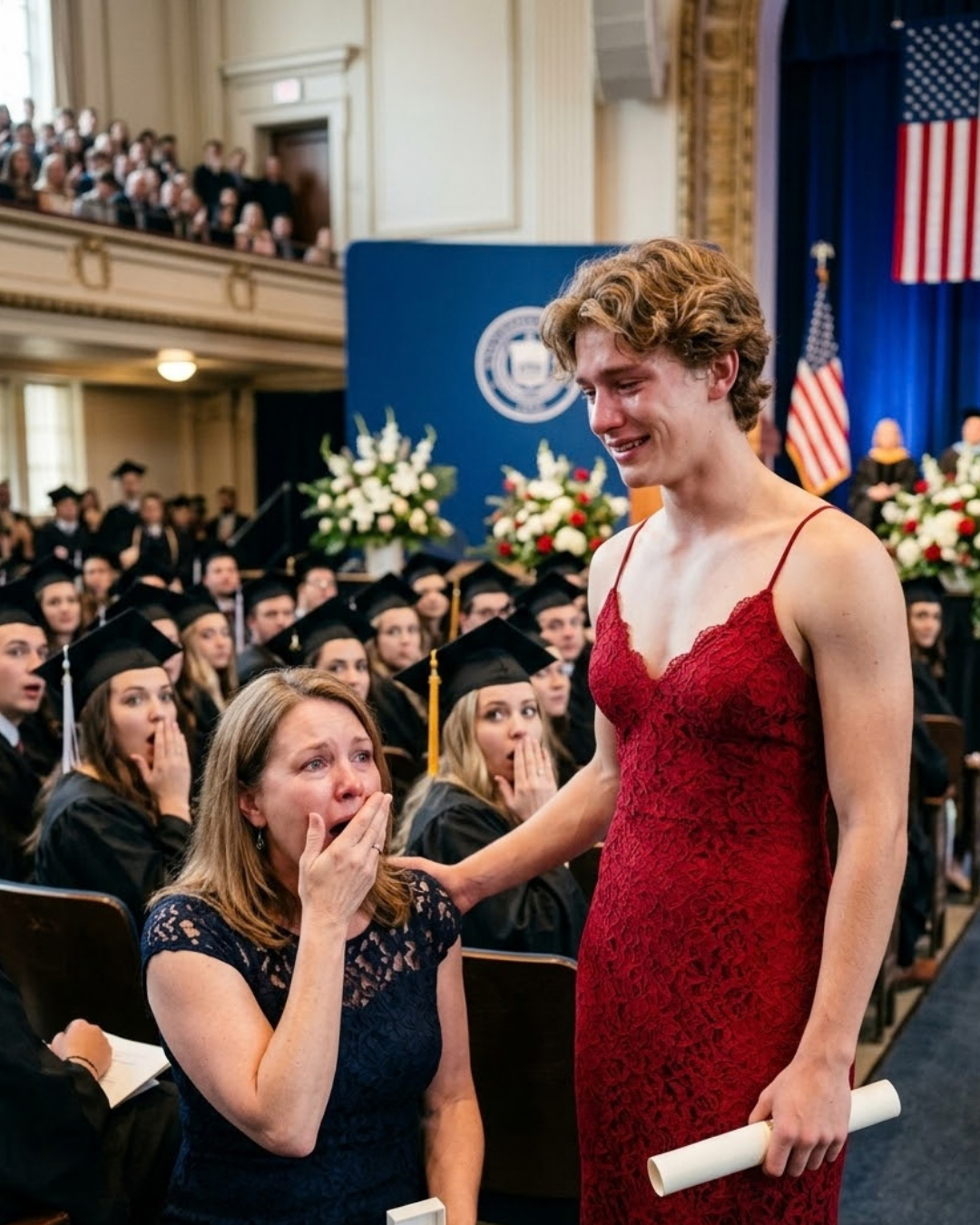
Eventually.
I touched the fabric.
My chest tightened.
For a second, I was back in Sophie’s bedroom.
Tag attached.
Her saying maybe next year.
Then Ethan at graduation.
Laughter.
Charm in my hand.
Letter.
Red.
So much red.
I asked:
“Are you sure?”
Ethan smiled.
“Mom, it was never about keeping the dress.”
I started crying.
Of course.
He was right.
The promise had already been kept.
The dress crossed the stage.
Sophie had been there in the only way she could be.
Keeping the fabric imprisoned wouldn’t extend the moment.
So we donated it.
No ceremony.
No plaque saying:
In memory of Sophie Bennett.
Anonymous.
Two months later, the nonprofit director sent a generic thank-you email with a photograph of several donated dresses hanging on racks.
I thought I saw Sophie’s red one near the back.
Maybe.
I didn’t zoom in.
That surprised me.
Old Laura would have needed proof.
New Laura didn’t.
The object had completed its work.
The hospital charm stayed with me.
I wore it on a chain sometimes.
Not every day.
One evening, I sat at the piano after my last student left.
The house was quiet.
The red bench was worn now.
Grace—the seven-year-old who used to attack scales—was twelve and playing Debussy badly but enthusiastically.
Life had filled the room again.
I opened the small drawer beside the piano.
Inside was Sophie’s original letter.
Not the copy Ethan carried.
My letter.
I read the last lines.
Loving someone who died does not require joining them halfway.
Stay all the way alive.
Five years earlier, I thought those words meant I had to become happy again.
They didn’t.
Nobody stays happy.
Life is not a recovery montage.
I had bad days.
Still missed Sophie.
Sometimes I saw a twenty-six-year-old woman at a grocery store with her hair color and felt my chest collapse.
Sometimes I hated Daniel again for things we had already forgiven.
Sometimes I resented Ethan for growing older when Sophie could not.
Then felt guilty.
Then let the guilt pass.
Staying alive wasn’t happiness.
It was participation.
Answering invitations.
Making plans.
Playing piano.
Letting people disappoint me.
Forgiving some.
Not others.
Laughing at stupid television.
Complaining about taxes.
Dating imperfect men.
Watching Ethan become someone Sophie never got to meet.
It was allowing ordinary life to matter even after extraordinary loss.
People still remembered Ethan’s graduation.
Every year or so, the old video resurfaced online.
Someone reposted:
Teen wears red dress to graduation for late sister.
New strangers commented.
Some mocked him.
Some cried.
Some argued about things the video had never been about.
Ethan stopped reading comments years ago.
Once I asked if that bothered him.
He said:
“No.”
“Why?”
“Because I wasn’t wearing it for them.”
That might have been the simplest lesson in the whole story.
We spend so much time imagining an audience.
Family.
Strangers.
Neighbors.
Internet.
What will people say?
Daniel missed his son’s graduation because he couldn’t tolerate what strangers might think for a few hours.
Ethan walked through the laughter because he cared more about what he would think years later if he broke a promise.
The laughter lasted minutes.
The promise lasted.
Sophie had known that.
Of course she had.
She was annoying that way.
On the fifth anniversary of graduation, Ethan called me.
“Do you still have the charm?”
“Yes.”
“Good.”
“What happened?”
“Nothing.”
“Then why ask?”
He paused.
“I was just thinking.”
“About Sophie?”
“About graduation.”
Then:
“Do you remember what I said?”
“This is for you, Mom.”
“And?”
“For both of us.”
“Yeah.”
I smiled.
“I remember.”
He became quiet.
Then:
“I thought I was keeping a promise to Sophie.”
“You were.”
“I think she was making me promise not to disappear too.”
My throat tightened.
He was right.
Sophie hadn’t only worried about me.
She had seen Ethan learning to become invisible around sick rooms and fighting parents.
She gave him a ridiculous task.
Wear the red dress.
Stand where everyone could see you.
Cross the stage.
Refuse to disappear.
The dress was for both of us.
For the mother who had stopped participating in her own life.
For the brother who had learned that needing nothing made everyone else’s grief easier.
Sophie’s final gift was not the charm.
Not the letter.
Not the dress.
It was permission.
Permission for me to stop paying grief like a debt.
Permission for Ethan to take up space again.
Even Daniel, eventually, received permission to stop trying to defeat every loss.
That was why, years later, I could think about the people who laughed in the auditorium without anger.
They didn’t know.
That was all.
They saw a young man in a red dress and invented a story because people hate unexplained things.
We had done the same in our family.
Daniel saw hospice and invented surrender.
I saw moving forward and invented betrayal.
Ethan saw being easy and invented love.
Sophie saw all of us more clearly.
She left us letters because she knew we would need help correcting the stories.
That night, before hanging up, Ethan said:
“Mom?”
“Yes?”
“I’m glad you started teaching again.”
I looked toward the piano.
“So am I.”
“Do you think Sophie would still say you’re rusty?”
“Absolutely.”
He laughed.
Then:
“Love you.”
“Love you too.”
After the call, I walked to the piano.
Sat on the red bench.
Placed Sophie’s silver charm beside the sheet music.
Then started playing.
Not for her.
Not exactly.
For me.
And that was how I finally knew I had kept my part of the promise too.
