

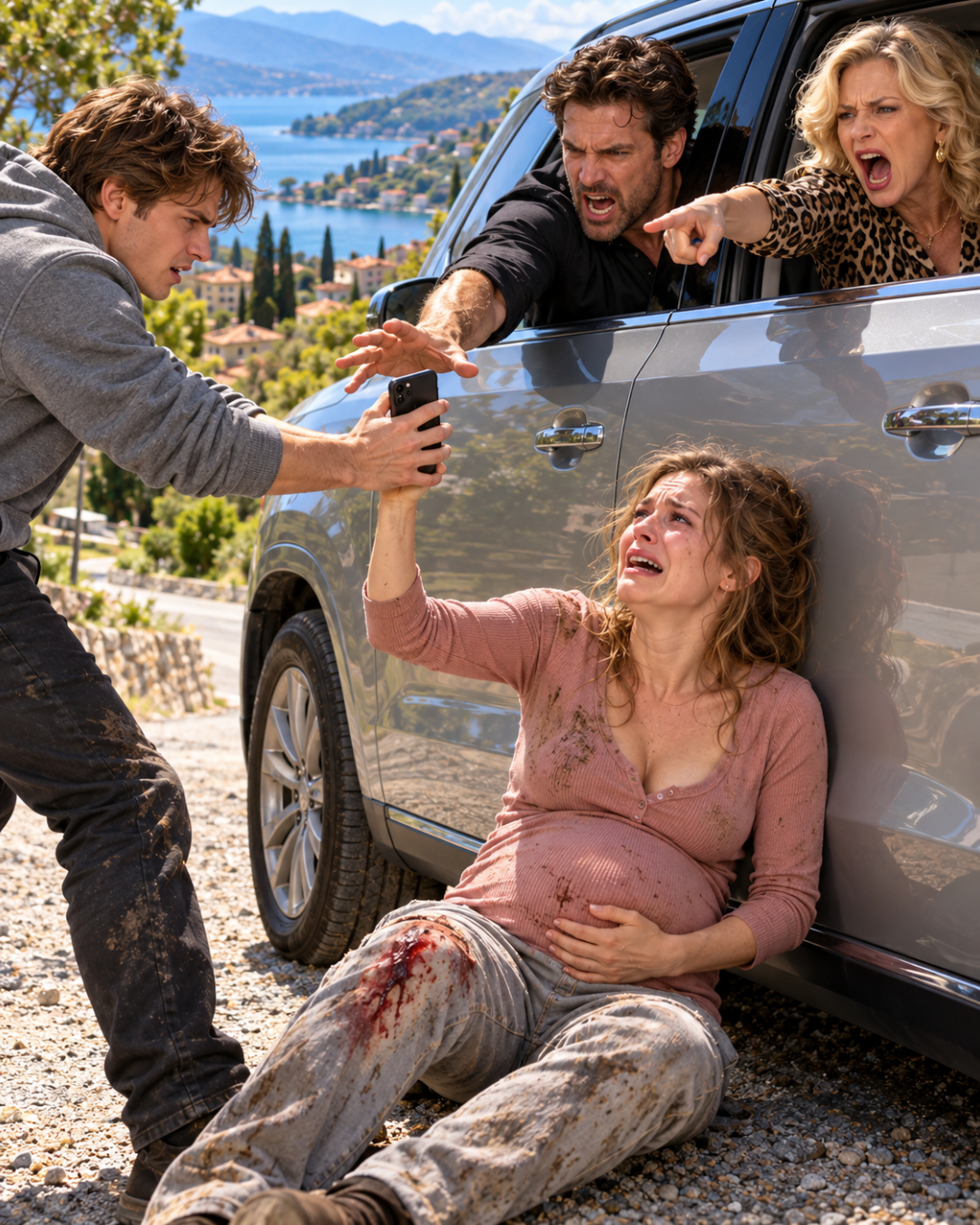
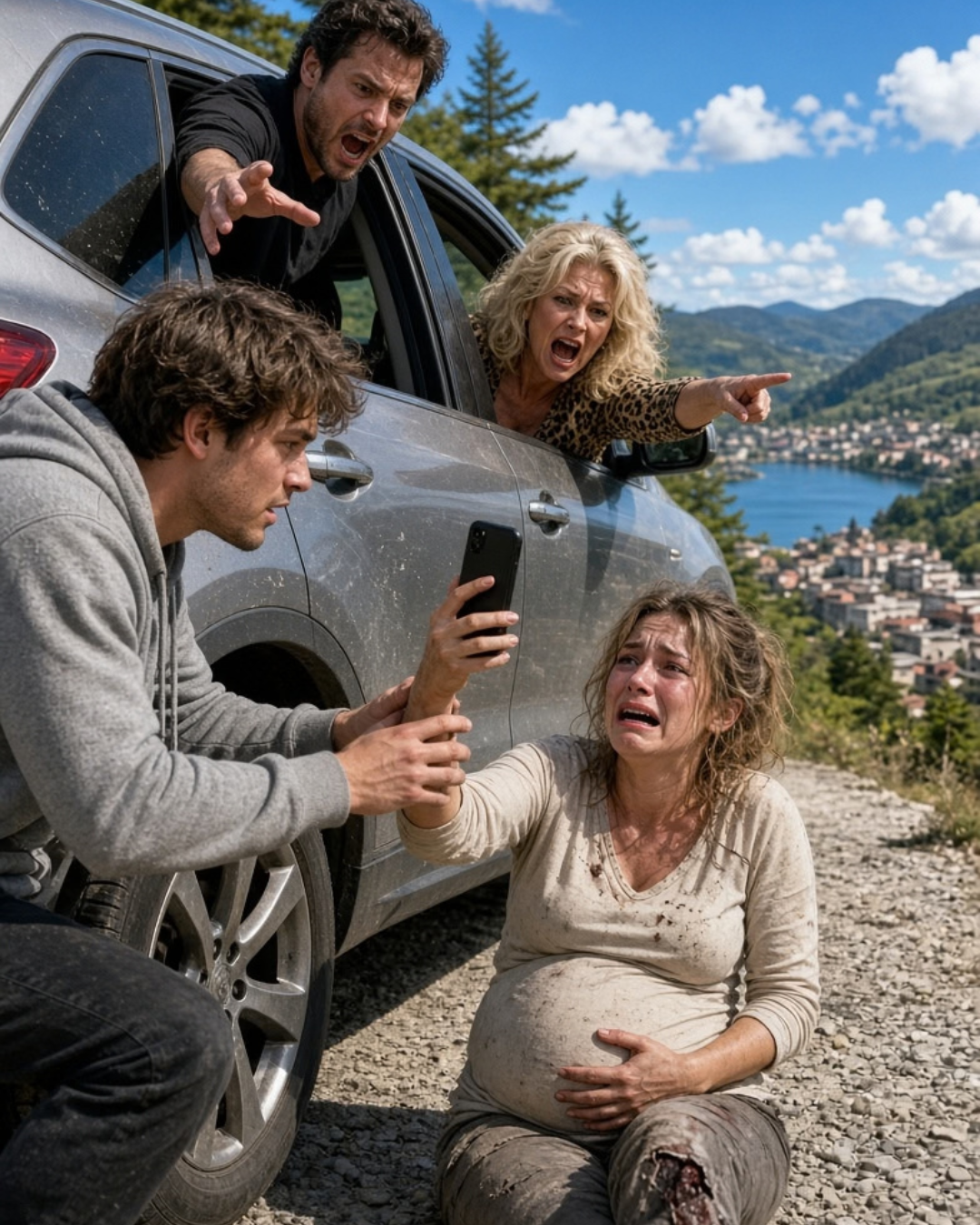
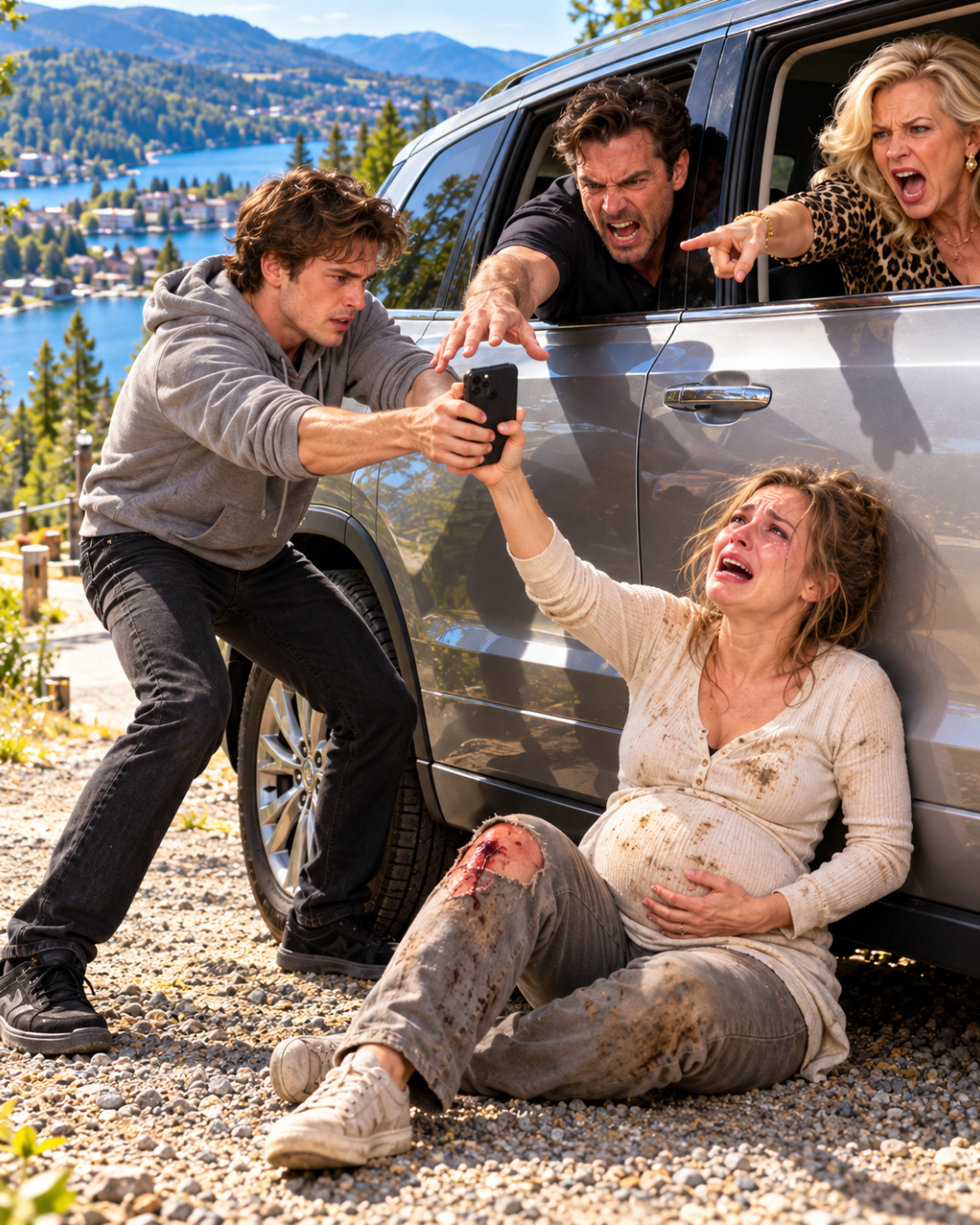
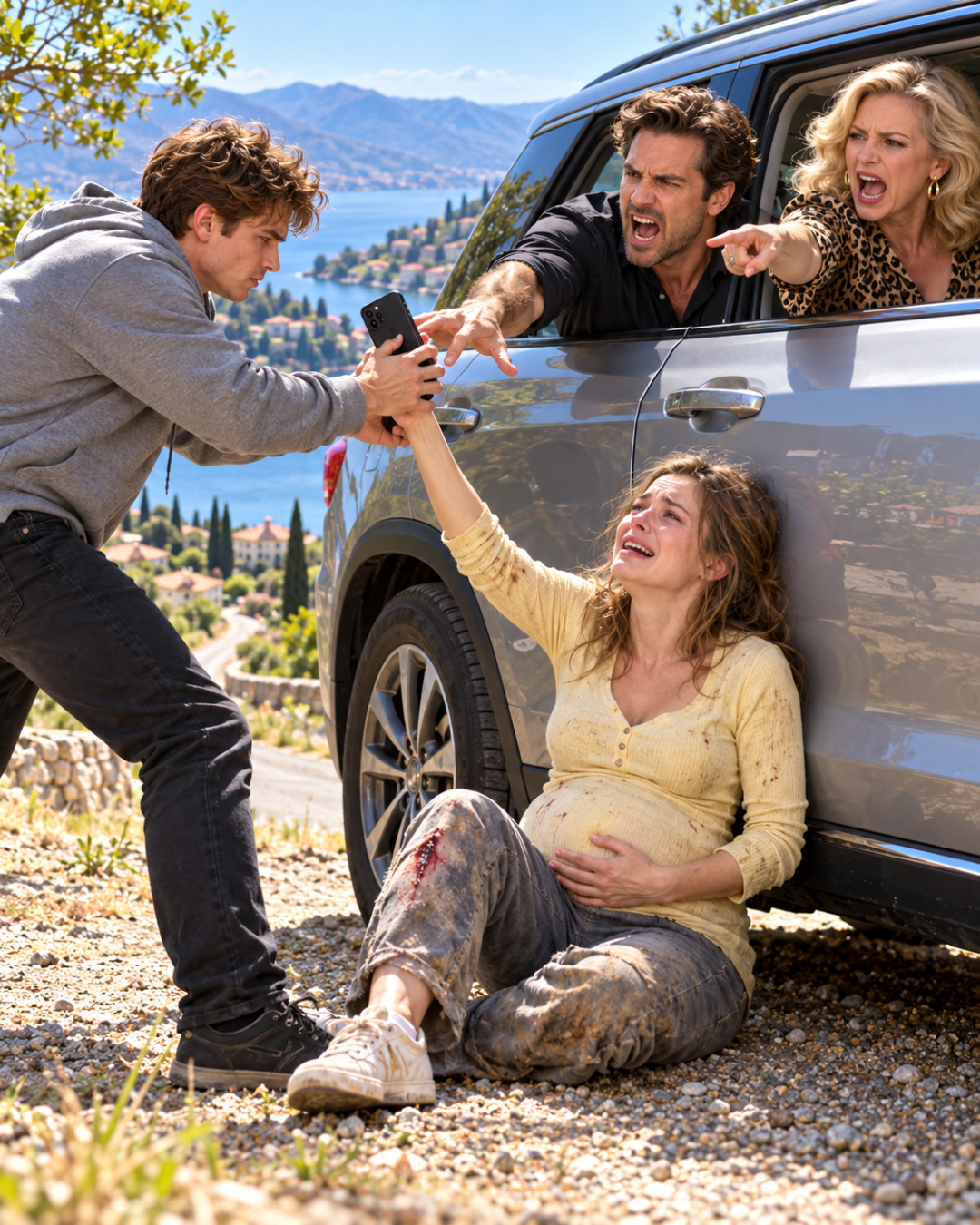
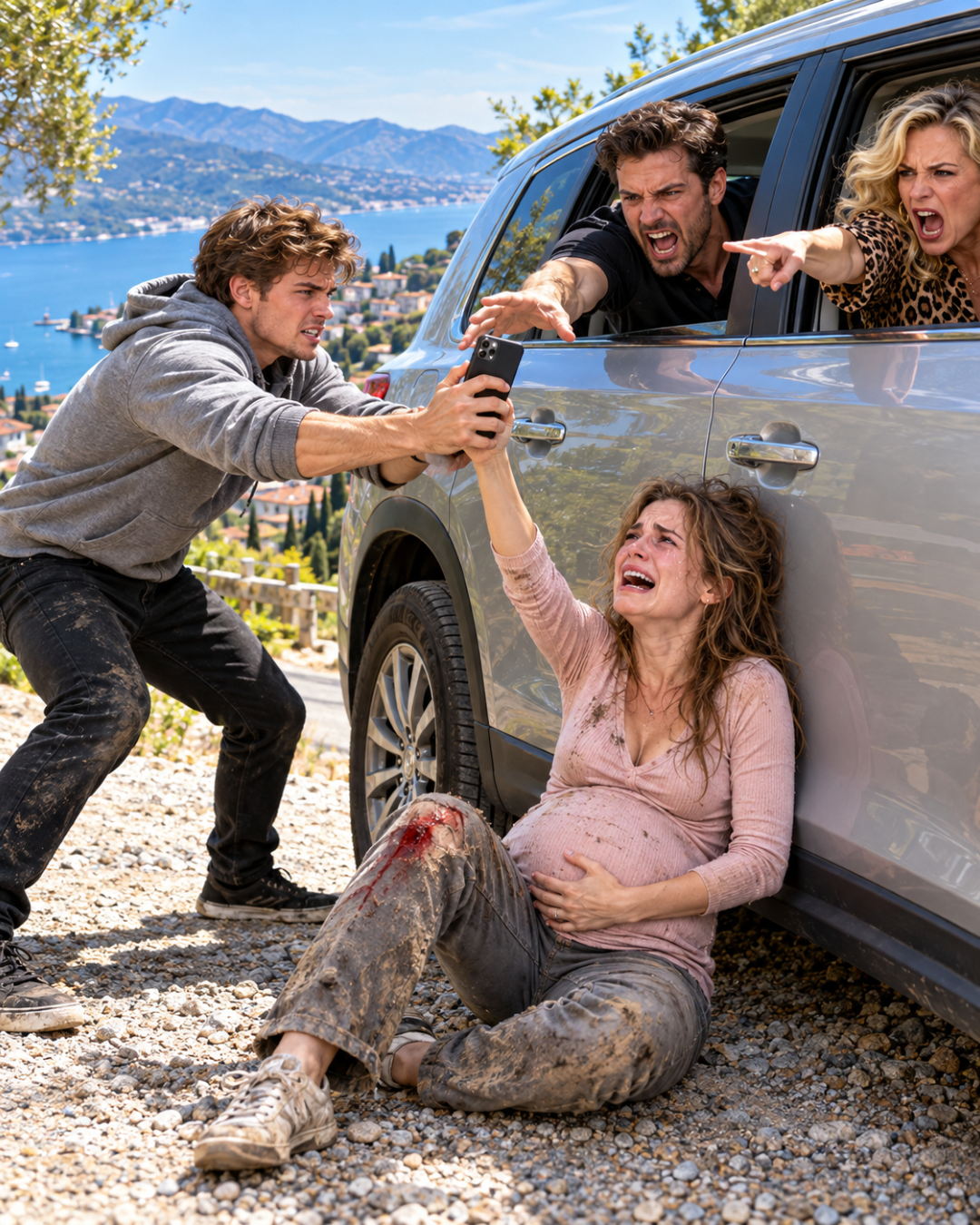
My mother-in-law forced me to push her stalled car uphill while pregnant because my husband had spent our fuel money on his girlfriend. He took the support from my injured knee and steered while his brother laughed from inside. Blood spread through my trouser leg before the car moved ten feet. Then they released the brake without warning.
The car jumped backward so suddenly I barely got out of its path. I threw myself sideways onto the grass, one hand protecting my stomach while my bad knee folded beneath me. My husband finally grabbed the brake again.
My mother-in-law leaned out the window. “Why did you move?”
I stared at her. “You released the brake.”
My husband shook his head like I was the unreasonable one. “I thought you were holding the car.”
“With what?” I asked. “My injured leg?”
His brother laughed again, but weaker this time. He was looking at the dark stain spreading down my pants now.
I pushed myself upright against the car. Every time I put weight on that leg, something hot and sharp ran through my knee. My husband didn’t reach for me. He stayed behind the wheel and told me we were almost at the top.
“I’m done,” I said. “Give me my phone.”
My phone was sitting on the dashboard where he’d left it earlier. He glanced at it, then at me.
“You’re not calling anybody over this.”
I thought I had misheard him.
“Over this?”
My mother-in-law sighed. “You always make everything bigger than it needs to be. Get the car up the hill first. Then you can have your little meltdown.”
I looked at my husband. “You spent our fuel money on her. Your mother knows that, and I’m the one being dramatic?”
He opened his mouth, but his mother answered first.
“Of course I knew about her.”
That hit harder than the pain in my knee.
She folded her arms against the open window. “I told him if he was going to keep seeing that woman, he needed to keep his problems away from my house. I didn’t say he had to tell you every detail.”
My husband snapped, “Mom.”
Too late.
I had spent weeks thinking the missing money was another stupid financial mistake. I had blamed late bills, unexpected expenses, anything except the truth sitting three feet in front of me.
“It was just gas money,” my husband muttered.
“Gas money we needed to get home,” I said. “Gas money you knew we needed because I can barely walk this hill.”
His mother rolled her eyes. “Then stop acting helpless and finish what you started.”
His brother stopped laughing.
“Mom, that’s enough.”
She turned on him immediately. “Stay out of it.”
My husband pointed uphill. “We’re not doing this here. Push the car, and we’ll talk at home.”
I looked at the car. Then at the hill. Then at the man who had watched me bleed while protecting the secret he’d spent our money to maintain.
“I’m not pushing anything,” I said. “Give me my phone.”
He reached across the dashboard first.
But his brother moved faster.
He climbed out, leaned through the open passenger door, snatched my phone off the dashboard before my husband could grab it, walked straight toward me, and placed it in my hand.
PART 2
The phone was warm from sitting in the sun on the dashboard. I remember that detail more clearly than almost anything else from that afternoon. The warmth of it. The way my fingers shook so badly I nearly dropped it into the grass.
Evan didn’t step back after he handed it to me. He stood there between me and the car, his hands loose at his sides, breathing like he’d just run a mile.
“Call whoever you need to call,” he said quietly.
Behind him, the driver’s door flew open. Derek got out so fast the car rocked on its tires, and for one awful second I thought it might start rolling again. It didn’t. The parking brake held. He’d finally remembered how to use it.
“Evan, what are you doing?”
“What somebody should have done ten minutes ago.”
“Give me the phone, Nora.” Derek held out his hand toward me, palm up, like I was a child holding something sharp. “Let’s just think for a second. Let’s not do anything stupid.”
I looked at his hand. The same hand that had slid the ring onto my finger four years ago in my father’s backyard. The same hand that had pressed against my stomach three weeks ago when the baby kicked for the first time, and he’d laughed, amazed, and said, “That’s my girl.”
That hand had been holding the steering wheel while I bled.
“Stupid,” I repeated.
“You know what I mean.”
“No, Derek. I don’t think I do anymore.”
I unlocked the phone. My thumb left a faint smear of red on the screen, and I realized I must have touched my knee without noticing. Derek saw it too. Something moved across his face. Not guilt, exactly. More like the look of a man doing math and not liking the answer.
Linda climbed out of the passenger side. She didn’t hurry. She never hurried. She smoothed the front of her blouse and walked around the hood of the car like she was crossing a church parking lot.
“Nora, sweetheart.” Her voice had changed completely. It was soft now. Honeyed. It was the voice she used on the phone with her pastor and on the ladies at her book club. “You’re upset. I understand. You’re hormonal and you’re hurting, and you’re not thinking clearly. Nobody’s going to blame you for that.”
“You released the brake.”
“It slipped.”
“You leaned over and pulled it. I saw your arm.”
“Honey, you were behind the car. You couldn’t have seen anything.” She smiled at me, and I understood suddenly how many times she had done this. How many times she had simply said a thing firmly enough, pleasantly enough, until the other person began to doubt their own eyes. “Now, if you call someone out here, they’re going to ask questions. And those questions are going to follow this family around. Derek’s job. Your baby’s name in some police report. Is that what you want for your daughter?”
For a moment it almost worked.
That’s the part I’m most ashamed of, even now. For about three seconds, standing on that hill with my knee on fire and my pants soaked through, I actually considered whether I was overreacting. Whether I was about to embarrass everyone. Whether a good wife, a good daughter-in-law, would just limp to the top of the hill and fix this quietly at home.
Then the baby moved.
It wasn’t a big kick. Just a small, rolling shift under my palm, like she was turning over in her sleep. Like she was saying, I’m still here.
I dialed 911.
“Nine-one-one, what’s the address of your emergency?”
I didn’t know the address. I knew the road, sort of. Evan leaned close and said it for me, the name of the county road and the mile marker we’d passed at the bottom of the hill. He said it loudly and clearly, and Derek swore under his breath and walked a few steps away with both hands on top of his head.
“I’m twenty-six weeks pregnant,” I told the dispatcher. My voice sounded strange to me, flat and far away. “I fell. A car rolled backward toward me and I had to jump out of the way. My knee is bleeding. I had surgery on it two months ago and I think the stitches have opened. I’m having some cramping. I don’t know if it’s from the fall.”
“Ma’am, are you in a safe place right now?”
I looked at Linda. At Derek pacing on the gravel shoulder. At Evan, who still hadn’t moved from his spot in front of me.
“I think so,” I said. “My brother-in-law is with me.”
“Okay. I’ve got help on the way. I need you to sit down if you can and keep pressure on the knee. Can someone help you with that?”
Evan was already pulling off his flannel shirt. He knelt in the grass, folded it into a thick square, and pressed it against my knee with both hands. I hissed through my teeth. He winced like it hurt him too.
“Sorry,” he whispered. “Sorry, sorry.”
I don’t think he was only apologizing for the pressure.
It took nineteen minutes for the ambulance to reach us. I know because I watched the clock on my phone the entire time, the dispatcher’s calm voice in my ear asking me every minute or so whether the cramping was getting worse, whether I felt dizzy, whether I could feel the baby moving.
Linda filled those nineteen minutes with talking.
She talked to Derek in a low, urgent voice near the back bumper. She talked to Evan, who ignored her. She talked to me, circling back every few minutes with a new version of the afternoon.
“You know, I really think you were already hurt when we got here. That knee’s been bad for months.”
“I was walking fine this morning.”
“You were limping.”
“I was limping carefully. I wasn’t bleeding.”
“Well, you insisted on getting out to push. Nobody asked you to.”
Evan’s head came up. “Mom. You told her to get out. You said if she didn’t, she could walk home.”
“I was joking.”
“She’s pregnant and it’s eight miles.”
“I said, I was joking.”
The sirens came around the bend below us, and Linda stopped talking mid-sentence. She straightened her blouse again. She walked back to the passenger door and stood beside it, hands clasped in front of her, the picture of a concerned grandmother.
The ambulance pulled onto the shoulder. Right behind it came a county sheriff’s SUV, lights flashing but no siren.
Derek looked at the SUV and all the color left his face.
The paramedics were a woman named Denise and a younger man whose name tag I never read. Denise knelt beside me and lifted Evan’s shirt off my knee, looked for about two seconds, and put it back.
“Okay,” she said. “That’s definitely coming with us. How far along?”
“Twenty-six weeks.”
“First baby?”
“Yes.”
“Any bleeding anywhere besides the knee? Any fluid?”
“No. Just cramping. Kind of on and off.”
“Alright, Mama. We’re going to take good care of you both.” She said it so simply, so kindly, that my eyes filled up for the first time that day. I had been fine through the brake and the blood and Linda’s smile. I fell apart because a stranger called me Mama like it was obvious I deserved to be looked after.
While they got me onto the stretcher, the deputy walked over. He was tall, maybe fifty, with a gray mustache and a patient, tired way of looking at things. His name was Deputy Hollis.
“Somebody want to tell me what happened here?”
Linda spoke first. Of course she did.
“Officer, it was an accident. Our car stalled on the hill and my daughter-in-law very sweetly offered to help push, even though we told her not to, and the brake slipped a little, and she got frightened and fell. We’re all just sick about it.”
Deputy Hollis nodded slowly. He wrote something on his pad. Then he looked at me on the stretcher.
“Ma’am? That how it went?”
Derek was standing behind his mother. He caught my eye and shook his head, very slightly. A tiny, pleading motion. Please.
I thought about the fuel money. About the girlfriend whose name I still didn’t know. About Linda saying of course I knew about her like she was commenting on the weather.
“No,” I said. “That’s not how it went.”
And I told him.
I told him about the empty gas tank and the money that was supposed to be in our account. I told him Linda ordered me out of the car and said I could walk if I didn’t push. I told him I asked Derek to push instead, and he said he needed to steer, and when I asked Evan, Linda said Evan had a bad back. I told him I pushed for about ten feet before the car started to move backward, and that I saw Linda lean across and pull the brake handle down. I told him I threw myself onto the grass. I told him Derek wouldn’t give me my phone.
Deputy Hollis wrote the whole time without interrupting. When I finished, he looked at Linda.
“Ma’am, you want to respond to any of that?”
“She’s confused. She’s in pain.”
“I’m not confused,” I said.
“She’s hormonal.”
Deputy Hollis’s pen stopped moving. He looked at Linda for a long moment, and something in his face hardened, just slightly.
“My wife had three kids, ma’am. I don’t recall hormones making her see things that didn’t happen.”
Evan cleared his throat.
“There’s a dashcam,” he said.
Every head turned.
“Derek put it in last Christmas. After Mom backed into that mailbox and the neighbor tried to say she hit his truck.” Evan pointed at the windshield. There it was, a small black rectangle tucked up behind the rearview mirror, its tiny blue light still blinking. “It records inside and outside. Audio too.”
Linda’s hand went to her throat.
Derek said, very quietly, “Evan. Don’t.”
Evan looked at his brother, and I will never forget the expression on his face. It wasn’t anger. It was grief. Like he was watching someone he loved walk off the edge of something and knew he couldn’t stop them anymore.
“I laughed at her,” Evan said. “When she was pushing. I sat in the back seat and I laughed because Mom was laughing and you were laughing and that’s what we do. That’s what we’ve always done. And then I saw the blood on her leg.” His voice cracked. “I’m not doing it anymore, Derek. I’m done.”
Deputy Hollis held out his hand. “I’m going to need that memory card.”
They took me to St. Anne’s Regional, forty minutes away. Denise sat beside me the whole ride and held a monitor strap against my belly, and every time the baby’s heartbeat came through the little speaker, fast and steady, like horse hooves on soft ground, she smiled at me.
“Listen to her,” she said. “She’s mad she got bumped around. Good strong heart.”
“Is she okay?”
“She sounds great. They’re going to watch you for a while at the hospital to make sure those cramps settle down. But that heartbeat? That’s a happy heartbeat.”
I cried again. Denise handed me tissues without comment.
“Is there someone we can call to meet you there?” she asked.
I thought about it.
There was only one answer, really. There had always only been one answer. I had just stopped calling him somewhere along the way, because Derek thought my father was nosy, and Linda thought my father was “low class,” and every visit had come with so much tension afterward that I’d simply let the phone calls get shorter and further apart.
My father was a retired diesel mechanic who lived three hours away in a small town with one stoplight. He had raised me alone after my mother died when I was nine. He wore the same brown work jacket for fifteen years. He cried at every single one of my school plays, even the one where I was a tree.
I called him from the ambulance.
He picked up on the second ring. “Hey, Peanut.”
I hadn’t heard him call me that in a long time. I opened my mouth and nothing came out.
“Nora?” His voice sharpened. “Honey, what’s wrong?”
“Dad,” I managed. “Can you come?”
There was no pause. No questions first. Just the sound of keys, a door, an engine turning over.
“Where are you?”
The next six hours blurred together.
A labor-and-delivery nurse named Priya strapped two monitors around my stomach and told me the cramps were irritability, not labor, and that they were already slowing down. An orthopedic resident named Dr. Castellano unwrapped my knee, made a low whistling sound, and said, “Well, you certainly did a number on this.” He explained that the incision from my surgery had torn open along two inches, and that there was some new swelling in the joint, but the repair underneath looked intact. He cleaned it and closed it again with a local anesthetic, talking the whole time about his golden retriever to distract me.
“You’re going to be on crutches for a bit,” he said. “And no pushing cars. Doctor’s orders.”
I laughed. It came out sounding like a sob.
Around seven o’clock, a social worker came in. Her name was Mrs. Adeyemi, and she had kind eyes and a clipboard. She closed the door behind her and sat down in the chair beside my bed.
“The deputy who responded called ahead,” she said gently. “He mentioned there might be some concerns about your safety at home. I just want to make sure you have somewhere to go when you’re discharged.”
“My dad’s coming.”
“Good. That’s good.” She studied me. “Nora, do you feel safe going back to the home you share with your husband?”
It was the simplest question in the world. And I didn’t know how to answer it.
Derek had never hit me. He had never raised his hand to me. I kept thinking that, as if it settled something. As if it were the only line that mattered.
But he had held the wheel while I bled. He had kept my phone from me. He had lied to me for months about where our money was going, while I apologized to our landlord and skipped my own prenatal vitamins to stretch the budget. He had let his mother talk to me like I was something stuck to her shoe, for four years, and he had called it “just how Mom is.”
“I don’t think I want to go back there,” I said slowly. “I don’t think I feel safe. Not the way I should.”
Mrs. Adeyemi nodded like I had just said something brave. Maybe I had.
“Then let’s talk about what that looks like,” she said.
My father arrived at 8:42 p.m.
I heard him before I saw him. His voice in the hallway, polite but urgent, asking the nurse’s station which room. Then the door opened, and there he was, still in his brown work jacket, his gray hair sticking up on one side like he’d been running his hands through it the whole drive.
He stopped in the doorway and looked at me. At the monitors. At the crutches leaning against the wall. At my knee, wrapped thick in white gauze and propped on two pillows.
He didn’t say anything for a long moment. His jaw worked.
Then he crossed the room in three steps and put his arms around me, carefully, so carefully, the way you’d hold something made of glass.
“I’m here,” he said into my hair. “I’m here, Peanut. I’m here.”
I held onto the back of his jacket and cried until the monitors started beeping and Priya came in to check on us. My father apologized to her. She waved him off and adjusted a strap and left us alone again.
When I could finally talk, I told him everything. All of it, from the beginning. The missing money. The hill. The brake. Linda’s smile. The girlfriend.
My father listened without interrupting once. His face stayed very calm. But his hands, resting on the edge of my bed, slowly curled into fists, and then slowly uncurled, and then curled again.
When I finished, he was quiet for a while.
“You know what I kept thinking about on the drive?” he said finally. “When you were little, maybe six, you got it in your head that you were going to carry the Christmas tree in from the truck by yourself. Big old Douglas fir. You wouldn’t let me help. You got it halfway up the porch steps and then you just stood there, holding it, shaking. You wouldn’t put it down, and you wouldn’t let me take it. You just kept holding it.”
I remembered. Vaguely. The smell of pine and cold air.
“I finally asked you why you wouldn’t let me help,” he went on. “And you said, ‘Because if I put it down, then I couldn’t do it.'” He shook his head. “Honey, you’ve been holding that tree for four years. You don’t have to hold it anymore.”
Derek came to the hospital at nine-fifteen.
The nurses had been told to check with me before letting anyone in. Priya came to the door and said, very neutrally, “Your husband is at the desk. Would you like to see him?”
My father stood up.
“Dad.”
“I’m just standing.”
“I know what your standing looks like.”
He sat back down. Barely.
I thought about it. Part of me never wanted to see Derek’s face again. But part of me needed to hear him say it. Whatever it was going to be.
“Five minutes,” I said. “And my dad stays.”
Derek walked in holding a plastic-wrapped bouquet of carnations from the gift shop downstairs. The price sticker was still on it. He saw my father, and his steps faltered.
“Mr. Callahan.”
My father said nothing. He just looked at him.
Derek set the flowers on the rolling tray table. He didn’t sit. He stood at the foot of my bed, hands in his pockets, and looked at my knee.
“How are you feeling?”
“Like I jumped out of the way of a car.”
He flinched. “Nora, I’m so sorry. I’m so, so sorry. I don’t know what happened today. I panicked. Mom was yelling and the car was sliding, and I just, I froze. I wasn’t thinking.”
“You were thinking about my phone.”
“I was scared!”
“Of what?”
He didn’t answer.
“Of what, Derek? Scared I was hurt? Scared the baby was hurt? Or scared I’d tell somebody what your mother did?”
He looked at the floor. When he spoke again, his voice was small. “Mom’s really upset. The deputy took the dashcam card. He said there might be a follow-up. She’s saying she could get charged with something. Reckless endangerment, maybe.”
“She released a brake on a car I was standing behind.”
“She didn’t mean to hurt you.”
“Then what did she mean to do?”
Silence.
He took a breath and tried again. “Look. I know you’re angry. You have every right to be angry. But if you could just talk to the deputy. Tell him you were confused. Tell him you want to drop it. They’ll listen to you. You’re the one who got hurt.”
My father made a sound in his throat. Not a word. Just a sound.
I stared at my husband. I had loved him. I want to be honest about that. For four years I had loved him, and some part of me, even then, still did. That’s the terrible thing about love. It doesn’t switch off just because it should.
But I looked at him standing there with the gift-shop carnations and the price tag and the request, the request, and I felt something inside me go very still and very clear.
“Who is she, Derek?”
He blinked. “What?”
“The woman. The one you spent our gas money on. The one your mother knew about. Who is she?”
“Nora, that’s not, that doesn’t matter right now.”
“It matters to me.”
He rubbed the back of his neck. “Her name’s Tessa. We work together. It’s not, it wasn’t serious.”
“How long?”
“A few months.”
“How many months?”
He hesitated. “Since March.”
It was September. Since March meant since before I’d told him I was pregnant. Since before the ultrasound where we’d found out she was a girl, and he’d cried in the parking lot, and I’d thought, this is it, this is the moment everything settles down.
“How much money?” I asked.
“What?”
“You heard me. How much of our money, Derek?”
“I don’t know exactly.”
I picked up my phone. I opened our bank app. I had been avoiding it for weeks because every time I looked at it, I felt sick and blamed myself for being bad at budgeting. Now I scrolled back. Slowly. Transaction by transaction.
A restaurant I had never been to. Twice. A hotel forty miles away on a weekend he’d told me he was helping his uncle move. A jewelry store. A florist. Gas station charges in a town on the other side of the county.
And a transfer. Eighteen hundred dollars. Out of the savings account we’d labeled BABY in all capital letters. The one I had been putting fifty dollars into every Friday since the day the test came back positive.
I turned the screen around and held it up so he could see.
“Eighteen hundred dollars,” I said. “From her fund. From her.” I put my hand on my stomach.
Derek’s face crumpled. “I was going to put it back.”
“When?”
“I don’t know. Soon. I was going to put it back.”
My father stood up. This time I didn’t stop him.
He didn’t raise his voice. He didn’t need to. He walked to the door and opened it and held it there.
“Son,” he said, “I think you ought to go now.”
Derek looked at me. Waiting for me to contradict him. Waiting for me to smooth it over, the way I had smoothed over every single thing for four years.
I didn’t.
He left the carnations on the table. After the door closed, my father picked them up, read the price sticker, and dropped them in the trash can without a word.
Evan came the next morning.
I almost didn’t recognize him. He was wearing a clean button-up shirt and he’d shaved, and he was holding a paper bag from the bakery across the street. He stood in the doorway like he wasn’t sure he was allowed in.
My father, who had slept in the recliner beside my bed all night, looked him up and down.
“You the brother?”
“Yes, sir.”
“The one who laughed?”
Evan’s ears went red. “Yes, sir.”
“And the one who gave her the phone?”
“Yes, sir.”
My father considered this for a long moment. Then he nodded at the bag. “What’s in there?”
“Cinnamon rolls. The nurse said she could eat.”
My father held out his hand. Evan gave him the bag. My father looked inside, took one out, and handed the rest to me.
“You can come in,” he said.
Evan sat on the very edge of the visitor’s chair like he expected it to collapse under him. For a while he didn’t say anything. Then he started talking, and once he started, he couldn’t seem to stop.
He told me that he’d grown up watching his mother run their house like a small, cold kingdom. That their father had left when Evan was eleven, and after that, Linda had leaned on Derek, the older one, the golden one, and taught him that the world owed him things and that women who complained were “difficult.” He told me Linda used to make fun of Evan for crying, for liking to draw, for being quiet, until he learned to laugh along with her because laughing was safer than being the target.
“I’ve been laughing along my whole life,” he said. “I didn’t even know I was doing it anymore. It was just automatic. Like breathing.” He stared at his hands. “And then I saw your leg. And I thought about how you’ve never once been anything but nice to me. You remembered my birthday when nobody else did. You sent me that card when I got the job at the print shop. And I was sitting in the back of the car laughing at you.”
“You stopped,” I said.
“Not fast enough.”
“You handed me the phone, Evan. You told the deputy about the dashcam. You know what she’s going to do to you for that.”
He smiled a little, humorlessly. “She already did. She called me last night and told me I’m dead to her. Said I betrayed my own blood.” He shrugged. “Honestly? It was the most peaceful night I’ve had in years.”
Then he reached into his back pocket and pulled out a folded piece of paper.
“There’s something else you should know,” he said. “I wasn’t sure whether to tell you, but I think you’d want to.”
He unfolded it. It was a printout of a text message thread. Between Derek and someone saved in his phone as T.
“Derek left his phone in my car a couple weeks ago,” Evan said. “I didn’t snoop, I swear, but it lit up while I was driving and I saw the preview. I took a picture of it. I didn’t know what to do with it. I think I was hoping I’d never have to.”
I read it.
T: When are you going to tell her?
Derek: Soon. After the baby. She’s too fragile right now.
T: You said you were separated. You said you only still lived there because of the lease.
Derek: We basically are separated. It’s complicated.
T: Derek, is she pregnant? My cousin saw you two at the grocery store. She said your wife was really pregnant.
Derek: Can we talk about this in person?
I read it twice. Then I folded it back up and held it in my lap.
“She didn’t know,” I said slowly.
“I don’t think so,” Evan said. “Not the whole truth, anyway. I think he told her you two were basically over.”
I didn’t know what to feel. I had spent the whole night imagining this woman. Imagining her laughing with him in restaurants I’d never been to, wearing jewelry our daughter’s savings had paid for. I had pictured her as someone cruel, someone who knew exactly what she was taking.
It had never occurred to me that she might be one more person Derek had lied to.
I was discharged two days later with a knee brace, a pair of crutches, a prescription for pregnancy-safe pain relief, and a follow-up appointment with my OB. Mrs. Adeyemi gave me a folder of information about family law clinics, and a card with her direct number, and a squeeze on the shoulder.
My father drove me home to his house. The house I grew up in. My old bedroom still had the glow-in-the-dark stars on the ceiling. He had put fresh sheets on the bed and moved the dresser so I wouldn’t have to maneuver around it on crutches. There was a new shower chair in the bathroom with the price tag still on it, and a bell on the nightstand, a little brass one shaped like a lady in a hoop skirt.
“That was your grandmother’s,” he said, a little embarrassed. “You ring it if you need anything. Day or night.”
“Dad, I’m not going to ring a bell at you.”
“You ring the bell,” he said firmly, “or I’m going to sleep in the hallway.”
I rang the bell eleven times that first night, mostly to make him laugh. He came every single time.
The next few weeks were hard in a way I don’t think I can fully explain.
It wasn’t just the knee, though the knee was bad. It wasn’t just the pregnancy, though being twenty-seven, then twenty-eight, then twenty-nine weeks pregnant on crutches was its own special kind of misery. It was the quiet. The quiet after four years of noise.
I kept waiting for someone to be angry with me. I would make a sandwich and brace myself for a comment about how I’d cut the bread wrong. I would sit on the porch in the afternoon and feel guilty for not doing something productive. My father would come home from the hardware store and say, “Hey, Peanut,” and I would flinch, just slightly, before I remembered where I was.
He noticed. He never said anything about it. But he started whistling when he came up the porch steps so I’d know it was him before the door opened.
Derek called every day for the first week. I didn’t answer. He left voicemails. The first few were apologies. Then they turned into arguments. You can’t just take my kid away from me. You’re overreacting. My mom is being investigated because of you, do you understand that? You’re destroying this family.
Then, on the eighth day, the voicemails stopped.
I found out why from Evan.
“Tessa found out,” he told me on the phone. “Everything. That you’re pregnant. That you’re not separated, or weren’t, until two weeks ago. That the money came out of the baby’s savings. The whole thing.”
“How?”
A long pause. “She messaged me. She found me online because I’m tagged in Derek’s photos. She asked me straight out if it was true that his wife was pregnant. I wasn’t going to lie to her, Nora.”
“What did she do?”
“She broke it off. Told him not to contact her again. And she reported him to HR, because apparently they’re not supposed to date when he’s technically her supervisor, which he also didn’t tell her.” Evan let out a breath. “He got suspended. Two weeks without pay while they investigate.”
I sat with that for a while.
“Evan,” I said finally, “is it wrong that I don’t feel happy about it?”
“No,” he said. “I think it means you’re a good person. Which, for the record, I’ve always known.”
Tessa wrote to me herself about a week later.
It came as a long message on social media. I almost didn’t open it. I stared at the notification for an entire afternoon before I finally tapped it.
She said she didn’t expect me to reply. She said she wasn’t writing to ask for forgiveness, because she didn’t think she’d earned it, and she wasn’t sure she ever could. She said that Derek had told her, from the very beginning, that his marriage was over in everything but name. That we slept in separate rooms. That I was cold to him and his family. That he only stayed because the lease wasn’t up until December and he couldn’t afford to break it.
She said she believed him because she wanted to. Because he was charming and attentive and he said all the right things, and because it was easier than asking hard questions.
When I found out you were pregnant, she wrote, I sat on my kitchen floor and couldn’t breathe. I kept thinking about every time he’d canceled plans with me at the last minute and said it was a “family thing.” I thought he meant his mother. I didn’t know he meant you. I didn’t know he meant your baby.
At the end, she said something that I’ve thought about many times since.
I don’t know you, and you have every reason to hate me. But I wanted you to know that he lied to both of us. You weren’t the only one he was making smaller. I hope you and your daughter have a beautiful life. I really, truly do.
I read it three times. Then I wrote back. Just a few lines.
Thank you for telling me the truth. I don’t hate you. I think we both deserved better than what he gave us. I hope you find it.
I never heard from her again. But I hope she did.
The follow-up from Deputy Hollis came in early October.
He called my father’s landline, because I’d given him that number, and my father handed me the phone with a very careful expression on his face.
“Mrs. Brennan,” Deputy Hollis said. “I wanted to update you personally. I reviewed the footage from the dashcam with the district attorney’s office.”
My stomach tightened. “And?”
“The audio’s clear. The video’s clear. You can see her hand on the brake, and you can hear the comments leading up to it.” He paused. “I’ll be honest with you, ma’am. I’ve been doing this job for twenty-six years. There aren’t a lot of things that surprise me anymore. But I had to stop that recording twice.”
I didn’t know what to say.
“The DA’s office is moving forward with a charge of misdemeanor reckless endangerment,” he went on. “Given her age and the fact that she’s got no prior record, I’d expect it to resolve with a plea. Probation, likely. A fine. Possibly some kind of court-ordered class. But it’ll be on her record. And it’ll be public.”
Public.
Linda had spent her whole life curating the way other people saw her. The pastor’s favorite volunteer. The head of the church bake sale for eleven straight years. The woman who wrote letters to the editor about declining family values and the importance of respect.
“Mrs. Brennan? You still there?”
“I’m here,” I said. “Thank you, Deputy. Really. Thank you for listening to me that day.”
His voice softened. “Ma’am, you were the only one telling the truth on that hill. It wasn’t hard to listen.”
Linda came to my father’s house the Sunday after that.
I was on the porch swing with my leg propped up on a pillow, reading a book about baby sleep schedules that I did not understand at all. I heard the car before I saw it. Her silver sedan, the same car, pulling slowly into the gravel drive.
My hands went cold.
She got out alone. She was wearing a pale blue church dress and pearls, and she was holding a covered casserole dish in both hands like an offering.
My father was out back working on his truck. I could have called him. I could have gone inside and locked the door. Instead, for reasons I still don’t fully understand, I stayed where I was.
Linda stopped at the bottom of the porch steps. She looked older than I remembered. Just three weeks, and she looked five years older.
“Nora.”
“Linda.”
“I brought you a chicken and rice casserole.” She held it up slightly. “It’s the one you liked. From Easter.”
I had not liked it. I had eaten it because she’d watched me until I did. But I said nothing.
“May I come up?”
“No.”
Something flickered in her face. Anger, maybe, quickly buried. She set the casserole down on the bottom step.
“I’ll just say what I came to say, then.” She folded her hands in front of her. “I’ve been advised by my attorney that I’m going to have to plead to this charge. It’s going to be in the county paper. Pastor Grant has asked me to step down from the women’s ministry until it’s resolved. Half of my book club won’t return my calls.”
I waited.
“I’m not saying this to make you feel bad,” she said, which was exactly what she was saying it for. “I’m telling you because I think you should understand the consequences of what you did. You made a choice that day, and that choice has hurt a lot of people.”
The old version of me would have apologized. I could feel it rising in my chest, the reflex, the habit. I’m sorry, I didn’t mean for it to go this far, I never wanted anyone to get in trouble.
I pressed my hand against my stomach. The baby kicked, hard, right against my palm.
“Linda,” I said. “You’re right. I did make a choice that day. I chose to call for help when I was hurt. That’s the only choice I made.”
“You could have handled it within the family.”
“I tried. For four years. The family decided I should push a car uphill while I was bleeding.”
“That was an accident!”
“I’ve seen the footage now,” I said quietly. “The deputy showed me. You laughed right before you did it, Linda. You said, ‘Let’s see how tough she really is.’ And then you reached over.”
She went completely still.
“I don’t know why you hate me,” I said. “Maybe you don’t. Maybe you just needed somebody to be smaller than you, and I was there. But I’m not going to be that person anymore. Not for you, not for Derek, and definitely not in front of my daughter.”
Her lips pressed together until they were white.
“You will never,” she said, very low, “keep my granddaughter from me.”
“You’re right,” I said. “I won’t be the one doing that. You did it yourself, on that hill. When you’re ready to take responsibility for that, really take responsibility, not just feel sorry that people found out, then maybe we can talk. But not until then.”
The screen door creaked behind me. My father stepped out onto the porch, wiping his hands on a shop rag. He looked at Linda. Then at the casserole on the step.
“Afternoon, ma’am,” he said pleasantly. “You’ll want to take that with you. We’ve got plenty of food.”
Linda looked at him, and then at me, for a long moment.
Then she turned around, got back into her silver sedan, and drove away. She left the casserole.
My father picked it up and carried it inside and put it in the fridge.
“Aren’t you going to throw it away?” I asked.
“Food’s food,” he said. “Mrs. Patterson next door has four grandkids staying with her this week. I’ll bring it over tonight. No sense punishing the rice.”
I laughed so hard I had to hold my stomach.
The legal part took longer than I wanted, and less time than I feared.
A family law clinic two towns over connected me with an attorney named Gloria Reyes, a small, fierce woman in her sixties with reading glasses on a beaded chain and a desk covered in succulents. She listened to my whole story, took four pages of notes, and then set down her pen and folded her hands.
“Here’s what I want you to understand,” she said. “You’re going to hear a lot of people tell you that you’re being harsh. That he’s the father, that he deserves chances, that the baby needs both parents. Some of that might even be true, eventually. But right now, my job is to make sure that you and that baby are safe and supported. Not comfortable for him. Safe for you.”
She filed for divorce in late October. She also filed a motion requesting that Derek repay the eighteen hundred dollars taken from the account labeled for the baby, plus half of the other joint funds he’d spent on the affair. She included the bank statements. She included the text messages Evan had given me. She included the deputy’s report.
Derek’s attorney called Gloria three days later to ask about settling.
“He wants to fight for custody,” Gloria told me over the phone. “Or at least, his mother wants him to. But his lawyer’s no fool. He’s read the police report. He’s watched that footage. No judge in this county is going to look kindly on a man who kept his injured pregnant wife from calling for help.”
“So what happens?”
“So we negotiate. Supervised visits to start, once the baby’s born, if he wants them. Child support, based on his income. Repayment of the money. And a clause that says his mother has no unsupervised contact with the child until the court says otherwise.”
I closed my eyes. “Is that really possible?”
“Honey,” Gloria said, “it’s already on paper.”
Here’s the thing nobody tells you about leaving.
It isn’t one big dramatic moment. It’s a thousand small ones. It’s the first time you buy groceries without calculating what someone else will criticize. It’s the first time you wear the yellow sweater he said made you look washed out. It’s the first time you laugh out loud at a TV show without checking the other person’s face first.
It’s learning, slowly, that silence doesn’t have to mean danger. That it can just mean peace.
By November, I was off the crutches and walking with a cane. Dr. Castellano’s physical therapist, a cheerful former college softball player named Marisol, put me through exercises three times a week that made me want to throw things at her. She would just grin and say, “That’s the spirit. Now do ten more.”
My father drove me to every appointment. He waited in the lobby doing crossword puzzles and chatting with the receptionist, and by the end of the month he knew the names of her kids, her dog, and her ex-husband.
Evan came up on weekends. At first he stayed at a motel in town because he didn’t want to impose. After the second weekend, my father told him that was ridiculous and set up a cot in the den. Evan and my father discovered they both loved old Western movies and terrible puns, and I’d come downstairs at eleven at night to find them arguing about whether John Wayne or Jimmy Stewart was the better cowboy.
“Jimmy Stewart,” Evan insisted. “He had feelings.”
“Cowboys aren’t supposed to have feelings,” my father said.
“That,” Evan said, pointing at him, “is exactly the problem with cowboys.”
Evan also started drawing again. He’d stopped when he was fourteen, when Linda found his sketchbook and read it aloud at dinner, mocking every page. One Saturday he showed up with a new sketchpad and a box of pencils and sat on the porch for three hours drawing the old oak tree in the front yard.
When he showed it to me, it was beautiful. Every twisted branch. Every shadow.
“Evan,” I said. “You’re really good.”
He ducked his head. “I’m rusty.”
“You’re good. Don’t do that.”
He looked at the drawing for a long moment. “Nobody’s ever said that to me before,” he said quietly. “Not about anything.”
I put my hand over his. “Well, get used to it. Because I’m going to keep saying it.”
Derek asked to meet me in early December.
Gloria advised against it. My father was against it. Evan said he’d support whatever I decided but that he’d be sitting in the parking lot either way.
I said yes anyway. Not because I wanted to get back together with him. That door was closed, locked, and bricked over. But because I was about to bring his daughter into the world, and some part of me needed to know who he was going to be to her.
We met at a diner halfway between our towns. A neutral place, full of people. I got there first and took a booth by the window. My father sat at the counter pretending to read the paper. Evan sat in his car outside with the engine running.
Derek walked in at ten past two. He’d lost weight. He looked tired, and older, and smaller somehow. He sat down across from me and looked at my stomach, now enormous at thirty-five weeks, and his eyes filled up.
“Wow,” he said softly. “She’s really coming.”
“January fourth, give or take.”
He nodded. He didn’t say anything for a while. The waitress came, and he ordered coffee and didn’t touch it.
“I’ve been going to counseling,” he said finally. “Court didn’t make me. I just, I started going. After everything.”
I didn’t say anything.
“The counselor asked me why I didn’t stop Mom that day. Why I didn’t get out of the car and push it myself. Why I didn’t give you your phone.” He turned the coffee cup in slow circles. “I told her I didn’t know. And she kept asking. Every week. And finally I said it.”
“Said what?”
He looked up at me. “That I was more scared of her being disappointed in me than I was of you being hurt.”
The words sat on the table between us.
“I’ve been scared of her my whole life,” he said. “Evan got the worst of it when we were kids, and I learned really early that the way to stay safe was to be on her side. Always. No matter what. And somewhere along the way, I just, I stopped being a person. I became her. I did to you what she did to him.” His voice broke. “I’m not saying that to make excuses. There’s no excuse. I’m saying it because it’s true, and you deserve to hear something true from me for once.”
I sat with that.
I had expected to feel triumphant, maybe, hearing him say it. Or furious. Instead I just felt very, very sad. For the little boy he’d been. For the man he could have been. For the four years I’d spent trying to love him into being someone he didn’t know how to be.
“Derek,” I said. “I believe you. And I hope the counseling helps. I really do. But I can’t be the one you practice on anymore.”
“I know.”
“Our daughter is going to know who you are. If you keep showing up. If you keep working. If you’re safe. But you’re going to have to earn it. Every single day. And you’re going to have to do it without your mother making the decisions.”
He nodded slowly. Tears were sliding down his face now, and he didn’t wipe them away.
“I signed the settlement this morning,” he said. “Gloria probably has it by now. All of it. The money, the custody terms, the thing about Mom. I didn’t fight any of it.”
I didn’t expect that. I didn’t know what to say.
“I want her to have a better life than I did,” he said. “Even if it’s not with me. Especially if it’s not with me the way I am right now.”
When he left, he paused at the door and looked back at me.
“Nora,” he said. “I’m sorry I made you push that car.”
It was the first real apology. The first one that named the thing. I nodded at him once, and he left, and I sat in the booth and cried quietly into a paper napkin while my father came over and slid in beside me and put his arm around my shoulders.
“You okay, Peanut?”
“Yeah,” I said. And to my surprise, I meant it. “Yeah, Dad. I think I really am.”
My daughter was born on January second at 4:17 in the morning, two days early, in the middle of the first real snowstorm of the year.
My father drove me to the hospital through four inches of fresh powder, both hands white-knuckled on the steering wheel, muttering the whole way. “Of course. Of course she picks tonight. She’s got your sense of timing, you know that? You were born during a tornado warning.”
“Dad, just drive.”
“I’m driving! I’m driving.”
Evan met us there. He had driven three hours through the snow at two in the morning after my father called him, and he arrived covered in snowflakes, clutching a stuffed giraffe he’d bought at a twenty-four-hour gas station.
“It was the only one they had,” he said breathlessly. “It’s kind of ugly. I’m sorry.”
It was very ugly. It had crossed eyes and one ear sewn on crooked. My daughter would love it more than any other toy she ever owned, and she would sleep with it every night until she was eight years old.
Labor was eleven hours. It was exhausting and painful and terrifying, and in the middle of it, my father held one hand and a nurse named Beth held the other, and I thought about that hill. About the gravel and the blood and the brake. I thought, I have already done something harder than this. I have already survived something that was trying to hurt me. This is not trying to hurt me. This is trying to bring me something good.
And then she was here.
She was small and red and furious, with a full head of dark hair and a scream that could have stripped paint. They laid her on my chest, and she stopped crying almost immediately and looked up at me with enormous, unfocused, dark blue eyes.
I had been told that the love would hit you like a truck. That’s not how it felt for me. It felt like the moment right after you set down something unbearably heavy that you’ve been carrying for a very long time. Your arms don’t know what to do. Your whole body shakes. And then you realize you can breathe.
“Hi,” I whispered to her. “Hi, baby. I’m your mom. I’m going to take such good care of you.”
My father was crying so hard he had to sit down. Evan was standing in the doorway, eyes wet, holding the ugly giraffe against his chest.
“What’s her name?” my father asked, when he could speak.
I had thought about this for months. I had made lists. I had crossed out every name Derek and Linda had ever suggested. And in the end, it had been simple.
“Grace,” I said. “Grace Evelyn Callahan.”
Evelyn was my mother’s name. And Callahan was my name. My father’s name. The name I had given up for four years and taken back the day the divorce was finalized.
My father put his face in his hands.
“Your mom,” he said through his fingers. “She’d have loved her so much, Nora. So much.”
“I know, Dad.” I looked down at my daughter’s tiny face. “I think she’s already here, a little bit.”
Derek came to meet Grace when she was nine days old.
It was at my father’s house, with Gloria’s supervision agreement in place. Evan was there. My father was there. Derek sat on the edge of the couch, stiff and terrified, and when I laid Grace in his arms, he held her like she was a live grenade.
Then she yawned. A big, huge, whole-face yawn that made her look like a tiny grumpy old man.
Derek laughed. It was a soft, surprised, broken sound, and his whole face changed.
“Hi, Gracie,” he whispered. “I’m, hi. I’m your dad.”
He visited every Saturday afternoon after that. Two hours, supervised. He never missed one. He brought diapers and wipes and formula samples and, once, a small wooden rattle he said he’d carved himself, following an online tutorial. It was a little lopsided. He looked embarrassed when he handed it over.
“It’s not perfect,” he said.
“It’s fine,” I said. “It’s really nice, actually.”
He kept going to counseling. He found a new job, at a different company, and started paying his child support on time, every month, without being reminded. He paid back the eighteen hundred dollars in six installments. On the last one, he wrote a note in the memo line of the check: For Grace’s fund. I’m sorry it took so long.
We will never be married again. We will probably never be friends in the way we once were. But he is becoming, slowly, a man my daughter can be proud of. And I have learned that I can want that for her without needing it for myself.
Linda sent a letter in March.
It arrived in a plain white envelope with no return address. I recognized her handwriting instantly, the neat, looping cursive she used on every birthday card and church flyer. My hands shook when I opened it.
It was one page long.
She had pled guilty in February. Probation, a fine, one hundred hours of community service, and a court-ordered anger management course. She had stepped down from the church ministry. She wrote that she had spent the last several months doing “a great deal of thinking,” which I suspected was the closest Linda could get to saying “therapy.”
She wrote that the anger management counselor had asked her to write letters to the people she had hurt. She said she had written eleven so far, and hadn’t sent any of them. This was the first one.
I don’t know how to apologize, she wrote. No one ever taught me. My own mother used to say that apologizing was a sign of weakness, and I believed her my whole life. I am trying to unlearn that now, at sixty-three years old, and I am finding it very hard.
I have watched the footage from that day four times now. My counselor made me. The first time, I was angry at you. The second time, I was angry at the deputy. The third time, I was angry at Evan. The fourth time, I finally saw myself. I did not like what I saw.
You were right. I did it myself. I understand if you never want to see me, and I understand if you never let me meet Grace. I am not asking you for anything. I just wanted you to know that I finally know what I did.
It was signed, simply, Linda.
I read it at the kitchen table while Grace napped in her bassinet beside me. Then I handed it to my father without a word.
He read it slowly. Then he set it down.
“What are you going to do?” he asked.
I thought about it for a long time.
“Nothing yet,” I said finally. “I’m going to keep it. And maybe someday, if she keeps doing the work, I’ll write back. But not yet. Grace is only ten weeks old. And I’m still healing.”
My father nodded. “That sounds about right to me.”
“You don’t think I should forgive her?”
“I think forgiveness isn’t a light switch, honey. It’s more like a garden. You plant a little something and you see what grows. And you don’t owe anybody a harvest before the seeds are ready.”
I smiled at him. “When did you get so wise?”
“Oh, I’ve always been this wise,” he said. “You just used to be too busy carrying Christmas trees to notice.”
Evan got into an art program in the spring.
A real one, at the community college. Night classes, so he could keep his job at the print shop. He’d applied with a portfolio of thirty drawings, and almost half of them were of Grace. Grace asleep. Grace yawning. Grace grabbing my father’s nose with one fat fist.
He called me the day he got the acceptance email, and he was laughing so hard he could barely get the words out.
“They said I have a real gift for faces,” he said. “Faces, Nora. I spent my whole life trying to read Mom’s face to figure out if I was about to get in trouble. And now it’s the thing I’m good at.”
“You were always good at it,” I told him. “You just finally get to use it for something beautiful.”
He was quiet for a second.
“I wouldn’t have done any of this,” he said. “If you hadn’t made that phone call. I would’ve just kept sitting in the back seat my whole life, laughing when I was supposed to.”
“Evan, you handed me that phone.”
“Yeah,” he said. “But you’re the one who dialed it.”
It’s September again as I write this.
One year, almost to the day, since that hill.
I asked my father to drive me back there last weekend. I wasn’t sure why. Just something I needed to see. Evan came too, and Grace, who is almost nine months old now, with a head of dark curls and my mother’s dimples and a laugh that sounds exactly like hiccups.
We parked at the bottom of the county road, at the same mile marker. The hill looked different in the early autumn light. Smaller, somehow. The grass on the shoulder was green and soft. There was no stain there anymore, of course. No mark. Nothing to show anything had ever happened in that spot at all.
My knee is almost completely healed now. Marisol officially graduated me from physical therapy in June, with a handmade certificate that said Most Improved Complainer. I can walk and climb stairs and chase Grace across the living room. On rainy days it still aches a little. My doctor says it might always ache a little. I’ve decided I’m alright with that. It reminds me of what I survived.
I unbuckled Grace from her car seat and put her in the stroller. Then I looked up at the hill.
“You want me to push?” my father asked.
“No,” I said. “I’ve got it.”
And I walked her up.
It wasn’t hard. It was a gentle slope, a pleasant little walk on a warm September morning. My father walked on one side of me and Evan walked on the other, and Grace kicked her feet and shrieked with delight at every bird that flew overhead.
When we reached the top, I stopped and turned around and looked back down at the road.
A year ago, I had stood at the bottom of this hill and thought my whole life was about how much I could carry. How much weight I could hold. How much pain I could absorb without complaining. I thought strength meant pushing uphill, alone, while other people sat in the car and watched.
I was wrong.
Strength isn’t about how much you can carry. Strength is knowing when to set it down. It’s picking up the phone. It’s saying no out loud, even when your voice shakes. It’s letting the people who truly love you take some of the weight, and trusting that they won’t drop it.
My father put his arm around my shoulders. Evan leaned down and made a silly face at Grace, who laughed her hiccup laugh and grabbed his nose.
“Ready to head home?” my father asked.
I looked out at the road below us. At the long, winding way we had come. Then I looked down at my daughter, and at my father, and at the brother I had not been born with but had chosen, and who had chosen me back.
“Yeah, Dad,” I said. “Let’s go home.”
We walked back down together.
And this time, nobody let go of anything.
If this story touched you, remember: asking for help is not weakness. Sometimes the bravest thing you’ll ever do is pick up the phone.
