

My parents demanded that I empty my farmhouse so they could entertain 40 anniversary guests. I warned them that my daughter had only recently returned home after a bone-marrow transplant and could not be around crowds. Mom coldly said, “Lock her upstairs.” I agreed. But when they arrived Saturday, the sheriff was waiting at the front gate.
Chapter 1: The Citadel
I erased the old access codes, replaced every deadbolt throughout the property, and drove a bold ‘No Trespassing’ sign into the timber beside the driveway.
The farmhouse belonged to me.
It was not some shared family property. It certainly wasn’t my parents’ enormous retirement retreat. It was mine. Seven years earlier, I had bought it from my late grandmother for its exact appraised value, paying every last cent. My parents had mocked the purchase, pointing to the outdated plumbing and twenty acres of neglected, worthless pasture. Only after I spent years draining my savings into renovations—repairing the original hardwood, replacing the pipes, and restoring the structure’s neglected bones—did they suddenly start calling it “our farmhouse.”
At exactly nine on a bitter Saturday morning, the harsh grind of tires shattered the quiet of the gravel road.
A convoy appeared. Three rented luxury coaches sat behind my parents’ polished silver Cadillac. Following them in a strange procession were a catering van, a florist’s truck, and a string quartet awkwardly carrying their instrument cases.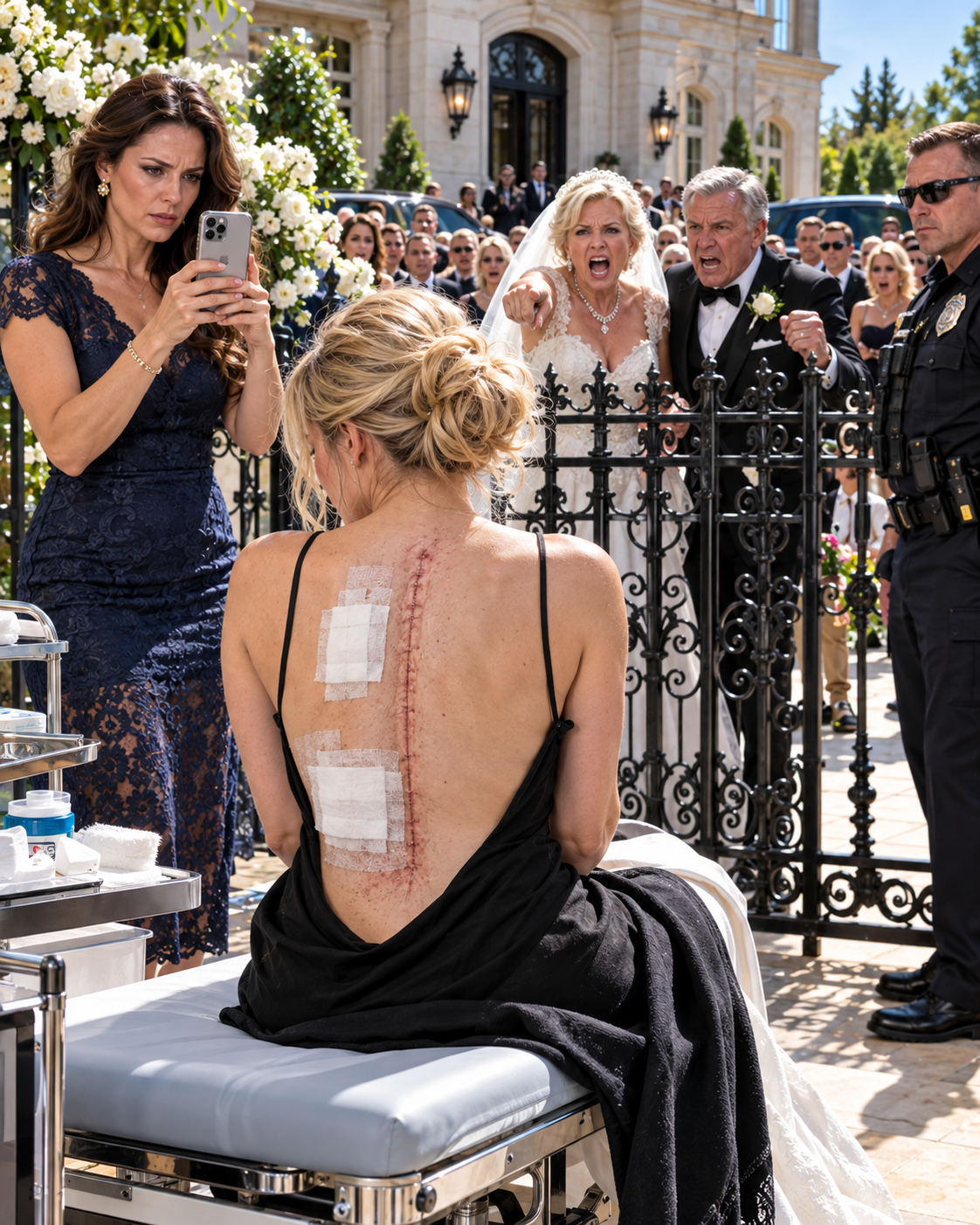
Standing calmly beside the chained front gate was Sheriff Daniel Brooks.
From the living-room window, I watched the spectacle unfold, my pulse pounding fiercely along my jaw. Behind me, in a room thoroughly cleaned with strong bleach and protected by hospital-grade air purifiers, my twelve-year-old daughter, Lily, slept peacefully. She had endured a brutal bone-marrow transplant and had come home just eleven days earlier. Her oncology team had been absolutely clear: her immune system was essentially non-existent. A simple sneeze, a persistent cough, or even a microscopic pathogen could quickly become a deadly danger.
My mother, Diane, climbed out of the Cadillac. She was dressed in a flawless ivory gown, her hair fixed into a stiff helmet of perfection, and she strode toward the iron gate with the confidence of an invading ruler.
“Why is the gate locked?” she demanded, her voice cutting through the frigid morning air.
Sheriff Brooks remained unmoved. He simply tapped the freshly installed notice. “Mrs. Carter, the property owner has formally withdrawn permission for you and your guests to enter the premises.”
“I am her mother,” she spat back, as though being related to me somehow overruled property law.
“That does not make you the titleholder, ma’am.”
My father, Richard, a man who had spent forty years apologizing for taking up space, stood behind her and pointed a shaking finger toward the wraparound porch. “Emily agreed to clear the place.”
That was my signal. I opened the heavy oak door and stepped onto the top stair. A tight N95 mask covered my face. I had not been within arm’s reach of an unmasked person for more than two months, and I wasn’t going to end that streak for a party.
“I did,” I called down, my voice unexpectedly calm. “I cleared it of absolutely everything belonging to you.”
Dozens of bewildered guests were already emerging from the coaches, their expensive shoes pausing uncertainly against the dirt. My mother stared at me through the wrought iron. Her lips formed that familiar, hardened smile—the frozen expression that silently promised my public humiliation would eventually make me surrender.
“You are embarrassing yourself, Emily,” she scolded, her voice thick with artificial pity. “Open the gate.”
“No.”
Her composure shattered. She seized the iron bars, her knuckles whitening as she screamed that family property could not be taken over by an insolent, ungrateful brat. Sheriff Brooks instructed her to step away, his hand resting casually near his duty belt. Rather than obey, she thrust her hand through the bars and angrily entered the old access code into the keypad.
It flashed an unyielding, furious red.
Then I noticed movement upstairs. Lily was standing behind her bedroom window. She looked painfully fragile, like a ghost behind a medical mask, her frightened eyes fixed on the crowd below.
My mother noticed where I was looking and pointed upward with satisfaction. “See?” she hollered so everyone could hear. “She’s already upstairs! There is absolutely no problem!”
Even Sheriff Brooks fell completely silent, seemingly stunned by the sheer audacity of her words.
I looked at my vulnerable daughter, then turned back toward the woman who had given birth to me. For eleven agonizing days, I had measured every microscopic risk, protecting a broken body that had survived more suffering than any child should ever have to endure. And now my mother was treating my daughter’s fragile hold on life as nothing more than an inconvenience standing in the way of her fortieth-anniversary celebration.
A cold, absolute calm settled over me. I reached inside my coat and pulled out my smartphone. There was one particular piece of evidence my mother had no idea I possessed.
“Let’s see how loud you want to be,” I muttered to myself, raising the volume to its highest setting, “when everyone hears exactly what you planned to do.” Chapter 2: The Echo Of Betrayal
I pressed play.
The tinny echo of my mother’s recorded voicemail sliced through the freezing breeze.
“If Emily resists,” the digital voice of Diane echoed, sharp and calculating, “we’ll go in through the kitchen. She won’t make a scene in front of everyone.”
For one long, agonizing moment, the gravel road became a graveyard. Nobody breathed. Not the confused guests gathered around the buses. Not the florist, who suddenly hugged a bucket of white roses against her hip like a stolen infant. Not even the autumn wind, which seemed to have abandoned the maple leaves.
I allowed the recording to continue. I had listened to it repeatedly in the darkness the previous night, letting its venom inoculate me against decades of conditioning. I wanted everyone standing at that gate to hear every word.
“Richard, bring the toolbox from the trunk, just in case,” the voicemail continued, dripping with arrogance. “It’s my mother’s house. Nobody is going to keep me out of my own mother’s house.”
A sharp click followed. Then came complete silence.
I lowered the phone. My hand remained perfectly steady.
“Mrs. Carter,” Sheriff Brooks said, his voice carrying the exact, frighteningly courteous tone an officer uses before putting someone in handcuffs. “Is that your voice?”
My mother raised her chin, although frantic fear flickered behind her eyes. “That is a private, confidential message between a mother and her daughter. It’s being maliciously played out of context.”
“Out of context.” The Sheriff slowly nodded, turning the words over. “Ma’am, I’ve worn this silver star for thirty-one years. I cannot fathom a universe where ‘go in through the kitchen with a toolbox’ translates to anything other than a planned burglary.”
Someone toward the back of the crowd cleared his throat. A man wearing a tailored gray suit suddenly became deeply interested in the stitching on his loafers.
Sheriff Brooks lifted the legal notice higher. “Let me make this crystal clear, so nobody claims ignorance. On Thursday, I personally pulled the deed from the county recorder’s office. Emily is the sole, undisputed owner. The warning on this gate is legally binding. You cross this line, it’s criminal trespass. You pry open a kitchen window—” He glanced toward my phone. “—that escalates to breaking and entering.”
“You wouldn’t dare arrest a sixty-six-year-old woman in front of her peers,” she hissed.
“I’d much rather not,” he answered effortlessly. “But I absolutely will.”
She stared at him. I had watched Diane intimidate waitstaff, frighten contractors, and verbally destroy the chairwoman of a church bake sale. But she had no weapon against a man who simply stood there beneath the authority of the law.
“Diane,” my father whispered, his shoulders weighed down by something invisible. “Let’s go.”
“Don’t you dare, Richard.”
I walked down the porch steps and crossed the flagstone path, stopping exactly ten feet from the barrier. From my pocket, I pulled out a thick cream-colored envelope and passed it through the bars to the Sheriff, who then handed it to my father.
“Everything you left at the farmhouse is now in Unit 214 at Harmon Road Self Storage,” I said clearly. “Paid through next August. The keys are inside, along with a single-spaced, alphabetized inventory. I placed your vintage coats on a specialized rack so they wouldn’t crease. Your imported champagne is against the north wall, protected from the sunlight.”
My father studied the detailed receipt. An unfamiliar emotion crossed his weathered face. “You hauled all of this by yourself?”
“It was a very long week.”
“You dumped our heirlooms in a storage locker?” my mother shrieked, as though I had thrown them into an active volcano.
“I secured them in a climate-controlled vault, Mom. I am not trying to rob you. I am trying to keep Lily breathing.”
“You planned this ambush!”
“I prepared for my child’s survival,” I shot back. “You prepared for forty uninvited guests. We were always destined to collide.”
She shook the iron gate, her diamond wedding band striking sharply against the steel. “Open. This. Gate.”
For thirty-six years, that particular poisonous tone had been enough to make me surrender. Don’t make a scene, Emily. That was the silent religion of our family. Smile, swallow the bitterness, and pretend the house wasn’t burning. But eleven nights earlier, I had walked a sterile hospital corridor, listening to the rhythmic synthetic chirp of a machine keeping my daughter tethered to the earth. That was when I understood there are two kinds of silence: the silence of defeat, and the silence of determination.
“No,” I said.
Before she could erupt, my brother, Mark, appeared from behind the coach. He had flown in from Denver, completely unaware of what was happening, having heard only my mother’s carefully sanitized version of events. He stopped cold when he saw the Sheriff, the barricade, and my masked face.
“Em? What the hell is happening?”
“Ask Mom about Lily’s immune system,” I replied.
“Mom said she was practically cured. The doctors were thrilled.” Mark looked utterly confused.
“She is healing,” my mother smoothly inserted.
“Mark, listen to me,” I ordered, my voice cutting through the tension. “Her immune system is equivalent to a premature infant’s. It takes a year to rebuild. One stray pathogen from this crowd puts her on a ventilator. Or in a casket.”
A collective murmur swept through the spectators. An older woman pushed toward the front. It was Bev Lindstrom. She had sat beside my mother in church for three decades.
“Diane,” Bev whispered, gripping her purse like a shield. “Tell me you didn’t.”
“I did nothing wrong, Bev! She was going to stay locked upstairs with her door shut, like any kid with the sniffles!”
“The sniffles?” Bev’s voice dropped, carrying sheer horror. “I managed a pediatric oncology ward for thirty-four years. Do you know how we handle visitors with a sniffle? We banish them at the elevator doors. And you wanted to pack forty people—half of them coughing—directly beneath a bone-marrow recipient’s floorboards?”
As though summoned by her words, a man in the crowd released a dry, hacking cough. His face turned beet red. “Sorry,” he mumbled. “Had this tickle since Wednesday.”
A young mother holding a toddler immediately recoiled, moving backward toward the safety of the bus. The crowd was visibly turning against Diane.
“I told her,” I said quietly, though my words carried like gunshots. “I sent the discharge papers. I emailed the oncologist’s mandate. I said the words ‘lethal risk’ until my throat bled.”
“She did,” a broken voice confessed.
We all turned at once. It was my father. He wasn’t looking at my mother. His eyes were fixed on the gravel. “Emily warned us, Diane. Repeatedly.”
My mother stared at her husband as though he had just driven a dagger into her spine.
Then, slicing through the suffocating silence, came a distinct metallic clack from above. Every head snapped toward the sky, none of us prepared for the ghost that had just appeared in the window. Chapter 3: The Ghost In The Window
Lily stood behind the second-floor glass.
The idling diesel engines must have awakened her. For eleven days, I had carried her fragile body to the bathroom, completely underestimating the determination of a curious twelve-year-old. She looked heartbreakingly small. Chemotherapy had drained the color from her skin, leaving behind a translucent, porcelain-like delicacy. Her mask was pulled high beneath her tired eyes, while a crooked knitted cap covered the stubborn peach fuzz beginning to return across her scalp.
She didn’t wave. She simply stared downward with the hyper-alert, calculating expression of a child who understands that loud adults usually mean trouble is coming.
My heart climbed into my throat. “Lily,” I whispered behind my mask.
She disappeared from view. For sixty agonizing seconds, the entire yard seemed to hold its breath. When she appeared again, she was holding her favorite sketchbook against the window. In thick black marker, she had written:
HI GRANDMA. HI GRANDPA.
A strangled whimper came from somewhere in the crowd.
Lily turned the page with trembling hands. She had drawn a crooked cake covered in thick frosting.
HAPPY ANNIVERSARY!
“Oh, sweet heaven,” Bev Lindstrom gasped, as though all the air had been knocked from her lungs.
Lily turned to the third page. She had worked carefully on this one. The shaky block letters reflected the violent trembling in her weakened hands.
I’M SORRY I CAN’T COME DOWN. I WOULD IF I COULD.
I closed my eyes as a hot tear burned down my cheek. Lily had never heard the words lock her upstairs. I had protected her from that poison. Yet this brilliant, battered child—who had endured radiation burns and mouth sores so painful she couldn’t swallow her own saliva—had figured out the conflict, understood the ruined celebration, and decided she needed to apologize for destroying their day.
The last page contained no words. It held one enormous heart, aggressively colored in red ink.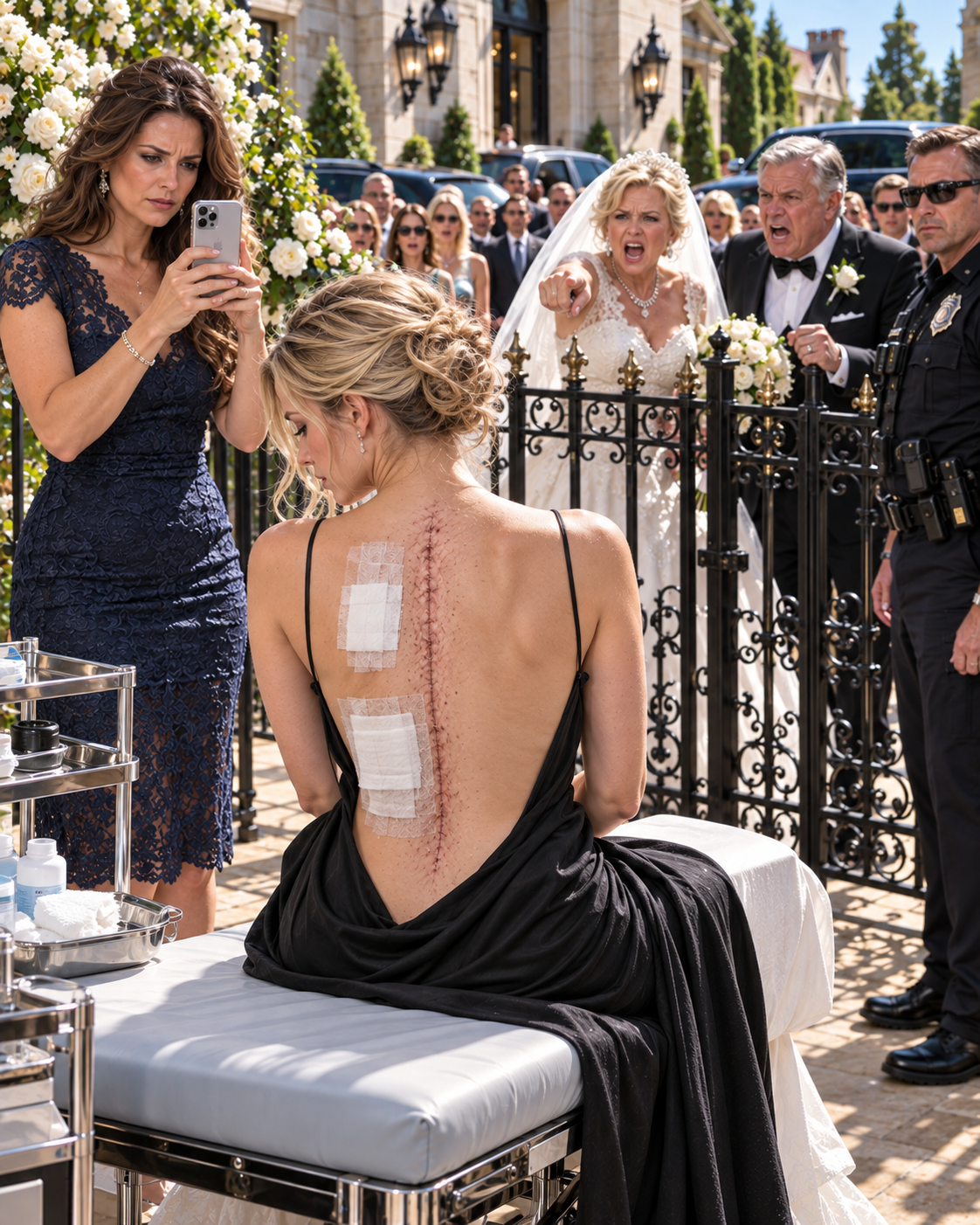
My father slowly took off his fedora. He approached the iron gate, rested his wrinkled forehead against the freezing bars, and lifted one trembling hand. Upstairs, Lily waved back. My father’s shoulders began shaking as silent, violent sobs overtook him.
My mother had been preparing to launch another defense, but she suddenly stopped. Her mouth fell open. Her expensive ivory dress looked ridiculous now—a lavish costume for a performance that had just been permanently canceled.
“She’s twelve,” Diane whispered into the wind. “She’s only twelve.”
“Yes,” a sharp voice interrupted. “She is.”
Ruth Delaney, my mother’s older sister, stepped away from the crowd. Aunt Ruth was a formidable seventy-year-old woman who still wrote letters by hand and had spent hours sitting with me in the hospital cafeteria, offering nothing but quiet, unwavering support.
“Diane,” Ruth ordered. “Look at me.”
“Ruth, please, not right now.”
“Right now.” Ruth took my mother by the chin and forced her to meet her eyes. “Do you comprehend what you just attempted? You ordered a mother to lock her immunocompromised child away so you could drink wine and eat canapés underneath her.”
My mother’s face went pale, the color draining from beneath her carefully applied makeup. “That isn’t the same,” she managed.
“Isn’t it?”
“Ruth, stop.”
“I have held my tongue for fifty-four years,” Ruth declared, her voice carrying the weight of decades of buried pain. “I am entirely finished.”
I looked toward Mark, who wore the same bewildered expression I felt. My father shut his eyes tightly, preparing himself for a tidal wave he had apparently always known would come.
Ruth faced the crowd before turning her eyes toward me. “Our youngest sister was named Annie,” she revealed. “She was eight. She had severe leukemia. It was 1972. The medicine back then was practically medieval. She died in a sterile ward in Columbus.”
The ground seemed to shift beneath my feet.
“Our mother brought her body back home. The funeral reception was held right here. In that exact front parlor.” Ruth pointed with a trembling finger toward my house. “Forty people attended. The house was suffocating with casseroles and whispers. And our mother, completely drowning in her own grief, couldn’t bear to look at her grieving twelve-year-old daughter. So she said to Diane, ‘Go upstairs, honey. Stay in your room. We don’t want to make a scene.’“
A wounded, guttural sound tore from my mother.
“She sat at the top of those stairs,” Ruth continued, tears streaming freely down her cheeks. “For six hours. I kept slipping away to check on her. She sat there in her scratchy black dress, her knees pulled against her chest, listening to forty strangers eat and drink while casually saying her dead sister’s name. She never came downstairs. Nobody went upstairs. And I don’t believe she has cried a single tear since that afternoon.”
The gravel road fell completely still.
“I think,” Ruth whispered, her voice softening into a devastating truth, “that when she looked at this farmhouse, and at Emily, and at sick little Lily… she didn’t see a grandchild. She saw the trauma she was never allowed to process. And she responded the only way she had ever been taught. By shutting the door.”
I hadn’t even noticed when it happened, but my mother had collapsed. She was sitting against the chrome running board of the Cadillac, her immaculate skirt spread across the filthy gravel, her face buried in her hands.
“I was twelve,” Diane sobbed through her fingers, the dam finally breaking after half a century. “Nobody came up to get me. Nobody ever asked.”
I stood motionless behind my barricade. I didn’t feel the righteous triumph I had imagined for five days. Instead, I saw a sixty-six-year-old woman suddenly reduced to a terrified, abandoned child. Every instinct inside me screamed to unlock the gate and embrace her.
But I couldn’t. Because a psychological wound can help explain someone’s toxicity, but it does not excuse the damage they cause to others.
“Mom,” I said through the gate.
She raised her head, her mascara smeared into a muddy mess.
“I am so incredibly sorry about Annie. I am sorry they abandoned you on those stairs. But you do not get to force my daughter onto that same staircase.”
She stared at me, trembling.
“I love you,” I said, the words carrying absolute weight. “But I will not sacrifice my child to protect your peace.”
For the first time in her carefully controlled life, Diane Carter made a scene. She sobbed with reckless, ugly, breathless abandon in front of forty strangers.
Sheriff Brooks respectfully stepped away, adjusting his hat. Aunt Ruth immediately stepped into the void, redirecting the guests toward a nearby grange hall so the catered food would not spoil. The party scattered like fog.
But as the buses disappeared down the road, I noticed my father slowly walking back up the driveway, loosening his silk necktie. He stopped ten feet from the iron bars, alone in the fading light, carrying a secret that seemed almost too heavy to keep inside. Chapter 4: The Anonymous Friend
The sun sank toward the horizon, painting the north pasture in bruised shades of orange. The automatic porch light blinked on, spreading a warm amber glow across the driveway.
I stepped back outside into the cold. “Dad?”
He twisted his hat between his hands. He looked completely unmoored, like a man who had spent his entire life avoiding conflict and had finally discovered there was nowhere left to escape. “Lunch was a damp affair,” he rasped. “Everyone cried. We sent the leftover meals to the pediatric charity house.”
“How is she?”
“Resting at Ruth’s. She hasn’t spoken a syllable.” He swallowed, his Adam’s apple rising and falling. “Emily, I need to confess something. Please don’t interrupt until I’m through.”
“Okay.”
“In April, right after Lily was transferred to the ICU, I drove to the medical center. Alone. I lied to your mother, said I was buying fertilizer.”
My fingers tightened around the iron bars.
“I made it to the concrete parking garage,” he whispered, his voice breaking. “I sat in my sedan for three hours, staring up at the sixth floor. I rehearsed walking in. I wanted to hold you. I wanted to tell you I was proud.” A tear rolled down his weathered cheek. “But Diane had convinced me earlier that morning that you were just being dramatic. That our presence would only escalate the panic. I let myself believe her fiction, because believing her was infinitely easier than facing the reality of my granddaughter fighting for her life.”
“Dad—”
“I’m not done.” He wiped his nose with the back of his sleeve. “Before I retreated, I went to the lobby gift shop. I bought a stuffed bear. A brown one, wearing a tiny blue vest. I slipped it onto the nurse’s station counter with a blank card, and I ran away like a coward.”
Everything seemed to stop.
“The card said, ‘Be brave. Somebody is thinking of you. A friend.’” He sobbed, the sound raw and miserable. “God forgive me, that was the absolute limit of my courage.”
My hand flew to my mask. I knew that bear. His name was Barnaby. For six agonizing months, he had been Lily’s fierce protector. She slept with him pressed against her cheek through the worst nights of chemotherapy, believing that a magical, anonymous volunteer was watching over her. I had studied the block-letter handwriting on that card countless times, never letting my mind connect it to the man who labeled every jar of nails in his garage.
“It was you,” I choked out.
“It was me.”
I cried. Not tears of anger, but the quiet, healing tears that come when a fractured bone finally starts to mend. I reached my arm through the cold iron bars. He seized my gloved hand with both of his, holding onto me like a drowning sailor.
“Tell me how to fix this, Emily,” he begged. “Tell me how to be a grandfather she actually deserves.”
I studied him, considering the weight of his request. “You learn, Dad. You read the medical literature. You update your vaccines. You don’t try to buy forgiveness with a checkbook. And you show up on Sundays.”
He came the following week. Two o’clock sharp. He brought a lawn chair, a thermos of hot cocoa, and a mask. He sat twenty feet away in the yard, calling crossword clues up to Lily on the porch. He returned the next Sunday, and the Sunday after that.
But Diane did not come.
The silence continued, slowly changing from hope into a dull, persistent ache.
Then, on the fourth Sunday, my father pulled a thick, unsealed envelope from his breast pocket. “From your mother,” he said, extending it toward me. “She drafted it three times. Read it first. It’s your call.”
I accepted the envelope and retreated to the wooden steps as the autumn wind howled around me, wondering whether I was about to open a peace treaty or another declaration of war. Chapter 5: The Road Back
The letter stretched across four pages. Diane’s elegant cursive—normally as precise and uncompromising as her personality—shook noticeably across the paper. Ink had blurred in several places, leaving tiny marks where tears had fallen onto the heavy stock.
It did not open with a defensive explanation. It began with a name.
Dear Lily,
I want to tell you about my sister.
She poured everything onto the page. She wrote about Annie’s gap-toothed smile, the terrible winter when she was diagnosed, and the suffocating silence that consumed the house after her death. She described the trauma of the stairs.
I decided that day that I would never be a burden, and I would never let anyone see my agony. I thought building a fortress made me strong. It didn’t, Lily. It was a prison cell. And I locked myself inside it for fifty-four years. When I saw you, sick and fragile, my brain panicked. I saw the stairwell. I inflicted my own trauma onto you.
I am not asking for your absolution. You are far too intelligent for cheap apologies. I am writing because your sign in the window broke my walls. You have nothing to be sorry for. I should have climbed those stairs to be with you.
I read the letter twice, the autumn cold gradually sinking into my bones. That evening, after carefully sanitizing the paper, I gave it to Lily. She read it without saying a word. Then she gathered her markers and disappeared into her own world for two hours.
Her answer was short, profound, and painfully empathetic. She told her grandmother she wasn’t angry, that they were connected by the shared experience of being frightened twelve-year-olds. She even drew a picture of a little girl with a gap-toothed smile sitting on a staircase.
My father cried when he saw it.
Three days later, at six in the morning, the sound of tires on gravel woke me.
I looked through the kitchen window. The Cadillac was parked unevenly along the shoulder. My mother stood by the gate. She appeared completely stripped of her usual armor. No pearls, no makeup, her hair secured in a messy claw clip. She remained a respectful foot away from the iron bars.
I put on my coat and mask and walked down the gravel path as the sky turned a bruised violet.
“Emily,” she rasped, her voice heavy and unfamiliar.
“Mom.”
“I don’t want to come inside. I just need you to hear me.” She wrapped her arms around herself against the biting frost. “I enrolled in the caregiver seminars at the hospital. I sat in the back row. I learned what neutropenia is. I learned that a microscopic infection could have triggered organ failure.” Her breath caught, forming clouds in the freezing air. “I learned that my arrogance could have killed my granddaughter. And I would have been drinking champagne on your lawn while she died.”
I said nothing.
“I’m seeing a trauma specialist in Lancaster,” she continued, releasing a bitter, self-mocking laugh. “I told her my emotional switch was permanently flipped to ‘off’ in 1972. She’s helping me pry it back open. It is agonizing, Emily. I don’t know if I can undo four decades of being a wall. But I am trying. I am asking you to let me earn my way back to your porch.”
The automatic porch light switched off as dawn finally arrived, covering the farm in a harsh, unforgiving brightness.
“Mom,” I said, my voice gentler than it had been in years. “You drove here at dawn, looking like hell, to admit you were wrong. That is everything I have ever wanted from you.”
She lowered her eyes, finally realizing her coat was buttoned incorrectly.
“But I am not unlocking this gate today,” I added firmly. “Lily’s white blood cell count isn’t high enough. When the oncologist clears us, I will enter the code. And it won’t be a prize you won. It will simply be the next step on the road.”
She nodded as tears streamed freely down her face. “Sunday. Two o’clock. I’ll bring the cocoa.”
Weeks blurred together. The crosswords continued across the grass. Diane read books aloud from the driveway, her voice carrying a warmth she had once reserved only for polite society.
Then the calendar moved forward. The frost grew harder. The hundredth day arrived. Chapter 6: The Light We Leave On
Day 100. In the brutal trench warfare of bone-marrow transplants, Day 100 is considered the holy grail. It marks the point when the transplanted cells have successfully established themselves in the host, reducing the danger of acute rejection. Dr. Okafor smiled for the first time in months and approved a thirty-minute outdoor gathering. The rules were strict: six vaccinated guests, masks required, with everyone maintaining a ten-foot distance.
We hung colorful paper lanterns across the porch beams. Mark put up a huge, misspelled banner. Bev Lindstrom arrived carrying sterilized thermoses and individually wrapped tea sandwiches.
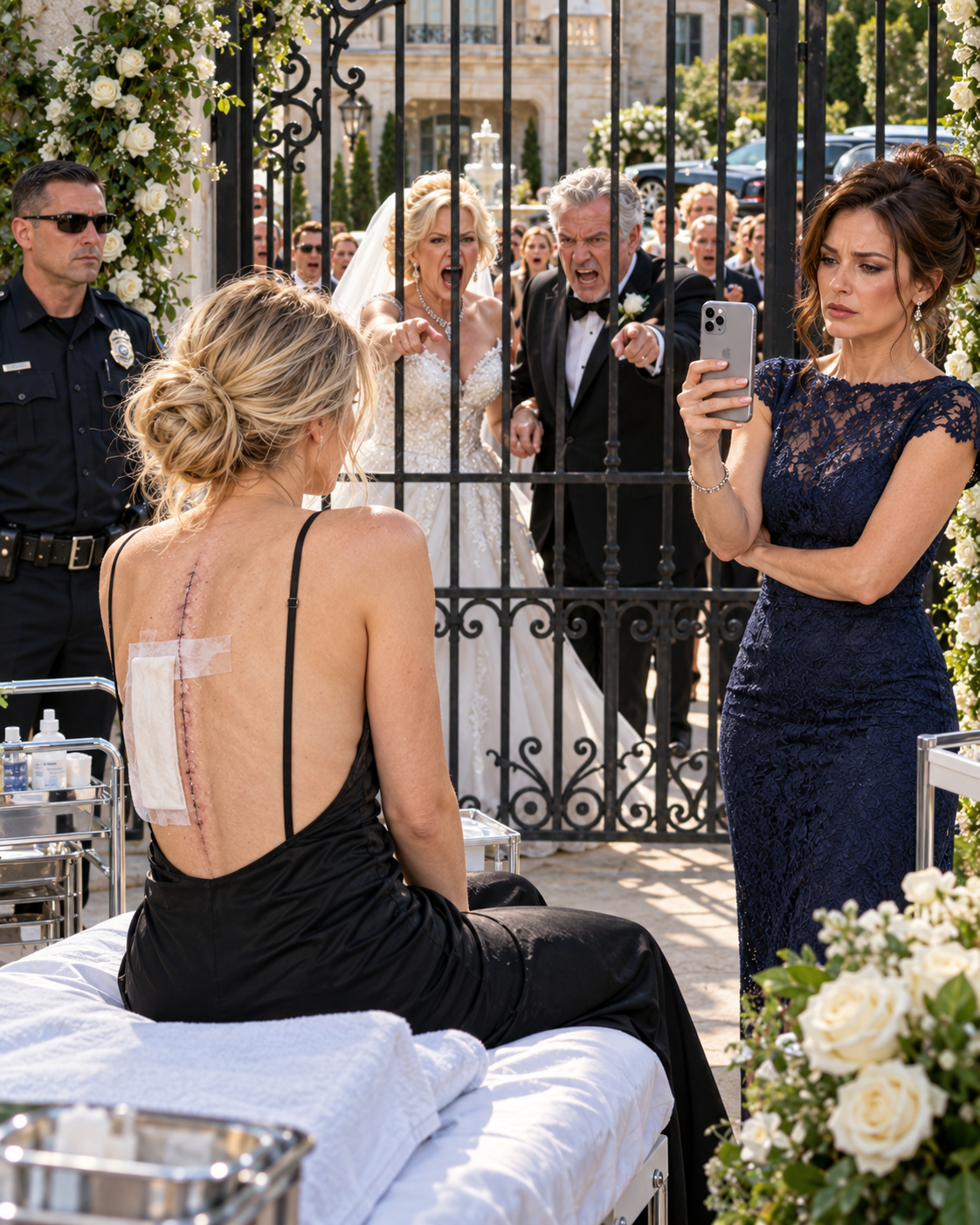
At exactly one o’clock, the Cadillac stopped at the perimeter.
Lily sat on the porch swing, wrapped in three thermal blankets, Barnaby held tightly in her lap.
My mother stepped out into the freezing air. She wore a soft green dress. She walked toward the iron barrier and stared at the keypad. The gate had remained locked for two months.
I took out my phone and sent a text. I watched Diane’s screen light up.
The new code is the date of Lily’s transplant. The day she got her second chance at life.
My father had told me that she had circled that exact date in thick red ink on her kitchen calendar since August.
Diane slowly lifted her bare, trembling hand. She entered the four digits into the keypad. The system answered with a gentle chime, followed by the deep mechanical sound of the electronic locks releasing. The heavy iron gates gradually opened inward, giving up the fortress.
Diane gasped, caught somewhere between laughter and tears. “It works.”
“Come on in, Mom,” I called.
They walked up the driveway and stopped exactly where the tiny painted flags marked the boundary I had placed in the frost. Ten feet from the porch.
Lily waved excitedly. “Hi, Grandma!”
“Hello, my sweet girl,” Diane whispered.
Then my mother did something that broke the last remaining piece of my heart. She didn’t bother with ceremony. She didn’t complain about the wet ground. She simply lowered herself onto the freezing, frosted grass in her beautiful green dress, crossing her legs like a schoolgirl.
“I’ve been waiting to sit next to someone on a staircase for fifty-four years,” she said, looking up at Lily. “I’m hoping the lawn counts.”
“The grass totally counts,” Lily beamed.
My father lowered himself beside her. Then Aunt Ruth, groaning as her knees cracked. Then Mark. We created a strange, scattered circle of masked survivors, separated by ten feet of invisible protection, yet closer than our family had been during my entire lifetime.
Before the thirty minutes were over, Diane stood. She brushed the ice from her skirt.
“I used to believe that strength meant building walls,” she told the group, her voice carrying clearly across the pasture. “I thought loyalty meant showing up to a party. It took a brave twelve-year-old to teach me that true love means sitting in the uncomfortable dark with the people who need you. It means you never, ever send someone upstairs to suffer alone.”
Lily reached beneath her blankets and pulled out her sketchbook. “I have a present.”
She lifted a huge, sprawling drawing created with bright colored pencils. It showed our farmhouse. In the yard, six tiny stick figures sat together in a circle. But the focal point was the porch. Above the door, colored a fierce, vivid yellow, was the porch light. Its beam stretched across the paper, lighting the driveway and flowing directly through the open gates.
Beneath it, she had written: EVERYBODY GETS TO COME HOME.
My mother covered her face with her hands and cried, completely unburdened. I walked down the steps and stopped exactly at the flag line. I opened my arms toward the freezing air. Ten feet away, my mother did the same. We stood there, embracing a ghost and crossing a river of generational trauma.
When the sun finally dropped beneath the treeline, the guests left. The automatic porch light switched on with a soft electrical buzz.
I sat on the swing beside my exhausted, victorious daughter. I thought about my grandmother, Josephine, who had faithfully kept that bulb burning every night of her life. At last, I understood the silent prayer behind the habit.
A house is nothing more than timber, drywall, and copper pipes. You can protect it with deadbolts and iron gates. But a true sanctuary is not created by keeping the world outside. It is forged by the relentless, burning light you leave on, sending a signal through the darkest nights and patiently waiting for the broken pieces of your family to finally find their way home.
