

I never told my mother-in-law that the daughter she had treated like a “stray dog” would eventually become the one person capable of removing her from our lives. On Christmas morning, she gave the other grandchildren cash and tablets, but when it was my daughter’s turn, she handed her a cheap candle with a tag that read, “To Caleb’s Girl.” The entire room fell silent. My seven-year-old rose from her chair in her gold dress, perfectly composed. “Grandma,” she said, “Dad told me to give this to you if you ever ignored me again.” She set a small red box in front of her. “Open it, Mom,” he said. Beatrice lifted the lid and immediately screamed.
Beatrice’s dining room in Minneapolis looked immaculate in the particular way a room does when everyone inside is carefully trying not to make a mistake. Pine garlands surrounded the doorway. Cinnamon rolls rested beneath sheets of foil. The chandelier cast reflections across the silver napkin rings, while outside, a small American flag tapped softly against the porch railing in the freezing winter wind.
Everyone knew Beatrice’s rules.
Smile.
Stay polite.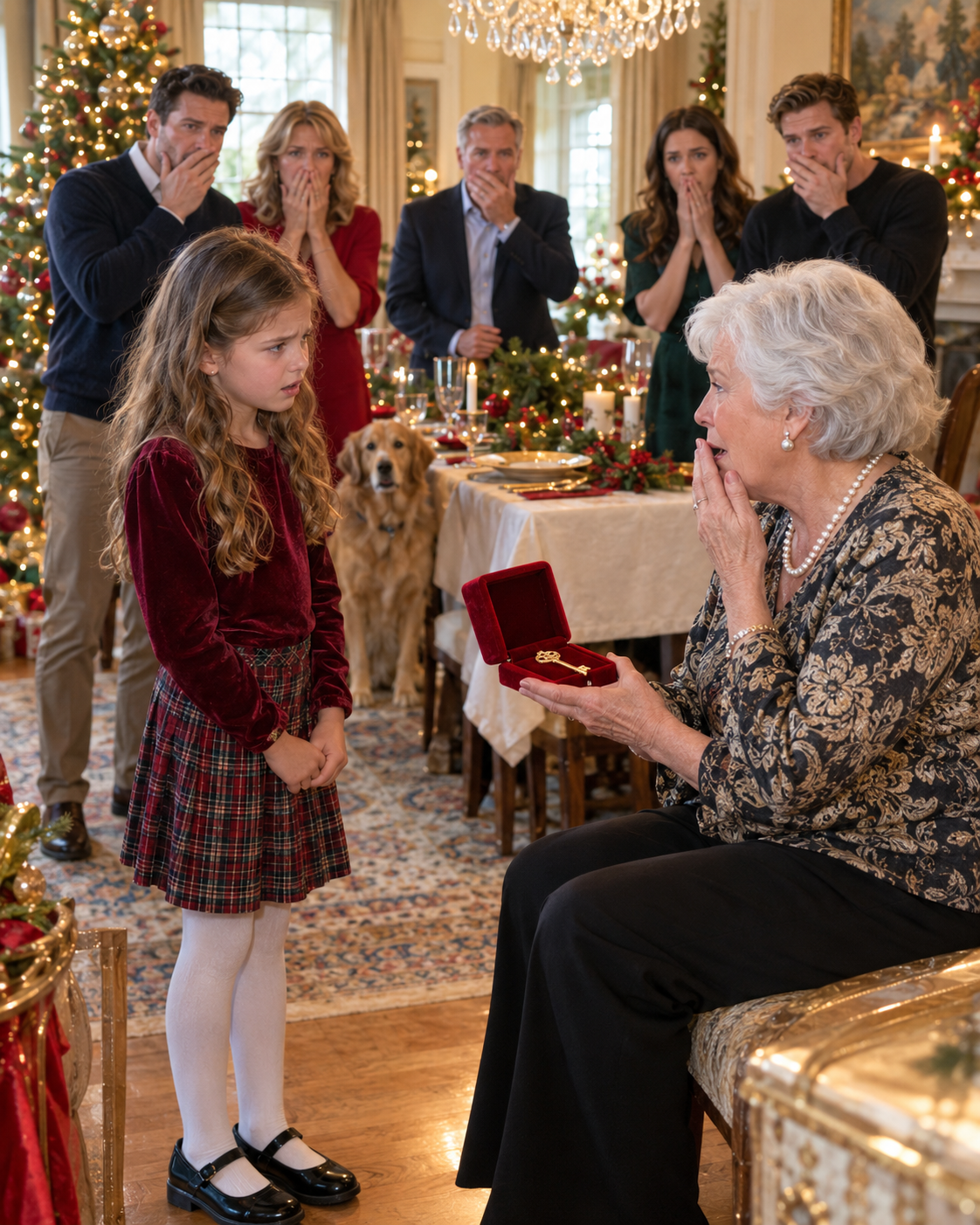
And never challenge her when she decided someone needed to be reminded of where they belonged.
That Christmas, she had decided it was my daughter’s turn.
Chloe sat beside me in the gold dress Caleb had steamed twice before we left our home in Duluth. She was seven years old, her black Mary Janes tucked neatly beneath the chair and both hands folded in her lap.
Before we walked inside, Caleb noticed a scuff on one of her shoes. He wiped it away and quietly told her, “You deserve at least one holiday where you feel chosen.”
Beatrice had spent the previous three years making certain she never felt that way.
Chloe was my daughter from my first marriage, but Caleb had never treated that as though it made her less important. He packed her lunches, remembered that her stuffed rabbit needed to face the bedroom door every night, and knew the difference between her real laugh and the careful little laugh she used around adults who made her uncomfortable.
Beatrice had never called Chloe her granddaughter.
Instead, she called her “Caleb’s girl,” “your child,” or “that sweet little visitor.”
Chloe was always almost part of the family.
But never completely.
At 8:47 a.m. on December 25, Beatrice began handing out presents as if she were presiding over some elaborate ceremony. One cousin opened an iPad. Another received the same gift. The older children pulled thick envelopes filled with cash from shiny Christmas cards.
Then Beatrice turned toward Chloe.
“Oh. Chloe.”
She extended a thin drugstore gift bag with a crooked bow attached.
“This is for you, sweetheart. I didn’t want you to feel completely left out.”
Chloe took the bag with both hands. Slowly, she moved aside the tissue paper.
Inside was a cheap vanilla candle.
The candle itself wasn’t what hurt.
It was the handwritten tag hanging from it.
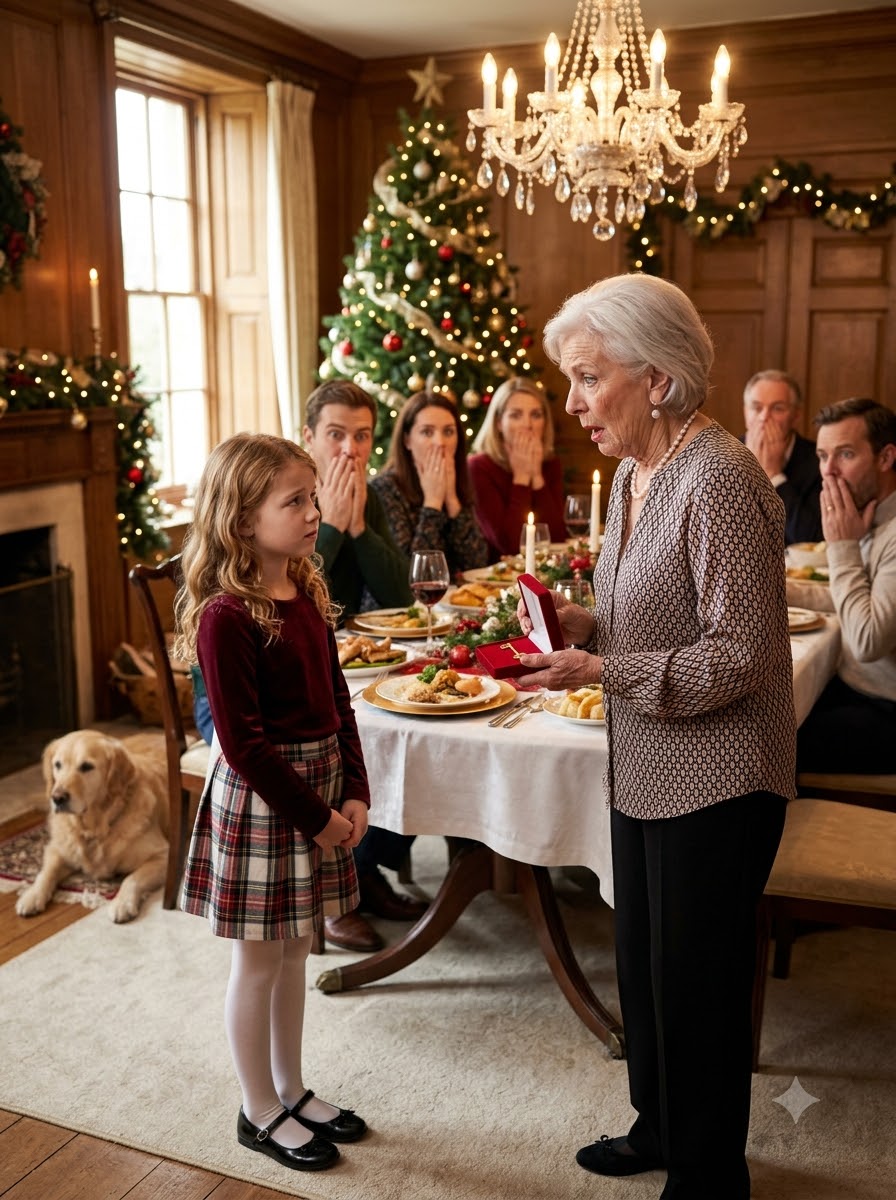
To Caleb’s Girl.
A fork froze halfway to someone’s mouth. One cousin suddenly became fascinated by the carpet. The golden retriever hiding beneath the table shifted farther from the chair legs.
Beside me, Caleb crushed the side of his paper coffee cup without even seeming to realize he was doing it.
Beatrice continued smiling as though the insult were far too insignificant for anyone with decent manners to acknowledge.
I quietly said Caleb’s name.
He leaned toward me.
“I told her to give Mom the red box if this happened again.”
“What red box?”
“The one in her overnight bag.”
I stared at him.
“You planned this?”
“No,” he said. “I prepared for it.”
Later that evening, at 9:12 p.m., I found Chloe sitting on the guest-room bed with the candle resting in her lap. Her gold dress was wrinkled, and she kept looking at the tag as though staring at it long enough might somehow change the words.
“Mom,” she asked softly, “am I only Dad’s girl?”
Before I could answer, Caleb knelt in front of her.
“You are my daughter,” he told her. “No tag gets to decide who you are.”
Then he reached into her overnight bag and placed a small red velvet box in her hands.
“If Grandma ever makes you feel invisible again, you get to decide whether she receives this. Not me. Not your mom. You.”
Chloe slowly turned the box over in her hands.
“Will she be mad?”
“Probably.”
“Will you still be my dad?”
For half a second, Caleb looked completely shattered.
“Always.”
The following morning, Beatrice hosted brunch.
Once again, the table was arranged with white dishes, silver napkin rings, and handwritten place cards.
Everyone had a name.
Except Chloe.
Her card simply said:
GUEST.
Chloe noticed it at exactly the same moment Caleb and I did.
She didn’t cry.
She didn’t ask either of us to fix it.
Instead, she reached into the tiny purse Caleb had given her, wrapped both hands around the red velvet box, and stood.
She crossed the dining room while every aunt, uncle, cousin, and in-law watched.
“Grandma,” Chloe said, loudly and clearly enough for everyone at the far end of the table to hear, “Dad told me to give this to you if you ever ignored me again.”
Beatrice’s polished smile tightened.
“Well, isn’t that dramatic.”
Caleb stood behind our daughter.
“Open it, Mom,” he said.
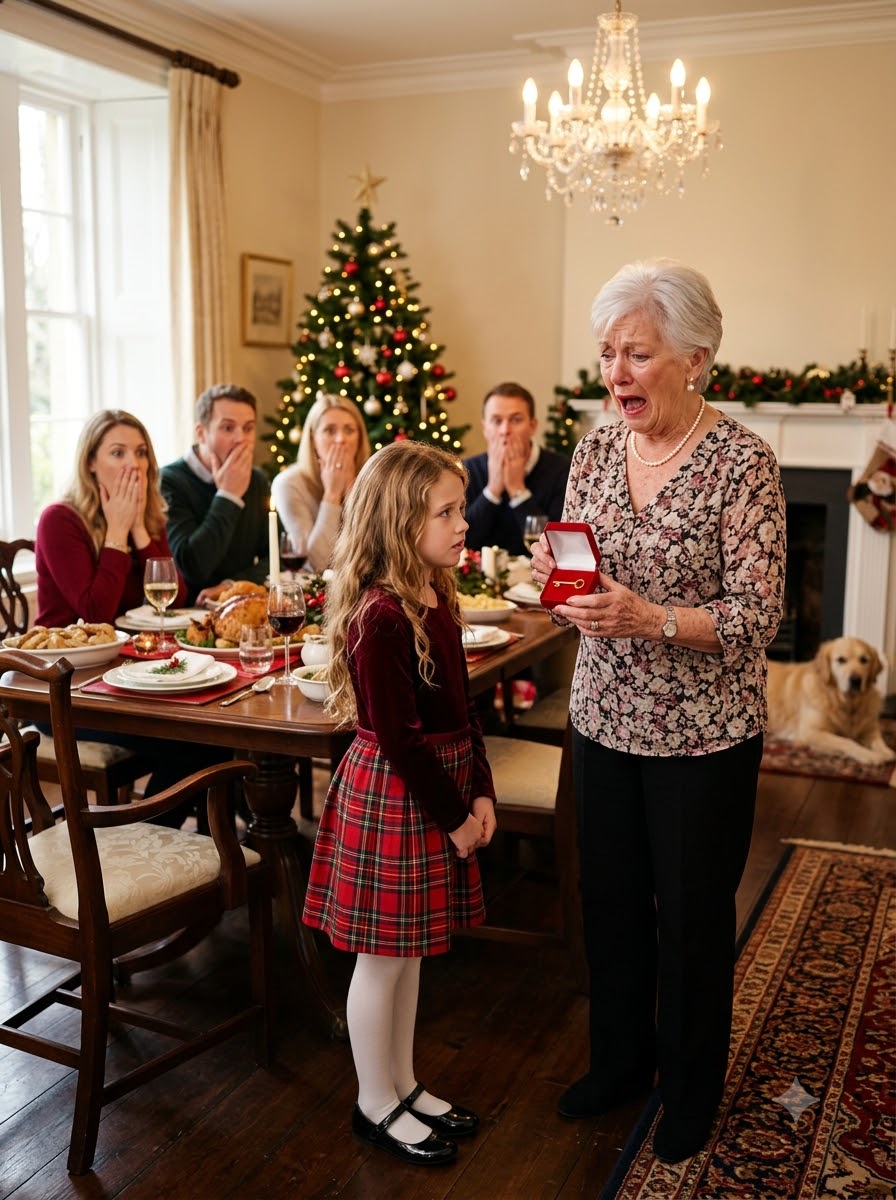
Beatrice lifted the lid while still wearing that smug expression, as though she already had a speech prepared about overly sensitive children and modern parenting.
Then she screamed.
The cousin standing near the window flinched.
Everyone leaned forward.
Inside the red velvet box sat a single small brass key and a folded white card.
The first words written on it were:
“Mom, this is your last key.”
Beatrice stared at the card.
Her face lost its color.
For several seconds, nobody moved.
Then she looked at Caleb.
“What is this?”
Her voice was no longer sharp.
It was frightened.
Caleb didn’t answer immediately.
He looked at Chloe first.
She was standing perfectly still, holding the empty velvet box against her little chest.
Then he looked back at his mother.
“It means exactly what it says.”
Beatrice gripped the edge of the table.
“You wouldn’t.”
“I already did.”
A murmur moved through the room.
One of Caleb’s brothers shifted uncomfortably in his chair.
“Caleb, what are you talking about?”
Caleb reached into his jacket and pulled out a second envelope.
“This key belonged to the side entrance.”
Beatrice stared at him.
“That doesn’t make any sense.”
“It opens the door to the house.”
She blinked.
“The house?”
“Our house.”
Her eyes widened.
“You changed the locks?”
“Yesterday.”
The room became completely silent.
Beatrice looked from Caleb to me.
“You changed the locks on my house?”
“No.”
Caleb placed the envelope on the table.
“I changed the locks on our house.”
Beatrice’s mouth opened.
For years, she had treated Caleb’s home as an extension of her own authority. She had a key. She arrived without warning. She opened cabinets. She rearranged things. She criticized the way Chloe’s shoes were left by the door and complained whenever a toy appeared in the living room.
But that key was no longer useful.
Caleb had made that clear.
Beatrice looked down at the brass key.
Then at Chloe.
“This is because of her?”
Caleb’s jaw tightened.
“This is because of you.”
Beatrice laughed once, but the sound was brittle.
“Oh, please. She received a candle.”
“No.”
Caleb’s voice remained calm.
“She received a message.”
Nobody spoke.
“You’ve been sending that message for three years.”
Beatrice shook her head.
“I have never done anything to that child.”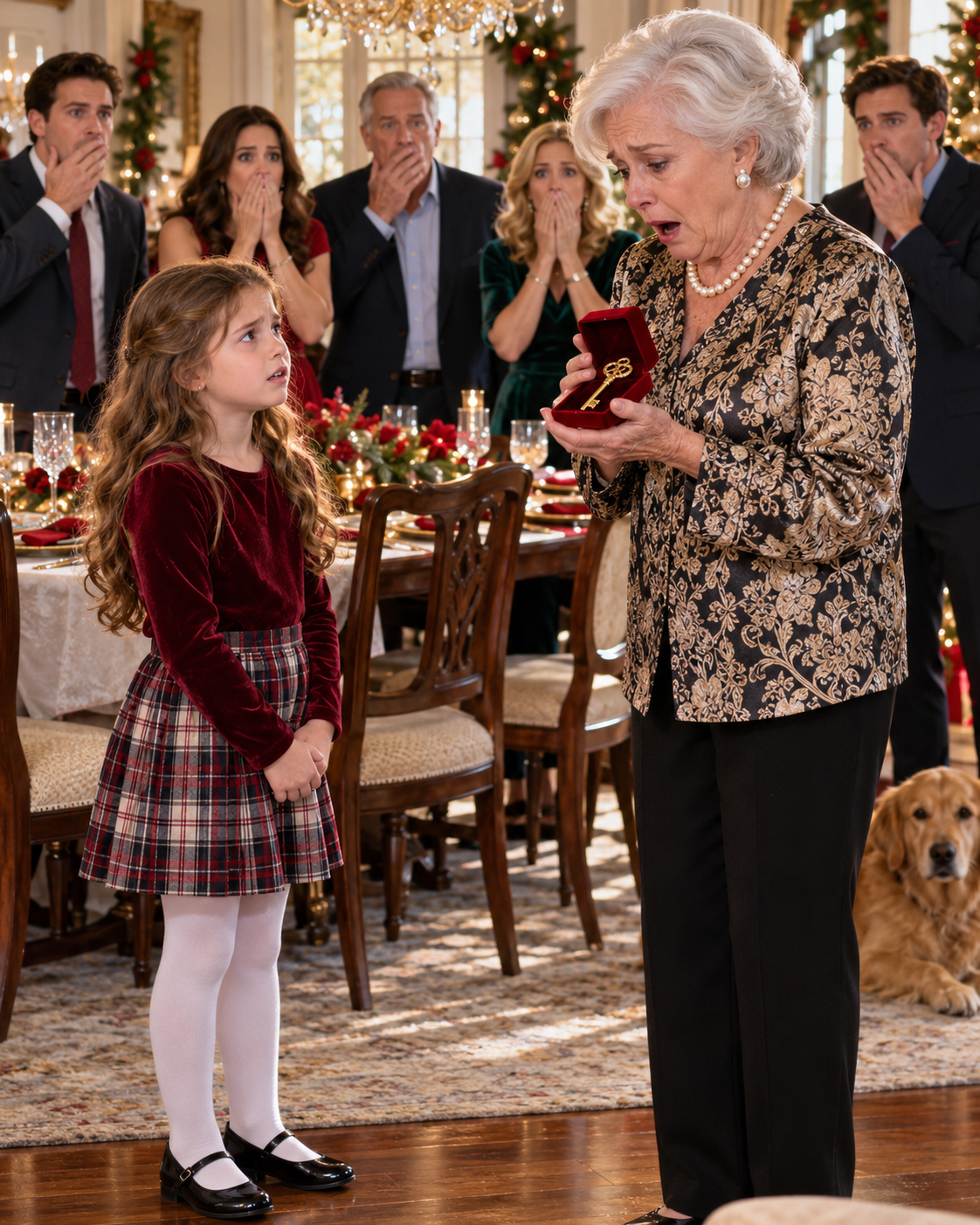
I felt something inside me go still.
Not angry.
Not surprised.
Just tired.
I reached across the table and picked up the cheap candle.
“This isn’t about the candle.”
Beatrice looked at me.
“It is about every time you called her ‘Caleb’s girl.’ Every time you introduced her as though she were someone visiting your family. Every time you gave gifts to everyone except her. Every time you made her stand outside conversations because you said they were ‘family matters.’”
Beatrice’s expression hardened.
“She isn’t my biological granddaughter.”
Chloe lowered her eyes.
Caleb immediately moved beside her.
“And there it is.”
Beatrice looked at him.
“What?”
“The truth.”
He crouched beside Chloe.
“You heard her.”
Chloe didn’t speak.
Caleb gently touched her shoulder.
“You don’t have to explain anything.”
Then he stood again.
“Mom, I spent years hoping you’d change.”
Beatrice folded her arms.
“And now?”
“Now I stopped asking.”
She stared at him.
“You’re throwing your mother away over a child who isn’t even yours?”
The room seemed to shrink.
Caleb’s face changed.
Not anger.
Something deeper.
Disappointment.
“She is mine.”
The words came quietly.
But everyone heard them.
“She is mine because I chose her. Because she calls me when she’s scared. Because I know which cereal she likes. Because I sit beside her bed when she has nightmares. Because when she looks for someone to protect her, she looks at me.”
He paused.
“And because I promised her father, before he died, that I would never let anyone make her feel like she didn’t belong.”
I felt my throat tighten.
Chloe looked up at him.
Beatrice stared at Caleb as though she had never seen him before.
“You promised her father?”
Caleb nodded.
“He asked me to be there for her.”
“And you think that gives you the right to turn against your own family?”
Caleb shook his head.
“No.”
He looked toward Chloe.
“She is my family.”
Beatrice’s fingers tightened around the white card.
“What does the key have to do with any of this?”
Caleb picked up the envelope again.
“The house key is symbolic.”
“Of what?”
“That you don’t have access to our home anymore.”
Beatrice’s face hardened.
“You can’t keep me from my own son.”
“I’m not.”
“You’re punishing me.”
“No.”
Caleb looked directly at her.
“I’m protecting my daughter.”
The words landed harder than anything else.
Chloe slowly reached for his hand.
He took it.
Beatrice noticed.
For the first time that morning, she seemed to understand that Chloe wasn’t standing alone.
She looked around the table.
No one was defending her.
Her other grandchildren were watching silently.
One of the cousins lowered his eyes.
An aunt who had laughed at Beatrice’s jokes all morning suddenly looked uncomfortable.
Beatrice turned toward her eldest son.
“You agree with this?”
He didn’t answer.
“Answer me.”
He swallowed.
“I think Mom went too far.”
Beatrice stared at him.
“You too?”
He nodded slowly.
“I’ve seen how you treat Chloe.”
Beatrice’s face reddened.
“You all think I’m cruel?”
Nobody answered.
That silence answered for them.
Beatrice pushed back her chair.
“This is ridiculous.”
She walked toward the hallway.
Caleb didn’t stop her.
At the front door, she turned.
“This isn’t over.”
Caleb remained beside Chloe.
“Yes, Mom.”
Beatrice looked at the brass key in her hand.
Then she dropped it onto the entry table.
“I hope you’re happy.”
Caleb didn’t respond.
She opened the door.
Cold air rushed inside.
For a moment, she stood there.
Then she left.
The door closed.
Nobody spoke.
Chloe looked up at Caleb.
“Is Grandma gone?”
Caleb knelt.
“For today.”
“Forever?”
He took a breath.
“I don’t know.”
She looked down at the floor.
“Did I do something bad?”
“No.”
He answered so quickly that she looked surprised.
“You did nothing wrong.”
“But she screamed.”
“That wasn’t your fault.”
“She hates me.”
Caleb’s eyes softened.
“We don’t know what she feels.”
Chloe looked toward me.
“Can we go home?”
I nodded.
“Yes.”
Caleb smiled faintly.
“That sounds like a very good idea.”
We packed quietly.
There was no dramatic goodbye.
No argument.
No final speech.
Just three people putting coats on in a house that suddenly felt much colder than it had an hour earlier.
Before we left, Chloe returned to the dining room.
The candle was still on the table.
She picked it up.
“Mom?”
“Yes?”
“Can I leave this here?”
I looked at the candle.
“Do you want to?”
She nodded.
“I don’t want it.”
“Then leave it.”
She placed it beside the plate marked GUEST.
Then she walked away.
As we stepped outside, snow had begun falling.
Chloe slipped her hand into Caleb’s.
He squeezed it.
“Dad?”
“Yeah?”
“Did the key really make Grandma lose her house?”
Caleb looked at me.
Then he smiled.
“No.”
“What did it do?”
“It reminded her that our home belongs to the people who live there.”
Chloe thought about that.
“Does our home belong to me too?”
Caleb stopped walking.
He crouched until they were eye to eye.
“Always.”
She smiled.
Then she hugged him.
He closed his arms around her.
I stood beside them in the cold, watching the two people I loved most.
And for the first time in three years, I realized something.
We hadn’t removed Beatrice from our lives because she was cruel to Chloe.
We had removed her because Chloe deserved a home where she didn’t have to earn the right to belong.
Three weeks passed.
There were no calls from Beatrice.
No messages.
No surprise visits.
Nothing.
At first, the silence felt strange.
Then it became peaceful.
Chloe stopped checking the driveway whenever a car slowed outside.
She stopped asking whether Grandma would be at family gatherings.
She stopped practicing what she would say if Beatrice made another comment about her being “Caleb’s girl.”
One Saturday morning, she came into the kitchen wearing pajamas and carrying her stuffed rabbit.
“Mom?”
“Yes?”
“Can I ask you something?”
“Of course.”
“Am I allowed to call Caleb Dad?”
I looked at her.
“You’ve been calling him Dad for three years.”
“I know.”
She hugged the rabbit tighter.
“But I mean really call him Dad.”
I smiled.
“You don’t need anyone’s permission.”
She ran down the hallway.
“Dad!”
Caleb appeared from the living room.
“What?”
“Mom said I can really call you Dad.”
He blinked.
Then he smiled.
“I thought you already did.”
Chloe threw her arms around him.
“I do.”
He hugged her tightly.
I watched them from the kitchen doorway.
And I understood why that little red box had mattered.
It hadn’t been about a key.
It hadn’t been about revenge.
It had been about giving a seven-year-old child a choice she should never have needed in the first place.
The choice to walk away from someone who kept telling her she didn’t belong.
Two months later, Beatrice finally called.
I was sitting at the kitchen table helping Chloe with homework when Caleb’s phone rang.
He looked at the screen.
His expression changed.
“Mom,” he said.
Chloe immediately stopped writing.
Caleb answered.
“Hello.”
There was a long pause.
Then his face tightened.
He listened.
“Okay.”
Another pause.
“I understand.”
He looked at Chloe.
She was watching him.
“I’ll think about it.”
He ended the call.
Chloe waited.
“What did Grandma say?”
Caleb sat down.
“She wants to see you.”
Chloe’s pencil stopped moving.
“Me?”
“Yes.”
“Why?”
“I don’t know.”
She looked at me.
“Do I have to?”
“No.”
The answer came from both of us.
She looked relieved.
Then thoughtful.
“Does she want to apologize?”
Caleb hesitated.
“She didn’t say.”
Chloe looked down at her homework.
“Then I don’t want to go.”
Caleb nodded.
“Okay.”
No pressure.
No guilt.
No adult telling her that she owed someone forgiveness because they were family.
A week later, another envelope arrived.
This time, there was no key.
No demand.
Just a handwritten letter.
Beatrice had written it herself.
She admitted that she had treated Chloe differently.
She admitted that she had believed being Caleb’s stepdaughter somehow made Chloe less deserving of the same place as the other grandchildren.
She admitted that the Christmas candle had been intentional.
And she apologized.
Not for being misunderstood.
Not for the family conflict.
For hurting Chloe.
Caleb read the letter twice.
Then he gave it to Chloe.
She couldn’t read all of it herself, so I read it aloud.
When I finished, she sat quietly for a long time.
“Is she sorry?”
“I think she is,” Caleb said.
“Do I have to forgive her?”
“No.”
“Can I forgive her later?”
“Yes.”
“Can I never forgive her?”
Caleb swallowed.
“Yes.”
Chloe thought about that.
Then she folded the letter carefully.
“I think I want to meet her someday.”
Caleb nodded.
“Whenever you’re ready.”
“And Dad?”
“Yeah?”
“I don’t want to go to her house.”
He smiled.
“Then we won’t.”
Months later, they met at a quiet café.
Beatrice arrived early.
For once, she wasn’t dressed for an audience.
She wore a simple coat and sat with both hands wrapped around a cup of coffee.
When Chloe entered, Beatrice stood.
Neither of them moved toward the other.
Then Beatrice said the words she should have said years earlier.
“I’m sorry.”
Chloe looked at her.
Beatrice’s eyes filled with tears.
“I was wrong.”
Chloe didn’t answer immediately.
Then she asked:
“Why didn’t you love me?”
Beatrice’s face crumpled.
“I don’t know.”
It was perhaps the first honest answer she had ever given.
Chloe looked down.
“I wanted you to.”
Beatrice nodded.
“I know.”
“You called me Caleb’s girl.”
“I know.”
“I have a name.”
“I know.”
“It’s Chloe.”
Beatrice wiped her eyes.
“I know.”
Chloe looked at Caleb.
He gave her a small nod.
Then she turned back to Beatrice.
“My dad says people can change.”
Beatrice nodded.
“I hope he’s right.”
Chloe took a breath.
“I don’t want to be your guest anymore.”
Beatrice stared at her.
“What do you want to be?”
Chloe thought for several seconds.
Then she answered:
“Your granddaughter.”
Beatrice began crying.
But Chloe didn’t rush into her arms.
She didn’t owe her that.
Instead, she simply sat there.
And Beatrice sat across from her.
For the first time, there was no performance.
No expensive presents.
No perfect dining room.
No place card designed to make someone feel small.
Just a grandmother and a little girl sitting across from each other, trying to decide whether something broken could be rebuilt.
It took time.
It wasn’t perfect.
Beatrice still made mistakes.
Chloe still remembered the candle.
But the insults stopped.
The labels stopped.
And eventually, a new Christmas came.
This time, when Beatrice handed Chloe a present, the tag didn’t say “Caleb’s Girl.”
It said:
To Chloe.
My Granddaughter.
Chloe stared at it.
Then she looked at Beatrice.
“Thank you.”
Beatrice smiled through tears.
“You’re welcome.”
Chloe opened the box.
Inside was a gold bracelet.
Nothing extravagant.
Just a small bracelet with her name engraved on it.
Chloe touched the letters.
“It’s my name.”
“Yes.”
She smiled.
Caleb stood behind her.
His eyes met mine.
Neither of us said anything.
We didn’t need to.
The little red box was still in our house.
Chloe kept it on a shelf beside her favorite books.
The brass key was inside.
Not because she needed it.
Not because it represented revenge.
But because she remembered what it had taught her.
Sometimes the most important key isn’t the one that opens a door.
Sometimes it’s the one that reminds you that you have the right to close one.
And Chloe finally understood something I wish she’d never had to learn so young:
Belonging isn’t something another person gets to grant you.
You belong where you are loved.
Where you are protected.
Where your name is spoken with pride.
And where nobody ever makes you feel like a guest in your own family.
That Christmas, Chloe sat between Caleb and me at the table.
Her place card had her full name written across it.
Chloe.
Not “Caleb’s girl.”
Not “guest.”
Just Chloe.
And for the first time, that was enough.
