

PART 1
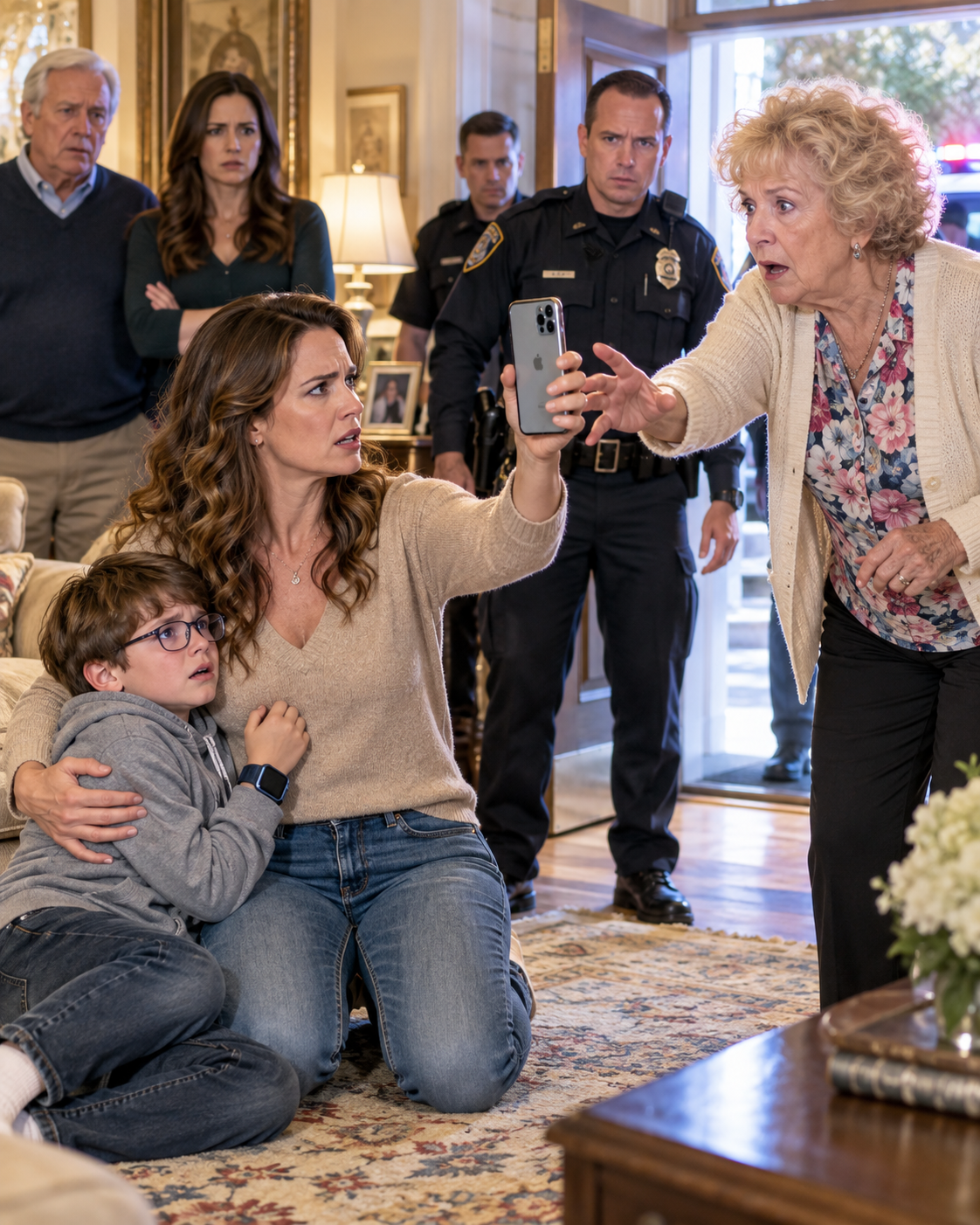
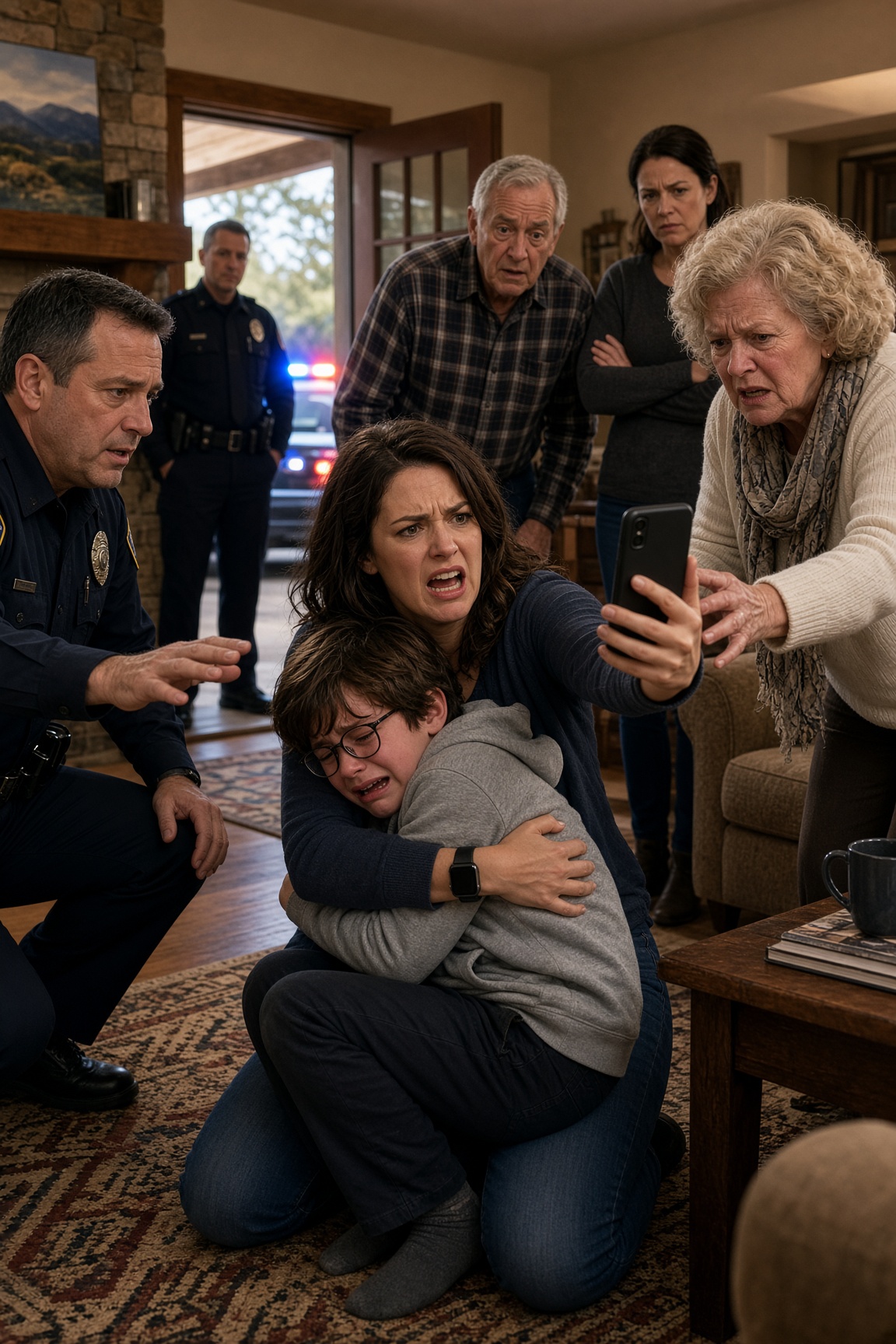
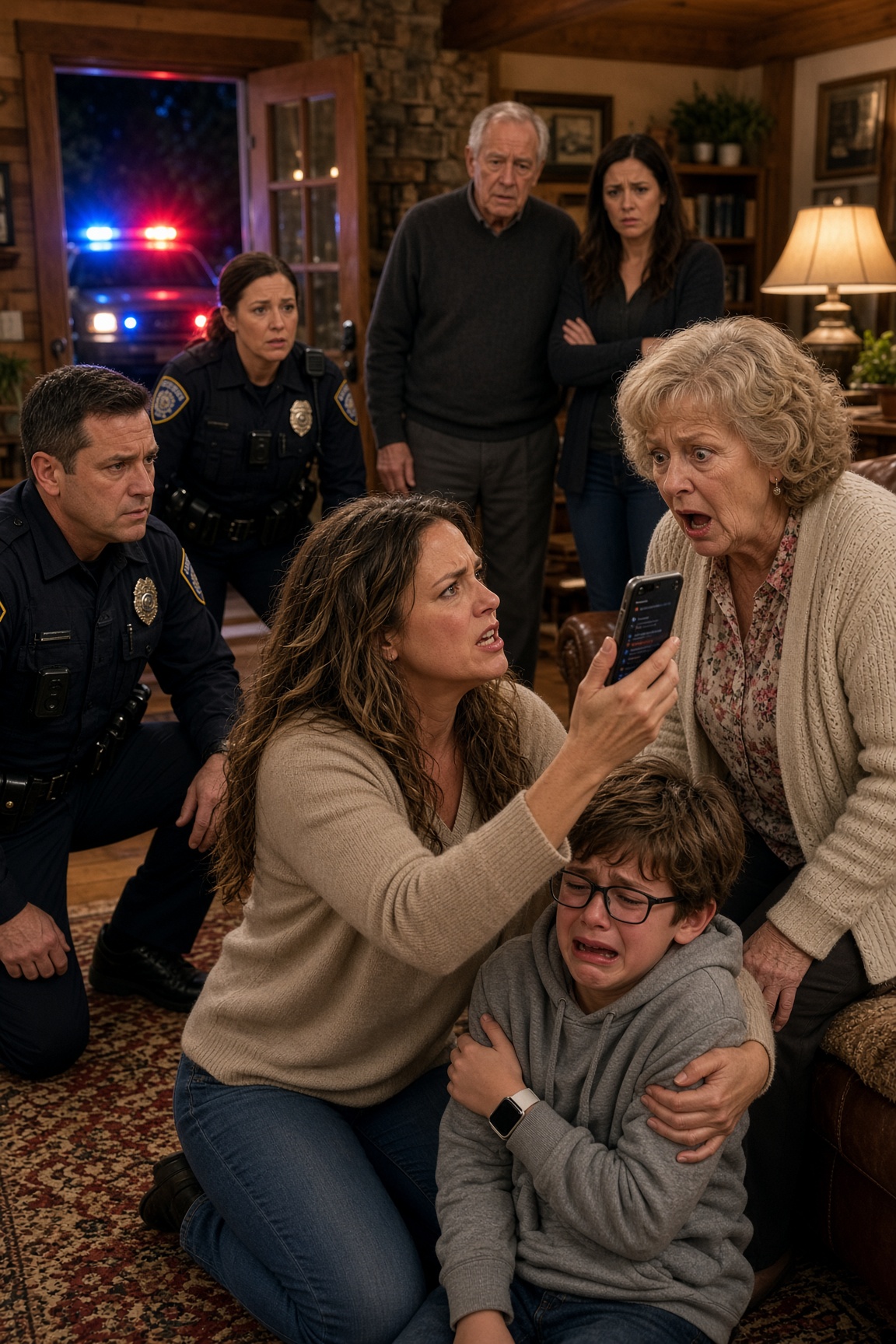
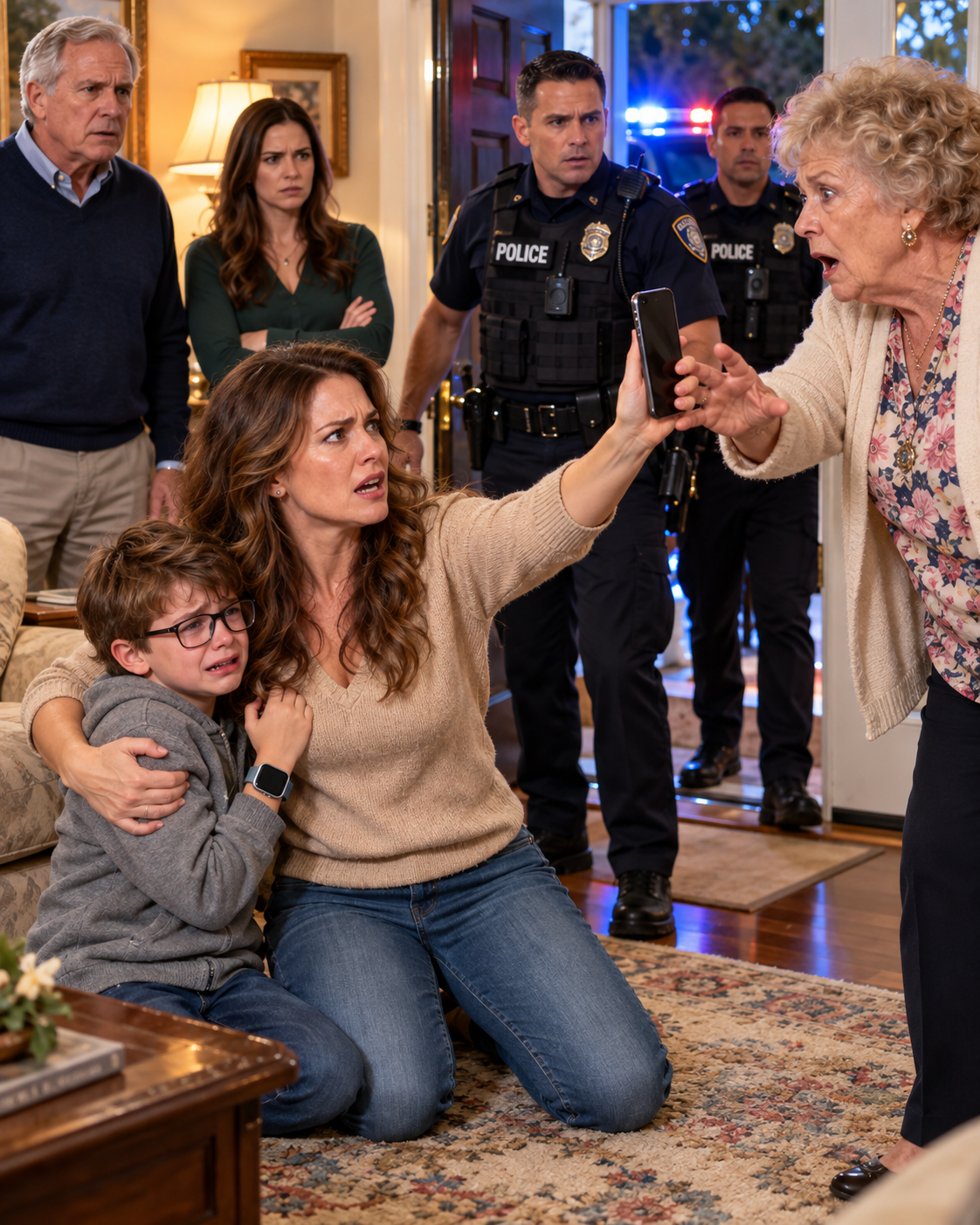
My eight-year-old son lay gasping on my parents’ floor after his twelve-year-old cousin’s beating fractured one of his ribs. When I reached for my phone to call 911, Mom snatched it away. “Boys fight. Don’t ruin your nephew’s future.”
Dad barely looked up. “You’re overreacting.”
My sister only smirked.
The living room smelled like burnt coffee and the lemon cleaner Mom used before company came over.
A game show kept chattering from the television while I dropped beside my son on the beige carpet. His face was pale around the mouth. One hand pressed against his left side, and every shallow breath ended in a small broken sound.
His glasses sat crooked on his nose. One sneaker had come loose. His smartwatch was half hidden beneath his hoodie sleeve, the one I usually reminded him to charge before school.
“It hurts,” he whispered.
I reached for my phone.
Mom grabbed my wrist, ripped it from my hand, and stepped back with the phone tucked behind her hip.
“Boys fight,” she said again. “You call the police over this and you could ruin your nephew’s future.”
I looked at my son. He tried to breathe deeper and stopped halfway.
Dad lowered the television by one click.
“You’re overreacting.”
My sister stayed against the doorway, arms crossed, while her twelve-year-old son remained somewhere down the hall.
“He started it,” she said.
My son shook his head once. Then pain stopped him.
I slid one arm behind his shoulders without lifting him and told him to stay still.
“Look at me, buddy. Small breaths.”
Mom stepped closer. “Stop making this dramatic.”
I asked for my phone again.
She refused.
I asked Dad to call instead.
He picked up his glass. “No.”
My sister glanced toward the hallway, then back at me.
“We just need everyone to calm down before somebody says something they can’t take back.”
I reached toward the landline on the side table.
Mom moved between us.
That failed too.
My son made another sharp sound, and I stopped arguing with them long enough to pull his hoodie away from his neck and make sure nothing was restricting his breathing.
The air conditioner blew cold against my hands. A contestant on television won a vacation. The audience applauded.
Nobody in that room moved toward my child.
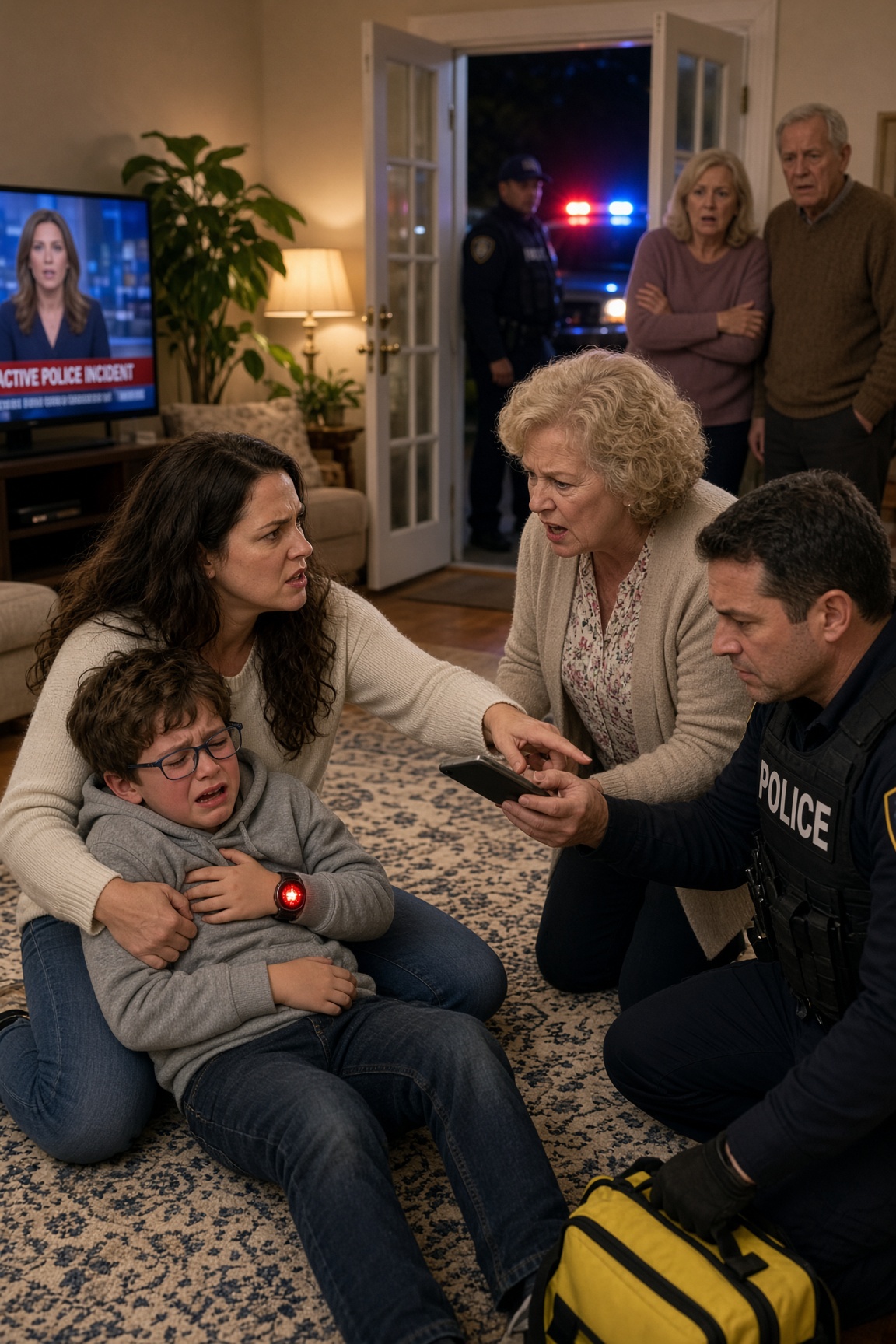
Then something red flashed beneath his sleeve.
I pushed the cuff back.
His watch screen was scratched, but a red SOS symbol blinked above a timer.
11:07.
11:08.
11:09.
I knew what that screen meant because I had set up the emergency feature when he started walking from the bus stop with a friend.
My son looked at me.
I looked at him.
He gave the smallest nod.
I stopped asking for my phone.
Mom noticed the change immediately.
“There,” she told my sister. “He finally understands.”
Dad took my phone from her and set it beside his recliner where I could not reach it without crossing the room.
My sister smiled again.
“See? Nobody needs police.”
Outside, tires rolled slowly over the gravel at the edge of my parents’ driveway.
I kept one hand beside my son’s shoulder.
Dad muted the television.
Nobody spoke.
A car door shut outside.
Then another.
Mom turned toward me.
“Who did you call?”
I checked my son’s breathing instead of answering.
Blue light moved across the wall and briefly washed over the framed school pictures Mom kept lined above the couch.
My sister pushed away from the doorway.
Dad stood up.
Mom grabbed my phone from the table and shoved it onto the end table beside me.
“Nobody says anything until we agree on what happened.”
A hard knock rattled the glass in the front door.
“Emergency services.”
I got up and opened it.
The first officer took one look past me and called the paramedics forward. His partner moved toward the hallway while he crouched several feet from my son.
Mom followed him into the room.
“This is a misunderstanding,” she said. “Boys fight, and my son is upset—”
The officer’s radio crackled.
He listened without interrupting her.
Then he looked toward my mother, looked at the watch on my son’s wrist, and held out his hand toward him.
PART 2
“Can I see your watch?” the officer asked.
My son lifted his trembling wrist just enough for him to take it without pulling on his injured side. The officer studied the screen, then touched his radio.
“Dispatch, confirm the emergency call came from this device.”
A voice answered immediately.
“Confirmed. Child-initiated SOS. Location matched this address.”
Mom stopped talking.
The paramedic beside my son asked where the pain was worst. When my son pointed to his ribs, she told her partner to bring the stretcher closer and warned everyone not to move him unnecessarily.
My sister stepped forward. “He was fine five minutes ago.”
The officer turned to her.
“You said he started the fight?”
“Yes.”
From the hallway, his partner called out, “I found the other boy.”
My nephew appeared behind him, suddenly pale. Before my sister could reach him, the officer asked one simple question.
“Did he hit you first?”
My nephew looked at my son, then at his mother.
“No.”
My sister’s face changed.
Mom whispered his name like a warning.
The officer heard that too.
Then my son spoke from the floor.
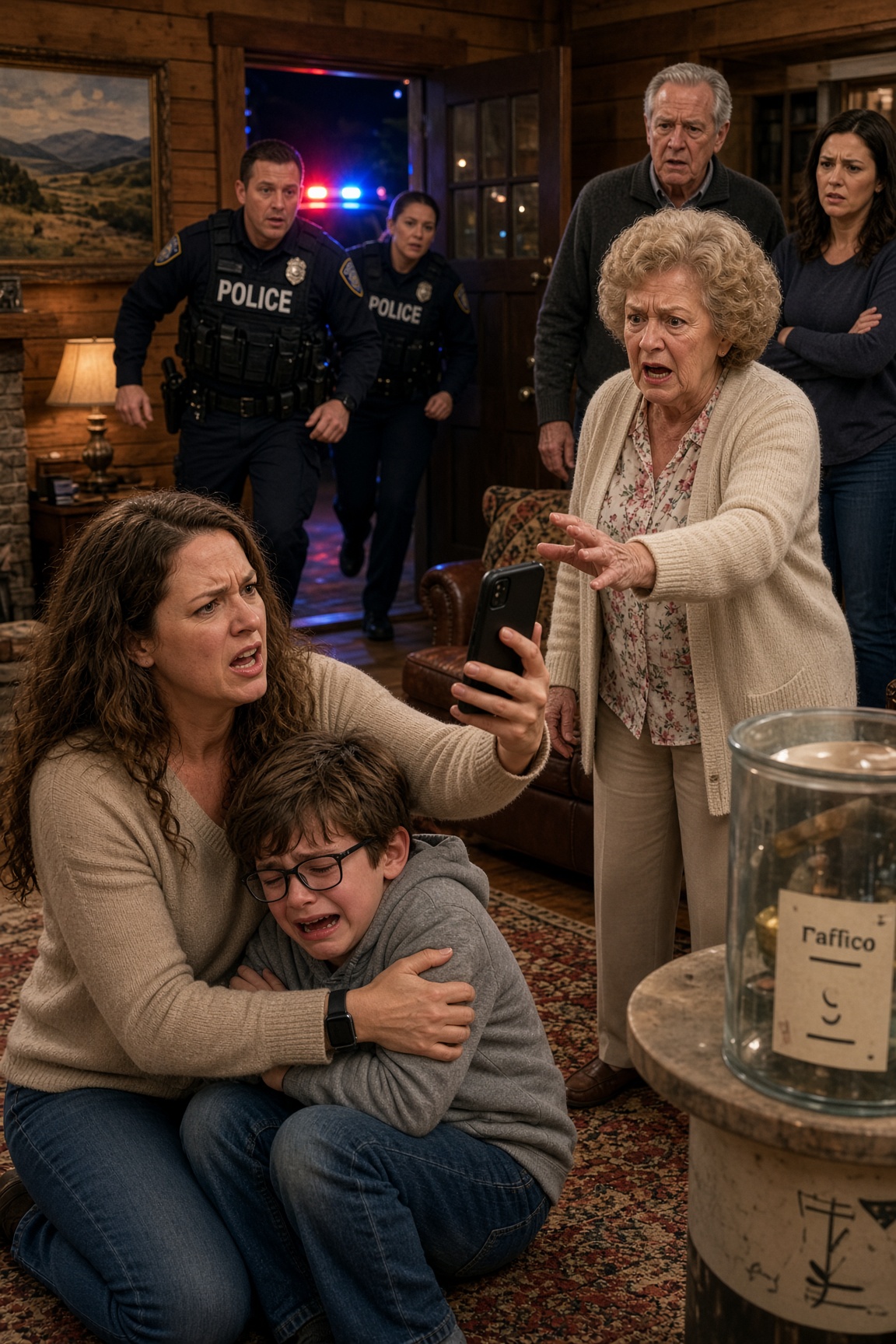
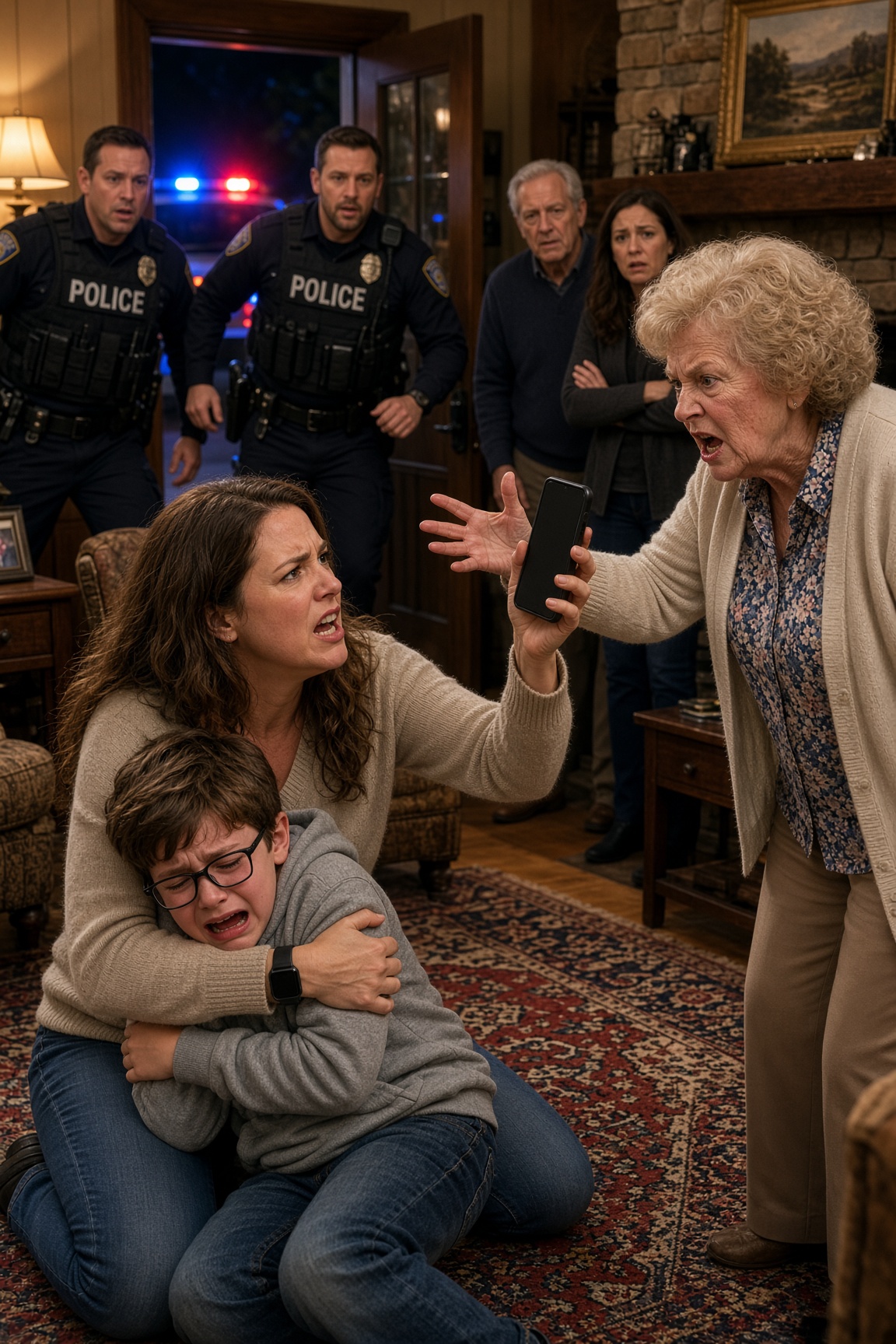
“Grandma took Dad’s phone so he couldn’t call 911.”
The room went completely still.
PART 3
The worst moment of that afternoon was not when my son got hurt.
It was when I realized the adults around him had decided protecting a family secret mattered more than protecting a child.
My eight-year-old son was lying on my parents’ living room floor.
He was struggling to breathe normally.
One hand was pressed against his side.
His face had gone pale.
And the person I expected to help me first was the person who tried to stop me.
My mother grabbed my phone.
“Boys fight.”
She said it like those two words could erase everything happening in front of her.
My father looked at the situation and decided I was overreacting.
My sister stood nearby defending her twelve-year-old son.
Nobody asked my child if he was okay.
Nobody moved toward him.
The room continued pretending everything was normal.
The television was still on.
The coffee was still sitting on the table.
The same house where I grew up suddenly felt unfamiliar.
I had trusted these people.
I had believed that if something happened to my child, everyone would immediately protect him.
Instead, they protected the person who caused the injury.
My son tried to tell me he was hurting.
I heard him.
They did not.
In the seconds after he said Grandma took my phone, I watched three adults do the same calculation at the same time. Not how do we help him. How do we keep this from leaving the house.
Mom’s mouth opened and closed once.
Dad set his glass down too carefully, as if a louder sound might make the officer write something down.
My sister took one step toward my nephew and the second officer shifted his body just enough to keep her from reaching him first.
“I need everyone to stay where they are,” the first officer said. His voice stayed even. “Paramedics are working.”
They lifted my son only as much as they had to. He made a sound I will remember for the rest of my life, short and startled, and then he looked for me over the edge of the stretcher.
“I’m right here,” I said. “I’m coming with you.”
Mom reached for my arm.
“We should talk first.”
I did not stop.
The officer at the door looked at my empty hands.
“You can ride if you’re the parent. Phone?”
Dad still had it by the recliner. I walked past him, picked it up, and did not look at his face.
Outside, the afternoon was bright in a way that felt wrong. Someone’s sprinkler ticked on the next lawn. A neighbor had paused with a grocery bag, watching without coming closer.
I climbed into the ambulance and took the jump seat. My son’s glasses were in a plastic bag now. The paramedic asked him his name, his age, whether he felt sick, whether the pain stayed in one place or moved.
He answered in small words.
When she asked who hurt him, he looked at me first.
“It’s okay to tell her,” I said.
“My cousin,” he whispered. “He pushed me into the table and then he kicked me when I was on the floor.”
The paramedic wrote it down without commenting.
Through the back window I saw my sister on the porch with both hands in her hair. Mom was talking fast to the officer. Dad stood in the doorway like a man waiting for the scene to reset.
It did not reset.
PART 4
The hospital smelled like antiseptic and warm plastic.
They took him straight back. A nurse asked me the same questions the paramedic had asked, then new ones. Allergies. Last meal. Whether he had ever broken a bone. Whether anyone at home had ever put hands on him before.
“No,” I said. “Not in my house.”
She nodded as if she had heard every version of that sentence.
X-rays confirmed what I already knew in my hands. One rib on the left side was fractured. They watched his oxygen and listened to his lungs twice. The doctor, a calm woman with a silver clip in her hair, said the break was consistent with a direct blow. She used the word assault without raising her voice.
“He is stable,” she said. “He is also eight. We are required to document this and notify the appropriate agencies.”
“Good,” I said.
She looked at me a second longer, then nodded again.
They gave him medicine for the pain. Color returned to his mouth. He asked if his watch was still working.
“They have it at the desk,” I said. “You did the right thing.”
He stared at the ceiling tile.
“Grandma said I was going to get Tyler in trouble.”
It was the first time he used his cousin’s name since we left the house.
“Tyler got himself in trouble,” I said. “You asked for help. That is not the same thing.”
He blinked hard.
“Dad?”
“Yeah.”
“I didn’t start it.”
“I know.”
A social worker named Ms. Grant came in with a folder and a voice that sounded practiced at not startling children. She asked my son if he wanted me in the room. He said yes. She asked him what happened in his own words, and he told her about the backyard first, then the hallway, then the living room table.
They had been playing a video game. Tyler lost. Tyler said he was cheating. My son said he wasn’t. Tyler shoved him. My son told him to stop. Tyler shoved him harder, into the corner of the coffee table. When my son went down and tried to get up, Tyler kicked him in the side and told him not to cry like a baby.
My sister had been in the kitchen with Mom.
Dad had been in the recliner.
Nobody came until my son made a sound loud enough to cross the room.
Ms. Grant wrote while he talked. She did not coach him. She did not tell him he was brave. She just let him finish.
When she asked if anyone had told him not to talk to police or doctors, he looked at me again.
“Grandma took Dad’s phone,” he said. “She said boys fight. Aunt said I started it. I didn’t.”
“Thank you,” Ms. Grant said. “You were very clear.”
After she left, my son slept with his mouth slightly open, the way he did when he was little. I sat in the vinyl chair and looked at my phone. Seventeen missed calls. Mom. Sister. Dad. Mom again.
I did not call back.
PART 5
They arrived anyway.
Mom came first, still in the same blouse, lemon cleaner clinging to her like a story she wanted to keep telling. My sister followed with makeup freshly done, which told me she had stopped in a bathroom to decide how she wanted to look while she explained this.
A nurse stopped them at the desk.
I stepped into the hall.
“You cannot see him right now,” I said.
Mom’s eyes filled on cue.
“He is my grandson.”
“He is my son. He is in pain. He already told three different adults what happened. He does not need to hear a new version.”
My sister’s voice sharpened.
“You are making Tyler into a monster over a scuffle.”
“A fractured rib is not a scuffle.”
“He is twelve.”
“And mine is eight. On the floor. Asking for air.”
Mom lowered her voice the way she did in church parking lots.
“If this goes on a record, it follows Tyler. Baseball. High school. You know how these things look.”
There it was again. The future. Always someone else’s future. Never the child who could not take a full breath.
“I know how a kicked rib looks,” I said. “I just saw the film.”
Dad appeared behind them, holding his keys like a peace offering.
“Let’s not do this in a hallway.”
“You had a hallway at the house,” I said. “You used it to look for the other boy instead of the one who couldn’t stand.”
He flinched. It was small. I filed it away.
Officer Brennan, the first officer from the house, came around the corner with a notebook. He asked if I had a minute. I did.
We stood near a window that looked out on the parking garage.
He confirmed the timeline. Child watch SOS at 11:07. Units dispatched. Arrival. Statements. My nephew’s answer. My son’s sentence about the phone.
“Interfering with a request for emergency help is something we take seriously,” he said. “I am not here to coach you. I am here to tell you that your mother’s action is in the report. Your sister’s first statement is in the report. The boy’s correction is in the report. Medical findings will be added.”
“What happens to Tyler?”
“That is not only a police decision. Juvenile services, the county attorney, and the family situation all factor. What I can tell you is that nobody is going to call this a misunderstanding and close the folder tonight.”
I asked if I needed a lawyer.
“You are the parent of the injured child. Document. Cooperate. Do not let anyone rewrite what your son already said.”
When I walked back, Mom tried to step around me toward the room.
The nurse did not move.
“Only the parent right now,” she said.
Mom looked at me as if I had invented the rule.
I went back in and shut the door.
PART 6
Night in a pediatric unit is never quiet. Machines beep in polite intervals. Someone laughs too loud at the far station. Ice machines thud.
My son woke at two and asked if Tyler was in trouble.
“I don’t know the official answer yet,” I said. “I know the truth is out.”
He picked at the hospital blanket.
“Aunt is going to be mad at me.”
“Aunt can be mad at the choices that were made. She does not get to be mad at you for breathing.”
He thought about that.
“Grandma loves Tyler more.”
The sentence was simple. It landed like a stone in a shallow pond.
I could have corrected him with a speech about different kinds of love. I did not. Children are better accountants than we pretend.
“Grandma made a bad choice today,” I said. “Love that only works when nobody is embarrassed is not the kind you needed.”
He nodded once and went back to sleep.
In the morning Ms. Grant returned with a safety plan draft. No unsupervised contact with the cousin. No visits at my parents’ house until the investigation allowed it. School notified only as needed. Follow-up medical appointment.
I signed.
A detective called from the juvenile unit. Polite. Direct. He had already spoken to Tyler with a parent present. He did not tell me everything. He told me enough.
Tyler admitted he shoved my son after losing the game. He admitted the kick. He said he did not think it would “do that.” He said his mom told him in the hallway to say the other boy started it. Then he said he did not want to lie to the officer.
That last part mattered.
It meant the truth was still reachable in him.
It also meant my sister had used the sixty seconds between the living room and the hallway to coach a child.
I sat with that until the doctor cleared my son to go home with pain medicine, careful movement, and a list of warning signs.
Home, for us, was a rented two-bedroom with a crooked porch step and a fridge that hummed too loud. It was also the only place I trusted.
I carried his backpack. He walked slowly. At the car he looked back at the hospital doors as if something might still come out of them and change the rules.
Nothing did.
PART 7
The first night home I made grilled cheese because it was the one meal that did not ask him to sit up too long. He ate half. He watched a show about animals that build dams. When a commercial came on he said, without looking at me, “Tyler said I was a snitch if I told.”
“When?”
“In the hallway. Before Grandma came.”
“You told anyway.”
“The watch told,” he said. “I just held the button.”
I had shown him that button in August. Hold for five seconds. If you cannot talk, it still calls. Share your location. I had said it was for walking home. I had not imagined it would be for my parents’ carpet.
“That button is for danger,” I said. “Today counted.”
He fell asleep on the couch with a pillow hugged to his uninjured side. I sat on the floor beside him and finally listened to the voicemails.
Mom: We need to get our story straight before this becomes a thing.
Sister: You are destroying a child’s future over a bruise.
Dad: Call your mother.
Mom again: He was fine enough to talk to police. That should tell you it wasn’t serious.
Sister again: Tyler has a tournament next month. Do you understand what a police file does?
I deleted them.
Then I screenshotted the call log and saved it to a folder labeled with the date.
I am not a vengeful man. I am a man who watched a room full of relatives decide that a twelve-year-old’s baseball season weighed more than an eight-year-old’s lungs.
Paper remembers when people try to forget.
PART 8
Two days later I drove past my parents’ house because the route to the pharmacy made it unavoidable.
The sprinkler was on. The flag was out. From the street it looked like a house where nothing had happened.
That was the trick of that house. It had always looked like that.
I grew up there. I remembered other afternoons. My sister breaking a neighbor’s window and Mom calling it an accident before anyone asked. My sister taking money from Dad’s dresser and Mom saying we did not need to make a federal case. Me coming home with a split lip from a kid on the bus and Dad telling me to shake it off because boys fight.
The phrase was an heirloom.
It had been waiting in the drawer for the next child.
I sat in the pharmacy parking lot with the pain medicine on the passenger seat and called my friend Marcus, who is a family lawyer and also the only person I know who will tell you the truth while you are still shaking.
He listened.
Then he said, “You protect the child first. You document second. You do not attend a family meeting designed to sand down what already happened. If they want to talk, they can talk to the people already writing reports.”
“They think I am blowing up the family.”
“They blew it up when they hid a phone,” he said. “You just turned on the lights.”
I picked up the medicine. I went home. My son was on the couch with a coloring book he was too old for and exactly old enough for. He had drawn a watch with a red circle on the face.
“That’s the button,” he said.
“I see it.”
“Can I still wear it to school?”
“Yes. We will get the screen fixed.”
He colored the band blue.
I thought about futures. Tyler’s future had been the only one named in that living room. Baseball. Reputation. The clean story a family tells at reunions.
My son’s future had not been mentioned at all.
Not school.
Not sleep.
Not the way a kicked rib can teach a child that the safest house is not safe.
That was the future I was going to guard.
PART 9
The county scheduled a family team meeting. The name made it sound like we would pass a talking stick and leave with a casserole.
It was not that.
A conference room. Thin coffee. Ms. Grant. A juvenile case worker named Mr. Alvarez. A school liaison on speakerphone because my son had missed two days.
My sister arrived in a blazer. Mom came in pearls. Dad sat with his cap in his hands. Tyler was not in the room. He was in another office with an advocate.
I came in a work shirt and the same shoes I had worn to the hospital.
Mr. Alvarez laid out facts without decorating them.
Injury confirmed.
Two statements from adults that minimized.
One statement from the injured child.
One admission from the older child.
One report that a parent’s phone was taken during an attempt to call emergency services.
Mom started talking before he finished.
“In our family we handle things ourselves.”
“That is one way families handle things,” Mr. Alvarez said. “It is not the way this county handles a child who cannot breathe.”
My sister leaned forward.
“Tyler is a good boy. He plays travel ball. He has never been in trouble.”
“He is in trouble now,” I said. “Because he hurt someone smaller and then was told to lie about it.”
“I did not tell him to lie.”
Mr. Alvarez opened a page.
“Your son said you did. In the hallway. Before officers reached him.”
The room went quiet in a different way than the living room had. This quiet had witnesses.
Mom tried a new angle.
“My son overreacts. He always has. He was a sensitive child.”
There it was. The old label, pulled out and pinned to me so the present would look like a personality problem instead of a broken bone.
I kept my voice level.
“I was sensitive enough to know an eight-year-old on the floor needed an ambulance. That is not a flaw.”
Dad spoke for the first time.
“We panicked.”
Mom stared at him.
“We did,” he said, still looking at the table. “I should have called.”
It was not enough. It was the first true sentence he had offered since the game show was playing.
Mr. Alvarez wrote it down.
The plan that came out of that room was not vengeance. It was structure.
Tyler would complete an assessment and follow recommended counseling. He would have no contact with my son until a professional said contact could be safe, and even then it would be supervised. My sister would attend parenting sessions focused on accountability, not image. My parents’ home would not be used for visits. I would continue medical follow-up and keep the school informed only as needed.
Mom asked if this would be on Tyler’s permanent record.
Mr. Alvarez looked at her over his glasses.
“The record that matters today is the one that kept a child from getting help. Everything else is secondary.”
My sister stood up so fast her chair bumped the wall.
“You are enjoying this,” she said to me.
“I am tired,” I said. “There is a difference.”
PART 10
The twist did not arrive as a movie reveal. It arrived as a stack of messages my sister had sent to a group chat of baseball parents, forwarded to me by a woman whose son played on the same team and who had seen the hospital post I put up asking for a meal train.
The messages were from the week before.
Tyler needs to be more aggressive. Coach said he plays scared.
If he wants that showcase in June he cannot keep backing down.
I told him cousins don’t get special treatment just because they are younger.
Make him tough or the other boys will.
I read them twice.
Then I understood the kick in a new way. Not as a random burst. As a lesson she thought she was allowed to assign.
Toughness, in her mouth, meant finding someone who would not hit back as hard.
My son had been convenient.
I sent the screenshots to Marcus and to Mr. Alvarez. I did not post them. I did not need an audience. I needed the file to be complete.
When my sister called that night, she did not say hello.
“Who gave you those messages?”
“Someone who thought an eight-year-old’s rib mattered more than a group chat.”
“You are taking things out of context.”
“The context is a child on the floor and a mother who snatched a phone.”
Silence.
Then, smaller, “I did not want him to kick anyone.”
“You wanted him fierce. You handed him a smaller target. That is the context.”
She hung up.
I sat on the porch step with a mug of tea I did not drink. Across the street a dad taught a little girl to ride a bike. She fell. He picked her up. He did not tell her not to make a scene. He did not protect the sidewalk’s reputation.
That was the whole job.
Pick the child up.
PART 11
Mom asked to come over “just to see him.”
I said no.
She arrived anyway with a bag of cookies and the look of a woman who believed baked goods could reopen a locked door.
I did not let her in.
We talked on the porch.
“You are punishing the whole family,” she said.
“I am keeping my son away from the room that told him his pain was inconvenient.”
“I raised you.”
“You did. You also taught me the sentence you used on Saturday. Boys fight. I am done using it.”
She set the cookies on the railing.
“Your sister had a hard year. Her husband left. The team is the only stable thing Tyler has.”
“Then the team should not require a victim.”
Mom’s mouth trembled.
“If people hear the police came to my house—”
“They came because a child called them. Be proud of that child. Be ashamed of the adults who tried to stop the call.”
She looked at the closed door behind me.
“Does he hate me?”
“He asked if you love Tyler more. I did not lie to him.”
That broke something in her face. Not enough to change the past. Enough to tell me she had heard the question before, in some quieter form, and ignored it.
She left the cookies. I threw them away after she drove off. I would not feed my son an apology that still wanted access more than it wanted accountability.
PART 12
Dad came without cookies.
He stood on the same porch with his cap in both hands and looked at the crooked step as if it might give him a script.
“I should have called,” he said.
“Yes.”
“I have been saying boys fight since you were little. It was what my father said.”
“It was wrong then too.”
He nodded.
“Is he sleeping?”
“Some.”
“Can I see him?”
“Not today.”
He accepted that faster than Mom had. Maybe guilt is clearer when it does not have a social calendar attached.
“I told your mother I would not be part of any story that says the little one started it,” he said. “I should have told her that while he was still on the carpet.”
“Yes.”
He put his cap on, then took it off again.
“I am sorry.”
Sorry does not knit bone. It can, if it is followed by different behavior, keep the next bone from breaking.
“Show it by backing the safety plan,” I said. “Do not host secret visits. Do not call my son dramatic. Do not ask me to soften the report.”
“I can do that.”
“Then do it where she can hear you.”
He looked at his car, then at me.
“I will.”
After he left I stood in the doorway and listened to my son’s show playing softly. For the first time since Saturday, the house felt like a house again and not a crime scene I had brought home with me.
PART 13
Tyler’s juvenile conference was not open to me. I received a summary.
He admitted the shove and the kick. He denied meaning to cause a fracture, which was probably true and also not the point. Intent does not have to wear a full costume to still do harm.
The recommendation was counseling, a written apology reviewed by his advocate, community service hours that did not include anything glamorous, and a stay-away condition regarding my son.
No criminal circus.
No headline.
No ruined life.
That was the part my family had never understood. Calling for help does not automatically destroy a twelve-year-old. Hiding the injury might have. Teaching him that smaller children are acceptable outlets would have. Letting him learn that adults will lie for him would have.
The system, for once, chose the smaller door.
My sister called Marcus’s office and asked if I would “drop it” if Tyler wrote a letter.
Marcus told her the medical file was not a favor I could retract.
I did not drop it.
I also did not chase punishment like a prize.
I wanted the next time a child in that family fell down to be met with a phone call, not a lecture about futures.
PART 14
Healing is slow when you are eight and every laugh hurts.
My son missed a week of gym. He flinched when a classmate bumped his shoulder. The school counselor, Mrs. Ellis, checked in twice. She did not make him perform recovery. She let him sit in her office and read if that was all he had that day.
At night he asked practical questions.
“Will the rib remember?”
“The bone will heal stronger at the break. The memory is separate. We can take care of both.”
“Will I have to see Tyler at Grandma’s?”
“Not until it is safe. Maybe not there at all.”
He considered this.
“I liked Grandma’s pancakes.”
“I can make pancakes.”
“Yours are rounder.”
“I will work on the shape.”
We made them on Sunday. They were not round. He ate two. He did not mention the other kitchen.
Small mercies are still mercies.
PART 15
A month out, the follow-up X-ray showed good progress. The doctor said he could return to recess with care. No contact sports for a while.
I told my son.
He said, “I didn’t like football anyway.”
Then he said, “Tyler liked that I didn’t like football. He said that was why I was easy.”
I sat down at the table with him.
“Easy is not the word. Smaller is the word. He used that. That says something about him, not about you.”
“Coach told him to be a hammer.”
I did not know if that was a real coach sentence or a sentence that had passed through my sister’s mouth and come out wearing a whistle. Either way, I answered the child in front of me.
“You are not a nail.”
He smiled a little, which still made him wince, and then he asked if we could walk to the park if we went slow.
We did.
He did not run.
He watched other kids run and did not look ashamed.
That was a kind of healing no film could show.
PART 16
The letter arrived in a plain envelope with the county letterhead in the corner.
Tyler’s handwriting was still the handwriting of a boy who rushed his lowercase e.
I read it first.
He said he was sorry he kicked him. He said he was sorry he lied. He said his mom was scared and he was scared and that was not an excuse. He said he hoped the rib got better. He said he would stay away until grown-ups said he could say hello.
It was not poetry.
It was better than poetry. It was specific.
I asked my son if he wanted to hear it.
He did.
I read it out loud at the kitchen table. When I finished he looked at the envelope for a long time.
“He spelled my name right,” he said.
“Yes.”
“Can I keep it?”
“If you want.”
He put it in the drawer where he kept rocks and old movie tickets.
He did not write back that week.
A month later he did, three sentences.
I got better. Don’t kick people. Thank you for telling the truth at the end.
I mailed it through the case worker.
That was enough conversation for a long time.
PART 17
Winter came. The crooked porch step got a new board. The watch screen was replaced. My son learned to take a deeper breath without checking my face first.
Mom sent a Christmas card with a note that said she missed us. I sent a short reply. We are safe. We are not coming for the holiday. I hope you are telling the truth in the rooms where it still matters.
Dad called on Christmas morning and asked to wish my son a good day. I put the phone on speaker. They talked about a football game neither of them cared about. It was awkward and human and did not include the phrase boys fight.
My sister did not call.
I heard from a cousin that Tyler was still on the team, with a new rule from the coach about sportsmanship that had nothing to do with me and everything to do with a county letter that had reached more than one mailbox.
I did not celebrate that.
I also did not mourn it.
A child’s future is not ruined by accountability. It is ruined by the adults who teach him that harm is a strategy.
In March my son had a birthday. Eight turning nine. We invited school friends and Marcus and Mrs. Ellis, who brought a book instead of a noisy toy. There was cake. There was a badly rounded pancake stack because he requested it as a joke.
No one from the old living room came.
The house did not feel empty.
It felt correctly sized.
After the last parent picked up the last child, my son sat on the couch with frosting on his thumb and said, “Dad. If something happens again, I know the button.”
“I know you do.”
“And you won’t let anyone take your phone.”
“I will not.”
He leaned against me, careful, then less careful.
Outside, a sprinkler started on a timer. Somewhere a game show was probably still awarding vacations. In this room there was only the sound of a boy breathing all the way in.
That was the future I had chosen when I opened the door for emergency services.
Not a perfect family.
A protected one.
PART 18
People like to ask, later, whether I forgive them.
Forgiveness, as they mean it, is usually a request for access.
I can hope my mother becomes the grandmother who runs toward a hurting child instead of toward a narrative. I can hope my sister learns that a boy’s character is not a trophy case. I can hope my father keeps saying the true sentence even when no case worker is writing it down.
Hope is not the same as a key to my door.
My son does not owe them a reunion so they can feel like the story ended neatly.
The story ended the afternoon a watch made a call that grown-ups refused to make.
Everything after that was the work of keeping faith with the child who trusted the button.
Some nights I still hear the game show applause from that living room. I still see the lemon shine on the table. I still feel my empty hand after the phone was taken.
Then I hear the knock.
Then I see my son on the stretcher looking for me.
Then I remember that I got up and opened the door.
If you ever find yourself in a room where an adult is protecting a reputation while a child is protecting a rib, you do not need a speech.
You need a phone.
If they take the phone, you need whatever the child already had the courage to press.
And when help arrives, you do not agree on a story.
You tell the one that happened.
That is how a family stops being a secret and starts being a place a child can breathe.
PART 19
In late spring the case worker closed the active file with conditions remaining in place. No dramatic courtroom scene. No viral speech. Just a letter that said compliance had been adequate and contact would stay restricted unless all parties and the child’s therapist agreed.
My son’s therapist was a man with dinosaur stickers on his stapler. My son liked him because he never made him talk about the kick if he wanted to talk about comic books instead. Some weeks they only drew. Some weeks my son said Tyler’s name and then changed the subject. That was allowed.
I went to two sessions myself. I learned that children watch who moves toward them. Not who loves them in theory. Who stands up from the recliner.
I had stood up too late to prevent the injury.
I had stood up in time to prevent the cover-up from becoming the official version of his childhood.
That would have to be enough.
On the last warm Saturday of the school year we went to the park again. He ran. Not far. Not fast. He ran and then he stopped and put his hands on his knees and grinned at me with his crooked glasses slipping down.
“Didn’t hurt,” he said.
I nodded because if I spoke right then I might have made it about me.
We bought ice cream. He chose the flavor that stained his tongue blue. He talked about a science project involving baking soda. He did not look over his shoulder.
A woman at the next table smiled at him and then at me and said, “He’s lucky to have you.”
I thought of the beige carpet. The snatched phone. The smirk. The watch.
“I’m lucky he knew how to call,” I said.
She did not need the rest.
He did not need the rest.
The rest lives in a folder, in a healed line of bone, in a drawer with a letter and a drawing of a red circle on a watch face.
If there is a moral that can survive a Facebook caption and also survive a real kitchen at midnight, it is this.
A child’s emergency is not a family inconvenience.
A nephew’s future is not paid for with a cousin’s silence.
And love that cannot bear a siren was never the kind that deserved to hold the phone.
We walked home in no hurry.
The porch step did not creak.
Inside, the fridge hummed.
My son put his watch on the charger without being asked.
I locked the door.
For the first time in a long time, the lock felt like care and not like fear.
That is a happy ending that does not require a reunion dinner.
It requires a child who can finish a breath.
He did.
He does.
He will.
PART 20
Years do not erase an afternoon. They put it in context.
My son is older now in the way that matters for this story: old enough to carry his own backpack without thinking about the left side, old enough to tell a friend that if someone hurts you, you do not wait for the grown-ups in the room to approve the call.
Sometimes he still asks whether Grandma meant what she said.
I tell him the accurate version.
She meant that she was afraid.
Fear is not a free pass.
We send a card on her birthday. We do not pretend Saturday never happened. Dad comes to school events if my son wants him there. Sometimes he does. Sometimes he does not. Both answers are allowed.
Tyler grew too. I do not track him. I do not need to. The stay-away order did its quiet work and then became a habit of distance that no longer needed a stamp.
If they meet as adults one day, that will be their choice, made without a parent standing in front of a landline.
I used to think a good family was one that stayed in the same living room no matter what.
I think now that a good family is one that will call for help even if the help has to come through the front door and see the mess.
My eight-year-old son lay gasping on that floor.
They told me not to ruin a future.
The future that survived was his.
He pressed the button.
I opened the door.
The rest was just the long, ordinary work of making sure he never had to wonder, again, whether his pain was allowed to matter.
It is.
It did.
It does.
PART 21
The first morning back at school I parked in the usual spot and sat with the engine off longer than I needed to. My son had his backpack on both shoulders the way the doctor preferred, weight even, no strap cutting across the healing side. He watched kids spill out of other cars with the focused look of someone taking attendance of a world that had continued without him.
“If anyone asks,” I said, “you can say you got hurt and you are okay now. You do not owe the long version.”
“What if Tyler’s friend is in my class?”
“Then you find a teacher. You do not explain yourself to a twelve-year-old’s messenger.”
He nodded. The watch was on his left wrist. The new screen had no scratch. I had almost bought a different band and then realized he wanted the same one, the one that had already done the important work.
Mrs. Ellis was on the sidewalk. She lifted one hand, not a big production, just a marker that an adult in the building knew the file existed and would not make him perform it at recess.
He walked in.
I sat in the car until the tardy bell, then went to work late and told my supervisor a version that was true enough: family medical emergency, child is stable, I will make up the hours.
Work is a mercy when your house has been a courtroom. Spreadsheets do not ask who started it.
At pickup he climbed in carefully and said gym was walking laps and a girl named June asked if he had been in a car accident.
“What did you say?”
“I said no. I said I got hurt at a house.”
“That’s accurate.”
“She said houses are supposed to be safe.”
I pulled out of the lot.
“They are supposed to be,” I said. “When they are not, we change the house.”
He unwrapped the granola bar I kept in the console and ate it in small bites, the way he had learned to do when a deep breath still asked permission.
PART 22
Marcus came over that Thursday with takeout and a folder he did not open until my son was in the shower.
“Your sister called my office again,” he said. “She used the word harassment.”
“Documenting an injury is not harassment.”
“I told her receptionist that. I also told her that if she contacts you to negotiate the medical facts, she should stop.”
He slid a single page across the table. It was a draft of a no-contact letter I could send if the porch visits continued.
“I do not want a war.”
“You want a perimeter,” he said. “Those are different.”
I signed a copy for him to keep. I did not send it that week. Mom stayed away. Dad texted once: Your mother is angry at me. I am still not asking you to bring him over.
That text was the most useful thing he had managed since the muted television.
After Marcus left I stood in the hall and listened to my son hum off-key through the bathroom door. The hum was new. Or rather, it was old and had come back. He used to hum when he brushed his teeth. He had stopped for seventeen days.
I did not mention it.
Some recoveries should not be turned into speeches.
PART 23
My own childhood returned in pieces, the way a house returns in dreams.
I remembered being nine and coming in with a busted lip from a boy who took my lunch money. Mom wiped the blood, called the other mother, and then, when the other mother cried about her son’s reputation, Mom told me at supper that I should have walked away and that we would not be “those people” who made a fuss.
I remembered my sister at fourteen, backing the car into a mailbox, and the mailbox becoming, in Mom’s mouth, an old mailbox that was already loose.
I remembered Dad in the garage saying, You have to learn to handle yourself, which sounded like strength and functioned like isolation.
None of that excused Saturday.
It explained the reflex.
A family can practice a sentence for decades and then be surprised when the sentence is waiting, polished, for the next small body on the carpet.
I wrote some of this down, not for court, for myself. If I ever started to doubt the look on my son’s face when the phone left my hand, I wanted a record of why that look mattered.
Doubt is how old phrases sneak back in.
I would not give them a key.
PART 24
The baseball parent who had forwarded the group messages asked to meet for coffee. Her name was Anita. She had a son on the same travel team and a habit of stirring sugar she did not use.
“I keep thinking about your boy,” she said. “I keep thinking about what I almost did not send you.”
“You sent it. That was the part that counted.”
She stared at the lid of her cup.
“They talk about toughness like it is vitamin D. Like you can dose a child with other children’s fear and call it coaching.”
“My sister wanted a showcase.”
“A lot of them do. I pulled my son from two conversations after I saw those texts. I did not make a speech. I just sat somewhere else.”
Sitting somewhere else is an underrated moral action.
I told her I would not name her if the file needed the messages. The messages could stand without a witness on a stage.
She looked relieved and then ashamed of the relief.
“I have a twelve-year-old too,” she said. “I do not want his future built on somebody else’s silence either.”
We parted in the parking lot. No alliance. No campaign. Just two adults who had decided a group chat was not a church.
PART 25
Tyler’s counseling, I learned later from the case summary, included a session on what a kick does to a smaller body. Not a scare film. A simple diagram. Ribs. Lungs. The way pain steals air.
I was glad I was not in that room.
I was glad someone was.
My sister posted nothing online for six weeks, which for her was a kind of wilderness. Then she posted a sunset and a caption about growth. I did not comment. Growth that cannot name the harm is just landscaping.
Dad forwarded me nothing. He showed up at my son’s spring concert and sat in the back. When my son spotted him he gave a small wave from the risers. Afterward Dad told him the second song was his favorite and did not mention Tyler, Mom, or the word family.
That was the correct playlist.
Mom sent a long email in April. She listed everything she had done for me since I was born. Laundry. Rides. A winter coat in 1998. The implication was a ledger. My silence was presented as unpaid debt.
I answered in seven lines.
Thank you for the coat. Saturday was still Saturday. My son still remembers who moved toward him and who moved toward the story. I will not bring him to a house that taught him his emergency was a public relations problem. I hope you become someone he can trust. That work is yours.
She did not reply.
Ledgers are quieter when they do not win.
PART 26
Summer heat made the healed rib feel, my son said, like a weather report inside his skin. Not pain. Information. A place that remembered.
We kept swimming to the shallow end for two more weeks than the doctor required, because caution is also a language.
At the pool a boy from school yelled, “Nice floaties,” at a younger kid and then looked at my son as if waiting for a laugh.
My son did not laugh.
He said, “Don’t.”
One word.
The other boy shrugged and swam off.
On the drive home I told him I heard it.
He said, “I didn’t want to be the hammer.”
I kept my eyes on the road so the moment could stay his.
“Good,” I said.
That night he took Tyler’s letter out of the drawer, read it, and put it back. He did not say anything. Some documents are not for discussion. They are for proof that the world can tell the truth after it fails to.
PART 27
A reporter from a local blog called the hospital trying to turn Saturday into a gadget story: child smartwatch saves the day.
The hospital gave no comment.
The reporter found my number anyway.
I said no.
My son’s lungs were not content.
The watch company sent a coupon. I threw it away. I will pay for a tool that calls for help. I will not let a brand wear his afternoon like a testimonial.
Ms. Grant called to say that was the right instinct.
“Children become symbols too easily,” she said. “Keep him a person.”
I kept him a person.
We went to the library. We lost a library book and paid the fine. We argued about bedtime. We lived the dull sacred schedule of a house that had decided excitement was not the same thing as love.
PART 28
In September, a full school year later in the way memory measures, my son asked if Dad could take him for pancakes.
“Grandpa,” I said, to make the word precise.
“Grandpa. Not Grandma’s house. The diner.”
I called Dad.
Dad said yes so fast I heard the loneliness in it and decided loneliness was not a reason to refuse a pancake if the rules stayed clear.
I dropped them off. I sat in the car for the first ten minutes like a man who could not yet believe a diner was only a diner. Through the window I saw my son talk with his hands. I saw Dad listen. I saw no one snatch anything.
When I went in at the end, there was a smear of syrup on my son’s chin and a look on Dad’s face I did not recognize from the recliner.
“He told me about the science fair,” Dad said.
“Volcano,” my son said. “Not a real one.”
“Good,” I said.
On the sidewalk Dad cleared his throat.
“I told your mother last night that if she ever takes a phone out of a parent’s hand again I will be the one who calls. I should have been that man already.”
“Say it when it counts.”
“I am practicing in rooms where it is easy so I can do it in rooms where it is not.”
That is the only training that works.
I shook his hand. It felt strange and correct.
PART 29
People will want a bow. They will want my sister on the porch with tears that fix the kick. They will want Mom to say she was wrong in front of a holiday ham. They will want Tyler and my son tossing a ball in slow motion while music swells.
That is a different genre.
This story is about an eight-year-old who could not get air and a room that called that air negotiable.
The bow we have is this.
He breathes.
He goes to school.
He knows the button.
He knows I will not trade his safety for a nephew’s brochure of a future.
My sister may still believe I ruined something. She is welcome to that belief in her own house. In mine, the definition of ruin is a child gasping while a game show claps.
I work. I cook uneven pancakes. I attend concerts. I keep the screenshots. I do not attend family meetings designed to sand the truth.
If that looks unforgiving from the outside, the outside did not kneel on that beige carpet.
I am not made of stone.
I am made of the sound he made when they lifted him.
I built a life that does not require me to hear it again.
PART 30
On the anniversary of that Saturday I did not mark it on the calendar. My son did. He came into the kitchen with the watch on and said, “This is the day.”
“Yes.”
“Can we have grilled cheese?”
“Yes.”
We ate on the couch. He chose the animal show. When the commercial came he said, “I was scared they would be mad forever.”
“Some of them may be. That is not yours to carry.”
“Are you mad forever?”
I thought about the honest answer.
“I am done,” I said. “Done is different from mad. Done means I do not argue with the carpet anymore. I just keep you away from it.”
He leaned against my shoulder.
“The button still works. I checked.”
“Good.”
Outside, gravel would still sound like tires if anyone pulled in. Inside, no one was going to take a phone out of my hand.
If you are reading this because a relative told you not to make a scene, make the scene that gets a child oxygen.
Call.
Drive.
Open the door.
Do not agree on a story while a rib is deciding how much air a boy is allowed to have.
My mother said, “Boys fight. Don’t ruin your nephew’s future.”
My father said, “You’re overreacting.”
My sister said he started it.
My son, from the floor, told the truth.
The watch confirmed it.
Help came.
That was the plot.
The meaning is simpler than the plot.
A future worth having is one a child can breathe in.
We have that now.
It looks like a rented house, a charged watch, a locked door, a grandfather in a diner, a letter in a drawer, and a boy who falls asleep without asking whether he is allowed to say that it hurts.
If that is not a happy ending, it is only because some people measure happiness by who still gets invited to the living room.
I measure it by who gets to finish a breath.
He does.
Every night.
That is the whole victory.
And it was always enough.
PART 31
There is a version of this story that ends in a courtroom with a gasp from the gallery. That is not our version. There is a version that ends with a viral clip of an officer quoting a watch log. That is not our version either.
Our version ends in rooms that do not trend.
It ends at a pediatric follow-up where a technician says the bone looks like bone again.
It ends at a parent-teacher conference where the only note is that he participates more than he did in the fall.
It ends at a hardware store because the porch step needed a board and I wanted him to hold the measuring tape.
“Is this the kind of work Saturday work?” he asked, because he had heard me joke that some jobs belong to Saturday.
“This is just a step,” I said. “Saturday work is when you take care of something that cannot take care of itself.”
He thought about that and pressed the tape against the wood.
“Like calling.”
“Like calling.”
We paid for the board. We went home. We fixed the step. He handed me screws one at a time and counted them out loud as if numbers could keep the world orderly. Maybe they can, a little.
When we finished he stood on the new board and bounced once, gently, testing.
“Solid,” he said.
“Solid,” I agreed.
If you need a symbol, use that one. Not a yacht. Not a speech. A step that does not give way when a child puts his full weight on it.
That is all I have been trying to build since the moment the phone left my hand.
A place that holds.
A voice that is believed.
A future that does not require anyone else to stay quiet in order to stay shining.
My eight-year-old son lay gasping on my parents’ floor.
They told me not to call.
He called anyway.
I opened the door.
We came home.
We stayed home.
He grew.
The rib healed.
The watch still charges on the nightstand.
And every time I pass the living room in the evening and hear him laugh at something ordinary, I think of the game show applause that tried to cover a child’s pain, and I turn our own volume up, not to drown anything out, but to fill the house with the sound that should have been there first.
Care.
That is the ending.
It is quiet on purpose.
Quiet is what a safe house sounds like when no one is grabbing a phone.
If a child in your family is gasping, you already know the number to call. You already know whose future is in the room. It is the child who cannot fill his lungs. Not the trophy case. Not the reunion photo. Not the sentence you inherited about boys and fighting and not making a scene.
Make the scene that brings the ambulance.
Hold the small hand.
Tell the truth when the officer asks.
And when the house you grew up in asks you to trade a rib for a reputation, leave the cookies on the railing, lock your own door, and teach the next generation that love answers the knock.
That is how this story stays faithful to what happened on the carpet, and how it still ends with a boy who can breathe.
He pressed the button. I opened the door. The rest was love with a spine. That is the story. That is the ending. That is enough for any house that wants to deserve the children inside it, tonight and every night after.
Safe children. Honest rooms. Open doors. Charged watches. Finished breaths.
