

Six nurses had walked away in five weeks, and one had fled the mansion sobbing so violently that she forgot her coat.
The town car smelled of leather and old cigarette smoke as it carried me away from Chicago and deeper into miles of dark evergreens. I sat with my worn scrubs beneath my hands, thinking about the final notice waiting on my kitchen counter and my younger brother Tommy, ninety pounds thin in a hospital bed.
His leukemia had stopped responding to standard treatment.
The experimental trial that might save him cost more money than I could possibly earn in three lifetimes.
Then an anonymous caller offered me $10,000 a week in cash.
The requirements sounded simple: live on the estate, carry no phone, ask no questions about my patient’s injuries, and ignore the armed men stationed around the property.
I accepted.
A man named Leo stood outside the stone mansion waiting for me.
“Your predecessor lasted two days,” he said as he escorted me upstairs. “The nurse before her lasted a shift and a half.”
“What’s wrong with him?”
Leo stopped before a pair of heavy doors.
“Liam Mercer hates being helpless. He’ll insult you, refuse medication, throw things.”
His voice lowered.
“Do your job. Don’t try to fix him. Don’t talk back.”
He paused.
“And never touch the blinds.”
“Why?”
“He wants the room dark.”
I shifted my cheap duffel higher over my shoulder.
“As long as Friday still means ten thousand dollars, he can growl all he wants.”
Leo opened the doors.
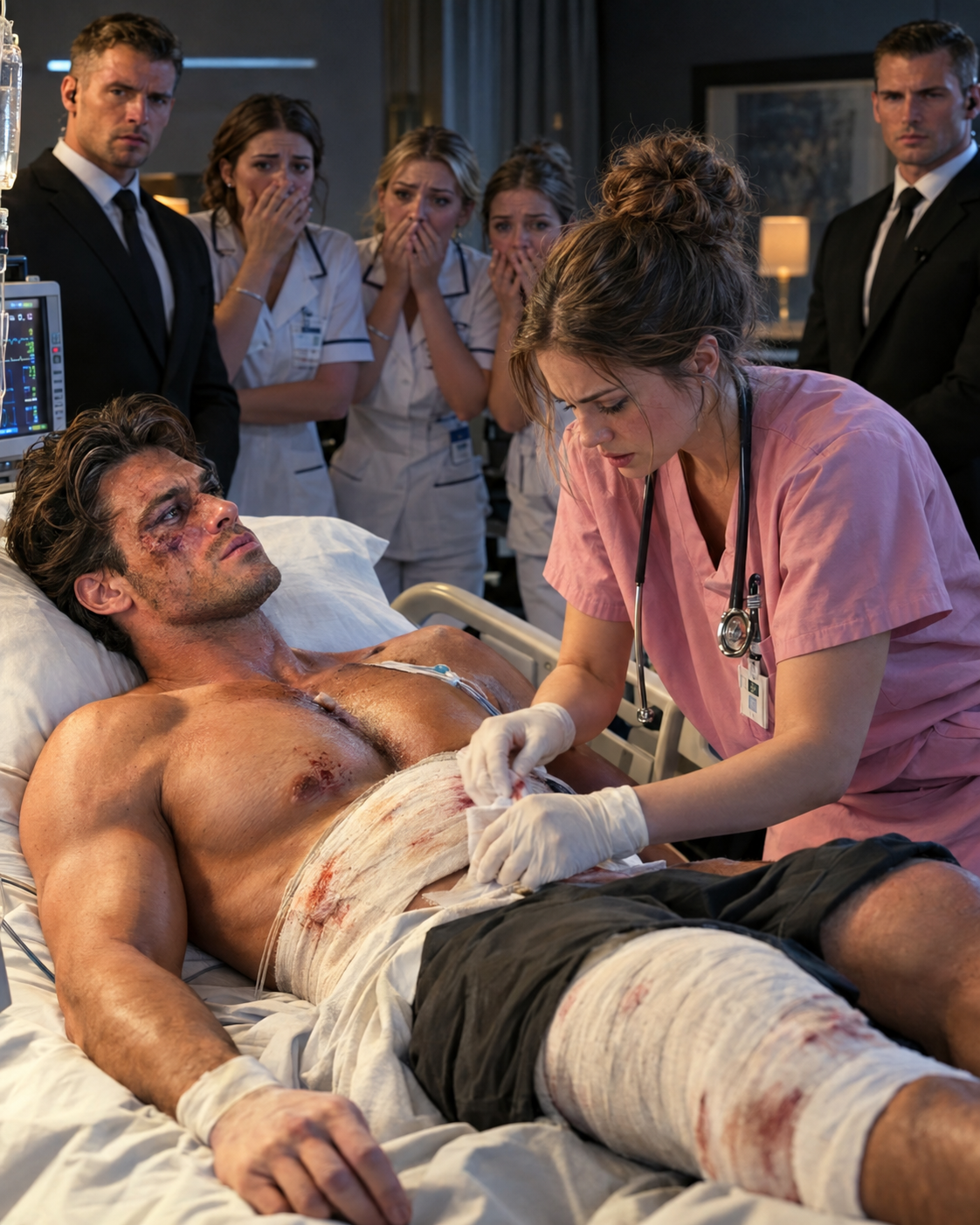
The room smelled of iodine, sweat, and infected flesh.
A voice emerged from the darkness, rough enough to scrape against my skin.
“Tell her to leave.”
Leo looked at me once and shut the door behind him.
I switched on a lamp.
A glass shattered against the wall beside my head.
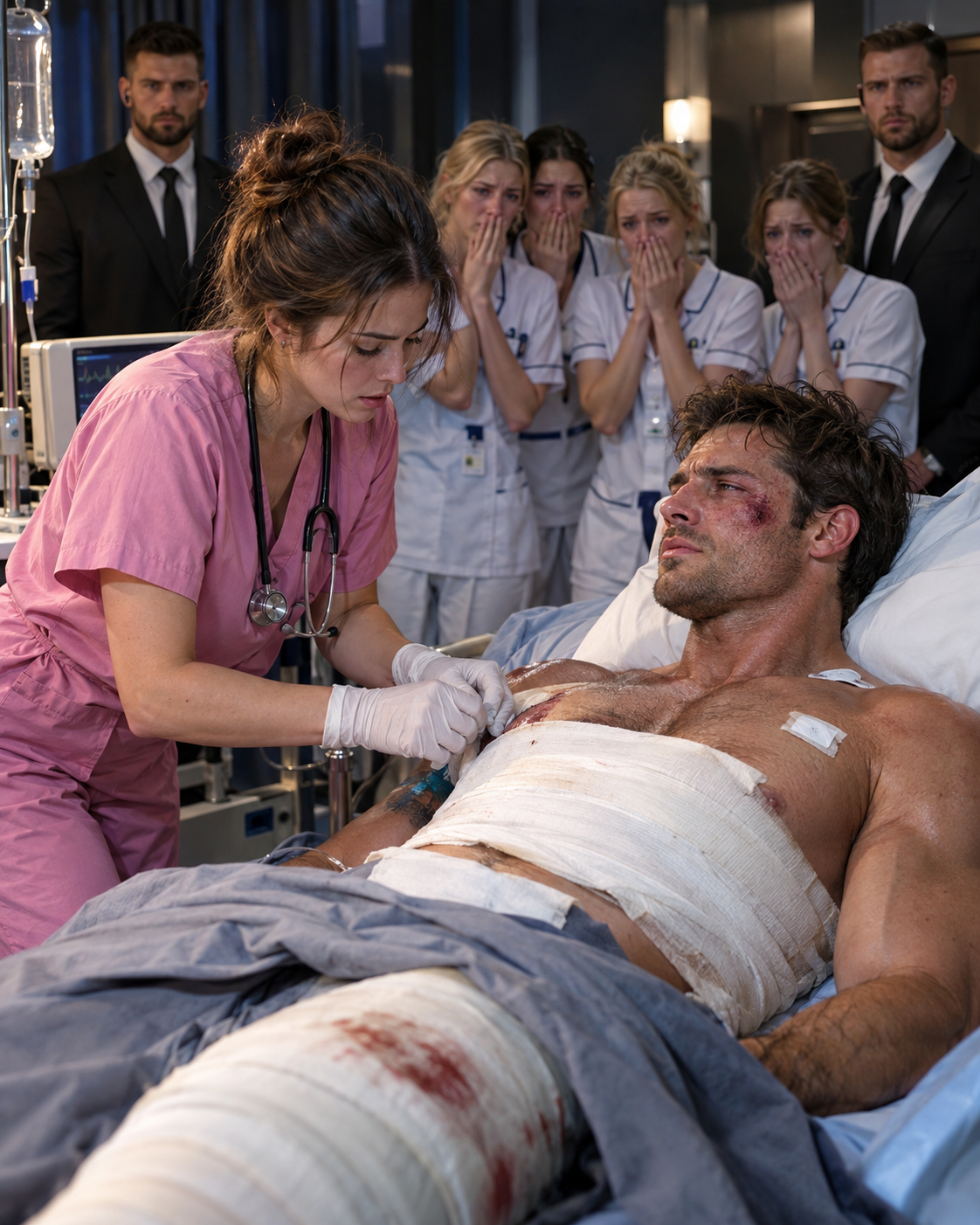
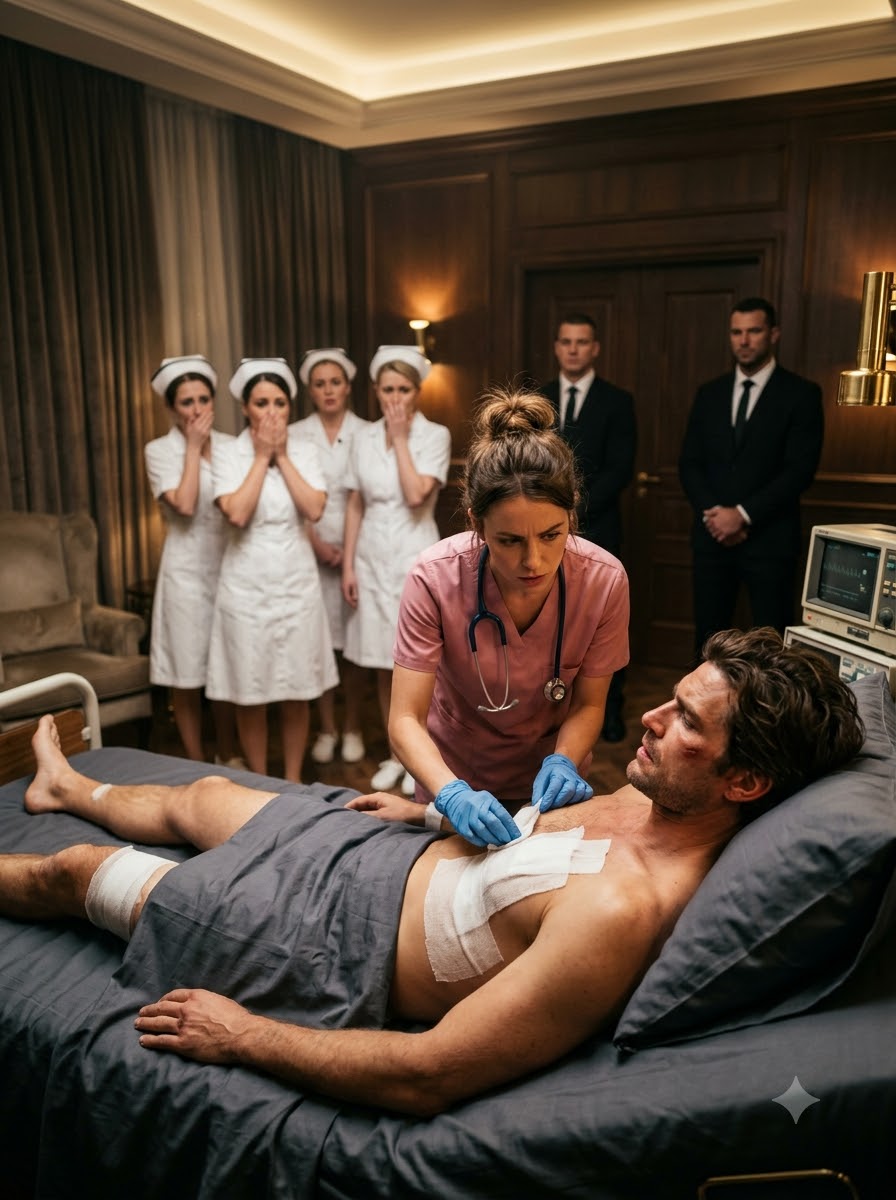
Liam Mercer was stretched across the enormous bed, bruised and pale, his right leg secured inside an external fixator, metal pins extending into the bone. Thick bandages covered his abdomen, already stained with blood.
“Turn that light off.”
“No.”
His icy blue eyes narrowed.
“I need to inspect your wound.”
“Get out.”
I washed my hands instead.
“From the smell, you’re developing an infection. So unless dying dramatically is part of your schedule, I’m changing that dressing.”
When I pulled the gauze away, the skin underneath was an angry red and beginning to deteriorate.
Liam grabbed my wrist.
“Don’t touch me.”
“You’re cutting off circulation.”
His fingers tightened.
“I said don’t.”
I met his stare without looking away.
“If I leave that tissue untreated, bacteria enter your bloodstream and you die.”
I leaned closer.
“And I need you alive until Friday.”
Something shifted behind his expression.
Slowly, he released me.
I cleaned the wound, started the antibiotics, examined each pin in his leg, and then settled into a corner with a paperback.
“Turn the light off.”
“When I finish the chapter.”
For the first time in five weeks, someone remained inside Liam Mercer’s room.
By the fourth day, he had stopped throwing things.
Instead, he punished me with silence.
“Pain from one to ten?” I asked, holding his morphine.
Nothing.
I looked straight at him.
“Fine. You can be stubborn in pain.”
His jaw tightened, but he refused to answer.
That afternoon, I noticed something I had somehow missed.
Whenever a narrow beam of sunlight slipped through the tiny opening between the curtains, Liam turned his face toward it.
Not away.
Toward it.
I stared at the sealed blinds.
Then I looked at him.
“Don’t,” he said quietly.
It was the first word he had spoken to me in hours.
My fingers closed around the cord anyway.
THE SECRET BEHIND THE BLINDS
I pulled the cord only an inch.
The blinds shifted.
A thin line of afternoon light entered the room.
Liam immediately raised one hand over his eyes.
“Stop.”
I released the cord.
The slats settled back into darkness.
For several seconds, neither of us spoke.
Then I noticed his breathing.
It had changed.
Not because of anger.
Because of fear.
That was something I had not seen from him before.
I moved away from the window.
“You’re afraid of the light?”
His eyes remained fixed on the ceiling.
“No.”
I waited.
He finally looked at me.
“I said don’t touch the blinds.”
There was a difference between an order and a plea.
That one had sounded like a plea.
I returned to my chair.
“All right.”
He seemed almost surprised.
“You’re not going to ask why?”
“You told me not to.”
His eyebrows drew together.
“That hasn’t stopped you before.”
“I ask questions when they affect your care.”
I picked up my book.
“The blinds aren’t affecting your medication.”
His expression softened for half a second before becoming guarded again.
That night, I checked his temperature.
It had risen slightly.
I examined the wound again and adjusted the medication schedule.
He watched me from the bed.
“You’re worried.”
“I’d be a terrible nurse if I wasn’t.”
“About the infection?”
“Yes.”
He looked toward the darkened window.
“And not about me?”
I paused.
“Those aren’t mutually exclusive.”
He said nothing after that.
I finished my rounds and returned to my chair.
Around midnight, I heard him moving.
When I looked up, Liam was staring at the window.
The room was completely dark.
“What is it?”
“Nothing.”
“You’re sweating.”
“I know.”
I stood.
His breathing was shallow.
I checked his temperature again.
Higher.
I reached for the emergency call button.
Liam caught my hand.
“Don’t call Leo.”
“This isn’t about Leo.”
“I don’t want the doctor.”
“You need the doctor.”
His grip loosened.
For the first time, he looked less like the man who had terrified six nurses and more like someone who was exhausted from fighting.
“Please.”
That single word stopped me.
I still called for medical assistance.
But I stayed beside him while we waited.
And when Leo finally entered the room with the estate physician, Liam did not throw anything.
He simply closed his eyes.
The physician examined the wound and ordered additional treatment.
As he left, Leo looked at me.
“You did the right thing.”
I glanced at Liam.
He was already asleep.
“Then why did everyone else leave?”
Leo’s face became unreadable.
“Because some people don’t understand what they’re looking at.”
“What am I looking at?”
He didn’t answer.
THE FIRST CRACK IN LIAM MERCER
The next morning, Liam was quieter.
Not hostile.
Just distant.
I changed his dressing, checked his medication, and documented the fever.
When I finished, I reached for the tray.
“Wait.”
I turned.
He was staring at me.
“Why didn’t you leave?”
I almost laughed.
“You mean last night?”
“I mean four days ago.”
I looked at him.
“Because you were sick.”
“That didn’t stop the others.”
“No.”
“Why didn’t it stop you?”
I thought about Tommy.
About the hospital bed.
About the anonymous offer.
About the number written on my kitchen counter.
“Because I need the money.”
Liam’s expression hardened.
“There it is.”
“What?”
“Everyone has a reason.”
I folded the used linens.
“You hired me for a reason too.”
He looked away.
“Ten thousand dollars a week isn’t normal.”
“Neither is this house.”
That earned the faintest movement at the corner of his mouth.
It wasn’t quite a smile.
But it was close.
Then his face became serious again.
“What will you do with the money?”
I hesitated.
“My brother is sick.”
He looked back at me.
“What kind of sick?”
I knew Leo’s instructions.
Ask nothing.
Say nothing.
But I was tired of pretending that two human beings could occupy the same room and remain completely separate.
“Leukemia.”
Liam went still.
“How old?”
“Twenty-four.”
His gaze dropped.
“And you’re trying to pay for treatment.”
“Yes.”
He didn’t ask anything else.
Instead, he looked toward the window.
For the first time, I understood that he wasn’t merely hiding from the world.
He was thinking about it.
WHAT HAPPENED TO LIAM
Several days passed.
His fever came down.
The infection stopped spreading.
The swelling around the injury gradually improved.
Liam began cooperating with medication.
He even started eating more than a few bites at a time.
But the blinds remained closed.
One evening, I found him awake before I entered.
“Don’t turn on the lamp.”
I stopped.
“All right.”
I could barely see him.
“Sit down.”
I did.
For a while, there was only the sound of rain against the windows.
Then he spoke.
“The accident wasn’t an accident.”
I remained silent.
“You’re not supposed to know that.”
“I didn’t ask.”
“I know.”
His voice sounded tired.
“I was driving home.”
He stopped.
I waited.
“Someone forced my car off the road.”
My stomach tightened.
“Were you alone?”
“Yes.”
He looked toward the covered window.
“I survived. Barely.”
I said nothing.
“Everyone thinks I was attacked because of the company.”
“Wasn’t that why?”
“No.”
His voice dropped.
“Someone wanted me dead for a different reason.”
I looked at him.
“What reason?”
He didn’t answer.
Instead, he said, “That’s why the blinds stay closed.”
I didn’t understand.
He continued.
“The people who did it never found what they were looking for.”
“What were they looking for?”
“My mother.”
The room seemed to become colder.
I stared at him.
“She disappeared years ago.”
“And you think the people who attacked you were connected to her?”
“I know they were.”
He turned his head toward me.
“They were watching this house before the accident.”
“Then why stay here?”
His expression became bitter.
“Because everyone knows I hate being here.”
I understood immediately.
“The house is bait.”
He nodded.
“And the blinds?”
His eyes shifted toward the window.
“Someone used the windows to watch me.”
I said nothing.
Then Liam surprised me.
“I kept them closed because I couldn’t stand the idea of someone watching me while I slept.”
That explained the fear.
But it didn’t explain why he always turned toward the sunlight.
Perhaps he still wanted to see the world.
He simply didn’t want the world seeing him.
THE LETTER
Two days later, a package arrived.
There was no sender.
Leo brought it upstairs.
Liam refused to open it.
I stood near the door.
“You want me to?”
“No.”
“Then why are you staring at it?”
He didn’t answer.
Finally, he reached for the envelope.
Inside was a single photograph.
Liam’s face changed.
I didn’t need to see the photograph to know it mattered.
“Who is that?”
“My mother.”
He turned the photograph over.
There was writing on the back.
His hands began shaking.
I noticed immediately.
“Do you need me to get Leo?”
“No.”
He read the message again.
Then again.
“What does it say?”
He looked at me.
“It says, ‘You were never the target.’”
A silence settled between us.
Then he folded the photograph and put it inside the drawer beside his bed.
“That’s all?”
“No.”
He swallowed.
“There’s a date.”
“What date?”
He told me.
It was the date of his accident.
I felt a chill.
“Someone sent this to you after the accident?”
“Yes.”
“Why?”
“I don’t know.”
He looked toward the blinds.
“Maybe they want me to know they’re still watching.”
That night, I couldn’t sleep.
Not because I was frightened.
Because I had begun to realize that the money wasn’t the only reason I had been brought here.
Someone had wanted a nurse who would stay.
Someone who would notice things.
Someone who wouldn’t run.
And suddenly, I wondered whether Liam had known that from the beginning.
THE CALL I WASN’T SUPPOSED TO MAKE
The following morning, I broke the rules.
I asked Leo for permission to make one phone call.
He refused.
“No phones.”
“My brother is undergoing treatment.”
“I know.”
“Then you know I need updates.”
Leo stared at me.
“You accepted the conditions.”
“I accepted a job. I didn’t agree to become a prisoner.”
His expression changed.
“You should be careful with that word.”
“I should be careful with a lot of things in this house.”
He stepped closer.
“You have no idea what you’re involved in.”
“Then tell me.”
He said nothing.
I turned away.
“Fine.”
That afternoon, Liam called my name.
I entered his room.
He was sitting upright for the first time since I arrived.
“Your brother.”
I froze.
“What about him?”
“I made a call.”
My heart began pounding.
“You what?”
“I made a call.”
He held out a phone.
My phone.
The one I had been forbidden to carry.
I stared at it.
“How?”
“Leo keeps a second phone.”
“You shouldn’t have done that.”
“I know.”
I took it anyway.
The call lasted less than three minutes.
Tommy was stable.
The doctors were still evaluating the trial.
I closed my eyes.
For the first time since leaving Chicago, I heard my brother’s voice.
When I hung up, tears were running down my face.
Liam looked away.
“You’re welcome.”
I wiped my eyes.
“Thank you.”
He nodded.
Then he said something I hadn’t expected.
“You shouldn’t have to choose between saving your brother and doing your job.”
I looked at him.
“What does that mean?”
“It means I’m going to change the terms.”
THE NEW AGREEMENT
Liam called Leo into the room.
“I want her paid every Friday.”
Leo looked surprised.
“You already agreed to that.”
“Double it.”
My eyes widened.
“No.”
Liam looked at me.
“Why?”
“Because I didn’t come here for charity.”
“Neither am I.”
He leaned back against the pillows.
“I need someone who can be trusted.”
Leo looked between us.
“Liam—”
“I said double it.”
I shook my head.
“I’ll accept the original amount.”
Liam studied me.
“Why?”
“Because I want to know I earned it.”
Something changed in his expression.
Respect.
Maybe even relief.
“All right.”
Leo left.
I sat down.
“You’re strange.”
“So are you.”
That was the first time Liam smiled.
It was small.
Almost invisible.
But it was real.
THE NIGHT THE BLINDS OPENED
Three nights later, a storm moved through the estate.
Thunder shook the windows.
The electricity flickered.
I entered Liam’s room with a flashlight.
He was awake.
“Power’s unstable.”
“I noticed.”
I checked his monitors.
Everything was functioning.
Then lightning flashed.
For an instant, the room filled with white light through the edges of the blinds.
Liam turned toward it.
I watched him.
“You miss the sunlight.”
He didn’t answer.
I walked toward the window.
“Don’t.”
I stopped.
“Do you trust me?”
Silence.
Finally:
“Yes.”
I placed my hand on the cord.
“I won’t open them all.”
His eyes remained on me.
I lowered the blinds just enough to let a narrow stripe of moonlight into the room.
Liam stared at it.
Nothing happened.
No panic.
No anger.
Just silence.
Then he whispered:
“I forgot what this looked like.”
I stepped away.
He looked toward the window for a long time.
“Why did you stay?”
I knew what he meant.
Not the room.
Not the job.
The whole situation.
“I needed the money.”
He nodded.
“And?”
I thought about it.
“And I don’t like leaving people alone when they’re scared.”
His eyes lowered.
“That makes two of us.”
WHAT I DISCOVERED ABOUT THE MONEY
The next morning, Leo gave me an envelope.
I opened it.
There was far more money inside than I expected.
I looked at him.
“This isn’t my payment.”
“No.”
“Then what is it?”
“Liam.”
I walked directly to his room.
He was awake.
“You paid for Tommy’s treatment.”
He didn’t deny it.
“I didn’t ask you to.”
“I know.”
“You had no right.”
His expression tightened.
“You were willing to spend your life working yourself into the ground because you thought money was the only thing standing between your brother and treatment.”
“That doesn’t give you the right to solve it.”
“No.”
He looked at me.
“But it gives me the right to help.”
I stared at him.
“I don’t want to owe you.”
“You don’t.”
“How can you say that?”
“Because I know what debt feels like.”
His voice became quieter.
“And I know what it feels like when someone offers help and then uses it to control you.”
That sentence stayed with me.
Because suddenly I understood.
The six nurses before me had probably seen an arrogant, violent, impossible patient.
They had not seen the frightened man underneath.
And Liam had probably never trusted anyone enough to show him.
THE TRUTH ABOUT THE SIX NURSES
Later that afternoon, I asked Leo what had happened to the previous nurses.
He didn’t answer immediately.
Then he sighed.
“They weren’t fired.”
I looked at him.
“They quit.”
“Why?”
“Because Liam pushed them away.”
“That part I know.”
Leo stared at the floor.
“His father taught him that needing anyone was weakness.”
I frowned.
“His father?”
“Liam grew up surrounded by people who wanted something from him.”
Leo’s voice was quiet.
“Money. Power. Access. Information.”
“And his mother?”
He hesitated.
“She was the only person he trusted.”
“What happened to her?”
“She disappeared.”
I remembered the photograph.
“Did Liam ever find her?”
“No.”
“Then why does he think she’s alive?”
Leo looked toward the hallway.
“Because every few years, someone sends him proof.”
“What kind of proof?”
“Something only she could know.”
A chill ran through me.
“So someone has been manipulating him.”
“Maybe.”
“Or protecting him.”
Leo nodded.
“Maybe.”
Neither of us knew which.
THE DAY LIAM STOOD
Two weeks after I arrived, the physical therapist came to help Liam stand.
He refused.
“No.”
The therapist looked at me.
I shrugged.
“He’s stubborn.”
Liam glared at me.
“You’re enjoying this.”
“A little.”
He almost smiled.
Then he tried.
His injured leg trembled.
His hands gripped the bars.
His face tightened with pain.
“Slowly,” I said.
“I know.”
“You’re shaking.”
“I know.”
“Breathe.”
“I am breathing.”
“Not very effectively.”
He shot me a look.
Then he stood.
For three seconds.
Five.
Eight.
The therapist smiled.
Liam sat down again.
He was exhausted.
But he had done it.
He looked at me.
“You’re not going to say anything?”
I smiled.
“You stood.”
He nodded.
“That was the plan.”
“No.”
I shook my head.
“That was the first time you believed you could.”
His expression changed.
He looked away.
But I saw the smile.
THE FINAL TEST
The following week, another envelope arrived.
This time, there was no photograph.
There was a message.
Stop looking.
Liam read it.
Then he handed it to me.
“You’re in this now.”
“I was in it the moment I walked through the door.”
He looked at me.
“No. You weren’t.”
He took the message back.
“I won’t let them hurt you.”
“You don’t get to decide that.”
“I know.”
He paused.
“That’s what makes me afraid.”
I stared at him.
“Why?”
“Because I care whether you get hurt.”
Neither of us spoke.
Then the door opened.
Leo entered.
His face was pale.
“We have a problem.”
Liam’s expression changed.
“What?”
“Someone got past the outer security.”
My heart tightened.
“Who?”
“We don’t know.”
Liam looked at the window.
Then at the blinds.
For the first time, he stood without assistance.
“Open them.”
I looked at him.
“What?”
“Open the blinds.”
I moved toward the window.
Slowly, I pulled the cord.
Light flooded the room.
Liam didn’t flinch.
He stood there, looking outside.
The estate stretched beneath the gray morning sky.
Then he saw something.
“What is that?”
Leo moved toward the glass.
A vehicle sat beyond the trees.
Liam’s face went completely still.
“That’s the same vehicle.”
“The one from the accident?” I asked.
He nodded.
“Call the police.”
Leo reached for his phone.
Liam looked at me.
“Stay behind me.”
I almost laughed.
“You can barely walk.”
“I can still stand.”
The tension broke for one second.
Then the vehicle disappeared between the trees.
THE CHOICE
The authorities arrived.
The estate was searched.
The vehicle was gone.
No one was found.
But Liam finally gave them everything he had.
The photograph.
The messages.
The information about the accident.
The records he had kept hidden for years.
He stopped protecting the people who had frightened him into silence.
And I finally understood why the blinds had mattered so much.
For years, Liam had lived in darkness because darkness felt safer.
He had convinced himself that if he couldn’t see the world, the world couldn’t see him.
But darkness had also kept him trapped.
Opening the blinds had been a small act.
Yet it was the first choice he had made for himself in years.
FRIDAY
Friday came.
I packed my duffel.
Liam watched from his chair.
“You’re leaving.”
“Yes.”
He nodded.
“I knew you would.”
I looked around the room.
The blinds were open.
Sunlight covered the floor.
The air no longer smelled like fear.
“I have a brother to see.”
“I know.”
I picked up my bag.
Then Liam said my name.
I turned.
“Thank you.”
I smiled.
“You’re welcome.”
He looked toward the window.
“You were right.”
“About what?”
“Dying dramatically isn’t part of my schedule.”
I laughed.
It was the first time I had heard him laugh.
A real laugh.
Quiet.
Uncertain.
But real.
Then he said:
“Take care of Tommy.”
“I will.”
“And yourself.”
I nodded.
“I’ll try.”
THREE MONTHS LATER
Tommy entered the experimental trial.
The treatment was difficult.
There were setbacks.
There were nights when I sat beside his hospital bed wondering whether we had made the right choice.
But he kept fighting.
And I kept showing up.
Liam kept his promise too.
He never tried to control my life.
He never demanded repayment.
He simply made sure I had what I needed to keep going.
Eventually, Tommy gained weight.
He started walking farther.
He began making jokes again.
And one afternoon, I received a message from Liam.
The blinds are still open.
I smiled.
I wrote back.
Good. Keep them that way.
His response came a few minutes later.
I intend to.
ONE YEAR LATER
I returned to the Mercer estate exactly one year after the night I arrived.
The mansion looked different.
Or maybe I did.
The armed guards were gone.
The windows were open.
The curtains moved gently in the breeze.
Liam walked toward me without a cane.
His leg still carried scars.
His abdomen still bore the evidence of what he had survived.
But he was standing.
Completely on his own.
He smiled when he saw me.
“You came back.”
“I said I would visit.”
“You didn’t say when.”
“I wanted to surprise you.”
He looked past me.
“Where’s Tommy?”
“He’s outside.”
Liam’s face brightened.
My brother stepped out of the car carrying a small gift bag.
Liam looked surprised.
“For me?”
Tommy nodded.
“You helped me.”
Liam accepted the bag.
Inside was a cheap paperback.
The same kind I had been reading in the corner of his room.
Liam looked at it.
Then at Tommy.
“Thank you.”
Tommy smiled.
“I heard you’re supposed to finish every chapter before turning off the light.”
Liam laughed.
I looked toward the windows.
Every blind was open.
Sunlight filled the room.
For months, I had believed I had accepted that job because I needed ten thousand dollars a week.
That was true.
I needed the money.
I needed to save my brother.
But somewhere between the infected wound, the closed blinds, the silent arguments, and the nights when Liam was too frightened to admit he was afraid, something else had happened.
Two broken people had recognized each other.
I had arrived believing I was there to care for a difficult patient.
Liam had expected another person to abandon him.
Neither of us got what we expected.
Instead, I stayed.
And he learned how to let someone stay.
Tommy’s leukemia did not disappear overnight.
Liam’s scars did not vanish.
The danger surrounding his family did not magically resolve every unanswered question.
But some things changed.
Tommy got his chance at treatment.
Liam learned to live in daylight.
And I learned that sometimes the person who looks impossible to save is simply someone who has spent too long believing nobody will stay long enough to try.
The six nurses before me had not failed because they were weak.
They had walked into a house where fear had been mistaken for cruelty and silence had been mistaken for strength.
I had almost made the same mistake.
The difference was that I needed Liam’s money badly enough to stay through the first few days.
But after that, I stayed for another reason.
He had finally begun to trust me.
And once someone gives you that kind of trust, you understand how fragile it is.
You don’t use it.
You protect it.
That was the real lesson I carried away from the Mercer estate.
Healing does not always begin with medicine.
Sometimes it begins when someone finally believes they are safe enough to open the blinds.
And sometimes the person who comes into your life because they desperately need something from you ends up giving you the one thing you had stopped believing you could have again.
A reason to step into the light.
