

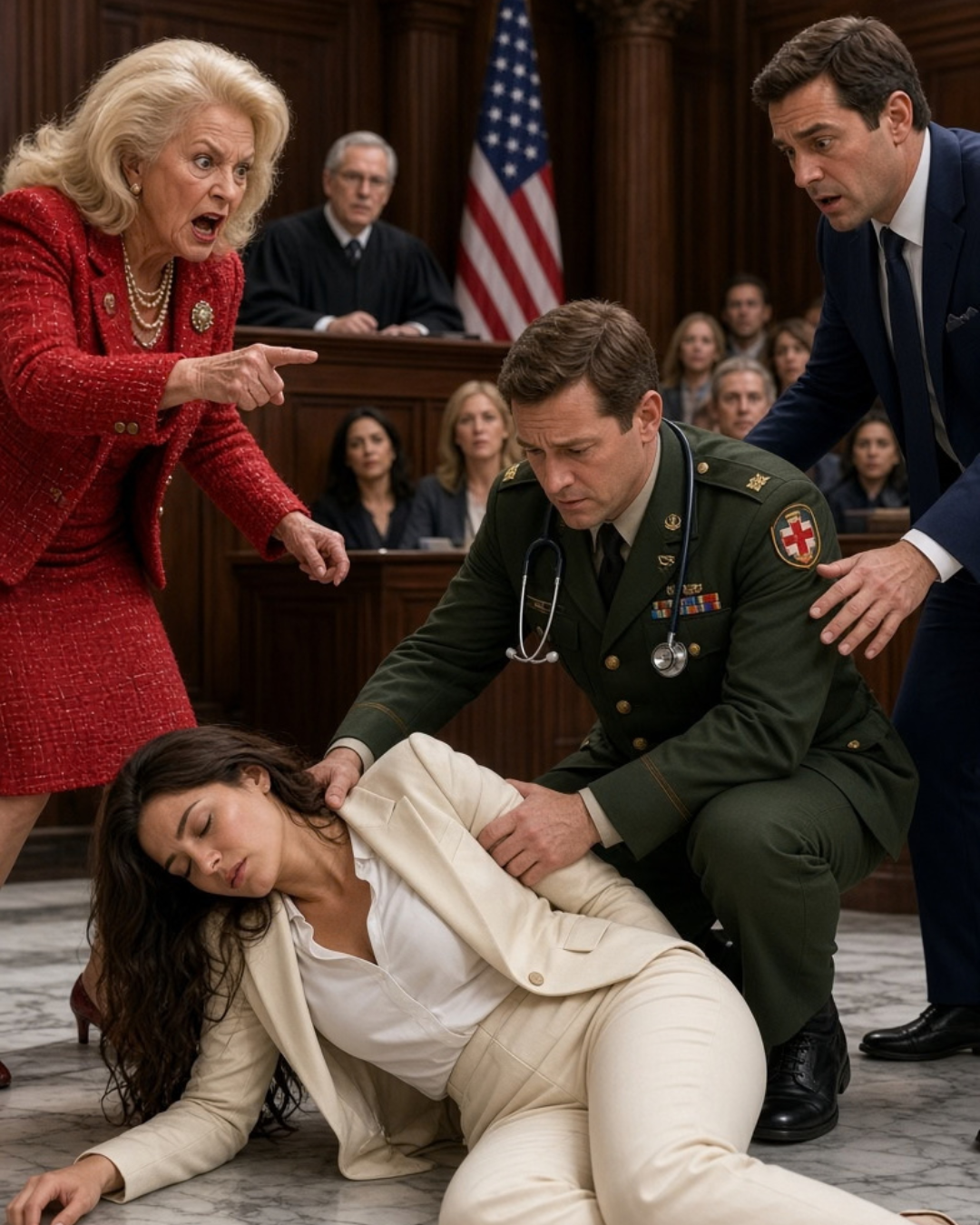
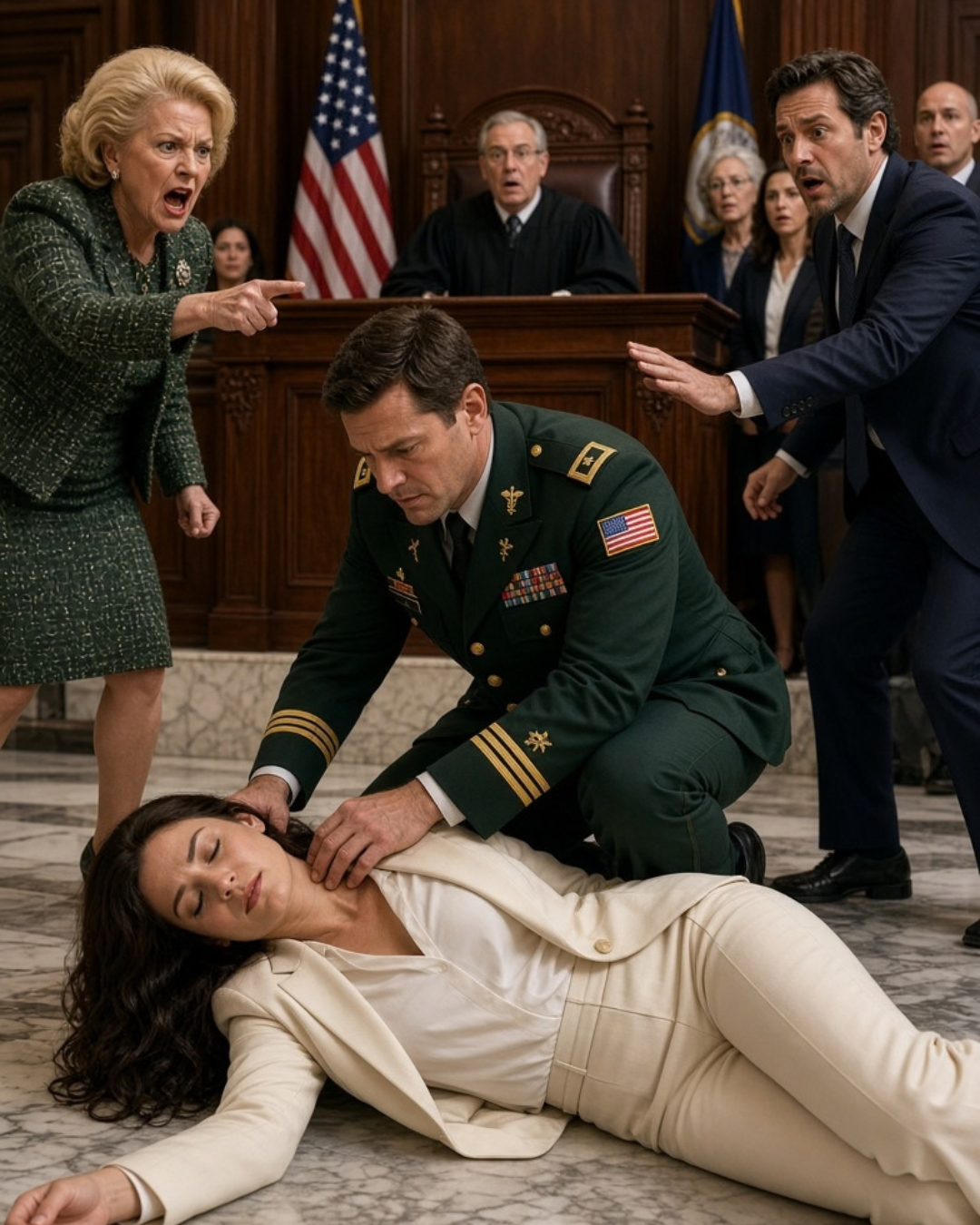
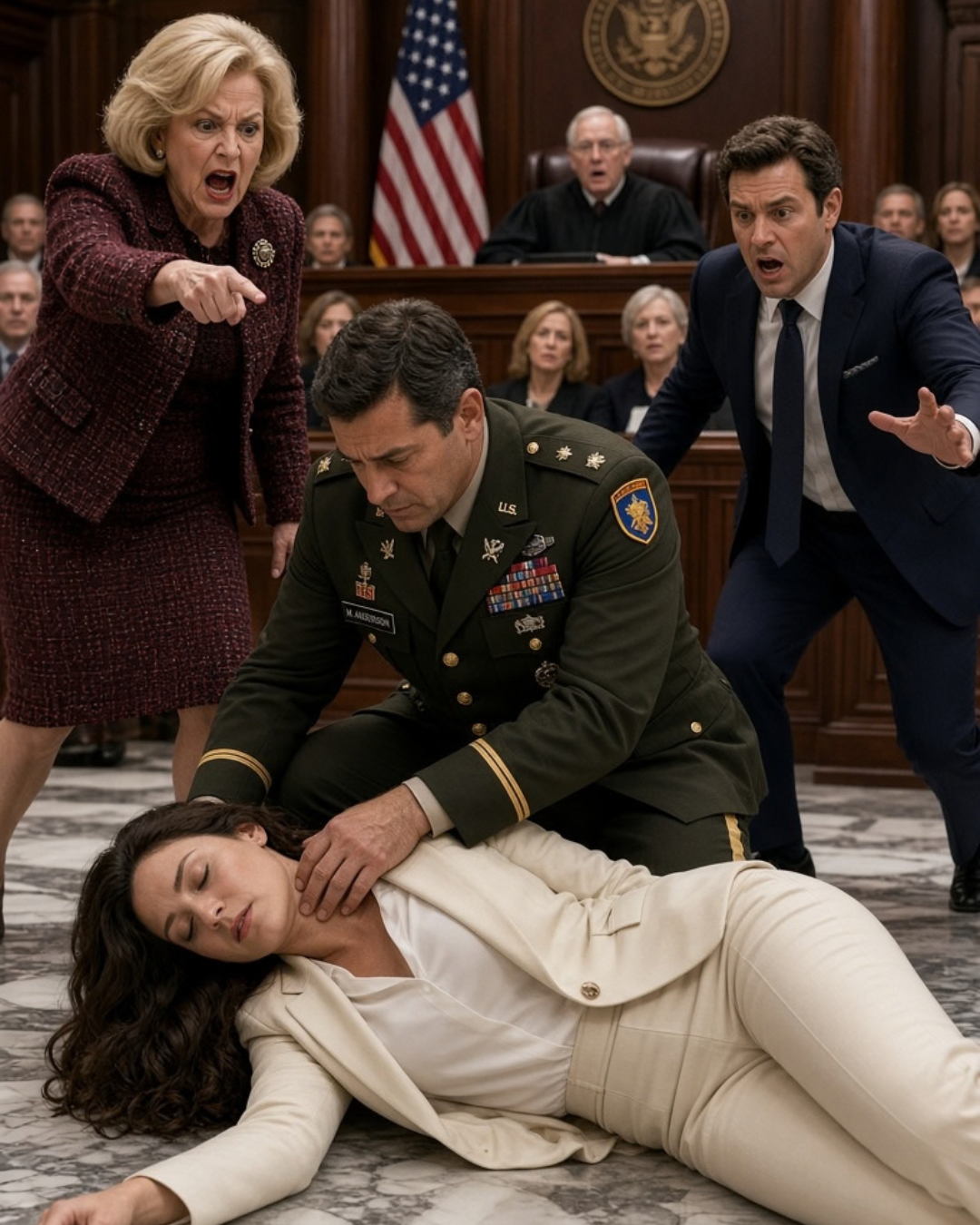
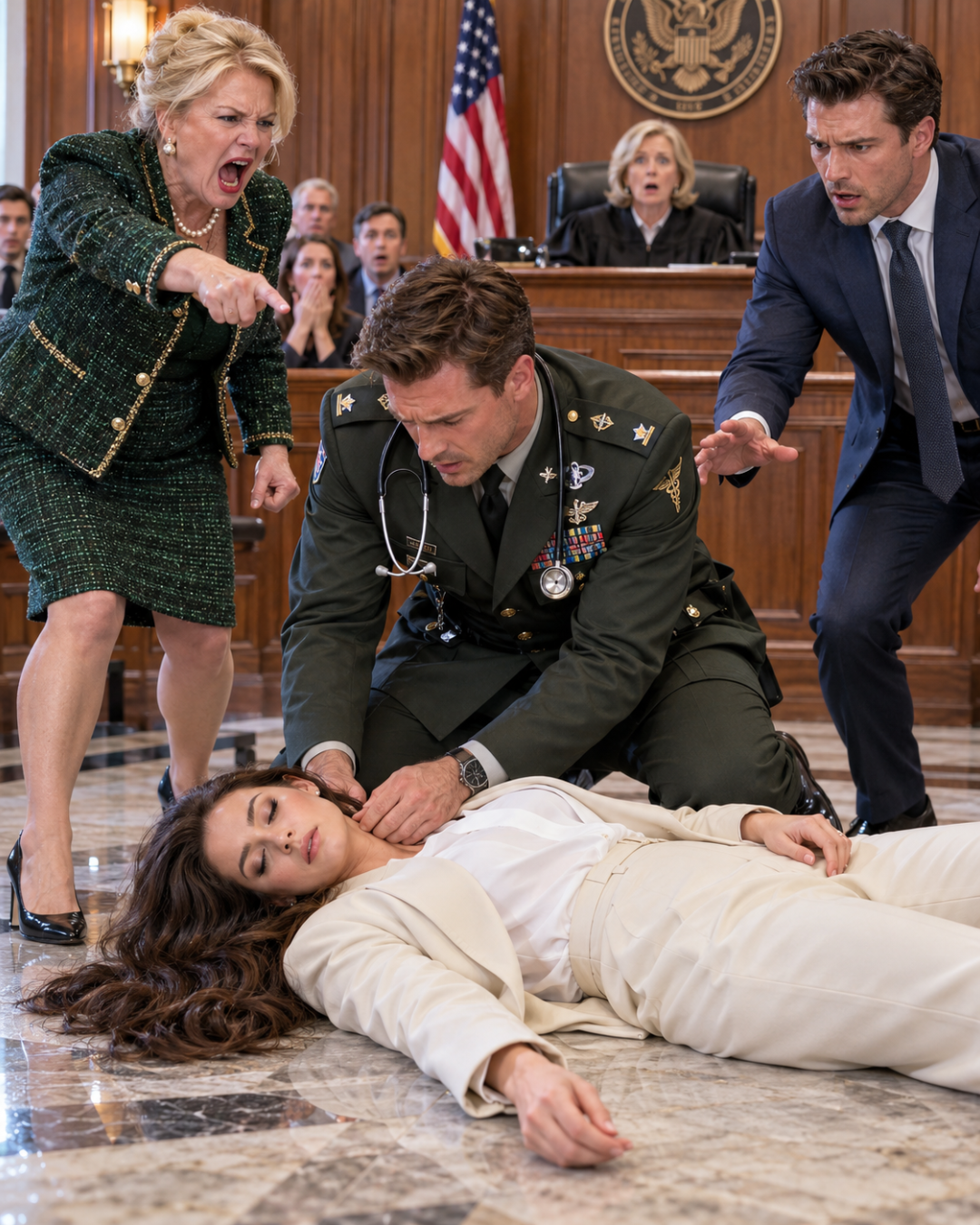
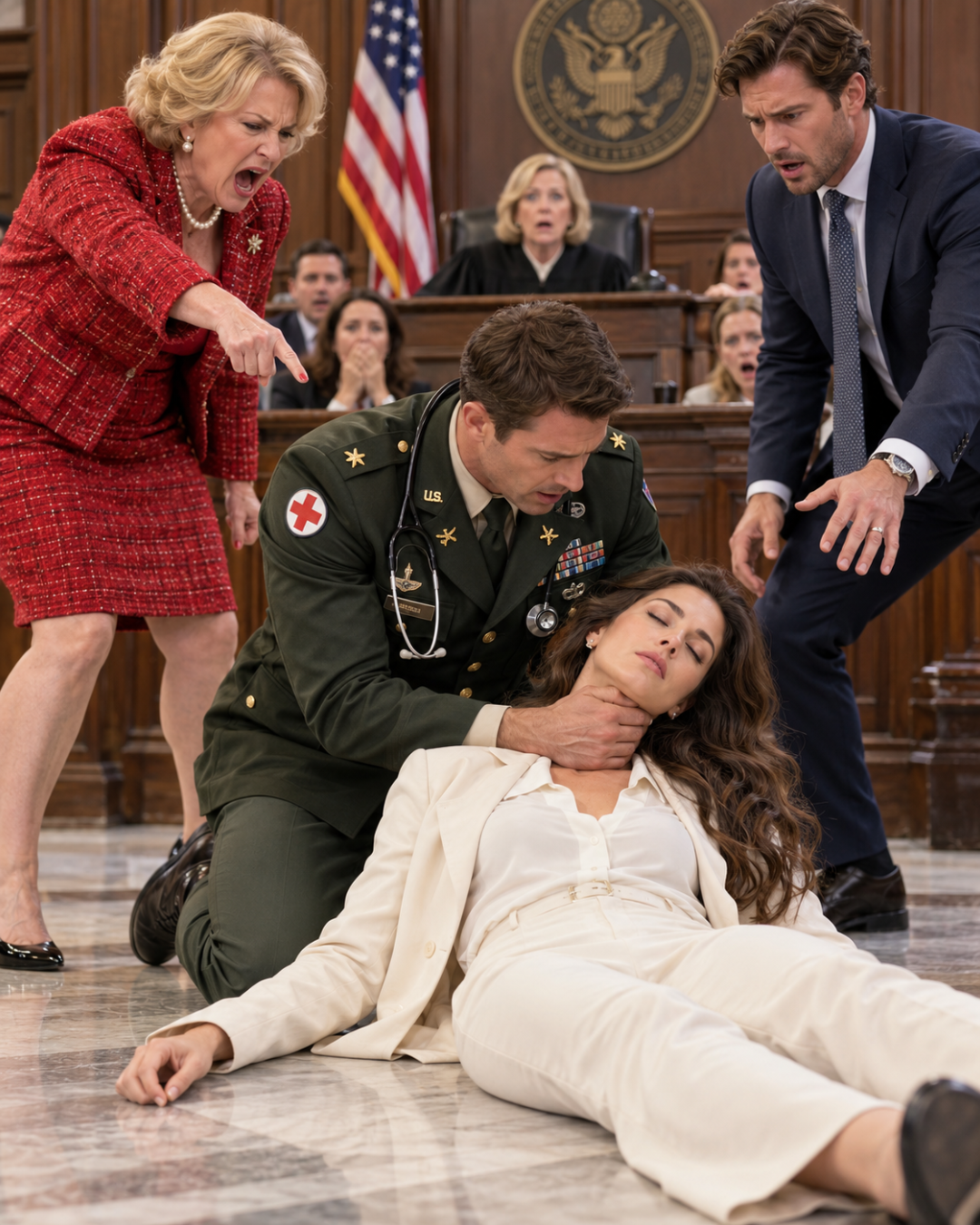
The moment my mother-in-law pointed across the courtroom and said, “She’s faking it,” my husband actually smirked. They had spent hours convincing everyone that my blackouts were nothing but manipulation, but seconds later my legs collapsed beneath me and a U.S. Army doctor came running from the back of the courtroom.
“She pulls this every time she doesn’t get her way,” my husband, Daniel Whitaker, told the judge.
I stood near the witness box with one hand wrapped around the wooden rail. My knuckles were white, the fluorescent lights seemed painfully bright, and the floor beneath me felt strangely unsteady.
Judge Richard Hanley peered over his glasses. “Mrs. Whitaker, are you able to continue?”
I opened my mouth, but nothing came out.
The custody hearing had already become a nightmare. Daniel’s attorney had spent the morning portraying me as unstable, emotional, and manipulative while my medical records were passed around like proof that I couldn’t be trusted.
My dizziness, blackouts, and hospital visits were treated as excuses. Daniel claimed I used illness whenever responsibility became inconvenient, and his mother, Patricia, calmly supported every word.
I had come to court alone.
My attorney had withdrawn two weeks earlier after Daniel emptied our joint bank account and delayed payments, leaving me to defend myself. All morning, I had tried desperately to explain why our seven-year-old daughter, Lily, cried every Sunday night before going to her father’s house.
Nobody seemed interested.
Suddenly, the courtroom tilted.
“Your Honor,” I whispered, tightening my grip on the rail. “I need a minute.”
Daniel laughed under his breath. “See?”
“Drama,” Patricia muttered.
Judge Hanley’s expression hardened. “Mrs. Whitaker, this court has been very patient.”
Then my legs gave out.
The railing slipped from my fingers, and my shoulder slammed against the courtroom floor. Voices erupted around me, but they sounded distant, almost as if I were underwater.
Someone came running from the back benches.
Through my blurred vision, I saw a tall man in a dark green military uniform kneel beside me. He had been sitting quietly near the aisle all morning waiting for another case, and the name tag above his chest read CARTER.
“Ma’am, can you hear me?” he asked, pressing two fingers against my neck.
I tried answering, but my tongue felt heavy.
Daniel stood and sighed impatiently. “She’s fine. She does this.”
The stranger’s head snapped toward him.
“I’m Colonel Aaron Carter, U.S. Army Medical Corps,” he said, his voice suddenly sharp. Then he looked directly at Judge Hanley. “Your Honor, this woman needs immediate medical attention.”
Patricia scoffed. “You don’t know her.”
Colonel Carter ignored her.
He checked my pulse again, then carefully lifted one of my eyelids. Whatever he saw made the calm disappear from his face.
“Call 911.”
For one strange second, nobody moved.
Daniel looked irritated, Patricia seemed almost offended, and even the judge appeared stunned by how quickly everything had changed.
Colonel Carter checked me again.
Then his face went pale.
“CALL 911!”
His voice thundered through the courtroom.
The room exploded into movement, but as my vision began fading, I felt Colonel Carter grip my wrist and heard him urgently asking me a question.
My answer made him freeze.
Then he slowly looked up at Daniel.
And the expression on his face terrified me more than the collapse itself.
PART 2
A courtroom collapse revealed the clue everyone missed about why my daughter dreaded Sundays.
When I opened my eyes again, the courtroom was gone.
A soft mechanical beeping came from somewhere beside me. White curtains hung around the narrow hospital bed, and afternoon sunlight pressed through half-closed blinds.
For several seconds I simply stared at the ceiling.
Then memory returned all at once.
The hearing.
Patricia pointing at me.
Daniel telling the judge I was pretending.
The floor rushing upward.
Colonel Carter.
Lily.
I pushed myself upright.
A nurse appeared almost immediately.
“Easy, Mrs. Whitaker.”
“My daughter.”
“She’s safe.”
Those two words loosened something inside my chest.
“Where is she?”
“With your sister, according to the information we were given. The court contacted her.”
I closed my eyes.
My younger sister, Emily, had been listed as my emergency contact for years. She lived only twenty minutes away and had offered to attend the hearing, but I had refused.
I had told myself I needed to prove I could handle one thing alone.
I was beginning to understand how often pride disguised itself as strength.
“What happened to me?”
The nurse hesitated.
“The doctor will explain what they know.”
That answer frightened me more than if she had simply named something.
A few minutes later, a physician named Dr. Shah entered with a tablet tucked beneath one arm.
Colonel Carter followed him.
Seeing the colonel made the courtroom return vividly.
“You’re the doctor from court.”
He gave a small smile. “One of them, apparently.”
Dr. Shah pulled a chair toward my bed.
“Mrs. Whitaker, you experienced a loss of consciousness related to reduced oxygen delivery. Your blood pressure was low when paramedics arrived. More importantly, one of your blood tests showed an abnormal level of carboxyhemoglobin.”
I stared at him.
“I don’t know what that means.”
“It means carbon monoxide has been binding to your red blood cells.”
For a moment I thought I had misunderstood.
“Carbon monoxide?”
Dr. Shah nodded.
“Your level isn’t where we’d expect after a severe acute exposure, but it’s high enough to concern us, especially considering your history of recurring headaches, dizziness, fatigue, confusion and fainting.”
I looked from him to Colonel Carter.
“But I haven’t been around a fire.”
“You don’t need a fire,” Carter said gently. “Faulty furnaces. Water heaters. Gas appliances. Attached garages. Poor ventilation.”
I felt cold despite the blanket covering my legs.
Dr. Shah continued. “Repeated low-level exposure can be difficult to recognize because the symptoms resemble many other conditions. And levels decrease once someone is away from the source and breathing normal air.”
Pieces of the last year began moving around inside my mind.
The headaches that seemed worse in winter.
The exhaustion.
The mornings I woke feeling as though I hadn’t slept.
Two emergency-room visits where the tests had shown nothing dramatic.
The strange improvement I experienced whenever Lily and I spent several days with Emily.
Then something else occurred to me.
“My apartment doesn’t have gas.”
Dr. Shah and Colonel Carter exchanged a glance.
“What heats it?” Carter asked.
“Electric units. The whole building was renovated five years ago.”
“Where else do you spend significant time?”
“My office. Lily’s school. The grocery store.” I stopped.
There had been another place.
Daniel’s house.
The house that had once been ours.
Even after I moved out eight months earlier, I still went there several times each week during the separation. At first, Daniel and I had tried to keep Lily’s routine unchanged. We had family dinners there. I collected clothes, schoolbooks and mail. Until six weeks ago, I had sometimes stayed for hours while Lily packed for visits.
And the Sunday headaches.
My heartbeat quickened.
Colonel Carter noticed.
“What are you thinking?”
“My symptoms got better after I moved.”
“Completely?”
“No. But…” I searched my memory. “They became less frequent.”
“Did you continue visiting your former home?”
“Yes.”
“When was the last time?”
“Friday.”
Two days earlier.
I had gone there to retrieve Lily’s winter coat.
Daniel had been at work, but Patricia had been there.
I had spent nearly three hours sorting through storage boxes in the basement.
By that evening, I had developed one of the worst headaches I had experienced in months.
I pressed my fingers against my temple.
“The basement.”
Carter’s expression sharpened.
“What’s in it?”
“Laundry room. Furnace. Water heater.”
The room became very quiet.
Dr. Shah stood.
“We should contact the fire department.”
I stared at him.
“Daniel is there sometimes. Lily stays there.”
“And if there’s a possible environmental hazard,” he said, “no one should return until it’s been checked.”
I reached for my phone.
Three missed calls from Emily.
Four from an unknown number.
Two from Daniel.
Before I could call anyone, the curtain moved.
A hospital administrator stepped in.
“Mrs. Whitaker? Judge Hanley’s clerk is trying to reach you.”
I almost laughed from disbelief.
“Of course he is.”
Colonel Carter glanced toward the door.
“I can leave.”
“No.”
The word came out faster than I intended.
He seemed surprised.
“Please stay.”
Something about having one person in the room who had believed what he saw rather than what he had been told made me feel steadier.
The clerk informed me that the hearing had been suspended.
Not decided.
Suspended.
Judge Hanley wanted medical documentation before proceeding and had ordered the previous temporary custody arrangement to remain unchanged until the next hearing.
That meant Lily would stay primarily with me.
For now.
After the call ended, I sank back against the pillows.
“Why were you in the courtroom?” I asked Carter.
He leaned against the windowsill.
“Expert testimony in a veteran’s disability case. Wrong place, right time.”
“You knew something was wrong before anyone else did.”
“I knew you were ill.”
“That seems to have been more than anyone else knew.”
He regarded me carefully.
“People see what they expect to see. Your husband expected drama because he’d decided your symptoms were emotional. His mother expected the same. The court had heard that story for several hours.”
“And you?”
“I didn’t know the story.”
He paused.
“I just saw the patient.”
That sentence stayed with me.
Later that afternoon, Emily arrived with Lily.
The instant Lily saw me sitting upright, she broke into a relieved smile and hurried toward the bed.
“Mom!”
She wrapped her arms around me carefully.
I kissed the top of her head.
“I’m okay, sweetheart.”
“Aunt Emily said you got dizzy.”
“That’s right.”
“Like before?”
I froze.
“What do you mean?”
Lily leaned back.
“When you used to sit on the kitchen floor.”
I looked at Emily.
She looked equally confused.
“What kitchen floor?” I asked.
“At Daddy’s house.”
A memory surfaced.
Thanksgiving morning.
I had been making mashed potatoes when the room began spinning. I sat against a cabinet for ten minutes while Patricia finished cooking.
She had laughed gently and told me I worked too hard.
I had forgotten.
Children remembered strange things.
“Lily,” I said carefully, “when your head hurts at Daddy’s house, where are you usually?”
She thought about it.
“In my room.”
“Anywhere else?”
“Sometimes downstairs.”
“The basement?”
She nodded.
“Daddy made the little table down there for my art stuff.”
My stomach dropped.
“Do you feel better after you leave?”
Another nod.
“Usually in the car with you.”
Emily slowly sat down.
“Oh my goodness.”
I took Lily’s hand.
“Sweetheart, you haven’t done anything wrong. The doctors think there might be something in Daddy’s house that needs fixing. That’s all.”
“Like the sink?”
“Exactly like the sink.”
That explanation satisfied her.
Children, I had discovered, could accept uncertainty more gracefully than adults when you gave them honesty without fear.
Emily took Lily to find something to eat while I called Daniel.
He answered on the first ring.
“What did you tell the judge?”
No hello.
No question about whether I was all right.
For the first time, it didn’t hurt.
It simply sounded tired.
“I haven’t spoken to him.”
“Then why did someone from the fire department call me?”
“Because the hospital found carbon monoxide in my blood.”
Silence.
“What?”
“They think I’ve been exposed repeatedly.”
“That doesn’t make sense.”
“They want your house checked.”
“My house?”
“Our old house.”
Another silence.
Then he said something unexpected.
“Lily.”
“Yes.”
I heard a chair scrape.
“She’s been complaining about headaches.”
“I know.”
Daniel’s breathing changed.
“I thought she didn’t want to stay with me.”
“So did I.”
“And you…”
“I thought it was stress.”
He was quiet for a long moment.
Then, softly, “I thought you were using the same thing.”
There it was.
Not an apology.
But the first crack in the certainty that had carried him through the courtroom.
“Daniel, don’t go back into the house until they inspect it.”
“I’m there now.”
My pulse jumped.
“Go outside.”
“I feel fine.”
“Please.”
Perhaps it was something in my voice.
Perhaps the hospital call had frightened him more than he wanted to admit.
Whatever the reason, he listened.
Ten minutes later he called again from his car.
“The fire department is here.”
I waited.
Twenty-three minutes passed.
Then thirty.
Emily and Lily returned.
Lily colored at the small table beside the window while Emily pretended not to watch my phone.
Finally it rang.
Daniel’s name appeared.
I answered.
For several seconds there was only background noise.
Then Daniel spoke.
“They found carbon monoxide.”
My throat tightened.
“How much?”
“I don’t know exactly. They said the reading near the furnace was dangerous.”
Emily covered her mouth.
Daniel continued.
“They shut everything down. Nobody’s allowed inside until the utility company comes.”
A terrible relief swept through me.
Terrible because something was wrong.
Relief because something was real.
For almost a year I had wondered whether I was becoming unreliable.
Whether the fog in my mind meant the lawyers were right.
Whether Daniel was right.
Whether Patricia was right.
Whether I was somehow manufacturing symptoms even I couldn’t understand.
I looked toward Lily.
She was drawing a purple house beneath a yellow sun.
“Daniel,” I whispered, “we weren’t imagining it.”
“No.”
His voice sounded very different now.
“No, Claire. We weren’t.”
The next morning, the hospital discharged me with instructions for follow-up testing and strict warnings to avoid the property until officials cleared it.
Colonel Carter visited once before I left.
“You saved me,” I told him.
He shook his head.
“I noticed something.”
“That was more than enough.”
He handed me a card.
“If the court needs confirmation of what I observed, they can contact me.”
I looked at the card.
Aaron Carter, M.D.
Department of Medicine.
Walter Reed National Military Medical Center.
“You don’t have to get involved.”
“I’m not getting involved in your custody case.”
His expression softened.
“But medical facts shouldn’t depend on who tells the better story.”
I slipped the card into my purse.
Outside, Emily waited with Lily.
The September air felt extraordinarily clean.
I breathed deeply.
For the first time in months, I wasn’t afraid of becoming dizzy.
Then my phone buzzed.
A message from Daniel.
They found the source.
I opened it.
The furnace exhaust system had partially separated inside the wall behind the basement utility room. The leak had likely existed for months.
Possibly longer.
But underneath Daniel’s message was another sentence.
One I read three times.
Mom says she remembers when it happened.
I stared at the screen.
Patricia remembered?
Remembered what?
I typed back.
What does she remember?
The reply came almost immediately.
Something from last winter.
Something she says she should have told us.
And suddenly the mystery I thought had been solved opened again.
PART 3
Patricia arrived at Emily’s house the following afternoon carrying a folder I recognized from the kitchen drawer of my old home.
For eight years, Patricia Whitaker had entered rooms as though she belonged there more than anyone else.
That afternoon she stood on Emily’s porch and waited to be invited inside.
It changed her more than any apology could have.
Lily was upstairs building a cardboard castle with Emily’s daughter, Sophie. Their laughter drifted faintly through the ceiling.
Emily looked at me.
“You want me to stay?”
“Yes.”
Patricia heard.
She nodded without objection.
We sat around Emily’s dining table.
For once Patricia didn’t immediately begin explaining herself.
She placed the folder down.
Inside were household receipts.
Repair estimates.
A warranty booklet.
And a yellow service invoice dated January 18.
My eyes stopped on it.
Furnace inspection.
“What is this?”
Patricia folded her hands tightly.
“Last winter, your heat stopped working for a few hours.”
I remembered.
Daniel had been traveling for work. Lily and I had spent most of the afternoon wearing sweaters until Patricia arrived with a repairman recommended by one of her neighbors.
“He got it running,” I said.
“Yes.”
“What does that have to do with the leak?”
“He told me there was something wrong with the exhaust connection.”
I looked at her.
The words seemed to take several seconds to make sense.
“He told you?”
“He said it needed additional work.”
“Additional work?”
Patricia nodded.
“He made a temporary adjustment. Daniel was away, and you were already worried about money because of the roof repair. I told the technician Daniel would arrange it when he returned.”
I stared at the invoice.
At the bottom, beneath faded blue handwriting, was a recommendation:
Vent connection should be professionally replaced. Do not delay.
“Did you show Daniel?”
Patricia’s eyes lowered.
“No.”
Emily leaned forward.
“Why not?”
It was the question I couldn’t yet trust myself to ask.
Patricia gave a tired sigh.
“Because two days later Daniel came home, you two had that terrible argument about whether you were going back to work full time, and everything became about the marriage.”
I remembered that argument too.
Not terrible by ordinary standards.
No shouting.
No slammed doors.
Just two people sitting at opposite ends of a kitchen table discovering that the plans they had made at twenty-nine no longer fit the people they had become at thirty-six.
Daniel wanted certainty.
I wanted room to change.
We both interpreted the other person’s fear as selfishness.
Patricia touched the folder.
“I put this away because I thought I’d mention it later.”
“But you didn’t.”
“No.”
“Why?”
She looked at me directly.
“Because I forgot.”
The answer surprised me.
No complicated excuse.
No hidden scheme.
Just one ordinary human failure with enormous consequences.
“I remembered the invoice yesterday when the fire department mentioned the vent.”
I pushed the paper across the table.
“You stood in court and said I was faking.”
Patricia closed her eyes briefly.
“I know.”
“You watched me get sick for months.”
“I thought…”
She stopped.
“What?”
“That you were overwhelmed. Then Daniel said your doctors hadn’t found anything. After that, every time something happened, I interpreted it through what I already believed.”
Colonel Carter’s words returned.
People see what they expect to see.
Patricia swallowed.
“I owe you more than an apology.”
“No,” I said quietly. “You owe Lily better judgment.”
Her eyes filled, but she nodded.
“Yes.”
“And Daniel.”
“Yes.”
“And yourself.”
That surprised both of us.
I sat back.
“I spent months believing I might be unreliable because people kept telling me I was. You spent months becoming more certain because Daniel agreed with you. Daniel became more certain because you agreed with him.”
Emily gave a rueful smile.
“That’s one efficient circle.”
Patricia almost smiled.
Almost.
Then she opened the folder again.
“There’s something else.”
My body tensed.
She pulled out a small notebook.
I recognized the cover immediately.
Lily’s weather journal.
Her first-grade teacher had given every student one the previous fall. They were supposed to record the weather each weekend and write one sentence about what they did.
“She left this at the house months ago,” Patricia said. “I found it while gathering her things.”
I opened it.
Most pages were exactly what I expected.
Cloudy. Made pancakes with Mom.
Sunny. Went to park with Dad.
Rain. Watched movie.
Then I reached December.
Sunday: Cold. My head hurt at Daddy’s.
January.
Sunday: Snow. Grandma came. I felt sleepy.
February.
Sunday: Sunny. Daddy opened my window because my head hurt.
March.
Sunday: Rain. Mommy got dizzy.
I stopped breathing for a moment.
Not because the notes were frightening.
Because they were simple.
A child recording facts no adult had put together.
One page at a time.
One Sunday at a time.
Emily came around the table and stood beside me.
“That’s the pattern.”
“Yes.”
Patricia stared at the notebook.
“I never read it.”
“Neither did I.”
That mattered.
Blame became harder when the evidence of everyone’s fallibility sat in front of us in a seven-year-old’s handwriting.
Daniel arrived twenty minutes later.
He had asked to come after Patricia told him where she was.
When he entered, Patricia stood.
“Daniel, I need to tell you something.”
“I know about the invoice.”
She froze.
“You do?”
“The technician remembered the job. The utility company contacted him this morning.”
He looked exhausted.
Not courtroom exhausted.
Not irritated.
Simply tired.
He sat across from me.
“They think the vent connection was already weak. The January repair may have kept the furnace running without actually solving the exhaust problem.”
“How long had carbon monoxide been leaking?”
“They can’t know exactly.”
“And the detector?”
Daniel looked away.
That was another detail.
Our carbon monoxide detector had disappeared during the kitchen renovation the previous year.
I had assumed Daniel reinstalled it.
Daniel had assumed the contractor did.
The contractor’s records said replacement detectors had been excluded from the project because homeowners were supplying their own.
Three assumptions.
One empty bracket on a hallway wall.
“I should’ve checked,” Daniel said.
“So should I.”
He looked at me.
“You weren’t living there for most of this year.”
“I lived there when the renovation happened.”
Patricia stared at the table.
“I should have told you about the repair.”
“Yes,” Daniel said.
The single word carried no accusation.
Only fact.
For several minutes, nobody spoke.
Then footsteps thundered overhead.
“Indoor feet!” Emily called.
The footsteps immediately softened.
Despite everything, I laughed.
So did Daniel.
It was the first time we had laughed together in months.
Lily appeared at the staircase.
“Daddy?”
Daniel stood.
“Hey, bug.”
“Are you staying?”
He looked at me before answering.
“Only if Mom says it’s okay.”
It was such a small sentence.
But during our marriage, Daniel had often answered first and negotiated later.
I noticed the difference.
“It’s okay,” I said.
Lily came downstairs carrying cardboard crowns.
Soon Daniel was kneeling on Emily’s living-room carpet while Lily explained the complicated politics of her cardboard kingdom.
Apparently Sophie was queen.
Lily was royal architect.
Daniel was responsible for maintaining the drawbridge.
Patricia watched from the dining table.
Her expression softened.
“We made this so much harder than it needed to be,” she whispered.
“Yes.”
“How do we fix it?”
“We don’t fix everything.”
She glanced toward me.
“We fix what we actually can.”
The custody hearing resumed nine days later.
I didn’t walk into court alone.
Emily sat behind me.
My new attorney, Rebecca Lin, stood beside me.
Colonel Carter attended by video because his schedule had changed.
Most importantly, the atmosphere was different before anyone spoke.
Daniel’s attorney requested a private conference with mine.
Twenty minutes later, Rebecca returned.
“Daniel is withdrawing his request for primary custody.”
I stared at her.
“What?”
“He wants to propose shared custody with your home remaining Lily’s primary residence until his property is certified safe.”
I looked across the courtroom.
Daniel was speaking quietly with Patricia.
He caught my eye.
Then he nodded.
Not triumphantly.
Not apologetically.
Just acknowledging me.
When Judge Hanley entered, the medical evidence was reviewed.
The hospital report confirmed elevated carboxyhemoglobin consistent with exposure.
The fire department report documented the defective furnace vent.
The utility report confirmed unsafe readings in the basement.
Colonel Carter described what he had observed during my collapse.
He never exaggerated.
He never commented on Daniel.
He never mentioned Patricia.
He simply explained the medical facts.
Judge Hanley listened.
Then he removed his glasses.
“Mrs. Whitaker,” he said, “the court owes careful attention to evidence. In this case, statements about your health were presented before the cause of your symptoms was understood.”
I nodded.
My hands still trembled slightly.
But I no longer felt small.
Daniel stood when his attorney asked permission for him to speak.
“Your Honor, I want to correct something I said during the previous hearing.”
Judge Hanley nodded.
Daniel looked toward me.
“I described Claire’s illness as manipulation.”
The courtroom became very quiet.
“I was wrong.”
Nothing dramatic happened.
No one gasped.
No triumphant music played.
But inside me, a door that had been jammed shut for months finally opened.
Daniel continued.
“I thought because doctors hadn’t found a cause, there wasn’t one. I also interpreted Lily’s reluctance to stay at my house as Claire influencing her.”
His voice faltered briefly.
“That was wrong too.”
Judge Hanley studied him.
“What are you requesting now, Mr. Whitaker?”
“That Lily’s schedule be based on what’s healthy and stable for her. Not on which parent wins an argument.”
I looked down.
Rebecca touched my elbow lightly.
When the hearing ended, the temporary order was replaced with a cooperative parenting schedule.
For the next month, Daniel’s parenting time would happen outside the house.
After professional remediation and independent inspection, regular overnight visits could resume.
We were ordered to use a family communication app.
We were also encouraged, though not required, to attend co-parent counseling.
Outside the courtroom, I expected Daniel to leave quickly.
Instead he approached me.
“I signed up for the counseling.”
I blinked.
“So did I.”
He gave a faint smile.
“Of course you did.”
“Was that criticism?”
“No.”
“Good.”
For a moment, we stood there almost like the people we had once been.
Not husband and wife.
Not opponents.
Just two people who knew each other’s habits.
“I’m sorry,” he said.
I looked at him.
“For court?”
“For deciding what your symptoms meant before I understood them.”
That distinction mattered.
“I accept that.”
He nodded.
Then I added, “I’m sorry I assumed Lily’s Sunday anxiety was entirely about you.”
His eyebrows rose.
“I wasn’t expecting that.”
“Don’t get used to it.”
He laughed.
I did too.
Patricia was waiting farther down the hall.
When Daniel joined her, she didn’t follow him immediately.
Instead she approached me.
“I scheduled an inspection at my house too.”
“Good.”
“And bought three new carbon monoxide detectors.”
“Three?”
“One upstairs. One downstairs. One near the bedrooms.”
“That might be the first thing we’ve agreed on without arguing.”
A smile appeared.
“Claire?”
“Yes?”
“I’m going to try to listen better.”
I believed she meant it.
That didn’t erase anything.
But forgiveness, I was beginning to understand, wasn’t the same as erasing.
It was allowing tomorrow to be informed by yesterday without being imprisoned by it.
The following Saturday, Daniel took Lily to the botanical garden.
When they returned, she came running toward me carrying a pressed maple leaf.
“Mom! Daddy says I can make another weather journal.”
“That sounds nice.”
“This one is going to have feelings too.”
Daniel looked at me from beside the car.
“Her idea.”
Lily opened the notebook.
On the first page, she had written:
Weather: Sunny.
Feeling: Happy.
Reason: Everybody listened.
I had to look away for a moment.
That evening, after Lily was asleep, I sat by the window with tea and opened the old weather journal again.
Near the back was a page I hadn’t noticed before.
The date was from early April.
Weather: Warm.
Then underneath, in Lily’s careful handwriting:
Mom got sick again. Daddy said maybe we should all stay somewhere else.
I frowned.
Daniel had never mentioned that.
Below it was another sentence.
Grandma said not yet because the house inspection was next month.
My hand stopped.
House inspection?
There had been no inspection in April.
At least none I knew about.
I called Daniel.
He answered sleepily.
“Claire?”
“Did you schedule a house inspection last spring?”
“What?”
“April.”
A pause.
Then his voice changed.
“No.”
“Lily wrote that Patricia said an inspection was scheduled.”
Silence stretched between us.
Finally Daniel said, “Wait.”
I heard movement.
A drawer opening.
Papers shifting.
Then he returned.
“Claire.”
“What?”
“I found something.”
“What is it?”
“A letter.”
My fingers tightened around the phone.
“From who?”
“The insurance company.”
He paused.
“Dated March twenty-eighth.”
“And?”
“They requested a safety inspection.”
“Why?”
Another pause.
Then Daniel read the first line.
His voice was suddenly very quiet.
“Because someone reported repeated illness associated with the property.”
I stared into the dark window.
“Who reported it?”
“That’s the strange part.”
He turned the page.
“The report didn’t come from you.”
“Then who?”
“I don’t know.”
And just when I thought we had finally identified every missed clue, we discovered that someone else had noticed the pattern months before any of us did.
Someone had tried to warn us.
The only question was who.
PART 4
The answer arrived from someone none of us had thought to ask.
Mrs. Elena Ramirez lived three houses down from Daniel.
She was seventy-two, retired from thirty-five years as an elementary school secretary, and knew nearly everything that happened on Willow Lane without ever appearing to pry.
She knew which children had lost teeth.
Which couples needed someone to collect packages while they traveled.
Which dog belonged to which yard.
And apparently she had known something was wrong at our house months before we did.
Daniel called me the morning after finding the insurance letter.
“The insurance company can’t identify the caller without authorization,” he said, “but they gave me the date the report was made.”
“And?”
“March twenty-fourth.”
I waited.
“That means something?”
“Mrs. Ramirez came over that day.”
I remembered slowly.
It had been a Saturday.
I had stopped by the house to help Lily collect clothes for the week.
Daniel and I were already separated.
The weather had warmed unexpectedly, and Lily had been drawing with sidewalk chalk outside.
Mrs. Ramirez had brought over lemon cookies.
“I got dizzy on the porch,” I said.
“Yes.”
I remembered sitting on the front steps.
Mrs. Ramirez had touched my shoulder.
You look pale, honey.
I had blamed skipping lunch.
Daniel had brought me water.
Twenty minutes later I felt better.
Then we all forgot about it.
Daniel exhaled.
“I’m going over there.”
“I’m coming.”
An hour later we stood together on Mrs. Ramirez’s porch.
The sight of Daniel and me side by side apparently surprised her.
“Well,” she said after opening the door, “either somebody won the lottery or you two finally learned how to talk to each other.”
Daniel glanced at me.
“Still working on the second one.”
“Come in.”
Her living room smelled faintly of cinnamon and furniture polish.
Photographs covered nearly every surface.
Children.
Grandchildren.
Former students.
People whose names she remembered after decades.
Mrs. Ramirez listened while Daniel explained the insurance report.
When he finished, she nodded.
“That was me.”
I stared.
“You reported our house?”
“I reported that something seemed wrong.”
“Why?”
She looked at me.
“Because you kept getting headaches.”
“You noticed?”
“Claire, you used to sit on my porch drinking coffee without a problem. Then suddenly every time you spent half a day inside that house, you looked exhausted.”
She turned toward Daniel.
“And you started opening windows in January.”
Daniel frowned.
“I did?”
“You told me the downstairs felt stuffy.”
He looked astonished.
Mrs. Ramirez continued.
“Then Lily mentioned headaches.”
My chest tightened.
“What did she say?”
“Nothing frightening. She was drawing outside one afternoon and said she liked fresh air because her head didn’t hurt.”
The simplicity of it struck me.
Fresh air.
We had all heard fragments.
No one had assembled them.
“Why didn’t you tell us directly?” Daniel asked.
Mrs. Ramirez gave him a look.
“I tried.”
He blinked.
“When?”
“I told you to have your furnace checked.”
Daniel’s face changed.
I remembered immediately.
Mrs. Ramirez had recommended a heating company during a neighborhood cookout.
At the time I thought she was making conversation.
Daniel apparently had too.
“You said your nephew worked for them,” he murmured.
“He does.”
“You didn’t say you thought something was wrong.”
“I didn’t know something was wrong.”
She shrugged.
“I only knew enough to be concerned. So when I saw your insurance company’s home-safety number on a letter sitting beside a recycling bin, I called.”
Daniel rubbed his forehead.
“And then nothing happened.”
“Oh, something happened. They mailed you a notice.”
“The inspection never took place.”
Mrs. Ramirez frowned.
“Why not?”
Daniel and I looked at each other.
That was the last missing piece.
Two phone calls later, we had it.
The insurance inspection had been scheduled for April 14.
On April 11, a severe spring storm damaged several homes across the county.
The inspector’s schedule changed.
Our appointment was postponed.
A rescheduling notice had been emailed to an address Daniel rarely checked.
Then our insurance policy moved to electronic documents.
The request disappeared into an inbox beneath hundreds of automated messages.
No villain.
No conspiracy.
No person deliberately hiding a dangerous truth.
Just a chain of missed signals.
A technician assuming we would follow up.
Patricia intending to mention something later.
Daniel assuming the contractor had installed a detector.
Me assuming my symptoms were stress.
Doctors seeing normal results after I had spent hours away from the house.
An inspector rescheduling.
An email going unread.
A child describing headaches nobody understood.
And one observant neighbor trying, quietly, to connect what she could.
I sat on Mrs. Ramirez’s sofa and laughed.
Not because it was funny.
Because sometimes relief had nowhere else to go.
Daniel began laughing too.
Mrs. Ramirez stared at us.
“You two are very strange.”
“That may be the first accurate diagnosis anyone has given us all year,” I said.
She brought us coffee.
We sat for nearly an hour.
Before leaving, I hugged her.
“Thank you.”
“For what?”
“For noticing.”
She patted my back.
“People should notice each other.”
That sentence became the quiet center of everything that happened afterward.
The house required significant repairs.
The furnace was replaced.
The damaged venting was rebuilt.
Carbon monoxide detectors were installed on every floor and tested twice.
Daniel refused to let Lily sleep there until an independent environmental inspector certified the property safe.
When the approval finally came, he sent me the complete report rather than simply saying everything was fine.
That was new.
Our co-parent counseling continued.
The first sessions were awkward.
The counselor, Marissa Cole, asked us questions neither of us enjoyed.
“What did you need from each other during the marriage that you never learned how to request?”
Daniel stared at the carpet.
“I needed Claire to tell me when she wanted help.”
I looked at him.
“I did.”
“You told me you were overwhelmed.”
“That was asking for help.”
“To me it sounded like you were describing how you felt.”
Marissa leaned forward.
“That may be an important distinction.”
I almost protested.
Then I realized he wasn’t trying to defend himself.
He was explaining.
So I tried explaining too.
“When I said I was overwhelmed, I assumed you would understand the request underneath it.”
“I didn’t.”
“I know that now.”
Daniel nodded.
“What did you need?” Marissa asked me.
I thought about it.
“To be believed before I had proof.”
Daniel looked down.
That answer stayed in the room.
Eventually he said, “I failed at that.”
“Yes.”
No argument.
No accusation.
Just truth.
Months earlier, such a sentence would have begun another fight.
Now it ended one.
Patricia changed too.
Not overnight.
People rarely do.
She still had opinions.
Many of them.
She still believed soup could solve nearly any minor illness and that nobody under forty knew how to buy sensible furniture.
But she began asking questions instead of announcing conclusions.
One afternoon, while helping Lily with a school project, she called me.
“Lily says she’s tired. She was up late reading. I was going to tell you she should skip dance class.”
I waited.
Patricia sighed.
“I am attempting to ask instead.”
I smiled.
“What does Lily want?”
“She says she wants to go.”
“Then let her go. She can leave early if she gets tired.”
“Reasonable.”
“That sounded painful for you.”
“A little.”
We both laughed.
Lily flourished.
Not because everything became perfect.
Because nothing had to be perfect anymore.
She stopped complaining of Sunday headaches.
She stopped asking repeatedly what time I would pick her up from Daniel’s house.
Soon she began asking whether she could stay an extra hour because she and Daniel were building a model train set in the basement.
The first time she asked, I felt a flicker of anxiety.
Then I remembered the inspection report.
The new detectors.
The photographs Daniel had sent showing each installation.
Trust, I learned, did not always return as a feeling.
Sometimes it returned as a series of verified facts.
Then, slowly, the feeling followed.
My own health improved steadily.
The headaches disappeared.
The dizziness became rare, then vanished.
My concentration returned.
At a follow-up appointment, Dr. Shah compared my newest bloodwork with the results from the day of the courtroom collapse.
“Everything looks normal.”
I smiled.
“I’ve been waiting a long time to hear that.”
“You should still keep your annual appointments.”
“I will.”
“And?”
He gave me a pointed look.
“And I bought a carbon monoxide detector.”
“One?”
“Three.”
He smiled.
“Excellent.”
Colonel Carter contacted me once after receiving the final environmental report.
His email contained only a few lines.
Glad you and your daughter are well.
Sometimes diagnosis begins with asking the question nobody else has asked yet.
Take care.
I printed it.
Not because I intended to frame it.
Because I wanted Lily to read it someday.
Years from now, perhaps she would remember very little about that strange season of her childhood.
I hoped she wouldn’t remember courtrooms.
Or lawyers.
Or adults misunderstanding each other.
I hoped she would remember that when something felt wrong, she was allowed to say so.
And that eventually someone would listen.
The final custody review occurred six months after my collapse.
This time there were no accusations.
No stacks of medical records presented as character evidence.
No Patricia sitting behind Daniel whispering advice.
She sat with Emily.
To everyone’s amusement, they had become friends.
Judge Hanley reviewed our parenting schedule.
“Any problems with transitions?”
“No, Your Honor,” Daniel said.
“Mrs. Whitaker?”
“No.”
“Medical concerns regarding Lily?”
“None.”
“Regarding you?”
“None.”
Judge Hanley glanced at both attorneys.
“It appears the current arrangement is working.”
Rebecca nodded.
Daniel’s attorney agreed.
The order became permanent.
Shared legal custody.
Primary school-week residence with me.
Regular weekends and additional weekdays with Daniel.
Holidays divided cooperatively.
Nothing dramatic.
Exactly what our daughter needed.
When the hearing ended, Judge Hanley gathered his papers.
Then he looked toward me.
“Mrs. Whitaker.”
“Yes, Your Honor?”
“I’m glad you’re well.”
“Thank you.”
Outside, spring sunlight covered the courthouse steps.
The last time I had entered that building, I had been afraid of collapsing.
This time I walked down the steps without touching the railing.
Lily waited at the bottom with Emily and Patricia.
She wore a yellow dress and carried a small flowerpot.
“What’s that?” I asked.
“School project.”
A tiny green stem rose from the soil.
“What did you plant?”
“Sunflowers.”
Daniel came down behind me.
Lily looked between us.
“Can we get ice cream?”
Daniel checked his watch.
“I can.”
I almost automatically said I had work.
Then I stopped.
For months our lives had been measured in schedules.
Pickups.
Drop-offs.
Hearings.
Appointments.
Inspections.
Sometimes meaningful choices were smaller than people expected.
Sometimes they sounded like a seven-year-old asking for ice cream on a sunny afternoon.
“I can too.”
Lily grinned.
“Grandma?”
Patricia placed a hand dramatically over her heart.
“As though I would reject ice cream.”
“Aunt Emily?”
“Obviously.”
Ten minutes later the five of us occupied two tables outside a small ice-cream shop.
Lily sat between Daniel and me, carefully transferring rainbow sprinkles from her cup onto his.
“You’re ruining perfectly good chocolate,” he told her.
“I’m improving it.”
“You sound like your mother.”
“I heard that,” I said.
Daniel smiled.
“I intended you to.”
Across the table, Patricia caught my eye.
There had been a time when I believed healing would mean being proven right about everything.
I had imagined some perfect moment when everyone who doubted me would admit every mistake and I would feel completely restored.
It hadn’t happened that way.
Daniel had been wrong about my illness.
I had been wrong about some of Lily’s fears.
Patricia had ignored an important repair recommendation.
I had ignored my own need for help.
Doctors had missed a difficult diagnosis.
An inspector missed an appointment.
Everyone possessed part of the truth.
No one possessed all of it.
And perhaps that was why forgiveness finally became possible.
Not because the past had become acceptable.
Because we had stopped demanding that the past provide us with something it couldn’t.
We chose what came next.
That summer, Daniel sold the house on Willow Lane.
Not because it was unsafe anymore.
The repairs had made it safer than it had probably been in years.
He simply said the place contained too many versions of who we had been.
He bought a smaller house seven minutes from mine.
Lily selected her bedroom because the window faced a maple tree.
Patricia helped decorate but—after considerable personal struggle—allowed Lily to choose the curtains herself.
They were bright purple.
Patricia disliked them.
She said nothing.
I considered that remarkable growth.
One evening in September, almost exactly a year after the courtroom collapse, Daniel stopped by to return Lily’s backpack.
She was inside doing homework.
He remained on the porch.
“Do you ever think about that day?” he asked.
“The courtroom?”
He nodded.
“Sometimes.”
“I do too.”
I waited.
He looked toward the street.
“I keep remembering Carter asking if Lily got headaches at my house.”
“So do I.”
“One question changed everything.”
“Not everything.”
He glanced at me.
“The question showed us where to look.”
He nodded slowly.
“That’s probably more accurate.”
There was an ease between us now that had never existed during the final year of our marriage.
Divorce had once felt like proof we had failed.
Now I understood it differently.
Our marriage had ended.
Our family had changed.
Those were facts.
But endings and failures were not always the same thing.
Sometimes refusing to continue something that no longer worked was the most responsible choice available.
Daniel had become a better father partly because he stopped trying to prove he was the better parent.
I had become steadier because I stopped believing strength meant doing everything alone.
Patricia learned that certainty was not the same as wisdom.
And Lily learned something I hoped would remain with her for life.
Her voice mattered.
Later that evening, I found her sitting beside the living-room window writing in a notebook.
Another weather journal.
“What are you writing?” I asked.
She covered the page.
“Private.”
“Understood.”
I began walking away.
“Mom?”
I turned.
“You can read this one.”
She handed me the notebook.
At the top she had written:
Weather: Clear.
Feeling: Safe.
Reason:
The rest of the page was blank.
“You forgot the reason.”
“No, I didn’t.”
“Then where is it?”
She took the notebook back.
“I don’t need a reason to feel safe.”
I couldn’t answer immediately.
So I kissed her forehead.
“No,” I said finally. “You don’t.”
Outside, evening settled gently over the neighborhood.
Somewhere nearby, a lawn mower stopped.
A dog barked twice.
A porch light came on across the street.
Ordinary sounds.
Ordinary life.
Once, I might have overlooked them while waiting for something important to happen.
Now I knew better.
Important things happened quietly all the time.
A neighbor noticed.
A doctor asked.
A mother listened.
A father reconsidered.
A grandmother admitted she was wrong.
A little girl told the truth in a weather journal.
And a family that could not remain what it had once been discovered that it could still become something good.
Not perfect.
Not unchanged.
But honest.
Safe.
And together in the ways that mattered.
