

“Your perfect sister needs you to save her.”
I glanced down at my prosthetic leg, called my lawyer, and smiled.
They believed I was still the desperate daughter they had abandoned all those years ago.
They had no idea what I had uncovered about that million dollars—and why I was the last person they should have approached.
PART 1
“We need one million dollars. And you’re going to give it to us because, at the end of the day, Chloe is still your sister.”
Those were the very first words my mother said to me after nineteen years of complete silence—nineteen years without even one phone call to ask whether I was dead or alive.
I was thirty-five, standing beside the floor-to-ceiling windows of my penthouse apartment in New York City, watching autumn rain cover the pavement below. Beatrice and Arthur, my parents, stood inside my living room as though they still had any claim to a place in my life.

There was no hug. No “I’m sorry.” Not even a “How have you been?”
My father placed a thick Manila folder on my marble coffee table. “Chloe made a mistake,” he said, his voice completely lacking warmth. “If we get the money before the audit hits next week, everything can be quietly handled.”
I stared at the folder before raising my eyes to them. “And why on earth would I fix it?”
My mother gave a sharp, bitter laugh. “Because you owe this family.”
I slowly looked down at my left leg. The titanium prosthesis could be seen beneath the hem of my tailored trousers. I tapped the cold metal twice with my fingers.
“I owe you?”
The color disappeared from my mother’s face.
I was ten years old when aggressive bone cancer forced surgeons to amputate my left leg above the knee. I can still vividly remember waking in a Manhattan hospital room, crying out for my mom.
Beatrice arrived hours later. She didn’t hug me. She didn’t hold my hand. She simply stood at the end of the bed, staring at the empty space beneath the bedsheet, and muttered, “What are we supposed to do with you now?”
From that moment on, I stopped being her daughter. I became “the burden.”
While my younger sister Chloe received ballet lessons, designer clothing, and extravagant sweet-sixteen parties, I was forced to rely on heavy, poorly fitted aluminum crutches because my parents claimed a decent prosthetic was an “unnecessary expense.”
Whenever guests came over, my mother kept me hidden. “Stay upstairs,” she’d whisper coldly. “We don’t need everyone asking awkward questions about your leg.”
When I turned sixteen, the final betrayal happened.
A photographer had been brought in to take a formal family portrait in our living room. As I tried to make my way quietly across the room, my crutch slipped on the hardwood, and I accidentally knocked a glass of red wine onto a white cashmere rug.
My father didn’t even ask whether I was hurt. He stormed into the kitchen, grabbed a large black trash bag, shoved it against my chest, and barked, “We are sick and tired of carrying you around. Pack your things and get out.”
I thought he couldn’t possibly mean it. He did.
My mother opened the front door. Chloe, who was fourteen then, sat on the sofa calmly examining her nails without looking up even once.
I crammed three changes of clothes into that trash bag and limped away from the house on my crutches.
I eventually walked nearly two miles before reaching my Aunt Sarah’s home—my mother’s estranged sister. Sarah took me in without hesitation, brought me to the hospital to have my crutches adjusted, and became the mother I had never had.
But the worst betrayal came two years later.
When I applied for a small student loan so I could purchase my first functional prosthetic leg for college, the loan officer told me that more than forty thousand dollars in delinquent debt was tied to my Social Security number.
Credit cards. Personal loans. Luxury store accounts I had never opened.
My parents had stolen my identity while I was still a minor to fund Chloe’s perfect, privileged life—her quinceañera, vacations, designer clothing, and even a summer semester studying abroad in Europe.
It took almost a decade of legal battles and relentless work to repair my credit and rebuild my life from nothing. Now, I was the CEO and founder of a leading commercial real estate development firm in Manhattan.
And now they were standing inside my living room, asking me for one million dollars to rescue the very daughter they had destroyed me for.
I walked toward the private elevator panel and pressed the call button. “Get out.”
My mother tightened her jaw, fury flashing in her eyes. “If Chloe ends up in a federal prison, it will be entirely your fault!”
As the elevator doors closed between us, I answered flatly, “No. It will be the fault of whatever crime Chloe committed.”
That same evening, I hired a highly regarded private investigator.
Three days later, he placed an intelligence dossier on my mahogany desk and said something that sent a chill through me:
“Ms. Vance, your sister doesn’t need that money to cover a bad investment. She needs it to cover up why a twenty-four-year-old woman may never walk again.”
What I discovered afterward was even worse than anything I had imagined.
PART 2
The victim was Daniela Ruiz. She was twenty-four, a junior accountant, and until a month earlier, she had been living a vibrant, ordinary life.
One rainy night, while driving home late from her office along the West Side Highway, a high-end SUV sped through a red light at seventy miles an hour and slammed into Daniela’s sedan.
Daniela survived the collision. Her spine did not.
Trauma surgeons told her family that she would probably remain in a wheelchair for the rest of her life, with no assurance that she would ever regain feeling below her waist.
The SUV had been driven by my sister, Chloe.
According to the initial police logs, Chloe had left an exclusive rooftop lounge just minutes before the crash, visibly intoxicated.
Yet the official police report that eventually reached the precinct desk appeared miraculously clean.
Witness accounts had mysteriously disappeared. Photos from the crash scene vanished from the digital database. A crucial eyewitness suddenly withdrew his statement. And Chloe’s name had been completely removed from the public accident report.
“Her fiancé’s family paid off the right officials to bury it,” my investigator explained.
Chloe was engaged to Marcus Montalvo. The Montalvo family controlled one of Wall Street’s most powerful hedge funds. Marcus’s father, Arthur Montalvo, was a ruthless billionaire known for two things: fiercely defending his family’s spotless reputation, and chairing a prominent global foundation that funded medical research for disabled children.
Chloe knew that if Arthur Montalvo learned she had paralyzed a young woman in a drunk-driving hit-and-run, the engagement would immediately end, and her golden ticket into Wall Street royalty would disappear.
So Chloe hired a fixer.
Daniela was visited in her hospital room and given veiled threats along with a meager fifty-thousand-dollar settlement offer, enclosed in a harsh non-disclosure agreement while her medical expenses climbed into the hundreds of thousands.
Then the real catastrophe happened.
Chloe needed enormous amounts of money to keep paying the fixer, purchasing silence, and concealing the paper trail. Because she worked in PR for the Montalvo Foundation, she obtained temporary access to its administrative wire accounts.
Over three frantic weeks, she stole one million dollars through structured wire transfers and fraudulent vendor invoices.
My sister had taken money intended for pediatric medical care to conceal the fact that she had crippled a young woman.
And now she faced a deadline that money couldn’t simply erase.
A surprise federal audit of the Montalvo Foundation was scheduled to begin in twelve days. The missing million had to be restored before the auditors compared the ledger accounts.
That was why my parents had returned after nineteen years.
Not because they missed me. Not because they felt even a trace of regret for abandoning a disabled teenager on the street. They needed my money to keep their golden child out of handcuffs.
Two days later, Chloe stormed into my corner office on the forty-fifth floor. She pushed past my executive assistant, slammed the double doors behind her, and marched straight toward my desk.
She no longer looked like the flawless socialite featured in magazine spreads. Her hair was disheveled, her designer coat wrinkled, and her hands shook uncontrollably.
“Where’s the money?” she demanded.
I stayed seated, my hands resting on the desk. “Good morning to you, too, Chloe.”
“Don’t play games with me, Valerie!” She slammed her palm onto my desk. “If you don’t wire the funds today, I’m going to the press. I’ll tell everyone that you’re a bitter, vengeful sociopath who abandoned her family! Do you think your board of directors wants a CEO who lets her own sister rot in prison?!”
I watched her silently for several seconds. “Was Daniela a sociopath when you left her crushed inside her car and ran away?”
The color drained from Chloe’s face. For one brief moment, her arrogance cracked. “You… you don’t know anything.”
“I know everything, Chloe.”
Chloe bent across my desk, her eyes narrowing into cold slits. “Mom was right about you all along. You’ve always been a bitter, pathetic cripple. Life dealt you a bad hand, and you decided to make everyone else suffer for it!”
Her words sliced through the room. But they didn’t hurt.
At that moment, an overwhelming clarity settled over me. I understood that there was nothing left between us worth saving. No shared blood, no sisterly connection, no remaining obligation.
I pushed the intercom button on my desk. “Security to the executive suite, please.”
Two armed security guards entered the office moments later.
Chloe started screaming at the top of her lungs as they firmly led her toward the private elevator. “I will destroy you, Valerie! When this comes out, I’ll make sure the whole world knows what kind of heartless monster you really are!”
That afternoon, I went to visit my Aunt Sarah at her Brooklyn townhouse.
After I told her everything, Sarah went upstairs to her second-floor study and came back carrying an old metal lockbox. Inside were the documents she had carefully preserved for nineteen years.
Bank statements. Collection notices. Copies of the police reports I had filed for identity theft when I turned eighteen. Even a handwritten letter signed by my father that implicitly admitted he had opened credit accounts in my name.
“I kept these because I knew a day would come when they’d try to rewrite history,” Sarah said softly, kissing my forehead.
There was still one person I needed to visit: Daniela Ruiz. I found her in an accessible ground-floor apartment in Queens. When she opened the door from her wheelchair and noticed my expensive business suit, her eyes immediately became guarded.
“I already told your lawyers I’m not signing anything else,” Daniela said, her voice trembling.
I took a seat on the sofa opposite her. “I’m not here to buy your silence, Daniela.”
I removed a thick folder from my briefcase and placed it on her coffee table. “I’m here to give you your voice back.”
Daniela opened the folder and read the first page. She lifted her eyes toward me, tears running down her cheeks.
And that was when she exposed the final secret.
Before the accident, Daniela had been a staff accountant working directly for the Montalvo Group. She had also kept an encrypted digital backup of the foundation’s internal server logs—a file Chloe never knew existed.
It contained evidence of every fraudulent wire transfer, including Chloe’s digital signature and administrative IP address.
Four days later, the Montalvo family was holding a lavish engagement gala at their Hamptons estate to officially announce Marcus and Chloe’s upcoming wedding.
Coincidentally, that same evening, I was scheduled to attend a private closing dinner with Arthur Montalvo himself to complete a fifty-million-dollar commercial joint venture between our firms.
Daniela looked at me, her hands tightly gripping the wheels of her chair. “What are you going to do?”
I closed the folder, placed it back inside my bag, and rose to my feet.
“Nothing illegal,” I smiled faintly. “I’m just going to ensure that, for once in her life, Chloe cannot buy her way out of the truth.”
What my parents and sister didn’t realize was that when they entered that Hamptons ballroom believing Chloe was about to marry into Wall Street royalty, I would already possess the evidence capable of destroying their illusion forever.
And Chloe had no idea who would be rolling through those double doors beside me.
PART 3
On Saturday evening, I stood silently in front of the full-length mirror in my dressing room before leaving.
I wasn’t nervous. I simply wanted to see the girl I once was—the sixteen-year-old carrying a black trash bag on a dark street corner, wondering what she had done to deserve being unloved.
For years, I believed that if I ever encountered my parents again, I would have to prove something to them. Prove that I could walk. Prove that I could earn millions. Prove that I deserved to exist.
Standing there in my custom midnight-blue tuxedo suit, I finally understood that I didn’t need to prove a damn thing.
The left trouser leg had been tailored slightly higher, revealing the sleek, brushed-titanium shaft of my prosthetic leg. I wasn’t concealing it. Not tonight. Not ever again.
The Montalvo estate in East Hampton was stunning. Dozens of luxury sedans covered the cobblestone driveway, while the grand ballroom glittered beneath crystal chandeliers. Wall Street executives, politicians, and socialites crowded the room.
To my parents, this world was the ultimate symbol of human achievement. It represented status—the very obsession that had shaped my miserable childhood.
I entered through the double doors without hesitation.
Click. Clack. Click.
The unmistakable rhythmic sound of my titanium foot meeting the polished marble floor echoed softly with every step. I saw my mother first. Beatrice was drinking champagne while holding court with a group of wealthy society women. When she noticed me, her smile instantly froze.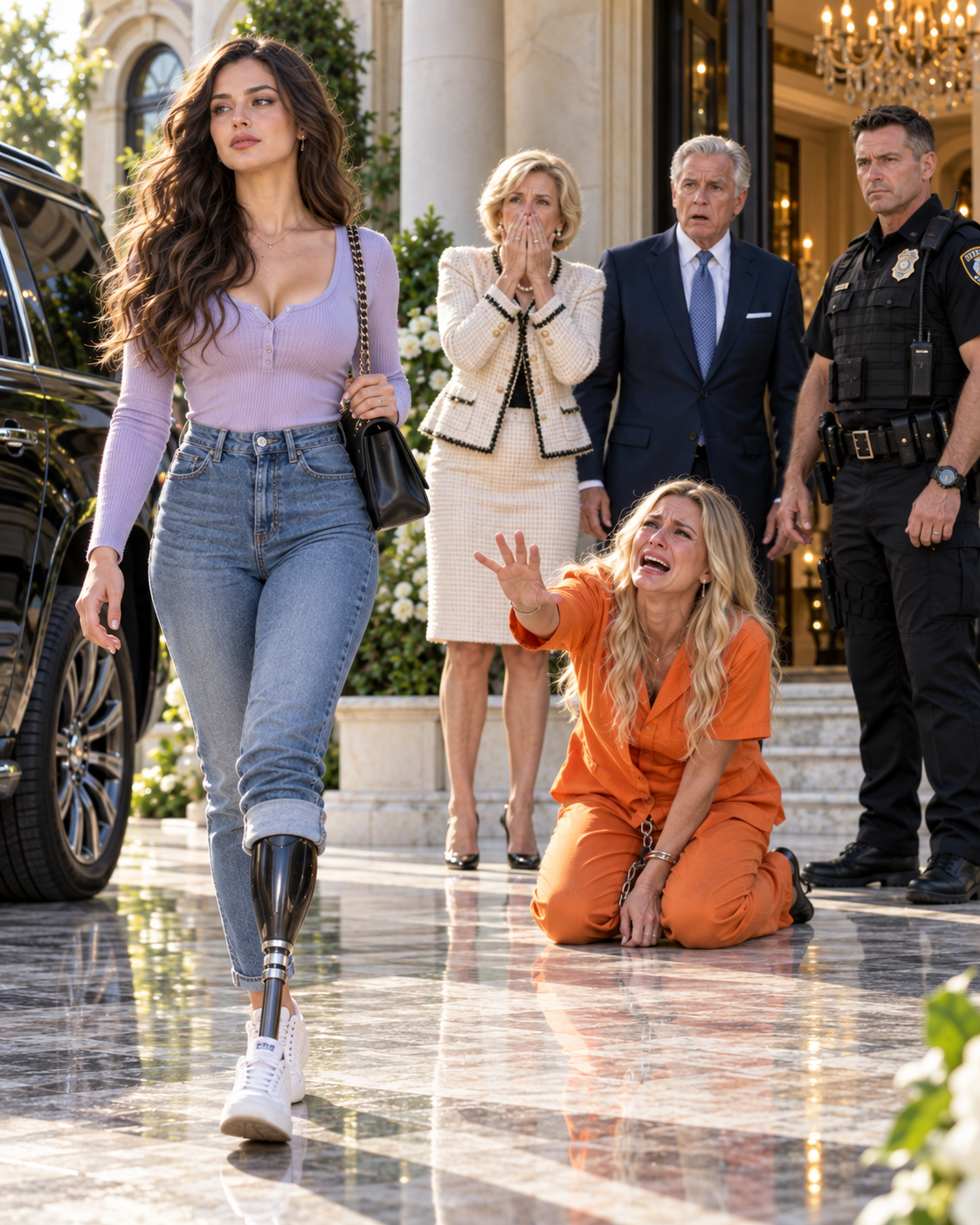
My father turned, followed her stare, and became completely rigid.
Chloe stood beside her fiancé, Marcus Montalvo, dressed in a breathtaking white couture gown, with a huge yellow diamond sparkling on her finger.
All three of them headed toward me before I could even make it to the bar.
“What the hell are you doing here?!” my father hissed quietly.
“I have a business meeting,” I answered smoothly.
Chloe gave a nervous, high-pitched laugh. “Don’t be ridiculous. Security will throw you out!”
My mother seized my arm tightly. “Valerie, do not ruin this for your sister! This is not the place for one of your pathetic scenes!”
I looked at her hand gripping my sleeve. She immediately pulled it away, as though it had been burned.
“I’m not here to make a scene, Beatrice.”
“Then get out!” Arthur snapped. “You don’t belong in a room like this!”
A deep, authoritative voice sounded from behind them. “She absolutely belongs here.”
Arthur Montalvo, accompanied by his chief legal counsel, stepped forward. He ignored my parents completely and reached out to shake my hand with tremendous respect.
“Valerie, wonderful to see you,” Arthur Montalvo said loudly enough for the surrounding guests to hear. “I’ve been telling my board about our joint venture all evening.”
My mother’s jaw fell open.
For nineteen years, my parents had described their eldest daughter to their extended social circle as a “troubled, estranged recluse.” They didn’t even know what company I owned.
Chloe knew. That was exactly why she had begged me for the million dollars. But she had no idea I was entering a partnership directly with her future father-in-law.
Marcus Montalvo stepped beside his father. “You’re Valerie Vance? My father hasn’t stopped talking about your real estate firm for months.”
“A pleasure, Marcus,” I smiled.
Chloe clenched her jaw so tightly that her teeth clicked. “Arthur, please, can we discuss this privately?”
“In a moment, Chloe,” the patriarch replied.
I opened my leather portfolio. “Arthur, before we sign our partnership agreement tonight, there is a compliance matter involving your foundation’s upcoming audit that you need to review.”
Chloe took a frightened step forward. “That can wait until Monday!”
Arthur Montalvo frowned, looking from one of us to the other. “What does my foundation have to do with our real estate deal, Valerie?”
I removed a sleek Manila folder. “I hope nothing. But as a future partner, I prefer complete transparency.”
Chloe lunged for the folder, but Arthur’s legal counsel smoothly caught her arm.
“What the hell are you doing?!” Chloe shrieked at me.
Arthur opened the folder. The first page contained forensic audit logs concerning the missing million dollars. The second showed fraudulent vendor invoices. The third outlined structured wire transfers.
The final page displayed the digital credentials used to authorize every transaction—leading directly back to Chloe’s personal corporate laptop.
Arthur’s expression shifted from confusion to dark, terrifying rage. “What is the meaning of this?”
Chloe started speaking at a frantic, manic pace. “It’s a lie! She’s been obsessed with ruining my life since we were kids because she’s jealous of me!”
Arthur lifted one of the pages. “This shows one million dollars funneled out of my children’s medical charity.”
“I didn’t do it! Someone hacked my account!”
Marcus took a document from his father’s hands. “Chloe… what does ‘Ruiz Settlement Allocation’ mean?”
Chloe tried to grab the paper back. “It’s nothing, Marcus! She’s framing me!”
My mother intervened, her voice shrill. “Arthur, please! Valerie has been mentally unstable ever since she lost her leg as a child! She’s deeply bitter and jealous of Chloe’s happiness!”
A heavy silence settled over the people immediately around us. Several nearby conversations stopped completely.
For the first time in my life, I watched my mother weaponize my childhood amputation—not to hide me away, but to attack my character in public. The exact same strategy. A different stage.
“Jealous?” I asked softly.
Beatrice raised her chin arrogantly. “Chloe had everything you couldn’t have, Valerie! And you’ve hated her for it your entire life!”
I didn’t respond. Because a voice rang out from the grand foyer behind us.
“She wasn’t jealous of your daughter. But I certainly suffered because of her.”
The crowd separated.
Daniela Ruiz rolled into the ballroom in her motorized wheelchair, accompanied by her civil litigation attorney.
Chloe stepped backward twice, striking the edge of a banquet table. Marcus turned completely pale. Arthur Montalvo’s eyes widened with recognition.
“Daniela…?” Arthur whispered. “You used to work in our accounting division.”
“Until a month ago, Mr. Montalvo,” Daniela replied, her voice clear, strong, and unyielding.
Daniela rolled her wheelchair directly into the center of the room. She didn’t yell. She didn’t cry. And because of her complete composure, every word she spoke seemed to shatter the room.
She described the night of the crash on the West Side Highway. She recounted the speeding SUV running the red light. She described the devastating collision. She described waking in the ICU and learning she would never walk again. She described the intimidation from Chloe’s hired fixers. She described the fifty-thousand-dollar hush-money offer intended to conceal a felony.
Then Daniela raised a flash drive.
“Before the crash, I was auditing suspicious vendor payments in the foundation’s database. I saved an automated cloud backup of the authorization logs. It proves exactly who stole that million dollars—and why.”
Marcus Montalvo dropped his champagne flute. It shattered against the marble floor. He stared at Chloe as though she were a complete stranger. “Tell me this isn’t true.”
Chloe broke into hysterical tears. “Marcus, I was terrified! I was trying to fix it!”
Marcus stepped away from her. “Fix it?! You crippled a woman and stole from a children’s charity to cover it up?!”
“Everything got out of control!” Chloe sobbed. That was her fatal confession. She didn’t say “it’s a lie.” She said “it got out of control.”
Arthur Montalvo shut his eyes for three long seconds. When he opened them again, his expression was lethal. “The hit-and-run got out of control, too?”
Chloe covered her face with both hands.
My mother hurried to Chloe’s side, shooting Arthur Montalvo an angry look. “She’s just a young girl! She made a mistake!”
Arthur’s legal counsel had already taken out his phone and was calling the District Attorney’s office.
My father, desperate, grabbed me by the elbow and pulled me toward a quiet corner. “Valerie, stop this right now!”
“I can’t,” I answered flatly.
“Of course you can!” he hissed, his trembling voice revealing his desperation. “Pay the million dollars to Arthur! We’ll cover up the rest! We can fix this!”
I stared at him in complete disbelief. Even after everything that had just been uncovered, his only concern was protecting the lie.
“A young woman is paralyzed for life, Arthur,” I said, using his first name for the first time.
“It was an accident!”
“And then your favorite daughter threatened her, bought off witnesses, and robbed a charity.”
My father clenched his teeth. “She is your sister!”
“And I was your daughter when you threw me out on the street with a black trash bag.”
He fell completely silent.
“I was sixteen years old,” I whispered, moving closer. “One leg. Two crutches. A trash bag of hand-me-downs. Do you remember?”
“We… we were different people then—”
“No,” I corrected him. “You are the exact same monsters you were back then. The only difference is that now, you need something from me.”
My mother stormed over, her face twisted with fury. “We gave you life!”
“And then you spent nineteen years trying to ruin it.”
I pulled another folder from my portfolio and opened it. Inside were certified bank records and police filings documenting the identity theft they had committed against me when I was a teenager. Aunt Sarah had kept every single receipt.
Beatrice stared at the documents and began stumbling over her words. “That… that was decades ago! We were your parents! We needed money!”
“To pay for Chloe’s luxury life,” I said.
“You don’t understand how difficult things were!” “I understand perfectly,” I said coldly. “While I was working night shifts filing papers to afford my first functional leg, you were piling debt onto my name so Chloe could go to Europe.”
My father lowered his head, a brief flash of genuine shame finally appearing on his face. But my mother refused to give in.
“Chloe had a future!” Beatrice yelled. “We couldn’t let her waste her potential!”
And in that moment, the anger I had carried deep inside for nineteen years simply disappeared.
Not because I forgave them. But because I finally understood the pathetic truth: it had never been about my leg. They didn’t reject me because I was disabled. They rejected me because they lacked basic human decency, empathy, and the ability to love anything that didn’t serve their narcissism.
Marcus Montalvo slowly removed the engagement ring from his finger and placed it on the table beside Chloe. “We’re done.”
Chloe collapsed to her knees, sobbing desperately. “Marcus, please! You can’t do this to me!”
“You did this to yourself,” Marcus said coldly, turning away from her. “You paralyzed an innocent woman and stole from my family’s charity.”
Arthur Montalvo turned toward his legal team. “File formal charges with the DA immediately. Full cooperation.”
Chloe started screaming hysterically at everyone in the room. “You’re all hypocrites! Every single one of you!” Then she pointed a trembling finger toward me. “And you planned this because you’ve always hated me!”
I looked down at her. “For years, I did hate you, Chloe. But then I realized that hating you meant letting you occupy space in my head. I didn’t cause your crash. I didn’t steal that money. I didn’t threaten Daniela. Every single thing happening to you tonight is the direct result of your own choices.”
The police didn’t arrive with dramatic sirens or turn the ballroom into a spectacle.
Attorneys and detectives arrived discreetly. During the following week, the District Attorney’s office opened a sweeping investigation.
The audit uncovered three shell companies Chloe had used to siphon money. The fixer she hired became a cooperating witness in exchange for a deal, providing text messages in which Chloe explicitly instructed him to intimidate Daniela Ruiz.
Months later, Chloe accepted a plea agreement and pleaded guilty to grand larceny, wire fraud, obstruction of justice, and felony hit-and-run.
She received a seven-year federal prison sentence, along with substantial financial restitution requirements.
Her high-society life disappeared overnight. Her engagement was over. And the elite future my parents had sacrificed everything to create for her collapsed completely.
Beatrice and Arthur spent almost their entire life savings on expensive defense attorneys and civil settlements. They eventually had to sell the family home—the same house whose doorway they had used to throw me out with a trash bag nineteen years earlier.
A year after the trial, my mother came to my corporate office building one final time.
She was no longer wearing designer clothing or costly jewelry. She looked twenty years older, broken and defeated.
“They’re foreclosing on our apartment,” she cried quietly in the lobby.
I stood beside the glass doors, watching her. “I’m sorry to hear that.”
She looked up, a small spark of hope appearing in her tired eyes. “Does that mean… will you help us?”
“No,” I answered quietly.
“I am your mother!”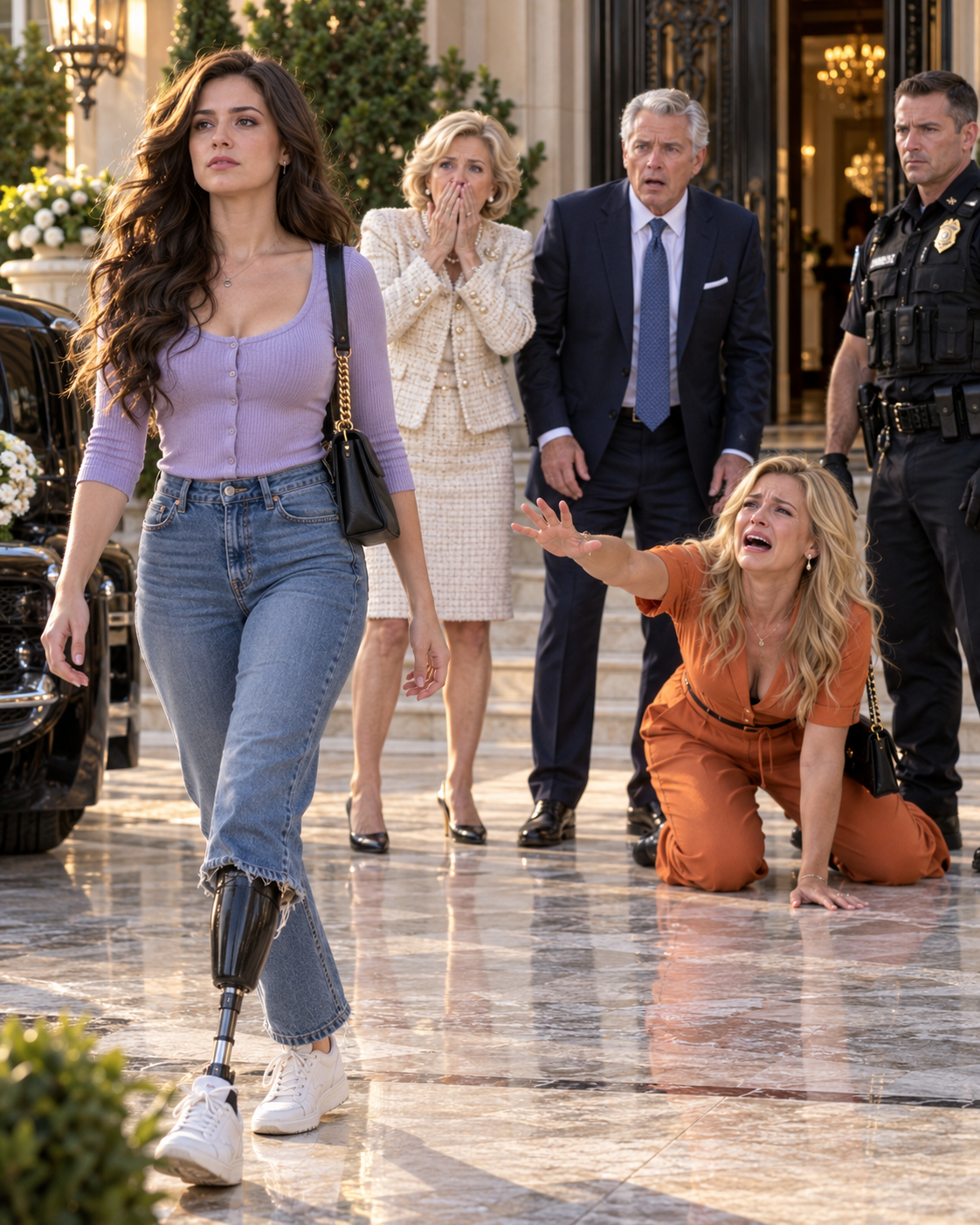
“Biologically, yes.”
She began to cry. “We made mistakes, Valerie…”
“A mistake is forgetting a birthday, Beatrice,” I said, my voice calm and steady. “Abandoning a disabled child, stealing her identity, and resurfacing nineteen years later solely to demand a million dollars is not a mistake. It’s who you are.”
“Your father is sick with worry!”
“Then I hope he finds peace.”
She stared at me in bitter disbelief. “How did you become so cold?”
I gave a faint smile. “Do you remember the night I turned sixteen? You threw me out in the rain and told me to stop being a burden. I limped two miles on crutches to Aunt Sarah’s house believing my own mother wished I didn’t exist. If I am capable of standing strong today, it’s not because I am cold. It’s because that sixteen-year-old girl survived you.”
Beatrice turned around and walked away without saying another word.
I felt no revenge. I felt no happiness. I simply felt peace.
As for Daniela Ruiz, before the legal trial even began, I quietly created an independent, fully funded medical trust to cover her specialized spinal rehabilitation and care. I structured it through a third-party foundation so no defense attorney could ever claim that money had influenced her testimony.
Daniela dedicated herself to intensive physical therapy.
A year later, she sent me a video.
In the footage, she was standing inside a rehabilitation facility, holding onto parallel bars. Slowly and painstakingly, she lifted her right leg, placed her foot down, and took a step forward.
Just one step. But she smiled as though she had conquered Everest.
I watched the video three times, tears clouding my vision.
Then I called my Aunt Sarah.
“Are you crying, Valerie?” Sarah asked softly over the phone.
“Maybe a little,” I smiled.
Sarah laughed warmly. She still lived in the Brooklyn townhouse where she had taken me in all those years ago. Every Sunday, I visit her. We cook dinner, bicker over silly things, and drink tea on the porch.
For years, I believed that being rejected by my parents meant I would be without a family forever.
I was wrong. Family isn’t defined by those who share your blood; it’s defined by the people who open the door when everyone else shuts you out.
Today, I still run my real estate firm. My titanium prosthesis is no longer something I conceal beneath long skirts or wide-leg pants. It is part of me—a symbol of survival, strength, and resilience.
On my mahogany desk sits a framed photograph Aunt Sarah gave me.
It’s a photo of me at seventeen, sitting on her front porch with my old aluminum crutches, smiling brightly despite everything I had endured.
On the back, Sarah had written: “This girl had no idea how high she was going to fly.”
I didn’t frame my business awards or the magazine covers featuring my company. I framed that photograph.
Because whenever someone enters my executive office and sees that teenager on crutches beside the CEO I am today, I am reminded of a truth that took me decades to understand:
Never let anyone who abandoned you in the storm decide your worth in the sunshine.
My parents believed that losing a leg made me broken. They learned far too late that the only broken things in that house were their own hearts.
